


INTRODUCTION
Congress has long given federal courts diversity jurisdiction to hear cases involving state-law claims when opposing parties are from different states and other requirements are met. The traditional, and current, rationale for federal diversity jurisdiction is to offer a neutral federal forum to avoid any appearance of a risk of bias that a state-court judge or jury might have in favor of an in-state party and against an out-of-state opponent (Burbank Reference Burbank2008; Dodson Reference Dodson2019a).
The bias rationale has theoretical appeal. Federal judges ostensibly provide more neutral forums (or more appearance of neutrality) for such disputes because they have life tenure, unlike most state judges who are either elected or appointed to terms and thus are accountable to either state officials or the state electorate. In addition, federal jury pools can be drawn in ways that could make federal juries more diverse and less influenced by local prejudices than state juries (Jones Reference Jones2007).
At the same time, diversity jurisdiction imposes significant costs on court systems and parties. Diversity jurisdiction diverts state-law claims away from state courts, which are expected to handle such claims with ease, facility, and authority, and into federal courts, for whom handling such claims is, according to empirical research, likely to be more difficult, taxing, and error prone (Flanders Reference Flanders1980). Federal-court adjudication cannot build authoritative precedent in the development of state law (Kramer Reference Kramer1990). Meanwhile, the federal diversity docket, which has long amounted to around 30 percent of the entire federal docket (Federal Courts Study Committee 1990; US Courts Reference Courts2019), takes resources and attention away from federal claims (Friendly Reference Friendly1973; Federal Courts Study Committee 1990). And the law of diversity jurisdiction itself presents another layer of legal arguments and potential uncertainties to resolve, leading to more expense and delay for the parties (Rowe Reference Rowe1979).
Because of these costs, diversity jurisdiction has always been controversial. That controversy—from the founding of the Constitution to today—has focused centrally on whether the bias rationale is a sufficient justification for the costs that diversity jurisdiction imposes (Dodson Reference Dodson2019a). Congress has attempted to moderate the controversy by imposing an amount-in-controversy limit on diversity cases, which denies diversity jurisdiction to cases that fall below a certain valuation. In addition, Congress has restricted the ability of in-state defendants from removing, based on diversity jurisdiction, a case filed in state court. The restriction is grounded on the assumption that an in-state party need not invoke diversity jurisdiction to protect against state bias because any state bias is presumed to run in that in-state defendant’s favor. But Congress has not—at least not for many years—restricted in-state plaintiffs (ISPs) from invoking diversity jurisdiction when suing out-of-state defendants. Thus, the law allows ISPs to invoke diversity jurisdiction and impose its costs without any obvious benefit of alleviating out-of-state bias.
One might think, given the out-of-state-bias rationale of diversity jurisdiction, that ISPs rarely would invoke diversity jurisdiction. After all, ISPs could invoke a state court to take advantage of the presumed state bias in their favor. History, however, tells a different story. For decades, thousands of ISPs a year, making up sizeable percentages of the diversity docket, have invoked diversity jurisdiction (American Law Institute 1969; National Center for State Courts 1989; Flango Reference Flango1995). In 2019, for example, of all original or removed domestic-diversity cases filed by represented plaintiffs, 27 percent were filed in federal court by ISPs. Using a different denominator, of all original domestic-diversity cases filed by represented plaintiffs, more than 51 percent were filed by ISPs.Footnote 1 In other words, in 2019, represented ISPs invoked domestic-diversity jurisdiction more often than represented out-of-state plaintiffs did. These percentages are striking.
Because the phenomenon of ISPs invoking diversity jurisdiction is inconsistent with the bias rationale of diversity jurisdiction, diversity reformers have perennially called for eliminating the ability of ISPs to invoke diversity jurisdiction. In 1969, for example, the American Law Institute (1969, 123–24) published a comprehensive study of federal jurisdiction and recommendations for its reform, in which it stated, in particular:
The Institute … accepted the proposition … that the function of [diversity] jurisdiction is to assure a high level of justice to the traveler or visitor from another state; when a person’s involvement with a state is such as to eliminate any real risk of prejudice against him as a stranger and to make it unreasonable to heed any objection he might make to the quality of its judicial system, he should not be permitted to choose a federal forum, but should be required to litigate in the courts of the state. In accordance with this principle, the most far-reaching proposal is to bar a plaintiff from bringing suit in the federal court in his home state simply because his opponent is a citizen of another state.
…
The right of an in-state plaintiff to institute a diversity action against an out-of-state defendant, although it dates back to the first Judiciary Act, is not responsive to any acceptable justification for diversity jurisdiction. The in-stater can hardly be heard to ask the federal government to spare him from litigation in the courts of his own state. Any prejudice which he may fear is not of the kind against which the diversity jurisdiction was intended to protect.
In 1976, the Judicial Conference of the United States (1977) endorsed the institute’s proposal to eliminate ISP invocation of diversity jurisdiction. In 1990, the Federal Courts Study Committee (1990, 42) reiterated the recommendation because “[t]he only colorable argument supporting diversity jurisdiction—fear of state court bias against out-of-state litigants—has no force when in-state plaintiffs invoke it.” Although Congress has not acted on these proposals, the idea has continued to be on the table ever since.
These calls for elimination of ISP-invoked diversity jurisdiction have come without significant study or understanding of ISP cases. Empirical and experimental studies of diversity jurisdiction and the motivations for invoking it have tended to focus, instead, on the meaningfulness of the bias rationale and on the motivations of out-of-state parties in invoking diversity jurisdiction (Summers Reference Summers1961–62; Anonymous 1965; Bumiller Reference Bumiller1980; Goldman and Marks Reference Goldman and Marks1980; Perlstein Reference Perlstein1981; Flango Reference Flango1991; Miller Reference Miller1992; Federal Judicial Center 2021; Kopko and Devine Reference Kopko and Devine2023). Jerry Goldman and Kenneth Marks (Reference Goldman and Marks1980), for example, intentionally excluded ISPs from their study of the motivations for invoking diversity jurisdiction. Neal Miller (Reference Miller1992) also excluded ISPs from original federal filings.
The failure to focus on ISPs has resulted in a significant gap in the literature on, and the understanding of, diversity jurisdiction. Who are these ISPs who are invoking diversity jurisdiction? Why do they invoke it? And do the answers have normative implications for diversity reform? These questions remain unstudied.
HYPOTHESES
To answer these questions, I focused on the fact that state and federal courts differ, or are perceived to differ, in ways that are independent of notions of out-of-state bias and that those differences may motivate ISPs to select federal court over state court in diversity-eligible cases.Footnote 2 Based on these differences, I hypothesize that ISPs who invoke federal diversity jurisdiction can be roughly separated into three discrete categories.
Category 1: ISPs Filing Multi-District-Litigation (MDL)-Eligible Cases, Which Tend to Be Individual ISPs Pursuing Tort Claims against Corporate Defendants, Who Invoke Diversity Jurisdiction because of the Likelihood of Consolidation with the MDL
Unlike federal courts, state courts are limited in their ability to transfer or join claims, parties, and cases involving interstate disputes (Dodson Reference Dodson2018). States have no interstate-transfer mechanism for consolidating like cases across states (Rowe and Sibley Reference Rowe and Sibley1986). Federal courts, by contrast, have more flexibility to transfer cases across state lines or to consolidate cases from different states. One particularly important mechanism for consolidation of federal cases is MDL transfer (Burch and Williams Reference Burch and Williams2017; Bradt and Rave Reference Bradt and Theodore Rave2018). MDL consolidation,Footnote 3 obtainable only in federal court, might be valuable for parties in terms of the economies of scale that MDL supplies. MDL consolidation may also be attractive for attorneys who hope for a seat on the plaintiffs’ leadership team. Accordingly, ISPs with cases eligible for consolidation with a MDL already pending in federal court case likely will be motivated to file in federal court originally because of the likelihood that the case will be consolidated with the MDL. Further, because MDL cases typically are mass torts, ISPs invoking federal diversity jurisdiction in MDL-eligible cases will tend to be individual plaintiffs suing corporate defendants for tort claims.
Category 2: Corporate ISPs Represented by Attorneys Who Primarily Defend Businesses in Federal Court Who Invoke Diversity Jurisdiction because of Perceptions of Better Federal-Court Procedure, Efficiency, and Quality
In non-MDL cases, the literature has theorized and documented other motivations for parties to select federal court, such as to avoid biases based on rural or urban connections, political or ideological affiliations, corporate or individual status, wealth, and race (Goldman and Marks Reference Goldman and Marks1980; Miller Reference Miller1992; Flango Reference Flango1995; Dodson Reference Dodson2019a). Bias-based motivations, however, are likely to be specific to particular cases and geographic regions. By contrast, three other differences between federal and state courts are more generalized and likely to be broadly linked: differences in procedure; perceived differences in efficiency, expense, and convenience; and perceived differences in the quality of federal and state courts.
Procedural Differences
Since 1938, Congress has permitted federal courts to adopt their own procedural laws. Although state-court procedure often mimics federal procedure (Dodson Reference Dodson2016), residual differences remain and could influence the decision to choose state or federal court (Clopton Reference Clopton2018). As one illustration, the Federal Rules of Evidence set different admissibility standards than state evidence rules.Footnote 4 As another, the Federal Rules of Civil Procedure require unanimous jury verdicts, while some states require only a supermajority.Footnote 5 Studies have shown that perceptions of procedural differences can motivate forum selection in diversity cases (Summers Reference Summers1961–62; Anonymous 1965; Goldman and Marks Reference Goldman and Marks1980; Flango Reference Flango1991; Miller Reference Miller1992; Federal Judicial Center 2021).
Efficiency, Expense, and Convenience
Attorneys and parties who regularly appear before either state or federal court may find that familiarity with their usual forum provides them conveniences and efficiencies. Survey studies suggest that perceived differences in efficiency, expense, or convenience can motivate parties to select federal court in diversity cases (Summers Reference Summers1961–62; Anonymous 1965; Bumiller Reference Bumiller1980; Goldman and Marks Reference Goldman and Marks1980; Perlstein Reference Perlstein1981; Flango Reference Flango1991; Miller Reference Miller1992; Federal Judicial Center 2021).
Perceived Better Quality of Federal Court
The prestige and job security of federal court may attract higher-quality candidates for the federal bench; congressional resources may give federal judges more support staff and technology support; and lighter docket loads may give federal judges more time to devote to each case (Shapiro Reference Shapiro1977; Posner Reference Posner1985). Each of these factors may create the impression that federal judges are of better adjudicative quality than state judges (Zambrano Reference Zambrano2019). Survey studies have found that perceptions of quality can influence forum selection, sometimes quite strongly. Goldman and Marks (Reference Goldman and Marks1980) found the quality of judges to be a motivation for 92 percent of the respondents invoking diversity jurisdiction. Victor Flango (Reference Flango1991) found strong motivations based on the perceived quality of the judge. And a recent study by the Federal Judicial Center (2021) found that the most important motivation was “judicial personnel,” which typically favored federal court.
No study links these generic motivations to ISPs in diversity cases. To the contrary, the studies in the literature tend to rely on the conventional wisdom that ISPs should prefer state court and that these motivations are more important for the decision of out-of-state defendants to remove cases that ISPs filed initially in state court. No study has tested whether, or when, these motivations might drive ISPs to select federal court in the first instance. I hypothesize that there is a category of ISP for whom these motivations will incentivize invocation of federal court. This category is composed of corporate ISPs represented by attorneys who typically defend businesses in federal court. The reason is historical. From the late 1800s until 1938, corporations—which could access federal diversity jurisdiction more easily because their cross-border activities tended to generate disputes between diverse parties—routinely invoked diversity jurisdiction in a concerted effort to drive federal courts to develop business-friendly substantive law (Purcell Reference Purcell1992). By the 1930s, the lower federal courts, as opposed to the state courts, were seen as pro-corporate (Ball Reference Ball1933; Purcell Reference Purcell2000). Although Erie Railroad Co. v. Tompkinsput an end to differences in substantive law between federal and state courts, the perception that federal courts are friendlier to businesses has persisted in modern times (Miller Reference Miller1992; Flango Reference Flango1995).Footnote 6
We prefer what we know and sometimes for good reason. Corporations and other businesses are repeat litigants, often as defendants, in federal court. Thus, their attorneys also repeatedly represent corporate defendants in federal court (Flango Reference Flango1991; Federal Judicial Center 2021). Routine practice before federal court can help drive interpretations of procedural law that favor repeat litigants (Frank Reference Frank1979; Sabino, Sabino, and Sabino Reference Sabino, Sabino and Sabino2017). Routine practice before federal court can breed familiarity with federal court that confers advantages of efficiency and convenience. And litigants with complex cases—also, often, corporations and other businesses—may perceive federal court as being better able to handle the intensity of the case. Thus, I hypothesize that corporate ISPs represented by attorneys who regularly defend businesses in federal court will invoke diversity jurisdiction for reasons of procedure, convenience, and judicial quality.
Category 3: ISPs Who Invoke Federal Court to Preempt a Defendant’s Right of Removal
An ISP filing a diversity-eligible case might choose federal court to avoid the expense of removal or to eliminate the defendant’s opportunity for judge shopping. The ISP may suspect that the out-of-state defendant will, consistent with the bias rationale behind diversity jurisdiction (or any of the rationales above that might motivate the defendant to prefer federal court), remove a state case to federal court anyway, and so the ISP may file originally in federal court to avoid the delay that removal entails (Gohn and Oliver Reference Gohn and Oliver1993) and any litigation costs in federal court regarding the propriety of removal. Not all ISPs will be motivated by the prospect of avoiding these costs, but some may be. An ISP may also choose a federal court to stave off judge shopping by the defendant. Filing in state court gives the defendant the opportunity to know who the state judge assigned to the case is. If the defendant likes that judge, the defendant can choose not to remove the case and stay with that judge.Footnote 7 But if the defendant dislikes that judge, the defendant can remove the case to federal court, which will assign a new judge. Filing originally in federal court takes this judge-shopping choice away from the defendant. For these reasons, some ISPs may choose to file originally in federal court, not because they see any inherent advantage of federal court but, rather, to preempt the possibility of removal to federal court by the defendant.
DATA AND METHODS
To understand the magnitude and case characteristics of ISP invocation of diversity jurisdiction, I relied on the Federal Judicial Center’s Integrated Database, which contains docket data provided by the federal courts themselves on a broad range of relevant case variables that are useful for inferring motivations and understanding relevant correlations, including county, federal district, federal circuit, removed or original, nature of suit, residence of the parties, date of termination, and case disposition. The Integrated Database is not perfect; some courts code differently from others, some fields have known unreliabilities, coding practices and fields have changed over time, coding may oversimplify or misrepresent complexities in the case, and parties and court staff themselves make mistakes in their description of the cases (Eisenberg and Schlanger Reference Eisenberg and Schlanger2003; Hadfield Reference Hadfield2004). Research suggests, however, that the particular data of interest to me—jurisdiction type, party type, origin, and the like, especially in cases involving represented plaintiffs and spanning just a single calendar year—are both sufficiently reliable in, and most easily obtainable from, the Integrated Database (Eisenberg and Schlanger Reference Eisenberg and Schlanger2003). Nevertheless, as I explain below, I took other measures to ensure coding reliability. For certain categories, I grouped nature-of-suit codes to minimize coding variability. For MDL identification, I included both a lower bound of MDL cases using solely the MDL transfer code and an upper bound using other case indices of MDL status. I also vetted my database methodology with staff members of the Federal Judicial Center familiar with the Integrated Database to minimize the effect of imperfect coding. Finally, for the survey, I asked respondents to confirm essential conditions of the case, including its origin and jurisdictional basis, making the survey data, in my view, highly reliable.
From the Integrated Database, I downloaded data for all diversity cases filed originally in, or removed to, federal court in 2019. I selected the year 2019 as the most recent filing year unaffected by the COVID-19 pandemic, which caused significant disruptions in court systems nationwide and likely involved unique forum-selection considerations (Kritzer Reference Kritzer2022). I excluded cases involving a pro se plaintiff, who may not have fully understood the legal requirements or the technical and strategic considerations of jurisdictional choice. The precise data-gathering parameters I used are recorded in Appendix A. To isolate cases involving domestic-diversity jurisdiction, I then excluded cases with foreign or nondiverse parties, based on the coding provided by the Integrated Database. The exclusions and filters resulted in 39,386 domestic-diversity cases filed in, or removed to, federal court in the year 2019 and involving a represented plaintiff. I titled this dataset the Magnitude Dataset.
To create a dataset involving only ISPs, I excluded from the Magnitude Dataset cases not involving ISPs, again based on the coding provided by the Integrated Database. That exclusion left me with 29,045 diversity cases filed in, or removed to, federal court in 2019 and involving a represented ISP. I titled this dataset the ISP Dataset. To ensure that the 2019 cases were representative and not themselves affected by circumstances unique to the year 2019, I compared the case demographics of the ISP Dataset against the case demographics of similarly culled cases from 2016–18. I selected 2016–18 as the baseline range to gather sufficient contemporaneous information for a meaningful comparison without expanding so far in the past that the baseline could be tainted by outdated or superseded differences between state and federal courts that would influence forum selection in ways unrepresentative of 2019. The statistical analysis, detailed in Appendix B, suggests that 2019 is representative along the case and party dimensions captured in the data.
The docket datasets are useful for revealing certain inferences about ISP motivations, but, to gather direct evidence of motivations, as I explain below, I created an original dataset of attorney motivations. Starting with the ISP Dataset of 29,045 cases, I removed MDL-eligible cases to bring the dataset to 8,103 original cases and 17,387 removed cases. I removed the MDL-eligible cases because the motivation to join an existing MDL can be confidently inferred from the docket data, and I wanted to isolate non-MDL cases to focus on other motivations. To make the removed dataset manageable for the survey, I used a random-number generator to randomly cull the removed cases down to 8,103 cases. The data thus included all original, non-MDL-eligible domestic-diversity cases filed in 2019 by a represented ISP and a randomized half of all non-MDL-eligible domestic-diversity cases filed in state court by a represented ISP and removed in 2019.
I then obtained the ISP attorneys’ e-mail addresses from the case dockets for the 8,103 original cases and for the 8,103 removed cases. Using the Westlaw Dockets database, I selected the first listed attorney with an e-mail address from the plaintiff side. I then de-duplicated the list and kept only one randomized case filed by any given attorney so that each attorney would receive only one survey in order to avoid confusing survey recipients with multiple survey requests and to allow me to equate responses with cases when reporting results. The resulting dataset, titled the Survey Dataset, contained 6,569 original cases and 6,337 removed cases. I e-mailed each attorney using the e-mail format described in Appendix C and included a link to the Qualtrics online version of the survey, which I had beta tested six months prior using four hundred randomized recipients from analogous sets of cases from 2015. Appendix D details the final survey design. I sent two reminder e-mails to attorneys who had not yet responded to the survey. Survey responses were linked to all underlying docket data from the Survey Dataset except party names, docket number, and attorney information, which were delinked to preserve confidentiality and anonymity. In addition, I set the Qualtrics surveys as anonymized to avoid recording respondent Internet protocol addresses and locational data.
For original cases, 487 e-mails bounced, failed, or were marked as spam; for removed cases, 398 e-mails bounced, failed, or were marked as spam. So, approximately six thousand e-mails were reliably sent in each category. My response rate was slightly above 10 percent, with 626 responses of original cases and 661 responses of removed cases. I then excluded survey responses that did not contain answers through the motivation question (Question 6), whose answers made clear that the case had been miscoded in some way (as Questions 1–3 were designed to do), or whose answers made clear that the attorney surveyed was not the attorney who chose the forum (as a few comments indicated).Footnote 8 These exclusions left me with 852 usable responses: 402 in original cases and 450 in removed cases. These response numbers are in line with other attorney-survey studies: Kristin Bumiller (Reference Bumiller1980) had 861 responses, Jerry Goldman and Kenneth Marks (Reference Goldman and Marks1980) had 320 responses, and Neal Miller (Reference Miller1992) had 482 responses.
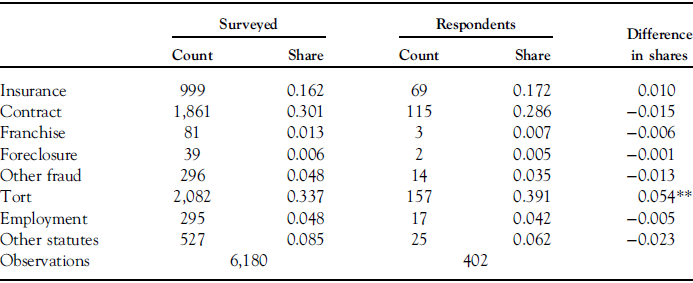
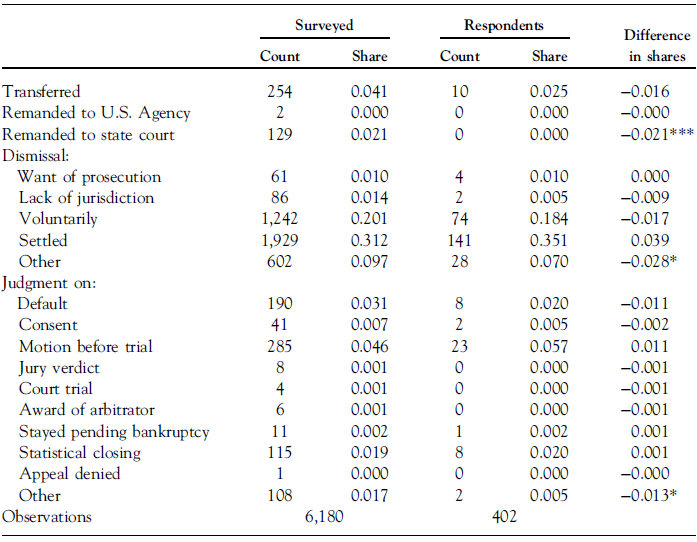
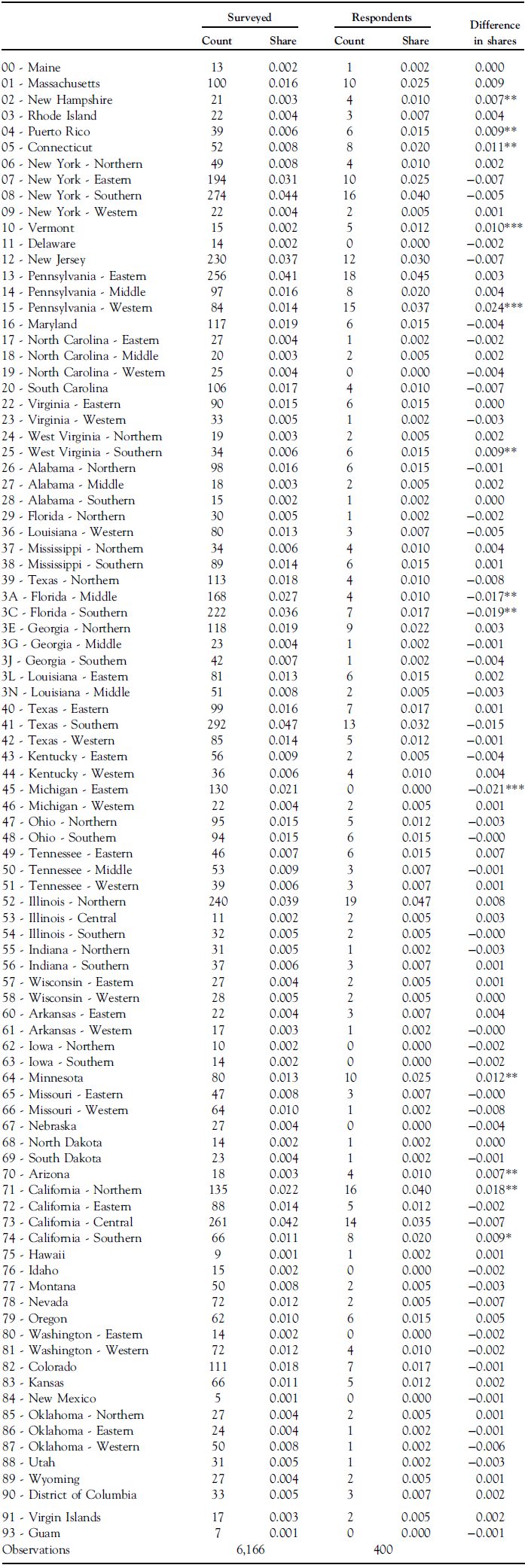
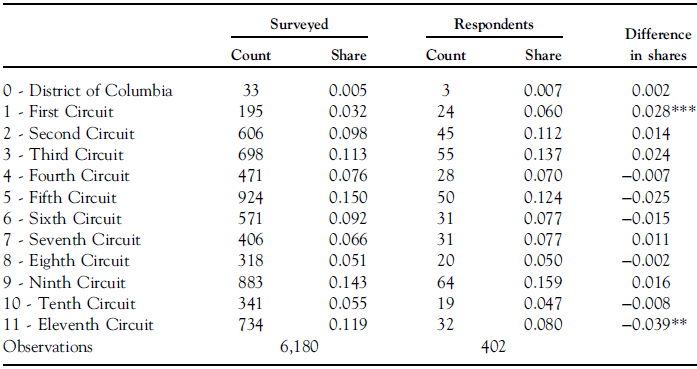
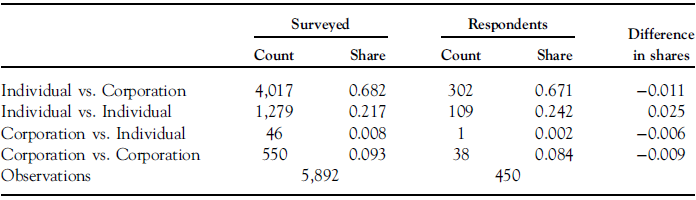
I then cleaned the survey data by reviewing the “other” text and reallocating certain answers to appropriate specified categories. For example, responses to Question 5 that selected “Other” and wrote in “LLC” were converted to “unincorporated entity.” I also treated decedents’ estates as natural persons. I titled the resulting dataset the Response Dataset. Finally, I tested the representativeness of the Response Dataset against the Survey Dataset to reveal any demographic-influenced selection effect in responsiveness. The statistical analysis, detailed in Appendix E, indicates that the responses are representative of the surveyed group in terms of case characteristics recorded in the docket data.
FINDINGS AND RESULTS
This section reports on the results of the statistical analyses and four findings that support the hypotheses articulated above.
MDL Consolidation Is a Significant Motivation for Individual ISPs Suing Corporate Defendants for Tort Claims in MDL-Eligible Cases
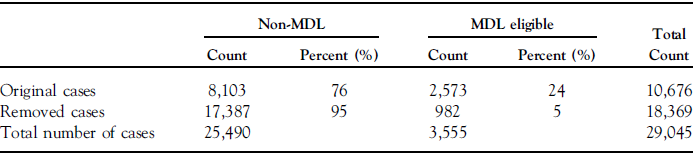
As stated above, in the ISP Dataset, the total number of domestic-diversity cases involving represented ISPs filed in, or removed to, federal court in 2019 was 29,045. Both the original cases and the removed cases contain cases that were eligible to be transferred for consolidation with an existing MDL. The Integrated Database already had coded 2,120 cases as transferred for MDL consolidation. Table 1A sets out the breakdown in numbers and the percentages of cases actually transferred for MDL consolidation. Table 1A shows a lower bound of MDL cases amounting to around 20 percent of diversity filed in federal court by a represented ISP in 2019. Because these figures include only those cases actually transferred for consolidation with a MDL, they undercount the number of MDL-eligible cases because some cases otherwise eligible for MDL transfer were dismissed or settled prior to any transfer, others likely were miscoded as ordinary venue transfer, and still others may have been filed directly in the MDL court. To obtain an upper bound, I separately coded as MDL eligible all cases actually MDL transferred (2,120) plus all other cases against MDL defendants (an additional 1,435 cases, the vast bulk of which were coded as dismissed, settled, or ordinary-venue transferred).Footnote 9
MDL transfers in original and removed cases

This upper bound likely includes some non-MDL cases that happened to be filed against defendants subject to an unrelated MDL, so the true number of MDL-eligible cases is likely between the lower and upper bounds. Thus, together, Tables 1A and 1B show that around 20–24 percent of diversity cases filed originally in federal court by a represented ISP in 2019 were eligible for MDL transfer. By contrast, only 2–5 percent of diversity cases removed to federal court in 2019 were eligible for MDL transfer. These summary statistics suggest a strong correlation between MDL eligibility and the invocation of federal court by ISPs.
MDL eligibility in original and removed cases
To confirm this correlation, I ran regressions of other case variables, clustered standard errors by district, and controlled for circuit and district. For claim type, I included the seven most prominent claim types, and I consolidated like nature-of-suit codes for tort (245, 310–68, and 380–85) and employment (442 and 790). Table 1C sets out the regressions, with the results for the MDL-eligibility variable in bold font. The regressions in Table 1C are likely reliable for their significance and direction and for their implications for correlations, but they should not be overinterpreted as supporting causality, and their coefficient magnitudes should be interpreted with caution because too many individual case factors and attorney preferences are uncaptured by the data. Still, while all variables show correlation with forum selection (and will be further explored below), the MDL-eligibility variable is strongly correlated with ISP choice to file diversity cases in federal court originally.
Regressions of case variables for original versus removed cases
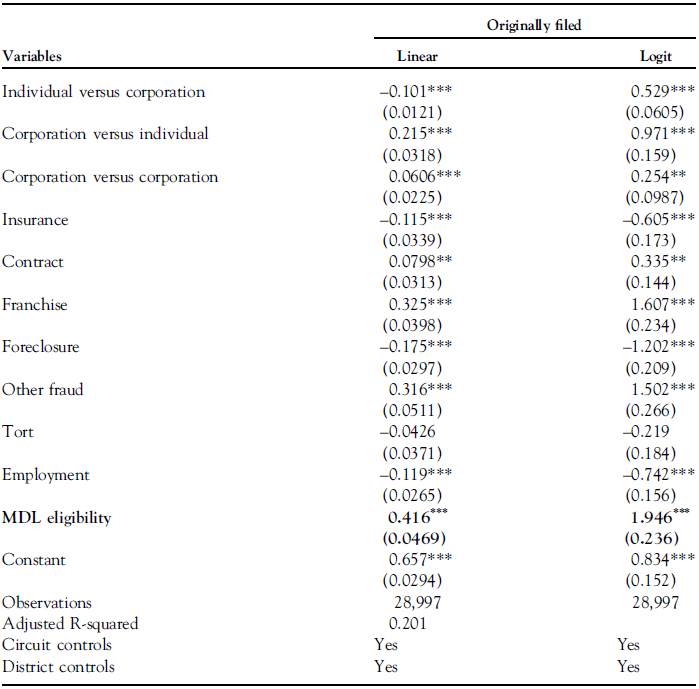
Notes: SE clustered by district in parentheses. * p < 0.05; ** p < 0.01; *** p < 0.001.
What kinds of cases are these MDL-eligible diversity cases filed originally in federal court by represented ISPs? Table 1D shows summary data that suggest that the cases overwhelmingly are individual plaintiffs suing corporate defendants for tort claims. These simple percentages are statistically significant compared to the non-MDL-eligible diversity cases filed in federal court, as set forth in Table 1E. Given these features of MDL-eligible cases, there is good reason to go beyond the strong correlation of MDL eligibility with the choice of ISPs to file in federal court to infer that the prospect of MDL consolidation motivated the forum selection. MDL transfers—available in federal court but not in state court—are both readily foreseeable prior to the initiation of the lawsuit and, in fact, likely to occur (Dodson Reference Dodson2019b). And MDL consolidation offers benefits to individual plaintiffs unique to MDL cases. Further, although individual non-MDL tort plaintiffs would tend to prefer to sue corporate defendants in state court (as implied in Table 1C and as more directly supported in Table 2), individual MDL tort plaintiffs tend to sue corporate defendants in federal court. These results strongly suggest that expecting to consolidate with a MDL is why a significant percentage of ISPs choose to file diversity cases in federal court.Footnote 10
Case and party characteristics of MDL-eligible original diversity cases

Notes: N = 2,573.
Party and claim characteristics of MDL-eligible original diversity cases
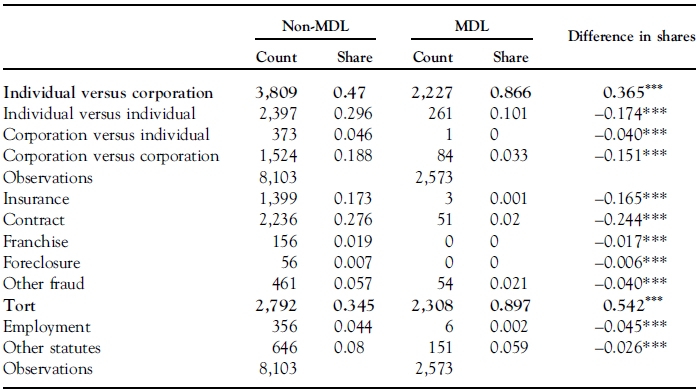
Notes: The Difference column is the coefficient of a simple regression of respondent status on the variable, controlling for circuit and district. * p < 0.10; ** p < 0.05; *** p < 0.01.
In Non-MDL Cases, The Choice of ISPs to Invoke Diversity Jurisdiction Is Correlated with Corporate Plaintiffs and Contract Claims, While the Choice of ISPs to File in State Court Is Correlated with Individual Plaintiffs and Tort or Employment Claims
To explore the motivations at work in non-MDL cases, I removed the MDL-eligible cases and re-ran the Table 1C regressions for party and claim variables. The results are set out in Table 2, with variables positively correlated with original filings in bold. As with Table 1C, the regressions in Table 2 are likely reliable for their significance and direction and for their implications for correlations, but their coefficient magnitudes should be interpreted with caution. Still, these results show correlations between original cases and corporate ISPs bringing the kinds of business or commercial claims that business entities would tend to bring (in bold font) and correlations between removed cases and individual ISPs bringing insurance, foreclosure, non-MDL tort, and employment cases—the kinds of cases that individuals would tend to bring (in normal font). The results are consistent with the conventional wisdom that corporations prefer federal court, while non-MDL individuals prefer state court, and they lend support to the conclusion that this conventional wisdom holds true even for ISPs by overshadowing any perceived advantages conferred by state-court bias against out-of-state parties.
Regressions of case variables for original versus removed non-MDL cases
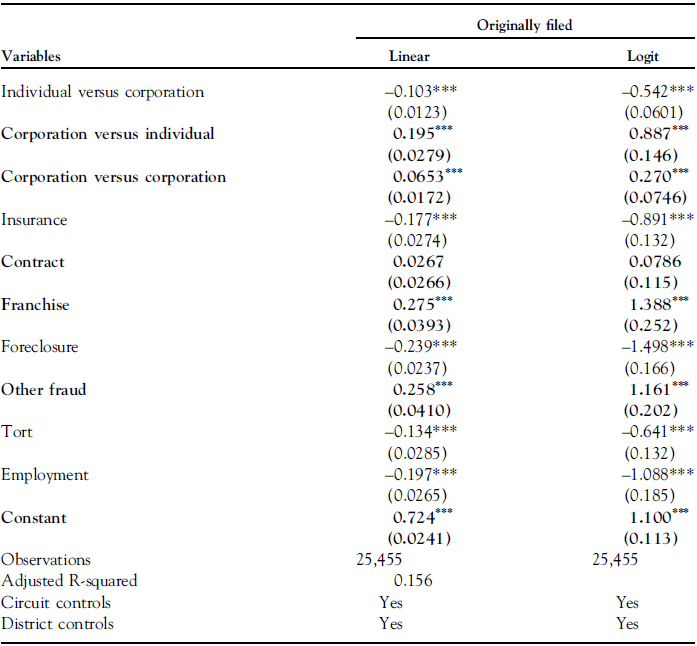
Notes: SE clustered by district in parentheses. * p < 0.05; ** p < 0.01; *** p < 0.001.
ISPs Invoke Diversity Jurisdiction Primarily for the Following Reasons: (1) Efficiency, Expense, or Convenience; (2) Preferences for Federal Procedure; (3) Perceived Better Quality of Federal Judges; and (4) Preempt the Defendant’s Opportunity to Remove
Docket data can only tell correlative results; motivations must be inferred. And motivations other than MDL transfer can be hard to infer from docket data. The Response Dataset, however, which contains the usable responses (402 responses in original cases and 450 responses in removed cases) to the motivations survey, provides direct information on motivations. Table 3A sets out the motivations selected by respondent ISPs who filed a diversity case originally in federal court, with the number of respondents citing each motivation (“Total number” column), the number of respondents citing that motivation as the strongest forum-selection motivation in the case (“Highest weight” column), the average weight of that motivation across all cases, with no selection = 0; almost no weight = 1; little weight = 2; moderate weight = 3; substantial weight = 4; and dispositive weight = 5 (“Mean weight” column), and the percentage of all respondents selecting that motivation as having moderate weight or stronger (“Percent moderate+” column).
Motivations of ISPs invoking diversity jurisdiction
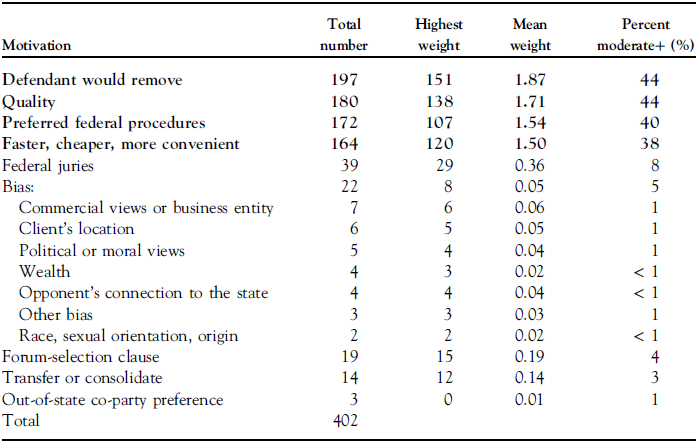
As Table 3A shows, four motivations (in bold font) for ISPs invoking federal diversity jurisdiction are separated from the other motivations by frequency and strength: (1) to preempt the defendant’s removal; (2) the perceived better quality of the federal bench; (3) preference for federal procedures; and (4) the expected faster speed, cheaper cost, and greater convenience of federal court. Other motivations, including the avoidance of state-court bias, were selected far less frequently and supply far less significance on generalizing why ISPs choose federal court. Table 3B sets out the results for ISPs who filed cases in state court that were then removed to federal court based on diversity jurisdiction:
Motivations of ISPs invoking state court

The predominant motivations (in bold font) for selecting state court were (1) preference for state procedures; (2) efficiencies and conveniences; and (3) preferences for state juries. Avoiding (or taking advantage of) court bias played a much more prominent role for those selecting state court (18 percent) than those selecting federal court (5 percent), while the perceived better quality of the court played a much less prominent role for those selecting state court (6 percent) than those selecting federal court (44 percent).
ISPs Who Invoke Diversity Jurisdiction for Reasons of Procedure, Efficiency/Convenience, or Quality Are Correlated with Business Entities Represented by Attorneys Who Tend to Defend Businesses in Federal Court, While ISPs Who Invoke Diversity Jurisdiction to Preempt Removal Are Correlated with Individuals Represented by Attorneys Who Typically Represent Plaintiffs
Respondent characteristics follow the predicted correlations for the predominant motivations for invoking federal court, as set forth in Table 4. All the coefficient directions are as expected, and most, though not all, of the coefficient magnitudes are statistically significant. These results tend to support the theory that litigants already comfortable in federal court (corporations, attorneys who represent defendants, and attorneys who primarily practice in federal court) tend to prefer what they know—the procedures, conveniences, and perceived quality of federal court. Meanwhile, different characteristics are associated (though with less statistical confidence) with the motivation to invoke federal diversity jurisdiction originally to preempt the defendant’s opportunity to remove.
Partial correlation of ISPs characteristics with top motivations for invoking federal court
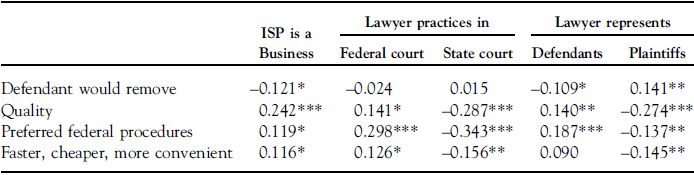
Notes: Each row represents the partial correlation between a particular motivation and characteristics of the parties or lawyer, controlling for circuit and district but not controlling for other variables. Motivations are either 0 (no weight or almost no weight) or 1 (moderate, substantial, or dispositive weight). * p < 0.1; ** p < 0.05; *** p < 0.01.
DISCUSSION
Represented ISPs invoke domestic-diversity jurisdiction with striking frequency. The 2019 federal docket data reveal that ISPs filed more than half of all original domestic-diversity cases with represented plaintiffs. The findings in this study support three conclusions that enrich our understanding about those diversity-happy ISPs. First, a sizeable percentage of them—around 20–24 percent in 2019—are MDL-eligible cases in which the motivation to file in federal court likely is based on the likelihood of consolidation with an existing federal MDL. These cases are dominated by individual plaintiffs suing corporate defendants for tort claims. Second, the remaining ISPs who invoke federal court do so for various reasons, but the predominant reasons are (1) to preempt the defendant’s likely removal of the case and (2) preferences based on perceived differences between federal and state court in terms of quality, procedures, and efficiency and convenience. Preferences for federal juries, trying to avoid state-court biases, and other factors motivate forum selection far less strongly. Third, ISPs motivated to select federal court to preempt the defendant’s option of removal are correlated modestly with individual plaintiffs represented by attorneys who primarily represent plaintiffs, while ISPs motivated to select federal court for quality, procedural, or efficiency and convenience reasons are correlated with business plaintiffs represented by attorneys who primarily represent defendants in federal court.
To be clear, these categories do not capture all ISP-invoked diversity jurisdiction. Significant numbers of cases represent minority motivations. As with any study of this sort, support for these conclusions has limits. Cases are complicated and inflected by individualized circumstances. The available data cannot account for all the variables that might influence forum shopping in a particular case. Further, some possible selection effects—the decision not to file a case at all or the decision not to remove a case, for example—cannot be detected in the data. Other selection effects endemic in the survey bounce-backs and response rate may not be discernible from the case-demographic comparisons detailed in Appendix E. Litigant gamesmanship also likely plays a role in nonrandomly influencing the federal dockets; plaintiffs who are strongly motivated to avoid federal court are likely to frame their cases in ways that prevent removal, such as by filing in a defendant’s home state or by adding a nondiverse defendant.Footnote 11 Despite the protections of confidentiality in the survey, attorneys may have been loath to characterize their preferences as based on judicial bias as opposed to other motivation choices offered by the survey. In addition, certain motivation choices in the survey could blend together or obscure underlying meaning. For example, the motivations of procedural differences, quality, and efficiency could be based on objective comparisons with state courts or could be due to the attorney’s own greater familiarity with federal court. This ambiguity obscures whether attorneys think federal courts are actually better (which might be important evidence to consider in structural reforms for allocating cases) or just have personal preferences (which might have nothing to say about the proper allocation of cases from a systemic perspective). The relatively low response rate to the survey raises the prospect of undetected yet significant selection effects in responsiveness and the low absolute number of responses reduces the power of the statistical findings and inhibits more refined analyses based on geography and nature of suit. For all these reasons, the findings in this article should be interpreted with caution.
Nevertheless, the essential finding of the prevalence of the three ISP categories hypothesized has implications both for the existing literature and for the possibility of diversity reform. As for the existing literature, the findings add to the debate about the bias rationale of diversity jurisdiction by suggesting that state-court bias—even if it is perceived to exist—can be outweighed by more practical factors in the forum-selection calculus. For individual MDL-eligible plaintiffs, the interest in (or resignation to) consolidation with an existing MDL likely exerts a powerful counterweight to the benefits of state court. For corporate plaintiffs and their attorneys, the interest in operating under more familiar federal procedure, along with the potential efficiencies and perceived higher quality of federal court, seem to outweigh any perceived home-state advantage of state court in some cases. These findings complicate the story of diversity jurisdiction and its rationale as primarily about the risks of state-court bias, and they suggest that diversity jurisdiction may offer non-bias-related benefits for certain kinds of parties and certain kinds of cases. Traditional arguments against diversity jurisdiction have tended to discount these potential private benefits from the systematic evaluation of diversity jurisdiction (American Law Institute 1969). Perhaps it is time to reconsider their role in diversity jurisdiction today.
At the same time, the findings validate the conventional wisdom that, in general, individual parties prefer state court, while corporate parties prefer federal court (Zambrano Reference Zambrano2019). The availability of federal MDLs may be a key exception to the general plaintiff preference, but the correlations between corporate ISPs and motivations based on procedure, quality, and efficiency are consistent with corporate parties’ general preference for federal court. Likewise, individual-ISP choice to file in federal court to preempt the defendant’s opportunity to remove the case is also consistent with individual parties’ general preference for state court. The findings dovetail with a widespread and dominant historical narrative about the perceived differential experiences of individual and corporate parties in federal courts, and they help explain why the docket data show substantial numbers of ISP-filed diversity cases despite studies showing the federal courts to be more anti-plaintiff than the state courts (Clermont and Eisenberg Reference Clermont and Eisenberg2000; Burbank and Farhang Reference Burbank and Farhang2014).
Turning to normative implications, the findings support a more nuanced approach to diversity reform. The invocation of diversity jurisdiction by individual ISPs to facilitate MDL consolidation may have positive benefits for both the parties and for the judicial system and should be taken seriously. For one, MDL cases often have national scope and national implications, heightening the justification for consolidated adjudication in federal court. As a practical matter, MDL’s enablement of consolidation across state lines—a feature unavailable in state court—has become a powerful vehicle for efficient case resolution; as of August 2022, more than 775,000 individual cases have been consolidated into 189 active MDL proceedings (US Joint Panel on Multidistrict Litigation 2022). The alternative to MDL consolidation is frightening; in 2019, the predicted cost to Uber to resolve just sixty thousand arbitrations individually (as mandated by its own arbitration agreement), instead of in the aggregate, was more than six hundred million dollars, much more than its expected liability (Rosenblatt Reference Rosenblatt2019).
Of course, the choice is not between MDL for everyone and MDL for no one. The MDL issues for diversity ISPs are but a slice of the MDL universe. And because diversity jurisdiction gives both plaintiffs and (usually) defendants a say in invoking federal court, it is hard to know what the implications are for MDL efficacy. After all, even were ISP invocation of diversity jurisdiction restricted, MDL-minded plaintiffs would still be able to file in federal court, as out-of-state plaintiffs, in the defendant’s home state or in any state in which the defendant has consented to personal jurisdiction. These two options are the result of forum-selection choices made solely by the defendant, presumably to the advantage of the defendant, so individual plaintiffs, understandably, may prefer the present option of bringing suit in their own home state for reasons of geographic convenience and ease of finding local counsel. And absent the ability to invoke diversity jurisdiction in their home state, individual ISPs would be forced into the choice of forgoing federal MDL consolidation in their own state or filing in the defendant’s preferred state. But a plaintiff’s choice to forgo federal MDL by filing in their own state’s state court is subject to override by a MDL-minded defendant who removes the case to federal court. No doubt, some such cases will get stuck in state court, potentially undermining the utility of the MDL aggregative device. But more research should be conducted to better understand the complexities of such forum choices in the MDL context. The finding here—that MDL eligibility likely induces diversity-eligible ISPs to elect federal court—should help frame future studies and reform efforts.Footnote 12
Meanwhile, the finding that other motivations drive forum selection demands different considerations. How strongly motivations based on private benefits like efficiency, procedural familiarity, and judicial quality should be weighed against the systemic costs of diversity jurisdiction is and should continue to be an ongoing conversation, but the correlation of these motivations with particular types of litigants and attorneys suggests that these private benefits are felt dis-uniformly across the familiar divides of individual/corporate status and plaintiff/defense bar. Although corporate-party preferences for federal court are consistent with the ancient concern that local prejudices might burden national commercial and economic interests, the overwhelming size and pervasiveness of the modern federal administrative state suggests that diversity jurisdiction is not as necessary today to protect those national interests. The experience with the 2005 Class Action Fairness Act suggests that diversity reform on grounds that cater to those kinds of parties should be approached with caution to avoid the ancillary effects of over-federalizing litigation to the detriment of both the state and federal courts.Footnote 13 Meanwhile, other motivations, such as the avoidance of rural or urban biases, are far less prevalent among ISPs and thus perhaps less deserving of focus in ISP-related reform proposals. The findings here provide a better understanding of stakeholder interests and identities that should inform the ongoing debates about diversity jurisdiction.
The motivation to select federal court to preempt removal has its own unique implications for diversity jurisdiction. Only diversity abolitionists would refuse diversity jurisdiction to out-of-state defendants seeking to remove a case; such removals facially align with the out-of-state bias rationale justifying diversity jurisdiction in the first place. If ISPs preempt removal by filing in federal court a case that was going to end up there anyway through removal, no one should have cause to complain. In fact, everyone should support the result. The defendant who was going to remove gets its preferred forum, the plaintiff saves the costs and delay associated with removal, the state court avoids ever having the case on its docket in the first place, and the federal court maintains consistent control over the case from start to finish without having to worry about adjudicating defects in the removal procedure. Perhaps diversity jurisdiction invoked by ISPs for this reason should be encouraged rather than discouraged.
Finally, the findings here suggest avenues for future research. Although the survey results show predominant motivations and correlations, they also reveal significant minority positions, which theoretically could be explained by individualized case circumstances and attorney preferences, but which will require larger datasets for validating theoretical explanations. Another avenue of research could investigate geographic influences on ISP forum selection. Other studies have found statistically significant differences among circuits on forum preference (Federal Judicial Center 2021), and, in theory, the magnitude in the differences between federal procedure and state procedure, between federal quality and state quality, and between federal efficiencies and state efficiencies should vary widely by state. In this study, some survey respondents added comments indicating that geography could be influential, but I received too few responses to test geographic influence. Geographic influences are ripe for further study. Finally, generating finer distinctions among motivations—especially those related to perceptions of quality, procedures, and convenience and efficiencies as well as whether those motivations reflect systemic assessments or personal preferences—could be useful for more refined reform proposals.
CONCLUSION
In-state plaintiffs file domestic diversity cases in federal court with frequency. This article suggests that they do so for discrete reasons that correlate with party and case characteristics. In particular, ISPs who invoke diversity jurisdiction tend to fall into one of three categories: (1) individual ISPs filing MDL-eligible tort cases against corporate defendants; (2) corporate ISPs represented by attorneys who primarily defend businesses in federal court who invoke diversity jurisdiction because of perceptions of better federal-court procedure, efficiency, and quality; and (3) individual ISPs who invoke federal court to preempt a defendant’s right of removal. The findings support a nuanced approach to efforts to reform diversity jurisdiction.
APPENDIX A
Database Parameters
IDB Civil 1988–Present
Circuit – all
Districts – all
Nature of suit – all
Disposition – allFootnote 14
Origin – 1 or 2 (original proceeding, removal)
Jurisdiction – 4 (diversity)
Pro Se – 0, 2 (filter out pro se plaintiffs)
Class action – allFootnote 15
File date – between 01/01/2019 and 12/31/2019, inclusive
APPENDIX B. Characteristics of Cases in 2016–2018 Versus 2019
Original Cases
Type of plaintiff and defendant

Nature of the suit
Disposition of the case

District
Circuit
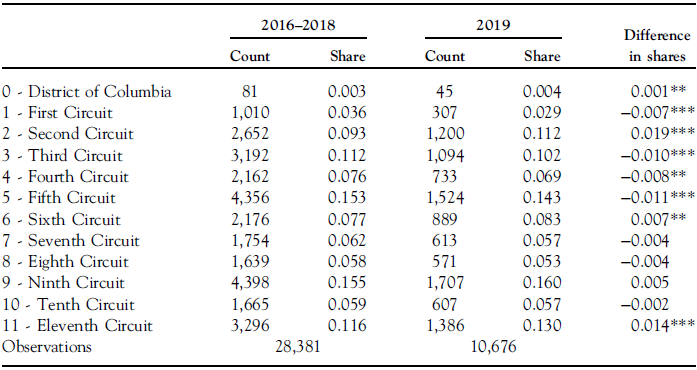
Removed Cases
Type of plaintiff and defendant
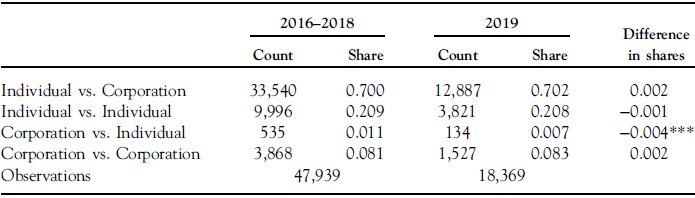
Nature of the suit
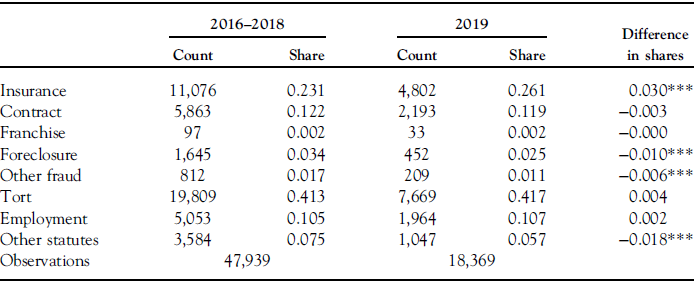
Disposition of the case

District

Circuit

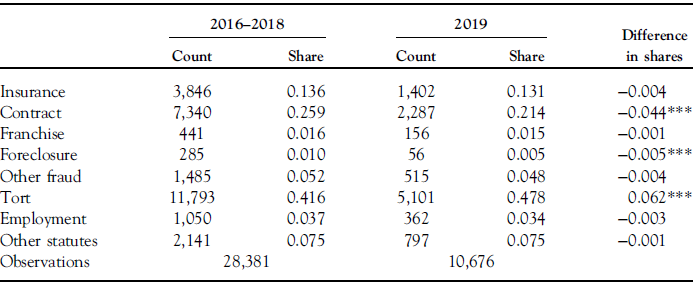
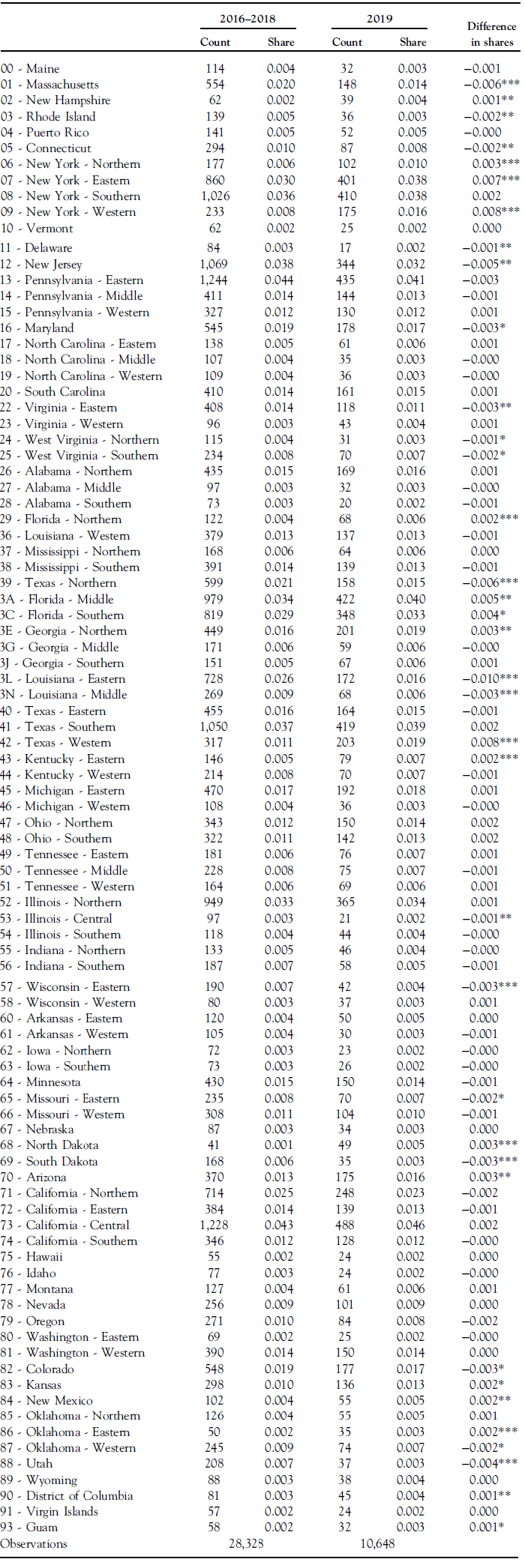
Note: The Difference column is the coefficient of a simple regression of respondent status on the variable. *p < 0.10, **p < 0.05, ***p < 0.01. The small magnitudes of difference suggest that any statistical significance is driven at least partly by the large number of observations and is unlikely to signify practical concerns about the representativeness of the responses. However, two observations are worth noting. First, the statistically significant increase in original tort cases in 2019 could be a continuation of the gradual increase in MDL litigation. That explanation could also explain the statistically significant increase in original Individual v. Corporation cases and the statistically significant increase in transfers of original cases in 2019. Second, the nearly uniform decrease in dispositions of 2019 cases likely stems from the fact that 2019 cases were all filed after, and thus had less time to reach conclusion than, the 2016–2018 cases. Neither of these observations undermines the conclusion that the 2019 cases are broadly representative of prior years.
APPENDIX C
E-mail for Survey
E-mail subject line: Your Case <<case caption>>: Diversity Jurisdiction Study
The Center for Litigation and Courts is conducting research on why in-state plaintiffs and their attorneys file diversity cases in federal or state court. Court records show that you represented an in-state plaintiff or petitioner in <<case caption>>. Completing a short survey will greatly assist the Center’s research on diversity jurisdiction.
The survey should take no more than 5 minutes. As compensation for completing the survey, you may enter a lottery for a $250 Amazon gift card.
Complete the survey here: <<survey link>>
About the Center. The Center for Litigation and Courts at UC Hastings College of the Law is a nonprofit, nonpartisan, academic research center whose mission includes expanding the knowledge of civil litigation and the courts and disseminating that knowledge to the bench, bar, legal academy, and public. You can learn more about the Center here.
Confidentiality. The survey is anonymous. Reported information will not be linked to the person who completed the survey or the case name or docket number involved. Findings will be reported in the aggregate so that no individual party or case will be identifiable. Any information that might permit identification of the named case, the attorneys, or the parties will be treated as confidential. This study is IRB compliant.
Questions. If you have questions about the survey, please contact Scott Dodson, Director of the Center for Litigation and Courts, at clc@uchastings.edu or (415) 565-4696.
Follow this link to the Survey: <<survey link>>
Or copy and paste the URL below into your internet browser: <<survey URL>>
Follow the link to opt out of future emails: <<opt-out link>>
APPENDIX D
Survey Questions
Original Cases
-
In this case, did you represent a plaintiff or petitioner who was a citizen of the state in which the case was filed? [If no, end survey]
-
2. Was this case filed originally in federal court based solely on diversity jurisdiction? [If no, end survey]
-
3. Was the case dismissed for lack of diversity jurisdiction? [If yes, end survey]
-
4. How satisfied were you with the ultimate disposition of the case?
-
• Extremely satisfied
-
• Somewhat satisfied
-
• Neither satisfied nor dissatisfied
-
• Somewhat dissatisfied
-
• Extremely dissatisfied
-
-
5. In this case, my primary in-state client was (check all that apply):
-
• A natural person
-
• A corporation
-
• An unincorporated entity
-
• A governmental entity
-
• Other
-
-
6. Which of the following motivated you or your client to file this case in federal court? (Check all that apply): [response options are randomized]
-
• An out-of-state coparty preferred federal court
-
• Belief that a forum-selection clause required me to file the case in federal court
-
• Belief that federal court would be faster, cheaper, or more convenient than state court
-
• Belief that federal court would be of better quality than state court
-
• Belief that the defendant would remove the case to federal court anyway
-
• Belief that federal court offered more opportunities to transfer the case to a different or to consolidate my case with a pending federal case
-
• Belief that state court might be biased against, or that federal court might be biased in favor, of me or my client [if checked, see below]
-
• Preferred federal-court procedure
-
• Preferred federal-court juries
-
• Other reason (please explain)
-
-
7. [If the bias response is selected] Belief that state court might be biased against, or that federal court might be biased in favor of, me or my client based on (check all that apply): [response options are randomized]
-
• race, sex, sexual orientation, national origin, or religion
-
• where my client resided or was located
-
• political or moral views
-
• commercial views or status as a business entity
-
• wealth
-
• my opponent’s connection to the state
-
• other (please explain)
-
-
8. [Repeated for each motivation selected] You selected as a motivating factor <motivation>. What weight did that motivating factor have on your decision to file the case in federal court?
-
• Almost no weight
-
• Little weight
-
• Moderate weight
-
• Substantial weight
-
• Dispositive weight
-
-
9. Which of the following best describes your law practice setting? (Check one)
-
• Private firm of 1-10 attorneys
-
• Private firm of 11-25 attorneys
-
• Private firm of more than 25 attorneys
-
• Legal staff or in-house counsel of a for-profit entity
-
• Legal staff or in-house counsel of a non-profit entity
-
• Government
-
• Other (please explain)
-
-
10. How many years have you practiced law? ________________ years
-
11. Do you represent plaintiffs, defendants, or both? (Check one)
-
• Primarily plaintiffs
-
• Both plaintiffs and defendants about equally
-
• Primarily defendants
-
-
12. In your civil practice, do you litigate in state or federal court?
-
• Primarily state court
-
• State and federal court about equally
-
• Primarily federal court
-
-
13. My race:
-
• American Indian or Alaskan Native
-
• Asian
-
• Black or African American
-
• Native Hawaiian or Pacific Islander
-
• Hispanic, Latinx, or Spanish origin;
-
• White
-
• Other, unknown, or prefer not to answer
-
-
14. My gender:
-
• Male
-
• Female
-
• Non-binary/third gender
-
• Prefer not to say
-
Removed Cases
[Same as above except the following questions]
-
2. Was the basis for removal solely diversity jurisdiction? [If no, end survey]
-
3. Was the case remanded for lack of diversity jurisdiction? [If yes, end survey]
-
6. Which of the following motivated you or your client to file this case in state court? (Check all that apply): [response options are randomized]
-
• An out-of-state coparty preferred state court
-
• Not able to file this case in federal court because of federal-court jurisdictional limits
-
• Belief that a forum-selection clause required me to file the case in state court
-
• Belief that state court would be faster, cheaper, or more convenient than federal court
-
• Belief that state court would be of better quality than federal court
-
• Force the defendant to remove the case to federal court
-
• Belief that state court would prevent transfer of the case to a different state or consolidation of my case with an existing federal case
-
• Belief that state court offered more opportunities to consolidate my case with a pending case
-
• Belief that federal court might be biased against, or that state court might be biased in favor of, me or my client [if checked, see below]
-
• Preferred state-court procedure
-
• Preferred state-court juries
-
• Other reason (please explain)
-
6a. [If the bias response is selected] Belief that federal court might be biased against, or that state court might be biased in favor of, me or my client based on (check all that apply): [response options are randomized]
-
• race, sex, sexual orientation, national origin, or religion
-
• where my client resided or was located
-
• political or moral views
-
• commercial views or status as a business entity
-
• wealth
-
• my opponent’s connection to the state
-
• other (please explain)
-
6b. [Repeated for each motivation selected] You selected as a motivating factor <motivation>. What weight did that motivating factor have on your decision to file the case in state court?
-
• Almost no weight
-
• Little weight
-
• Moderate weight
-
• Substantial weight
-
• Dispositive weight
APPENDIX E Characteristics of Cases in Surveyed Population Versus Respondent Population
Original Cases
Type of plaintiff and defendant

Timing of the case
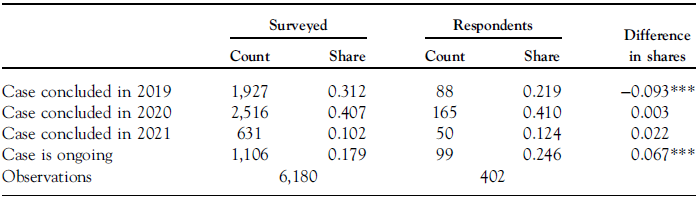
Nature of the suit
Disposition of the case
District
Circuit
Removed Cases
Type of plaintiff and defendant
Timing of the case
Nature of the suit
Disposition of the case
District

Circuit
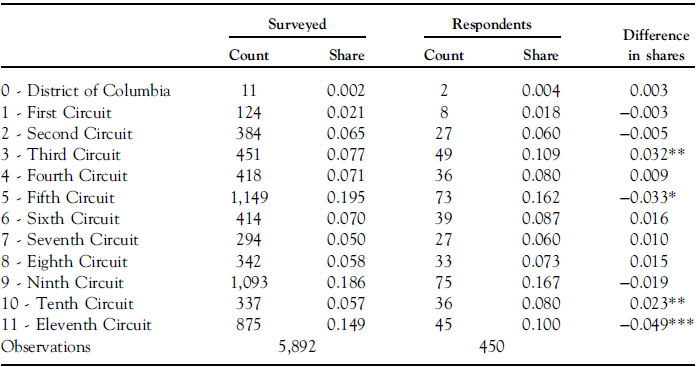
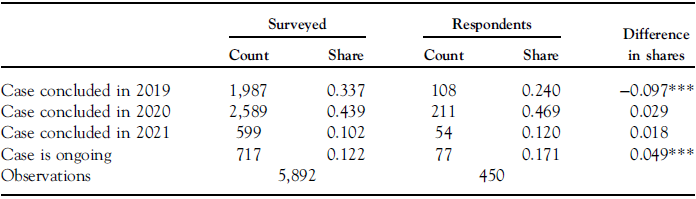
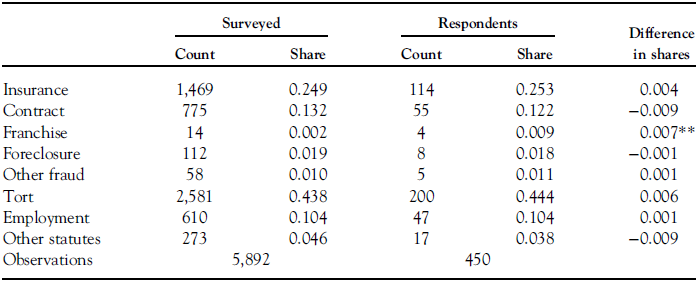
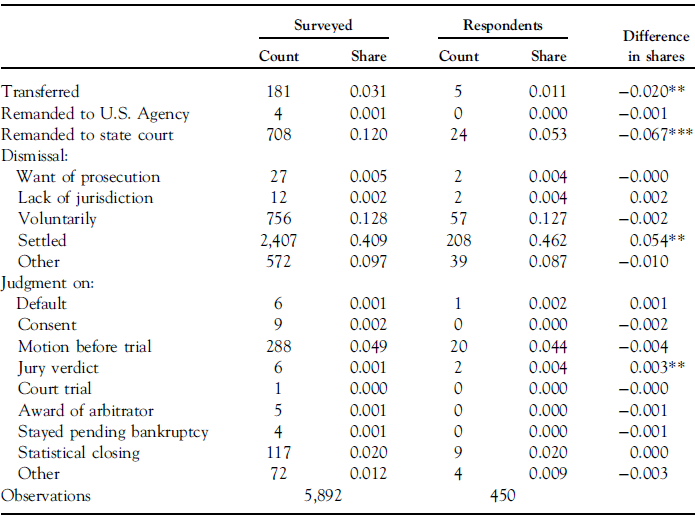
Note: The Surveyed columns exclude Respondents. The Difference column is the coefficient of a simple regression of respondent status on the variable. *p < 0.10, **p < 0.05, ***p < 0.01. The magnitudes of difference suggest that any statistical significance is driven at least partly by the large number of observations and is unlikely to signify practical concerns about the representativeness of the responses. One observation is worth noting. The differences in the timing of the disposition, as reflected in Panels 1B and 2B, suggest an underrepresentation of responses in quickly resolved cases and an overrepresentation of responses in ongoing cases. One possible reason for those differences is that attorneys in ongoing cases may have that case in their minds already and thus be more likely to respond to a survey about it, as contrasted with a case that concluded many months ago. It is possible that the time to dispose a case in federal court both is reliably predictable at the time of filing and is a factor in forum selection. The uncertainty of that possibility, coupled with the low absolute magnitude of the difference, minimizes concerns that the difference is practically significant.


 Open access

