

Introduction
Archaeologists across Europe record ‘public finds’ (finds recovered by the public, primarily by metal detectorists) with the understanding that these data can contribute to archaeological knowledge (Deckers et al., Reference Deckers, Lewis and Thomas2016a; Wessman et al., Reference Wessman, Thomas, Deckers, Dobat, Heeren and Lewis2023). While broadly similar, approaches and priorities contrast: landscapes differ in their archaeological potential and the ease with which finders can exploit them, and hence archaeologists adapt to the challenges this brings. Similarly, the processing of public finds is conducted within varying models of heritage protection grounded in diverse cultural and historical traditions. Public finds are usually logged in central databases, which may (or may not) be open. While archaeologists may sometimes approach datasets as if they are interchangeable without fully appreciating the complex biases they contain, the mechanisms by which finders report their discoveries and how those data are created also differ. This significantly affects the character and reuse potential of finds data for research and other purposes: the importance of better appreciating this critical aspect of the archaeological evidence is underlined by the recent successes of significant international data aggregation efforts such as ARIADNEplus (https://ariadne-infrastructure.eu/; Richards & Niccolucci, Reference Richards and Niccolucci2019).
This study concerns systems for processing public finds through digital technology and citizen science in England, Estonia, and Finland and considers opportunities for improving them. We chose these countries for several reasons. First, while metal detecting is legal in all three countries, the obligations of finders vary, as do approaches to recording public finds and making this information accessible. Second, the countries differ in material culture, geography, and the terrain in which finds are made, thus influencing legal and societal approaches to finds in the context of heritage protection and public involvement in archaeology. Third, all are experiencing a growth in hobby metal detecting, which has placed pressure on existing resources and systems for identifying and recording detected finds. Fourth, all three have embraced digital technology to address these challenges in various ways. Recognizing that much can be learnt from the experience of those who record public finds daily, we seek here to examine the further potential of applying new digital technologies in conjunction with archaeological citizen science.
It is important to note that, even in countries where metal detecting is legal, many archaeologists view the activity as problematic, which can explain approaches to ‘dealing with it’. These will vary from country to country depending on factors such as the number of active finders, types of landscapes searched, number of items recovered, and the (perceived) archaeological value of the discoveries. They are also contingent on the legislative processes that regulate public finds, and the degree of cooperation and trust built between archaeologists and finders. Essentially, archaeologists are (mostly) engaging with detectorists (in a top-down approach) because the data have archaeological value and help to understand sites at risk. This recognition has led to the establishment of European public finds recording schemes, the first of which was the Portable Antiquities Scheme (PAS) in England and Wales, founded in 1997 (https://finds.org.uk/; Bland, Reference Bland2005; Lewis, Reference Lewis2016). Outside the area of this study, established and active European finds recording schemes include the Digitale Metaldetektorfund (DIME: https://www.metaldetektorfund.dk/ny/) in Denmark (Dobat et al., Reference Dobat, Christiansen, Henriksen, Jensen, Laursen and Jessen2019) and the Portable Antiquities of the Netherlands (PAN: https://portable-antiquities.nl/; Kars & Heeren, Reference Kars and Heeren2018). More information on metal detecting in different European countries is available from the European Public Finds Recording Network (EPFRN: https://www.helsinki.fi/en/networks/european-public-finds-recording-network), Dobat et al. (Reference Dobat, Deckers, Heeren, Lewis, Thomas and Wessman2020), and Wessman et al. (Reference Wessman, Thomas, Deckers, Dobat, Heeren and Lewis2023).
Elsewhere, hobby metal detecting might be restricted or prohibited. Still, archaeologists, especially those interested in small metal finds within a pan-European perspective, appreciate their significance, even if divorced from a precise stratigraphic context (e.g. Sawicki et al., Reference Sawicki, Lewis and Vargha2023). Furthermore, there is a growing belief that these data must be shared as widely as possible and that the public should be involved in their creation (Wessman et al., Reference Wessman, Thomas, Rohiola, Koho, Ikkala, Tuominen, Jameson and Musteaţă2019b).
Although England has many more detectorists, the overall ratio of detectorists to population is not too dissimilar across the case studies (see Table 1). The challenge posed to all countries that permit hobby metal detecting is how to process the large numbers of reported finds. Ideally, archaeologists would be adequately resourced to do this work, but more public finds are being recovered than archaeologists can cope with; hence, we shall explore what new digital technology and citizen science can do to address this challenge.
Summary of metal detecting in England (Westcott et al., Reference Westcott, Forster, Heyworth and Pitt2021: 11–12; Lewis, Reference Lewis2023: 37–39), Estonia (Kurisoo et al., Reference Kurisoo, Posti, Jegorov and Kangert2023: 217), and Finland (Immonen & Kinnunen, Reference Immonen and Kinnunen2020: 318).

* = number of Ilppari’s find report IDs (identifications). Since the number of finds within a single report is not recorded, an ID might represent multiple finds and therefore their number is merely indicative of the total.
Reporting and Recording
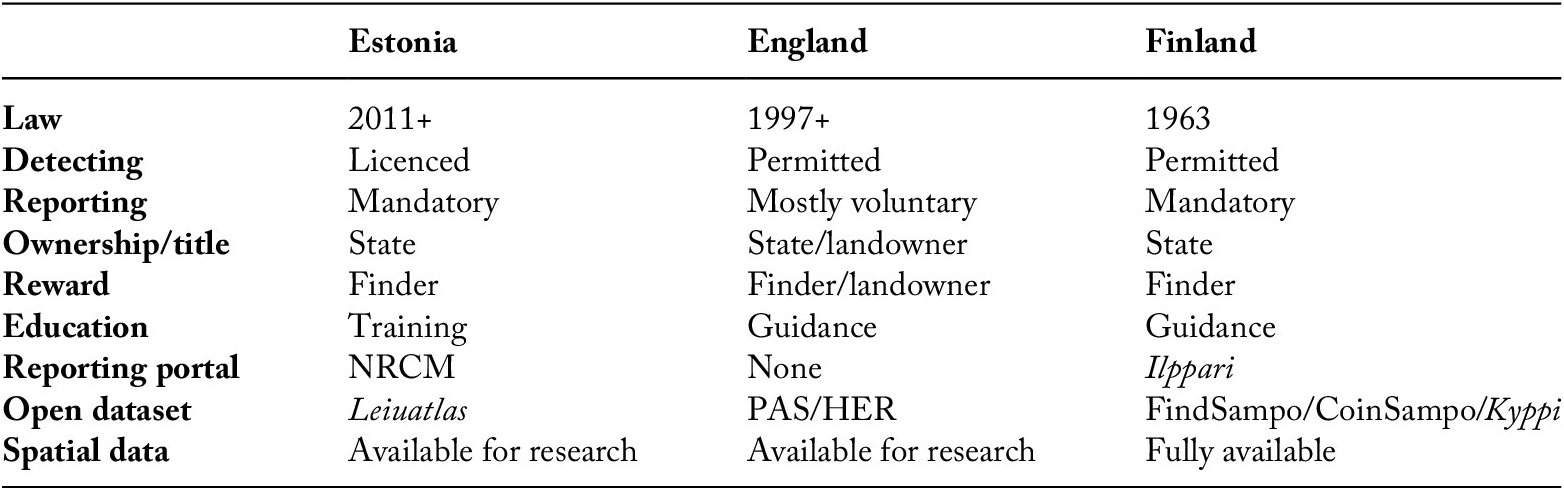
Although archaeologists processing public finds undertake similar work, the motivations behind it can vary, as defined by national legislation, culture, and traditions (see Table 2). These are examined below, focusing on a primary objective (amongst many) for each country studied here: ‘cataloguing’ (Finland), ‘heritage protection’ (Estonia), and ‘research’ (England).
Summary of legislation and public finds recording datasets in Estonia, England, and Finland.

Cataloguing finds (Finland)
Finland’s approach to dealing with public finds is grounded in its 1963 Antiquities Act, long before the advent of metal detecting in Finland in the 1980s and its subsequent boom in popularity during the early to mid-2010s (Wessman et al., Reference Wessman, Thomas and Rohiola2019a: 2; Rohiola & Kuitunen, Reference Rohiola, Kuitunen and Stevenson2022: 551; Oksanen & Wessman, Reference Oksanen and Wessmanaccepted). According to the Act, all objects over 100 years old that are discovered in the ground and whose owner is unknown belong to the State and must be reported (Antiquities Act 295/1963, §16; Opetusministeriö, 1963; this law is currently under revision). Since the destination of items deemed archaeologically significant is the Finnish Heritage Agency (FHA) collections, the processing of finds is directed towards their acquisition and cataloguing.
Finders report items to the FHA through an online portal, Ilppari (https://www.kyppi.fi/palveluikkuna/ilmoitus/edit/asp/enk_default.aspx). Before 2019, find reports were submitted by email, sometimes to local archaeologists or museums. Although the law applies to all objects over 100 years old, mainly prehistoric and medieval (pre-1560) items are consistently required to be handed over to the FHA, which is about half of all reported finds. Unique objects from later periods might be requested on a case-by-case basis, and occasionally more extensive collections are acquired as exemplary cases of items from certain areas (e.g. Ehrnsten, Reference Ehrnsten2015 on coin finds). As only two to four people handle find reports, decision-making on what objects to redeem is reasonably consistent despite the lack of FHA official guidelines. However, some finders, especially experienced individuals, report finds selectively despite the law, because they know what items the FHA typically takes in or may have been given incomplete or contradictory advice in the past, especially concerning more modern finds (Ehrnsten, Reference Ehrnsten2015; Wessman, Reference Wessman and Ljunge2020; Rohiola & Kuitunen, Reference Rohiola, Kuitunen and Stevenson2022: 553–55). Where items are requested, these are either sent in directly or deposited with local museums before being transferred to Helsinki. If finds are acquired into the collections, they will be formally catalogued.
Since Spring 2023, finds have been logged onto the FHA’s new digital catalogue, Apuri (Figure 1). Although Apuri automatically replicates some of the information from Ilppari, FHA staff need to check, update and add information: findspots will be checked against the Muinaisjäännösrekisteri (Register of Ancient Monuments) in the Kulttuuriympäristön palveluikkuna (https://www.kyppi.fi/palveluikkuna/) or Kyppi (Cultural Environment Service Window) data portal for cultural heritage. Finds will usually be re-photographed and may need to be X-rayed, cleaned, or conserved. While the new digital tools have streamlined the process, a backlog of finds waiting to be catalogued is substantial. Therefore, finds processing might take as much as three years.
Sami Raninen (Finnish Heritage Agency) processing finds.

Although Finnish archaeologists recognize that public finds data have a broader research value, the system’s operational principle revolves around ensuring that items are appropriately catalogued as part of its object management systems. As discussed above, the chronological selection biases within the databases are quite consistent. Furthermore, the small team of finds specialists means that its consistency (e.g. descriptions and terminology based on controlled vocabularies recorded in the national Ontology for Museum Domain and Applied Arts (MAO/TAO); see below) is unusually uniform, greatly facilitating data reuse.
Heritage protection (Estonia)
Although public finds made in Estonia also belong to the State and can be acquired into public collections, the main aim of the National Heritage Board (NHB) is different from Finland (and England) in its focus on protecting sites at risk (Kadakas, Reference Kadakas and Degraeve2017), a task made difficult by the large influx of finds (e.g. Kurisoo et al., Reference Kurisoo, Posti, Jegorov and Kangert2023).
The use of ‘search devices’ was first regulated in 2011 under an amendment to the Heritage Conservation Act (MuKS, 2011), revised in 2019 (MuKS, 2019; Kadakas, Reference Kadakas2020). Anyone wishing to use a metal detector (Figure 2) in Estonia must have a permit to do so, including passing thirty-eight hours of academic training: the course costs about €200, and the permit is €50 for five years. In 2022, more than 900 people held permits (Kurisoo et al., Reference Kurisoo, Posti, Jegorov and Kangert2023: 217), though the extent of metal detecting (i.e. illegal metal detecting) might be more significant.
Toomas Prantstibel detecting outside Tallinn.

Finders must notify the NHB before any search via an online form on the National Register of Cultural Monuments (NRCM) or by email, giving their name, permit number, proposed time of search and search area. The ‘search notification’ aims to provide proof of a legal search, but it also captures important negative information if a search proves unfruitful (Kurisoo et al., Reference Kurisoo, Rammo and Smirnova2020: 270). If a finder makes a significant or unusual find, they must contact the NHB immediately. Otherwise, they should submit an activity report within thirty days, even if nothing is found. Finders are expected to send images of finds, add brief descriptions of findspots, and provide coordinates and other relevant information. NHB staff give feedback on these reports and ask finders to bring in any items that need to be recorded or acquired. They also seek to visit sites searched to understand more about the archaeological context of any finds made.
Before the Estonian Heritage Conservation Act of 2019, finders had to report new object discoveries promptly but only needed to submit activity reports once a year. Because finders were not necessarily directed on what information to provide, and much time may have elapsed between their search and report submission, vital information might be missing (Kurisoo et al., Reference Kurisoo, Rammo and Smirnova2020: 270). Nowadays, the tighter reporting window has significantly improved data quality.
A drawback of the Estonian system is that it relies on freelance small finds experts to produce reports on the finds. Since too few archaeologists are willing to do this work, the processing often takes two to three years (Kurisoo et al., Reference Kurisoo, Rammo, Smirnova and Kangert2021: 271). Furthermore (as elsewhere), some finds may need to be cleaned or conserved before they can be worked on, and the budget to cover these costs is inadequate (Kurisoo, Reference Kurisoo2022). Ironically, while heritage protection is the priority for the NHB, delays in processing finds due to resource issues mean that finds and sites are at risk (Kurisoo et al., Reference Kurisoo, Posti, Kangert and Karro2022: 270). Nonetheless, digital technology and citizen science provide opportunities to address these issues.
Research (England)
The primary legislation regarding public finds in England is the Treasure Act 1996, by which the ‘most important archaeological finds’ can be acquired by museums. This has medieval origins, designed to benefit the Crown. It is, therefore, quite unlike Estonia and Finland, where the law is more focused on precious metal finds, although changes to the Act, notably in 2023, extended its scope to include ‘significant’ base-metal items. Otherwise, landowners have ‘best title’ (a claim to ownership) to most finds. The PAS was established to complement the Act by providing a voluntary mechanism for recording public finds for archaeological benefit.
The scheme aims to preserve knowledge about public finds through its online database, recognizing that most objects will enter private collections and never be seen again by archaeologists. In 2003, the PAS was extended to all of England and Wales. Also launched was its online database to enable the recording of finds and make these publicly available. At the time, it was not absolutely clear what the value of these data might be, although it was increasingly understood that detector finds could provide new insights into the past. Soon, the principle was established that this information should be shared as widely as possible, although the primary audience was archaeologists and researchers (Lewis, Reference Lewis2016). Nowadays, the data generated by the scheme are key for studying British finds (in a European context), their relationship with one another, and understanding the wider historic environment (see Robbins, Reference Robbins2012, Reference Robbins2013): the PAS database gives a list of research topics using PAS data (https://finds.org.uk/research; Oksanen & Lewis, Reference Oksanen and Lewis2023: 161–62 give a summary of recent key projects).
The English system currently depends on face-to-face meetings between archaeologists, known as finds liaison officers (FLOs), and finders (Figure 3). This has been essential in building relations and trust. The PAS now has around seventy staff across England and Wales, of which forty-three are FLOs based with local museums and heritage organizations. Finds are usually handed over to the local FLO at detecting clubs, finds days, or through museum events. The large number of recorders combined with the long operational life of the scheme means that the data is more heterogeneous than in Estonia and Finland, presenting challenges for its reuse (Lewis et al., Reference Lewis, Oksanen, Ehrnsten, Rantala, Tuominen and Hyvönenforthcoming). The system is ad hoc, and practices will vary between FLOs and the local context. Finders must liaise with their FLOs to record their finds, as the PAS lacks a digital reporting portal, though a small number (over eighty) of trusted finders have been trained to record their finds directly onto the PAS database. This set-up can frustrate finders, especially if they cannot easily reach a liaison officer. Consequently, the PAS is rebuilding its database to make the reporting and recording of finds easier and to expand opportunities for public involvement.
Suzie White (finds liaison officer) exploring the PAS database with a finder.

Challenges
The role of digital technology and/or citizen science in processing public finds is (somewhat) predetermined by the finders’ legal requirement to report their discoveries. Estonia and Finland have broad definitions of the types of items that must be reported by law, which therefore requires finders to be proactive (as citizens) and engage with archaeologists through digital technology, i.e. recording portals. In Estonia, finders must report all ‘archaeological finds’ of any period or date (MuKS, 2019), whereas in Finland the emphasis is on them being also ‘ownerless’ and over 100 years old.
There is anecdotal evidence that, since an export licence is not required for coins from Estonia dated after 1721, detectorists may assume that the NHB is not interested in them (KultVS, 2019). Similarly, even though between 2013 and 2023 the FHA systematically collected data on all reported coin finds (see below, and Oksanen et al., Reference Oksanen, Ehrnsten, Rantala and Hyvönen2024; Rantala et al., Reference Rantala, Oksanen, Ehrnsten, Hyvönen, Bruns, Poltronieri, Stork and Tietz2024), the Agency rarely acquires individual post-medieval coins into their collections, leading some Finnish detectorists to think these have a low reporting priority; a similar situation exists in Estonia.
In England, experience shows that detectorists often make their own judgements about whether finds should be recorded (or not), and these decisions can sometimes be motivated by other factors (Lewis, Reference Lewis2016: 131). For example, such views can be grounded in understanding cultural identity, history, and traditions (Sawicki et al., Reference Sawicki, Lewis and Vargha2023: 3–5). Aesthetics and economics also come into play, especially if finds are common, broken, or incomplete. Finders are similarly conscious that the resources needed to process public finds are stretched, and items perceived as ‘less significant’ will burden those systems. Consequently, while finders should be clear on their legal and ethical obligations, digital technology and citizen science can also have a role in maintaining confidence in the law by having systems that support the effective and efficient processing of public finds.
Reporting portals
Countries that require the mandatory reporting of public finds usually have ‘reporting portals’ to assist that process. Outside Estonia and Finland, Flanders (Deckers et al., Reference Deckers, Bleumers, Ruelens, Lemmens, Vanderperren, Marchal, Pierson and Tys2016b) and the Netherlands (Kars & Heeren, Reference Kars and Heeren2018) adopted new digital infrastructures in 2016, following changes to the law that permitted metal detecting.
As noted, the system for managing metal detecting in Estonia is aligned with the goal of heritage preservation, even if, in practice, the protection of sites falls short of the ideal (e.g. Kurisoo et al., Reference Kurisoo2022: 270). Information about the finders’ search activities is logged as part of a more comprehensive information system, the NRCM (Figure 4). Unlike other portals that record metal detector finds, the Estonian system is structured around findspots and finders rather than individual artefacts. Hobbyists can use the portal to submit search notifications, complete search reports, access previous entries, and undertake other actions related to their accounts. They can also mark the areas of their searches on a map and upload photographs; this makes the portal a dynamic tool with rich potential for protecting archaeological sites at risk and sharing archaeological information.
The Estonian National Register of Cultural Monuments.

Ilppari has undoubtedly brought efficiency to the reporting of public finds in Finland. As with the Estonian NRCM, finders must be registered to use the system. When reporting a find, they are prompted to provide specific details, including an identification and description, contextual information, findspot, and images. Once the report is logged, a ‘chat tool’ enables the finder to ask archaeologists questions about their discovery and the FHA (and local museum) to communicate with them. Consequently, IIppari has helped to improve communication and reassures finders that their cases are progressing. If finds are reported outside Ilppari, they are usually still added to the system so that all the information about public finds is stored in one place.
The FHA usually advises finders on what to do with their discoveries within one or two days. Once the find is reported, FHA staff will add further details to Ilppari. This also allows the responsible local heritage manager to ensure that information can be used for heritage protection and development control. As noted, FHA staff will use the finders’ report to determine whether the find(s) need to be brought in. After that, the process slows down, highlighting a challenge common to all systems for recording public finds (see below). The processing of finds would also benefit from all information being linked to the museum catalogue records after verification by the handler of the report. This would require Ilppari to be better integrated into the new data service Apuri and the MAO/TAO ontologies to be used more carefully at the reporting stage. There are opportunities to make the process even more efficient and effective by using digital technology (in particular) and citizen science approaches (more generally), as will be discussed.
Public finds databases
The advantages of opening data to researchers and the wider public, as advocated by the European Public Finds Recording Network (https://www.helsinki.fi/en/networks/european-public-finds-recording-network; Dobat et al., Reference Dobat, Deckers, Heeren, Lewis, Thomas and Wessman2020), have become increasingly evident. But finding systems—generically referred to as ‘public finds databases’—that can do all that is asked of them has proven to be challenging, not least because systems are often bespoke. This is generally due to the needs of archaeologists processing public finds (and those of the people using the data) varying from one jurisdiction to another, as they are grounded in different laws and legislation, but also because relations between finder communities and attitudes towards them also differ (Deckers et al., Reference Deckers, Lewis and Thomas2016a). The approach to sharing spatial data varies considerably in different countries and is debated among archaeologists and finders (Wessman et al., Reference Wessman, Thomas, Rohiola, Koho, Ikkala, Tuominen, Jameson and Musteaţă2019b). Findspot information in England and Estonia is protected from broader public view (and therefore only accessible to staff and researchers), while in Finland an open-access model (in line with the openness of the FHA in general) is followed (Table 2). The spatial location of all archaeological sites in Finland is public; it is even possible to download the whole site register. While this approach is commendable, such findspot information might lead metal detectorists (legally or otherwise) to known sites, risking them being damaged. On the other hand, if these sites are protected (less likely in England and Estonia), finders must comply with the law.
Alongside the development of Ilppari, work began on developing a digital web service to disseminate information about public finds from Finland. Known as FindSampo (Hyvönen et al., Reference Hyvönen, Rantala, Ikkala, Koho, Tuominen and Anafi2021). This was the outcome of the SuALT (Suomen arkeologisten löytöjen linkitetty avoin tietokanta, Linked Open Database of Finnish archaeological finds) research project led by the University of Helsinki, with Aalto University and the FHA (Wessman et al., Reference Wessman, Thomas and Rohiola2019a: 4; Rohiola & Kuitunen, Reference Rohiola, Kuitunen and Stevenson2022: 551). Grounded in a citizen science approach and fully engaged in recent semantic computing developments (Wessman et al., Reference Wessman, Thomas, Rohiola, Koho, Ikkala, Tuominen, Jameson and Musteaţă2019b: 344–46; Rohiola & Kuitunen, Reference Rohiola, Kuitunen and Stevenson2022: 548), this project sought to enable users to retrieve contextualized data about some 3000 redeemed and recorded finds using linked open data (LOD) from other databases in Finland and elsewhere (Rantala et al., Reference Rantala, Ikkala, Rohiola, Koho, Tuominen, Oksanen, Growth, Vidal, Suchanek, Szekeley, Kapanipathi and Pesquita2022). Developed with detectorists’ needs at its heart, it nonetheless lacked some features relevant to the reporting of finds and management process of the FHA. It was, therefore, only partially adopted—as a dissemination rather than a reporting platform (Rohiola & Kuitunen, Reference Rohiola, Kuitunen and Stevenson2022). FindSampo (https://dev.loytosampo.fi/en/) (Figure 5) was launched in 2021 as a stand-alone service for sharing, analysing, and interrogating Finnish public finds data (Hyvönen et al., Reference Hyvönen, Rantala, Ikkala, Koho, Tuominen and Anafi2021; Rantala et al., Reference Rantala, Ikkala, Rohiola, Koho, Tuominen, Oksanen, Growth, Vidal, Suchanek, Szekeley, Kapanipathi and Pesquita2022). Work in the field of applying semantic computing and digital humanities solutions to Finnish public finds data (https://seco.cs.aalto.fi/projects/diginuma/) has continued with the subsequent project and data service CoinSampo launched in 2024; this updated the Sampo-system interface, provided an enhanced model for the framework’s international LOD capabilities, and made accessible 18,000+ public coin finds from the Finnish National Museum’s numismatic database (Oksanen et al., Reference Oksanen, Ehrnsten, Rantala and Hyvönen2024; Rantala et al., Reference Rantala, Oksanen, Ehrnsten, Hyvönen, Bruns, Poltronieri, Stork and Tietz2024). While system integration was complex to achieve and is still ongoing, the lessons learnt from these projects provide a model for future development and help to feed discussions. For these portals, exact findspots are not published until the find is catalogued, and the findspot is registered in the ancient monuments database and thus protected by law.
Views of CoinSampo, showing the versatility of the application.

The PAS database now contains over 1.7 million items and has revolutionized British archaeology, especially in terms of understanding find types and their landscape context (Oksanen & Lewis, Reference Oksanen and Lewis2020; Gosden et al., Reference Gosden, Green, Cooper, Creswell and Donnelly2021; and see also above). Much of these data have been provided voluntarily, showing the benefits of liaison with finders and the potential of citizen science approaches, even if not fully exploited. Crucially, this information is also available for archaeological works, including development control. Although the PAS database has stood the test of time, it is now operating on ‘end-of-life’ technology, highlighting the fragility of highly bespoke systems, especially as new technology is advancing at pace. Fortunately for the PAS, the UK Government’s Department for Culture, Media & Sport has provided £850 k in its 2023 Spending Review for a rebuild (taking place 2024–25), which will not only enable a reinvigorated digital infrastructure but also provide opportunities to make the system more user-friendly and better utilize the support of finder communities. Nonetheless, challenges will remain in supporting such a system in the long term; it will be vital to balance the need to be innovative and sustainable.
Similar aims of data sharing are at the core of the creation of a ‘digital atlas’ (Leiuatlas; (https://leiuatlas.ee/) of detected finds begun in Estonia, inspired by a database for recording Estonian plants (eElurikkus; https://elurikkus.ee/en/plant-atlas/quad). Leiuatlas developed from an earlier project, MetDect (https://cordis.europa.eu/project/id/101003387), which sought to use Estonian detector finds data to examine long-term developments in settlement, technology, and material culture. Both projects aimed to make public finds data more accessible than was possible through the NRCM (Kurisoo, Reference Kurisoo2022). A key aim of MetDect was to digitize the finds reports made by freelance archaeologists working for the NHB and append them to the NHB’s geoportal. To date, over 40,000 metal detector finds have been added to MetDect, which can be interrogated as a separate map layer on the NRCM, helping to identify new sites, assess their cultural value, and inform development control (Kurisoo et al., Reference Kurisoo2022: 271). Challenges with this approach are that MetDect is a bolt-on to the NRCM, bespoke to the needs of Estonian archaeologists, and clearly constrained by funding for new digital systems that reflect the changing needs of archaeologists and wider communities. The overall finds management system has been iteratively streamlined: freelance finds experts previously submitted reports to the NHB as PDF documents, but now they are adding this information directly to Excel spreadsheets for easier transfer to the MetDect database. However, since these archaeologists cannot add to the public reports (submitted through the NRCM portal), they must produce their reports from scratch. It would be more efficient if MetDect were closely integrated with the NRCM portal, making the processing of finds seamless. Nonetheless, it highlights the opportunities provided by new digital technology and the role finder communities can have in producing usable data.
Citizen science
Citizen science has emerged as an important concept over recent years, although this is still being explored in the field of cultural heritage (e.g. Smith, Reference Smith2014; Bonacchi et al., Reference Bonacchi, Bevan, Pett, Keinan-Schoonbaert, Giligny, Djindjian, Costa, Moscati and Robert2015; Wessman et al., Reference Wessman, Thomas and Rohiola2019a, Reference Wessman, Richardson, Bintley, Hines, Seaman and Swift2023). Indeed, hobby metal detecting may sit somewhat poorly within the standard definitions of citizen science, as metal detecting often takes place regardless of whether hobbyists engage with professionals. Detectorists do not need a framework of ‘contributory’, ‘collaborative’, or ‘co-created projects’ (Bonney et al., Reference Bonney, Ballard, Jordan, McCallie, Phillips, Shirk and Wilderman2009) to produce finds and knowledge, and will often act alone. Therefore, the ‘scientific’ aspect of metal detecting typically emerges from the interface between professionals and hobbyists, which can take many forms. The point is that the responsibility for turning detecting into a ‘citizen science’ activity lies equally with professional archaeologists, which requires commitment.
The challenge is how to manage this interface most productively. We have noted (see Table 1) that the ratio between finders, finds, and the population is broadly similar in England, Estonia, and Finland. However, the estimated number of detectorists in any one country might not reflect the hobby’s true nature. Indeed, recorded finds evidence demonstrates that a relatively small proportion of finders can be termed ‘prolific’. A survey of PAS finds records in 2019 showed that one per cent of finders were responsible for thirty-four per cent of the 1.5 million items logged, whereas seventy per cent of all finders contributed ten or fewer finds, amounting to six per cent of the total. A broadly similar pattern exists in Estonia (Kurisoo et al., Reference Kurisoo, Posti, Jegorov and Kangert2023: 224) and Finland (Rohiola, Reference Rohiola2014: 21; Oksanen & Wessman, Reference Oksanen and Wessmanaccepted). These ‘prolific detectorists’ are key to any ‘citizen science approach’ to processing more finds and enhancing data standards. Enabling them to be involved presents a challenge, often defined by the digital technology that supports public participation.
In Estonia, MetDect is already using volunteer help to process more finds. Perhaps finders’ reports (submitted to the NHB) could be more succinct to enable the efficient transfer of data, and archaeology students (or others) could also be involved in processing finds (Kurisoo et al., Reference Kurisoo, Rammo, Smirnova and Kangert2021: 272). Volunteer help could also aid in the processing of finds in Finland. Many finders do their own research before reporting finds, and some might add detailed descriptions and references to their reports.
As noted, in England, the PAS allows certain finders to contribute directly to its online database. Besides granting access to volunteers working alongside FLOs, a project funded by the Heritage Lottery Fund, ‘PASt Explorers: Finds Recording in the Local Community’ (2014–21), provided training for people to get involved with the PAS and, crucially, increase the scheme’s recording capacity. This included detectorists, known as ‘self-recorders’; 619 people (many not detectorists) volunteered, attending over 190 training sessions and recording over 104,000 finds (Costin, Reference Costin2020). Although the project has now ended, its legacy continues. In 2022, eighty-one detectorist self-recorders were still active (Lewis, Reference Lewis2023: 6), and self-recording is currently being reinvigorated through regional, community-based, detectorist-led teams (Figure 6).
Tom Redmayne ‘self-recording’ on the PAS database.

With many people (currently 229) actively using the PAS database to record finds, ensuring data integrity, accuracy, and consistency is key, especially relevant in a citizen science approach. Subjective judgements and personal interests will have led to heightened regional and thematic variance in the character and quality of records. Although accuracy is ensured to a degree by using controlled vocabularies and drop-down menus, a significant component of the PAS data is added into ‘free-text’ fields. These have great potential for errors and inconsistencies, inevitably affecting an entry’s research value (Lewis et al., Reference Lewis, Oksanen, Ehrnsten, Rantala, Tuominen and Hyvönenforthcoming), so training for all involved is essential.
Opportunities
With these challenges in mind, we turn to the opportunities provided by new digital technology and citizen science. Here, the focus is on what seems most achievable, practical, and within the resources available.
Training
The expertise of many finders, which can often surpass most archaeologists’ knowledge of small metal finds, is often underutilized, and can go beyond simply reporting finds. A barrier to making more of this has been the concern of most archaeologists, who believe detectorists might not understand the intricacies of finds recordig, leading to the creation of poor-quality data. Archaeologists have thus tended to manage (top-down) how detectorists provide information, which is at odds with a ‘true’ citizen science approach. While reporting portals can enable convenient and efficient reporting of large numbers of finds, significant work is often still needed to process them further, primarily to ensure consistency. This means that the archaeologists processing such finds must spend time checking and, where necessary, amending this information. This would undoubtedly be more efficient if the ‘raw’ data were higher quality. Among the countries studied here, Estonia has led the way in this respect, ensuring that finders are trained in some archaeological principles before they are granted a permit to search, whereas in England and Finland only guidance on best practice is offered (CoP, 2017; Maaranen, Reference Maaranen2020b). The Estonian approach shows that there are opportunities for further development, as greater education of finders in archaeological methods will result in better practice, including recording standards. Similarly, recent research in Finland shows that finders value expert feedback on their discoveries (Wessman et al., Reference Wessman, Thomas and Rohiola2019a: 5–8; Wessman, Reference Wessman, Richardson, Bintley, Hines, Seaman and Swift2023). This can incentivize finders to record new finds, enhancing the opportunities to ‘crowdsource’ public involvement in co-creating metal-detected data (Rohiola & Kuitunen, Reference Rohiola, Kuitunen and Stevenson2022: 550; Wessman and Oksanen, Reference Wessman, Oksanen, Halinen, Heyd and Mannermaa2022; Oksanen and Wessman, Reference Oksanen and Wessmanaccepted), especially if supported by new technology.
The Portable Antiquities of the Netherlands (PAN) was established with the same principle that detectorists can contribute directly to the dataset. To assist this, PAN uses typologies of main artefact types as a visual reference collection to which finders link their discoveries (Kars & Heeren, Reference Kars and Heeren2018: 20). The beauty of this system is that recorders need less knowledge and experience than those using the PAS database. That said, the data are not as comprehensive: for example, PAS uses free-text descriptions that require recorders to describe all aspects of the item being recorded. In Denmark, the approach has been to build a database (Digitale Metaldetektorfund: DIME) that works for finders with a ‘mobile recording app’ linked to that database (Dobat et al., Reference Dobat, Christiansen, Henriksen, Jensen, Laursen and Jessen2019: 6–9; Dobat, Reference Dobat2021: 57–58). This in-field app (Figure 7) allows finders to upload basic data about their finds—including findspot and image—as the basis of a full record. However, the raw data provided by finders is of mixed quality, and DIME lacks the staff to clean it. So, while the Danish and Dutch public finds recording schemes may facilitate ‘easy recording’, data quality is poorer than within systems where archaeologists do all or most of the recording work. Therefore, while both of these models enhance the link between reporting and recording, further work is needed to maintain data quality.
Michael Rønde using the Digitale Metaldetektorfund (DIME) recording app. Photograph by permission of Allan Faurskov.

Understanding context at multiple scales
Capturing precise locational (findspot) information has been fundamental to improving the analytical potential of detector finds (e.g. Wessman & Oksanen, Reference Wessman, Oksanen, Halinen, Heyd and Mannermaa2022). The situation has improved noticeably with the advent of mobile GPS devices and smartphones, as well as navigational aids such as what3words (https://what3words.com/about). Finders now regularly use online maps and in-field applications (Wessman et al., Reference Wessman, Thomas and Rohiola2019a: 3–4). In the UK, the National Council for Metal Detecting has developed an app designed to facilitate recording findspots with the PAS. In view of the quantity of data now being offered to archaeologists processing archaeological finds in England, Estonia, and Finland, a practical consideration is whether data should be triaged. The prioritization of some finds over others is a complex issue and somewhat subjective, since archaeologists will have varying views on the value or otherwise of different kinds of data, often shaped by their own training, interests, and expertise (this is further explored in Lewis et al., Reference Lewis, Oksanen, Ehrnsten, Rantala, Tuominen and Hyvönenforthcoming). Almost certainly, archaeologists will regard a precise findspot as essential. They might also decide that items from certain places are more important than others if they provide new information. These prioritization issues (especially against the uneasy backdrop of limited resources) highlight a need for clear recording strategies, as well as a need for archaeologists to communicate clearly with finders, e.g. why some finds are being recorded and others not (Figure 8).
A typical assemblage of detector finds from the UK, mostly medieval to post-medieval in date. Photograph by permission of Peter Carey.

Since finders may vary in their understanding of the archaeological value of their finds, and archaeologists recording public finds may not always consider them within a broader archaeological framework, this can lead to what might be described as a ‘hamster-wheel’ approach to recording whereby finds are recorded without more holistic consideration. This is more symptomatic of recording large quantities of finds, with little time to consider them within a wider archaeological or landscape context. To a degree, reporting portals such as those used in Estonia and Finland enable better consideration of finds than the current system in England. Yet, even here, digital tools and citizen science approaches could assist further. An idea being considered in England and Wales is establishing a portal that enables finders to add finds data to their own online ‘diary’, to which they can add geo-referenced images from an in-field mobile app. This would enable the finder to log finds, see their finds within a landscape context, and provide a basis for discussing what finds need ‘full recording’ (i.e. addition to the PAS database). These ‘raw’ data could also be shared more widely for scientific purposes and research, if desired.
There are examples across Europe—including Austria (Tobias et al., Reference Tobias, Siegl, Özyurt and Perstlingforthcoming), Hungary (Rácz, Reference Rácz2017), and Sweden (Rundkvist, Reference Rundkvist and Ljunge2020)—where archaeologists have worked closely with finders to help understand ‘their sites’. Such activities have generally developed because detecting without archaeological support is illegal. There are also numerous examples of detectorists assisting in archaeological excavations, these being the locations where archaeologists are keenest to investigate. These projects show that metal detecting adds the most value to archaeology when finders are invested in learning about the sites they search, and that professional support better enables the interpretation of the finds made within a landscape context.
Enhancing the quality of collaboration between detectorists and archaeological professionals typically leads to better results for both parties. In Finland, it has been noted that finders make the best finds reports when they have developed relationships with local museum curators. This is important because, while ‘reckless’ metal detecting can cause damage to underlying archaeology (Kurisoo et al., Reference Kurisoo, Rammo, Smirnova and Kangert2021: 271; Maaranen, Reference Maaranen2020a: 42), ‘responsible’ searching can also reveal previously unknown sites or identify sites at risk from, for example, agricultural industry. Whereas in England, these places are typically only investigated if in situ material is found, it is much more common for archaeologists in Estonia and Finland to examine findspots. Such archaeological fieldwork—even if small-scale—can be resource-intensive, and if a site needs protection, processes are often complex and slow (Kadakas, Reference Kadakas2020: 246). Metal items in the plough zone are also at risk of corrosion, damage and/or destruction. Therefore, in some instances, archaeologists might ask finders to undertake additional searches to better assess a site’s potential. Another way of promoting closer cooperation is to link up detectorists with archaeological mentors. There are undoubtedly benefits to bringing together different communities with a common purpose.
Data sharing and interoperability
In addition to efficiency, digital technology can promote the co-creation and sharing of data. With advances in online technology, including social media, finder communities are especially keen to share information about their discoveries.
Although the PAS database in England is publicly accessible, information about finds in the Estonian NRCM is not immediately available for research, let alone for wider public appreciation. Making Estonian detector finds more accessible is being addressed by the Leiuatlas digital atlas project, and in Finland there are proposals to link Apuri and the Sampo services. In short, those processing public finds recognize that, while the information collected is vital in terms of advancing knowledge and heritage protection, it has a broader value. This aspect is crucial in a sector that is largely publicly funded.
In designing these data services, it is essential to consider multiple user audiences (Oksanen et al., Reference Oksanen, Ehrnsten, Rantala and Hyvönen2024). LOD, built on formal ontologies and controlled vocabularies, is widely thought to have the potential to transform cultural heritage management internationally (Hyvönen, Reference Hyvönen2012). In this context, it would enable the contextualization of recorded public finds data so that items could be more precisely identified and classified by the public (Hyvönen et al., Reference Hyvönen, Rantala, Ikkala, Koho, Tuominen and Anafi2021; Rantala et al., Reference Rantala, Ikkala, Rohiola, Koho, Tuominen, Oksanen, Growth, Vidal, Suchanek, Szekeley, Kapanipathi and Pesquita2022; Rohiola & Kuitunen, Reference Rohiola, Kuitunen and Stevenson2022: 561). Collaborating with the Finnish Terminology Centre (Sanastokeskus, TSK) on the SuALT project, for example, the FHA developed an ontology of archaeological objects, imagined as a concept-based vocabulary of object names that will form part of the Finnish thesaurus and ontology service Finto (Wessman et al., Reference Wessman, Thomas and Rohiola2019a: 9). Such services make it possible for people to record data, search databases, and promote interoperability between datasets (Wessman et al., Reference Wessman, Thomas and Rohiola2019a, Reference Wessman, Thomas, Rohiola, Koho, Ikkala, Tuominen, Jameson and Musteaţă2019b: 340).
In view of the rapid advance of digital technology, a key challenge is that the platforms for reporting and recording public finds must be sustainable. Such applications are expensive and time-consuming to build and maintain, with financing rebuilds, in particular, being less attractive to funders. As noted, the PAS database currently operates with end-of-life and unsupported technology. The bespoke nature of DIME is likely to be hard to sustain over time without a key sponsor. It is crucial, therefore, to design cultural heritage data services that follow the principle of separating the data from the application that serves the data. The data themselves can be stored in a non-proprietary format (such as RDF, or Resource Description Framework, for LOD databases) that is more robust and longer lasting than any application software, which will need to be updated or replaced regularly (Oksanen et al., Reference Oksanen, Ehrnsten, Rantala and Hyvönen2024). Further, developing new programmes to support the processing of public finds is most sustainable when it relates to other historic environment datasets through LOD principles. Since funding for new technology is way behind advancements in that technology, we must be realistic about what can be achieved in the short to medium term. Although this has implications for aspirations to develop public finds databases, embracing advances in semantic computing, machine learning research and other digital technologies, and their citizen science applications clearly shows great promise.
To summarize, many opportunities exist to improve systems for processing public finds through digital technology and citizen science. Fundamentally, training finders in archaeological practices is key to improving standards, not only in terms of processing but also more widely. Since finders tend to be more invested in the archaeological integrity of sites they regularly search, archaeologists have a vital role in fostering cooperation between themselves and public finders. Working together invariably improves trust between communities, which is crucial when dealing with public finds. Digital tools such as recording apps and portals can make the processing of finds more effective and efficient if such tools are sustainable and interoperable. The more joined up apps are to portals, the better, albeit expensive to maintain. Linking with third-party apps might spread costs and be more sustainable in the long term. We also need to recognize that archaeologists alone cannot record all the finds made by the public, and therefore recording strategies are critical. These might specify priorities for finds recording, but also how the public is involved.
Concluding Thoughts
In this article, our aim was to address the practical challenge of processing vast numbers of public finds and consider the potential of digital technology and citizen science. Traditionally, the approach has been for archaeologists to identify, record, and research public finds, believing that only they have the necessary experience and knowledge. Through our study of solutions developed in different European countries, we hope to encourage archaeologists to embrace a citizen science approach to recording an ever-increasing number of finds, which also provides more opportunities for the public to get involved in archaeology. This will mean slightly different things in various national contexts as the law permits; nonetheless, it builds on the work of the most active and enthusiastic finders, allowing them to become more involved in learning about the past and its material culture. To achieve this, embracing new technologies is essential. This will make it possible to report public finds more efficiently and identify and record them accurately. Within Europe, access to cultural heritage has been enshrined as a human right in the Faro Convention (Council of Europe, 2005), albeit that principle is generally appreciated in a much broader context. If the past is truly for all, there is an ethical need to ensure public data is co-created and made available to as many people as possible.
Acknowledgements
Eljas Oksanen’s research has received funding from the European Union’s Horizon 2020 programme under the Marie Sklodowska-Curie grant agreement (no. 896044), as has Tuuli Kurisoo (no. 101003387). The Estonian Language and Culture in the Digital Age (2019–27) R&D programme of the Estonian Ministry of Culture (grant no. EKKD75) provided further support. The authors thank the University of Helsinki and the Institute for Social Sciences and Humanities for supporting Michael Lewis as a visiting professor in 2023, 2024, and 2025.



 Open access

