


Following the economic and political revolution in China, the presence of supervision loopholes leading to transgression prevalence is unavoidable, especially in the domain of bribery (see Transparency International, 2013). Tolerance of bribery as a form of transgression (violation of the law) appears to be widespread throughout the developing world (Punnett, Reference Punnett, Lane, Maznevski, Mendenhall and McNett2004) but is generally less prevalent in developed countries. How can we explain this trend? When exposed to the prevalence of bribery in society, children and adolescents may be more tolerant of bribery with age; that is, the descriptive norms of society are implicated in a vicious circle of expectations and confirmation of expectations as children are enculturated into their native societies. Indeed, there have been several reports in China of high school students attempting to bribe teachers for higher grades (‘The high school student’, 2011), primary school students bribing classmates to be elected as class leader (Weng, Reference Weng2012), and even a little girl expressing the desire to become a corrupt official when she grows up (‘Comments on primary school students’ shocking ideals’, 2013; this report went viral in China). These media reports signal that children's and adolescents’ morality may be negatively affected by the tolerance of bribery from the influence of descriptive norms throughout society.
Some researchers have found that children and adolescents may be more tolerant of occasional and minor transgressions with increasing age, such as accidentally spilling a classmate's juice or pushing a classmate to the ground (Loke, Heyman, Forgie, McCarthy, & Lee, Reference Loke, Heyman, Forgie, McCarthy and Lee2011; Loke, Heyman, Itakura, & Toriyama, Reference Loke, Heyman, Itakura, Toriyama and Lee2014). However, few studies have examined children's and adolescents’ tolerance of more common and serious illegal transgressions, such as bribery in the school context. Moreover, the prevalence of transgressions in the larger society may become the basis for descriptive norms, particularly behaviours that are common in a given setting, according to Cialdini, Kallgren, and Reno (Reference Cialdini, Kallgren, Reno and Zanna1991). Thus, the prevalence of bribery may become a ‘latent social norm’. Few studies have compared the different effects of descriptive norms and moral evaluations on the tolerance of serious transgressions, although some researchers have indicated that social experiences or school climate may induce greater tolerance of transgressions with age (Loke et al., Reference Loke, Heyman, Itakura, Toriyama and Lee2014; Syvertsen, Flanagan, & Stout, Reference Syvertsen, Flanagan and Stout2009). Furthermore, previous research has rarely investigated the developmental trends of the influence of moral evaluations and descriptive norms on transgression tolerance. Therefore, the current study aimed to examine the differing effects of moral evaluations and descriptive norms on children's and adolescents’ tolerance of transgressions (violation of the law; e.g., bribery) with increasing age.
Moral Evaluations and Tolerance of Transgression
According to moral domain theory, morality is the system of rules that regulate social interactions, based on the concepts of welfare (harm), justice, and rights (Turiel, Reference Turiel1983). From this perspective, bribery as a legal transgression violates the justice principle and harms others; therefore, the moral evaluation of legal transgressions may affect the tolerance of such transgressions. For example, adolescents with high morality scores reported fewer involvements in burglary than those with low morality scores (Judy & Nelson, Reference Judy and Nelson2000). The perceived immorality of bribery lowered the intention to offer bribes (Powpaka, Reference Powpaka2002). People do not appear to tolerate such behaviour when they consider it immoral.
However, the relationship between moral evaluations and moral behaviour is not always clear (Martorell, Reference Martorell and Martorell2012); in fact, the correlation is often weak (Bruggerman & Hart, Reference Bruggeman and Hart1996). People with a post-conventional level of reasoning do not necessarily act more morally than those operating at lower levels (Martorell, Reference Martorell and Martorell2012). According to social learning theory, social environment and situational factors strongly influence moral behaviour (Bandura, Reference Bandura1991; Fisher & Pruyne, Reference Fisher, Pruyne, Demick and Andreoletti2003). When a situation provides people with excuses to commit transgressions favouring their self-interests, they may disapprove of such transgressions less even if they evaluate them as immoral. For example, when a transgression is not punished (Walker, Reference Walker2000), when the goal achieved by the transgression has great importance, or when peers strongly encourage bad behaviour (Shaffer & Kipp, Reference Shaffer and Kipp2009), people are more likely to commit transgressions despite knowing that such behaviour is immoral. Thus, moral behaviour is a complex process that is affected not only by moral evaluations but also by social environment and situational factors. Hence, attitudes toward transgression may also be considered from the perspective of social norms, particularly descriptive norms.
Descriptive Norms and the Tolerance of Transgression
Descriptive norms constitute a category of social norms that refer to a particular behaviour that is common in a given setting, reflecting how most people behave in a certain situation (Cialdini et al., Reference Cialdini, Kallgren, Reno and Zanna1991; Cialdini, Reno, & Kallgren, Reference Cialdini, Reno and Kallgren1990). Descriptive norms differ from injunctive norms, which are the same as moral or prescriptive norms (Jacobson, Mortensen, & Cialdini, Reference Jacobson, Mortensen and Cialdini2011), all referring to the perception of common (dis)approval of a particular type of behaviour and indicating which behaviour is most appropriate in a certain situation that is located in the mind (Cialdini et al., Reference Cialdini, Kallgren, Reno and Zanna1991; Cialdini et al., Reference Cialdini, Reno and Kallgren1990). However, descriptive norms affect behaviour because they provide information about which behaviour is most common and likely to be effective, or how to adapt behaviour in a particular context (Smith et al., Reference Smith, Louis, Terry, Greenaway, Clarke and Cheng2012).
Researchers have repeatedly found that descriptive norms influence behaviour when descriptive and moral norms are aligned (i.e., injunctive norms; Goldstein, Cialdini, & Griskevicius, Reference Goldstein, Cialdini and Griskevicius2008; Jacobson et al., Reference Jacobson, Mortensen and Cialdini2011; Schultz, Khazian, & Zaleski, Reference Schultz, Khazian and Zaleski2008). However, descriptive norms can conflict with moral norms. Previous research has found that conflict between descriptive and moral norms weaken the intention to engage in pro-environmental behaviour; for example, an individual's intention to participate in energy conservation is lower when the descriptive norms are not supportive (Smith et al., Reference Smith, Louis, Terry, Greenaway, Clarke and Cheng2012). Such conflict can also lead to the violation of social norms or legitimate rules. In field experiments (Cialdini et al., Reference Cialdini, Reno and Kallgren1990; Keizer, Lindenberg, & Steg, Reference Keizer, Lindenberg and Steg2008), researchers discovered that more people littered or even stole in a setting in which anti-graffiti norms (injunctive norms) were in conflict with the descriptive norm (the setting indicating that it was common to spray graffiti). Descriptive norms have also been found to increase the likelihood of cheating when an associate who had cheated previously was an in-group member (Gino, Ayal, & Ariely, Reference Gino, Ayal and Ariely2009). Therefore, it appears reasonable that when some common transgressive behaviours have become the descriptive norm in certain situations, people may become more tolerant of such transgressions. However, few studies have examined the effect of descriptive norms on a more serious legal transgression, such as bribery, and where the conflict between descriptive norms and moral prohibitions for bribery is much stronger.
Age and Tolerance of Transgression
Because one cannot always behave in a completely moral way regardless of the maturity of his or her moral reasoning based on age (Shaffer & Kipp, Reference Shaffer and Kipp2009), the effect of moral evaluations on transgressive behaviour may be stable or at least not increasing with age. Individuals may even be more tolerant of transgression on certain situations as their age advances. When the school climate is not perceived as democratic, high school students are less likely than middle school students to intervene in a peer's plan to ‘do something dangerous’ (Syvertsen et al., Reference Syvertsen, Flanagan and Stout2009). With increasing social experience, adults may hold more positive views of major transgressions than children do (Loke et al., Reference Loke, Heyman, Itakura, Toriyama and Lee2014). Social environment and situational factors may increase transgression tolerance with age, as the knowledge of descriptive norms may change with age as individuals become increasingly cynical.
Young children may not attach a significant level of importance to descriptive norms in their social environments because their parents are the primary agents of socialisation (John, Reference John1999), and this parent–child interaction is a central socialisation factor (Maccoby, Reference Maccoby, Grusec and Hastings2007; Matthies, Selge, & Klöckner, Reference Matthies, Selge and Klöckner2012). Therefore, the effect of descriptive norms in society may not necessarily be stronger for children. For instance, research has shown that aggressive classroom descriptive norms do not affect normative student beliefs or aggression (Henry et al., Reference Henry, Guerra, Huesmann, Tolan, Van Acker and Eron2000), and pro-social descriptive norms were unrelated to changes in aggression and victimisation among elementary school students over the course of one academic year (Mercer, McMillen, & DeRosier, Reference Mercer, McMillen and DeRosier2009).
However, as children move into adolescence, social influences such as friends, school and social media become stronger (Chan, Prendergast, Grønhøj, & Bech-Larsen, Reference Chan, Prendergast, Grønhøj and Bech-Larsen2010), and the effect of descriptive norms from peers also increases for adolescents. Descriptive norms of peers approving of risky sexual activity have been found to predict higher numbers of sexual partners (Coley, Lombardi, Lynch, Mahalik, & Sims, Reference Coley, Lombardi, Lynch, Mahalik and Sims2013), while descriptive norms of friends approving of speeding predicted adolescents’ speeding behaviour (Møller & Haustein, Reference Møller and Haustein2014), and school-wide descriptive norms (the prevalence of school substance use) in 7th grade were significantly associated with tobacco and marijuana use in 9th grade (Eisenberg, Toumbourou, Catalano, & Hemphill, Reference Eisenberg, Toumbourou, Catalano and Hemphill2014). In addition, peer descriptive norms were found to be more strongly related to eating behaviours in adolescents than peer injunctive norms (Eisenberg et al., Reference Eisenberg, Toumbourou, Catalano and Hemphill2014; Lally, Bartle, &Wardle, Reference Lally, Bartle and Wardle2011; Stok, de Ridder, de Vet, & de Wit, Reference Stock, de Ridder, de Vet and de Wit2014).
In addition to the effect of peer descriptive norms, societal descriptive norms (i.e., how most people in society behave in certain situations) may also influence the transgressions of adolescents more than those of younger children, although studies examining this issue are scarce. As adolescents formulate and solidify their value systems and identities at this developmental stage (Smetana & Villalobos, Reference Smetana, Villalobos, Lerner and Steinberg2009), they may form these systems and socialisation experiences by assimilating the prevailing beliefs and attitudes of society (Harris, Reference Harris1995). Adolescents may recognise descriptive norms of society from adults or mass media, not merely from peer groups, and descriptive norms may serve as a signal of social adaptation and enculturation. Furthermore, when descriptive norms conflict with moral norms (e.g., although bribery may be considered immoral, it is prevalent in society), adolescents may be more influenced by descriptive norms because they have greater social-cognitive abilities than younger children in terms of coordinating the conflicting elements of complex events (Jambon & Smetana, Reference Jambon and Smetana2014; Nucci & Turiel, Reference Nucci and Turiel2009). Moreover, adolescents place less emphasis on strict adherence to rules and begin to incorporate environmental factors into their reasoning about transgressions (Kalish & Shiverick, Reference Kalish and Shiverick2004). Therefore, when bribery becomes the descriptive norm as a result of its prevalence in society, adolescents may be more influenced by such descriptive norms than younger children and may even use them to pursue their own self-interests. That is, the effect of descriptive norms on transgression tolerance may increase with age.
The Present Research
The present research aimed to investigate the differing effects of moral evaluations and descriptive norms on the tolerance of serious transgressions among children and adolescents as their age advances. Considering the prevalence of bribery in China, we chose to emphasise bribe-giving in the school context as such a transgression in our pilot study interviews. We hypothesised that children and adolescents would indicate greater approval of and willingness to engage in bribery with age when bribery was a prevalent descriptive norm in society. Given that the moral evaluation of transgressions might not differ by age (Shaffer & Kipp, Reference Shaffer and Kipp2009), we anticipated that the effect of moral evaluations on bribery tolerance would stabilise with age. However, considering that the acceptance of bribery as a descriptive norm is expected to increase with age, we also expected the effect of descriptive norms on bribery tolerance to become stronger with age.
We tested our hypotheses in two studies. In Study 1, we used bribe-offering scenarios to test the correlation effects of moral evaluations and descriptive norms on the tolerance of bribery among primary, middle and high school students. In Study 2, we manipulated the descriptive norms to examine their effects on the tolerance of bribery (i.e., the approval of and willingness to engage in bribery). Development-related tendencies of the effects of moral evaluations and descriptive norms on bribery tolerance were also investigated.
Pilot Study
The scenarios for the study were developed after interviews and a pilot study were conducted. We interviewed twenty 10-, 13-, and 16-year-old students and asked them to recall situations in which they had observed a serious transgression (a violation of the law). We found that offering bribes (illegal behaviour in which gifts are given in exchange for an anticipated outcome) in the school context was the most commonly reported transgression. Chinese students are required to pass entrance examinations when they commence higher-level education (e.g., moving from primary to middle school or from middle to high school). Given this requirement, the intense competition to enter a top-ranking high school often results in some students and their parents taking extreme measures to gain entry when they do not pass these entrance examinations. Indeed, encountering such difficulties with enrolment may drive students to use bribery. Therefore, this type of situation was investigated in our research.
STUDY 1
In Study 1, we used the following bribe-offering scenario to test the correlation effect of moral evaluations and descriptive norms on the tolerance of bribery among primary, middle, and high school students:
Chinese students need to take a senior high school entrance exam to be admitted to a top-ranking high school. Unfortunately, X did not pass the entrance exam. X's parents were worried about this and tried to figure out a solution. They planned on giving a gift to the schoolmaster of the top-ranking high school and asking for his/her help in getting X admitted.
Methods
Participants
We recruited 420 children and adolescents from schools during a class-wide meeting of five schools that included two primary schools, two middle schools, and one high school in the Chaoyang district in Beijing, China. All participants were Han Chinese and were from lower-middle to upper-middle socioeconomic family backgrounds. A subset of the participants was excluded because of missing values or difficulties with reading comprehension (see below). A final sample of 371 participants was used in the statistical analyses. Specifically, the sample consisted of 112 primary school students (55.4% boys, M age = 10.46, SD = .98), 136 middle school students (43.3% boys, M age = 13.29, SD = .88) and 123 high school students (35.8% boys, M age = 15.93, SD = .74).
Procedure
The participants were tested in groups (via in-class surveys) and informed that they would complete an anonymous survey pertaining to their social attitudes. After consent was received from the participants and class teachers, the participants at each grade level were assigned to read hypothetical bribery scenarios. They subsequently answered one comprehension question and items measured moral evaluations, descriptive norms, approval of bribery and demographic information. After completing the questionnaire, the participants were debriefed and given gifts for thanks. The duration of the procedure was approximately 20 minutes.
Demographic factors, including gender, family income, parents’ occupations, and parents’ education backgrounds had no significant effects on the dependent variables in either study. Therefore, these variables were excluded from further analyses.
Reading comprehension
One question was used to confirm whether the participants had accurately understood the scenario: ‘Why did X's parents give a gift to the schoolmaster?’ If the participants answered correctly (i.e., that the gift was given to obtain the schoolmaster's assistance in admitting X), then their comprehension of the scenario was confirmed. Twenty participants (mostly primary school students) did not pass this comprehension check and were thus excluded from the analyses.
Measures
Following Turiel (Reference Turiel, Damon and Eisenberg2006), we measured the moral evaluations of bribery from three perspectives: ‘I think X's parents’ behaviour would make other applicants unhappy’ (perception of harm); ‘If X is accepted by the top-ranking high school, I think it would be unfair for other applicants’ (perception of fairness); and ‘I think X's parents’ behaviour violated the applicants’ rights to have an equal chance to be admitted after passing the entrance examination’ (perception of rights), Cronbach's α = .70. The participants were instructed to respond to items using a 6-point scale from 1 (do not agree at all) to 6 (agree completely). All three item scores were reverse scored and averaged, with high ratings indicating less perceived immorality. Two items measured descriptive norms (in an average score). One item asked the participants to report the percentage of people who would take the same actions as X's parents, based on a 6-point scale from 1 (0%) to 6 (100%) with 20% intervals. The other item measured the extent of agreement with an opinion that most people would do the same as X's parents, Cronbach's α = .73, and the students responded using a 6-point scale from 1 (do not agree at all) to 6 (agree completely). High ratings indicated that bribery was perceived as more prevalent. In addition, the approval of bribery was measured by one item, ‘I approve of X's parents’ behaviour’, with responses based on a 6-point scale from 1 (do not agree at all) to 6 (agree completely).
Results
Differences in the Approval of Bribery, Moral Evaluations, and Descriptive Norms by Grade Levels
We tested grade level differences in the approval of bribery, moral evaluations, and descriptive norms related to bribery using a one-way ANOVA. The means and standard deviations of all dependent variables are shown in Table 1. In order to ascertain if we have any significant clustering and an associated need to control for school, we conducted tests of intra-class correlation (ICC) by HLM, choosing school as intra-group variable, and choosing approval of bribery, moral evaluations and descriptive norms as outcome variables. The results showed that all of ICCs were lower than 0.05 (for approval of bribery, 0.04; for moral evaluations, 0.02; for descriptive norms, 0.03). Therefore, the ratio of school variance on total variance were small and we would not have associated need to control for school.
Means and Standard Deviations for the Approval of Bribery, Moral Evaluations of Bribery, and Descriptive Norms in the Bribery Scenario
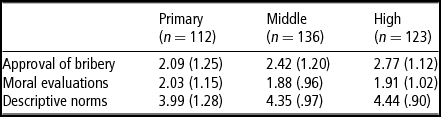
Although all participants gave relatively low ratings for the approval of bribery (M = 2.44, SD = 1.22), grade level still had a significant impact on approval of bribery, F(2,368) = 9.58, p < .001, ηp 2 = .05. Post hoc tests (least significant difference [LSD]) showed that high school students held a higher level of approval bribery than did middle school students (p = .02) and primary school students (p < .001). In addition, middle school students reported stronger approval of bribery than primary school students did (p = .03). These outcomes were consistent with our hypothesis.
For moral evaluations, the overall average rating was low (M = 1.93, SD = 1.04), which indicated that students perceived bribery as immoral. The differences among the three grade levels were not significant (F < 1.00), suggesting that there was no significant relationship between moral evaluations of bribery and age.
However, for descriptive norms, the overall average rating was high (M = 4.27, SD = 1.33), and consistent with our hypothesis, grade level significantly affected ratings for descriptive norms, F(2,368) = 6.01, p = .003, ηp 2 = .03. Older participants more strongly perceived bribery as a common behaviour in society. Post hoc tests (LSD) indicated that high school students and middle school students considered bribery more prevalent than primary school students did (p middle-primary = .01, p high-primary = .001).
Effects of Moral Evaluations and Descriptive Norms on the Approval of Bribery as Age Increases
We hypothesised that the effect of moral evaluations on the approval of bribery would not be moderated by age but that age would moderate the effect of descriptive norms. That is, we predicted that the positive relationship between the moral evaluation and approval of bribery would stabilise with age. However, the positive relationship between descriptive norms and the approval of bribery would become stronger with age. We tested this prediction via hierarchical regression analysis with approval of bribery as the dependent variable. Age (which was coded as: primary school students = −1, middle school students = 0, high school students = 1) and the standardised scores for descriptive norms and moral evaluations were entered in the first step of the regression. Then the two hypothesised interaction terms (age × descriptive norms, age × moral evaluations) were entered in the next step. As observed previously, the results revealed significant main effects of age, B = .25, t(367) = 4.80, p < .001, moral evaluations, B = .63, t(367) = 11.62, p < .001, and descriptive norms, B = .28, t(367) = 5.42, p < .001, ∆R 2 = .35. As predicted, the results showed a significant interaction effect of age and descriptive norms, B = .13, t(365) = 1.97, p = .049, ∆R 2 = .01, whereas age and moral evaluations did not have a significant interaction effect, B = .001, t(365) = .03, p = .98. These findings suggested that the increasing tendency to tolerate bribery may result from the effects of descriptive norms that increase with age, rather than the effects of moral evaluations.
Discussion
Overall, the results of Study 1 supported the hypothesis: Children and adolescents tended to report greater approval of bribery with increasing age. However, the ratings for moral evaluations did not show an age trend or explain the increase in the approval of bribery. Notably, the effect of descriptive norms increased with age and was especially found in primary to middle/high school students; this pattern may have contributed to the bribery tolerance trend. However, the effect of descriptive norms was merely a correlation resulting from the survey method used. Therefore, we still need to test the causal effect of descriptive norms on bribery tolerance with increasing age. Moreover, the socially desirable response (SDR) phenomenon may influence the rating of bribery tolerance because of the sensitive nature of such issues. Therefore, in Study 2 we further attempted to manipulate the descriptive norms to examine the interaction effects of these variables with increasing age on bribery tolerance. We also controlled for the effects of SDR.
STUDY 2
In Study 2, we manipulated the descriptive norms to examine whether they influenced the developmental trends of bribery tolerance.
Methods
Participants
We recruited 236 participants in a class-wide meeting from three schools, including one primary school, one middle school, and one high school in Beijing, China. The participants’ nationality and social class were the same as those in Study 1. Data for some participants were excluded because of missing values and incorrect responses on the reading comprehension test and manipulation check (see below). Therefore, the final sample consisted of 214 participants. Specifically, the sample consisted of 70 primary school students (51.4% boys, M age = 10.29, SD = 1.33), 72 middle school students (48.6% boys, M age = 13.35, SD = .77), and 72 high school students (43% boys, M age = 16.18, SD = .83). None of these individuals participated in Study 1.
Procedure
To manipulate the descriptive norm levels, each participant was provided with a hypothetical scenario similar to that used in Study 1. We employed a descriptive norm manipulation similar to that used by Smith et al. (Reference Smith, Louis, Terry, Greenaway, Clarke and Cheng2012); that is, the participants were informed that in a 1,000 student survey sample, either 85% of the students (high descriptive norm) or 23% of the students (low descriptive norm) believed that they would take the same action as X's parents in similar contexts. The participants in each grade level were randomly assigned to one of the two conditions. The procedure for Study 2 was the same as that of Study 1.
Reading comprehension
Two reading comprehension questions verified the participants’ comprehension of the material. One measured bribery judgment with one item (‘I think that X's parents’ behaviour is bribery’). The other item was: ‘In this scenario, what percentage of people would give a gift to the schoolmaster in the same way that X's parents did?’ The participants chose one of four answers: 23%, 48%, 67%, or 85%. When the participants chose the correct answers, they were categorised as having understood the information.
Manipulation check
The participants rated two items that measured their perceptions of the descriptive norms. The first was: ‘I think most people would do the same thing as X's parents in the same situation’, using a 6-point scale ranging from 1 (do not agree at all) to 6 (agree completely). The second was: ‘What percentage of people do you think would do the same thing as X's parents in the same situation?’ using an 11-point scale from 1 (0%) to 11 (100%).
Measures
Two items measured bribery tolerance. One item was used to assess the approval of bribery (‘I approve of X's parents’ behaviour’), and the other assessed the willingness to bribe (‘If I were X's parents, I would do the same’), Cronbach's α = .63. We also assessed the SDR using 13 items (Reynolds, Reference Reynolds1982. e.g., ‘No matter who I'm talking to, I'm always a good listener’), Cronbach's α = .77. The mean scores of all variables were used in the analysis, and all measures were rated on a 6-point scale ranging from 1 (do not agree at all) to 6 (agree completely).
Results
Reading Comprehension Check
Twelve participants did not pass the reading comprehension check and were excluded from subsequent analysis. The remaining participants considered the behaviour described in the scenario to be bribery, and no significant age differences among the three age groups were observed, M primary = 4.46, SD primary = 1.65; M middle = 4.67, SD middle = 1.59; M high = 4.65, SD high = 1.32; F < 1.00.
Manipulation Check
The manipulation of descriptive norms was successful. Compared with the low descriptive norm condition, the participants in the high descriptive norm condition more strongly agreed that most people would take the same action as X's parents in this situation, M high = 4.18, SD high = 1.08; M low = 3.46, SD low = 1.36; t(194.61) = 4.28, p < .001, Cohen's d = 0.61. Moreover, the participants in the high norm condition estimated that a significantly higher percentage of people would behave as X's parents did in the same situation compared with the responses of the participants in the low norm condition, M high = 8.31, SD high = 1.86, corresponding to 75.55%; M low = 5.62, SD low = 2.41, corresponding to 51.09%, t(191.52) = 9.08, p < .001, Cohen's d = 1.31.
Effects of Descriptive Norms and Grade Level on Tolerance of Bribery
We analysed the tolerance of bribery data using a 2 (descriptive norms: high and low) × 3 (grade levels: primary, middle, high school) between-subjects ANOVA. The means and standard deviations for the participants’ tolerance for bribery are shown in Table 2.
Means and Standard Deviations for the Approval of and Willingness to Engage in Bribery Under Two Descriptive Norm Conditions

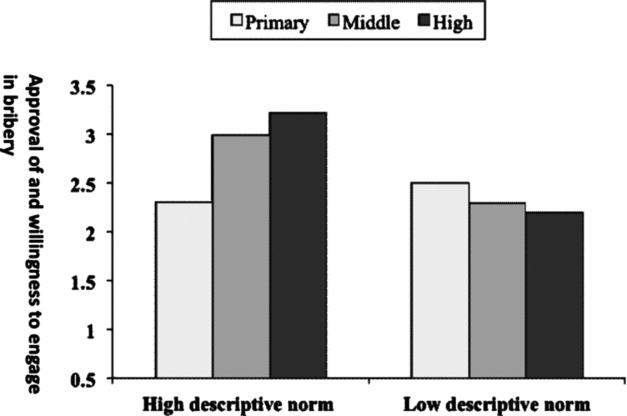
After we controlled for the effects of SDR in univariate analyses, F(1,207) = 8.88, p = .003, ηp 2 = .04, the main effect of the descriptive norms on bribery tolerance was significant, F(1, 207) = 10.91, p = .001, ηp 2 = .05. The participants in the high norm condition were more tolerant of bribery than were those in the low norm condition (M high = 2.83, SD high = 1.25; M low = 2.32, SD low = 1.19). The main effect of grade level was not significant (F < 1.00). Notably, as expected, the interaction effect of descriptive norms and grade level was significant, F(2,207) = 5.54, p = .01, ηp 2 = .05. One-way ANOVAs indicated that in the high norm group, the effect of grade level on bribery tolerance was significant, F(2,108) = 5.94, p = .004, ηp 2 = .10: middle and high school students were more tolerant than primary school students, based on post hoc testing (LSD), p middle-primary = .02, p high-primary = .001. The results revealed no significant difference between the middle and high school students, p middle-high = .40. By contrast, no significant differences among different grade levels were observed in the low norm group, F(2, 100) < 1.00 (see Figure 1). This significant interaction effect of descriptive norms and grade level also indicated that the effect of descriptive norms on bribery tolerance was moderated by age. For each age group (primary, middle, and high school students), after we controlled for the effects of SDR, F(1,67) = .45, p = .51; F(1,69) = 5.93, p = .02, ηp 2 = .08; F(1,69) = 7.01, p = .01, ηp 2 = .09, univariate analyses indicated that the effect of descriptive norms was not significant for primary school students, F(1,67) = .43, p = .52, ηp 2 = .05, but that the effect was significant for middle and high school students, F(1,69) = 8.25, p = .005, ηp 2 = .11; F(1,69) = 18.39, p < .001, ηp 2 = .21. These results were the same as in Study 1, consistent with our prediction that the effect of descriptive norms on bribery tolerance increased with age.
The interaction effect of descriptive norms and grade level on the approval of and willingness to engage in bribery.
Discussion
The results of Study 2 largely supported the hypothesis that descriptive norms have an important influence on individual tolerance of bribery. Moreover, the results indicated an increasing tendency for bribery tolerance with age only in the high descriptive norm condition. Furthermore, middle and high school students were more influenced by descriptive norms than primary school students. This result indicated that when the descriptive norm was in conflict with moral norms, adolescents appeared to be more influenced by such descriptive norms and to show greater tolerance for transgressions than younger children did. During their socialisation process, adolescents may regard bribery as a way to adapt to the social world.
General Discussion
In two studies, we demonstrated that the moral evaluation of transgression (whether this behaviour is immoral) decreased tolerance for transgressions, while descriptive norms (whether this behaviour is prevalent) increased tolerance for transgressions. Notably, children and adolescents became more tolerant of transgressions as they got older, given the increasing perceptions of descriptive norms that support transgression.
Moral Evaluations Influenced the Tolerance of Transgressions
In Study 1, we demonstrated that moral evaluations weakened the tolerance for transgressions, a finding that was consistent with previous studies. For instance, individuals disapproved of bribery when they perceived bribery as immoral (Powpaka, Reference Powpaka2002). Moreover, we found no evidence of a significant difference between the moral evaluation of transgressions and age (among children aged 10–16) for the bribery scenario in this study. This finding suggests that children at age 10 have a moral evaluation ability similar to that of adolescents aged 13–16 years when they perceive the morality of bribery as a serious transgression. Age and moral evaluation did not appear to be related among children and adolescents when assessing the morality of bribery, consistent with studies of adults whose moral evaluations of bribery were not affected by age (Ross & Roberston, Reference Ross and Robertson2003). All participants judged the behaviour in the scenario as bribery, and no age differences appeared (Study 2, bribery judgments); all participants knew that bribery was immoral (Study 1, moral evaluations). However, the effect of moral evaluations on bribery tolerance was stable and could not explain the increasing tolerance of bribery with age.
Descriptive Norms Influenced the Tolerance of Transgressions
Consistent with our hypotheses, the incongruence between descriptive norms and morality increased the tolerance of transgression (the high descriptive norm condition in the present study). This finding extends the knowledge of descriptive norm effects in two ways. First, in previous research, conflict conditions (in which descriptive norms are incongruent with moral norms) led to the tolerance of illegitimate behaviour beyond that examined in previous studies (e.g., littering or cheating; Cialdini et al., Reference Cialdini, Reno and Kallgren1990). More serious transgressions such as bribery may evoke more conflicting goals between the desire to act appropriately and the desire to act in one's own self-interest. The goal of acting appropriately was weakened when people observed that others did not pursue this same goal (Lindenberg & Steg, Reference Lindenberg and Steg2007; Keizer et al., Reference Keizer, Lindenberg and Steg2008). Similarly, conforming to descriptive norms (i.e., most people engage in bribery) may be a means of pursuing the goal of acting in one's own self-interest (e.g., enrolment in a top-ranking high school), thereby weakening conformity to moral norms (e.g., acting appropriately). Indeed, these findings warn us about the dangers of descriptive norms that support illegitimate acts. Second, the level of transgression tolerance was low when the descriptive norm was congruent with morality (the low descriptive norm condition in the present study); this finding suggests that congruence between descriptive norms and moral evaluations can not only increase moral behaviour intentions (Schultz et al., Reference Schultz, Khazian and Zaleski2008), but can also decrease the tolerance of transgressive behaviour. Paek, Li, and Hove (Reference Paek, Lee and Hove2014) also found descriptive norms perception was significantly and directly related to antismoking behavioural intention among the Korean participants. Therefore, descriptive norms may strongly influence behaviour intention. Transgression may be tolerated (e.g., approval and willingness to transgress) when descriptive norms support it, whereas it may be resisted when descriptive norms do not support it. Indeed, congruence between descriptive norms and moral evaluations should form the basis for effectively invoking injunctive norms (moral norms).
The Developmental Trend of Descriptive Norm Effects on Transgression Tolerance
The results suggested a developmental trend in the effects of descriptive norms on bribery tolerance in the high norm condition. According to the results, the more the participants regarded this transgression as a descriptive norm, the more they tended to approve of or accept such transgression with age. Such developmental trends have largely been overlooked in the previous literature.
The developmental trend of descriptive norms reflects children and adolescents’ socialisation and social adaptation. Rowe (Reference Rowe1994) postulated an innate adaptive mechanism that directs individuals to learn from any source — a learning mechanism that is ‘general with respect to informational source’ (p. 194). Descriptive norms provide information regarding the behaviour that is most prevalent and is likely to be effective or adaptive in a particular context (Smith et al., Reference Smith, Louis, Terry, Greenaway, Clarke and Cheng2012). ‘Most prevalent’ denotes a generic norm for society as a whole that also has an important influence on adolescents’ willingness to commit transgressions in addition to norms from the peer group. Compared with conforming to descriptive norms from peers (which could help to be accepted by peers and to avoid deviating from group norms; Stok et al., Reference Stock, de Ridder, de Vet and de Wit2014), adolescents learn descriptive norms from society and consider their use to be a signal of social adaptation. Adolescents may conclude that certain transgressions are ‘just the way things work’ and may thus endorse them as a pragmatic way to ‘succeed’ in society. We found significant effects of descriptive norms on bribery tolerance for middle and high school students, but not for primary school students. These results suggested that younger children are likely to be less influenced by society's descriptive norms because parental social norms are more influential at that stage (Maccoby, Reference Maccoby, Grusec and Hastings2007; Matthies et al., Reference Matthies, Selge and Klöckner2012). Thus, an immoral social climate, akin to the effect of bad apples in a barrel (Gino et al., Reference Gino, Ayal and Ariely2009), could cause adolescents with a strict moral code to compromise that code in favour of descriptive norms, whereas such compromise is less likely to occur among younger children.
Moreover, moral flexibility (e.g., a morally utilitarian stance that approves of harmful actions that maximise good consequences; Greene, Morelli, Lowenberg, Nystrom, & Cohen, Reference Greene, Morelli, Lowenberg, Nystrom and Cohen2008) may be the underlying mechanism driving the increasing age-based influence of descriptive norms on the tolerance for transgressions. Increased moral flexibility helps people to draw on arguments that support tolerance or justification for one's own immoral behaviour (Gino & Ariely, Reference Gino and Ariely2012; Greene et al., Reference Greene, Morelli, Lowenberg, Nystrom and Cohen2008); for instance, exhibiting hypocrisy (Lammers, Reference Lammers2012), or increased dishonest behaviour in creative people (Gino & Ariely, Reference Gino and Ariely2012). Descriptive norms influence behaviour based on the assumption that ‘if a lot of people are doing it, it's probably a wise thing to do’ (Cialdini, Reference Cialdini2007, p. 264). This assumption may evoke moral flexibility and justify the transgressive behaviour as more acceptable. Furthermore, moral flexibility was age related, in that older individuals were more flexible than younger ones (Levy, Taylor, & Gelman, Reference Levy, Taylor and Gelman1995). Therefore, it appears reasonable that descriptive norms may increase moral flexibility, such as adopting a utilitarian stance, and thereby enhance the toleration of transgression.
Applications
Our findings can be applied in at least two domains. First, in the area of moral education, awareness of the effects of descriptive norms on children's and adolescents’ moral development is crucial. Descriptive norms that support transgressive behaviours are harmful because they may cause children and adolescents to be more prone to engage in such behaviours. Therefore, descriptive norms that promote transgressions must be addressed. Specifically, bribery in the school context must be strictly managed. Schools should create supervision systems that prevent schoolmasters and teachers from being able to accept bribes and should provide a more wholesome educational climate for children and adolescents. Moreover, schools should help students form healthy and proper values and morality systems to resist certain improper values and behaviours prevalent in society. Children and adolescents may thereby construct appropriate attitudes toward transgressions.
A second implication is that governments and administrations should increase the investigation and punishment of transgressive behaviour. Such steps would increase awareness of the risks and costs of transgressions, thus decreasing their prevalence (Matthies et al., Reference Matthies, Selge and Klöckner2012). Furthermore, increasing the costs of committing transgressions are likely to decrease conformity to descriptive norms. Indeed, the ‘anti-corruption campaign’ by the Chinese government (Anti-corruption campaign in China, Wikipedia, 2015) has achieved success in fighting corruption in recent years (232 officials of prefecture-department rank were disciplined from December 2012 to February 2015; see Central Commission for Discipline Inspection Anti-Corruption Report, 2015), which facilitates to reconstruct a fair and just social environment.
Limitations and Future Directions
Despite its strengths, this study also had certain limitations. The items measuring bribery tolerance were few, which may have influenced the stability of the results. Moreover, our data were cross-sectional; future research should use longitudinal data to investigate these findings. In addition, the effect size of descriptive norms from the larger society was not big enough, and the effect of descriptive norms from peers on transgressions could have been much more influential. Future research should compare the strength of the influence of these two descriptive norms. Moreover, Study 2 did not include control conditions in which the participants received no information on how others behave. Future research should use a design that includes this control condition to improve the validity of the results. Furthermore, future research should verify the findings by evaluating other transgressive behaviours in different situations with children and adolescents in order to expand the generalisation of these findings. Furthermore, future research should examine moral flexibility as a possible underlying mechanism for the influence of descriptive norms on transgressions. Finally, injunctive norms, but not descriptive norms, were found to be positively related with collectivism orientation (Paek et al., Reference Paek, Lee and Hove2014). Given that Chinese are quite collectivistic (Singelis, Triandis, Bhawuk, & Gelfand, Reference Singelis, Triandis, Bhawuk and Gelfand1995), children and adolescents may be more influenced by injunctive norms as they are enculturated into their native societies. Therefore, the effect of injunctive norms on bribery might also become stronger with age among children and adolescents. Future research is needed to compare the strength of the influence of injunctive norms and descriptive norms on the tolerance of transgression with age.
Conclusion
We demonstrated that children and adolescents showed greater tolerance of bribery with increasing age and that this increasing tolerance resulted from the increasing effects of descriptive norms rather than from moral evaluations. Society should discourage descriptive norms that promote transgressive behaviours and encourage those that enhance moral behaviours to prevent the erosion of children and adolescents’ morality.
Acknowledgments
The authors would like to express appreciation to the instructors and students who assisted in collecting the data in the present study. We are also grateful to Professor James H. Liu, Massey University, New Zealand, and Professor Ying-yi Hong, Nanyang Technological University, Singapore, for their assistance in processing the manuscript. This research was supported by the National Natural Science Foundation of China (31571145), MOE Project of Key Research Institutes of Humanities and Social Science at Universities (10JJDXLX002), Project of Beijing Municipal Commission of Education (PXM2014_014202_07_000067) and Project of Chinese Positive Psychology Research.



