


1. Introduction
When a technology company partners with a university to advance an emerging solution, two distinct agendas converge. The company seeks to increase the technology readiness level (TRL)Footnote 1 of their innovation, moving it from concept toward market deployment. The academic researcher pursues a knowledge gap; a question that, once answered, contributes to the scholarly discourse. Ideally, these agendas align harmoniously: the research produces both practical utility and theoretical insight. In reality, however, many industry-sponsored research projects conclude with limited knowledge effectively transferred back to the sponsoring organization, representing a missed opportunity for both partners (Reference CommissionCommission, 2007; Reference Dwivedi, Jeyaraj, Hughes, Davies, Ahuja, Albashrawi, Al-Busaidi, Al-Sharhan, Al-Sulaiti, Altinay, Amalaya, Archak, Ballestar, Bhagwat, Bharadwaj, Bhushan, Bose, Budhwar, Bunker and WaltonDwivedi et al., 2024).
The principle of “industry as laboratory” (Reference MullerMuller, 2013; Reference PottsPotts, 1993) suggests that academic researchers can address industrially motivated problems while advancing scientific knowledge. Yet this dual mandate creates inherent tensions. Academia prioritizes theoretical novelty and generalizability; industry demands actionable solutions within tight timeframes. Academic discourse often remains inaccessible to practitioners, while industrial contexts resist the abstraction necessary for scholarly contribution. These misalignments manifest in divergent timelines, evaluation criteria, and communication practices that can destabilize collaborations before they yield transformative results. Design Science Research (DSR) approaches such as Action Design Research (ADR) (Reference Sein, Henfridsson, Purao, Rossi and LindgrenSein et al., 2011) and its variants and extensions focus on co-creation and capturing of the practitioners’ knowledge to inform the research activities. While it informs the directly involved practitioners, it does not guarantee wide knowledge transfer. Furthermore, none of the nine design research quality themes directly tackle the embedding of the research results into the sponsoring organization (Reference Cash and DaalhuizenCash & Daalhuizen, 2025).
This positioning paper addresses a critical question: How can a research methodology effectively promote knowledge transfer in the context of academic research projects sponsored by industry partners? We propose that the solution lies not in choosing between rigor and relevance, but in structuring the research process to approach both simultaneously. The Dual Impact Research Methodology (DIRM) emerges from this commitment; a framework designed to bridge engineering problems and research problems through deliberate integration rather than sequential treatment.
However, our intention is not to replace the existing DSR methodology, but to complement it by offering an approach for structuring and organizing DSR projects that supports effective knowledge transfer. This is achieved through a methodological integration that treats the engineering problem and the research problem as interrelated objectives throughout the inquiry, rather than as separate challenges.
Therefore, our contribution relies on proposing a set of guidelines for dual-impact design research—research that integrates knowledge transfer and delivers value to both academia and industry. These guidelines adapt and extend the original Design Research Guidelines by Reference Hevner, March, Park and RamHevner et al. (2004).
In the following sections, we outline the conceptual foundations of industry–academia collaboration, contextualize the problem and existing solutions, present the Dual-Impact Research Methodology Guidelines, and finally evaluate these guidelines against our study objectives before concluding.
2. The conceptual foundation: where engineering meets research
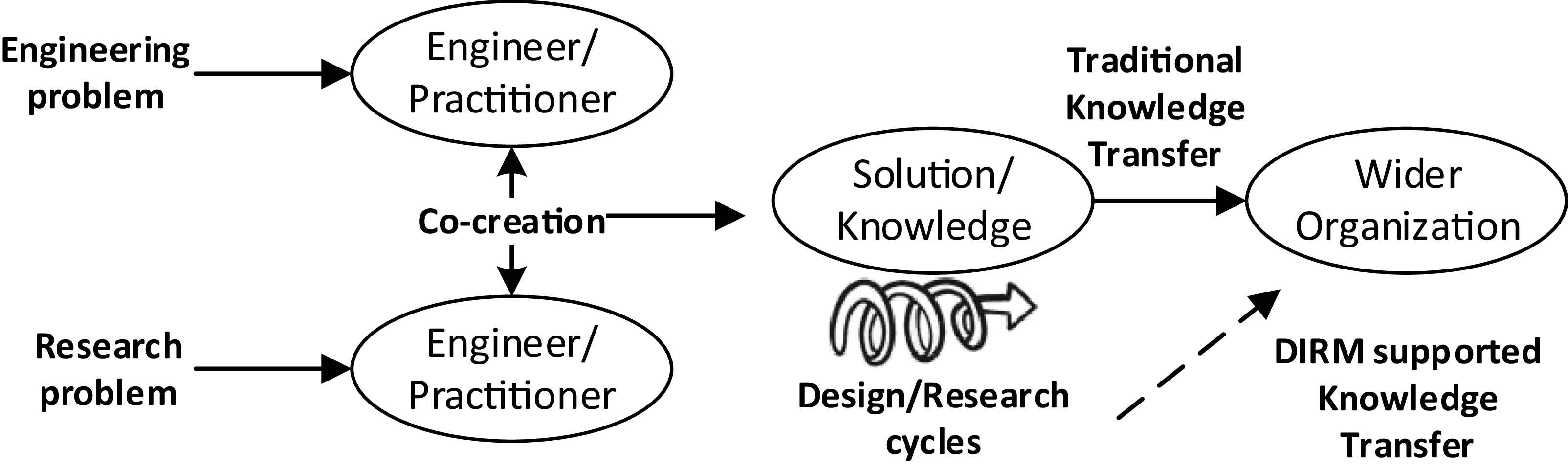
Four interconnected concepts structure the landscape of this research: engineering problem, research problem, knowledge transfer, and co-creation (Figure 1).
An engineering problem represents a real-world technical challenge requiring the application of knowledge, methods, and tools to create solutions within defined constraints. Engineering problems are application-oriented and solution-focused, typically involving the design, construction, or improvement of artifacts, processes, or systems. The evaluation criteria centre on functionality, performance, usability, and practical relevance.
By contrast, a research problem identifies a knowledge gap requiring systematic investigation to produce new insights, models, or theories. Research problems are knowledge-oriented and discovery-driven, focusing on understanding why or how phenomena occur. The evaluation criteria emphasize scientific rigour, which ensures validity, reliability, generalizability, and theoretical contribution.
The research landscape

These two problem types are not merely different; they embody distinct epistemologies. Engineering operates through abductive and iterative reasoning, creating possible solutions and refining them synthetically. Scientific research proceeds through deductive and inductive reasoning, deriving general laws or verifying hypotheses analytically. Yet, in the context of industry-sponsored research, these two modes must converge (Reference Christersson, Melin, Widén, Ekelund, Christensen, Lundegren and StaafChristersson et al., 2022).
Co-creation represents a collaborative approach where academics and practitioners work together to produce knowledge that addresses specific challenges or opportunities. Rather than operating in separate spheres, both parties integrate their distinct expertise and perspectives to generate solutions that neither could develop alone (Reference Prahalad and RamaswamyPrahalad & Ramaswamy, 2004; Reference Sanders and StappersSanders & Stappers, 2008).
Knowledge transfer refers to the structured process through which knowledge, expertise, and research outcomes are shared between individuals, organizations, or sectors to enable innovation, learning, and practical application (Reference CommissionCommission, 2007). In academia-industry contexts, it specifically involves translating academic research into usable insights, technologies, or solutions that address real-world challenges. This transfer is often treated as a final phase, as something that happens after research concludes (Reference de Wit-de Vries, Dolfsma, van der Windt and Gerkemade Wit-de Vries et al., 2019).
Knowledge transfer and co-creation represent two distinct yet complementary approaches to bridging the gap between academia and industry. Without adequate knowledge transfer mechanisms, even the most successful co-creation efforts may fail to achieve their full practical impact (Reference De Silva, Al-Tabbaa and PintoDe Silva et al., 2023).
In this paper, dual impact results from integrating knowledge transfer to the co-creation cycles where the design and the research take place (Figure 1). Co-creation allows for the development of innovative, context-specific solutions through shared effort, while knowledge transfer ensures that the insights generated can be effectively disseminated, applied, and scaled within the business environment.
3. The friction points: why integration Is difficult
Integrating engineering challenges, research objectives, co-creation and knowledge transfer offers significant potential for impact but also introduces complex tensions. When design research is conducted in collaboration with industry, it operates at the intersection of three value systems: scientific rigor, design innovation, and industrial impact. Each system brings distinct timelines, evaluation criteria, knowledge types, and engagement modes that can either destabilize or catalyse collaboration. Within this interplay, several friction points emerge (Reference de Wit-de Vries, Dolfsma, van der Windt and Gerkemade Wit-de Vries et al., 2019; Reference MullerMuller, 2013; Reference Peffers, Gengler, Tuunanen and RossiPeffers et al., 2006).
Purpose misalignment occurs because science prioritizes understanding and explaining phenomena, design emphasizes creating innovative artifacts, and industry focuses on solving immediate operational problems. These divergent purposes lead to disagreements about project objectives—is success measured by theoretical contribution, functional effectiveness, or business impact?
Temporal tensions arise from incompatible time horizons. Science pursues long-term knowledge accumulation, design employs iterative prototyping cycles, and industry demands short-term deliverables. This pacing mismatch can frustrate all parties: industry partners may perceive academic research as too slow, while researchers struggle to publish work developed under compressed timelines.
Evaluation conflicts emerge from different success criteria. Scientists value rigor, validity, and generalizability. Designers assess fitness for purpose, creativity, and functionality. Industry measures return on investment, performance metrics, and market readiness. Without explicit reconciliation, partners may reach project conclusions with fundamentally different assessments of whether the work “succeeded.”
Knowledge translation barriers reflect the different forms knowledge takes across domains. Academic knowledge tends toward the theoretical and explanatory; design knowledge is prescriptive and procedural; industrial knowledge often remains tacit and experiential. Moving insights across these forms requires deliberate translation work that many research methodologies do not explicitly support.
Communication barriers due to academic writing are often too technical and filled with jargon, making it inaccessible to practitioners. Papers tend to prioritize journal acceptance over impact or usability
Cultural and procedural divides, where universities and companies operate with different rules regarding confidentiality, intellectual property, safety, and delivery standards. Industry expects ready-to-use products, whereas academia focuses on exploratory prototypes or proofs of concept
Role ambiguity compounds these tensions. Is the academic researcher an objective observer, a co-designer, or a consultant? The answer shifts throughout the project, creating confusion about responsibilities and contributions. Industry partners may expect deliverables resembling consulting outputs, while researchers prioritize scholarly publications that may not serve immediate industrial needs.
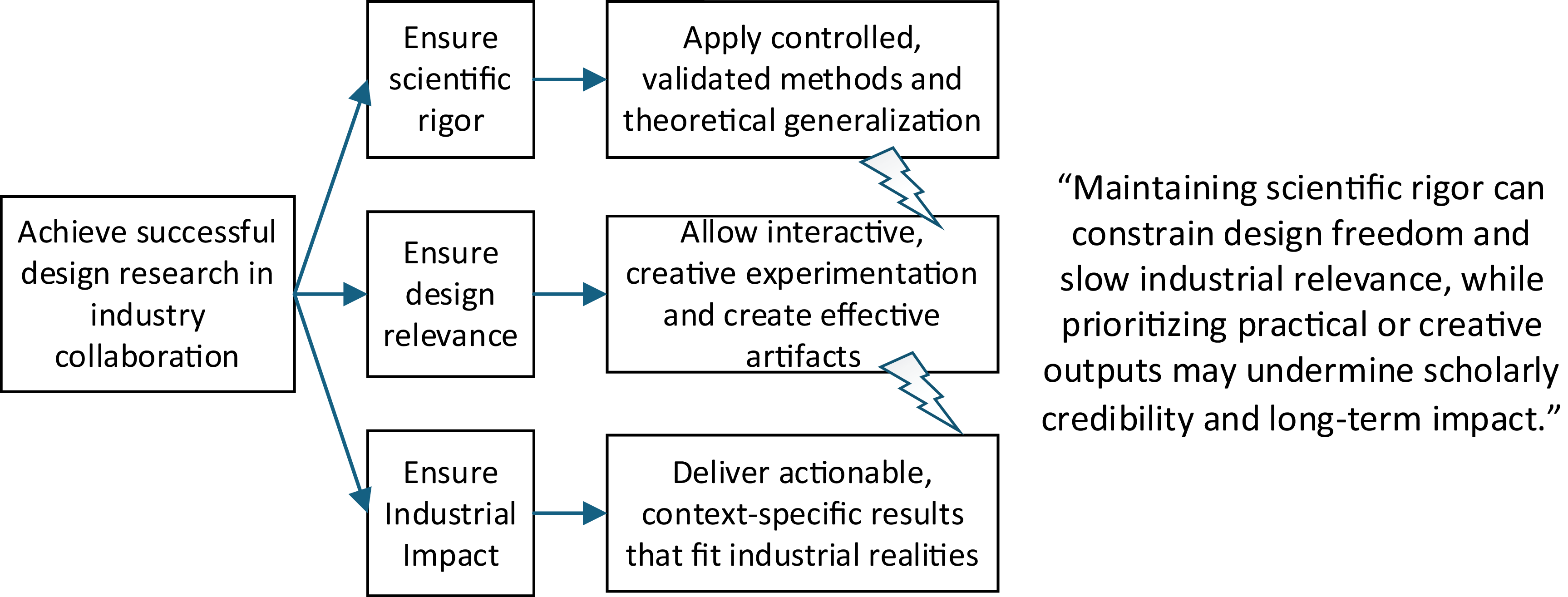
At the heart of these tensions lies a fundamental challenge: maintaining scientific rigor can constrain design freedom and slow industrial relevance, while prioritizing practical or creative outputs may undermine scholarly credibility and long-term impact (Figure 2).
Evaporating cloud diagram

These friction points are not inherently problematic. When managed effectively, they become catalysts for high-impact research that produces knowledge which is simultaneously rigorous, innovative, relevant, and transferable. The challenge lies in structuring the research process to fulfil all three value systems without compromising any.
4. Existing design research methodologies: strengths and gaps
The convergence of the scientific process and the design process yields both theoretical insights and practical solutions; a dual outcome that forms the foundation of Design Science Research (DSR) methodologies that align research problems with engineering challenges (Reference Nunamaker, Chen and PurdinNunamaker et al., 1990).
DSR is grounded in the idea that knowledge can be created not only by observing phenomena but also by designing and evaluating purposeful artifacts such as methods, models, constructs, processes, or systems. Several established methodologies operationalize DSR principles, including the Systems Development Research Methodology (SDRM) (Reference Nunamaker, Chen and PurdinNunamaker et al., 1990), Design Research Methodology (DRM) (Reference Blessing and ChakrabartiBlessing & Chakrabarti, 2009), Action Design Research (ADR) (Reference Sein, Henfridsson, Purao, Rossi and LindgrenSein et al., 2011) the Spiral Approach for Systems Engineering Research (SASER) (Reference Bonnema, Pereira Pessoa and NizamisBonnema et al., 2022) echeloned DSR (eDSR) (Reference Tuunanen, Winter and vom BrockeTuunanen et al., 2024). For guidance on selecting an appropriate design research methodology and for a detailed comparison of some of the available approaches, see Reference Venable, Pries-Heje and BaskervilleVenable et al. (2017).
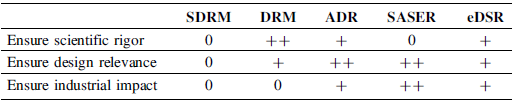
Table 1 compares these DSR methodologies against the three challenges depicted in Figure 2. Specifically, we interpret ensuring industrial impact as creating results that are framed to facilitate technology transfer. In this comparison, SDRM serves as the baseline reference and is assigned a value of 0 across all criteria. The other methodologies are then evaluated relative to SDRM, with ratings indicating whether they are more capable (+, ++) in addressing each criterion.
Comparative o DSR methodologies

Within the comparison of methodological rigor, the DRM stands out as the most rigorous approach due to its step‑wise structure, which incorporates dedicated descriptive and prescriptive studies as well as explicit evaluation both before and after the provision of design support. This end‑to‑end organization enhances methodological transparency, traceability, and the validity of research findings. In contrast, although SDRM also contributes to scientific rigor, it provides looser procedural structure and fewer explicit validation requirements than DRM, making it less prescriptive with respect to methodological transparency and evaluation rigor. Compared to ADR, DRM is more formalized and less dependent on organizational contingencies, resulting in a clearer separation of evaluation phases and more consistent documentation standards. Additionally, its maturity and detailed prescriptions for study design and reporting offer stronger guardrails for securing internal and external validity than emerging approaches such as SASER. While eDSR strengthens rigor through echelon‑specific validation, it remains a newer, complementary organizing logic rather than a full methodological replacement.
In terms of practical relevance, both ADR and SASER stand out as the strongest methodologies. ADR achieves exceptional relevance by embedding building, intervention, and evaluation into a single concurrent cycle within the host organization, allowing artifacts to evolve in direct response to organizational realities and maximizing practitioner usefulness. SASER excels by shortening iteration cycles with industry partners and mitigating the risk of analysis lock‑in; by prioritizing early demonstrators and prototypes, it enables firms to rapidly observe tangible value and remain engaged throughout the research process. SDRM also offers practical relevance through its emphasis on system building, experimentation, and observation in real organizational contexts; however, it is less explicit than ADR and SASER in structuring continuous cycles of engagement with practitioners, resulting in a more moderate level of practical relevance. Although DRM does aim for industrial significance, it typically introduces practical engagement only after extensive upfront analysis, whereas ADR and SASER compress the distance between research and application through embedded and spiral iteration. Likewise, while eDSR improves manageability and enhances communication with stakeholders, its hierarchical organizing logic does not inherently require the depth of concurrent organizational intervention characteristic of ADR and SASER and thus does not reach the same level of direct practical relevance.
Regarding industrial impact and knowledge transfer, SASER demonstrates the strongest performance among the compared methodologies. SASER is explicitly designed to enhance adoption by synchronizing research activities with the iterative rhythms of industrial development, thereby generating tangible intermediate outcomes—such as prototypes and demonstrators—that can be transferred, trialed, and institutionalized at earlier stages than in more linear methodologies. While ADR also fosters strong uptake through in-situ organizational intervention, SASER surpasses it by making sustained industrial engagement a primary methodological principle; frequent spirals ensure that knowledge transfer is not a secondary effect but an intentional design variable. In contrast, both DRM and SDRM support practical outputs but provide fewer explicit mechanisms for early demonstrators and recurring transfer checkpoints, which can slow the path to organizational adoption. Finally, although eDSR improves transfer through incremental deliverables and structured communication, it does not inherently enforce real-world spiral cycles or “industry as laboratory” practices to the same extent as SASER and thus achieves comparatively lower impact in industrial uptake.
To achieve this paper’s objective, it is desirable to combine the complementary strengths of DRM, ADR, and SASER. Although SASER presents itself as a promising alternative, particularly due to its attempt to integrate the formal rigor of DRM with iterative, industry-aligned spiral development, its current formulations provide limited guidance on how research questions should be structured to support systematic and incremental progression. Early examples of SASER’s application further suggest that it may unintentionally overcomplicate the research process by advocating that DRM’s phases, along with the research questions derived from them, be addressed progressively through successive spirals (Reference Lenssen, Ahmed, Nizamis, Pessoa and BonnemaLenssen et al., 2023). It introduces ambiguity for researchers seeking to implement SASER’s gradual inquiry process in practice (Reference Pessoa and NizamisPessoa & Nizamis, 2023).
4.1. Learning from practice: empirical insights
Recent empirical studies provide valuable insights into practices that effectively bridge academia and industry.
Reference Dwivedi, Jeyaraj, Hughes, Davies, Ahuja, Albashrawi, Al-Busaidi, Al-Sharhan, Al-Sulaiti, Altinay, Amalaya, Archak, Ballestar, Bhagwat, Bharadwaj, Bhushan, Bose, Budhwar, Bunker and WaltonDwivedi et al. (2024) conducted a multi-institutional study on bridging research and practice that identifies specific challenges and effective mechanisms. Their findings highlight the importance of researchers’ ability to translate, reframe, and align academic and industrial perspectives. Successful knowledge transfer requires progression from syntactic communication (information transfer) to semantic (shared meaning) and pragmatic (mutual benefit) forms of engagement.
Similarly, Reference Dolmans, Walrave, Read and van StijnDolmans et al. (2022) emphasize that effective knowledge transfer depends not only on the quality of research but also on researchers’ ability to act as boundary spanners: individuals capable of mediating between academic and industrial domains by translating, reframing, and aligning their respective perspectives. Their study identifies a persistent communication gap between academia and industry, driven by misaligned goals, timelines, and terminologies. Academic outreach often remains technical and one-directional, while a general discomfort with business-like engagement and a lack of formal collaboration structures further impede interaction. To overcome these barriers, Reference Dolmans, Walrave, Read and van StijnDolmans et al. (2022) recommend the establishment of boundary infrastructures to support coordination and technology adoption, iterative engagement and reflection to move from simple information transfer toward shared meaning and mutual benefit, and regular cross-institutional meetings and shared documentation to foster peer learning, transparency, and adaptive improvement.
Complementary evidence from research on sympraxis and co-creation models demonstrates the value of deep collaboration throughout all stages of research: planning, execution, and dissemination (Reference Chatterjee, Bhattacherjee, Gilb, Mandviwalla, Söllner and TuunanenChatterjee et al., 2024; Reference Kuechler and VaishnaviKuechler & Vaishnavi, 2008). Rather than following sequential phases in which academia conducts research and subsequently transfers results to industry, co-creation conceptualizes knowledge as jointly produced through sustained partnership. This approach promotes shared ownership, builds trust, and yields outcomes that are simultaneously relevant to academic and industrial objectives.
A review of university–industry knowledge transfer practices by Reference de Wit-de Vries, Dolfsma, van der Windt and Gerkemade Wit-de Vries et al. (2019) identifies some findings relevant to a methodology aiming to bridge research and practice in industry-funded projects. Such a methodology must: (1) integrate personnel exchange, joint sense-making, and on-site collaboration as core processes; (2) include structured steps for negotiating meaning, building trust, and aligning epistemic norms; and (3) employ iterative interaction cycles (e.g., meetings, prototypes, feedback) rather than relying solely on contractual deliverables.
In a similar vein, the Reference CommissionCommission (2007) provides practices and insights relevant to the design of research methodologies that bridge academia and industry. These include structuring collaboration governance to ensure joint decision-making between academic and industrial partners, and embedding education and mutual learning throughout research projects to strengthen knowledge absorption.
Taken together, these empirical insights suggest that effective design research for industry–academia collaboration should structure the research process as a continuous learning and translation mechanism in which knowledge is co-produced, refined, and applied collaboratively, rather than merely disseminated at the conclusion of the project. This is reflected in our own experiences within the Fraunhofer Innovation Platform for Advanced Manufacturing at the University of Twente (FIP-AM@UT). This FIP employs research engineers (REs), who provide a bridge between projects as defined by its industry partners and university academics who can connect through their knowledge of research, advanced thinking and methods. This works particularly well for small/medium scale enterprises who have limited internal R&D. The principal skills these REs possess are an interdisciplinary approach to problem solving combined with knowledge of the manufacturing industry domain and project management.
5. Dual Impact Research Methodology guidelines
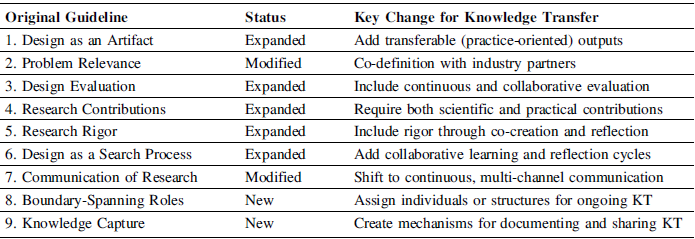
To ensure that knowledge generated through Dual Impact Research Methodology (DIRM) is effectively transferred to industry partners throughout the research process, the original seven Design Science Research guidelines proposed by Reference Hevner, March, Park and RamHevner et al. (2004) have been adapted and extended (Table 1). These revised guidelines embed continuous collaboration, co-creation, and knowledge exchange as integral components of the research methodology. The revisions incorporate best practices for co-producing knowledge between academia and industry, as outlined in the preceding sections.
Guideline 1: Design as a Dual Artifact (Scientific and Transferable)
Dual Impact Research must produce a viable scientific artifact (construct, model, method, or instantiation) and a transferable knowledge artifact that facilitates understanding and application by industry partners.
Addition: Each research iteration should yield outputs interpretable and usable by practitioners (e.g., prototypes, playbooks, insights, decision aids), ensuring ongoing practical relevance.
Guideline 2: Problem Relevance and Co-Definition
The objective of Dual Impact Research is to co-define and address technology-based solutions to mutually recognized problems of business and scientific importance.
Change: Problem definition becomes a joint activity involving both researchers and industry partners, ensuring alignment of objectives and vocabulary early in the process.
Guideline 3: Continuous and Contextual Evaluation
The utility, quality, and efficacy of a design artifact must be continuously evaluated throughout the project in collaboration with practitioners, using both formative (ongoing) and summative (final) evaluation methods.
Addition: Evaluation should include feedback loops that generate mutual learning—where industry feedback refines the design, and research reflection refines theory.
Guideline 4: Dual Contributions — Scientific and Practice-Based
Dual Impact Research must provide dual contributions. To scientific knowledge, it contributes with artifacts, methods, and theoretical advances. To practice knowledge, it contributes with validated guidelines, frameworks, or tools enabling implementation in industrial settings).
Addition: The transfer of practice knowledge should be documented and measurable throughout the research.
Guideline 5: Research Rigor with Co-Creation Methods
Rigor must be maintained through the systematic application of established research methods and co-creation practices (e.g., joint workshops, design sprints, boundary-spanning sessions).
Addition: Co-creation and participatory validation serve as legitimate forms of methodological rigor when ensuring knowledge transfer.
Guideline 6: Design as a Collaborative Search and Learning Process
The search for an effective artifact is a collaborative learning journey, where both researchers and practitioners contribute insights, constraints, and evaluation criteria.
Expansion: The methodology should incorporate learning cycles, with reflection after each iteration to capture emergent knowledge and adapt design directions accordingly.
Guideline 7: Multi-Channel Communication and Knowledge Translation
Dual Impact Research must communicate progress and outcomes continuously through multiple channels tailored to diverse audiences: academic, managerial, and operational.
Change: Replace one-time reporting with iterative communication mechanisms such as joint reflection sessions, prototype demonstrations, industry briefs, and embedded documentation.
Guideline 8 (New): Boundary-Spanning Roles and Structures
Dual Impact Research projects involving industry partners must formally identify boundary spanners or knowledge brokers responsible for maintaining bidirectional flow of knowledge between academia and practice.
Addition: These individuals or roles ensure that insights are contextualized, translated, and integrated into both domains throughout the research.
Guideline 9 (New): Knowledge Capture and Institutionalization
Research must establish mechanisms for capturing, documenting, and institutionalizing knowledge generated during collaboration.
Addition: Use shared repositories, engagement logs, or learning histories to ensure that tacit knowledge is retained and transferable beyond the project’s lifespan.
Summary of adaptations and extensions to the original Design Science Research guidelines

5.1. Guidelines instantiation example
Figure 3 exemplifies the use of the guidelines (G) to create a possible DIRM to a research project. Note that the dual outputs (G1, G4, G8) which approach both the engineering and research problems, imply and co-creation and collaboration between researchers and practitioners (G2, G5, G6) and the knowledge transfer requires effective knowledge capture with artifacts that facilitate institutionalization and that allow contextual evaluation (G3, G7, G9).
6. Discussion: addressing the friction points through DIRM
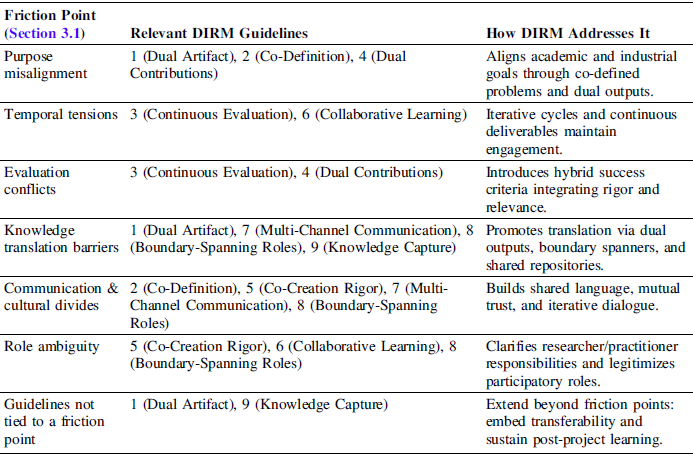
The Dual Impact Research Methodology (DIRM) guidelines directly respond to the six friction points identified earlier by embedding co-definition, continuous evaluation, and boundary-spanning mechanisms throughout the research process. Each guideline contributes to resolving specific tensions between scientific rigor, design innovation, and industrial relevance (Table 3).
DIRM mitigates purpose misalignment through dual problem framing and joint definition of objectives (Guidelines 1, 2, 4), ensuring that academic and industrial goals remain synchronized. Temporal tensions are managed by iterative learning and continuous evaluation (Guidelines 3, 6), allowing short-term deliverables without sacrificing long-term inquiry. Evaluation conflicts are addressed via hybrid criteria and dual contributions (Guidelines 3, 4), though standardized cross-domain metrics are still needed.
Example of the guidelines’ implementation

Figure 3 Long description
A diagram illustrating the process of design science research, highlighting four key studies and their interactions. Panel A: Study 1 Framing & Scoping. Clear understanding of the problem (effect + root causes). Requirements and constraints for evaluating solution alternatives. The research problem to be approached, based on what is already known about the causes of the engineering problem, and where are the gaps. The hypotheses that can be formulated to advance knowledge in this area. Research project plan based on the balancing the needs and possibilities from the practice and the research, and which creates a clear set of expectations based on desirability, viability and feasibility. Panel B: Study 2 Analyzing and Describing. Engineering problem generalization. Identification of the state of the practice in dealing with the generalized problem. Mapping of the state of the practice (if applicable including patents). Research problem and gaps generalization. Analysis of the state of the art. Compare the state of the art with the state of the practice. Analyze the TRL from the state of the art alternatives. Make of a concept and impact models. A mapping output that turns information into knowledge, e.g. comparative maps that show the state of the practice and the state of the art, including their TRL. Panel C: Study 3 Developing and Verifying. Analyze the feasibility of solution directions under current industrial constraints. Reflect on what prototype or system architecture can embody this new knowledge. Investigate new models, methods, or theories that can explain the underlying mechanisms. Analyze the theoretical limits of performance achievable by applying the candidate approaches. Trade-off curves and tradespace exploration charts are examples of possible outputs of value. Panel D: Study 4 Validating and Reflecting. Does the prototype/system meet the industry’s performance and regulatory requirements? What are the implications for standards, guidelines, or future product development? How does the new approach compare with the state-of-the-art academically? What are the broader theoretical contributions emerging from this research? What new open questions or hypotheses arise from the findings? Including the developed solution in the previously created trade-off curves and tradespace charts. Is applicable, patent drafts.
Knowledge translation barriers are reduced by producing dual-purpose artifacts and establishing continuous communication, boundary-spanning roles, and knowledge capture mechanisms (Guidelines 1, 7, 8, 9). Communication and cultural divides are alleviated through co-creation practices, multi-channel dialogue, and formal mediating roles (Guidelines 2, 5, 7, 8), yet institutional and legal asymmetries persist. Role ambiguity is minimized by recognizing participatory research as legitimate, structuring collaboration as shared learning, and defining boundary-spanning responsibilities (Guidelines 5, 6, 8), although authorship and accountability structures remain underdeveloped.
Two guidelines—Guideline 1 (Dual Artifact) and Guideline 9 (Knowledge Capture)—extend beyond these specific tensions. The first introduces a proactive principle of transferability in research design, while the latter ensures post-project continuity of knowledge. Overall, DIRM transforms friction points into productive design parameters but leaves governance, time management, and institutional negotiation for future refinement.
Mapping between the DIRM guidelines and the identified friction points

7. Conclusion
This positioning paper set out to address a persistent challenge in industry–academia collaborative research: how a research methodology can effectively promote knowledge transfer while maintaining both scientific rigor and industrial relevance. Such challenges have been experienced by the REs at FIP-AM@UT.
The analysis demonstrates that existing Design Science Research (DSR) approaches (though valuable for producing theoretically and practically relevant artifacts) often treat the engineering problem merely as context. Dual Impact Research Methodology (DIRM) advances beyond this limitation by embedding mechanisms for dual problem framing, continuous evaluation, and knowledge translation throughout the research lifecycle. In doing so, it operationalizes the epistemic convergence described in Section 2, where engineering’s abductive reasoning (“what can we build?”) and science’s deductive and inductive reasoning (“what can we know?”) are integrated within a single, iterative inquiry process. This integration enables research outcomes that are simultaneously reliable, innovative, and applicable in industrial settings.
This paper proposes nine DIRM guidelines that directly mitigate the key friction points that often destabilize collaboration between universities and industry. DIRM provides a pragmatic framework for aligning divergent purposes, managing temporal and evaluative tensions, and establishing communication and translation infrastructures that sustain engagement. It advances the vision of industry as laboratory by demonstrating that rigor and relevance are not opposing poles but interdependent dimensions of knowledge creation. At the same time, this positioning paper acknowledges that DIRM remains a conceptual prototype requiring further refinement and empirical validation.
The DIRM guidelines contribute to the field in three principal ways:
-
• Methodological integration: They support reframing design research as a dual-impact process in which engineering and research objectives are treated as mutually reinforcing rather than competing.
-
• Operationalization of knowledge transfer: They embed translation mechanisms—such as boundary objects, continuous evaluation, and co-creation practices—within the methodology itself, making knowledge transfer an intrinsic, iterative activity.
-
• Conceptual advancement of DSR: They extend the Design Science Research paradigm to actively promote knowledge transfer as a core methodological concern.
While the guidelines provide a coherent framework, their practical implementation remains underdeveloped. The next step involves refining, applying, and empirically validating DIRM across different domains. Future work should focus on specifying research methods appropriate for each methodological step, ensuring both rigor and transferability. To achieve this, it is desirable to combine the complementary strengths of DRM, ADR, and SASER. By linking these methods explicitly to the DIRM guidelines, researchers can evolve DIRM from a conceptual framework into a validated, operational methodology capable of guiding real-world collaborative projects.


 Open access

