


Introduction
Chronic obstructive pulmonary disease (COPD) is a leading cause of chronic morbidity worldwide and causes major health problems (GOLD, 2011). COPD affects patients’ functioning in daily life by reducing functional capacity and performance (Leidy, Reference Leidy1994) as well as quality of life (QoL) (Wang et al., Reference Wang, Beyer, Gensichen and Gerlach2008; Heyworth et al., Reference Heyworth, Hazell, Linehan and Frank2009), due to dyspnoea, fatigue, cough, exacerbations, dietary problems, anxiety and depression (ATS/ERS, 2006; Miravitlles et al., Reference Miravitlles, Molina, Naberan, Cots, Ros and Llor2007). Pulmonary rehabilitation (PR) in hospital settings for patients diagnosed with COPD has been found to increase functional capacity, QoL and decrease exacerbations (Lacasse et al., Reference Lacasse, Goldstein, Lasserson and Martin2006). PR focuses on physical activity and includes patient education on self-management and lifestyle changes (ATS/ERS, 2006).
When describing out-patient's experiences of hospital-based PR from the perspective of the patient with COPD, five studies have been identified (Monninkhof et al., Reference Monninkhof, van der Aa, van der Valk, van der Palen, Zielhuis, Koning and Pieterse2004; Arnold et al., Reference Arnold, Bruton and Ellis-Hill2006; Kanervisto et al., Reference Kanervisto, Kaistila and Paavilainen2007; Wilson et al., Reference Wilson, O'Neill, Reilly, MacMahon and Bradley2007; Halding et al., Reference Halding, Wahl and Heggdal2010). Participants in the above-mentioned studies stated that the group as such was very important. The participants experienced support and a sense of belonging when others were in the same situation (Monninkhof et al., Reference Monninkhof, van der Aa, van der Valk, van der Palen, Zielhuis, Koning and Pieterse2004; Arnold et al., Reference Arnold, Bruton and Ellis-Hill2006; Kanervisto et al., Reference Kanervisto, Kaistila and Paavilainen2007; Wilson et al., Reference Wilson, O'Neill, Reilly, MacMahon and Bradley2007; Halding et al., Reference Halding, Wahl and Heggdal2010). The programme provided participants with an opportunity to share their problems and offer advice to others (Arnold et al., Reference Arnold, Bruton and Ellis-Hill2006; Halding et al., Reference Halding, Wahl and Heggdal2010). Learning self-care was described as valuable, especially relaxation and breathing techniques in order to manage dyspnoea (Monninkhof et al., Reference Monninkhof, van der Aa, van der Valk, van der Palen, Zielhuis, Koning and Pieterse2004; Arnold et al., Reference Arnold, Bruton and Ellis-Hill2006; Kanervisto et al., Reference Kanervisto, Kaistila and Paavilainen2007; Wilson et al., Reference Wilson, O'Neill, Reilly, MacMahon and Bradley2007). They learned that lifestyle changes were encouraged to engage in physical training. Their health improved and they learned how to limit their activities (Arnold et al., Reference Arnold, Bruton and Ellis-Hill2006; Wilson et al., Reference Wilson, O'Neill, Reilly, MacMahon and Bradley2007; Halding et al., Reference Halding, Wahl and Heggdal2010). The participants felt that they had obtained a new identity, that of living with COPD (Halding et al., Reference Halding, Wahl and Heggdal2010). One important and positive factor was the commitment of staff members who showed that they had time for the participants and this made them feel secure (Wilson et al., Reference Wilson, O'Neill, Reilly, MacMahon and Bradley2007; Halding et al., Reference Halding, Wahl and Heggdal2010). Some participants did not experience any changes, had no motivation and did not have a sense of belonging to the group (Kanervisto et al., Reference Kanervisto, Kaistila and Paavilainen2007; Halding et al., Reference Halding, Wahl and Heggdal2010).
Rationale
Only quantitative outcomes have previously been identified in studies of PR in primary health care (PHC); (Chavannes et al., Reference Chavannes, Grijsen, van den Akker, Schepers, Nijdam, Tiep and Muris2009; Zakrisson et al., Reference Zakrisson, Engfeldt, Hägglund, Odencrants, Hasselgren, Arne and Theander2011) where PR has been shown to increase QoL, functional capacity and decrease exacerbations. In hospital settings, it has been found that PR performed in the patients’ immediate surroundings has an important factor to facilitate participation (GOLD, 2011). However, it is important to understand more about the personal experience of participating in such a programme in PHC and to increase the knowledge of whether participation is experienced as having an impact on daily life. Thus, the present study aims to describe experiences among patients with COPD and the lasting usefulness one year after participating in a multidisciplinary PR programme in a PHC setting.
Method
The Research Ethics Committee in Uppsala, Sweden, approved this descriptive, qualitative study (No. 2009/058), which is part of a longitudinal study comprising a multidisciplinary programme for PR for patients with COPD in PHC. The intervention consisted of a PHC multidisciplinary programme for PR over a six-week period comprising of two hours every week; one hour of group education, provided as a lecture and one hour of physical activity (Table 1). Every group consisted of about five patients. Each patient was additionally provided with an individual home training programme. Advice about smoking cessation was given throughout the programme. An asthma/COPD-nurse participated as a group leader in every session. The goal was to increase the patients’ function in everyday life near their immediate surroundings (Zakrisson et al., Reference Zakrisson, Engfeldt, Hägglund, Odencrants, Hasselgren, Arne and Theander2011). The intervention was built on the content of hospital-based PR but adjusted into PHC conditions in that no dietician participated and in that there was no physical training to the extent recommended in guidelines for PR (ATS/ERS, 2006).
Brief description of the intervention, a 6-week multidisciplinary programme, for patients with COPD in primary health care
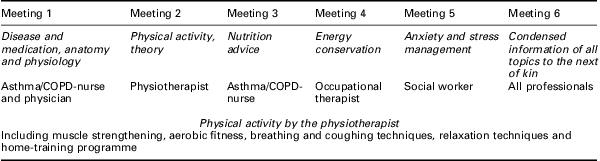
COPD = chronic obstructive pulmonary disease.
A total of 49 PHC patients with COPD, GOLD stage 2–3, which implies moderate to severe COPD (stages are based on spirometry, ie, lung function tests), participated in the programme. At that time their COPD was in a stable phase. The PR took place in nine PHC centres in two Swedish county councils during 2007–2008. All 25 patients who resided in one of the county council areas were invited to attend the interviews. This sampling can be regarded as a convenience sample, but was satisfying based on the assumption that the sample size would be large enough to reach data saturation. Four patients declined participation and in one case the address was unknown. Therefore, 20 patients, who lived in both urban and rural areas, participated in the interview study. On average the patients had severe COPD and a majority were ex-smokers (Table 2).
Demographic data of participants (n = 20)
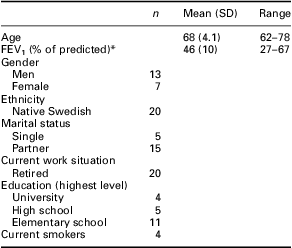
*Forced expiratory volume in the first second (FEV1).
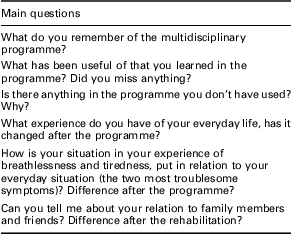
Semi-structured interviews (Patton, Reference Patton2002) were conducted by the first author, A-BZ, in spring 2009, at a location chosen by the patient. Eleven patients were interviewed in their PHC centre and nine in their homes. An interview guide was used containing six main questions about experiences of rehabilitation and on how the programme had influenced their daily life and they lasted on average 30 minutes (Table 3). Individual follow-up questions were asked depending on what arose during the interviews. The interviews were audio-taped and transcribed verbatim (Patton, Reference Patton2002). A pilot interview to test the usefulness of the questions led to no changes and was therefore included in the study.
Description of the interview guide
The interview text was analysed by qualitative content analysis as described by Graneheim and Lundman (Reference Graneheim and Lundman2004). A software programme, QSR NVivo8© (QSR International, 2007) was used as a tool in the analysis process. Meaning units were identified and were labelled with a code that was clustered into groups based on similarities and differences and sorted into categories, representing the manifest data. The categories were then grouped based on common content and abstracted into sub-themes, illustrating the main experiences connected to the lasting usefulness of the programme. These were reflected on, discussed and refined to identify and formulate one unifying theme, a process whereby parts are formed into a whole based on threads through codes and categories. The theme and sub-themes are interpretations of the underlying meaning and the result of latent analysis of the interview text (Graneheim and Lundman, Reference Graneheim and Lundman2004).
Findings
The findings are presented in one theme and three sub-themes, where the theme illustrates the participants’ overall experience of the current situation, one year after the completion of the programme and the sub-themes illustrate the experiences connected to the lasting usefulness after participation in the programme (Table 4). The quotations are provided with participant attribution, subject and number (S11-S71).
Theme and sub-themes

I live life at my own pace
After one year, the experiences of the participants were that they realised that life was fragile and that their future was uncertain but they lived life at their own pace. Almost all of them also expressed worry of some kind; the knowledge provided by the programme created worry while, for others, the worry decreased but did not vanish after the programme. They lived their lives at their own pace:
Things that I shouldn't, like hanging the washing, my bath towels are quite thin and it takes time too, because I need plenty of time in the mornings, to shower, get dressed and ready because that takes time. All those things that you don't are allowed to do slowly, but still I think… It's about allowing yourself (S51)
The programme was reported to have given tools to manage daily life, although they also had been aware of their own limitations. Yet other participants expressed that the multidisciplinary programme lead to no change in their life. They continued to live their lives at their own pace, just as they did before the programme.
Awareness of limitations in my life
The participants gained insights into limitations in life by the programme. Some of the participants felt frustrated and irritated that they did not have sufficient strength and missed a more active life. After the programme they found it difficult, but not impossible, to accept the disease. A few were frustrated about family members who were overprotective, although some had been permitted to help more after the programme. However, some developed a feeling of inferiority when family members took over tasks that they had carried out before.
She does many of the things that I used to do, really. You are, you feel inferior, you really do (S63)
Although they experienced benefits, the participants also experienced worry after the programme. The participants believed that the disease would become worse and wanted to manage for as long as possible without oxygen and experienced that they had gained some tools to slow down the progression by the programme. Breathlessness was experienced as the worst part. Before the programme, some did not realise that COPD was such a serious disease but afterwards they were no longer in any doubt. During the programme, the participants saw other group members who were worse than themselves and started to wonder whether they would end up like that. They found it alarming that their energy level declined so quickly, in the space of just a few years, and they wondered how it would end.
When you have a disease like COPD and all that, there's a gnawing worry at the back of your mind and you wonder, how long will I live and all sorts of thoughts like that (S64)
It was experienced that the education had had an impact also on their relatives and thereby on their own lives. They felt it hard to see the worry that the disease and the increased knowledge of the disease caused their family members. Children and even grandchildren were worried about their health. Sometimes the relatives became distressed when they read about the ‘dangerous disease’ COPD in the newspaper. One wife was so worried that she left her job because she did not want to leave her husband at home alone. Some relatives became sad due to knowledge gained during the programme.
My wife attended once and it was beneficial for her but she became quite sad afterwards, moved. She had never thought about me being ill in the way she had now become aware of (S71)
Regained control over my life
The multidisciplinary programme had been given an opportunity to gain control of the disease and of their life. The participants were careful to look after themselves and wanted to live as good a life as possible. By the programme they learned to live at their own pace. Although the programme helped the participants regaining control, worry was also evident.
It was experienced that the programme had helped the participants to overcome difficulties, taught them to manage the disease and change to an easier everyday life. Participants reported that they were more aware of the need for self-care and the awareness of this responsibility made them feel better. They experienced that they could utilise their time in order to manage everyday life more efficiently. Almost all participants described using the coughing and breathing technique in which they had been trained and had discovered its benefits. Some managed their fatigue by adapting the home environment such as rearranging furniture and the contents of kitchen cupboards. Almost all participants took a nap every day and had started new leisure-time activities that better suited them. Some had changed their diet; several had obtained a higher dose of medication that seemed to have an effect, while others had reduced their medication or stopped smoking. The participants accepted more help from others after the multidisciplinary programme. Several obtained help with housekeeping and other duties from family members. A few paid someone to do harder work. They had found strategies for living with COPD and given themselves permission to live a more peaceful life.
It was described how participants had started to accept the disease and tried to cope with it. The multidisciplinary programme gave them another view of their condition. They no longer excused themselves because they had COPD and had stopped feeling inferior to others. A few had discovered that their breathing problems were stress related. The breathlessness no longer frightened them and they tried to accept fatigue, immobility and lack of energy.
I became aware that I need not feel so frightened when out of breath and that was the most important. I felt that I got sufficient information to make me calm and less frightened when I lose my breath (S62)
They had previously been sad and depressed but had by the programme learnt to handle these feelings.
The participants were aware of the importance of health care and were satisfied with the PHC system and personnel. They considered it easier to contact the PHC now that they knew the staff, and closeness of the PHC centre made it more personal. The participants asked for regular check-ups because it felt positive to actually see changes and they were also reminded of what they had learned.
I found that it gave me so damned much so that is why…and it's the same now that she phones or sends me a letter to do a test, I hurry to do it! Yes, that's what I do! Because it's so bloody interesting to see if the value on that scale has changed (S63)
Furthermore, it was good to have information about technical assistance aids in case they should require them in the future, which also applied to the information provided by the social worker. Generally, information was considered important for controlling COPD. New information and previous knowledge complemented each other. However, too much information at the beginning was a bit overwhelming.
I think that you should be offered participation in a group like this some time after you have received [the diagnosis], not immediately after. So that you have been able to pull yourself together and gain some perspective on what it's all about (S12)
The participants realised the importance of the group for meeting other patients in the same situation, learning from others how to solve problems and experiencing a community spirit. The regular group meetings became a forum for discussion and an opportunity to pose questions.
What was useful was gaining insight into how the others perceived things. Awareness that you can work together to find solutions as the problems are similar (S11)
It was reported that the programme enhanced awareness of the importance of physical as well as intellectual activity. Some regarded it as intellectually stimulating to participate in clubs, play music with others and work on computer-based programmes. The participants were encouraged to perform physical activities, leading to positive effects. A few had started to exercise with other members of the group and expressed that they trained at their own pace as well as stating that even simple training was effective.
The participants reflected on the family's reactions and experienced it as positive that relatives could participate in the programme because it made them more secure and allowed them to more actively share the problems related to COPD. They experienced that their relatives were more aware of the difficulties caused by the disease. One common such problem was social interaction. The multidisciplinary programme taught both the patient and the relative to adjust their social interaction to the patient's own physical capacity. The participants experienced that it was now easier to handle relatives’ worry and fear as well as explain their condition to others.
He is calmer in that sense, as he became very worried when I was taken extremely ill but he is calmer now that he has experienced it and knows where to turn (S11)
No change in my life
Participants expressed that the multidisciplinary programme was of no crucial relevance to them and led to no changes in life. These participants experienced that it did not change their everyday life.
I really don't know what to say actually. I don't know, I think that daily life grinds on as usual, I haven't thought very much about it since the last time. I just go out and walk a lot, otherwise it has become part of everyday life (S41)
Many did not remember the programme. Some expressed resignation and lived life as best they could. They had adapted to the disease and lived at their own pace, with no matter given to the programme.
Some participants expressed that they did not learn anything new by the programme. Others expressed that they did not feel bad and had no problems with the disease and managed housekeeping and other duties as before. They found it difficult to understand the occupational therapist's role, as they did not consider that they needed any technical assistance aids. Several of the participants thought that they were disabled but that it was still too early for technical assistance aids. Some were aware of the importance of smoking cessation but were unable to quit and felt ashamed of suffering from COPD. Yet others believed that stopping smoking probably would not help and that factors other than smoking had contributed to the development of COPD. A few still felt depressed, had difficulties sleeping and there were days when they did not want to talk to anybody. The participants wanted to normalise their situation despite the severity of their disease; they did not want to admit that they had COPD.
I feel as good as can be expected, after all, I'll soon be 70, I suppose it is beginning to tell (S51)
Several expressed that they found the programme of no crucial use.
Several participants could see no benefit in the group. Some stated that there were no discussions in the group sessions. They did not get to know other members and found it difficult to speak in the group. Some were irritated by one group member who took command of the group sessions.
One person in particular didn't think that it was of much relevance, ‘I work as usual, I am my ordinary self, I don't need this’, well well, which had a dampening effect. He took the edge out of the discussions (S64)
Physical training in the programme was described as impossible to perform. Some had given it up after a while, because it was difficult to get into a daily routine. Participants experienced that factors other than COPD caused difficulties in everyday life, such as taking care of family members and other diseases that they themselves suffered from. Others experienced a different kind of tiredness than previously and therefore did not carry out the home training programme. A few did not like physiotherapy and found it boring. Some experienced more breathlessness, considered themselves overweight as it was difficult to follow the dietary advice and for that reason did not exercise.
… because I never get around to training, I do go out walking a lot but it's not always that you …get to actually do it. Now my husband is at home all the time, and since last winter when he fell ill he is too weak to go for walks so this winter there haven't been any (S12)
Discussion
The findings in the present study show two somewhat dichotomous patterns, in that some participants had found their strategies to regain control over life by the programme and, on the other hand, some went on living their life as they did before, and regarded the programme to be of no change in their life. A third pattern identified was that the participants had been aware of their limitations. The findings can to some extent be understood in the light of coping theories, as described by Lazarus (Reference Lazarus1993). According to Folkman and Lazarus (Reference Folkman and Lazarus1988), there are eight coping strategies and in the present study four of them can be traced: self-control (ie, using the learned breathing technique), accepting responsibility (ie, starting to perform physical activities), escape-avoidance (ie, believing that stopping smoking probably would not help) and planful problem solving (ie, manage fatigue by adapting the home environment). According to Lazarus (Reference Lazarus1993), there are at least two major functions of coping; problem focused and emotion focused. The group that regained control over life can be seen as more problem-focused as they seemed more prone to solve practical problems. The other group, who regarded the programme to be of no crucial relevance to them, and made no changes in life, seemed to be more emotion focused. They tended to deal with their COPD-related stress by more avoiding strategies. One year after the multidisciplinary programme, all participants in the present study described that they lived their lives at their own pace, which also could be seen as a way of self-control (c.s Lazarus, Reference Lazarus1993). In some cases, the education had provided insights that led the participants to allow themselves to live in this way, a way of acceptance, while others reported that it had nothing to do with the programme, they accepted the disease by a form of resignation (c.s Lazarus, Reference Lazarus1993).
The reason for whether or not the participants experienced that they had benefitted from the PR or not, is not fully revealed within the interviews. From a theoretical perspective learning can enhance certain activities. In this study, it was found that some of the participants experienced that they learned to manage the disease, which made their everyday life easier. This is in line with Marton et al. (Reference Marton, Runesson and Tsui2004, p. 5) theory of learning. They state that learning is ‘the process of becoming capable of doing something as a result of having had certain experiences’. The participants expressed that, thanks to the multidisciplinary programme (the experience), they had started (becoming capable), for example, exercising and using the breathing technique and had found it beneficial.
The findings showed that the group itself was very important for some of the participants in terms of sharing experiences with others, as are also described in other studies from hospital settings (Petersson et al., Reference Petersson, Berglund, Brodin, Glimelius and Sjoden2000; Gustafsson et al., Reference Gustafsson, Ekholm and Ohman2004; Monninkhof et al., Reference Monninkhof, van der Aa, van der Valk, van der Palen, Zielhuis, Koning and Pieterse2004; Barlow et al., Reference Barlow, Bancroft and Turner2005; Clark et al., Reference Clark, Whelan, Barbour and MacIntyre2005; Arnold et al., Reference Arnold, Bruton and Ellis-Hill2006; Kanervisto et al., Reference Kanervisto, Kaistila and Paavilainen2007; Wilson et al., Reference Wilson, O'Neill, Reilly, MacMahon and Bradley2007; Halding et al., Reference Halding, Wahl and Heggdal2010). The present findings are similar to other findings where persons with other chronic diseases have told that the group promotes a collective identity and sense of belonging (Clark et al., Reference Clark, Whelan, Barbour and MacIntyre2005; Halding et al., Reference Halding, Wahl and Heggdal2010) and that participants learned together how to manage the disease (Petersson et al., Reference Petersson, Berglund, Brodin, Glimelius and Sjoden2000; Barlow et al., Reference Barlow, Bancroft and Turner2005; Clark et al., Reference Clark, Whelan, Barbour and MacIntyre2005; Arnold et al., Reference Arnold, Bruton and Ellis-Hill2006; Halding et al., Reference Halding, Wahl and Heggdal2010). As in another study, they felt that they had regained control over life and obtained a new identity, that of living with COPD (Halding et al., Reference Halding, Wahl and Heggdal2010).
However, some participants regarded the programme as being of no crucial relevance to them, and made no change in their life. Previous research (Kanervisto et al., Reference Kanervisto, Kaistila and Paavilainen2007; Halding et al., Reference Halding, Wahl and Heggdal2010) have also identified that some participants in educational programmes experience no changes, have no motivation and do not have a sense of belonging to the group.
From a theoretical perspective learning can offer also non-wanted insights. Maybe the process of learning (Marton et al., Reference Marton, Runesson and Tsui2004) forced some of the participants to face their situation from a new perspective, to obtain insights into limitations in life. By the group interaction, the participants could compare their situation to that of others and were able to generalise patterns and symptoms of COPD, which was worrying for some. Their perception of COPD was thereby challenged and they had to reshape their identity. It seems important to take such aspects into consideration when dealing with group activities.
The majority of patients with COPD would benefit from physical activity (ATS/ERS, 2006) but the health care cannot force them to train. Some participants in this study considered themselves as in no need to increase their physical capacity or change their daily lives. Despite such an attitude, it is important to try to motivate these patients. A previous study showed that it was the patients who did not continue training that reported more fear and uncertainty (Clark et al., Reference Clark, Whelan, Barbour and MacIntyre2005). It is impossible to know whether a greater extent of training, in line with existing guidelines for PR, would have resulted in a higher motivation for exercise than was found in this present study.
The participants in our study experienced worry, which was also reported in another study (Bailey, Reference Bailey2004). The participants in the present study reported that their worry decreased by the programme, which is in line with the findings of Williams et al. (Reference Williams, Bruton, Ellis-Hill and McPherson2010). However, for some the worry increased, especially the worry of an uncertain future. It is important for group leaders of COPD-group activities to be aware of this. It has been said to be very important that health care staff are engaged and competent, as it helps patients to feel safe and trust the exercises (Gustafsson et al., Reference Gustafsson, Ekholm and Ohman2004; Barlow et al., Reference Barlow, Bancroft and Turner2005; Wilson et al., Reference Wilson, O'Neill, Reilly, MacMahon and Bradley2007; Halding et al., Reference Halding, Wahl and Heggdal2010).
The present findings, in line with previous findings, point at the importance to keep in mind that not everyone is of the opinion that group education has beneficial effects. Therefore, some patients with COPD may require a different kind of education, maybe on an individual basis, as group education might not be the ideal choice for them. Yet another possible reason for the participants experiencing that there is no need of the programme may be that all the participants before the programme were cared for at a nurse-led COPD clinic and thereby might already have received sufficient education.
Patients in this study experienced it easier to contact the PHC after the programme and perceived the contact as being more personal. This is an interesting finding as one important aspect in the design of the present study was to evaluate the multidisciplinary programme in a PHC setting specifically, as this setting is near the patients’ immediate surroundings. It has been stated that local programmes could facilitate participation (GOLD, 2011).
Methodological considerations
One strength of this study is that the findings complement the quantitative outcomes in the previous intervention study, where the participants increased their functional capacity, improved their QoL and their exacerbation frequency decreased (Zakrisson et al., Reference Zakrisson, Engfeldt, Hägglund, Odencrants, Hasselgren, Arne and Theander2011). Another strength is that the present study presents findings after PR performed in PHC as to our knowledge no such study has been conducted before. The use of multiple methods within the main project provides a more complete picture of the impact of the programme (Sandelowski, Reference Sandelowski2000). The findings from a qualitative study can be used to interpret and support the findings from a quantitative study and to increase the understanding or place the quantitative outcomes into a context (SBU, 2012). The design to conduct the study one year after completion of the programme made it possible to get hold of more long-lasting and grounded experiences, compared with the interviews that would have been conducted in close connection to the programme.
In the light of the present findings, the selection of participants for the multidisciplinary programme can be questioned. Perhaps it would be better to base the selection on the presence of symptoms or on functional status in everyday life instead of on spirometry values. This is indicated by the fact that not all participants experienced themselves in need of the content of the programme. Furthermore, more men than women participated in the present study, which should be taken into account when reflecting on the transferability of the study. It is anticipated that in the future more women than men will be affected by COPD (Buist et al., Reference Buist, McBurnie, Vollmer, Gillespie, Burney, Mannino, Menezes, Sullivan, Lee, Weiss, Jensen, Marks, Gulsvik, Nizankowska-Mogilnicka and Group2007; Atsou et al., Reference Atsou, Chouaid and Hejblum2011). Therefore future studies should focus equally on both men and women, as they may have different needs.
The authors’ various professional backgrounds are regarded as beneficial for achieving a critical discussion in the analysis process. An additional quality measure that was taken during the process was that the analysis process and tentative findings were discussed at research seminars. Quotations from the interviews were included in the findings section in order to demonstrate credibility and confirmability of the study. To achieve dependability, an interview guide was used in order to cover the same areas in all the interviews. The use of NVivo8© in the data analysis was regarded as a valuable tool related to dependability, as it was easy to move back and forth in the interview text during the coding and categorising. The findings from a qualitative study are not intended to be generalised but can be transferred to provide increased understanding of similar situations in a new context. The responsibility for judging the transferability is imposed with the reader. The authors have provided demographic data and information on the study context in order to facilitate for the reader to judge the transferability.
Conclusion
Irrespective of whether the patients had found their own strategies for managing the disease or whether the programme had had an impact on their lives, the participants lived life at their own pace, and in the shadow of worry.
Different coping strategies may have an impact of the experience of a multidisciplinary programme for PR. As the previous findings are somewhat similar to previous studies on hospital-based PR, the findings of this study suggest that PR could be administered in PHC setting, with similar outcomes as if it had been administered in a hospital setting. However, further research is needed in how to prevent the symptom burden in COPD through educational interventions so that the patients can live life at their own pace. The selection of patients for the PR intervention should, if possible, be based on the presence of symptoms or functional capacity in everyday life. That would be more appropriate in order to meet their individual needs
Relevance to clinical practice
The findings show that some patients seemed to benefit from a multidisciplinary programme for PR, while others did not. For some patients a group intervention might not be a first hand choice, instead some patients may require individual attention. Nurses could possibly assess the individual patient's coping strategies before suggesting that the patient should join a programme like the one described here. A multidisciplinary programme in a PHC setting can facilitate to contact the PHC after the programme, as the patients through the programme come to know the staff. In addition, because of the proximity to the PHC centre a PR there may be perceived as more personal and easier to participate in.
Acknowledgements
The authors thank all patients for their participation. They also thank Susanne Collgård and Peter Engfeldt at Family Medicine Research Centre, Doris Hägglund in School of Health and Medical Sciences, Örebro University, for their support and finally all discussion in diverse seminars together with Centre for Health Care Sciences, Örebro University Hospital. At the end, they thank for the funding by The Research Committee of Örebro County Council [grant number OLL-94071].
Contributions
Study design, data collection and analysis and manuscript preparation is contributed by the three authors A-B.Z., K.T. and A.A-C.



