

Art, mental states and relating
Relating to others' mental states
As psychiatrists we spend much of our professional time doing in an intense way something people do all of the time – intuiting states of mind in others. Such states of mind cannot be inferred in any direct way: they are intuited from a synthesis of evidence in the form of language, gestures, expressions, movement. We may experience another's feeling through empathic mirroring in ourselves; a more cognitive understanding may come quite suddenly as a ‘gestalt’ (or pattern) emerges. The process is not always easy; we may fumble towards understanding, we may (frequently) get it wrong, we may need successive inferences towards the best understanding possible. But the meaning, when it comes, lies at a moment of understanding beyond the particularities of the evidence before us; it is an inference beyond the evidence. In complex mental states we may need to watch and be with the other over time to see the movement of their thoughts and emotions, to test out reality or falsehoods, or to penetrate layers of meaning. Psychiatrists aim to develop skill to infer such states in extremis and have developed a language to codify them in typologies. We may have developed specific techniques for enquiring about minds, but essentially the process is the specialisation of a normal faculty that everyone exercises.
How this faculty arises in ontogeny has been the subject of theory and research in developmental science. It is likely that infants initially experience isolated sense-impressions and reactions, and these come together in the second part of the first year into the beginnings of a more cognitive intuition of wholes. As it develops, this cognitive ability can be traced in laboratory psychological tests, but is also apparent behaviourally in the way the young infant at this age begins to distinguish between individuals (as wholes) that are familiar and those that are unfamiliar, showing differentiated responses to each (Reference BowerBower 1974). The later, related capacity to infer mental states in others is sometimes described as the ability to have a ‘theory of mind’, but that is a rather abstracted way of describing a vibrant, engaged and interactional process in which the child will begin to be able to infer experiences and intentions in other individuals as a basis for their own reactions and planning. This happens in the second and third years of development, and is well established by the age of 4 years (Reference Carpendale and LewisCarpendale 2006). Clearly, as this capacity develops, it makes increasingly possible the capacity for relationship, since relating is inevitably dependent on the intuition of another's mental state. Just as in a relationship there is an assumption of self and other, so with the capacity to experience relationship comes the capacity to experience self within intersubjectivity (Reference Hobson and BratenHobson 2006; Reference Trevarthen and BratenTrevarthen 2006).
Painting as a ‘state of mind’
This article is based on the idea that works of art – in this case, paintings – carry their cultural power by being ways of embodying states of mind using previously inert materials. In the creative making, these materials are manipulated so that the painting increasingly embodies a ‘state of mind’ or a ‘state of experience’. The power of works of art and the reason people wish to make them is that states of mind thus embodied in inert and permanent materials are held outside the normal flux of time, action and experience. Put this way, art is an extraordinary achievement. It can invest small pieces of paint and canvas with almost limitless cultural value.
In so far as the artist achieves this aim, it follows from the argument above that the work of art will therefore increasingly take on the capacity to be related to. What in art theory is commonly described as ‘reading’ a painting is then an active process of intuiting which uses much of the same capacity that we use to intuit mental states in another. Just as intuiting the mental state of another person is associated with relating, so intuiting the painting's ‘mental life’ also results in the (aesthetic) experience of a relationship. It is this that constitutes the deep aesthetic satisfaction of experiencing works of art and what makes it a humanising and paradoxically human activity, even as it is apparently an activity in relation to an inanimate object.
In this article, therefore, I suggest that inferring mental states is not only a core psychiatric skill – but also one we exercise in looking at art. This raises the possibility that engaging with painting in this way may exercise this faculty in a way useful for psychiatric CPD as well as life enhancement!
I proceed in three parts. First, I tackle the way that artists create and make meaning in paintings. Painting is particularly interesting because it is a non-verbal activity that happens largely outside language until, commonly at the end, the image achieves a kind of autonomy and also a ‘name’ – in its title.
Second, I consider whether there is any empirical evidence that forms of art do indeed embody different states of mind. I describe some research evidence in relation to investigations of form in children's drawings in normally developing children and children who have psychiatric disturbance.
Third, I look in more detail at the process by which we ‘read’ a painting. Just as in development the young infant needs to be able to perceive formal wholes from disparate elements before they can develop a theory of mind, so someone ‘reading’ a painting has to intuit its formal structure before they can experience an aesthetic relationship with it. This is a ‘gestalt moment’; something similar, I argue, to the experience we have in trying to understand another person's mind out of the plethora of sense impressions and communications that we receive.
So, my central argument is that visual art embodies a state of mind using pictorial means. It is the formal coherence of the painting that carries this embodiment. Both to create and to creatively look at a painting requires that one puts oneself into a relationship with it.
Building up the painting
Starting – ‘le petit sensation’
The impulse to begin a painting is usually experienced by the artist as a build up of an internal tension of some kind – either in front of the object to be painted or in relation to an internal state or imagined idea – leading to the need to start work. Cézanne called this his petit sensation; he regarded it as the secret key to his art, an experience intimate and private to be protected at all costs (Reference KendallKendall 1988). Sometimes it has been talked about as if the impulse represents some internal energy or emotion that needs to be ‘discharged’. I argue in more interpersonal terms that it represents more in the way of a desire for or anticipation of a future relationship – that is, the relationship that will be experienced by the artist with the planned work of art when it is finished.
Following this idea then, the aim of painting is to make an object into which this emotion can be directed – or an ‘other’ to be a partner in the imagined relationship. Once this is achieved and the painting made, the starting impulse in the maker is assuaged. For this to happen, however, a painting has to end up with enough aesthetic content to allow this imagined relationship to exist. The painting marks have to be made with a complexity and vividness sufficient to embody details of the artist's experience or feeling; they then have to be combined together using pictorial (visual) logic to create a sufficiently coherent and deep whole that can be related to. If the pictorial logic is absent, then the canvas contains an expressive mess, an expulsion or discharge, rather than a newly created autonomous object: there would be no coherence and the object would not meet the criteria for an embodied state of mind (or an autonomous work of art). If there is plenty of pictorial logic but no affective charge or artistic valency, then the object has a kind of removed abstraction, which may satisfy at the level of geometry or proportion (or maybe decoration), but not engage sympathy, empathy and relatedness in the viewer.
Affect traces
The ways in which an artist links the marks made to their own experience are various. It can be a choice of colour, texture, line, and all the other means of expression. The logic here is that of a symbolic association or resonance. Anything that links the quality of material to an affect state can be used. The painter Howard Hodgkin, for instance, bases his art on the capacity to recreate a strong affective charge within certain colours and shapes, recovering affect traces from his memories of specific situations (Fig. 1).
Pictorial logic
Pictorial logical or visual grammar is a matter of aesthetics, and has been the subject of much writing, instruction and protocol. In an instructive example, the painter Paul Klee developed at the Bauhaus a teaching system based on the science of the time, including biology, geology and psychology, as well as the history of visual culture (Reference Klee, Spiller and ManheimKlee 1961). He advocated building a picture step by step using an internally lawful visual logic which mirrored or reproduced the laws of nature. In this way the process of making the image is supposed to recapitulate in some way the natural processes underlying the nature of the subject. Such an idea can be seen at work in his painting Mountain Formation (Fig. 2). Here the method of building up the painting proceeds first with a pattern of tone and colour gradients creating initial emphasis and momentum. Onto this background Klee places a rhythmic sequence of lines – one set curved and another set jagged. Two arrows (a device he often uses) are placed in such a way as to create a visual sense of shearing compression in the suite of curved lines, emphasising their stress and dynamism. Against this curvature is set off the series of jagged lines, juxtaposed in a way that gives a strong sense of momentum and energy to their sudden direction changes. It is then a small (but sudden) shift to read the curved lines as rock strata under compression and the zigzags as peaks thrust up under this force. Klee's method of making the picture generates a visual dynamic that embodies the idea of the process of formation of a mountain – and this in turn leads to the ‘subject’. Indeed, his writings suggest that he would have generated this form in the first instance in a playful or exploratory way without necessarily planning that it would be ‘about’ a mountain at all – then to find that the resulting image emerged as a mountain range. When this happens and a name (or subject) suggests itself, he said, the painting is complete. The title Mountain Formation thus refers both to the eventual subject of the image and the process of its creation.
Such modernist theory and practice brings out clearly a general truth: that all painting essentially works at an abstract level, in terms of pictorial logic. When the abstract form and the subject of the work act in tandem, the result is a powerful resonance.
Building the painting
So as paintings are made, affect traces or units of sensation are built up together according to the pictorial logic of visual grammar to form a coherent image. This process might involve as much taking apart as putting together, as much archaeology as architecture, as much mess as clarity, as much destruction as construction. Some irreducible elements of truth in sensation and marking must be found and gradually built up together. The process of building the painting is of generating symbolic equivalents for experiences and then putting those experience-equivalents (and thus, at some level, oneself too) together on the canvas. Destruction and construction on the canvas echo a sense of internal dynamic in the artist. In the end some coherence, both external and internal, is established. Two canvases of Cézanne, one left incomplete at an early stage (Fig. 3), the other more tightly finished (Fig. 4), illustrate the progression.
In contrast to Klee, Cézanne here builds marks on the canvas in response to what he observes in the external world in the moment. However, as he tightens the picture, pushes the marks forward and builds the interrelationships on the canvas, it is these interrelationships that become the foreground concern. They grow in intensity both in terms of form and colour and, while never losing contact with the observed reality, the constructed representation begins to have its own life. An interesting issue in Cézanne is the focus or goal towards which this patterning is pushing; for as it intensifies and deepens, as the texture becomes more complex, the emotional resonance actually becomes clearer and simpler. His paintings are first empirical and inductive, that is they depend on intensive close observation of natural phenomena and are impossible to imagine outwith such close attention. But the phenomena of nature are not used for some ulterior purpose. Rather, the process of looking itself that becomes the point: the increasing coherence of the image becomes a representation of the observing self. What is interesting is this quietening of the emotionality as it becomes more stable, as if the intensity of observation breaks through into a kind of meditative state, tapping into resonant areas of a deep and static experience – and this becomes the mental life of the painting.
The painting ‘speaks’
As the painting proceeds, the focus may progressively shift from the internal state in the artist to a concern with the internal organisation of the painting itself. More and more time is spent just looking at the canvas. The painting sucks in attention to itself. Most artists talk of a point at which the painting begins to acquire an autonomous existence and ‘speaks back’ to the painter. Here the direction of energy in a sense reverses and the painter becomes more aware of themselves in front of the canvas, and of the relationship between themselves and the canvas, than of themselves and the object that initially inspired it. This is a point at which Reference Klee, Spiller and ManheimKlee (1961) described the painting as ‘breaking into language’ and giving him its title: ‘it names itself’, he said (something we saw at work in Mountain Formation). Hodgkin says that ‘My pictures are finished when the subject comes back’ (Reference SylvesterSylvester 1984). The increasingly autonomous nature of the visual image is marked by its coherence, its complexity, reflecting the fact I suggest that a mental state can be intuited within it and a relationship can be made with it. Here the artist/observer gets something back from the image: most likely something unexpected, since the pictorial logic developed to its full extent is going to embody more and different things than might have been expected beforehand. It will contain an element of surprise, adventure and expansion.
There is an analogy possible here between this notion of the painting getting to a point of self-naming or breaking into language and the developmental emergence of language in children, depending on a necessary and sufficient cognitive competence. From 18 months of age, the child becomes increasingly mentally autonomous, capable of symbolic representation and, in a linked way, increasingly verbal. At the same time, in becoming more autonomous and aware of self, the child becomes more consciously able to relate. This idea of individuation and relatedness can also apply to the visual image. People talk about the image acquiring ‘life’ at this time: I translate this as the painting increasingly becoming able to embody mental life. The painter Chagall used to place a flower next to his developing painting. When the texture and ‘presence’ of the painted surface matched that of real flower he felt it was developing this kind of threshold complexity.
A mark of this emergence in a painting is that we increasingly feel a relationship with it. The greatest completed images allow such a richness of relationship in this way that they can evoke the deepest feelings of interpersonal relating of which we are capable, although held within this strange reflective aesthetic state. This is close to Winnicott's theory of art as a transitional object (Reference WinnicottWinnicott 1971). The art-object then becomes available potentially to give others a similar experience of relating; it becomes autonomous and multipotential. It makes concrete a symbolic representation apart from the flux of time and distils experience into a form that can be shared.
Form and mental state
Children's drawings as expressions of mental states
Is there any empirical evidence to support this idea that formal aspects of visual art are associated with mental states? Drawing is a prime means of expression for the young school-age child and drawing analysis has a long history in assessment and treatment within child mental health, but there have been few contemporary studies of the phenomenology of drawings and their predictive validity of psychopathology. With students, I undertook an analysis of the drawings of 151 children (Reference Cohen, Samson and ShakespeareCohen 2001). For the analysis of form in the drawings we used a synthesis of (a) operationalised single indicators commonly described in the literature – for instance, omission of body parts, exaggeration of features, or figures separated by barriers (Reference KendallKendall 1988) – and (b) global ratings of form such as ‘bizarreness’ (e.g. complex grotesque images containing unusual fantasy themes, signs or symbols), ‘happiness’ (warmth and vitality of the drawing, family represented as an integrated unit), ‘emotional isolation’ (degree of physical or represented emotional distance between the figures), and an overall coding of ‘global pathology’ (Reference HulseHulse 1952). Good two-way interrater reliability (κ >0.7) was achieved on our analysis coding. In one study we compared family drawings of clinically referred children 5–7 years of age with mixed emotional and conduct disorder (n = 25) and a non-clinical age-matched control group (n= 65). In a complementary clinical study, we analysed drawings from a separate clinically referred group (n= 61, aged 4–10 years) of children with conduct disorder in relation to measures of their psychopathology (Eyberg Child Behaviour Inventory, ECBI; MacArthur Emotionalising Scale, MES) and maternal mood (Beck Depression Inventory, BDI).
The formal quality of the drawings in these studies showed a direct relationship with clinical status and severity of psychopathology. Clinical and control groups were distinguished by ratings of global bizarreness (χ2=5.31, P<0.05) and some single indicators (e.g. omission of body parts, χ2= 4.5, P≤0.05). Bizarreness (Fig. 5) was also associated with symptom severity (ECBI score). A coding of happiness (Fig. 6), on the contrary, was associated with non-clinical status in the first study and parents' rating of low emotional symptoms in the second study. Overlapping closeness of mother and child (Fig. 7) was associated with high maternal depression scores on the BDI (t=2.4, P=0.02).
These studies, then, suggest that a systematic analysis of the form of children's drawings relates to measured aspects of their mental state. Although the equivalent analysis in relation to adult art is inevitably more complex (and certainly influenced also by aspects of shared cultural style at a particular time), much literature suggests that similar relationships between form and mental state can be identified (Reference LangerLanger 1953).
Reading the painting
In this section I argue that, whereas building the image is a process of generating form out of the intuition of an imagined relationship, a visitor reading the image reverses this process by generating the feeling of a relationship out of an intuition of form. In this way, reading or unlocking the potential of a painting is rather like an exercise in reading a mental state or experiencing a relationship with it.
The process of reading the painting reverses the process of building it. First, by intuiting the visual grammar, the formal relationships and the abstract quality of the painting, one is brought into contact with its symbolised mental state. At that point of ‘reading the painting's mind’ it is possible to feel a relationship with it. The experience of the relationship is the aesthetic pleasure of the work. I argue that we use the same capacities to do this that we have developed to intuit other people's minds: that is, an intuition of coherent wholes, the recognition of the gestalt, empathy for effective communication, attention to detail, receptiveness and concentration. Just as this intersubjective process with people exercises most fully our empathic abilities, so we are drawn to do the same with the visual image.
Perplexity and attentiveness
The initial experience of the confrontation with a new painting is quite likely to be perplexity. A similar experience is well described by the psychiatrist Robin Skynner talking about his emotions as a therapist on first being in a room with a new family (Reference SkynnerSkynner 1976). He describes the need to tolerate this perplexity without foreclosing into preconceptions or premature conclusions. It is a process, I suppose, that is similar to the one that Keats in 1817 described as ‘negative capability’: the ability of ‘being in uncertainties, mysteries, doubts, without any irritable reaching after fact and reason’ (Reference WolfsonWolfson 2006). In the psychiatric encounter we tolerate this uncomfortable sense of not knowing while maintaining an alert and free-floating attention, picking up and evaluating and relating individual parts, testing out correspondences and formal relationships; assessing forms of expression, movement and voice; noting the linkage of modes of expression, inconsistencies, coherences, incongruities; interpreting facial expression in the light of our own internal sensation; testing a reaction within ourselves against the evidence of our eyes. Over time we may develop a more solid, substantial and reliable picture of our interpretation of the other's mental state based on numerous small isolated pieces of evidence, intuited and synthesised into a coherent experience of the other's mental intentions. We are probably never fully able to understand someone else's mind, but these intuitions of mental intentions do at least give us an insight into an aspect of the other's experience.
Thus, I am suggesting two processes: the first, a sustained sense of not knowing, linked with free-floating attention; the second, a gradual piecing together of local connections between elements of another's communication, which build up gradually into a more coherent overall image. This image is suddenly meaningful, ‘makes sense’ and is accompanied by an intuition of the other person's mental state.
A similar experience is possible in front of a new painting. Sometimes it may make sense immediately and unequivocally without any doubt. More often the elements of the painting or the apparent image take time to make sense (paintings often do take time, and why not? We might spend weeks reading a novel). Thus, in front of Piero's famous painting Flagellation of Christ (Fig. 8) the initial impression is of a perplexing contrast between the apparent harmony of the overall image and a striking discontinuity; an odd apparent juxtaposition between the foreground group of figures to the right and the recessed interior flagellation scene on the left. It is almost as if there are two separate images in one, which seem to be held together in some sort of underlying unity that is impossible immediately to work out. It took me considerable time looking at the local relationships of form and wondering about them before it became clear that the key to the paradox lies in the analysis of the perspective. What unifies these disparate tableaux in formal terms is the fact that they are contained within one perspective system. The lines of recession – following, for instance, the line of the rooftop at the upper right, the line of the black marbled roof element down the top left, the lines up the pattern of the marbled flooring – all lead to a single vanishing point in the darkness just to the right of the right hip of the man with the whip. The vanishing point is exactly on the vertical bisection of the picture, but located in darkness: the only figurative connection is that it is directly beneath the vertical line of the flagellating whip (the named subject of the painting). Given this key, the reader might like to spend some time identifying the myriad other formal associations and unexpected correspondences between apparently dissimilar parts of the work that reveal themselves – particularly between the two seemingly disparate tableaux to right and left. As one does so, the image becomes more and more dense and coherent.
There is not space here to develop the full symbolic and formal meaning of this work, save to say that the coherence developed around the perspective system gradually reveals, I think, an intention in the painting linking to present and past, memory and conscience, morality and expediency. The group to the right seem to relate to external and present; the recessed flagellation scene to planes of memory, history, interiority and conscience. The perspective functions as much more than a means of generating an illusion of pictorial depth; it is the means of articulating the painting's thinking. My point is that it is necessary to have penetrated this formal structure for the painting to reveal itself. And the experience of ‘relating’ to the image when this is discovered? That is for each viewer to say. But for me it is an aesthetic thrill – along with the sense of emotion as when things kept conveniently apart collapse together; an ache, an anxiety, but a sense of the real.
A different kind of perceptual gestalt leading to meaning is illustrated in Howard Hodgkin's painting of Keith and Kathy Sachs (Fig. 9). If you first look at this painting fresh without pre-knowledge, it is just an abstract assembly of shapes and colours. Then add the verbal part of the painting (i.e. the title) and the knowledge that it is a double portrait of two art collectors. The abstract shapes suddenly click into different focus. This changed perception transforms our response – we intuit a mental life in the image (human personality and relationships). The radical shift in our feelings here is a measure of the power of the image to embody mental life.
Formal analysis of a painting may thus be a first precondition for understanding its internal organisation and emotional communication. But in itself this may or may not be enough; often some more detailed knowledge of iconography or background is useful to complete an intuition as a whole and deepen our relationship to the image. We need to be able to infer the meaning of individual parts through cultural understanding of what is being symbolised, through attention to detail and through understanding the iconography of the image.
Difficulties in relatedness and the intuition of form – the case of autism
This link between the intuition of formal coherence and mental state is highlighted in a situation in which there are difficulties in both areas: that is, in the study of children with autism, who find both ‘mind-reading’ and relating particularly difficult. Two aspects of failure to mind-read in autism are salient here. One is the difficulty in intuiting wholes (the failure of so-called ‘central coherence’); the other is the capacity to read social signals or affective meaning. Children with autism often have great difficulty intuiting overall wholes – they can see local connections but not an overall gestalt or central coherence. This difficulty intuiting coherence is a key component of their difficulty in intuiting mental states and relating. And it is also often seen in the characteristic forms of their art expression (Fig. 10).
Postmodernism
This idea of direct engagement with painting – on the part of the artist and of the viewer – the idea that there is a unified single authorial voice or meaning in the work with an emphasis on authenticity is characteristic of a particular style of art. By apparent contrast, the years since the mid-20th century have been dominated by something apparently rather different: an ironic and knowing distance of artist from work; a constant qualification of passion or engagement and a spirit of reflexiveness. On the face of it, this ‘postmodernism’ fatally undermines the idea of the importance of ‘intuiting the whole’ and ‘reading a painting’ that I have outlined above. But there may be more to it than this. The introduction of a self-reflexiveness into experience is not just something that has happened in art criticism; it has also been characteristic of much contemporary thought within psychiatry, psychology and human sciences. What can we learn from this?
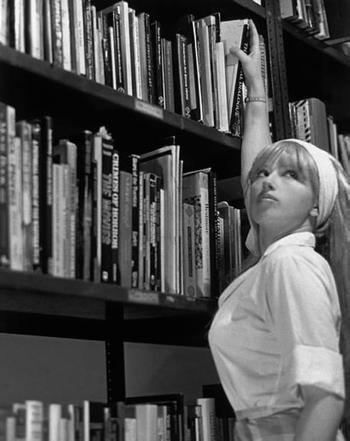
Cindy Sherman's untitled film stills are a good place to start consideration of postmodernism in this context (Fig. 11). The overt content of Sherman's multiple photographic series is usually women in a variety of ‘iconic’ poses or situations; such as pin ups or fashion models, seductive librarians, domestic drudges, rebellious teens, films idols. As one looks more it is apparent that, curiously, each is Sherman herself, cleverly made up and acting the role. Look longer and a number of more troubling complexities are revealed. She subtly presents each image within a context that undermines it; at the same time engaging the viewer reflexively in a disturbing sense of what he or she might be assuming, enjoying or judging while looking. The image, one's look as a viewer, her look at the viewer, one's self awareness of one's own gaze – over multiple images all this becomes challenging in the most subtle way; as to how we create, judge and react to identity in ourselves and others. The presentation of paradox in an image put forward within a context that undermines it, a smile allied to coldness in the eyes, are all experiences of the more subtle end of social communication. After all, irony and sarcasm are mental states. As one gets to understand the layers and the resonances and the self-referential nature of this kind of work, one's understanding of the unitary image alters. To the simple relationship to the intuited image is added a reflexive awareness of the context of that relationship. This is a more subtle experience; but the mixture of empathy, engagement and self-reflexive awareness that relating to these images evokes is part of our current cultural context and the kind of stance that will serve psychiatrists well in their everyday work.
Howard Hodgkin, Lovers. 1984–1992 (© Howard Hodgkin. Courtesy of Gagosian Gallery, London).

Paul Klee, Gebirgsbildung/Mountain Formation. 1924, 123. Staatsgalerie Stuttgart (© DACS 2008).

Paul Cézanne, The Garden at Les Lauves, c. 1906. The Phillips Collection, Washington, DC.

Paul Cézanne, Chateau Noir. c. 1904. © Collection Oskar Reinhart ‘Am Römerholz’, Winterthur, Switzerland.

Child's drawing coded as showing bizzareness (author's collection).Footnote 1
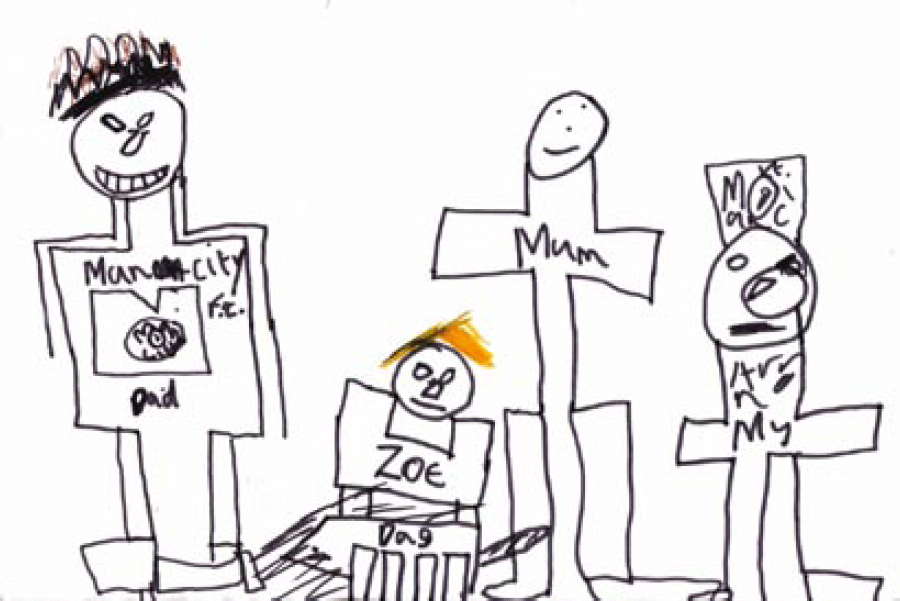
Child's drawing coded as showing happiness (author's collection).

Child's drawing coded as showing enmeshment (author's collection).

Piero della Francesca, Flagellation of Christ. c.1455. The Bridgeman Art Library, New York.

Howard Hodgkin, Keith and Kathy Sachs. 1988–1991 (©Howard Hodgkin. Courtesy of Gagosian Gallery, London).

The gates of Buckingham Palace, drawn by a 10-year-old boy with autism (author's collection).

Cindy Sherman, Untitled film still No. 13, 1978 (courtesy of the Artist and Metro Pictures).




eLetters
No eLetters have been published for this article.