

Our everyday macroscopic experience of being in the world is saturated with asymmetries – thermodynamic asymmetries, and radiative asymmetries, and epistemic asymmetries, and phenomenological asymmetries, and asymmetries of overdetermination, and asymmetries of influence, and what have you – between the past and the future.
And there is a long-cherished hope – something that has its origins in the work of Boltzmann and which has been pursued by any number of other investigators, through any number of fits and starts, and revelations, and wrong turns, ever since – that all of those asymmetries can ultimately be traced back to some relatively simple characteristic of the initial macrocondition of the universe. The thought (as people put it nowadays) is that all we need to do in order to account for these asymmetries is to add to the fundamental time-reversal-symmetric dynamical laws, and to the standard statistical-mechanical probability-measure over the space of possible fundamental physical states, a simple postulate – a so-called Past Hypothesis – to the effect that the world first came into being in whatever particular low-entropy macrocondition it is that the normal inferential procedures of cosmology are eventually going to present to us.
The business of working this thought out in detail is a large undertaking, which is still very much in its infancy, and which is still a topic of very lively debate – and I don’t want to attempt anything along the lines of an overview of that project here. All I want to talk about today is a widespread, and fundamental, and perennial sort of puzzlement about how it is that such a project could even seriously be entertained – a puzzlement (that is) about how it is that the macrocondition of the universe 15 billion years ago – all by itself – could even imaginably be up to the job of explaining so much about the feel, today and on earth, of the passing of time.
This puzzlement takes a number of different forms and arises in a number of different contexts. On the most trivial level, there is a question of how the lowness of the entropy of the world 15 billion years ago can impose any genuinely profound and vivid constraints whatever on what the world is doing now. And all that needs to be said in order to make that sort of puzzlement go away is that although 15 billion years is a long time, the entropy of the universe at that time was very, very low – and that (in particular) 15 billion years is a great deal shorter than the expected relaxation time of the state in which our universe seems to have started out.
But there is a somewhat more interesting question, in the general vicinity of this first one, about how the lowness of the entropy of the world 15 billion years ago can have any genuinely profound and vivid effects or impose any genuinely profound and vivid constraints on what particular, localized, human-scale, quasi-isolated subsystems of the world are doing now. There is a worry (in particular) that runs like this: Let it be stipulated that the standard Boltzmannian arguments do indeed establish that the overall entropy of a universe which starts out in a low-entropy, Past Hypothesis sort of macro state is overwhelmingly likely to rise toward the future. People are fond of pointing out that that tells us nothing at all, in and of itself, and, considered as a purely logical matter, about the behaviors of the entropies of quasi-isolated subsystems of the world – just as the fact that dogs can run tells us nothing at all, in and of itself and, considered as a purely logical matter, about whether or not dogs’ heads can run. And it is the behaviors of quasi-isolated subsystems of the world – after all – and not of the universe as a whole, that the science of thermodynamics is, primarily and in the first instance, about.
And all of this, considered as a purely logical matter, is surely true – but it seems to me to ignore, or to overlook, or to misunderstand how the Boltzmannian arguments actually work. The core of what the Boltzmannian tradition has given us is a general strategy for assigning specific numerical probabilities to any propositions whatever about the macroconditions of isolated thermodynamic systems at any time  , given the macrocondition of the system at
  – and the argument to the effect that thermodynamic systems in nonequilibrium macroconditions are overwhelmingly likely to increase their entropies as time goes forward is simply an application of that general strategy to the special case of entropy. The business of actually calculating those probabilities, in physically interesting cases, is usually going to be prohibitively complicated – but what Boltzmann and his various collaborators and inheritors are widely thought to have made plausible is that those probabilities are in good accord with the entirety of our everyday thermodynamic experience. If (for example) the isolated system in question consists of two gases, which are initially at different temperatures and are in thermal contact with one another, what the Boltzmannian arguments make plausible is not merely that the overall entropy of this system is overwhelmingly likely to go up toward the future, but (in addition) that the entropy of the hotter gas is overwhelmingly likely to go down toward the future. And if the isolated system in question consists of (say) 12 isolated gases, in 12 separate containers, each of which is initially far from its own individual equilibrium state, then what the Boltzmannian arguments are going to make plausible is not merely that the overall entropy of this system is overwhelmingly likely to go up toward the future, but (in addition) that the separate entropies of each of those 12 gases are all, individually, overwhelmingly likely to go up toward the future. Of course, the probability that the entropy of some particular one of those gases goes down toward the future will be much larger than the probability that the overall entropy of all 12 of them together goes down toward the future – but both of those probabilities are going to be fantastically small.
And there is also a third question in the general vicinity of these first two – which is the deepest and the most interesting, the most amorphous, and the most phenomenological form of the general puzzlement about the Boltzmannian project that I mentioned at the outset of this chapter – and it’s that third question that I mainly want to talk about here.
Let me put it in four increasingly concrete, simple, and tractable ways:
(1) How can it seriously be imagined that my own sense of the passage of time, or (for example) that my own sense – right here and right now – of whether a specific baseball happens to be flying toward me or away from me, is somehow anchored in the lowness of the entropy of the universe 15 billion years ago?
(2) How it can be, how it can work, that the increase of the entropy of the world, or of myself, somehow constitutes the standard or the yardstick against which I judge the direction in which events are unfolding? How is it (that is) that the entropy gradient of anything ever comes into the picture? I am certainly not aware that I am checking on the entropy gradient of anything in the course of deciding whether a baseball is flying toward me or away from me. No comparison with anything else, so far as I am aware, is involved. I simply, directly, unmediatedly see that the baseball is flying either toward me or away from me.
(3) Consider the sense of the direction of time that is implicit in the operations of (for example) a simple mechanical realization of a Turing machine. Can anyone seriously believe that thermodynamical characteristics of the world somehow play a role in the way a machine like that distinguishes between what it has just done and what it is to do next? How so? How can that be? How would that work? Machines like that can apparently function perfectly well and apparently have no trouble at all distinguishing between what they have just done and what they are to do next, without the aid of special devices for measuring the entropy gradient of the world, or themselves, or anything else!
(4) Consider (finally) a simple mechanical device which has no business other than distinguishing between what it has just done and what it is to do next – the paradigmatic distinguisher, the distinguisher par excellence, between what it has just done and what it is to do next. Think (that is) of a clock. And think (for the sake of concreteness, or of simplicity) of an old-fashioned, fully mechanical pendulum clock.
Good. Now we have our hands on something that we are in a position to analyze in detail. Note (to begin with) that in the course of the normal and intended operations of a clock of this kind there are going to be specific moments when the pendulum is precisely at the apogee of its swing – when each of its macroscopic moving parts is completely at rest, or (to put it slightly differently) that in the course of the normal and intended operations of a clock like that, there are going to be moments –the moments (again) when the pendulum is precisely at the apogee of its swing– when the macrocondition of the clock, in its entirety, is invariant under time reversal. And consider how it is, at such moments, that the clock manages to distinguish between what it has just done and what it is to do next.
The macrocondition of the clock, together with the microscopic dynamical equations of motion, together with the statistical postulate, is manifestly not going to do the trick. For if the present macrocondition of the clock together with the microscopic dynamical equations of motion and the statistical postulate makes it likely that the clock is going to read (say) 3:05 five minutes from now, and if the present macrocondition of the clock is invariant under time reversal, then the present macrocondition of the clock, together with the microscopic dynamical equations of motion and the statistical postulate – both of which are invariant under time reversal as well – is necessarily also going to make it likely, and to exactly the same degree, that the clock read 3:05 five minutes ago.
And all there is to break the symmetry, all there is that stands in the way of the clock’s having read 3:05 five minutes ago, is the Past Hypothesis. The clock’s ability to distinguish between what it did last and what it does next, and your ability to distinguish between a baseball’s flying toward you and a baseball’s flying away from you, is anchored in the entropy gradient of the universe. If we were to hold the present macrocondition of the world fixed and move the Past Hypothesis from the beginning of time to its end, the clock would run backwards.
Period. Case closed. End of story.
But the fact is that people sometimes find this hard to understand. Here (for example) is the reaction of an anonymous referee to an earlier version of this chapter:
It’s uncharacteristic of Albert to pass over details. He could’ve described how a pendulum clock works (e.g., falling weight version) in a couple of minutes, but he didn’t. The mechanism CANNOT run backwards. What drives it is the falling of the weight, pulling on the cord. If there’s no pull on the cord the clock stops. If there’s PUSH on the cord the clock stops. It’ll ONLY work if there’s tension on the cord and that will make the hands move clockwise because of the way the cord is wound around the drive axel. And that would be true even if the weight rose into the air and started pulling upwards. Putting the low entropy in the future of the universe can’t make the clock run backwards, as he claims. The clock “knows” which way to go, if it’s going to go at all, because the information is built into it in the way that the cord is wound around the axel.
And this will be worth pausing over and thinking about.
Let me begin by simply reiterating the very general point that I made a minute ago. The referee must be mistaken. No further details about the inner workings of the clock can make the slightest bit of difference. Consider (again) a moment when the macroscopic state of the clock is stationary. Consider (that is) a moment when the macroscopic state of the clock is invariant under a reversal of all the velocities of its microscopic particulate constituents. In the absence of a Past Hypothesis, the predictions of statistical mechanics about the evolution of the macrocondition of this clock away from that moment toward the future are going to be identical to its predictions about the evolution of its macroscopic condition away from that moment toward the past, for the simple reason that there is nothing whatever in the situation to distinguish between them. In the absence of a Past Hypothesis, the predictions of statistical mechanics are (in particular) that as we proceed away from the present, in either temporal direction, the cord is always going to be unwinding, and the weight is always going to be going down, and the hands of the clock are always going to be turning in the clockwise direction. And it is only because of the truth of the Past Hypothesis, it can only be because of the truth of the Past Hypothesis, that (as a matter of fact) those hands turn counterclockwise, as we proceed away from the present, in the direction of the past. And that (again) is why a clock like this can be used – just as we might use a half-dispersed puff of smoke, or a half-melted block of ice – as an indicator of the temporal direction in which the entropy of the whole universe is increasing.
Good. But there is a puzzle here.
Consider a half-dispersed puff of brightly colored smoke in an otherwise empty, transparent, cubical container. The entropy of this puff of smoke is going to be a relatively simple monotonically increasing function of its volume. So, we can determine the temporal direction in which the entropy of this puff of smoke is increasing by simply noting the temporal direction in which the smoke’s volume is increasing. And what that means – since the temporal direction in which the entropy of this puff of smoke is increasing is overwhelmingly likely to coincide with the temporal direction in which the entropy of the whole world is increasing – is that we can determine the temporal direction in which the entropy of the world as a whole is increasing by noting the temporal direction in which the volume of this puff of smoke is increasing. You might say that the puff of smoke wears its entropy – and, by extension, the entropy of the whole world – on its sleeve, or on its face.
And look at how utterly different everything is with the clock: We can determine the temporal direction in which the entropy of the world as a whole is increasing – or (at any rate) we are convinced that we can determine the temporal direction in which the entropy of the world as a whole is increasing – by noting the temporal direction in which the hands on the clock are moving clockwise. But how does that work? The entropy of the puff of smoke (remember) is a relatively simple and monotonically increasing function of its volume. But the entropy of the clock is not a function at all of the positions of its hands. And the reason that we can determine the temporal direction in which the entropy of the world is increasing by noting anything at all about the smoke is that the smoke is in thermodynamic disequilibrium – the reason that we can determine the temporal direction in which the entropy of the world is increasing by noting anything at all about the smoke is that the smoke is undergoing a process of dissipation. But clockmakers invariably go to a great deal of trouble precisely to eliminate any potential sources of dissipation – any rubbing or scratching or denting or heating or what have you – in the clocks they produce. And if I open up a pendulum clock and examine its inner workings, I find nothing that looks as if it has been designed to measure the volume or the temperature or the pressure of anything – I find nothing (that is) that looks as if it has been designed to track some process of thermodynamic equilibration. So, what is going on here? How does the increase in the entropy of the world, or of the clock, or anything at all, even get into the picture here? How does any of that ever become relevant to the direction in which the clock hands are turning? That’s the puzzle – and that (I think) is what has the referee so confused – and it is, indeed, on the face of it, confusing.
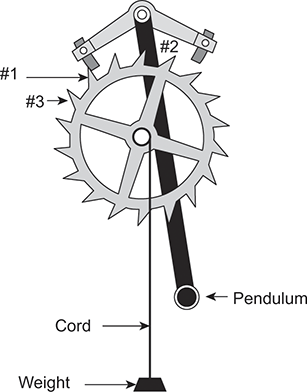
Let’s have a look (then) at the inner workings of the sort of pendulum clock that the referee has in mind – which are pictured in Figure 1.1.
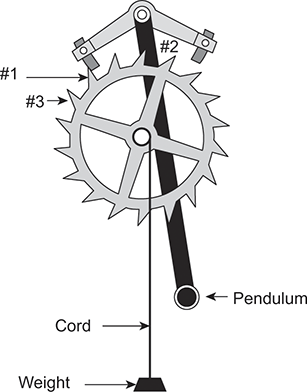
Figure 1.1 The inner workings of a pendulum clock.
Note that the cord to which the weight is attached is wound around the axle in the clockwise direction, so that the axle itself, and the clock hands that are attached to it, rotate in the clockwise direction as the weight descends.
The rest of the mechanism – the pendulum and the escapement – are apparently there simply to regulate the rate at which the axle rotates. If they weren’t there, the axle, and the clock hands that are attached to it, would rotate more and more quickly as the weight accelerated, under the influence of gravitation, toward the floor. What the pendulum and the escapement do is to set a limit – call it θ – on the angle through which the axle is able to turn over the course of any single swing of the pendulum.
What happens – in a little more detail – is this: We begin in the macro state depicted in Figure 1.1. The pendulum is at the apogee of its rightward swing. As it begins to swing toward the left, the little metal tab on the left is lifted out of the way of gear tooth #1 and the weight exerts an uncanceled torque on the axle, pulling it in the clockwise direction. As the pendulum swings toward the left, the little metal tab on the right is lowered into the path of gear tooth #2, and the ensuing collision stops the rotation of the axle dead in its tracks, where it is held fast by the pressure of the weight, until the pendulum begins to swing back toward the right. As the pendulum swings toward the right, the little metal tab on the left is lowered into the path of gear tooth #3, and the ensuing collision stops the rotation of the axle dead in its tracks, where it is held fast by the pressure of the weight, and the process begins again. And what the referee seems to have overlooked, and this is the heart of the matter, is that all of this critically depends on the occurrence, at every swing of the pendulum, of phenomena like denting and scraping and heating in the operations of the escapement.
For suppose that no such things – no denting or scraping or heating – ever did occur. Suppose that the collisions between the gear teeth and the little metal things were perfectly elastic. We begin (again) in the macro state depicted in the picture. The pendulum is at the apogee of its rightward swing. As it begins to swing toward the left, the little metal tab on the left is lifted out of the way of gear tooth #1 and the weight exerts an uncanceled torque on the axle, pulling it in the clockwise direction. As the pendulum swings toward the left, the little metal tab on the right is lowered into the path of gear tooth #2, and in the ensuing elastic collision the gear tooth will bounce off the metal tab, and the axle will completely retrace its previous clockwise rotation in the counterclockwise direction, at the end of which the little tab on the left will be smoothly reunited, in exactly the configuration shown in the picture, with gear tooth #1! And then, of course, the whole process will simply begin again, and the axle will turn clockwise by θ, and then counterclockwise by θ, and then clockwise by θ, and then counterclockwise by θ, and so on, forever – and the clock will be rendered utterly incapable of distinguishing between the past and the future.
Good. Let’s take one more look then – with all that in mind – at the words of the anonymous referee. The referee says “Putting the low entropy in the future of the universe can’t make the clock run backwards, as he [that is: me] claims. The clock ‘knows’ which way to go, if it’s going to go at all, because the information is built into it in the way that the cord is wound around the axel.”
Well, let’s see. Something is plainly right (to begin with) about the claim that “The clock ‘knows’ which way to go, if it’s going to go at all, because the information is built into it in the way that the cord is wound around the axel.” If the cord were wound around the axle in the opposite direction (after all) the axle would plainly turn in the opposite direction. But turn with respect to what? With respect to the temporal direction that we have arbitrarily, and as a matter of pure convention, labeled with a “+” sign? How could that be? With respect to the temporal direction that is picked out by some fundamental metaphysical “arrow of time” which makes no appearance whatever in the laws of physics? How could that be? What must be the case, and what we ought to have seen all along, and what we have just now managed to spell out in full mechanical detail is that the information that is built into the way that the cord is wound around the axle is information about which way to turn with respect to the entropy gradient of the escapement. What must be the case, and what we ought to have seen all along, and what we have just now managed to spell out in full mechanical detail, is that the information that is built into the way that the cord is wound around the axle is information about which way to turn with respect to the temporal direction away from the Big Bang.
And we can now see, in particular, that in the absence of dissipation – and notwithstanding the specific way that the cord happens to be wound around the axle – a clock like this is going to have no clue “which way to turn”; or (to put it slightly differently) the macroscopic evolution of a clock like this (not merely the laws of that evolution, mind you, but the evolution itself) is going to be completely invariant under time reversal! Suppose (for example) that we are shown a movie of the operations of a clock like the one we have just now been talking about – turning clockwise by θ and then counterclockwise by θ and then clockwise by θ and so on, ad infinitum. Nothing about the sequence of the images with which we are presented – and nothing (in particular) about the way that the cord happens to be wound around the axle – is going to tell us anything at all about whether the movie is being run forwards or in reverse.
So, it is perfectly true that clockmakers take great pains to eliminate every imaginable source of dissipation from the mechanisms they produce – and they are perfectly right to do so. But it is also true, and it is a beautiful and ironical and surprising feature of the way the world actually turns out to work, that if they were ever to perfectly succeed, their clocks would be perfectly useless.
And (to make a long story short) I suspect that something very much along these lines must explain how a typical mechanical realization of a Turing machine knows the difference between what it did last and what it does next. And it seems to me that once all this has been taken on board, the atmosphere of mystery around my own ability to sense the difference between a baseball flying toward me and a baseball flying away from me – to sense it (mind you) immediately, and without any conscious act of inference, and without my being aware of ever checking on the entropy of anything – entirely melts away.