




INTRODUCTION
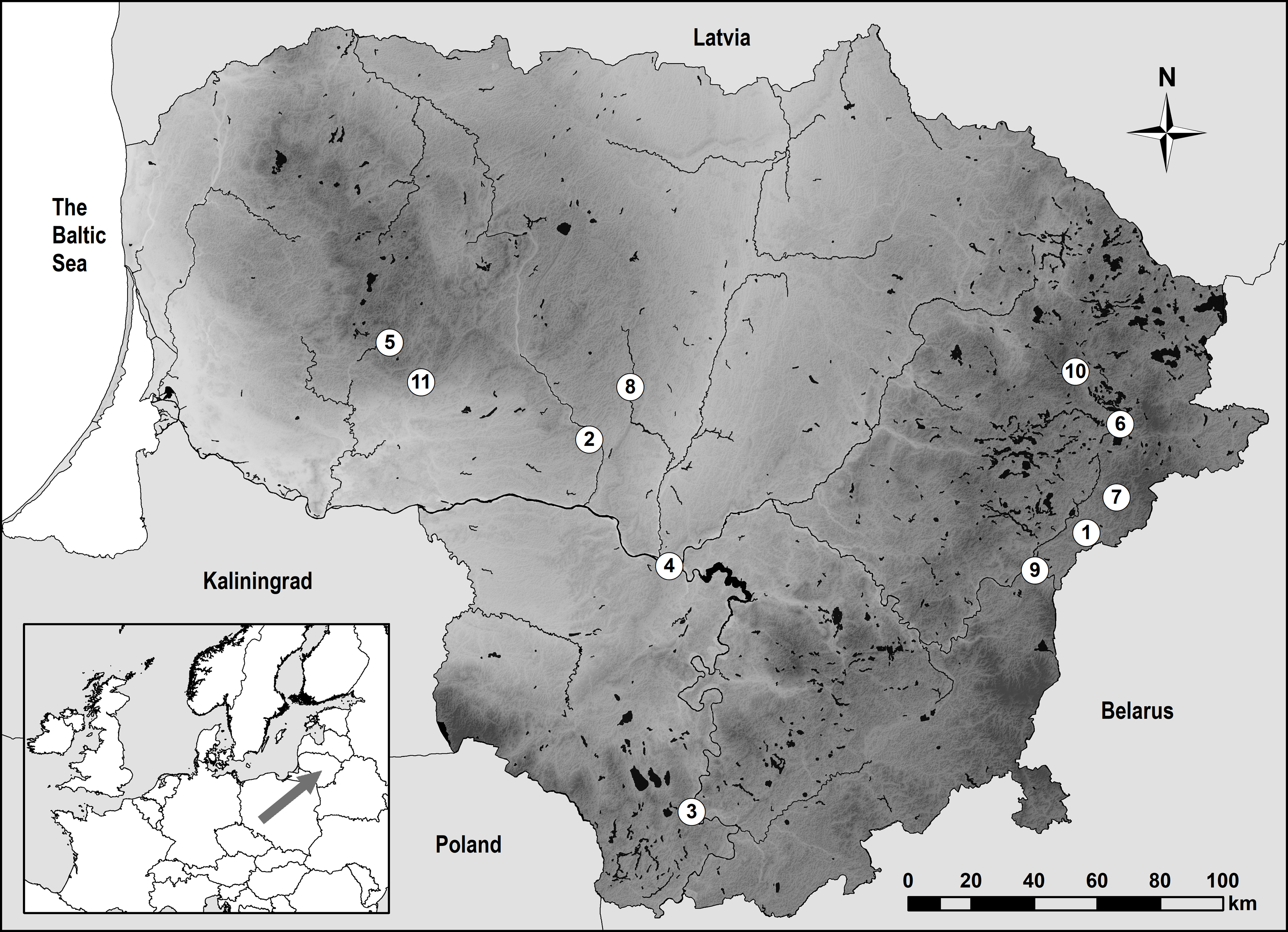
The Roman Period–Migration Period burial sites are well-studied across Europe and chronological schemes of the period are established on the basis of artifact typology (Bliujienė Reference Bliujienė2013: Table 7; Mączyńska Reference Mączyńska, Bursche, Hines and Zapolska2020). Revisions of chronological horizons based on radiocarbon (14C) dating are still rare though (e.g., McCormac et al. Reference McCormac, Bayliss, Baillie and Brown2004, Reference McCormac, Bayliss, Brown, Reimer and Thompson2008; Kaizer et al. Reference Kaizer, Wild, Stadler, Teschler-Nicola and Steier2019; Krol et al. Reference Krol, Dee and Nieuwhof2020). This paper presents a set of new human bone accelerator mass spectrometry radiocarbon (AMS 14C) dates from 11 Roman Period–Migration Period Lithuanian burial sites excavated in the 1950s–2000s (Figure 1). This is the first study in the whole of E Baltic to approach the chronology of mortuary sites of this period with such an extensive application of radiocarbon dating.
Cemeteries from which the samples were collected: 1 – Baliuliai, 2 – Kalniškiai, 3 – Krikštonys, 4 – Marvelė, 5 – Pagrybis, 6 – Pavajuonis-Rėkučiai, 7 – Peršaukštis-Kasčiukai 2, 8 – Plinkaigalis, 9 – Santaka-Šventininkai, 10 – Taurapilis, 11 – Vėluikiai.
The analyses were carried out as part of the scientific project “Humans and horses in Lithuania during the Migration Period (4th–6th c. AD) on the basis of Sr and O stable isotope data: origin and social context” (Vilnius University). The project will proceed into the search for possible markers of migrations based on the 87Sr/86Sr and 18O/16O isotopic data of human and horse remains from burials.
Samples for this study were collected from burial sites in E, S, Central, and W Lithuania—regions with well-defined, archaeologically distinguishable features (Bertašius Reference Bertašius2016; Bliujienė Reference Bliujienė2016; Jovaiša Reference Jovaiša2016; Kiulkys Reference Kiulkys2016; Kurila Reference Kurila, Zabiela, Baubonis and Marcinkevičiūtė2016). In line with the goal of the project, alongside an attempt to cover the territory of Lithuania when collecting the samples, we also made an effort to date burials of both sexes and different social groups, as defined by archaeological markers. However, most attention was paid to burials representing the elite, which are those containing sets of weapons or other warrior gear, ornaments of non-local origin, precious metals, internment of horses together with humans, etc.
With reference to archaeological criteria we attempted to identify burials dating to the Early Migration Period, i.e. the time of the Hunnic wars in Europe (ca. 370/375–454/469 AD) or some decades around that time, i.e. periods D and E1, following the currently established chronological schemes (Bliujienė Reference Bliujienė2013: Table 7). At the beginning of the project we formulated three vectors of migrations into present-day Lithuania as a hypothesis. These vectors are indicated by different sets of non-local artifacts, which allowed us to suggest not only different regions of their origin, but also discrepancies in time and historical backgrounds.
The presumed early burials in E Lithuanian barrows are those of females buried with luxurious items, which have analogues in SE and Central Europe and are related to influences from the Gothic Sântana de Mureş culture. The generally accepted date of this cultural horizon is the junction of the Late Roman Period–Early Migration Period (late 4th–early 5th centuries AD) (Bliujienė and Curta Reference Bliujienė and Curta2011; Kurila Reference Kurila, Zabiela, Baubonis and Marcinkevičiūtė2016).
Supposedly, the slightly later stage of the East Lithuanian barrow culture is represented by burials of military aristocracy, who were accompanied into the afterlife by weapons and prestigious items that mostly originated from the Middle Danube region at the time of the Hunnic conquests or later. The middle of the 5th–early 6th centuries AD is the chronology most often proposed for this horizon in scholarly debates (Bliujienė and Steponaitis Reference Bliujienė and Steponaitis2009; Bliujienė and Curta Reference Bliujienė and Curta2011; Kurila Reference Kurila, Zabiela, Baubonis and Marcinkevičiūtė2016).
The third suggested route of influence or immigration extends from the Sambia peninsula (now Kaliningrad, Russian Federation) into Lithuania through the lower reaches of the Nemunas River and further into W Lithuania as well as along the Nemunas into Central Lithuania. It is reflected by the appearance of new sets of grave goods in both male and female burials, which consist of specific weapons, rider’s gear, and prestigious ornaments. Although it is difficult to trace their provenance, archaeologists largely ascribe them to Central European, Sambian, and Scandinavian influences from the 5th–early 6th centuries AD (Bitner-Wróblewska Reference Bitner-Wróblewska2000; Prassolow Reference Prassolow2013; Jovaiša Reference Jovaiša2016; Kontny Reference Kontny, Bursche, Hines and Zapolska2020).
It is worth noting that while the western wave approached E Lithuania, the material cultures of the two regions, despite being dated to generally the same period, never exchanged their attributes but both maintained their distinctive burial customs, weaponry, ornaments, etc. Therefore, precise dating is of essential importance here to enable a discussion as to whether this was due to hostile atmosphere or whether these two waves of people or influences were actually asynchronous and their material attributes were brought from different historical settings.
MATERIAL AND METHODS
During the project, 32 unburnt human bone samples were dated. The samples for radiocarbon dating were taken from human skeletons currently stored in the repository of Vilnius University’s Faculty of Medicine, Department of Anatomy, Histology and Anthropology. Specialists of this institution perform a macroscopic osteological analysis of the excavated remains to identify the sex and age at death of the deceased. Only the occipital or parietal bones of adult individuals were selected for sampling.
In a few cases, previously radiocarbon dated samples were redated for the purpose of testing the possible variability of the results. Previously published (Kurila Reference Kurila2015) radiocarbon dates included in this study were recalibrated using the most recent IntCal20 curve (Reimer et al. Reference Reimer, Austin, Bard, Bayliss, Blackwell, Bronk Ramsey, Butzin, Cheng, Edwards and Friedrich2020).
For three samples, more than one 14C measurements were performed, obtaining 37 dates in total. This was done in order to verify the dates that were obtained earlier and appeared to conflict with the dating by defined archaeological typology.
Radiocarbon dating was carried out in the Center for Physical Sciences and Technology, Vilnius, Lithuania. Bone collagen extraction was performed according to the acid-alkali-acid (AAA) procedure followed by gelatinization (Molnár et al. Reference Molnár, Janovics, Major, Orsovszki, Gönczi, Veres, Leonard, Castle, Lange, Wacker, Hajdas and Jull2013). Samples were treated with 0.5M hydrochloric acid, 0.1M sodium hydroxide, and 0.5M hydrochloric acid. Bone collagen gelatinization was performed in pH 3 solution at 70°C for 20 hr. Gelatin solution was filtered using a cleaned Ezee-filter and freeze-dried. Conventional 14C dates were calibrated with the OxCal 4.4.4 software (Bronk Ramsey Reference Bronk Ramsey2021) using the IntCal20 curve (Reimer et al. Reference Reimer, Austin, Bard, Bayliss, Blackwell, Bronk Ramsey, Butzin, Cheng, Edwards and Friedrich2020). All 14C dates are given in the 95.4% (2σ) probability range.
DESCRIPTION OF THE CEMETERIES
Five of the discussed burial sites lie within the E Lithuanian barrow cultural area—the territory which became the cradle of the Lithuanian statehood in the early 2nd millennium AD. Inhumation was the exclusive burial custom here during the Roman Period (ca. 3rd–4th centuries AD), but cremation came into dominance since the late 4th–5th century AD, according to the current model (Kurila Reference Kurila, Zabiela, Baubonis and Marcinkevičiūtė2016). A dense concentration of barrow cemeteries spanning some 60 km from N to S caught the attention of researchers because of the burials that display attributes of military elites or contain prestigious non-local items (Bliujienė and Curta Reference Bliujienė and Curta2011; Bliujienė et al. Reference Bliujienė, Steponaitis, Šatavičius and Grižas2017a). Most of the sites discussed further in the text lie within this concentration.
Baliuliai barrow cemetery (Figure 1:1) is one of several small cemeteries that cluster next to each other. In 1999–2000, 12 barrows containing both inhumations and cremations were excavated (Kliaugaitė and Kurila Reference Kliaugaitė and Kurila2012). Several burials stood out from the others: two male cremations were distinguished by the abundance of weapons and iron ornaments and three female inhumations notable by fibulae of W Balt or Gothic origin as well as other ornaments. These finds encouraged the construction of a hypothesis about the involvement of the local community in the events of the Migration Period or immigration from Central or S Europe. On the basis of the grave goods the aforementioned burials were dated to the late 4th–5th centuries AD. In addition, there were marked similarities in burial constructions suggesting that they belong to a relatively short span of time within this period. However, recent radiocarbon dating of these two cremations yielded different dates— FTMC-DG54-1: 1611 ± 13 BP, 416–536 cal AD (barrow 3, burial 2) and FTMC-DG54-2: 1741 ± 18 BP, 246–380 cal AD (barrow 3, burial 3) (Šapolaitė et al. Reference Šapolaitė, Ežerinskis, Butkus, Garbarienė, Garbaras, Kurila, Bučinskas, Pabedinskas and Remeikis2021). Remains of a juvenile female(?) (sex determined only by the grave goods) from barrow 7(10), the only inhumation to contain preserved bones, were dated Poz-63938: 1720 ± 30 BP, 250–411 cal AD (Kurila Reference Kurila2015). In this article, radiocarbon date of another sample from the latter burial is presented in the Results section.
In Pavajuonis-Rėkučiai barrow cemetery (Figure 1:6) two barrows were excavated in 1994 and 1996 (Semėnas Reference Semėnas1996, Reference Semėnas1998). These were part of a cluster of barrows situated around several barrows of very specific shape and exceptionally large dimensions, one of them being the largest in the E Baltic (Kurila Reference Kurila2020). One of the excavated barrows contained an inhumation of a human with a horse and had been looted in prehistory. In barrow 2(11) inhumations of a female and a child were unearthed. They contained sets of silver ornaments, glass, amber, coral beads, etc. These artifacts have analogues in the Germanic milieu of the Middle Danube region, Central and S Europe (Bliujienė and Curta Reference Bliujienė and Curta2011) and draw attention as possible indicators of immigration by the elite. The burials are dated to the Early Migration Period (late 4th–first half of the 5th centuries AD) on the grounds of archaeological typology. Furthermore, some similarities of the finds attest to their possible contemporaneity to the female inhumations from Baliuliai. Previous radiocarbon dating of the barrow 2(11), female burial 2 gave the date Poz-63957: 1805 ± 30 BP, 132–340 cal AD (Kurila Reference Kurila2015, Reference Kurila2020). In the course of the current project, another sample from the same burial was dated by performing three 14C measurements on the same bone.
Peršaukštis-Kasčiukai 2 barrow cemetery (Figure 1:7) is a small group of barrows in a long chain of similar concentrations of barrows. Five barrows were excavated in 2002–2004 and both inhumations and cremations were found (Kurila and Kliaugaitė Reference Kurila and Kliaugaitė2008). In barrow 4, a male inhumation was furnished with an abundant set of weapons and iron ornaments, very similar to those discovered in the above-mentioned male cremations from Baliuliai barrow cemetery. The grave goods suggested that the burial belongs to the latest stage of inhumation in the region and to the period of shift to cremation, namely the second half of the 5th century AD. However, earlier radiocarbon dating yielded an older date than expected Poz-63954: 1750 ± 30 BP, 239–400 cal AD (Kurila Reference Kurila2015). Three more 14C measurements were carried out on a sample from the same individual. Another inhumation from barrow 6 contained grave goods dated to the 5th–6th centuries AD.
In Santaka-Šventininkai (Figure 1:9), a large barrow cemetery, 6 barrows were excavated in 2000–2003 (Vaitkevičius Reference Vaitkevičius2007). Barrow 2(77) contained two inhumations and two cremations. All burials were dated by the excavator to approximately mid-5th century AD on the basis of rather vague archaeological criteria. Male burial 1 did not contain any grave goods indicative of its chronology.
Taurapilis barrow cemetery (Figure 1:10) is the most renowned Lithuanian Migration Period burial site. 14 barrows were excavated there in 1970–1971 (Tautavičius Reference Tautavičius1981; Bliujienė and Steponaitis Reference Bliujienė and Steponaitis2009). Barrow 5 contained a burial of a chieftain, who was accompanied to the grave by a horse and equipped with an abundant set of grave goods that included imports from N, S and Central Europe. The set is comprised of a spatha type sword in a silver-decorated sheath and four other weapons, a drinking horn, spurs, numerous bronze, prestigious silver and gilded silver ornaments as well as other items. It is the northernmost find of a Barbarian princely warrior’s assemblage in Europe. These finds allowed the precise dating of the grave to the second half of the 5th–early 6th centuries AD (Bliujienė and Steponaitis Reference Bliujienė and Steponaitis2009) or even more narrowly, around 450–475 (Anke Reference Anke1998:134), in accordance to numerous typological schemes. Three other males buried together with horses were found in surrounding barrows. These were also well armed, but had incomparably less ornaments. The dominant interpretation is that this was either a group of immigrants, or a local chieftain and his retinue who had participated in the wars which took place during the Migration Period. A sample of human bone from the chieftain’s grave was previously radiocarbon dated Poz-63960: 1670 ± 30 BP, 257–530 cal AD (Kurila Reference Kurila2015). For this study two radiocarbon measurements from another sample were performed and dates for the other three individuals were obtained. Horse remains from the same burials were also radiocarbon dated to 1656 ± 37 BP, 259–538 cal AD; 1705 ± 50 BP, 236–530 cal AD; and 1714 ± 48 BP, 235–430 cal AD for the individuals from barrows 4, 5, and 6, respectively (Piličiauskienė et al. Reference Piličiauskienė, Kurila, Ežerinskis, Šapolaitė, Garbaras, Zagurskytė and Micelicaitė2022).
Krikštonys barrow cemetery (Figure 1:3) was located in S Lithuania, a transit region between E Lithuania, the Lithuanian Užnemunė (Trans-Nemunas region), and the Suwałki region of Poland. Kerbed barrows or barrow mounds built entirely of stones were most prevalent in the mortuary landscape of this region. Like their northern neighbors, people in S Lithuania buried their dead uncremated in the Roman Period, whereas cremation rite began to spread since the 3rd–4th centuries AD (Bliujienė Reference Bliujienė2016). In 1958, a barrow which was in danger of being washed away by the Nemunas River was excavated at Krikštonys and a male inhumation was discovered inside. The grave contained a spatha type sword, a spearhead, a drinking horn and other artifacts (Kulikauskas Reference Kulikauskas1959). Similarities of the weapon assemblage to the ones from burials in Taurapilis and elsewhere suggest the date of the grave to be in the middle or the second half of the 5th century AD.
Three of the cemeteries are situated in Central Lithuania. These cemeteries differ from the ones described above because they do not contain barrow mounds. There are also marked differences in grave good assemblages. Inhumation was practiced in the region from the first centuries AD. From the middle of the 1st millennium AD cremation began to spread. However, it was still a rare custom during the Migration Period. Some of the wealthier warriors were accompanied to the grave by horses (Bertašius Reference Bertašius2016).
Over the course of excavations in 1985–2004 in Kalniškiai cemetery (Figure 1:2) 256 inhumations and 16 cremations were found (Kazakevičius Reference Kazakevičius1998). Three warrior burials were selected for the present study. Two of the deceased were buried in a single grave-pit (burial 5) and represent the so-called burial of “brothers-in-arms” which is characteristic for the period. In burial 39 a male was buried with two horses. All individuals were well armed and equipped with silver and bronze ornaments. The archaeologist who excavated the monument dated the burials to the 5th century AD. A later date of the middle 5th–early 6th centuries AD is suggested for the burial 39 (Bliujienė and Butkus Reference Bliujienė and Butkus2009).
Marvelė cemetery (Figure 1:4) is the largest prehistoric burial site in Lithuania. A total of 1591 human inhumations and cremations as well as 236 horse burials were unearthed there from 1991 to 2013. Three burials were radiocarbon dated. A female’s burial 325 was part of a small cluster containing several rich burials. It was distinguished by a luxurious set of silver and bronze ornaments dated to the late 4th–5th centuries AD (Bertašius Reference Bertašius2005: 83–84). Male burials 1071 and 1075 were set in a large grave-pit together with a horse; all burials inside the grave-pit were disturbed and looted. The remaining sets of grave goods included weapons as well as several iron ornaments dated to the Late Roman Period (Mindaugas Bertašius, unpublished data). The excavator interpreted this burial as the grave of a chieftain and his squire (Bertašius Reference Bertašius2002: 43ff).
Plinkaigalis cemetery (Figure 1:8) was fully excavated in 1977–1984. 372 human burials were found of which 8 were cremations, while the rest were inhumations (Kazakevičius Reference Kazakevičius1993). Most burials date to the Migration Period and the 5th–6th centuries AD is the chronology generally accepted by most researchers. However, the large number of burials and the diversity of grave goods indicates a wider time interval for the use of the cemetery. To represent burials of both sexes and individuals of different status, seven male and four female burials were selected for the present study. On the basis of the grave good assemblages the burials ranged from commoner burials (burials 76, 91, 190, 280), containing iron and bronze ornaments and tools, to those of the elite (burials 50, 61, 106, 115, 144, 224, 332), which were furnished with weapon sets, imported gilded silver ornaments, drinking horns, etc. Radiocarbon dates from several other burials have been published recently (Kurila et al. Reference Kurila, Piličiauskienė, Ežerinskis, Šapolaitė and Garbaras2021).
Although W Lithuanian cemeteries have been rather extensively excavated, the choice of samples for this study was limited due to low number of bones from the period of interest in the repository. In W Lithuania the mortuary landscape of the Roman and Migration Periods is represented by flat cemeteries and inhumation burials (Jovaiša Reference Jovaiša2016; Kiulkys Reference Kiulkys2016). In the middle of the 1st millennium AD the lower reaches of the Nemunas River became a gateway for the new culture and probably new militaristic groups, whose path later extended both to the N and to the E, into the above-mentioned Central Lithuania. This process is illustrated not only by new types of weapons and ornaments, but probably also by the custom of horse sacrifice, a rite during which a horse’s head and limbs were buried together with a human and which was common among Asian nomads (Bliujienė et al. Reference Bliujienė, Stančikaitė, Piličiauskienė, Mažeika and Butkus2017b).
Pagrybis cemetery (Figure 1:5) was excavated in 1980–1982. In total, 217 burials were discovered and 38 of the burials contained horse sacrifices (Vaitkunskienė Reference Vaitkunskienė1995a). The excavator’s dating of the cemetery to the 5th–6th centuries AD has never been debated. Four burials from the cemetery were selected for radiocarbon dating. Moreover, a larger set of samples was taken for the Sr isotopic analysis in order to characterize the different ranks of the military hierarchy which were defined by the excavator (Vaitkunskienė Reference Vaitkunskienė1995a, Reference Vaitkunskienė1995b). Burials 85 and 145, dated to the middle 5th–early 6th centuries AD, represent the elite mounted warriors (Bliujienė and Butkus Reference Bliujienė and Butkus2009). In burial 62 a female (62A) was buried inside the same pit with a male individual (62B). The individuals were buried in a position facing each other, holding hands and their foreheads touching. Such burial position indicates that both individuals died simultaneously, while the monument’s excavator suggested this to be an instance of female sacrifice. The horse sacrifice from burial 145 was radiocarbon dated to 1406 ± 27 BP, 601–662 cal AD (Piličiauskienė et al. Reference Piličiauskienė, Kurila, Ežerinskis, Šapolaitė, Garbaras, Zagurskytė and Micelicaitė2022).
In Vėluikiai cemetery (Figure 1:11) three burials were discovered during small-scale excavations in 2006 (Jovaiša Reference Jovaiša2007). A well-armed chieftain was uncovered in burial 3. In addition to three weapons, the chieftain’s burial was furnished with a set of ornaments and luxurious riding gear. Multiple traces of trauma caused by combat and long-term riding testified to the individual’s engagement in military affairs of the Migration Period. The archaeologist who excavated the burial dated it to the first half of the 5th century AD.
RESULTS AND DISCUSSION
The results of radiocarbon dating are given in Table 1, Figure 2, and Figure 3. OxCal R_Combine command was used to combine the 14C dates from three burials on which several 14C measurements were performed (Figure 4). In addition, using the OxCal Combine command we attempted to combine the 14C dates of related samples from group burials Kalniškiai 5A and 5B as well as Pagrybis 62A and 62B, which yielded statistically significant agreement indices (Acomb = 119.2%, An = 50.0% and Acomb = 110.9%, An = 50.0%, respectively). However, an attempt to combine the 14C dates from the presumed group burial from Marvelė (burials 1071 and 1075) resulted in a low agreement index (Acomb = 24.2%, An = 50.0%), thereby raising doubts as to whether these disturbed burials can be considered contemporaneous, as had been previously suggested by the archaeologist who excavated them.
Summary of the radiocarbon dates.

Calibrated radiocarbon dates (see Table 1).

Calibrated radiocarbon dates (continuation of Figure 2).

Combined radiocarbon dates.

The available radiocarbon dates from the first chronological horizon of the wealthy E Lithuanian female burials do not yet allow the definition of precise chronological boundaries for this horizon. Two representative burials from Baliuliai barrow 7(10) and Pavajuonis-Rėkučiai barrow 2(11) were dated to ca. 1700 BP and have a statistically significant agreement (Acomb = 109.9, An = 50.0%), indicating the Late Roman Period–Early Migration Period.
The E and S Lithuanian elite warrior burial horizon is represented by seven burials, those from Krikštonys, Peršaukštis-Kasčiukai 2, and Taurapilis. All 14C dates point to a generally similar period to those of the aforementioned female burials (ca. 1670–1740 BP). Only the date from Peršaukštis-Kasčiukai 2, barrow 4, burial 3 is different at a statistically significant index (A = 46.5%, A’c = 60.0%). However, it falls within the Late Roman Period and is not exceptional from the archaeological perspective. The six remaining dates from warrior burials and two from female burials can be combined with a high statistical agreement index (Acomb = 122.9, An = 25.0%). An OxCal Order query was also used to test the chronological ordering of all nine E and S Lithuanian elite female and male burials (Table 2) (the closer the ratio is to 0.5:0.5, the higher probability that the dated events are synchronous).
Order analysis of the radiocarbon dates from the E and S Lithuanian burials.

When viewed as a phase, the nine discussed burials fall within a chronologically homogenous set of events (Figure 5) with the estimated start and end dates of 236–377 cal AD and 262–444 cal AD respectively. This allows us to draw two inferences crucial for the goals of the project. First, all E Lithuanian elite burials can be dated to the Late Roman Period–Early Migration Period. This fact allows to correct the dominant chronological schemes, which tend to ascribe the burial horizon with weapons to the Late Migration Period (Bliujienė and Curta Reference Bliujienė and Curta2011, Kurila Reference Kurila, Zabiela, Baubonis and Marcinkevičiūtė2016). Second, there is no radiocarbon-based evidence of two distinct chronological horizons in the E Lithuanian burial data, as had been initially suggested. It can be argued that both female and male elite burials represent the same historical background.
Phase of the radiocarbon dates from the E and S Lithuanian burials.

It should be stressed that the 14C dates of the humans and horses (Piličiauskienė et al. Reference Piličiauskienė, Kurila, Ežerinskis, Šapolaitė, Garbaras, Zagurskytė and Micelicaitė2022) from the Taurapilis barrow cemetery show a statistically significant agreement in all three barrows (barrow 4: Acomb = 78.9%, An = 50.0; barrow 5: Acomb = 118.0%, An = 50.0; barrow 6: Acomb = 109.8%, An = 50.0). It is therefore possible to reject the potential significant bias caused by the freshwater reservoir effect or older individual ages at death of the human individuals. A more detailed analysis of the impact of the freshwater reservoir effect will be possible in the light of the results of the 13C and 15N stable isotope studies, which will be published in a separate paper (Simčenka et al. submitted).
Out of all W and Central Lithuanian cemeteries, 14 burials of both males and females belong to the elite group—those from Kalniškiai, Marvelė (burial 325), Pagrybis (burials 85 and 145), Plinkaigalis (burials 50, 61, 106, 115, 144, 244, and 332), and Vėluikiai. Hitherto, no definitive archaeological criteria exist to draw firm chronological divisions within this group. Therefore, we viewed it as a continuous horizon extending over the whole Migration Period. The 14C dates are distributed between ca. 1730 and 1460 BP with an extremely high probability of being statistically different (Acomb = 0.2%, An = 18.9). An OxCal Order query also yielded very different similarity indices (Table 3).
Order analysis of the radiocarbon dates from the W and Central Lithuanian burials.

The 14C dates from the W and Central Lithuanian elite burials form a phase with its start and end dates at 257–405 cal AD and 463–685 cal AD respectively (Figure 6). This indicates that the burials, which fall into the phase should belong to different historical contexts, most likely representing the pre-Hunnic (Late Roman) Period, the period of the Hunnic wars, the stage after the collapse of the Roman and Hunnic Empires and likely the Early Avar Period (ca. 568–630 AD).
Phase of the radiocarbon dates from the W and Central Lithuanian burials.

In accordance with the archaeological data, the W and Central Lithuanian 14C dates can be divided into stages only tentatively and preliminarily. The early stage (ca. 1730–1640 BP) is marked mainly by baldrics of the type balteus Vidgiriai and knives-daggers of the early types, while the late stage (ca. 1640–1490 BP) is distinguished by seaxes, knives-daggers of the late type, spurs, drinking horns, crossbow fibulae of the type Daumen/Tumiany as well as sacrificial horse internments. There also exists a rather indistinct intermediate stage, which includes the attributes of both the early and late stages. Typo-chronological reconsideration of fibulae, neck-rings, bracelets, buckles and other ornaments based on even larger sets of radiocarbon dates is necessary in future studies.
With only individual 14C dates from the large cemeteries having been obtained, the available data are not yet sufficient for the reconstruction of a detailed image of the studied period. The currently apparent scenario is a rather rapid spread of the new material culture tradition throughout the region in the Late Roman Period–Early Migration Period and its consistent development at least until the end of the Migration Period. This model makes it possible to pin down the period during which the evidence of migrations could be sought to the beginning of the 5th century AD at the latest.
The late 14C dates from the Pagrybis burials seem somewhat unexpected in the light of the earlier research (Bliujienė and Butkus Reference Bliujienė and Butkus2009). Burials 85 and 145 contained horse sacrifices. The tradition of burying horse heads and limbs was practiced by the W Balts in the first centuries AD (Bliujienė and Butkus Reference Bliujienė and Butkus2009; Bliujienė et al. Reference Bliujienė, Stančikaitė, Piličiauskienė, Mažeika and Butkus2017b) and later in the second half of the 1st millennium AD and until the early 2nd millennium AD (Vaitkunskienė Reference Vaitkunskienė1981). It is not yet clear whether there has been a break in this practice. Being already ancient at that time, it was either continued into the second half of the 1st millennium AD or was revived. New radiocarbon dates from the Pagrybis, together with the dates from horse burials from this cemetery (580–668, 601–662, 540–640, 565–654 cal AD) (Piličiauskienė et al. Reference Piličiauskienė, Kurila, Ežerinskis, Šapolaitė, Garbaras, Zagurskytė and Micelicaitė2022), provide a new reason to consider the second model more plausible. The dates of the human and the horse from burial 145 show a statistically significant agreement (Acomb = 62.9%, An = 50.0).
The Avars were among the many nomadic peoples who practiced the burial of horse body parts (Bede Reference Bede, Bede and Detante2014; Vörös Reference Vörös and Révész2013). Although so far there is too few data to consider the possible influence of Avars, the horses buried according to a nomadic custom as late as the 6th–7th centuries AD provide an initial impetus for discussion. What is more, perhaps research of these burials can help in finding the missing link between the aforementioned Migration Period horse burials and Viking age (late 1st–early 2nd millennium AD) horse cemeteries (Bertašius and Daugnora Reference Bertašius and Daugnora2001). Investigating the continuity of horse burial customs on the basis of radiocarbon data could be the aim for future research.
CONCLUSIONS
The set of radiocarbon dates presented in this paper is so far the most extensive one to be applied for the purpose of verification of dominant Roman Period–Migration Period chronological schemes in the E Baltic. Cemeteries from this period are generally characterized by a relatively abundant grave furnishings, tempting many archaeologists into focusing solely on typological dating. Therefore, large series of radiocarbon dates are of particular importance in studying the finer details of the relationships of archaeological sites with dynamic historical contexts. The primary goal of our project was identification of migration and did not include corrections to archaeological chronology. However, the sampling strategy used allowed us to link the radiocarbon ages with many artifact types, including those specific to the whole E Baltic and other regions of Barbarian Europe.
The initial chronological analysis revealed that the radiocarbon dating of human bones can both confirm and introduce corrections to the already established patterns of cultural development in the region. In E and S Lithuania, where previously two successive stages were distinguished in the Early and Late Migration Periods, both marked by different external influences or immigrations, the 14C dates show a single narrow period of material culture change in the Late Roman Period–Early Migration Period. By contrast, the dated burials in W and Central Lithuanian cemeteries are distributed over a much longer period than expected, but the oldest 14C dates allowed to define the time of the emergence of new material culture tradition. This time roughly coincides with the time of material culture change in E and S Lithuania. We can thus argue that two vectors of influence or immigration reached Lithuania at about the same time ca. 1700 BP. However, whether these changes occurred in the pre-Hunnic or the Hunnic Period remains one of the key questions. The fact that the two vectors did not overlap in space indicates a complex development scenario, the reconstruction of which requires, aside from study of the cultural milieu, even more accurate dating including that of cremations in the case of E Lithuania. The current paper demonstrates that large-scale application of 14C dating can make a significant contribution to the shaping of the Roman and Migration periods research agenda.
ACKNOWLEDGMENTS
This project has received funding from the Research Council of Lithuania (LMTLT), agreement No. S-MIP-19-67.


 Open access

