




Introduction
Agriculture is the main source of livelihood for smallholder farmers in sub-Saharan Africa. Yet, the region has the lowest agricultural productivity worldwide (Giller et al., Reference Giller, Delaune, Silva, van Wijk, Hammond, Descheemaeker, van de Ven, Schut, Taulya, Chikowo and Andersson2021). For maize, the most important cereal staple in the region, smallholders typically produce about 20% of what is possible with best agronomic practices (Assefa et al., Reference Assefa, Chamberlin, Reidsma, Silva and van Ittersum2020; Silva et al., Reference Silva, Baudron, Ngoma, Nyagumbo, Simutowe, Kalala, Habeenzu, Mphatso and Thierfelder2023; van Ittersum et al., Reference van Ittersum, Alimagham, Silva, Adjei-Nsiah, Baijukya, Bala, Chikowo, Grassini, de Groot, Nshizirungu, Mahamane Soulé, Sulser, Taulya, Amor Tenorio, Tesfaye, Yuan and van Loon2025). Such a large yield gap, i.e., the difference between the water-limited potential yield and the actual farm yield under rainfed conditions (van Ittersum et al., Reference van Ittersum, Cassman, Grassini, Wolf, Tittonell and Hochman2013), is the result of multiple agronomic and biophysical constraints. Poor agronomy is associated with suboptimal crop stands (Nyagumbo et al., Reference Nyagumbo, Nyamayevu, Chipindu, Siyeni, Dias and Silva2024), late planting and weed control (Leonardo et al., Reference Leonardo, van de Ven, Udo, Kanellopoulos, Sitoe and Giller2015), and declining soil fertility due to continuous cultivation with limited fertilizer inputs (Bekunda et al., Reference Bekunda, Sanginga, Woomer and Donald2010; Tittonell and Giller, Reference Tittonell and Giller2013). Climate variability, particularly erratic rainfall, further exacerbate the risks of rainfed maize production (Cairns et al., Reference Cairns, Chamberlin, Rutsaert, Voss, Ndhlela and Magorokosho2021; Silva et al., Reference Silva, Cairns and Kutywayo2025), often compromising the return on investment in fertilizer use (Bonilla-Cedrez et al., Reference Bonilla-Cedrez, Chamberlin and Hijmans2021).
Sustainable crop intensification is required to meet future food demand in sub-Saharan Africa (Jayne and Sanchez, Reference Jayne and Sanchez2021; Vanlauwe and Dobermann, Reference Vanlauwe and Dobermann2020). Crop yields are the result of genotype-by-environment-by-management (G × E × M) interactions (Fischer, Reference Fischer2015; Evans and Fischer, Reference Evans and Fischer1999). Cultivars of maize with improved genetics that have been adapted to current climate conditions are available to smallholders in the region (Cairns et al., Reference Cairns, Chamberlin, Rutsaert, Voss, Ndhlela and Magorokosho2021) and are often adopted with positive impacts on maize productivity and farmers’ livelihoods (Evenson and Gollin, Reference Evenson and Gollin2003; Ngoma et al., Reference Ngoma, Setimela, Silva and Krishna2025). While climate change is projected to have a negative impact on cereal production across the region, such effects can be partially offset with existing cultivars (Alimagham et al., Reference Alimagham, van Loon, Ramirez-Villegas, Adjei-Nsiah, Baijukya, Bala, Chikowo, Silva, Soulé, Taulya, Tenorio, Tesfaye and van Ittersum2024). The impact of climate change on crop production will depend on the soil fertility status and agronomic management practices, which can be influenced by farmers at the beginning and throughout the growing season. For instance, Descheemaeker et al. (Reference Descheemaeker, Reidsma, Giller and Deryng2020) found that poor soil fertility and associated nutrient limitations were as important as climate change in explaining future farm performance in southern Zimbabwe, underscoring the need to account for management factors alongside climate when assessing maize productivity. Similarly, Wafula (Reference Wafula1995) applied a dynamic crop growth model to evaluate the combined effects of weather variability and management practices on maize yield in bimodal rainfall environments of Kenya. Therefore, evaluating the relative importance of G × E × M interactions to crop yields is key to identify opportunities for sustainable crop intensification adapted to local conditions.
According to the Global Climate Risk Index, Mozambique is the most affected country by climate change and the least prepared for it (Eckstein et al., Reference Eckstein, Künzel and Schäfer2021) because droughts, floods, and cyclones occur with increasing frequency in the country, leading to devastating outcomes for insufficiently prepared farmers who rely on rainfed agriculture. Agriculture is dominated by small-scale farmers (about 98%) who primarily produce for their own consumption (MADER, 2024). According to the same source, about 10% of farmers use improved seeds, 8% use inorganic fertilizers, 7% have access to extension services, and less than 1% have access to agricultural credit. In Mozambique, a country with relatively abundant land, maize is the most important food and cash crop for smallholders, cultivated on nearly 40% of the cropland under smallholder agriculture. Yet, maize is also the most vulnerable crop to climate variability, exposing smallholders to food insecurity. Past increases in maize production in the country were achieved through cropland expansion (Leonardo et al., Reference Leonardo, Van De Ven, Kanellopoulos and Giller2018) rather than productivity increases on existing cropland. However, increasing production through cropland expansion is limited by labour availability (Baudron et al., Reference Baudron, Andersson, Corbeels and Giller2012a; Leonardo et al., Reference Leonardo, Van De Ven, Kanellopoulos and Giller2018) and associated with greenhouse gas emissions and biodiversity loss (Beyer et al., Reference Beyer, Hua, Martin, Manica and Rademacher2022). Increasing crop production per unit area through increases in fertilizer use and adoption of improved cultivars and good agronomic practices will be required to curb land conversion to agriculture and increase maize self-sufficiency at the national level.
The objectives of this study were to (1) investigate the relative contribution of G × E × M interactions to smallholder maize yields under on-farm conditions in Central Mozambique and (2) explore options for sustainable intensification of maize production amid soil fertility and rainfall variability. Researcher-managed and farmer-managed on-farm experiments were established in fields with varying soil fertility statuses to assess how different maize cultivars respond to changes in sowing date and fertilizer regime over two consecutive cropping seasons. The experiments were conducted in Buzi District, a region severely affected by recent extreme weather events, such as Cyclone Idai in 2019, Tropical Storm Chalane in 2020, Cyclone Eloise in 2021 (Crawford et al., Reference Crawford, Michael and Mikulewicz2023; Mashula et al., Reference Mashula, Ntombela, Kunene, Desiree, Nedson, Nhamo and Chapungu2021; Speight et al., Reference Speight, Stephens, Hawker, Baugh, Neal, Cloke, Grey, Titley, Marsden, Sumner, Ficchi, Prudhomme, Archer, Bazo, Dambo, Dolan, Huhn, Moschini, Savage, Smith, Towner and Wanzala2023), and the 2024 El Niño-induced drought (Figure 1a). We hypothesized that maize yield response to improved cultivars and sowing date is conditional on nutrient availability and soil fertility status, which remains the most limiting factor to maize productivity in the study area. This study contextualizes the benefits of improved agronomic practices and improved genetics for smallholder maize production under climate change.
Rainfall anomalies across selected countries of Southern Africa (Zambia, Zimbabwe, Malawi, and Mozambique) during the 2023–2024 cropping season (a) and measured daily rainfall data in the study sites in Buzi District, Central Mozambique (b). Panel (a) displays the anomalies in total rainfall between November and April (cropping season period), quantified as the difference between the 2023–2024 cropping season rainfall and the long-term average cropping season rainfall (1981–2023). See Supplementary Fig. 1 for further details. Data were obtained from Funk et al. (Reference Funk, Peterson, Landsfeld, Pedreros, Verdin, Shukla, Husak, Rowland, Harrison, Hoell and Michaelsen2015). Panel (b) displays measured daily rainfall data between November and April in two sites of Buzi District, Bandua and Inharongue, during the 2022–2023 and 2023–2024 cropping seasons.

Material and methods
Site selection and characteristics
Researcher-managed experiments were conducted on-farm in two consecutive cropping seasons (2022–2023 and 2023–2024) in Buzi District, Central Mozambique. The study area lies within 19°55′53.1″S, 34°25′46.3″E in Bandua and 19°56′56.7″S, 34°32′50.6″E in Inharongue. These sites were selected due to their importance for maize production, diversity of soil types, and high frequency of extreme weather events. The main soil types found in the study area are Mollic Fluvisols and Eutric Fluvisols (FAO-UNESCO, 1988). The district has a humid tropical climate, with a hot, wet season from November to March and a cool, dry season from April to October. The unimodal rainfall pattern allows for a single cropping season (wet season) per year. The rainfall anomaly (i.e., the difference between the 2023–2024 cropping season rainfall and the 30-year average growing rainfall) across southern Africa is provided in Figure 1a and Fig. S1. The cumulative daily rainfall measured in the study sites during both cropping seasons is provided in Figure 1b.
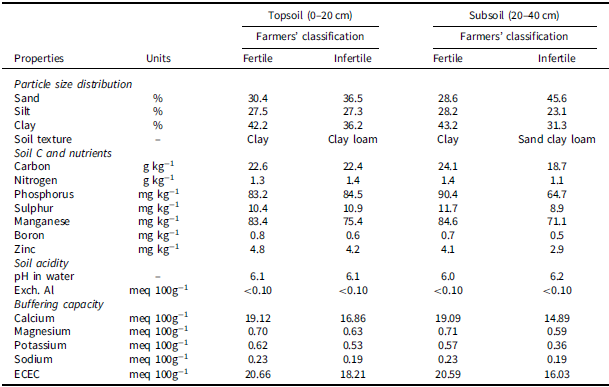
Heterogeneity in soil fertility status is a common characteristic of smallholder agriculture. Recognizing this diversity is important for targeting appropriate soil fertility management practices (Tittonell et al., Reference Tittonell, Vanlauwe, Leffelaar, Rowe and Giller2005). Four focus group discussions with farmers, with six men and six women participating in each, were organized to identify the most common soil types for the researcher-managed experiments. Based on soil water-holding capacity, soil texture, and farmers’ experience in cultivating maize on their fields, two types of soil were identified and classified by farmers as having high and low soil fertility (see detailed soil properties in Table 1). In the 2022–2023 cropping season, four experiments (two in high-fertility fields and two in low-fertility fields) were established and managed by agronomists. In the 2023–2024 cropping season, the number of researcher-managed fields increased to five (one in a high-fertility field and four in low-fertility fields). Farmers prefer to keep the high-fertility fields for their own food production, which made it difficult to secure such fields for experimentation purposes. An additional 33 farmer-managed experiments (four in high-fertility fields and 29 in low-fertility fields) were conducted in the second cropping season to capture variability in the response to the tested treatments across a wider range of soil and management conditions. The experimental design in the farmer-managed experiments was the same as described for the researcher-managed experiments. Apart from fertilizer application, all farming activities in the farmer-managed experiments, i.e., sowing, weeding, and harvesting, were performed by the farm household with minimal interference from researchers.
Physical and chemical soil characteristics from the researcher-managed experiments for the 0–20 and 20–40 cm depth. Soil samples were taken prior to the establishment of the experiments in the 2022–2023 growing season. Exch. Al = exchangeable aluminum

Experimental design, treatments, and crop management
Both researcher- and farmer-managed experiments were implemented as a randomized complete block design. The main factor evaluated was sowing date, which included three levels: early sowing in November, intermediate sowing in December, and late sowing in January. In the 2023–2024 cropping season, only the early sowing date was possible due to the severe drought and early cessation of rainfall caused by El Niño (Figure 1). The second factor evaluated was maize cultivar with two different hybrids: an early maturity with 110–115 days between sowing and maturity (DKC-80-33 in the 2022–2023 cropping season and MH43A in the 2023–2024 cropping season) and an intermediate maturity with 115–130 days between sowing and maturity (DK777 in both cropping seasons). Different early maturity cultivars were used in the two cropping seasons because farmers were not interested in cultivating DKC-80-33 in the second year due to its poor storability. The third factor evaluated was fertilizer regime, either with or without mineral fertilizer application. The source of nutrients used in the experiment was the commonly available fertilizer blend NPK 23:10:5 + 6S + 1Zn applied at sowing at a rate of 125 kg ha−1. Urea (46% N) was applied at the knee-high stage (V8–V11), depending on moisture availability, at the same rate as the basal application (125 kg ha−1). This translates to a total of 86.3 kg N ha−1, 12.5 kg P ha−1, and 6.25 kg K ha−1. There are no fertilizer recommendations in Mozambique for the cultivars tested in our experiment, and the rates used thus reflect a combination of expert knowledge and blanket fertilizer recommendations from the Mozambican Agrarian Research Institute (IIAM) and the Eduardo Mondlane University (UEM) (IIAM and UEM, 2010). The experimental design allowed us to study the relative contribution of G × E × M interactions, since the sowing dates reflect different E × M interactions on maize yield, the two cultivars reflect the contribution of G on maize yield, and the two fertilizer regimes reflect the contribution of M on maize yield. Cropping season and soil fertility status are other important components of E considered in our experimental setup.
The area of cultivation for each sowing date consisted of five blocks, each with four plots of 5 m × 8 m, and five replications per treatment. Therefore, each researcher-managed experiment was composed of 60 plots in 2022–2023 cropping season and 20 plots in 2023–2024 cropping season (only one sowing date). Maize was planted at the spacing of 0.75 m × 0.50 m, with two plants per hole, targeting a plant population at sowing of 53,333 plants ha−1. On researcher-managed experiments, land preparation (ploughing and harrowing) was performed with a tractor, allowing the incorporation of crop residues from the previous cropping season. To avoid the residual effects of fertilizers, new adjacent fields were selected in the second cropping season. On farmer-managed experiments, most land preparation was done manually or using oxen. For all experiments, maize was the previous crop. Sowing, fertilizer application, and weeding were done manually in all experiments. No irrigation was supplied, and the first sowing date was determined by the soil moisture content. Rainfall was measured daily using a rain gauge between November 1st and April 30th at each site and recorded by the field technician and lead farmers. During the growing season, the crop was treated with commercial pesticides to control fall armyworm (Spodoptera frugiperda) when the risk of infestation existed.
Soil sampling and analysis
Soil samples were collected following a zig–zag pattern within each field prior to sowing and fertilizer application. A total of eight samples were taken using a soil auger at 0–20 cm and 20–40 cm depths. An air-dried subsample of about 0.5 kg from each depth was analysed at Crop Nutrition Laboratory Services in Nairobi, Kenya. Subsamples were oven-dried, at 60°C for 14 h, passed through a 2 mm sieve, and analysed for pH (H2O) following the potentiometric method; available P, exchangeable K+, Ca2+, Mg2+, Na+, Zn2+, Mn2+, Cu2+, S, and B following the Mehlich-3 inductively coupled plasma; exchangeable aluminum following the colorimetric method; total N following the Kjeldahl method; soil organic carbon (dry combustion); and texture following the hydrometer method (see Appendix 1 for further details about the laboratory procedures and respective references).
Yield and plant population at harvest
At maturity, the two middle rows of each plot were harvested, leaving two plants at each end of the row (net harvest area). All plants in the net harvest area of each plot were cut at surface level, and the total aboveground biomass (stems, leaves, and cobs) was weighed. A subsample of 10 plants was randomly taken from the harvested plants and weighed. If the yield was poor, as in the second cropping season on low-fertility fields, all biomass from the net harvest area was considered for the final measurement. The cobs from subsamples or the net harvest area were separated from the plants, and both weights were taken separately. Then, cobs and stalks (stems and leaves) were air-dried for about two weeks, threshed, and weighed, and the moisture content was determined with a grain moisture metre (Draminski TwistGrain). Grain yields were then adjusted to a moisture content of 12%. Maize plant population was determined at harvest by counting the number of plants in each net harvest area, which was then converted to plants ha−1.
Economic assessment
An economic assessment of the treatments tested in the researcher-managed experiments in the two cropping seasons and in the farmer-managed experiments in the 2023–2024 cropping season was conducted based on the profit and returns on investment associated with seed and fertilizer inputs. Profit (USD ha−1) was calculated as the difference between gross return and input costs. Return on investment (USD USD−1) was calculated as the ratio between gross return and input costs. Gross return was calculated by multiplying the maize yield in each treatment by the market price of maize, USD 0.22 kg−1, regardless of cultivar type. The price of maize was estimated as the average of three farm-gate prices in the study region: the price at harvest (April to July), during the intermediary period (August to November), and during the lean period (December to March) (Handa and Mlay, Reference Handa and Mlay2006; Leonardo et al., Reference Leonardo, van de Ven, Udo, Kanellopoulos, Sitoe and Giller2015). Input costs were calculated as the sum of seed and fertilizer costs. Seed costs were calculated by multiplying the amount of seed used for each treatment by the price of the seed: USD 3.3 kg−1 for the early maturity cultivar DKC-80-33 (seed amount equal to 23.3 kg ha−1), USD 2.4 kg−1 for the early maturity cultivar MH43A (12.5 kg ha−1), and USD 3.3 kg−1 for the intermediate maturity cultivar DK777 (14.8 kg ha−1). Fertilizer cost was calculated by multiplying the amount of urea and NPKSZn fertilizer used in each treatment by the respective market price in the study region, USD 45 per 50 kg bag for both fertilizer types. Seed and fertilizer prices for each cultivar and fertilizer type were obtained from local agro-dealers in the study region.
Data analysis
Statistical analyses were conducted using linear mixed models fitted to different subsets of the data. Treatment effects on maize grain yield were assessed separately for researcher-managed experiments conducted in high-fertility and low-fertility fields in each cropping season and for farmer-managed experiments conducted in high-fertility and low-fertility fields in the 2023–2024 cropping season. The analyses were done separately for these subsets of data because there were large differences in rainfall between the two cropping seasons (Figure 1), which compromised the second and third sowing in the 2023–2024 cropping season, resulting in unbalanced data, and because of differences in indigenous soil fertility (low- vs. high-fertility fields; Table 1) and trial management (researcher- vs. farmer-managed experiments).
The linear mixed models fitted for researcher-managed experiments in high- and low-fertility fields conducted in the 2022–2023 cropping season tested a three-way interaction between the fixed effects: cultivar type, sowing time, and fertilizer regime. For the researcher- and farmer-managed experiments conducted in the 2023–2024 cropping season, the fitted linear mixed models tested a two-way interaction between the fixed effects: cultivar type and fertilizer regime. All models considered the replicate within each farm (i.e., its identifier) as a random effect, except in the case of high-fertility fields in the 2023–2024 cropping season, where only replication was considered as a random effect since only one farm hosted the researcher-managed experiment on a high-fertility field during this cropping season. Linear mixed models were fitted with restricted maximum likelihood using the lmer() function of the lmerTest R package (Kuznetsova et al., Reference Kuznetsova, Brockhoff and Christensen2017). The dependent variable was log-transformed when fitted models did not meet the assumptions of normality and constant variance of the residuals, which was only the case for yield and profit data in infertile fields of farmer-managed trials in the second cropping season. The statistical significance of the fixed effects and their interaction on maize yield was tested using analysis of variance with the anova() function of R. Least square means were then predicted using the fitted models for each cultivar type × sowing time × fertilizer regime combination using the emmeans() function of the emmeans R package (Lenth, Reference Lenth2024). The same linear mixed model approach was used to test treatment effects on profit and return on investment.
Variability in maize yield response to cultivar type, sowing time, and fertilizer regime was assessed using cumulative distribution curves (Vanlauwe et al., Reference Vanlauwe, Coe and Giller2019), computed for each factor separately and for each cropping season x management type (researcher vs. farmer management) combination in both high- and low-fertility fields. Cumulative distribution curves provide a measure of the risk associated with each of the factors tested and indicate the likelihood of obtaining a given outcome within the range of outcomes captured in the data. Cumulative distribution curves were developed for absolute maize yield response (i.e., the difference between treatment and control yields) and for relative maize yield response (i.e., the absolute maize yield response relative to the control yield). The early maturity cultivar, the first sowing date, and no fertilizer use were considered as controls when assessing maize yield response to cultivar type, sowing time, and fertilizer regime, respectively.
Data on maize plant population at harvest were only collected for the experiments conducted in the 2023–2024 cropping season. Linear mixed models were fitted to assess the effect of cultivar type and fertilizer regime (two-way interaction) on the maize plant population on high- and low-fertility fields. The two-way interaction and the fertilizer regime had no statistically significant effect on plant population in either of the fitted models; hence, data on plant population were presented for different cultivar types only. Finally, maize yield response to plant population was assessed using boundary line functions that depict the maximum maize yield for a given plant population. As such, input–output combinations that define the boundary function are limited by plant population, whereas input–output combinations below the boundary function are limited by other factors as well. Boundary lines were estimated for the pooled data with quantile regressions fitted to the 90th and 95th quantiles using the rq() function of the quantreg R package (Koenker, Reference Koenker2024).
Results
Soil fertility status
The farmers’ classification of low- and high-fertility fields was mostly based on the clay content and buffering capacity, especially in the subsoil (Table 1). Soil texture was dominated by clay in high-fertility fields and clay loam to sandy clay loam in low-fertility fields. The mean measured pH (H2O) of the topsoil and subsoil of both high- and low-fertility fields ranged from 6.0 to 6.2, which can be classified as optimum for maize crops. Soil organic carbon was also at adequate levels for maize production at 19–24 g kg−1, while total N was low, ranging between 1.1 and 1.4 g kg−1. Available P (Mehlich 3) was between 64.7 and 90.4 mg kg−1, whereas exchangeable K was low in the topsoil and the subsoil of most fields, between 139 and 242 mg kg−1. Sulphur, magnesium, and zinc were at optimum levels in the topsoil and subsoil regardless of the soil fertility classification. Boron and calcium were low in the topsoil and the subsoil of both high- and low-fertility fields.
Maize yield response to cultivar type, sowing date, and fertilizer regime
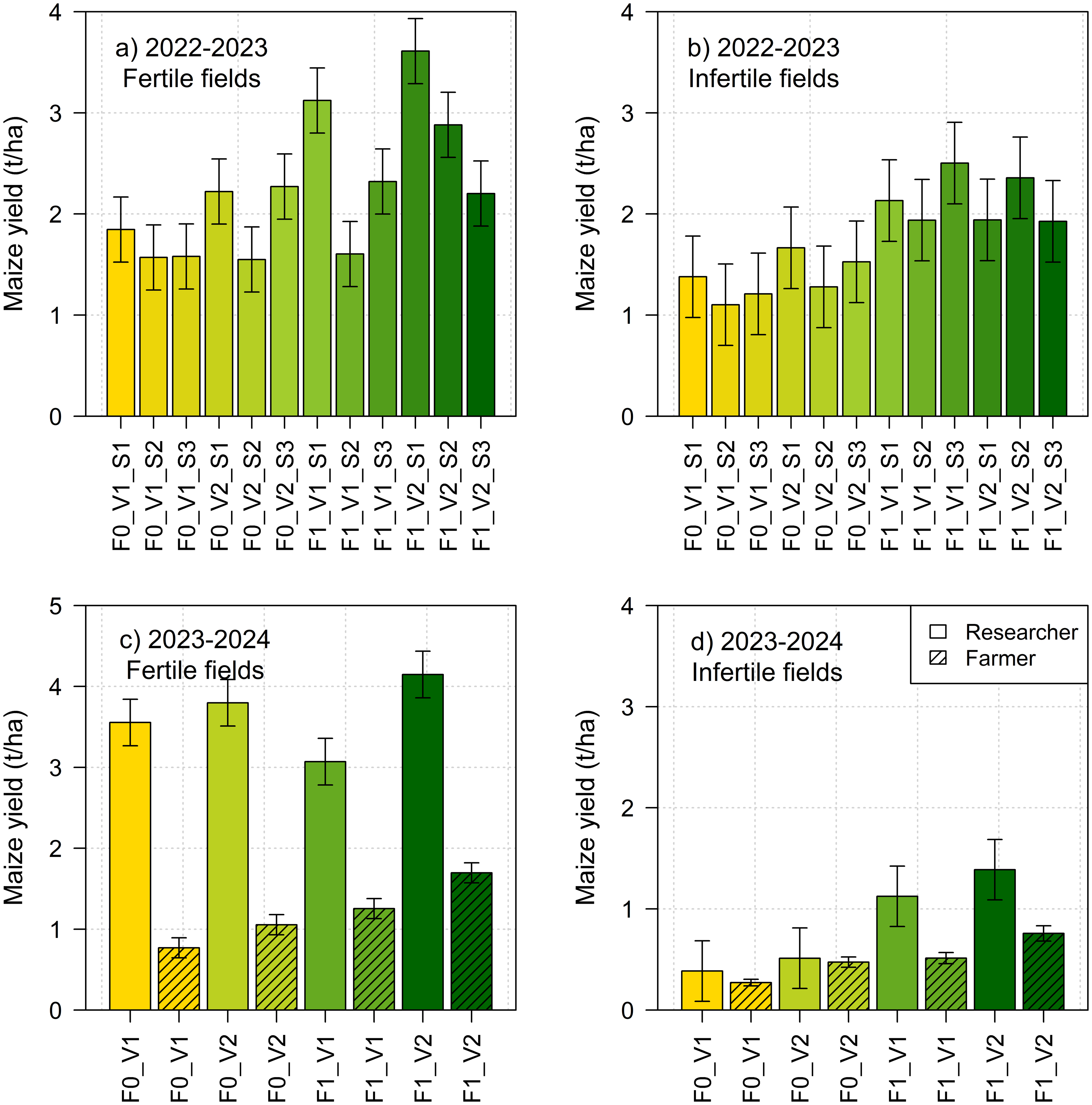
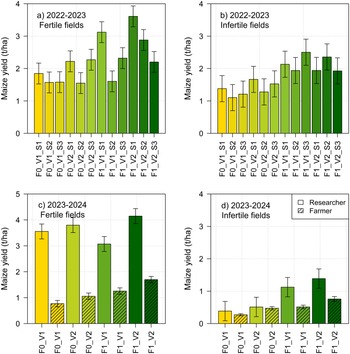
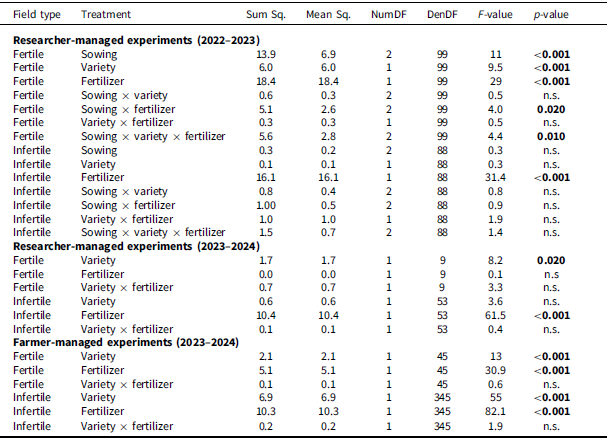
In the 2022–2023 cropping season, maize yield was significantly influenced by a three-way interaction between fertilizer regime, sowing date, and cultivar type on researcher-managed experiments in high-fertility fields (p < 0.01) (Table 2). The highest maize yields in these fields were obtained with early sowing of an intermediate (3.6 t ha−1) or early (3.1 t ha−1) maturity maize cultivar with fertilizer applied (Figure 2a). Conversely, late sowing without fertilizer yielded the least in these fields regardless of cultivar type (about 1.6 t ha−1 on average). No interactions between sowing date, cultivar type, and fertilizer regime were observed for this cropping season on researcher-managed experiments in low-fertility fields (Table 2). Yet, the effect of fertilizer regime was highly significant in these fields (p < 0.001), with fertilized treatments yielding an average of 2.1 t ha−1, compared with 1.4 t ha−1 obtained in the unfertilized treatments (Figure 2b). Maize yields were 23% greater on researcher-managed experiments in high-fertility fields than in low-fertility fields, showing the importance of soil fertility status on maize productivity and response to agronomic management practices.
Maize yield response to cultivar, sowing date, and fertilizer regime in high- and low-fertility fields of Buzi District, Central Mozambique, during the 2022–2023 and 2023–2024 cropping seasons. The effect of sowing date could not be assessed in 2023–2024 cropping season due to severe dry spells at the time of sowing. In the 2022–2023 cropping season, only researcher-managed experiments were carried out. In the 2023–2024 cropping season, the researcher-managed experiments were complemented with farmer-managed experiments conducted in the vicinity of the former. Note different y-axis values in (c). V1 and V2 refer to the early maturity and the intermediate maturity hybrid maize cultivars, respectively, F0 to treatments without addition of mineral fertilizer, and F1 to treatments with addition of mineral fertilizer.
Analysis of variance regarding the effects of cultivar, sowing date, and fertilizer regime on maize yield in Buzi District, Central Mozambique. Researcher-managed experiments were conducted in the 2022–2023 and 2023–2024 cropping seasons. The same experiment was also conducted under farmer management in the latter cropping season. The effect of sowing date could not be assessed in 2023–2024 due to severe dry spells at the time of sowing
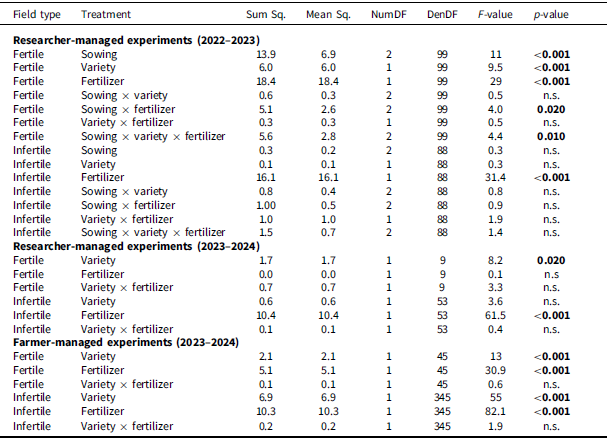
In the 2023–2024 cropping season, significant yield differences (p < 0.05) were observed between early and intermediate maturity cultivars on researcher-managed experiments in high-fertility fields (Table 2). Maize yield in these fields was on average of 3.3 t ha−1 with the early duration cultivar and 4.0 t ha−1 with the intermediate duration cultivar (Figure 2c). Conversely, significant yield differences (p < 0.001) were observed between fertilizer regimes on researcher-managed experiments in low-fertility fields (Table 2). In these fields, maize yield was 1.3 t ha−1 on average with fertilizer and 0.4 t ha−1 without fertilizer (Figure 2d), substantiating the results of the 2022–2023 cropping season. Maize yields in the farmer-managed experiments conducted in the 2023–2024 cropping season were very low, and maize yield variability was explained by the additive effects of cultivar type (p < 0.001) and fertilizer regime (p < 0.001) in both high- and low-fertility fields (Table 2). In these experiments, maize yield in high-fertility fields was highest for the intermediate maturity cultivar with fertilizer (1.7 t ha−1), followed by the early maturity cultivar with fertilizer (1.3 t ha−1), intermediate maturity cultivar without fertilizer (1.1 t ha−1), and early maturity cultivar without fertilizer (0.8 t ha−1, Figure 2c). Similar results were observed in low-fertility fields, where maize yield was highest for the intermediate maturity cultivar with fertilizer (0.8 t ha−1), followed by the early maturity cultivar with fertilizer (0.5 t ha−1), intermediate maturity cultivar without fertilizer (0.5 t ha−1), and early maturity cultivar without fertilizer (0.3 t ha−1, Figure 2d).
Variation in yield response to cultivar type, sowing date, and fertilizer regime
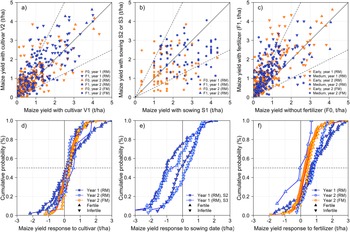
Maize yield response to sowing date, cultivar type, and fertilizer regime was highly variable across experiments and field types (Figure 3). Greater maize yield responses were observed for fertilizer regime than for sowing time and cultivar type. Maize yield responses to fertilizer regime were not only greater but also more consistent since the use of fertilizer had a more positive effect on maize yield than sowing dates or cultivar types. The relative maize yield response to sowing date, cultivar type, and fertilizer regime is provided in Figure S2.
Variations in maize yield response to cultivar, sowing date, and fertilizer regime in Buzi District, Central Mozambique, during the 2022–2023 (year 1) and 2023–2024 (year 2) cropping seasons in high- and low-fertility fields. The effect of sowing date could not be assessed in the 2023–2024 cropping season due to severe dry spells at the time of sowing. In the 2022–2023 cropping season, only researcher-managed experiments were carried out. In the 2023–2024 cropping season, the researcher-managed experiments were complemented with farmer-managed experiments conducted in the vicinity of the former. Maize yield response to cultivar was computed as the yield difference between the intermediate maturity cultivar and the early maturity cultivar. Maize yield response to sowing date was computed as the yield difference between the two later sowing dates (S2 and S3) and the early sowing date (S1). Maize yield response to fertilizer was computed as the yield difference between the fertilized treatments (F1) and the unfertilized treatments (F0). Data on the yield response in relative terms are provided in Fig. S2.

The intermediate maturity cultivar outyielded the early maturity cultivar in 34 out of 60 (57%) of the farm x treatment combinations on researcher-managed experiments in high-fertility fields and less in low-fertility fields, i.e., 25 out of 51 (49%) farm × treatment combinations in the 2022–2023 cropping season (Figure 3a). In these experiments and cropping season, the intermediate maturity cultivar outyielded the early maturity cultivar by 1 t ha−1 or more on 17 out of 34 (50%) and five out of 25 (20%) of the farm × treatment combinations in high- and low-fertility fields, respectively (Figure 3d), pointing to the benefits of intermediate maturity cultivars in high-fertility soils. In the 2023–2024 cropping season, two out of six (33%) and four out of 17 (24%) of the farm × treatment combinations showed yield gains with the intermediate maturity cultivar equal to or greater than 1.0 t ha−1 on researcher-managed experiments in high- and low-fertility fields, respectively. On farmer-managed experiments, the intermediate maturity cultivar outyielded the early maturity cultivar by 1 t ha−1 or more on about 14% of the farm × treatment combinations in both high- (3 out of 23) and low-fertility fields (20 out of 140).
The early sowing date outyielded the intermediate sowing date on 30 out of 40 (75%) of the farm × treatment combinations and the late sowing date on 26 out of 40 (65%) of the farm × treatment combinations on researcher-managed experiments in high-fertility fields in the 2022–2023 cropping season (Figure 3b). In these fields, the yield difference between the early sowing date and the intermediate sowing date and between the early sowing date and late sowing date was equal or greater than 1.0 t ha−1 in 77% and 65% of the farm × treatment combinations, respectively (Figure 3e). In low-fertility fields, the early sowing date outyielded the intermediate sowing date on 17 out of 33 (52%) and the late sowing date on 11 out of 34 (32%) of the farm × treatment combinations (Figure 3b). In these fields, the yield difference between the early and intermediate sowing dates and between the early and late sowing dates was equal to or greater than 1.0 t ha−1 on about 24% and 36% of the farm × treatment combinations, respectively. The effect of sowing date could not be assessed for the 2023–2024 cropping season due to dry spells at the time of sowing, indicating that early planting was the only option for farmers to harvest a crop in that year.
In the 2022–2023 cropping season, fertilized treatments outyielded unfertilized treatments on 43 out of 60 (72%) and on 43 out of 51 (84%) of the farm × treatment combinations on researcher-managed experiments in high- and low-fertility fields, respectively (Figure 3c). The yield difference between the fertilized and the unfertilized treatment was equal to or greater than 1.0 t ha−1 in 60% and 49% of the farm × treatment combinations in high- and low-fertility fields, respectively (Figure 3f). In the 2023–2024 cropping season, the fertilized treatments outyielded the unfertilized treatments on four out of eight (50%) and in 28 out of 33 (85%) of the farm × treatment combinations on researcher-managed experiments in high- and low-fertility fields, respectively (Figure 3c). In high-fertility fields, the largest yield difference between fertilizer regimes was about 0.7 t ha−1 and was observed in 25% of the farm × treatment combinations. On farmer-managed experiments, the fertilized treatments outyielded the unfertilized treatments on 27 out of 32 (84%) of the farm × treatment combinations in high-fertility fields. In low-fertility fields, the fertilized treatments outyielded the unfertilized treatments on 160 out of 232 (69%) of the farm × treatment combinations. The yield difference between the fertilized and the unfertilized treatments was equal to or greater than 1.0 t ha−1 in 22% and 13% of the farm × treatment combinations in high- and low-fertility fields, respectively.
Effect of plant population at harvest on maize yield
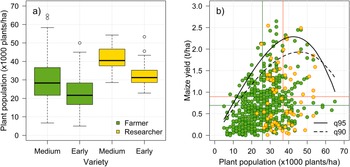
Cultivar type had a statistically significant (p < 0.05) effect on plant population at harvest, unlike fertilizer and cultivar × fertilizer. The number of maize plants at harvest differed significantly (p < 0.05) between the early and intermediate maturity cultivars on both researcher- and farmer-managed experiments, with a higher number of plants observed for the intermediate maturity cultivar (Figure 4a). Plant population at harvest was higher on researcher-managed experiments at about 42,000 plants ha−1 for the intermediate duration cultivar and 32,000 plants ha−1 for the early maturity cultivar. The median plant population on farmer-managed experiments was about 28,000 plants ha−1 for the intermediate maturity cultivar and 22,000 plants ha−1 for the early maturity cultivar.
Variations in plant population at harvest across early (MH43A) and intermediate (DK777) maturity cultivars (a) and maize yield responses to plant population at harvest (b) in researcher- and farmer-managed experiments during the 2023–2024 cropping season. The solid and dashed black lines in (b) display quantile regressions fitted to 95th and 90th quantiles. Vertical lines in (b) indicate the average plant population whereas horizontal lines indicate the average maize yield in the researcher- and farmer-managed experiments.

The variation in plant population was larger in the farmer-managed experiments than in the researcher-managed experiments, and the same was true for the maize yields obtained for a given plant population (Figure 4b). Overall, plant population varied from 5,000 to 65,000 plants ha−1 and from 25,000 to 53,333 plants ha−1 in the farmer- and researcher-managed experiments, respectively. The mean plant population in both experiments was lower than the target value of 53,333 plants ha−1 in this drought-affected cropping season: about 38,000 plants ha−1 in the researcher-managed experiments and 26,000 plants ha−1 in the farmer-managed experiments. The quantile regressions fitted to the 90th and 95th quantiles indicated that maize yield was maximized at a plant population of around 50,000 plants ha−1, corresponding to 2.0 t ha−1 at the 90th quantile and 2.6 t ha−1 at the 95th quantile (Figure 4b). Plant populations of more than 50,000 plants ha−1 were associated with slight decreases in maize yield. Results thus show a clear contribution of plant population to maize productivity as well as the importance of other factors at a given plant population level.
Profit revenue and return on investment in seeds and fertilizer
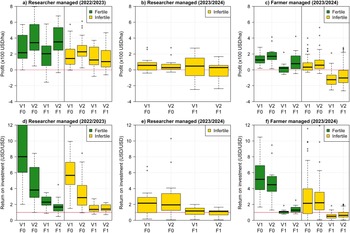
In the 2022–2023 cropping season, the results show that it is profitable to grow improved maize cultivars in high- and low-fertility fields (Figure 5). The profit for the intermediate maturity cultivar was higher than for the early maturity cultivar in high (median of USD 370 ha−1 vs. USD 200 ha−1) and low-fertility (median USD 200 ha−1 vs. USD 100 ha−1) fields (Figure 5a). The maximum profit was about USD 800 ha−1 for the intermediate maturity cultivar and USD 700 ha−1 for the early maturity cultivar. The profit for both cultivars was comparable across fertilizer regimes, indicating that gains in maize yield due to fertilizer offset the cost of the fertilizers. The return on investment in improved seed was higher for the early maturity cultivar than the intermediate maturity cultivar and decreased with the application of fertilizers (Figure 5d). It was also slightly lower in low-fertility fields.
Profitability and return on investment of early (V1) and intermediate (V2) maturity cultivars with (F1) and without (F0) addition of mineral fertilizers in researcher- and farmer-managed experiments conducted in Buzi District, central Mozambique during the 2022–2023 and 2023–2024 cropping seasons. Data are disaggregated across high- and low-fertility fields. The horizontal red lines indicate no profit and return on investment equal to 1 (i.e., gross returns equal to input costs).

In the 2023–2024 cropping season, the profit and return on investment were on the margin in researcher-managed experiments for both early and intermediate maturity varieties (Figures 5b and 5e). The maximum profit was about USD 100 ha−1 for both cultivars. Fertilizer application increased the maximum profit up to USD 250 ha−1 but increased the number of unprofitable fields by nearly 25%. Overall, fertilizer use was not profitable in farmer-managed experiments, especially in low-fertility fields, for both cultivars (Figures 5c and 5f). The maximum profit in high-fertility fields ranged between USD 100 ha−1 and USD 250 ha−1.
Discussion
Improving soil fertility and agronomic management are widely recognized as pathways for sustainable intensification of crop production in sub-Saharan Africa (Kuyah et al., Reference Kuyah, Sileshi, Nkurunziza, Chirinda, Ndayisaba, Dimobe and Öborn2021). This study investigated whether maize yield response to improved cultivars and early sowing was conditional on soil nutrient availability, arguably the most limiting factor to maize yields in African smallholder farming (Bekunda et al., Reference Bekunda, Sanginga, Woomer and Donald2010; Tittonell and Giller, Reference Tittonell and Giller2013), including Central Mozambique (Roxburgh and Rodriguez, Reference Roxburgh and Rodriguez2016). The experimental approach involved testing two hybrid maize cultivars with three sowing dates and two fertilizer regimes over two distinct cropping seasons (one with good rainfall distribution and one characterized by El Niño-induced drought) and in high- and low-fertility fields. This allowed us to disentangle the relative contribution of interactions between genotype, environment, and management to maize yields and thus to identify the most pressing constraints to farm yields amid climate change and variation in soil fertility.
The cropping season of 2022–2023 was characterized by a normal rainfall amount and distribution (Figure 1b), as reflected in the considerably higher maize yields observed in this cropping season compared to the 2023–2024 cropping season, regardless of agronomic management or soil fertility status. Under such conditions, considerable maize yield gains were observed for early and intermediate maturity cultivars when sown earlier and with the use of fertilizer (Figure 2a). The positive impact of improved maize cultivars of intermediate maturity on maize yield is well established in southern Africa (Nyagumbo et al., Reference Nyagumbo, Mkuhlani, Mupangwa and Rodriguez2017; Setimela et al., Reference Setimela, Magorokosho, Lunduka, Gasura, Makumbi, Tarekegne, Cairns, Ndhlela, Erenstein and Mwangi2017), as is the importance of timely sowing (Rurinda et al., Reference Rurinda, van Wijk, Mapfumo, Descheemaeker, Supit and Giller2015; Wafula, Reference Wafula1995), particularly under moderate to high soil fertility. Our results in low-fertility fields further show that maize yield response to sowing date and cultivar type is only observed with the application of fertilizers, pointing to the importance of fertilizer use where soil fertility is poor (Amare et al., Reference Amare, Alemu, Bazie, Woubet, Kidanu, Alemayehu, Awoke, Derebe, Feyisa, Tamene, Kerebh, Wale and Mulualem2022; Falconnier et al., Reference Falconnier, Cardinael, Corbeels, Baudron, Chivenge, Couëdel, Ripoche, Affholder, Naudin, Benaillon, Rusinamhodzi, Leroux, Vanlauwe and Giller2023; Silva et al., Reference Silva, Baudron, Ngoma, Nyagumbo, Simutowe, Kalala, Habeenzu, Mphatso and Thierfelder2023). We also found that sowing an early maturity cultivar is riskier than sowing an intermediate maturity cultivar in low-fertility fields; hence, the latter is recommended regardless of soil fertility when early sowing can be ensured. Overall, it is important to prioritize soil fertility management in Central Mozambique in the short term, certainly when favourable rainfall can be expected, and our results provide recommendations to exploit positive interactions between management practices and their associated risk for farmers under such conditions.
Despite the El Niño-induced drought in the cropping season of 2023–2024, the cultivars tested under researcher management in the high-fertility field reached yields comparable to those obtained in the first cropping season with fertilizer application in the same field type (Figure 2c). The good maize yield in this field in a drought year could be attributed to good soil structure and water-holding capacity, indicating some degree of heterogeneity in soil fertility among the high-fertility fields in our sample (Vanlauwe et al., Reference Vanlauwe, Tittonell and Mukalama2007). This can be explained by differences in past field management practices and differences in resource endowments between farmers (Giller et al., Reference Giller, Rowe, De Ridder and Van Keulen2006). Conversely, maize yields in low-fertility fields were much lower in the second season than in the first season, but fertilized plots yielded about twice that of unfertilized plots under researcher and farmer management. The variability in yield response to fertilizer use in low-fertility fields can be attributed to (1) differing soil sand content and associated soil water-holding capacity, (2) inappropriate fertilizer rates and types, and (3) the calcium and boron deficiencies observed in some fields. Previous studies in smallholder settings also found low-fertility fields to be unresponsive to fertilizer use (Giller et al., Reference Giller, Tittonell, Rufino, van Wijk, Zingore, Mapfumo, Adjei-Nsiah, Herrero, Chikowo, Corbeels, Rowe, Baijukya, Mwijage, Smith, Yeboah, van der Burg, Sanogo, Misiko, de Ridder, Karanja, Kaizzi, K’ungu, Mwale, Nwaga, Pacini and Vanlauwe2011; Nziguheba et al., Reference Nziguheba, Van Heerwaarden and Vanlauwe2021) and proposed a focus on integrated soil fertility management as a means to increase and stabilize maize yields (Zingore et al., Reference Zingore, Delve, Nyamangara and Giller2008). Our findings support such approach to soil fertility improvement and highlight the importance of adopting improved cultivars for food security in dry years.
By including researcher-managed and farmer-managed experiments, this study further allowed an evaluation of the impact of improved agronomic management on maize yield. A large difference was found between the productivity obtained under researcher and farmer management in high-fertility fields (Figure 2c) and in low-fertility fields where fertilizer was applied (Figure 2d). This finding points to the critical role of improved agronomy to maize productivity in southern Africa (see also Nyagumbo et al., Reference Nyagumbo, Nyamayevu, Chipindu, Siyeni, Dias and Silva2024; Roxburgh and Rodriguez, Reference Roxburgh and Rodriguez2016; Silva et al., Reference Silva, Baudron, Ngoma, Nyagumbo, Simutowe, Kalala, Habeenzu, Mphatso and Thierfelder2023). In this context, improved agronomy goes beyond timely sowing and fertilizer application, since these operations were also handled by researchers in farmer-managed fields, encompassing timely weeding and management practices that can ensure a good crop development and plant population at harvest (Figure 4a). For instance, ensuring a plant population at harvest of up to the recommended 53,333 plants ha−1 can potentially increase maize yield from 0.6 up to 2.0 t ha−1 under farmer management, roughly twice the average annual maize consumption in the study region. On farmer-managed experiments, most land preparation was done manually or using oxen, with implications on the quality of the seedbed for seed germination and growth, uniformity of seed depth, and access to soil moisture and nutrients. In this study, it was not possible to monitor whether weeding on farmer-managed experiments was done at the appropriate time, but the water stress induced by El Niño in the 2023–2024 cropping season might have further increased competition for water and nutrients in the case of late weeding.
Maintaining soil fertility and crop productivity under smallholder farming conditions requires a long-term perspective involving complementary practices tailored to local contexts. Conservation agriculture principles like no-tillage hold promise in improving soil moisture retention and yields under water-limited conditions, particularly on sandy soils (Thierfelder and Wall, Reference Thierfelder and Wall2012), while crop diversification through maize-legume intercropping can help manage drought risk and enhance soil fertility in land-constrained settings (Wafula, Reference Wafula1995). However, the suitability of these practices for smallholder farms is contingent on resource endowments and on resolving trade-offs on crop residue management at the farm level, particularly on mixed crop-livestock farms (Giller et al., Reference Giller, Witter, Corbeels and Tittonell2009). Suboptimal plant population at harvest further compounds these challenges, driven by a combination of in-season droughts, poor soil fertility, cultivar choice, and untimely field operations due to competition for labour during critical periods of the growing season (Page et al., Reference Page, Cerrudo, Westra, Loux, Smith, Foresman, Wright and Swanton2012; Silva et al., Reference Silva, Baudron, Reidsma and Giller2019; Tittonell and Giller, Reference Tittonell and Giller2013). Beyond residue management, complementary practices such as seed priming, water-harvesting techniques, manure application, and micro-dosing of mineral fertilizer are also important to sustain crop performance in semi-arid environments (Aune et al., Reference Aune, Coulibaly and Giller2017). Where animal manure is scarce due to low livestock densities or free-grazing systems, these alternative soil fertility management options offer viable pathways toward long-term soil fertility management.
In addition to agronomic benefits, improved cultivars can increase the profitability of smallholder farms in Central Mozambique, particularly in cropping seasons with good rainfall. Our results indicate that nearly half of the farms achieved a profit of USD 350–800 ha−1 when the intermediate maturity cultivar was used without fertilizer application in the researcher-managed experiments (Figure 5a). This is substantial, even when labour costs are not accounted for, since the minimum wage for the agriculture sector in Mozambique is about USD 100 month−1 (Governo de Moçambique, 2024) and that smallholders in Central Mozambique farm 1.7 ha on average, slightly above the national average of 1.5 ha (MADER, 2024). Yet, such short-term benefits will lead to soil fertility decline if improved cultivars are grown without fertilizer in the same field over time (Bekunda et al., Reference Bekunda, Sanginga, Woomer and Donald2010; Lal and Stewart, Reference Lal and Stewart2016). The low profitability observed in the farmer-managed experiments (Figure 5c) is largely the result of the El Niño-induced drought. Moreover, investing in improved seeds in low-fertility soils is often not economically attractive, particularly when fertilizers are used in low rainfall years (Figure 5). The rainfall variability observed across two consecutive seasons shows the risk of investing in fertilizers despite its positive effect on increasing yields (Silva et al., Reference Silva, Cairns and Kutywayo2025). The maize yield in the 2023–2024 cropping season was lower, contributing to lower profitability or even losses when fertilizer was used (Figure 5c). If profit and high production are the goals, then fertilizer could be targeted to high-fertility fields with good water-holding capacity.
Earlier studies highlighted the importance of mineral fertilizers toward the sustainable intensification of African smallholder farming (Amare et al., Reference Amare, Alemu, Bazie, Woubet, Kidanu, Alemayehu, Awoke, Derebe, Feyisa, Tamene, Kerebh, Wale and Mulualem2022; Falconnier et al., Reference Falconnier, Cardinael, Corbeels, Baudron, Chivenge, Couëdel, Ripoche, Affholder, Naudin, Benaillon, Rusinamhodzi, Leroux, Vanlauwe and Giller2023; Silva et al., Reference Silva, Baudron, Ngoma, Nyagumbo, Simutowe, Kalala, Habeenzu, Mphatso and Thierfelder2023). Yet, smallholders’ access to mineral fertilizers remains limited in Mozambique, when compared with neighbouring countries. The response of early and intermediate maturity cultivars to fertilizers in our experiments (Figure 2) shows how fertilizers can significantly increase and sustain yields. While the financial analysis indicates that applying fertilizers in a drought year substantially decreases profit, the economic gains can be large in years with adequate rainfall. Several studies indicated the positive impact of smart agro-input subsidy programmes on agricultural productivity, food security, and the nutritional status of the most vulnerable farming households in sub-Saharan Africa (Haile et al., Reference Haile, Wossen, Tesfaye and Von Braun2017; Obayelu et al., Reference Obayelu, Arowolo, Oyawole, Aminu, Ibrahim and Charis2021). This is also relevant because residual fertilizer effects on maize yield are more pronounced in the dry season than in high-rainfall seasons (Keating et al., Reference Keating, Godwin and Watiki1991), suggesting that the benefits of input subsidies may extend beyond the season of application. Future research must therefore consider the long-term effects of residual fertilizer on both productivity and soil fertility improvement.
The crop failure in the intermediate and late sowing dates reported in the second cropping system of our experiment compromised our quantitative evaluation of the effect of sowing date on maize yields. The plots of the intermediate sowing date were in fact planted, but the crop did not establish due to severe dry spells that followed, whereas the late sowing date could not be planted due to lack of soil moisture for germination. Although such crop failures unbalanced our dataset, they are still important to our analysis. First, they show the importance of early planting for farmers, particularly in severe drought years. Second, the fact that our experimental years are so contrasting in terms of water availability enriches our findings on how G × E × M play out under such extreme conditions, i.e., in an average year rainfall compared to a severe drought year. We account for the resulting unbalanced data in our statistical analysis to the extent possible and caution with extrapolations of our results beyond the cropping seasons under which the experiments were conducted. We recommend generating more empirical evidence on how sowing date, cultivar choice, and fertilization interact and shape maize yields in Central Mozambique and other parts of southern Africa over time. This will be important to identify limiting factors to maize productivity in the region and to inform priority setting towards investments in food security amid climate variability and change (see also Silva et al., Reference Silva, Cairns and Kutywayo2025).
Conclusions
Maize yield variability in Central Mozambique can be explained by the interaction between sowing date, cultivar type, and fertilizer regime, reinforcing the importance of understanding G × E × M interactions to maize production in southern Africa. Overall, the intermediate maturity cultivar had better agronomic performance and economic return compared with the early maturity cultivar. The low return on investment with the application of fertilizer serves as a disincentive for farmers to invest in fertilizers under prevailing grain and fertilizer prices. Measures such as smart input subsidies to reduce fertilizer costs are required to improve access to fertilizers for farmers and to ensure longer-term sustainability of crop production in relation to soil fertility replenishment over time. Through the application of various complementary methods, these results underscore the potential of improved cultivars, sowing time, fertilizer use, and the recommended plant density to sustain maize productivity amid climate change and highlight the associated profitability and risks they carry for smallholders in southern Africa.
Supplementary material
The supplementary material for this article can be found at https://doi.org/10.1017/S0014479726100301.
Acknowledgements
The authors would like to acknowledge the funding from the U.S. Agency for International Development Bureau for Resilience, Environment, and Food Security for Sustainable Opportunities for Improving Livelihoods with Soils Consortium, implemented by IFDC. We extend our acknowledgement to the smallholder farmers in Buzi district who agreed to participate in the study.
Competing interests
The authors declare none.



 Open access

