


16.1 Introduction
The founders of the European Union set up a system to resolve collective action problems that was unique in international law. In order to secure compliance and the credibility of joint commitments, the drafters of the Treaties tasked one of the EU’s institutions, the European Commission, with monitoring compliance and conferred upon it the ability to initiate administrative and judicial proceedings ‘for failure to fulfil legal obligations’ (Article 258 TFEU). Over the years, the Commission has developed a broad toolkit to bolster its monitoring and enforcement powers (Smith Reference Smith, Drake and Smith2016). Where conflicts over compliance cannot be resolved in dialogue with the offending Member State, the Commission can call on the Court of Justice of the European Union (CJEU) to adjudicate. Member State governments – as High Contracting Parties (Article 1 TEU) – have strengthened the judicial enforcement procedure by allowing for substantial fines against Member States that have been found to have failed obligations. In a less anticipated fashion, the CJEU created a parallel channel for – de-centralised – enforcement of EU law. In declaring EU law supreme and directly effective, from the mid 1960s onwards, citizens, groups, and companies could challenge public authorities before national courts for alleged infringements of EU law (Pavone Reference Pavone, Gallo and Cecchetti2024). This combination of centralised and de-centralised enforcement ensures that the European Union remains a uniquely effective supranational organisation.
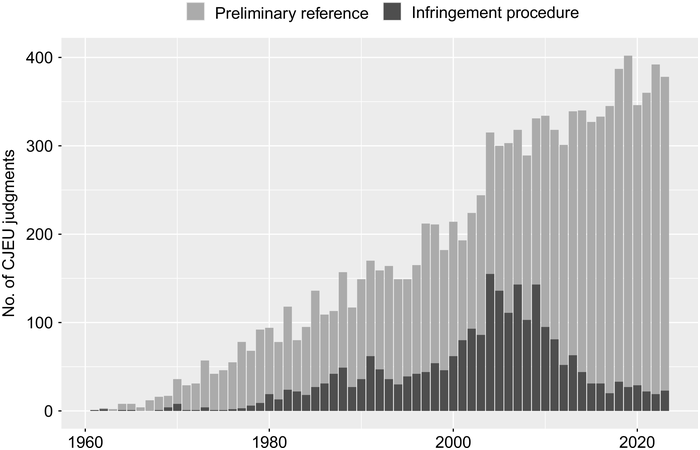
While the legal outlines of this enforcement framework have not changed significantly since the introduction of financial penalties at Maastricht,Footnote 1 the channels by which EU law has been enforced in practice over these three decades have shifted dramatically. We require real-world data to trace these shifts – legal texts and policy documents often diverge starkly from the empirics. Research on Member State compliance with EU law has long relied on empirical data, but an empirical focus on enforcement has lagged. The reflexive reference to the Commission as the ‘Guardian of the Treaties’, for example, ignores that the number of infringement procedures it pursues has precipitously declined since the Barroso II Commission. As Figure 16.1 shows, numbers of CJEU judgments in infringement procedures are back to levels not seen since the 1980s, when the Union was much smaller in size and scope.Footnote 2 By contrast, the number of de-centralised proceedings over the same period has strongly increased.
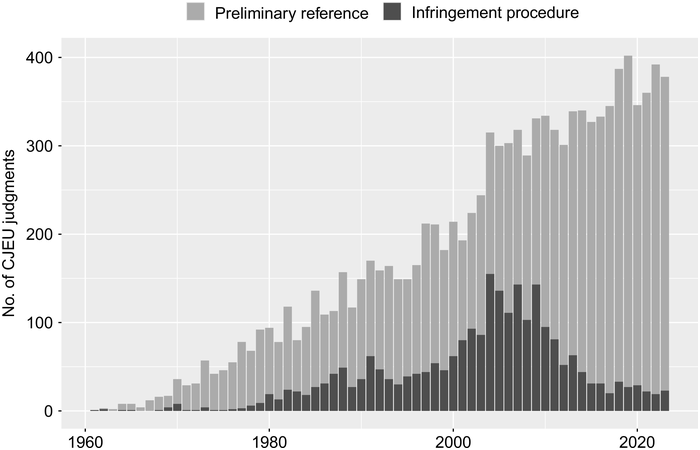
Figure 16.1 Long description
The y-axis represents the number of C J E U judgments, ranging from 0 to 400. The x-axis represents the years, starting from 1960 and extending to 2020. The graph plots two categories of judgments, namely, preliminary reference and infringement procedure. Preliminary reference follows a general upward trend with mild fluctuations from 1 in 1960 to 400 in 2019, and 370 in 2024. The infringement increases from 0 and reaches its highest at 150 in 2024, which decreases with fluctuation. Note, all values are approximated.
This development has not gone unnoticed by academic commentators. In previous work, I have outlined how the Commission actively drives this process by facilitating conditions for private, de-centralised enforcement (Hofmann Reference Hofmann2018, Reference Hofmann2019). Gerda Falkner has argued that the development should be ‘read in the context of mounting doubts if, or how much and at what price, infringements can at all be stopped against the will of the relevant government’ (Falkner Reference Falkner2018: 770). More recently, Daniel Kelemen and Tommaso Pavone have conducted interviews with Commission officials that pointed to political pressures as an impulse for the observed shift (Kelemen and Pavone Reference Kelemen and Pavone2023). They suggest that the Commission has actively retreated from centralised enforcement in order to garner goodwill from Member State governments for newer policy projects. Other contributions highlight a greater willingness by the Commission to tolerate non-compliance where compliance would significantly impact national legal orders (Zhang Reference Zhang2022), and an increased emphasis on informal compliance-promoting tools (Smith Reference Smith, Drake and Smith2016).
The outlines of the development are now well established. Less attention, however, has been paid to the substance of Commission enforcement action. As this chapter will show, not only is the Commission doing less, its substantive and geographic focus of activity has also changed markedly over the last decade. From a previous emphasis on internal market rules, transport, taxation, and the environment, only the latter remains a substantive priority. A small but increasing percentage of cases pursued by the Commission today concern justice and migration, including rule of law backsliding in Poland and Hungary, ‘golden passport’ schemes in Malta, Cyprus, and Bulgaria, and rules concerning police and judicial cooperation throughout the Union. The geographic focus of enforcement action has concomitantly shifted from the previous ‘usual suspects’ – Spain, Italy, Greece and Portugal – to more recently joined Member States.
This contribution investigates this substantive and geographic shift. I will use data on EU legislative activity and data on the infringement procedure to draw a profile of Commission enforcement activity over the years. In doing so, I demonstrate how empirical research based on diverse data sources can be employed to answer questions about the real-world effect of EU ‘law on the books’. The chapter proceeds as follows. The following section summarises previous findings on three factors that drive Commission enforcement activity: the degree of legislative production in the EU, Member State implementation record, and the Commission’s own enforcement policy. The next section compares this to empirical findings on the current state of centralised enforcement. First, I look at how the Commission describes its own priorities and challenges in enforcement. I then present the data sources employed in the empirical overview. This is followed by, first, an overview of the decline in centralised enforcement measured against legislative production, and second, a look at geographic and substantive shifts in Commission enforcement action. A final section concludes and reflects on the trajectory of empirical research in this field.
16.2 Centralised Enforcement
In the present context, the term enforcement describes the process by which a Member State is brought to comply with EU law by means of (a threat of) sanctions following a legally prescribed procedure (Tallberg Reference Tallberg2002: 611). Compliance, in turn, describes ‘a state of conformity or identity between an actor’s behavior and a specified rule’ (Raustiala and Slaughter Reference Raustiala, Anne-Marie, Carlsnaes, Risse and Simmons2002: 539). While de-centralised enforcement of EU law relies on private actors to bring cases in national courts, centralised enforcement is in the hands of the European Commission. As the EU’s oft-heralded ‘Guardian of the Treaties’, the Commission monitors the implementation and application of EU law by the Member States, and it works towards securing Member State fulfilment of their obligations (Article 17 TEU). Existing research has highlighted that the amount of activity the Commission undertakes to do this broadly rests on three conditions: first, the number of legislative acts that create legal obligations, coupled with the number of Member States that are required to apply them, second, the degree of Member State compliance, and third, the Commission’s own ability and proclivity to allocate resources to enforcement. Together, these three factors should explain the variance in aggregate infringement cases over any given period of time. However, for the external observer, all three come with measurement problems. I will elaborate one by one.
16.2.1 Legislative Production
The Commission is tasked with enforcing legal obligations. While primary law is relatively stable, secondary law continuously creates new obligations. New pieces of legislation need to be implemented, and the initial period of national adaptation is an important focus of Commission enforcement activity. Directives, in particular, explicitly require national transposition measures. As the Commission has highlighted, ‘for the purposes of monitoring the application of Community law, directives require particular attention because of the specific requirements for transposal incumbent on the Member States’ (European Commission 2002: 6–7). The number of directives produced by the legislature should therefore be one predictor of Commission enforcement activity. Over the past two decades, the Commission has largely automated the initiation of infringement proceedings when a Member State fails to notify a transposition on time (European Commission 2007: 9). Monitoring the correct transposition requires more effort, but the Commission’s introduction of mandatory correlation tables, in which Member State authorities list how they have transposed every element of a directive, has facilitated this (European Commission 2007: 6). Nonetheless, it requires language skills and knowledge of national legal systems (European Court of Auditors 2018: 33). More recently, the Commission has also highlighted the need to set up systematic procedures for the monitoring of regulations (European Commission 2023: 19–20). This indicates that this had not been a priority before. While regulations do not explicitly require transposition measures, they do require national adaption, either in law or in (administrative) practice. Similarly, part of the Commission’s enforcement efforts focus on the application of primary law in the Member States. In sum, these considerations result in an expectation that the overall amount of legal obligations, the production of new legislation – specifically directives – and the number of Member States that need to fulfil obligations predict the workload of the Commission.
16.2.2 Member State Performance
Next to the number and type of legal acts the Commission is tasked with enforcing, the second element to structure the Commission’s workload is the Member States’ implementation record. Unlike the amount of legislation in force, this aspect is almost impossible to measure systematically (Smith Reference Smith, Drake and Smith2016: 61). Member States are too diverse and the body of EU law too broad to know the ‘true’ state of the life of EU law at street level. Research has therefore concentrated on aspects that are the most measurable. The early literature on Member State compliance with EU law focused on the transposition of directives, and in particular the presence or absence of a notification of transposition measures by the deadline, as recorded by the Commission. This is a comparatively unambiguous domain of compliance particularly conducive to quantitative coding. Studies recorded whether the deadline was met or not, and the duration of the compliance deficit. In his extensive 2014 review of research on Member State compliance with EU law, Oliver Treib outlined how national transposition instruments and the number and type of actors involved have been identified as important explanatory factors for variance in national transposition performance (Treib Reference Treib2014: 11–12).
From this, compliance research went in two directions: one strand continued the path taken by transposition research to employ data generated by the Commission as a proxy for Member State compliance beyond transposition. While such research acknowledged that Commission data only covered the ‘tip of the iceberg’ of the true state of Member State (non-)compliance (Börzel Reference Börzel2021b: 9; Falkner et al. Reference Falkner2005: 204–05; Hartlapp and Falkner Reference Hartlapp and Gerda2009: 292), representatives of this strand maintained that ‘there is no evidence that infringement data contain systematic biases’ (Börzel Reference Börzel2021b: 20). While findings from this approach were not always conclusive, many contributions focused on national administrative capacity, the degree of fit between EU obligations and existing national practices, political will, EU-level bargaining, and the politicisation of implementation procedures at the national level as factors that predict national implementation performance (Börzel Reference Börzel2021b: 20–29; Treib Reference Treib2014).
The other strand of contributions explored alternative sources to measure the state of Member State compliance. Gerda Falkner, Oliver Treib, Miriam Hartlapp, and Simone Leiber engaged in an in-depth analysis of the implementation of six EU labour law directives. They based their measure on interviews with public officials, trade union representatives, employer associations, and labour inspectorates (Falkner et al. Reference Falkner2005: 6–10). Thomas König and Lars Mäder employed law school graduate students to evaluate the legal ‘correctness’ of national implementation measures relating to 21 directives passed between January 1999 and December 2000 (König and Mäder Reference König and Lars2014: 251). Case selection aimed to assure variance on ‘the type of legislative procedure to which they were subject, the time period in which they were introduced and discussed, and their political importance’ (Thomson and Stokman Reference Thomson, Stokman, Thomson, Stokman, Achen and König2006: 27). In a series of studies, Asya Zhelyazkova and co-authors relied on evaluation reports by national policy experts to derive information on implementation performance (Zhelyazkova Reference Zhelyazkova2013: 708–09; Zhelyazkova et al. Reference Zhelyazkova2016: 883, Reference Zhelyazkova2017: 220–21). While robust results on drivers of non-compliance also remain elusive for this strand of research, it does in fact shed light on the enforcement behaviour of the Commission. One central take-away is that the Commission acts strategically in choosing cases to pursue.
A difficult obstacle to any objective measure of compliance is the inherent indeterminacy of many EU rules. When compliance is the ‘state of conformity between an actor’s behavior and a rule’ (Raustiala and Slaughter Reference Raustiala, Anne-Marie, Carlsnaes, Risse and Simmons2002: 539), such conformity can only be established if there is a clear conception of what behaviour the rule actually prescribes. This may not always be straightforward, and particularly not for EU primary law. That Article 28 of the Treaty establishing the European Economic Community contained an obligation to mutually recognise one another’s product standards was hardly evident to public authorities before the CJEU’s Cassis de Dijon judgment.Footnote 3 Similarly, the drafters of Article 8 of the Treaty on European Union at Maastricht did not intend to require a ‘certain degree of financial solidarity’Footnote 4 of national welfare systems with migrant EU citizens in need. Enforcement is therefore also a strategic tool for the enforcer to transmit their interpretation of ambiguous legal obligations. What compliant behaviour actually entails only becomes apparent after an authoritative interpretation of the CJEU (Hartlapp Reference Hartlapp, Tömmel and Verdun2009: 284). The Commission has historically been very successful in convincing the Court of its interpretation (Hofmann Reference Hofmann2013; Schmidt Reference Schmidt1998).
In sum, research on Member State compliance with EU law offers few concrete indications about the level of enforcement activity to be expected of the Commission. This is because the true state of compliance is difficult to measure empirically. Moreover, any attempt at measurement conceptually requires a concrete idea of what compliant behaviour looks like. This is easier in some cases than in others.
16.2.3 The Commission’s Own Enforcement Policy
The third factor in explaining the level of Commission enforcement activity comprises the resources at its disposal to pursue enforcement action (primarily staffing) and its strategic decision-making about how to employ those resources. The Commission refers to this as its ‘enforcement policy’ (European Commission 2017: 2). Critics of the validity of Commission enforcement action as an indicator for Member State compliance have frequently pointed out that the Commission does not have the resources to comprehensively monitor Member State behaviour (Hartlapp and Falkner Reference Hartlapp and Gerda2009: 298). As mentioned above, even something as comparatively straightforward to ascertain as the correctness of notified transposition measures with the use of correlation tables (European Commission 2007: 6) requires extensive resources (European Court of Auditors 2018: 32–33). The Commission itself expressed in a 2023 staff working document the ‘concern that human and financial resources currently allocated are not sufficient to pursue the required enforcement action’ (European Commission 2023: 4). In addition to its own monitoring efforts, the Commission relies on external cues, mainly from civil society via its own complaints procedure or transmitted via the European Parliament’s committee on petitions or the European Ombudsman (European Commission 2002: 4). Nonetheless, effectively following up on detected infringements requires adequate staffing. Given stable resources, an increase in obligations outside of enforcement will inevitably put a strain on Commission enforcement capacity, as the Commission itself admits: ‘The combination of the extra demands of crisis and an ambitious policy agenda and resource constraints have created an increasing pressure on enforcement work’ (European Commission 2023: 4).
Scarce resources limit Commission activity, but legal rules place very few constraints on the Commission’s decisions how to deploy them. Article 17 TEU tasks the Commission with ensuring the application of EU law and Article 258 TFEU describes the outlines of the infringement procedure, but the rest is largely left to Commission discretion. The CJEU has confirmed that the Commission is under no legal obligation to pursue potential infringements.Footnote 5 It cannot be legally compelled to do so, even where the infringement may be obvious.Footnote 6 There are few practical limits to its discretion (Smith Reference Smith, Chalmers and Arnull2015: 352–53). Koen Lenaerts, the current president of the CJEU, has written about the infringement procedure as a ‘political tool at the Commission’s disposal’ (Lenaerts and Gutiérrez-Fons Reference Lenaerts and Gutiérrez-Fons2011: 4). From early on, voices from within the Commission have acknowledged the strategic nature of enforcement action. In 1981, Claus-Dieter Ehlermann, former head of the Commission’s Legal Service, highlighted that the Commission selects cases it is likely to win in court (Ehlermann Reference Ehlermann, Grewe, Rupp and Schneider1981: 139).Footnote 7 Research has repeatedly confirmed this strategic nature. Thomas König and Lars Mäder presented findings indicating that the Commission is less likely to pursue an infringement where it itself disagrees with the policy, the Member State government in question strongly disagrees, or the domestic constellation of interest groups is unlikely to pressure the government to comply (König and Mäder Reference König and Lars2014: 252–54). Joshua Fjelstul and Clifford Carrubba found that a lack of public support for the EU and the ‘ideological distance of the government from the political center of gravity’ decrease the likelihood that the Commission will pursue infringements (Fjelstul and Carrubba Reference Fjelstul and Carrubba2018: 438). Sivaram Cheruvu presented evidence that the Commission delays enforcement action in anticipation of a Member State government’s electoral defeat (Cheruvu Reference Cheruvu2022). Asya Zhelyazkova and Reini Schrama showed that the Commission reacts to cues in external expert reports that indicate implementation deficits, depending on Member State support for the EU and the existence of an active and supportive civil society (Zhelyazkova and Schrama Reference Zhelyazkova and Schrama2023). Gerda Falkner demonstrated how the Commission drops ‘hopeless’ cases in the face of strong domestic opposition even after CJEU judgments remain unimplemented (Falkner Reference Falkner2018). Yaning Zhang provided evidence that the Commission tolerates non-compliance out of concern for the integrity of national legal orders (Zhang Reference Zhang2022). Daniel Kelemen and Tommaso Pavone suggested the Commission has actively retreated from centralised enforcement in order to garner goodwill from Member State governments for newer policy projects (Kelemen and Pavone Reference Kelemen and Pavone2023). In previous work, I demonstrated how the Commission facilitates private litigation in an apparent effort to ‘outsource’ its own enforcement action (Hofmann Reference Hofmann2018).
Alongside such empirical research, a separate strand of literature has offered a normative critique of the opacity of Commission decision-making in enforcement matters and its handling of citizen complaints. Richard Rawlings attributed to the Commission ‘an internal legal culture that has insufficient regard … for the due process norms of contemporary administrative law systems’ (Rawlings Reference Rawlings2000: 14). Melanie Smith highlighted the ‘discretionary, secretive and diplomatic’ nature of the infringement procedure during its administrative stage, where 90 per cent of all cases are settled (Smith Reference Smith2008: 779). She pointed out the mismatch between this state of affairs and the Commission’s own commitment to ‘good governance’ since the publication of its ‘White Paper on Governance’ (European Commission 2001). Centralised enforcement, she stressed, was ‘neither open, participatory, effective, coherent nor accountable’ (Smith Reference Smith2008: 782), and Ombudsman investigations uncovered ‘disturbing practices that range from mismanagement, administrative ineptitude, “high handed and arrogant” treatment of the complainants, a routine lack of reasoning and the potential for corruption due to a lack of administrative controls’ (Smith Reference Smith2008: 790).
Finally, a somewhat different strand of literature has looked at how the Commission uses enforcement powers to promote its own policy agenda. Francis Snyder was one of the first to highlight how the Commission can use litigation in order to develop political strategies: ‘Instead of simply winning individual cases, it is able to concentrate on establishing basic principles, or playing for the rules.’ In doing so, the Commission can ‘convert litigation into a resource for structured bargaining’ and it can ‘use litigation as an aspect of its negotiating strategy’ (Snyder Reference Snyder1993: 30–31). In other words, merely getting individual Member States to comply with evident obligations may not be the only motivation behind the Commission’s use of the infringement procedure. Susanne Schmidt later laid out this potential in greater detail. She described how the Commission used its enforcement powers in the 1980s and 1990s to pursue a strategy of market liberalisation, specifically the gradual removal of public monopolies in telecoms and energy (Schmidt Reference Schmidt1998). She demonstrated how the Commission could strategically employ both its law-making powers in competition policy and its general enforcement powers to ‘manipulate either the Council’s default condition of decision-making or the preferences of some of its members’ (Schmidt Reference Schmidt2000: 38). This could be done through either a strategy of ‘divide and conquer’, where the Commission would target the domestic regimes of individual Member States in order to change their vote in the Council, or to threaten enforcement that would threaten the status quo for all Member States, who would then adopt Commission proposals as a ‘lesser evil’ (Schmidt Reference Schmidt2000: 43). In subsequent studies, Daniel Seikel described how the Commission used judicial strategies to ‘circumvent the political blockade of the regulatory integration of financial services with legal means’ (Seikel Reference Seikel2014: 170) and Benjamin Werner showed how Commission legal action limited the ability of governments to exert control over formerly public companies by way of so-called golden shares with special voting rights (Werner Reference Werner2013). In all cases, the Commission was able to circumvent Member State opposition in the legislative process by convincing the CJEU of an expansive interpretation of EU market freedoms and Member State obligations under EU competition policy. This serves as a forceful demonstration that ‘compliance’ can be a decidedly moving target. It also demonstrates that a decisive factor in predicting Commission enforcement activity will be its own policy priorities.
16.3 Commission Enforcement Action
The following section first looks at how the Commission itself describes its enforcement policy and then compares this to available data on how it carries it out in practice. These data will focus on the ‘visible layer’ of Commission enforcement activity (Smith Reference Smith, Drake and Smith2016: 49), and specifically on the final stage of the formal infringement procedure – the referral of a case to the CJEU. It is a conscious choice that omits the less visible (or invisible) layers of centralised enforcement, which potentially take up more of the Commissions time and resources than legal action, but which are difficult to systematise. Referrals to the CJEU are a specific subsection of centralised enforcement and we have no means of ascertaining whether it is representative of enforcement activity as a whole. As Melanie Smith writes, ‘reasons for not proceeding with a case can be complex, resource driven, strategy driven, administrative, and often relate to the particular culture of the DG (and each Commissioner) and the surrounding political circumstances’ (Smith Reference Smith, Drake and Smith2016: 66). Nonetheless, referrals cover those areas of conflict where Member States are not willing to concede to Commission demands and where the Commission is willing to cease control over the process by calling upon a third party to adjudicate.
16.3.1 The Commission’s Stated Enforcement Priorities
Since its White Paper on Governance (European Commission 2001), the Commission has formulated a set of enforcement priorities in relation to its ‘Better Regulation Agenda’ (European Court of Auditors 2018: 23). In a Communication on ‘Better Monitoring the Application of Community Law’ (European Commission 2002), the Commission highlighted a number of priority areas for enforcement action. According to this, the Commission prioritised cases that ‘undermine the foundations of the rule of law’, including ‘breaches of the principle of the primacy and uniform application’ of EU law, ‘violations of human rights and fundamental freedoms’ or ‘serious damage to the [EU’s] financial interests’, cases that ‘undermine the smooth functioning’ of the EU legal system, including violations of exclusive Union powers, systematic repeated infringements of the same piece of law, and finally all cases concerning a failure to (correctly) transpose directives (European Commission 2002: 11–12). A 2007 Communication added ‘respect for Court judgments’ in previous infringement cases to this list (European Commission 2007: 9).
During the Juncker presidency, the Commission announced a ‘more strategic approach to enforcement’ to focus on the ‘most important breaches of EU law’ (European Commission 2017: 3, 8), without, however, fundamentally altering priority areas. The Commission continued to highlight the transposition of directives, compliance with CJEU judgments, damage to the EU’s financial interest, and the violation of the EU’s exclusive powers (European Commission 2017: 8). Against the backdrop of developments in Hungary and Poland, the Commission specified that the priorities included cases concerning the ‘capacity of the national judicial system to contribute to the effective enforcement of EU law’, ‘practices which impede the procedure for preliminary rulings’, and ‘requirements of the rule of law and Article 47 of the Charter on Fundamental Rights of the EU’ (European Commission 2017: 8–9). In addition, it repeated the priority status of cases concerning fundamental rights and fundamental freedoms. Highlighting its ‘discretionary power’ in enforcement action, the Commission stressed its focus on cases where ‘added value’ could be achieved, whereas it reserved the right to close cases that it considered not ‘appropriate from a policy point of view’ (European Commission 2017: 9).
Two more Commission documents have since addressed its enforcement priorities. A 2022 Communication illustrated the existing priorities with a long list of examples from various policy fields. This document highlighted that Commission observations in preliminary reference cases contribute to its enforcement action (European Commission 2022a: 7), and the strategic connection between compliance and financial support (European Commission 2022a: 14). It reiterated the emphasis on securing ‘effective redress procedures for a breach of EU law, through an independent and efficient judiciary’, with an additional focus on ‘on ensuring that national authorities and regulatory bodies are equipped to provide effective redress’ (European Commission 2022a: 21). Finally, in response to a ‘landscape review’ by the European Court of Auditors (European Court of Auditors 2018), the Commission issued a ‘stocktaking report’ on its working methods in enforcing EU law. This report contained an admission that the national application of regulations had not been a focus of Commission enforcement activity: ‘In most services, monitoring the application of regulations focuses on checking that Member States send reports and plans …. More challenging is the assessment of the actual implementation and application …. In the absence of a more structured monitoring of the application of regulations, some services report that they rely almost exclusively on complaints to identify potential problems’ (European Commission 2023: 16–17). The report also stressed that beyond its overall strategy, ‘there is also room to emphasise the role of sectoral enforcement strategies’ (European Commission 2023: 7). This suggests that individual Directorates General (DGs) pursue their own enforcement priorities. Finally, the report also highlighted ‘adequate staffing’ as a challenge to effectively apply its prioritisation policy (European Commission 2023: 8–9).
The apparent existence of sectoral strategies outside those captured in general strategic documents makes it difficult to draw overall conclusions from the Commission’s own description of its enforcement policy. Besides the non-communication of transposition measures, which the Commission highlights as a priority, we would expect to see a focus of Commission action on core rule of law and access to justice themes. Facilitating private access to national remedies had been a priority of the Commission even before rule of law backsliding made this a highly salient issue. I have previously described this emphasis as part of the Commission’s efforts to ‘outsource’ enforcement to private actors (Hofmann Reference Hofmann2018). It is less clear in how far a focus on ‘added value’ and ‘systematic repeated infringements’ is something that is measurable in practice.
16.3.2 Data on Commission Enforcement Action
Given the highly discretionary nature of the infringement procedure, critics have often highlighted a lack of transparency around Commission decision-making in centralised enforcement (Prete and Smulders Reference Prete and Ben2010: 57; Rawlings Reference Rawlings2000; Smith Reference Smith2008). On the other hand, once the Commission has taken a decision to pursue an infringement, this is now rather well documented. The Commission started reporting on its enforcement activity with the first ‘Annual Report on Commission Monitoring of the Application of Community Law’ published in 1984. These reports contain broad qualitative overviews and summary statistics about complaints received, files opened and handled. They also used to contain long annexes with information about individual files. Every officially initiated procedure is assigned a file number by which subsequent decisions can be traced.
Tanja Börzel was among the first to compile this information for research purposes. She describes how information in the annexes did not add up to the aggregate data presented in the reports, and how the Commission eventually granted her access to its more complete internal database (Börzel Reference Börzel2021b: xi). These data are available as the ‘Berlin Infringement Database’ (BID), which contains all infringement files opened between 1978 to 2017 that have advanced to at least the ‘reasoned opinion’ stage by 7 March 2019 (Börzel Reference Börzel2021a). The Commission eventually replaced the annexes in its annual reports with its own online repository of infringement decisions,Footnote 8 which appears to contain complete information on Commission infringement decisions from the Barroso I Commission (2004) onwards. This database has been continuously upgraded and at the time of writing contains information about the Directorate General (DG) in charge of the file, the legal basis of the infringement actions (the legal act that has allegedly been infringed) and the type of infringement (non-communication of a transposition measure, non-conformity of a transposition measure, or bad application of a legal act), alongside links to press releases and standard meta-data (decision dates, country concerned, etc.). Below, I use a combination of the two sources for data on all infringement files that the Commission decided to refer to the CJEU between 1978 and November 2024. Unless otherwise indicated, all figures below are based on these data.Footnote 9
16.3.3 Trends in Commission Enforcement Action
What exactly has happened to centralised enforcement? Data on the Commission’s use of the infringement procedure paints a rather clear picture. The Commission has drastically scaled down this layer of its enforcement activity. The historical peak of judicial enforcement can be located with the Prodi and Barroso I Commissions. The enforcement activity profiles of the Juncker and von der Leyen I Commissions resemble more the Commissions under presidents Gaston Thorn in the early 1980s and Jaques Delors in the early 1990s, a time when Commission terms were shorter, the EU had less than half the number of Member States, and was much narrower in policy scope.
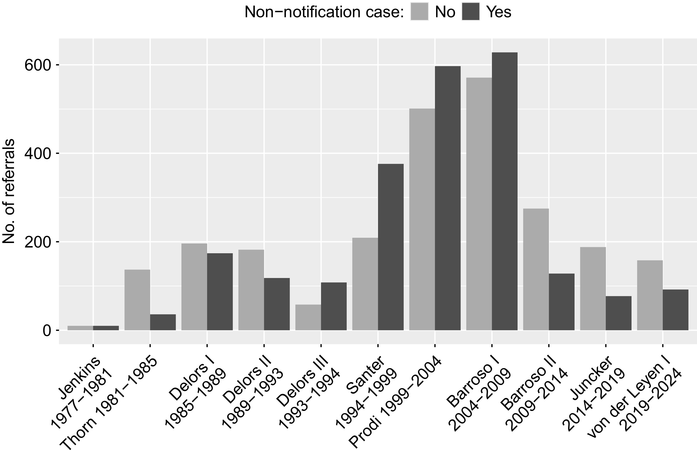
Figure 16.2 shows the total number of court referrals from 1978 to November 2024.Footnote 10 It separates the underlying cases into two types: one type based on the failure by Member States to notify transposition measures to the Commission, and one type capturing all other kinds of infringements. Since the first type gets triggered more or less automatically when a Member State misses a deadline for communicating transposition measures, the second type is sometimes called ‘discretionary’ to underline the fact that these are cases the Commission actively chooses to pursue. Non-notification cases made up the majority of Commission enforcement actions from the mid 1990s to the end of the first decade of the 2000s, but they have only played a minor role since the Barroso II Commission. I am not aware of any arguments in the literature that the Commission might be strategic about the pursuit of non-notification cases. The introduction of the expedited sanction procedure in Article 260(3) TFEU in cases of non-notification may have contributed to increased Member State discipline as they anticipate costs (Smith Reference Smith, Chalmers and Arnull2015: 366). The decline in centralised enforcement has been less stark but still very pronounced with regard to discretionary proceedings. In these cases, too, directives are the focus of Commission enforcement action.
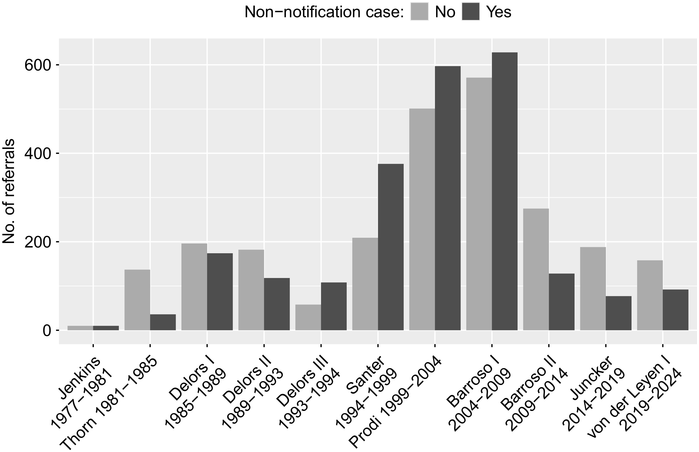
Figure 16.2 Long description
The Y-axis represents the number of referrals, ranging from 0 to 600. The X-axis represents C J E U judgments by procedure. The graph plots bars for no and yes of non-notification cases. Jenkins from 1977 to 1981, 5 and 2. Thorn from 1981 to 1985, 140 and 30. Delors 1 from 1985 to 1989, 200 and 190. Delors 2 from 1989 to 1993, 190 and 110. Delors 3 from 1993 to 1994, 60 and 110. Santer from 1994 to 1999, 210 and 380. Prodi from 1999 to 2004, 500 and 600. Barroso 1 from 2004 to 2009, 570 and 630. Barroso 2 from 2009 to 2014, 280 and 140. Juncker from 2014 to 2019, 190 and 70. Von der Leyen 1 from 2019 to 2024, 140 and 90, respectively. Note, all values are approximated.
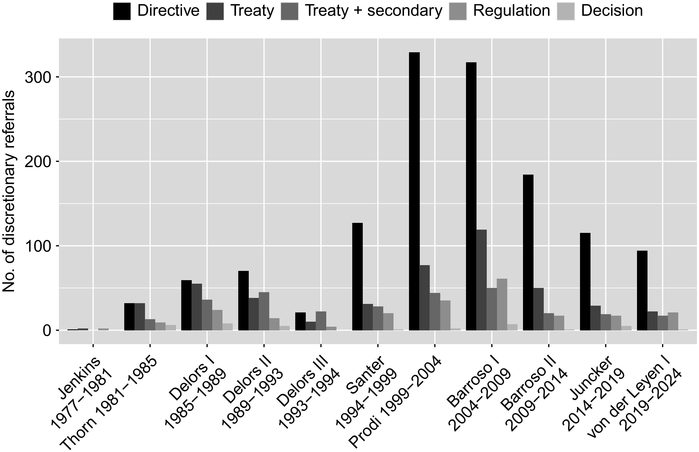
Figure 16.3 shows the types of legal acts cited in discretionary cases that the Commission has decided to refer to the CJEU.Footnote 11 The Commission sometimes combines the enforcement of secondary law with a reference to primary law, such as in a case against Germany, initiated in 2015, in which the Commission held that German minimum and maximum tariffs for architects and engineers infringed both the Services Directive and Article 49 TFEU on the free movement of services.Footnote 12 Other cases rest solely on primary law, such as a 2020 case against a Maltese investor citizenship scheme which the Commission found to infringe on the principle of sincere cooperation (Article 4(3) TEU) and Union citizenship (Article 20 TFEU).Footnote 13 Both categories are not rare but have been eclipsed by the enforcement of directives since the Santer Commission. Regulations and decisions are very rarely subject to infringement proceedings. The data contain only thirty-six cases based on decisions and 219 cases based on regulations that the Commission has decided to refer to the CJEU since 1978. The Commission’s admission to deficits in the enforcement of regulations is clearly borne out in the data.
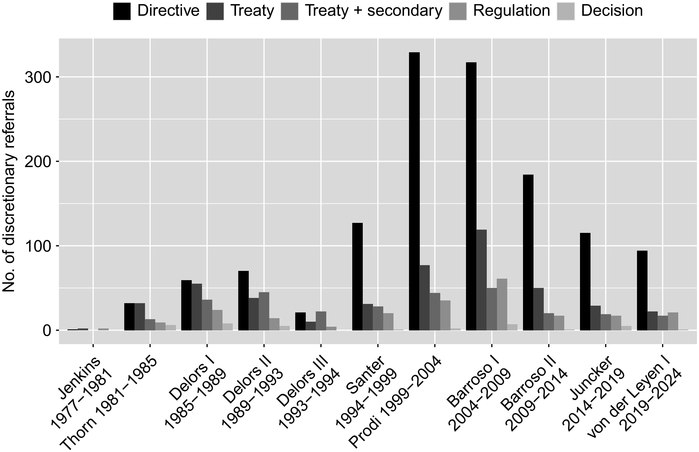
Figure 16.3 Long description
The Y-axis represents the number of discretionary referrals, ranging from 0 to 300. The X-axis plots for decision, directive, regulation, treaty, and treaty plus secondary. Jenkins from 1977 to 1981, 1, 2, 3, 3, and 2. Thorn from 1981 to 1985, 5, 70, 10, 70, and 15. Delors 1 from 1985 to 1989, 5, 60, 30, 50, and 40. Delors 2 from 1989 to 1993, 3, 70, 15, 40, and 50. Delors 3 from 1993 to 1994, 1, 20, 5, 10, and 20. Santer from 1994 to 1999, 2, 130, 20, 30, and 35. Prodi from 1999 to 2004, 2, 330, 40, 80, and 45. Barroso 1 from 2004 to 2009, 5, 320, 65, 120, and 50. Barroso 2 from 2009 to 2014, 3, 180, 20, 50, and 25. Juncker from 2014 to 2019, 5, 120, 20, 30, and 20. Von der Leyen 1 from 2019 to 2024, 2, 180, 20, 20, and 20, respectively. Note, all values are approximated.
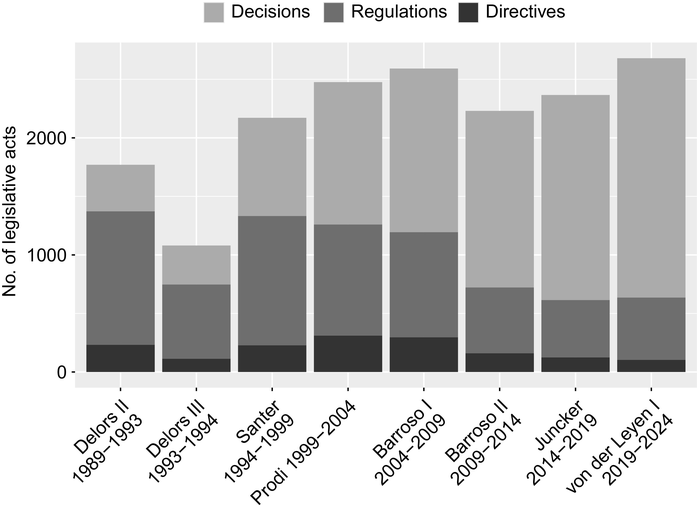
Given the centrality of directives, one possible explanation for the decline in centralised enforcement is a concomitant decline in the production of new directives by the EU legislature. Figure 16.4 depicts aggregate statistical data on EU legislative output available on EUR-Lex for every month since 1990.Footnote 14 While these data do not suggest a decline in legislative activity overall, there has been a clear shift away from directives and regulations and an increase in the number of decisions. This reflects restrained policy activism that began with the Barroso II Commission (Kassim et al. Reference Kassim, Connolly, Dehousse, Rozenberg and Bendjaballah2016: 666). Fewer legislative directives mean fewer transposition deadlines that Member States can miss, and hence fewer automatic non-notification cases. A simple bivariate regression of the variables underlying Figures 16.2 and 16.4 shows that the number of legislative directives produced by the legislature during the term of a Commission explains about 75 per cent of the variance in the number of CJEU referrals.Footnote 15 Even for discretionary cases, the percentage of the variance in referrals explained by the number of legislative directives produced per Commission term of office is also rather high (65 per cent). While Kelemen and Pavone (Reference Kelemen and Pavone2023: 793) found no correlation between Commission enforcement and the number of new legislation combined with the number of Member States that need to implement it (what Börzel calls ‘violative opportunities’, Börzel Reference Börzel2021b), ignoring the number of Member States and focusing on new legislative directives alone yields a strong relationship. The Commission clearly appears to focus much of its enforcement work on new legislative directives, but the accession of new Member States has not resulted in increased activity.
New legislative acts.
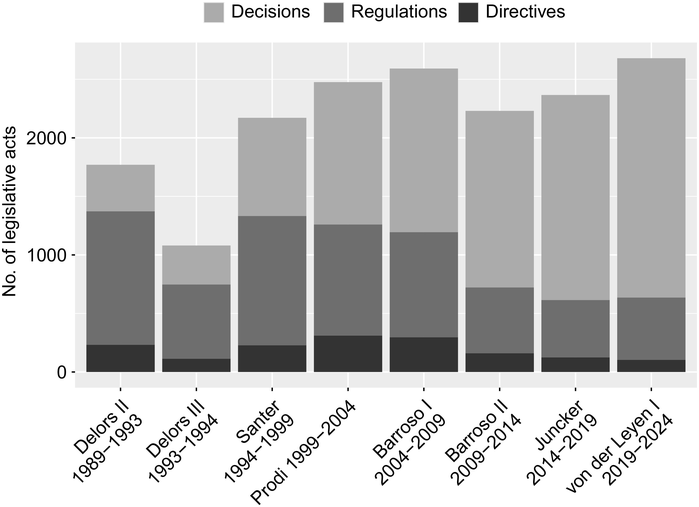
Figure 16.4 Long description
The Y-axis represents the number of legislative acts, ranging from 0 to 2000. The graph plots directives, regulations, and decisions. Delors 2 from 1989 to 1993, 0 to 250, 250 to 1400, and 1400 to 1750. Delors 3 from 1993 to 1994, 0 to 100, 100 to 800, and 800 to 1050. Santer from 1994 to 1999, 0 to 200, 200 to 1350, and 1350 to 2200. Prodi from 1999 to 2004, 0 to 300, 300 to 1300, and 1300 to 2500. Barroso 1 from 2004 to 2009, 0 to 300, 300 to 250, and 250 to 2600. Barroso 2 from 2009 to 2014, 0 to 100, 100 to 700, and 700 to 2200. Juncker from 2014 to 2019, 0 to 150, 150 to 600, and 600 to 2400. Von der Leyen 1 from 2019 to 2024, 0 to 100, 100 to 600, and 600 to 2700, respectively. Note, all values are approximated.
Given the discretion the Commission enjoys in its enforcement policy, such a focus reflects a decision on the part of the Commission on how to allocate scarce resources. Regulations, too, require an adaptation of national behaviour, but as described, Commission documents confirm that this is not a focus (European Commission 2023: 16–17). Moreover, as the Commission’s own implementation reports demonstrate (European Commission 2020, 2022b), older pieces of legislation also give frequent rise to conflicts over compliance. The Commission’s enforcement policy does not seem to give much room to this. Finally, one area of decline in enforcement that cannot be explained by legislative production is primary law. Previous Commissions had a strong focus on primary law in bringing centralised enforcement actions, while the Juncker and von der Leyen I Commissions have hardly pursued this. This can be read as a strategic decision that gives support to the impression of a declining importance of negative integration in the EU, which some authors have recently highlighted (van den Brink et al. Reference van den Brink2023; Zglinski Reference Zglinski2024). At the same time, it casts doubt on the Commission’ assertion that its enforcement actions emphasise ‘fundamental rights and fundamental freedoms’ (European Commission 2017: 9).
16.3.4 Geographic and Substantive Shifts in Centralised Enforcement
The overview so far has focused on overall numbers of Commission decisions to refer infringement cases to the CJEU. In the following, I will look at geographic and substantive shifts in Commission enforcement action. Since my interest is in shifts in Commission enforcement policy, that is in the way the Commission strategically allocates resources to enforcement, I focus here on discretionary cases and exclude cases pursued for non-notification of transposition measures.
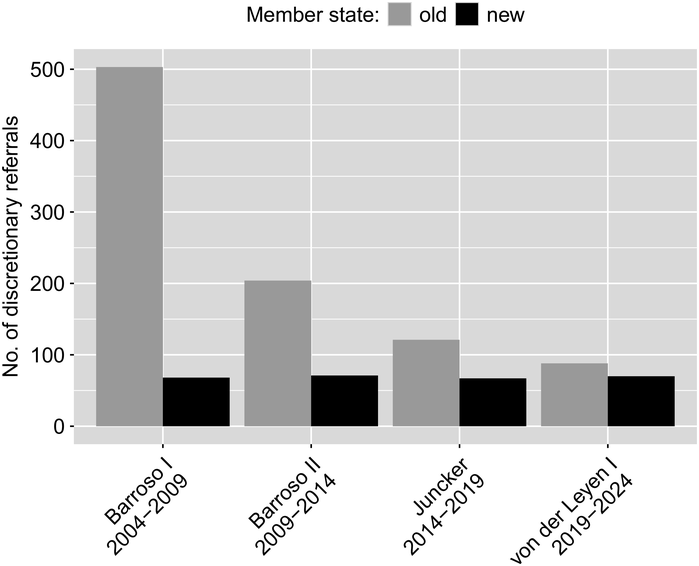
Figure 16.5 illustrates the geographic focus of Commission action in discretionary cases. The picture here is quite striking. Almost the entirety of the decline in discretionary enforcement action pertains to the fifteen ‘old’ Member States. The overall number of cases concerning the ‘new’ twelve Member States has not substantially changed since they became Member States. The von der Leyen I Commission referred an almost equal number of cases to the CJEU relating to both groups of Member States, despite there being fewer ‘new’ Member States and their smaller population size. The emphasis of Commission enforcement action has evidently shifted eastward, and it is expending less effort towards the old ‘usual suspects’.
Old and new Member States.
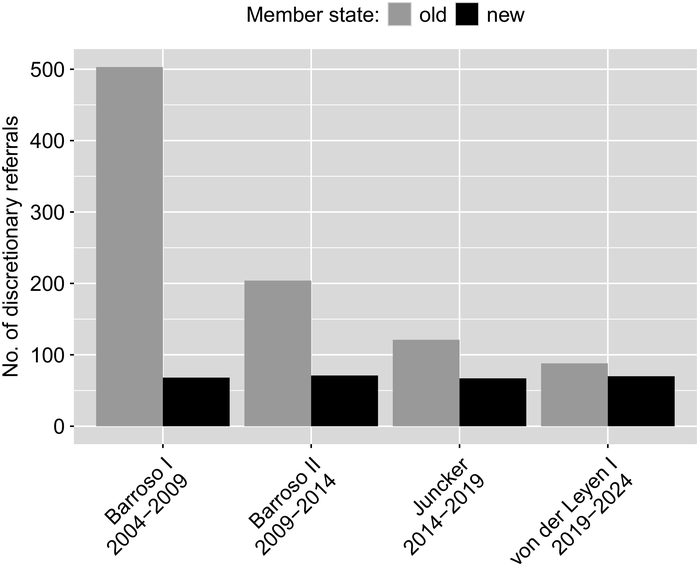
Figure 16.5 Long description
The X-axis represents the number of discretionary referrals, ranging from 0 to 500. The graph plots bars for the member states of the old and new. Barroso 1 from 2004 to 2009, 500 and 350. Barroso 2 from 2009 to 2014, 200 and 70. Juncker from 2014 to 2019, 120 and 70. Von der Leyen 1 from 2019 to 2024, 70 and 60, respectively. Note, all values are approximated.
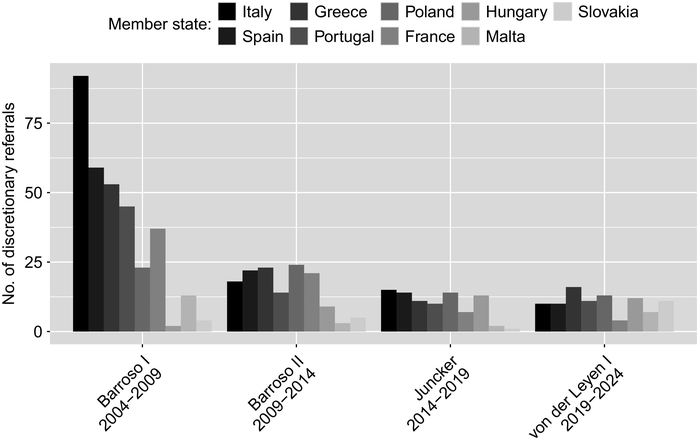
Figure 16.6 further differentiates by the most prominent ‘targets’ of Commission enforcement action at the referral stage. What is striking here is the ‘disappearance’ of Italy and Spain as the foci of Commission enforcement action. This disappearance began with the Barroso II Commission and found its completion with von der Leyen I. The Barroso I Commission made 92 (discretionary) decisions to refer Italy to the CJEU, while the von der Leyen I Commission did so only 10 times, the same number as against Slovakia. The coincidence of this development with the unfolding Eurocrisis seems noteworthy, and Kelemen and Pavone allude to this in their research (Kelemen and Pavone Reference Kelemen and Pavone2023: 802). As a result, there are no longer any ‘usual suspects’ in Commission enforcement action. Italy and Spain are now ‘normal’ Member States, and, if anything, ‘newer’ Member States are now overrepresented in centralised enforcement action. Contrary to what might be expected, Commission action against democratic backsliding in Hungary and Poland is not driving this pattern – Poland in particular had already been a focus of attention during the Barroso I Commission, and cases against Poland have since declined. Nonetheless, the Juncker and von der Leyen I Commissions have pursued enforcement action against democratic backsliding, and this represents an entirely new and challenging focus of centralised enforcement (Anders and Priebus Reference Anders, Priebus, Lorenz and Anders2021). However, research has shown that the Commission did not pioneer a creative use of legal sources to counter such backsliding (Mandujano Manriquez and Pavone Reference Mandujano Manriquez and Pavone2024), but followed legal innovations developed by the CJEU in response to claims by sophisticated domestic litigants (Ovádek Reference Ovádek2023).
Individual Member States.
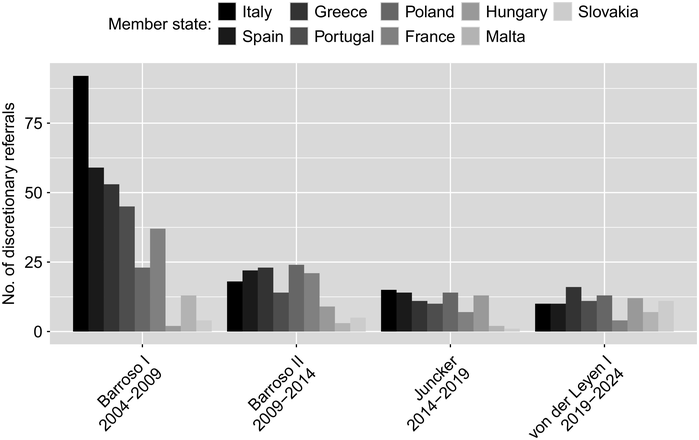
Figure 16.6 Long description
The X-axis represents the number of discretionary referrals, ranging from 0 to 75. The graph plots bars for the member states, namely Italy, Greece, Spain, Portugal, France, Hungary, Malta, and Slovakia. Barroso 1 from 2004 to 2009, 13, 55, 60, 45, 23, 37, 1, 13, and 3. Barroso 2 from 2009 to 2014, 20, 24, 23, 15, 25, 23, 10, 2, and 3. Juncker from 2014 to 2019, 17, 15, 17, 15, 17, 10, 17, 2, and 1. Von der Leyen 1 from 2019 to 2024, 10, 15, 7, 10, 13, 3, 10, 7, and 10, respectively. Note, all values are approximated.
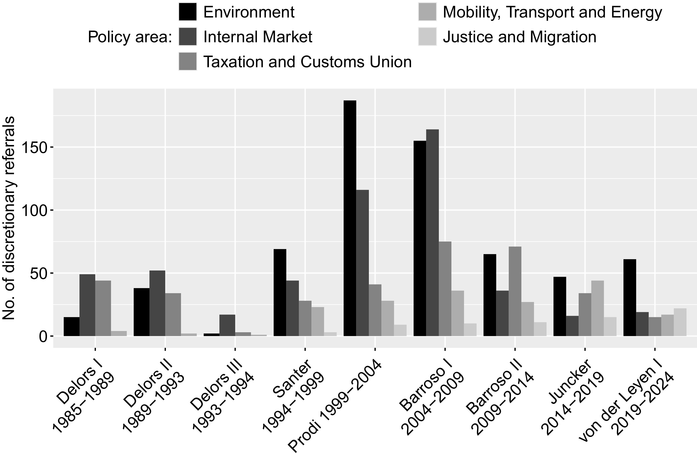
Figure 16.7 depicts shifts in the substantive focus of Commission enforcement action over time. The data contain information on the DG in charge of the file, from which I infer the policy area that the file pertains to. Figure 16.7 focuses on four policy areas that have traditionally been prominent foci of Commission action (the environment, the internal market, taxation and customs union, and mobility and transport) as well as ‘justice and migration’Footnote 16 as a newer field for centralised enforcement. The internal market had historically been the focus of Commission enforcement activity until it lost importance during the Barroso II Commission. This decline is much more pronounced than for other policy areas. I am not aware of a specific explanation for this development, but it coincides with the rise to prominence of the SOLVIT administrative network, which handles internal market conflicts. Writing in 2022, Dorte Sindbjerg Martinsen, Ellen Mastenbroek, and Reini Schrama described this network as issuing ‘more problem-solving cases than the European Commission sends out opening letters as part of its infringement procedure’ (Martinsen et al. Reference Martinsen, Mastenbroek and Schrama2022: 1532). Taxation eclipsed the internal market during Barroso II and the Juncker Commission, but virtually disappeared during von der Leyen I. Cases relating to mobility and transport increased up to and including the Juncker Commission. The von der Leyen I Commission, however, had only one clear focus: environmental cases. Almost half of all cases that the von der Leyen I Commission decided to refer to the Commission pertain to the environment. The environment first became the most frequently enforced policy area in the late 1990s during the Santer Commission and it has remained the Commission’s (now sole) focus since. It is in fact the only policy area that has had a more or less steady number of cases since the big drop from the Barroso I to the Barroso II Commission. Finally, the area of justice and migration has seen a slow but steady increase in focus since it first emerged during the Santer Commission, but overall case numbers are still low.
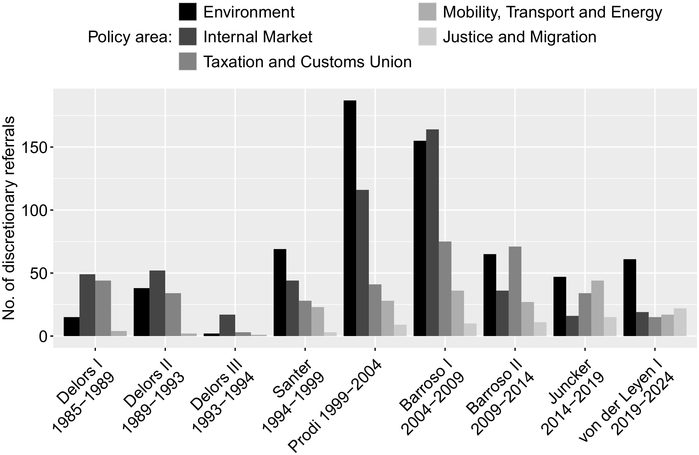
Figure 16.7 Long description
The X-axis represents the number of discretionary referrals, ranging from 0 to 150. The graph plots bars for the policy area, namely environment, internal market, taxation and customs union, mobility, and justice and migration. Delors 1 from 1985 to 1989, 15, 50, 47, 3, and 0. Delors 2 from 1989 to 1993, 40, 50, 35, 2, and 0. Delors 3 from 1993 to 1994, 1, 20, 3, 2, and 0. Santer from 1994 to 1999, 70, 45, 27, 24, and 4. Prodi from 1999 to 2004, 185, 120, 45, 26, and 10. Barroso 1 from 2004 to 2009, 153, 165, 75, 35, and 10. Barroso 2 from 2009 to 2014, 69, 35, 73, 26, and 10. Juncker from 2014 to 2019, 48, 17, 30, 47, and 17. Von der Leyen 1 from 2019 to 2024, 60, 23, 10, 10, and 20, respectively. Note, all values are approximated.
It is difficult to say that this substantive focus, including drastic changes over time, could be predicted based on the Commission’s stated enforcement priorities. None of the general policy documents make specific mention of the environment as a prime priority. Only the increase in cases brought in the field of justice and migration can be tied to the Commission’s stated emphasis on fundamental rights issues, but their comparatively small number makes it hard to speak of a genuine priority. Unstated sectoral strategies seem better candidates for an explanation, as would be a closer examination of the organisation and resources of enforcement units within Commission DGs (European Commission 2023: 9; European Court of Auditors 2018: 26–28).
Figure 16.7 also replicates patterns of litigation that Urška Šadl, Lucía López Zurita, and Sebastiano Piccolo found in citation networks between CJEU judgments more broadly (Šadl et al. Reference Šadl, López Zurita and Piccolo2023). They demonstrate that the CJEU is moving away from case-law that relies on market freedoms to liberalise domestic markets, towards case-law that shapes (harmonises) European markets by way of secondary legislation. Liberalising judgments decline in numbers, whereas harmonising judgments increase (Šadl et al. Reference Šadl, López Zurita and Piccolo2023: 849). I find similar trends in Commission enforcement action, which might be an indication that this development is driven by litigants as much as the CJEU itself. This fits with recent work by Martijn van den Brink, Jan Zglinski, and Mark Dawson, who also find a shift in emphasis from negative to positive integration in the internal market (van den Brink et al. Reference van den Brink2023). Similar to Šadl, López Zurita, and Piccolo (Šadl et al. Reference Šadl, López Zurita and Piccolo2023: 840), I also find a slow increase of cases in the field of justice and migration. Commission enforcement in this sense is aligned with broader legal developments that are driven by an interplay of litigants, national courts, and the CJEU.
16.4 Conclusions
This chapter has explored empirical data on recent developments in the centralised enforcement of EU law. It summarised previous literature on Commission enforcement practices and contrasted this with data on the actual use of the infringement procedure, focusing on referrals to the CJEU – the last stage of the procedure that is still under control of the Commission. I explored three factors that influence real-world behaviour. The first is the EU’s legislative output and the number of Member States that need to implement it. The data show a strong relationship between the number of referrals and the number of new legislative directives produced by the EU legislature, but no effect of the number of regulations and decisions, which are rarely subject to enforcement action. This is acknowledged by the Commission, which only recently highlighted the need to develop instruments for the monitoring of the application of regulations. The number of Member States that are required to implement EU law also does not seem to influence Commission activity – the 2004 enlargement did not lead to increased enforcement. In fact, data on the geographical ‘targets’ of infringement action show that the Commission has drastically reduced its activities vis-à-vis the fifteen ‘old’ Member States, whereas the amount of activity directed towards the ‘new’ twelve Member States has not changed significantly since 2004. Previously prominent targets of enforcement action, first and foremost the Italian government, no longer stick out. Commission enforcement no longer has any ‘usual suspects’.
The second factor discussed was Member State implementation performance, or, broadly speaking, Member State ‘compliance’. Literature has highlighted the Commission’s complete discretion in pursuing infringements and its strategic selection of cases, which gives rise to the impression that Commission action does not necessarily reflect the ‘true’ state of compliance. Independently assessing compliance is a daunting task for research. Moreover, the concept of compliance presupposes an agreement on what behaviour is mandated by rules, and a broad literature has shown that in the past, the Commission used its powers of enforcement to pursue political objectives, such as the breaking up of public monopolies, employing interpretations of legal obligations that were not shared by the original signatories of the European Treaties. However, the data give little indication that the Commission still pursues such objectives today.
The third factor is the Commission’s own enforcement policy. Part of the literature on this issue is devoted to a normative critique of the opacity of Commission action in enforcement. My data do not allow me to address this. What I did offer, though, is a comparison between the Commission’s own stated priorities and its activity profile. One take-away here is that unpublished sectoral priorities seem to be driving Commission activity more than the general objectives stated in central policy documents. The only discernible substantive focus of Commission enforcement action is environmental law, which the general policy documents hardly mention. Empirical research can highlight such discrepancies between text and the real world. Commission documents, however, also stress efforts to increase access to effective domestic remedies for EU law infringements. This does correspond to empirical findings on the Commission’s efforts to ‘outsource’ enforcement to private actors. More recently, the Commission’s focus on domestic remedies has expanded to broader efforts to protect the rule of law, and indeed the data show growing activity of the Commission in this field, albeit with low overall numbers. The Commission’s stated emphasis on ‘fundamental freedoms’ does not translate into a continued focus on market integration. The ‘four freedoms’ (free movement of goods, services, capital, and workers) have largely disappeared from the Commission’s agenda, as have internal market rules more broadly, which have gone from prime priority to afterthought.
I will conclude with three observations. First, empirical data on Commission enforcement action is comparatively easy to come by and lends itself to fruitful analysis of broader developments in law and policy. Rather than use such data to infer the state of Member State compliance, data produced by the Commission can be used much more readily to learn about the Commission’s own political priorities. Second, since enforcement is central to the real-world impact of EU law on the ground, doctrinal research on procedural administrative law, remedies, and access to courts can very fruitfully be combined with empirical data on the actual use of enforcement procedures. Third, more can be done to connect empirical data on centralised enforcement with data on de-centralised enforcement. The Commission’s ongoing retreat from centralised enforcement leaves gaps in the effectiveness of EU law that can only partially be compensated by private legal action. Such private legal action is comparatively easy to trace if it includes a preliminary reference to the CJEU, but the life of EU law on the ground can only be traced with comprehensive data on national proceedings, which are harder to come by. This should be a focus of future research.

 Open access