


Introduction
Dissociation is common (Foote et al., Reference Foote, Smolin, Kaplan, Legatt and Lipschitz2006; Sar, Reference Sar2011), associated with increased risk of self-harm and suicide (Černis et al., Reference Černis, Chan and Cooper2019; Foote et al., Reference Foote, Smolin, Neft and Lipschitz2008), and with increased severity and incomplete treatment-response of co-morbid mental health diagnoses (Bae et al., Reference Bae, Kim and Park2016; La Mela et al., Reference La Mela, Maglietta, Castellini, Amoroso and Lucarelli2010). Despite this, only 28–48% of patients will receive mental health treatment for their dissociative difficulties (Nester et al., Reference Nester, Hawkins and Brand2022), and no NICE (National Institute for Health and Care Excellence) guidance exists for the treatment of dissociative disorders.
After years of ‘stymied progress’ resulting from ‘entrenched’ and conflicting theoretical stances (Lynn et al., Reference Lynn, Maxwell, Merckelbach, Lilienfeld, Kloet, der and Miskovic2019; p. 1, 4), recent small-scale clinical studies (Hunter et al., Reference Hunter, Wong, Gafoor, Lewis and David2023; van Minnen and Tibben, Reference van Minnen and Tibben2021; Varese et al., Reference Varese, Douglas, Dudley, Bowe, Christodoulides, Common, Grace, Lumley, McCartney, Pace, Reeves, Morrison and Turkington2021), have demonstrated the value of targeting dissociative phenomena in their own right. Research is now underway that will directly address the ‘disturbing […] lack of studies evaluating interventions for people with dissociation’ (Fung et al., Reference Fung, Ross, Lam and Hung2022; p. 4). For example, trial protocols have been devised to evaluate schema therapy for dissociative identity disorder (DID; Huntjens et al., Reference Huntjens, Rijkeboer and Arntz2019), and cognitive behavioural therapy (CBT) for depersonalisation disorder (DPD; Hunter, Reference Hunter2022).
The present review concerns the treatment of a specific type of dissociative experience: felt sense of anomaly-type dissociation (FSA-dissociation). This is a novel construct, developed bottom-up through an explicit focus on the phenomenology of common dissociative experiences (Černis et al., Reference Černis, Beierl, Molodynski, Ehlers and Freeman2021a). By attending to the lived experience of these dissociative phenomena, Černis et al. (Reference Černis, Beierl, Molodynski, Ehlers and Freeman2021a) conceptualise a dissociative subtype that, at its core, concerns highly subjective and embodied feelings of anomaly or strangeness; for example, feeling unfamiliar to oneself, or feeling as though the world is unreal. Whilst FSA-dissociation therefore demonstrates phenomenological overlap with depersonalisation (Černis et al., Reference Černis, Beierl, Molodynski, Ehlers and Freeman2021a), it encompasses a broader range of experiences, and so may have different relationships to proposed maintenance mechanisms (Lofthouse et al., Reference Lofthouse, Waite and Černis2023). The novelty of this approach to understanding subtypes of dissociative experience is that it answers recent calls to focus more on the lived experience of mental health when conceptualising (e.g. Pagdon and Jones, Reference Pagdon and Jones2023; Ritunnano et al., Reference Ritunnano, Papola, Broome and Nelson2023; Sass, Reference Sass2019), and benefits from focusing on a broader range of experiences for which clients seek help.
The work outlined here also differs somewhat from recent considerations of trauma-based dissociation arising in psychosis, such as work by Morrison, Longden, Varese, and colleagues conceptualising voice-hearing from a dissociative frame (e.g. Longden et al., Reference Longden, Branitsky, Moskowitz, Berry, Bucci and Varese2020; Longden et al., Reference Longden, Corstens, Bowe, Pyle, Emsley, Peters, Branitsky, Chauhan, Dehmahdi, Jones, Holden, Larkin, Miners, Murphy, Steele and Morrison2022; Strachan et al., Reference Strachan, Paulik and McEvoy2024; Varese et al., Reference Varese, Douglas, Dudley, Bowe, Christodoulides, Common, Grace, Lumley, McCartney, Pace, Reeves, Morrison and Turkington2021). In this valuable work, dissociation is considered as a trauma-based mechanism through which voice-hearing arises, and therefore an important (and amenable) target for recovery. In the work presented here, however, the emphasis is on the perceptual and embodied experience of dissociation itself, taking a trauma-informed – rather than explicitly trauma-focused – approach to resolve the client’s dissociative symptoms as the primary therapeutic goal.
Indeed, to date, work addressing dissociation has predominantly emphasised the role of trauma and trauma-related processes. Whilst these approaches have led to promising interventions (e.g. Longden et al., Reference Longden, Corstens, Bowe, Pyle, Emsley, Peters, Branitsky, Chauhan, Dehmahdi, Jones, Holden, Larkin, Miners, Murphy, Steele and Morrison2022), dissociation may not always be trauma-related (Briere et al., Reference Briere, Weathers and Runtz2005; McGuinness et al., Reference McGuinness, Herring, Wu, Almandi, Bhangu, Collinson, Shang and Černis2025) or meet thresholds for a diagnostic disorder, and there is therefore a need for a symptom-specific approach if we are to address a broader range of dissociative experiences that may impact functioning or cause distress.
This is an especially pertinent consideration in the context of psychosis. The relationship between psychosis and dissociation is complex, but dissociative and psychotic symptoms are undeniably linked (Longden et al., Reference Longden, Branitsky, Moskowitz, Berry, Bucci and Varese2020), and even overlapping (Renard et al., Reference Renard, Huntjens, Lysaker, Moskowitz, Aleman and Pijnenborg2017). This pattern could be explained by a shared cause (i.e. trauma; Hardy, Reference Hardy2017; Varese et al., Reference Varese, Douglas, Dudley, Bowe, Christodoulides, Common, Grace, Lumley, McCartney, Pace, Reeves, Morrison and Turkington2021); mis-classification of dissociative experiences as psychotic (Longden et al., Reference Longden, Branitsky, Moskowitz, Berry, Bucci and Varese2020); and/or viewing dissociative experiences as a cause of psychotic experiences (Černis et al., Reference Černis, Evans, Ehlers and Freeman2021c; Černis et al., Reference Černis, Molodynski, Ehlers and Freeman2022b; Černis et al., Reference Černis, Antonović, Kamvar and Perkins2024). Regardless of the exact nature of the relationship, it is clear that dissociative experiences are very common in psychosis (Černis et al., Reference Černis, Dunn, Startup, Kingdon, Wingham, Pugh, Cordwell, Mander and Freeman2014; Černis et al., Reference Černis, Molodynski, Ehlers and Freeman2022b; Lyssenko et al., Reference Lyssenko, Schmahl, Bockhacker, Vonderlin, Bohus and Kleindienst2018; Renard et al., Reference Renard, Huntjens, Lysaker, Moskowitz, Aleman and Pijnenborg2017). Crucially, they are also experienced as distressing and subjectively distinct from psychotic symptoms (Černis et al., Reference Černis, Freeman and Ehlers2020), meaning that clients tend to seek support for them (Černis et al., Reference Černis, Freeman and Ehlers2020; Schlax et al., Reference Schlax, Wiltink, Beutel, Münzel, Pfeiffer, Wild, Blettner, Ghaemi Kerahrodi and Michal2020).
Thus, what follows in this review is symptom-specific guidance for clinicians, based on clinical work undertaken by the first author with clients who were under the care of an Early Intervention for Psychosis (EIP) service. The aim is to offer practice-based guidance for how to work with common dissociative experiences that are characterised by highly subjective, difficult-to-describe sensations of detachment, strangeness, unfamiliarity, and unreality.
Assessment and formulation
Presenting problem: recognising FSA-dissociative experiences
Five themes or ‘types’ of felt sense of anomaly (FSA) have been identified by Černis et al. (Reference Černis, Beierl, Molodynski, Ehlers and Freeman2021a), and awareness of these themes may help clinicians detect FSA-dissociation within their clients’ descriptions of the presenting problem(s) at the point of assessment. These are: unreality, unfamiliarity, automaticity (as opposed to conscious effort or control), disconnection, and (unexpected) absence (for example, a memory or body part is ‘missing’). These types of FSA are proposed to affect numerous domains of experience: the mind (one’s thoughts and memories), affect, the physical body (including interoception and proprioception), sensory perception, identity, behaviour (including experience of one’s own physical actions), as well as the external environment, and other people. Note that it remains to be tested whether these proposed types and domains are exhaustive, and if they have any unique implications for clinical presentation, clinical severity, or treatment outcomes.
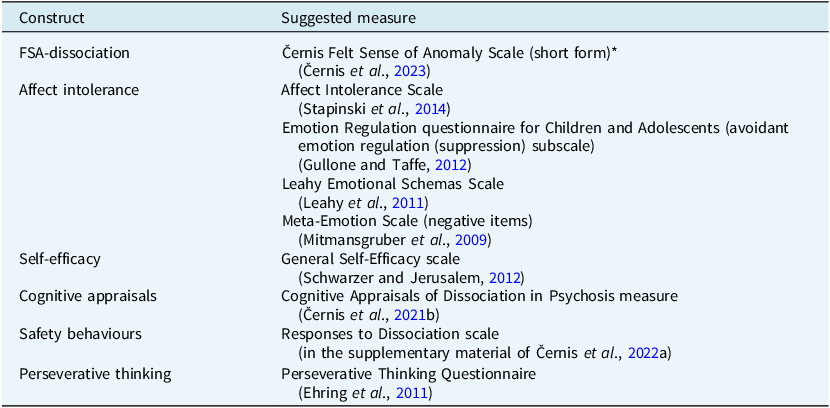
FSA-dissociative experiences can be incredibly difficult to find the words for, given their highly subjective and embodied nature – and it may therefore be helpful to use measures, such as the Černis Felt Sense of Anomaly (ČEFSA) scale (Černis et al., Reference Černis, Beierl, Molodynski, Ehlers and Freeman2021a; Černis et al., Reference Černis, Loe, Lofthouse, Waite, Molodynski, Ehlers and Freeman2023; Table 1), to facilitate discussion about FSA-dissociation, as well as measure it. The Comprehensive Assessment of At Risk Mental States (CAARMS; Yung et al., Reference Yung, Yung, Pan Yuen, Mcgorry, Phillips, Kelly, Dell’olio, Francey, Cosgrave, Killackey, Stanford, Godfrey and Buckby2005) items of ‘delusional mood and perplexity’, and to some extent ‘crystallised ideas’ of somatic passivity and nihilism, and certain ‘perceptual abnormalities’ may also lead to productive discussions about FSA-dissociative symptoms.
Summarising suggested tools for measuring key constructs within the FSA-dissociation model

*See https://osf.io/t2re7/ for guidance on choosing between the full- and short-form scale, and for updates and translations.
Another approach is a detailed assessment of the antecedents of other problems, including difficulties in daily functioning and other mental health symptoms, as FSA-dissociation has been associated with these (Černis et al., Reference Černis, Freeman and Ehlers2020).
Regarding its initial onset, clients commonly describe first noticing FSA-dissociation during a time where they faced multiple mild-to-moderate stressors over an extended period. This suggests that FSA-dissociation may appear as a kind of slow burn, perhaps more related to chronic than acute stress.
A model of FSA-dissociation
In our previous work, (Černis, Reference Černis2020; Černis et al., Reference Černis, Ehlers and Freeman2022a), we outlined a cognitive behavioural model of FSA-dissociation (summarised in a newly simplified diagram in Fig. 1). This model proposes an intrapersonal context where changes in arousal are interpreted as a form of internal threat, reinforced by counterproductive efforts to manage this threat. Suggested measures for each of the key components of the model are listed in Table 1.
A simplified diagram summarising the hypothesised model.

Background feedback loop: affect intolerance and low self-efficacy
Key to the model is the suggestion that arousal-related changes in internal state are interpreted by the individual as threatening. This interpretation is caused and maintained by the combination of affect intolerance and low confidence in one’s ability to cope with challenging situations (low self-efficacy), which leads the person to believe they would struggle to cope with emotions that are too overwhelming or uncontrollable. Due to this context operating in the background, the person over-evaluates the negative effects (threat) of dissociative sensations, and under-estimates their ability to cope with and tolerate them (or their anticipated meaning and consequences).
Affect intolerance
Clients might recall being ‘sensitive’ individuals ever since they were young. Easily emotionally affected by the world and people around them, they may have quickly learned an aversion to their emotional states and report becoming easily overwhelmed. This aversion may also have been inadvertently – or explicitly – reinforced by caregivers; perhaps because they witnessed frightening or confusing displays of emotion in an adult, their caregiver frequently declined to acknowledge or accept their emotional states, or through learning that affect is ‘wrong’ (e.g. ‘boys don’t cry’). Alternatively, in clients with alexithymia (including autistic clients), internal states may be aversive because they are difficult to interpret. In such clients, the significance of cognition may be over-valued and de-contextualised, leading to extreme concern about cognitions whilst avoiding consideration of emotions. Thus, clients may hold implicit or explicit negative beliefs about affect that lead to negative meta-emotional (Mitmansgruber et al., Reference Mitmansgruber, Beck, Höfer and Schüßler2009) responses, exacerbating the original arousal state.
Subjective low self-efficacy
Self-efficacy considerations arise in both the content and process of this work. Clients may explicitly express low confidence in their abilities to cope with affect or stress, describe frequent unsuccessful or thwarted attempts to make change in their lives in the past, or else talk about themselves as weak, fragile, or powerless, in contrast with evidence to the contrary. In the process of therapy, this may translate into unhelpful patterns of acquiescence, avoidance of engagement in change techniques, difficulties with ending sessions, or over-reliance on scaffolding from the therapist.
Catastrophic cognitive appraisals (internal threat)
The perceived danger of being overwhelmed by internal threat (due to the factors above) explains why the cognitive appraisals of the dissociative experience are catastrophic in nature; for example, ‘I’m losing my mind’ – which is particularly relevant to address when working with clients presenting with At Risk Mental State (ARMS).
A key theme of appraisals is the catastrophising of any (perceived) loss of control. This may be due to high personal standards, fear of inadequacy, or – for individuals with social anxiety or paranoia – loss of control may also be interpreted as inviting judgement or harm from others. Importantly for the context of psychosis, it may also be interpreted as signifying a feared relapse (indeed, the above conceptualisation overlaps with Gumley et al.’s (Reference Gumley, White and Power1999) model of relapse in psychosis).
In clients who have experienced a frightening episode of psychosis, clinicians should therefore consider whether dissociative experiences are being interpreted as indicators of relapse, or whether the episode of psychosis itself is viewed as proof of being unable to cope with life’s demands, or as a failure of control.
Foreground feedback loop: perseverative thinking and safety behaviours
Finally, safety-seeking and ruminative behaviours are employed as a best attempt to understand and manage an aversive and perplexing situation. As in all cognitive behavioural models, such behavioural responses reduce distress in the short term, but reinforce the problem in the long term.
Safety behaviours
As well as common safety behaviours such as checking or monitoring symptoms (Hunter et al., Reference Hunter, Phillips, Chalder, Sierra and David2003), individuals with FSA-dissociation typically use engagement behaviours (in order to distract oneself or test one’s ability to function), or disengage and avoid all experiences. An example of an engagement behaviour is carrying out complex mental tasks in an attempt to keep the mind active and focused, which may have the unintended consequence of causing mental fatigue. In terms of disengagement coping, people report isolating themselves from others to avoid the distressing sensation of feeling disconnected from them. This perpetuates the difficulties as may be expected: avoidance prevents the individual from learning that they would cope better than feared (and arguably, allows more room for perseverative thinking).
Perseverative thinking
Presented to clients as rumination or worrying, this describes the tendency for clients to focus excessively upon their dissociative sensations and catastrophic appraisals, especially in a negative way. Rumination often persists because it is seen as a positive attribute of the individual (a sign that they are ‘attuned’ to their internal world), or it is considered a useful tool to find a way to understand what is happening, or to guard against danger. It may also persist due to habit: many of our clients have described being lifelong ‘worriers’.
Perseverative thinking maintains hypervigilance to internal (cognitive and physiological) states, and keeps negative cognitive content at the forefront of individuals’ minds. It may also serve as a further avoidance of affect (in the form of intellectualisation).
Mutual reinforcement between loops
Crucially, we hypothesise that the two feedback processes mutually reinforce each other. The unintended result of using safety behaviours is an increased sense of low self-efficacy: the individual tried to manage the FSA-dissociation, but it has nevertheless persisted. Similarly, perseverative thinking results in the individual focusing on the aversive experience, potentially reinforcing their tendency towards affect intolerance.
Camilla’s FSA-dissociation formulation.

Case example:
‘Camilla’Footnote 1 came under the care of EIP following an episode of psychosis during which she had called an ambulance and told them that she was dead.
In assessment, Camilla described the months leading up to the psychotic episode as characterised by chronic stress. She was struggling to keep up with a new project at work, injured her wrist playing sport – making self-care difficult – and a casual romantic relationship ended. Camilla recalled at this point beginning to feel ‘light’ and that ‘everything was too bright’. A month before her psychotic episode, Camilla was wrongly accused by her landlord of missing her last two rent payments. She described feeling ‘so heavy it hurt’ and ‘out of it’. Despite having very high standards for her levels of achievement in her hobbies, she withdrew from these, and felt as though she was ‘falling through the floor’ whenever she sat or lay still.
Talking about her childhood, Camilla reported being a ‘worried kid’ who ‘kept the peace’ in a busy family. She often felt overlooked compared with her younger siblings, and felt ‘different’ at school. Ultimately, this led to beliefs and assumptions such as: ‘I need to “put up and shut up”’, and ‘feelings cause fights’.
Following her recovery from the psychotic episode, Camilla continued to complain of perceptual anomalies: she reported that hard surfaces around her looked ‘shimmery’. On further questioning, this transpired to be her trying to describe a sensation that her surroundings were not quite solid, and that whilst they did not look different, they somehow seemed ‘unreal’ in a way she struggled to put into words. She found herself touching walls to check they were solid, or keeping the room dark to avoid seeing them clearly. She strongly endorsed ČEFSA items relating to the ‘unreal’ type of anomaly.
Formulating Camilla’s dissociative experiences (Fig. 2) enabled her to hold a different relationship to them (see ‘Intervention’ section below).
Intervention
Whilst therapists could intervene at any point in the above formulation, we suggest following the sequence below: tackling the feedback loop of cognitive appraisals (Phase 1), safety behaviours, and perseverative thinking (Phase 2), before moving on to address affect intolerance and self-efficacy (Phase 3). It is intended to offer the client ‘quick wins’ early in therapy and to familiarise them with the key vocabulary of CBT – thereby encouraging confidence in the psychological method, their own abilities to effect change, and building the therapeutic alliance. The early phase cognitive work aims to equip clients to tackle the more challenging targets of affect intolerance and self-efficacy later on in the course of therapy. Nevertheless, clinicians should bear in mind the whole formulation whilst working, as ‘stuckness’ in Phase 1 or 2 may be due to processes addressed in Phase 3.
Phase 1: Catastrophic cognitive appraisals
For cognitive appraisals of dissociation, the aim is to de-catastrophise, and shift the perception of these experiences away from them being a threat. Thus ‘bread-and-butter’ therapeutic techniques, such as cognitive restructuring (i.e. via thought diaries) and targeted behavioural experiments are indicated.
‘Psychoeducation’ is also crucial in the context of dissociation: both for increasing understanding, and for normalising clients’ experiences. People typically feel extremely lonely and believe they are unique in suffering in this way (Černis et al., Reference Černis, Freeman and Ehlers2020), and clients may have previously experienced inadvertent invalidation by clinicians unfamiliar with dissociation (e.g. Nester et al., Reference Nester, Hawkins and Brand2022) during their journey through healthcare services.
The key messages for psychoeducation in dissociation are similar to those for psychosis; namely, that the client is believed, can be understood, is not going mad, and is not the only one experiencing these strange sensations. Such information supports building up an alternative explanation that is less distressing than the catastrophic interpretation.
An excellent resource for clinicians requiring rapid familiarisation with this area is a summary article and infographic about depersonalisation disorder (DPD) by Hunter et al. (Reference Hunter, Charlton and David2017) (FSA-dissociation has a significant phenomenological overlap with depersonalisation (Černis et al., Reference Černis, Beierl, Molodynski, Ehlers and Freeman2021a)).
Peer support groups and resources authored by people with lived experience of dissociation may also be particularly helpful for this purpose. At the time of writing, Unreal, a specialist UK charity for DPD run by experts by experience and experts by training, hold monthly online peer support meetings, and have a website full of helpful information and first-hand accounts (www.unrealcharity.com). The latter may be particularly valuable to clients, since finding words to put to these experiences and learning that other people have them too can be incredibly powerful.
Psychoeducation about the effects of anxiety and adrenaline may also be useful here to help the client understand how stress has triggered their dissociative experiences: which also reduces the appraisals of the experiences as strange or alarming. Relatedly, we highly recommend, where appropriate, discussing the ‘6 F’s’ framework of Schauer and Elbert (Reference Schauer and Elbert2010), which extends the familiar ‘freeze’, ‘fight and flight’ response into a second dissociative phase incorporating ‘fright’, ‘flag’, and ‘faint’. This can help clients understand that once their fight or flight response becomes exhausted, dissociation naturally follows.
Phase 2: Intervening on the foreground feedback loop
As discussed, the left-hand side of the formulation diagram involves cognitive and behavioural processes that are classic CBT targets. We have found it beneficial to support the client to see the link between thoughts (both catastrophic appraisals and the process of worrying) and continued dissociation, and to explore the perceived usefulness of introspection and hypervigilance (rumination and worry). Reference to Wells’ (Reference Wells1995) meta-cognitive model of worry may be relevant here to validate engagement in worry, before introducing practical strategies for managing it.
Phase 3: Intervening on the background feedback loop
With the rationale that their current (threat) response to affect perpetuates dissociation, and that emotions are functional and human, clients may be open to forming a new relationship with emotion. Explicitly exploring beliefs about emotions (and their capacity to cope with them), alongside psychoeducation about the function of emotion, may be helpful for those who hold beliefs that it is unnecessary or should be ‘got rid of’. It is likely that the theme of control could arise during this stage. CBT continuum exercises and surveys may be helpful where beliefs about control are held inflexibly or to an unhelpful degree.
A personalised form of the opposite action skill in dialectical behaviour therapy (DBT), and trying new ways of responding to affect and its triggers, may also be helpful. These will help build a new experience of affect and a bank of recent examples of self-efficacy. Note that DBT skills enabling sitting with the emotion may also constitute opposite action where a client’s initial response is to avoid.
Where affect intolerance and low self-efficacy are exacerbated by alexithymia and/or deficits in emotional literacy, psychoeducation about the link between thoughts and emotions – for example, using the CBT ‘hot-cross bun’ model – has been helpful. This can be used to support the client to practise detection and labelling of emotional or arousal states (for example, by working backwards from an observed change in cognition).
Case example:
Phases 1 and 2
Camilla was supported to understand that her dissociative experiences were the sign of a ‘tired brain’. She used the analogy of her dissociative feelings being ‘like the fans in a computer’, because they switched on and worked very hard when she was processing ‘too much [stress or stimulation]’. This helped her understand the triggers for her dissociative experiences, but she was still hypervigilant for occasions when her thoughts would race and become ‘stuck’ on anxious themes. She viewed this in positive terms of being highly attuned to her mind, but also ‘proof’ that she would relapse if she became too stressed.
Understanding that her reason to worry was to stay alert to trouble (but that actually this produced more dissociation) provided a rationale for Camilla to engage in worry management strategies. With practice, she observed that these helped keep her stress under control more than worrying may have done. Camilla also catastrophised less after dissociating, as she could now see where stress and worry had triggered the experience. Having an alternative explanation for the dissociation reduced the ‘feedback’ in the system.
Moving into Phase 3
Later, Camilla was able to identify that she had ‘never really learnt how’ to manage emotions as these were frequently dismissed by caregivers when she was growing up. She found affect ‘confusing’ and endorsed the belief that being too emotional could lead to becoming out of control. An introduction to the ‘hot-cross bun’ explanation of the links between thoughts, feelings, body, and affect ‘changed everything’ for Camilla, as she had not considered before that these elements could be connected. She revisited the diagram often between sessions, explaining with enthusiasm that it had been helpful to understand why her thoughts impacted her bodily sensations.
Phase 3
Camilla still struggled to label affective states when using the hot-cross bun, and so sessions focused on distinguishing just two states: these were termed as ‘hot (high energy) versus cold (low energy)’ and colour-coded red or blue, respectively. Towards the end of her sessions, Camilla found it easier to name her affective state in these terms, and could begin linking management strategies to the two states (e.g. behavioural activation for low mood (cold/low energy/blue); stress management and relaxation strategies for anxious mood (hot/high energy/red)). The sense of achievement in managing her worry and understanding her dissociation and affect gave Camilla a renewed sense of self-efficacy.
Considerations for therapy process
In-session adaptations
General principles for working with clients with dissociative presentations include considering and making adaptations when dissociative symptoms may directly interfere with therapeutic techniques (e.g. being unable to feel the body during grounding) or process (e.g. struggling to have meaningful therapeutic conversations whilst feeling distant). Key adaptations we recommend are:
-
• Explicitly acknowledging the impact of dissociative experiences on memory and using strategies to mitigate this; for example, using pocket summaries, proactively suggesting you may need to repeat yourself, letting the client know they can ask you to repeat yourself at any point without shame, and making a plan for how to record the key points a client wants to retain (by writing, audio or video).
-
• Offering breaks, suggesting movement (e.g. stretching, walking and talking), providing fidget toys, or shortening sessions if the client feels too detached to focus.
-
• Having alternatives of any exercises that require connection with the body, but also encouraging openness to trying by explaining to the client that any exercises will require practice – even the one(s) that eventually work well for them may ‘do nothing’ the first few times they try it.
Gauging the client’s progress
Affect-based state-dependent memory can influence reports of how severe dissociation has been that week and how much progress the client believes they are making in therapy. This can oscillate significantly week-to-week. The use of between-session diaries may reduce this, but careful set-up will be required to overcome difficulties presented by impacted memory and low self-efficacy; for example, asking the client to set alarms on their phone during the session, prompting them to label these informatively, and problem-solving non-judgementally any barriers (including motivational barriers) they can foresee with the intended activity.
Scaffolding and promoting independence
Clinicians should be aware that clients’ negative beliefs about their ability to cope or make change in their lives (low self-efficacy) may show up in the therapy process in the form of passivity or acquiescence in the therapeutic relationship. Therapists may notice a disconnect between clients agreeing with change techniques in session, but disengaging with them outside of session. As always, the clinician’s role is to resist entering into unhelpful patterns around worry and reassurance-seeking, and to scaffold and foster the client’s independence and self-efficacy.
Managing endings
Low self-efficacy is relevant also to relapse-planning and endings: proneness to worry and discounting their own abilities may make it difficult for this client group to feel confident managing without support from the therapist. This therefore needs to be an explicit consideration in supervision and therapy planning. Client-facing adaptations include signalling the up-coming end of sessions far ahead of time, and highlighting examples of good coping, resilience, and independence throughout the course of therapy.
Mind the gap
Clinicians should monitor and manage the impact on therapy when clients have an absent or very detached sense of self. Due to activation of self-efficacy schemas within the therapy relationship, clinicians faced with this presentation may easily be drawn into similar feelings of helplessness, futility, or numbness that their client feels daily. The role of the clinician is to be mindful of this, explicitly hold hope, and provide a stable base for the client to anchor a new sense of self; built through the therapeutic work undertaken together.
Discussion
The current paper presents our practice-based advice and insights for clinicians working with common transdiagnostic dissociative experiences involving highly subjective, difficult-to-describe sensations of detachment, strangeness, unfamiliarity, and unreality (FSA-dissociation). Clinicians are not routinely trained to assess, formulate, or intervene with such phenomena, and may therefore be unaware that they already possess the skills required to work with them. Here, we present a theoretical model of FSA-dissociation where such experiences can be understood as arising from a threat response to internal (affect-related) stimuli, and can thus be treated by applying familiar evidence-based clinical techniques.
Specifically, the background feedback loop (affect intolerance and low self-efficacy) explains why people have a threat-based response to internal stimuli: changes in arousal due to affect are aversive because they are perceived as having the potential to become overwhelming. The ultimate aim, therefore – once the client’s initial responses to dissociation are de-catastrophised in Phases 1 and 2 – is to support the client to understand this context as setting the scene for a threat-based response, and for them to develop a new relationship to their internal environment.
This contextual aspect is the key difference between our FSA-dissociation model and the CBT model for DPD (Hunter et al., Reference Hunter, Phillips, Chalder, Sierra and David2003). The latter proposes a formulation not dissimilar to that for health anxiety (Salkovskis et al., Reference Salkovskis, Warwick and Deale2003), where depersonalisation triggers catastrophic appraisals of the experience, increasing anxiety symptoms, which in turn reinforce depersonalisation and initiate classic maintenance cycles (e.g. avoidance, safety behaviours, symptom monitoring). This is analogous to the foreground feedback loop in the FSA-dissociation model.
The approach outlined above also constitutes a departure from many current approaches to dissociative phenomena in that it is not explicitly trauma-focused. This is a strength for implementation, as it may mean that it can be helpful for the spectrum of dissociative experiences reflected by FSA-dissociation, regardless of role of trauma in their development and maintenance.
The model presented here also subtly differs from (although overlaps with) the approach one may usually follow when working with psychosis presentations. In conventional CBT for psychosis, the intervention typically focuses on empowering the client to cope with, and modify the content and appraisals of, their anomalous perceptual experiences. The focus presented here is one of building the client’s understanding of their internal world and the unhelpful beliefs they may hold about it; and both approaches aim to normalise the client’s subjective experience as the result of a chronically activated stress response.
This framing and the phenomenology of such experiences may be particularly familiar to clinicians working with clients presenting with At Risk Mental State. We anticipate that the approach outlined above may therefore be particularly valuable in this clinical context – and particularly pertinent, given suggestions that FSA-dissociation may have a causal influence on the development of key psychotic symptoms (Černis et al., Reference Černis, Evans, Ehlers and Freeman2021c; Černis et al., Reference Černis, Molodynski, Ehlers and Freeman2022b).
Conclusion
Whilst there is increasing recognition that dissociative experiences are common and problematic across the breadth of mental health diagnoses, the clinical training and advice for managing such phenomena in the context of psychosis are scarce. Here, we have outlined a theoretical formulation of dissociative experiences that are defined by a subjective sense of anomaly as being part of an internal threat response to one’s own affect or arousal. The novelty of this approach is that it extends existing conceptualisations of similar dissociative phenomena to include a contextual consideration of clients’ affect intolerance and low self-efficacy. We have illustrated that widely used evidence-based CBT techniques familiar to the reader can be applied when working with such presentations. Nevertheless, the impact of this approach on clinical outcome remains to be empirically tested in efficacy studies, and we suggest this be the focus of future research endeavours.
Data availability statement
Data sharing not applicable – no new data generated.
Acknowledgements
With many thanks to those who undertook therapy sessions with E.Č. in 2019 and 2020. The clinical practice described here was undertaken during E.Č.’s clinical doctoral fellowship: E.Č. would like to acknowledge again the support of Professors Daniel Freeman and Anke Ehlers in the completion of the DPhil/PhD component of this fellowship.
Author contributions
Emma Černis: Conceptualization (equal), Funding acquisition (lead), Investigation (equal), Methodology (lead), Project administration (lead), Visualization (lead), Writing - original draft (lead), Writing - review & editing (equal); Louise Johns: Conceptualization (equal), Investigation (equal), Supervision (equal), Writing - review & editing (equal); Amy Hardy: Conceptualization (equal), Investigation (equal), Supervision (equal), Writing - review & editing (equal).
Financial support
The work was supported by the Wellcome Trust via a Clinical Doctoral Fellowship to E.Č. (grant number 102176/B/13/Z).
Competing interests
The authors declare none.
Ethical standards
Authors have abided by the Ethical Principles of Psychologists and Code of Conduct as set out by the BABCP and BPS. Case examples are composites, containing no identifiable client information in order to respect privacy.


 Open access


Comments
No Comments have been published for this article.