

INTRODUCTION
The Pew Research Center (2015) predicts that by 2055, less than half of the U.S. population will be White due to the growing population shares of Asians and Latinos.Footnote 1 In spite of this increasing ethnoracial diversity, a report by the Public Religion Research Institute shows that, on average, most friendships are ethnoracially homogeneous (Cox et al., Reference Cox, Navarro-Rivera and Jones2016). The social network of the average White person is 91% homogeneous whereas for the typical Black and Latino respondents, the networks are 83% and 64% homogeneous, respectively.
Although intergroup friendships may be infrequent, they can have great implications for U.S. ethnoracial relations. According to the social psychology literature, contact with members of another ethnoracial group can help reduce prejudice toward that group (Allport Reference Allport1954; Tropp and Pettigrew, Reference Tropp and Pettigrew2005). Among White people, cross-ethnoracial friendships can reduce feelings of social distance to ethnoracial minorities (Fischer Reference Fischer2011). Having friends of different ethnoracial origins is associated with being in a romantic cross-ethnoracial relationship later in life (Kao et al., Reference Kao, Joyner and Balistreri2019; Shiao Reference Shiao2018; Van Zantvliet and Kalmijn, Reference Van Zantvliet and Kalmijn2013). According to Grace Kao and colleagues (Reference Kao, Joyner and Balistreri2019), for both Asian men and women, the percentage of those who report an intergroup romantic relationship in young adulthood is approximately twice as high among those who had at least one intergroup friendship during adolescence in comparison to those who did not have any cross-ethnoracial friendships. In light of the growing ethnoracial diversity in the United States, identifying determinants of interethnic and interracial relationships, including informal nonmarital relationships, may help uncover mechanisms that can reduce the nation’s ethnoracial divides.
An underexplored determinant of intergroup friendships is skin color. There is a large body of literature that gives evidence to the stratifying role of skin color, especially among ethnoracial minorities. Research shows that darker skin color is correlated with an array of lower socioeconomic and health outcomes (Codina and Montalvo, Reference Codina and Montalvo1994; Hunter Reference Hunter2005; Keith and Herring, Reference Keith and Herring1991; Monk Reference Monk2015). Cynthia Feliciano (Reference Feliciano2016) argues that skin color is the most salient determinant of an individual’s perceived ethnoracial identity. According to the study, she finds that dark skin color is the strongest predictor for a person to be perceived as Black, even if said person has other stereotypically White physical features. Within the United States, different skin tone shades are tied to particular ethnoracial groups and stereotypes, with darker skin color being associated with Blackness, dirtiness, savagery, and unattractiveness while lighter skin color has ties to Whiteness, civility, cleanliness, and beauty (Hunter Reference Hunter2005; Dixon and Telles, Reference Dixon and Telles2017; Feliciano Reference Feliciano2016; Russell-Cole et al., Reference Russell-Cole, Wilson and Hall2013). Therefore, for U.S. ethnoracial minorities, lighter skin color may be a status symbol that not only predicts better outcomes, but also indicates greater proximity to a particular ethnoracial group.
A growing subset of this literature suggests that an individual’s skin color is associated with characteristics of their romantic partners. For example, Margaret L. Hunter (Reference Hunter2005) and Ellis P. Monk (Reference Monk2014) find that among Black respondents, having a lighter skin tone is related to having a partner with higher educational attainment. In an older study, Michael Hughes and Bradley R. Hertel (Reference Hughes and Hertel1990) show that lighter skin color among Black Americans is associated with both greater spousal occupational prestige and spousal education. Moreover, skin color’s relationship to dating may in part be a function of friendship networks (Keels and Harris, Reference Keels and Harris2014).
There is the strong possibility that skin color can play an influential role in intergroup friendships. Nao Hagiwara and colleagues (Reference Hagiwara, Kashy and Cesario2012) show that after accounting for facial features, darker skin color among Black people—relative to lighter skin color—has a negative effect on White people’s implicit emotional responses and explicit liking toward Black people. Similarly, Black people who look more “stereotypical” (which may include, but is not limited to, darker skin color), seem to face lower acceptance from outgroup members than their less stereotypical looking counterparts (Hebl et al., Reference Hebl, Williams, Sundermann, Kell and Davies2012). Analyzing determinants of friendships, in particular the role of a person’s skin color in their likelihood of engaging in cross-ethnoracial friendships, could give new insight into the strength of the boundaries between ethnoracial groups. Shedding light on which group members are most likely to cross ethnoracial boundaries aids race/ethnicity scholars to identify (1) those who are most likely to reshape ethnoracial boundaries, and (2) the possible future directions of these boundaries. An individual’s skin color is a particularly telling determinant because of its associations with race and status. A significant relationship between a person’s skin color and befriending individuals of other ethnoracial groups suggests that to cross ethnoracial boundaries, a person may have to possess characteristics that put them in a distinct social position relative to other members of the same ethnoracial group.
The questions I address in this study are: Among ethnoracial minorities, is an individual’s skin color associated with the likelihood that they will engage in a cross-ethnoracial friendship? Does the role of skin color depend on the specific ethnoracial combination of the groups involved? This article uses the imperfect yet useful concept of an ethnoracial hierarchy in which particular groups have distinct levels of social standing. Based on a quantitative analysis of the National Longitudinal Survey of Freshmen, I argue that lighter skin color is associated with greater odds for members of lower status groups to have a close friend from a higher status ethnoracial group, specifically among Black and Latino respondents. Furthermore, in the case of Asian respondents, I also find limited evidence that suggests that darker skin color is associated with greater odds for individuals of a higher status group to have close friendships with members of a lower status ethnoracial group, in that darker skin color is associated with a greater likelihood of befriending people who identify as “other”.
LITERATURE REVIEW
Patterns and Predictors for Intergroup Friendships
Research on intergroup friendships shows major differences in the prevalence of this type of relationship by race/ethnicity. Kara Joyner and Grace Kao (Reference Joyner and Kao2000) find that once school racial composition is accounted for, Black and Asian adolescents, relative to White adolescents, have lower odds of forming an intergroup friendship. Lincoln Quillian and Mary E. Campbell (Reference Quillian and Campbell2003) explore the likelihood of having a friend of a particular ethnoracial background using a methodological approach that accounts for all possible friendships within a school. They find salient differences in the likelihood of observing particular ethnoracial combinations; for example, the odds that Black students befriend Black Latino students are notably higher than the odds that Black respondents have a White Latino, other Latino, or an Asian friend. White respondents gravitate most strongly toward White Latinos and least toward Black people (Quillian and Campbell, Reference Quillian and Campbell2003). A consistent pattern for all ethnoracial groups is the preference for ethnoracial intragroup friendships (Espenshade and Radford, Reference Espenshade and Radford2009; Joyner and Kao, Reference Joyner and Kao2000; Kao et al., Reference Kao, Joyner and Balistreri2019; Quillian and Campbell, Reference Quillian and Campbell2003).
Social networks, ranging from personal networks to professional networks, show a tendency toward homophily with respect to individual characteristics such as gender, age, nativity, and socioeconomic status (Kao et al., Reference Kao, Joyner and Balistreri2019; McPherson et al., Reference McPherson, Smith-Lovin and Cook2001). Individuals of the same gender have greater chances of being friends, even after accounting for ethnoracial origins (Hallinan and Smith, Reference Hallinan and Smith1985; Hallinan and Teixeira, Reference Hallinan and Teixeira1987a, Reference Hallinan and Teixeirab). Quillian and Campbell (Reference Quillian and Campbell2003) find that similar socioeconomic backgrounds may also encourage the formation of friendships while Kao and colleagues (Reference Kao, Joyner and Balistreri2019) find that adolescents of high socioeconomic status are especially prone to reporting friends of high socioeconomic status.
Beyond similarity, the literature on relationships suggests that certain individual characteristics are associated with the formation of cross-ethnoracial friendships. Gender, for example, has distinct associations depending on the specific ethnoracial combination of intergroup friendships (Hallinan and Teixeria, Reference Hallinan and Teixeira1987b). Maureen T. Hallinan and Ruy A. Teixeria (Reference Hallinan and Teixeira1987b) show that Black female students exhibit a greater likelihood of having a best friend of a different ethnoracial group relative to Black male students, whereas the reverse is true for White students. Thomas J. Espenshade and Alexandria Walton Radford (Reference Espenshade and Radford2009) obtain mixed findings about how immigrant generation status relates to cross-ethnoracial interactions. In their ethnoracially mixed sample, there is evidence that relative to fourth generation+ respondents, second generation respondents are significantly more likely to have cross-ethnoracial interactions such as socializing or having a close friend of a different race. There is no statistically significant difference between the first generation and fourth generation+ respondents.
A particularly influential determinant for the formation of intergroup relationships is the relative levels of status between individuals. Higher social status (as measured by class rankings) may increase the likelihood that Black students have White friends (Hallinan and Teixeira, Reference Hallinan and Teixeira1987a, Reference Hallinan and Teixeirab). These particular findings follow a pattern within research on different types of intergroup relationships, which shows that members of a lower status ethnoracial group who have “high status” traits (e.g., greater socioeconomic status), relative to group members with “low status” traits, have a greater likelihood of interacting with members of a higher status ethnoracial group (e.g., Kalmijn Reference Kalmijn2012; Wang and Kao, Reference Wang and Kao2007).
Cross-ethnoracial friendship studies within educational institutions highlight the significance of school context in determining friendship patterns. For example, taking a course related to a particular ethnoracial minority group is associated with greater chances of having a close friend of that group (Espenshade and Radford, Reference Espenshade and Radford2009). Mary J. Fischer (Reference Fischer2008) shows that larger college population sizes may impede cross-ethnoracial interactions. Past research argues that having a greater proportion of in-group members within the school discourages intergroup friendships (Joyner and Kao, Reference Joyner and Kao2000). However, Quillian and Campbell (Reference Quillian and Campbell2003) find that among White, Asian, and Black respondents (and to some extent among Latino respondents), a greater share of in-group members is associated with a lower likelihood of intragroup friendships. Studies that have explored the role of outgroup members find that a greater proportion of another ethnoracial group is associated with a higher likelihood of forming a close outgroup friendship (Hallinan and Smith, Reference Hallinan and Smith1985; Hallinan and Teixeira, Reference Hallinan and Teixeira1987a; Kao et al., Reference Kao, Joyner and Balistreri2019). Additionally, having greater ethnoracial diversity within the school in general may encourage intergroup interactions/friendships, but the relationship between diversity and interactions/friendships may depend on the ethnoracial group (Bowman and Park, Reference Bowman and Park2014).
U.S. Ethnoracial Relations
The structure of U.S. ethnoracial relations are in flux. The positioning of groups such as Asians and Latinos is especially debatable because they are increasingly prominent ethnoracial minority groups, each with high levels of heterogeneity. Asians and Latinos encompass a broad swath of national origins, phenotypes, and socioeconomic status levels (Bonilla-Silva Reference Bonilla-Silva2004; Gans Reference Gans2012; O’Brien Reference O’Brien2008; Portes and Rumbaut, Reference Portes and Rumbaut2014; Rondilla and Spickard, Reference Rondilla and Spickard2007). On one hand, Latinidad is racialized, meaning that at times people perceive and treat Latinos as an exclusive, separate group with distinct physical features (Feliciano et al., Reference Feliciano, Lee and Robnett2011; Flores-González Reference Flores-González2017; Roth Reference Roth2012). On the other hand, there is flexibility to Latinidad in that Latinos can also be racialized into different racial groups, which in turn is associated with patterns in cross-ethnoracial interactions (Feliciano and Robnett, Reference Feliciano and Robnett2014; Quillian and Campbell, Reference Quillian and Campbell2003). Belinda Robnett and Cynthia Feliciano’s (Reference Robnett and Feliciano2011) study on internet dating suggests that there are distinct outcomes when examining patterns of exclusion among Asian Indians and non-Indian Asians.
For the sake of simplicity, a principle assumption of this study is that U.S. ethnoracial relations are approximately a hierarchy in terms of social standing in which White people are at the top, and thus have the greatest amount of privilege, Black people are at the bottom, and Latinos and Asians are approximately in the middle. I derive this conceptualization based on previous research that points to said order (Bonilla-Silva Reference Bonilla-Silva2004; Gans Reference Gans2012; O’Brien Reference O’Brien2008). Using indicators such as socioeconomic status, intermarriage, and residential patterns, Eduardo Bonilla-Silva (Reference Bonilla-Silva2004) theorizes that U.S. ethnoracial relations are reconfiguring into a tri-racial system consisting of the categories “White”, “Honorary White”, and “Collective Black”. Latinos and Asians are notable in this conceptualization of U.S. ethnoracial relations because they are the only two large ethnoracial groups that can fall into any of the three mentioned categories, while White people (minus Middle Easterners) and Black people are distinctly in the “White” and “Collective Black” categories, respectively. Eileen O’Brien (Reference O’Brien2008) argues that Asians and Latinos have distinct experiences and beliefs as the “racial middle” that set them apart both from Black and White racial groups. Nonetheless, in some ways, the racial middle functions more similarly to White people and they show a greater affinity toward White people rather than Black people (O’Brien Reference O’Brien2008). Given the previous literature, one interpretation is that the broad, collective status, or social position, of a given ethnoracial group is based on their distance from Whiteness.
A body of research suggests that there is validity to the claim of an ethnoracial hierarchy. For example, Latino-White and Asian-White multiracials can more readily “blend” into Whiteness than Black-White multiracials (Lee and Bean, Reference Lee and Bean2010). S. Michael Gaddis and Raj Ghoshal’s (Reference Gaddis and Ghoshal2020a) research on roommate searches among millennials shows that Americanized Asians (specifically Indian and Chinese) and Latinos have a similar likelihood to get responses to ad inquiries for roommates. Of all groups tested in the study, Black applicants were the least likely to receive responses (Gaddis and Ghoshal, Reference Gaddis and Ghoshal2020a). When focusing specifically on White millennials’ roommate choices, Asian (Indian and Chinese), Latino, and Black roommate applicants are perceived in distinct ways, especially when accounting for the level of Americanization among Asians and Latinos (Gaddis and Ghoshal, Reference Gaddis and Ghoshal2020b). Nonetheless, Black applicants are still the most excluded (Gaddis and Ghoshal, Reference Gaddis and Ghoshal2020b). Lastly, parts of Robnett and Feliciano’s (Reference Robnett and Feliciano2011) analysis on patterns in online dating preferences support this concept. Latinos and Asians seem to be closer to White people than Black people are to White people (Robnett and Feliciano, Reference Robnett and Feliciano2011)Footnote 2 . Latinos especially are an ethnoracial “middle ground” because they are the least excluded minority group in terms of online dating preferences and Latinos, relative to Asian or White respondents, are least likely to exclude Black daters (Robnett and Feliciano, Reference Robnett and Feliciano2011).
Skin Color-Based Social Stratification
Social stratification by skin color in the United States stems from the country’s history with slavery. Lighter-skinned slaves, who were mainly the result of master-slave relations, tended to receive more education and better treatment than other slaves (Dixon and Telles, Reference Dixon and Telles2017; Hunter Reference Hunter2005; Russell-Cole et al., Reference Russell-Cole, Wilson and Hall2013). After the Civil War, lighter-skinned former slaves were more likely to take leadership positions relative to their darker-skinned counterparts, which fed into the perception that Black people who were more successful and seemed more intelligent had these characteristics because of their White heritage (Hunter Reference Hunter2005; Russell-Cole et al., Reference Russell-Cole, Wilson and Hall2013). The benefits these individuals received has passed onto later generations (Dixon and Telles, Reference Dixon and Telles2017; Hunter Reference Hunter2005). Thus, the United States, historically, has associated lighter skin color, relative to darker skin color, with greater social status, wealth, access, and privilege.
Scholars have theorized that skin color within the United States is an aspect of race that is charged with stereotypes (Dixon and Telles, Reference Dixon and Telles2017; Hunter Reference Hunter2005; Russell-Cole et al., Reference Russell-Cole, Wilson and Hall2013). Lighter skin color’s historical association with wealth, beauty, and status remains intact, while darker skin color is tied to ugliness and incivility (Dixon and Telles, Reference Dixon and Telles2017; Hunter Reference Hunter2005; Russell-Cole et al., Reference Russell-Cole, Wilson and Hall2013). More foundationally, an individual’s skin color is itself a marker of race that influences how others perceive that individual’s race (Feliciano Reference Feliciano2016). According to Feliciano (Reference Feliciano2016), light skin color indicates a proximity to Whiteness, medium skin color to Latinidad, and dark skin color to Blackness. St. Clair Drake and Horace R. Cayton’s (Reference Drake and Cayton1945) study gives insight into how skin color can help particular members of an ethnoracial group to transcend the boundaries of their own group. Light-skinned Black people in the 1940’s could inhabit White spaces by virtue of being able to pass as White (Drake and Cayton, Reference Drake and Cayton1945). Therefore, skin color functions as a kind of bodily capital in predicting a range of within-group inequalities due to the stereotypes associated with skin color.
To give a few concrete examples of the stratifying role of skin color within ethnoracial groups, darker-skinned Black respondents tend to have worse health (e.g., mental health and hypertension) and socioeconomic outcomes (e.g., educational attainment and income) than their lighter-skinned counterparts (Hunter Reference Hunter2005; Monk Reference Monk2014, Reference Monk2015) and experience more racial discrimination (Klonoff and Landrine, Reference Klonoff and Landrine2000; Monk Reference Monk2015). Darker-skinned Latinos likewise tend to have lower occupational prestige scores (Espino and Franz, Reference Espino and Franz2002), perceive more discrimination in anonymous situations (Santana Reference Santana2018), and earn lower income (Telles and Murguia, Reference Telles and Murguia1990) in comparison to those with lighter skin tones. There is not as much work on the role of skin color on unequal outcomes among Asians, but research suggests that broadly there is a preference for lighter skin (Dixon and Telles, Reference Dixon and Telles2017; Rondilla and Spickard, Reference Rondilla and Spickard2007).
An emerging segment of the skin color literature explores the role of skin color in relationships. Past research shows that for Black Americans, lighter skin color is associated with spousal characteristics such as greater educational attainment and lighter skin color (Monk Reference Monk2014). Plausibly, a person’s educational attainment and skin color are measures of their social status. Research on the role of skin color in determining the likelihood of dating people of different ethnoracial backgrounds suggests that skin color operates as a stratifying factor, however, the relative social status of the groups may determine whether lighter or darker skin color is related to a greater likelihood of crossing ethnoracial lines (Santana Reference Santana2020).
There is evidence that the role of skin color in shaping romantic interactions with other group members may in part be a function of their friendships and that, for Black people specifically, phenotype influences cross-ethnoracial interactions (Hebl et al., Reference Hebl, Williams, Sundermann, Kell and Davies2012; Keels and Harris, Reference Keels and Harris2014). Skin color, due to its role as a status symbol and an indicator of mixed ancestry, may shape opportunities within ethnoracial groups to cross ethnoracial lines. Specifically, lighter skin color, which has greater status and signals proximity to Whiteness, may be associated with greater access to higher status groups whereas darker skin color, which signals lower status and non-White ancestry, may lead to more interactions with members of lower status groups.
Although the literature on skin color and relationships is growing, there is not a deep understanding of how skin color influences friendships. Studying this relationship may therefore clarify the intricacies and dynamics of cross-ethnoracial friendships, specifically who is most likely to engage in these relationships among ethnoracial minorities, which may have long-term implications such as reduced social distance between major ethnoracial groups, an increase in romantic relationships between these groups, and even growth in the multiethnic/multiracial population. In this study, I test the following:
H1: Net of personal, familial, and contextual factors, the role of an individual’s skin color is dependent on the relative levels of status of the ethnoracial backgrounds of the individual and the friend.
H1a: Lighter skin color should be associated with greater odds for a member of a lower status ethnoracial group to claim a friendship with a member of a higher status ethnoracial group.
H1b: Darker skin color should be associated with greater odds for a member of a higher status ethnoracial group to claim a friendship with a member of a lower status ethnoracial group.
METHODOLOGY
I use the National Longitudinal Survey of Freshmen (NLSF) for this study, which for four years followed a cohort of freshmen that enrolled in twenty-eight selective institutions of higher education in the Fall of 1999 (Massey et al., Reference Massey, Charles, Lundy and Fischer2003). The sample features a range of fourteen private universities such as Columbia University and Stanford University; nine liberal arts colleges such as Williams College and Bryn Mawr College; four public universities including University of North Carolina - Chapel Hill and University of Michigan - Ann Arbor; and Howard University, a historically Black university (Massey et al., Reference Massey, Charles, Lundy and Fischer2003). Although the data may not be generalizable to the greater U.S. population, they do speak to a particularly insightful period in adult life. For many people, college is the first time away from their parents, giving them greater freedom to experiment socially by befriending and dating people that they may not have considered otherwise while living at home. If skin color is indeed a significant predictor of intergroup formation, therefore, college and university campuses offer a favorable environment for this relationship to be expressed and observed. I source the information on population size from the Integrated Postsecondary Education Data System’s (IPEDS) data from 1999 (National Center for Education Statistics n.d.). I also glean information from U.S. News & World Report (n.d.) to determine whether a given college is located in an urban area.
The outcome variable, the race of a close friend, is based on measures collected at wave 3 (the end of sophomore year, Fall 2001). The survey asks about the four individuals who are closest to the respondent, which I reduce to responses that are identified explicitly as “friend” but are neither “parent”, “sibling”, nor “relative”. The sample could include friends who are also a romantic partner, classmate/coworker, roommate, family friend, and/or a teacher. The explanatory variables are from wave 1 (collected at the beginning of freshman year), wave 2 (collected at the end of freshman year), and wave 3 (collected at the end of sophomore year). The main explanatory variable, skin color, is an ordinal variable that ranges from 1 (lightest) to 8 (darkest). I top-code the original skin color variable, which had a range of eleven categories, due to sparse observations. Interviewers were verbally trained to rate a respondent’s skin color in person during wave 1. Arguably, the greatest attribute of this variable is that it was collected before the outcome variables, which aids in the causal order of the analysis.
The models account for personal characteristics (respondent’s sex and nativity), friend’s characteristics (sex, an indicator for same-sex friendships because different-sex friendships may have a greater likelihood of also being romantic relationships (Joyner and Kao, Reference Joyner and Kao2000), and whether the friend is a college student), parental characteristics (highest educational attainment—if a response is missing for one parent, I use the given information from the other parent for this variable—and nativity), and contextual factors (whether the respondent took an ethnic or racial studies course during their freshman year,Footnote 3 the region in which the institution is located, whether this location is in an urban area, percentage of same race students at the institution in the academic year of 1998–1999Footnote 4 , the log of the undergraduate population size, and the entropy score, also known as a diversity score, for a given institution based on the undergraduate population). Lastly, to ensure that the contextual variables properly speak to the experiences of the respondents, I limit the sample to respondents who reported having stayed at their original institutions as of wave 3.
I used the entropy equation featured in research such as Marcus L. Britton (Reference Britton2014) and John Iceland (Reference Iceland2004). I treat a given institution in the sample as an area unit. The six groups that I use for the calculation are the population sizes for the groups White, Black, Latino, Asian/Pacific Islander, Indigenous, and race/ethnicity unknown, as reported by IPEDS. For a calculation based on six groups, the highest entropy score is 1.79 while the lowest entropy score (one in which only one group is represented) is 0. The sum of the six groups are a proxy for undergraduate population size for the calculation rather than the given IPEDS undergraduate grand total. The figures in general are quite similar. Thus, the entropy score is an imperfect yet useful proxy for total diversity in a given institution.
The unit of analysis for the study is friendship pairs. The models are multinomial logit models with standard errors adjusted by respondent to account for the non-independence of observations.Footnote 5 I choose to not use individual-level sample weights that are calculated to account for ethnoracial group sampling among different colleges. The unit of analysis of this study is dyads rather than individual respondents, which would make the sample weights inappropriate. I run the models separately by ethnoracial group. A respondent’s ethnoracial group membership is determined by the race/ethnicity information they reported to their institution prior to the beginning of the survey. The study was originally designed to examine the outcomes of four mutually exclusive ethnoracial groups (Black, White, Asian, and Latino).
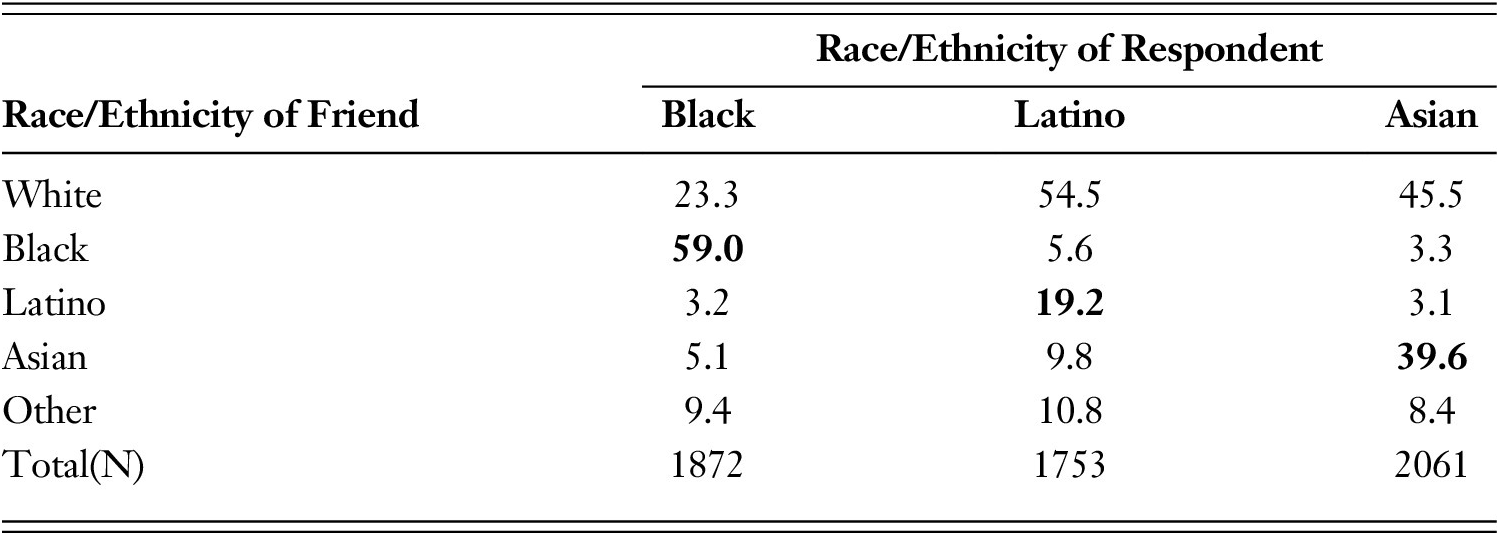
Tables 1 and 2 present the distributions for the explanatory and outcomes variables in the final sample of friendship pairs after utilizing listwise deletion. The distribution of the outcome variable is especially telling. More than half of the Black subsample reports an ethnoracially homogeneous friendship while 19.2% and 39.6% of the Latino and Asian subsamples report a homogeneous friendship, respectively. When crossing ethnoracial boundaries, reporting a White friend is the most common response.
Percentage distribution of friends’ ethnoracial backgrounds in friendship dyads
Distribution of independent variables

RESULTS
Main Results
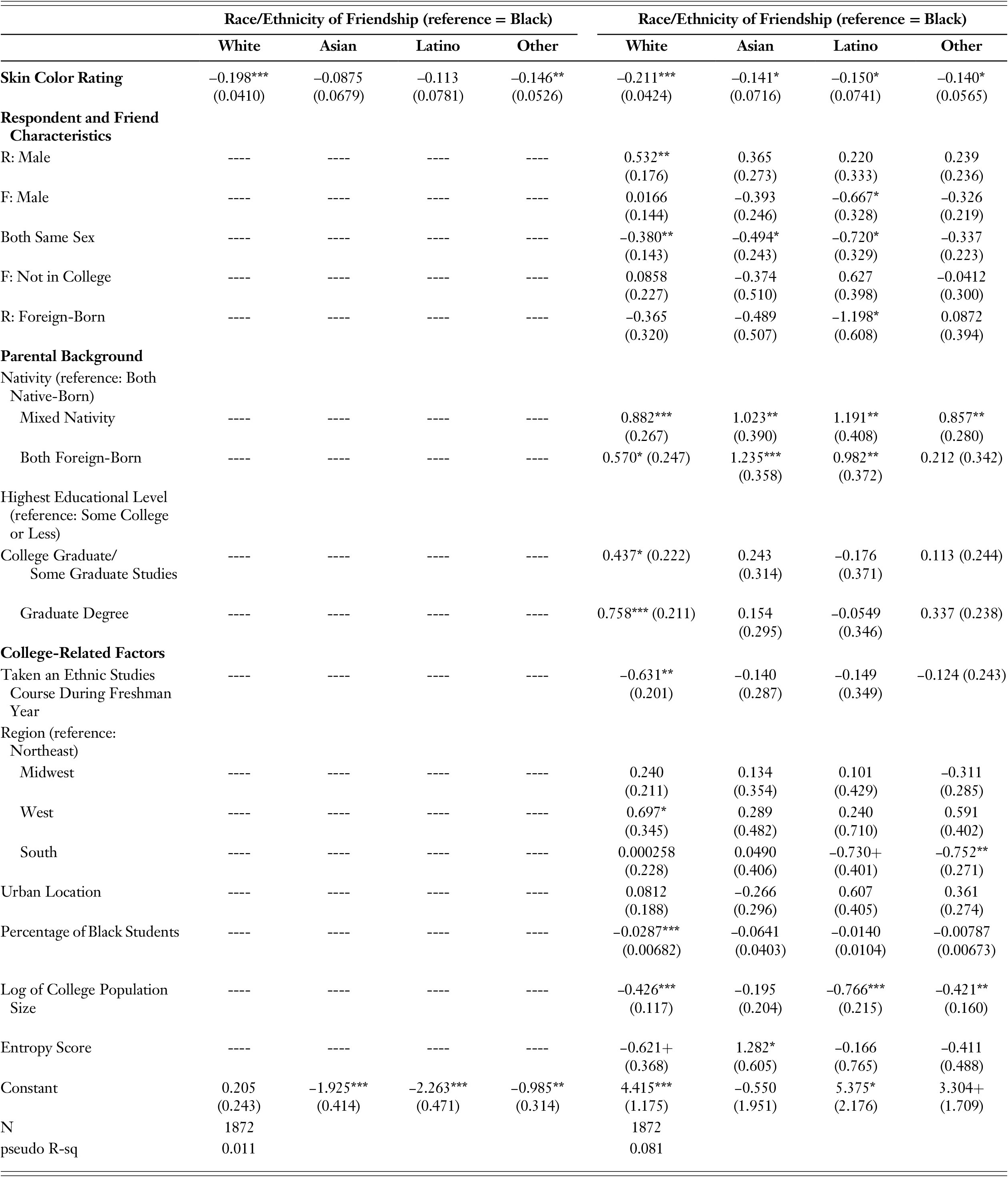
Table 3 presents the multivariate models of the log-odds of intergroup friendships among Black students. The bivariate results suggest that darker skin color is significantly associated with lower odds of having a close friend who is White or “other”, relative to having a close Black friend. The coefficients are statistically significant at the p < 0.001 and p < 0.01 levels respectively. According to the full model, which accounts for personal, familial, and school factors, darker skin color is correlated to a significantly lower likelihood of having close Asian and Latino friends as well as a close White friend and a close friend who is “other”. The level of significance in the second model for three of the outcomes is p < 0.05 (having a close Asian or Latino friend or a friend who is “other”) and p < 0.001 for having a close White friend.
Log-odds for Black respondents to have a close intergroup friendship
+ p < 0.1, * p < 0.05, ** p < 0.01, *** p < 0.001 (two-tailed tests); standard errors in parentheses.
The predicted probabilities in Graph 1, which are based on the full model, show that skin color may be especially pertinent to friendships between Black and White people. Among the lightest respondents, the predicted probability of reporting a close White friend is 38.3% while the darkest respondents have a probability of 17.3%.
Predicted Probability of Intergroup Friendships – Blacks
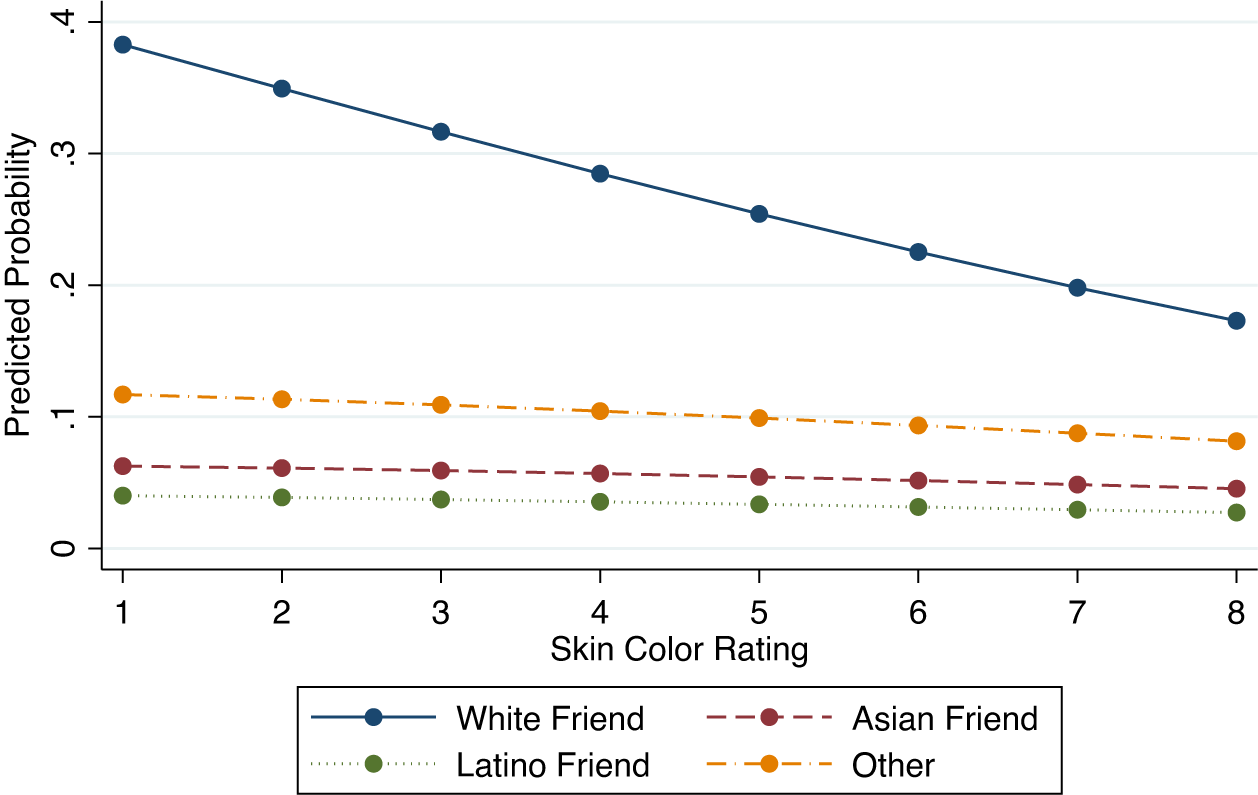
The change in probability is much smaller for reporting Latino and Asian close friends, which may speak to the lower number of opportunities that respondents have to befriend Latino and Asian people relative to White people as well as the shorter social distance between Black people in relation to Latino and Asian people, in comparison to between Black and White people. For example, the predicted probability for respondents to report a close Latino friend ranges from 4.0% for the lightest respondents to 2.7% for the darkest respondents. Even if the predicted effect may be small for certain outcomes, the results give support to Hypothesis 1a because lighter skin color is consistently associated with greater log-odds of having intergroup friendships for Black respondents.
Furthermore, the predicted probability for having a close friend who identifies as “other” drops from 11.7% for the lightest Black respondents to 8.1% for the darkest Black respondents. While the category “other” is inherently vague and may encompass a wide range of ethnoracial identities, especially multi-ethnoracial backgrounds, Black people plausibly may have a lower status relative to the individuals that encompass the “other” category.
Among Black respondents, other significant factors worth mentioning are sex, nativity, parental background, taking an ethnic studies course, the college’s location, and the demographic makeup of the college. Referring to the full model, males display significantly greater log-odds of having a close White friend (p < 0.01), yet having a male friend is associated with lower log-odds of having a Latino friend (p < 0.05). When the respondent and friend are the same sex, there are consistently significant lower log-odds of the friendship being cross-ethnoracial for three outcomes. Being foreign-born is significantly associated with lower log-odds of having a close Latino friend (p < 0.05).
The parental background measures in the full model show that having at least one foreign-born parent is significantly associated with greater log-odds of having close intergroup friendships with multiple groups. Moreover, having a more educated parent is correlated to statistically significant higher log-odds of having a White close friend, which follows the pattern of having higher status being related to interacting with a higher status group.
For contextual variables, the model shows that taking an ethnic studies course during freshman year may cut the odds of having a White close friend by approximately 50% (e(-.631) = 0.532; p < 0.01). There is some evidence that a college’s location is significantly correlated with the likelihood of having an intergroup friendship, especially in the West and South in comparison to the Northeast. Having a higher percentage of Black undergraduate students within the college is associated with statistically significant lower log-odds of having a White close friend (p < 0.001) whereas attending a larger institution is consistently correlated with lower odds of having intergroup friendships with multiple groups. Lastly, the role of diversity seems to depend on the outcome. There is a marginally significant negative correlation between the diversity score and the log-odds of having a White friend, but there is a significant positive association between the diversity score and the log-odds of having an Asian friend (p < 0.05).
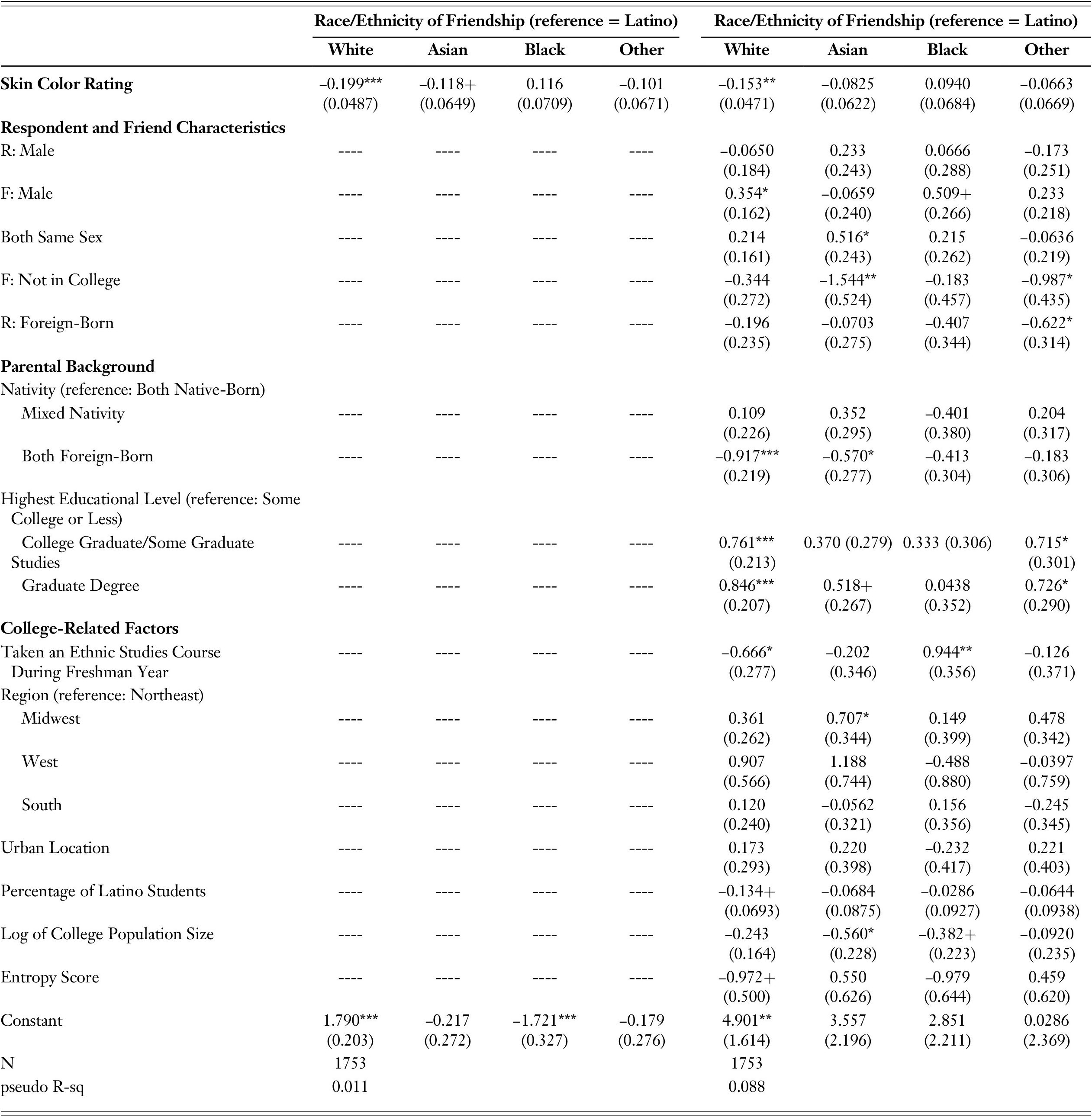
The results in Table 4 show quite distinct patterns for Latinos. Of all outcomes, darker skin color is significantly associated with lower odds of having a close White friend, relative to a close friend being Latino, in both the bivariate and full models. In the full model, a unit increase in the skin color variable is associated with 14.2% lower odds of having a close White friend (e(-.153) = 0.858; p < 0.01). Graph 2 illustrates that there is a twenty percentage-point difference in the predicted probability of reporting a close White friend (61.9% for the lightest skin shade to 41.9% for the darkest skin shade). These results give evidence to Hypothesis 1a. Moreover, in the bivariate analysis, darker skin color is marginally associated (p = 0.07) with lower odds of having a close Asian friend. The coefficient is no longer marginally correlated to having a close Asian friend once the control variables are accounted for in the model.
Log-odds for Latino respondents to have a close intergroup friendship
+ p < 0.1, * p < 0.05, ** p < 0.01, *** p < 0.001 (two-tailed tests); standard errors in parentheses.
Predicted Probability of Intergroup Friendships - Latinos with Whites

According to the full model, both personal as well as familial factors are related to the likelihood of reporting a close cross-ethnoracial friendship for Latinos. Among these respondents, the friend being male is significantly correlated to greater log-odds of having a close White friend (p < 0.05) and marginally significant to having a Black friend. Moreover, being of the same sex is associated with greater log-odds for a Latino respondent to report having a close Asian friend (p < 0.05). A friend not being a college student is significantly correlated to lower log-odds of having a close Asian friend and a close friend who is “other”. Both respondent and parental foreign nativity are correlated to lower log-odds of having intergroup friendships with multiple groups while having a more educated parent is associated with greater log-odds.
Among contextual predictors, the role of an ethnic studies course seems to depend on the considered outgroup. The variable is significantly associated with lower log-odds of having a close White friend (p < 0.05) but greater log-odds of having a close Black friend (p < 0.01). A school located in the Midwest, relative to one in the Northeast, is associated with greater log-odds of having a close Asian friend (p < 0.05). A greater proportion of Latino students is marginally correlated to a reduction in the log-odds of having a close White friend while a larger college is associated with lower log-odds of having a close Asian friend (p < 0.05) and having a close Black friend (p < 0.1). Greater diversity is marginally associated with lower log-odds of having a close White friend.
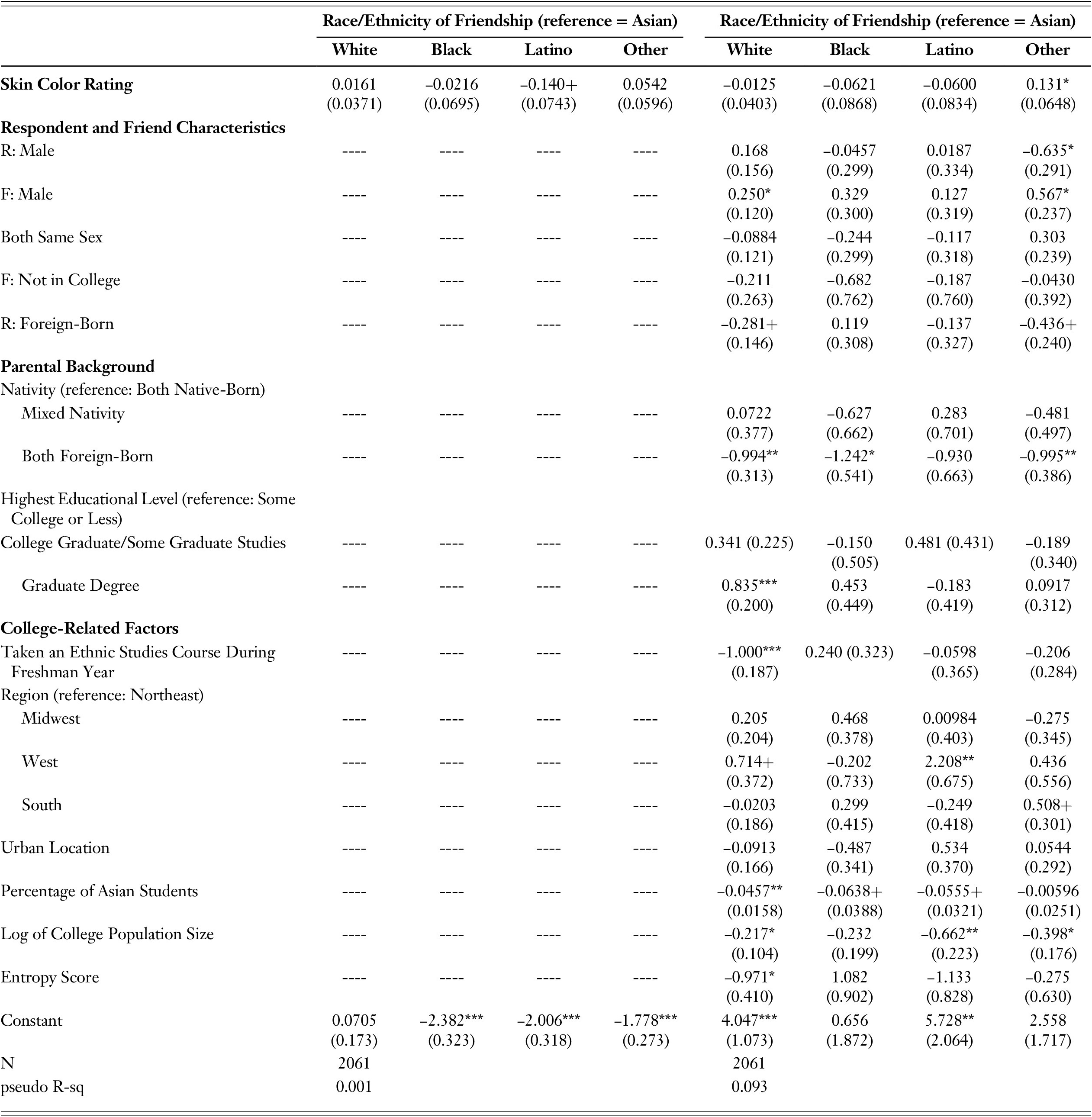
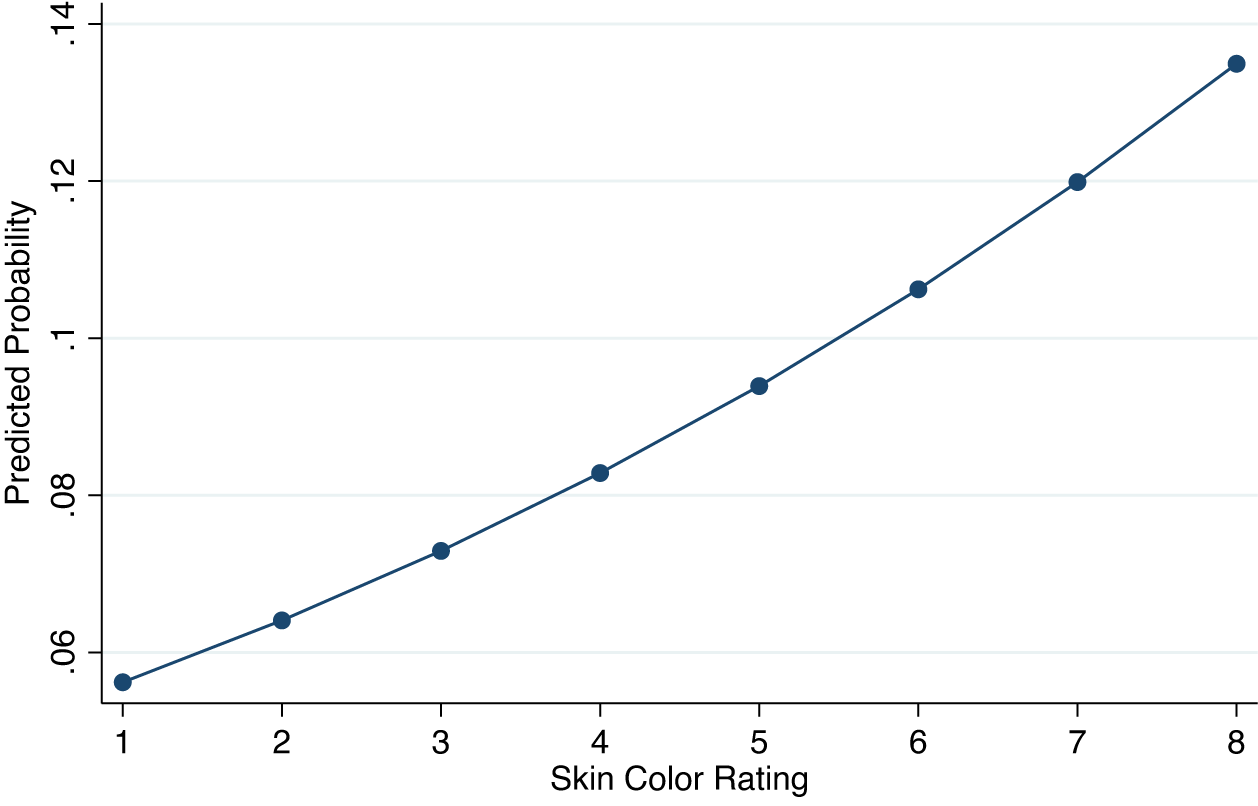
Table 5 shows the regressions for Asian respondents. Skin color in general is not a strong predictor of having interethnic and interracial friendships. It is marginally significant for one outcome in the bivariate analysis. Darker skin color is associated with lower log-odds of having a Latino close friend (p = 0.059), but those results change once personal, friend, and familial characteristics are accounted for in the model. The full model indicates that a unit increase in skin color darkness is associated with a 14.0% (e(.131) = 1.140; p < 0.05) increase in the odds that Asians have a close friend who is “other”. Graph 3 presents the predicted probability for Asian students to report a friend who is “other”. The probability more than doubles from 5.6% for the lightest respondents to 13.5% for the darkest respondents. Since the “other” category could refer to individuals of various backgrounds and because Asians are theorized to be in the middle category in terms of status, the results give limited evidence to Hypothesis 1b. While more nebulous to interpret, the result does suggest that in the case of Asian respondents, darker skin color is associated with some sort of ethnoracial boundary crossing.
Log-odds for Asian respondents to have a close intergroup friendship
+ p < 0.1, * p < 0.05, ** p < 0.01, *** p < 0.001 (two-tailed tests); standard errors in parentheses.
Predicted Probability of Intergroup Friendships - Asians with ‘Other’
Referring to the full model, the associations between personal/friend characteristics and the likelihood of having an intergroup friendship are somewhat weak. A respondent being male is negatively associated with having a close friend who is “other” (p < 0.05) while a friend being male is positively correlated with the respondent reporting a close White friend or a friend who identifies as “other” (p < 0.05). There are no statistically significant coefficients for the same sex dummy. Foreign-born nativity is at most marginally associated with lower log-odds of having close intergroup friendships.
Parental determinants seem influential for results among Asians. Foreign parental nativity is significantly associated with a lower likelihood of having intergroup friendships with White and Black people and those who identify as “other”. Having a highly educated parent is significantly correlated with greater log-odds of having a close White friend at the p < 0.001 level.
For contextual factors, Asian respondents show the same pattern seen among Black and Latino respondents in that taking an ethnic studies course is associated with a decrease in the odds of having a close White friend by over 50% (e(-1.000) = 0.368; p < 0.001). Region is at least a marginally significant predictor for multiple outcomes. An increase in the proportion of Asian students within the respondent’s college is at least marginally significantly associated with lower log-odds of having a close White, Black, or Latino friend. Similar to the other two groups, a larger college population size is significantly correlated to lower log-odds of reporting multiple close intergroup friendships. Finally, a greater level of diversity is associated with a lower likelihood of having a close White friend (p < 0.05).
Robustness Checks
I run a series of robustness checks to ensure that the results remain stable. I examine whether the results differ when recoding the skin color measure into a set of dummies, incorporate the ethnoracial composition of respondents’ club participation during the third wave of the study—which may influence friendship networks (Bowman and Park, Reference Bowman and Park2014)—explore the interaction between sex and skin color, analyze respondent’s racial attitudes, and account for mixed ancestry among respondents. While the Appendix discusses at length the implications of these results, findings that may uncover possible underlying mechanisms for the results of this study, especially among Black and Asian respondents, include experiences with and attitudes towards particular groups and mixed ancestry/national origin background.
CONCLUSION
In this study, I argue that an individual’s skin color, as a marker of intragroup social standing, is associated with their likelihood of forming close friendships across ethnoracial lines. The full models show that among Black respondents, the group theorized to have the lowest status, lighter skin color is correlated to friendships across multiple ethnoracial groups. Among Latino respondents, lighter skin color is associated with greater odds of having a White close friend, the most socially dominant group in the United States. These results suggest that for lower status groups, having lighter skin color is associated with a greater likelihood of forming friendships with higher status groups. Moreover, among Asian respondents, darker skin color is associated with greater odds of having a friend who ethnoracially is “other”. The evidence is not as concrete that for higher status groups, darker skin color is associated with a greater likelihood of having friendships with members of lower status groups. Nevertheless, the result for Asian respondents suggests that darker skin color is correlated with cross-ethnoracial interactions.
This study is not intended to be representative of the broader U.S. population, but it does speak to possible patterns in the future of U.S. ethnoracial relations. According to the literature on theories that predict the trajectory of U.S. ethnoracial relations, three well-known theories are the “White versus non-White divide”, the “Black versus non-Black divide”, and the Latin Americanization thesis (Bean et al., Reference Bean, Lee and Bachmeier2013; Bonilla-Silva Reference Bonilla-Silva2004). The results from the full models speak the most to the Latin Americanization thesis, which theorizes that the future of U.S. ethnoracial relations will follow a triracial system comprised of “White”, “Honorary White”, and “Collective Black” (Bonilla-Silva Reference Bonilla-Silva2004). Following the logic of this theory, respondents who have lighter skin color and are of a lower status group may be the ones to become a part of the “White” and “Honorary White” groups in part because of their greater access to higher status groups. The one result that suggests a positive correlation between darker skin color and the odds of having a cross-ethnoracial friendship, net of other factors, is between Asians and those who identify as “other”. This pattern could speak to Latin Americanization as well but without knowing more details about those who identify as “other”, it is not possible to make a strong claim.
The analyses also highlight how personal, familial, and contextual factors function differently across ethnoracial groups and outcomes. For example, parental foreign nativity is associated with a greater likelihood for Black respondents to engage in close interethnic and interracial friendships while the opposite holds for Latinos and Asians. Mary C. Waters’ (Reference Waters1999) study on Black immigrants and children of immigrants illustrates that Black children of immigrants with strong ties to their ancestral background can more readily dismiss possible obstacles that Black Americans face, such as discrimination. Thus, interacting with non-Black individuals may seem more feasible for Black children of immigrants than for Black children of natives. However, Latino immigrant parents have been shown to encourage their children to marry within their own ethnic group (Foner and Dreby, Reference Foner and Dreby2011; Morgan Reference Morgan2009), so the possible role of parental foreign nativity may be negative in this situation.
Nonetheless, there are several similarities across groups. For all three ethnoracial groups, taking an ethnic/racial studies course is associated with a decrease in the odds of having a close White friend. For most ethnoracial groups, having a relatively well-educated parent is associated with a higher likelihood of having a friendship across ethnoracial lines, especially with White people. In contrast, a greater percentage of same-group members within the respondent’s college is correlated to lower odds of having an intergroup friendship.
The robustness checks highlight areas for insightful future research. For example, among Black students, an underlying factor that may partly drive the skin color results is mixed ancestry. The literature has shown that Black people of mixed ancestry are more likely to identify with being Black than with another ethnoracial group (Lee and Bean, Reference Lee and Bean2004). These results suggest that ethnoracial lines may blur via ethnoracial group members who have lighter skin color, which is associated with mixed heritage, and thus have a particular status within their ethnoracial group. Therefore, the robustness check does support the broader argument of the paper, which is that the particular social standing of an individual (in the case of Black respondents, having lighter skin and/or being ethnoracially mixed can put them in a higher position), relative to other members in their respective ethnoracial group, is associated with their likelihood of engaging with members of other ethnoracial groups. Nevertheless, the results also beg the following question: Is it the social status associated with skin color that is leading these results or is it the mixed ancestry of these individuals that encourages cross-ethnoracial friendships?
This study also points to certain factors that future research should further explore that cannot be examined in this study due to lack of data. Exploring differences by national origin could be especially pertinent for Latinos and Asians. Although the results do not change when accounting for national origin among Latinos, the results do change for Asians. Future research on skin color and interethnic and interracial friendships would benefit from having more information on the friend’s characteristics, such as friend’s skin color, their socioeconomic background, and the friends that they share, to gauge how the combination of the respondent’s and the friend’s traits may interact. Previous research has given evidence to the significance of having similar traits and shared networks between friendships (Wimmer and Lewis, Reference Wimmer and Lewis2010).
While this study uses the conceptualization of an ethnoracial hierarchy to describe the relative social distance of four major ethnoracial groups, there is greater nuance to U.S. ethnoracial relations (Gaddis and Ghoshal, Reference Gaddis and Ghoshal2020b; Kim Reference Kim1999, Reference Kim2004), especially when considering groups beyond the ones discussed in this study (Zou and Cheryan, Reference Zou and Cheryan2017). Beyond heterogeneity within the mentioned ethnoracial groups, these groups do not always readily fall into a neat, status-based hierarchy. Claire J. Kim (Reference Kim2004), a proponent of the concept “racial positionality”, states that,
We need a way to retain racial hierarchy’s focus on vertical power differences while at the same time acknowledging more fully the differentiation and heterogeneity of nonwhite experiences… it [the concept of racial positionality] would discard the idea of a single-scale ranking and instead locate racialized groups on a plane defined by at least two axes of dimensions – that of superior/inferior and that of American/foreigner (Kim Reference Kim1999). This would allow us to recognize that Asian Americans and Latinos have been seen historically as both between black and white on the former scale and quite foreign on the later scale (p. 999).
Thus, the concept I use in this study speaks more to a particular aspect of racial positioning among these groups, that of superiority versus inferiority. More recent research speaks to the concept of racial positionality. For example, Gaddis and Ghoshal (Reference Gaddis and Ghoshal2020b) find that when using the axes of valorization (superior/inferior) and cultural inclusion (outsider/insider) to examine perceptions of racial ordering among White millennials, they find support for Kim’s (Reference Kim1999) conceptualization of racial positionality, which she also refers to as “racial triangulation”. They also find notable departures from that framework. For example, White people valorize Asians (whether foreign or not) similarly as they do other White people (Gaddis and Ghoshal, Reference Gaddis and Ghoshal2020b). The authors argue in favor of “dynamic racial triangulation”, which speaks to how Asians’ and Latinos’ positions within U.S. ethnoracial relations may in part be a function of how acculturated they may be and that White people may view Black people as outsiders, akin to foreign Asians (Gaddis and Ghoshal, Reference Gaddis and Ghoshal2020b).
Linda X. Zou and Sapna Cheryan (Reference Zou and Cheryan2017) further highlight the nuances of ethnoracial dynamics in the United States when applying the concept of racial positionality to lesser-mentioned groups such as Native Americans and Arab Americans. Their findings do differ from Gaddis and Ghoshal (Reference Gaddis and Ghoshal2020b) in some aspects (e.g., Asians have a lower rating on the superior/inferior scale relative to White people). Their results also emphasize how there is little understanding of the racial positionality of groups such as Arab Americans. The U.S. Census racializes this group as “White” yet its members have distinct lived experiences that suggest that they do not have the same position as other White people (Gaddis and Ghoshal, Reference Gaddis and Ghoshal2015; Salaita Reference Salaita2006). Future studies should further explore the role of racial positioning in determining cross-ethnoracial friendships while accounting for groups such as Native Americans and Arab Americans.
Lastly, recent research has shown that White people’s skin color can also be a determinant of intergroup relations for White students (Santana Reference Santana2020). Due to space limits as well as distinct theoretical implications of skin color inequality for White people, I choose to not examine the role of skin color among White students in this study. One could argue that among ethnoracial minorities, having a broader range of phenotypical features—including a broader range of skin tones—relative to White people could imply that skin color may have distinct implications for how ethnoracial minorities are perceived and treated by others in comparison to White people.
The timeframe of the data must be acknowledged. The data were collected at the turn of the twenty-first century. Since the early 2000s, there is evidence of greater acceptance towards ethnoracial intermarriage. In 2000, 30% of non-Black respondents were opposed to a relative marrying someone who was Black (Livingston and Brown, Reference Livingston and Brown2017). That figure shrank to 14% by 2016 (Livingston and Brown, Reference Livingston and Brown2017). The election of the first Black U.S. president post-2000 further suggests greater acceptance of ethnoracial diversity. However, recent racially-charged events, including the emergence of the Black Lives Matter movement, the anti-immigrant discourse fueled by the Trump administration, and the increase in the salience of anti-Asian sentiment due to the COVID-19 pandemic show that ethnoracial cleavages are far from over in the United States (Chen et al., Reference Chen, Trinh and Yang2020; Finley and Esposito, Reference Finley and Esposito2020; Rickford Reference Rickford2016). More recent data on the broader population could expand our understanding of how the possible mechanisms shown within this study apply to the current greater U.S. population.
In spite of the limited generalizability to the current U.S. population, the data speak to a time in these individuals’ lives—during college attendance—in which forming intergroup relationships may be more readily available compared to other periods within the life course. Finding a significant relationship between skin color and intergroup friendships during their undergraduate experience suggests that skin color can be an even stronger determinant of intergroup friendships in more restrictive environments.
ACKNOWLEDGEMENTS
I would like to acknowledge Douglas Massey, Marta Tienda, Tod Hamilton, Yu Xie, Miguel Centeno, Jennifer Jennings, Dwanna McKay, and (several) anonymous reviewers for their advice on this paper. An earlier version of this paper was presented at the 2019 annual meeting of the American Sociological Association.
SUPPLEMENTARY MATERIALS
To view supplementary material for this article, please visit http://doi.org/10.1017/S1742058X21000291.


 Open access

