

Highlights
-
• While informal social protection systems (ISPs) are limited in addressing covariate risks, they present the first line of response for many poor communities and hence can be leveraged as a point of entry to channel external support.
-
• If government and private role players are to learn from and build off ISPs, design thinking, and community development principles can be used to optimize the integration process while retaining important aspects of solidarity, kindness, and community cohesion embedded in ISPs.
-
• Adopting a genuinely collaborative approach based on empathy has the potential to introduce transformative innovations to ISPs without undermining the sociocultural basis that supports them.
Introduction
Societies have long relied on cooperation to navigate challenges in life. For example, in traditional agrarian societies where agriculture is the main form of livelihood, Ukusisela – a process of lending animal/livestock to help others use draught power remains a norm in parts of the African continent (Temu and Hill, Reference Temu and Hill1994; European Union, 2017). Labour sharing during harvest time is also common (Mahohoma and Muzambi, Reference Mahohoma and Muzambi2021) – an act popularly known as the Meitheal in Ireland, referring to a process where neighbours come together to assist in the saving of crops or other tasks. These informal and local assistance systems remain active and functional in many societies. Isiphala seNkosi or Zunde RaMambo,Footnote 1 a method of communal food reserve, is utilised by the Government of Zimbabwe as a channel to respond to El Nino-induced droughts (Chitumba, Reference Chitumba2024). Religious practices continue to play a role, with charitable acts deeply rooted in teachings on kindness. Zakat (almsgiving), embedded in Islam faith, prevails in many countries (United Nations, 2015; Bilo and Machado, Reference Bilo and Machado2018; Ruhana, Reference Ruhana2019), while a preferential option for the poor is also inherent in Christianity (Hopkins, Reference Hopkins and Hopkins2002) and other religions. Research shows that these informal initiatives show strong promise in contributing to social cohesion, poverty reduction, and resilience (De Coninck and Drani, Reference De Coninck and Drani2009; Mumtaz and Whiteford, Reference Mumtaz and Whiteford2021; Kim. et al., Reference Kim, Humphrey, Kadasi and Maxwell2022b; Mumtaz, Reference Mumtaz2023; Mumtaz et al., Reference Mumtaz, Enworo and Mokomane2024) in most societies in the Global South where the coverage and reach of government-sanctioned social security measures remains limited. Maxwell et al. (Reference Maxwell, Majid, Adan, Abdirahman and Kim2016) note that locally organized groups and informal initiatives adapt and emerge as a first line of response to deteriorating conditions and distribute resources to vulnerable neighbours and displaced households in cases of disasters. Locally organized groups offer entry points for external support as they can channel external support through existing mechanisms such as savings groups and self-help groups (Maxwell et al., Reference Maxwell, Majid, Adan, Abdirahman and Kim2016).
Clearly, in many contexts, social policy instruments fail to effectively reach poor and vulnerable populations, making informal social systems a crucial safety net. Given this, Nordensvard and Ketola (Reference Nordensvard and Ketola2024) highlight that while informal and formal welfare systems are interdependent, they are not necessarily complementary. In many states, the former does not serve as a comprehensive solution for addressing welfare needs due to various factors, as outlined by (Gough et al., Reference Gough, Wood, Barrientos, Bevan, Davis and Room2004; Wood and Gough, Reference Wood and Gough2006). These include reliance on informal networks, community and family relationships, or clientelism, rather than ensuring individual, guaranteed, non-personal, and justiciable rights that are independent of birth, wealth, gender, status, and other ascribed characteristics.
While ISPs provide essential safety nets, they often perpetuate inequalities and power imbalances. Gough et al. (Reference Gough, Wood, Barrientos, Bevan, Davis and Room2004)’s “insecurity and welfare regimes framework” underscores that the reliance on informal security systems can be seen as both a source of resilience and a reflection of systemic vulnerabilities within the broader welfare landscape. This duality underscores the need for deliberate and equitable approaches to integrating formal and informal welfare systems. Informal systems do not need to promote accountability for the provision of social services to all, in contrast to social policy which is expected to ensure services are delivered with expected standards of quality, fairness, and transparency. Building on Wood and Gough’s (Reference Wood and Gough2006) critique of one-size-fits-all policy solutions for poverty eradication, we argue that examining informal protection within its specific context in relation to welfare regimes can offer valuable insights for formal social protection systems. Apart from illuminating the utility of informal systems, authors have called for the incorporation, integration, and recognition of informal systems with-and-within formal systems to close coverage gaps. For example, Mumtaz et al. (Reference Mumtaz, Enworo and Mokomane2024) argue that integration is crucial for enhancing the overall efficiency of welfare systems, especially in the face of financial constraints experienced by both developing and less developed countries. In the same vein, proffering recommendations for bridging the divide between formal and informal social protection in South Africa, Dekker (Reference Dekker2008) underlines that the starting point in efforts to strengthen informal systems is government recognition of and support for the fact that informal systems are providing social security for a large number of people (Dekker, Reference Dekker2008, p. 120). However, a more recent theorization by Mumtaz and Kühner (Reference Mumtaz and Kühner2025), offers valuable insights into the interplay between welfare state regimes and community-based welfare systems through a typological framework. Their typology identifies four types of welfare regimes, based on their formality and effectiveness – effective formal, effective informal, ineffective formal, and ineffective informal. Using this typology, Mumtaz and Kühner (Reference Mumtaz and Kühner2025) highlight the diverse roles that community regimes play in the welfare mix, emphasising that such interactions are complex and may yield both positive and negative outcomes.
Leveraging on this “incorporation, integration, and recognition” stream of literature, our article outlines a framework for practically and systematically assessing and managing relationships of actors involved in the process of integration of informal and formal social welfare systems (we focus specifically on social protection systems to address vulnerabilities and risk) and identifies different pressures that could impede the integration process. Noting that the theoretical relevance of informal social protection to social policy literature has already been outlined by (Stavropoulou et al., Reference Stavropoulou, Holmes and Jones2017; Mumtaz and Whiteford, Reference Mumtaz and Whiteford2021; Mumtaz, Reference Mumtaz2023; Gambaro et al., Reference Gambaro, Schäper and Spiess2024; Mumtaz et al., Reference Mumtaz, Enworo and Mokomane2024; Mumtaz and Kühner, Reference Mumtaz and Kühner2025), our aim is to contribute to the social policy and practice debates. We note that whilst previous research has advocated for integration, it often overlooks the “factors embedded in the integration process,” e.g. the formalization ambition that drives most governments; technocracy that ignores “other knowledges”; globalizing forces that shape social policy; corruption and power dynamics – especially in volatile political regimes, and how these can affect the performance of informal social protection systems when attempts are made to integrate with formal systems.
Our article focus is also underpinned by Olivier and Mpedi (Reference Olivier and Mpedi2003)’s question “under which conditions and in what manner should governments and private role players become involved in informal social security arrangements?” To provide a guiding framework for aligning informal social protection and formal social policy, we sought guidance from both design thinking (DT) approaches and community development (CD) principles. Both processes encourage actors to come together to identify and address common needs, improve quality of life, and build communities. We hope to contribute to the refinement of debates regarding the concept of the welfare state co-existing with other actors and systems, providing a new perspective on how the welfare state can function in situations where governments are struggling with social spending and budget deficits, whilst still trying to put in place welfare programmes that reach all citizens equally. We also contribute by offering a methodology to understand the relationship between formal and informal welfare, examining where they may complement each other or where contradictions emerge (Mumtaz and Kühner, Reference Mumtaz and Kühner2025). Applying this methodology could provide valuable insights into how formal welfare systems can be enhanced by drawing on the “moral good” elements that underpin informal welfare.
Methodology and limitations
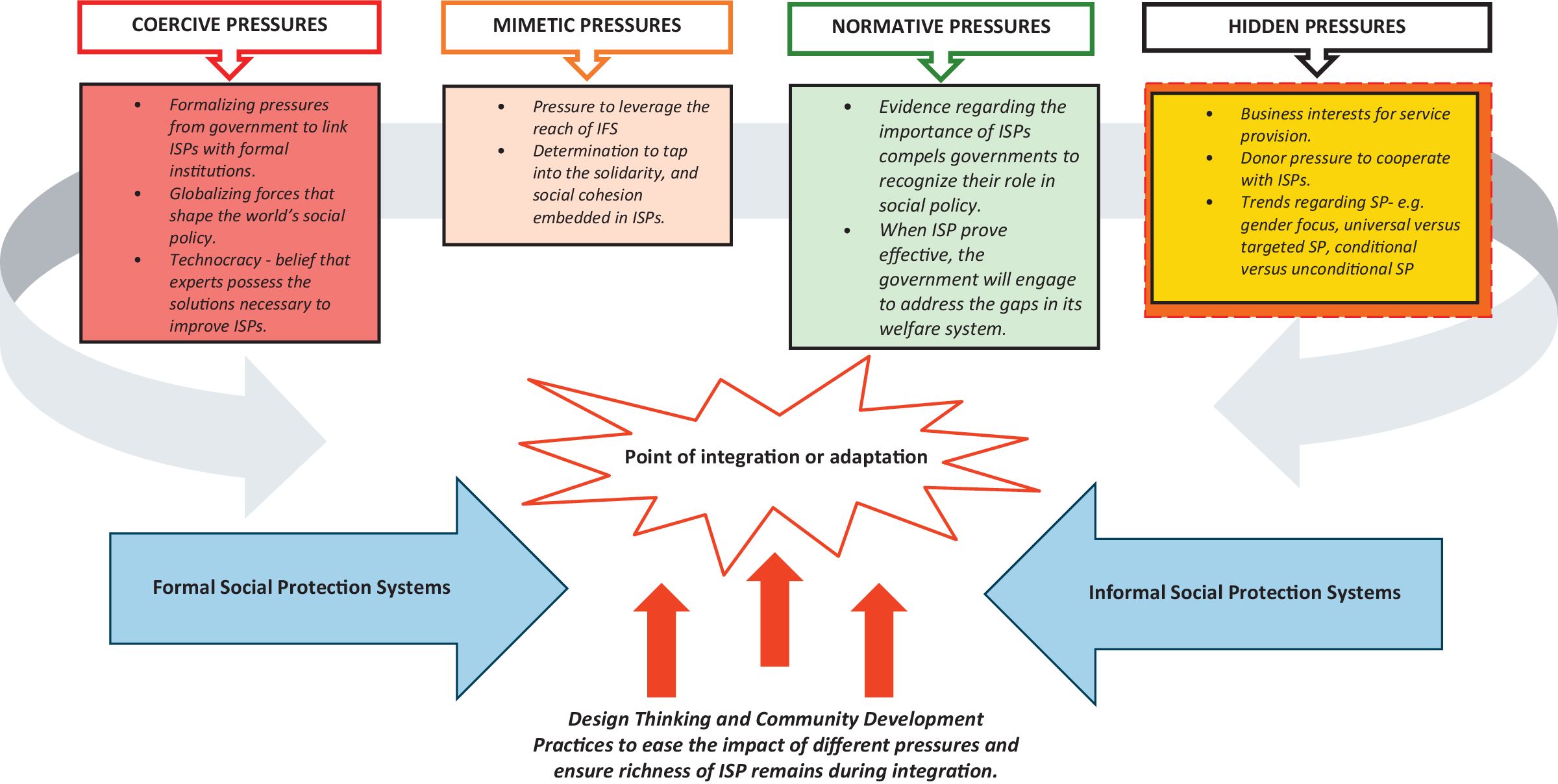
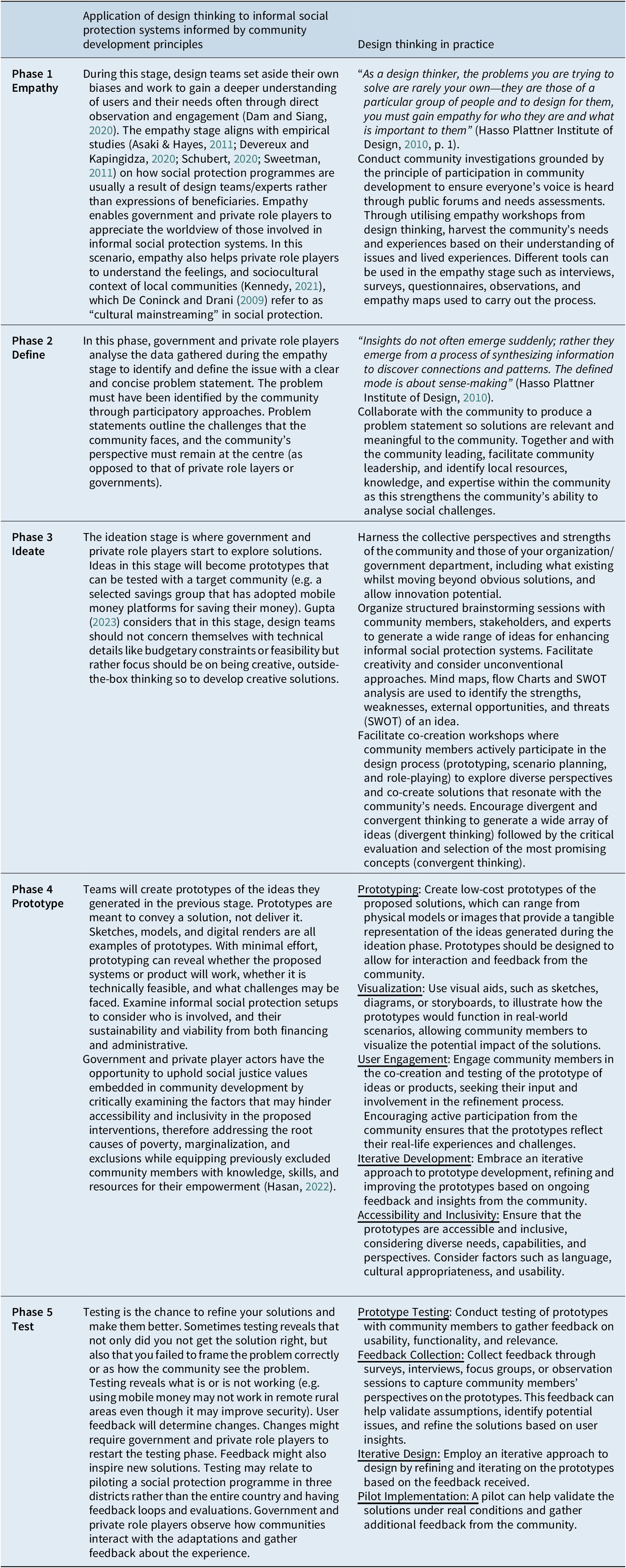
Building off from Olivier and Mpedi’s (Reference Olivier and Mpedi2003) question, we sought to assess the current state of knowledge on the interaction and integration of informal and formal social protection systems. A major hurdle was to navigate the vast literature across social policy and theory, community development, and design thinking, hence a systematic review would have constrained our multidisciplinary exploration. A narrative review was considered appropriate due to the need to interpret and critique towards an authoritative argument based on published evidence (Furley & Goldschmied, Reference Furley and Goldschmied2021). Whilst, a limitation of narrative reviews is that methodological guidelines are not applied, Furley and Goldschmied (Reference Furley and Goldschmied2021) argue that the difficulties in evaluating narrative reviews do not mean that systematic reviews are always appropriate or the superior form of literature review. With a narrative literature approach, we could be creative, innovative and cover a wider range of literature to develop an analytical framework for understanding the integration environment for ISP and SP (Figure 1) as well as outline principles for optimising government and other actor involvement in ISPs (Table 1).
Framework for understanding the integration environment for informal social protection and formal systems. Source: Authors, adapted from (DiMaggio and Powell, Reference DiMaggio and Powell1983; Gilchrist et al., Reference Gilchrist, Taylor, Gilchrist and Taylor2022; Mumtaz et al., Reference Mumtaz, Enworo and Mokomane2024).
Principles for the practical and systematic integration of informal social protection and formal social protection
Understanding social protection: formal versus informal system
Social protection is defined in several diverse ways, yet all the definitions point to the support that people require to effectively deal with either covariate or idiosyncratic risks. Nigar and Qayyum (Reference Nigar and Qayyum2021) conceptualise idiosyncratic shocks as socioeconomic shocks faced by households, e.g. health shocks (illness of a household member, death of a household head), job loss, or business loss, while covariate shocks are faced by the community at large (rise in prices, conflict, displacement, or asset damage due to floods) (Nigar and Qayyum, Reference Nigar and Qayyum2021, p. 796). The Office of the United Nations High Commissioner for Human Rights (OHCHR) (2022) considers social protection to be a potent tool to combat discrimination, reduce poverty and promote social inclusion. The International Labour Organization (ILO) characterizes social protection as all measures for providing benefits whether in cash or in kind, contributory or non-contributory which are designed to secure protection across the lifecycle from lack of income caused by sickness, disability, maternity, employment injury, unemployment, old age, or death of a family member (ILO, 2014). UNICEF (2019) characterizes SP as a set of policies and programmes aimed at preventing or protecting all people against poverty, vulnerability, and social exclusion throughout their life course, with a particular emphasis on vulnerable groups. Considering social protection’s role in promoting human dignity, a human rights-based argument has surfaced, mandating national governments to uphold their social-contract commitments through the provision of such entitlements, citing that SP should be enshrined in constitutions and backed by adequate legislative, regulatory and institutional frameworks that promote and facilitate its realisation (Sepúlveda & Nyst, Reference Sepúlveda and Nyst2012; Barrantes et al., Reference Barrantes, Bulman and Sawhney2019; Kaltenborn, Reference Kaltenborn2020). At an international level, the right to social protection emanates from the ILO Social Protection Floor Recommendation; International Covenant for Economic, Social and Cultural Rights (ICESCR), and is included in Sustainable Development Goal (SDG) Target 1.3.
In general, definitions focus on formal social protection systems, as they refer to “policies, programmes, labour systems, and duty bearers (countries/states).” Indeed, Mupedziswa and Ntseane (Reference Mupedziswa and Ntseane2013) theorize that formal social protection programmes are based on statutory arrangements provided by the state through policies and legislation, a sentiment shared by Holzmann and Jørgensen (Reference Holzmann and Jørgensen2001) who note that the concept of “formal social protection” derives from the government’s commitment to provide support to critically poor individuals, households, and communities to help them manage risk.
Even with the proliferation of formal social protection policies and programmes, their coverage remains low in the Global South thus informal support systems continue to be the key means of protection for most of the rural poor and vulnerable (De Coninck and Drani, Reference De Coninck and Drani2009; Stavropoulou et al., Reference Stavropoulou, Holmes and Jones2017, p. 73; Dafuleya, Reference Dafuleya2018; Mumtaz and Whiteford, Reference Mumtaz and Whiteford2021; Dafuleya, Reference Dafuleya, Patel, Plagerson and Chinyoka2023; Mumtaz, Reference Mumtaz2023; Surender, Reference Surender2024). Asaki and Hayes (Reference Asaki and Hayes2011) argue that formal social protection mechanisms have so far proven inadequate to provide for the many people living in poverty, particularly in the developing world of Africa, Latin America, and Asia. A series of challenges inhibit the potential of formal SP systems, ranging from a lack of financial resources, up to what Norton et al. (Reference Norton, Conway and Foster2001) consider as deficiencies not just in financial resources but also in the institutional capacity and accountability necessary to deliver scarce resources to the poor (Norton et al., Reference Norton, Conway and Foster2001, p. 12). Indeed, the ILO (2024) World Social Protection Report underlines that 52.4% of the global population was covered by at least one social protection benefit in 2023.
Rather than waiting for government assistance or advocating for its improvement, communities in poor societies continue to use their own innovative social protection mechanisms, which often foster economic growth and prosperity (Asaki and Hayes, Reference Asaki and Hayes2011, p. 241). Describing informal social protection systems, scholars characterize them as a set of casual, informal, and private interventions aimed at supporting the poor and more vulnerable members in meeting their basic needs up to building their human capital (Oduro, Reference Oduro2010; Mumtaz and Whiteford, Reference Mumtaz and Whiteford2021). Mumtaz and Kühner (Reference Mumtaz and Kühner2025) further categorise welfare systems based on their effectiveness or ineffectiveness systems; however, in this article, we focus solely on the distinction between formal and informal. What makes ISPs unique is their embeddedness in people’s cultural beliefs, norms, and values (Mupedziswa and Ntseane, Reference Mupedziswa and Ntseane2013), as well as values of solidarity and reciprocity (De Coninck and Drani, Reference De Coninck and Drani2009). Calder and Tanhchareun (Reference Calder and Tanhchareun2014) reveal that ISPs usually manifest through (i) help rendered and or resources shared amongst immediate and extended family, and friends (ii) mutual assistance and informal cooperation popularly in livelihood and production practices such as agriculture, and (iii) kinship-based networks to support during major life crises (death, sickness) and transitions (unemployment, old age, etc.). Similar to formal social protection, Mumtaz indicates that ISP can be described under three taxonomies, namely informal assistance, informal insurance, and informal labour market measures (Mumtaz, Reference Mumtaz2021). Informal assistance includes in-kind (childcare support, caring for the elderly) or cash assistance (remittances) and is considered an essential safety net for those unable to afford paid services when welfare is not available. Informal insurance is defined in relation to risk pooling networks and risk-sharing strategies enacted by households with little access to formal risk markets and can include work-sharing, burial societies, livestock lending associations, and rotating savings and credit associations (Tadesse and Brans, Reference Tadesse and Brans2012; Mobarak and Rosenzweig, Reference Mobarak and Rosenzweig2013). Informal mechanisms also include high-interest loans from local money lenders. Informal labour market measures have many definitions but generally include economic activities in unregistered enterprises (Munro, Reference Munro2011).
The pros and cons of merging informal and formal social protection systems
Given the limited scope of formal social protection in many developing countries and the existence of informal systems that work for many, there is a need to investigate how to best balance the benefits of both and strengthen linkages (Stavropoulou et al., Reference Stavropoulou, Holmes and Jones2017, p. 78). Discourse has grown over the years, with a study by Mumtaz et al. (Reference Mumtaz, Enworo and Mokomane2024) arguing for the inclusion of ISP in social policy theory and practice. Utilizing a case-study approach, Mumtaz et al. (Reference Mumtaz, Enworo and Mokomane2024) show that in certain societies in Pakistan and Nigeria, integrating ISP mechanisms with formal social protection holds the promise of: (i) significantly broadening coverage and reducing existing gaps, and (ii) promoting a more precise and targeted allocation of resources. Earlier theorizations by Stavropoulou et al. (Reference Stavropoulou, Holmes and Jones2017) underlined that integration is of essence considering that (i) informal support systems are less able to cope with covariate or repeated idiosyncratic shocks, hence formal programming could be utilised to broaden their risk-pooling potential through expanding their membership or linking ISPs to commercial reinsurance markets; (ii) formal programming could be used to promote the inclusivity of informal networks and incorporate the most marginalised by increasing resource transfers and improving access to informal networks, and (iii) integration could enable informal systems to evolve and grow rather than fade away and thus contribute to a more robust and inclusive safety net adapted to the local context.
Other researchers have argued that even though ISPs continue to coexist with formal systems, once established, formal social protection systems should replace non-formal ones (e.g. Reference Nhabinde and SchoemanNhabinde and Schoeman, n.d. cited in Mupedziswa and Ntseane (Reference Mupedziswa and Ntseane2013). However, evidence from Botswana (Mupedziswa and Ntseane, Reference Mupedziswa and Ntseane2013); South Africa (Olivier and Mpedi, Reference Olivier and Mpedi2003); Nigeria and Pakistan (Mumtaz et al., Reference Mumtaz, Enworo and Mokomane2024), shows that due to limited resources, developing countries cannot afford to discard informal social protection systems as they serve as the mainstay source of assistance for the majority of ordinary people. A study by Amdissa et al. (Reference Amdissa, Adanech, Kassa and Terefe2015) estimated that about 90% of the Ethiopian population belonged to at least one informal support system in 2015. Remittances to low- and middle-income countries, another form of ISP, were estimated to have reached $669 billion in 2023 (World Bank, 2023).
Kim. et al. (Reference Kim, Humphrey, Kadasi and Maxwell2022b) highlight that leveraging and strengthening informal support systems is an untapped opportunity and resilience imperative for aid actors to maximize impact as they can do more with less. For Kim. et al, working with and through informal support networks provides critical opportunities for aid actors to programme their responses more effectively, noting in particular complex environments like South Sudan and Yemen (Kim. et al., Reference Kim, Humphrey, Kadasi and Maxwell2022b, p. 2). An Ethiopian case study provides a practical example, where, in response to the food security crisis, an NGO tested the effectiveness of delivering emergency assistance through 230 self-help groups. An impact evaluation conducted by Zischka (Reference Zischka2017) found that using self-help group networks to transfer cash provided financial opportunities to individuals and households that would have been otherwise inaccessible. Opportunities to link and integrate formal and informal social protection are thus beneficial, with integration processes necessary (Dafuleya (Reference Dafuleya, Patel, Plagerson and Chinyoka2023).
A selling point for proponents of integration is that it can improve formal social protection systems, particularly their targeting, as integration builds on deeply rooted understandings of poverty, local contexts, and realities, resulting in higher levels of community trust and satisfaction (Mumtaz et al., Reference Mumtaz, Enworo and Mokomane2024; Stavropoulou et al., Reference Stavropoulou, Holmes and Jones2017). Moreover, integrationists argue that as informal systems are bottom-up approaches and local, they are well positioned to engender participation and foster legitimacy – critical for the uptake of new programmes (Stavropoulou et al., Reference Stavropoulou, Holmes and Jones2017, p. 78). De Coninck and Drani (Reference De Coninck and Drani2009) argue that instead of designing externally inspired social protection initiatives, policymakers could strengthen, build on, or scale up these localized ISPs as they are culturally driven, and are sustained by solidarity mechanisms and values, rather than starting afresh. Their view is based on observations in Ghana, where informal social protection mechanisms continue to show resilience, adaptability, and a degree of inclusiveness even though they appear insufficient to address all economic and social challenges faced by the extremely poor in some scenarios. Others argue that instead of commencing with formalization, government policies should endeavour to maintain or improve the capacity of informal social protection mechanisms (Olivier and Mpedi, Reference Olivier and Mpedi2003; Dekker, Reference Dekker2008) which is important for countries facing financial constraints (Asiamah, Reference Asiamah2024). Such a process requires a focus on social capital, which encompasses the value embedded in social relationships, networks, and institutions that facilitate cooperation, trust, and reciprocity among individuals and groups (Putnam, Reference Putnam, Crothers and Lockhart2000).
However, the backdrop of the call for integration is an oversimplification of the integration process, as scholars overlook the influence of actor intentions, behaviour, power dynamics, and pressures/factors. We argue that if integration is to be implemented, questions around who drives the process, their beliefs/ideologies and interests’ matter. This requires us to confront the discussion of optimising the involvement of the government and other players engaged in the process of integrating formal and informal forms of social protection. Within the literature, the effects of government and other actors’ involvement in informal social protection systems still remain poorly understood. Stavropoulou et al. (Reference Stavropoulou, Holmes and Jones2017), indicate that most of the global and national poverty reduction strategies have paid little attention to informal security mechanisms. Ali and Hatta (Reference Ali and Hatta2014), assessing the level of recognition of and utilisation of zakat in Islamic countries observed that zakat formalisation was different across the countries. They found that the planners of poverty alleviation strategies, both in the public and private sectors lacked proper Islamic understanding and faith in zakat, and their perceptions regarding religious ideas as “non-progressive” inhibited the integration process (Ali and Hatta, Reference Ali and Hatta2014, p. 65). Indeed, the dilemma facing ISPs is that when they are acknowledged, the conversations tend to note their rapid decline, their replacement by formal social protection or their potential to expand with limited interest in understanding how and when this can happen (Stavropoulou et al., Reference Stavropoulou, Holmes and Jones2017, p. 77).
Formal social protection programmes can have a positive or negative effect on informal support mechanisms (Stavropoulou et al., Reference Stavropoulou, Holmes and Jones2017, p. 77; Mumtaz, Reference Mumtaz2023, pp. 1–2). Ali and Hatta’s (Reference Ali and Hatta2014) study found that incorporating zakat into Indonesia’s poverty reduction strategy sparked public outcry due to corruption in intermediaries tasked with the collection and distribution of Zakat, causing citizens to abandon their services. The same was observed in Bangladesh where private sector groups were found to be operating without transparency. In comparison, in Malaysia, a robust arrangement for the collection of zakat was found (Ali and Hatta, Reference Ali and Hatta2014). Whilst avoiding clientelism, the process of integration must garner support and confidence from communities (Wood and Gough, Reference Wood and Gough2006, p. 28). In studying the effects of formal services on informal care in Germany, using the crowding-out hypothesis, (i.e. when state-supported provision develops, informal exchanges decline) panel data results from Gambaro et al. (Reference Gambaro, Schäper and Spiess2024) showed that the expansion of formal childcare was not matched by a corresponding decline in informal childcare. The conclusion was that policy and practice ought to be attuned to these findings given the role that informal childcare plays in the lives of families.
While previous research (Olivier and Mpedi, Reference Olivier and Mpedi2003; Dekker, Reference Dekker2008; De Coninck and Drani, Reference De Coninck and Drani2009) recommends that government and other actors should recognise the role and utility of ISPs and has called for integration (Mumtaz and Whiteford, Reference Mumtaz and Whiteford2021; Mumtaz, Reference Mumtaz2023; Mumtaz et al., Reference Mumtaz, Enworo and Mokomane2024), there is a methodological paucity on how government and other actors should do this without undermining the principles inherent in ISP. Our article attempts to fill this gap.
Conceptual arguments and key principles for aligning formal and informal social protection systems
Wood and Gough (Reference Wood and Gough2006) challenged the dominant concept and typology of welfare state regimes, which was largely based on Esping-Andersen (Reference Esping-Andersen1999), by extending it to the Global South. They also highlighted how informal and community-based forms of social protection interact with state-based welfare regimes. Our framework for aligning ISP and SP provides a new perspective on how to consider existing systems, and how to reimagine and optimise from both traditional and formal systems. We also contribute to debates on how the welfare state can address inequality highlighting some issues related to justice and intersectionality in access to social protection in informal systems. To situate our argument, we applied design thinking (DT) and community development (CD) principles to demonstrate how the state and other actors can learn systematically from on-the-ground realities, moving towards an active role in welfare. By engaging with communities involved in informal social protection and incorporating these approaches into the formal social welfare system, the State can ensure that they are expanding coverage to basic needs and a basic income. However, we are not naïve in our understanding of solidarity in “communities,” acknowledging that all types of social cooperation involve some degree of power and inequality with communities also giving rise to groups who undermine social cohesion and contribute to harmful dynamics within communities. As Mumtaz and Kühner (Reference Mumtaz and Kühner2025) argue, the interaction between welfare state regimes and community regimes can take various forms and does not always yield positive outcomes. In their typology of the interplay between the community welfare regime and overarching national welfare regimes, they highlight several dominant relationships that emerge from these interactions. They emphasise the importance of understanding these dynamics, because of the role they play in shaping the overall welfare landscape. In this article, we aim to contribute to discussions on how the welfare state can coexist with other actors and systems. We present our framework, which operationalises the theorized role of community in the welfare mix, as highlighted by (Mumtaz and Kühner, Reference Mumtaz and Kühner2025). Our innovative perspective is particularly important in contexts of limited social spending and budget deficits, where there is a need to balance equitable welfare programmes. In doing so, we offer insights that contribute to a more nuanced debate on privatisation versus public welfare debate.
As a process where people concerned with social justice act together as engaged and active citizens, community development adopts an all-inclusive approach that is embedded in principles of empowerment, human rights, inclusion, social justice, self-determination, and collective action (Kenny and Connors, Reference Kenny and Connors2016; Ardle and Murray, Reference Ardle and Murray2020). By starting from “where people are at now,” not where outsiders think they should be (Twelvetrees, Reference Twelvetrees1991; Gilchrist et al., Reference Gilchrist, Taylor, Gilchrist and Taylor2022), CD considers community members to be experts in their lives and communities, and thus values community wisdom and ability to plan their future (Australian Institute of Family Studies, 2023). This approach is known as a “bottom-up” and contrasts with “top-down” models where the agenda is set by external targets, area programmes, or funders’ priorities (Gilchrist et al., Reference Gilchrist, Taylor, Gilchrist and Taylor2022, p. 83). CD recognises that the “poor” possess innovative local knowledge that can serve to improve their situations – seen in the existence of ISPs (Chambers, Reference Chambers, Atal and Oyen1997; Renner et al., Reference Renner, Bok, Igloi and Linou2018). Several factors determine the level to which communities can participate in shaping how outsiders view and collaborate with them. Community interaction with the outside world presents several pressures. DiMaggio and Powell (Reference DiMaggio and Powell1983) cited in Gilchrist et al. (Reference Gilchrist, Taylor, Gilchrist and Taylor2022) identify three forms of pressure: coercive pressures which are imposed by resource providers; mimetic pressures which emanate from organizations/communities copying other organizations that are seen to be successful, thus adopting what is considered “best practice”; and normative pressures that derive from following professional or group norms and values. We outline these pressures in Figure 1 in the context of the interaction of formal and informal social protection systems.
Formalizing an informal social protection measure often exerts mimetic pressures on informal systems, prompting the existing system to adopt similar mechanisms and structures. This can result in the borrowing of elements from formal welfare programs, such as digital payment services, “advanced bookkeeping methods,” or using formal governance structures. However, these mimetic pressures may lead to unintended consequences, such as new forms of exclusion and discrimination, which could undermine the effectiveness and sustainability of informal social protection systems rather than enhancing them. Gilchrist et al. (Reference Gilchrist, Taylor, Gilchrist and Taylor2022) add that while communities need to recognize these pressures, they do not have to succumb to them. Design thinking (DT) provides a structured, human-centred approach to problem-solving, emphasising that solutions should be defined with the user in mind (Aulet, Reference Aulet2017) – here, communities who rely on ISPs. Like Community Development, DT starts with people and delves deeply into their lives and challenges before proposing solutions (Liedtka et al., Reference Liedtka, Salzman and Azer2018). Its five stages – empathy, define, ideate, prototype, and test (Dam and Siang, Reference Dam and Siang2020; Murtell, Reference Murtell2021) facilitate equal community engagement and foster conversations that lead to generating solutions that can be shared and tested (Hasso Plattner Institute of Design, 2010; Liedtka et al., Reference Liedtka, Salzman and Azer2018). Murray (Reference Murray2005) notes that DT counters the assumptions of experts by forcing them to engage directly with the community. This is crucial as discussions about integrating ISPs with formal systems often overlook grassroots perspectives in favour of technocratic views.
By combining community development and design thinking principles, the pressures outlined in Figure 1 can be effectively challenged, thereby moderating their impact. We note that if principles of DT processes and CD principles are adopted as a framework for practically and systematically guiding government and other actors in their engagement with ISPs, communities can have the power to challenge/question prevailing assumptions or blueprint ideas that are usually introduced to promote the efficiency of traditional approaches. We provide a framework for moving forward with integration in Table 1. Table 1 highlights how both DT and CD processes promote participatory engagement, comprehensive problem analysis, and solutions driven by the community. DT explores solutions at the intersection of business and society, while CD draws inspiration from people’s resourcefulness (Dalberg Group, 2017). Olivier (Reference Olivier and Pieters2003) stresses that transforming ISPs should build on existing mechanisms rather than impose disruptive changes that alienate traditional support mechanisms.
Examples of government and other stakeholders’ involvement in ISP
Governments offering social protection frequently implement pilot programmes in partnership with NGOs and collaborate closely with the private sector to formalize strategies. Calder and Tanhchareun (Reference Calder and Tanhchareun2014) observe that donors, NGOs, and governments from different Southern African countries are building on indigenous practices to support the poor. Mupedziswa and Ntseane (Reference Mupedziswa and Ntseane2013) caution that while the role of such actors is noble in scaling up ISPs, it is important to ensure that their integrative roles do not destroy the cultural basis of informal social protection systems, because ordinary people are likely to resist them (Mupedziswa and Ntseane, Reference Mupedziswa and Ntseane2013, p. 93). De Coninck and Drani (Reference De Coninck and Drani2009) found that in Uganda, government initiatives would be more effective if they clearly reinforced existing informal, family- or community-based mechanisms (De Coninck and Drani, Reference De Coninck and Drani2009, p. 6). In this section, we identify selected case examples of government and private role players’ involvement in informal social protection systems, and the outcomes of such engagement. Our objective here is to juxtapose how different outcomes may be possible if the ethos of design thinking were applied in line with community development principles.
Asset transfer programmes
The Rwandan government through the President’s Office, established Rwanda’s Girinka (“One Cow Per Poor Family”) programme in 2006 in collaboration with NGOs as intermediaries. This programme was an adaptation of an informal arrangement known as indagizanyo or Girinka which involves the sharing of livestock through “social relations” (Ezeanya, Reference Ezeanya2014; Kim et al., Reference Kim, Marshall and Dawson2022a).Footnote 2 Argent et al. (Reference Argent, Augsburg and Rasul2014) reveals that the implementation of the programme differed across intermediaries, with some giving beneficiaries a cow and training. Beneficiaries were trained in animal husbandry, building sheds for cows, feeding cows, and disease identification and manure making. Those who received the livestock transfers faced financial challenges associated with veterinary services, underscoring the need for empathy in programme design and a lack of consultation with local communities regarding preferred livestock breeds. There were differences in resources provided by intermediaries to support the programme. As argued by Argent et al. (Reference Argent, Augsburg and Rasul2014) what determined whether training was provided or not, was the intermediaries’ philosophy (as in, what they perceived to be local knowledge of cows and the necessity of training or not). Some service providers believed that animal husbandry was deeply rooted in the Rwandan culture, and thus farmers possessed local knowledge. Argent et al. (Reference Argent, Augsburg and Rasul2014) note that while that might have been the case for traditional breeds, local knowledge did not apply to the exotic cow breeds distributed (which were also unsuitable breeds) (Ezeanya, Reference Ezeanya2014). There was assumption that government veterinarians were available to assist farmers. Argent et al. (Reference Argent, Augsburg and Rasul2014) found that travel times to the nearest government vets entailed additional costs.
An analysis of Argent et al. (Reference Argent, Augsburg and Rasul2014)’s results shows that the ideation stage was not undertaken for the Girinka program. During ideation (Phase 3 in DT), actors harness the collective perspectives and strengths of the community while stepping beyond obvious solutions and also increase the innovation potential (Hasso Plattner Institute of Design, 2010). Based on Argent’s study, the assumptions held by intermediaries who did not provide training are reflective of a lack of harnessing the community’s perspectives on what it would mean to own an exotic cow. This lack of perspective is what Liedtka (Reference Liedtka2013, p. 21) refers to as cognitive bias, while Blomkamp (Reference Blomkamp2018) characterises it as “risks associated with expert-driven processes” that perpetuate biases and filter out knowledge which could contribute to innovative solutions. Structured sessions with community members, stakeholders, and experts, using community development processes would have led to different perspectives and other solutions. In retrospect, if cow distributors had not assumed that a body of local knowledge existed among farmers and that government veterinary services were accessible, all beneficiaries would have gained equally from the training thus benefitting from high milk yields which were only recorded for beneficiaries who had received training. We note that in this case, if well applied and aligned with community development processes, design thinking had the potential to provide a standardized way in which governments and those implementing programmes interact with informal social protection systems.
In a case study from Zimbabwe, an NGO launched a Small Livestock Transfers programme based on an informal social assistance scheme called “Ukusisela”, which provides calves to those without cows (Koenane, Reference Koenane2014; Lombo, Reference Lombo2017). This programme aimed to distribute small livestock (chickens, guinea fowl, goats) through direct transfers or livestock trade fairs (Ellis et al., Reference Ellis, Devereux and White2009). However, beneficiaries reported losing monetary support from wealthier relatives upon joining the scheme, and some had to sell assets for vaccines for their new livestock, resulting in little overall gain. Ellis et al. (Reference Ellis, Devereux and White2009) noted that the project may have caused social friction, with non-beneficiaries feeling equally deserving of support. Had the principles of design thinking – particularly empathy and ideation – been applied, a fairer process could have emerged. Effective design requires understanding the community’s true priorities, as demonstrated by the failure to involve them in replicating Ukusisela, which ultimately weakened solidarity and social cohesion.
ROSCAS – VSLAs – Savings groups
Rotating Savings and Credit Associations (ROSCAs) are self-selecting groups, where each member saves a fixed amount, and the total sum is given to one member in rotation (Allen and Panetta, Reference Allen and Panetta2010; Hossein and Christabell, Reference Hossein, Christabell and Caroline2022). In essence, people come together to pool money into cooperative-like institutions. ROSCAs are known by different names due to adaptations and innovations e.g. the Village Savings and Loans Associations (VSLAs). ROSCAs have attracted the attention of external actors, with banks targeting potential bankable clients, governments seeing ways to tax them, and telecommunication companies viewing ROSCAs as potential clients for digitalized forms of banking (Nelson and Gash (Reference Nelson and Gash2016). Integrating ROSCAs requires recognizing and understanding the intentions of the actors involved, especially the level of their engagement. Nelson and Gash (Reference Nelson and Gash2016) observe that:
“While the traditional Savings Group model is simple, enabling member-controlled, community-based financial services, the current state of practice, however, is characterized by innovation, growth, and controversy. It is a dynamic time as traditional stakeholders -NGOs, donors, and the groups themselves have been joined by financial service providers (FSPs), telecommunications companies, and government agencies. Savings Groups are a new target market for banks and microfinance institutions (MFIs), and they are an increasingly important component of integrated development programmes and efforts to reach the ultra-poor (Nelson and Gash, Reference Nelson and Gash2016, p. 3).”
Evidence on the performance of these village savings groups after the involvement and introduction of innovations by external actors remains scarce. Where available, such evidence is either inconclusive, mixed, or conflictual. For example, reports published by Murray and Rosenberg (Reference Murray and Rosenberg2006) and Thompson (Reference Thompson2008) on the performance of Kupfuma Ishungu programme in ZimbabweFootnote 3 present conflicting information. Murray and Rosenberg (Reference Murray and Rosenberg2006) concluded that externally funded Community-Managed Loan Funds (CMLFs) have a poor track record, and thus funders were advised to discontinue using them as a means of providing finance to low-income communities. Murray and Rosenberg (Reference Murray and Rosenberg2006) argue that after observing two-thirds of the groups disband following their loan disbursement, the NGO ceased providing further capital to the groups. They concluded that Kupfuma Ishungu failed due to the concept of “cold money.” Cold money refers to external capital from donors or governments, which lacks the emotional connection of locally generated savings or “hot money.” Cold money was treated with less respect, compared to hot money where defaulting was stealing from neighbours, and without community pressure to repay, borrowers were less likely to prioritise repayment, even if it affected future access to the fund (Murray and Rosenberg, Reference Murray and Rosenberg2006, p. 6).
The failure of Kupfuma Ishungu may be because of a failure to align with socio-cultural dynamics (Phase 1 – Empathy) or true partnership and solidarity as espoused by the principles of community development. As argued by Sikhosana (Reference Sikhosana2001), some external interventions fail in African communities due to the strong sense of pride, especially in rural communities where pride is hinged in local traditions and functioning of the communities. This often leads to resistance to changes imposed from outside which do not come from the communities themselves (Sikhosana, Reference Sikhosana2001) cited in (Olivier and Mpedi, Reference Olivier and Mpedi2003). “Outsiders” need to demonstrate respect for local culture. Indeed, VSLA methodology is usually presented through language which undermines the functionality and relevance of the traditional model of the savings group, overlooking that VSLAs are an adaption of ROSCAs. Whilst economists have predicted the end of ROSCAs, evidence shows that as “enduring and self-sustaining economic systems” rooted in reciprocity, solidarity, community, and self-help, ROSCAS are showing a reverse trend, demonstrating their continued relevance in modern times and indicating that they are here to stay (Hossein and Christabell, Reference Hossein, Christabell and Caroline2022).
The digitizing of savings groups – introducing mobile technology to provide members with access to formal accounts and information – is gaining traction. Whilst digitization offers benefits such as reduced meeting times and fewer record-keeping errors, Nelson and Gash (Reference Nelson and Gash2016) argue that technology’s impact is not uniform for all members, raising concerns about the potential exclusion of those who do not understand or trust digital tools. Thus, it is crucial to apply a design thinking approach to create innovations that address the community’s accessibility, and inclusivity needs.
As Rutherford (Reference Rutherford2001) cautions that while refining ISPs, we must consider whether they address the diverse needs, capabilities, and perspectives of the community, including cultural appropriateness, and usability for different demographic groups. There is often scepticism towards private sector partnerships, and in many Global South countries, private player efforts to digitalize savings groups may not succeed with a one-size-fits-all approach. Naghavi (Reference Naghavi2020, p. 33) emphasises that digital savings products should be designed with the socio-cultural context of local communities in mind. Empathizing helps build a customer base while allowing actors to meet both business and social objectives.
Discussion
Whilst researchers argue that the role of informal SP needs to be acknowledged and incorporated into social policy theory, development, and analysis (Mumtaz et al., Reference Mumtaz, Enworo and Mokomane2024), Figure 1 and Table 1 present a conceptual approach for doing so. Extremely poor people usually fall between the cracks as informal insurance mechanisms (mutual insurance) usually exclude those who are chronically poor (De Coninck and Drani, Reference De Coninck and Drani2009; Oduro, Reference Oduro2010; Santos and Barrett, Reference Santos and Barrett2011; Dafuleya, Reference Dafuleya, Patel, Plagerson and Chinyoka2023). As a result, governments and private role players have designed different interventions aimed at remedying some of these gaps, albeit based on expert-driven approaches that may have carried biases and filtered out local evidence and knowledge (Blomkamp, Reference Blomkamp2018). Yet, from the reviewed literature and case examples, we note that integration efforts that are implemented from unstructured government and private actor involvement may be deleterious to informal social protection systems. To summarise, three key conditions for successful integration have been identified: engaging with empathy; treating communities as equal and active collaborators; and maintaining a focus on social justice and the well-being of the community. Each is elaborated below.
Condition 1: Engagement with empathy
Highlighting the importance of social empathy in policy design, Lian (Reference Lian2015) notes that a key challenge in social policy-making is helping those who have no firsthand experience or insights on what it means to be discriminated or grow up in poverty to truly grasp what it is like to live in such conditions. To overcome this challenge in social policy and practice, Sabates-Wheeler and Roelen (Reference Sabates-Wheeler and Roelen2011) suggest that social protection should be understood beyond the narrow narratives of mere provision of forms of social assistance and insurance but should encompass “careful design and delivery in a pro-poor and inclusive development approach.”. To achieve such ‘carefully designed, pro-poor and inclusive development approaches’ requires practicing empathy (Roelen, Reference Roelen2025) – which Allio (Reference Allio2014) defines as the capacity to understand and imaginatively enter into another person’s feelings in order to learn and gain new insights.
Leveraging tenets from community development that underscore community agency, self-determination, and collective action, we note that for governments and private role players to become involved in the process of integrating or incorporating informal social protection systems with formal systems, their engagement should be guided by empathy. As highlighted in the case examples above, there is a potential danger in imagining what a community’s challenges are without engaging with genuine empathy – a process that requires community participation and engagement. Sweetman aptly captures this:
“To analyse the extent to which a particular social protection programme enables socially marginalised groups to gain what they need to live a decent, dignified, and fulfilling life; requires a focus on the extent to which the programme enables its beneficiaries to assert their rights to the resources they lack (Sweetman, Reference Sweetman2011, p. 172).”
By engaging with empathy, policy designers can better analyse social problems and develop policies that are grounded in the lived realities of marginalised communities (Lian, Reference Lian2015) hence identifying the resources they lack. Indeed, developing empathy is about bringing public administrators outside their office; confronting them with real-life situations, and helping them directly grasp users’ challenges and expectations (Allio, Reference Allio2014, p. 8). Empathy bridges the gulf between the regulators/service providers and the users. Empathy helps clarify the distinctions between users’ “needs” and “wants”. This understanding is essential, particularly during the integration process, as it enables various actors to align their expectations regarding integration and achieve the best from the welfare mix.
Condition 2: Treat communities as equal and engaged collaborators
There is increasing recognition of the essential role that informal social protection instruments play. This awareness arises from various pressures placed on formal social security systems including evidence of the effectiveness of ISPs; acknowledgement of their reflection of local culture and practice; and the perception that they can serve as a bridge between state and society. Informal institutions may improve public service delivery; help stimulate investment; and facilitate the transition to more inclusive, rules-based governance (Haider and Mcloughlin, Reference Haider and Mcloughlin2016; Mumtaz et al., Reference Mumtaz, Enworo and Mokomane2024). Yet in practice, these informal institutions and systems face the challenge of being crowded out, undermined or replaced (Stavropoulou et al., Reference Stavropoulou, Holmes and Jones2017). A key factor is mitigating these negative outcomes through collaborating with communities as equal partners, respecting their diverse views, knowledge, skills, and lived experience.
In the case of Bangladesh (as articulated in Ali and Hatta (Reference Ali and Hatta2014)), we noted that the challenges faced in operationalising the integration of zakat with formal institutions stemmed from a failure to effectively engage communities as equal and engaged collaborators, where formal institutions took the lead while discarding the cultural relevance of zakat. As highlighted in Table 1 (Phase 2 – ideation), it is necessary to collaborate with the communities to produce problem statements so that the solutions developed are relevant and meaningful to the community as well as respectful of local traditions, beliefs, and customs. General assumptions often influence work on informal systems. Engaging communities in defining problems is an effective way to understand the causes of exclusion. Applying design thinking can promote a collaborative approach in which governments and NGOs act as partners rather than replacements for the ingenuity and resilience of informal social protection systems, thereby leveraging the resourcefulness of the community.
Condition 3: Keep the focus on social justice and the good of the community
The integration of formal social policy into informal social protection systems must be based on a commitment to social justice. This is challenging to enforce in practice. Mumtaz and Kühner (Reference Mumtaz and Kühner2025) describe “institutional logics” as the systems of values, norms, and rules that guide the actions and interactions of actors within a particularly social domain, including bureaucratic logic. They also outline how “path dependency” – where past events shape a system – often creates structural constraints that are difficult to deviate from. Path dependency therefore can stand in the way of achieving social justice. A key challenge in integrating the informal system with formal structures is ensuring equal access to resources and services. Informal systems often operate on close personal relationships and mutual obligations, which may sometimes conflict with more universal, rights-based approaches characteristic of formal social protection. During integration, it is important to create mechanisms that prevent the exclusion of specific groups from formal social protection benefits. This requires careful consideration of the ethical implications of the integration process, in particular emphasising that outcomes are beneficial to all members of the community.
Integration can have negative outcomes if not centred on social justice, equity, and an understanding of redistribution. Figure 1 emphasises pressures such as the formalisation overdrive that drives the national policy landscape; globalizing forces that shape global social policy; and technocracy which may undermine social justice gains and community cohesion. As informal social protection systems often act as a lifeline for those excluded from the state’s social safety net, any effort to integrate both systems should be guided by an emphasis on compassion and human-centred problem-solving solving which we believe can be achieved through a combination of design thinking and community development principles. Social justice is also deeply tied to transparency and accountability in decision-making processes. As formal systems begin to integrate and incorporate with ISPs, it is important that power dynamics are recognised and that mechanisms for holding all actors accountable are put in place. This is essential in insecurity regimes where the integration process can be hijacked by politicians and powerful individuals (Wood and Gough, Reference Wood and Gough2006). Without transparency, the risk of perpetuating power imbalances is apparent. The use of community-driven monitoring and evaluation processes can help mitigate this risk. Design thinking’s iterative approach, which values feedback and constant refinement, aligns well with the need for continuous community engagement in evaluating the impact of integration efforts. By enabling communities to participate in monitoring the integration policies, those who wish to integrate ISPs with SP can ensure that the benefits of integration are felt equitably with adjustments made in response to real-time challenges.
Additional considerations
This article proposes a framework that can create conditions under which governments and private role players can become involved in informal social security arrangements. As we explore the broad and multidimensional area involving the integration of ISPs and formal SP, the roles of private actors and government, with the application of design thinking and community development principles, we acknowledge that our discussion is not exhaustive, given the limited number of case examples we have examined.
We note that while a design thinking approach holds the potential for establishing the much-required structure to inform the involvement of government and non-state actors in informal social protection systems, we acknowledge that it does not entirely address power dynamics that are inherent in insecurity regimes (Gough et al., Reference Gough, Wood, Barrientos, Bevan, Davis and Room2004) as well as gaps that exist in different community social protection typologies such as ineffective informal (Mumtaz and Kühner, Reference Mumtaz and Kühner2025). Therefore, emphasising power dynamics in community development serves as a complementary perspective. Another point to note is that DT assigns a strong emphasis on empathy and understanding of community needs, but there are inherent ethical considerations when designing interventions that affect the lives of vulnerable individuals. Balancing the interests of different stakeholders while ensuring the protection and dignity of participating communities requires careful consideration and may not always align with the iterative, experimental nature of design thinking (Lewis et al., Reference Lewis, McGann and Blomkamp2020). Given that design thinking relies on collaboration and stakeholder alignment (Lewis et al., Reference Lewis, McGann and Blomkamp2020), achieving consensus amid ideological stalemates from stakeholders with different agendas can be challenging. This may result in tokenised participation or further impoverishment of communities if external players avoid the iterative processes of DT. Thus, we advocate for integrating DT with community development principles.
Considering that our research focuses on ISPs, which usually thrive in countries and contexts where resource constraints are common (Dafuleya, Reference Dafuleya, Patel, Plagerson and Chinyoka2023), cost-benefit considerations may pose a major barrier to adopting design thinking approaches as governments may have limited budgets, resources, expertise, and capacity for innovation (Partl and Hussein, Reference Partl and Hussein2023). Conducting cost-benefit analyses may be necessary, as investments in design thinking processes must demonstrate tangible returns in terms of improved outcomes and efficiencies in social protection delivery.
On its own, design thinking may overlook existing inequalities within communities, where informal social protection systems function. For example, women may not be able to attend brainstorming meetings as these take a long, thus conflicting with their household and care responsibilities. Marginalized populations and groups may not have the capacity to be involved in the DT process due to existing exclusionary systems even if the programmes being deliberated directly affect them. We therefore emphasize the need for inclusion and respect, which are fundamental to community development approaches. Monitoring gender dimensions throughout the process is strongly encouraged.
Conclusions
Researchers have found a disconnect between social protection innovations and the communities they target (Asaki and Hayes, Reference Asaki and Hayes2011; Holmes et al., Reference Holmes, Jones, Mannan, Vargas, Tafere and Woldehanna2011; Sabates-Wheeler and Roelen, Reference Sabates-Wheeler and Roelen2011; Sweetman, Reference Sweetman2011). In this article, we stress that informal social protection systems will continue to have a significant and positive impact in offering immediate relief to communities and ensuring that no one is left behind, considering the limited reach of formal systems. While the resilience of ISPs is evident, there is a bourgeoning interest in understanding how they can be integrated with formal systems or be disbanded in favour of formal systems. ISPs are rooted in community solidarity, social cohesion, reciprocity, agency but also clientelism. Recognising that governments may wish to enhance their role in providing welfare and services to address poverty and inequality within a Welfare State, we see that many are struggling to balance budget deficits with social spending. Integrating informal social protection systems in the welfare mix may help ensure that funds are allocated effectively to strengthen welfare programs, yet caution should be practised as some ISPs can fall into the ineffective informal threshold of Mumtaz and Kühner (Reference Mumtaz and Kühner2025)’s typology, underscoring the complexity of the interaction between formal and informal social protection systems. The process of formalising SP is shaped by various pressures, including coercive, mimetic, normative, and hidden influences.
Involvement from the private sector and NGOs has become essential, driven by the need to expand outreach. However, there is limited understanding of how NGOs, governments, and other external organisations can collaborate to fulfil social welfare functions ethically and respectfully, without undermining the sociocultural bonds that have supported informal social protection systems for years. We provide a framework in response to Olivier and Mpedi’s (Reference Olivier and Mpedi2003, p. 29) question regarding when and how governments and private role players should become involved in informal social security arrangements. Our approach builds on both design thinking and community development theory and practice, aiming for policy improvements in countries where SP coverage is limited (Table 1). DT grounded in CD principles can ensure innovative solutions that are community-owned are offered. While DT focuses on innovation and learning, both DT and CD are valuable for addressing the pressures ISPs face during integration. Governments and non-state actors can leverage design thinking by grounding it in core community development principles. Our article presents a middle ground whereby, the state can learn in a structured way from what is happening on the ground and use it to continue to play an active welfare state role. Learning from and building on informal social protection on the ground, and understanding the different pressures influencing integration can help to ensure that the state is still responsible for ensuring all citizens have access to basic needs and a basic income. If interactions between ISPs and private role players and governments continue, design thinking reinforced by community development principles and approaches can be used to systematically and practically manage the integration process to safeguard the interests and rights of communities as equal collaborators in the co-creation of solutions to problems affecting them.
Apart from providing a guideline that sets the stage for the actions of actors involved in the integration process, our article suggests three caveats for government and private actor players if considering becoming involved in informal social protection systems. These three caveats are that government and other actors should (i) engage with empathy to ensure that interventions are sustainable and feasible based on community resources and knowledge; (ii) treat communities as equal and engaged collaborators to promote partnership; and collaborate and (iii) keep the focus on social justice and the good of the community at the centre. While we advocate for design thinking underpinned by community development principles as a framework for achieving these conditions, we recognize limitations, particularly when confronted with resources for implementation. By applying a design thinking approach informed by community development principles, we find that interventions by external actors can more realistically use available resources to meet community needs and challenges. We contend that by acknowledging these weaknesses and developing strategies to address them, there are opportunities for design thinking to enhance engagement with informal social protection.


 Open access

