





1. Introduction
Infectious diseases have long been a leading cause of global mortality. Although modern pharmaceuticals have transformed outbreak management, the COVID-19 crisis reaffirmed the indispensable role of non-pharmaceutical interventions (NPIs) – including distancing, quarantine, and mask-wearing – in curbing transmission. Yet as global interconnectedness deepens, behavioural adaptation remains a crucial, though fragile, determinant of epidemic control. Microbial threats are invisible, consequences are delayed, and individuals often weigh personal convenience over collective well-being. With another pandemic likely within our lifetimes, understanding and sustaining public cooperation is a fundamental challenge.
Public health behaviours are shaped by a complex ecosystem of information and influence. Physicians and scientific institutions traditionally serve as trusted anchors of expertise, guiding preventive decisions (Freed et al., Reference Freed, Clark, Butchart, Singer and Davis2011; Larson et al., Reference Larson, Jarrett, Schulz, Chaudhuri, Zhou, Dube, Schuster, MacDonald and Wilson2015). Social networks of family and peers also diffuse norms through embedded cultural interactions (Betsch and Sachse, Reference Betsch and Sachse2012). However, digital platforms have radically transformed these dynamics: online content spreads rapidly across borders, collapsing conventional gatekeeping and elevating both credible and misleading claims (Burki, Reference Burki2019; Lazer et al., Reference Lazer, Baum, Benkler, Berinsky, Greenhill, Menczer, Metzger, Nyhan, Pennycook, Rothschild, Schudson, Sloman, Sunstein, Thorson, Watts and Zittrain2018; Vosoughi et al., Reference Vosoughi, Roy and Aral2018). While the influence of medical authorities and interpersonal networks on health behaviour is well established (Larson et al., Reference Larson, Jarrett, Schulz, Chaudhuri, Zhou, Dube, Schuster, MacDonald and Wilson2015; Nyhan and Reifler, Reference Nyhan and Reifler2015; Tustin et al., Reference Tustin, Crowcroft, Gesink, Johnson, Keelan and Lachapelle2018), the population-level consequences of online infodemic remain less systematically understood.
The COVID-19 pandemic unfolded within societies marked by profound socioeconomic and digital inequalities. Disparities in trust, media literacy, and vulnerability to economic disruption shaped who complied with restrictions and who felt alienated by expert-led responses. These structural tensions created fertile conditions for political entrepreneurs – particularly populist radical right (PRR) actors – to frame NPIs as illegitimate intrusions by detached elites. Rooted in nativism, authoritarianism, and anti-elitism (Mudde, Reference Mudde2007), PRR discourse politicised public-health measures across Europe and beyond, mobilising grievance, amplifying anti-expert rhetoric, and transforming compliance into a marker of political identity.
Such dynamics reveal that the infodemic is not merely an informational crisis. It reinforced longstanding socioeconomic resentments and provided interpretive frames through which citizens judged both health risks and authority. As a result, misinformation did not simply mislead individuals – it channelled frustration into visible resistance, from opposition to mask mandates to mass protest.
Digital traces have previously offered useful surveillance of health behaviour, such as predicting vaccine uptake through Twitter sentiment (Salathé and Khandelwal, Reference Salathé and Khandelwal2011) or monitoring disease spread via search data (Carneiro and Mylonakis, Reference Carneiro and Mylonakis2009; Ginsberg et al., Reference Ginsberg, Mohebbi, Patel, Brammer, Smolinski and Brilliant2009). During COVID-19, micro-level experiments demonstrated that false narratives can reduce vaccination intent and NPI adherence (Bridgman et al., Reference Bridgman, Merkley, Loewen, Owen, Ruths, Teichmann and Zhilin2020; Pennycook et al., Reference Pennycook, McPhetres, Zhang, Lu and Rand2020). Yet most existing work focuses on short-term or country-specific contexts and often neglects the mechanisms through which misinformation influences politics and epidemiology simultaneously (Cinelli et al., Reference Cinelli, Quattrociocchi, Galeazzi, Valensise, Brugnoli, Schmidt, Zola, Zollo and Scala2020; Zarocostas, Reference Zarocostas2020). There remains a critical need for theoretical and empirical frameworks that explain how infodemics translate into real-world collective behaviour – and with what consequences for population health.
1.1. Literature overview
Health-related information, misinformation and disinformation – collectively termed the ‘infodemic’ – proliferate rapidly on social media platforms, often outpacing credible information (Acerbi, Reference Acerbi2019; Wang et al., Reference Wang, McKee, Torbica and Stuckler2019). Studies demonstrate that false narratives, particularly those evoking fear or outrage, achieve greater engagement and reach than factual content (Lazer et al., Reference Lazer, Baum, Benkler, Berinsky, Greenhill, Menczer, Metzger, Nyhan, Pennycook, Rothschild, Schudson, Sloman, Sunstein, Thorson, Watts and Zittrain2018; Vosoughi et al., Reference Vosoughi, Roy and Aral2018). Algorithmic recommendation systems reinforce this pattern by prioritising sensationalist or emotionally charged material, creating echo chambers that entrench existing beliefs and limit exposure to corrective information (Cinelli et al., Reference Cinelli, Quattrociocchi, Galeazzi, Valensise, Brugnoli, Schmidt, Zola, Zollo and Scala2020). Platform design choices – such as virality incentives on Facebook, X (Twitter), and TikTok – thus enable myths about vaccine safety or disease origins to circulate with minimal friction (Brennen et al., Reference Brennen, Simon, Howard and Nielsen2020; Pennycook et al., Reference Pennycook, McPhetres, Zhang, Lu and Rand2020; Zarocostas, Reference Zarocostas2020), transforming personal uncertainty into collective epistemic risk.
Growing scholarship connects these digital dynamics to health attitudes, mobilisation, and behavioural noncompliance. Cross-national evidence shows that populist attitudes correlate strongly with vaccine hesitancy and resistance to NPIs, while political polarisation heightens susceptibility to misinformation (Recio-Román et al., Reference Recio-Román, Recio-Menéndez and Román-González2021; Wang et al., Reference Wang, Basellini and Camarda2026; Wróblewski and Meler, Reference Wróblewski and Meler2024). Communication research similarly demonstrates how PRR governments and parties politicised pandemic messaging, amplifying controversy and contestation around expert guidance (Hallin et al., Reference Hallin, Mihelj, Ferracioli, Rao, Vanevska, Stojiljković, Klimkiewicz, Rothberg and Štětka2024). This politicisation converts scientific directives into ideological signals, encouraging citizens to align health behaviour with partisan identity rather than epidemiological realities.
Individuals’ vulnerability to infodemics is compounded by cognitive biases, such as confirmation bias and the illusory truth effect (Pennycook and Rand, Reference Pennycook and Rand2019; Scheufele and Krause, Reference Scheufele and Krause2019). Even well-intentioned users face difficulty assessing credibility in digital environments where expert and lay voices are visually indistinguishable and where the sheer volume of user-generated content overwhelms careful evaluation (Scheufele and Krause, Reference Scheufele and Krause2019). As a result, misinformation often feels intuitively plausible, especially when it resonates with pre-existing grievances or distrust. These psychological and informational vulnerabilities can further translate into real-world harms. Exposure to anti-vaccine content correlates with reduced vaccination uptake (Lee et al., Reference Lee, Sun, Jang and Connelly2022; Loomba et al., Reference Loomba, De Figueiredo, Piatek, De Graaf and Larson2021; Pierri et al., Reference Pierri, Perry, DeVerna, Yang, Flammini, Menczer and Bryden2022), while narratives that downplay severity or question the legitimacy of NPIs undermine adherence to public health measures (Pennycook et al., Reference Pennycook, McPhetres, Zhang, Lu and Rand2020). By framing mandates as threats to autonomy or constitutional liberty, misinformation polarises discourse (Fasce et al., Reference Fasce, Schmid, Holford, Bates, Gurevych and Lewandowsky2023; Lorenz-Spreen et al., Reference Lorenz-Spreen, Oswald, Lewandowsky and Hertwig2022), fuelling conspiracy beliefs linked to declining institutional trust (Chan and Albarracín, Reference Chan and Albarracín2023; Paoletti et al., Reference Paoletti, Dall’Amico, Kalimeri, Lenti, Mejova, Paolotti, Starnini and Tizzani2024; Wahab et al., Reference Wahab, Mustafa and Bamatakina2021). Its impacts are unevenly distributed: lower education levels, lower trust in science, and specific ideological orientations predict greater vulnerability (Roozenbeek et al., Reference Roozenbeek, Linden and Nygren2020).
Civil resistance to NPIs – ranging from small demonstrations to large-scale protests – is systematically more prevalent where political trust is low and anti-intellectualism strong (Bethke and Wolff, Reference Bethke and Wolff2023; Merkley and Loewen, Reference Merkley and Loewen2021). Mobilisation processes often display groupthink dynamics, privileging internal consensus over critical evaluation of public-health evidence (Forsyth, Reference Forsyth2020). Ethically, such movements seldom meet normative criteria for civil disobedience, as they prioritise individual liberties over collective welfare, thereby exacerbating transmission risks (Della Croce and Nicole-Berva, Reference Della Croce and Nicole-Berva2023).
Behavioural theory further explains how infodemics shape response patterns. The Health Belief Model suggests that distorted perceptions of susceptibility, severity, benefits, and barriers reduce compliance with preventive measures (Jones et al., Reference Jones, Jensen, Scherr, Brown, Christy and Weaver2015; Rosenstock, Reference Rosenstock1966). Ecological models add that behaviour emerges from interactions across multiple levels – from cognitive biases to media systems – implying that effective interventions must target both psychological predispositions and structural environments (Brennen et al., Reference Brennen, Simon, Howard and Nielsen2020; Roozenbeek et al., Reference Roozenbeek, Linden and Nygren2020; Sallis et al., Reference Sallis, Owen and Fisher2008; Verma et al., Reference Verma, Bhardwaj, Aledavood, De Choudhury and Kumar2022).
Historical research has long revealed that misinformation undermines epidemic response. False claims about vaccines during smallpox or cholera outbreaks eroded trust in lifesaving interventions, a pattern revived during COVID-19. Sensationalist media, partisan cues, high-profile influencers, and digital falsehoods amplified opposition to proven containment strategies. PRR communication is especially relevant: science-related populism pits ‘ordinary people’ against ‘immoral experts’, delegitimising scientific authority (Mede and Schäfer, Reference Mede and Schäfer2020). This dynamic reduces vaccine support, weakens adherence to NPIs (Baumgaertner et al., Reference Baumgaertner, Carlisle and Justwan2018; Bennhold, Reference Bennhold2020; Mejova and Kalimeri, Reference Mejova and Kalimeri2020; Organization, Reference Organization2020), and can destabilise governance by mobilising political backlash (Aljazeera, 2022; Barbieri and Bonini, Reference Barbieri and Bonini2021). Despite extensive attention to these phenomena, significant gaps remain: much existing work relies on cross-sectional surveys or small-scale experiments, limiting insights into long-term and cross-cultural processes (Bridgman et al., Reference Bridgman, Merkley, Loewen, Owen, Ruths, Teichmann and Zhilin2020; Pennycook et al., Reference Pennycook, McPhetres, Zhang, Lu and Rand2020). Research using digital traces such as Twitter posts or Google search data offers valuable proxies for tracking infodemic trends (Carneiro and Mylonakis, Reference Carneiro and Mylonakis2009; Salathé and Khandelwal, Reference Salathé and Khandelwal2011), yet rarely captures the political mobilisation mechanisms that connect exposure to real-world noncompliance (Cinelli et al., Reference Cinelli, Quattrociocchi, Galeazzi, Valensise, Brugnoli, Schmidt, Zola, Zollo and Scala2020). Integrating behavioural, political, and epidemiological dynamics across national contexts thus remains an urgent empirical priority.
This study addresses these gaps by theorising and testing a political–epidemiological mechanism through which health infodemics affect population outcomes. Rather than focusing solely on false claims themselves, I analyse how higher levels of infodemic can potentially reshape perceptions of legitimacy, erode trust, and motivate resistant behaviours – including civic protest.
Using structural equation models across six countries, I show how civil mobilisation mediates the relationship between online infodemics and epidemiological indicators. PRR actors are conceptualised as key intermediaries: they translate grievances circulating online into organised resistance, framing mandates as elite overreach or threats to sovereignty. These narratives reinforce group identities that valorise noncompliance, thereby influencing contact patterns and disease transmission.
By integrating digital information exposure, political contention, and public health outcomes, this study explains how similar informational shocks can yield divergent epidemiological trajectories across countries. It contributes a framework for designing interventions that address not only cognitive vulnerabilities but also the social and political structures through which misinformation becomes collective action.
2. Materials and methods
2.1. Data collection
I assemble the datasets from multiple sources to capture the interplay between online infodemics and real-world outcomes. Because cross-national digital data access varies substantially across platforms, the analysis relies on Twitter/X as the primary source of online information indicators. Twitter provides consistent public access through APIs and offers high-frequency daily data across countries, making it particularly suitable for comparative time-series research. While other platforms such as Facebook or private messaging applications may also play important roles in the circulation of misinformation and mobilisation, comparable cross-national datasets from these environments are not consistently available for the full observation period. The Twitter/X-based indicator therefore serves as a proxy for the broader online information environment. Specifically, the infodemic indicator is sourced from the COVID Infodemic Observatory, a project by the Bruno Kessler Institute. The observatory adopted an established approach for collecting social media data, focusing on Twitter due to its well-documented accessibility to public messages via the platform’s application programming interface. To capture discussions related to the emerging COVID-19 outbreak, they defined a set of keywords and hashtags that rapidly gained global attention following the first reported cases, including coronavirus, ncov, Wuhan, covid19, covid-19, sarscov2, and covid. This list encompasses both the official terminology for the virus and disease, as well as early variants and the name of the city where the outbreak was initially detected. The researchers estimate that these terms retrieved between 16% and approximately 40–60% of all COVID-19–related tweets during the data collection period Gallotti et al. (Reference Gallotti, Valle, Castaldo, Sacco and De Domenico2020). I consider the standardised volume of tweets (see statistical model section) as an indication of the infodemic level.
Civil protest data come from the Armed Conflict Location & Event Data, which documents protests explicitly opposing COVID-19 NPIs, such as lockdowns, mask mandates, and vaccination requirements, as well as more politically driven events with anti-establishment sentiments. The dataset includes timestamps, locations, actors, and event types, enabling precise tracking of resistant movements. I also supplement the dataset with a manual online search of major protest events related to PRR movements from online news channels. Because protest events are episodic and therefore sparse in daily time-series data, protest indicators were aggregated using 7-day rolling sums. This temporal smoothing reduces zero inflation and captures clusters of mobilisation rather than isolated events.
Other behavioural data includes population mobility patterns derived from the Google COVID-19 Community Mobility Index. The Mobility Index measures daily changes in movement trends across key categories of places relative to a pre-pandemic baseline, allowing comparisons of how mobility restrictions, compliance with NPIs, and behavioural adaptations evolve over time. I use country-level, daily mobility data to capture the extent to which populations adjusted their movements in response to pandemic waves and policy interventions.
Infection and mortality statistics are drawn from the WHO COVID-19 dashboard, providing standardised, 7-day-smoothed case rates and mortality rates globally. Control variables include policy stringency indices from the Oxford COVID-19 Government Response Tracker, reflecting the strictness of measures over time, and vaccination rates drawn from the global COVID-19 vaccination database developed by Our World in Data, as first described in ‘A global database of COVID-19 vaccinations’ (Mathieu et al., Reference Mathieu, Ritchie, Ortiz-Ospina, Roser, Hasell, Appel, Giattino and Rodés-Guirao2021). This dataset tracks the scale and pace of vaccine rollout across countries by aggregating official government reports and public health sources. I use the variable ’new daily doses per population (smoothed over 7-day windows)’ in the analysis. The analysis focuses on 6 major European countries over 3 years, ensuring temporal and geographic diversity to robustly examine these dynamics.
2.2. Statistical model
To investigate the mechanism from online infodemics to behavioural changes, I utilised structural equation modelling (SEM) to estimate the role of the intermediary variables in the chain of events. SEM is a powerful statistical technique for testing and estimating complex relationships between observed (measured) and unobserved (latent) variables. This method is especially relevant for understanding how infodemics affect resistant motivations (unobserved), behaviours, and ultimately population health outcomes.
Before the analysis, I first constructed the within-country measures of infodemic intensity using daily counts of COVID-19-related tweets from the infodemic dataset. First, I converted the data into a panel format with one observation per country-day. I then log-transformed tweet counts to reduce skewness and computed daily and 7-day log changes to capture short-term dynamics in digital activity. Within each country, I standardised the log volumes to mean zero and unit variance, ensuring comparability over time. These transformations yield multiple indicators – log volume, its daily growth, and relative shares – that can be used directly in time-series regressions or as observed indicators for a latent ‘Infodemic Intensity’ factor in structural equation models linking information dynamics to behavioural and health outcomes.
I then classify the protest events into categories using a topic modelling method on Python. I analyse free-text event ’notes’, which indicate the news information that characterises the events, to derive both unsupervised themes and supervised, corpus-grounded keyword lists for classification. After detecting the ’notes’ field and standardising text (whitespace normalisation, lowercasing, and accent folding via NFKD), I fit a topic model using the Term Frequency-Inverse Document Frequency feature (1–2 g, min df = 2, max df = 0.6) and non-negative matrix factorisation. The number of topics was set adaptively to corpus size, and I reported the top 12 terms per topic. To construct category vocabularies (anti-lockdown/vaccine, and conspiratorial/populist-radical-right), I first mined all 1–3 g terms present in the corpus (min df = 2, max df = 0.8). Using a small set of transparent seed cues per category, I identified seed-positive documents and computed add-one-smoothed log-odds enrichment of each n-gram in seed-positive vs. seed-negative documents. I retained present terms with ≥ 2 document occurrences and the highest enrichment, then converted them into case-insensitive regular expressions with flexible inter-word spacing and alphanumeric boundaries to reduce false positives. The categorisation is also manually checked for consistency purposes. These categorisations of protest will guide the unobserved resistance variable in our SEM. The coding for the topic analysis can be found in the online repository.
I now describe the path diagrams (Figure 1) and structural equation models. Specifically, I presume the higher level of infodemic diffuses the sense of insecurity and uncertainty in times of crisis, affecting the resistance sentiments of government measures such as NPIs, leading to different types of civil protests and mobility violations. As such, I constructed resistance as a latent factor indicating the manifestations of resistance to public health measures.
Structural equations model path diagram.

Operationally, resistance t is a time-varying latent construct measured by three 7-day trailing indicators: residential mobility (7-day moving average) and two protest subtypes (7-day rolling sums): anti-vaccine/lockdown, and PRR mobilisation. Each indicator x jt loads on the latent factor via $x_{jt} = \nu _j + \lambda _{p} \cdot resistance_{t} + \varepsilon _{it}, \qquad j=1,\ldots, 3,$
with identification obtained by fixing the first loading to 1. All measurement indicators were standardised prior to estimation to ensure comparability between continuous mobility indicators and protest counts; indicator residuals are assumed uncorrelated with the latent factor.
The structural component links information and policy to behaviour, and behaviour to epidemiological outcomes. First, resistance t is modelled as a function of the political infodemic and policy environment, as well as recent epidemic conditions, each lagged by seven days to reflect information uptake and behavioural adaptation. $resistance_t = \alpha _R + \beta _1\, infodemic_{t-7} + \beta _2 \,stringency_{t-7} +\beta _3 R_{t-7} + \zeta _{Rt}$
Second, the effective reproduction rate evolves according to $R_{t} = \alpha _r + \gamma _1 \,resistance_{t} + \gamma _2 \,vaccination_{t-14} + \zeta _{rt}$
where vaccination t − 14 is the 7-day average vaccination uptake lagged two weeks (capturing immune onset). Finally, mortality dynamics follow $D_t = \alpha _d + \delta _1 R_{t-14} + \rho _1 D_{t-7} + \zeta _{dt}$
with D t the standardised 7-day aggregate of new deaths and D t − 7 an autoregressive term capturing reporting and clinical persistence. This lag structure follows empirical evidence on temporal response dynamics between exposure to online information and subsequent behavioural or attitudinal change (Cinelli et al., Reference Cinelli, Quattrociocchi, Galeazzi, Valensise, Brugnoli, Schmidt, Zola, Zollo and Scala2020; Loomba et al., Reference Loomba, De Figueiredo, Piatek, De Graaf and Larson2021; Pennycook et al., Reference Pennycook, McPhetres, Zhang, Lu and Rand2020). In the context of pandemic communication, behavioural responses to policy and infodemics typically emerge with a delay of several days, reflecting the time needed for information diffusion, cognitive processing, and collective mobilisation. Likewise, a 14-day lag for vaccination reflects the biological delay to effective immune protection (Haas et al., Reference Haas, Angulo, McLaughlin, Anis, Singer, Khan, Brooks, Smaja, Mircus, Pan, Southern, Swerdlow, Jodar, Levy and Alroy-Preis2021), while a 21-day lag between infection transmission and mortality captures clinical progression and reporting delays (Flaxman et al., Reference Flaxman, Mishra, Gandy, Unwin, Mellan, Coupland, Whittaker, Zhu, Berah, Eaton, Monod, Ghani, Donnelly, Riley, Vollmer, Ferguson, Okell and Bhatt2020).
Estimation proceeds by maximum likelihood by country on daily data, using the 7-day aggregates described above and the specified lags. The latent scale is set by the first loading; the remaining loadings and intercepts are freely estimated. Exogenous predictors (infodemic, stringency and reproduction rate) enter as observed variables. I report standardised factor loadings and residual variances for the measurement model, structural coefficients with confidence intervals and equation-level indices. Substantively, the signs of the indicator loadings determine the empirical orientation of resistance (eg. positive protest loadings coupled with a positive mobility loading indicate defiance/backlash). A positive γ 1 implies that higher resistance increases effective contacts and transmission; a negative γ 2 captures the protective effect of recent vaccination; and a positive δ 1 maps transmission into mortality, net of persistence. This specification thus formalises a mechanism linking political communication and policy to collective behaviour, and behaviour to epidemiological outcomes.
I conduct two sets of sensitivity analyses to assess the robustness of the results to alternative model specifications and measurement assumptions. First, I employ alternative operationalisations of the latent resistance construct to address concerns regarding the sparsity of protest events and their contribution to the latent factor. The modelling framework explicitly distinguishes between baseline behavioural adaptation, captured by mobility patterns, and episodic collective mobilisation, reflected in protest activity. To examine the differential contribution of protest types, I disaggregate the latent construct by pairing the mobility indicator with each protest type separately, reporting the standardised factor loading of each specification. Second, I vary the lag structure of the model to evaluate whether the results are sensitive to the temporal specification. These analyses test whether relationships are stable across alternative specifications and are therefore unlikely to be artefacts of the chosen modelling strategy.
3. Results
3.1. Descriptives
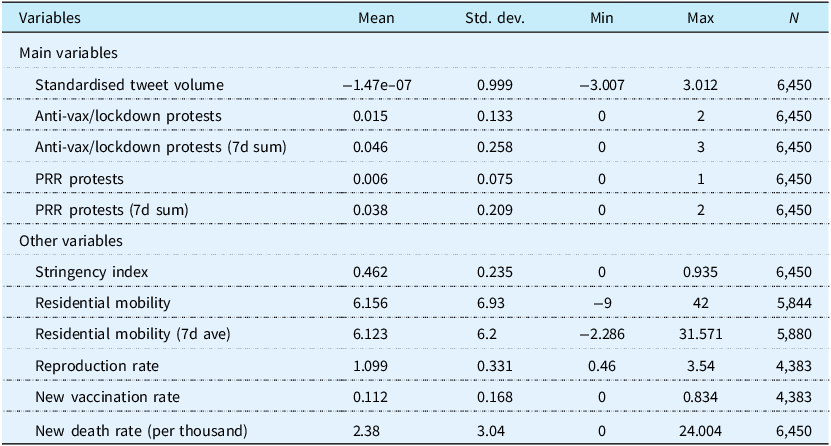
Table 1 summarises the key variables used in the analysis. The standardised tweet volume, which captures daily fluctuations in COVID-19-related online discourse, shows high variability over time (SD = 0.999), reflecting the cyclical nature of information surges accompanying major pandemic events. Protest indicators are rare but meaningful, with low mean frequencies indicating that such events are exceptional yet symbolically powerful episodes of collective mobilisation. Anti-vax/lockdown protests are slightly more prevalent than conspiratorial PRR protests, consistent with the sequence of pandemic measures and the later emergence of vaccine-specific resistance.
Descriptive statistics

The average stringency index (M = 0.462) indicates moderately strict containment measures across the observation period, with substantial variation (SD = 0.235) reflecting successive tightening and relaxation phases. Residential mobility displays the widest dispersion (SD = 6.93), capturing dramatic behavioural shifts between lockdown and reopening periods. Vaccination rates (mean = 0.112) and death rates (mean = 2.38 per thousand) align with the known temporal progression of the pandemic, where vaccine rollout gradually mitigated mortality risk.
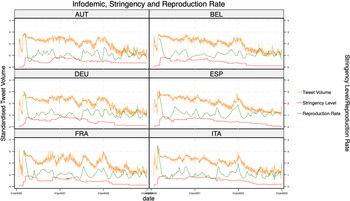
Figure 2 illustrates the temporal evolution of the infodemic intensity, policy stringency, and epidemic dynamics across the six European countries. The orange lines show the standardised volume of COVID-19-related tweets, the red lines track the Oxford stringency index, and the green lines indicate the effective reproduction rate. Stringency levels (red lines) rose abruptly during the early pandemic months and gradually declined as governments relaxed containment measures in 2021–2022. Despite this general downward trend, the infodemic signal (tweet volume) remained volatile, indicating persistent information turbulence even after policy stabilisation. The reproduction rate (green lines) fluctuated with successive waves, often rising in the aftermath of policy relaxation or periods of low public compliance. The joint evolution of these three indicators shows how digital communication, policy, and epidemiological dynamics were tightly interwoven: moments of high online infodemics often coincided with periods of elevated transmission or contentious policy shifts.
Time series of tweet volume, stringency level, and effective reproduction rate.

Figure 3 shows trends of collective mobilisation and behavioural adaptation. The blue lines trace residential mobility (inverted compliance with stay-at-home measures), while coloured markers denote distinct categories of protest events: anti-lockdown (green diamonds), anti-vaccine (brown circles), and conspiratorial populist radical right (PRR) protests (maroon triangles). Across cases, mobility fell dramatically during the first lockdowns, then gradually rebounded, mirroring policy relaxation and behavioural fatigue.
Time series of protest events and residential mobility.

The temporal clustering of protest events reveals striking cross-national variation in the forms and intensity of collective resistance. Germany and Italy stand out for the frequency and overlap of protest types, with anti-lockdown, anti-vaccine, and PRR-associated events occurring in close temporal proximity – an indication of the fusion between pandemic-specific grievances and pre-existing far-right networks. France and Austria show more sporadic protest activity concentrated in mid-2021, corresponding to vaccine mandate controversies. Belgium and Spain exhibit relatively fewer events, though these align with phases of renewed restrictions or epidemic surges.
These descriptive patterns underscore how digital infodemics and populist mobilisation jointly shaped the social response to the pandemic. These dynamics provide the empirical foundation for the latent ‘Resistance’ construct in the structural equation models, capturing how information turbulence translated into collective behavioural defiance and, ultimately, measurable public health consequences.
3.2. Main results
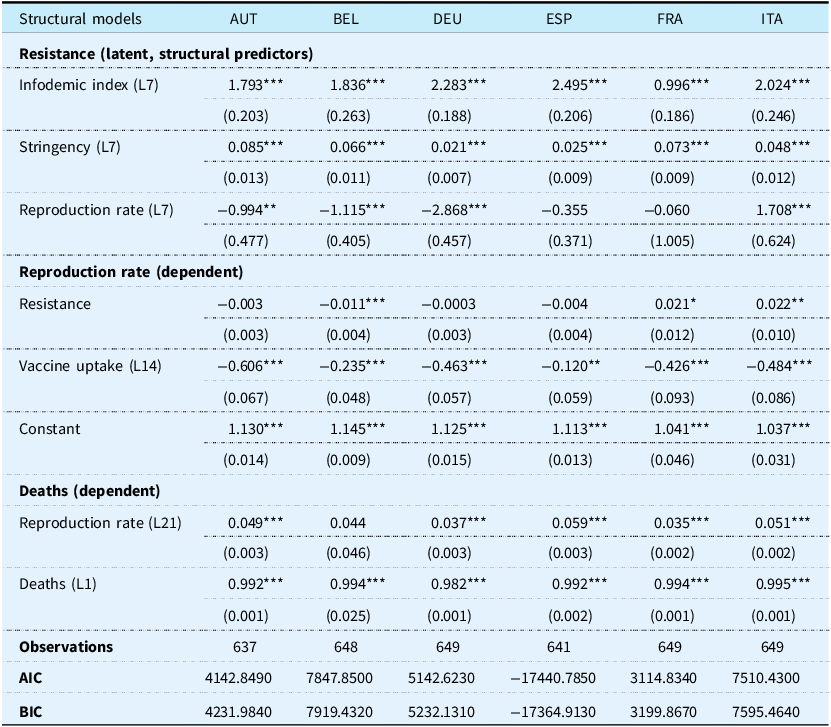
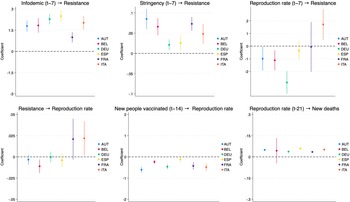
The structural equation model (SEM) reveals a consistent and statistically significant association between the infodemic index and the latent construct of resistance across all six countries, although the strength of the effect varies substantially. As shown in Table 2 and Figure 4, a one-unit increase in the infodemic index seven days prior predicts a sizeable increase in resistance, with coefficients ranging from approximately 1.00 in France to 2.495 in Spain (all p < 0.01). These estimates indicate that spikes in online infodemics are systematically followed by increases in behavioural and attitudinal resistance, including increased residential compliance and heightened protest activity. The temporal lag strengthens the directional interpretation, supporting the hypothesis that digital infodemics act as a leading indicator of subsequent offline contestation.
Structural equation model results by country

Notes: Standard errors in parentheses.
* * *p < 0.01, **p < 0.05, *p < 0.1.
Structural equation model result.

In terms of policy stringency, the model identifies a positive and statistically significant association with resistance in all countries. Coefficients range from 0.021 in Germany to 0.085 in Austria (all p < 0.01), indicating that more stringent containment measures are systematically associated with higher levels of resistance. This pattern suggests that restrictive policies – while epidemiologically necessary – can generate behavioural pushback, potentially through mechanisms such as fatigue, reactance, or politicisation of public-health measures. The reproduction rate (R t ) at a seven-day lag exhibits heterogeneous effects on resistance. In Austria, Belgium, and Germany, the coefficients are negative and statistically significant (–0.994, –1.115, and –2.868 respectively), suggesting that worsening epidemiological conditions are associated with lower resistance, possibly reflecting increased risk perception and compliance. In contrast, Italy shows a positive and significant effect (1.718, p < 0.01), indicating that higher transmission may instead fuel discontent or perceptions of policy failure. Effects in Spain and France are statistically insignificant. Overall, these mixed results suggest that epidemiological pressure does not have a uniform behavioural impact and is mediated by national context, including trust, communication, and political framing.
Downstream relationships provide more support for a direct political–epidemiological feedback mechanism. Resistance has a positive and statistically significant effect on the reproduction rate only in Italy (β = 0.022, p < 0.05), and a weaker marginal effect in France (β = 0.021, p < 0.10). In Austria, Belgium, Germany, and Spain, the estimated coefficients are small and statistically insignificant. This suggests that, while resistance may influence epidemiological dynamics in some contexts, its direct impact on viral transmission is not consistently observed across countries.
In contrast, vaccination uptake exhibits a robust and consistent negative association with epidemic growth. Across all six countries, higher levels of newly vaccinated individuals (lagged by 14 days) significantly reduce the reproduction rate, with coefficients ranging from –0.12 in Spain (p < 0.05) to –0.606 in Austria (p < 0.01). This confirms the central role of immunisation in mitigating transmission and highlights vaccination as the most stable countervailing force against behavioural noncompliance.
The mortality equation behaves in line with standard epidemic dynamics. The reproduction rate lagged by three weeks significantly predicts new deaths in most countries, with coefficients ranging between 0.035 and 0.059 (p < 0.01), although the estimate for Belgium is not statistically significant. The autoregressive parameter for deaths remains very close to unity (approximately 0.98–0.99 across all countries), indicating strong persistence in mortality dynamics over time.
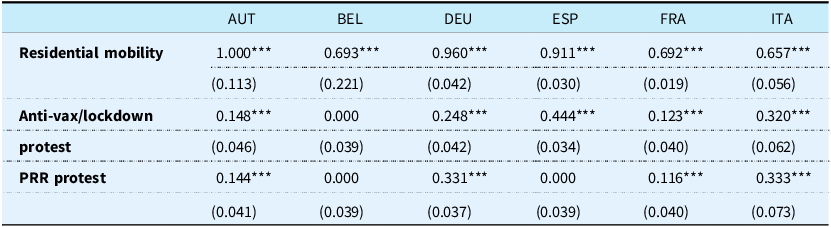
Yet the relationship between resistance and PRR-related mobilisation is more heterogeneous. As seen in Table 3 and Figure 5, in Germany and Italy, standardised loadings on conspiratorial PRR protests are statistically significant (0.33 in both cases), indicating that pandemic resistance is meaningfully embedded in broader populist and conspiratorial worldviews. In these contexts, resistance reflects a partially politicised rejection of expert authority and shows some alignment with pre-existing anti-elite narratives. The unstandardised loading factors can also be found in section 1 of the supplementary material.
Measurement model: standardised factor loadings on resistance

Notes: Entries are standardised factor loadings from sem, standardise. Standard errors in parentheses.
* * *p < 0.01. Values rounded to three decimal places.
Structural equation model result.

By contrast, in Austria and France, PRR loadings are positive but relatively modest (0.14 and 0.12, respectively), suggesting a weaker and more limited connection between pandemic resistance and populist ideological mobilisation. In Belgium and Spain, the PRR loadings are effectively zero and statistically insignificant, indicating that conspiratorial or far-right protest activity does not meaningfully contribute to the latent resistance construct in these cases. Rather than reflecting generalised ideological distrust, resistance in these countries appears to be largely decoupled from PRR mobilisation and more narrowly rooted in other behavioural dimensions.
This cross-national heterogeneity underscores that while the infodemic consistently fuels oppositional attitudes across Europe, its ideological embedding varies substantially. In countries such as Germany and Italy, infodemics interact with existing populist ecosystems, producing a more clearly politicised form of resistance. Elsewhere, resistance appears more fragmented and context-specific, driven less by durable ideological cleavages and more by situational responses to pandemic governance. The measurement model thus reinforces that resistance is a multidimensional construct, anchored in both behavioural noncompliance and protest activity, but differing across countries in the extent to which it is politically structured.
In summary, these findings reveal a coherent chain of relationships linking the infodemic to political resistance and, in turn, to epidemiological outcomes. They highlight that digital infodemics do not operate in isolation but interact with political opportunity structures, institutional trust, and policy communication to shape collective behaviour. The SEM therefore captures not only the informational origins of resistance but also its behavioural and epidemiological consequences, providing empirical support for the proposed political–epidemiological mechanism connecting online discourse, mobilisation, and population health.
Given the dynamic time-series nature of the variables and the integration of behavioural and epidemiological processes, conventional global SEM fit indices were unavailable because the models were just-identified or nearly saturated after accounting for lagged structures and limited within-country variation Hoyle (Reference Hoyle2023). Following Kline (Reference Kline2023), I focus on equation-level and parameter significance to determine if the hypothesised paths actually explain the variance in the latent ‘Resistance’ and subsequent viral reproduction rates. As seen in section 2 of the supplementary material, the equation-level fit statistics for the latent resistance construct indicate substantial cross-national variation in how well the structural predictors account for latent variance. The equation-level R 2 values for observed outcomes further clarify where the model performs well and where it remains limited. The measurement model shows that residential mobility is strongly captured by the latent resistance factor in most countries, whereas protest-based indicators exhibit strong explanatory power only in Germany and Italy. This reinforces earlier findings that protest activity is sparse and unevenly linked to the underlying resistance construct. On the structural side, the model explains only a modest share of variation in the reproduction rate (generally around 10–13%), while the mortality equation displays near-perfect fit across countries, with R 2 values close to one.
3.3. Sensitivity analysis
As seen in section 3 of the supplementary material, the sensitivity analysis on the latent variable shows that the core structural relationships of the model are broadly robust to alternative specifications of the measurement model, but the stability of the latent construct itself depends strongly on the choice of protest indicator. Across both specifications, the effect of the infodemic on resistance remains consistently positive and statistically significant in all countries, confirming that misinformation exposure is a stable driver of oppositional attitudes. Likewise, vaccine uptake retains a strong and negative association with the reproduction rate, reinforcing the epidemiological validity of the model. However, the measurement results reveal substantial heterogeneity: the anti-vax/lockdown specification produces more stable and consistently significant loadings across countries, whereas the PRR-based specification yields significant results only in Austria, Germany and Italy. This suggests that PRR mobilisation captures a country-specific and politically contingent dimension of protest. Overall, the findings support the robustness of the structural pathways while indicating that resistance is better operationalised through behavioural and issue-specific protest measures than through ideologically anchored PRR mobilisation.
In testing the time-sensitivity of the model (section 4 of the supplementary material), I show that the main structural relationships are robust to alternative specifications of both the latent resistance construct and the temporal lag structure. While the contribution of individual protest indicators varies across specifications, reflecting their episodic nature, the core relationship between infodemic exposure, resistance, and epidemic dynamics remains stable.
4. Discussions
This study demonstrates that digital infodemics and populist mobilisation are not parallel but deeply intertwined processes that shape collective responses to public health crises. By tracing the pathway from online information flows to behavioural and epidemiological outcomes, it shows that resistance to NPIs is not merely a cognitive by-product of infodemics but a socially and politically mediated form of collective action in some countries. The latent construct of resistance captures how oppositional narratives – initially diffused through online ecosystems – can potentially crystallise into coordinated protest, behavioural noncompliance, and attitudinal defiance. These dynamics undermined compliance with containment measures and indirectly sustained viral transmission, thereby linking the informational and epidemiological dimensions of the pandemic.
The results reveal two interdependent mechanisms underpinning this process. First, the infodemic–resistance link is robust and consistent across European contexts. In Belgium, Germany, Spain, and Italy, higher levels of online infodemics seven days earlier significantly predicted stronger resistance (standardised coefficients are positive and statistically significant across all specifications, with similar magnitudes across countries), while the effects in Austria and France, though smaller, remained positive. This suggests that infodemic exposure systematically erodes trust and legitimacy perceptions, fostering opposition to expert-led governance. In these settings, digital infodemics operate as both cognitive and emotional catalysts: they heighten uncertainty, amplify perceived coercion, and activate grievance frames that pit ‘ordinary citizens’ against ‘corrupt elites’ or ‘unaccountable experts’. This mechanism aligns with existing evidence that false information thrives not because it is persuasive per se, but because it resonates with affective mistrust and identity-based worldviews.
However, infodemics alone cannot account for the variation in resistance across countries. The second mechanism – political mobilisation by PRR actors – explains how online narratives acquired organisational coherence and real-world impact in Germany and Italy. PRR movements act as symbolic and infrastructural conduits, translating diffuse anxieties about vaccines, lockdowns, and scientific authority into collective defiance rooted in nationalism, anti-elitism, and libertarian individualism. However, the sensitivity analysis shows that this mechanism is not uniformly stable across model specifications. These movements reframed compliance as submission and noncompliance as civic virtue, transforming misinformation into a resource for political identity formation.
In contrast, countries such as Austria, Belgium, and France show weaker or null associations between PRR mobilisation and resistance. Here, the SEM loadings suggest that resistance was more ‘pandemic-specific’ – driven by fatigue, perceived inequities in restrictions, or diffuse frustration rather than entrenched ideological commitments. The cross-national heterogeneity thus demonstrates that while misinformation is a necessary precondition for health resistance, its translation into sustained mobilisation depends on the presence of political entrepreneurs capable of framing discontent and coordinating action. At the same time, the findings indicate that such politicisation is contingent rather than generalisable and should not be treated as a universal feature across Europe.
These intertwined processes produced tangible epidemiological effects. The SEM results show that the effect of resistance on the reproduction rate is not consistently robust across specifications and countries, with statistically significant effects emerging only in selected cases (notably Italy). In contrast, vaccination uptake had the expected negative impact, mitigating transmission. This contrast highlights how social and political processes can either amplify or dampen disease spread depending on whether they enhance compliance or foster defiance. While the epidemiological pathway remains theoretically coherent, the sensitivity analysis suggests that its empirical strength is more modest and context-dependent than initially estimated. Resistance thus represents a behavioural externality: individual or collective noncompliance, often politically motivated, imposes epidemiological risks on the broader population.
One of the main limitations concerns platform coverage. The infodemic indicator is derived from Twitter/X activity and therefore captures only one component of the broader digital communication ecosystem. Platform preferences vary across countries – for example, Facebook and messaging applications such as WhatsApp play a larger role in political communication in some contexts. Because comparable cross-national data from these platforms are difficult to obtain at daily frequency, they are not included in the present analysis. Future research could extend the framework developed here by integrating multi-platform data to better capture the full dynamics of digital misinformation and mobilisation. I also acknowledge that the reproduction rate is influenced by time-varying factors such as the emergence of more transmissible variants and seasonal patterns, which are not explicitly modelled here. While R t partially captures these dynamics, the omission of harmonised cross-country indicators for variant prevalence and seasonality may lead to some residual confounding in attributing effects to resistance or infodemics.
From a theoretical standpoint, the findings of this analysis deepen understanding of the political–epidemiological mechanism linking digital environments, collective behaviour, and population health. They show that infodemics do not operate solely through belief distortion but through their interaction with identity, grievance, and mobilisation structures. Once politicised, health behaviours become markers of belonging within ‘counterpublics’ that reject scientific authority. Compliance with health mandates is then interpreted not as a civic duty but as a sign of out-group conformity. The result is the emergence of parallel moral economies of health, where social media users, activists, and PRR actors co-produce oppositional norms that directly interfere with epidemic control.
From a policy perspective, these findings caution against conceiving infodemics solely as a problem of individual cognition remediable through fact-checking or prebunking alone. Once misinformation becomes embedded in collective identities and populist mobilisation, it functions less as an information deficit and more as a symbolic resource that binds communities around distrust. Correcting falsehoods in such contexts is insufficient without addressing the structural conditions that sustain distrust: inequality, institutional opacity, and polarised media systems. Effective countermeasures must therefore operate on multiple levels – informational, institutional, and relational. Transparent communication, early engagement with trusted local intermediaries, and depoliticisation of health expertise are crucial steps to reduce the resonance of populist grievance frames.
Ultimately, the challenge illuminated by this study is not merely to ‘fight infodemics’ but to rebuild the trust infrastructure that underpins collective action in crises. Public health governance must move beyond reactive correction toward proactive trust-building – recognising that compliance with health measures depends as much on the legitimacy of institutions as on the accuracy of information. The political–epidemiological feedback loop revealed here underscores that epidemics are not only biological events but also social contests over authority, solidarity, and truth.
Supplementary material
The supplementary material for this article can be found at https://doi.org/10.1017/S1744133126100589.
Data availability statement
The data and supplementary materials underlying this article are available anonymously at the Open Science Framework at this link.
Acknowledgements
This research is funded by the EU’s Horizon Europe Framework under grant agreement 101107454. I thank the participants of the Max Planck Institute for Demographic Research Seminar, the participants of the Population Association of America’s annual conference, and the audience of the Sciences Po CRIS seminar series for their valuable comments.
Financial support
This research is funded by the EU’s Horizon Europe Framework under grant agreement 101107454.
Competing interests
The author declares that they have no known competing financial interests or personal relationships that could have appeared to influence the work reported in this paper.
Declaration of AI use
In the preparation of this manuscript, I used the AI tool ChatGPT (OpenAI, GPT-4.1) during April 2026 for table formatting, grammar checking, and language refinement. No AI-generated content was used to create original ideas, interpret data, or write substantive portions of the manuscript. All outputs produced by the AI were reviewed and verified by the authors to ensure accuracy and compliance with ethical standards. The author takes full responsibility for the content of this manuscript.




 Open access

