




Impact statement
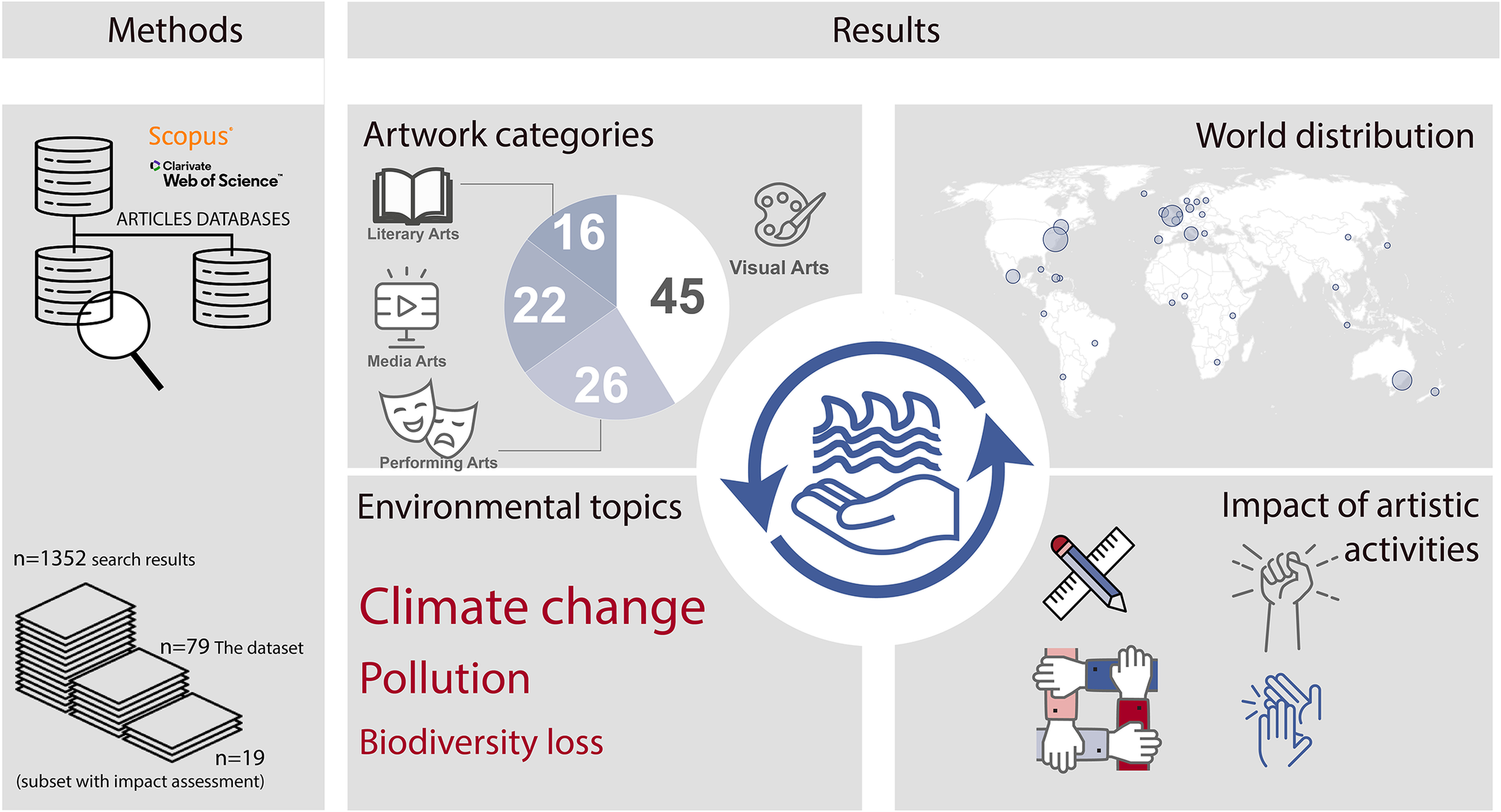
Even though we know that art can go beyond its aesthetic value because of its emotional engagement, we asked ourselves, ‘What is the role of art in the sustainability of coasts and seas?’ To address this question, we searched databases of articles published in scientific journals to find works that describe connections between artistic practices and coastal and marine issues. We set the current state of knowledge of this emerging topic through the identification and categorisation of art forms, expected impacts, target audiences and geographical distribution of the studies in our dataset. We have found that art is relevant, among others, to engage people, promote dialogue and increase knowledge about coastal and marine issues. While our dataset is relatively large (79 articles), evidence is scattered, and is not particularly robust because only 19 articles provide impact assessment. Within a worldwide task force pro-sustainability, we believe that there is still a long way to go to demonstrate how, when and where art can/should contribute to it.
Introduction
Societal challenges with regard to sustainability and resilience are related to persistent and complex problems, such as climate change, biodiversity loss, energy transition and resource depletion. To address them, transformations in societal systems are increasingly advocated to move towards a sustainable future (Köhler et al., Reference Köhler, Geels, Kern, Markard, Onsongo, Wieczorek, Alkemade, Avelino, Bergek, Boons, Fünfschilling, Hess, Holtz, Hyysalo, Jenkins, Kivimaa, Martiskainen, McMeekin, Mühlemeier, Nykvist, Pel, Raven, Rohracher, Sandén, Schot, Sovacool, Turnheim, Welch and Wells2019). In this regard, new forms of science–society collaboration play an important role in research on and for sustainability transformations (Bergmann et al., Reference Bergmann, Schäpke, Marg, Stelzer, Lang, Bossert, Gantert, Häußler, Marquardt, Piontek, Potthast, Rhodius, Rudolph, Ruddat, Seebacher and Sußmann2021). Several authors have highlighted the arts as tools to (re)frame and engage with controversial topics, and recognise their value beyond their aesthetic qualities (Eernstman and Wals, Reference Eernstman and Wals2013). However, others suggested that any individual artwork is unlikely to have a transformative effect on viewers or society (Stocker and Kennedy, Reference Stocker and Kennedy2011). Rather, if people are exposed to a variety of artworks over the course of their lives, their consciousness may be raised so that they are open to different perspectives and to changes in their cognition, affect and behaviour (Stocker and Kennedy, Reference Stocker and Kennedy2011; Muhr, Reference Muhr2020). Moreover, it should be kept in mind that the arts have a limited and uneven influence, and some may argue that they only work for people who value the arts or who are already engaged in them (van der Vaart et al., Reference van der Vaart, van Hoven and Huigen2018). People involved in art and science projects may envisage their experience as:
Spending time at a remote field laboratory with art and science students provided the opportunity for both ecological and artistic exploration of the island and informal, non-judgmental conversations about climate change processes and what images might better convey information about them to the public. (Jacobson et al., Reference Jacobson, Seavey and Mueller2016, p. 4)
In this article, we start by framing the concept of sustainability and how it has been evolving, and briefly clarify terms that are related, complementary or contribute to sustainability. We describe it in a conceptual scheme of environmental sustainability and connected it to human actions when embedded into the coastal and marine resources realm. We then frame art and the artistic practices, how they are regarded for this review and how they may be classified. As our main research question, we ask, What is the role of art in coastal and marine sustainability? We undertake a systematic literature review to assess the research that embraces these transdisciplinary experiences, and whether there is scientific evidence of the claimed role that art plays in coastal and marine sustainability. We describe the diversity of studies in terms of geographical distribution, art forms, audiences and their contribution to sustainability. Finally, we associated artworks with envisaged human actions (e.g., raising awareness, fostering collaboration and learning) and relate them with impacts on attitude, behaviour and knowledge. This article is the first to gather, review and analyse evidence of the impact of art on coastal and marine sustainability.
Framing concepts of sustainability
The concept of ‘sustainability’ initially appeared in the 1970s in technical reports and books related to the field of ecology, usually associated with the idea that development in a world with finite resources should have environmental limits (Kidd, Reference Kidd1992). In 1987, this concept jumped to the international political sphere and gained popularity with its use in the United Nations (UN) Report. In this landmark publication, the term ‘sustainability’ was defined as “meeting the needs of the present without compromising the ability of future generations to meet their own needs” (Brundtland Commission, 1987, p. 15), encompassing three main dimensions: the economic, social and environmental. Most of the scientific literature on sustainability, including our study, focuses on the ecological (or environmental) dimension, which can be defined as a balanced development “meeting human needs without compromising the health of ecosystems” (Callicott and Mumford, Reference Callicott and Mumford1997).
This concept of environmental sustainability was also used as one of the eight goals of the UN’s Millennium Development Goals proposed in 2000. Fifteen years later, all UN Member States adopted the 2030 Agenda for Sustainable Development, with 17 sustainable development goals (SDGs) as the central point. This global partnership between developed and developing countries “recognize that ending poverty and other deprivations must go hand-in-hand with strategies that improve health and education, reduce inequality, and spur economic growth – all while tackling climate change and working to preserve our oceans and forests” (United Nations (UN), 2015). The sustainability of the coastal and marine areas is more directly connected with two SDGs: Goal 13 (related to climate change) and Goal 14 (related to sustainable oceans). Moreover, the UN designated 2021–2030 a Decade of Ocean Science for Sustainable Development to promote increased scientific knowledge for ocean health (Intergovernmental Oceanographic Commission (IOC), 2018). The use of art practices can improve communication about marine issues and promote a better understanding of these societal challenges, thus potentially helping to minimise threats to the ocean in the future.
In what concerns the measurement of global environmental sustainability (e.g., Wackernagel and Rees, Reference Wackernagel and Rees1996; Wackernagel et al., Reference Wackernagel, Onisto, Bello, Linares, Falfán, García, Guerrero and Guerrero1999; Millennium Ecosystem Assessment, 2005), the first initiatives tended to attribute reduced importance to marine ecosystems and/or use only world fisheries data as a proxy for the welfare of their health (Meadows et al., Reference Meadows, Meadows and Rangers1992, Reference Meadows, Meadows and Randers1972). In later studies about global sustainability, which concern planetary boundaries that guarantee a “safe operational space for humanity”, more information about the marine environment is introduced: reduction of biodiversity (terrestrial and marine) and ocean acidification (Rockström et al., Reference Rockström, Steffen, Noone, Persson, Chapin, Lambin, Lenton, Scheffer, Folke, Schellnhuber, Nykvist, de Wit, Hughes, van der Leeuw, Rodhe, Sörlin, Snyder, Costanza, Svedin, Falkenmark, Karlberg, Corell, Fabry, Hansen, Walker, Liverman, Richardson, Crutzen and Foley2009; Steffen et al., Reference Steffen, Broadgate, Deutsch, Gaffney and Ludwig2015). Because of its large population, the coastal zone is the most important part of the human habitat exposed to sea-level rise and other consequences of global climate change. In addition, its enhanced population density intensifies local human impact (IPCC, 2021).
Sustainability provides a research paradigm that, when embedded into coastal and marine resources management, delivers an approach to drawing interconnections between business activities and societal challenges (Dordi and Palaschuk, Reference Dordi and Palaschuk2022). Human actions towards the environmental sustainability of coastal and marine environments are various and diverse: they can include management, conservation, restoration, energy transition, engagement, education and activism (Figure 1).
Conceptual scheme of environmental sustainability and connected human actions, when embedded into coastal and marine resources.
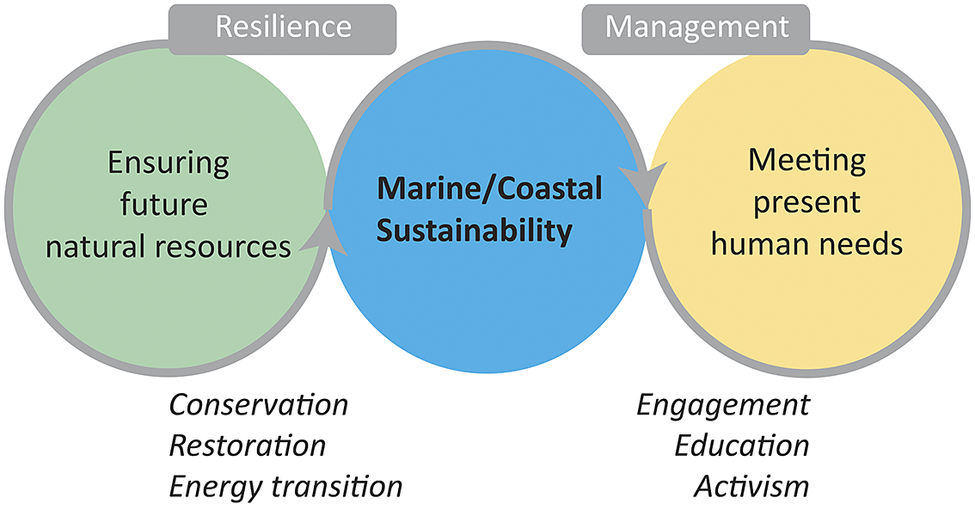
In the context of sustainability, ‘resilience’ is currently defined as the capacity of a system to absorb disturbance and reorganise while changing so as to still retain essentially the same functions, structure, identity and feedbacks (Flood and Schechtman, Reference Flood and Schechtman2014). This is a buzzword in current conservation discourse, and extremely important for sustainability studies (Brand and Jax, Reference Brand and Jax2007). Asides from resilience, and under the scope of the Decade on Ecosystem Restoration, aligned with the recent conservation paradigm, the concept of Restoration also gained traction in recent years in the sustainability science; intending to prevent, halt and reverse the degradation of ecosystems on every continent and in every ocean. The term Restoration refers to the process of assisting in the recovery of an ecosystem that has been degraded, damaged or destroyed, and is thus intimately related to conservation, but also energy transition, as ecosystems can play crucial roles in global decarbonisation strategies.
In sustainability and energy transitions research, participation has gained an increasing role in recent decades via diverse applications at the local level (Wittmayer et al., Reference Wittmayer, Schäpke, van Steenbergen and Omann2014; Bergmann et al., Reference Bergmann, Schäpke, Marg, Stelzer, Lang, Bossert, Gantert, Häußler, Marquardt, Piontek, Potthast, Rhodius, Rudolph, Ruddat, Seebacher and Sußmann2021), as well as wider-scale governance processes (Loorbach et al., Reference Loorbach, Frantzeskaki and Avelino2017; Sengers et al., Reference Sengers, Wieczorek and Raven2019). Engagement, education and/or activism are ways to empower, involve, inform, listen and give voice to the citizens and organisations, enabling them to envision and act for sustainability (Wittmayer and Schäpke, Reference Wittmayer and Schäpke2014; Hölscher et al., Reference Hölscher, Wittmayer, Avelino and Giezen2019; Huttunen et al., Reference Huttunen, Ojanen, Ott and Saarikoski2022), thus contributing to more effective management of natural resources.
Framing art and artistic practices
‘Art’ can be defined as something that is created with imagination and skill and that is beautiful or that expresses important ideas or feelings (Britannica, 2023). ‘Art’ can also be defined as the conscious use of skill and creative imagination, especially in the production of aesthetic objects (Merriam-Webster, 2023). Moreover, art can also entail a ‘science–society’ component. For example, it can create shifts in consciousness by challenging people to see the environment differently and to imagine new types of relationships with the coast and the sea. While scientific text, figures and statistics are regarded as the most legitimate forms of knowledge for policy and management of the coasts and seas, shifts in mindsets are not always achievable by cognitive, scientific and didactic methods (Stocker and Kennedy, Reference Stocker and Kennedy2011). Indeed, emotional and affective responses to the natural world and environmental concerns can be as engaging and decisive as government reports or scientific data (Miles, Reference Miles2010).
Hawkes (Reference Hawkes2001) regards the arts as the fourth pillar of sustainability; the arts’ techniques involve improvisation, intuition, spontaneity, lateral thought, imagination, cooperation, serendipity, trust, inclusion, openness, risk-taking, provocation, surprise, concentration, unorthodoxy, deconstruction, innovation, fortitude, and an ability and willingness to delve beneath the surface, beyond the present, above the practical and around the fixed.
In this review, we do not present the concept of ‘art’ as an authoritative definition or a comprehensive presentation of the concept in all its expressions, at all times, in all places and in all senses. We did not choose which articles could (or could not) be included; rather we opted to accept as artistic practices whenever the authors claimed them as such. Furthermore, artistic practices are defined according to the characteristics of the society and culture in which they are included, and of the bodies of the human beings who listen to them, and create and perform them (Blacking, Reference Blacking1974). Hence, we intended to apprehend if there was some sort of intention of an expressive practice as art, either by the direct mention of such intention, by the context where it was being described (e.g., presented in an art museum or art festival; Liburd and Derkzen, Reference Liburd and Derkzen2009; D’Ambrosio and Dominici, Reference D’Ambrosio, Dominici, Filho and Bardi2019), or for a sort of practice that one could understand that involved artistic creation in a way that could be perceived as art (e.g., children drawing; Boaventura et al., Reference Boaventura, Neves, Santos, Pereira, Luís, Monteiro, Cartaxana, Hawkins, Caldeira and Ponces de Carvalho2021; Pantaleo, Reference Pantaleo2021).
To organise and systematise the artworks, we adopted the classification of the arts of McCarthy et al. (Reference McCarthy, Brooks, Lowell and Zakaras2001), adding sub-disciplines, when absent. According to these authors, art forms can be classified into four main categories: performing arts, media arts, visual arts and literary arts. Details on the several disciplines and sub-disciplines can be found in Matias et al. (Reference Matias, Carrasco, Pinto and Reis2023). Other classification systems are also possible; for example, Balfe and Peters (Reference Balfe, Peters, Cherbo and Wyszomirski2000) use a different classification scheme that includes design and architecture as major categories.
Method of the systematic review
This systematic review follows the Preferred Reporting Items for Systematic Reviews and Meta-Analyses (PRISMA; Page et al., Reference Page, McKenzie, Bossuyt, Boutron, Hoffmann, Mulrow, Shamseer, Tetzlaff, Akl, Brennan, Chou, Glanville, Grimshaw, Hróbjartsson, Lalu, Li, Loder, Mayo-Wilson, McDonald, McGuinness, Stewart, Thomas, Tricco, Welch, Whiting and Moher2021) guidelines, when applicable. The flowchart of the identification of studies for the systematic literature review is available at Matias et al. (Reference Matias, Carrasco, Pinto and Reis2023).
Search terms were from three fields: area/domain (coast and sea), art and sustainability. Words used for each field can be found on the query string (string in the dataset available at Matias et al., Reference Matias, Carrasco, Pinto and Reis2023). Two large scientific databases for articles were searched on 29 July 2022: Scopus and Web of Science. The terms were searched in articles and book chapters in English; on the title, abstract and keywords on Scopus; and on the abstract on Web of Science.
Using the query expression, we retrieved 1,176 articles in Scopus and 618 articles in Web of Science. After concatenation and deleting duplicates, we obtained 1,352 articles. All articles’ abstracts and titles were screened to select the eligible items for the study. Records were excluded when:
-
• Coast/sea was used as toponymy (e.g., Ivory Coast) or only to locate some place (e.g., a study located in the Red Sea).
-
• Words were used as metaphors or analogies (e.g., ocean of words).
-
• Words that have more than one meaning and were used in the figurative meaning (e.g., ‘theatre’ is used for a building or a ruin, not a performative form of art).
-
• When ‘Ecology’ described relations between living beings and the environment, in biology research.
-
• They were studies of rock art.
-
• ‘Painting’ and ‘installation’ were used as a verb, not a noun of an art form (e.g., painting the boat or wheelhouse building installation).
Finally, 110 full-text articles were assessed for eligibility. Cross-check analysis was made by having at least two authors scan each abstract. Of these, 31 articles were excluded because no artwork was described. Thus, 79 articles were found eligible for the present systematic review, that is, they compose our dataset. Content analysis of the articles was made in terms of artwork classification, expected outcome, methods, location, audiences, etc., and cross-checking was made by having three authors validate the coding. Basic statistics were used to obtain frequency and trends.
The articles were filtered again to identify which studies conducted measurements of the impact of the art activities (details in the dataset available at Matias et al., Reference Matias, Carrasco, Pinto and Reis2023). Only 19 of the articles in the dataset fulfilled these requirements, composing our sub-dataset.
For sure, many more projects are being carried out, but are not the objects of published studies, hence could not be detected by this analysis. The limited examples used in this paper are based on published scientific literature and, thus, provide an accurate representation of the role of art in coastal and marine sustainability within such context, without intending to surpass it, but hopefully providing a frame for future works concerning such a topic.
The role of art in coastal and marine sustainability is multifaceted and ever-changing. The immense multitude of artists and artworks that might be seen as having a connection to such a topic cannot provide a starting point by itself for the lack of an appropriate methodology that would allow a systematic analysis of such data for several reasons. There is no evidence of the existence of literature that includes a holistic approach to this topic. Choosing artists that are well known and legitimated by powerful structures in the worlds of arts, such as Christa Sommerer and Laurent Mignonneau, may provide good examples, but would lead this research into a path focused in worlds that are themselves led by very specific groups and networks of people and would exclude many other with an impartial criterion.
The diversity of ‘art and sustainability’ projects
As in other areas of research, the number of articles describing and analysing the role of art in coastal/marine sustainability increased during the last decade, and more dramatically in the last years (10 articles between 2014 and 2016; 21 articles between 2017 and 2019; 35 articles between 2020 and 2022, and 2022 is still incomplete as the year is not finished).
A word cloud was constructed from the text of the articles in the dataset (Figure 2A). This statistic, which portrays all articles in the dataset at a glance, enables visual highlighting of subjects most prevalent in the dataset. At the centre of the word cloud is ‘art’, surrounded by ‘science’, ‘climate’ ‘change’, ‘sea’ and the ‘environment’. It is worth noting that climate change was not one of the keywords used in the search – it just emerged from this analysis. Other words are also very common, such as ‘people’, ‘culture’, ‘human’ and ‘society’, that take us back to the field of social sciences, and interestingly ‘Anthropocene’. Also worthy of note are the words ‘water’, ‘coral’, ‘island’, ‘creative’, ‘technology’, ‘future’, ‘community’, ‘visual’ and ‘students’. This is indeed a very diverse, rich and interesting collection of words, or said differently, a diverse and transdisciplinary field.
(A) Word cloud constructed from the text of all articles in the dataset. (B) Distribution by country of the reported artistic activities around the world.

There is no strong dominance of projects related to the coast or the sea, and only 9% considering both areas/domains. It was noticed that artistic projects related to the coast were more human-focused, whereas artistic projects related to the sea explored more the value of resources, nature conservation and climate change issues. The dataset describes art projects that have taken place on all continents (Figure 2B). However, the frequency of this reporting and analysis is not the same everywhere. Most of them are located in Europe and North America, and three English-speaking countries stand out: the UK, the US and Australia. There may be several factors that lead to this distribution. One of them is probably related to the ease of publication in English by researchers and artists from these countries.
In this literature review, we deal largely with the use of art in local issues, rather than global scale. There are two main reasons for this: 1) it is a characteristic of the existing literature itself to focus on local or regional case studies, and 2) it is according to the slogan “think global, act local”. Local studies are often easier to deal with than global problems because local responses can be faster, and local solutions are easier and cheaper to implement (Tett and Sandberg, Reference Tett, Sandberg, Tett, Sandberg and Mette2011).
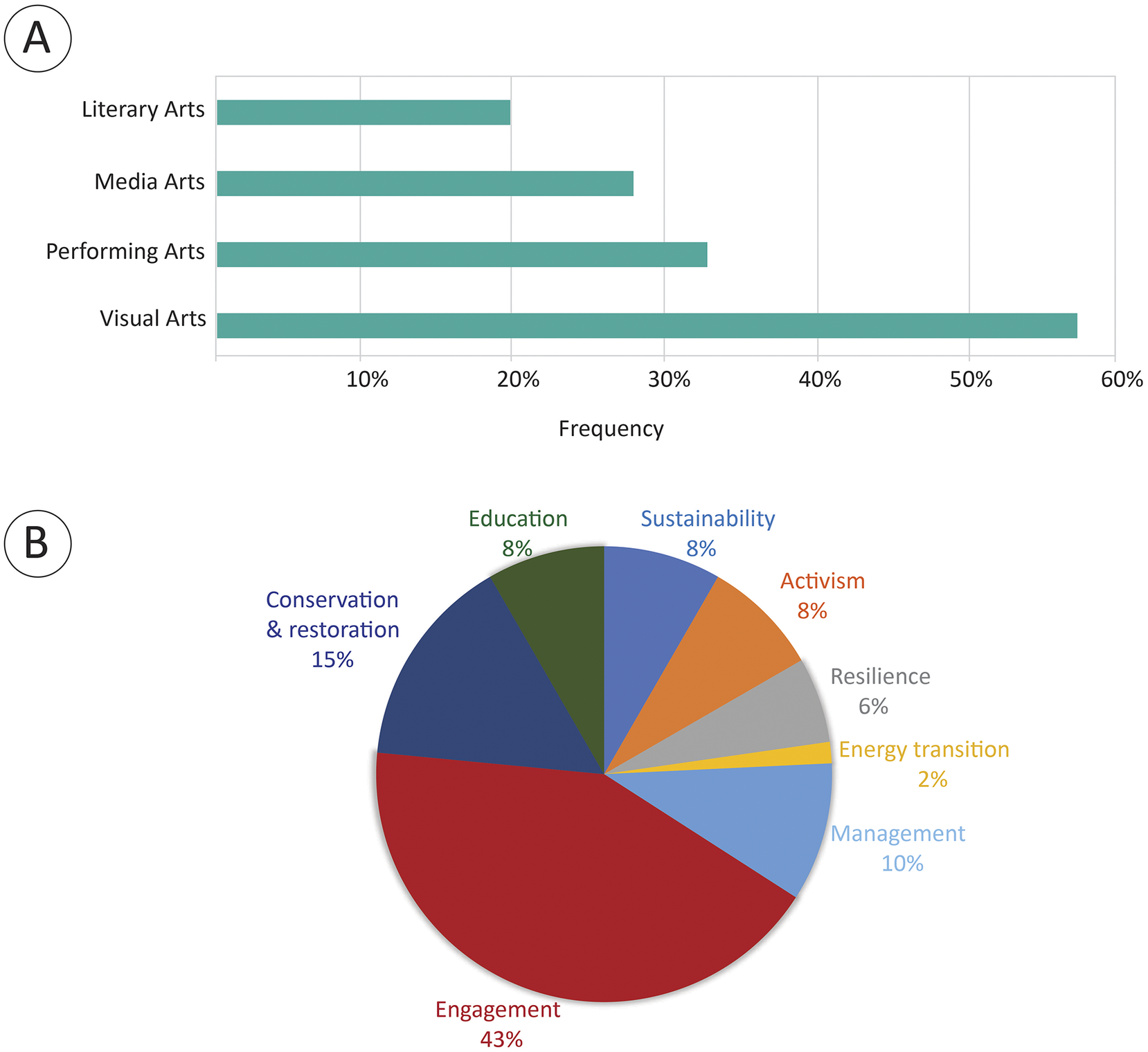
A wide range of artworks is contained in the dataset, exemplified in Figure 3, covering the visual arts (Figure 3A,E), the performing arts (Figure 3B,F), the media arts (Figure 3C) and the literary arts (Figure 3D). Within each category, some articles describe or analyse specific art forms such as sculpture (e.g., Rathwell, Reference Rathwell2020), poetry (e.g., Egya, Reference Egya2021), music (e.g., Larsen and Gilbert, Reference Larsen and Gilbert2013) and cinema (e.g., Mattson and Gordon, Reference Mattson and Gordon2022). The prevalent art category is visual arts (including painting, sketching, collage, carving, photography, photovoice, comics and architecture), with 57% (n = 45) of the article mentions (Figure 4A). There are 26 performing arts (33%) mentioned on the dataset that comprises theatre (including comedy), dance, performance, sonification and music. Media arts, with 22 projects/art forms (28%, Figure 4A), is dominated by installations, but there are also mentions of cinema, videos and digital art. In the literary arts, there are 16 mentions (20%) of literature (including science fiction and climate fiction), poetry and script writing. Most articles report a single art category (57/79 = 72%), though many use several art forms within the same category (e.g., sculpture and photography [Williams, Reference Williams2018], or dance and theatre [Rhodes, Reference Rhodes2021]). Few papers report several art categories, for example, literature and cinema (Schuster, Reference Schuster2019) or sculpture, literature, painting and installation (Hayward, Reference Hayward2021).
Examples of artworks in the dataset. (A) One of ‘hybrid’ series sculptures by Jason deCaires Taylor in Museo Atlántico, Lanzarote, Spain (image from Meyers, Reference Meyers2020). (B) Performance by Susanna Rechia on ‘Beach-dancing Day’, 2014, in Wales, UK (image from Olsen, Reference Olsen2018). (C) A 360° film ‘A Calling, Deeply’, by Kristina Pulejkova, 2019 (image from Frangovska, Reference Frangovska2020). (D) Poem ‘Up/down/fragile’ by Lorenzo Carnevali, translated to English by Larry Mayer, 2018 (from Nesci and Valentini, Reference Nesci and Valentini2020). (E) Mural ‘The guardians of water’ by students from Esmeraldas, Ecuador, 2017 (image from Sanchez et al., Reference Sanchez, Vinueza, Izurieta and Rey2020). (F) The ‘Microbial Bebop’ by Peter Larsen and Jack Gilbert, 2013 (image from Larsen and Gilbert, Reference Larsen and Gilbert2013).

(A) Frequency of the four artistic categories described in the articles, grouped according to the classification of art forms defined in Matias et al. (Reference Matias, Carrasco, Pinto and Reis2023; adapted from McCarthy et al., Reference McCarthy, Brooks, Lowell and Zakaras2001). Note that because there are articles that describe more than one artistic category, the sum of frequencies in more than 100%. (B) Frequency of pursuit impacts by artistic practices reported in the dataset.
We found different artists who addressed or were inspired by the same sustainability-related theme. For example, plastics in the ocean led artists to produce their work, such as photography (Strandvad et al., Reference Strandvad, Davis and Dunn2021), and even provided material in the work of sculptures (Merlino et al., Reference Merlino, Locritani, Farina, Sorbini, Battaglini, Dellacasa, Scaglia, Marchi and Bonaccorsi2022). For this specific topic, there were also other approaches, such as the work ‘Bottled Ocean 2,117’ of the Maori sculptor George Nuku, for whom, although made by people, plastic is sacred since for the Maori all things created and of Earth are sacred (Boswell, Reference Boswell2021). Raising awareness of ocean conservation was the motto behind the theatre play ‘The Orphan Sea’ written by Caridad Svich, and directed by Kevin Brown, which premiered at the University of Missouri in 2014 (Brown, Reference Brown2016) and the poem ‘Up/down/fragile’ by Lorenzo Carnevali in 2018 (analysed by Nesci and Valentini, Reference Nesci and Valentini2020). Both artworks elicit feelings of fragility and vulnerability of a sea that needs to be protected.
Looking at artistic practices, the dataset shows a high variety of techniques. For example, in music, there are traditional musical practices of women celebrating newly initiated master mariners in the Federated States of Micronesia (Diettrich, Reference Diettrich2018) to innovative methods by which microbial environmental data are transformed into music (Larsen and Gilbert, Reference Larsen and Gilbert2013). Or, from more amateur traditional plastic art techniques, such as a mural made by students from Ecuador (Sanchez et al., Reference Sanchez, Vinueza, Izurieta and Rey2020) to professional digital technologies to produce a complex multimedia installation that includes a video in 360° virtual reality (Frangovska, Reference Frangovska2020). Also, the dataset shows artworks exploring varying physical scales for the same target, from small paintings and postcards (Kato, Reference Kato2016) to installations that cover part of a public garden (Aragón et al., Reference Aragón, Buxton and Hamin Infield2019), with probably the most extreme settings as underwater sculptures that are also artificial reefs (Meyers, Reference Meyers2020).
The dataset includes artworks that target diverse audiences: there are performances such as the ‘Beach-dancing Day’ in Wales, performed by Susanna Recchia (Olsen, Reference Olsen2018), that target smaller audiences, present at the time and place where they take place; while others, such as animated stories in an online map-based platform (Brennan, Reference Brennan2018), still currently accessible, reach larger audiences. Among the art viewers or participants of art projects, there are children (e.g., Matias et al., Reference Matias, Carrasco, Ramos and Borges2020), teenagers (e.g., Sanchez et al., Reference Sanchez, Vinueza, Izurieta and Rey2020), young adults in education (e.g., Jacobson et al., Reference Jacobson, Seavey and Mueller2016) or not (e.g., Trott et al., Reference Trott, Rockett, Gray, Lam, Even and Frame2020), local communities (e.g., van der Vaart et al., Reference van der Vaart, van Hoven and Huigen2018) and residents (e.g., Liburd and Derkzen, Reference Liburd and Derkzen2009), community representatives (e.g., Strand et al., Reference Strand, Rivers and Snow2022), scientists (e.g., Paterson et al., Reference Paterson, Le Tissier, Whyte, Robinson, Thielking, Ingram and McCord2020) and occasional pedestrians passing public art (e.g., Aragón et al., Reference Aragón, Buxton and Hamin Infield2019).
Overall, engagement is the most frequent outcome action (43%, n = 56) reported by authors of the analysed papers (Figure 4B). Coastal/marine conservation and restoration are also relevant impacts (15%, n = 20) that authors/artists intend to achieve. Similar frequency was obtained for the outcome actions of management (10%, n = 13), education (8%, n = 11), sustainability (8%, n = 11) and activism (8%, n = 11). Resilience and energy transition were only mentioned occasionally, in 6% (n = 8) and 2% (n = 2) of articles, respectively. If we group these impacts into broad categories, more related to people on the one hand and more related to resources and the environment on the other, we can see that what is being pursued is mainly related to human attitude, behaviour and knowledge. The vast majority of artistic practices contribute to sustainability indirectly, via the actions described above; however, two mentions of artistic works intend to have a more direct contribution (Beans, Reference Beans2018; Meyers, Reference Meyers2020; Sutton et al., Reference Sutton, Paton, Buergelt, Sagala and Meilianda2021). These are the cases of environmental art installed underwater that are also artificial reefs, by the artist James Taylor (Figure 3A) in Museo Atlántico (offshore Lanzarote, Canary Islands, Spain) and by Collen Flanigan in Cozumel (offshore Mexico). Interestingly, there is an article where the art itself contributes specifically to disaster risk reduction at the coast. This is the case for the people of Simeulue (Indonesia), whereby lullabies and nandong (traditional songs of Simeulue) incorporate risk information about tsunami and their avoidance. Sutton et al. (Reference Sutton, Paton, Buergelt, Sagala and Meilianda2021) identified music as an important part of Simeulue’s disaster risk reduction success after the Indian Ocean tsunami in December 2004.
Finally, we found that most retrieved studies in the dataset (69%, n = 54) are predominantly descriptive, that is, there is no qualitative or quantitative measurement of the impact that such activities produce on audiences/participants. Thirty-two studies are self-assessments, that is, the authors of the artistic practices describe and analyse their own work, which can imply some bias in the study assessment.
Does art play a role in coastal and marine sustainability? The evidence so far
While studies measuring the impact of artistic practices account for only 31% (n = 19) of the dataset, we still considered it useful to examine what they claim. This sub-dataset described mostly qualitative analyses (obtained by interviews, focus groups, analysis of documents, analysis of visual objects and participant observation), although eight studies use questionnaires. In three studies, we found mixed methods were used, that is, they include both quantitative and qualitative methods. In this short list of articles, the impact of artistic activities was studied on children, teenagers, young adults, adult participants in activities, artists, scientists, event organisers, stakeholders and visitors or viewers. Most articles fit the visual art category (used in 14 articles, 74%). The majority of the impacts were assessed for participants (14 articles), and only five articles assessed effects on visitors/viewers, not initially involved in the art project development.
We found that the covered artistic practices showed evidence of contributions to sustainability by A) raising awareness of the environmental and climate change (n = 7); B) increasing knowledge about coastal or marine ecosystems or climate change (n = 7); C) promoting engagement with issues and enjoyment of projects (n = 5); D) encouraging active participation (n = 2); E) creating new ways of collaborating (n = 2); F) empowering individuals (n = 2); G) communicating views on environmental issues (n = 1); H) addressing issues of coastal and marine management and planning (n = 1) (Figure 5). The way the impact of artworks is expressed in the articles may be multiple, as described by Sanchez et al. (Reference Sanchez, Vinueza, Izurieta and Rey2020, p. 1):
The results obtained in this study show that the use of mural art [about aquatic ecosystems and use of water] is an effective tool for environmental education programs. Murals represent a place for interaction; therefore, they become effective spaces for expressing and communicating messages.
Systematisation of actions and associated impact categories, based on the sub-dataset (containing 19 articles) with impact analysis.

If we consider the impacts in terms of attitude, behaviour and knowledge impact categories (Figure 5), the intended impact by the artworks is relatively well distributed (eight for change in attitude, six for change in behaviour and five for change in knowledge). An example of change in attitude was measured by Dutton et al. (Reference Dutton, Boyd, Luckie, Knox and Derrett1995) in viewers that saw the exhibition ‘Images from the Edge!’, in Australia, and become aware of coastal problems. Another example comes from the photo-environment course that was conducted to promote changes in behaviour by supporting youth’s critical awareness of environmental problems, their capacity to communicate with adults – including decision makers – and by encouraging their active participation in transforming their community (Trott et al., Reference Trott, Rockett, Gray, Lam, Even and Frame2020). A measurable increase in knowledge is given, for example, by a study where children saw a comedy show and become more knowledgeable about mangroves (Lertlum, Reference Lertlum2020). Changes in behaviour (considered the hardest impact category to attain) are reported only in cases where the audience members are also participants, not in studies where the audience is more passive (viewer or visitor). Brennan (Reference Brennan2018, p. 123) argues that:
This form of creative socio-cultural engagement [art-science collaboration to create an interactive map] functions as a bridge, or meeting point, between different (and sometimes polarised) communities of interest. It helps make visible different forms of knowledge that are often invisible within the policy environment, and has the potential to aid dialogue around marine environments and related spatial planning.
We also found evidence that visitors/viewers are influenced by artworks through learning, becoming more aware of a coastal/marine issue, or getting engaged on a particular subject. Aragón et al. (Reference Aragón, Buxton and Hamin Infield2019) proof-of-concept for the role of public art showed that it contributes to viewers’ engagement by bringing attention to and visualising local effects of climate change using the landscape as a publicly accessible setting.
Final remarks
This systematic review has shown that art plays a role in coastal and marine sustainability. This role is given, for the most part, by an indirect contribution and less by a direct contribution. Only the environmental artworks in the form of underwater sculptures (e.g., Meyers, Reference Meyers2020) aimed to address sustainability in a direct way. Indirect contributions consist of a variety of forms that can be narrowed to communication and engagement: communication to educate (e.g., Lertlum, Reference Lertlum2020) and to inform (e.g., Valentini et al., Reference Valentini, Nesci, Carnevali, Baiocchini, Brizigotti, Teodori, Argalia, Çiner, Grab, Jaillard, Doronzo, Michard, Rabineau and Chaminé2019) about several topics related to coastal and marine sustainability, and engagement to promote attitude (e.g., Trott et al., Reference Trott, Rockett, Gray, Lam, Even and Frame2020) and/or behaviour change (e.g., Baldwin and Chandler, Reference Baldwin and Chandler2010). Communication about sustainability, seen as a dialogue, not an authoritarian discourse, and citizens’ engagement with sustainability are crucial to achieving the pressing societal transformations towards a sustainable future. This review showed how diverse and creative multidisciplinary projects are all over the world, with evidence that art forms’ contribution is mostly on a local/community scale.
Having proven that art does play a role in driving change, the question is, How great is the role of art in sustainability?
We know that there are citizens for whom engagement through art is very efficient (e.g., Eernstman and Wals, Reference Eernstman and Wals2013) – first and foremost, the artists themselves (in their work, in their relation to other artists and in their relation to other art forms), but also people in organisations and structures involved in the arts (gallery curators, cinema producers, theatre technicians, museum guides, among many others), besides the artists’ followers. Moreover, we have evidence that students, local communities, managers, etc., that participate in artistic projects about sustainability enjoy and become engaged with these issues. Nevertheless, this evidence does not answer the question of the magnitude of the artistic role. It is necessary to identify how many people are influenced by these art projects and how they are affected. For example, in artistic activities that take place with students in specific classes, in specific schools, the short- and medium-term effects can be measured through various standard social science methods. However, for the case of, for example, cinema or music, which may have larger and anonymous audiences, and which may be seen and heard over and over again and for many years, measuring art contribution is very complex. Nevertheless, we think more scientific work is needed to measure the effects, identify best practices, and assess the various roles that art can play in future coastal and marine sustainability.
Open peer review
To view the open peer review materials for this article, please visit http://doi.org/10.1017/cft.2023.13.
Data availability statement
The datasets generated during and/or analysed during the current study are available from the corresponding author upon reasonable request. Articles dataset and string of search are available in Matias et al. (Reference Matias, Carrasco, Pinto and Reis2023), freely available online.
Acknowledgements
A.M. is grateful to her dear friend and colleague Giovanni Coco for the revision of the manuscript. The authors thank Dr. Gwenda van der Vaart and an anonymous reviewer for their useful suggestions to improve this work.
Author contribution
A.M., A.R.C. and B.P. designed the study. A.M., A.R.C., B.P. and J.R. read the articles, produced the dataset and characterised the articles. A.M., A.R.C. and B.P. analysed the results, wrote the main manuscript text and produced the figures.
Financial support
This study had the support of the Fundação para a Ciência e Tecnologia (FCT), through the strategic projects UID/MAR/00350/2020 (CIMA) and UID/MAR/04292/2020 (MARE), and the project LA/P/0069/2020 granted to the Associate Laboratory ARNET. A.R.C. was supported by the contract DL57/2016/CP1361/CT0002, and B.P. was supported by the contract CEECIND/03059/2017, funded by FCT.
Competing interest
The authors declare no potential competing interest with respect to the research, authorship, and/or publication of this article.


 Open access


Comments
Dear editor,
this is to let you know that this submission is a commissioned review article to be considered for publication in Cambridge Prisms: Coastal Futures, to be published at launch in January 2023 with the title “The role of art in coastal and marine sustainability”.
The submission deadline was agreed with the senior scientific editor Jessica Jones for 09-12-2022.
On behalf of all authors, kind regards,
Ana Matias