

Introduction
Organizational citizenship behavior (OCB) is a construct with a rich history in organizational science literature and is deeply rooted in the field of organizational behavior (Fischer, Hyder & Walker, Reference Fischer, Hyder and Walker2020; Guzman & Espejo, Reference Guzman and Espejo2015; Mostafa, Reference Mostafa2021; Latham & Skarlicki, Reference Latham and Skarlicki1995; Podsakoff, Whiting, Podsakoff & Blume, Reference Podsakoff, Whiting, Podsakoff and Blume2009; Zhang, Liu, Xu, Yang & Bednall, Reference Zhang, Liu, Xu, Yang and Bednall2019). OCB is conceptualized as employee behavior on the job that is discretionary, which is not directly or explicitly recognized by the formal reward system, but overall contributes to the efficient and effective functioning of the organization (Organ, Podsakoff & MacKenzie, Reference Organ, Podsakoff and MacKenzie2006; Testa, Corsini, Gusmerotti & Iraldo, Reference Testa, Corsini, Gusmerotti and Iraldo2018). Employees who voluntarily engage in behaviors beyond their expected job duties have a positive impact on both themselves and the organization (Organ et al., Reference Organ, Podsakoff and MacKenzie2006; Whiting, Podsakoff & Pierce, Reference Whiting, Podsakoff and Pierce2008). Conversely, other studies find downfalls when employees engage in OCBs. For example, research reports individuals feeling depleted and ultimately realizing as if there is a personal ‘cost’ for engaging in OCBs (Bergeron, Reference Bergeron2007; Bolino, Klotz, Turnley & Harvey, Reference Bolino, Klotz, Turnley and Harvey2013). Furthermore, when individuals expend resources (e.g., energy or effort) to engage in OCBs and believe these expended resources are not replenished, citizenship fatigue (CF) can adversely impact the individual (Bolino, Hsiung, Harvey & LePine, Reference Bolino, Hsiung, Harvey and LePine2015), including their job performance (De Clercq, Suhail, Azeem & Haq, Reference De Clercq, Suhail, Azeem and Haq2021). Despite its relevance, OCB literature shows a limited understanding of how employees manage or cope with the challenges of OCBs and their implications.
Bolino et al. (Reference Bolino, Hsiung, Harvey and LePine2015) identified CF as a new construct relative to other OCB and stress literature. CF (Bolino et al., Reference Bolino, Hsiung, Harvey and LePine2015: 57) is a state of ‘feeling wore out, tired, or on edge’, which is attributed to engaging in OCB. While a search for papers on OCB will show a plethora of studies, there is a dearth of studies related to CF (i.e., the dark side). Scholars express a pressing need for deeper examination into related constructs that impact CF (Aydemir, Reference Aydemir2023; Bolino et al., Reference Bolino, Hsiung, Harvey and LePine2015). CF is deemed a kind of stress from being emotionally and cognitively burdened by the demands of OCBs. We use a theory pertinent to stress research, the conservation of resources (COR) theory, to develop our theoretical assertions and hypotheses.
Specifically, this study posits that P–O (person–organization) fit is a key construct of interest to scholars and practitioners alike. Organizations regularly make statements about diversity to highlight their societal relevance (Ratten, Reference Ratten2025), and organizations continue to commit significant resources to cultivate OCBs and belongingness in an increasingly complex and volatile global environment. P–O fit (and misfit) is conceptualized as a situation where employees and organizations share congruent foundational values and goals (Boon & Biron, Reference Boon and Biron2016; Hamstra, Van Vianen & Koen, Reference Hamstra, Van Vianen and Koen2019; Han, Chiang, McConville & Chiang, Reference Han, Chiang, McConville and Chiang2015; Kristof-Brown, Zimmerman & Johnson, Reference Kristof-Brown, Zimmerman and Johnson2005). Greater levels of P–O fit in the form of the compatibility of goals, priorities, and values between an organization and individual can lead to many positive outcomes, e.g., greater efforts, better adjustment, job satisfaction, productivity, and interpersonal and organizational OCBs (Farzaneh, Dehghanpour Farashah & Kazemi, Reference Farzaneh, Dehghanpour Farashah and Kazemi2014; Hoffman & Woehr, Reference Hoffman and Woehr2006; Podsakoff et al., Reference Podsakoff, Whiting, Podsakoff and Blume2009; Wei, Reference Wei2013). According to several meta-analyses and empirical studies, P–O fit exerts influence on favorable work attitudes, employee trust (Edwards & Cable, Reference Edwards and Cable2009; Verquer et al., Reference Verquer, Beehr and Wagner2003), and organizational commitment (Hoffman & Woehr, Reference Hoffman and Woehr2006; Verquer et al., Reference Verquer, Beehr and Wagner2003). While P–O fit is a widely recognized concept that manifests in various contexts across the realms of business and organizational research, little to no research has methodically filled in the extant scholarly gaps by investigating the adverse side effects of P–O fit and CF in view of key employee outcomes. The purpose of this article is to highlight these understudied phenomena and the complex relationship between P–O fit and OCBs. Importantly, we shed light on these under-explored aspects because they may inform supervisors and leaders about adopting a broad conceptualization of P–O fit based on similarity and complementarity in successfully promoting organizational trust, healthy and ethical management of their workforce.
The underlying motivation of this study is that individuals experiencing CF report feeling frustrated, misunderstood, or unappreciated (Bolino et al., Reference Bolino, Hsiung, Harvey and LePine2015), and this may impact their key workplace attitudes and affective responses. The CF construct is relatively new, and its empirical evidence is in the process of emerging. This provides valuable opportunities for exploratory studies, which are pivotal in examining literature gaps. This study tested four key relationships to observe the explanatory power of COR. Our research addresses existing gaps and extends COR by examining what antecedents impact CF and how employees handle these stressors. Through the conceptual model, we identify the importance of perceived experience of stress and exhaustion as both a direct and an indirect force shaping individual and organizational outcomes. First, we examine whether P–O fit (compatibility of values and goals between employee and organization) impacts CF. Next, we study the impact of CF on key attitudinal aspects of employee outcomes, such as turnover intention and affective commitment. Based on the assumptions of P–O fit, we logically surmise that CF is a type of stress that may be a by-product of both extra-role effort (i.e., in case of high P–O fit) and emotional exhaustion (e.g., due to value and goal conflict given a low P–O fit).
Statistically examining a sample of 206 respondents through a time-lagged two-phase survey, we posited that individual perception of their resource availability shapes the relationship between P–O fit. Given that a stressed employee is inclined to adopt a defensive posture, we posit that even highly compatible and engaged employees go through a cognitive process of leaving their employment and adjusting their affective organizational commitment due to CF. Importantly, we propose some assertions around resource, stress, and fatigue to demonstrate two indirect links to explain turnover intention and affective commitment. These results emphasize why managers and leaders need to acknowledge the impact of CF, an adverse side-effect of OCBs, on employee attitudes and their organization-level consequences.
Our study contributes to addressing two extant gaps in the literature. First, the overwhelmingly positive framing in existing organizational research underestimates the negative impacts of P–O fit and OCBs. We demonstrate that even a strong P–O fit or experience of weak fit may carry unintended negative consequences for individuals and their organizations. Second, CF remains an important and understudied construct in the age of generational differences marked by distinct work values. Given the rise of the gig economy, ideological polarization in the workforce, fuzzy boundaries between work and life due to digitalization, increasing the inability of people to detach from their work (Ratten, Reference Ratten2024). Third, we respond to calls from the seminal organizational scholars (Bolino et al., Reference Bolino, Hsiung, Harvey and LePine2015; Hobfoll, Reference Hobfoll1989) to deepen our knowledge about employees’ relationships with resource constraints, stress, and exhaustion. By underscoring how P–O fit may deplete employee experience through heightened citizenship expectations, we aim to add nuance to the overall understanding of an employee’s well-being.
The rest of this paper is organized as follows. First, we present a brief discussion of the existing literature. Second, we present the emerging studies exploring our key constructs and relevant theories. Next, we theorize on the relationships predicted through our hypotheses drawing on the COR theory. Third, we present our methodology section explaining the variables, measures, and analytic approach. Finally, the paper concludes with a discussion of the results and implications of our findings, followed by avenues for future research.
Literature review
Organizational citizenship, fit, and fatigue: the undercurrent
The construct OCB, as an ideal-worker norm, is an individual-level phenomenon comprised of discretionary behavior that is not directly related to a formal reward system, but is generally believed to promote an efficient and effective organization (Organ, Reference Organ1988; Reizer, Oren & Hornik, Reference Reizer, Oren and Hornik2022; Whiting et al., Reference Whiting, Podsakoff and Pierce2008). Engaging in OCBs can help an individual be thought of as a good corporate citizen by others as they take on additional roles beyond assigned duties. The impact of OCBs on an organization’s efficiency, productivity, and customer satisfaction has been well documented in a meta-analysis (Podsakoff et al., Reference Podsakoff, Whiting, Podsakoff and Blume2009). Investigating the repercussions of OCBs, the authors further concluded that there exists an inverse relationship between OCBs and turnover intention. Additionally, a nonsignificant relationship between OCB and role overload was found in a meta-analysis (Eatough, Chang, Miloslavic & Johnson, Reference Eatough, Chang, Miloslavic and Johnson2011). However, a more recent study found that role overload acts as a mediator in the relationship between job stress and OCB (Loukopoulos, Papadimitriou & Glaveli, Reference Loukopoulos, Papadimitriou and Glaveli2025).
Interestingly, recent studies indicate that there is a dark side to engaging in OCBs that can take a toll on employees’ psychological and/or physical health through role-overload, overwork, stress, and longer hours. For instance, employees may encounter work–family conflict (Bolino & Turnley, Reference Bolino and Turnley2005). Relatedly, a study by Babic, Stinglhamber, Barbier and Hansez (Reference Babic, Stinglhamber, Barbier and Hansez2022) found that heavy work investment was a mediator in the relationship between work environment and work–family conflict. OCBs could be likened to a form of work investment, even if they are voluntary. It stands to reason that there is a dark side for employees engaging in OCBs. Other streams of research have reported employees feeling depleted and thus experiencing a cost associated with engaging in OCBs (Bergeron, Reference Bergeron2007; Bolino et al., Reference Bolino, Klotz, Turnley and Harvey2013). Subsequently, CF, defined as ‘a state in which feeling worn out, tired, or on edge’ is attributed to engaging in OCB (Bolino et al., Reference Bolino, Hsiung, Harvey and LePine2015:57). CF stands apart as a distinct and explicit construct when juxtaposed with felt stress, role overload, and burnout, which are typically linked to the specific job tasks and responsibilities (Bolino et al., Reference Bolino, Hsiung, Harvey and LePine2015). Therefore, upon review of the literature, one can conclude that CF is a unique construct that requires further scholarly attention. Studying CF can help us to have a nuanced understanding of how employees who engage in OCBs can experience stress and other negative outcomes.
COR theory
A review of existing stress literature, and the more specific CF literature (Bolino et al., Reference Bolino, Hsiung, Harvey and LePine2015), reveals that Hobfoll’s COR theory (Reference Hobfoll1989, Reference Hobfoll2001) is frequently applied to explain why individuals behave the way they do in stressful situations (Brennan, Garavan, Egan, O’Brien & Ullah, Reference Brennan, Garavan, Egan, O’Brien and Ullah2023; De Clercq & Belausteguigoitia, Reference De Clercq and Belausteguigoitia2024; Lin, Scott & Matta, Reference Lin, Scott and Matta2019; Parker, Jimmieson & Techakesari, Reference Parker, Jimmieson and Techakesari2017; Rofcanin et al., Reference Rofcanin, Wang, Heras, Taser, Bosch, Fındıklı and Vallina2023; Sungu, Weng, Hu, Kitule & Fang, Reference Sungu, Weng, Hu, Kitule and Fang2020; Yu, Lau & Lau, Reference Yu, Lau and Lau2023). At its core, this theory revolves around individuals’ efforts to acquire, safeguard, and generate resources, facilitating effective stress coping mechanisms. In the context of COR, resources are ‘objects, personal characteristics, conditions, or energies that are valued in their own right, or that are valued because they act as conduits to the achievement or protection of valued resources’ (Hobfoll, Reference Hobfoll2001: 339). According to COR assumptions, although resources help people deal with stress, stress is inversely proportional to the availability of resources. Moreover, when employees invest resources without reciprocated resource gains, the likelihood of stress increases, leaving individuals with diminished resources for forthcoming demands. In the face of reduced resources, individuals tend to conserve what remains and adopt a defensive posture.
In short, COR theory propounds that the availability of resources and stress response are interdependent. In the absence of resources, the likelihood of experiencing stress is heightened. Relative to the main constructs studied in this paper, prior literature in OCB (De Clercq & Belausteguigoitia, Reference De Clercq and Belausteguigoitia2024) has hinted that CF can be explained by a net loss of resources. Whereas P–O fit refers to a level of similarity and complementarity between an individual’s characteristics and their organization’s norms, values, and culture, as the world and work culture evolve, it is imperative to broadly define the P and the O to create a culturally appropriate and inclusive work environment even for highly embedded employees who are ‘misfits’ (Kristof‐Brown, Schneider & Su, Reference Kristof‐Brown, Schneider and Su2023). Organizational embeddedness matters as it mediates the relationship between P–O fit and OCB (Afsar & Badir, Reference Afsar and Badir2016), which likely makes misfits more prone to stress and fatigue. Furthermore, the process of organizational choice and selection within the P–O framework can represent uncertainty and tension. As a result, we believe COR helps to integrate these fragmented strands of literature by highlighting the resource-based stress responses at the intersection of OCBs and P–O fit.
Theoretical framework and hypothesis development
P–O fit and CF
CF is a negative by-product of OCBs in individuals pursuing prolonged careers and/or loosely fitting with certain organizational values and cultures. Notably, the occurrence of CF among employees is contingent on their initial involvement in OCBs. Upon carefully reviewing the conceptualization of CF, one may highlight its similarities to constructs such as felt stress, role overload, and burnout. While there certainly are similarities, CF ‘is also different from these constructs in meaningful ways’ (Bolino et al., Reference Bolino, Hsiung, Harvey and LePine2015: 57). Bolino et al. (Reference Bolino, Hsiung, Harvey and LePine2015) suggested that this is because for constructs such as felt stress, role overload, or burnout, ‘there is nothing inherent in these outcomes that is related to citizenship behavior’ (p. 58). For example, felt stress is ‘a sense of time pressure, anxiety, and worry that is associated with job tasks’ (Hunter & Thatcher, Reference Hunter and Thatcher2007: 954; Ng, Zhang & Chen, Reference Ng, Zhang and Chen2021). While role overload focuses on employees feeling as if they do not have the time or abilities to complete their responsibilities at work (Bolino et al., Reference Bolino, Hsiung, Harvey and LePine2015; Bolino & Turnley, Reference Bolino and Turnley2005; Schaubroeck, Cotton & Jennings, Reference Schaubroeck, Cotton and Jennings1989). Thus, felt stress and role overload represent a sense of diminishing resources related to one’s ability to complete tasks at work. Therefore, our first assertion is that these resource constraints or stress types are not concerned exclusively with OCB (Bolino et al., Reference Bolino, Hsiung, Harvey and LePine2015).
In accordance with COR theory (Hobfoll, Reference Hobfoll1989), if an individual’s resources are depleted and not replenished by their organization, it can result in elevated and prolonged stress at the employee level. Therefore, we posit that P–O fit is a complex phenomenon that can accelerate individual-level resource depletion through OCBs but decelerate fatigue through psychological replenishment. The following two distinct mechanisms elucidate how a net loss and replenishment of resources occur due to both high and low P–O fit, which will likely variously affect employee-level CF. First, empirical findings (Iqbal & Piwowar-Sulej, Reference Iqbal and Piwowar-Sulej2023; Ruiz-Palomino & Martínez-Cañas, Reference Ruiz-Palomino and Martínez-Cañas2014; Zoghbi-Manrique-de-Lara, Ruiz-Palomino & Linuesa-Langreo, Reference Zoghbi-Manrique-de-Lara, Ruiz-Palomino and Linuesa-Langreo2023) suggest that employees with high P–O fit are more likely to feel motivated and obligated to perform OCBs, which exposes them to a level of CF. However, due to congruence of values, a high P–O fit could be regarded as a personal resource for employees (Kiazad, Seibert & Kraimer, Reference Kiazad, Seibert and Kraimer2014; Mackey, Perrewé & McAllister, Reference Mackey, Perrewé and McAllister2017). Specifically, P–O fit serves as a psychological resource. In cases of high P–O fit, employees are intrinsically motivated to display certain ideal worker norms consistent with organizational values and goals that lead to continued and extra-role service efforts on the job, which generally lead to logistical, emotional, and cognitive depletion. However, we argue that high P–O fit helps to facilitate renewals through highly compatible citizenship tasks and roles (due to greater fit), resulting in net resource conservation on the individual level. For example, employees with higher levels of P–O fit can better predict and understand the behaviors manifested inside an organization, as values are shared between the employee and organization (Erdogan & Bauer, Reference Erdogan and Bauer2005). A greater degree of P–O fit is also believed to provide stress-resistance potential (Edwards, Reference Edwards2008). As a result, in general, P–O fit is an asset toward achieving superior organizational outcomes through the pathway of organizational homogeneity. Based on these resource arguments, we assert that employees with a high fit will experience lower stress and fatigue.
Second, and in contrast, misfit has also been a key element of P–O fit theorizing (Subramanian, Billsberry & Barrett, Reference Subramanian, Billsberry and Barrett2023). Early work considered recruiting employees low in fit (i.e., misfits) to be unfavorable to organizations due to turnover costs (Chatman, Reference Chatman1989). Subsequent studies suggest that increased diversity, creativity, and innovation on the organization level hinge on employing misfits (Kristof‐Brown et al., Reference Kristof‐Brown, Schneider and Su2023). On the individual level, however, a low level of P–O fit results in emotional dissatisfaction and disengagement. Drawing on COR, we argue that an individual in a low P–O fit or misfit, in an organizational setting that espouses diversity and plurality in recruiting and hiring, may experience CF given their efforts to fit in and work value incongruence with their organization. Due to differences of opinions, task preferences, citizenship roles, and values, despite their valuable contributions and efforts, the organization or the unit may experience heightened tension. While the creative friction is beneficial for the organization overall, the misfits will likely experience negative emotions due to discouragement, disagreements, debates, and challenges. This process, when long-standing, can lead to the misfits developing fatigue, which COR theory explains because the replenishment of resources is not forthcoming as some scholars observed that high levels of P–O fit result in privilege and favoritism in favor of in-group members and perpetuate bias and unfairness toward organizational outcasts (Amis, Mair & Munir, Reference Amis, Mair and Munir2020). We specifically argue that a perceived lack of support and fit will likely lead to citizen fatigue through individual disappointment, tension, and stress. Relatedly, Siegall and McDonald (Reference Siegall and McDonald2004) found a relationship between low P–O fit and high individual-level burnout, which is another advanced form of stress leading to depletion of resources. These findings are consistent with Bolino et al. (Reference Bolino, Hsiung, Harvey and LePine2015), for instance, that a higher prevalence of CF is observed when there is a lower perception of organizational support, reflecting the extent to which an employee feels supported by the organization.
In summary, we argue that P–O fit will be negatively related to CF, given many variables beyond one’s individual and protracted control. A perceived high P–O fit leads employees to engage in OCBs. These extra-role efforts are likely to result in employees taking a defensive posture in low P–O fit situations. However, we argue that in the cases of OCBs shaped by high P–O fit, employees will likely experience lower CF due to their greater alignment between individual and organizational values. This alignment helps to manage stress and constraints on the job. According to Liu and Yu (Reference Liu and Yu2019), job stressors and emotional exhaustion play a role in increasing CF. Therefore, we argue that in the cases of low value-conflict situations (i.e., high P–O fit context), CF is reduced due to the employee’s perceived compatibility with and control over their discretionary activities on the job (which adds strain on their resource availability). Based on the above, CF can be classified as a type of stress that is compounded by employees’ perception related to their P–O fit. Therefore, we posit:
Hypothesis 1: The levels of P–O fit are negatively associated with the levels of CF.
CF and turnover intention
Turnover intention captures the attention of numerous organizational science researchers due to its significance as not only a cognitive process but also as a precursor to eventual voluntary turnover (Griffeth, Hom & Gaertner, Reference Griffeth, Hom and Gaertner2000; Mobley, Horner & Hollingsworth, Reference Mobley, Horner and Hollingsworth1978; Mobley, Griffeth, Hand & Meglino, Reference Mobley, Griffeth, Hand and Meglino1979; Park, Wolfart, King, Sicam & Viswesvaran, Reference Park, Wolfart, King, Sicam and Viswesvaran2025; Shareef & Atan, Reference Shareef and Atan2019; Vance, Jaros, Becker & McKay, Reference Vance, Jaros, Becker and McKay2020). Turnover intention is defined as the ‘final cognitive decision-making process’ of resigning at work (Steel & Ovalle, Reference Steel and Ovalle1984: 673). It is a set of logical, logistical, or emotional measures that encompasses contemplations of quitting, the intention to explore job opportunities with alternative companies, and the resolve to leave the current position (Carmeli & Weisberg, Reference Carmeli and Weisberg2006). Consistent with the premise of an inverse relationship between CF and OCBs (Bolino et al., Reference Bolino, Hsiung, Harvey and LePine2015), prior research shows that various types of stress are antecedents to turnover intention (Grandey & Cropanzano, Reference Grandey and Cropanzano1999; Huffman & Olson, Reference Huffman and Olson2017). We, therefore, argue that CF (i.e., a form of stress) relates to employee turnover intentions.
This stress and intention relationship is explained by the COR assumptions. We argue that as a response to contextual, logistical, cognitive, and emotional adversity, stressed and fatigued individuals will conserve and safeguard their resources. Additionally, a stressed employee is inclined to adopt a restorative posture, i.e., engaging in reactive behaviors to maintain their general sense of equity and well-being. This situation may materialize as the employee seeks redress, aiming for the return or restoration of resources. For instance, if an employee invests additional time in a project, they anticipate a reciprocal return of that resource (time) in the future, such as leaving early on another day. If the employee does not receive the anticipated resource restitution (whether because of OCBs or misfit), they are likely to adopt a defensive stance, conserving the resource for subsequent scenarios requiring substantial time commitments. In this context, the employee might refrain from volunteering for extra time in future projects and might choose to leave work early independently to replenish the depleted time resource. Therefore, when an employee is grappling with CF, resulting in heightened stress and perceived resource constraints, they will be inclined to consider withdrawal to preserve existing resources and seek restoration of depleted resources within their current organizational context. We further argue that the prolonged negative effect of CF will result in an employee searching for opportunities to leave the job and/or the organization to improve their challenging situation, heightened by P–O misfit-induced stress. Thus, we hypothesize:
Hypothesis 2: The levels of CF are positively associated with the levels of turnover intention.
CF and affective commitment
Organizational commitment is another often-studied workplace attitude, and there has been a plethora of studies on the topic. Different domains of organizational commitment across disciplines have received attention in recent years in organizational studies. The most widely cited definition of organizational commitment emphasizes the affective commitment of employees (Bouraoui, Bensemmane, Ohana & Russo, Reference Bouraoui, Bensemmane, Ohana and Russo2019; Mercurio, Reference Mercurio2015). Organizational affective commitment, or simply also referred to as affective commitment in this article, is an employee’s moods, feelings, and attitude focused on aligning with the goals and values of the organization (Meyer & Allen, Reference Meyer and Allen1991). Affective commitment can be conceptualized as a connection or bond between the individual and the organization (Meyer & Herscovitch, Reference Meyer and Herscovitch2001). This bond, we argue as a personal resource, can help reduce employee stress, specifically protecting an individual from burnout and emotional exhaustion (Schmidt, Reference Schmidt2007). Drawing from an extensive review of diverse settings, we argue that employee stress, in general, and CF, in specific, undermine affective commitment. For instance, research showed that emotional exhaustion is inversely related to affective commitment (Cole & Bedeian, Reference Cole and Bedeian2007; Jamal, Reference Jamal1990; Sager, Reference Sager1994; Wright & Hobfoll, Reference Wright and Hobfoll2004). This assertion also finds support in prior work, indicating that affective commitment is inversely correlated with various forms of stress and the outcomes associated with stress (Leiter & Maslach, Reference Leiter and Maslach1988). Consistent with COR, Wright and Hobfoll (Reference Wright and Hobfoll2004) asserted that for organizations to cultivate highly committed employees, they must furnish employees with essential resources. Employees encounter heightened stress when lacking or unable to access the requisite resources that are broadly defined to alleviate a diverse array of negative individualized experiences necessary to cope with stress due to CF. We argue that persistent resource constraints and stress will undermine an employee’s motivation and ability to align themselves with organizational goals and values – creating a persistent negative loop. Therefore, we hypothesize:
Hypothesis 3: The levels of CF are negatively associated with the levels of affective commitment.
Indirect effects of CF
We identify P–O fit as a personal contingency (e.g., asset for some; liability for others in case of misfit) explained by the COR theory (Chen, Sparrow & Cooper, Reference Chen, Sparrow and Cooper2016; Mackey et al., Reference Mackey, Perrewé and McAllister2017). This implies that when an employee has fewer resources available, due to a low degree of P–O fit, higher stress and exhaustion are more likely to occur to fulfill organizational commitment due incompatibility of norms, expectations, and priorities. In contrast, when an employee experiences high P–O fit, their perception of greater alignment with the organizational values allows them to emotionally and cognitively manage their resources more efficiently. This leads to lower fatigue. Therefore, we hypothesized a negative relationship between P–O fit and CF. Moreover, when an employee undergoes CF, they are inclined to adopt a defensive stance, conserve existing resources, and seek restoration of their depleted resources. This suggests that an individual experiencing CF (i.e., presuming a continued lack of P–O fit) will eventually either look to reduce his or her commitment to the organization or increase seeking opportunities elsewhere to alleviate their stress. Therefore, we argue that as CF increases, so does employee interest in other employment alternatives and contemplations on resignation. Furthermore, we argue that due to the continued stress and exhaustion resulting from CF, the affective commitments of the employees will suffer.
We also build on the premise that regardless of a high or low P–O fit, when employees endure resource-related stress, neither the employee nor the organization will have the means or inclination to consistently supply an individual experiencing CF with the necessary reinforcements of resources. This continued dearth of resource and support will prompt citizenship-fatigued employees, despite all intents and purposes even in case of high P–O fit, to strive to preserve their current resources and adopt a defensive posture (e.g., withdrawal, antagonism). The defensive responses will undermine employees’ thoughts, abilities, emotions, and efforts to identify with the organizational goals, values, and cultures. Considering this complex interwoven path, we believe that CF mediates the relationship between P–O fit with turnover intention and affective commitment. We use specific language referring to indirect effects for our mediation hypotheses as suggested by Hayes (Reference Hayes2017). Therefore, we hypothesize that:
Hypothesis 4a: P–O fit has an indirect relationship with turnover intention through CF.
Hypothesis 4b: P–O fit has an indirect relationship with affective commitment through CF.
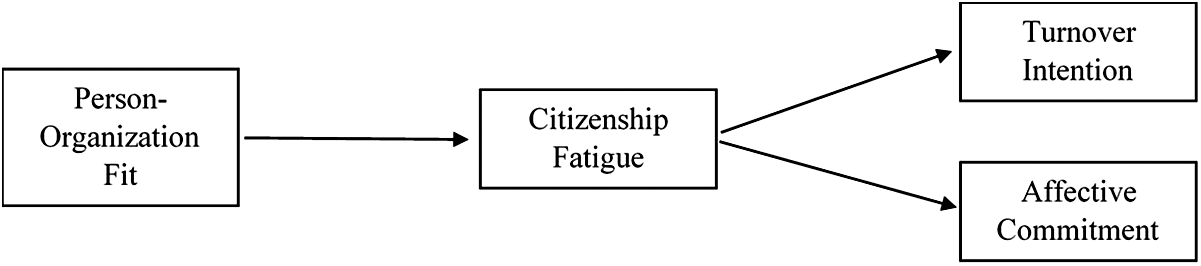
A conceptual framework of the research model is depicted in Fig. 1
Conceptual framework of the study.

Methods
Sample and procedure
The population examined in this study comprises US employees from numerous organizations working 20 hr or more per week. The criterion of employees working 20 hr or more within their organizations has been a precedent employed in previous research concerning organizational behavior constructs (Wepfer, Allen, Brauchli, Jenny & Bauer, Reference Wepfer, Allen, Brauchli, Jenny and Bauer2018). The various individuals in our sample were working in a variety of fields and industries such as manufacturing, hospitality, retail, and logistics. The average age of our sample is 26 years, and the sample was 74% female and 26% male. The sample consisted of 10% in top management, 29% in supervisory positions, 54% employees without a supervisory function, and 6% considered a trainee/intern. These various employees were accessed at a Midwestern state college – they were invited to participate in the study via email. The study was approved by two different IRB (institutional review board) offices at two Midwestern universities, which the authors are affiliated with, and informed consent was obtained from the various participants.
Two-phase web surveys were administered to collect the data for this study. After eliminating incomplete and unusable surveys from both phases, 206 usable surveys remained to be used in our analysis. Adhering to the statistical power of a study enhances its rigor, as power signifies the capability to thoroughly assess the study’s hypotheses effectively (Devlin, Reference Devlin2018). Our sample size met adequate statistical power requirements (Hair et al., Reference Hair, Risher, Sarstedt and Ringle2019; Soper, Reference Soper2018). Participants were sent links to the survey by email, and confidentiality and anonymity of their responses were accorded to them as per IRB requirements. While the drop from 302 to 206 may appear steep, it is normal in studies involving two phases of data collection (Eissa, Reference Eissa2020).
Common method bias poses a methodological issue in many survey-based research designs. It refers to the ‘variance attributed to the measurement method rather than to the constructs that the measures represent’ (Podsakoff, Mackenzie, Lee & Podsakoff, Reference Podsakoff, Mackenzie, Lee and Podsakoff2003: 879). Some scholars have suggested that common method bias is not a problematic issue, because it is exceedingly rare, and even when it does exist, it serves to deflate relationships, not inflate them as is commonly thought (Bozionelos & Simmering, Reference Bozionelos and Simmering2022; Simha, Reference Simha2024). Regardless, we have taken some pre- and post-survey measures to ensure that the common method bias does not exist in our data.
To further address common method bias, we applied suggestions from the other existent literature. Specifically, we relied on a two-phase survey process, creating a time lag between predictor and criterion variables, as variables were measured from a single source (Podsakoff, MacKenzie & Podsakoff, Reference Podsakoff, MacKenzie and Podsakoff2012). We collected data at two points in time. At T1, 302 responses were collected based on initially completed surveys. One week later at T2, 290 responses were collected. P–O fit, CF, and all control variables (listed in the next section) were measured at T1. One week later, both turnover intention and affective organizational commitment were measured at T2. Additionally, applying suggestions provided by Podsakoff et al. (Reference Podsakoff, Mackenzie, Lee and Podsakoff2003) and Podsakoff et al. (Reference Podsakoff, MacKenzie and Podsakoff2012) to further mitigate common method bias, we employed established measurement scales, furnished clear and concise instructions, and emphasized the protection and anonymity of respondents and their data. Finally, we conducted further statistical analyses to allay any remnant doubts about common method bias, especially since our two survey collection times were spaced apart by a week.
Specifically, even though we collected time-lagged data, two key variables (i.e., independent variable and mediator) were from the same source at Time 1. We used multiple methods, including Harman’s single factor test, as well as controlling for the effect of an unmeasured latent method factor to test for the presence of Common Method Variance (CMV) (Podsakoff et al., Reference Podsakoff, Mackenzie, Lee and Podsakoff2003). A one-factor model did not fit well (X2 = 335.06, df = 35, X2/df = 9.573, Root Mean Square Error of Approximation (RMSEA) = .205, Comparitive Fit Index (CFI) = 0.775, Tucker-Lewis Index (TLI) = 0.711). However, the two-factor model has a better fit (X2 = 85.62, df = 33, X2/df = 2.595, RMSEA = .088, CFI = 0.961, TLI = 0.946). The X2 comparison shows that the one-factor model is significantly worse than the two-factor model.
We also controlled for the effects of an unmeasured latent method factor (Podsakoff et al., Reference Podsakoff, Mackenzie, Lee and Podsakoff2003). We constructed one latent variable, CMV, by loading all observed indicators of the two theoretical variables. As such, we developed a three-factor model that includes two theoretical variables and CMV. The results reveal that the three-factor model (X2 = 85.622, df = 32, X2/df = 2.676, RMSEA = .090, CFI = 0.960, TLI = 0.944) does not substantially improve the goodness of fit of the two-factor model because the CFI change is only 0.001, which is much less than the 0.05 rule of thumb (Bagozzi & Yi, Reference Bagozzi and Yi1990). Common method variance is thus not deemed a serious threat for our single-source data. All of these analytical procedures were done with MPlus software version 8.3 (Muthén & Muthén, Reference Muthén and Muthén2017).
To mitigate non-response bias, particularly, we minimized it by implementing three rounds of follow-up reminders to non-responders, as recommended by Rogelberg and Stanton (Reference Rogelberg and Stanton2007). Furthermore, the utilization of established scales in this study facilitated the application of the benchmarking analysis technique to address non-response bias (Rogelberg & Stanton, Reference Rogelberg and Stanton2007). The survey instruments employed in this study did not include any contentious or embarrassing questions regarding the respondent’s attitudes. Lastly, respondents were assured that their responses would be treated with anonymity and confidentiality.
Measures
P–O fit construct was measured via an existing scale from Bright (Reference Bright2008). This survey contained four items and was measured on a 5-point Likert scale (1 = strongly disagree, 5 = strongly agree). A representative question from this measurement scale is, ‘I feel a strong sense of belonging to my organization.’ P–O fit was measured at T1, and Cronbach’s alpha for this scale was α = 0.838.
CF was measured via an existing scale from Bolino et al. (Reference Bolino, Hsiung, Harvey and LePine2015). This survey contained six items measured on a 5-point Likert scale (1 = strongly disagree, 5 = strongly agree). A sample question from this measurement scale is ‘because of going the extra mile for my organization, I feel “on edge” about various things’. CF was measured at T1, and Cronbach’s alpha for this scale was α = 0.939.
Turnover intention was measured with an existing 1-item scale from Moynihan and Pandey (Reference Moynihan and Pandey2008). The solitary question from this measurement scale is, ‘How often do you look for job opportunities outside of this organization?’ Although a 1-item scale may not be optimal for determining reliability figures, it has been firmly established in previous literature that single-item measures for turnover intention are effective in capturing and assessing the construct (Bertelli & Lewis, Reference Bertelli and Lewis2013; Choi, Reference Choi2009; Kim & Wiggins, Reference Kim and Wiggins2011; Moynihan & Pandey, Reference Moynihan and Pandey2008; Wynen & de Beeck, Reference Wynen and de Beeck2014). Turnover intention was measured at T2.
Affective organizational commitment was measured via an existing scale from Mowday, Steers and Porter (Reference Mowday, Steers and Porter1979). This survey contained 15 items measured on a 7-point Likert scale (1 = strongly disagree, 7 = strongly agree). A sample question from this measurement scale is ‘I talk up this organization to my friends as a great organization to work for.’ Affective commitment was measured at T2, and Cronbach’s alpha for this scale was α = 0.951.
To mitigate confounding impacts on the dependent variables, control variables were utilized consistent with prior research (Bolino et al., Reference Bolino, Hsiung, Harvey and LePine2015; Jin, McDonald & Park, Reference Jin, McDonald and Park2018). We used age, gender, tenure with organization, and level within company. For example, Bolino et al. (Reference Bolino, Hsiung, Harvey and LePine2015) found that older workers (age) were less prone to CF, possibly due to their increased job experience (tenure with organization). All control variables were measured at T1.
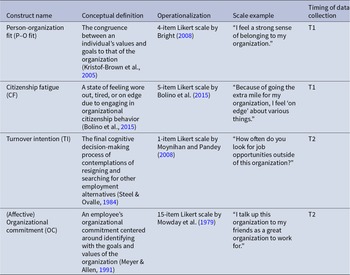
A summary of the key constructs of the research model and their measurements is illustrated in Table 1.
Key constructs and measures

Data analytic procedure
The data collected for this paper were analyzed using the PROCESS macro (Hayes, Reference Hayes2017) on SPSS software version 27. The data were collected and cleaned, utilizing a listwise deletion technique to deal with any missing data. We decided against a data imputation approach and instead preferred to delete any missing cases. PROCESS uses an ordinary least squares analytical framework, which helps to identify indirect effects in mediation models (Hayes, Reference Hayes2017). Bootstrap methods are implemented in the PROCESS macro, as this helps to infer both unmediated and mediated models.
Results
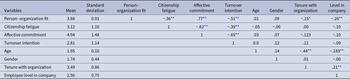
The means, standard deviations, and intercorrelations for all variables included in the article are found in Table 2. When looking at CF, the construct of interest in this study, this construct was negatively associated with P–O fit (r = −.362, p < .01), affective commitment (r = −.617, p < .01), and turnover intention (r = −.389, p < .01). While age, gender, tenure with organization, and level within company had minor and insignificant relationships with CF.
Descriptive statistics, variable correlations, and significance levels
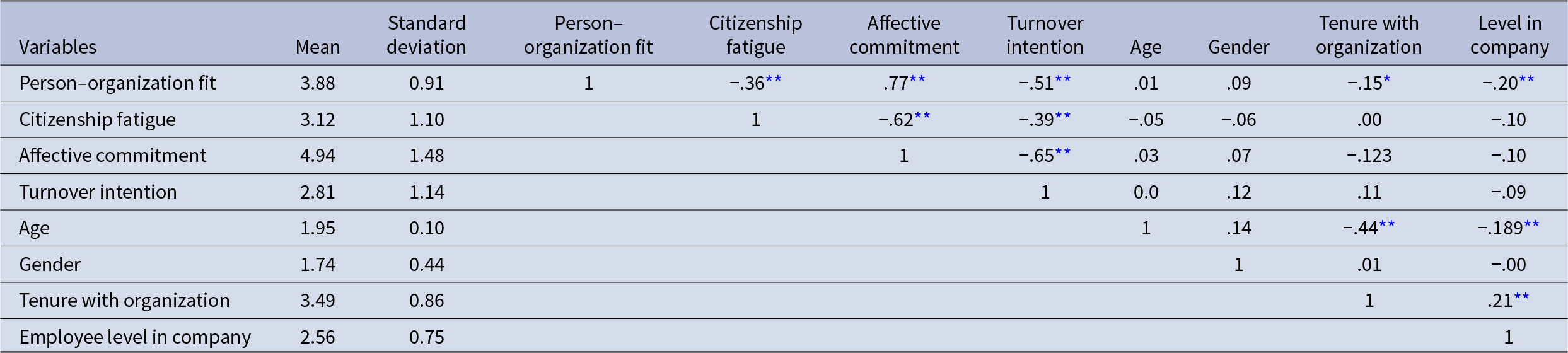
Note. Age (1 = 18–24, 2 = 25–34, 3 = 35–44, 4 = 45–54, 5 = 55–64, 6 = 65+); Gender (1 = male, 2 = female); Tenure (1 = 12+ years, 2 = 8–11 years, 3 = 4–7 years, 4 = 0–3 years); Level in company (1 = top management, 2 = supervisory position, 3 = employee without a supervisory function, 4 = trainee/intern).
** Correlation is significant at the 0.01 level (two-tailed),
* Correlation is significant at the 0.05 level (two-tailed).
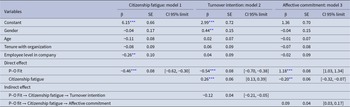
To assess hypotheses H1–H4, which center around investigating the connections among P–O fit, CF, turnover intention, and affective commitment, we conducted a simple mediation analysis using Hayes’ (Reference Hayes2017) PROCESS macro. Bootstrapping was set to 5,000 resamples, as is typical in most studies using Hayes’ macro. Table 3 illustrates the statistical results. Model 1 shows a significant and negative relationship between P–O fit and CF (b = −0.46, p < .001), thus supporting H1. Similarly, the direct effect sections under models 2 and 3 show that CF is positively related to turnover intention (b = 0.26, p < .001) and negatively related to affective commitment (b = −0.20, p < .01), thus supporting both H2 and H3, respectively.
Results of mediation analysis (direct and indirect effects)

Note. Unstandardized estimates are reported, CI = confidence interval. N = 206 employees.
** p < .01,
*** p < .001.
The indirect effect sections of Table 3 present the statistical results regarding mediation. We found a significant unconditional indirect association between P–O fit and turnover intention through CF (b = −0.12; 95% Bias-corrected and Accelerated Bootstrap Confidence Interval (BCa CI) = −0.20, − 0.05), thus supporting H4a. Finally, we found a significant unconditional indirect association between P–O fit and affective commitment through CF (b = 0.09; 95% BCa CI = 0.03, 0.17), thus supporting H4b. Hence, all empirical findings aligned with the theoretical predictions posited in this study.
Post hoc analyses for age and gender
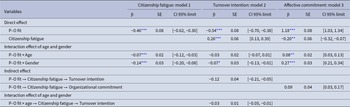
To address concerns about sample homogeneity, we conducted an exploratory moderation and moderated mediation analysis to assess whether the effects of P–O fit varied by age and gender. Results of this testing can be found in Table 4. Specifically, we tested interaction terms for P–O fit × age and P–O fit × gender predicting CF. Age did moderate this relationship in a significant and negative way (β = −0.07, SE = 0.02, p < .001; 95 % CI = [−0.12, −0.03]). Therefore, the negative association between P–O fit and CF is stronger for older employees and weaker for younger employees. Gender also moderated the relationship in a significant and negative way, (β = −0.14, SE = 0.03, p < .001; 95 % CI = [−0.20, −0.08]), indicating that the CF reducing effects of P–O fit is stronger for females and weaker for males.
Post hoc moderated mediation analysis for age and gender

Note. Unstandardized estimates are reported, CI = confidence interval. N = 206 employees.
* p < .1,
** p < .01,
*** p < .001.
Conditional indirect-effect tests confirmed that these demographic differences disseminate through CF for older (vs. younger) employees and for female (vs. male) the indirect pathway from P–O fit to lower TI (β = −0.03 and −0.05, respectively) and to higher organizational commitment (β = 0.04 and 0.05) was stronger. Despite the differing effects of magnitudes from demographic sub-groups, the sign and significance of all path coefficients remain unchanged, supporting the robustness of our model and reducing concerns about limited external validity. Importantly, all indirect effects retained their original direction and significance, demonstrating the model’s generalizability across demographic sub-groups.
Discussion
Earlier research has shown that the employee perceptions and experiences explored in this study significantly influence employee behaviors, specifically turnover intention and affective organizational commitment (Albrecht & Andreetta, Reference Albrecht and Andreetta2011; Griffeth et al., Reference Griffeth, Hom and Gaertner2000; Lapointe & Vandenberghe, Reference Lapointe and Vandenberghe2017; Vance et al., Reference Vance, Jaros, Becker and McKay2020; Wong & Cheng, Reference Wong and Cheng2020). Our findings underscore previously underexplored mechanisms and an emerging construct that influence how employees cope with the interactions between positive (high P–O fit) and negative experiences (fatigue from engaging in citizenship behaviors) given dwindling resources. The empirical support of all four hypotheses underscores the relevance of COR assumptions in explaining the relationships between fatigue and its antecedents and outcomes. Interestingly, the P–O fit was shown to have an indirect mediating relationship with turnover intention and affective organizational commitment through CF (H4a and H4b). The COR logic helps to identify the importance of the perceived experience of employees on individual stress and exhaustion as an indirect force shaping employee outcomes in an organizational context.
Our empirical results additionally substantiate and align with previous research that applies the COR theory (Hobfoll, Reference Hobfoll1989, Reference Hobfoll2001). We found that when employees face resource constraints, regardless of their positive perception or intent, the experience of stress diminishes individual efforts and outcomes. In this study, the resources required to address stress were symbolized by a deficiency in P–O fit, while stress was manifested by CF. This empirical support is aligned with Mackey and his colleagues (Mackey et al., Reference Mackey, Perrewé and McAllister2017), who established that perceptions of organizational fit can be construed as a resource within the COR theory framework, thereby reducing employee stress.
Next, our results suggest that in the case of employee stress, there is a tendency to conserve resources and adopt a defensive posture toward the organization, aiming to safeguard and preserve valuable resources. Specifically, the empirical results demonstrate that in the instances where employees undergo CF, they respond by diminishing their affective commitment and taking measures to replenish their resources long term by actively seeking alternative employment, as demonstrated through a positive association with turnover intention. These findings align with a concurrent body of recent research, indicating that stress has an adverse effect on various forms of affective commitment (Garg & Dhar, Reference Garg and Dhar2014; Saadeh & Suifan, Reference Saadeh and Suifan2020).
While prior studies largely highlight the positive effects of P–O fit, we argue here that the misalignment of fit can have negative implications, resulting in emotional and physical exhaustion (i.e., CF). Other scholars have documented that a lack of P–O fit was strongly associated with some negative outcomes, such as stress (Chen et al., Reference Chen, Sparrow and Cooper2016; Mostafa, Reference Mostafa2015; Verquer et al., Reference Verquer, Beehr and Wagner2003), turnover intentions (Jin et al., Reference Jin, McDonald and Park2018), and burnout (Gould-Williams et al., Reference Gould-Williams, Mostafa and Bottomley2015; Mostafa, Reference Mostafa2015; Siegall & McDonald, Reference Siegall and McDonald2004). We demonstrate how the process toward exhibiting a greater degree of P–O fit can exacerbate CF through stress, tension, and role-overload in misfits, as it requires engaging in job tasks beyond formal work duties in a value-conflict context.
P–O fit and OCBs run parallel in the organizational literature. We demonstrated that they have an overlapping dark side, namely CF, that leads to turnover intentions and reduced affective organizational commitment through increased employee withdrawal. This suggests that leaders and managers ought to be more judicious when it comes to their responses to P–O misfit and OCB levels. It will behoove the leaders to keep an eye out if they notice some employees engaging in behaviors that may lead to CF. As an example, in academic institutions and organizations, faculty members must balance teaching responsibilities with research and service responsibilities, with service responsibilities frequently falling into the OCB bucket, and minority and women faculty ending up doing more of these service responsibilities, thus increasing their own stress and burnout levels (Domingo et al., Reference Domingo, Gerber, Harris, Mamo, Pasion, Rebanal and Rosser2022; Guarino & Borden, Reference Guarino and Borden2017). This sort of unfairness dictates differing levels of fatigue and, as our results suggest, differing levels of turnover intention. This could then turn into a situation where organizations end up losing the ability to retain diverse and/or conscientious employees, because those are the employees who are more likely to perform more OCBs and hence suffer more CF. Since OCBs are voluntary, perhaps leaders should emphasize that to their employees and ensure that the ones who are engaging in too many OCBs are asked to desist from doing so. Essentially, leaders (be they academic or non-academic organizations) should not be putting employees into a position where they feel obliged to engage in too many OCBs.
The COR logic is particularly insightful in promoting P–O fit, a parallel stream to voluntary OCBs and compulsory OCBs (Haldorai et al., Reference Haldorai, Kim, Mussina and Li2025; Klotz et al., Reference Klotz, Bolino, Song and Stornelli2018; Qin & Zhang, Reference Qin and Zhang2024). Essentially, what our results signal is that leaders and managers can make a difference by tweaking their employee evaluation and reward systems to avoid unintended consequences of emphasizing P–O misfit and promoting OCBs. These unintended consequences would make highly conscientious employees engage in more OCBs, and then experience fatigue, which would then result in negative outcomes for them and their organizations. A meta-analysis by Maricuţoiu, Sava and Butta (Reference Maricuţoiu, Sava and Butta2016) found that controlled interventions were effective in preventing employee burnout. Therefore, it makes sense for organizational leaders to keep an eye out and possibly proactively design interventions with those employees in mind who may be likely to suffer or are suffering from CF. OCBs are discretionary and voluntary actions and should never be tied to reward systems. Harking back to the example of academic institutions, promotions and retention decisions should never be tied to these voluntary OCBs, which unfortunately occur widely, as studies document (Domingo et al., Reference Domingo, Gerber, Harris, Mamo, Pasion, Rebanal and Rosser2022; Guarino & Borden, Reference Guarino and Borden2017).
Contributions and implications
The construct of CF examined in this study is relatively new and underexplored. The results of this study make a meaningful contribution to the growing body of literature on employee stress and work outcomes by highlighting the negative by-products of OCBs and P–O fit. In the inaugural paper that introduced CF as a construct, Bolino et al. (Reference Bolino, Hsiung, Harvey and LePine2015) emphasized the imperative to enhance comprehension regarding the factors influencing CF and the coping mechanisms adopted by employees. The framework developed in this study substantiates this need by empirically delineating both an antecedent and key consequences linked to CF. Therefore, this paper advances this new avenue of the OCB literature by identifying P–O fit’s ramifications. Leveraging the insights from this study, which illuminates the influence of P–O fit on CF within the COR theory framework, scholars can expand their conceptualization to explore additional antecedents of CF, which has been perceived to be a result of OCBs.
Furthermore, because ‘employees who experience citizenship fatigue feel frustrated or underappreciated’ (Bolino et al., Reference Bolino, Hsiung, Harvey and LePine2015: 15), this study makes a significant contribution to the existing body of knowledge by highlighting how intervening employee attitudes and behavioral pathways are influenced by P–O fit dynamics. Both turnover intentions and affective commitment were empirically supported as consequences of CF, carrying noteworthy implications for both individuals and their organizations. In light of previous research demonstrating that the attitudes under investigation in this study, specifically CF, impact employee behaviors such as voluntary turnover (Albrecht & Andreetta, Reference Albrecht and Andreetta2011; Griffeth et al., Reference Griffeth, Hom and Gaertner2000; Lapointe & Vandenberghe, Reference Lapointe and Vandenberghe2017; Wong & Cheng, Reference Wong and Cheng2020), this study provides valuable insights for both scholars and practitioners in managing expectations and organizational measures (e.g., policies and practices) related to promoting P–O fit and OCBs in a broad and inclusive manner (Kristof‐Brown et al., Reference Kristof‐Brown, Schneider and Su2023).
From a practitioner perspective, the P–O fit is perceived as a vital resource; organizational support plays a crucial role in assisting employees in alleviating stress and fostering loyalty to their respective organizations. As organizations strive to build cultures of belongingness, this study indicates the need for caution in promoting greater P–O fit and navigating P–O misfit. Acknowledging the negative implications through CF presents practitioners with an additional layer of understanding in managing a diverse workforce, i.e., multiplicity of racial background, moral codes, norms, religion, socio-economic experience, national culture, and their underlying value differences that lead to a lower level of P–O fit. Therefore, it is critical that managers and leaders promoting recruitment and hiring accept individual values in a more inclusive manner in alignment with organizational values (i.e., even when individual values may conflict with a supervisor’s or team’s values).
Another important implication for managers and leaders is to carefully assess the importance of job crafting, role crafting, and evolving organizational cultures as they may have a widespread effect on P–O fit and OCBs. By normalizing a reasonable level of P–O fit, formalizing boundary conditions, and communicating an inclusive approach, managers are more likely to recruit and cultivate employees who are more likely to be productive and engaged and less susceptible to being fatigued from consistently going ‘above and beyond’. This, in turn, aids in fostering employee commitment to the organization, subsequently reducing the likelihood of them seeking alternative employment, resulting in decreased organizational costs associated with recruitment, hiring, and training.
Our findings suggest that organizations may benefit from incorporating structured systems to both recognize and regulate P–O fit and misfit. First, organizations can and should proactively manage biases and unfairness toward misfits through appropriate awareness programs, reporting systems, and organizational policies that acknowledge the contributions of misfit employees. Rather than relying on informal praise, managers can implement formal recognition programs that clearly define expectations and boundaries and acknowledge the tangible and intangible benefits of complementary fit (in addition to similarity). For employees engaging in OCBs due to a high P–O fit (i.e., similarity), creating an ‘above and beyond’ category during employee evaluations can highlight discretionary and non-required behaviors. Evaluators should clarify that while OCBs are valued, they are not required. After all, some forms or levels of OCB may prove dysfunctional for either the organization, the individual, or both (Organ, Reference Organ2018). Organizational evaluation systems should be carefully monitored to ensure that promotions remain based on the codified policies addressing core job performance, as discretionary OCB engagement may be challenging to measure and recognize given a formal structure. Doing so reinforces that the ‘above and beyond’ category duly reflects discretionary, not mandatory, efforts. If an organization seeks to promote a cultural expectation for OCBs, it is essential to explicitly communicate the limits through formal and informal channels. For instance, during annual evaluations, engaging in one regular type of OCB could be rated favorably, while engaging in multiple types may be rated unfavorably to signal boundaries.
Second, a structured system can focus on monitoring for signs of CF and resource strain in real time. Organization-wide culture surveys can include questions related to stress and fatigue to help identify whether CF is localized within specific teams, units, or divisions. Supervisors and leaders should be educated, empowered, and incentivized to acknowledge that both P–O fit and OCB provide a valuable opportunity to open dialogue about CF.
Finally, when these systems reveal issues related to P–O misfit, OCBs, or fatigue, policies that protect employee health and well-being are critical. Regular check-ins with employees and encouraging healthy behaviors (e.g., normalizing individual differences, availing paid leaves, and instituting no-email after hours) should also be an organizational imperative. Employees experiencing high levels of stress and fatigue may benefit from a temporary break from OCBs, with a focus solely on core job responsibilities. After a mutually agreeable period of recovery, the employee’s reengagement in OCBs can be revisited. Adjusting organizational conceptualization of P–O fit and expectations around OCBs can be crucial toward managing a healthy and productive workforce. Overall, structured systems to recognize and regulate various evidence-based approaches can help leaders avoid creating a culture where employees feel unspoken pressure to go above and beyond at the detriment of themselves and the organization.
In summary, by being cognizant of the negative nomological network – particularly CF – of some key practical constructs like P–O fit and OCBs, employers ought to refine their approach to promoting employee productivity, job satisfaction, and cultivate and retain internal talent. Consequently, companies can economize both time and money by effectively managing the short- and long-term implications of fit and OCBs. Furthermore, by mitigating CF, known to adversely affect future instances of OCBs (Bolino et al., Reference Bolino, Hsiung, Harvey and LePine2015), organizations increase the likelihood of having employees actively and productively participate in OCBs. As previously highlighted, while engaging in OCBs can be highly beneficial for both individuals and organizations, doing so without a strong sense of P–O fit may increase the risk of CF. Therefore, broadly conceptualizing P–O fit, by emphasizing the value of both similarity and complementarity with an employee, can help ensure that OCBs remain energizing rather than exhausting.
Limitations and future research
Although this study contributes to the existing body of knowledge and has useful implications for theory and practice, it has some limitations. First, data and results for this study were generated from a convenience sample (although the respondents were from multiple industries) of respondents primarily located in the Midwest region of the United States. Concerns can arise regarding external validity when convenience samples are utilized. This provides our study with a limited ability to build a generalized theory without significant further research using cross-national samples. We urge subsequent studies to consider using larger and cross-sectional samples and include respondents from diverse locations and contexts. Additionally, future studies could test these constructs using new methodologies such as experience sampling methodology, especially when paired with Virtual Reality or Augmented Reality technologies. Future studies may also investigate whether the findings presented here are generalizable to specific industries, divisions, employee levels (senior managers vis-à-vis entry positions), professions (teachers, scientists, and bankers), and sectors, or across regions and national cultures. For instance, Paine and Organ (Reference Paine and Organ2000) in their exploratory model suggested that cultural dimensions like power distance and individualism-collectivism may have a predictable relationship with OCBs. Treviño and colleagues (Reference Treviño, Egri, Ralston, Naoumova, Li and Darder2020) found that P–O fit dynamics are more relevant in individualistic than in collectivistic societies, suggesting that future research at the intersection of P–O and national culture may provide nuanced insights into understanding CF and other outcomes. These links may variously lead to CF, as what is perceived as OCB varies across cultures (Organ, Reference Organ2018), and addressing fatigue, therefore, may require personalized and precise culturally relevant and evidence-based interventions.
Our post hoc analyses revealed that the CF-reducing impacts of P–O fit are not the same across employees. Specifically, older workers and women who have higher levels of P–O fit yield greater reductions in CF. This ultimately will have a stronger downstream effect on turnover intentions and affective commitment. Although these moderation effects qualify our main results, they do not overturn them. Rather, they point to boundary conditions that open avenues for future studies to explore more explicitly. Given the rising diversity (ethnic, religious, ideological, cognitive, etc.) in organizational settings, internationalization of companies, increased global migration trends, and the continued coalescence in pluralistic societies, Kristof‐Brown et al. (Reference Kristof‐Brown, Schneider and Su2023) suggested that scholars bridge P–O fit with DEI (diversity, equity, and inclusion) research. Given these findings, we believe new avenues to explore fatigue, stress, burnout, and other adverse implications of P–O fit and OCBs will be insightful. It is important to consider the deep and surface-level individual values of all employees and to examine how diversity programs complement organizational cultures or affect P–O fit. For instance, white women and minority job seekers view organizational commitment to diversity to be relevant when accepting employment, and high achievers and new immigrants also find organizations with diversity practices more attractive (Ng & Burke, Reference Ng and Burke2005). Furthermore, as individual characteristics and value systems are relatively enduring and shaped by group identities (Treviño et al., Reference Treviño, Egri, Ralston, Naoumova, Li and Darder2020), we believe it would be important to longitudinally explore how the individual- and organizational-level implications of P–O fit change over time. Kristof‐Brown et al. (Reference Kristof‐Brown, Schneider and Su2023), importantly, also advise scholars to differentiate P–O fit from other forms of fits (e.g., person-vocation, person-job, person-team, person-recruiter, and person-supervisor) and examine supplementary and complementary fit that may shape the selection and socialization process. A systematic attempt to discern the implications of these fits may open a rich direction for research at the intersection of individual and organizational outcomes.
Related to measurement, turnover intention was measured using a single-item scale to minimize participant burden and reduce survey fatigue. Although this approach has precedent in organizational research, it may limit the depth and reliability of the construct. Future studies should consider using multi-item measures to enhance construct validity. Regarding the temporal aspects of our measurements, this study used a two-phase survey, measured at T1 and T2. This measurement approach may result in a decrease in the number of individuals participating in surveys at T2 compared to the initial count at T1, as demonstrated by the attrition rate of respondents in our study. Participants were provided with several reminders at each point in time, but with a temporal aspect of measurement, there is always a possibility of participants dropping off. This may create a level of unintended sampling bias. Future studies may employ experimental designs to replicate these hypothesized relationships and the effects of various organizational approaches to achieving P–O fit. Relatedly, as emerging studies distinguish between discretionary and compulsory OCBs and highlight the P–O misfit, future experimental studies may examine the boundary conditions for how implicit OCB expectations and the lack of P–O fit variously relate to important organizational dynamics, e.g., negative cultures, poor human resource practices (Kristof‐Brown et al., Reference Kristof‐Brown, Schneider and Su2023), and harmful individual outcomes like lack of productivity and creativity, poor satisfaction and engagement, deviant behaviors, stress, or CF.
Finally, since the construct of CF is new, we also recommend further examining the construct through future studies. Certainly, there is value in exploring additional dimensions and factors influencing CF, as well as delving into various coping mechanisms employees employ. For instance, in line with COR assumptions, investigating alternative ways in which employees ‘maintain a defensive posture’ or ‘conserve resources’ when faced with CF could yield valuable insights. The scarcity of existing literature on CF presents numerous intriguing research opportunities for future studies. Given the empirical findings of our study, we suggest future studies that can better refine the understanding of CF. Other P–O fit-related antecedents that could be investigated include ethical climates (Simha & Pandey, Reference Simha and Pandey2020), leadership (Avolio & Gardner, Reference Avolio and Gardner2005; Kerse, Reference Kerse2021), personality (Vollrath, Reference Vollrath2001), organizational values (Bourne & Jenkins, Reference Bourne and Jenkins2013), organizational culture (Hatch, Reference Hatch1993), and organizational structure (Gross, Reference Gross2017).
Conclusion
CF remains a relatively new construct associated with OCB. This empirical study advanced our understanding of CF by employing the COR theory and establishing a framework to identify both its antecedents and consequences. Findings in this paper indicate that when employees experience CF, individuals and organizations alike are more likely to have costly implications, such as turnover intentions, and reduced commitment to their organizations. Before too heavily promoting individuals to exhibit OCBs, managers and leaders need to consider the negative consequences (i.e., both short and long term; individual-level and organizational) associated with a segment of the employees in an organization becoming tired of being ‘the good soldier’. It is of paramount importance to further expand our knowledge of CF as it relates to OCBs, and this article is a preliminary step in that direction as organizations grapple with the challenge of managing and motivating an increasingly diverse workforce.
Data availability statement
The data that support the findings of this study are available from the first author, upon reasonable request.
Funding statement
There was no funding.
Conflicts of interest
The authors declare that they have no conflicts of interest.

 Open access

