


In spite of the growth of the field of behavioral genetics, established links between personality traits and specific genes are currently tenuous, at best. Indeed, several recent important meta-analyses show that many published studies linking single-nucleotide polymorphisms (SNPs) with personality traits fail to replicate (De Moor et al., Reference De Moor, Costa, Terracciano, Krueger, De Geus, Toshiko and … Derringer2012; Montag & Reuter, Reference Montag and Reuter2014; Rietveld et al., Reference Rietveld, Conley, Eriksson, Esko, Medland, Vinkhuyzen and … Dawes2014). One reason underlying the presence of inconsistencies across gene×personality studies may be that many studies have yet to consider epigenetic factors impacting the way genes function and are ultimately expressed (Kumsta & Heinrichs, Reference Kumsta and Heinrichs2013). Genes do not directly impact psychological phenomena: they initiate biochemical and physiological mechanisms. Furthermore, identical SNPs that occur in different people typically do not function in identical ways, and may result in a variety of phenotypes being expressed. Thus, investigating the association between SNPs and individual differences in human traits is limited because several intermediary factors that exist between genotype and phenotype are not typically considered. One novel way to elucidate the way genes are associated with phenotypes, such as with personality, is to use an epigenetic approach.
Epigenetics is the study of how gene functioning is altered by exogenous and endogenous factors. One epigenetic process that influences the expression of genes is DNA methylation, which occurs when a methyl group forms a covalent attachment with the 5' carbon of cytosine in the context of a cytosine phosphodiester guanine (CpG) dinucleotide, commonly called a CpG site. DNA methylation regulates the expression of genes by influencing the recruitment and binding of regulatory protein to DNA. Typically, an increase in DNA methylation is associated with a decrease in expression of that gene. Although several studies show that stable genetic variants, such as SNPs, confer tendencies toward specific personality types, very little is currently known regarding the association between epigenetic modification of genes and personality.
The oxytocin (OT) system is one biological substrate that may be associated with individual differences in human behavior and social cognition. OT is a neuropeptide, synthetized within the hypothalamus in the brain. Some evidence indicates that greater endogenous OT is associated with higher trait novelty-seeking temperament and OT administration leads to increased holistic processing, more flexible thinking, more original ideas, and better creative problem solving (De Dreu et al., Reference De Dreu, Baas, Roskes, Sligte, Ebstein, Chew and … Shamay-Tsoory2014). In addition, Cardoso, Ellenbogen, and Linnen (Reference Cardoso, Ellenbogen and Linnen2012) demonstrated that OT administration is associated with changes in self-report personality. Following OT administration, people tend to self-report higher extraversion and Openness to Experience. These findings have motivated the search for genes within the OT system that confer individual differences in personality traits and social cognition.
One OT pathway gene linked to human traits and social cognition is the Oxytocin Receptor Gene (OXTR), located on chromosome 3p25, which codes for a G-protein-coupled receptor that mediates the effects of OT on postsynaptic activity. Some research shows that SNPs of OXTR confer individual differences in cognition, sociability, and novelty-seeking (Melchers, Montag, Markett, & Reuter, Reference Melchers, Montag, Markett and Reuter2013; Montag et al., Reference Montag, Sindermann, Melchers, Jung, Luo, Becker and … Kendrick2017). In spite of mounting data, there also exist evidence that OXTR SNPs fail to explain a significant portion of individual differences in human behavior and traits (Apicella et al., Reference Apicella, Cesarini, Johannesson, Dawes, Lichtenstein, Wallace and … Westberg2010; Bakermans-Kranenburg & Van IJzendoorn, Reference Bakermans-Kranenburg and Van IJzendoorn2014). One reason underlying the presence of inconsistences across studies may be the fact that many investigations have not taken into account epigenetic modification of OXTR.
In this study, we sought to investigate the association between epigenetic modification of OXTR, via DNA methylation, and self-reported, Big-5, personality traits. Genetic data were collected from saliva samples and analyzed to target and quantify DNA methylation in the MT2 region (Kusui et al., Reference Kusui, Kimura, Ogita, Nakamura, Matsumura, Koyama and … Murata2001) within the promoter region of OXTR. A recent study demonstrated that methylation of DNA extracted from saliva is more similar to the methylation patterns observed in brain tissue than DNA extracted from blood (Smith et al., Reference Smith, Kilaru, Klengel, Mercer, Bradley, Conneely and … Binder2015). The promotor region of OXTR contains many CpG sites. However, there currently exists consistent and converging evidence that epigenetic modification of CpG site -934 is associated with psychological functioning (Bell et al., Reference Bell, Carter, Steer, Golding, Davis, Steffen and … Harris2015; Kader, Ghai, & Maharaj, Reference Kader, Ghai and Maharaj2018; Rubin et al., Reference Rubin, Connelly, Reilly, Carter, Drogos, Pournajafi-Nazarloo and … Tandon2016), and individual differences in brain structure and function (Jack, Connelly, & Morris, Reference Jack, Connelly and Morris2012; Puglia, Lillard, Morris, & Connelly, Reference Puglia, Lillard, Morris and Connelly2015), and that increased DNA methylation in the MT2 region, which includes this site, associates with lower expression levels (Kusui et al., Reference Kusui, Kimura, Ogita, Nakamura, Matsumura, Koyama and … Murata2001). This evidence guided our decision to target DNA methylation at CpG site -934. However, we could not isolate the -934 from the -924 CpG sites based on a limitation of the mass spectrometry technology employed for this assay.
In this study, we explored the association between in Big-5 personality traits and epigenetic modification of OXTR. On the basis of existing evidence that OT administration is associated with increased holistic processing, more flexible thinking, more original ideas and better creative problem solving (De Dreu et al., Reference De Dreu, Baas, Roskes, Sligte, Ebstein, Chew and … Shamay-Tsoory2014), and changes in self-reported Openness to Experience (Cardoso, Ellenbogen, & Linnen, Reference Cardoso, Ellenbogen and Linnen2012), we predicted that DNA methylation at promoter region of OXTR would be associated individual differences in Openness to Experience. Furthermore, there currently exists a mixed pattern of results linking the OXTR gene with sociability (Bakermans-Kranenburg & Van IJzendoorn, Reference Bakermans-Kranenburg and Van IJzendoorn2014). We therefore explored the associated between epigenetic modification of OXTR and prosocial personality traits, Extraversion and Agreeableness. To test these predictions, we conducted a multiple regression analysis with all Big-5 personality traits entered simultaneously as predictor variables and OXTR DNA methylation entered as the criterion variable (controlling for age and sex).
1. Methods
1.1. Participants
In order to estimate an appropriate sample size for this study, we carried out an effect size estimate based on existing evidence linking DNA methylation of OXTR with individual differences in behavior. We pooled effect sizes from three recently published studies (Kim, Kim, Kim, & Treasure, Reference Kim, Kim, Kim and Treasure2014; Rubin et al., Reference Rubin, Connelly, Reilly, Carter, Drogos, Pournajafi-Nazarloo and … Tandon2016; Ziegler et al., Reference Ziegler, Dannlowski, Bräuer, Stevens, Laeger, Wittmann and … Reif2015). The average reported effect size for associations between OXTR DNA methylation and behavior was .34. We then conducted a power analysis, using π=0.80, to determine an appropriately sized sample. On the basis of these reported effect sizes, we estimated that a sample size of greater than N=66 would be sufficient. However, it is also clear that this analysis did not account for many other factors such as publication bias. We acknowledge that this is a single study, and that any potential results obtained here, warrant replication.
We recruited 128, healthy, fluent English-speaking (71 females, 57 males; mean age=21.32 years, SD=3.46 years) adults from the surrounding community to participate in genetic and behavioral testing. All participants were screened for neurological and psychiatric conditions, via self-report. All participants provided written informed consent as detailed in the Declaration of Helsinki, and the University of Georgia Institutional Review Board approved all procedures within this study.
1.2. Saliva collection and DNA extraction
Saliva samples were collected using Oragene Discover OGR-500 kits (DNA Genotek Inc., Ottawa, ON, Canada). DNA was extracted using prepIT®∙L2P reagent (DNA Genotek Inc.) and was quantified with PicoGreen® (Quant-iT™ PicoGreen® dsDNA Assay Kit; Thermo Fisher Scientific, Waltham, MA, USA).
1.3. DNA methylation of OXTR
One milligram of DNA was treated with bisulfite using the EpiTect Bisulfite Kit (Qiagen, Hilden, Germany). DNA methylation of CpG site -934, -924 (19.20) within the promoter region of the OXTR gene was analyzed using EpiTYPER (MassARRAY system; Agena Biosciences, San Diego, CA, USA) according to the manufacturer’s instructions. Forward (5'- aggaagagagGAGGTTTTAGTGAGAGATTTTAGTTTAG-3') and reverse (5'- cagtaatacgactcactatagggagaaggctTCCCTACTAAAAAAACCCCTACCTC-3') primers corresponding to chr3: 8,811,074–8,810,603 were designed using EpiDesigner (Agena Bioscience), and the spectrum characteristics were validated with RSeqMeth (https://cran.r-project.org/src/contrib/Archive/RSeqMeth/). Cycling conditions were as follows: denaturation (94°C for 15 min) then 50 cycles of amplification (94°C for 30 s, 58°C for 60 s, and 72°C for 30 s), and a final extension step of 72°C for 10 min. Samples were electrophoresed using 2% agarose gel to confirm amplification. The CpG site -934/-924 was unambiguously interrogated. The mass spectra methylation ratios were generated using EpiTYPER ver. 1.2 (Agena Biosciences).
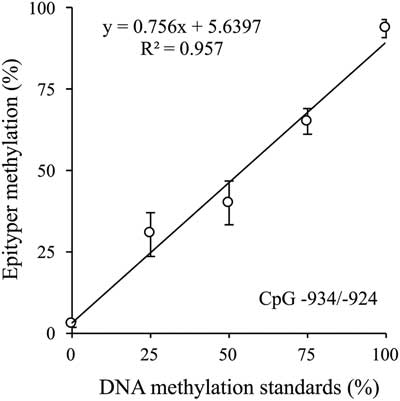
Lastly, we confirmed the reliability of the OXTR methylation assay by using Epitect unmethylated (0%) and methylated (100%) DNA samples (Qiagen) as positive controls (Figure 1). For each participant, percent OXTR DNA methylation values were retained and used as the criterion variable in subsequent statistical analyses.
Linear association between unmethylated (0%), 35, 50, 75, and 100% methylated samples for individual and mean values across target region (cytosine phosphodiester guanine [CpG] -934/-924) in the EpiTYPER assay. Each standard was run in triplicate. The error bars are indicative of standard error.
1.4. Personality assessment
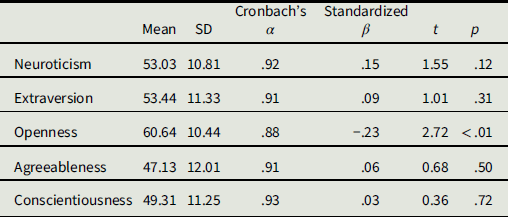
Each participant completed the NEO Personality Inventory-3. The NEO Personality Inventory-3 covers each of the Big-5 personality traits (Neuroticism, Extraversion, Openness to Experience, Agreeableness, and Conscientiousness). Personality data were scored to represent T-values, with the population mean defined as T=50 and 1 SD of T=10. An examination of the internal consistency for all items included for each trait dimension showed high internal consistency (Table 1).
Descriptive statistics (means and SD), reliability (Cronbach’s α), and standardized coefficients for the associations with Oxytocin Receptor Gene (OXTR) DNA methylation values
1.5. Statistical analyses
We undertook a statistical approach designed to test for the significance of associations between OXTR DNA methylation and Big-5 personality traits (Neuroticism, Extraversion, Openness to Experience, Agreeableness, and Conscientiousness). Statistical analyses were initiated by performing a multiple regression analysis, with each of the Big-5 personality dimensions entered as predictor variables and OXTR DNA methylation values entered as the criterion variable, while controlling for sex and age. Thus, this analysis tests for OXTR × personality trait associations, while controlling for the variance of all other Big-5 personality dimensions, as well as sex and age. We used a p=.05 significance threshold for this analysis. Next, we performed a confirmatory analysis using a standard, correction for multiple comparisons, approach. In this analysis, we tested for gene × personality trait associations independently, using a standard Bonferroni (.05/5 comparisons: α=.01) statistical threshold, while controlling for sex and age.
2. Results
Across our sample, mean OXTR DNA methylation at CpG -934/-924 was 0.580 (SD=0.053). We tested for associations between personality and OXTR DNA methylation (Table 1). Openness to Experience was significantly associated with OXTR DNA methylation, while controlling for the remaining Big-5 personality dimensions (Neuroticism, Extraversion, Agreeableness, and Conscientiousness) and sex and age (standardized β=−.232, t=2.72, p=.007). People that exhibit reduced OXTR DNA methylation (presumably associated with higher OXTR expression) tend to score higher on Openness to Experience. No other Big-5 personality trait was found to be significantly associated with OXTR DNA methylation. Next, we performed a confirmatory analysis, for gene × personality trait associations independently, using a standard Bonferroni (.05/5 comparisons: α=.01) statistical threshold, while controlling for sex and age. The results of this analysis were consistent with the results derived from the multiple regression analysis: reduced OXTR DNA methylation is associated with higher Openness to Experience, r=−.22, p=.007. Lastly, no other Big-5 personality trait was found to be significantly associated with OXTR DNA methylation using the standard, Bonferroni corrected, approach. Lastly, we performed an exploratory analysis associating OXTR DNA methylation with facet level Openness to Experience. The results of this analysis indicated that reduced OXTR DNA methylation was associated with higher Actions (O4: r=−.60, p=.037), Ideas (O5: r=−23, p=.006), and Values (O6: r=−.17, p=.028) but not Fantasy, Esthetics, or Feelings.
3. Discussion
In this study, we observed an association between epigenetic modification of OXTR and trait Openness to Experience. People that exhibit reduced OXTR DNA methylation (presumably associated with higher OXTR expression) tend to score higher on Openness to Experience. This finding is consistent with evidence that individual differences in endogenous OT is associated with trait novelty-seeking (De Dreu et al., Reference De Dreu, Baas, Roskes, Sligte, Ebstein, Chew and … Shamay-Tsoory2014) and that OT administration is associated with increased self-reported Openness to Experience (Cardoso, Ellenbogen, & Linnen, Reference Cardoso, Ellenbogen and Linnen2012). This finding provides additional support for models associating OT with individual differences in personality and identity in humans.
Openness to Experience is a Big-5 personality trait that represents the affinity toward variety and the tendency toward thinking in a flexible and fluid way (McCrae & Costa, Reference McCrae and Costa1997). Behavioral research shows that high Openness to Experience is associated with intelligence (Ashton, Lee, Vernon, & Jang, Reference Ashton, Lee, Vernon and Jang2000; Harris, Reference Harris2004), social and political attitudes (Van Hiel, Kossowska, & Mervielde, Reference Van Hiel, Kossowska and Mervielde2000), and hypnotizability (Glisky, Tataryn, Tobias, Kihlstrom, & McConkey, Reference Glisky, Tataryn, Tobias, Kihlstrom and McConkey1991). People scoring higher on Openness to Experience tend to be more open to different cultures and lifestyles and lower on right-wing authoritarianism (McCrae, Reference McCrae1996). Interestingly, recent empirical research shows that OT administration influences interpersonal and political trust (Merolla, Burnett, Pyle, Ahmadi, & Zak, Reference Merolla, Burnett, Pyle, Ahmadi and Zak2013) as well as ethnocentrism (De Dreu, Greer, Van Kleef, Shalvi, & Handgraaf, Reference De Dreu, Greer, Van Kleef, Shalvi and Handgraaf2011). It is important to note, however, that De Dreu et al. (Reference De Dreu, Greer, Van Kleef, Shalvi and Handgraaf2011) demonstrated that OT administration was associated with greater ethnocentrism, while Openness to Experience is typically associated with lower ethnocentrism. There also exists evidence that OT is associated with hypnotizability. Following OT administration, people tend to be more easily hypnotized (Bryant, Hung, Guastella, & Mitchell, Reference Bryant, Hung, Guastella and Mitchell2012) and OXTR SNPs are associated with individual differences in hypnotizability (Bryant, Hung, Dobson-Stone, & Schofield, Reference Bryant, Hung, Dobson-Stone and Schofield2013). Combined, these findings indicate that epigenetic modification of OXTR influences the relationship between OT and a variety of cognitive styles in humans.
There exists prior evidence that individual differences in Openness to Experience can be explained by genetics. Bergeman et al. (Reference Bergeman, Chlpuer, Plomin, Pedersen, McClearn, Nesselroade and … McCrae1993) performed an adoption/twin study and demonstrated that for Openness to Experience, genetic influence was substantial and that there was little evidence of shared rearing environment. Peciña et al. (Reference Peciña, Mickey, Love, Wang, Langenecker, Hodgkinson and … Weisenbach2013) demonstrated that a commonly occurring genetic variant within the dopamine system (DRD2) is associated with trait Openness to Experience. Interestingly, the OT and dopamine systems have been shown to interact with one another to influence the way many social and cognitive tasks are performed (Baskerville & Douglas, Reference Baskerville and Douglas2010; Love et al., Reference Love, Enoch, Hodgkinson, Peciña, Mickey, Koeppe and … Zubieta2012; Rosenfeld, Lieberman, & Jarskog, Reference Rosenfeld, Lieberman and Jarskog2011). Together, these findings strengthen existing models that link genetic predispositions to personality phenotypes.
Based on prior evidence that OT administration is associated with increased self-reported Openness to Experience and Extraversion (Cardoso, Ellenbogen, & Linnen, Reference Cardoso, Ellenbogen and Linnen2012), we predicted that epigenetic modification would also be associated with individual differences in trait Extraversion. The results of this study did not support this hypothesis. These findings indicate that the way OT administration affects self-perceptions of Extraversion is different than the way epigenetic modification of OXTR affects self-perceptions of Extraversion. This is consistent with prior evidence indicating OT administration affect brain function differently according OXTR genotype (Feng et al., Reference Feng, Lori, Waldman, Binder, Haroon and Rilling2015; Marsh et al., Reference Marsh, Henry, Pine, Gorodetsky, Goldman and Blair2012). In addition, there is also evidence that effects of OT administration vary according to sex and age (Ebner et al., Reference Ebner, Chen, Porges, Lin, Fischer, Feifel and Cohen2016). Future studies are required that combine OT administration, measurement of DNA methylation, and personality and behavioral measures.
In this study, we characterized epigenetic modification of OXTR via DNA methylation values derived from saliva samples. Despite its association with personality, methylation patterns observed in saliva may not reflect DNA methylation patterns in the brain specifically. Some studies, however, indicate that DNA derived from the saliva may be a good proxy for methylation within brain tissue (Smith et al., Reference Smith, Kilaru, Klengel, Mercer, Bradley, Conneely and … Binder2015; Smith et al., Reference Smith, Kilaru, Kocak, Almli, Mercer, Ressler and … Conneely2014) and may reflect epigenetic programming that is not tissue-specific. It is currently unclear how exogenous and endogenous factors may impact DNA methylation of the OXTR gene. Changes in DNA methylation occur in response to early childhood experience (Essex et al., Reference Essex, Thomas Boyce, Hertzman, Lam, Armstrong, Neumann and Kobor2013), neuronal activity (Guo et al., Reference Guo, Ma, Mo, Ball, Jang, Bonaguidi and … Ford2011), and social stress (Unternaehrer et al., Reference Unternaehrer, Luers, Mill, Dempster, Meyer, Staehli and … Meinlschmidt2012). It will be important for future epigenetic studies on OXTR to include variables representative of individual life experience and psychological stress.
The current results do not provide an indication of directionality. Specifically, it is currently unclear if highly “open” people are exposed to factors that reduce OXTR methylation. Alternatively, it is currently unclear if reduced OXTR methylation leads to being more “open.” There is evidence that both Openness to Experience and DNA methylation are dynamic. For example, out of the Big-5 personality traits, Openness to Experience tends to be the most dynamic (Bleidorn, Kandler, Riemann, Angleitner, & Spinath, Reference Bleidorn, Kandler, Riemann, Angleitner and Spinath2009), and tends to reduce with age (Gregory, Nettelbeck, & Wilson, Reference Gregory, Nettelbeck and Wilson2010). In addition, mindfulness-based training (van den Hurk et al., Reference van den Hurk, Wingens, Giommi, Barendregt, Speckens and van Schie2011), as well as psilocybin intake (MacLean, Johnson, & Griffiths, Reference MacLean, Johnson and Griffiths2011) are associated with increased Openness to Experience. DNA methylation is also subject to change in response to experience (Essex et al., Reference Essex, Thomas Boyce, Hertzman, Lam, Armstrong, Neumann and Kobor2013), and according to age (Horvath, Reference Horvath2013). Unternaehrer et al. (Reference Unternaehrer, Luers, Mill, Dempster, Meyer, Staehli and … Meinlschmidt2012) showed that OXTR methylation increases following acute psychosocial stress (Trier social stress test). Together these studies indicate that the relationship between OXTR methylation and trait Openness to Experience is dynamic and likely bidirectional. In addition, these findings highlight the need for future studies to incorporate longitudinal approaches to investigate epigenetics and personality.
There exist several important limitations of this study that warrant consideration. First and foremost, the sample size in this study is modest and the current finding requires replication. This study is also limited in terms of the number of predictor and outcome variables. We targeted CpG -934/-924 based on extant data demonstrating this site to be associated with psychological and brain-based metrics (Bell et al., Reference Bell, Carter, Steer, Golding, Davis, Steffen and … Harris2015; Jack, Connelly, & Morris, Reference Jack, Connelly and Morris2012; Kader, Ghai, & Maharaj, Reference Kader, Ghai and Maharaj2018; Puglia et al., Reference Puglia, Lillard, Morris and Connelly2015; Rubin et al., Reference Rubin, Connelly, Reilly, Carter, Drogos, Pournajafi-Nazarloo and … Tandon2016). However, this study fails to examine the association between other CpG sites within the promoter region of OXTR or other genes with the OT system and personality. In addition, other genes, such as within the serotonin or dopamine systems, may also be associated with trait Openness to Experience, but were not considered here. Lastly, it will be important for future epigenetic studies of personality to take into account measures of gene expression as well a life experience.
In conclusion, this study presents new evidence that epigenetic modification of OXTR confers individual differences in personality. Reduced DNA methylation of OXTR is associated with higher trait Openness to Experience. This finding sheds new light onto an important psychological question: “what factors influence human identity?”
Conflicts of Interest:
The authors have nothing to disclose.
Acknowledgments:
The authors wish to thank the anonymous reviewers for their thoughtful advice.


 Open access

