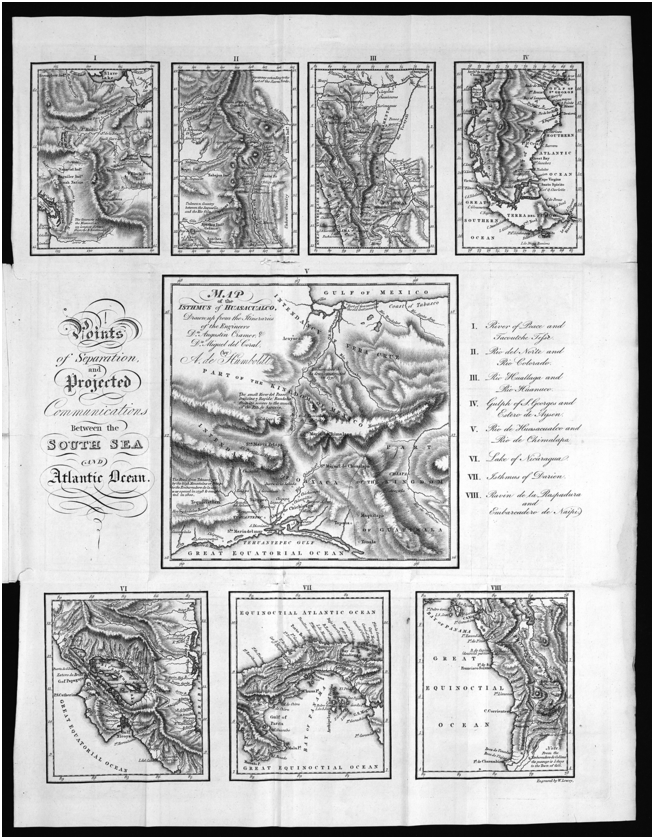
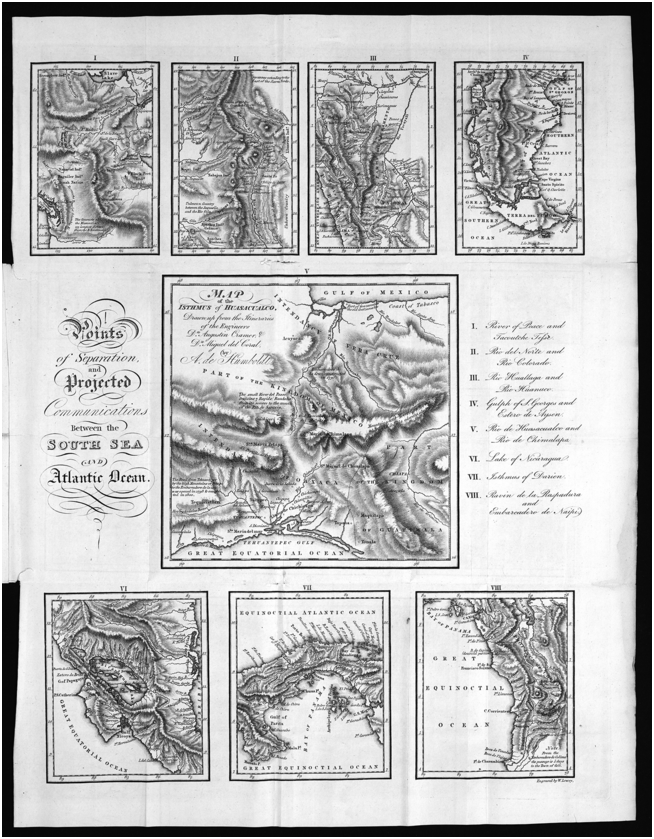
In 1804, Alexander von Humboldt’s expedition to Spanish America seemed to open new ways of imagining not just geography but nature itself. Humboldt’s travels helped him visualize nature as united, connected, one part linked to the other. It is perhaps not surprising that the Nicaragua Canal would find space within this Humboldtian “cosmic” vision of unity. The Nicaragua Canal appears in two of Humboldt’s most widely read works: Political Essay on the Kingdom of New Spain and Personal Narrative of Travels to the Equinoctial Regions of the New Continent during the Years 1799–1804. In the first, he presented the Nicaragua route as one of nine possible routes for linking the Atlantic and the Pacific Oceans (see Figure I.1). In the second, he made his preference for Nicaragua clear. “It seems quite probable,” he wrote, “that it will be the province of Nicaragua that will be chosen for the great work of uniting the two oceans.”Footnote 1 In this, Humboldt was echoing the wisdom of over three centuries of explorations in the isthmus that saw Nicaragua as a prime locale for an interoceanic canal. A little over 100 years later, the construction of the Panama Canal would irrevocably change this narrative.
Map of Humboldt’s proposed routes for passage between the Atlantic and Pacific Oceans. Image source: Alexander von Humboldt and John Black, Political Essay on the Kingdom of New Spain. 2nd ed. (English), Atlas (vol. 5). London: Longman, Hurst, and Brown (etc.), 1814, pl. 9.
The story of the interoceanic canal linking the Atlantic and Pacific Oceans has been inextricably and almost exclusively tied to the triumphalist narrative of the Panama Canal. In this version of events, competing canal schemes of the nineteenth century are portrayed as mere byproducts or detours on a long and arduous journey, with Panama as the inevitable endpoint.Footnote 2 Yet such a narrative threatens to erase a 400-year-old historical trajectory where Nicaragua was widely regarded as a preferred choice for the location of a transisthmian route through Central America. In the nineteenth century, in particular, the Nicaragua route became a zone of active contestation between the imperial powers of Great Britain and the United States and the focal point of Nicaraguan national and Central American regional ambitions.
Recovering the interwoven histories of the Nicaragua Canal (see Map 1) and the Afro-Indigenous Mosquito CoastFootnote 3 (see Map 2) in the nineteenth century, The Link That Divides complicates the received story of Panama as destiny. It charts the tensions that characterized the transatlantic quest for the Nicaragua Canal, revealing the central paradox of the interoceanic dream: that visions of connection and unity that drove canal ambitions stood on – and were, in turn, shattered by – the fractured foundations of rivalry, conflict, and exclusion.
A Story of Erasures
Following the decision to build the canal in Panama in 1902, we find an erasure of the story of the Nicaragua Canal from the triumphalist narrative of the Panama Canal. The official narrative of the Panama Canal history portrayed the decision to build a canal through Panama as logical and cumulative. The construction of this narrative owes much to the efforts of Joseph Bucklin Bishop, who was the chief executive of the U.S. Isthmian Canal Commission (ICC) and its “unofficial propagandist.”Footnote 4 Bishop crafted a triumphalist narrative of the Panama Canal that presented it as the inevitable culmination of the historical quest for an interoceanic canal through the Central American isthmus. “The Panama Canal,” wrote Bishop in the opening line of his book Panama Gateway, “is the realization of an idea four centuries old.”Footnote 5 In this narrative, the Nicaragua Canal appeared as a small step towards the natural and inevitable move towards Panama. For instance, in writing about the contest between the Nicaragua and Panama Canal routes, Bucklin suggested that the only reason for the ICC’s positive report on Nicaragua was the unfavorable terms of sale offered at the time by the New Panama Canal Company. In Bishop’s narrative, once these terms of sale were favorable, the U.S. government naturally gravitated towards the Panama Canal. In Bishop’s view, the choice to build the canal at Panama was “beyond dispute.”Footnote 6 Bishop’s narrative would have a lasting impact on both academic and popular renditions of the story of the Panama Canal.Footnote 7 Writing about the congratulatory literature around the Panama Canal produced in the lead-up to the opening of the Canal, Sarah Moore described it as “a heroic account of the massive undertaking and technological accomplishments of the United States in building the canal.”Footnote 8 Indeed, newspapers often described the Panama Canal as the eighth wonder of the world.Footnote 9 In later renditions as well, the story of the Nicaragua Canal was mostly invisible or subsumed to provide a touch of drama to the Panama Canal story. We can see this way of incorporating the story of the Nicaragua Canal into the Panama Canal narrative in almost all extant works on the history of the Panama Canal, including David McCullough’s acclaimed The Path between the Seas and Matthew Parker’s Panama Fever, in a chapter aptly titled “The Battle of the Routes.” While there has been a plethora of popular and academic books on the Panama Canal, the Nicaragua route has received scant attention.Footnote 10
In some ways, the erasure of the story of the Nicaragua Canal and the related preponderance of the Panama Canal narrative appear logical and natural. After all, the Panama Canal exists. Yet I would argue that despite the fact that the Nicaragua Canal was never built, it was patently real for imperial and national governments, for diplomats and soldiers on the ground, and for filibusters and local Miskitus, whose lives were forever upended as a result of the contest over the Nicaragua route in the nineteenth century. The quest for the Nicaragua Canal – even though it never finally transpired – irretrievably altered the course of imperial, regional, national, and local history in Central America. Moreover, the erasure of the Nicaragua Canal story is a denial of the very real trajectory of four centuries of canal exploration and diplomacy, where Nicaragua was widely considered to be a prime location for an isthmian canal through Central America. Focusing on developments in the nineteenth century, this book argues that the Panama Canal was not inevitable, the ultimate choice to build it, not simply a result of cumulative knowledge. The turn towards Panama was disruptive to the main flow of Anglo-American efforts to build a transisthmian canal, which throughout the nineteenth century had been largely concentrated in Nicaragua. This is not to deny the significance of the Panama Canal but rather to recover a longer, more complex history of the interoceanic canal, one in which the “unbuilt” had as much impact as the project that was eventually realized. The argument here is not that the Nicaragua Canal was central or inevitable but that contestation over it shaped imperial, national, and regional projects even in failure.
This book also attempts to recover the interwoven history of the Mosquito Coast and the Nicaragua Canal, which had significant repercussions for Miskitu politics and Afro-Indigenous lives.Footnote 11 In the mid nineteenth century, the Mosquito Coast, a narrow strip of land on the Caribbean coast of Nicaragua, became the locus of the transatlantic contest among Britain, the United States, and Central American republics for control over a possible canal route linking the Atlantic and the Pacific Oceans. During this contest, the status of the Mosquito Kingdom as an “Indigenous” polity became a crucial linchpin around which the different transatlantic powers maneuvered to gain control over the Mosquito Coast’s San Juan delta, including the harbor of San Juan del Norte (Greytown), the proposed Caribbean mouth of the interoceanic canal. The story of the Nicaragua Canal was intimately connected to the Mosquito question and had a real impact on the relationship between Nicaragua and the Mosquito Coast. Yet in none of the extant narratives of the Panama Canal that touch on the Nicaragua story, do we get any sense of these stakes on the ground. This book takes on the task of recovering this second erasure resulting from the narrative around the Panama Canal: the erasure of the story of the Mosquito Coast. Because the surviving sources are overwhelmingly imperial and colonial, this recovery is necessarily partial, reading both the traces and the silences they contain. By rendering the intertwined history of the Nicaragua Canal and the Mosquito Coast, I show that the deployment of the language of race, indigeneity, and exclusion was central to imperial, colonial, and national efforts to control the Nicaragua Canal route.
An Imperial Staging Arena
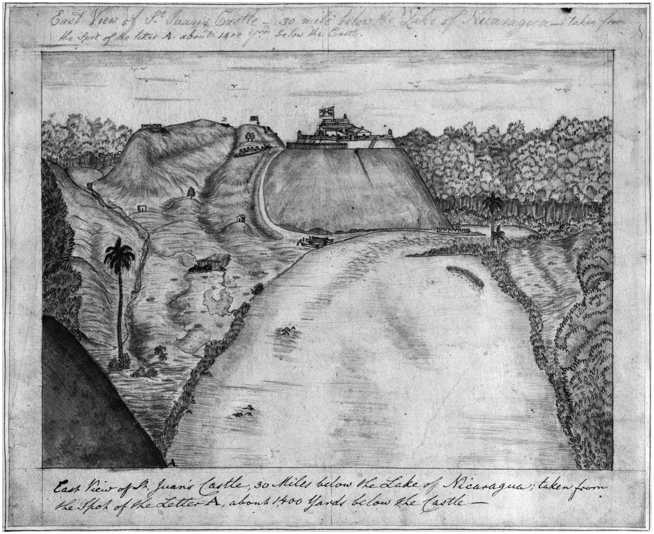
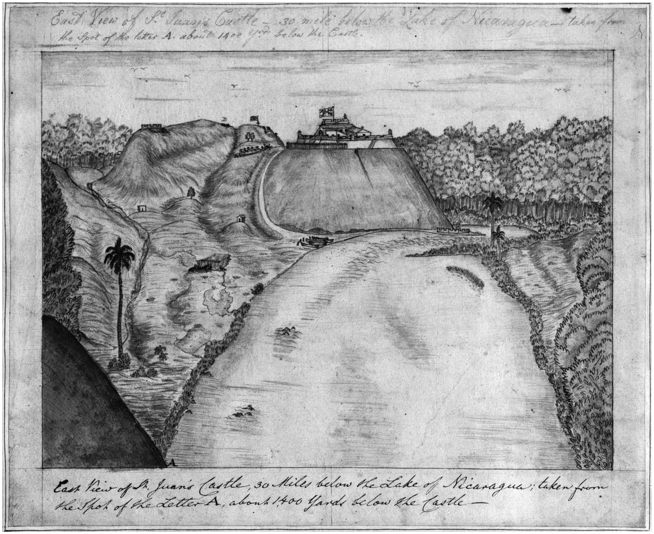
It is near impossible to tell the story of the Nicaragua Canal – or the Mosquito Coast – without recounting the impact of repeated imperial incursions on the region. Shortly after Vasco Núñez de Balboa’s 1513 expedition opened the Pacific Ocean to Western imagination, in 1539 Captain Alonso Calero and Diego Machuca de Suazo conducted a significant exploration of the San Juan–Lake Nicaragua waterway. Their expedition mapped the topography of the San Juan River, including its multiple rapids, and confirmed its connection to the Atlantic Ocean, enhancing Spanish knowledge of the region’s strategic waterways. While, like many conquistadores of the sixteenth century, Calero claimed that he had paid for his own armada to undertake this expedition, there is no doubt that this early exploration phase of the Nicaragua route was closely tied to Spanish conquest expeditions and as such was characterized by both the thrill of discovery and the specter of violence.Footnote 12 Calero and Machuca’s expedition, for instance, was outfitted with a brigantine and a force of 200 Spaniards.Footnote 13 Not only was the San Juan River (the critical artery of the canal route) a base for conquest expeditions to “pacify” Indigenous groups, but it was also rife with piracy. In the seventeenth century, in a bid to retain control over the San Juan River, Spanish authorities erected the fort of El Castillo on the right bank of the river overlooking the Santa Cruz rapids (see Figure I.2). El Castillo was the largest defense structure built in Central America at the time and became a focal point of subsequent contests over the San Juan River and the canal route.Footnote 14
View of El Castillo. Source: “East View of St. Juan’s Castle, 30 miles below the Lake of Nicaragua; taken from the spot of the Letter A, about 1,400 Yards below the Castle,” in Charles Napier Robinson, A Pictorial History of the Sea Services: Or Graphic Studies of the Sailor’s Life and Character Afloat and Ashore. Vol. X, Part 1: Nelson, 1758–1800 (London: n.p., 1911).
However, the concentration of Spanish institutions on the Pacific side of Nicaragua meant that until the mid-seventeenth century, the Indigenous communities of the Caribbean coast – who would eventually constitute the Mosquito Kingdom – remained largely isolated from Spanish influence. As Daniel Mendiola writes: “Accordingly, no known sources referenced the Mosquito people by any name until the English settlers at Providence Island began trading with them in the 1630s.”Footnote 15 These communities, however, soon began to engage in commercial relations with the English and even participated in raids on Spanish settlements in the interior of Nicaragua.Footnote 16 As these Amerindian groups became more closely integrated into the Caribbean world, new patterns of African admixture reshaped the Indigenous population, giving rise to communities identified as Tawira Miskitus, who emphasized Amerindian descent, and Zambo Miskitus, who identified as Afro-Indigenous. These identities persisted in the Mosquito Kingdom, a confederation of Miskitu communities that developed into an important regional player.Footnote 17 Following the War of Jenkins’ Ear (1739–1748), with the British installing a protectorate over the area, close relations developed between the Indigenous Miskitu leadership and the British settlers in the area. The Miskitu also developed a high degree of affinity for British ways, with prominent Miskitus acquiring English names and even royal coronations of Miskitu kings taking place amidst pomp in the neighboring British settlement of Belize.
Amidst growing Anglo-Spanish rivalry in the context of the American Revolution, the San Juan River became a critical staging point for imperial struggle in the Caribbean. By the 1760s, the Royal Navy’s explorations on the Pacific Coast of Nicaragua had convinced the British government of the vital importance of the Lake Nicaragua–San Juan waterway to the Spanish Empire. Control of the San Juan River, which effectively connected the Lake to the Atlantic and Pacific coasts, could thus strategically cleave the Spanish empire into two, separating Central America from South America. Led by the legendary Horatio Nelson in what would become Britain’s “most significant military intervention in interior Central America,”Footnote 18 British forces descended on the San Juan River with a view to capturing El Castillo, which became a battleground between British and Spanish forces. Though Nelson’s victory was ultimately pyrrhic, the military engagement underscored the importance of the San Juan route to Anglo-Spanish rivalry and illuminated how the Mosquito Coast became a southern theater of war during the American Revolution.Footnote 19
Following a treaty with Spain in 1787, the British protectorate came to an end, and most settlers, and their enslaved, evacuated to Belize. Although the Spanish returned to the Coast following the evacuation, they faced difficulties in exerting effective control over this frontier region. The Spanish continued to depend on the English settlers, who had stayed behind on the Coast, to mediate with the Miskitus. By 1800, the Miskitus had successfully repelled the Spanish from the Coast, and relations with the English in Belize gradually resumed. Miskitu Princes George FredericFootnote 20 and Robert Charles Frederic traveled to Jamaica in June 1805 for their education, and in 1816, George Frederic’s coronation ceremony took place in Belize.Footnote 21 While traditional views of Anglo-Miskitu relations portrayed the Afro-Indigenous groups as pliant “puppets” of British merchants and officials, a new spate of scholarship has successfully retrieved Miskitus as powerful and complex political agents.Footnote 22 While engaging closely with this work, this book does not attempt a comprehensive ethnohistory of the Miskitu. Rather, adding to this vibrant conversation, this book incorporates the Miskitu story within the history of the Nicaragua Canal, highlighting along the way the impact of competing projects of control over the canal route on Miskitu communities and documenting moments of resilience and resistance.
This book focuses on the Anglo-American quest for the Nicaragua Canal, which largely defined the contest over the San Juan River and the Mosquito Coast in the nineteenth century. It is important to mention at the outset that this book is not a study per se of Anglo-American relations; rather, it explores the nature and limits of both British and U.S. projects of imperialism in the context of the Nicaragua Canal. Since Gallagher and Robinson’s assertion that the British “expanded overseas by means of ‘informal empire’ as much as by acquiring dominion in the strict constitutional sense,” much of the British Empire’s activities in Latin America in the nineteenth century have been understood through the trope of “informal empire.” Looking beyond the focus on economics and trade that characterized Gallagher and Robinson’s work, Robert Aguirre has successfully incorporated the role of culture within the notion of “informal empire.” In an edited collection by Matthew Brown (2008), scholars have stressed the importance of culture in revitalizing the concept of “informal empire.” In the context of the Mosquito Coast, Robert Naylor examines the British informal empire on the Atlantic coast of Nicaragua and argues that the British did not have a “grand design” in Central America. Charles Hale shows how the legacies of the British informal empire in Mosquito Shore affected Miskitu self-identity and consequently the Indigenous political position in the twentieth century. Recently, scholars such as Ann Stoler have questioned the term, pointing out that it is really a euphemism for imperialism. Adding to the historiography of “informal empire,” this book suggests that there was a great deal of dissonance between British imperial/metropolitan policies and the actions of British officials on the ground in the Mosquito Shore. Thus, whereas British official policy regarding the Mosquito Shore was one of nonintervention, on the ground, colonial and consular officials were much more interventionist and, in some cases, did not balk from using military force to preserve British influence in the region.Footnote 23
Studies of U.S. intervention in Latin America have traditionally focused on the early twentieth century. However, recent efforts of historians have begun to recognize the crucial importance of the nineteenth century in forging practices of U.S. imperialism. Michel Gobat (2005) has highlighted that since the mid nineteenth century, U.S. actions in Nicaragua were part of a broader project of U.S. imperialism in the Caribbean and, in his 2018 book, links William Walker’s enterprise in Nicaragua to U.S. liberal imperialism in the nineteenth century.Footnote 24 Greg Grandin (2006) argues that from the mid nineteenth century onwards, Latin America constituted a “workshop” or “trial run” for U.S. imperialism that would later be deployed at a global level.Footnote 25 According to Alan Knight (2008), the circum-Caribbean was a “paranoid” concern for U.S. foreign policy since at least the early twentieth century, if not before.Footnote 26 Recently, Daniel Immerwahr (2019) has suggested that the U.S. logo conveniently “hides” an empire that was forged beginning in the nineteenth century and including parts of the Caribbean basin.Footnote 27 Aims McGuinness (2008) has highlighted the intertwined history of the Panama route and U.S. imperial expansion in the Gold Rush era.Footnote 28 Julie Greene (2009) has illuminated how the Panama Canal forged America’s “new empire” in the post-1898 period.Footnote 29 This book contributes to this conversation by showing the United States’ deep involvement in the Nicaragua Canal project – both officially, and through the actions of the “advance-men” of imperialism, the filibusters – and the importance of the Nicaragua Canal to U.S. geopolitical vision and imperial ambitions in the second half of the nineteenth century.Footnote 30 Thus while popular narratives have traditionally identified the wars of 1898 as the starting point of U.S. imperialism, the story of the Nicaragua Canal challenges this timeline, revealing an earlier trajectory of U.S. imperial efforts. The Nicaragua Canal story exemplifies how grand infrastructure projects, whether completed or not, often function as proxies for broader geopolitical influence, with competing powers using them to assert authority and secure strategic advantages. Indeed, it can be argued that the quest for the unbuilt Nicaragua Canal was deeply entangled with the United States’ rise as the dominant influence in Latin America, effectively supplanting Great Britain by the dawn of the twentieth century.
According to historian Jay Sexton, the Monroe Doctrine (1823) became “American shorthand for a hemisphere (and, ultimately, a world) cleared of the British empire.”Footnote 31 While scholars of Anglo-American relations have pointed to a period of “rapprochement” at the turn of the twentieth centuryFootnote 32 – marking the shift from rivalry to partnership and the ascendancy of U.S. power – this transition was neither inevitable nor uncontested. As this book demonstrates, the story of the Nicaragua Canal serves as a microcosm for understanding this imperial “changing of the guard” in the Western Hemisphere, as British influence waned and U.S. power rose to dominance. Contrary to the belief that the United States stepped into a power vacuum in Central America after Britain disentangled itself from the region in the 1860s, this book argues that the Nicaragua Canal was a crucial battleground in the shifting balance of power throughout the nineteenth century. Rather than depicting this transition as a seamless process, this book reveals how, at the local level, the Anglo-American contest was fractious and, at times, even violent. Treaties such as the Clayton?Bulwer Treaty – one of the only agreements of its kind in which the United States sought to limit its own future territorial expansion – further complicate the idea that U.S. imperialism was inexorable or inevitable. By incorporating the history of the Mosquito Coast, this book further challenges the notion of a two-way struggle by illustrating how regional and local actors shaped, resisted, and maneuvered within Anglo-American rivalries. Thus, rather than portraying the Anglo-American shift as a smooth and inevitable progression, this book highlights the spaces of contestation and struggle that defined the transition from British to U.S. dominance in the hemisphere.
While this book focuses on the nineteenth-century developments related to the Nicaragua Canal, it is important to acknowledge the legacy of imperial contests over the isthmian route. In recent years, China has shown its own interest in developing the interoceanic canal, raising fears of a shift in geopolitical equilibrium and U.S. influence in Central America. With the Panama Canal confronting dire technical challenges in the face of climate change, there are renewed hopes and prospects for building the Nicaragua Canal. As this book demonstrates, the Nicaragua Canal has long served as a testing ground for empires. Its story has powerful resonance in a geopolitical future where the Central American isthmus will continue to be a crucial fulcrum for newly emerging configurations of global superpowers.
Histories of Failure
The nineteenth century was an age of technological optimism. Newfangled inventions like steamboats, the telegraph, and automobiles revolutionized social and cultural life, and whether in the construction of the Eiffel Tower or the inauguration of the Great Exhibition of 1851, Western nations celebrated the scientific and technological progress of the era. The idea that technology could bridge geographical, social, and cultural divides imbued nineteenth-century imagination, leading to a proliferation of science fiction such as Jules Verne’s Around the World in Eighty Days and Journey to the Centre of the Earth. Imperial powers such as Britain, France, and the United States viewed the Nicaragua Canal as the enterprise that would not only connect the Atlantic and Pacific Oceans but also Europe and the United States with their Asian economic interests. For an internally riven Nicaragua, the Canal presented a geographical destiny akin to the United States’s own Westward expansion and held out the promise of making the young republic the center of global commerce. In the backdrop of the disintegration of the Central American Federation, the newly formed republics of Central America also saw in the Canal a way to rise above petty internal squabbles and move towards a new union of Central American republics.Footnote 33 The Nicaragua Canal would dash these hopes, becoming not the pinnacle but rather the graveyard of competing imperial, national, and regional political and technological projects.
The history of imperialism in the nineteenth century has generally been told as a history of success, and with good reasons. It was during this time that the British Empire reached its largest extent, so that the “sun never set” on its dominions. For the United States, this century marked both its successful consolidation as a continental nation and the beginning of international expansion and influence. These stories of success jump out of the pages of archival documents, often reported in multiple correspondences with copies across different folders. Yet what if we were to mine these archives for instances of failure? As this book shows, delving into cases of failure opens up new ways of visualizing the limits of imperial and national projects. Such instances allow us to uncover evidence of anxieties, dissonances, and conflicts that are more easily swept under the carpet in narratives of success. As Scott Sandage, in his acclaimed book on failure in the nineteenth-century United States, writes, “Failure stories are everywhere, if we can bear to hear them.”Footnote 34 Ultimately, this book offers a methodological proposition for the study of imperialism and nation-making, which centers on mining for instances of failures to shed light on the shadowy limits of power and sovereignty.
As a society, we are obsessed with stories of technological success. But for every successful technological project, there are scores of undertakings that fail, go unfinished, or are never realized. We tend to ignore these failed attempts as the usual byproducts on the route to technological innovation and success. As Jonathan Coopersmith, one of the foremost historians of technology to talk about failure, wrote: “Histories of technologies usually focus on success, on the triumphant progress of a technology from a dream into a world-reshaping reality. These histories tend to minimize, if not exclude, failure.”Footnote 35 Other historians of technology, such as Henry Petroski, have recognized the ways in which examining cases of failure can result in new insights on both the technology and the context in which it is deployed.Footnote 36 Focusing on the unrealized Central American Seaway proposal, Christine Keiner has illuminated the lasting legacies of unbuilt megaprojects.Footnote 37 In recent years, historians of technology have begun to move away from writing about shiny new inventions to the humdrum but equally vital issue of maintenance and repair – a crucial aspect of preventing failure.Footnote 38 Adding to this burgeoning conversation, this book suggests that failures can provide us a glimpse into the human condition and illuminate the complex play between human power and the natural environment that undergirds all technological interventions. It illuminates how official and imperial egos, racial politics, and local power struggles impacted one of the most important infrastructure projects in Latin American history.Footnote 39 In the process, it shows how the study of failure can help us understand that technological projects are, at their heart, human problems.
Interestingly, recent studies on the history of the Panama Canal have significantly illuminated the human cost of large infrastructure projects in Latin America. Recent literature on the Panama Canal has highlighted not just the engineering and diplomatic dimensions of the canal story but also the impact of the canal on people on the ground, using race as a crucial analytical category. Scholars such as Velma Newton, Olive Senior, and Joan Flores-Villalobos have highlighted the role of West Indian immigrants and black labor in the building of this great infrastructure.Footnote 40 In her acclaimed book Erased, Marixa Lasso gives a powerful account of the untold human cost of the Panama Canal by recovering the history of displaced populations.Footnote 41 This book adds to this conversation on the racial dimensions of the transisthmian canal project by showing how racial concerns and the language of race – and more specifically, indigeneity – became crucial tokens through which the contest over the canal route was negotiated. By recovering the interwoven history of the Nicaragua Canal and the Afro-Indigenous Mosquito Kingdom, this work also adds to the conversations around the human fallout of the canal project on communities on the ground and recovers the Mosquito Coast as a revelatory site of imperial contradiction.
Limits of Technological Optimism
Between February and December 1915, the Panama–Pacific International Exposition in San Francisco witnessed a record crowd of over 18 million people who had gathered to celebrate the opening of the Panama Canal. The Expo, which celebrated the opening of the Panama Canal, was spread over 635 acres, which included a 5-acre model of the canal itself – a tribute to what was then widely considered the greatest American technological achievement to date. The Expo signified the world’s limitless optimism about the potential of the interoceanic canal in the midst of the raging World War I that shattered the nineteenth-century aura around technological progress. As aircraft and machine guns underscored the grim fallout of a century of technological innovation and the world literally reached a breaking point, the idea of the Canal continued to be seen as a panacea for a war-torn world.
In a remarkable compendium of views gathered from people in all walks of life about the legacy of the Expo, contributors highlighted how the Panama Canal exemplified the “pursuit of peace” amidst the destructiveness of the war. As C. J. Bushnell, the president of Pacific University, Oregon, declared: “In these times, when the face of so large a part of the world has been miserably turned backward toward barbarism, I believe that the Panama–Pacific International Exposition has done much to turn the face of humanity toward the larger era of international cooperation and goodwill that is surely coming.”Footnote 42 Similarly, a resident of Santa Rosa, California, wrote: “The trail of War leaves crime, poverty, misery, destruction and death. The Panama-Pacific International Exposition – most wonderful, beautiful, successful and most educational exhibit the world has ever seen – is a living demonstration that the path of Peace brings life, strength, health, courage, valor, harmony, happiness and prosperity.”Footnote 43 Ironically, the Panama Canal and the Expo, which were heralded as harbingers of peace and cooperation, legitimized U.S. expansion in Latin America.Footnote 44
As I pen these words, the Panama Canal has become the latest casualty of climate change. Record-setting droughts have severely hampered passage through this shipping artery that is a vital trading link between the Eastern and Western Hemispheres, giving fresh salience to a centuries-old question: Do we require an alternative route between the Atlantic and Pacific Oceans? For much of the nineteenth century, the answer to this question had been the Nicaragua route – a path through the seas that many contemporaries believed had unique advantages over the Panama route, including the existence of water bodies for almost the whole length of the proposed canal route, a shorter traveling distance between the U.S. Eastern and Western Coasts, and reportedly more favorable winds and climate. In fact, the idea of the Nicaragua Canal continues to persist. In 2013, the Nicaraguan President Daniel Ortega contracted a Chinese private company to build a canal through Nicaragua that would be longer, wider, and deeper than the Panama Canal. Briefly, Russia appeared to signal interest in lending its support to the Chinese-led canal. Indigenous groups protested this latest onslaught on their ancestral land and way of life since the canal would pass through the largely Indigenous Mosquito Coast. Although this latest plan to build the Nicaragua Canal eventually petered out, it raises uncomfortable questions. What would the proximity of a competing transisthmian canal controlled by Chinese and Russian interests mean for the United States and the post-Cold War world order?Footnote 45 And what would be the social and cultural fallout of a project that undermines local Indigenous interests?
The interoceanic canal project has always captured public imagination, and its physical act of linking hitherto separated oceans has served symbolically to exemplify the canal’s potential for bridging social, cultural, and political divides. Although newspaper reports prior to the 1915 Expo noted Nicaragua’s participation in the Fair, remarkably no mention of it appears in the documents publicizing the Expo, including the Official Guide. The Nicaraguan isthmian route that had fueled Anglo-American rivalry and dominated visions of interoceanic canals in the nineteenth century had been effectively erased from public imagination. Yet the pages in this book reveal how the Nicaragua Canal became a crucible of nineteenth-century dreams of technological progress – dreams that were spun through the webs of competing projects of expansion and unity.
Focusing on the Anglo-American contest over the Nicaragua Canal route in the nineteenth century, this book serves as a timely reminder that the canal has long been a testing ground for empires and a nemesis for grand ambitions of technological progress. Through exploring the deep rivalries, distrust, and even violent interventions that characterized the Nicaragua Canal project, The Link That Divides holds out the central paradox of the interoceanic dream: that visions of connection were built on, and in turn, ruptured by the reality of division and conflict. Today, the Nicaragua route remains a locus of national and regional dreams and a geopolitical pivot point for imperial aspirations, just as it was 200 years ago. Such grand infrastructure projects, then and now, carry the potential to profoundly reshape local and Indigenous ways of life. Yet the persistence of the belief that technology can solve complex social and political problems reflects the enduring and dangerous naïveté of scientific optimism and the bureaucratic hubris that scientific knowledge and organization can overcome deep-rooted historical conflicts. As new configurations of global superpowers emerge, the Nicaragua Canal story offers a cautionary tale with renewed urgency.
Brief Overview of the Book
The Link That Divides revisits the long and often overlooked history of the Nicaragua Canal and its entanglement with the politics and sovereignty of the Mosquito Coast and the Mosquito Kingdom. The narrative of the book unfolds chronologically from 1837 to 1902 (the moment when there is a decisive shift toward the Panama Canal). Each chapter is centered on pivotal events and periods that shaped the interlinked history of the Mosquito Coast and the Nicaragua Canal in the second half of the nineteenth century.
Part I (Chapters 1–3) focuses on British efforts to control the canal route through the exploration of the tenures of three British officials, Belizean Superintendent Colonel Alexander MacDonald, his aide (later British consul) Patrick Walker, and British Consul William Dougal Christie, who sought to establish themselves as the central authority figures in the Mosquito Shore in the context of the breakdown of the Central American Federation and the emerging interests in the canal route.
As the early 1840s saw a growing rivalry between nascent Central American republics over the Mosquito Coast as a likely site for a transisthmian canal through Río San Juan, MacDonald and Walker justified British authority over the region by harking back to the historic ties between the Mosquito Kingdom and Great Britain even as, paradoxically, the actions of the British officials undermined the Indigenous Miskitu leadership. British Consul William Dougal Christie sought to settle territorial disputes over the Mosquito Shore with rival Central American republics and attempted to establish unchallenged British authority over the Nicaragua Canal route by shifting the capital of the Mosquito Kingdom to the harbor of San Juan del Norte (renamed Greytown), the Caribbean mouth of the projected canal route. Even as policies of these British officials relegated Miskitus to the margins of governance, they reached back to a glorious Miskitu past to justify British involvement in the tussle over San Juan. As the possibility of a Nicaraguan canal loomed ahead, competing sovereign powers of Britain and Nicaragua converged on the authenticity of the Afro-Indigenous Mosquito Kingdom as the linchpin around which to settle their territorial dispute over the San Juan delta. Thus, from the very beginning of the contest over the Mosquito Coast in the nineteenth century, race and indigeneity were central to British efforts to control the Nicaragua Canal route.
Part II (Chapters 4–6) examines the escalating struggle over the Nicaragua Canal route, particularly the port town of Greytown. It explores the emergence of the United States as a rival to British interests in the region and the growing sentiment of unionism in Central America to counter perceived U.S. threats.
The 1850s saw the rise of U.S. interest in the Nicaragua Canal in the context of the Gold Rush as well as the beginning of a transatlantic rivalry between Great Britain and the United States over control of the canal route. The Gold Rush transformed Greytown and made the Nicaragua route a serious contender to Panama. However, increasing tensions between the local government at Greytown and Cornelius Vanderbilt’s Accessory Transit Company ultimately led to the bombardment of Greytown and undermined dreams of the canal. In the mid-1850s, the canal route became central to American filibustering enterprises under Henry Kinney and William Walker. Throughout this decade, Nicaragua and Central America wrestled with the consequences of increasing American interest in the canal route and began to perceive the importance of national and regional unity as a counterweight to threats of U.S. influence in the region.
Part III (Chapters 7 and 8) illuminates the period of revival of international interest in the Nicaragua Canal, following the successful completion of the Suez Canal. It charts the efforts of Nicaragua to incorporate Mosquito territory within its nation, even as the post-Civil War United States increasingly sought to establish control over the canal route in a bid to carve out a position of leadership and rebuild its image as a global leader.
As Nicaragua attempted to consolidate and control the transit route, it pushed for greater incorporation of Greytown and the Mosquito territory (known as the Reserve) within the Republic, even as the Miskitu communities showed signs of internal splintering. Great Britain and the United States remained concerned with how Nicaraguan incorporation would affect their ability to retain neutrality of the route. In the 1880s, following the success of the Suez Canal, there was a revival of interest in the Nicaragua Canal. The latter became central to geopolitical identity both of the nascent Republic of Nicaragua and post-Civil War United States, even as the ideal of union that had nourished Nicaragua’s relationship with the rest of Central America began to fracture. Espousing ideals of liberal nation-making, Nicaragua sought to assimilate the Miskitu by attempting to annex the Reserve to the Republic in 1894 and fulfill its vision of unbroken sovereignty from the Atlantic to the Pacific. Thus, the pursuit of the Nicaragua Canal was predicated on the elimination of the Mosquito autonomous territory.
Finally, the Conclusion (Chapter 9) focuses on the decisive moment that led to the creation of the Panama Canal and the waning of Nicaragua as the site of a potential transisthmian canal. The apparent abruptness of the decision to build the canal in Panama in 1902 belied the steady buildup of a new American way of looking at the world that was heavily informed by the American press. The final turn towards Panama profoundly altered the course of Nicaraguan history and effectively stymied dreams of regional unity.