


Introduction
Inappropriate antibiotic use remains a major public health problem. In 2020, Tribble et al showed that approximately 25% of hospitalized children receive an inappropriately prescribed antibiotic. Reference Tribble, Lee and Flett1 Antibiotic use can select for antibiotic resistance and confers risk for development of drug-related adverse events. Reference Lipsitch and Samore2–Reference Bell, Schellevis, Stobberingh, Goossens and Pringle4 The estimated 2017 United States (US) health care cost attributed to methicillin-resistant Staphylococcus aureus (MRSA) was $1.2 billion. Reference Nelson, Hatfield and Wolford5 Current guidelines recommend implementation of antimicrobial stewardship program (ASP) strategies to optimize the choice and duration of antimicrobial therapy. Reference Barlam, Cosgrove and Abbo6,Reference Dellit, Owens and McGowan7 One such strategy uses rapid nares MRSA poymerase chain reaction (PCR) screening to guide empiric treatment of pneumonia. Although cost-effectiveness analyses have been performed to assess utility of MRSA nares PCR in other healthcare scenarios, limited data for use in pediatric community-acquired pneumonia (CAP) and tracheitis exist. This study estimates the cost effectiveness of MRSA nares PCR use in pediatric CAP and tracheitis.
Methods
We examined the cost-effectiveness of nares MRSA PCR use in hypothetical patient cohorts less than 18 years of age hospitalized in the pediatric intensive care unit for CAP or tracheitis. The primary outcome measure was cost per incorrect antibiotic treatment course avoided when comparing PCR use versus non-use. Due to parameter uncertainty, local prevalence calculations, package insert information, and expert estimates informed base case point estimates and parameter ranges examined in the model. All parameters were varied in sensitivity analyses. Patients receiving empiric MRSA therapy were assumed to receive it for at least 72 hours in accordance with a typical “rule out” period with receipt of one drug monitoring level. Length of stay and hospital costs unrelated to MRSA antibiotic and drug monitoring costs were assumed to be the same across hypothetical cohorts regardless of MRSA nares PCR assay use. Costs were assessed from a health care perspective.
We built a decision tree model comparing strategies of either screening with a MRSA nares PCR or usual standard of care (Figure 1) in identical hypothetical patient cohorts in pediatric ICUs. The model was built using TreeAge decision analysis software (TreeAge Software, Williamstown MA). Cohort members in the PCR screen arm can either screen positive and receive treatment for MRSA, or screen negative and not receive MRSA treatment. Among those screening positive, there may be true positive or false positive results, and among true positives, positive results may represent MRSA colonization or may not. With negative screens, true negative or false negative results may occur. Among false negatives, true MRSA presence may represent colonization or may not. Those receiving usual care without PCR screening will either be started on empiric MRSA therapy or will not and will then either be found to have MRSA infection (pneumonia or tracheitis) or will not. The model time horizon is the hospital length of stay.
MRSA screening protocol decision tree for pediatric pneumonia or tracheitis. Legend: The tree diagram depicts the decision to screen or not screen with a MRSA nares PCR in hospitalized pediatric patients with pneumonia or tracheitis. MRSA, methicillin-resistant Staphylococcus aureus.

Key model parameters are shown in Table 1. Several assumptions were made to develop the model. We assume MRSA assay use in diagnostic evaluation does not change hospitalization risk and that the main effect of the assay is rapid optimization of anti-MRSA antibiotic therapies compared to culture-based methods. Patients with both pneumonia and tracheitis were included because the PCR could provide more rapidly actionable results than traditional culture-based methods. We also assume that the assay has no adverse side effect. MRSA prevalence was assumed to be 12.5% and varied from 0% – 25% based on ranges that could be observed in the US. The prevalence of MRSA isolation from the respiratory tract was established by review of retrospective data in pediatric patients located in either the pediatric intensive care unit or the cardiac intensive care unit at our institution. Expert opinion informed assumptions that MRSA colonization risk was 5%, which was varied widely over a range of 0% – 30% given its uncertainty, and the probability of initiating empiric therapy for MRSA was set equal to 80%, ranging from 25% – 100%. MRSA nares PCR cost was $64 in the base case analysis. MRSA nares PCR test sensitivity was assumed to be 92.9% and specificity was 97.6%.
Parameter values used in the MRSA nares PCR screening model with ranges examined in the sensitivity analyses

A cost effectiveness analysis from a healthcare perspective was evaluated and calculated as the difference in cost divided by the difference in effectiveness (the likelihood of receiving a correct antibiotic course) between strategies. Results, which were in terms of costs per incorrect antibiotic treatment course avoided, were compared to a $140 empiric MRSA-targeted therapy cost, based on the average antibiotic cost during the “rule out” period with receipt of one vancomycin level. Costs per incorrect treatment course avoided less than $140 were considered cost-effective. All parameters were varied in 1-way sensitivity analysis, with selected parameters examined in 2-way sensitivity analyses. Results were calculated as an incremental cost-effectiveness ratio (ICER), which is the difference in cost divided by the difference in effectiveness between strategies.
Results
Table 2 shows results comparing a MRSA PCR screening strategy versus no screening. The cost and incremental cost of MRSA PCR was $64 when other non-antibiotic hospitalization costs are assumed to be the same between strategies. There was an absolute incremental difference of 69% in receiving the correct initial therapy (the effectiveness term of the analysis) with MRSA screening compared to no screening. Without screening, there was a 2.5% risk of not receiving appropriate MRSA treatment, whereas in the MRSA screen arm, this risk was .8%. The ICER was about $93 per incorrect treatment course avoided, less than the $140 empiric therapy treatment course comparison value.
Base case cost effectiveness analysis of two strategies for optimization of antibiotic use in inpatient management of pediatric patients with presumed community-acquired pneumonia or tracheitis

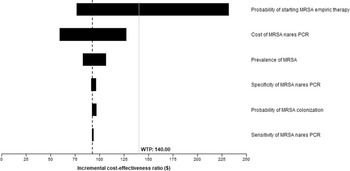
A tornado diagram depicting 1-way sensitivity analysis results is shown in Figure 2. The only parameter whose individual variation caused screening to cost >$140 per incorrect treatment course avoided was the probability of initiating empiric MRSA, where screening would not be favored if empiric therapy occurred in ≤ 49.5% of patients (base case value 80%). PCR cost and MRSA prevalence were also influential, but variation of each over plausible ranges did not cause screening to reach the $140 per empiric treatment course avoided threshold. Variation of MRSA colonization rates and PCR test sensitivity and specificity had lesser influence on results.
One-way sensitivity analysis results for MRSA nares screening versus usual standard of care for inpatient management of pediatric pneumonia and tracheitis, presented as a tornado diagram with model parameters varied over Table 1 ranges and listed based on impact on analysis results. The vertical dashed line depicts base case results, the vertical solid line depicts the $140 per treatment course avoided threshold. If the probability of empiric MRSA treatment is 49.5% or more, PCR may be favorable. Variation of other parameters had less impact on PCR favorability. MRSA, methicillin-resistant Staphylococcus aureus.

A two-way sensitivity analysis was performed, simultaneously varying two influential and potentially highly variable parameters, MRSA prevalence and probability of starting MRSA empiric therapy. As shown in Figure 3, if the likelihood of empiric MRSA treatment is ≥52%, then screening would be favored at the $140 per empiric treatment course threshold if MRSA prevalence ≤ 25%.
Two-way sensitivity analysis. Graph depicts the area where MRSA PCR screening is favored when simultaneously varying the likelihood of prescribing MRSA targeted empiric antibiotic therapy (x-axis) and MRSA prevalence (y-axis). MRSA, methicillin-resistant Staphylococcus aureus.

A three-way sensitivity analysis varying MRSA prevalence, probability of starting MRSA empiric therapy, and cost of the MRSA PCR was performed. As shown in Supplemental Figure 1 included within the Supplemental Material, the PCR becomes less favorable as cost of the assay increases to the highest range value of the parameter ($88).
Discussion
In this analysis, screening was generally favored in centers with moderate to high rates of MRSA empiric therapy when comparing MRSA PCR-related costs and costs for empiric MRSA antibiotic therapy. The analysis also demonstrated that the likelihood of missed MRSA diagnoses was higher in the “no screen” arm compared to the “MRSA screen” arm. Results were sensitive to the likelihood of starting MRSA empiric therapy. MRSA PCR cost, MRSA prevalence, and MRSA colonization rates had little impact on MRSA PCR favorability in sensitivity analyses.
This analysis should be interpreted based on its main outcome, cost per incorrect MRSA-directed antibiotic course avoided and its comparison, an estimate of $140 for MRSA-directed therapy during the rule-out period with necessary drug monitoring. Since antibiotic costs are a component of the outcome, they are not included as parameters in the model; instead, they are used to interpret analysis results. Thus, if empiric therapy costs are higher or lower, the comparison value would also change, with higher costs more favorable to MRSA screening.
In institutions that are more likely to begin empiric MRSA therapy, MRSA PCR may be cost-effective, assuming all other hospitalization costs are equal. For example, in settings where the probability of starting MRSA therapy is 49.5% or higher, MRSA PCR may be cost effective. It is reasonable to consider patient-specific factors in the decision to screen with MRSA PCR, such as those with particular risk factors for MRSA. However, while the favorability of the assay might change based on physician judgement, drawing that conclusion is difficult to justify based solely on the findings of this analysis. Additionally, the exact cost of the MRSA PCR within all potential clinical settings is unknown, though likely will not significantly differ from the base case scenario. However, if the cost is higher than that of the base case, PCR does become less favorable. Importantly, in clinical practice it is likely untrue that all subsequent costs related to MRSA PCR use and its result are equal. For instance, additional MRSA PCR tests could result in a higher number of positive MRSA results, thus necessitating various infection prevention related protocols and costs. Additionally, a positive MRSA PCR test may result in the initiation of unnecessary MRSA antibiotic therapies should a patient not have MRSA recovered by culture, such as those with false positive tests or MRSA colonization only, which could again increase antibiotic costs. These various costs have an unknown exerted effect on the model, and including these estimations could result in an increased area under which the PCR is favorable.
Multiple studies have evaluated the cost effectiveness of the MRSA PCR. However, most studies evaluated its impact on infection prevention-based procedures, or its use related to presurgical screening, but the cost effectiveness of integrating it into routine clinical care is unclear. Reference Hardy, Szczepura and Davies8–Reference Struelens and Denis11 While the MRSA nares PCR is used in adult guidelines for antimicrobial management in certain infectious syndromes and was a strong negative predictor for MRSA infection in pediatric studies, a cost-effectiveness analysis of this tool in management of respiratory disease has not yet been published in pediatric populations. Reference Metlay, Waterer and Long12–Reference Crawford, Pertsovskaya, Shanklin, Zhang and Hamdy14 Our analysis is novel in its approach and may serve to prompt further analyses of MRSA PCR cost-effectiveness. MRSA nasal swab testing is variable across pediatric medical centers. Among settings where this assay is not routinely utilized, pediatric ASPs and clinical care guidelines should prompt its use. This study supports the concept that rapid diagnostics can be an important tool in antimicrobial stewardship. An analysis in adults found that MRSA PCR screening in high-risk adults was cost saving compared to a no screening strategy. Reference Tubbicke, Hubner, Hubner, Wegner, Kramer and Flessa15
Our analysis does not account for costs that may be secondarily saved by decreasing vancomycin use, such as subsequent vancomycin level monitoring, hospitalization costs, or extended courses of empiric therapy. Additionally, the parameters evaluated within this model most reflect those related to cases of CAP or tracheitis. This model did not evaluate parameters that may have additional impact on cases of hospital-acquired pneumonia or tracheitis. The willingness-to-pay threshold of $140 is conservatively estimated given that this threshold evaluated testing from a cost-savings standpoint. As a result, a higher willingness-to-pay threshold might result in a larger set of scenarios where MRSA PCR could be favored.
Conclusion
In summary, we found that screening pediatric patients with the MRSA nares PCR could be a promising tool to rapidly optimize antibiotic therapy for MRSA pneumonia or tracheitis. More data are needed to ascertain additional non-antibiotic costs that could potentially be saved through this tool’s use in the clinical setting, which could then be incorporated in future analyses. Continuing efforts through future prospective study to define clinical impact and patient outcomes with PCR use could elucidate potential antimicrobial stewardship benefits for pediatric patients hospitalized with MRSA invasive disease.
Supplementary material
For supplementary material/s referred to in this article, please visit https://doi.org/10.1017/ash.2025.10043
Acknowledgements
None.
Author contributions
None other than those included in authorship.
This work was previously presented as an abstract at the 13th Annual International Pediatric Antimicrobial Stewardship Conference in St. Louis, MO. It has not been published or presented elsewhere as an abstract or report.
Financial support
This work was supported by the National Institutes of Health [grant number T32HD071834].
Competing interests
Evan E. Facer—Potential Conflicts of Interest:
Cepheid provides support of E.F.’s other research endeavors with test kits but had no input on the study design, analysis or publication. Author also receives support from AbbVie, Inc. to characterize ceftazidime/avibactam use in children which is unrelated to the goals of this study.
Zachary Aldewereld—No conflict.
Michael D. Green—Potential Conflicts of Interest:
ITB-MED: Consultant serving on DSMB not related to stewardship.
Bristol-Myers Squibb: Consultant serving on DSMB not related to stewardship.
Allovir: Consultant serving on an adjudication committee not related to stewardship.
Kenneth J. Smith—Potential Conflicts of Interest:
Author receives grant funding from Sanofi Pasteur to study influenza vaccination and from NICO Corporation for neurosurgical device cost-effectiveness analysis.
Summary
We built a cost-effectiveness decision analysis model based on MRSA prevalence and probability of empiric treatment for MRSA pneumonia or tracheitis. MRSA PCR use may be cost-effective in institutions with moderate to high rates of MRSA empiric therapy.




 Open access

