





Introduction
Psychosocial well-being is a key component of quality of life during palliative care (Madan Reference Madan1992). Maintaining dignity is difficult for patients if they are experiencing existential and psychological burdens (Chochinov Reference Chochinov2006). Dignity Therapy is a brief, person-centered psychotherapy designed to foster dignity in patients with advanced disease (Chochinov Reference Chochinov2002). The intervention involves providing a forum to reflect on one’s life story and consider the personal legacy they wish to leave loved ones. Myriad research indicates Dignity Therapy is effective for enhancing the dignity of individuals suffering from advanced diseases, including cancer (Fitchett et al. Reference Fitchett, Emanuel and Handzo2015). However, some studies have found mixed results (Fitchett et al. Reference Fitchett, Emanuel and Handzo2015; Xiao et al. Reference Xiao, Chow and Liu2019). As Dignity Therapy implementation spreads internationally, identifying mechanisms underlying its effectiveness is critical (Xiao et al. Reference Xiao, Chow and Liu2019) – if we can identify these mechanisms, then we can work to bolster them in the implementation. The present study focused on examining one potential mechanism, the extent of communion participants narrate when talking about their life and legacy during the Dignity Therapy session.
Dignity Therapy is a multidimensional intervention centered on reminiscence and generativity, and grounded in a life story-legacy interview. The content of patients’ narrative responses may be one factor central to effectiveness. Providers guide patients in 2 contexts of narration: telling their life story and considering the legacy they want to leave (e.g., hopes, dreams, instructions they have for loved ones). That is, patients respond to core questions cueing them to look back on the life lived (i.e., life story) and look ahead to when they will be gone (i.e., legacy) (Chochinov et al. Reference Chochinov, Hack and Hassard2005). This process is based on the notion that patients’ sense of dignity will increase post-therapy: narration should foster role preservation, encourage a sense of self-continuity, facilitate a reflection on integrity across the lived life, allow expression of generativity toward important others, and a sense one’s influence will transcend death through others (Chochinov et al. Reference Chochinov, Hack and McClement2002).
While all patients respond with a life story-legacy narrative during Dignity Therapy, how they tell these stories varies (McAdams Reference McAdams2001b; Mroz et al. Reference Mroz, Bluck and Sharma2020). Telling personal stories that are rich, organized, and affect-laden has been linked to greater psychosocial outcomes while telling skeletal, fractured, and emotionally neutral stories, even if factually correct, has not (Bauer and Park Reference Bauer, Park, Fry and Keyes2010; Neimeyer Reference Neimeyer2019). In particular, communion may be a critical component in telling a rich narrative during Dignity Therapy. Based in life story research, communion is defined as the extent to which individuals use a lens of love and care when reflecting on their life story and considering their legacy (McAdams et al. Reference McAdams, Hoffman and Day1996). While individuals may also benefit from sharing difficult or painful sentiments regarding others, communion focuses specifically on these positive elements. Greater communion in life story and legacy narration is linked with an array of positive, health-related outcomes, including greater life satisfaction, greater well-being, and better mental health (Adler et al. Reference Adler, Dunlop and Fivush2017; Grossbaum and Bates Reference Grossbaum and Bates2002; Grysman Reference Grysman2022). Accordingly, we hypothesize that greater communion narration during the life story-legacy interview of Dignity Therapy is one mechanism of increased patient dignity post-intervention.
Recalling one’s life story and generating a legacy, though both part of Dignity Therapy, are different psychosocial tasks for the patient. Narrating greater communion during the life story may support patient dignity through guided reflection on their past lived experience of having caring, warm relationships (McAdams et al. Reference McAdams, Hoffman and Day1996). In contrast, communal legacy narration involves looking into one’s future to create a generative, caring narrative regarding wishes and goals for loved ones that will be left behind after death (McAdams et al. Reference McAdams, Diamond and De1997). Note that these constructs do not simply capture individuals who had more loving, warm relationships during their life. Rather, communal narration reflects an individual difference in how patients select and communicate memories. With the goal of increasing Dignity Therapy utility, it is useful to identify whether dignity outcomes are impacted by communion during either or both the life story and legacy portion of Dignity Therapy to target improvements in how providers may facilitate and support patients.
The current study
This study has 3 central aims. First, the extent of communion expressed in the Dignity Therapy session is evaluated as a mechanism (i.e., mediator) for facilitating greater patient dignity from pre- to post-test. Second, the effects of communion narration during the life story and during the legacy portions of Dignity Therapy are examined separately to determine whether one part of the Dignity Therapy session is key for increasing patient dignity. Finally, exemplars of how communion manifests in Dignity Therapy are provided to elaborate on communal themes that support individual patient dignity.
Methods
Design
Data for this study was drawn from a 3-arm, pre- and post-test, randomized, controlled 4-step, stepped-wedge study examining the use of Dignity Therapy to improve seriously ill cancer patients’ sense of dignity (Kittelson et al. Reference Kittelson, Scarton and Barker2019). The present study conducted secondary data analysis on data from participants who completed Dignity Therapy using content coding and mediation analyses.
Setting
Recruitment occurred in 6 large U.S. medical centers.
Recruitment
Eligibility criteria included: (1) diagnosed with cancer, (2) receiving outpatient palliative care, (3) 55 years or older, (4) speaks and reads English, and (4) able to complete the study.
Sample
Participants were 203 older adults (M = 65.80 years; SD = 7.45 years, Range = 55–88 years; 66.01% women). They self-identified their race/ethnicity as 77.94% White, 11.76% Black or African-American, 7.84% Hispanic or Latino, .49% American Indian or Alaska Native; .49% Asian, .49% Native Hawaiian or other Pacific Islander, and .98% declined. The majority (82.84%) had completed education post-high school and about half (48.53%) had a college degree.
Data collection
Participants completed self-report measures about sense of dignity, symptom severity, and demographics. They then engaged in a Dignity Therapy interview with a trained provider following a standardized interview protocol framed by 9 core questions. Four questions focused on telling one’s life story (e.g., “Tell me a little about your life history; particularly the parts that you either remember most or think are the most important?”) and 5 focused on leaving a legacy (e.g., “Are there words or instructions that you would like to offer your family to help prepare them for the future?”) (4, 5). About 3–5 weeks later, participants completed a post-test assessing impact on their sense of dignity. Dignity Therapy sessions were audio-recorded, transcribed, and de-identified for narrative coding analysis. Average duration of sessions was 48.70 minutes (SD = 13.10). Patients were compensated $150 for completion. All data were collected between 2019 and 2022.
Ethics and consent
The Institutional Review Board at each of the 6 sites approved the study (https://clinicaltrials.gov: NCT03209440). The University of Florida Institutional Review Board (RB201601190, “Dignity Therapy for Older Cancer Patients: Identifying Mechanisms and Moderators”) approved all research activities. All participants provided written informed consent.
Measures
Dignity impact
The major variable of interest was patient dignity. The Dignity Impact Scale is a 7-item scale assessing impact of care on patients’ current sense of dignity and psychological well-being (Chochinov et al. Reference Chochinov, Kristjanson and Breitbart2011). Patients respond on 5-point scales from “strongly disagree” to “strongly agree” to statements such as “The care I received during the past month has given me a heightened sense of purpose.” Other items tap into patient dignity through questions about whether recent care helped resolve unfinished business, made life feel more meaningful, lessened sense of depression and helped with family connection. Sum scores ranged from 7 to 35 (M = 24.31, SD = 4.38) at pre-test and 13 to 35 (M = 26.21, SD = 4.57) at post-test. Cronbach’s α was .79 at pre- and .84 at post-test.
Communion in Dignity Therapy narratives
Communion, defined as expression of loving, caring or closeness with others, was coded using narrative analysis (McAdams et al. Reference McAdams, Hoffman and Day1996). We adopted a modified version of a well-established codebook for assessing communion in open-ended narrative data (McAdams Reference McAdams2001a). We employed best practices for narrative analysis (Adler et al. Reference Adler, Dunlop and Fivush2017; Bluck et al. Reference Bluck, Mroz and Wilkie2022). Two coders were rigorously trained on pilot narratives and achieved strong inter-rater reliability (κ = .85). Communion was coded as present when utterances referred to: love and friendship toward others, caring and helping others, and feelings of unity and togetherness. Transcripts were divided into idea units that were coded with a “1” if the subtheme was present and a “0” if the subtheme was absent. Accordingly, each idea unit could receive a sum communion score from 0 (no communion present) to 3 (love and friendship, caring and help, and unity togetherness all present). Narratives were double-coded for additional rigor. Remaining discrepancies were resolved through discussion. Coder drift was mitigated through regular meetings. Across the whole Dignity Therapy session, mean number of instances of communion ranged from 0 to 26 (M = 8.29, SD = 4.66). Communion ranged from 0 to 17 instances (M = 5.12, SD = 3.24) within the life story portion and 0 to 18 (M = 3.16, SD = 2.71) in the legacy portion.
Symptom severity
We assessed symptom severity to adjust for patients’ mental health and physical functioning. Symptom severity was measured with the 10-item Edmonton Symptom Assessment System assessing pain, tiredness, nausea, depression, anxiety, drowsiness, appetite, well-being, shortness of breath, and other symptoms (Watanabe et al. Reference Watanabe, Nekolaichuk and Beaumont2012). Items were measured on a Likert scale where 0 = no presence of symptom and 10 = worst possible experience of symptom. Sum scores ranged from 0 to 77 (M = 26.90, SD = 15.02) at pre-test. Scale reliability was good (α = .77).
Data analyses
We addressed the first aim with a model examining communion as a mediator of improvement in Dignity Impact from pre- to post-test. For Aim 2, we conducted an additional model assessing if mediation effects differed by whether communion occurred during the life story or the legacy portion of Dignity Therapy. Given that life story focuses on reminiscence and legacy centers on future generativity, we anticipated that communion may function differently during these sections. Race, education level, and symptom severity were covariates in all models. Complete data was used. Models were fit in MPlus 7.4 (Muthén and Muthén Reference Muthén and Muthén1998). Model fit is considered good if the comparative fit index (CFI) is greater than or equal to .95, root mean square error of approximation (RMSEA) is less than or equal to .06, and standardized root mean square residual (SRMR) is less than or equal to .05 (Kline Reference Kline2005). To address the third aim, we extracted exemplars from patients’ narratives.
Results
Aim 1. To evaluate whether extent of communion expressed in the Dignity Therapy session acts as a mechanism for increased dignity from pre- to post-test
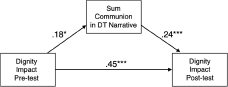
Results from the first communion mediation model are shown in Fig. 1. The relation of Dignity Impact from pre- to post-test was partially explained by an indirect effect through extent of communion narration (B = .05, p < .05), indicating mediation. Further, narrating a greater extent of communion in their Dignity Therapy session was significantly and directly related to more positive Dignity Impact at post-test (B = .24, p < .001). Addition of covariates did not affect the pattern of findings.
Sum communion mediation model.

Aim 2. To evaluate whether this effect differs for the life story and the legacy portions of patients’ narratives
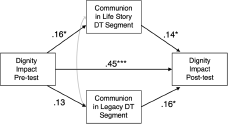
Greater communion in both the life story (B = .14, p < .05) and legacy (B = .16, p < .05) segments of Dignity Therapy had significant direct effects on post-test Dignity Impact (see Fig. 2). However, neither life story communion (B = .02, p = .12) nor legacy (B = .02, p = .14) communion individually contributed indirect effects to relations between pre-test Dignity Impact and post-test Dignity Impact. That is, patients’ expression of communion could occur anywhere in the Dignity Therapy session and still support increased patient dignity. Addition of covariates did not affect the pattern of findings.
Communion in life story and legacy DT segments mediation model.

Aim 3. To provide exemplars of how communion manifests in Dignity Therapy sessions
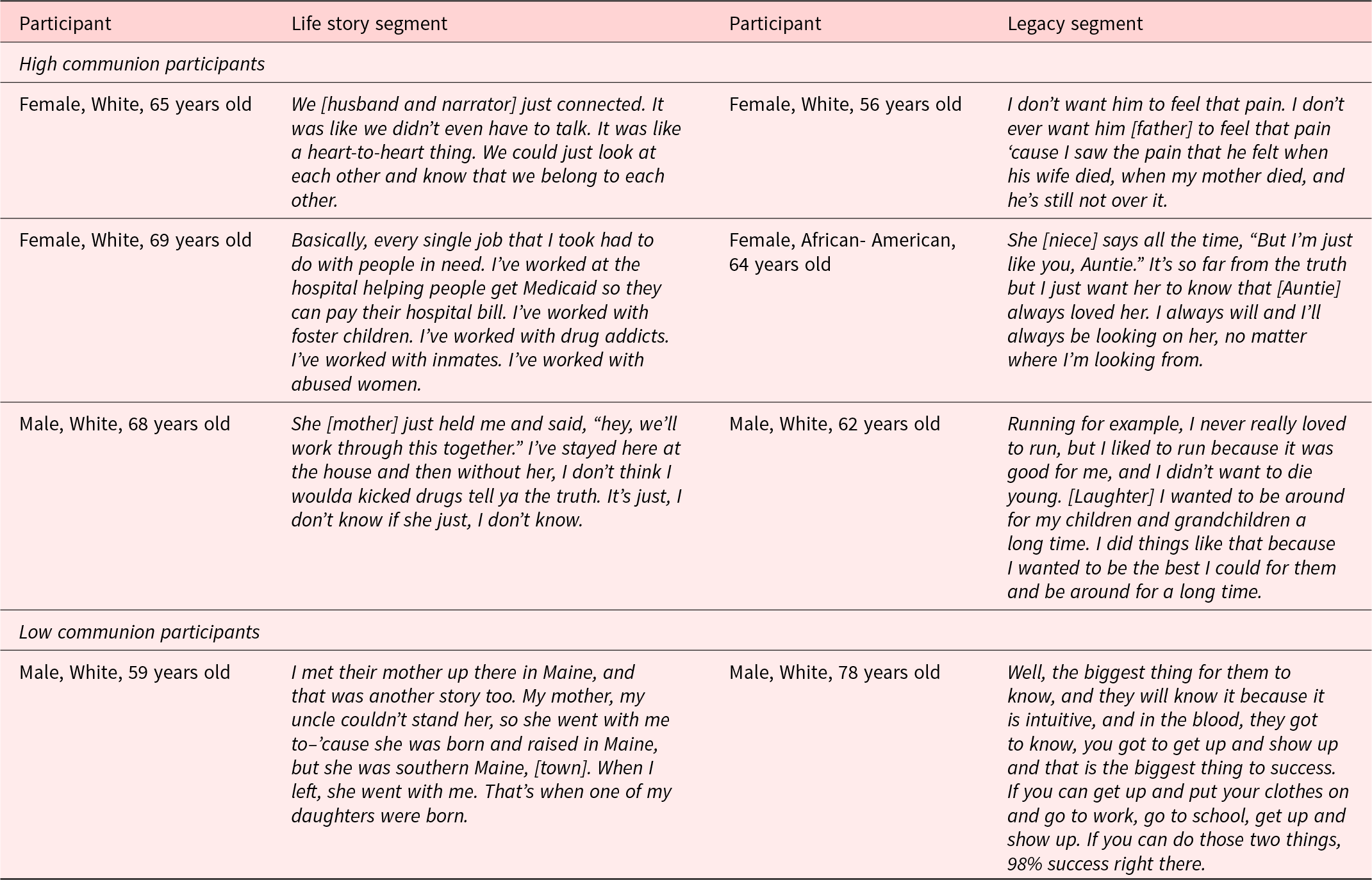
Patients often talked about typical life events (e.g., work-life, children). However, they differed in how they narrated events. Patients high in communion described life experiences emphasizing love and caring. For example, one high communion participant described first meeting her spouse, including the warm connection they quickly shared (Table 1). In contrast, a low communion participant described a similar event but did so without a communal focus. Patients who narrated more than 13 instances of communion were considered exemplars of high communion whereas those with less than 4 instances were considered exemplars of low communion. It is the events that occur in one’s life but also the ways in which individuals tell their stories and legacy that is critical to patient dignity outcomes.
Examples of high and low communion narration during dignity therapy

Note: Narrative exemplars from participants who showed high levels (more than 13 occurrences) and low levels (less than 4 occurences) of communion throughout their narratives. Exemplars are included from legacy and life story sections of the transcript.
Discussion
Patient dignity is a paramount concern in end-of-life care, particularly for individuals grappling with serious and terminal illnesses. Dignity Therapy has emerged as an effective intervention to address this concern with international implementation success. Patients are offered a person-centered approach that allows them to narrate their life stories and legacies. While previous research has demonstrated the utility of Dignity Therapy in enhancing patient dignity, there remains a need to identify mechanisms underlying its effectiveness. Present quantitative findings provide compelling evidence that the extent of communion expressed by patients during Dignity Therapy is a significant mechanism for enhancing patient dignity between pre- and post-intervention. In addition, the effect of communion was not limited to a specific segment of the Dignity Therapy session. This underscores the importance of fostering communion throughout the entirety of the therapeutic process, rather than focusing solely on 1 aspect of the patient’s narrative.
Quantitative findings suggest that warm, loving relations when facing advanced cancer may support patient dignity during Dignity Therapy interventions. These trends may also be expanded to other aspects of clinical care. For instance, narrative exemplars highlighted the significance of interpersonal relationships and emotional connections in supporting patient dignity, reinforcing the importance of a person-centered approach in end-of-life care. Accordingly, the encouragement of communication rich responses or narratives could apply to other healthcare settings outside of Dignity Therapy, such as palliative and psycho-oncological care. Although time may be more limited in other care settings compared to Dignity Therapy, incorporating a brief life review question may be beneficial for patient dignity (e.g., What was your most memorable role?). Specific to Dignity Therapy, providers may be trained to encourage patients in communal expression during sessions to enhance patient dignity. However, this should be attuned to the patient as individuals wanting to express remorse or regret may not be interested or benefitted by such redirection.
The present study raises several intriguing questions for further investigation that may support insight into providing quality care to seriously ill patients. Given present results benefiting psychosocial outcomes, future research should identify when Dignity Therapy may also relieve physical symptoms. This may contribute to end-of-life healthcare utilization through improving patient outcomes while limiting unwanted burdensome care. In addition, Dignity Therapy providers may test whether using questions that reframe negative emotions (e.g., “What was learned from that challenging experience that helped the relationship grow in the future?”) also helps patients experience greater dignity outcomes.
Limitations of the present study include that the sample predominantly consisted of older adult patients with cancer receiving outpatient palliative care, limiting the generalizability of the findings to other populations. Further, the present sample was American and predominately White. While effects held even when accounting for patients’ race, education level, and symptom severity, future research is needed to understand whether Dignity Therapy performs optimally under different conditions for patients from a broader range of racial and cultural backgrounds. Finally, the present data did not include relationship quality measures, which may be important to include as a covariate when considering the effects of communion in life story and legacy narration.
A strength of the present study was the use of the life story and legacy narratives that are produced by patients during Dignity Therapy sessions. By examining these interviews quantitatively, we were able to identify how mechanisms that occur during sessions may impact patient dignity outcomes. This is important because prior work has not examined the narrative processes that may help explain why Dignity Therapy is effective for patient dignity.
Conclusions
This study contributes to our understanding of the mechanisms underlying the effectiveness of Dignity Therapy in enhancing patient dignity. By highlighting the role of communion in patient narratives during therapy sessions, we provide valuable insights for improving psychosocial interventions in end-of-life care. In addition, Dignity Therapy is a therapeutic approach that can be applied to palliative care in the shared pursuit of understanding and supporting the dying person. Palliative care teams may draw similar insights from present findings to help further understand the dynamics of fostering patient dignity during clinical practice. Future research should continue to explore the complex interplay between narrative elements and patient outcomes to further optimize the delivery of person-centered care for individuals facing advanced illness.
Acknowledgments
Research reported in this publication was supported by the National Cancer Institute of the National Institutes of Health [R01CA200867, R01CA253330].
Competing interests
The authors declared no potential conflicts of interest with respect to the research, authorship, and/or publication of this article.

 Open access

