

Introduction
Dr di Giura, retiring physician of Peking, is leaving Shanghai today by the Lloyd Triestino str. Gange for Italy. Dr di Giura is one of the oldest foreign residents in North China, having arrived in 1900. He was physician to the Italian Legation and Italian Guard and had many friends in Chinese official circles. (The North-China Daily News, 23 March 1931).
This report profiled an Italian doctor who lived among the local elite in early twentieth-century China.Footnote 1 Upon his return, Dr di Giura, formally known as Ludovico Luigi Nicola di Giura,Footnote 2 resettled in his family estate in Chiaromonte, a mountain town in the Basilicata region of Italy, where he curated a study room adorned with books and artwork collected during his stay in China, creating an intriguing juxtaposition of the study room and the panoramic view of Lucanian mountains and valleys just outside.
This paper delves into di Giura's ‘Chinese library’ to reveal the individual's profile through the examination of his evolving cultural inclinations and emotional motivations. Specifically, it will reveal di Giura's textual engagements with China and his related social and cultural experiences. In reference to his individual experiences, the study will present the conditions that existed and the resources that were available in the local cultural milieu for other Italians in Beijing, as well as the uniqueness of di Giura's involvement with China.
Di Giura was born into an aristocratic family of barons on 18 February 1868. Two years earlier, in 1866, Italy and China had established official diplomatic relations with the signing of the Treaty of Commerce and Navigation in Beijing.Footnote 3 However, this did not seem to significantly enhance the mutual knowledge and interest between the two countries. On the diplomatic front, Italy did not differentiate its diplomatic representations between China and Japan until 1878, and the permanent legation in the Chinese capital, Beijing, had not begun operations until 1889. Culturally, Italian studies about China from the late eighteenth century to the first half of the twentieth century were often considered to be in decline compared to the studies of other European powers like the United Kingdom and France, and to the studies about China in earlier centuries when Italian Jesuit missionaries were pioneers in China-Europe cultural exchanges.Footnote 4 For a contemporary Italian not specialised in orientalist or sinological studies, knowledge about China would not be easily accessible through daily reading, such as in newspapers or popular literature.
Regarding di Giura's educational background, as a ‘cadet son’ in an aristocratic family, he chose a conventional path in medicine and military service. On 28 June 1888, he participated in the conscription in the municipality of Salerno, enlisting as a second-category soldier. In 1891, he graduated in Medicine and Surgery from the Royal University of Naples.Footnote 5 At the end of the year, he was assigned to the Corpo Sanitario Militare Marittimo as a second-class doctor.
Therefore, before his long-term stay in China, di Giura did not have specialised training in studies related to the country, nor did he possess the preconceived observational paradigms common among, for example, professional journalists, anthropologists, or geographers. Instead, his background holds the potential to reveal an authentic perspective of China from an ordinary Italian's viewpoint, which can be discerned from his diaries during a global navigation mission to which he was assigned by the Italian Navy from 1894 to 1896. During this mission, di Giura visited China for the first time and recorded his impressions of the local society and culture (Reference Di Giura1977, 76–136). Generally, the diaries suggest a notable attention to the inferior distinctiveness of indigenous elements, especially the hygienic conditions and local customs, echoing Edward W Said's description of Orientalism as a style of thought based on the distinction between ‘the Orient’ and ‘the Occident’ (Reference Said1979, 1–3).Footnote 6
Rather than being a result of a prepared personal plan, di Giura's arrival and extended stay in China appeared to be much affected by the circumstances of contemporary Italian-Chinese relations. On 14 August 1900, he arrived in China by the cruiser Fieramosca as part of the Forza navale oceanica, dispatched by the Italian Ministry of War to participate in the multinational military intervention against the Boxers.Footnote 7 Afterwards, he remained in Beijing as the doctor for the Italian Navy detachment on guard at the Italian legation (ASDMAE 1902a). The legitimacy of his continued presence in China was enabled by the Boxer Protocol in 1901, which recognised the right of the powers to maintain a permanent legation guard, and granted Italy 5.9 per cent of the indemnity, amounting to around 27 million taels (approximately 100 million French francs) (Samarani and De Giorgi Reference Samarani and De Giorgi2011, 31–32).
During his stay in Beijing, di Giura provided medical services to the Chinese and was a director of an Italian dispensary that commenced construction in 1905 with the support of Associazione Nazionale per Soccorrere i Missionari Italiani (hereinafter referred to as ANSMI), which received approximately 18 per cent of Italy's share of the Boxer indemnity (Francioni Reference Francioni2004, 156).Footnote 8 In addition, he engaged in local medical affairs and institutions, including the Peking Union Medical CollegeFootnote 9 and the Peking Central Hospital.Footnote 10 Combined with his language studies and cultural interests, the Italian doctor built a social network that connected him with the political and cultural elite of Beijing, including esteemed literati, former royal family members, and influential officials of the Republic of China.
At the same time, Italian public opinion experienced a surge in interest towards China, driven by diplomatic events between the two countries at the turn of the twentieth century. Following China's defeat in the First Sino-Japanese War of 1895, foreign powers engaged in a ‘partition of China’ to secure interests in China through territorial concessions and market penetrations. Initially, Italy cautiously acknowledged the unfavourable conditions of seeking concessions in China, but eventually sought to seize the opportunity to rebuild its global reputation by requesting from the Chinese government the lease of Sanmen Bay in Zhejiang province. However, the request was rejected by the Chinese government, resulting in significant impacts in both countries. In Italy, these events heightened public attention on foreign policies in the Far East, which was further intensified by Italy's military involvement against the Boxers the following year. This surge in public interest facilitated not only the emergence of journalistic reports introducing the socio-political situation in China, but also the emergence of informative works delving into various aspects of Chinese culture.Footnote 11
Grounded in his direct engagement with the local society, di Giura was able to participate in this trend. He provided approximately 40 articles about the Chinese situation for prestigious platforms, including the journal Nuova Antologia and the daily La Stampa, which allowed his observations to reach a large educated audience. In the final decade of his stay, he sought to introduce Chinese literature to Italy by translating Liaozhai zhiyi (Strange Tales from the Study Liao), Confucian maxims, Li Bai's poems, and selected poems from the Chinese novel Hongloumeng (Dream of the Red Chamber) (P'u Reference P'u1926; Di Giura Reference Di Giura1926, Reference Di Giura1929, Reference Di Giura1930). Moreover, he authored a novel set in 1920s Beijing (Reference Di Giura1931). Six novels that he collected about historical Chinese female figures were posthumously published by Mondadori in an anthology in Reference Di Giura1958. An additional essay on the Boxers and the Dowager Empress Cixi (1835–1908) was published in Il Veltro journal in Reference Di Giura1962. In the 1920s, when Italian Fascism was introduced into China and its ‘strategic outposts’ – the Fasci – were established in Shanghai, Tianjin, and Beijing, di Giura supported it through his journalistic publications and political activities (De Caprariis Reference De Caprariis2000; Lasagni Reference Lasagni2019, 67). In 1924, he published an article in the local daily Shuntian shibao (Shuntian Times) under two pseudonyms, stressing the importance of finding a young Chinese similar to Mussolini to rescue China from its struggles (Moushi/Yiguomoushi 1924). On 21 April 1926, he participated in the assembly for the formation of the Fascio of Beijing. By 30 October 1928, he had assumed the role of secretary of the Fascio (The North China Standard 1928).Footnote 12
In recent years, di Giura's translation efforts have garnered attention by Chinese scholars (Gu Reference Gu2021; Chen Reference Chen2022; Wang and Wen Reference Wang and Wen2024). In contrast, attention to his historical figure and intellectual biography remains limited, and this article aims to offer insights by examining his personal library.
The following sections will examine di Giura's library in reference to the ‘Heraclitean approach’ proposed by Weingarten (Reference Weingarten, Camlot and Weingarten2022). According to Weingarten, a library, akin to a Heraclitean river, is subject to continual ebbs and flows that cause dramatic, subtle, or even imperceptible changes in form and meaning. Given this ever-changing quality, Weingarten warned of the risk of oversimplifying the relationship between the collector and their book collection by hastily or rigidly characterising either the collector or the collection.
Nevertheless, this sceptical concern does not deny the potential of a personal library for researching its owner's biography. In this context, Weingarten considered personal libraries symbols of individual and communal longings (Reference Weingarten, Camlot and Weingarten2022, 233). Specifically, an individual's collection could reveal what they aspired to, desired, or reached for, under circumstances shaped by emotional, psychological, and/or historical contexts. To discern these longings, scholars need to apprehend a greater whole, find larger contexts, and consistently observe the impermanence and instability of the library. Metaphorically, scholars need a ‘Heraclitean perspective’ of the collection and the collector, whose tastes, beliefs, ideas, era, and self are ever-changing. The task is not to pin down the meaning of a collection, but to observe and chart its ‘ebb and flow’ (237).
To interpret di Giura's library, Weingarten's approach can provide a solid theoretical foundation on both an ontological and an epistemological level. Firstly, most of the volumes in the library were collected by di Giura during his stay in Beijing from 1900 to 1931, a period when he encountered and engaged with the local socio-cultural context, which featured considerable changes from the imperial to the republican era. Observing the ‘ebb and flow’ of di Giura's collection over time would thus provide insight into the evolution of his individual longings and the constantly changing cultural milieu surrounding him. Secondly, the study of both di Giura's historical figure and his library has been limited. For this initial study of di Giura's intellectual biography, Weingarten's open-minded critical approach appears to be particularly suitable for its emphasis on avoiding hegemonic claims to a singular truth about the collector and collection.
On a practical level, Weingarten demonstrated a feasible solution to avoid oversimplification of the relationship between collector and collection in his study of the Canadian writer F R Scott's library, by emphasising attention to multiple interpretations of the marginalia in books (Reference Weingarten, Irvine, Lent and Vautour2017). Specifically, for texts without annotations, researchers should be cautious of overestimating their meaning and potential to reveal the collector's reading habits merely because of their physical presence. For books with marginalia, scholars need to acknowledge the multiple interpretations of these signs, symbols, dialogues, and other traces to avoid creating false claims to hegemonic interpretation. The same attention will be applied to di Giura's library, which comprises 296 units of books in total,Footnote 13 among which 99 contain marginalia.Footnote 14 Meanwhile, the quantitative nature of his books will not be overlooked, in view of the long-distance transportation that potentially gave each of them more significance than those in fixed-location libraries.Footnote 15
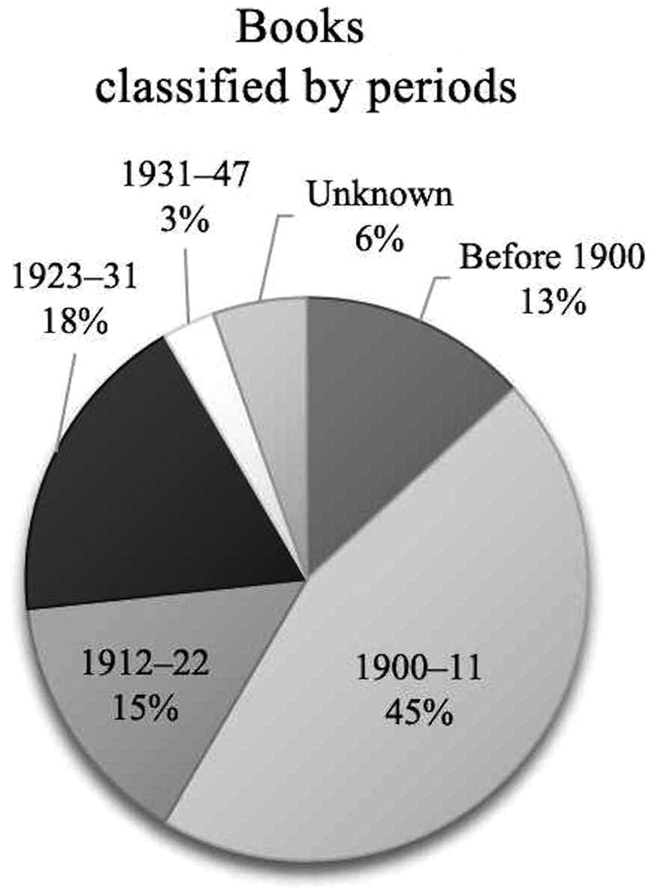
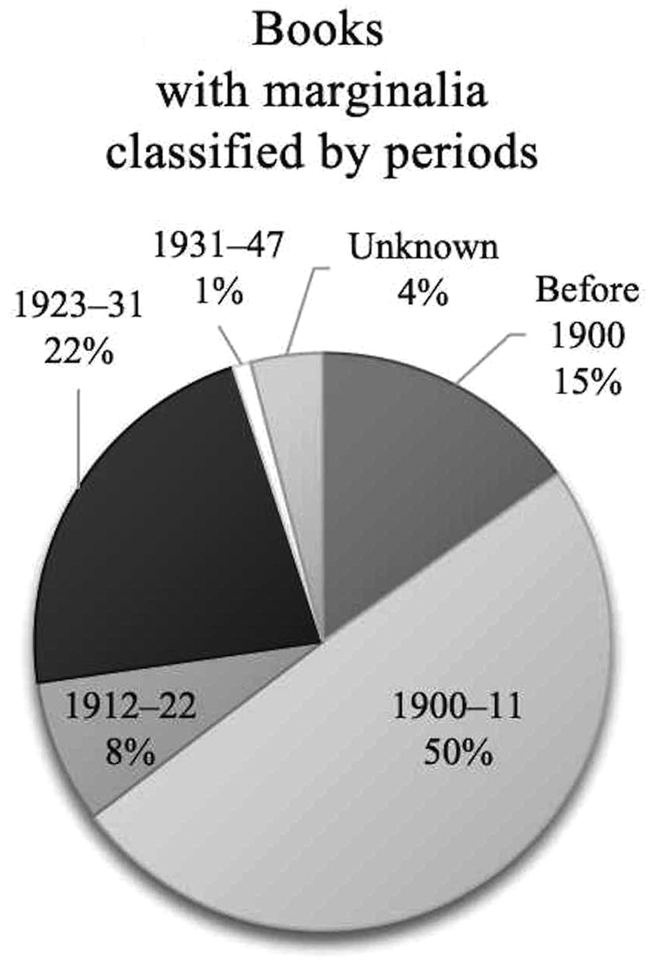
To observe the ‘ebb and flow’ of di Giura's library, the paper adopts a chronological categorisation, despite the challenge posed by the owner's infrequent dating (only 29 units out of 296 have documented dates). The primary criterion is the time of publication, with a priority given to the time of use or acquisition for the 29 units with documented dates.Footnote 16 By adopting cut-off points for years including 1900, 1912, 1923, and 1931, which mark respectively di Giura's arrival in China, his temporary return to Chiaromonte, his commencement of a considerable amount of translations and writings, and his permanent return to Italy, the total of 296 units and 99 units with marginalia will be categorised, as illustrated in Figure 1 and 2.
Books classified by periods.

Books with marginalia classified by periods.

In terms of Figure 1 and 2, the subsequent sections will focus on books categorised in 1900–11, 1912–22 and 1923–31, respectively, to examine di Giura's evolving cultural longings and emotional motivations reflected by his collection and marginalia within the books, and to utilise his personal experiences as a lens for observing the dynamics of Italians in early twentieth-century China.
1900–1911: Transcultural background and multifaceted image
The largest chronological section comprises books from 1900 to 1911, totalling 134 units. These years are significant from both the micro-scale perspective of di Giura's library and the macro-scale perspective of Chinese history. Following the Boxer uprising, China underwent significant changes, including the reforms attempted by the imperial monarchy and a surge of revolutions, culminating in the 1911 Revolution that marked the end of the Qing dynasty and led to the establishment of the Republic of China. In this context, di Giura built a multifaceted image, as discussed in this section.
Dr di Giura and his medical treatises
In Chinese archival and bibliographical sources, di Giura's image as a Western doctor was particularly notable in China at the time.Footnote 17 The doctor's library contains ten medical treatises published and collected during his initial decade in China. Among them is a medical textbook composed by di Giura himself, titled Xinyi dubing huibian (Tu-Ping-Hue-Pien: Lezioni sulle malattie infettive dettate al Dispensario Italiano di Pechino), which sheds light on his efforts to impart Western medicine to his assistants at the Italian dispensary in Beijing (Reference Di Giura1907a). This teaching approach aligns with the prevalent paradigm during the period of the early introduction of Western medicine to China, when a doctor heading a medical institution would transfer knowledge to local assistants who then edited treatises based on the doctor's dictation (Hao Reference Hao2005).
Additionally, according to the travel account about China written by Italian mathematician Giovanni Vacca (1872–1953), di Giura used a Japanese manual on anatomy in teaching activities due to the lack of standardised Western medical terminology in Chinese (Lioi Reference Lioi2016, 114). This manual could potentially be the Chinese rendition of the Japanese textbook Jitsuyō kaibōgaku (Practical Anatomy) by Tsukanu Imada (Reference Imada1907), which is held in di Giura's library.
Regarding the medical terminology issue, the China Medical Missionary Association formed the Committee on Medical Terminology in 1890 (Zhang Reference Zhang1994, 16). In 1908, di Giura acquired two reference volumes edited by members of the committee (Committee on Medical Terminology 1904; Cousland Reference Cousland1908). The acquisition, along with di Giura's notes on the pronunciation of Chinese terms related to bones in Cousland's work, may be relevant to his position on the Examining Board at the aforementioned Peking Union Medical College. Between 1908 and 1915, he served as an examiner at the college, and specifically as Examiner in Anatomy in the academic year from 1913 to 1914 (Cochrane Reference Cochrane and MacGillivray1910, 218; Jiang Reference Jiang2018, 43, 177).
Moreover, two units on the 1911 plague outbreak in north-eastern China are associated with di Giura's anti-epidemic efforts: an unedited report on the anti-epidemic service in Mukden (now Shenyang) and an album titled Views of Harbin (Fuchiatien) Taken during the Plague Epidemic (1911). In April 1911, he participated in the International Plague Conference in Mukden as one of the Italian delegates alongside Gino Galeotti (1867–1921) and Ernesto Signorelli, delivering a speech on the correlation between the 1898 Bombay pneumonic plague and the contemporary epidemic (Strong Reference Strong1912, VII, 180–182).Footnote 18
As Feuerwerker (Reference Feuerwerker and Fairbank1983, 167) noted, modern Western medicine in China was significantly influenced by missionary efforts: the development of Western medical institutions generally followed the spread of missionary activities. The first institution appeared in Canton in the 1830s, followed by those in treaty ports like Shanghai, and eventually expanded throughout the country. In Beijing, the first medical institution was established in 1861 by William Lockhart (1811–1896), supported by the London Missionary Society. Subsequently, John Dudgeon (1837–1901) further advanced the medical mission with his Shuangqigan Hospital, founded in 1864, by introducing Western medicine to Chinese official circles. During di Giura's stay in Beijing, the number of Western medical institutions significantly increased. In 1900, notable hospitals included Lockhart's, Dudgeon's, the Douw Hospital for Women and Children, and the Peking Methodist Hospital (He Reference He2016, 116). By 1917, the number of hospitals in Beijing had grown to 38, and reached 46 by 1919 (Gamble Reference Gamble1921, 118). Consequently, di Giura's initial status as one of the few Western doctors in Beijing may have diminished over time, making the need to distinguish himself and his Italian Dispensary from various colleagues and competitors more pressing. This may have driven him to engage more deeply with Chinese society and culture.
Learning Chinese language to be a ‘Sapient Confucian Scholar’
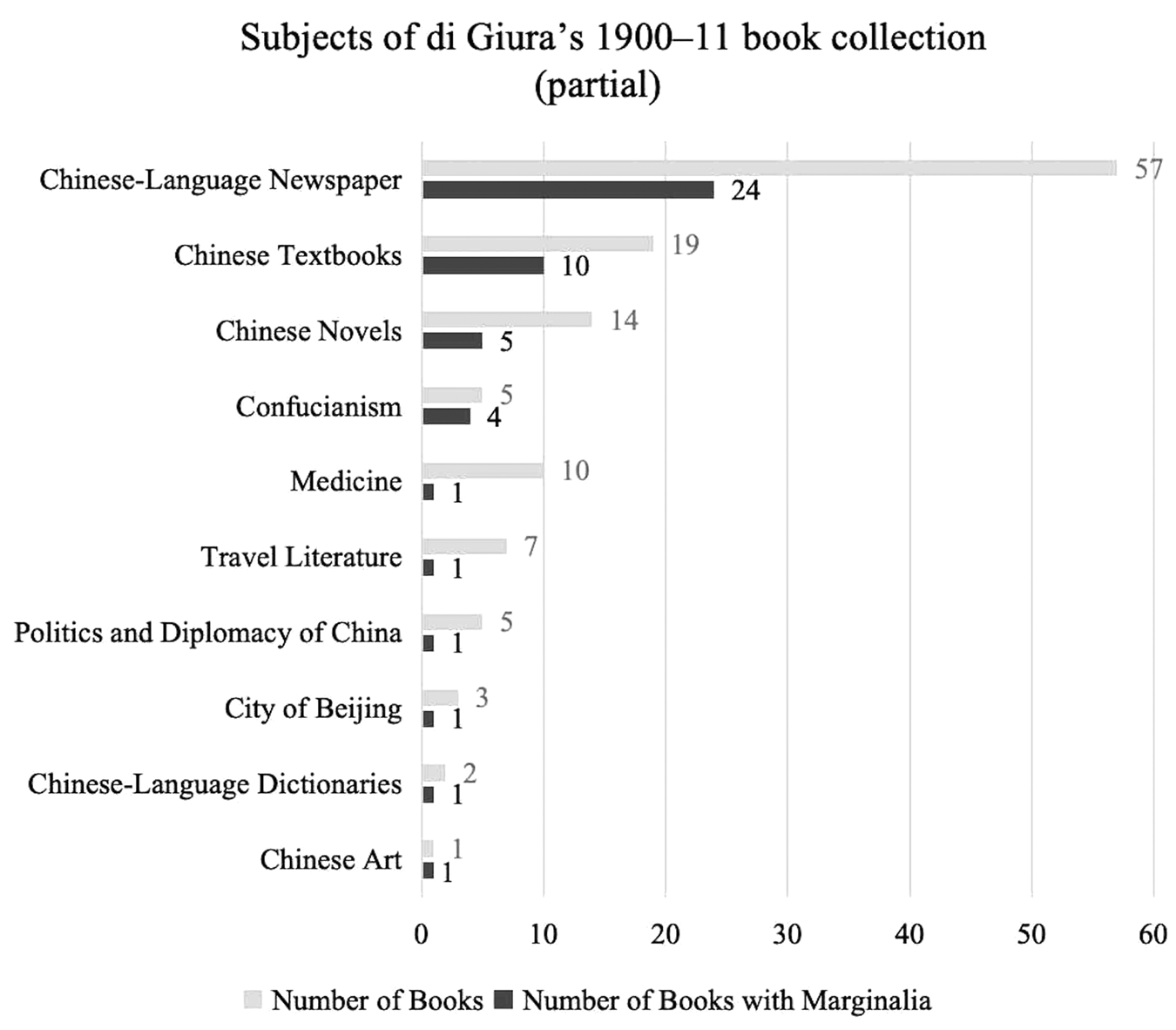
Between 1900 and 1911, di Giura acquired 19 Chinese textbooks and studied ten of them.
His marginalia in Chinese textbooks include underscores of Chinese characters and corresponding annotations of pronunciation. Such attention to orthography not only demonstrates di Giura's personal need of communication, but also mirrors a common phenomenon among foreign learners during the time when spoken Chinese lacked standardisation. In the late nineteenth century, foreign missionaries and diplomats engaged in heated discussions over which dialect best represented the modern spoken language of China, with the Beijing and Nanjing dialects at the forefront of the debate (Kaske Reference Kaske2008, 66–74). This was reflected in di Giura's library, particularly in two textbooks notable for his thorough study, with a considerable amount of his pronunciation annotations: Boussole du langage mandarin (Boucher Reference Boucher1900), which is based on the Nanjing official language, and Peking Dialect: T'an Lun Hsin P'ien (Jin and Hiraiwa Reference Jin and Hiraiwa1900), which is a reference to the dialect spoken in Beijing.
Di Giura displayed a wide range of reading interests when he was learning Chinese language, as illustrated in Figure 3.Footnote 19
Subjects of di Giura's 1900–11 book collection (partial)

As observed in Figure 3, despite the number of books on Confucianism not constituting a majority of his collection, di Giura read books on Confucianism (four out of five) most frequently. Confucianism emerges as a vital subject for the Italian doctor's initial exploration of Chinese culture. He had a habit of taking down the dates he finished reading in books with detailed annotations: there are only seven such books in the entire library, four of them Confucian classics, which were studied during di Giura's first decade in China (Chen Reference Chen1904; Couvreur Reference Couvreur1896, Reference Couvreur1897, Reference Couvreur1899). His study of Chen's work was completed in 1908, and the other three were finished in 1910. He treated these classics like language textbooks, studying them by making typical underscores and pronunciation annotations of Chinese characters.
In contrast to our efforts to infer di Giura's passion for Confucianism based on his reading, Chinese people of his time had no trouble recognising such passion from his choice of a Chinese name: Ru La儒拉.Footnote 20 The character Ru exactly indicates Confucianism. Along with his ‘courtesy name’ – zitong 子通 – he was referred to as Ru Zitong (Sapient Confucian Scholar).Footnote 21 It remains unknown whether he or his Chinese acquaintances chose the name, but his intention to create a profile as a Confucian-trained intellectual is notable.
Reporting on China's situation to Italy
From 1905 to 1911, di Giura acquired 57 units of Chinese-language newspapers: 17 monthly collections of Yuzhe luyao (Edicts and Memorials) from January 1905 to June 1906; 15 monthly collections of Jinghua ribao (Jinghua Daily) from January 1905 to May 1906; and 25 monthly collections of Zhengzhi guanbao (Political Gazette) from March 1909 to June 1911.Footnote 22 At the time, these were among the most influential newspapers in Beijing.Footnote 23 Additionally, a notebook discovered in the library contains newspaper clippings annotated by di Giura from 1907 to 1925, with news from 1907 to 1908 composing roughly one-third of the total.
As mentioned earlier, di Giura published three articles on Chinese socio-political events in Nuova Antologia journal (Reference Di Giura1905, Reference Di Giura1907b and Reference Di Giura1910), demonstrating a noteworthy reformist stance. For example, being delighted to see the Chinese government's promotion of exchanges by sending officials abroad in preparation for institutional reforms, di Giura extensively reported on the officials’ international travels and the reform initiatives they proposed upon their return to China (Reference Di Giura1907b, 492–498).Footnote 24 Regarding these events, he read news about the visits of Duanfang (1861–1911) and Dai Hongci (1853–1910) to Denmark and Norway, the administrative reorganisation for constitution establishment, and the edict to send military officials to visit the United States and Japan.
Di Giura's interest in the local socio-political context can also be observed through his reading of popular literature. Among the 1900–11 Chinese novels with marginalia, four of the five are allegorical narratives of social criticism (Liu Reference Liu1907; Li Reference Li1906; Wu Reference Wu1906, Reference Wu1907). Among them, Ershinian mudu zhi guaixianzhuang (Eyewitness Reports on Strange Things from the Past Twenty Years) and Laocan youji (The Travels of Laocan) stood out as masterpieces of the new fictional genre Qianze xiaoshuo (exposé), garnering significant popularity during the ‘fiction boom’ at the turn of the twentieth century.Footnote 25
Di Giura's 1900–11 book collection reflects the formation of his transcultural background through his language studies, observations of socio-political events, and exploration of classic and popular literature after his arrival in China. During this period, he cultivated a multifaceted image in Beijing as a doctor, diplomat, journalist, and enthusiast of Chinese language and culture, demonstrating his versatility and curiosity in socio-cultural interactions with China.
Combined with his linguistic abilities and cultural interests, di Giura's social activities extended outside medical circles and encompassed more than just interactions with patients as a doctor. His interest and efforts in engaging with Chinese culture seemed to have been recognised by the circle he frequented in Beijing, as evidenced by Chinese books and calligraphic works preserved in his library, which were presented to him by his acquaintances in China, including Gu Hongming (1857–1928), who presented his work to the Italian doctor in 1911 (Gu Reference Gun.d.).Footnote 26
In subsequent years, di Giura maintained his multifaceted role within the Italian and local community in Beijing. Besides his personal circumstances, the relatively small Italian community that persisted in Beijing after the Boxer uprising should be taken into account.Footnote 27 Did this environment afford di Giura more opportunities to distinguish himself in various fields among the Italians in Beijing? Would his status be comparable if he were situated in another city with a larger Italian community, or an Italian community with different dynamics, such as Shanghai?
1912–22: An ‘interlude’
From February to September 1912, di Giura returned to Italy. Initially, he received treatment for otosclerosis from ‘Professor Ferrero of the University of Rome’ (ASDMAE 1913). In late June, he returned to Chiaromonte and stayed for about one month (ANSMI 1912a, 1912b).
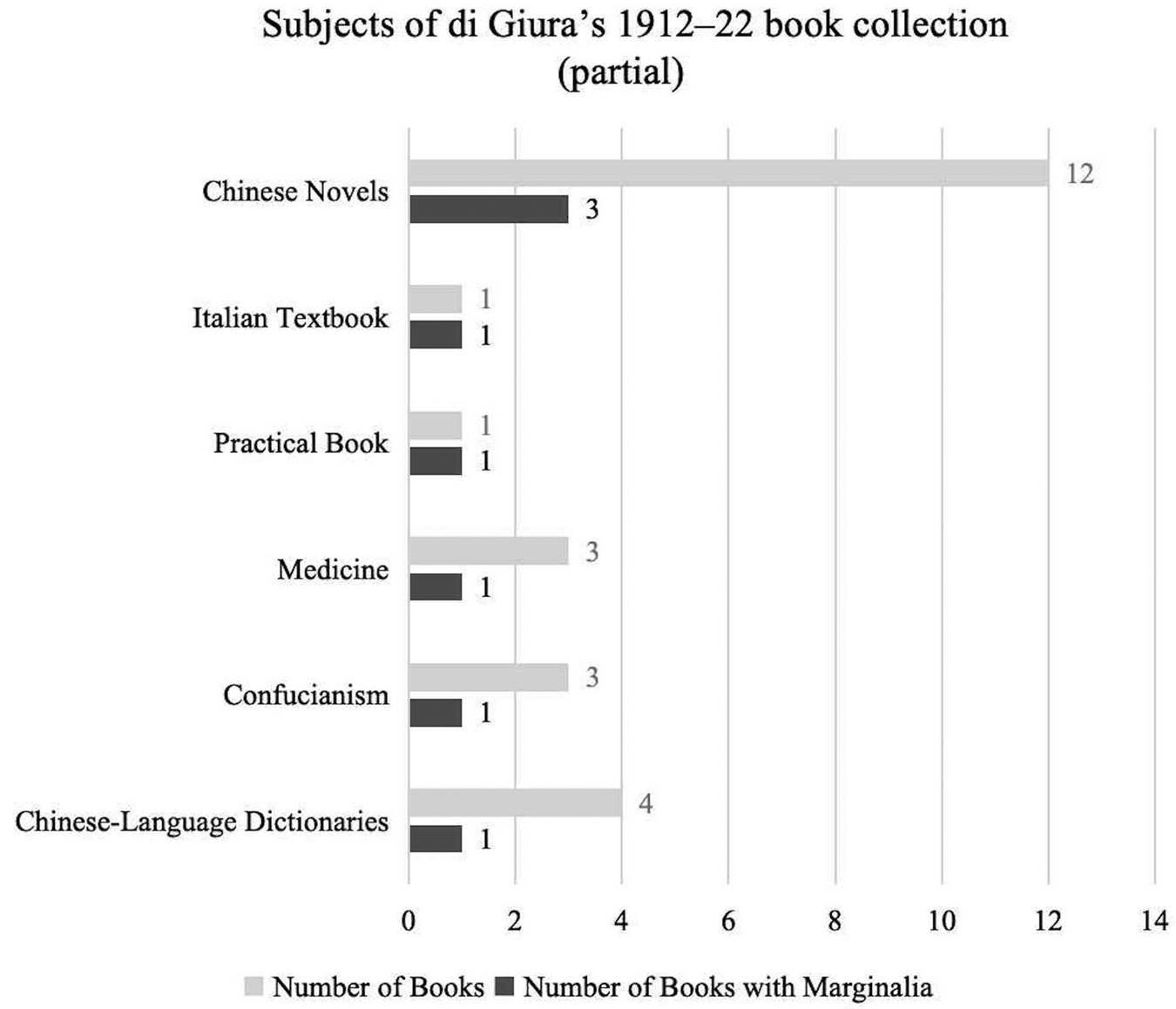
The decade following 1912 seems to represent an ‘interlude’ in di Giura's book collection: with a total of 44 units, the number is fewer than in both the preceding and succeeding phases. As illustrated in Figure 2, this contrast tends to be greater in terms of the quantity of books with marginalia. Figure 4 further demonstrates that only eight books categorised during this period have traces of being read, and they scarcely indicate any special attention to particular subjects.Footnote 28
Subjects of di Giura's 1912–22 book collection (partial)

Unlike the previous phase, these eight books with marginalia mainly have symbols whose function is to highlight, with few textual annotations.
Concerning reasons for this ‘interlude’, a paper fragment found in an unedited volume prompted a hypothesis about the mobility of books in di Giura's library. The fragment bears the words ‘LINICO, Rom’ on one side and ‘LICLINICO’ on the other, suggesting ‘POLICLINICO, Roma’, the University of Rome's polyclinic. This raises questions about whether di Giura transported books to Chiaromonte in June 1912 after receiving treatment from ‘Professor Ferrero of the University of Rome’, leaving the fragment with the university polyclinic's name in one of the books. If so, could it be this mobility that has contributed to the greatest chronological concentration of the 1900–11 collection in his library?
Another hypothesis regarding the ‘interlude’ concerns di Giura's medical workload in the decade 1912–22. From October 1912 to December 1922, his Italian dispensary in Beijing appeared to conduct over 80 significant surgical procedures and received more than 127,000 visits, averaging 34 per day.Footnote 29 In addition, correspondence from the family's private collection reveals that on 27 December 1917, di Giura was invited by Wu Lien Teh (1879–1960), the Medical Director of Peking Central Hospital, to serve as a visiting staff member at the hospital. Having accepted the invitation, he started attending to surgical cases on Tuesdays, Thursdays, and Saturdays since February 1918. Did such a heavy medical workload contribute to a decline in his endeavours in reading? If so, could this ‘interlude’ reflect the pragmatic characteristic of his book collection?
In any case, some books acquired from 1912 to 1922 provide valuable information about di Giura's life. For example, a 1916 address book for Beijing and Tianjin, categorised as ‘Practical Book’ in Figure 4, notes his residence: ‘North Royal River Bridge, Imperial City Corner, East Side, n.1’ (Minghaobu 1916, 97). This geographical context is crucial for investigating di Giura's social and cultural activities, in view of the diverse dynamics of Italian communities in different cities, as well as the unique milieu in Beijing at the time.
As stated by Wang (Reference Wang2022, 18), the history of early twentieth-century Beijing signifies a transformation from a feudal imperial capital to a modern urban centre, where novel and traditional, foreign and indigenous elements collide and interweave, collectively shaping a hybrid milieu. In this environment, di Giura's reformist stance in his early years evolved into a defence of the traditional Confucian order. Specifically, he attributed the phenomenon ‘New China has a horror of Confucius and his works’ to the fact that the works ‘are not written in an easy language, and the majority of young Chinese do not understand them’ (Di Giura Reference Di Giura1927).
This linguistic perspective raises questions about the evolution of di Giura's cultural inclinations. Since the New Culture Movement began in 1915, intellectuals like Qian Xuantong (1887–1939) advocated for the Romanisation, Latinisation, and abolition of the Chinese language (Sang Reference Sang2013, 71). In this context, the cultural capital that di Giura had acquired in accordance with the Confucian order of the imperial monarchy during its final period might have found limited applicability. In this regard, could his initial engagement with Chinese language and culture contribute to his later scepticism towards ‘New China’? Was his defence of Confucianism in the 1920s driven more by emotional motivations than an ideological conviction? Was his revalorisation of the Confucian order, in some way, inventing an ‘Old China’?Footnote 30
Another noteworthy book between 1912 to 1922 is a Japanese-English translation of The Analects (Yamano Reference Yamano1912, hereinafter referred to as Rongo), a collection of selected sayings attributed to Confucius (551–479 BC).
In 1926, di Giura published an Italian-Chinese version of 55 items drawn from The Analects. His Italian translation is probably based on James Legge's English version in Rongo, amid seven other editions of this classic in his library (Zhushi jiaozheng huaying sishu n.d.; Zhu Reference Zhu1878; Couvreur Reference Couvreur1895; Chen Reference Chen1904; Yamano Reference Yamano1912; L. Y. T. Reference L.Y.T.1914; Tuhua sishu baihuajie n.d.). Besides textual resemblance, di Giura marked Legge's translation with a blue cross next to each maxim that he later translated into Italian. Some maxims in Zhushi jiaozheng huaying sishu and Couvreur's work were also highlighted, but only those in Rongo precisely match the maxims translated by di Giura.
Legge's English translation of Confucian classics remained the resource most consulted by later translators (Nordvall Reference Nordvall2020). However, di Giura's reference to Legge may have been influenced more by the timing of his intellectual pursuits. While he owned a 1914 edition which included The Analects translated by Legge, there is no indication that the book has been read. In contrast, di Giura engaged with Legge's work collected in Rongo, a book gifted to him by his legation colleague Alfredo De Prospero in 1921. Could this detail further contribute to the hypothesis that the years following di Giura's temporary return to Italy in 1912 constituted an ‘interlude’ in his intellectual activities?
From an alternative perspective, it would be hasty to affirm a decline in di Giura's interest in Chinese culture during this period, considering the historiographical contradiction that a period lacking documentation might coincide with the most significant period in shaping historical experiences. As suggested by archival records of his intensive medical work, the absence of documentation in di Giura's book collection from 1912 to 1922 might correspond to the extent of his daily interactions within Chinese society. Moreover, his active engagement with Chinese society during this decade could have enabled him to draw upon a wealth of accumulated knowledge for his intellectual pursuits in the final years of his stay in China, as discussed in the next section.
1923–31: Intellectual pursuits
As illustrated in Figure 1 and 2, di Giura's reading during 1923–31 intensified, totalling 54 units with 22 bearing marginalia. These marginalia – featuring corrections of printing errors, underscores, symbol marks and handwritten notes on inserted pieces of paper – potentially illuminate the intertextuality between di Giura's readings and his works, as discussed in this section.
Introducing Chinese novels
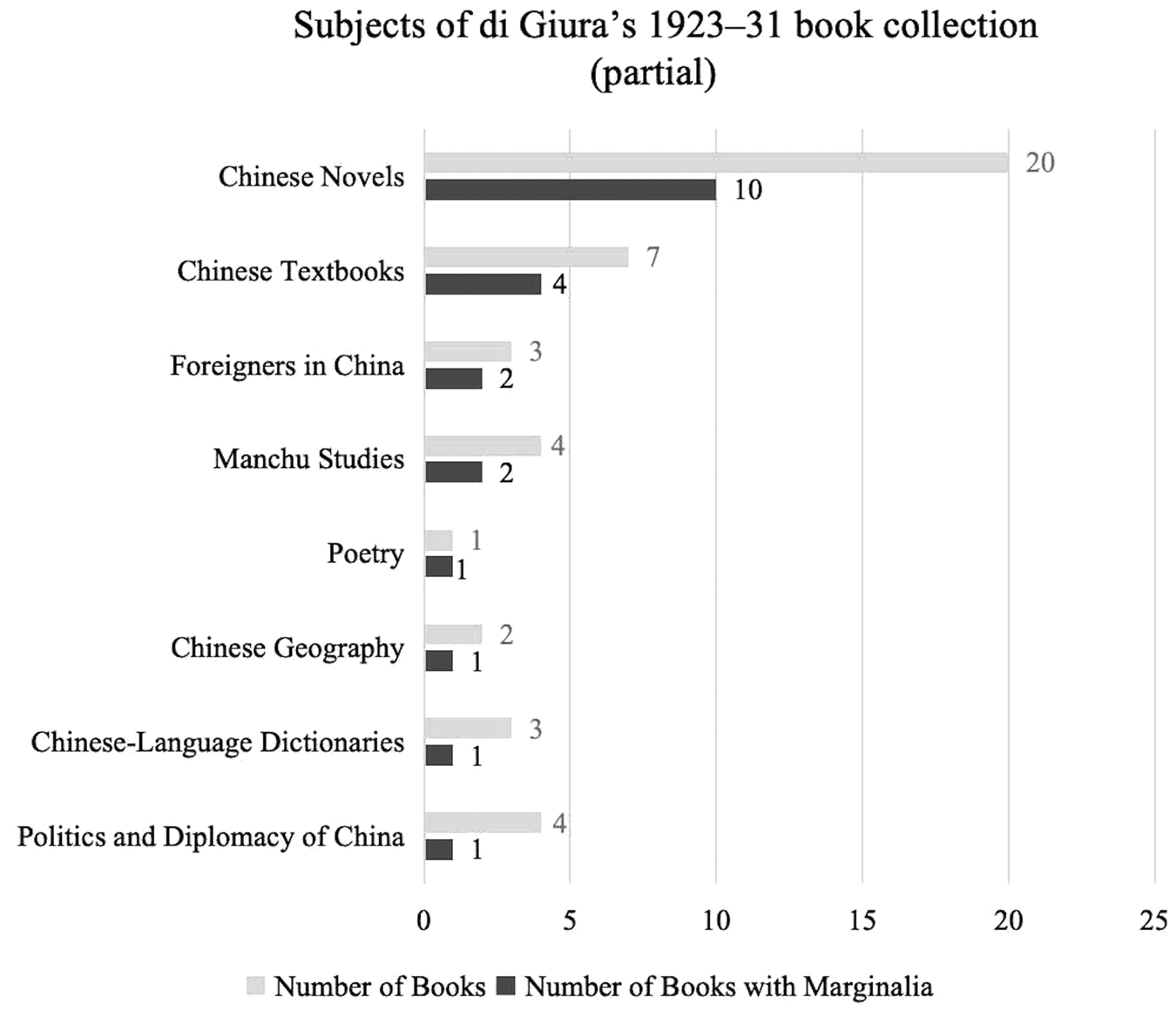
In the 1923–31 collection, di Giura's interest in reading Chinese novels stands out, as illustrated in Figure 5.Footnote 31
Subjects of di Giura's 1923–31 book collection (partial)

As for di Giura's choice of novels, his previous inclination towards allegorical narratives of social criticism on contemporary issues evolved into a preference for yanyi (fiction based on historical facts). Among the ten annotated novels, four fall into this category: Xishi yanyi (Story of Xishi, 1923), Zhaojun yanyi (Story of Zhaojun, 1924), Qinggong lishi yanyi (History of the Imperial Court of Qing Dynasty) (Xu Reference Xu1924), and Qingchao lishi yanyi (History of the Qing Dynasty) (Ruan Reference Ruan1924).
Fiction based on historical facts probably provided di Giura with necessary material for crafting stories about Chinese historical female characters. A preliminary analysis suggests that two stories in his 1958 work, focusing on the female figures Zhaojun and Xishi respectively, appear to be an Italian rendition of the aforementioned Chinese novels – Story of Xishi (1923) and Story of Zhaojun (1924). Additionally, in his diary for January 1927, di Giura wrote down the Italian translation of a section extracted from the History of the Qing Dynasty (Ruan Reference Ruan1924), which has a striking resemblance to his later 1962 essay on the Boxers and Dowager Empress Cixi.Footnote 32
Furthermore, among ten novels with marginalia from 1923 to 1931, there are two editions of Liaozhai zhiyi (hereinafter referred to as Liaozhai) (Giles Reference Giles1916; Pu Reference Pun.d.a]), the collection of supernatural tales compiled by Pu Songling (1640–1715). During the same period, di Giura translated Pu's work into Italian. According to his translation draft and preparatory notes, between January 1923 and June 1925, di Giura exhausted 13 notebooks to specify the Italian pronunciation, explanations, and cultural connotations of Chinese expressions selected from every Liaozhai story. Upon completing the translation of 436 stories in Beijing on 29 May 1925, he continued to revise the draft until 18 September 1928, with the final revision finished in Chiaromonte on 17 May 1940.
Considering his detailed notes on Chinese culture-loaded expressions and concurrent textual translation, it appears to be more likely that di Giura translated Liaozhai directly from Chinese to Italian, rather than through an intermediary language.Footnote 33 Among the five Chinese editions of Liaozhai in his library (Pu, Xu and Gao Reference Pu, Xu and Gao1921–22; Pu Reference Pun.d.a; Pu Reference Pun.d.b; Pu Reference Pu1918a; Pu Reference Pu1918b), the Reference Pu1918a edition stands out with extensive underscores in the texts and a piece of paper annotated with the Chinese characters Sibaisishisiduan (444 paragraphs) inserted in the first volume. In spite of this, di Giura's arrangement of the ten stories with more than one subject is not entirely identical to the original edition: while seven stories align with the multi-subject format as in the 1918a edition, for the other three, each subject has been presented as an individual story.Footnote 34 His alternative organisation aligns with another edition (Pu Reference Pun.d.b), which, however, lacks annotations. Considering the possibility of dispersion, additional intertextual studies are necessary to explore di Giura's translation activities in relation to these two editions.
Translating Chinese poems
In 1930, di Giura published the Italian translation of 50 poems of Li Bai (701–762). In the preface, he provided details about the reference edition: ‘The few poems that we present to the public are all contained in the collection of poems of T'ang, made by Wang Yao-Ch’ü, and bear the Chinese title T'ang Shih Ho Chieh (Reference Di Giura1930, iv).’ In di Giura's library, a six-volume Gu tang shi hejie (Anthology of Ancient Poems and Tang Poems) by Wang Yaoqu (Reference Wangn.d.) emerges as the sole edition of the work mentioned by the Italian translator. While one volume containing 13 poems translated by di Giura has been dispersed, there are no annotations for the remaining 37 translated poems. According to his translation draft, the original Chinese text of each poem was transcribed on the left side of a piece of paper, which was used as a folder for his translation of the poem and preparatory notes. Could the initial transcription result in the absence of annotations in the Anthology of Ancient Poems and Tang Poems?
Furthermore, di Giura referred to the Japanese diplomat Shigeyoshi Obata as ‘the one who maintained fidelity to the [original] text’ among previous translators of Li Bai's work (Reference Di Giura1930, iv–v). In di Giura's library, there is a 1923 edition of Obata's English translation. Within it, there is a mark related to the title of a poem: ‘Lü shui qu’, translated by Obata as ‘The Blue Water’ (Reference Obata1923, 56). Di Giura annotated another Chinese character Lu (clear) in the margin and translated the title into Italian as ‘La canzone dell'acqua chiara’ (‘The Ode of the Clear Water’) (Reference Di Giura1930, 36). Besides this detail, the significant contrast between Obata's and di Giura's translations lies in their chosen genres: the former opted for a prose presentation, while the latter preserved the poetic cadence, maintaining approximately eleven syllables per verse (Wang and Wen Reference Wang and Wen2024).
The interests in Li Bai's works prompted di Giura to translate eight poems from the Chinese novel Dream of the Red Chamber (Reference Di Giura1929). As he noted in the work, these poems were translated since they ‘recall those [poems] of the famous poet LI PUO’. This note seems to suggest a certain lack of valorisation for the novel itself, but di Giura collected seven versions of Dream of the Red Chamber – five published and two unpublished, which is the highest count for any book in his library (Tsao and Kao Reference Tsao and Kaon.d.; Cao Reference Cao1899, Reference Cao1905a, Reference Cao1905b, Reference Caon.d.). In terms of the reference for his translation, the edition titled Guochu chaoben yuanben hongloumeng (Dream of the Red Chamber Reprinted in the Early Years of the Republic of China) (Cao Reference Caon.d.) stands out. It features a divergence from other editions concerning the Chinese text of the first poem translated by di Giura, titled ‘Paesaggio’ (‘Landscape’). In Dream of the Red Chamber Reprinted in the Early Years of the Republic of China, we read Lüliu hengpo (Green willows spread across the slope), whereas in all other editions, it is Bailiu hengpo (White willows spread across the slope). Di Giura's translation is consistent with the 1927 edition: ‘e dell'acque sul bordo verdi salici s'incurvano’ (And green willows curve on the water's edge) (Reference Di Giura1929, 5).
Di Giura's 1923–31 collection illuminates the intertextuality between his readings and intellectual pursuits, particularly in the Italian translation of Chinese literary works. Among these works, Liaozhai appeared to have received the most attention from di Giura, with preparatory annotations beginning in 1923 and the final revision completed in 1940. His motivation for this long-term effort seemed to be driven by Liaozhai's popularity in China and its potential to represent Chinese social life, rather than its artistic value. In the preface to his translation, di Giura emphasised that the tales could provide Italian readers with insights into Chinese life and superstitions. Highlighting the work's popularity in China, he described how he witnessed storytellers in Beijing captivating audiences with Liaozhai tales, stopping at the most interesting points to ask for money, with hardly anyone leaving (P'u Reference P'u1926, 7). For his translations of The Analects and Li Bai's poems, di Giura stressed the works’ significance in Chinese history and culture, presenting Confucius as ‘the supreme Chinese sage’ and Li Bai as ‘a supreme Chinese poet’.Footnote 35 With the intention to introduce these highest achievements of Chinese culture to Italian readers, di Giura organised his translations akin to didactic materials for Chinese language study, which feature the original Chinese text with phonetic transcriptions of every character and detailed annotations for culture-loaded expressions. This organisation was maintained in the 1926 translation of The Analects, where di Giura claimed the didactic objectives of his work were: ‘to facilitate the study of the Chinese written language and Chinese classics’, and ‘to allow those who have not studied Chinese to grasp the wisdom Confucius imparted to his disciples’. In contrast, the published version of Li Bai's poems retained only the translations and annotations, omitting the Chinese original text and phonetic transcriptions. Had Li Bai's poems been published according to di Giura's original manuscript, they could have served a similar purpose – assisting Italian learners of Chinese while allowing a wider readership to appreciate the charm of Chinese poetry. Di Giura's comprehension of these literary works and his motivations for translating them reveal him as an Italian who aspired to present the most influential and popular Chinese works he encountered through his direct contact with Chinese society and culture to his home country audience.
As for whether his aspirations were achieved, from a temporal perspective, di Giura's translation works represent early efforts to introduce these Chinese works in Italy. His translation of Liaozhai, titled I racconti fantastici di Liao (The Fantastic Tales of Liao) and published by A. Mondadori in 1955, is considered the first complete translation of this work into a European language (Gu Reference Gu2021, 1). His 1930 translation of Li Bai's poems was among the earliest efforts to introduce Tang poems to Italy.Footnote 36 His translation of poems from Dream of the Red Chamber was published in 1929, almost 30 years before the first full Italian version of the novel.Footnote 37
However, historical sources suggest a risk in overestimating the circulation and impact of di Giura's translations in Italy at his time. As di Giura complained in correspondence with Mondadori (FAAM 1931), the performance of his 1926 translation of Liaozhai was unfavourable in the Italian market. His translation of Li Bai's poems faced notable difficulties in publication due to the lack of an interested audience, as suggested by his private correspondence to Gino Carabba on 20 July 1928. His translations of The Analects and Dream of the Red Chamber were published in Beijing and have garnered scarce scholarly attention in Italy, with only a few copies available in public libraries today.Footnote 38 The effectiveness of di Giura's transcultural contribution between Italy and China during the first half of the twentieth century requires further investigation.
Judging by his book collection, di Giura's active engagement with Chinese literature seems to have waned by 1931, aligning with his return to Chiaromonte. Considering the significantly diminished availability of China-related literature in Chiaromonte compared to Beijing, it appears that di Giura only added nine relevant volumes to his collection after his return. Nevertheless, the physical presence of a Chinese library in Chiaromonte was likely to have assumed an aesthetic and symbolic function to build di Giura's public profile as a reference figure of China in his later years, as suggested by the local people referring to the tower housing the library as the ‘la torre cinese’ (‘the Chinese tower’).
Conclusion: an Italian within Chinese society
The interpretation of di Giura's Chinese library illuminates the utilitarian and functional characteristics of the library, providing the collection with the potential to reveal the owner's evolving roles and cultural interests. In contemporary China, records of di Giura's image as a Western doctor can be frequently found. His library, on the other hand, illustrates his longing to build the image of a ‘cultural man’ within the local society. During his initial decade in China, besides his profession as a doctor for the Italian diplomatic and military corps, di Giura began learning the Chinese language and classical literature, reading local journals, and reporting on socio-political affairs, showcasing his versatility and curiosity in social and cultural interactions with China. In subsequent years, his focus on Chinese literature appeared to narrow, which, however, paradoxically coincided with a period of intensive and profound daily experiences within Chinese society. Such experiences were likely to lay the foundation for the renewed vigour in his intellectual pursuits during the final decade of his stay in China, and his concurrent collection offers valuable resources for exploring the intertextuality between his readings and writings.
As stated by Samarani (Reference Samarani, Marinelli and Andornino2014, 49), despite the frequent challenges presented by fragmented and dispersed historical documents, the reconstruction of the history of Italians in early twentieth-century China remains essential. In this area, di Giura's ‘Chinese library’ emerges as a valuable repository, offering insights into his and other Italians’ textual engagements with China, which are often linked to their socio-cultural experiences. As an archive containing symbols of ‘individual and communal longings’, his library mirrors the cultural milieu commonly experienced by Italians in China during that time, and provides a micro perspective on the potential opportunities for social, cultural, and textual engagements with China available to contemporary Italians in the country. Specifically, di Giura's library reveals the favourable conditions and available resources for Italians in China who wanted to contribute to mutual understanding between the two countries without having the relative professional training. In China, the burgeoning commercial publishing industry facilitated the growing access to literature related to the country. Di Giura's collection shows the most prevalent subjects – Chinese-language newspaper (57 units) and Chinese novels (51) – aligning with the rise of the newspaper press and the ‘fiction boom’ in the country. In Italy, the growing public interest in the Far East after the Sanmen Bay and Boxer events presented opportunities for Italians in China to engage in intellectual discourse through publishing reports, travel journals, or informative monographs based on their readings, observations, and occasional involvement in local and international affairs. Additionally, at a time when China-related materials in Italian were limited and not easily available, the circulation of textbooks and translated works in other European languages, especially English and French, provided opportunities for Italians without sinological training to embark on the study of Chinese language and culture, deepen their study of China, and eventually contribute to introducing China to the home country.
Italians engaged with Chinese studies from the nineteenth century to the middle of the twentieth century, when Italy lost its leadership position in Sino-European cultural exchanges, have a ‘blurred’ profile, as noted by Paternicò (Reference Paternicò2023). Some developed in institutions of sinological studies, others beginning their intellectual careers after serving as missionaries or diplomats in China, and still others after travelling in the country. Di Giura contributed to this landscape with a noteworthy profile as an Italian engaged in Chinese studies based on his direct contact and long-term experience with the local society. Immersed in the local cultural milieu of Beijing, he developed curiosity and interest in classical and popular Chinese literature, and translated the works that he deemed most representative of China to Italian readers. Observing events in daily life and through journalistic reading, he provided first-hand accounts and commentaries on the local socio-political situation. His collection embodies the authenticity of an Italian observing this foreign world without a prepared professional framework or observational paradigm. This authenticity set di Giura's cultural pursuits apart from a structured ideological stance or original reflections on specific historiographical issues. Instead, the library reveals di Giura's image as an unprofessional yet versatile participant in politics, literature, and history, which could facilitate a more genuine portrayal of the interaction between two cultures. This article interprets di Giura's life through his library, not to present him as an exceptional case, but to use his experiences as a lens for observing the potential social-cultural interactions of Italians in China during the early twentieth century, aiming to enrich perspectives for further studies on the theme.
Acknowledgements
The author is much obliged to the referees and editors of Modern Italy for their valuable feedback on the manuscript. The article reflects part of the author's doctoral research on the intellectual biography of Ludovico Luigi Nicola di Giura, made possible through the support of a PhD scholarship programme provided by the China Scholarship Council (CSC) in collaboration with the University of Padua, Italy. The author wishes to express profound gratitude to her supervisor and co-supervisor, Professor Laura Cerasi and Professor Laura De Giorgi, whose indispensable guidance significantly contributed to the development of this manuscript. The article presents preliminary insights derived from a recent on-site investigation into di Giura's personal library in Chiaromonte. The author wishes to extend heartfelt gratitude to Fabrizio di Giura, Giovanni di Giura, and Andrea di Giura for their generous support and permission to access the library during her research.
Competing interests
The author declares none.
Jinxiao Wang is currently affiliated to the PhD programme in Historical, Geographical, and Anthropological Studies at the University of Padua and Ca’ Foscari University of Venice, specialising in the Historical Studies curriculum. She is also a member of the National Social Science Fund of China Research Program Duojuanben zhongguo wenhua yuwai chuanboshi (No. 17ZDA195) (Multi-volume) The History of Chinese Culture Abroad (1807–1949), with Beijing Foreign Studies University serving as the responsible institution. Among her previous scholarly contributions, she authored the article ‘Chongxinfaxian yidali hanxuejia rula’ (‘Rediscovery of the Italian Sinologist Ludovico Luigi Nicola di Giura’), published in the CSSCI journal Guojihanxue (International Sinology), which is, like this article, also relevant to her doctoral project.

 Open access

