





Introduction
Because of their reduced access to the sounds of spoken language, people who are prelingually and profoundly deaf rely more on orthographic information to access semantics during reading (e.g., Sehyr & Emmorey, Reference Sehyr and Emmorey2022; Fariña et al., Reference Fariña, Duñabeitia and Carreiras2017). Given that in English spelling-to-meaning mappings are more consistent than spelling-to-sound mappings (Berg & Aronoff, Reference Berg and Aronoff2017), deaf readers may also rely more on morphological structure to support lexical access. Deaf readers show equivalently precise orthographic representations as hearing readers despite less precise phonological representations (e.g., Meade et al., Reference Meade, Grainger, Midgley, Holcomb and Emmorey2020), and rapid activation of orthographic codes may result in more efficient access to the semantic information of the word (see Bélanger & Rayner, Reference Bélanger and Rayner2015). In fact, for deaf readers, morphological awareness, or the ability to identify and manipulate component parts of complex words (Levesque et al., Reference Levesque, Kieffer and Deacon2017), is significantly related to reading comprehension ability and vocabulary size (Saunders et al., Reference Saunders, Helms and Emmorey2026). Further, morphological awareness is related to English placement levels assigned upon entry to university for deaf students, while phonological awareness is not (Clark et al., Reference Clark, Gilbert and Anderson2011).
Deaf individuals also vary in their eye movements during sentence reading, with several studies demonstrating highly efficient reading patterns for signing deaf readers (Bélanger et al., Reference Bélanger, Slattery, Mayberry and Rayner2012; Traxler et al., Reference Traxler, Banh, Craft, Winsler, Brothers, Hoversten, Piñar and Corina2021). There are several hypotheses for the sources of this reading efficiency. Deaf individuals’ allocation of visual attention tends to be distributed more widely across the visual field than for hearing individuals (Bavelier et al., Reference Bavelier, Dye and Hauser2006). This attentional distribution affects sentence reading, and studies with skilled deaf readers have demonstrated that they take in information from a wider area of the parafovea than skill-matched hearing readers, reaching up to 18 characters to the right of fixation compared to 14–15 for hearing readers (Bélanger et al., Reference Bélanger, Slattery, Mayberry and Rayner2012). Being able to begin initial word recognition farther into the periphery may allow deaf readers to more efficiently process words once they land on them (see Traxler et al., Reference Traxler, Banh, Craft, Winsler, Brothers, Hoversten, Piñar and Corina2021). Initial word recognition for deaf readers takes advantage of a more direct connection between orthography and meaning, bypassing less specified or precise phonological codes during word processing (Bélanger et al., Reference Bélanger, Slattery, Mayberry and Rayner2012, Reference Bélanger, Mayberry and Rayner2013), and morphological processing is likely an important facet of this initial processing stage. However, online morphological processing has been understudied with deaf readers.
Morphological processing at the single-word level for hearing readers has been investigated using priming methods. These studies show that readers are faster to recognize a simple word if it is preceded by a complex (or pseudocomplex) prime containing that root, even if the prime is presented only for a short time (Rastle et al., Reference Rastle, Davis and New2004; Rastle & Davis, Reference Rastle and Davis2008). Priming studies indicate that readers break down morphological structure in the earliest stages of word recognition. During natural reading, this stage occurs while the word is still in the reader’s parafovea, between 1° and 5° of visual angle from the central fixation. A parallel to priming in single-word recognition studies is the gaze-contingent boundary paradigm used in eye-tracking studies (Rayner, Reference Rayner1975). In this paradigm, preview information in the parafovea is changed to a target as a participant’s eyes cross an invisible boundary preceding a target word. Participants typically do not perceive the display change because it occurs as their eyes move (saccadic suppression; Matin, Reference Matin1974). Crucially, the information in the preview affects readers’ eventual fixation on a target word, i.e., related information facilitates processing and decreases fixation time, while unrelated information inhibits/slows processing and increases fixation time. This pattern reflects the ability of readers to begin processing the word in the parafovea ahead of their first fixation on the word (Schotter et al., Reference Schotter, Angele and Rayner2012). Thus, the paradigm is considered to be sensitive to the early stages of word recognition.
Numerous studies have demonstrated an orthographic preview benefit: previews with related orthographic information to the target, such as transposed letters as opposed to substituted letters (e.g., macihne-machine vs. macabne-machine), resulted in larger preview benefits (shorter fixation durations on the target word) (Balota et al., Reference Balota, Pollatsek and Rayner1985; Briihl & Inhoff, Reference Briihl and Inhoff1995; Drieghe et al., Reference Drieghe, Rayner and Pollatsek2005; Johnson et al., Reference Johnson, Perea and Rayner2007; Johnson & Dunne, Reference Johnson and Dunne2012). Shorter fixation times are hypothesized to occur because the preview allows readers to initiate lexical processing, which facilitates lexical access for the target word when they fixate on it (Schotter et al., Reference Schotter, Angele and Rayner2012). Deaf readers also show orthographic preview benefits, and this is true for both skilled and less skilled deaf readers (Bélanger et al., Reference Bélanger, Mayberry and Rayner2013).
Evidence for a morphological preview benefit, indicating that readers begin the initial stages of processing morphological structure in the parafovea, is mixed. Morphological preview benefits have been observed in German (Mousikou & Schroeder, Reference Mousikou and Schroeder2019), Chinese (Yen et al., Reference Yen, Tsai, Tzeng and Hung2008), and Hebrew (Deutsch et al., Reference Deutsch, Frost, Pollatsek and Rayner2000), but not English (Kambe, Reference Kambe2004; Lima, Reference Lima1987) or Finnish (Bertram & Hyönä, Reference Bertram, Hyönä, Van Gompel, Fischer, Murray and Hill2007). In German, readers are able to extract the identity of embedded stems from pseudoword previews. Fixation durations on a real-word target (bettlein, “little bed”) are shorter when preceded by a pseudomorphological pseudoword preview; that is, a preview created by combining a stem and a suffix that both exist in German but do not result in an interpretable meaning (bettlich, “bedly”). German readers also have shorter fixations after a nonmorphological pseudoword preview (bettpern, where “pern” is orthographically plausible but is not an existing German suffix) compared to an unrelated preview (Mousikou & Schroeder, Reference Mousikou and Schroeder2019). Mousikou and Schroeder (Reference Mousikou and Schroeder2019) concluded that readers were able to begin processing the embedded stems in the parafovea, regardless of whether they were accompanied by an affix.
In English, the parafoveal preview benefit is not different for prefix-only compared to stem-only letter information (for a target word review: prefix preview rexwsz and stem preview cmview) (Kambe, Reference Kambe2004); that is, readers show preview effects from both types of partial preview, with no difference depending on whether the preview was the prefix or the stem. Kambe (Reference Kambe2004) concluded that there was no evidence of morphologically motivated preprocessing in English sentence reading but rather that any related letter information in the parafoveal preview facilitated processing of a target. This result was consistent with Lima (Reference Lima1987), who also found no evidence of parafoveal preprocessing of prefix information.
Nonetheless, a more recent study found evidence of a morphological preview benefit in English, but only for suffixed words in which the root appears in the beginning part of the word (Dann et al., Reference Dann, Veldre and Andrews2021). Previewing words with pseudomorphological suffixes such as stressary yielded a larger preview benefit effect on a target word (stressful) compared to preview words with nonmorphological endings (stressard). In contrast, readers showed no preview benefit from prefixed or pseudoprefixed words in which the root appears at the end of the word, replicating Kambe (Reference Kambe2004). These results suggest that readers of English are able to decompose morphologically complex previews in the parafovea, but only when the more salient stem (as opposed to the prefix) falls in the highest acuity area of the parafoveal region directly next to the fixation (Dann et al., Reference Dann, Veldre and Andrews2021). The authors additionally suggest that the legitimacy of the suffix (i.e., its status as a real English suffix, as opposed to a pseudosuffix) contributed a “boost” to the preview effect of the stem. Readers were more easily able to decompose (and therefore preprocess) the stem when it was attached to a familiar English suffix. These results are consistent with accounts of morphological decomposition in which stems and affixes are segmented according to orthographic characteristics, regardless of their true semantic relationship (Lavric et al., Reference Lavric, Clapp and Rastle2007; Rastle & Davis, Reference Rastle and Davis2008).
The combination of deaf readers’ ability to attend to information further into the periphery and their sensitivity to orthography in early word processing may contribute to a greater ability to preprocess morphological structure compared to their hearing peers. Morphological processing in a sentence context has yet to be investigated for deaf readers and may be an important pathway from orthography to semantics in the absence of reliable or accessible phonological decoding. The extent to which deaf readers decompose morphological structure in the earliest stages of word recognition during sentence reading (i.e., while words are in the parafovea) will provide insight into the relationship between their robust orthographic-to-semantic mappings and their parafoveal processing abilities. In addition, morphological awareness ability has a stronger relationship with reading comprehension for deaf compared to hearing readers (Saunders et al., Reference Saunders, Helms and Emmorey2026), and thus morphological awareness might modulate the size of the preview benefit from morphologically complex words for deaf but not hearing readers.
Using a gaze-contingent boundary paradigm (Rayner, Reference Rayner1975), we tested whether deaf and hearing readers with varying morphological skill (objectively assessed by morphological awareness tests) extract morphological information from the parafovea during sentence reading, as evidenced by a morphological preview benefit. Based on research that suggests that morphological preview benefits in English are restricted to suffixed words (Dann et al., Reference Dann, Veldre and Andrews2021), target words all consisted of a stem and a suffix, while preview words either had a pseudomorphological suffix (“sadment”), a nonmorphological suffix (“sadnard”), or were unrelated pseudowords (“florous”) (see Stimuli for additional details). Given that previous research shows that longer words (e.g., multimorphemic words) are more likely to receive multiple fixations (Schotter & Dillon, Reference Schotter and Dillon2025; Vergilino & Beauvillain, Reference Vergilino and Beauvillain2000), we selected gaze duration, the sum of all fixation durations a reader makes on a target word before moving past it, as our primary measure of initial word recognition.
We hypothesized that both hearing and deaf readers would have shorter gaze durations on target words following parafoveal previews that share a root with the target (i.e., both morphological (“sadment”) and nonmorphological (“sadnard”) previews) compared to unrelated previews (“florous”). Such a result would reflect the general orthographic preview benefit from the common letters (here, “sad-”) between the parafoveal preview and the target word. Both deaf and hearing readers are expected to show a graded preview benefit, with the most benefit from pseudomorphological previews, then nonmorphological, then unrelated pseudoword previews (following Dann et al., Reference Dann, Veldre and Andrews2021). However, if deaf readers are indeed more attuned to morphology, they should show a stronger preview benefit from the aspects of the preview specific to morphological structure. In other words, deaf readers should be better able to extract the informative root (“sad-”) from a pseudoword with an apparent morphological structure (a valid English suffix, “-ment”) than from a pseudoword with no apparent suffix (a meaningless letter string, “-nard”). Greater morphological sensitivity would result in a larger difference in fixation time between the pseudomorphological (“sadment”) and nonmorphological (“sadnard”) conditions compared to the hearing readers. The comparison between the nonmorphological and pseudomorphological preview conditions should therefore index the difference in parafoveal morphological processing between the two groups. These processing differences may also be impacted by morphological awareness, as deaf and hearing readers differ in both their morphological awareness skills and the relationship between this skill and overall reading comprehension.
Methods
Participants
Two groups of adult participants were recruited: 1) twenty-four hearing, monolingual English speakers (15 women, mean age = 30.4 years, SD = 13.3 years), and 2) twenty-four prelingually and severely/profoundly deaf signers (13 women, mean age = 36 years, SD = 8.7 years). All deaf participants learned American Sign Language (ASL) before age 7 (M = 2.07 years, SD = 2.94 years) and use ASL as a primary means of communication. All participants had normal or corrected-to-normal vision and reported no reading or learning disabilities. Background information (education, knowledge of other languages) was collected for both groups. Hearing participants reported an average of four years post-high school education (SD = 1.26). Deaf participants reported an average of 5.48 years post-high school education (SD = 3.35 years).
Assessments
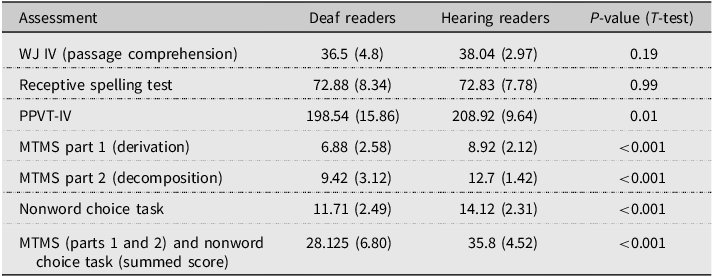
In addition to the eye-tracking experiment, participants also completed a battery of reading assessments, summarized below. The groups were matched on reading skill (p = 0.19) and spelling skill (p = 0.99). The hearing readers had larger vocabularies (p = 0.01) and performed better on the morphological awareness tests (p < 0.001). Morphological awareness was correlated with reading comprehension for both groups (Deaf: r(24) = .66, p < 0.01; Hearing: r(24) = 0.60, p < 0.01); the relationship is numerically though not significantly stronger for the deaf readers than the hearing readers (z = 0.32, p = 0.75). See Table 1 for a summary of participant scores on reading assessments.
Mean scores on assessments for each participant group (standard deviations reported in parentheses)
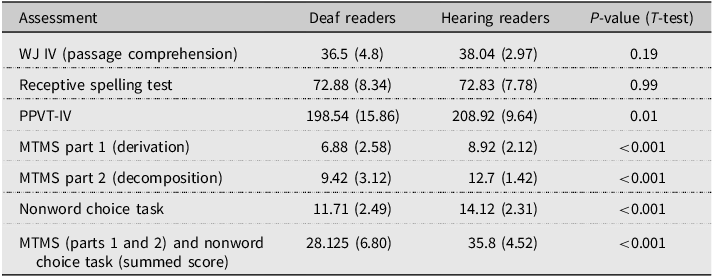
Table 1. Long description
The table presents mean scores on assessments for deaf and hearing readers, with standard deviations in parentheses. It includes six rows and four columns. The columns are labeled Assessment, Deaf readers, Hearing readers, and P-value (T-test). The rows are labeled with different assessments: WJ IV (passage comprehension), Receptive spelling test, PPVT-IV, MTMS part 1 (derivation), MTMS part 2 (decomposition), Nonword choice task, and MTMS (parts 1 and 2) and nonword choice task (summed score). The values for each assessment are as follows: Row 1: WJ IV (passage comprehension), Deaf readers 36.5 (4.8), Hearing readers 38.04 (2.97), P-value 0.19. Row 2: Receptive spelling test, Deaf readers 72.88 (8.34), Hearing readers 72.83 (7.78), P-value 0.99. Row 3: PPVT-IV, Deaf readers 198.54 (15.86), Hearing readers 208.92 (9.64), P-value 0.01. Row 4: MTMS part 1 (derivation), Deaf readers 6.88 (2.58), Hearing readers 8.92 (2.12), P-value less than 0.001. Row 5: MTMS part 2 (decomposition), Deaf readers 9.42 (3.12), Hearing readers 12.7 (1.42), P-value less than 0.001. Row 6: Nonword choice task, Deaf readers 11.71 (2.49), Hearing readers 14.12 (2.31), P-value less than 0.001. Row 7: MTMS (parts 1 and 2) and nonword choice task (summed score), Deaf readers 28.125 (6.80), Hearing readers 35.8 (4.52), P-value less than 0.001.
Woodcock Johnson IV passage comprehension subtest
Participants read short passages (1–2 sentences) containing one blank and filled in the blank with the correct missing word (LaForte et al., Reference LaForte, McGrew and Schrank2014). Raw scores were calculated by subtracting errors from the ceiling item (maximum score 47). This test measures readers’ general reading comprehension level.
Test of receptive spelling
Participants were given a list of 87 printed words, some of which were spelled incorrectly, and asked to circle only the incorrectly spelled items (Andrews & Hersch, Reference Andrews and Hersch2010). Raw score was calculated by subtracting errors (i.e., missed “incorrect” words or falsely circled “correct” words) from the total number of words (87). Because this test does not involve dictation or auditorily presented test items, it is an appropriate and comparable measure of spelling skill for both deaf and hearing readers.
Peabody picture vocabulary test IV (PPVT-IV)
In the adapted version of the PPVT-IV, participants read an English word in the center of a page and are asked to identify which of four pictures on the same page is the most accurate representation of the English word (Dunn & Dunn, Reference Dunn and Dunn2007; Sarchet et al., Reference Sarchet, Marschark, Borgna, Convertino, Sapere and Dirmyer2014). Raw scores were calculated by subtracting errors from the ceiling item (maximum score 228). This test represents participants’ vocabulary size.
Modified test of morphological structure (MTMS)
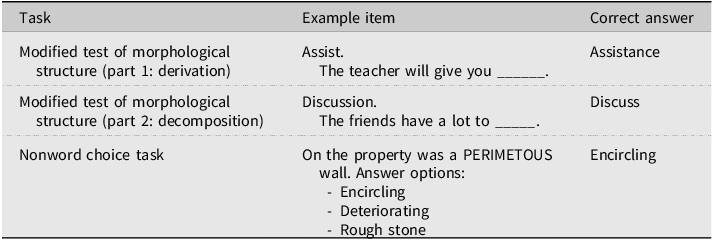
In part one of this assessment (derivation), participants were provided with a simple root word and a sentence containing a blank, then asked to derive a complex word using the root that fits a sentence frame. In the second part (decomposition), participants were provided with a complex word and another sentence frame that contained a missing word, then asked to remove an affix or affixes from the complex word to produce the simple word that successfully completes the sentence (Bernstein et al., Reference Bernstein, Flipse, Jin and Odegard2020). See Table 2 for example items. Part 1 (derivation) measures participants’ ability to generate complex words by applying the correct affixes to a root word (15 total items). Part 2 measures participants’ ability to identify which parts of complex words are the roots and affixes and then extract the appropriate root based on the sentence context (15 total items).
Example items from MTMS and nonword choice tasks, comprising the measure of morphological awareness
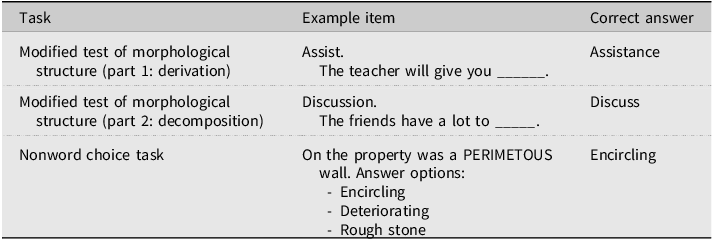
Table 2. Long description
A table with three columns labeled Task, Example item, and Correct answer. The table has three rows. Row 1: Task, Modified test of morphological structure (part 1: derivation); Example item, Assist. The teacher will give you _______.; Correct answer, Assistance. Row 2: Task, Modified test of morphological structure (part 2: decomposition); Example item, Discussion. The friends have a lot to _______.; Correct answer, Discuss. Row 3: Task, Nonword choice task; Example item, On the property was a PERIMETOUS wall. Answer options: Encircing, Deteriorating, Rough stone; Correct answer, Encircing.
Nonword choice task
Participants were provided with a sentence containing one orthographically plausible nonword that contains possible English affixes (e.g., acquitation) and asked to choose from three options to identify the most plausible meaning for the nonword (McCutchen & Logan, Reference McCutchen and Logan2011). See Table 2 for example items. This task assesses participants’ ability to infer the meaning of novel words by using familiar affixes and roots (18 items).
Participants’ summed scores on the MTMS and the Nonword Choice Task comprised our measure of morphological awareness (MA). Raw scores were calculated by subtracting errors from the total number of items (48).
Stimuli
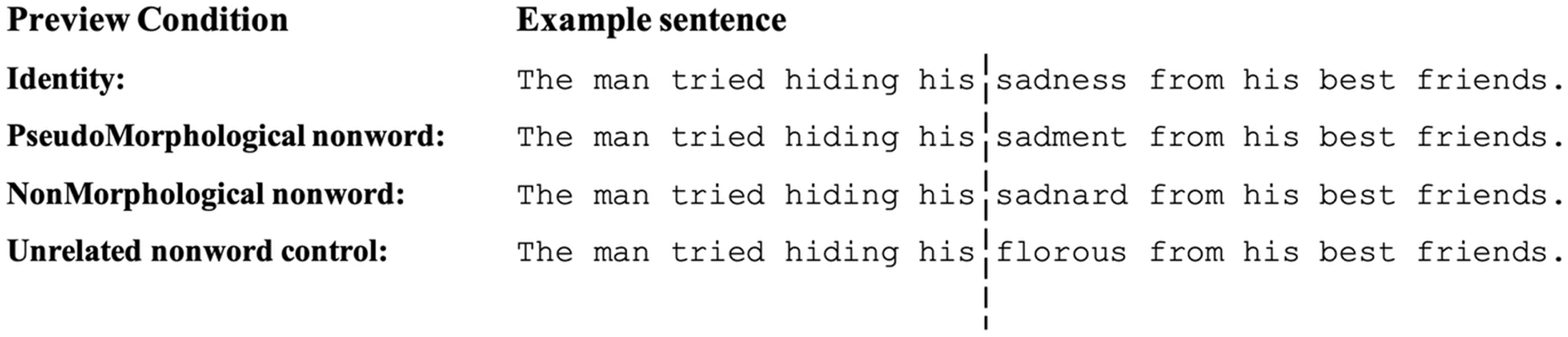
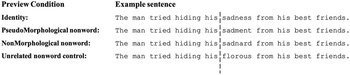
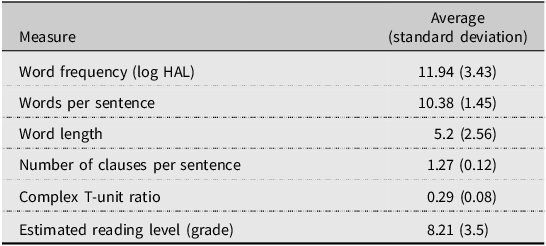
The stimulus set contained 256 sentences with a morphologically complex target word located in the middle of the sentence, with four preview conditions (see Figure 1): identity, pseudomorphological pseudoword, nonmorphological pseudoword, and unrelated pseudoword. Participants read all 256 sentences, evenly distributed across four experimental conditions (64 per condition). The sentences were counterbalanced using four lists, ensuring that each participant read all 256 sentences and an equal number of participants encountered each sentence in each of the four conditions. Morphologically complex pseudowords were formed by combining the target root with an existing English suffix that does not form an existing English word. Nonmorphological pseudowords were formed by combining the target root with an orthographically plausible but meaningless string of letters that does not resemble English suffixes such as “-erp,” “-rol,” etc. Unrelated previews were formed by combining an unrelated root and an unrelated suffix to form a pseudoword with the same number of letters as the target. The three pseudoword conditions did not differ in bigram frequency (all ps > 0.10), as calculated by the CLEARPOND database (Marian et al., Reference Marian, Bartolotti, Chabal and Shook2012). The average number of overlapping letters between the morphological pseudoword and the target word and between the nonmorphological pseudoword and the target word were 4.9 and 4.8, respectively (t = 1.96, p = 0.1), ensuring that apparent morphological structure was the only difference between the two related pseudoword conditions. Eighty-seven items were taken from Dann et al. (Reference Dann, Veldre and Andrews2021), and the remaining 169 items were constructed with the same parameters; see Table 3 for descriptive statistics of sentences.
Example sentences with each type of preview condition. The vertical line indicates the location of the invisible boundary.
Summary of the characteristics of the experimental sentences. Reading level was estimated using the Flesch-Kincaid readability formula (Flesch, Reference Flesch1948; Kincaid et al., Reference Kincaid, Fishburne, Rogers and Chissom1975), and measures of syntactic complexity were calculated using the Haiyang Ai Web-based L2 Syntactic Complexity Analyzer (Lu & Ai, Reference Lu and Ai2015)
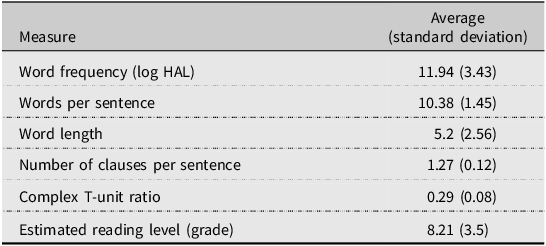
Table 3. Long description
A table summarizing the characteristics of experimental sentences used in a study. The table has two columns: Measure and Average (standard deviation). It contains seven rows with the following data: Row 1: Word frequency (log HAL), 11.94 (3.43). Row 2: Words per sentence, 10.38 (1.45). Row 3: Word length, 5.2 (2.56). Row 4: Number of clauses per sentence, 1.27 (0.12). Row 5: Complex T-unit ratio, 0.29 (0.08). Row 6: Estimated reading level (grade), 8.21 (3.5).
Procedure
Participants sat comfortably in front of a computer screen and silently read single-line sentences while their eye movements were tracked with an SR Research Eyelink 1000+ eye tracker in desktop configuration or an Eyelink Portable Duo. Stimuli were presented in 14pt black Courier New font on a light gray background on a 24-inch LCD monitor with a 1000 Hz refresh rate. The screen was placed 85 cm from the participants’ eyes, providing ∼3.5 letters/degree of visual angle. Participants first performed a 3-point calibration and then read silently. When participants’ eyes crossed the programmed invisible boundary, the preview word either changed from one of the different previews (in the display change conditions) or remained that same (in the identical condition). Participants pressed a gamepad button when they finished reading a sentence to move on to the next trial. To ensure they were reading for comprehension, participants answered Yes/No questions with buttons on the gamepad after 20% of the trials.
Analyses
The data were analyzed using a linear mixed effects (LME) model with random intercepts for item and subject, as models with more complex random effects structures did not converge. The fixed effects contained predictors for group (entered with a treatment contrast, with the hearing group as the baseline and the deaf group as the comparison), preview condition (entered with successive differences contrasts), and morphological awareness score (centered around group means). The preview condition was contrast coded using successive differences as follows:
-
1. Identity preview benefit: Pseudomorphological (sadment)—Identity (sadness)
-
2. Morphological preview benefit: Nonmorphological (sadnard)—Pseudomorphological (sadment)
-
3. Orthographic preview benefit: Unrelated (florous)—Nonmorphological (sadnard)
The morphological preview benefit, the second contrast testing the difference between fixation durations after the pseudomorphological compared to nonmorphological previews, was our primary contrast of interest because it represents the preview effect of morphological structure distinct from the orthographic overlap present in both related previews.
The model was fit with the lmer function from the lme4 package (Bates et al., Reference Bates, Maechler, Bolker, Walker, Christensen, Singmann and Bolker2015) in the R statistical computing environment. P-values were estimated using the Satterthwaite approximation method via the lmerTest package (Kuznetsova et al., Reference Kuznetsova, Brockhoff and Christensen2017), and we used a standard alpha criterion of .05 to determine statistical significance. In addition to the primary analysis of the target word, we also report a comparison of comprehension accuracy and global reading measures (reading rate, mean fixation duration, and percent regressions) between the two groups.
Results
Comprehension accuracy
The groups did not differ significantly on comprehension accuracy (Deaf: Mean = 84% accurate, SD = 36%; Hearing: Mean = 88% accurate, SD = 32%; t = −1.74, p = 0.07).
Global sentence measures
When collapsed across preview condition, deaf readers had numerically faster overall reading rates (Deaf: M = 215 wpm, SD = 96.6; Hearing: M = 199 wpm, SD = 74.3), fewer percent regressions (Deaf: M = 10.1%, SD = 6.9; Hearing: M = 12.4%, SD = 6.0), and longer mean fixation durations (Deaf: M = 221.73 ms, SD = 37.1; Hearing: M = 212.33 ms, SD = 33.1). However, none of these differences were statistically significant in t-tests (all ps > 0.2) or LME models (main effects of group, all ps > 0.2).
Gaze durations on the target word
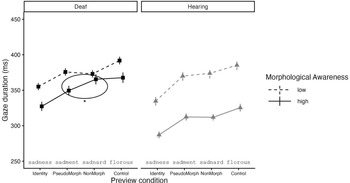
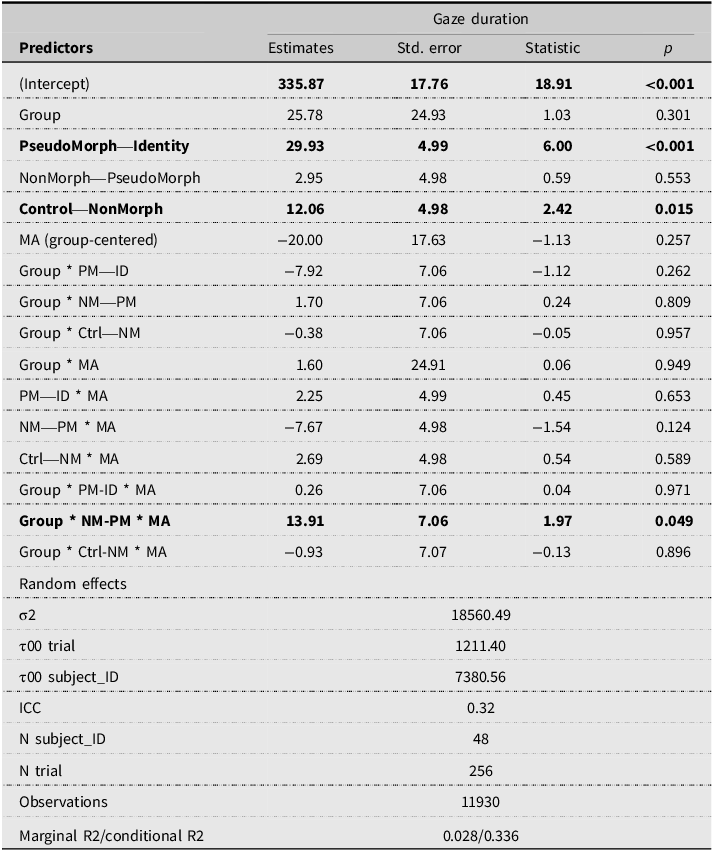
There was no significant effect of group, indicating similar gaze durations for deaf and hearing readers with average morphological awareness scores when collapsing across the preview condition. For hearing readers (the baseline group in the analysis), there was a significant identity preview benefit (i.e., shorter gaze durations on the target in the identity preview condition than in the pseudomorphological preview condition, p < 0.001) and a significant orthographic preview benefit (i.e., shorter gaze durations on the target in the nonmorphological condition compared to the unrelated condition, p < 0.05). However, hearing readers did not show a significant morphological preview benefit (i.e., their gaze durations were similar on targets in the pseudomorphological and nonmorphological preview conditions, p = 0.553). For hearing readers, there were no significant overall effects of morphological awareness or two-way interactions between morphological awareness and any of the preview comparisons (all ps > 0.123).
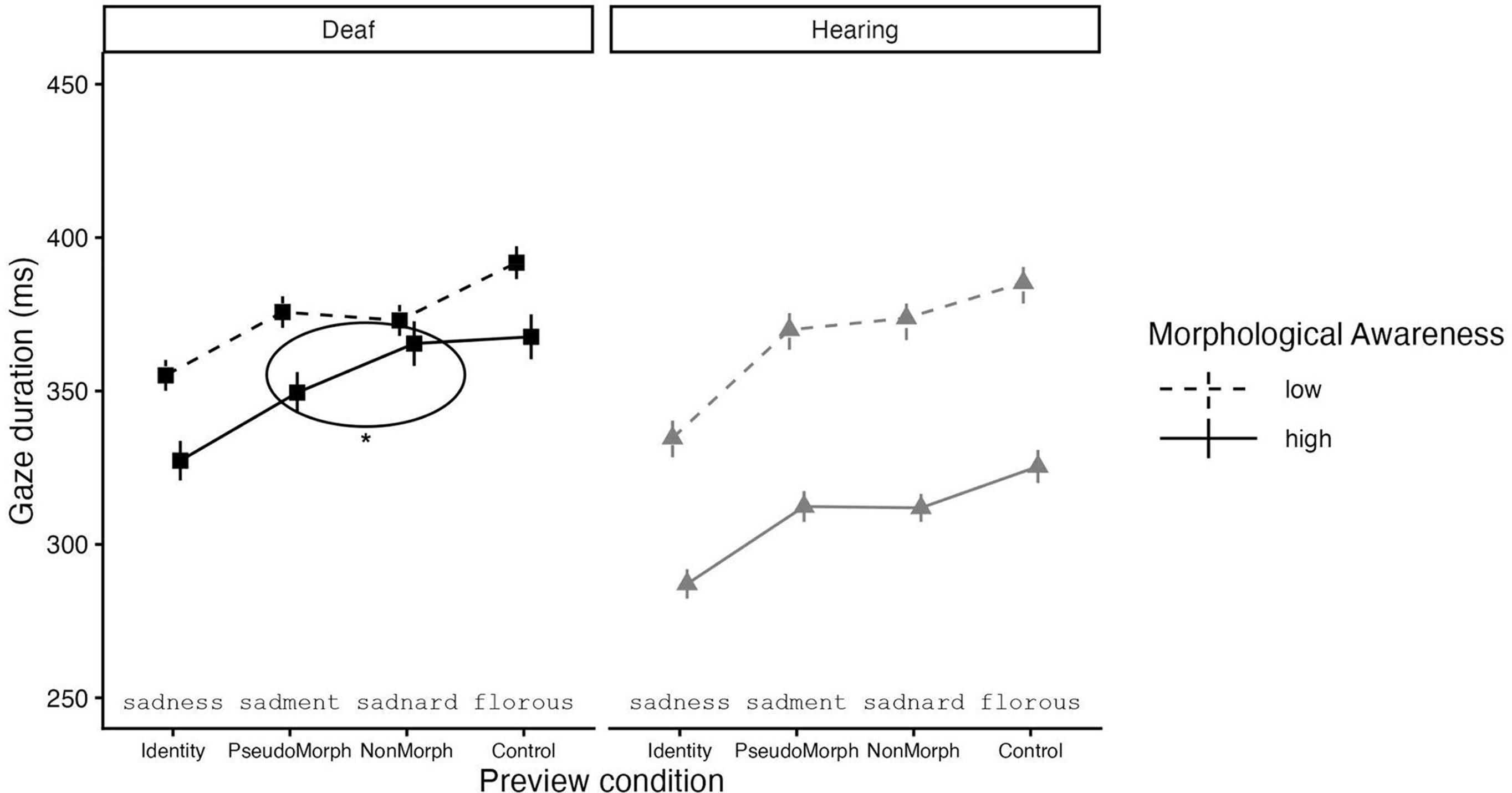
There were no significant two-way interactions between group and any of the previous comparisons, suggesting that on average the groups were similarly sensitive to the manipulations. However, there was a significant three-way interaction between group, morphological awareness, and the morphological preview benefit. The interaction indicates shorter gaze durations on the target following the pseudomorphological preview compared to the nonmorphological preview for the deaf group, particularly for those with high morphological awareness, and no difference between preview conditions for the hearing group (p = 0.049, see Figure 2 and Table 4 for statistical results with effect sizes represented in the estimates column). The inclusion of the three-way interaction in the model resulted in a marginally better model fit than a model with only two-way interactions: Δ χ2 (3, N = 48) = 7.46, p = 0.059.
Interaction between group, morphological awareness, and preview condition. The circle highlights the three-way interaction between group, morphological awareness (visualized by median split), and preview condition (pseudomorphological (“sadment”) vs. nonmorphological (“sadnard”) previews).
LME results, gaze duration
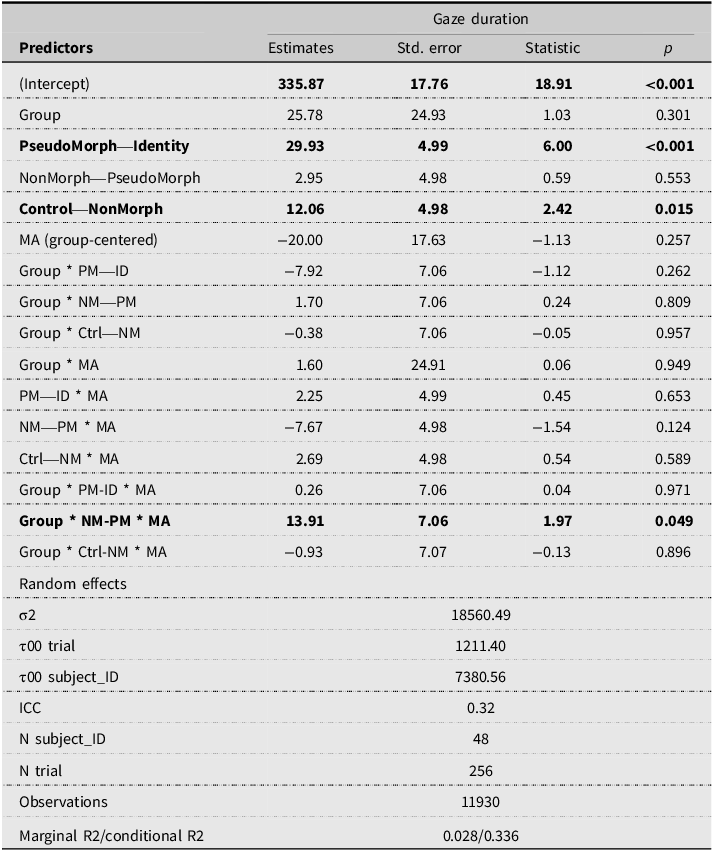
Table 4. Long description
The table presents the results of a linear mixed-effects model analysis on gaze duration. It includes predictors such as Group, PseudoMorph-Identity, NonMorph-PseudoMorph, Control-NonMorph, MA (group-centered), and various interactions among these predictors. The table has 21 rows and 5 columns. The columns are labeled as Predictors, Estimates, Std. error, Statistic, and p. Each row lists a predictor, its estimate, standard error, statistic value, and p-value. Notable predictors include PseudoMorph-Identity with an estimate of 29.93 and a p-value of less than 0.001, and Control-NonMorph with an estimate of 12.06 and a p-value of 0.015. The table also includes random effects such as sigma squared, tau00 trial, tau00 subject_ID, ICC, and the number of subjects and trials. The marginal R2/conditional R2 is 0.028/0.336.
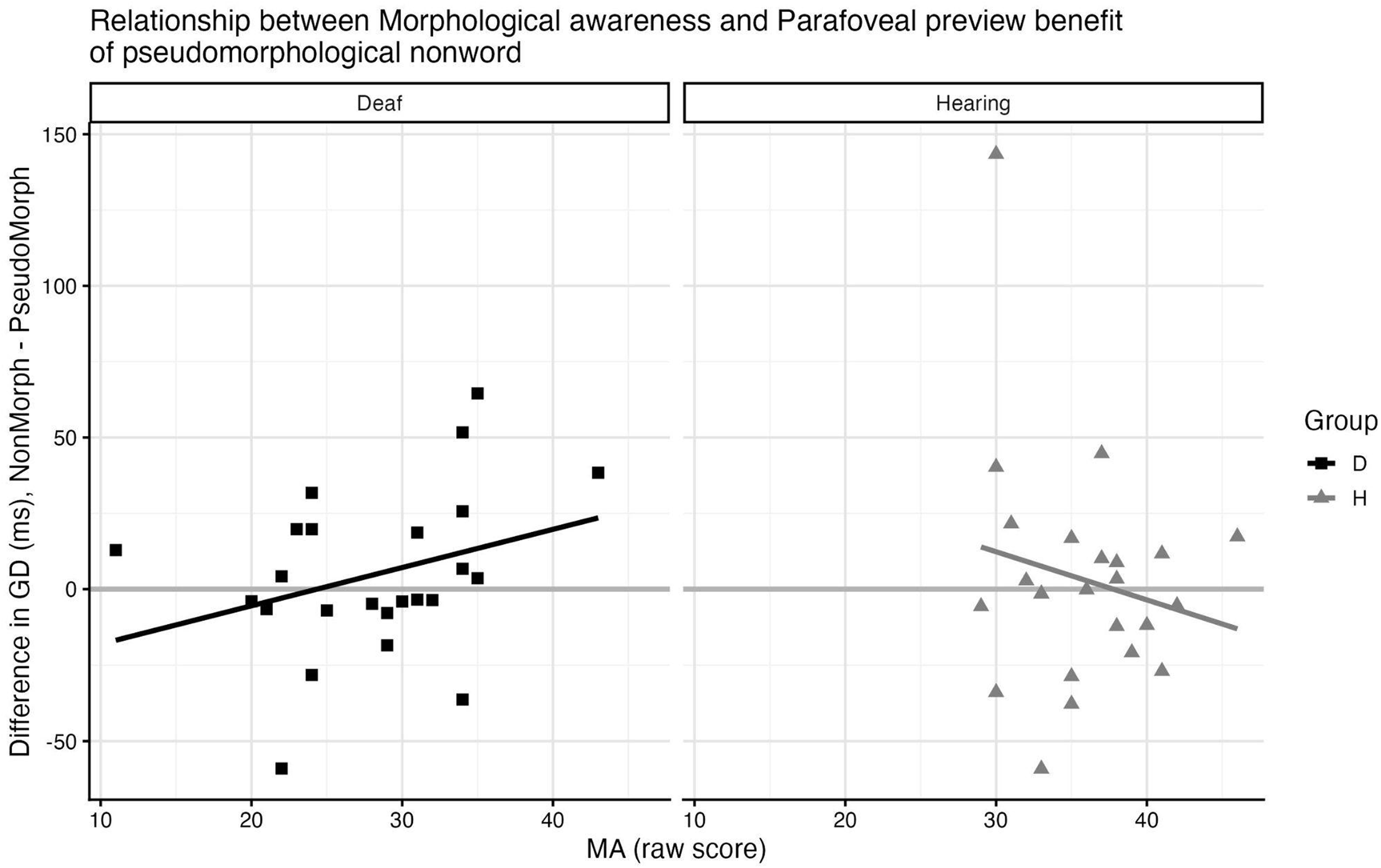
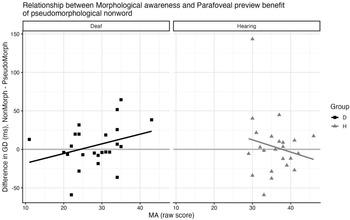
To more clearly illustrate the three-way interaction indexing the different patterns of the morphological preview effect, we calculated the difference in average gaze duration after nonmorphological and pseudomorphological previews for each participant. A positive number reflects a preview benefit from the pseudomorphological condition, distinct from the orthographic preview benefit of the shared letters present in both pseudomorphological (“sadment”) and nonmorphological (“sadnard”) conditions. Figure 3 illustrates the group interaction between the preview condition and morphological awareness using these difference scores.
Relationship between morphological awareness and parafoveal preview benefit measured as the difference in gaze duration (GD) after nonmorphological versus pseudomorphological previews. A positive difference score indicates a preview benefit from the pseudomorphological preview.
Additional eye-tracking measures on the target word
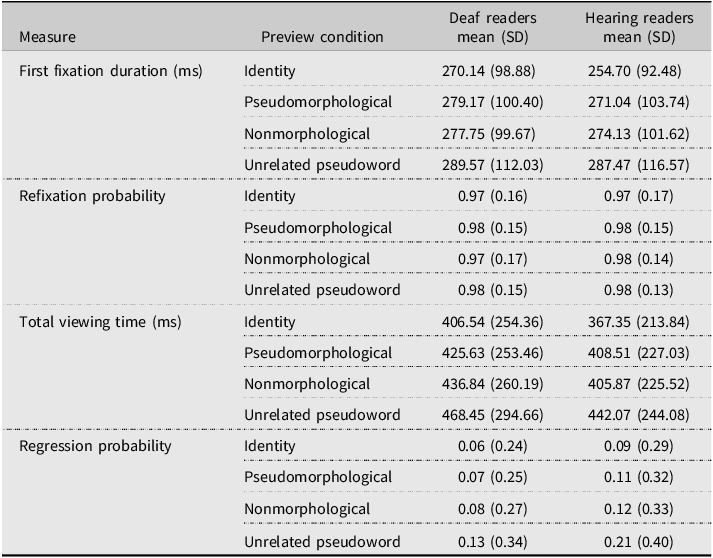
When collapsed across preview conditions, there was no main effect of group for first fixation duration, total viewing time, or refixation probability (all ps > 0.44), but deaf readers regressed marginally less than hearing readers (deaf M = 0.08%, hearing M = 0.13%; t = −1.78, p = 0.075) (see Table 5).
Summary of additional eye-tracking measures on the target word, summarized by group and preview condition
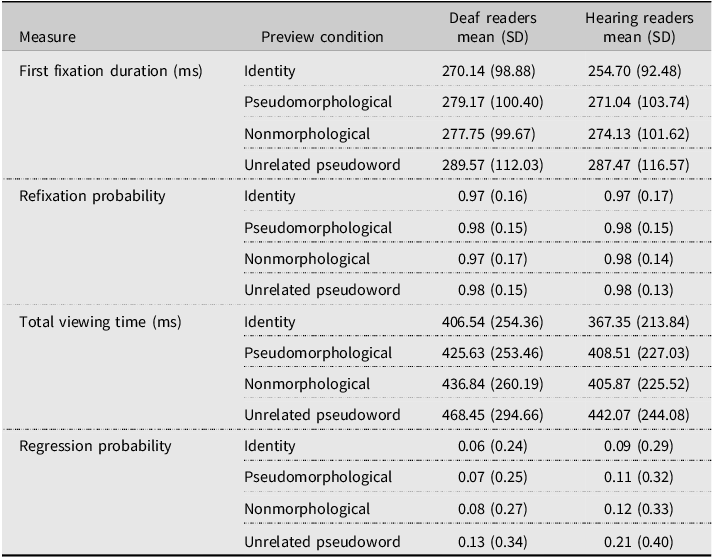
Table 5. Long description
The table presents eye-tracking measures for deaf and hearing readers across various preview conditions. It has four rows and three columns. The columns are labeled Measure, Preview condition, Deaf readers mean (SD), and Hearing readers mean (SD). The measures include First fixation duration (ms), Refixation probability, Total viewing time (ms), and Regression probability. The preview conditions are Identity, Pseudomorphological, Nonmorphological, and Unrelated pseudoword. Row 1: First fixation duration (ms), Identity, Deaf readers mean (SD) 270.14 (98.88), Hearing readers mean (SD) 254.70 (92.48). Row 2: First fixation duration (ms), Pseudomorphological, Deaf readers mean (SD) 279.17 (100.40), Hearing readers mean (SD) 271.04 (103.74). Row 3: First fixation duration (ms), Nonmorphological, Deaf readers mean (SD) 277.75 (99.67), Hearing readers mean (SD) 274.13 (101.62). Row 4: First fixation duration (ms), Unrelated pseudoword, Deaf readers mean (SD) 289.57 (112.03), Hearing readers mean (SD) 287.47 (116.57). Row 5: Refixation probability, Identity, Deaf readers mean (SD) 0.97 (0.16), Hearing readers mean (SD) 0.97 (0.17). Row 6: Refixation probability, Pseudomorphological, Deaf readers mean (SD) 0.98 (0.15), Hearing readers mean (SD) 0.98 (0.15). Row 7: Refixation probability, Nonmorphological, Deaf readers mean (SD) 0.97 (0.17), Hearing readers mean (SD) 0.98 (0.14). Row 8: Refixation probability, Unrelated pseudoword, Deaf readers mean (SD) 0.98 (0.15), Hearing readers mean (SD) 0.98 (0.13). Row 9: Total viewing time (ms), Identity, Deaf readers mean (SD) 406.54 (254.36), Hearing readers mean (SD) 367.35 (213.84). Row 10: Total viewing time (ms), Pseudomorphological, Deaf readers mean (SD) 425.63 (253.46), Hearing readers mean (SD) 408.51 (227.03). Row 11: Total viewing time (ms), Nonmorphological, Deaf readers mean (SD) 436.84 (260.19), Hearing readers mean (SD) 405.87 (225.52). Row 12: Total viewing time (ms), Unrelated pseudoword, Deaf readers mean (SD) 468.45 (294.66), Hearing readers mean (SD) 442.07 (244.08). Row 13: Regression probability, Identity, Deaf readers mean (SD) 0.06 (0.24), Hearing readers mean (SD) 0.09 (0.29). Row 14: Regression probability, Pseudomorphological, Deaf readers mean (SD) 0.07 (0.25), Hearing readers mean (SD) 0.11 (0.32). Row 15: Regression probability, Nonmorphological, Deaf readers mean (SD) 0.08 (0.27), Hearing readers mean (SD) 0.12 (0.33). Row 16: Regression probability, Unrelated pseudoword, Deaf readers mean (SD) 0.13 (0.34), Hearing readers mean (SD) 0.21 (0.40).
In LME/GLME models with both group and preview condition as predictors, there was a marginally significant interaction between group and the orthographic preview benefit (unrelated—nonmorphological) for regression probability, such that hearing readers were slightly more likely to regress after the unrelated preview than the nonmorphological preview compared to the deaf readers (p = 0.052). There was also a marginally significant interaction between group and identity preview (pseudomorphological—identity) such that the hearing readers spent slightly less total time on the target after an identity preview compared to a pseudomorphological preview than the deaf readers (p = 0.054).
There were no significant group interactions with the morphological preview contrast of interest (nonmorphological—pseudomorphological) for first fixation duration, total viewing time, refixation probability, or regression probability (all ps > 0.11).
Discussion
The present study investigated parafoveal preprocessing of morphological structure for deaf and hearing readers using a gaze-contingent display change paradigm. As expected, we found a significant preview benefit effect of shared orthography with the target word (sadnard-sadness) compared to an unrelated preview (florous-sadness), indicating that both groups of readers initiated word recognition from a parafoveal preview and used the presence of shared letters to facilitate access to a complex target word once they fixated on it. We observed differences between the groups with respect to the pattern of morphological preview benefit and its relationship with morphological awareness. The deaf readers with higher morphological awareness exhibited a preview benefit from morphological structure in the parafovea (i.e., pseudomorphological previews resulted in shorter fixation durations than nonmorphological previews). For this group, the size of the preview benefit also increased with morphological awareness. This pattern suggests that deaf readers with higher morphological awareness were segmenting morphological structure in the earliest stages of word recognition. They were more easily able to extract the root when the suffix was a true suffix, even though this segmentation did not result in a valid English word (sadment), compared to when the suffix was not a valid English suffix (sadnard). This segmentation facilitated access to a morphologically complex target word, as evidenced by shorter gaze durations. The timing of this effect, given that the pseudomorphological manipulation was only visible while in the parafovea, indicates that morphological segmentation likely occurs in the pre-lexical stage of the processing stream, before readers become consciously aware of the meanings of each morpheme.
In contrast, the relationship between the morphological preview effect and morphological awareness for the hearing readers was smaller and trended in the opposite direction, indicating that the presence of morphological structure in the parafovea yielded no additional facilitation as morphological awareness increased. The relationship for the deaf readers with low morphological awareness was similar to that of the hearing readers. For both of these groups, a preview with shared letters, whether or not it had a valid morphological structure (sadment/sadnard), provided more facilitation than a preview with no shared letters (florous), indicating an orthographic preview benefit. In contrast, for deaf readers with high morphological awareness, a preview with shared letters but invalid morphological structure (“sadnard”) provided no more facilitation than an unrelated preview. For this group, an invalid morphological ending (despite a shared root) may hinder the orthographic preview benefit demonstrated by the other groups in the current study. This pattern would suggest that without a familiar suffix indicating a morpheme boundary after the root, this group of readers was less able to segment the informative shared root in the nonmorphological preview (“sad” out of “sadnard”) and initiate word recognition in the parafovea. Readers who have developed a strong awareness of morphological structure may prioritize this type of information when processing upcoming words that are likely to be morphologically complex, i.e., longer words. Longer words without an apparent morpheme boundary, like “sadnard,” would thus be processed more similarly to a single-morpheme word, which may not allow these readers to identify the familiar root word in the short time the preview is available.
The results of the current study indicate that deaf readers with relatively good morphological knowledge were able to carry out initial morpho-orthographic segmentation in the parafovea when preview words had apparent morphological structure. Segmenting a preview word according to morphological structure facilitated their recognition of complex multimorphemic targets, allowing these deaf readers to more efficiently direct their attention (i.e., their fixations) to the long, infrequent target words.
Because this pattern was primarily observed for skilled deaf readers who had high scores in both morphological awareness and general reading comprehension, the unique reading profile of an individual deaf reader likely plays an important role in how they allocate their attentional resources. This could be an effect of morphological awareness or reading ability more generally. Deaf readers as a population tend to be more heterogeneous than hearing readers, and this trend is reflected in the wider variance in reading assessment scores in our deaf group. The relationship between morphological awareness and reading comprehension, while statistically significant for both groups, was slightly stronger for the deaf than the hearing participants in our sample. Therefore, when interpreting differences in online morphological processing for deaf readers, it is necessary to consider individual differences in reading proficiency, including and especially morphological awareness.
It is important to note that although the two groups did not differ in overall reading comprehension scores (Deaf: M = 36.5, SD = 4.8; Hearing: M = 38.0, SD = 2.9; p = 0.19, see Table 1), they did differ in morphological awareness (p < 0.01). Furthermore, the morphological awareness scores of the deaf group with high morphological awareness were lower than those of the hearing group with high morphological awareness (Deaf: M = 33.9, SD = 3.5; Hearing: M = 39.4, SD = 2.7; p < 0.01). This pattern indicates that the parafoveal preprocessing of morphological structure was not a result of high morphological awareness alone, but rather this pattern was a characteristic unique to the reading processes of skilled deaf readers. Morphological awareness, which can be a route through which deaf readers achieve word recognition in the absence of accessible input from phonology, may therefore be instrumental in helping deaf readers access the meaning of complex multimorphemic words. Strong morphological awareness skills could provide a boost to reading comprehension levels in complex contexts, helping deaf readers to access more advanced content. Morphological awareness has been shown to have a strong relationship with overall reading skill for deaf readers (Saunders et al., Reference Saunders, Helms and Emmorey2026) and predicts college-level English placement (Clark et al., Reference Clark, Gilbert and Anderson2011). Targeting this skill in reading interventions for developing deaf readers may provide an accessible tool for these readers to improve their vocabulary, comprehension, and eventual literacy outcomes.
In the current study, deaf readers’ gaze durations on target words were numerically (though not significantly) longer than the hearing readers’ gaze durations, in contrast to previous research finding overall shorter fixation durations for deaf readers (e.g., Traxler et al., Reference Traxler, Banh, Craft, Winsler, Brothers, Hoversten, Piñar and Corina2021). This difference may be best explained by the nature of the target words in the current study. Word length and frequency have been shown to have larger effects on the skipping behaviors and gaze durations of deaf readers compared to hearing readers (Cooley et al., Reference Cooley, Emmorey, Saunders, Sinclair, Stringer and Schotter2025). Specifically, deaf readers skip long words less often than their hearing peers and may also spend more time on them when they do fixate, indicating that these more “difficult” long words require more of their attentional resources. Morphologically complex words, which are more likely to be long and infrequent than simple words (English Lexicon Project; Balota et al., Reference Balota, Yap, Cortese, Hutchison, Kessler, Loftis, Neely, Nelson, Simpson and Treiman2007), make up the majority of words encountered by skilled readers (Nagy & Anderson, Reference Nagy and Anderson1984). Enhanced attention to morpho-orthographic structure in upcoming words could allow deaf readers to identify complex or infrequent words while they are still in the parafovea and determine that these words will require more attentional resources and longer fixations.
Limitations and future directions
One limitation of the current study is that morphological awareness and reading skill were correlated in our participant sample. This pattern aligns with previous research that morphological awareness supports overall reading ability (Deacon et al., Reference Deacon, Kieffer and Laroche2014; Kotzer et al., Reference Kotzer, Kirby and Heggie2021), and particularly for skilled deaf readers (Saunders et al., Reference Saunders, Helms and Emmorey2026). Although the two groups were matched on overall reading comprehension scores, decreasing the likelihood of group differences explained by reading skill, it is possible that the pattern of morphological preview benefits observed for the skilled deaf readers is driven by more general reading skill, as opposed to specifically morphological awareness.
Another possible concern regarding this study is that we did not replicate the findings of Dann et al. (Reference Dann, Veldre and Andrews2021), who found that hearing readers demonstrated a preview benefit from pseudomorphological structure in the parafovea. One speculative explanation for the difference between studies could be demographic variation in the participant samples. The participants in Dann et al. (Reference Dann, Veldre and Andrews2021) were all university students at the time of participation, whereas the participants in the current study ranged in age from 19 to 59 years and had a wide variety of occupations and educational backgrounds. Readers who are actively immersed in a higher education setting frequently encounter unfamiliar multimorphemic words and may be more attuned to morpho-orthographic cues compared to readers who are not college students. Although our sample of hearing readers scored highly on offline assessments of morphological awareness, their everyday reading habits likely require less attention to complex morphology in order to discern novel word meanings. Thus, their online eye movement behaviors during passive sentence reading may be less affected by morphological structure.
Previous research with prefixed preview words concluded that (hearing) readers of English did not preprocess morphological structure in the parafovea, likely because the most informative part of the preview (the stem) was too far from the central fixation to result in a preview benefit (Kambe, Reference Kambe2004; Dann et al., Reference Dann, Veldre and Andrews2021). Deaf readers, however, who can process word information further into the periphery, may exhibit a parafoveal preview benefit from prefixed information, whereas hearing readers do not. Further research can reveal whether deaf readers exhibit morphological preview benefits for prefixed stimuli.
Conclusions
This study reported the first evidence of parafoveal preprocessing of morphological structure during sentence reading for deaf readers. We observed a larger preview benefit from pseudomorphological preview items than nonmorphological preview items that shared a root with the target word, but only for deaf readers with high morphological awareness. Segmentation of morphologically structured pseudoword cues facilitated access to a root word, and by extension, the real target word for these deaf readers. Hearing readers, regardless of morphological awareness ability, did not show a difference between pseudo and nonmorphological preview items, although both types of previews with a shared root elicited a preview benefit compared to an unrelated preview. This pattern of results suggests a unique relationship between morphological awareness and the initial stages of complex multimorphemic word recognition during sentence reading for skilled deaf readers.
Replication package
An OSF project containing the complete anonymized Rmarkdown project, stimuli, and data can be found at the following link: https://osf.io/wjca7/.

 Open access

