





1 Introduction and background
1.1 Notations and preliminaries
Let ${\mathbb D}$
denote the open unit disk in the complex plane and
${\mathbb D}$
denote the open unit disk in the complex plane and ${\mathbb T}$
be the unit circle. For a function f analytic in
${\mathbb T}$
be the unit circle. For a function f analytic in ${\mathbb D}$
, the integral means are defined as
${\mathbb D}$
, the integral means are defined as

and

It is said that f is in the Hardy space $H^p (0 < p \le \infty )$
if
$H^p (0 < p \le \infty )$
if

A function $f \in H^p$
has the radial limit
$f \in H^p$
has the radial limit

in almost every direction, and $f({e^{i\theta }})\in L^p({\mathbb T})$
. Detailed surveys on Hardy spaces and integral means can be found in, for example, the book of Duren [Reference Duren6]. Throughout this article, we follow notations from [Reference Duren6].
$f({e^{i\theta }})\in L^p({\mathbb T})$
. Detailed surveys on Hardy spaces and integral means can be found in, for example, the book of Duren [Reference Duren6]. Throughout this article, we follow notations from [Reference Duren6].
A complex-valued function $f=u+iv$
is harmonic in
$f=u+iv$
is harmonic in ${\mathbb D}$
if u and v are real-valued harmonic functions in
${\mathbb D}$
if u and v are real-valued harmonic functions in ${\mathbb D}$
. Every such function has a unique representation
${\mathbb D}$
. Every such function has a unique representation ${f=h+\overline {g}}$
, where h and g are analytic in
${f=h+\overline {g}}$
, where h and g are analytic in $\mathbb {D}$
with
$\mathbb {D}$
with $g(0)=0$
. Analogous to the
$g(0)=0$
. Analogous to the $H^p$
spaces, the harmonic Hardy spaces
$H^p$
spaces, the harmonic Hardy spaces $h^p$
are the class of harmonic functions f for which
$h^p$
are the class of harmonic functions f for which $M_p(r,f)$
is bounded.
$M_p(r,f)$
is bounded.
1.2 Growth of conjugate functions
Given a real-valued harmonic function u in ${\mathbb D}$
, let v be its harmonic conjugate with
${\mathbb D}$
, let v be its harmonic conjugate with $v(0)=0$
. It is a natural question that if u has a certain property, whether so does v. In the context of boundary behavior, this is answered by a celebrated theorem of M. Riesz.
$v(0)=0$
. It is a natural question that if u has a certain property, whether so does v. In the context of boundary behavior, this is answered by a celebrated theorem of M. Riesz.
Theorem A [Reference Duren6, Theorem 4.1]
If $u \in h^p$
for some p,
$u \in h^p$
for some p, $1<p<\infty $
, then its harmonic conjugate v is also of class
$1<p<\infty $
, then its harmonic conjugate v is also of class $h^p$
. Furthermore, there is a constant
$h^p$
. Furthermore, there is a constant $A_p$
, depending only on p, such that
$A_p$
, depending only on p, such that
 $$ \begin{align*}M_p(r,v) \le A_p \, M_p(r,u),\end{align*} $$
for all $u \in h^p$
.
$u \in h^p$
.
Curiously, the theorem fails for $p=1$
and
$p=1$
and $p=\infty $
, examples can be found in [Reference Duren6, p. 56]. Although the harmonic conjugate of an
$p=\infty $
, examples can be found in [Reference Duren6, p. 56]. Although the harmonic conjugate of an $h^1$
-function need not be in
$h^1$
-function need not be in $h^1$
, Kolmogorov proved that it does belong to
$h^1$
, Kolmogorov proved that it does belong to $h^p$
for all
$h^p$
for all $p<1$
. Later, Zygmund established that the condition
$p<1$
. Later, Zygmund established that the condition $|u| \log ^+ |u| \in L^1({\mathbb T})$
is the “minimal” growth restriction on u which implies
$|u| \log ^+ |u| \in L^1({\mathbb T})$
is the “minimal” growth restriction on u which implies $v\in h^1$
. We refer to the paper of Pichorides [Reference Pichorides14] for the optimal constants in the Riesz, Kolmogorov, and Zygmund theorems.
$v\in h^1$
. We refer to the paper of Pichorides [Reference Pichorides14] for the optimal constants in the Riesz, Kolmogorov, and Zygmund theorems.
In [Reference Hardy and Littlewood7], Hardy and Littlewood showed that in the case $0<p<1$
, Riesz’s theorem is false in a much more comprehensive sense. Kolmogorov’s result might suggest that if
$0<p<1$
, Riesz’s theorem is false in a much more comprehensive sense. Kolmogorov’s result might suggest that if $u\in h^p$
, then v, while not necessarily in
$u\in h^p$
, then v, while not necessarily in $h^p$
, should belong to
$h^p$
, should belong to $h^q$
for
$h^q$
for $0<q<p$
. But this is false, and in fact, v need not belong to
$0<q<p$
. But this is false, and in fact, v need not belong to $h^q$
for any
$h^q$
for any $q>0$
.
$q>0$
.
Nevertheless, they proved that the symmetry is restored in these latter cases if instead of the boundedness of the means, one considers their order of growth.
Theorem B [Reference Hardy and Littlewood7, Theorem 4]
Let $0<p\le \infty $
and
$0<p\le \infty $
and $\beta>0$
. Suppose
$\beta>0$
. Suppose $f=u+iv$
is analytic in
$f=u+iv$
is analytic in ${\mathbb D}$
, and
${\mathbb D}$
, and
 $$ \begin{align*}M_p(r,u) = O \left(\frac{1}{(1-r)^{\beta}}\right).\end{align*} $$
Then,
 $$ \begin{align*}M_p(r,v) = O \left(\frac{1}{(1-r)^{\beta}}\right).\end{align*} $$
The proof of this theorem is based on an extremely complicated (as remarked by the authors themselves) result, which can be stated as follows.
Theorem C [Reference Hardy and Littlewood7, Theorems 2 and 3]
If $f=u+iv$
is analytic in
$f=u+iv$
is analytic in ${\mathbb D}$
, and
${\mathbb D}$
, and
 $$ \begin{align*}M_p(r,u) = O \left(\frac{1}{(1-r)^{\beta}}\right),\quad 0<p\le \infty,\quad \beta\ge 0,\end{align*} $$
then
 $$ \begin{align*}M_p(r,f') = O \left(\frac{1}{(1-r)^{\beta+1}}\right).\end{align*} $$
Further, the converse is true for all $\beta>0$
.
$\beta>0$
.
Let us note that the functions $|u|^p$
and
$|u|^p$
and $|v|^p$
are subharmonic when
$|v|^p$
are subharmonic when $p\ge 1$
, but not when
$p\ge 1$
, but not when $p<1$
, and therefore,
$p<1$
, and therefore, $M_p(r,u)$
and
$M_p(r,u)$
and $M_p(r,v)$
are not necessarily monotonic for
$M_p(r,v)$
are not necessarily monotonic for $p<1$
. This is the principal difficulty in dealing with the case
$p<1$
. This is the principal difficulty in dealing with the case $0<p<1$
for harmonic functions.
$0<p<1$
for harmonic functions.
1.3 Riesz theorem for harmonic quasiregular mappings
For $K\ge 1$
, a sense-preserving harmonic function
$K\ge 1$
, a sense-preserving harmonic function $f=h+\overline {g}$
is said to be K-quasiregular if its complex dilatation
$f=h+\overline {g}$
is said to be K-quasiregular if its complex dilatation $\omega = g'/h'$
satisfies the inequality
$\omega = g'/h'$
satisfies the inequality
 $$ \begin{align*}|\omega(z)| \le k <1 \quad (z\in {\mathbb D}),\end{align*} $$
where

The function f is K-quasiconformal if it is K-quasiregular as well as homeomorphic in ${\mathbb D}$
. One can find the
${\mathbb D}$
. One can find the $H^p$
-theory for quasiconformal mappings in, for example, the paper of Astala and Koskela [Reference Astala and Koskela1]. It is worth mentioning that harmonic quasiconformal mappings have generated considerable interest in recent times, perhaps from a novel point of view. In [Reference Wang, Wang, Rasila and Qiu16], Wang et al. constructed independent extremal functions for harmonic quasiconformal mappings, which were then further explored by Li and Ponnusamy in [Reference Li and Ponnusamy12]. Recently, in [Reference Das, Huang and Rasila3], Baernstein-type extremal results were obtained on the analytic and co-analytic parts of functions in the harmonic quasiconformal Hardy space.
$H^p$
-theory for quasiconformal mappings in, for example, the paper of Astala and Koskela [Reference Astala and Koskela1]. It is worth mentioning that harmonic quasiconformal mappings have generated considerable interest in recent times, perhaps from a novel point of view. In [Reference Wang, Wang, Rasila and Qiu16], Wang et al. constructed independent extremal functions for harmonic quasiconformal mappings, which were then further explored by Li and Ponnusamy in [Reference Li and Ponnusamy12]. Recently, in [Reference Das, Huang and Rasila3], Baernstein-type extremal results were obtained on the analytic and co-analytic parts of functions in the harmonic quasiconformal Hardy space.
Suppose $f=u+iv$
is a harmonic function in
$f=u+iv$
is a harmonic function in ${\mathbb D}$
, and
${\mathbb D}$
, and $u\in h^p$
for some
$u\in h^p$
for some $p>1$
. Then, the imaginary part v does not necessarily belong to
$p>1$
. Then, the imaginary part v does not necessarily belong to $h^p$
, i.e., the Riesz theorem is not true for harmonic functions. One naturally asks under which additional condition(s) a harmonic analog of the Riesz theorem would hold. Recently, Liu and Zhu [Reference Liu and Zhu13] showed that such a condition is the quasiregularity of f.
$h^p$
, i.e., the Riesz theorem is not true for harmonic functions. One naturally asks under which additional condition(s) a harmonic analog of the Riesz theorem would hold. Recently, Liu and Zhu [Reference Liu and Zhu13] showed that such a condition is the quasiregularity of f.
Theorem D [Reference Liu and Zhu13]
Let $f=u+iv$
be a harmonic K-quasiregular mapping in
$f=u+iv$
be a harmonic K-quasiregular mapping in ${\mathbb D}$
such that
${\mathbb D}$
such that $u \ge 0$
and
$u \ge 0$
and $v(0)=0$
. If
$v(0)=0$
. If $u \in h^p$
for some
$u \in h^p$
for some $p\in (1,2]$
, then also v is in
$p\in (1,2]$
, then also v is in $h^p$
. Furthermore, there is a constant
$h^p$
. Furthermore, there is a constant $C(K,p)$
, depending only on K and p, such that
$C(K,p)$
, depending only on K and p, such that
 $$ \begin{align*}M_p(r,v) \le C(K,p)M_p(r,u).\end{align*} $$
Moreover, if $K=1$
, i.e., f is analytic, then
$K=1$
, i.e., f is analytic, then $C(1,p)$
coincides with the optimal constant in the Riesz theorem.
$C(1,p)$
coincides with the optimal constant in the Riesz theorem.
The condition $u\ge 0$
was subsequently removed by Chen et al. [Reference Chen, Huang, Wang and Xiao2], who remarkably extended the result for all
$u\ge 0$
was subsequently removed by Chen et al. [Reference Chen, Huang, Wang and Xiao2], who remarkably extended the result for all $p\in (1,\infty )$
. Later in [Reference Kalaj10], Kalaj produced a couple of Kolmogorov type theorems for harmonic quasiregular mappings. Very recently, a quasiregular analog of Zygmund’s theorem has been obtained by Kalaj [Reference Kalaj11], and also independently by Das, Huang, and Rasila [Reference Das, Huang and Rasila4].
$p\in (1,\infty )$
. Later in [Reference Kalaj10], Kalaj produced a couple of Kolmogorov type theorems for harmonic quasiregular mappings. Very recently, a quasiregular analog of Zygmund’s theorem has been obtained by Kalaj [Reference Kalaj11], and also independently by Das, Huang, and Rasila [Reference Das, Huang and Rasila4].
The purpose of this article is to show that the real and imaginary parts of a harmonic quasiregular mapping have the same order of growth for all $p>0$
. This extends Theorem D to the cases
$p>0$
. This extends Theorem D to the cases $0<p<1$
and
$0<p<1$
and $p=\infty $
. The main results and their proofs are presented in the next section.
$p=\infty $
. The main results and their proofs are presented in the next section.
2 Main results and proofs
In what follows, we always assume that K and k are related by (1.1).
Theorem 1 Suppose $0<p\le \infty $
and
$0<p\le \infty $
and $\beta>0$
, and let
$\beta>0$
, and let $f=u+iv$
be a harmonic K-quasiregular mapping in
$f=u+iv$
be a harmonic K-quasiregular mapping in ${\mathbb D}$
. If
${\mathbb D}$
. If
 $$ \begin{align*}M_p(r,u) = O \left(\frac{1}{(1-r)^{\beta}}\right),\end{align*} $$
then
 $$ \begin{align*}M_p(r,v) = O \left(\frac{1}{(1-r)^{\beta}}\right).\end{align*} $$
Proof For $1<p< \infty $
, we could apply the result of Chen et al. from [Reference Chen, Huang, Wang and Xiao2], but here we shall give a simple proof which makes no appeal to this deeper result.
$1<p< \infty $
, we could apply the result of Chen et al. from [Reference Chen, Huang, Wang and Xiao2], but here we shall give a simple proof which makes no appeal to this deeper result.
Let us write $f=h+\overline {g}$
, and let
$f=h+\overline {g}$
, and let $F=h+g$
. Then,
$F=h+g$
. Then,
 $$ \begin{align*}{\operatorname{Re}\,} F = {\operatorname{Re}\,} f = u.\end{align*} $$
If $M_p(r,u)$
has the given order of growth, it follows from Theorem C that
$M_p(r,u)$
has the given order of growth, it follows from Theorem C that
 $$ \begin{align*}M_p(r,F') = O \left(\frac{1}{(1-r)^{\beta+1}}\right).\end{align*} $$
Now, we observe
 $$ \begin{align*}F'=h'+g'=(1+\omega)h',\end{align*} $$
so that
 $$ \begin{align*}|F'|\ge (1-|\omega|)|h'| \ge (1-k)|h'|,\end{align*} $$
as $|\omega | \le k$
. This readily implies
$|\omega | \le k$
. This readily implies
 $$ \begin{align*}M_p(r,h')\le \frac{1}{1-k}M_p(r,F') = O \left(\frac{1}{(1-r)^{\beta+1}}\right). \end{align*} $$
Since $|g'|\le k|h'|$
, we also have
$|g'|\le k|h'|$
, we also have
 $$ \begin{align*}M_p(r,g') = O \left(\frac{1}{(1-r)^{\beta+1}}\right).\end{align*} $$
Therefore, the converse part of Theorem C shows that
 $$ \begin{align*}M_p(r,h) = O \left(\frac{1}{(1-r)^{\beta}}\right)=M_p(r,g).\end{align*} $$
For $1 \le p \le \infty $
, Minkowski’s inequality gives
$1 \le p \le \infty $
, Minkowski’s inequality gives
 $$ \begin{align*}M_p(r,f) \le M_p(r,h)+M_p(r, g),\end{align*} $$
while for $0<p<1$
, we have
$0<p<1$
, we have
 $$ \begin{align*}M_p^p(r,f) \le M_p^p(r,h)+M_p^p(r, g).\end{align*} $$
In either case, we find that
 $$ \begin{align*}M_p(r,f) = O \left(\frac{1}{(1-r)^{\beta}}\right),\end{align*} $$
which, in turn, implies
 $$ \begin{align*}M_p(r,v) = O \left(\frac{1}{(1-r)^{\beta}}\right).\end{align*} $$
This completes the proof.
The next theorem deals with the case $\beta =0$
. If
$\beta =0$
. If $f=u+iv$
is harmonic K-quasiregular and
$f=u+iv$
is harmonic K-quasiregular and $u\in h^p$
for some
$u\in h^p$
for some $p<1$
, then of course, v need not be in any
$p<1$
, then of course, v need not be in any $h^q$
, as discussed before. Nevertheless, it is still possible to give an estimate on
$h^q$
, as discussed before. Nevertheless, it is still possible to give an estimate on $M_p(r,v)$
, as we show in Theorem 2. The proof is somewhat similar to that of Theorem 1, and relies on the following lemma from [Reference Das and Sairam Kaliraj5].
$M_p(r,v)$
, as we show in Theorem 2. The proof is somewhat similar to that of Theorem 1, and relies on the following lemma from [Reference Das and Sairam Kaliraj5].
Lemma A [Reference Das and Sairam Kaliraj5]
Let $0 < p < 1$
. Suppose
$0 < p < 1$
. Suppose $f=h+\overline {g}$
is a locally univalent, sense-preserving harmonic function in
$f=h+\overline {g}$
is a locally univalent, sense-preserving harmonic function in ${\mathbb D}$
with
${\mathbb D}$
with $f(0)=0$
. Then,
$f(0)=0$
. Then,
 $$ \begin{align*}\| f\|_p^p \le C \int_{0}^{1} (1-r)^{p-1} M_p^p(r,h')\, dr, \end{align*} $$
where $C>0$
is a constant independent of f.
$C>0$
is a constant independent of f.
Theorem 2 Suppose $f=u+iv$
is a harmonic K-quasiregular mapping in
$f=u+iv$
is a harmonic K-quasiregular mapping in ${\mathbb D}$
, and
${\mathbb D}$
, and ${u \in h^p}$
for some
${u \in h^p}$
for some $p \in (0,1)$
. Then,
$p \in (0,1)$
. Then,
 $$ \begin{align*}M_p(r,v) = O\left(\left(\log \frac{1}{1-r}\right)^{1/p}\right).\end{align*} $$
Proof As before, we write $f=h+\overline {g}$
and
$f=h+\overline {g}$
and $F=h+g$
. Since
$F=h+g$
. Since $M_p(r,u)$
is bounded, an appeal to Theorem C, for
$M_p(r,u)$
is bounded, an appeal to Theorem C, for $\beta =0$
, shows that
$\beta =0$
, shows that
 $$ \begin{align*}M_p(r,F') = O \left(\frac{1}{1-r}\right).\end{align*} $$
The quasiregularity of f, like in the previous proof, then implies
 $$ \begin{align*}M_p(r,h') = O \left(\frac{1}{1-r}\right).\end{align*} $$
Without any loss of generality, we assume that $f(0)=0$
. For
$f(0)=0$
. For $0<r<1$
, let
$0<r<1$
, let $f_r(z)=f(rz)$
. Applying Lemma A for the function
$f_r(z)=f(rz)$
. Applying Lemma A for the function $f_r$
, we find
$f_r$
, we find
 $$ \begin{align*} M_p^p(r,f) & \le C\int_{0}^1 (1-t)^{p-1}M_p^p(rt,h')\, dt \le C\int_{0}^1 \frac{(1-t)^{p-1}}{(1-rt)^p}\, dt\\ & = C\left[\int_{0}^r \frac{(1-t)^{p-1}}{(1-rt)^p}\, dt+\int_{r}^1 \frac{(1-t)^{p-1}}{(1-rt)^p}\, dt\right]\\ & \le C \left[\int_{0}^r \frac{1}{1-t}\, dt+\frac{1}{(1-r)^p}\int_{r}^1 (1-t)^{p-1}\, dt \right]\\&= O\left(\log \frac{1}{1-r}\right). \end{align*} $$
Therefore, it follows that
 $$ \begin{align*}M_p(r,v) \le M_p(r,f) = O\left(\left(\log \frac{1}{1-r}\right)^{1/p}\right).\end{align*} $$
The proof is thus complete.
Generally speaking, Theorem 1 suggests that the real and imaginary parts of a harmonic quasiregular mapping have the same “order of infinity.” We now wish to show that they also have the same degree of smoothness on the boundary (see Theorem 3).
Let $\Lambda _\alpha (\alpha> 0)$
be the class of functions
$\Lambda _\alpha (\alpha> 0)$
be the class of functions $\varphi : {\mathbb R} \to {\mathbb C}$
satisfying a Hölder condition of order
$\varphi : {\mathbb R} \to {\mathbb C}$
satisfying a Hölder condition of order $\alpha $
, i.e.,
$\alpha $
, i.e.,
 $$ \begin{align*}\vert\varphi(x)-\varphi(y)\vert \le A \vert x-y\vert^\alpha,\end{align*} $$
for some constant $A>0$
. If
$A>0$
. If $\alpha> 1$
,
$\alpha> 1$
, $\Lambda _\alpha $
is the class of constant functions, hence, we restrict attention to the case
$\Lambda _\alpha $
is the class of constant functions, hence, we restrict attention to the case $0<\alpha \le 1$
. Clearly,
$0<\alpha \le 1$
. Clearly, $\Lambda _{\beta }\subset \Lambda _{\alpha }$
for
$\Lambda _{\beta }\subset \Lambda _{\alpha }$
for $\alpha < \beta $
.
$\alpha < \beta $
.
The following principle of Hardy and Littlewood says that an analytic function f is Hölder continuous on the boundary if $f'$
has a “slow” rate of growth, and conversely.
$f'$
has a “slow” rate of growth, and conversely.
Theorem E [Reference Hardy and Littlewood8, Theorem 40]
Let f be an analytic function in ${\mathbb D}$
. Then, f is continuous in the closed disk
${\mathbb D}$
. Then, f is continuous in the closed disk $\overline {{\mathbb D}}$
and
$\overline {{\mathbb D}}$
and $f({e^{i\theta }}) \in \Lambda _\alpha (0<\alpha \le 1)$
, if and only if
$f({e^{i\theta }}) \in \Lambda _\alpha (0<\alpha \le 1)$
, if and only if
 $$ \begin{align*}\vert f'(r{e^{i\theta}})\vert = O\left(\frac{1}{(1-r)^{1-\alpha}}\right).\end{align*} $$
We are now prepared to discuss the final result of this article.
Theorem 3 Let $f=u+iv$
be a harmonic K-quasiregular mapping in
$f=u+iv$
be a harmonic K-quasiregular mapping in ${\mathbb D}$
, and suppose u is continuous in
${\mathbb D}$
, and suppose u is continuous in $\overline {{\mathbb D}}$
. If
$\overline {{\mathbb D}}$
. If $u({e^{i\theta }}) \in \Lambda _{\alpha }$
,
$u({e^{i\theta }}) \in \Lambda _{\alpha }$
, $0<\alpha < 1$
, then v is continuous in
$0<\alpha < 1$
, then v is continuous in $\overline {{\mathbb D}}$
and
$\overline {{\mathbb D}}$
and $v({e^{i\theta }}) \in \Lambda _{\alpha }$
.
$v({e^{i\theta }}) \in \Lambda _{\alpha }$
.
Proof First, we note that if v is continuous on ${\mathbb T}$
, then
${\mathbb T}$
, then $v(r{e^{i\theta }})$
is the Poisson integral of
$v(r{e^{i\theta }})$
is the Poisson integral of $v({e^{i\theta }})$
. Hence, the continuity of
$v({e^{i\theta }})$
. Hence, the continuity of $v({e^{i\theta }})$
would imply the continuity of v in
$v({e^{i\theta }})$
would imply the continuity of v in $\overline {{\mathbb D}}$
. Therefore, it is enough to show that
$\overline {{\mathbb D}}$
. Therefore, it is enough to show that $v({e^{i\theta }}) \in \Lambda _{\alpha }$
.
$v({e^{i\theta }}) \in \Lambda _{\alpha }$
.
Now, suppose $u({e^{i\theta }})\in \Lambda _{\alpha }$
and
$u({e^{i\theta }})\in \Lambda _{\alpha }$
and $f=h+\overline {g}$
. As before, we write
$f=h+\overline {g}$
. As before, we write $F=h+g$
so that
$F=h+g$
so that
 $$ \begin{align*}{\operatorname{Re}\,} F = {\operatorname{Re}\,} f=u.\end{align*} $$
Since u is continuous in $\overline {{\mathbb D}}$
, we can represent F by the Poisson integral formula
$\overline {{\mathbb D}}$
, we can represent F by the Poisson integral formula
 $$ \begin{align*}F(z) = \frac{1}{2\pi}\int_{0}^{2\pi} \frac{e^{it}+z}{e^{it}-z}\, u(e^{it})\, dt+i{\operatorname{Im}\,} F(0).\end{align*} $$
This implies
 $$ \begin{align*} F'(z) &= \frac{1}{2\pi}\int_{0}^{2\pi}\frac{\partial}{\partial z} \left(\frac{e^{it}+z}{e^{it}-z}\right)\, u(e^{it})\, dt\\ & = \frac{1}{\pi}\int_{0}^{2\pi} \frac{e^{it}}{(e^{it}-z)^2}\, u(e^{it})\, dt. \end{align*} $$
Therefore, for $z=r{e^{i\theta }}$
, we have
$z=r{e^{i\theta }}$
, we have
 $$ \begin{align} F'(r{e^{i\theta}}) = \frac{1}{\pi}\int_{0}^{2\pi} \frac{e^{it}}{(e^{it}-r{e^{i\theta}})^2}\, u(e^{it})\, dt. \end{align} $$
Also, from the Cauchy integral formula, it is easy to see
 $$ \begin{align*}0= \frac{1}{2\pi i}\int_{{\mathbb T}} \frac{d\zeta}{(\zeta-z)^2} = \frac{1}{2\pi}\int_{0}^{2\pi} \frac{e^{it}}{(e^{it}-r{e^{i\theta}})^2}\, dt,\end{align*} $$
so that
 $$ \begin{align} 0=\frac{1}{\pi} \int_{0}^{2\pi} \frac{e^{it}}{(e^{it}-r{e^{i\theta}})^2}\, u({e^{i\theta}})\, dt. \end{align} $$
Subtracting (2.2) from (2.1), and taking absolute value, we find
 $$ \begin{align}|F'(r{e^{i\theta}})| \le \frac{1}{\pi} \int_{0}^{2\pi} \frac{\left|u(e^{i(\theta+t)})-u({e^{i\theta}})\right|}{1-2r\cos t +r^2} \, dt.\end{align} $$
Since $u({e^{i\theta }})\in \Lambda _{\alpha }$
, we have
$u({e^{i\theta }})\in \Lambda _{\alpha }$
, we have
 $$ \begin{align*}\left|u(e^{i(\theta+t)})-u({e^{i\theta}})\right| \le A|t|^\alpha,\end{align*} $$
for some constant $A>0$
. Therefore, it follows from (2.3) that
$A>0$
. Therefore, it follows from (2.3) that
 $$ \begin{align*}|F'(r{e^{i\theta}})| \le \frac{A}{\pi} \int_{0}^{2\pi} \frac{|t|^\alpha}{1-2r\cos t +r^2} \, dt = \frac{2A}{\pi} \int_{0}^{\pi} \frac{t^\alpha}{1-2r\cos t +r^2} \, dt. \end{align*} $$
For $0\le t \le \pi $
, we can estimate the denominator as
$0\le t \le \pi $
, we can estimate the denominator as
 $$ \begin{align*}1-2r\cos t +r^2=(1-r)^2+4r\sin^2 \frac{t}{2} \ge (1-r)^2+\frac{4r}{\pi^2}\,t^2,\end{align*} $$
which implies
 $$ \begin{align*}|F'(r{e^{i\theta}})| \le \frac{2A}{\pi} \int_{0}^{\pi} \frac{t^\alpha}{(1-r)^2+(4r/\pi^2)t^2} \, dt.\end{align*} $$
Now, we substitute $u=t/(1-r)$
to obtain
$u=t/(1-r)$
to obtain
 $$ \begin{align*} |F'(r{e^{i\theta}})| & \le \frac{2A}{\pi} \frac{1}{(1-r)^{1-\alpha}}\int_{0}^{\pi/(1-r)} \frac{u^\alpha}{1+(4r/\pi^2)u^2} \, dt\\ & \le \frac{2A}{\pi} \frac{1}{(1-r)^{1-\alpha}}\int_{0}^{\infty} \frac{u^\alpha}{1+(4r/\pi^2)u^2} \, dt\\ & = O\left(\frac{1}{(1-r)^{1-\alpha}}\right),\end{align*} $$
because the last integral converges for $\alpha < 1$
. As in the proof of Theorem 1, we have
$\alpha < 1$
. As in the proof of Theorem 1, we have
 $$ \begin{align*}|h'| \le \frac{1}{1-k}\, |F'|, \quad |g'| \le \frac{k}{1-k}\, |F'|,\end{align*} $$
and therefore,
 $$ \begin{align*}|h'(r{e^{i\theta}})|=O\left(\frac{1}{(1-r)^{1-\alpha}}\right)=|g'(r{e^{i\theta}})|.\end{align*} $$
Then, an appeal to Theorem E implies
 $$ \begin{align*}h({e^{i\theta}}) \in \Lambda_{\alpha} \quad \text{and} \quad g({e^{i\theta}}) \in \Lambda_{\alpha}.\end{align*} $$
It follows that $f({e^{i\theta }}) \in \Lambda _{\alpha }$
, and consequently,
$f({e^{i\theta }}) \in \Lambda _{\alpha }$
, and consequently, $v({e^{i\theta }}) \in \Lambda _{\alpha }$
, as desired. This completes the proof.
$v({e^{i\theta }}) \in \Lambda _{\alpha }$
, as desired. This completes the proof.
The theorem is not true for $\alpha =1$
, even if f is analytic (i.e.,
$\alpha =1$
, even if f is analytic (i.e., $1$
-quasiregular). The following example is well-known.
$1$
-quasiregular). The following example is well-known.
Example 1 Let u be the harmonic function in 𝔻 with boundary values
 $$\begin{align*}u(e^{i\theta}) = |\theta| \quad \text{for } \theta \in [-\pi, \pi]. \end{align*}$$
Clearly, u(e iθ ) is Lipschitz. One can show, by the method of Hilbert transforms, that the boundary values of the conjugate function v behave like
 $$\begin{align*}v(e^{i\theta}) \sim \theta \log|\theta| \quad \text{near } \theta = 0. \end{align*}$$
It follows that
 $$\begin{align*}v'(e^{i\theta}) \sim \log|\theta|, \end{align*}$$
which is unbounded as θ → 0. Thus, v(e iθ ) is not Lipschitz.
Remark 1 The Hölder continuity of quasiregular mappings has been widely studied in the literature. Suppose $G \subset {\mathbb R}^n$
,
$G \subset {\mathbb R}^n$
, $n\ge 2$
, is a domain and
$n\ge 2$
, is a domain and $\mathbb {B}^n$
is the unit ball in
$\mathbb {B}^n$
is the unit ball in ${\mathbb R}^n$
. It is known (see [Reference Rickman15, Theorem 1.11], cf. [Reference Hariri, Klén and Vuorinen9, Theorem 16.13]) that every bounded K-quasiregular mapping
${\mathbb R}^n$
. It is known (see [Reference Rickman15, Theorem 1.11], cf. [Reference Hariri, Klén and Vuorinen9, Theorem 16.13]) that every bounded K-quasiregular mapping $f:G\to {\mathbb R}^n$
is
$f:G\to {\mathbb R}^n$
is $\delta $
-Hölder continuous for some exponent
$\delta $
-Hölder continuous for some exponent ${\delta \in (0,1]}$
which depends on the inner dilatation of f (and therefore, on the constant K). Further, the exponent
${\delta \in (0,1]}$
which depends on the inner dilatation of f (and therefore, on the constant K). Further, the exponent $\delta $
is best possible, as can be seen from the function
$\delta $
is best possible, as can be seen from the function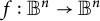 $f: \mathbb {B}^n \to \mathbb {B}^n$
,
$f: \mathbb {B}^n \to \mathbb {B}^n$
, $f(x)=|x|^{\delta -1}x$
(here
$f(x)=|x|^{\delta -1}x$
(here $\delta =K^{1/(1-n)}$
).
$\delta =K^{1/(1-n)}$
).
It is important to clarify that Theorem 3 presented herein diverges from this setting. We have shown that if $u({e^{i\theta }})$
is
$u({e^{i\theta }})$
is $\alpha $
-Hölder continuous, then so is
$\alpha $
-Hölder continuous, then so is $v({e^{i\theta }})$
, for any arbitrary
$v({e^{i\theta }})$
, for any arbitrary $\alpha \in (0,1)$
, i.e., the constant K plays no role here. In other words, the primary interest of our result is in showing that the real and imaginary parts of a (planar) harmonic quasiregular mapping essentially behave like “harmonic conjugates.”
$\alpha \in (0,1)$
, i.e., the constant K plays no role here. In other words, the primary interest of our result is in showing that the real and imaginary parts of a (planar) harmonic quasiregular mapping essentially behave like “harmonic conjugates.”


 Open access

