




Braille is a tactile writing system that enables people who are blind or visually impaired to read and write. Braille literacy has been linked with the attainment of higher levels of education, personal satisfaction, independence, and employment (Eldridge, Reference Eldridge1979; Lund & Cmar, Reference Lund and Cmar2019; Ryles, Reference Ryles1996, Reference Ryles2000; Schroeder, Reference Schroeder1989, Reference Schroeder1996, Reference Schroeder2000; Silverman & Bell, Reference Silverman and Bell2018; Stephens, Reference Stephens1989). Braille provides a means for blind and visually impaired individuals to actively read—to access information independently, at our own pace, and in our own voice. Braille also provides blind and visually impaired individuals the ability to write, and, importantly, to be able to subsequently read what we have written. Braille enables active engagement with written language at all levels: spelling, punctuation, and formatting. In other words, braille offers direct experience with literacy equivalent to that which print affords for people who are sighted. By contrast, other literacy-related tools such as audio books and synthetic speech provide mainly passive access to information and lack many of these affordances. Technology has not made braille obsolete for people who are blind or visually impaired any more than it has made print obsolete for people who are sighted. In fact, with the advent of automatic braille translation software, braille embossers, and electronic braille displays, technology has made braille more available and accessible than ever before, providing near-instantaneous and virtually limitless access to online resources and electronic books, including from sources such as Kindle and other mainstream providers (Cornish, Reference Cornish2014).
Because of the importance of braille in the lives of its users, organizations of blind people around the world, such as the National Federation of the Blind and the American Council of the Blind in the United States, Braille Literacy Canada, the Braillists Foundation in the United Kingdom, the World Blind Union, and many others, strongly advocate for braille literacy, and the United Nations celebrates World Braille Day annually on January 4 “to raise awareness of the importance of braille as a means of communication in the full realization of the human rights for blind and partially sighted people” (United Nations, n.d.). In the United States, a school-aged child’s right to braille literacy is Written into Federal Law as the so-called “Braille Provision” of the Individuals with Disabilities Education Act: “in the case of a child who is blind or visually impaired, provide for instruction in Braille and the use of Braille unless the IEP Team determines, after an evaluation of the child’s reading and writing skills, needs, and appropriate reading and writing media (including an evaluation of the child’s future needs for instruction in Braille or the use of Braille), that instruction in Braille or the use of Braille is not appropriate for the child” (Individuals with Disabilities Education Act, 2004, §614 (d)(3)(B)(iii)). In other words, the default expectation is for all blind and visually impaired children in the United States to learn braille, unless a professional evaluation advises otherwise—although the extent to which this is actually implemented for individual students across the country may often fall short of this goal.
In sum, braille is a tactile writing system that plays a central role in the lives and literacies of those of us who use it and is recognized and promoted by advocacy organizations and the law. For print writing systems, the science of how reading works, how it is learned, and why some people struggle to learn it has provided a strong base of evidence to support educational policies and practices (Seidenberg, Reference Seidenberg2017). Those learning braille would benefit from similar support from the scientific community. Yet, most general works on reading in the cognitive sciences are virtually silent about braille. For example, there is not a single mention of braille in the recently published 2nd edition of The Science of Reading: A Handbook (Snowling et al., Reference Snowling, Hulme and Nation2022), despite the clear recognition of the importance of research that takes into account the diversity of the world’s writing systems. Similarly, Wolf (Reference Wolf2007) and Seidenberg (Reference Seidenberg2017) arguably the two most popular books about the reading sciences intended for general audiences to have appeared in the last 20 years, are likewise silent about braille, despite the fact that braille readers have “reading brains,” and braille reading and writing are also grounded in underlying perceptual, cognitive, and linguistic processes.
The silence about braille is attributable to at least two factors. First, braille readers are relatively few in number. Blindness is a low-incidence disability, and the number of braille readers is a subset of this already small minority. Sheffield et al. (Reference Sheffield, D’Andrea, Morash and Chatfield2022) clearly explicate that there are no comprehensive or reliable statistics about the number of braille readers in the United States (much less in the world). They demonstrate that figures claiming “only ten percent” of blind people read braille, which are often cited in the media, are either based on secondary sources that cite other secondary sources rather than primary counts, are based on small sample sizes that are local in nature and decades old, or are based on the extrapolation of inappropriate data sources. Furthermore, definitions of blindness, and what it means to “read” braille vary across studies. Sheffield et al. (Reference Sheffield, D’Andrea, Morash and Chatfield2022) highlight the need for accurate census data about blindness and other disabilities, which simply does not yet exist. But regardless of whether there are, say, five million braille readers around the world, or 5,000, we contend that literacy is a basic human right, and the centering of braille and braille literacy in the reading sciences is a matter of equity: A basic scientific understanding of how braille is read and written is crucial for promoting equality and opportunity of literacy for people who are blind and visually impaired.
The second factor leading to silence about braille is that the overwhelming majority of people who read and write are sighted, and, for them, print is the dominant means of literacy. We are certainly not suggesting that every reading researcher should be fully informed about all aspects of braille research. The problem, however, is that focusing exclusively on the sighted norm leads to the “erasure” of braille and its readers. Braille remains unseen, its readers likewise remain invisible, and the reading sciences miss out on the opportunity to offer evidence-based work to contribute to educational policy and the promotion of literacy for people who are blind or visually impaired. Erasure can be roughly glossed: “they don’t talk about braille, so it’s apparently not relevant to the reading sciences and must not be very important.” This essentially leads to a self-fulfilling cycle of disinterest and further perpetuates lack of awareness and lack of research. Another result of the silence about braille is “adequation”—equating braille with print and assuming that the findings of print research apply to braille wholesale. Adequation can be roughly glossed: “they don’t talk about braille, so we can assume that findings for print readers must be relevant to braille readers as well.” Adequation may lead to unwarranted assumptions about braille and its users, the use of print-based assessment materials or experimental methods not appropriate for braille users, and to a lack of awareness of the ways in which understanding braille on its own terms can contribute to the science of reading.Footnote 1
The silence about braille in general reading science references belies the fact that there are indeed reading researchers who include braille in their research agendas. So far, the only monograph devoted to braille in the cognitive sciences is Millar (Reference Millar1997), which summarizes decades of experimental research that Millar conducted with English Braille readers in the United Kingdom, including children learning braille, adult braille readers, and former print readers who learned braille after vision loss. This work offers an overview of braille reading at every level—tactile perception, phonology, spelling, semantics, and comprehension. Millar concludes by proposing a model of braille reading and provides numerous suggestions throughout the book for future research and follow-up. Regrettably, since the publication of this book more than a quarter century ago, most of these remain unaddressed. As with Millar (Reference Millar1997), most previous work on braille within the cognitive sciences has been conducted by sighted researchers who are themselves not braille users. While much of this research is excellent and insightful, there are also notable sight-centric assumptions about braille baked into many of these works, and we will touch on several of these in this paper.
We will begin this position paper with a brief summary of the history and development of braille and an overview of the formal characteristics of braille as a writing system. We will then explore how print-centric assumptions and sight-centric motivations have potentially negative consequences, not only for braille users but also for the types of questions researchers think to pursue, and we will conclude by offering recommendations for conducting responsible and informed research about braille. We affirm that blindness is most equitably understood as but one of the many diverse ways humans experience the world. Researching braille literacy from an equity and diversity perspective provides positive, fruitful insights into perception and cognition contributes to the typologically oriented work on the world’s writing systems and contributes to equity by centering the perspectives and literacy of the people who read and write braille.
Positionality statement
Each of the three co-authors of this article approaches braille from a unique set of perspectives and lived experiences that inform our attitudes toward braille and shape our research questions. Englebretson has been a braille reader since kindergarten and uses braille daily in all aspects of literacy—including leisure reading, professional writing, and preparing lecture notes for teaching and presentations. This background provides lived experience with braille from which to approach research questions, deep knowledge of braille as a writing system, and contacts within the broader community of braille users. Despite his daily use of braille for literacy, it took Englebretson many years and achieving tenure before he began to feel comfortable also embracing braille as an area worthy of professional study as a linguist and cognitive scientist. As the primary author of this article, Englebretson uses “we,” “us,” and “our” throughout the paper to consciously center the perspective of braille users. Holbrook learned braille in college as part of her undergraduate training to become a Teacher of Students with Visual Impairments and reads braille by sight. She began her career by teaching braille to young children, now teaches braille in preservice courses for teachers, and has authored several textbooks on braille and braille pedagogy. This background provides a deeply informed perspective on braille literacy and the structure and use of braille, and knowledge and experience with how braille is taught and learned. Fischer–Baum is a newcomer to braille, who approaches it primarily from the perspective of a cognitive scientist. This perspective provides for rigorous questions and observations and deep connection to the research on print reading and writing. The complementary backgrounds and strengths of the three researchers provide interdisciplinary breadth to the work. All three authors are committed to a multiperspective understanding of braille as literacy and literacy as a basic human right.
Overview of braille
This section provides a brief introduction to the history and development of braille and its formal characteristics as a writing system. This overview is admittedly cursory, designed to acquaint sighted print readers with the basics of braille, to establish a shared vocabulary for discussing it, and to hopefully spark further interest among reading researchers who may have little knowledge about braille.
Origins and development
The development of braille came about through the historical confluence of three events in France during the late 18th and early 19th centuries. (For sources and more details see Campsie, Reference Campsie2021; Lorimer, Reference Lorimer2002; Mellor, Reference Mellor2006; Weygand, Reference Weygand and Cohen2009.) First, Valentin Haüy (1745–1822), a philanthropist and educator, founded what is now known as the Institut National des Jeunes Aveugles (National Institute for the Young Blind) in Paris in 1785. Haüy promoted the teaching of reading using large embossed print letters that students read by tracing them with their fingertips. Second, Charles Barbier (1767–1841), an inventor with an interest in the development of shorthands and alternative writing systems, proposed two tactile writing systems in 1815: a 5 × 5 grid of dots, where the position of each dot represented one letter of the French alphabet, and a 5 × 6 grid based in French phonetics, which Barbier explicitly intended for use by people who are blind. Barbier also created the design for a frame and punch, which were easily able to be fabricated and which blind people could use for writing this system. The third event took place in 1821, in what could be thought of as an early foray into UX (User Experience research), when Alexandre-René Pignier, the then-director of the Institute, introduced blind students to Barbier’s system, and students began modifying it to better meet their needs. One of these students was Louis Braille (1809–1852), after whom the tactile writing system is named. Braille took the lead in this endeavor and reduced Barbier’s 6 × 5 dot grid to a 2 × 3 tactile character ⠿ (now called a cell), which easily fits under the pad of a single finger. Braille assigned the 64 possible dot combinations of this 6-dot cell (63 characters and a blank space) to letters in parallel with the French print alphabet, which is still in use and forms the basis of most braille systems around the world. Braille also designed a system of musical notation using the 6-dot cell, which remains the basis of braille music notation to this day. Braille remained at the Institute as a teacher, publishing his system in 1829 and refining it for revised publication in 1837. The first four rows of Braille’s system are shown in Table 1. (Note the pattern, in which the first 10 symbols repeat with the addition of dots in the bottom row of the braille cell.)
French Braille alphabet
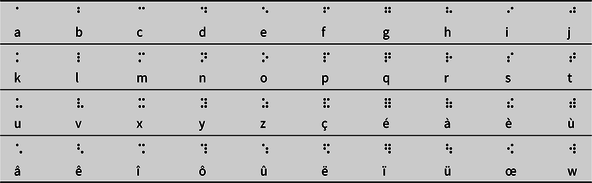
The 6 dots of the braille cell are typically referred to by number, where the dots in the left-hand column are numbered 1–3 from top to bottom, and the dots in the right-hand column are numbered 4–6 from top to bottom. In other words, ⠁ “a” is referred to as dot 1; ⠃ “b” is dots 1–2; ⠝ “n” is dots 1–3–4–5, and so on.
Braille’s script soon began to be adapted for languages beyond French. Languages whose print writing system are based in the Latin alphabet tend to keep to the braille alphabet as presented in Table 1, with variation across languages in the presentation of accented letters. Languages whose print writing systems are nonalphabetic still rely on the 6-dot cell, but utilize the dot combinations in ways that best fit the spoken language being represented in braille. For example, Mainland Chinese Braille uses a semi-syllabary similar to Zhùyīn Fúhào (“bopomofo”) where the first cell represents the syllable initial and a second cell represents the final. (A third cell can represent tone, but is rarely used.) For example 苹果 “apple” (Pinyin: píngguǒ) is written in Mainland Chinese Braille as ⠏⠡⠛⠕, where ⠏ represents the syllable-initial /p/, ⠡ the syllable-final /iŋ/ ⠛ the syllable-initial /ɡ/ and ⠕ the syllable-final /uo/. Japanese Braille, on the other hand, is an abugida based in Kana, where each cell typically represents a mora. The dots in the upper-left corner of the cell (dots 1, 2, and 4) indicate the vowel of the mora, and the remaining dots in the cell indicate the consonant. For example, Japanese りんご “apple (Hiragana)” (Romaji: ringo) is written in Japanese Braille as ⠓⠴⠐⠪. The first cell ⠓ represents /ri/ (dots 1–2 for the vowel /i/ and dot 5 for the consonant /r/), ⠴ represents /n/, ⠐ is the dakuten diacritic indicating voicing on the consonant of the following mora, and ⠪ /ko/ (dots 2–4 for the vowel /o/ and dot 6 for the consonant /k/), which is pronounced /ɡo/ because of the preceding dakuten.
There are over 130 languages in the world with braille systems (World Braille Usage, 2013), and braille is also used to notate the International Phonetic alphabet (Englebretson, Reference Englebretson2009), mathematics, chemistry, music, and for hobbies such as chess and knitting/crocheting.
The origin and development of braille serves as a clear example of innovation that came about by centering the perspective of people who are blind rather than following the sighted norm. The sighted norm in the early 19th century was to educate blind people to read large raised-print letters, essentially imposing the print writing system into the tactile modality. This proved problematic for several reasons, which the blind-centric perspective of Louis Braille and his schoolmates resolved. While the lines and curves of print letters are well suited to the affordances of the human visual system, tactile perception is less able to discriminate fine details, especially at a smaller scale. This necessitated the need for raised print to be extremely large when compared to visual print, and it meant that touch-reading of raised print was particularly slow, as fingers needed to trace individual characters to recognize them. Braille’s 6-dot cell solves these problems, since the human tactile system is well attuned to discriminating texture and dot density. A single braille cell easily fits under the fingerpads, leading to instant recognition when quickly scanning the fingers across the line of text, with no need to trace the shapes of characters. Another downside of raised print was the time consuming and technically demanding process of producing it, requiring modified dies and a specialized printing press. Blind students could not use raised print for writing, and therefore had no means of taking notes, writing to one another, or producing materials for themselves. The frame and punch envisioned by Barbier and promoted by Braille and his schoolmates solved this problem and enabled blind students to write in a system that they could also read. In sum, the development of braille eventually put an end to the educational practice of treating blind students as if they were sighted people who happened to be reading print by touch and shifted the perspective to a writing system that is better suited to tactile perception.
Braille orthography
The previous section illustrated the braille script and briefly discussed the ways various languages have implemented it. Like French, most languages whose print writing system is based on the Latin alphabet use combinations of the 6-dot braille cell to create a braille alphabet equivalent to the language’s print alphabet. Other languages, such as Mandarin and Japanese, discussed earlier, do not parallel the standard print writing system at all, but instead use the 6 dots of the braille cell to represent the language in other ways: i.e., a semi-syllabary for Mainland Chinese Braille and a Kana-based abugida for Japanese Braille. But even in languages whose braille alphabet directly parallels the print alphabet, reading and writing braille are not simply a matter of memorizing the location of dots and transliterating between the print script and the braille script. The braille orthography of many languages, including French, German, and English, uses a system of “contractions,” where one or more braille cells represent whole words or strings of letters. In Unified English Braille, for example, the official braille system currently in use in most English-speaking countries around the world, there are 180 contractions. Some examples of contractions include ⠬ “ING” ⠫ “ED,” ⠂ “EA,” ⠯ “AND,” ⠜ “AR,” ⠮ “THE,” ⠸⠓ “HAD,” and ⠐⠓ “HERE.” As a result of contractions, the orthographic representation of a word in braille may differ considerably from its orthographic representation in print. For example, the English word written in print as “disappearance” contains 13 letters, while the contracted braille representation of this same word contains only eight cells: ⠲⠁⠏⠏⠑⠜⠨⠑ “DISappeAR.ANCE.” (In the glossing conventions for braille, small capital letters transliterate contractions, adjacent contractions are separated from one another by a period, and direct transliterations of braille letters appear in lowercase.) Contractions are language specific, aim to save space and paper, and facilitate faster reading and writing. In English and some other languages, being a fully literate user of braille entails reading and writing contracted braille, since braille publishing houses, educational institutions, and blindness organizations use this grade of braille, and it is also, e.g., the type required on public signage in the United States under the Americans with Disabilities Act.
Another consequence of braille contractions is that they may cause words in braille to differ substantially from print in terms of the orthographic representation of sublexical structure. Graphemes and morphemes that are easily apparent in print may be obscured in braille. For example, in the print word “strengthen,” the “ng” grapheme represents /ŋ/, and the word is clearly decomposable into two morphemes, the stem “strength” and the suffix “-en.” However, because of contractions, neither of these are apparent in the braille word ⠌⠗⠢⠛⠮⠝ “STrENgTHEn.” There is no “ng” digraph here, since there is no ⠝ “n” in the first syllable of this word. Instead, ⠢ “EN” groups the letters “e” and “n” together as a single unit, separate from “g”. As for the morphological structure, the contraction ⠮ “THE” bridges the boundary between the stem “strength” and the suffix “-en,” incorporating the final “th” of the stem and the initial “e” of the suffix into a single cell, and so neither stem nor suffix are apparent in this braille word. Contrast this with the word ⠺⠂⠅⠢ “wEAkEN ,” on the other hand, where the contractions mirror the sublexical structure of the print word directly: ⠂ “EA” represents the digraph “ea” for /i/. And ⠢ “EN” corresponds to the suffix “en,” and so both the stem ⠺⠂⠅ “wEAk” and the suffix ⠢ -“EN”3 are clearly evident. The interaction of braille contractions and sublexical structure causes the orthography of English braille to be considerably different from print orthography, and this is a crucial area of ongoing research (cf. Englebretson et al., Reference Englebretson, Holbrook, Treiman and Fischer-Baumunder review; Fischer-Baum & Englebretson, Reference Fischer-Baum and Englebretson2016).
Decentering print-centric assumptions: braille as a “Code for Print”?
As demonstrated above, braille is a writing system that represents spoken language in the tactile modality using characters composed of the dots in a 6-dot cell. The nature of braille orthography depends on the language being written—e.g., a tactile semi-syllabary for Chinese, a tactile abugida for Japanese, and a tactile alphabet for many languages including French and English, which also may use contractions. Throughout this paper so far, we have been careful to adopt this framing, to position braille as literacy and as a writing system that represents spoken language, and to discuss it from the perspective of those of us who use it as our primary means of reading and writing.
However, rather than positioning braille as a writing system parallel to and equal to print, the overwhelming majority of literature about braille positions it as a “code” designed to represent the dominant print writing system, e.g., a “secondary notation system”/“shorthand” (Daniels & Bright, Reference Daniels and Bright1996, pp. 816–818), “a portrayal of print” (Rex et al., Reference Rex, Koenig, Wormsley and Baker1994, p. 30). This perspective centers braille as a code for print, as derived from print, as valorized because it represents print, and as an access tool to enable those who cannot read standard print to do so. Ultimately, this is a print-centric/sight-centric perspective on braille, as it positions braille as dependent on print, rather than as a writing system in its own right.
Teachers of Students with Visual Impairments (TVIs), other braille professionals, and braille readers generally refer to braille as “the braille code,” or just “the code,” but rarely address the question “a code for what?.” The default assumption seems to be that braille is a “code for print” rather than, just like print is, a code that represents a spoken language. For example, the authors of a recent monograph titled Psychology of Touch and Blindness characterize braille as follows: “Braille is a very useful tangible code for reading, writing, and communication for blind and VLV [Very Low Vision] individuals. … Braille characters are abstract representations of letters, and they differ significantly from the shapes that they represent” (Heller & Gentaz, Reference Heller and Gentaz2014, p. 150, emphasis mine). At one level, the authors are correctly pointing out that braille letters look nothing like print letters—essentially dispelling the idea that braille is simply a tactile form of print. However, in doing so, the authors are also making a statement about the nature of braille that reflects a sight-centric/print-centric perspective. This code-based view of braille states that “Braille characters are abstract representations of letters.” In other words, the English braille character ⠞ is an “abstract representation of” the English print letter t. Similarly, “they differ significantly from the shapes that they represent” would suggest that the braille character ⠞ is a representation of a “shape.” This formulation suggests that when braille readers read, we are decoding a representation of print. It is perhaps understandable from the point of view of a sighted print reader looking at braille and thinking about it in terms of their native print, but it makes no sense whatsoever for those of us for whom braille is our first and only writing system. Furthermore, the claim that “Braille characters are abstract representations of letters” also misses the crucial point of the alphabetic principle: both braille letters and print letters are representations of phonemes, not representations of each other. For example, the braille letter ⠞ represents the phoneme /t/ and the English print letter t also represents the phoneme /t/. Decentering the code-based perspective on braille leads to the recognition that both print readers and braille readers are decoding a representation of a spoken language.
The code-based perspective is the dominant positioning of braille, and even lifelong braille readers may fail to question its accuracy and potential impact. In the spirit of constructive dialogue with which this position paper is intended, consider the following unfortunate characterization of braille that appears in a previous publication by the current article’s primary author: “braille is a rule-based cipher for converting an inkprint writing system to the tactile modality” (Englebretson, Reference Englebretson2009, p. 69). On its face, there is nothing inherently false about this statement—however, it is woefully incomplete and print centric. It is true that braille characters can be mapped directly to print characters, such as the letters of the French Braille alphabet and the letters of the French print alphabet in the rows of Table 1, above, since braille historically came about based on the already existing print French alphabet. It is also the case that computer programs can take standard print as an input and generate fully correct contracted braille. And it is also true that braille can represent nearly anything that print can represent. However, this characterization of braille falls short in several respects. It completely fails to acknowledge that braille is also socially and functionally based; its users comprise a minority group within society, and its function is as a means of literacy for its users. Most strikingly, this statement fails to question the idea that braille should be understood as a derivative of print in the first place rather than as a writing system in its own right, and it also fails to position braille from the perspective of its readers and writers. This positioning of braille as a formal system derivable from print has unfortunate potential consequences for braille pedagogy, to which we will return below.
A third set of examples comes from a video designed to introduce elementary school teachers to braille, in preparation for having a student who is blind or visually impaired in their classrooms (Herzberg & Rosenblum, Reference Herzberg and Rosenblum2019). The code-based perspective on braille is explicitly invoked on three separate occasions during this short video: “Braille is a code that represents print” (0 m:11 s); “Braille is a way to represent print” (1 m:08 s); “Now Braille is simply a way to tactually represent print, the written word” (1 m:56 s). This perspective is designed to center the potential experience of a (probably sighted) teacher, who does not know braille, and who has likely never taught a blind student: it positions braille as an access tool for print, clarifying that this student will use braille to access the materials that the sighted students in the class will read in print.
Of course both the literacy perspective and the code-based perspective can be true of braille at the same time: braille is a writing system that enables literacy, and braille also can represent print. But our position is that the perspective one chooses to adopt about braille has potential consequences for its users and for the types of research questions one thinks to ask. The most troubling consequence of the code-based view of braille is that it leads to the idea that reading braille entails two discrete activities: first decoding the braille and then reading it. Returning to the video discussed above (Herzberg & Rosenblum, Reference Herzberg and Rosenblum2019), “a beginning Braille reader is not only learning the mechanics of actual reading, but is also learning how to read these different Braille configurations” (3 m:35 s). (Note the print-based perspective and privilege inherent in the juxtaposition of “actual reading” versus “read these different braille configurations”.) This represents a common approach to teaching children who are blind or visually impaired where the classroom teacher teaches “reading,” and the TVI teaches “braille,” i.e., “the code,” the way to represent the print that the classroom teacher is teaching.
We contend that this positioning matters. A code-based view of braille would suggest that readers first decode braille into uncontracted/print orthography, from which they access sound and meaning. A literacy-focused perspective, on the other hand, positions braille readers as reading braille on its own terms, as a writing system that provides direct access to sound and meaning. In terms of pedagogy, if TVI’s, who are usually visual readers of braille, primarily understand and experience braille as a code mapping from print, then they may (consciously or not) teach their students to be “print decoders,” as suggested by the video quoted in the above paragraph, and are not teaching them to be “actual” readers per se. But if teachers intentionally conceptualize braille as a native writing system, parallel to, equal to, and not dependent on print, then the focus of their work may better enable their students to achieve literacy.Footnote 2 Similarly, a researcher who assumes a code-based view of braille will treat print as an intermediary between braille and spoken language, in which case braille is not particularly worth studying as reading and writing. A researcher who takes a literacy-based view of braille, on the other hand, understands that braille readers decode directly to spoken language and approaches braille as reading and writing that is parallel to print. In sum, it is crucial for teachers and researchers to consider their own assumptions about braille and to interrogate the ways in which print-centric positionings of braille may affect their work.
De-centering sight-centric motivations: considering research questions and subjects
This section shifts the discussion away from the characteristics of braille as a writing system and focuses instead on conducting informed and equitable research. We recommend that researchers consider the motivations for the research questions they are asking and strive for research that addresses the nature of braille or braille literacy. The way that researchers think about asking and answering questions, and the special types of concerns that come up when working with the heterogeneous and diverse population of braille readers, requires careful consideration beyond what many researchers in the cognitive sciences may be accustomed to. We suggest that many of the typical assumptions from print-based cognitive science research are not necessarily appropriate for researching braille, and we offer some considerations for building a research team and conducting research that is broadly responsible to the braille-reading population.
One sight-centric motivation for researching braille, often apparent among the few articles in the cognitive sciences that deal with braille at all, is to use braille as the laboratory for addressing some aspect of print reading. Two theories of sighted reading, say, may make contradictory claims about some phenomenon (e.g., “phenomenon x is due to visual processing,” vs. “Phenomenon x is due to orthographic knowledge”) and researchers then investigate phenomenon x in braille to resolve the matter (i.e., if braille readers also show evidence of phenomenon x, then it must not be due to visual processing, since braille is read tactually). We see two major issues with taking this approach. The first is that it centers sighted reading. Such an approach takes very little interest in braille or its readers, and the research simply positions braille as a means of resolving a theoretical dispute. We do not believe it would be helpful to use this position paper to “call out” or analyze specific studies that have done this. But our position is that researchers in the reading sciences have a responsibility, when using braille to address disputes in sighted reading, to ensure that their research also offers knowledge that enriches our understanding of braille, contributes to braille literacy, or highlights the diverse nature of reading and writing. Braille readers are members of a marginalized group, and, we would argue, it is the ethical responsibility of researchers to conduct just and equitable research that recognizes this.
The second issue with this group comparison approach is methodological. Built into group comparisons is the assumption that the two populations are the same except for one critical difference—in the example above, namely, one group reads through the visual system and the other does not. With a sight-centric approach that fails to consider social and contextual factors about braille, it is easy to see how researchers might be comfortable with this assumption. Once social and contextual factors are considered, however, it becomes clear that not only is the population of braille users small but it is also highly diverse and heterogeneous, and the group of braille readers being tested cannot simply be conceived as being the same as print readers who just happen to read through a different modality. There are vast differences among braille readers in terms of the nature, duration, and onset of visual impairment. There are differences among braille readers in the use of one or both hands to read braille, how many fingers are reading, and the patterns of hand movement. There are vast differences in what our braille education was like, e.g., some individuals may have had regular, daily braille instruction in school, others may have lived in a school district that only provided braille instruction for an hour per week, many individuals may have learned braille after already having been print readers, and some individuals are “dual media learners” who use both braille and print at different times or for different purposes. Across the groups, orthographies are different—contracted braille represents the surface spelling and sublexical structure of words quite differently than does print. The passive exposure to written language is also quite different across groups: for young sighted children, print is ubiquitous in the environment, but for young children who are blind, the environment affords little, if any, opportunity to notice braille, much less interact with it. And finally, for many children who are blind and their families, there is a stigma around the use of braille that simply does not exist for sighted children using print: parents may argue that they do not want their child learning braille because it makes them look “blind”; children may avoid using braille because it differentiates them from their classmates; teachers may not want their students to learn braille because they either do not know how to teach it, or mistakenly believe it is “too difficult”; and some children with low vision are taught “print at any cost,” and end up not learning braille until later in their life. Our point here is that all of these variables are intrinsic to the heterogeneous population of braille users, may affect an individual’s performance in reading and writing braille, and cannot simply be statistically controlled away. Braille researchers must understand these contextual variables and their consequences, and research methods must take this heterogeneity into account from the outset. We argue that this is best accomplished by de-centering sight-centric views of reading.
As a part of this process, braille researchers must be intentional about where and how to recruit participants. Because blindness is a low-incidence disability, the population of braille users tends to be sparse and widely distributed, and this poses challenges for researching braille (Wright, Reference Wright2010). As noted above, there is also no replicable or accurate information concerning the number of people who read braille (Sheffield et al., Reference Sheffield, D’Andrea, Morash and Chatfield2022). For proficient adult braille readers, this may entail seeking permission to conduct research at the summer conventions of blindness organizations where hundreds of braille readers may be present in the same location (cf. Fischer-Baum & Englebretson, Reference Fischer-Baum and Englebretson2016). Conducting research on braille-reading children is even more difficult, and studies seeking a large sample size have typically been conducted across multiple sites in multiple states (cf. Wall Emerson et al., Reference Wall Emerson, Holbrook and D’Andrea2009), or through the analysis of a large longitudinal corpus of writing samples (Englebretson et al., Reference Englebretson, Holbrook, Treiman and Fischer-Baumunder review). To the extent that it is possible, detailed information about each participant should be collected, including information about how and when they came to learn braille, how they read braille, the nature of their visual impairment, their attitudes toward braille, and in what contexts they typically use braille. We currently have very little understanding of how exactly these contextual variables influence reading and writing processes, but if we do not collect information about them, we are unlikely to ever understand these issues that are core to braille literacy.
Issues of appropriate research methods are important for all cognitive science research, but we argue that braille researchers have an especially urgent responsibility to make sure their research is solid and well-grounded. Because this is an area with little research, the process of self-correction can be especially slow. It can take decades for an incorrect finding to be refuted, simply because there are not enough researchers to attempt to replicate the work or even to question its underlying assumptions. At the same time, individual findings can have an outsized impact, and questionable conclusions may be generalized beyond their original intent, e.g., findings from a single experiment with, say, readers of uncontracted Spanish braille in Spain may be applied to pedagogical approaches to learners of contracted English braille in the United States, despite the lack of parity across the writing systems and the unwarranted nature of the conclusions. Taking a sight-centric approach to braille research can lead to problematic research methods that draw incorrect inferences, which in turn may have a long-lasting applied impact on braille pedagogy.
One suggestion for de-centering sight-centric approaches is to build a research team composed of individuals who are diverse both in terms of their areas of expertise and in terms of their lived experiences with braille, who work together to identify research questions and approaches that are broadly relevant for the braille-reading community. This is the approach we have taken. Braille research tends to cut across several fields, e.g., education, disability studies, cognitive psychology, and linguistics. Generally speaking, the little research on braille that exists within each of those fields has remained siloed from the other fields, and a research team with expertise in two or more of these areas is crucial. Engaging with each team member’s complementary areas of strength and expertise leads to synergy, the ability to generate more comprehensive research questions, and the dissemination of findings across disciplines. In addition to a team that bridges across disciplines, effective and equitable research on braille also requires a team with diverse backgrounds and lived experiences with braille, e.g., our current team consists of a lifelong braille reader, a braille educator, and a relative newcomer to braille. This likewise ensures an informed understanding of braille from multiple perspectives and enables the team to conduct research that engages multiple stakeholders, assuring that reading scientists, braille teachers, braille learners, and proficient adult braille readers all may benefit from the research in different ways.
Conclusion
Research on braille has been largely ignored in the reading sciences, and therefore the applied benefits of the science of reading have typically not been extended to improving braille literacy. What little research that has been done on braille has often taken a print- and sight-centric view of reading, rather than treating braille as a writing system worthy of study on its own merits. Our position is that braille research should be carried out in such a way that de-centers print- and sight-centric assumptions and motivations, asks research questions that are relevant to the individuals who are blind and visually impaired who are participating in the research, and seeks to recognize and take into account the social and educational contexts in which braille is taught and learned. This approach to braille research can be accomplished through teams that are diverse, both in their disciplinary expertise and in their lived experiences with braille.
Financial support
The research reported here was supported by the Institute of Education Sciences, U.S. Department of Education, through Grant R324A190093 to Rice University. The opinions expressed are those of the authors and do not represent views of the Institute or the U.S. Department of Education.
Conflict of interest
The authors declare none.


 Open access

