


1 Introduction
It makes no sense to eat a dessert that you dislike, or pay a stock broker knowing that the money will be lost, right? Yet, many people do exactly this; they make investments that will be in vain to prevent wasting earlier investments. Having paid for a dessert, people thus feel they should finish it, even though the dessert is not to their liking; it would be a waste to “pay and not eat”. In a similar vein, people may be reluctant to sell their losing stocks, because by selling they would have to acknowledge that their prior investments were wasted.
This tendency to honor prior costs by holding on to failing projects is called the sunk cost fallacy (Arkes & Blumer, Reference Arkes and Blumer1985; Staw, Reference Staw1976). In more general terms, the sunk cost fallacy describes the tendency “to continue an endeavour once an investment in money, effort, or time has been made” (Arkes & Blumer, Reference Arkes and Blumer1985, p. 124). People regularly use sunk costs to justify further investments in many decisions, ranging from the decision to eat a dessert one has already paid for (Thaler, Reference Thaler1985) to the decision to continue research and development of already outperformed products (Arkes & Blumer, Reference Arkes and Blumer1985). This effect is not restricted to consumer behavior or economic decision making, but extends to many other decisions, including policy making. For instance, one of the important reasons to continue the war in Iraq was to prevent acknowledging that soldiers who fell in battle died in vain. The sunk cost fallacy thus influences many decisions, from very mundane to highly exceptional, and affects all sorts of people ranging from customers in restaurants to the most important and influential leaders.
From the above it is clear that people are likely to become victims of the sunk cost fallacy. However, one could wonder whether all people are equally likely to fall prey to this effect. Some people seem to dwell more on the past than others. Such differences in coping have been demonstrated in the extensive research on state versus action orientation. Action-oriented people typically get over negative events quickly, and focus on taking action to solve them, while state-oriented people typically find it difficult to overcome a negative event, and keep ruminating about it and how it affects their current state (see for overviews, Dieffendorff, Hall, Lord, & Strean, Reference Dieffendorff, Hall, Lord and Strean2000; Kuhl & Beckmann, Reference Kuhl and Beckmann1994). This distinction seems highly relevant to the question of whether people differ in their susceptibility to the sunk cost fallacy. Although prior investments (like paying for a dessert, or buying stocks) may not be seen as negative events, they may become negative if they are not compensated by current and future outcomes (i.e., if the dessert tastes horrible, and the stocks lose their value). The question then becomes how state and action-oriented people respond to those prospects, and how much they let their decisions be affected by prior investments.
Our proposition is that state-oriented people are more affected by prior investments. We argue that the more state-oriented people are, the more prone they are to see current decisions in the light of previous investments, thereby strengthening the association between the two events. The more action-oriented people are, the more likely they are to focus on the future and what they can achieve, thereby weakening the association between current decisions and previous investments. Indirect support for this reasoning comes from research showing that the more action-oriented people are, the more they decouple missed opportunities in the past from related decisions they currently face (Van Putten, Zeelenberg, & Van Dijk, Reference Van Putten, Zeelenberg and Van Dijk2009). With respect to the sunk cost fallacy, we expect that, compared to action-oriented people, state-oriented people are more influenced by previous investments when deciding about a current investment and hence that they are more likely to show the sunk cost fallacy.
These predictions are particularly interesting in relation to prior reasoning in the action orientation literature. There, the assumption is often made that an action-oriented mindset increases the likelihood of finishing a project (e.g., Harmon-Jones & Harmon-Jones, 1999). Moreover, it is argued that it is against the nature of action-oriented people to quit an already started project (McElroy & Dowd, Reference McElroy and Dowd2007). At first sight, the present hypothesis seems to be at odds with this reasoning, as it predicts precisely the opposite. However, we argue that it is in line with these earlier studies in the sense that action-oriented people are expected to be more decisive than state-oriented people, and that they have an urge to take action to solve a failing situation. Thus, in the case of sunk costs, applying this reasoning leads to the counterintuitive prediction that the more action-oriented people are, the more likely they are to quit the project they started investing in. Put differently, we expect state-oriented people to be more likely to continue investing than action-oriented people.
In order to examine this we presented participants a standard sunk cost decision scenario (adopted from Arkes & Blumer, Reference Arkes and Blumer1985) in which the presence or absence of a sunk cost was manipulated. We related participants’ answers to their scores on the chronic action orientation measure that was assessed at an earlier occasion. We expected to find stronger sunk cost effects for state-oriented people than for action-oriented people.
2 Method
Seventy-five students (13 males, 62 females, M age = 19 years) at Tilburg University volunteered to participate in this study. Participants arrived in the laboratory and completed the Dutch translation of the 24 forced-choice item Action Control Scale (ACS-90) to measure their degree of action orientation (for a complete item listing, see Kuhl & Beckmann, Reference Kuhl and Beckmann1994). State-oriented answers were coded 0 and action-oriented answers were coded 1. All answers were summed to form an action orientation measure, with higher scores indicating a higher degree of action orientation. The scores on the action orientation measure, which could range from 0 to 24, were centered on the mean (M = 11.01, SD = 4.50; α = .77), such that people who scored 0 on the action orientation measure had a mean degree of action orientation.
Participants returned to the laboratory a week later to participate in other studies. Our sunk cost study was part of that larger assessment. Participants were randomly assigned to either the sunk cost present or absent condition. In the condition with a sunk cost present the scenario read as follows (adopted from Arkes & Blumer,Reference Arkes and Blumer1985; Question 3A):
As the president of an airline company, you have invested 10 million dollars of the company’s money into a research project. The purpose was to build a plane that would not be detected by conventional radar, in other words, a radar-blank plane. When the project is 90% completed, another firm begins marketing a plane that cannot be detected by radar. Also, it is apparent that their plane is much faster and far more economical than the plane your company is building. The question is: should you invest the last 10% of the research funds to finish your radar-blank plane?
In the condition with a sunk cost absent the scenario read as follows (adopted from Arkes & Blumer, Reference Arkes and Blumer1985; Question 3B):
As president of an airline company, you have received a suggestion from one of your employees. The suggestion is to use the last 1 million dollars of your research funds to develop a plane that would not be detected by conventional radar, in other words, a radar-blank plane. However, another firm has just begun marketing a plane that cannot be detected by radar. Also, it is apparent that their plane is much faster and far more economical than the plane your company could build. The question is: should you invest the last million dollars of your research funds to build the radar-blank plane proposed by your employee?
Participants could answer the question by checking a box labeled “Yes” or “No”.
3 Results
The effects on willingness to continue the project (dummy-coded as 0 for No and 1 for Yes) of the presence of a sunk cost (dummy-coded as 0 for Absent and 1 for Present) and of the action orientation score were analyzed using a logistic regression analysis. The results revealed a main effect of presence of sunk cost (B = –1.90, SE = .54; χ ²(1, N = 75) = 12.34, p < 0.001) and a significant interaction effect (B = 1.16, SE = .57; χ ²(1, N = 75) = 4.18, p = .04). The results of simple slope analyses (see Fig. 1; Aiken & West, 1991) showed a significant effect of the presence of a sunk cost on the investment decision for state-oriented people (1 SD below the mean; B = –3.06, SE = 0.87; χ ²(1, N = 75) = 12.40, p < 0.001), but not for action-oriented people, (1 SD above the mean; B = –0.746, SE = 0.67; χ ²(1, N = 75) = 1.14, p = .29). The results thus support our hypothesis that people with an action orientation are less likely to show the sunk cost fallacy than people with a state orientation.
Simple slope analysis, comparing B-coefficients of the dummy variable for presence of sunk cost for people with a high and a low score on action orientation.

For presentation purposes we created Table 1, which shows the number of participants willing to invest in the project, classifying them into action versus state-oriented people by means of a median split (Median = 11, before mean centering). This illustrates that indeed state-oriented people showed the typical sunk cost effect, such that the presence of a sunk cost increased their willingness to invest in the project. Action-oriented people however, showed no such effect. From the columns of Table 1 we can derive what drives this stronger sunk cost effect for state than for action-oriented participants. As expected, when a sunk cost is present, action-oriented participants were less willing to invest than state-oriented participants (marginally significant effect; χ²(1, N = 37) = 3.07, p = .08). This finding shows that the sunk cost is extra motivating to invest for state-oriented participants, but not extra motivating for action-oriented participants. When a sunk cost is absent, action-oriented participants are statistically not more willing to invest than state-oriented participants (χ²(1, N = 38) = 0.87, ns). In other words, an action-oriented mindset does not form an indestructible shield against the sunk cost fallacy, but it clearly decreases the likelihood to invest in failing projects.
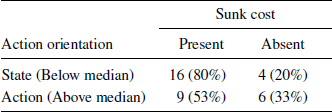
Note. The presence of the sunk cost influenced willingness to invest for state-oriented participants (χ ²(1, N = 40) = 14.40, p < 0.001), but not for action-oriented participants (χ ²(1, N = 35) = 1.73, p = .24).
4 Discussion
The aim of the present study was to investigate whether some people are more likely to fall prey to the sunk cost fallacy than others. We reasoned that people who are generally more prone to dwell on the past (state-oriented) will be more likely to use investments already made as a reason to invest in a project than people who quickly get over past events (action-oriented). Indeed our data show stronger sunk cost effects the more state-oriented people are. Conversely, the more action-oriented people are, the more the decision to invest (or not) approaches a 50–50 division, indicating that the decision to invest also depends on other factors besides the sunk cost. From our experiment we therefore conclude that there indeed are individual differences in the proneness to the sunk cost fallacy. More specifically, we obtained support for the prediction that once prior investments are made, action-oriented people are more likely to change their course of action by quitting a failing project than state-oriented people.
In previous research, other moderators of the sunk cost fallacy have been revealed, for example transaction decoupling (Soman & Gourville, Reference Soman and Gourville2001), ambiguity of information (Van Dijk & Zeelenberg, Reference Van Dijk and Zeelenberg2003), having an optimistic view about the returns of the investment (Juliusson, Reference Juliusson2006), and age (Strough, Mehta, McFall, & Schuller, Reference Strough, Mehta, McFall and Schuller2008). The present data add to this knowledge, by showing that besides these factors there are individual differences which influence the likelihood that sunk costs are weighed heavily in investment decisions.
The present study found that chronic differences in mindsets lead to differences in the willingness to honour sunk costs. But of course, mindsets can also be altered by moods or situations. For example, one moment people might be suckers for the sunk cost fallacy, because they find themselves focusing on past investments, while at other times the same people might be less likely to show the sunk cost fallacy, because they are in an “improvement mood”. Either way, this effect of mindset on the sunk cost fallacy has important theoretical and practical implications. Theoretically, it means that the sunk cost fallacy depends on the strength of the association between the sunk cost and the current investment decision, supporting earlier strength-of-association models of the sunk cost fallacy (Soman & Gourville, Reference Soman and Gourville2001; Van Dijk & Zeelenberg, Reference Van Dijk and Zeelenberg2003). Moreover, it shows that strength of association does not only depend on situational factors, but can be driven by mindsets as well. Practically, this means that sunk cost fallacies might be prevented if people stop focusing on past investments and think about how they can improve the here and now instead. This may improve their investment decisions and reduce the chance of eating disgusting desserts.


 Open access

