

Introduction
In the context of policies to extend working lives, a key justification for raising state pension ages is that life expectancy increases put an unsustainable burden on the welfare state (see Macnicol, Reference Macnicol2015, for a critique of this based on the UK context). While the UK life expectancy has risen, the upward trend has recently stalled (Marmot et al., Reference Marmot, Allen, Boyce, Goldblatt and Morrison2020), and previous improvements have not been matched by increases in healthy life expectancy (Jivraj et al., Reference Jivraj, Goodman, Pongiglione and Ploubidis2020). Chronological age alone does not give us an accurate purchase on an individual’s ability to work because health, strength, and resilience vary considerably within all age cohorts (Taylor & Earl, Reference Taylor and Earl2016; Nicholson et al., Reference Nicholson, Mayho, Robson and Sharp2019). Nevertheless, many physical health conditions are increasingly common with age and with extended working lives more people ‘of working age’ will develop chronic health conditions (Crawford et al., Reference Crawford, Davis, Cowie and Dixon2016) and/or experience changes in physical health functioning as a result of the ageing process (Vickerstaff et al., Reference Vickerstaff, Phillipson and Wilkie2012). This may make it harder for individuals to continue working without changes to job content or how work is organised or supported.
In this context, the UK government has called for employers to make work adaptations in response to changes in individual’s health as they age. The Department for Work and Pensions argued that: ‘it is increasingly important that employers are able to support an ageing workforce, by providing workplaces and job roles that enable people to manage their health conditions and disabilities at work’ (DWP, 2017, p. 31). Likewise, a British Medical Association report advocates ‘adapting employee roles or job responsibilities as abilities change’ (Nicholson et al., Reference Nicholson, Mayho, Robson and Sharp2019, p. 21). Work adaptations might involve making changes enabling the individual to continue doing the same role (‘fitting the job to the individual’) or redeploying them to a different role (Naegele & Walker, Reference Naegele and Walker2006; Lain et al., Reference Lain, Vickerstaff and van der Horst2022).
This raises an important policy question: to what degree, in the current context, are employers likely to implement significant health-related work adaptations? The management of older workers’ health is a relatively neglected topic (Poscia et al., Reference Poscia, Moscato, La Milia, Milovanovic, Stojanovic, Borghini, Collamati, Ricciardi and Magnavita2016; Söderbacka et al., Reference Söderbacka, Nyholm and Fagerström2020), and it is unclear why some employers are more inclined to make work adaptations than others. This article explores how various factors including financial pressures, work intensity, and attitudes to age influenced the implementation of work adaptations in three UK organisations prior to the Covid 19 pandemic. Ill-health exit among over fifties was gradually increasing before the pandemic; subsequent increases (primarily for reasons other than Long Covid) indicate that the topic of this study has become even more relevant (see Tinson et al., Reference Tinson, Major and Finch2022).
Contextualising older workers’ health: adjustments versus adaptations
UK legislation grants individuals of all ages the right to reasonable work-related adjustments in response to medical conditions or disabilities that have a ‘substantial’ and ‘long-term’ negative effect (see https://www.gov.uk/definition-of-disability-under-equality-act-2010). This might include changes to where the work is done or the equipment used, upskilling, or redeployment to a new role. However, employers have significant discretion over making work adjustments. What counts as sufficiently ‘substantial’ and ‘long-term’ is not clearly defined. Moreover, what is deemed a ‘reasonable adjustment’ is not clearly determined within law and can be legitimately influenced by ‘factors such as the cost and practicability’ (Government Equalities Office, n.d.). It is also acknowledged that there is a lack of employer and employee awareness and understanding over legal rights and responsibilities (HM Government, 2021, p. 20). Additionally, research by Heymann et al. (Reference Heymann, Ashley Stein, Moreno, Heymann, Stein and Moreno2014) suggests that employers tend to overestimate costs of making alternative arrangements for disabled workers, underestimate their productivity, and incorrectly assess the impact of disability on work capacity; the public sector and large employers are not necessarily better at dealing with these issues (Kumar & Provost, Reference Kumar and Provost2022, p. 28). Finally, individuals may have no legal protections if they experience certain physical changes as they age, for example decreased muscle mass/strength or cardiovascular functioning (cf. Maertens et al., Reference Maertens, Putter, Chen, Diehl, Huang, Borman and Hedge2012), that are not necessarily related to conditions covered by the UK Equality Act.
The conception of health in relation to work adaptations, as distinct from work adjustments, which have some legal underpinning, therefore needs to be broader than conditions covered by the Act. Indeed, historically, work adaptations were available more broadly. Before the advent of retirement, firms often moved individuals from heavier to lighter work as they aged, as part of an implicit lifetime employment contract (Phillipson, Reference Phillipson1982). For the purposes of this paper, we define health conditions in relation to changes in physical and mental functioning that make the continuation of the current job more difficult based on how it is currently organised. This may or may not be related to a health condition covered by the Act.
This conceptualisation is sensitive to the fact that jobs are initially designed on ableist assumptions about universal, biological, or medical standards of structure, function, and ability common to everyone. Ableism is, according to Campbell (Reference Campbell2001, p. 44), ‘a network of beliefs, processes and practices that produce a particular kind of self and body (the corporeal standard) that is projected as perfect, species-typical and therefore essential and fully human’. Wendell (Reference Wendell1996) notes that what is ‘normal’ functioning is at least partly socially constructed and dependent on the society in which one lives. Adaptations are, then, concessions from the ‘ideal’ and therefore almost by definition ‘inferior’ (cf. Foster, Reference Foster2018). This impacts how both employers and employees see these adaptations and ableism may reduce the willingness of companies to deviate from the ‘norm’ of how work is organised.
Next to ableism, ageism may also negatively affect the provision of work adaptations. Stereotypes about older workers include positives, such as being more reliable, and negatives, which includes diminishing physical or mental capacity (see e.g. Harris et al., Reference Harris, Krygsman, Waschenko and Laliberte Rudman2018). The ‘decline narrative’ (cf. Gullette, Reference Gullette2004) suggests that ageing inevitably brings continually worsening health, meaning that individuals are categorised as ‘over the hill’ (cf. Bellaby, Reference Bellaby2018) when they first exhibit minor health issues and seen as not worth investing in in terms of health adaptations. This may be at least partly hidden ableism, but ageism is likely to also play a role (see also Van der Horst and Vickerstaff, Reference Van der Horst and Vickerstaff2022).
Relative to employers in several other countries, UK employers have a particularly high degree of discretion over making work adaptations. Occupational Health (OH) services are ‘a tool for supporting a healthy workforce, enabling self-management of conditions, preventing ill-health related job loss and promoting better work and health outcomes’ (HM Government, 2023, p. 9), but UK employers are not mandated to provide them. According to estimates, only 45% of workers in Great Britain have access to OH services, and ‘only 3% of UK employers provide access to comprehensive occupational health services’ (Nicholson, Reference Nicholson2017, p. 7). A recent comparative study reviewing the occupational health systems and provisions distinguished between countries with an integrated approach and those with more fragmented systems. Comprehensive systems such as in France or Finland have a national level policy, legally enshrined rights and obligations in which employers have a duty to provide OH services. This is distinct from countries like the UK and the United States where the system is more disjointed with no single piece of legislation covering OH and few employer obligations (Hassard et al., Reference Hassard, Jain and Leka2021). The report concluded: ‘Those countries where OH services are legally specified were observed to have higher estimated levels of coverage’ (Hassard et al., Reference Hassard, Jain and Leka2021, p. 46).
The employer and the organisational context of work adaptations
Fullick et al. (Reference Fullick, Maquire, Hughes and Leary2019) identified three main reasons UK employers have OH services: legal compliance, to reduce costs and increase efficiency, and to support worker health and wellbeing. Organisations with OH services might be expected to make adaptations, but research has highlighted implementation barriers. Cunningham et al. (Reference Cunningham, James and Dibben2004), for example, identified obstacles related to a lack of line manager training; a lack of organisational support for line managers; tensions between return-to-work policies and discipline; and decentralised budgets devolving expenses to the local unit. In addition, they identify lean production methods and work intensification as broader contextual factors (see also Foster & Scott, Reference Foster and Scott2015). Cunningham et al. (Reference Cunningham, James and Dibben2004) therefore provide a useful account of general barriers to implementing work adaptations, but it is less clear why differences exist between employers with OH in this regard.
We argue that the focus on work intensification and leanness as cross cutting factors in Cunningham et al. (Reference Cunningham, James and Dibben2004) point towards competitive financial pressures as a possible underlying explanation for why some employers are more likely to implement adaptations than others. Older employees may particularly need to conserve labour power to carry on earning a living, but employers are incentivised to exploit labour power to make a profit according to Bellaby (Reference Bellaby2018); this is intensified in instances where financial pressures are high. Greasley and Edwards (Reference Greasley and Edwards2015) argue that managers may have positive commitments to health and well-being initiatives, but these are insufficient to ensure effective implementation, especially where organisations face competitive demands. Thompson’s (Reference Thompson2003; Reference Thompson2013) arguments about ‘disconnected capitalism’ are relevant here. He argues that managers often recognise the need to provide secure/stable employment and access to career development – and by inference also work adaptations – in order to generate organisational commitment; however, managers struggle to ‘keep their side of the bargain’ because of increasing financial pressures facing organisations. Financial pressures emerge from ‘financialisation’ in the private sector (Thompson, Reference Thompson2003) and austerity in the public sector (Thompson, Reference Thompson2013; Johnson et al., Reference Johnson, Rubery and Grimshaw2021); this contributes to widespread work intensification (Burchell et al., Reference Burchell, Ladipo and Wilkinson2005) and reduces perceived options for adaptations. The extent to which organisations are subject to such pressures are likely to vary, however, which may help to explain some differences in their ability to deliver on, and their enthusiasm for, work adaptations.
In the current context of significant financial pressures, managerial commitments to health and well-being may be under pressure with managers who perhaps are otherwise in principle sympathetic feeling constrained from making health-related adaptations. This may partly explain the popularity of health and well-being programmes that focus on how individuals can become more ‘resilient’ in paid work. According to Foster (Reference Foster2018, p. 189), there ‘has been a shift away from diagnosing the social conditions of work as the cause of ill-health, towards blaming the “failings” of individual employees to withstand an increasingly brutalized workplace’. Moreover, such pressures may also increase implicit ableism from managers; it is considered even more ‘necessary’ that everyone fits the ‘corporeal standard’ (cf. Campbell, Reference Campbell2001). Goodley (Reference Goodley2014) talks in this respect about ‘compulsory neo-liberal able-bodiedness’. Foster and Scott (Reference Foster and Scott2015, p. 331) argue that ‘normative ableist “ideal worker” assumptions […] become increasingly powerful in times of austerity, job losses and work intensification’.
In these circumstances people might withhold information about their health issues and needs for two intertwined reasons. First, a number of articles have highlighted the importance of ‘organisational climates’ on the management of health in the workplace (Zacher & Yang, Reference Zacher and Yang2016; Qureshi et al., Reference Qureshi, Rasli and Zaman2014; Vanajan et al., Reference Vanajan, Bültmann and Henkens2020), i.e. ‘employees’ shared perceptions of their work environment’ (Zacher & Yang, Reference Zacher and Yang2016, p. 2). As an extension to this argument, in organisations facing financial pressures employees might feel psychologically unsafe/anxious about raising health issues as they expect to be ‘managed out’ of employment (see Williams and Beck, Reference Williams and Beck2018). Second, older workers may hesitate to disclose health conditions because they feel a sense of ‘ontological precarity’ – they are worried their jobs are unsustainable from a health-perspective, but are not in a financial position to retire and think the likelihood of getting a more compatible job elsewhere is low due to discrimination (Lain et al., Reference Lain, Airey, Loretto and Vickerstaff2019).
The need for organisations to provide some degree of security therefore becomes potentially important – i.e. an expectation that the organisation is committed to delivering health adaptations and ideally has some kind of adequate financial compensation if individuals are managed out of work. Where this is not possible, limited availability of work adaptations may be exacerbated by older workers’ reluctance to raise health issues because they feel precarious in such circumstances.
The study
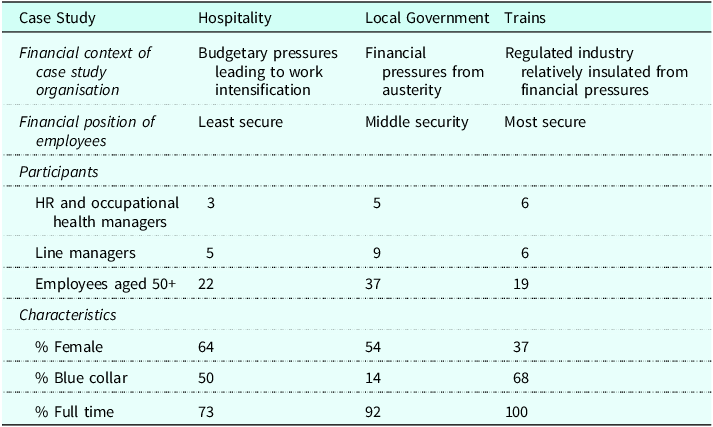
This article presents case study analysis from three UK organisations, taken from a wider project on extended working lives (EWL) conducted prior to the Covid 19 pandemic; see Table 1. The original research design and protocols received full ethical approval from the University of Kent, Faculty of Social Sciences Research Ethics Advisory Group. Case study companies and individual participants are pseudonymised. The analysis here represents a comparative case study design (Fitzgerald & Dopson, Reference Fitzgerald, Dopson, Buchanan and Bryman2009) with organisational cases selected because of their points of similarity and difference. The original aim was to identify the emergence of new organisational policies and management strategies relating to EWL. We focused on large organisations with well-established Human Resource Management and Occupational Health infrastructure as this is where innovative practice might be found.
Case study financial contexts and participant details

Note: rounded to full percentage.
The qualitative case study design sought a ‘comprehensive description’ of each setting regarding the research focus (Marshall, Reference Marshall1999, p. 380), avoiding sole reliance on either espoused management policies or employee perceptions of climate. Qualitative semi-structured interviews were conducted with line managers, Human Resources (HR)/Occupational Health managers, and employees aged fifty plus. Employees were selected using a maximum variation sampling strategy (Patton, Reference Patton2002) to capture the experiences of informants from different genders and occupations. For line managers, the key criterion was that they were involved in managing older workers. Interviews explored attitudes and perspectives towards ageing, the management of retirement, views about longer working lives, health issues and capacity to work. They lasted forty-five to fifty minutes on average and were digitally recorded and transcribed verbatim.
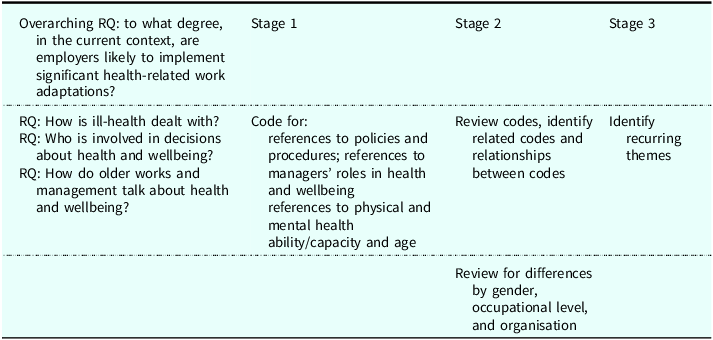
In the original study open coding (Silverman, Reference Silverman2010) revealed that issues around health and ageing surfaced as key concerns for employees and managers. For the investigation into occupational health issues reported here, we used a phronetic iterative analysis approach (cf. Tracy, Reference Tracy2020). Table 2 gives the framework for conducting the qualitative analysis, which shows how the interviews were re-coded in the light of the research questions. Three of the original case study companies were selected because they were organisations in very different sectors with different workforces but who had OH services and expressed sympathy to the government’s call to adapt work in response to individuals’ health needs.
Framework for qualitative analysis

As Table 1 shows, the financial and broader contexts of the organisations differed markedly:
-
‘Hospitality’ was a business unit dealing with catering, cleaning, and accommodation within a larger establishment. As is common in the hospitality sector (Jolly et al., Reference Jolly, McDowell, Dawson and Abbott2021) wages were low and margins were tight, resulting in pressures to reduce costs. Compared with the other case studies, older workers interviewed were more likely to be women in physically demanding blue-collar jobs who were the least financially secure in terms of pay and pensions. These kinds of so-called ‘Lopaq’ jobs have provided significant employment of older workers in the general population (Lain, Reference Lain2012).
-
‘Local Government’ was typical of similar public sector employers in terms of facing severe financial pressures to cut costs because of austerity and budget cuts from central government (see Johnson et al., Reference Johnson, Rubery and Grimshaw2021). Older employees interviewed were less likely to be in blue-collar jobs and their financial positions were more variable than in the other case studies. Over half of UK women and a fifth of men aged fifty to sixty-four work in ‘public administration, health and education’ (Centre for Ageing Better, 2022), including local government and other employers exposed to austerity.
-
‘Trains’ was a private company representing a highly regulated industry; at the time of the data collection it was unusual in being insulated from financial pressures experienced in the other case studies to a significant degree, with travel fares regulated by the government and rail companies benefitting from significant public subsidies (see Bowman, Reference Bowman2015).
Findings
All case study organisations had ageing workforces and employees with chronic conditions such as diabetes and osteo-arthritis. Stress was especially an issue in Local Government because of the downsizing that was underway. In Trains and Hospitality in particular, there were problems associated with the physical dimensions of the jobs. In Trains there were back issues and diabetes attributed to the need to sit down a lot and the impact of shift systems on eating patterns. In Hospitality musculoskeletal conditions such as bad backs and knee problems associated with heavy lifting and working on your feet were common. The four most prominent themes related to work/health adaptations emerging from the data (Stage 3, Table 2) were: the changing nature of work, affordability, (in)security, and the link between declining health/capacity and age. How these issues played out differed between organisations. We look at the management of health issues in each case study in turn.
Hospitality
Hospitality had access to the larger organisation’s occupational health function, which included a counselling service and physiotherapy. The bulk of its work was dealing with management and self-referrals especially in relation to musculoskeletal conditions and post-operative or post-treatment returns to work. Affordability was a perceived barrier to supporting older workers, as one HR manager reported:
[I have] no budget […] I’m always having to try and influence—[…] it is very relevant, actually, for older workers. ‘Cause there’s loads of different things you can do for wellbeing, but […] it’s lapsed by the wayside because […] the executive group I don’t think are really interested in it to be quite frank with you. […] it’s not something anybody really wants to hear because it’s seen as-- spending money.
Historically, managers had the capacity to make informal arrangements around shift patterns and areas of work for staff with health conditions. In the context of financial pressures and employees working longer scope for doing this had diminished, as an HR manager commented:
And it is very hard, and it’s becoming more and more [hard] […] whereas previously we might have been able to accommodate some staff still working but doing slightly less strenuous cleaning jobs, we haven’t got those options anymore, and that’s what we’re finding harder and harder.
Some of the reduced capacity to provide work accommodations appeared to be because there were fewer ‘lighter jobs’ available with more staff needing them. However, this was only part of the story. Interviewees reported that there had been work intensification, which in this case of predominantly blue-collar work was influenced by the financial pressures previously mentioned. In this context, many of the older employees interviewed worried about their ability to work into their middle/later 60s and the expected negative effects of extended working lives on their health:
Some of us that have been here 12 years or maybe longer, we’ve seen changes and the job sort of gets more and more demanding and physical, and you think, I can’t see me doing this in another couple of years or five years – female, blue-collar with line managerial responsibilities
The managerial focus was on the older workers’ capacity to do their jobs and the possible need to manage people out, rather than adapting the work to the individual circumstances or updating skills to allow easier job moves:
somebody […] working in an area where it was purely physical, they had no other skills at all, they weren’t able to carry on doing the job they were doing and actually the only option for them was to be retired […] But they weren’t in the pension scheme so then that comes down to capability – HR manager
Employee perceptions regarding adaptations were mixed. Some not yet needing work adaptations thought that they were available, perhaps because they had been in the past. Others, perhaps having seen changes over time, concluded that redeployment opportunities were dependent upon the specific line manager. Emphasising the importance of taking a broader definition of health, some felt that occupational health were better at dealing with diagnosed health conditions than physical changes related to ageing:
How good they would be because you said well, you know, I’m getting older and I just can’t work as hard as I used to be, it’s different because that’s not something that’s necessarily measurable or provable – male, blue-collar
Employees that had experienced health issues were often the most negative, as summarised by one older worker:
Yeah. I don’t think if I went and said to them, you know, “Oh, I’m finding it really difficult,” they normally say, “Well, obviously if you can’t do the job, you need to leave then”.…It’s not, “Well, let’s see what we can do to help you,” it’s not like that at all – female, blue-collar
The theme of (in)security manifested itself in a sense of ‘job precarity’ (cf. Lain et al., Reference Lain, Airey, Loretto and Vickerstaff2019) among those with health issues, who viewed their jobs as potentially unsustainable in the long term because adaptations required were unlikely. Additionally, there was a sense of financial precarity – individuals had low private pension provision and limited financial support from the organisation if they were to leave work on health grounds. Some staff felt under pressure to conceal or downplay their health issues for fear of losing their jobs, an issue strengthened by the belief that as older workers their chances of finding alternative work were severely compromised:
I’m in agony today…. I have to come in every day and put a brave face on it so that they don’t know. […] the minute I make a mistake or I can’t do something, then it’ll be, “I think it’s time for you to leave,” and financially I can’t do that at the moment – female, blue-collar
In summary, despite some sympathy for work adaptations in principle and the suggestion that more could be done to support older workers, financial pressures and lack of perceived affordability limited the extent to which mangers felt able to deliver adaptations. The physical nature of the work was an important issue, but it also reflected work intensification. In this context the link between health, capacity and age was highlighted and workers felt precarious. This meant some hid health worries for fear of being seen as ‘old’ and ‘incapable’ and then managed out of work. This made responding to health issues even more difficult.
Local Government
In Local Government some HR managers presented a positive impression of their occupational health services. Health screening and wellbeing initiatives were highlighted and as one HR manager commented:
Looking at our occupational health provision […] we’re doing loads of stuff around [being] active, getting the workforce to be more active and healthy, and running clubs and eating better and managing their weight…. you know, trying to get people to be proactive and look after their own health so that hopefully, they don’t need to access as much support and resource.
Such initiatives were therefore based on changing individual behaviour (cf. Foster, Reference Foster2018), rather than adapting work to individual needs. On top of that, their efforts were overshadowed by the financial pressures caused by ‘severe spending cuts and the financial settlement from central government’ (HR manager). It had avoided compulsory redundancies and was trying to manage substantial headcount reductions through a voluntary severance offer and an internal redeployment system. The net result from an occupational health perspective was high levels of stress amongst the older workforce. Some interviewees felt that older workers were targeted in these processes creating a sense that health, capacity and age were linked in managers’ minds:
By default the older you get, the more illnesses you seem to pick up [laughs] – female line manager
The majority of the workforce was white collar and the scope for redeployment from one role to another was theoretically greater than in Hospitality where many roles were physically demanding. If someone was unable to continue in the current role for health reasons they could be referred to the internal redeployment system:
it [redeployment] is across the board for anybody who wants to either change a role, needs development, needs moving due to ill health, no longer have a job because the service is restructured. It’s for all the scenarios – HR manager
While health was raised as a reason for redeployment, there was limited evidence that this was what it was actually used for. HR managers referred to one specific individual downsizing from a more senior role for health reasons, and one older interviewee matched this description. He had taken his pension and moved down four grades to remove himself from a stressful job with long hours following a serious health event. The response was not, therefore, to adjust the job to the individual, but to allow the individual – who had previously worked in HR and arguably understood the system – to move to lower paid work.
Beyond the redeployment scheme, some limited scope existed for informally moving people between roles. More broadly, however, redeployment was precipitated by the needs of the organisation. People primarily joined redeployment because their previous job had been disestablished, and they were moved to areas where workers were needed. One manager thought that the redeployment process might be actually causing physical and mental health problems as people were redeployed to inappropriate work. Responding to health changes positively was marginal. Indeed, individuals with health issues could be prevented from accessing the redeployment scheme if their skills were required in their current role. Reflecting wider changes in the nature of work and work intensification, one individual in a professional/managerial role saw his workload dramatically expand. This had a negative effect on his mental health, resulting in him and some colleagues seeking professional medical help. However, access to the redeployment scheme to move into another role on the basis of ill health would be blocked, as he explained:
To go on to the [redeployment scheme] … your boss and his bosses have got [to] let you go. So if they’re not letting you retire earlier they’re not going to let you do that – male, white-collar
Many workers felt precarious as their jobs were insecure due to organisational restructuring in the context of austerity and they had to apply for other jobs in Local Government that were not aligned with their needs. They were typically in a less financially precarious situation than in Hospitality, as voluntary early retirement and severance was an option. However, at the time of the interviews a lot of those with the financial means to leave had already done so. For those remaining, departure from work – with little expectation of finding alternative work elsewhere – was often not an easy option. This created an environment of insecurity which made it difficult for individuals to request adaptations, and in which managerial priorities focused on responding to financial pressures.
Trains
The situation in Trains was very different to that of Hospitality and Local Government. There was an acknowledgement that the workforce was ageing, as with the other case studies, but there were attempts to adjust general requirements in response:
Yeah, the standards are changing and adjusting, as people are getting older they’re realising that a lot more people are going to have these issues and they pilot it initially to see if it’s okay and then it becomes the standard that--, ’cause we never used to let drivers drive with a hearing aid but now we are – HR manager
One line manager stated there was an industry recognition that in the next ten years there would be difficulties recruiting and retaining train drivers, but it is too simple to view this as simply responding to a shortage of drivers because this was seen as a future issue.
What was particularly contrasting with Hospitality and Local Government was the absence of discussion about financial constraints on making adaptations, which is likely to reflect to some degree the lack of competitive financial pressures on the industry at that time (Bowman, Reference Bowman2015). Financial considerations were not the only influences on the willingness to make adjustments, but they did help enhance the influence of several other factors. For example, drivers were operating in a safety critical environment in which most staff were required to have regular medicals, which helps identify health problems and may encourage the pipeline for work adaptations. In more financially precarious industries employers could alternatively have made individuals redundant when they failed medicals. In Trains affordability was looked at in a more strategic way. For example, responding positively to medical conditions was sometimes financially incentivised – for example, cost-benefit analyses were done on whether to fund quicker private treatment for things like knee replacements rather than face the uncertainty of long waiting lists in the National Health Service (NHS – a publicly funded healthcare system). Trade unions were also present which, in the context of relative organisational financial security, may have contributed to a willingness to make adaptations (in local government trade unions instead focused on seeking to enhance financial settlements for leaving).
In Trains, regular health and well-being initiatives were provided, work modifications were expected and were common, and if someone could not drive anymore for medical reasons, they were likely to be offered other roles in the organisation:
There’s redeployment options, yeah, and we do have quite a good--, as part of my role we do have quite a good success rate with redeploying, where we can, into other roles. – HR manager
Despite options for redeployment, it was argued that the priority was trying to keep people in their jobs, as illustrated by the following quote:
They have an occupational health specialist nurse […] I’ve got someone in engineering […] who’s got a problem with dust, and breathing problems and she’s going to go and look at what equipment we need and things like that to try and support him to keep in his—[job], ’cause he wants to carry on working so we can’t put him at risk [laughs], – occupational health manager
Eyesight and hearing tests were routinely offered, and support given to those needing hearing aids or changes to prescriptions for glasses. The link between health and age was not assumed to prejudice capacity as they had the data to show that age was not predicting capacity.
In this positive environment employees generally praised how health issues were dealt with:
I think they have been absolutely brilliant right from the lower management all the way up to human resources, … when I was having radiotherapy treatment it was a case of, just--, ‘cause I was going to go sick and they said, ‘Oh no, don’t go sick, just phone up, stay at home, phone up, book on and don’t bother coming in,’ and they were really really brilliant. – female, blue-collar
The above individual was unable to drive anymore. However, unlike in Hospitality and Local Government, there was an open dialogue, arguably encouraged by an organisational context in which medical severance meant the financial consequences of leaving were not deemed to be concerning:
I spoke to the occupational health and he said he could make me a U2… it’s ‘unfit for any railway duties’ […] I would get my pension paid fully up to 60. And I just kind of looked at the figures and I thought, oh I could […] get my medical severance and then just take a part time job but then thinking about it I’d miss it [laughs]. – female, blue-collar
As this individual did not want to retire, she was encouraged/supported by her manager to continue working: ‘my managers got me onto a ticket office course… He was kind of saying, “you’re too young to retire,” you know [laughs]”. This involved keeping her drivers pay for a year, and then moving on to 75% until the grade caught up; this was substantially better pay than she could get for another job outside of Trains. Without the context of financial insecurity/precarity, the organisation was able to help the individual arrive at an accommodation that suited them.
Discussion and conclusion: the need for security to deliver health adaptations
The UK government is calling on employers to make work adaptations in response to people’s changing health as they age (DWP, 2017; Nicholson et al., Reference Nicholson, Mayho, Robson and Sharp2019). This article examines the implementation (or not) of work adaptations in three organisations, each facing differing financial and contextual pressures. Drawing on the insights from Thompson (Reference Thompson2003), we examined the suggestion that varying degrees of financial pressures were likely to influence the extent to which organisations feel they can make adaptations, alongside wider factors identified by Cunningham et al. (Reference Cunningham, James and Dibben2004). Cunningham (2004) identified lean-ness and work intensification as barriers to implementing adjustments, suggesting that financial pressures may be of importance. This article therefore makes a contribution by comparing the provision of work adjustments in organisations based on whether they are insulated from, or exposed to, financial pressures.
The evidence from the article suggests that financial considerations were one of multiple influences, and they amplified or diminished the impact of several other important factors. All organisations expressed sympathy with the provision of work adaptations, but their ability to provide them was influenced by a constellation of factors including affordability; the changing nature of work (including work intensification); the degree of security/precarity which older workers felt; and the perceived link between declining health/capacity and age.
Trains was relatively insulated from financial pressures found in the other case studies (Bowman, Reference Bowman2015). Drivers worked in a highly regulated safety critical environment in which medical tests identified health issues. This was translated into the provision of adaptations in part because, in a relatively stable financial context, a well-developed OH service including medical professionals created a potential pipeline for adaptations and trade unions provided a measure of security for staff. These workers were also in a financially secure position, with good pensions and pay. They could expect enhanced benefits if they left work for health reasons, or pay protection if redeployed to a lower-income role. This created an environment in which there was an open dialogue about health issues, and space to accommodate the needs of the individual in terms of adapting work. This was not just about holding onto workers doing ‘in demand’ jobs, however, as evidenced by the example of an individual moving into a customer-facing role on higher wages than they would otherwise get for this new position. In this context, we see less health-related work anxiety among older workers, reflecting the relatively secure, and unprecarious environment in which they worked (cf. Lain et al., Reference Lain, Airey, Loretto and Vickerstaff2019).
Conditions in the other two organisations were different. In Hospitality, there were challenges around the physical nature of the work that need to be recognised. However, the idea of work adaptations in the form of job redeployment to ‘lighter roles’ was not new and these had been available in the past. As is common in the hospitality industry, margins were tight leading to pressures to cut costs, which was manifested in work intensification. In this context, managers said they were less able to accommodate work adaptations than in the past. Work intensification seemed to have strengthened the ‘corporeal standard’ (cf. Campbell, Reference Campbell2001) all workers needed to meet. Older workers had low expectations about the organisation being able to make work adaptations enabling them to stay in work, increasing their job insecurity. The problem was exacerbated because the organisation was also unable to protect workers from financial insecurity in the way observed in Trains. Workers feared the financial consequences of losing their jobs, making open dialogue and the management of health even more difficult and some workers hid health issues.
Local Government had a mechanism by which certain adaptations could be implemented – a redeployment scheme. However, this was introduced primarily to enable restructuring in response to financial pressures from central government austerity budget cuts, with jobs being disestablished and people being moved to areas where labour was required. Redeployment was posited as a tool for moving individuals in response to health needs, but moves were almost always precipitated by organisational needs in the context of financial austerity. Indeed, those with health issues could be blocked from entering the redeployment scheme if their skills were needed in their current role. Like Hospitality, there was work intensification and Local Government was less able to protect older workers from job and financial insecurity because of a lack of health-related adaptation and redeployment paths such as those identified in Trains.
The contribution of this article has been to tease out a combination of factors likely to encourage or discourage employers from responding effectively to the health concerns of older workers. As we have seen, even employers who in principle express sympathy with work adaptations felt constrained in delivering them in part because of the financial pressures they face, in line with the arguments of Thompson (Reference Thompson2003; Reference Thompson2013). Financial pressures and associated work intensification also seemed to strengthen a normative ableist ‘ideal worker’ assumption (cf. Foster & Scott, Reference Foster and Scott2015), which, as our cases show, can place particular stress on older workers. The case studies flesh this out further by demonstrating how job and financial security are prerequisites for older workers to feel safe to request adaptations; this relates to wider debates about ‘ontological precarity’ (Lain et al., Reference Lain, Airey, Loretto and Vickerstaff2019). Trains was the exception in terms of positively responding to changing health needs, but they were unusual in terms of levels of anticipated older worker job demand, regulation, and protection. Conditions of employment in Local Government and Hospitality are likely to be more reflective of the kinds of jobs held by many older workers (Centre for Ageing Better, 2022); half of older workers say their jobs require excessive work demands (Centre for Ageing Better, 2022). Moreover, although Trains may be questioning parts of the normative ableist ‘ideal worker’ assumption (cf. Foster & Scott, Reference Foster and Scott2015), for example by now allowing hearing aids among their drivers, more room for improvement is likely possible.
From a policy perspective, this issue has only grown in importance since the Covid 19 pandemic, given a rise in ill-health exit from work among the over fifties (Tinson et al., Reference Tinson, Major and Finch2022). Employers can always do more (Vickerstaff et al., Reference Vickerstaff, Phillipson and Wilkie2012), and in the case studies we found the perception that some line managers did more than others to support the health of their workers. However, government appeals for employers to make significant work adaptations are less likely to work in the current context. Improving this situation requires more regulatory and policy change than seems feasible at the current time to address issues related to austerity, work intensification and ontological precarity.
Acknowledgements
The original research for this project was part of the Uncertain Futures: Managing Late Career Transitions and Extended Working Life project funded by the Economic and Social Research Council (ESRC) [Ref. ES/L002949/1]. We would like to express our gratitude to the staff of the case study companies for enabling, and participating in, our research. We would also like to thank the other researchers in this project for their part in collecting the data. The secondary data analysis that underlies this article was supported by the ESRC in the UK (grant number ES/S00551X/1). We would like to thank Joanne Crawford for her involvement in the beginning of this paper. Finally, we thank the anonymous reviewers of the article for helping us to strengthen our argument. The authors made the following contributions to the analysis and writing of this article: Lain (40%), van der Horst (40%) and Vickerstaff (20%).
Competing interests
The authors declare none.

 Open access

