


Electroconvulsive therapy (ECT) is viewed by many in the psychiatric profession as a safe and effective treatment that can be life-saving. The public does not always share this view and one important reason might be a lack of confidence that general clinical practice adequately mirrors stringent research methodology. The National Audit of ECT aimed to audit clinics against standards set by the Royal College of Psychiatrists, to carry out a survey of patients who receive ECT and to record outcome in a routine clinical setting.
Method
From the outset, it was determined that to be effective, the audit would have to actively involve all clinicians responsible for ECT. The Scottish ECT Audit Network (SEAN) was formed, initially by consultant psychiatrists but soon expanding to include nurses and anaesthetists, and this met twice-yearly for the duration of the audit. Service users and their representatives were invited to join a reference group that met regularly with the audit network steering group. The project consisted of three main phases:
-
(a) 1 February 1997-31 July 1997, visits to all ECT sites;
-
(b) 1 August 1997-31 July 1998, 9 months' data collection, 3 months' analysis;
-
(c) 1 August 1998-31 July 1999, repeat visits to all sites, 9 months' data collection, 3 months' analysis.
Training of ECT staff in the collection of demographic and outcome data was standardised by use of a teaching video. Two members of the management team visited all clinics at least twice to assess premises and equipment, treatment protocols and ECT training and supervision.
The process standards were drawn from the Royal College of Psychiatrists' ECT Handbook (Royal College of Psychiatrists, 1995) and were formulated as a checklist. The standard for clinical improvement was set as ‘at least a 50% reduction in the Montgomery—Åsberg Rating Scale for Depression (MADRS; Reference Montgomery and ÅsbergMontgomery & Åsberg, 1979) in 70% of patients’ or ‘a definite improvement in the Clinical Global Impression Scale (CGI)’ (Reference GuyGuy, 1976), if more relevant. The Clinical Resource Audit Group (CRAG) Good Practice Statement on Electroconvulsive Therapy was published in February 1997 (Clinical Resource Audit Group, 1997) and acted as a timely intervention in promoting standards. A computer-based package for audit and quality assurance was developed and piloted by clinicians in 2000.
Results
Who gets ECT?
The demographic details and clinical indications for treatment relate to all patients treated during the audit. When the two cycles of audit data were compared, there were no significant differences found in these variables that are therefore reported as a whole.
-
(a) During the survey period (August 1997—July 1999), 1624 courses of ECT were given to 1511 patients. The average number of ECT treatments per course was 6.7.
-
(b) This represents an annual rate of ECT in Scotland of 142 ECT treatments per 100 000 population.
-
(c) Therapy was given mainly to White (99.6%) adult patients; 87% had a case note diagnosis of depressive illness, 6.3% schizophrenic illness and 3% manic illness. No patient under the age of 17 years received ECT during the study period.
-
(d) The ratio of female to male patients was approximately 2:1, reflecting the higher number of female admissions with a diagnosis of depressive illness. There was no evidence that male psychiatrists prescribed ECT preferentially to women.
-
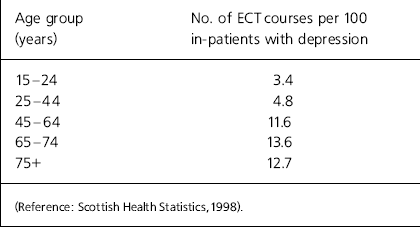
(e) ECT was not given disproportionately to the elderly; the rate of ECT given to all in-patients with a mood disorder is shown in Table 1.
-
(f) The majority of patients were of informal status (76%) and 81.8% of all patients gave informed consent to the course of treatment. A total of 3.5% were given their first ECT under emergency procedures and 11.9% following a second opinion from a Mental Welfare Commission doctor.
Courses of electroconvulsive therapy (ECT) per 100 in-patients with depression by age group
| Age group (years) | No. of ECT courses per 100 in-patients with depression |
|---|---|
| 15-24 | 3.4 |
| 25-44 | 4.8 |
| 45-64 | 11.6 |
| 65-74 | 13.6 |
| 75+ | 12.7 |
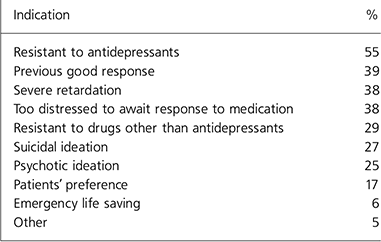
Clinicians were asked to identify, for each patient, all relevant indications for treatment; these are given in Table 2. The recording of resistance to medication was at the discretion of each clinical team and so strict research criteria might not have been applied.
Indications for eclectroconvulsive therapy
| Indication | % |
|---|---|
| Resistant to antidepressants | 55 |
| Previous good response | 39 |
| Severe retardation | 38 |
| Too distressed to await response to medication | 38 |
| Resistant to drugs other than antidepressants | 29 |
| Suicidal ideation | 27 |
| Psychotic ideation | 25 |
| Patients' preference | 17 |
| Emergency life saving | 6 |
| Other | 5 |
Is the ECT process up to standard?
Facilities and equipment
A total of 32 of the 35 services delivered ECT in a designated ECT suite. Two had sole use of a theatre side-room. In the private sector, ECT was given in the patient's own hospital room. In 1997, one unit still gave ECT in a ward side-room, but by 1998 this service was closed.
All centres were using an acceptable ECT machine by the end of phase 1 of the audit. Anaesthetic equipment was generally of a high standard, the majority of units providing a level well above the College criteria for adequacy (with the exception of a capnograph, at that time considered non-essential by most anaesthetists interviewed).
Staffing
In all 34 National Health Service units trainee doctors were involved in the delivery of ECT, although the rota might be shared by a senior colleague. Three-quarters employed a rota system for attendance, with the majority of trainees (69%) in rotas of six or less.
No clinic reported difficulties with routine anaesthetic cover, the majority enjoying input from a regular core of 1-3 senior anaesthetists (78%). At no location did junior anaesthetists work unsupervised. All patients for ECT were accompanied by a ward nurse or nurse familiar to them. The standard of nursing was high and 89% of ECT nurses were defined as either ‘designated’ or ‘special interest’ ward staff.
ECT practice
The ECT was always prescribed by a consultant psychiatrist. There was a 30-fold variation in the rate of use of ECT across the country, ranging between 13 and 386 ECT treatments per 100 000 head of population. Written information for patients was available at all locations. Bilateral ECT remained the treatment of choice. By completion of the audit, all units had, in line with College recommendations, developed a protocol for altering the electrical stimulus according to response. Clinical information on response to treatment was available for the ECT team from case notes at 89% of sites in 1997, rising to 97% by 1999.
Training and supervision
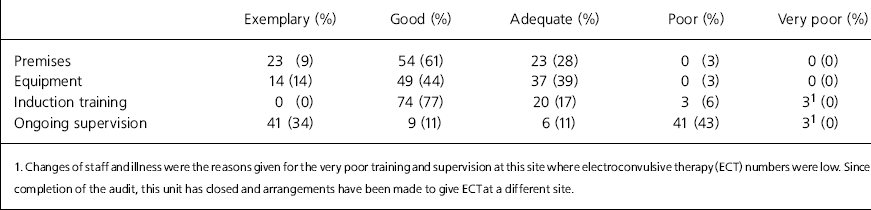
Ratings were made following interviews with the ECT consultant, the senior house officer giving ECT at the time of the audit visit and in response to a questionnaire sent to all senior house officers at ECT. The information received was consistent. Induction training was rated as adequate for 93% of senior house officers, but continuing supervision was adequate in only 55% of clinics.
Local audit activity
A total of 80% of units had undertaken some kind of review or audit of their own activities in the 3 years before the start of this audit. This had led to an update in equipment or practice in half of these clinics.
The overall ratings made during phases 1 (1997) and 3 (1999) of the project are given in Table 3. These showed an improvement in premises and equipment to College standard, no real change in the already high level of induction training and some improvement in continued supervision. An explanation of the rating scales can be found in the full report (Reference Freeman, Hendry and FergussonFreeman et al, 2000).
Overall rating from phase 3 of the audit (results from phase 1 are in parentheses)
| Exemplary (%) | Good (%) | Adequate (%) | Poor (%) | Very poor (%) | |
|---|---|---|---|---|---|
| Premises | 23 (9) | 54 (61) | 23 (28) | 0 (3) | 0 (0) |
| Equipment | 14 (14) | 49 (44) | 37 (39) | 0 (3) | 0 (0) |
| Induction training | 0 (0) | 74 (77) | 20 (17) | 3 (6) | 31 (0) |
| Ongoing supervision | 41 (34) | 9 (11) | 6 (11) | 41 (43) | 31 (0) |
Is ECT effective?
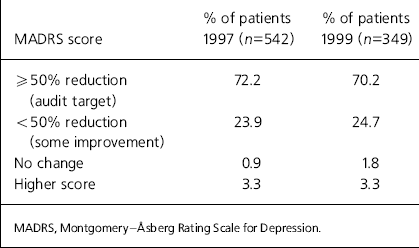
Data on outcome were recorded on 78% of the audit forms returned. As Table 4 shows, there was an average clinical improvement with treatment, as measured by at least a 50% reduction in MADRS score (the audit standard), in 71.2% of patients treated for depressive illness. By phase three of the audit, a CGI was recorded for all patients and Table 5 shows ratings of ‘definite improvement’ in over 72% of patients with depressive disorder and over 60% for other (psychotic) illnesses. Of the 636 patients who fully recovered, 342 (54%) did so within 3 weeks of starting ECT. There was no relation between outcome and ECT machine or technique, but the numbers in some centres were too small to reach a statistically significant conclusion.
MADRS score (depressive illness)
| MADRS score | % of patients 1997 (n=542) | % of patients 1999 (n=349) |
|---|---|---|
| ≥ 50% reduction (audit target) | 72.2 | 70.2 |
| < 50% reduction (some improvement) | 23.9 | 24.7 |
| No change | 0.9 | 1.8 |
| Higher score | 3.3 | 3.3 |
Clinical Global Impression Scale for all patients (phase 3)

| Definite improvement (%) | Minimal improvement (%) | Same (%) | Worse (%) | |
|---|---|---|---|---|
| Depressive illness (n=378) | 72.0 | 18.3 | 7.3 | 2.4 |
| Schizophrenic illness (n=29) | 60.8 | 25.4 | 13.8 | 0 |
| Manic illness (n=13) | 68.4 | 18.3 | 13.4 | 0 |
| Other illnesses (n=6) | 50.0 | 37.5 | 0 | 12.5 |
Discontinuation of treatment
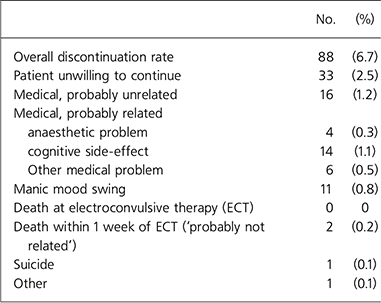
The reasons for failing to complete a course of treatment were also studied. In total, 88 of the 1314 courses supplying information were discontinued prematurely; Table 6 outlines the reasons for this. The audit did not set out to study in detail the adverse effects of ECT or the risks associated with treatment; however, a more detailed discussion of these is to be found in the project report available on the SEAN website (www.sean.org).
Reasons for discontinuation of treatment
| No. | (%) | |
|---|---|---|
| Overall discontinuation rate | 88 | (6.7) |
| Patient unwilling to continue | 33 | (2.5) |
| Medical, probably unrelated | 16 | (1.2) |
| Medical, probably related | ||
| anaesthetic problem | 4 | (0.3) |
| cognitive side-effect | 14 | (1.1) |
| Other medical problem | 6 | (0.5) |
| Manic mood swing | 11 | (0.8) |
| Death at electroconvulsive therapy (ECT) | 0 | 0 |
| Death within 1 week of ECT (‘probably not related’) | 2 | (0.2) |
| Suicide | 1 | (0.1) |
| Other | 1 | (0.1) |
Discussion
The third Royal College of Psychiatrists' audit of ECT in England and Wales (Reference Duffet and LelliotDuffet & Lelliot, 1998) had concluded that only 30% of clinics met the current standards. At the outset, the average standard of facility, equipment and practice in Scotland appeared higher than for the rest of Britain, but even so improvements were evident by completion of the second audit cycle.
The College has identified the need for consultantled teaching and supervision, and the audit was a useful tool with which to benchmark local training practices. Although the level of induction training was high and all trainees were supervised for their first ECT session, there were some definite problems with continued supervision. The wide range in prescription of ECT across the country is interesting; at its highest, the use of ECT is comparable with other British surveys in the last 10 years, so it could be that the lower levels of use represent under-prescribing in some areas. In any case, claims from some anti-ECT lobbies that ECT in Scotland is overused or given preferentially to minority groups can now be refuted on the basis of this evidence.
This was the first time that outcome data were collected on a national basis and the major conclusion reached was that the clear majority of patients, given ECT in a routine clinical setting, improve. Because this was an audit of real life clinical practice, all other treatments, including concomitant medication, were continued as usual and local clinicians decided when a course of ECT was complete.
Further work
The national audit was successful in fulfilling its intention to gather basic facts about facilities, staffing, use of ECT and outcome. It did not, however, provide unequivocal answers to questions on the optimum treatment package for ECT. There was a considerable variation in prescription rates across the country and some centres gave ECT so infrequently that statistical comparisons of outcome were invalid. A system of electronic data collection has been developed and is now being implemented, and additional national information from this should enable a more powerful statistical analysis of inter-site variations of practice and outcome. All Trusts in Scotland have given a commitment to financial support and the continuation of SEAN, as a clinically driven forum for maintaining standards and sharing information on ECT, will help shape the way ahead.
Acknowledgements
The SEAN steering group members were Dr S. Backett (Livingston); Dr A. Hay (Inverness); Dr D. Lyons (Glasgow); Prof. I. Reid (Dundee) and Dr A Scott (Edinburgh). Many thanks go to project workers Charlotte Nevison and Kirstine Postma for their patience and dedication.


 Open access


eLetters
No eLetters have been published for this article.