


Introduction
The Swinhoe’s Rail Coturnicops exquisitus is not only the smallest of the Rallidae but also one of the least studied. Its distribution is still poorly known, but the population is believed to be declining and is therefore listed as ‘Vulnerable’ on the IUCN Red List (BirdLife International 2017). The species inhabits wet meadows in south-eastern Russia and north-eastern China and occurs during passage and in winter in south-eastern China, Japan, the Korean peninsula and Mongolia (Taylor and van Perlo Reference Taylor and van Perlo1998). There are two major regions where the species is believed to breed: the first is situated in Transbaikalia (Russia), the second in the Primorye area, especially near Khanka Lake in the very south-east of Russia, and possibly adjacent areas of China (Figure 1). However, recent surveys failed to find this species in the Chinese part of Khanka Lake (Glushenko et al. Reference Glushenko, Xiaomin, Korobov, Volkovskaya-Kurdiukova, Kalnitzkaya, Huajin, Fengkun and Wentao2012) and there are no breeding records or current observations during the breeding season from China (T. Townsend in litt.). The distance between the two regions is around 1,200 km.
Distribution of Swinhoe’s Rail Coturnicops exquisitus following BirdLife International (2017) and new records at Muraviovka Park, the Amur region and Japan.

To our knowledge, there have been no published breeding records from the presumed breeding areas in Transbaikalia since 1867 (Potapov and Flint Reference Potapov and Flint1989) and in the Primorye region since 1868 (Potapov and Flint Reference Potapov and Flint1989, Shibnev and Glushenko Reference Shibnev and Glushenko2008), but birds have been observed in recent times during the breeding season (June) near Khanka Lake (Glushenko et al. Reference Glushenko, Kalnizkaya and Korobov2006).
Stegmann (Reference Stegmann1930) and Potapov and Flint (Reference Potapov and Flint1989) were unaware of any records but already assumed breeding of Swinhoe’s Rail in Amurland, as this region is situated in between the two known breeding sites along the middle course of the Amur River and contains suitable habitat. Furthermore, a clutch was found near Albazin (Figure 1) at the north-western edge of the Amur region in July 1906 (Taylor and van Perlo Reference Taylor and van Perlo1998, BirdLife International 2001), but this record is missing in the Russian literature (Dementiev and Gladkov Reference Dementiev and Gladkov1951, Potapov and Flint Reference Potapov and Flint1989). The first bird in the Amur region was found in 1995 at Khingan Nature Reserve (Ryabzev Reference Ryabzev1997). More records were obtained in the 1990s and early 2000s at this site and in the neighbouring Jewish Autonomous Oblast, situated further downstream along the Amur River (Antonov Reference Antonov2006). At Khingan Nature Reserve, densities of 3–5 birds/km2 were estimated from surveys on 22 June 2000 and 4 July 2007 (Antonov and Parilov Reference Antonov and Parilov2009).
Almost all past records refer to rails flushed in the field (Ryabzev Reference Ryabzev1997, Antonov Reference Antonov2003, Glushenko et al. Reference Glushenko, Kalnizkaya and Korobov2006, Antonov and Parilov Reference Antonov and Parilov2009, Volkovskaya-Kurdiukova and Kurdiukov Reference Volkovskaya-Kurdiukova and Kurdiukov2010). In the absence of any hint of breeding, e.g. a record of a singing male, most authors were unsure about the status of the birds (as breeder or migrant). Therefore, the status of this species was categorized as rare migrant or unknown in the species lists of the Khingan Nature Reserve (Antonov and Parilov Reference Antonov and Parilov2010) and for five nature reserves of the Primorye region (Glushenko et al. Reference Glushenko, Elsukov, Katin, Nechaev, Kharchenko, Shibnev and Shokrin2013). The same is true for the Republic of Korea, where its past and present status is uncertain as well (Duckworth and Moores Reference Duckworth and Moores2008, Moores et al. Reference Moores, Kim and Kim2014).
Recently it became clear that the song as well as the calls of Swinhoe’s Rail differ strongly from its Nearctic sister taxon, the Yellow Rail Coturnicops noveboracensis (Wulf et al. Reference Wulf, Heim and Thomas2017). As these taxa are sometimes considered conspecific and are hardly separable in field (Taylor and Sharpe Reference Taylor, Sharpe, del Hoyo, Elliott, Sargatal, Christie and de Juana2018), our aim was to use genetic markers to evaluate the species identity of the observed rails in the Amur region.
Material and methods
Field work
Our survey took place in and around Muraviovka Park in Far East Russia (49°55´08.27´´N, 127°40´19. 93´´E), a floodplain area situated along the middle reaches of the Amur River (Figure 1). All observations (acoustic and visual) during bird counts from 2013 to 2015 were recorded and included in this analysis. In 2016, targeted surveys were carried out from 9 June to 23 July. We opportunistically searched for Swinhoe’s Rails in wetlands (c.250 ha) using our recordings of song and calls as playback. These calls proved to belong to the observed rails (Wulf et al. Reference Wulf, Heim and Thomas2017). Responding individuals were dazzled with a spotlight and caught by hand (Robert and Laporte Reference Robert and Laporte1997). Caught birds (n = 4) were ringed with metal rings of the Moscow Bird Ringing Centre and buccal swab samples for genetic analysis were taken with cotton sticks and stored in an EDTA buffer (10% EDTA, 0.5% NaF, 0.5% thymol, 1% Tris-HCl, pH = 7.5). The vegetation type was noted for sites where birds were heard calling or where individuals were caught. Furthermore, we noted whether the area was affected by a spring fire or not.
Sample analysis
DNA was extracted from the four buccal swab samples and one eggshell, which was found during the surveys and presumed to belong to the study species. One half of the cotton tip and the skin of the eggshell was cut into small pieces. Afterwards, the five samples were incubated overnight at 50°C in 900 µL respectively 500 µL buffer B (10 mM Tris, pH 7.5, 25 mM EDTA, 75 mM NaCl) for the skin of the eggshell with 50 µL proteinase K (Boehringer, Mannheim) and 50 µL of 20% SDS, or in guanidinium thiocyanate buffer (4 M guanidium thiocyanate, 0.1 M Tris-HCl pH 7.5), 1% beta-mercaptoethanol, followed by a standard phenol-chloroform extraction. The DNA was precipitated with 900 µL of cold isopropanol, centrifuged, washed with 500 µL of 70% ethanol, dried and resuspended in TE buffer (Sambrook et al. Reference Sambrook, Fritsch and Maniatis1989).
The mitochondrial cytochrome b gene was amplified as a marker gene via polymerase chain reaction (PCR) in the standard volume of 50 µL, containing 21.8 µL respectively 39.8 µL water for the skin of the eggshell, 5 µL 10x buffer, 2 µL dNTPs, 0.5 µL forward primer (L14764: 5´-TGRTACAAAAAAATAGGMCCMGAAGG-3´ (Sorenson et al. Reference Sorenson, Ast, Dimcheff, Yuri and Mindell1999) or mt-C2: 5´-TGAGGACAAATATCATTCTGAGG-3 (Fritz et al. Reference Fritz, Auer, Bertolero, Cheylan, Fattizzo, Hundsdorfer, Martin Sampayo, Pretus, Široký and Wink2006), 0.5 µL reverse primer (mt-C4: 5´-AGTGTTGGGTTGTCTACTGA-3´ (Broders et al. Reference Broders, Osborne and Wink2003) or mt-FSH: 5´-TAGTTGGCCAATGATGATGAATGGGTGTTCTACTGGTT (Van der Bank et al. Reference Van der Bank, Engelbrecht, Sauer-Gürth, Wink and Mulder1998), 0.2 µL Taq-polymerase (Bioron, Ludwigshafen) and 20 µL respectively 1 µL DNA for the skin of the eggshell. The thermal cycling profile consisted of an initial denaturation for 5 min at 94°C, followed by 38 cycles of denaturation for 45 s at 95°C, 1 min at 50°C, 2 min at 72°C and final extension for 10 min at 72°C. The PCR program was used on the thermal cycler T1 (Biometra, Germany). The cytochrome b gene was amplified with forward primers L14764 and mt-C2 and with the reverse primers mt-C4 and mt-FSH. Sequencing was performed by StarSeq (Mainz, Germany).
The nucleotide sequences of the five samples were aligned in the program BioEdit v. 7.1.9 (Hall Reference Hall1999) and verified by BLAST (Altschul et al. Reference Altschul, Madden, Schäffer, Zhang, Zhang, Miller and Lipman1997). A phylogenetic tree was reconstructed with Maximum Likelihood (ML) analysis (Tamura et al. Reference Tamura, Stecher, Peterson, Filipski and Kumar2013). For that, sequences of cytochrome b from various species (Table S1 in the online supplementary material) which are closely related to the Swinhoe’s Rail were taken from the database of National Center for Biotechnology Information (NCBI).
Results
Observations
Swinhoe’s Rails were found at 10 different sites in and around Muraviovka Park between 2013 and 2016. All observations were made in wet, low-growing sedge meadows with rich litter. No Swinhoe’s Rails were found in wetland areas that were burnt in spring of the survey year.
Results of the genetic analysis
DNA was successfully isolated from all samples and the mitochondrial cytochrome b gene was amplified by PCR and sequenced. A total of 1,018 nucleotides of the swab samples (GenBank accession numbers MG708233-MG708236) and 517 nucleotides for the eggshell sample (MG708237) of the cytochrome b gene were aligned together with a set of related species. The sequence of the eggshell matched the sequences of the swab samples, only three nucleotides were different in the sequence of the eggshell in comparison to the consensus sequence of all swab samples.
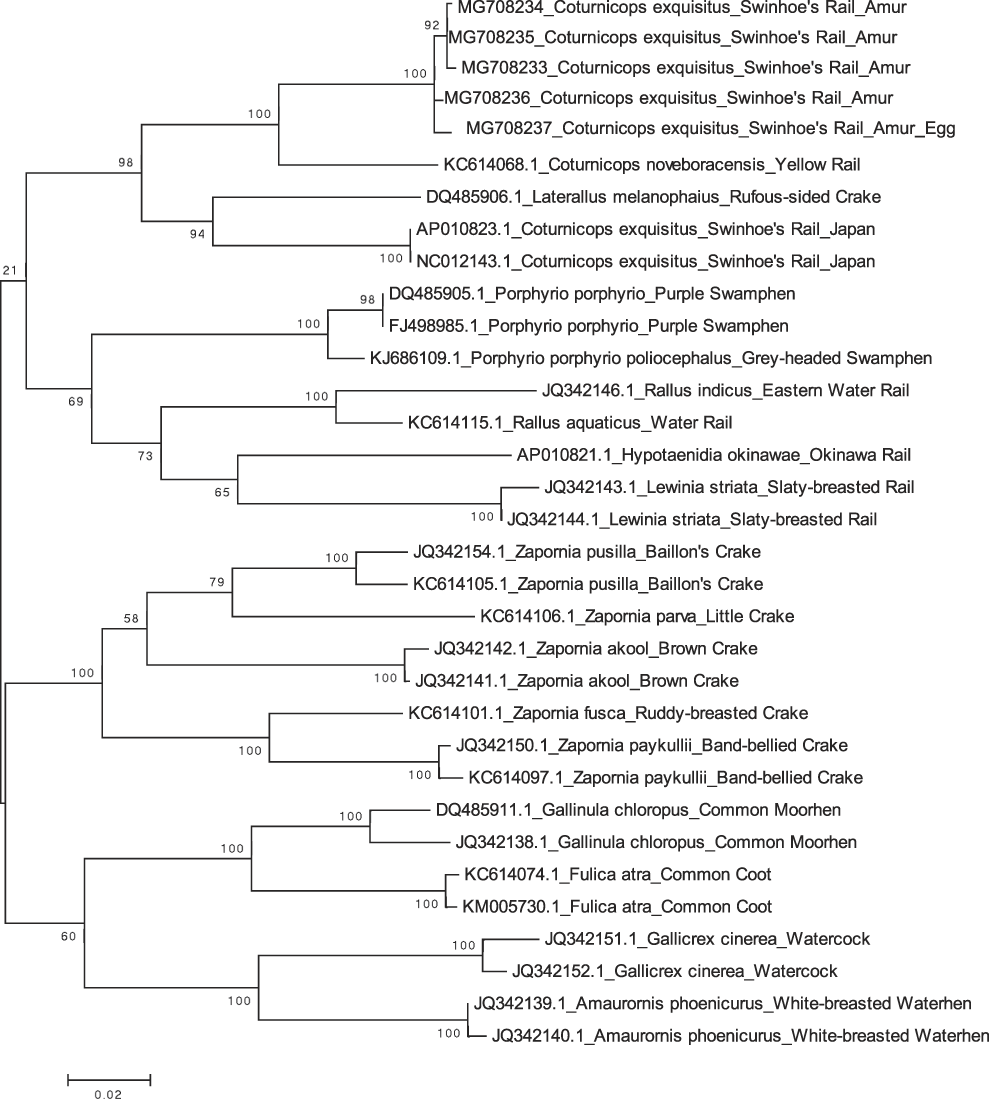
The relationship of the Swinhoe’s Rail to other closely related species was supported by a bootstrap analysis (500 replicates) and can therefore be taken as the best estimate of the phylogeny from this dataset, using the ML method and the Okinawa Rail Hypotaenidia okinawae as outgroup (Figure 2). All sequences from our analysis were grouped in one clade, as a sister species to the Nearctic Yellow Rail. However, the sequence of the Swinhoe’s Rail from GenBank differs strongly from our samples. The number of different nucleotides between the consensus sequence of the Amur Swinhoe’s Rail and the sequence of the Japanese Swinhoe’s Rail is 107 out of 1,018 nucleotides (10.51%); with the latter being more closely related to the Rufous-sided Crake Laterallus melanophaius. Thus, the five Swinhoe’s Rails from our data analysis are not the same species as the sample from Japan.
Relationship of Swinhoe’s Rail and closely related species based on the mitochondrial cytochrome b (1018 nucleotides; for the eggshell only 517 nucleotides), analysed by maximum likelihood. Bootstrap values are shown above the nodes.
Discussion
Using genetic markers, we could unequivocally confirm that the Swinhoe’s Rail is a breeding bird of the Zeya-Bureya floodplains along the middle course of the Amur River. To our knowledge, the eggshell that we found is the first breeding record of this species for 110 years, and the first breeding record for this area. The location of the last breeding record, a clutch found near Albazin in 1906 (Taylor and van Perlo Reference Taylor and van Perlo1998), is situated more than 500 km upstream and is separated by the Greater Khingan mountain range, and thus might represent a different population.
The genetic distance from existing GenBank samples to our sample might indicate there is an undescribed species of rail in Japan that has so far been mistaken as Swinhoe’s Rail. Alternatively, samples might have been mixed up, and the Japanese sample might refer to another rail species. We are confident that we have indeed sampled Coturnicops exquisitus, based on a) the plumage (see photos in Figure S1 and in Wulf et al. Reference Wulf, Heim and Thomas2017), and b) the occurrence of our samples as a sister species to the closely related C. noveboracensis in the phylogenetic tree (whereas the Japanese sample seems to be more closely related to the genus Laterallus).
We found Swinhoe’s Rails in wet meadows with low water levels, and all observations were made in areas spared from spring fires. A study on the Nearctic Yellow Rail demonstrated the importance of a thick litter cover for this species, and that a fire frequency of 2–5 years would provide suitable habitat conditions (Austin and Buhl Reference Austin and Buhl2013). Fire frequency is increasing in the Amur region due to climate change and drying up of wetlands caused by dam construction (Smirenski and Smirenski Reference Smirenski and Smirenski2007, Sokolova Reference Sokolova2015, Yu et al. Reference Yu, Zheng, Kershaw, Skrypnikova and Huang2017). As frequent fires leave little litter behind, an increase in annual fires could threaten the species in the future.
We assume that the scarcity of records in general and at Muraviovka Park might be explained by the lack of knowledge about the vocalisation of Swinhoe’s Rail. Based on 23 observations from the presumed breeding grounds in China and Russia between 1867 and 2015, gathered from 11 publications (Table 1), most observations (n = 21; > 90%) referred to individuals that were seen but not heard. Only one publication (Stein Reference Stein2011) refers to an acoustic record and for one observation it was unclear whether birds were heard or seen. Of the visual records, one bird was reported dead, six were shot and collected and 14 were flushed. It is remarkable that almost all of the Swinhoe’s Rail records refer to visual observations, despite Swinhoe’s Rail being a very secretive species that is hard to observe (like many other rails). The only acoustic record (Stein Reference Stein2011) lacks any description of what was heard and we consider it doubtful. We hypothesize that this was caused by inadequate descriptions of its vocalisation (Wulf et al. Reference Wulf, Heim and Thomas2017), since all sources, including widely used field guides (e.g. Brazil Reference Brazil2009), describe the song as being similar to its Nearctic sister species, the Yellow Rail. It seems likely that this species was therefore overlooked (or its calls misidentified) and it might be much more widely distributed and more common than previously thought. This is also suggested by numerous observations of this species during the breeding season from Khingan and Bastak Nature Reserves and from several locations in the Primorye region. In Japan, Swinhoe’s Rail was recently observed during the breeding season (Figure 1) and identified by its calls as well (Miya et al. Reference Miya, Sannohe, Ebina and Sekishita2005). Furthermore, it is interesting to note that the vocalisation of the closely related Speckled Rail Coturnicops notatus was also described only recently, and an increase of records of this secretive species is now expected (Dias et al. Reference Dias, Centeno, Coimbra and Zefa2016).
Published records of Swinhoe’s Rail Coturnicops exquisitus from the presumed breeding areas in Russia (1867–2016).

We encourage ornithologists in North-East Asia to use the sound recordings recorded in the course of this study as tape lure and search for Swinhoe’s Rail in suitable habitats (for sound recordings see http://www.xeno-canto.org/321489). Recent studies have demonstrated that our knowledge on distribution of secretive rail species contains high levels of uncertainty (Girard et al. Reference Girard, Takekawa and Beissinger2010, Seifert et al. Reference Seifert, Becker and Flade2012). A better understanding of the ecology, habitat use and population size of the Swinhoe’s Rail is needed to protect this little-known and rare species.
Supplementary Material
To view supplementary material for this article, please visit https://doi.org/10.1017/S0959270918000138
Acknowledgements
The field work of the Amur Bird Project was supported by the German Ornithologists’ Society (DO-G e.V.) and the Mohamed bin Zayed Species Conservation Fund in 2016. Many thanks to the staff of Muraviovka Park (http://www.muraviovkapark.ru/) for hosting our team. For helpful comments the authors want to thank Aleksey I. Antonov, Masao Takahashi, Richard Lewthwaite, Paul Holt and Terry Townsend. We also thank Arne Schlegelmilch and Florian Fahr for providing literature and Hedwig Sauer-Gürth for helpful advice in the laboratory. Comments by three anonymous reviewers helped to improve an earlier version of this manuscript.



