




Introduction
The literati of classical China have long held the catalogue (pulu 譜錄) genre in high esteem. Albeit an eccentric literary endeavor to undertake, compiling catalogues on peculiar subjects was historically deemed comparable to the high arts of writing poetry or drafting essays. Contemporary scholars, too, have marveled at the “scientific spirit” of catalogues, which predated, in many cases by several centuries, the Linnean recensions of the natural world that punctuated the scientific revolution.
The Song-dynasty scholar Chen Renyu 陳仁玉 (1212–?) is typically celebrated as the originator of the mushroom catalogue subgenre. His popular Fungus Catalogue (Junpu 菌譜; alt. Xiang junpu 香菌譜 or Fragrant Fungus Catalogue), is heralded for its taxonomic flair. The inventory inspired a number of later exemplars, including the Ming-dynasty Expansion to the Fungus Catalogue (Guang junpu 廣菌譜) and the Qing-period Mushroom Catalogue of the Wu [Region] (Wu xunpu 吳蕈譜).
Beyond the wealth of mycological data they provide, these catalogues also represent an unanticipated and unexplored source of culinary knowledge. The first three sections of the present study examine each of the aforementioned catalogues in relative detail, focusing, when appropriate, on their contributions to food culture. Our triad of sources supplies a fair amount of information about the taste and texture of fungi—pointing to the fact their readers most likely made practical use of the texts, relying on them to identify comestible species rather than merely satisfying their curiosity about an idiosyncratic subject. Many of the catalogue entries even include recipes on how to optimally prepare mushrooms for consumption.
Yet, for all their innovativeness and modernity, it should not come as a surprise that the mushroom catalogues were indebted to previous textual genres. Our reading reveals a preoccupation with the medicinal effects of fungi as well as an overlay between culinary and pharmacological recipes. Indeed, the catalogues adopt a number of elements—including the recipe (fang 方) format—from the entries of earlier medical pharmacopeia. Such borrowings are highlighted in the fourth section.
In the fifth section, we trace mountain lore and religio-spiritual tropes to a genre with a long history of sensitivity to things fungal: Daoist writings. Although these most likely constituted an independent font of inspiration for the mushroom catalogues, they were also intertwined with medical sources.
By looking at how our catalogues combined local culinary knowledge with the formats and concerns of pharmacological texts as well as religious sources, this study attempts to show that mushrooms were not merely biological curiosities but entangled cultural objects tied to taste, nutrition, health, longevity, and even spirituality. Accordingly, the catalogues that indexed them had entangled histories and straddled multiple genres, heirs of textual practices that stretched across centuries.
The “fungus catalogue” and the emergence of a new genre
The earliest surviving catalogue of edible mushrooms was compiled at the very end of the Song dynasty, in the year 1275. The scope of the work was to provide a detailed list of the prized culinary delicacy’s local varieties in Taizhou 台州, a region in present-day Zhejiang at the intersection of the Siming 四明, Wen 溫, and Taishan 台山 valleys still famous for its mushrooms. The catalogue also supplies precious information on when the fungi grow, when it is best to harvest them, their appearance, and their taste. A few suggestions for preparing them are included, although for the most part, it appears that the fruiting bodies were best consumed fresh or dried, with little seasoning or transformation. Some brief instructions for antidotes to mushroom-poisoning are also furnished.
The Fungus Catalogue (Junpu) has received a fair amount of scholarly attention of late. Contemporary sinologists hail it as the first of its kind, a pioneering and unprecedented work that constitutes the archetypal mushroom manual of premodern China.Footnote 1 As one scholar elaborates, the text is “significant for its dual status as not only the earliest manual of edible mushrooms recorded from China, but also indeed the oldest practical treatise on fungi known from anywhere in the world.”Footnote 2
The catalogue was compiled by Chen Renyu, a scholar-official who enjoyed prestigious posts including Department Director of the Imperial Library (mishu lang 秘書郎) and the Ministry of Rites (libu lang 禮部郎), Judicial Commissioner (tixing 提刑) of Zhedong 浙東, Prefect (zhizhou 知州) of Quzhou 衢州, and, most remarkably, Vice Minister of War (bingbu shilang 兵部侍郎). He penned the Fungus Catalogue early in his career, before securing his jinshi degree (1259) and obtaining his most senior appointments. Besides his mushroom inventory, Chen Renyu authored a single other work, the Compiled Records of Travel (Youzhi bian 游志編), an essay in the “notebook” (biji 筆記) style.Footnote 3
The relatively short Fungus Catalogue, under three folios in length, is made up of a preface composed by Chen Renyu in 1245 and descriptive entries for eleven kinds of fungus that are native to Xianju 仙居 county, where the author was originally from. Chen Renyu describes his homeland as a quasi-fantastical, almost supernatural place:
Xianju county is nestled in between Mount Tiantai [to the north], Mount Kuocang [to the south], and clusters of peaks that enter the heavens and are inhabited by immortals and numina. Thus, it follows that [Xianju] produces marvelous fungi.Footnote 4
仙居介天台括叢山入天, 仙靈所宮, 爰產異菌。
We may underscore that the author connects extraordinary and delectable fungi with the unmistakably Daoist tropes of inaccessible mountains, immortals, and numina. Chen opens the preface with the declaration that “mushrooms and fungi both emerge from vital pneuma”; in other words, because Xianju is a location that benefits from exceptionally pure or refined pneuma, it produces exceptional mushrooms.
An eighteenth-century summary of contents (zongmu tiyao 總目提要) from the Siku quanshu edition confirms that Xianju was known for its exquisitely delicious fungi. It cites Ye Mengde’s 葉夢得 (1077–1148) Record of Conversations Had When Escaping the Summer Heat (Bishu luhua 避暑錄話) and Zhou Mi’s 周密 (1232–1298) Miscellaneous Notes from Guixin [Street] (Guixin zashi 癸辛雜識) to that effect.Footnote 5 Although details about edible fungi do subsist in the archive, both the author’s preface and the summary underscore that the treatments are usually cursory and cover one or two specimens at most. Moreover, “when it comes to selecting the varieties that are food-grade,” Chen laments, “there is no record of ancient precedents”—a statement that is, as we shall see, not entirely accurate.Footnote 6 The summary is more on the mark, stating “these fungi entered the culinary repertoire in antiquity, but since [their varieties] are of a rather subtle order, many of them did not make it into reference books.”Footnote 7
Despite this perceived dearth of available information about comestible varieties, mushrooms were prized delicacies in the Song.Footnote 8 They were celebrated in local culinary cultures but also appreciated as transregional delicacies, making their way into metropolitan and even kingly plates. Chen refers to them in the context of lavish banquets known as “jade feasts” (yushi 玉食) as offerings to royalty and nobility, stressing that “truly, [they have] the utmost richness of wild spinach and surpass the auspiciousness of brasenia.”Footnote 9 He explains that his only desire is to understand mushrooms and their culinary uses. This is why, he conveys, he has listed gastronomic varieties and compiled the Fungus catalogue. Footnote 10 The summary from the Siku quanshu edition adds: “for this reason, [Chen] Renyu fully describes the local product’s famous varieties in this catalogue. … Preserving this in a single text is contributing something to the knowledge of things.”Footnote 11
With the impetus behind the groundbreaking work and the circumstances surrounding its production coming into focus, we may turn to the text’s centerpiece—the mushrooms that fill its pages. Altogether, eleven varieties of fungi are described, more or less, in the order in which they are esteemed, with the top grades listed first. The final entry, which is considered high-quality, is exceptionally listed last, but this is certainly on account of its poisonous potential. The first two entries, describing the most prized fruiting bodies of all, are longest, amounting to a full paragraph of a hundred or two hundred characters. Comparatively, the other nine mushrooms are described in a line or two. To illustrate the tenor of the entries, I translate the description of the “harmony mushroom” (hexun 合蕈; alt. taixun 台蕈 or tai/terrace mushroom)Footnote 12:
On the outside, [the harmony mushroom] is brown and its texture is like that of pure jade. The fragrant aroma that rises from the iron kettle [in which it is cooked] can be smelled from a hundred paces away. In fact, while numerous are the mushrooms that can compare in terms of softness and beauty, none have its fragrance. Only the harmony mushroom is praised for both its fragrance and taste; not even numinous mushroomsFootnote 13 or the celestial flowerFootnote 14 are like this. Is this not complete virtue? It should be the only one venerated as the culmination of fungi!Footnote 15
菌質外褐色, 肌理玉潔, 芳薌韻味發金鬲, 聞百步外。葢菌多種例柔美皆無香。獨合蕈香與味稱, 雖靈芝天花無是也。非全德耶, 宜特尊之以冠諸菌。
The entry for the second most esteemed mushroom, the “dense sap mushroom” (chougao xun 稠膏蕈),Footnote 16 is also relatively lengthy. It is particularly voluble with respect to preparing specimens for gastronomic purposes:
The preparation method is as follows: [the dense sap mushrooms] should be gently submerged into a kettle. Wait for the water to boil then strain them out. Be mindful not to stir them with a ladle. If you stir, they turn mucilaginous as well as putrid and cannot be consumed. [This mushroom’s] particularity is that it combines favorably with numerous flavors. It is especially well completed by ale. When prepared correctly it will complement [any dish], taking on a gently tender and smoothly sweet taste; even a pheasant-tail brasenia [stew] could not be spoken of in the same sentence.Footnote 17
鬻法當徐下鼎瀋, 伺涫沸漉起。謹勿匕撓, 撓則涎腥不可食。性參和眾味而特全於酒, 烹齊旣調, 溫厚滑甘, 雉尾蓴不足道也。
In addition to the harmony mushroom and dense sap mushroom, the Catalogue discusses nine other varieties, most of them with considerable brevity. Thus, Chen describes the “chestnut husk mushroom” (like xun 栗殼蕈),Footnote 18 the “bamboo mushroom” (zhu xun 竹蕈),Footnote 19 the “barley mushroom” (mai xun 麥蕈),Footnote 20 the “jade mushroom” (yu xun 玉蕈),Footnote 21 the “yellow mushroom” (huang xun 黃蕈),Footnote 22 the “purple mushroom” (zi xun 紫蕈),Footnote 23 and the “four seasons mushroom” (siji xun 四季蕈)Footnote 24 in succinct terms, typically focusing on the locations in which they grow, their appearance/color, as well as their texture and taste. The entries for the “pine mushroom” (song xun 松蕈) and the “goose fat mushroom” (e’gao xun 鵝膏蕈) are a bit more elaborate, but they do not reach the length of the first two entries. For the former, the pine mushroom,Footnote 25 Chen notably details its medicinal uses: “if those who suffer from afflictions such as turbid urination or incontinence happen to fortuitously consume a mushroom that [grows] beneath pine trees, they will see their ailment completely cured.”Footnote 26
The latter entry, centering on the goose fat mushroom,Footnote 27 contains a notable excursus on a dangerously toxic fungus with which it is sometimes confused, the “birchleaf pear tree mushroom” (du xun 杜蕈).Footnote 28 It is
produced by the vital breath of venomous creatures. … All who are afflicted by its toxicity invariably laugh. To neutralize it one should combine young [lit. bitter] tea leaves and alum together with a ladleful of freshly drawn well water and drink it. None will fail to immediately recover.Footnote 29
毒蠚氣所成 … 凡中其毒者必笑, 解之冝以苦茗雜白礬, 勺新水併並咽之, 無不立愈。
Judging from these lines, it appears that Chen was familiar with the properties of psychedelic mushrooms. The description of the pear tree fungus and its non-toxic analogue, the goose fat mushroom, are not specific enough to aid us in identifying the type of fungi under discussion, but some have ventured to guess that the passage may be in fact referring to, respectively, poisonous and comestible varieties of the infamous Amanita or agaric mushroom family.Footnote 30
After this brief section on antidotes, the text transitions rather abruptly to a closing statement. It is there that, in some contrast to the opening declarations of the preface, Chen’s deeper motivation for compiling the Fungus Catalogue is revealed: “The reason for composing [this text],” he explains, “is to enable those who dwell in mountains to enjoy the fungi’s delicious flavors while also steering clear of their harm.”Footnote 31
Later significant fungus catalogues: The Ming-dynasty Expansion to the Fungus Catalogue
Chen Renyu’s Fungus Catalogue attracted a good deal of attention during the Ming, notably gaining a postface (ba 跋) by Hu Yunjia 胡允嘉 (1570–1614). It also generated a wave of enthusiasm for mycology. In the wake of a veritable catalogue (pulu) boom, the classification and study of mushrooms found new legitimacy as a serious scholarly pursuit on par with literature and poetry—in which Chen Renyu also partook.Footnote 32 At first glance, fungi might appear to be just another idiosyncratic object of the scholarly gaze, but as I hope the previous section has shown, the organisms lay at the intersection of a number of discourses—those pertaining to literati aesthetics, of course, but also to the cultural practice of gastronomy and spiritual pursuits as well. Thus, the mushroom catalogue (and the pulu genre more broadly) was not an isolated literary form but constituted, rather, the distillation of multiple previous discourses about a single topic.
Pan Zhiheng 潘之恒 (1556–1622) was another scholar who married literary and mycological vocations. A salt merchant from Xin’an 新安 (present-day Anhui) and failed official, he was a relatively prolific writer and poet.Footnote 33 He is known for his Penetrating Historical Digest (Genshi chao 亙史鈔; 1612 terminus ante quem), only fragments of which survive. The miscellaneous chapters of the compilation apparently contained a number of writings related to mushrooms including sections on “auspicious fungi” (jun rui 菌瑞), “records of fungal calamities” (junzai ji 菌災記), and “poems about fungi” (junshi 菌詩), but also a list of “categories of fungi” (junlei 菌類). Although much of Pan’s Digest is lost, the latter section has survived in abridged form in a later anthology, Tao Ting’s 陶珽 (b. 1573–d. after 1646) Continued Suburban Discourses (Shuofu xu 說郛續) of 1646.Footnote 34 It appears under a different title in its truncated form, namely, Expansion to the Fungus Catalogue (Guang junpu).Footnote 35 In assigning it this name, the editor of the anthology surely thought of it as a follow up or appendix to Chen Renyu’s installment, which he also included in the collectanea. Indeed, the source consists of twenty curt entries modelled on the shorter ones from the Fungus Catalogue, much akin to this one:
The fragrant mushroomFootnote 36 grows on paulownia, willow, mandarin orange, and jujube date trees. Among the fungi that grow on these trees, [only] those that are purple are called “fragrant mushroom.” The character for “mushroom” derives from the character for “herb” and the character for “depth.”Footnote 37 The character for “depth” [also] means “extensive.” The mushroom’s taste is flavorful,Footnote 38 meaning that it has depth and is extensive.Footnote 39
香蕈, 生桐、柳、枳、椇木上, 紫色者名香蕈。字從草,從覃。覃, 延也, 蕈味雋永, 有覃延之意。
Although they describe mushrooms from various locales, as opposed to Chen’s focus on a specific area, the entries from the Expansion to the Fungus Catalogue are, on the whole, similar to those of its predecessor. If one were compelled to draw a detailed comparison, they would be found to present comparatively less information on appearance, color, growing conditions, and harvesting methods. Nevertheless, flavor is still discussed, leaving no doubt as to the Ming source’s value as a culinary guide. A prefatory line that has survived from Pan Zhiheng’s original text explains:
I obtained the Compendium of Materia Medica compiled by Li Shizhen from Chu.
Upon reading it, I found that many among the numinous wood ear type of mushrooms are of the same category as [edible] fungi arranged under the “vegetables” section. I have [only] slightly highlighted them in an effort to contribute to the investigation of culinary marvels.Footnote 40 If numinous mushrooms are a type of divine plant, they should have their own dedicated catalogue; they should not be disgraced by being categorized [together] with [mere] vegetables.Footnote 41
偶得楚人李時珍所輯《本草綱目》, 讀之, 其芝檽之屬多與菌相類者, 列諸菜部, 稍爲標出以佐郇廚之調。若芝爲靈草種, 自冝專譜, 不當以菜品辱之矣。
Pan Zhiheng sums up the purpose of his catalogue, namely, to provide the standout “wood ear” (ruan 檽, alt. mu’er 木耳) with its own platform, as befits such an exceptional fungus. After all, wood ear mushrooms, identified today as species from the Auricularia genus, were not only edible, but also delectable; moreover, they were considered to have non-negligeable medicinal properties, which is probably what earned them their “divine” (ling 靈) status. The earlier Fungus Catalogue profiles some of its mushrooms as having medicinal properties, but the Expansion to the Fungus Catalogue is even more loquacious on this point, as in the following example:
Willow ear mushroomsFootnote 42 repair stomach disorders and regulate vital pneuma. They fix vomiting and expectoration. Use five to seven mushrooms in a warm broth and drink. You will promptly heal.Footnote 43
柳耳, 主補胃理氣 ,治反胃吐痰, 用五七箇煎湯服, 即愈。
Pan Shizheng quotes from a number of sources in his work, but none more than Li Shizhen’s 李時珍 (1518–1593) Compendium of Materia Medica (Bencao gangmu 本草綱目, late sixteenth century),Footnote 44 which he openly credits as the principal point of departure for the Expansion in the prefatory line translated above. In fact, a large portion of the work is derivative of Li Shizhen’s influential pharmacopeia, either through paraphrases, verbatim copy-pasting, or attributed citations largely from the “Mushrooms and Wood Fungi” (Zhi’er lei 芝栭類) section of the work.Footnote 45 In this respect, there is very little original material in this catalogue, particularly in comparison to Chen Renyu’s, but the compiler does not aspire to anything more than shedding light on the culinary applications of known medicinal mushrooms. To this effect, he also cites Tao Hongjing’s 陶弘景 (456–536) Collected Annotations on [the Divine Husbandsman’s] Materia Medica (Bencao jing jizhu 本草經集注; 498 CE) which, not by coincidence, is one of the sources of Li Shizhen’s compendium.
Although Pan Shizheng relies with parsimony on other primary types of materials including miscellanies,Footnote 46 there is no doubt that he privileges the medico-pharmacological sources, highlighting once again the composite nature of the catalogue genre and more particularly the layers of meaning that went into constituting mushrooms as cultural objects—beyond those derivative literati aesthetics of consumption or selfhood that are typically associated with pulu. Footnote 47
Later significant fungus catalogues: The Qing-dynasty Mushroom Catalogue of the Wu [Region]
The Expansion to the Fungus Catalogue remained a niche publication—albeit one certainly appreciated by mycological experts and literati fans of the catalogue genre. By contrast, the original Fungus Catalogue continued to attract readers well into the Qing period, so much so that it accrued a second preface, as we have seen, by the nineteenth-century scholar Wang Weisheng. It also spawned a second “expansion” or, more accurately in this case, a full sequel.
The Mushroom Catalogue of the Wu [Region] (Wu xunpu; preface dated to 1683) was compiled by Wu Lin 吳林 on the model of the original Fungus Catalogue and the collection of gazetteers that preserved tidbits on local funga, which it cites.Footnote 48 Accordingly, its focus is strictly regional, concentrating on the mushrooms that grew in the area around Suzhou—a locale that had acquired some measure of fame for the delectability of its fungi. The text emulates the Fungus Catalogue in terms of structure (inventory entries) and organization (in tiers or grades), as well as style and content. Wu Lin directly refers to Chen’s work on a few occasions,Footnote 49 and while he unmistakably builds on it, he also significantly develops new mycological knowledge. He lists twenty-six mushrooms, more than double Chen Renyu’s count.
What is more, the individual entries are voluminous, with ample details on the appearance, taste, fruiting locations, and harvesting times of mushrooms as well as their sub-varieties. In some cases, methods for preparation and consumption are supplied. Less frequently, but with some consistency nevertheless, entries list what could fall under the category of medical applications. The following is a representative example:
The tea-tree mushroomFootnote 50 has a yellow-blackish color like that of soy sauce. It has a white skirt and large cap with a long stem. Its taste is outstanding; its texture is slightly elastic. It is commonly found at the foot of tea trees around the White Dragon shrine on the western flank of Mount Yang. It is also produced in gardens below tea trees, but these are not as fragrant as those from the White Dragon shrine. The monks from the shrine say it can clear up the lungs. I remember that my uncle used to suffer from lung heat and swelling in the face. After eating some of this mushroom by chance, his conditions cleared up!Footnote 51
茶棵蕈, 黃黑如醬色, 白褶大面長腳, 味勝, 微韌。陽山西白龍祠左右茶樹下往往有之。山園茶棵下亦皆產, 不及白龍者香美, 祠僧雲能清肺。憶先父嘗患肺熱, 面腫, 偶啖此菌良已。
As can be gleaned from these lines, a good deal of the medical knowledge presented in the text is tied to religious figures or sites, especially Buddhist ones. This dimension that was absent from the previous fungus catalogues.
Beyond its twenty-six entries, the Mushroom Catalogue of the Wu [Region] contains a substantial preface and closing postface, appreciably more robust than those of its predecessors. The front and back matter place most weight on the topic of avoiding mushroom poisoning or mollifying/neutralizing the toxic compounds once ingested, another concern that would fall under the aegis of medical knowledge. Judging by the proportion of text that addresses the matter—roughly one fourth to one third of the content of the opening and closing sections—mushroom intoxication was a serious issue in the area around Suzhou during the Qing. The following passage conveys the full extent of the concern with contamination that the compiler and his readers harbored. Of note here is the avowed familiarity with psychedelic fungi or “laughing mushrooms” (xiao xun 笑蕈),Footnote 52 which are categorized as “poisonous” (du 毒):
The Record of Trifling Matters states: “In general, anomalous fruits invariably have snake venom at their root, so one should avoid eating them.” I believe that as a rule, anomalous mushrooms also invariably have venomous snakes and vipers dwelling at their base. The Yangshan County Annals also explains that normally, if one picks a red fungus with white folds on its surface or a pure white mushroom without folds, they should be discarded. Those mushrooms that grow on sweetgum trees are called “laughing mushrooms.” Eating them causes people to uncontrollably laugh, but by drinking “soil sauce”Footnote 53 they will recover. Another method is to throw several stems of lamp grass into a cauldron while mushrooms are boiling; if the lamp grass turns black, then the mushrooms contain toxins and they cannot be consumed.Footnote 54
《瑣碎錄》云, 凡果異常必根有毒蛇, 忌食。竊謂凡菌異常, 亦必其下有蛇虺居焉。《陽山舊志》又曰, 凡白折面紅者、純白與無折者, 採宜棄之。生楓樹者曰笑蕈, 食之令人笑不止, 飲以土漿則愈。又法:烹時以燈草數莖投釜中, 燈草黑, 有毒不可食。
Judging from these lines and others like them in the materials that bookend the entries of Mushroom Catalogue of the Wu [Region], discerning inedible from edible mushrooms was manifestly an important preoccupation, as were therapeutic antidotal recipes. Although the actual entries are not necessarily focused on clinical or pharmacological content, such content is still present. Wu Lin refers to Tao Hongjing’s Collected Annotations on [the Divine Husbandsman’s] Materia Medica on three occasions, and to other pharmacological collections as well.Footnote 55 We may infer that, like his forerunners, he was intimately familiar with the key medical sources in circulation at this time. The persistent association of mushrooms with spiritual pursuits is also noteworthy here. As we will see, it may very well have stemmed from the imbrication between medical sources and Daoism.
Roots in materia medica
The catalogues considered above were groundbreaking in a number of respects, but they were not created ex nihilo. The works of Chen Renyu, Pan Shizheng, and Wu Lin were partly modelled on the funga sections of gazetteers. All three compilations draw on data from these local sources or on secondary sources that rely on them, such as anthologies.
But the mushroom catalogues also drew on another important set of sources. Pharmacological materials had featured fungi centuries prior. Accordingly, materia medica figure prominently among mushroom catalogue citations. Indeed, the late-imperial gazetteers more than likely took a page out of the much earlier medical sources that had refined and perfected the inventory format over hundreds of years. Tao Hongjing’s Collected Annotations on [the Divine Husbandsman’s] Materia Medica, for example, was a sixth-century composition based on third-century content, but its relevance had not waned even in late imperial times—and this, despite the success of Li Shizhen’s Compendium of Materia Medica. The following lines from Tao Hongjing’s work, pertaining to the “stork fungus” (guan jun 雚菌),Footnote 56 offer a sample of the overall tenor of its mushroom entries:
Its taste can be salty or sweet, [in both cases] it is neutral. It is mildly warming with minor poison. It is administered to heal pain in the heart. As an internal warming [agent] it dispels serpents, ringworm, pinworms, the venom from snake bites, or digestive tract obstructions caused by worms. It [clears up] ulcer maggots and dispels the roundworms and tapeworms in skin abscesses. Another name for it is “stork reed.” It grows around the ponds and marshes adjacent to the Eastern Sea and as far as Zhangwu county next to the Bohai sea. It should be picked in the eighth month and dried in the shade. (Taking it with ale yields good results; avoid [consuming] with eggs. This mushroom comes from the North; it does not exist here. Since it looks like a fungus and it is said that it grows from crane droppings, another name for it is the “crane fungus.” If a single stem is eaten together with pork meat, it can clear up roundworm.)Footnote 57
雚菌, 味鹹, 甘, 平, 微溫, 有小毒。主治心痛, 溫中, 去長蟲、白㿅、蟯蟲, 蛇螫毒, 癥瘕, 諸蟲。疽蝸, 去蛔蟲、寸白, 惡瘡。一名雚蘆。生東海池澤及渤海章武 生東海池澤及渤海章武。八月採, 陰乾。(得酒良, 畏雞子。出北來, 此亦無有, 形狀似菌。云鸛屎所化生, 一名鸛菌。單末之, 豬肉 和食, 可以遣蛔蟲。)
It comes as no surprise, given the nature of the source, that the focus of these lines is squarely on the mushroom’s medical applications. Yet, despite the putative difference in genres, the entries from the [Collected] Annotations bear a close resemblance to those from our trio of later catalogues. There is mention of taste, appearance, alternate names, growing locations, harvesting times, and processing methods. A preparation method is even suggested: it would appear that medicinal recipes were forerunners of culinary recipes, at least when it came to mushrooms.
The similarities between the Collected Annotations and subsequent mushroom catalogues do not stop there. The former espouses a three-tiered classification system of high-grade, medium-grade (zhongpin 中品), and low-grade (xiapin 下品) for medical ingredients that it borrows and develops from its original source, the Divine Husbandsman’s Materia Medica. This system was adopted in the catalogues we have considered above as well as some gazetteers. Beyond format and structure, specific content is also shared by early medieval pharmacopieas and the post-Tang culinary fungal catalogues. The locus classicus for the “soil sauce” (tu jiang 土漿 alt. di jiang 地漿) recipe mentioned in Wu Lin’s work as a remedy for mushroom poisoning is none other than the Divine Husbandsman’s Materia Medica; it is reproduced in Tao Hongjing’s annotated and expanded recension.Footnote 58
Tao’s Collected Annotations in fact preserves one of the earliest textual sources exclusively devoted to mushrooms. Its passage on the five mushrooms or “excrescences” (zhi 芝) dates to around 200 CE, constituting the first known exemplar from which all later mushroom catalogues were derived. Below is the entry for purple mushrooms (zi zhi 紫芝),Footnote 59 the last of the six kinds of fungi listed:
Its taste is sweet and it is warming. It is administered to treat deafness. It benefits joints, preserves the spirit, and increases essence and vital breath. It makes firm the sinews and bones and is good for one’s countenance. If you consume it for a long time, it will lighten your body, prevent aging, and extend your years to the point of becoming a divine immortal. Another name for it is “wood mushroom.” It grows in the valleys of Mount Gaoxia.Footnote 60 All six mushrooms [discussed] are not poisonous. They should be picked in the sixth or eighth months.Footnote 61
味甘, 溫。主治耳聾, 利關節, 保神, 益精氣, 堅筋骨, 好顏色。久服輕身, 不老延年, 神仙。一名木芝。生高夏山谷。六芝皆無毒, 六月、八月採。
From these representative lines, there is little doubt that later culinary-centered accounts of Chinese funga emulated earlier sources, reproducing many of their features. We may note in this context the presence of a “religious” or “spiritual” dimension that is shared by all six entries. Chen Renyu’s work notably referenced numina (ling 靈), pneuma (qi 氣), and immortals (xian 仙); Wu Lin connected mountain-dwelling monastics (seng 僧) with fungal lore; but the bold and confident mention here of lightening the body, extending years, and immortality points to yet another early and altogether richer vein of textual materials regarding mushrooms: Daoism.
Roots in Daoist mushroom catalogues
There is no question that Tao Hongjing, the compiler of the Collected Annotations, had firsthand knowledge of Daoist sources. As a systematizer of Daoist teachings and the ninth patriarch of the famed Upper Clarity (Shangqing 上清) school, he had privileged access to esoteric scriptures and revelations. One of the key Upper Clarity sources for fungi was “The Mao Lords’ Five Kinds of Mushroom Growths” (Maojun wuzhong zhirong 茅君五種芝茸). Tao Hongjing would have studied it closely since it is attributed to the divine founders of his lineage, a trio of deified brothers known as the Three Perfected Mao Lords (Sanmao zhenjun 三茅真君).Footnote 62 In the revealed source, the divine siblings provide instructions for finding and picking numinous mushrooms (lingzhi 靈芝) in mountains. They also supply brief descriptions of five types of mushrooms; the scope is somewhat different from sources we have examined so far, but the rudimentary features are shared nonetheless. As in compilations with medical or culinary orientations, the fungus’ name(s) and appearance are provided. The location where they grow, namely Mount Juqu 句曲 (subsequently renamed Mount Mao, Maoshan 茅山) in present-day Jiangsu, and harvesting instructions are also provided in a separate segment of the text. The spiritual benefits listed are not unlike the healing properties enumerated in ulterior inventories. Thus, the entries from the Mao brothers’ text effectively consist of a basic template for mycological sources to which gastronomic details—taste, texture, recommended methods of preparation, etc.—would be added in later sources.
“The Mao Lords’ Five Kinds of Mushroom Growths,” believed to have been composed around 400 CE, is textually related to another source, earlier still: the Master Who Embraces Simplicity: The Inner Chapters (Baopuzi neipian 抱朴子內篇), by Ge Hong 葛洪 (283–343), dated to 323 CE. The exact relation between the two texts is not fully understood, but lines from two of the five entries in “The Mao Lords” appear in a section of the Master Who Embraces Simplicity that centers on mushrooms (zhi 芝). It is similar in style and structure to later fungal catalogues, furnishing the same type of information—although it is sometimes more detailed and focuses both on genera as well as individual species. It is, chronologically speaking, a distant forebear, but an unmistakable one.
In the relevant section, Ge Hong divides numinous mushrooms into five genera based on where they grow or what they look like. There are stone mushrooms (shi zhi 石芝), that appear on cliffs or mountain faces and look like rocks.Footnote 63 There are also wood mushrooms (mu zhi 木芝), that grow from the roots or sap of thousand-year-old trees.Footnote 64 Plant mushrooms (cao zhi 草芝) have the same physical characteristics as plants—stems, leaves, and sometimes even flowers and fruitFootnote 65—but the latter play no role in reproduction since numinous mushrooms are “self-” or “spontaneously-generating” (zisheng 自生). The intriguing flesh mushrooms (rou zhi 肉芝) are defined as animals that are long-lived and exceptionally hard to come by: these include a ten thousand-year-old horned toad (wansui chanchu 萬歲蟾蜍),Footnote 66 a thousand-year-old white bat (qiansui bianfu 千歲蝙蝠), and a small humanoid figure on a miniature horse-drawn carriage.Footnote 67 The fungus mushrooms (junzhi 箘芝) that constitute the last genus are closer to the types listed in the catalogues considered above, but they remain numinous, divine growths, exceptional in every respect. Ge Hong describes them in the following way:
Fungus mushrooms grow either deep in the mountains, at the base of large trees, or beside springs. They look like palatial buildings, horse-drawn carriages, dragons and tigers, human beings, or flying birds. They come in any of the five colors. There are 120 varieties for which there are illustrations. For all fungus mushrooms, one should reach them with the Pace of Yu and pick them, using a bone knife to harvest them. After drying them in the shade, making them into powder, and ingesting one square-inch spoonful, these mushrooms will make people ascend to immortality. Those of the medium grade grant several thousand years of longevity, while those of the lowest grade bestow one thousand years.Footnote 68
菌芝, 或生深山之中, 或生大木之下, 或生泉之側, 其狀或如宮室, 或如車馬, 或如龍虎, 或如人形, 或如飛鳥, 五色無常, 亦百二十種, 自有圖也。皆當禹步往採取之, 刻以骨刀, 陰乾末服方寸匕, 令人昇仙, 中者數千歲, 下者千歲也。
Overall, there are unmistakable parallels to later catalogues, but what stands out is the clear signaling of kinship with the Divine Husbandsman’s Materia Medica: the tripartite classification of medicines according to grades is reproduced and there are also direct references to the pharmacopeia at the outset of the section. Another element that stands out is the fleeting mention of “illustrations” or “charts” (tu 圖) that, we may guess from the context, would have accompanied descriptions of 120 varieties of fungi for each of the five genera (600 in total) in an original text summarized by Ge Hong. This mystery ur-source of all things fungal is merely alluded to here, but it is listed in the Master Who Embraces Simplicity’s bibliographic chapter. It appears as an unnamed collection made up of five individual documents: the “Charts of Wood Mushrooms” (Muzhi tu 木芝圖), the “Charts of Fungal Mushrooms” (Junzhi tu 菌芝圖), the “Charts of Flesh Mushrooms” (Rouzhi tu 肉芝圖), the “Charts of Stone Mushrooms” (Shizhi tu 石芝圖), and “Charts of Various Great Whitesoul (alt. Earthsoul) Mushrooms” (Dapo zazhi tu 大魄雜芝圖)—the latter most likely a variant title for what would logically have been called, if we are to guess from Ge Hong’s overview, the “Charts of Plant Mushrooms” (Caozhi tu 草芝圖).Footnote 69 In addition to the Divine Husbandsman’s Materia Medica, this illustrated anthology of sacred fungi, now lost, was an original source on which Ge Hong certainly drew in crafting his section on mushroom lore. It also very probably contributed to “The Mao Lords’ Five Kinds of Mushroom Growths.”
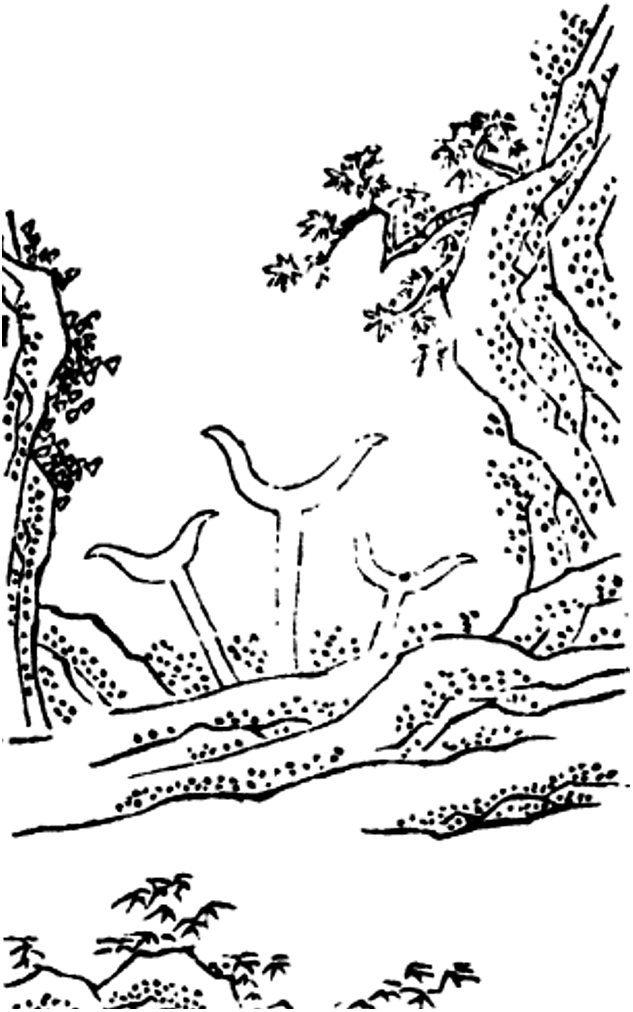
A final Daoist text on fungi deserves our attention. Dated to the eleventh century, it is considerably later than the Master Who Embraces Simplicity and “The Mao Lords,” but it is noteworthy for its proximity in style and content to later mushroom inventories—and also for its inclusion of images of fungal growths. The Numinous Treasure Catalogue of Mushroom Plants (Taishang lingbao zhicao pin 太上靈寶芝草品) constitutes an exemplar of the mature Daoist mushroom catalogue genre, in which features of earlier Daoist sources, materia medica, and fungal catalogues all intersect. Judging from the title, the Catalogue of Mushroom Plants may have been an attempt at reconstituting the “Charts of Plant Mushrooms.” The number of mushrooms listed, 127 in total (some of the sub-species), also points to this scenario, along with the incorporation of illustrations or “charts” for most of the entries, as in the example below (and see Figure 1):
The wood essence fungus grows in the middle of famous mountains. In the winter it suddenly appears at the base of trees like a spinning wheel. It can be picked and harvested at any time. Its color is white and its taste is bittersweet. Consuming it makes the body light and it bestows immortality. It has no cap, resembling a fork. Its stem is red.Footnote 70
木精芝, 生於名山之中, 冬即木本如紡車, 捃拾採揀無時。其色白, 其味甘苦。食之令人身輕仙矣。無蓋似叉, 莖赤。
“Wood essence fungus” (mujing zhi 木精芝) from the Numinous Treasure Catalogue of Mushroom Plants (Taishang lingbao zhicao pin; DZ 1406), 16a.

The Catalogue of Mushroom Plants is an unmistakable direct parent to the culinary catalogues of Chen Renyu, Pan Zhiheng, and Wu Lin; given its chronological proximity to the first of these, it is possible that Chen Renyu might have come across it. He does refer to Daoist lore in his work, but to be clear, there is no evidence that he had direct access to esoteric Daoist scriptures. What is certain is that Chen Renyu’s Mushroom Catalogue, which is often touted as being highly innovative and the first of its kind, was not. Like the Expansion to the Fungus Catalogue and the Mushroom Catalogue of the Wu [Region], it stood on the shoulders of previous sources, inscribing itself in a long and illustrious lineage spanning multiple centuries and a plurality of genres.
In their stated purpose alone, the later culinary mushroom catalogues betray their indebtedness to earlier materials. The opening lines of the Daoist Catalogue of Mushroom Plants, where the anonymous compiler—presumably an immortal—expounds the motives that underlie their sharing such material, is highly redolent of parallel passages from the literati catalogues of the Song and later:
I consider the basis of the arts of extending life to be fungal medicines. … [We immortals] roam the famous mountains, observing plants and plumbing the depths of the unknown. The shapes and varieties of auspicious mushrooms is manifold. [Even for us] it is truly difficult to distinguish them. For this reason, I have drawn their images, recorded them and attached some clarifications on their appearance to circulate. [In this way] would those who seek to find and snag some not be able reach the road the immortality?Footnote 71
竊以延命之術本因, 餌[茸]藥。[ … ] 遊歷名山, 顧觀草木, 闡驗幽昧。芝英一作精形品萬端, 實難辨別, 故畫圖記, 著狀貼傳, 請撾尋求, 得臻仙路耶。
We may be confident that Chen Renyu, Pan Shizheng, Wu Lin, and their readers were not only led by their stomachs. Beyond sampling the rarest and most delectable fungal fruits, they were also interested in the medicinal benefits of some of the prized growths. Undoubtedly aware of the rich history of fungal catalogues, perhaps they were just as interested in the spiritual benefits of eating mushrooms.
Conclusion: From panacea and entheogens to prized culinary ingredients
Rare fungi were regarded as regional delicacies and luxury food items in imperial China. Yet dedicated written sources about them as culinary ingredients are non-existent before the thirteenth-century Mushroom Catalogue. In this respect, Chen Pu’s source is perhaps the first of its kind, a pioneering gastronomical work that inspired later iterations. Nonetheless, the Mushroom Catalogue and its successors were composite works, pastiches of earlier sources and earlier concerns. Materia medica from the fifth century or prior, although centered on the medicinal properties of substances and organisms, furnished mycological catalogues with the recipe format and a distinctive telegraphic style, which included descriptions of texture and flavor. From there, the jump to the culinary recipes was a small one.
More unforeseen is the connection to Daoist sources. In addition to information about taste, texture, and healing properties, the fungal catalogues of China incorporate a fair amount of knowledge about terroir, which usually translates to mountain lore. This almost inevitably introduces notions related to longevity and self-cultivation, both spiritual pursuits. In a few significant Daoist scriptures, mushrooms are explicitly connected to health, long life, and spiritual attainment. These mycological sources are subsumed under the broader Daoist tradition of inventory-style texts documenting the features and properties of numinous flora or substances.Footnote 72 Given the proximity between medicine and Daoism in classical China—incarnated in figures such as Tao Hongjing—these fields and their textual sources were certainly cross-fertilized.
Whatever the case, the Daoist mycological materials surveyed above exhibit a parenthood with later mushroom catalogues that is, I would argue, independent of medical texts. The recurrence of elements that are exclusively the domain of spirituality or self-cultivation confirm this. In the Daoist context, a proportion of the scriptures that catalogue substances, and those that center on fungi in particular, were tied to meditation practices. Numinous mushrooms were either objects of visualization or chemical aids to contemplation.Footnote 73 For non-Daoist literati authors, focusing intently on such quixotic entities, devoting months if not years to single-mindedly reading and writing about them, could have produced effects analogous to those of a meditative trance. Perhaps the practice of meticulously documenting and itemizing specimens offered parallels to the minutia of ritualized visualization. After all, Buddhists, who were stalwart advocates of meditation, also wrote catalogues. The illustrious monk-official Zanning 贊寧 (919–1001) notably penned a Bamboo Catalogue (Sunpu 筍譜; alt. 笋譜).
Speculation aside, the three fungus catalogues of imperial China considered above were undeniably driven by a singular culinary curiosity and taxonomic thrust. They drew on different local or region-specific knowledge but were undergirded by the same literati concerns (most notably about the performance of identity through consumption) that motivated many of the inventories of the pulu genre. More unexpectedly, materia medica and Daoist scriptures were just as integral to shaping the sub-genre of fungus catalogues, a point that highlights the porous boundaries between food, medicine, and religion in Chinese intellectual culture.
Historically, mushrooms were ubiquitous cultural objects at the intersection of gastronomic, medical, and spiritual discourses. Today too, they remain important material nexuses of cultural production, as recent publications have shown; some, focusing on the matsutake in a contemporary setting, describe fungi as world-making actors that reshape ecosystems and reconfigure entire social structures.Footnote 74 There is no doubt that the fruiting bodies documented by Ge Hong, Chen Renyu, and others, had the same world-making impact in their time. The eclectic nature of the catalogues that describe them are evidence enough. In reading these sources against wider patterns of textual production, we have uncovered some continuity across genres and history in how fungi were conceived of as objects of taste, health, and self-cultivation. We have also revealed a sometimes-delicate process of transmitting, reinterpreting, and adapting fungal knowledge. It is our hope that future studies will continue to excavate the roots—or the mycelia, rather—of mushrooms and their textual sources and uncover more of the manifold ways in which these entrancing organisms were constituted in the Chinese cultural imagination.
Competing Interests
The author declares none.

 Open access

