
Skip to main content Accessibility help
×
  • Cited by 20
    • Show more authors
    • Access check Access
      You have digital access to this book
    • Select format
    • Publisher:
      Cambridge University Press
      Publication date:
      01 June 2011
      23 May 2011
      ISBN:
      9780511977466
      9780521761635
      9781107617308
      Dimensions:
      (234 x 156 mm)
      Weight & Pages:
      0.77kg, 424 Pages
      Dimensions:
      (234 x 156 mm)
      Weight & Pages:
      0.65kg, 424 Pages
    Access check Access
    You have digital access to this book
    Selected: Digital
    Add to cart View cart Buy from Cambridge.org

    Book description

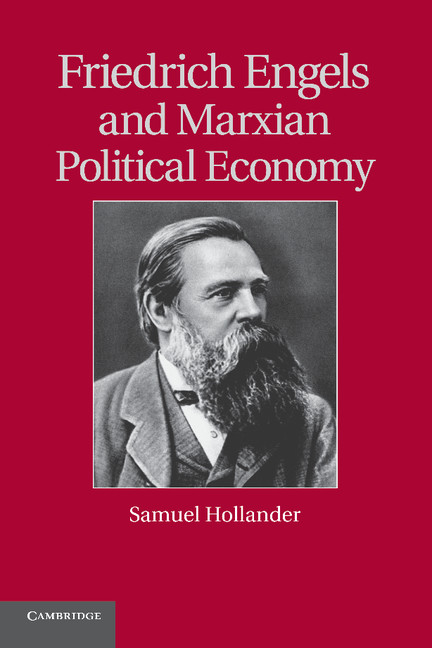
    This book rejects the commonly encountered perception of Friedrich Engels as perpetuator of a 'tragic deception' of Marx, and the equally persistent body of opinion treating him as 'his master's voice'. Engels' claim to recognition is reinforced by an exceptional contribution in the 1840s to the very foundations of the Marxian enterprise, a contribution entailing not only the 'vision' but some of the building blocks in the working out of that vision. Subsequently, he proved himself to be a sophisticated interpreter of the doctrine of historical materialism and an important contributor in his own right. This volume serves as a companion to Samuel Hollander's The Economics of Karl Marx (Cambridge University Press, 2008).

    Reviews

    ‘Based upon an extraordinarily close and careful reading of the texts, Hollander presents a detailed, comprehensive, and sophisticated assessment of key issues in the development of Engels's (and Marx's) economic ideas - this is a major and impressive contribution to scholarship in the field.’

    Greg Claeys - Royal Holloway, University of London

    ‘A valuable, incisive, and compelling account of Engels's contribution to the economics of Marxism. At last, Hollander has revealed the great debt which Marxian political economy owes to Marx's right-hand man.’

    Tristram Hunt MP - Queen Mary, University of London

    ‘Hollander’s critical dissection of Friedrich Engels’s economic thought is scholarly, provocative, and engaging. This book makes a major contribution to our understanding of one of nineteenth-century socialism’s most important, and most neglected, economists.’

    John King - La Trobe University

    ‘Samuel Hollander is the leading authority on classical economics. His erudite and incisive accounts of Smith, Ricardo, Malthus, Mill, Say, and Marx are definitive. In his new book, Friedrich Engels and Marxian Political Economy, Hollander shows that Engels was more than the junior partner of a famous man, the second author of The German Ideology and The Communist Manifesto. Engels was an important and influential thinker in his own right. Disentangling Engels from Marx, exploring the intricacies of Engels on economic theory, applied economics, history, legislation, and the State, Hollander fills a major gap in the literature of ideas. The book is a major contribution to the social sciences. It will be the definitive analysis of an important author who is seldom read and even less frequently understood.’

    D. A. Reisman - Nanyang Technological University and University of Surrey

    ‘This volume adds substantially to our understanding of the distinctive contribution made by Engels to nineteenth-century socialist political economy. Hollander’s work makes clear Engels’s role in shaping Marxian political economy in the 1840s and subsequently. Engels emerges in this work as a thinker whose capacity for self-effacement and deference to Marx too-often obscured the originality and importance of his contribution to socialist thinking. Engels in Hollander’s rendition proves a more subtle and original theorist than he is often presented and certainly not as a proponent of the crude determinism which some have seen as his corruption of the Marxian legacy. Taken with his earlier volume … The Economics of Karl Marx, Hollander’s Friedrich Engels and Marxian Political Economy represents a major addition to the scholarly literature on these two titans of socialist thought.’

    Noel Thompson - University of Wales, Swansea

    Refine List

    Actions for selected content:

    Select all | Deselect all
    • View selected items
    • Export citations
    • Download PDF (zip)
    • Save to Kindle
    • Save to Dropbox
    • Save to Google Drive

    Save Search

    You can save your searches here and later view and run them again in "My saved searches".

    Please provide a title, maximum of 40 characters.
    ×

    Contents

    • Frontmatter
      pp i-viii
    • Contents
      pp ix-xii
    • Preface
      pp xiii-xiv
    • Prolegomena
      pp 1-24
    • 1 - Engels's Early Contribution
      pp 25-86
    • 2 - The Surplus-Value Doctrine, Rodbertus's Charge of Plagiarism, and the Transformation
      pp 87-124
    • 3 - Economic Organization, and the Price Mechanism
      pp 125-175
    • 4 - “Revisionism” I. Constitutional Reform versus Revolution
      pp 176-228
    • 5 - “Revisionism” II. Social Reform
      pp 229-278
    • 6 - The Engels–Marx Relation
      pp 279-313
    • 7 - A Methodological Overview
      pp 314-340
    • Epilogue: The Immediate Legacy
      pp 341-356
    • Appendix A - Prolegomena: A Brief Chronology
      pp 357-358
    • Appendix B - Chapter 5
      pp 359-367
    • Appendix C - Chapter 7
      pp 368-372
    • Bibliography of Works Cited
      pp 373-392
    • Index
      pp 393-408
    • Titles in the series
      pp 409-409

    Metrics

    Altmetric attention score

    Full text views

    Total number of HTML views: 0
    Total number of PDF views: 0 *
    Loading metrics...

    Book summary page views

    Total views: 0 *
    Loading metrics...

    * Views captured on Cambridge Core between #date#. This data will be updated every 24 hours.

    Usage data cannot currently be displayed.

    Accessibility standard: Unknown

    Why this information is here

    This section outlines the accessibility features of this content - including support for screen readers, full keyboard navigation and high-contrast display options. This may not be relevant for you.

    Accessibility Information

    Accessibility compliance for the PDF of this book is currently unknown and may be updated in the future.
