

Introduction
Across Africa and beyond, an increasing number of political candidates are (very) wealthy businesspeople.Footnote 1 Tycoons elected heads of state in recent decades range from Donald Trump and Silvio Berlusconi in Western democracies to Thaksin Shinawatra in Thailand, Petro Poroshenko in Ukraine, Patrice Talon in Benin, Sebastián Piñera in Chile, and Cyril Ramaphosa in South Africa. Countless others have been voted into subnational or legislative offices.
Existing research explores the structural conditions facilitating the political influence of big business as well as businesspeople’s incentives to run for office. Meanwhile, no analysis to-date examines voters’ receptiveness to distinct electoral strategies pursued by tycoon candidates, which is important for two reasons. First, scholarly analysis of tycoon candidates has lagged far behind their rising prominence and substantive importance. After all, power assumption by economic elites is consequential. Stark class differences between voters and their representatives skew economic policy away from voter preferences.Footnote 2 Second, their financial advantages notwithstanding, tycoon candidates also face unique electoral challenges. Data on inequality aversion and antipathy toward high-status groupsFootnote 3 suggests that voters approach tycoon candidates with skepticism. The material fortunes of the super-wealthy are often regarded as illegitimate by the respective populations.Footnote 4 Furthermore, in the era of populism, anti-elite campaigning increasingly resonates with voters around the world.
Still, some tycoon candidates are able to overcome these challenges, which generates our key theoretical question: why do voters support some tycoon candidates but not others? Indeed, as structural conditions, including inequality and the costs of campaign finance, increasingly prevent blue-collar candidates from running for office while also facilitating the political dominance of wealthy elites,Footnote 5 how voters choose between different super-wealthy candidates emerges as a critical—yet understudied—question.
We define “tycoon candidates” as super-wealthy business owners who run for office in popular elections. (For our purposes, “tycoons” is more apt than “oligarchs” as the latter term presupposes significant political influence.) While tycoon candidates run for office in both advanced and developing democracies, they tend to play a more prominent role in weakly institutionalized settings without effective constraints on money in politics.Footnote 6
To shed light on the micro-level underpinnings of differential voter support across tycoon candidates, we administered a preregistered experiment embedded in a nationally representative survey in South Africa—a country where tycoons are gaining office across diverse contexts ranging from the entire nation (president Ramaphosa) and the metropolis of Johannesburg (mayor Mashaba) to the small town of Greytown (mayor Mavundla) in the KwaZulu-Natal province, while also spanning tycoons who support the ANC and those in opposition.
Our goal is to test the relative efficacy of four possible mechanisms behind the differential electoral support across tycoon candidates in a developing democracy: competence signaling, racial framing, fame, and clientelism. In our survey experiment, respondents are primed with a particular mechanism while evaluating a hypothetical tycoon candidate. We find that clientelism is particularly effective, especially for mobilizing support from the less affluent voters. Racial framing matters too by—perhaps unexpectedly—decreasing tycoon support among white voters. Meanwhile, tycoons’ fame and media exposure, or signals of competence do not help them at the ballot box, contrary to well-established literatures.
We contribute to key macro-level accounts of democratic capture in the literature on business and politics by shifting focus to micro-level voter calculus and the associated tactics of individual tycoons. In other words, while existing work explains the supply of wealthy candidates, we investigate voters’ demand for such candidates, hence contributing to our understanding of the equilibrium between candidates and voters. We also advance the literature on voting behavior by analyzing heretofore neglected tycoon candidates. Furthermore, we develop the scholarship on clientelism by specifying why tycoon candidates may matter in clientelist exchange and by identifying the effect of their clientelist strategies on electoral support. Finally, by presenting evidence from a critical developing democracy in Africa, we extend the geographical scope of survey experiments on business and politics.
Theory: mechanisms of tycoon support
We build on two literatures. First, a voluminous literature on business and politics has theorized democratic capture by wealthy asset owners—a process facilitated by campaign finance rules, policy delegation to business, the cross-national competition for capital, tycoons’ personal connections, business platforms for collective action, or tycoons’ media ownership, among other factors.Footnote 7 In emphasizing such structural conditions, political scientists tend to conceptualize the involvement of business elites in government as “quiet politics”Footnote 8 or “stealth politics”Footnote 9 which avoid the limelight of elected office. Business scholars, while typically more interested in instrumental power, also emphasize the “concealment of corporate political activity.”Footnote 10 Yet while this foundational literature offers important insights, to the extent tycoons do contest popular elections, it also suggests an overlooked research agenda.
Second, an emerging literature explores business candidates in elections.Footnote 11 These studies generally do not distinguish between the super-wealthy tycoon candidates and the general representatives of “business” that may include small entrepreneurs. Besides, the focus here is on the candidates’ incentives to run for office, or on the benefits of office for associated firms.Footnote 12
Together, the path-breaking literatures on democratic capture and business candidates in elections recognize that politics is ever more dominated by wealthy elites in advanced and developing democracies alike. While such conditions enable the increasing participation of tycoon candidates in elections—cue Michael Bloomberg, Tom Steyer, and Donald Trump, three billionaires in the run-up to the 2020 US presidential elections, for example—they also beg the question about the comparative efficacy of the mechanisms allowing certain tycoon candidates to attract voters. To introduce this missing element, we conceptualize four such mechanisms below.
Competence signaling
Voters in democracies generally prefer competent candidates,Footnote 13 and candidates’ personal background can provide valuable information. Voters may infer, for example, that if a candidate built a prosperous business, she could successfully run a governmental administration too. Indeed, many candidates with private sector experience actively encourage such extrapolation of competence by stressing their business-derived but generally applicable skills, for example, the ability to manage problems on tight budgets, to negotiate with counterparties, to innovate and be entrepreneurial, etc.Footnote 14 While scholars have shown that business elites can use their narrow issue-based expertise to shape economic policies through lobbying,Footnote 15 we posit that tycoon candidates in particular can leverage their business accomplishments for electoral competence signaling. For example, Herman Mashaba, the former tycoon mayor of Johannesburg in South Africa, promised to “run Johannesburg like a business” during his campaign, elaborating that “politics and business are the same thing… The city needs to have the capacity and brain power to collect the [tax] money and… has… the responsibility to use this money efficiently, get value for it.”Footnote 16 Therefore, we expect that tycoon candidates who emphasize their business accomplishments will enjoy higher voter support relative to tycoon candidates who do not.
Racial framing
Tycoon politicians, especially in developing democracies, have a record of adopting self-enriching policies that economically harm their constituentsFootnote 17 : this could deter potential voters. Inequality aversion and antipathy toward high-status groupsFootnote 18 also suggest that extreme wealth can be a liability for candidates in terms of voter perceptions.
In this context, framing, which is a process through which “public preferences can be… manipulated”Footnote 19 by changing the presentation of the issue or its alternatives, may allow candidates to render their extreme wealth or tycoon status less salient for voters. When tycoon candidates campaign on issues other than the economic interests of their voters, these alternative non-economic issues can displace economic concerns as the most salient problems for the voters. In a dynamic observed across the globe, successful framing by political candidates along these lines may alter the key cleavage in the electorate from class-based toward cultural, partisan, racial, or other issues.Footnote 20 National context, in turn, determines which particular frame is salient to the voting public. Ukrainian tycoons, for example, have used resistance against the Russian aggression as a way to rally public support, while Thai tycoons have relied on the Buddhist religion to do the same.Footnote 21
As the most unequal country on the planetFootnote 22 , South Africa presents tycoons—who epitomize inequality—with an obvious electoral challenge. Framing might help tycoons to dissociate themselves from economic disparity. Given its troubled history of apartheid rule, racial justice provides the most potent political frame in South Africa.Footnote 23 In 2016, for example, a major public relations firm was hired to furtively stoke racial tensions so as to deflect blame for massive corruption toward white elites, away from the so-called “Zupta regime,” a joint state-capture effort by the former president Zuma (currently under arrest) and the multi-billion dollar corporate holding of the Gupta tycoons.Footnote 24 An observable implication of the racial framing mechanism is that tycoon candidates who portray themselves as advocates of racial justice should enjoy higher voter support compared to tycoon candidates who do not.
Fame
The affairs of the super-wealthy, and tycoons, in particular, often generate broad media coverage. Such quasi-celebrity status and fame may create higher levels of trust among voters, due to the legitimizing effects of extensive media coverage,Footnote 25 as compared to the less famous candidates.
The fame-based mechanism is distinct from “name recognition.” While name recognition may boost political support subconsciously (by serving as a subliminal cognitive shortcut for voters), fame largely operates via conscious and deliberate decision-making channelsFootnote 26 —which facilitates the testing of the fame mechanism in an experimental setting. Furthermore, it is fame per se, beyond popularity, that generates trust and legitimacy: that is, notoriety for “bad behavior” or scandals can also boost a candidate’s chances.Footnote 27
Overall, the imprint of fame has been shown to boost candidates’ chances.Footnote 28 Just like actors (e.g., Arnold Schwarzenegger, former governor of California) or sports stars (e.g., Manny Pacquiao, boxer and senator in the Philippines), tycoons can leverage their fame to run for political office. In South Africa, for example, Tokyo Sexwale (former head of government in the Gauteng province) is a tycoon whose fame and media coverage likely benefitted his campaigns according to local press. The previously mentioned tycoon candidate Mashaba also received broad media coverage due to his wealth, including being featured on the cover of Forbes Africa. Hence, we expect that tycoon candidates who are famous will enjoy higher voter support than tycoon candidates who are not.
Clientelism
While voters value economic performance, they may disregard any public policies from a candidate if she offers voters private rewards in exchange for political support.Footnote 29 Clientelism involves the instrumental exchange of political support for material benefits, for example, the provision of food to one’s village, access to government jobs, or simple cash hand-outs.
So far, there has been little theoretical integration of clientelistic mechanisms and the size of personal wealth of political candidates such as business tycoons. Still, these phenomena may be related for three reasons. First, if voters think that a candidate may pay for their votes out of her own pocket rather than by redirecting state resources, then the depth of that candidate’s pocket certainly matters. Thanks to their personal wealth, tycoon candidates may credibly promise to engage in clientelism. Second, clientelist distribution may serve as a signal of programmatic redistributive intent after the election.Footnote 30 This mechanism may work particularly well for tycoon candidates whom voters might not otherwise associate with progressive redistribution and pro-poor social policies. Finally, tycoon candidates are inevitably employers who can act as effective brokers in clientelistic exchange or, more directly, exchange jobs and work at local businesses for political support.Footnote 31 Whichever of these mechanisms is at play, tycoon candidates who use clientelistic distribution during elections should enjoy higher voter support than tycoon candidates who do not.
While clientelism in South Africa is widely discussed as a survival strategy for the ANC party,Footnote 32 several studies suggest that clientelism also matters in candidate-based campaigns via individual tycoons’ wealth. Local clientelism is rooted in practices such as ukusisa in South Africa, a system in which a wealthy businessman loans goods (e.g., cattle) to a poor person from the village—to be repaid for the help later.Footnote 33 Ostensible philanthropy is generally moored in the “one hand washes the other” principle.Footnote 34 This, again, hints at potential advantages of clientelism for tycoon candidates.
Context and case selection
Following apartheid rule, South Africa held its inaugural democratic election in 1994.Footnote 35 Since then, the ANC has dominated South Africa’s political landscape, thanks to its status as a former liberation movement with close ties to the broad population. Dense networks between business, government, and political parties have increasingly defined South African politics, giving rise to an “ANC oligarchy”Footnote 36 as high-profile ANC members used their political connections to amass huge personal fortunes in business. Estimates suggest that 40 percent of ANC MPs have business interests as directors or through ownership,Footnote 37 while in 2014, more than half the cabinet members of Jacob Zuma’s government had “major business interests.”Footnote 38
While many of the early links between business and politics relied on ANC members who were active in the anti-apartheid struggle, in recent years a number of tycoons without prior links to the ANC have gained political power. Herman Mashaba, for example, had been elected mayor for the Democratic Alliance in Johannesburg in 2016, and in 2020 launched a new party, Action SA. Philani Mavundla quit the ANC to join the National Freedom Party in 2019—only to switch gears again and found the Abantu Batho Congress, a new party that Mavundla continues to lead. Overall, tycoons are increasingly escaping the ANC orbit and keeping their political options open.
Of course, political loyalties never stood in the way of self-enrichment in South Africa, as suggested by the rise of so-called “tenderpreneurs”Footnote 39 —businesspeople who utilize their connections across the political spectrum to obtain lucrative government tenders and contracts. Allegations of egregious rent-seeking linked to tycoons from the Gupta family culminated in the unprecedented 2018 resignation of the former president Jacob Zuma.
Zuma’s place was taken by President Cyril Ramaphosa, arguably South Africa’s most successful tycoon candidate. A former anti-apartheid activist, Ramaphosa was initially sidestepped in internal ANC power struggles and left politics after the democratic transition to build a business empire. Having maintained links to the ANC, Ramaphosa gradually re-entered national politics—and led the ANC to yet another victory in the national elections of 2019. In 2020, riding a wave of public disgust with government capture by large business, president Ramaphosa—one of the richest individuals in the entire African region—published a bombshell letter to the ANC, accusing the party leadership and big business of corruption.Footnote 40 Ramaphosa’s own record appears relatively “clean” by South African standards, despite the ongoing allegations of money laundering in 2023, and he has sought to present himself as an anti-corruption crusader.
South Africa is an ideal setting to explore the voters’ “inter-tycoon” evaluations and the relative appeal of distinct electoral strategies pursued by tycoon candidates. Close links between business and politics are not rare events in South Africa and are salient to the population at large. Importantly, while many business tycoons are white South Africans, there are numerous prominent examples of black South African business tycoons too. The post-apartheid era has seen the rise of a growing black middle-class—and a new black economic elite (Seekings and Nattrass Reference Seekings and Nattrass.2005). A subset of this black elite constitutes prominent business tycoons, most famously former mayor of Johannesburg and current leader of the ActionSA party, Herman Mashaba; President Cyril Ramaphosa; former ANC minister Tokyo Sexwale; as well as business tycoons operating outside the formal channels of politics, like Patrice Motsepe and Sipho Nkosi. This suggests that a candidate’s wealth or status as a business tycoon cannot be directly inferred from racial classifications.
Moreover, all four theoretical mechanisms at the center of our study are highly plausible empirically in the South African context. Regarding competence signaling, South Africa emerged from apartheid rule with its black population uniformly impoverished yet politically empowered, generating sufficient social mobilityFootnote 41 for occasional rags-to-riches stories and personal credit-claiming for business success. Deep grievances related to ethnic politics provide a potent cleavage for racial framing tactics.Footnote 42 A thriving media industryFootnote 43 ensures that fame can “travel” and mobilize voters. Finally, corruption and a sufficiently weak rule of lawFootnote 44 render illegal tactics such as clientelism available to tycoon candidates. These structural conditions make South Africa into a quasi-laboratory for testing a broad spectrum of mechanisms through which material capital is converted into political support at the ballot box.
Finally, South Africa as such presents a challenging terrain for politically ambitious tycoons. The prevalent liberation ideology in all major political forces in South Africa is left-leaning and anti-corporate.Footnote 45 Labor unions are strong.Footnote 46 Popular outrage at big business corruption is the norm, including via organized protests.Footnote 47 This “tycoon-hostile” political environment is particularly suited to study the comparative efficacy of various electoral strategies pursued by tycoon candidates.
Experimental design and survey administration
To test the observable implications of the theoretical mechanisms, we marshal original data from a survey experiment in South Africa. We designed and implemented a new survey in July and August of 2017, administered in collaboration with Citizen Surveys, a leading South African survey agency (that has conducted surveys for, e.g., the World Bank and the Afrobarometer). The sample frame for the survey is the 2011 census which covers all enumeration areas (EAs) in South Africa. We used a stratified, multistage probability sampling strategy to draw the sample (n=1500) across all nine provinces of South Africa (including the large Metros, as well as urban and rural areas).Footnote 48 The sample is representative—and reflects the broader demographics—of the adult South African population at the national level. Based on the sampling strategy, we randomly selected 250 EAs for field work. Within each EA, the team of enumerators were assigned to a random starting point and then conducted a random walk to select households for interviews. In the last step, a respondent (18 years or older) was randomly selected for an interview (six interviews were conducted per EA). Interviews were conducted face-to-face by trained enumerators using tablet-based questionnaires. Respondents were given the choice of being interviewed in one of the six local languages.
In addition to data quality advantages from nationally representative sampling and professional, face-to-face, context-sensitive administration of the survey instrument, our design benefits from the experimental component. Observational studies of voting behavior suffer from endogeneity problemsFootnote 49 which the experimental design alleviates. While an increasing number of studies use conjoint designs to test voter support for candidates that vary on many dimensions, a simple experimental design is best-suited for our purposes because we want to establish the effectiveness of a limited number of mechanisms that could make voters more (or less) likely to support certain tycoons running for office (when compared to other tycoons).Footnote 50 Our design also allows us to avoid potential pitfalls of conjoint experiments.Footnote 51
Our experimental design was registered prior to survey implementation and data analysis.Footnote 52 For the experiment, 1500 survey respondents were randomly assigned to one of five experimental groups using complete random assignment, such that each experimental group contained 300 respondents. The randomization procedure was precoded onto the tablet and independent of enumerators in the field.
The survey experiment involves the description of a hypothetical tycoon candidate running for mayor in the respondent’s municipality. Businesspeople are often involved in municipal politics in South Africa and, as noted previously, there are numerous examples of tycoon candidates (such as Mavundla or Mashaba) running for office in municipal elections.Footnote 53
Table 1 presents the vignettes shown to the five respondent groups. All five scenarios are realistic and salient in the South African context, as elaborated below, while also sufficiently ubiquitous so as to minimize associations with any particular real-life candidate.
Survey experimental vignettes

The baseline vignette describes the candidate as a “very wealthy businessperson” who “owns a large corporation.” Great wealth and corporate ownership are two common traits of tycoons involved in politics not just in South Africa but around the world. The four treatment vignettes randomly add short pieces of information to the baseline vignette to prime the respondent with a specific mechanism being tested.Footnote 54 After reading the description of the candidate in their experimental group, respondents are asked how likely they would be to support the candidate on a five-point scale from “very unlikely” to “very likely.”
In the competence signaling vignette, respondents are informed that the tycoon candidate has been “very successful in creating a profitable business.” This is critical since “tycoon” status can result from inheritance (i.e., luck) rather than a candidate’s (earned) success. In the racial framing vignette, the candidate is described as “a strong advocate of removing apartheid symbols and statues from government buildings and public spaces.” The role of public symbols associated with colonialism and apartheid—recently targeted by the Rhodes Must Fall movement—has ignited fierce debate throughout South African society and politics and constitutes one of the most salient non-economic political issues. The fame vignette informs respondents that the tycoon candidate is “a famous person in South Africa who often appears on television.” Fame and the associated legitimacy in the public eye have been used as a launch pad for many political candidates in South Africa, including actors (e.g., Fana Mokoena) and tycoons (e.g., Tokyo Sexwale). Finally, the clientelism vignette notifies respondents that the tycoon candidate “offers housing and food parcels to people in your local area who support him politically.” Both food parcels and access to housing have been identified as typical channels for clientelist distribution in South Africa.Footnote 55 This phrasing was also validated in our pre-survey tests as being directly associated with clientelism. Any mechanisms linking clientelism to tycoon candidates are likely amplified by the weak regulatory framework on money in politics: at the time of the survey in 2017, parties and candidates were not required to disclose private sources of funding, or how such funding is spent.
Another point regarding the political role of tycoons’ wealth relative to non-tycoon candidates must be made, based on recently available data.Footnote 56 Business tycoon Herman Mashaba, for instance, has channeled substantial amounts of his private wealth into his own party, ActionSA.Footnote 57 Likewise, the company Mashaba founded and which made him rich—Black Like Me—has made substantial donations to ActionSA. This shows that business tycoons, like Mashaba, have opportunities to channel personal wealth into their own election campaigns—something that is much less likely for non-tycoon candidates without similar financial means. For the ANC, in comparison, a substantial amount of their party donations come from corporations and trusts like the ANC affiliated Chancellor House Trust fund. The key point is that tycoons’ personal wealth enable them to make credible promises to channel their own funds into (clientelist) election campaigns. Non-tycoon candidates in South Africa, in contrast, more often rely on party funds and modes of (clientelist) distribution orchestrated by party machines, like the ANC, when engaging in elections campaign.Footnote 58
Methods and model
To analyze our survey experiment, we use the linear regression model in Equation (1). Variable descriptions, summary statistics, and a power test appear in Appendices A-C in the Supplementary Material:
 $$y_{i} = a + dT_{i}+ e_{i}$$
The dependent variable, y i , is respondents’ stated support for the tycoon candidate presented in their experimental group which is measured on a five-point Likert scale, as is common in survey experiments on voting behavior.Footnote 59 To facilitate the interpretation of results, we recode this scale to vary from 0 to 100.Footnote 60 (Recoding does not change the underlying results.) T is the treatment indicator with five groups of randomly assigned respondents, a is the average response in the baseline group, and d is the effect of the treatment(s) on the outcome (relative to the baseline support, a).
The key requirement for d to identify the effect of the tycoon candidate traits is proper randomization procedure ensuring that the assignment to treatment groups is orthogonal to observable and unobservable pretreatment characteristics of respondents, and minimizing confounding risks. We conduct a balance test (Appendix D) by using a multinomial regression with the five-category treatment indicator as the dependent variable and the following socio-economic covariates as regressors: living standards, education, social grant receipt, political awareness, ANC or DA partisanship, racial group classification, gender, age, urban–rural residence, and province. The test shows no particular relation between these covariates and treatment assignment, minimizing concerns about selection effects or covariate imbalances.
Results
The overall distribution of the dependent variable indicates that electoral support across tycoon candidates is bifurcated (Appendix E). While circa 50 percent of all respondents are (very) unlikely to support the tycoon candidate described to them, around 40 percent are (very) likely to support the candidate, and 10 percent are indifferent. To get a sense of which voters might support tycoon candidates, Table 2 shows a basic set of respondent characteristics as predictors of tycoon support. We show these for the full sample and by subsamples of experimental groups. While these findings are descriptive and not causally identified, results from the full sample suggest that ANC partisans and politically uninformed respondents are more supportive of tycoons running for office, while older people, females, and social grant recipients are less supportive. Interestingly, across the full sample and the experimental groups, living standard, education, and urban–rural residence are not closely related to voter support for tycoon candidates.
Predictors of tycoon support
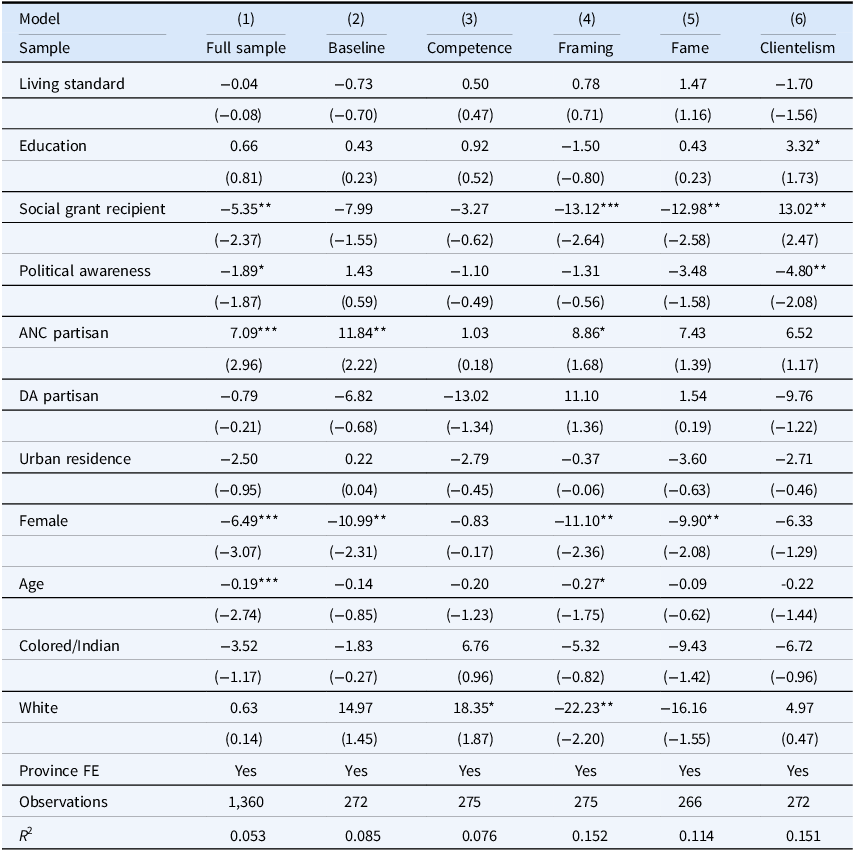
Notes: OLS regression (t-statistics in parentheses). Full set of province fixed effects (FE) included. Reference groups for urban: Rural area; reference group for female: Male; reference group for Colored/Indian and White: Black. A test for multicollinearity among the covariates, using the Variance Inflation Factor (VIF), shows no reason for concern. The VIF for each covariate falls between 1.11 (min.) and 2.26 (max.) with a mean VIF of 1.55. ***p<0.01, **p<0.05, *p<0.1.
Next, we analyze the mechanisms behind the differential support across tycoon candidates. Figure 1 summarizes the first set of findings from the experiment. The results are based on OLS regression equivalent to Equation (1), without additional covariates. Appendix F (Table F1) in the supplementary material provides the corresponding regression table—and, additionally, shows that using an ordered logistic model yields substantively similar results. Appendix F (Figure F2) also shows the straight comparisons of means. Since the five experimental groups are balanced on pretreatment characteristics, the inclusion of additional covariates is not necessary. However, controlling for pretreatment covariates does not change the results (Appendix G). The average support for the tycoon candidate in the baseline group is 43.3 (on a 0–100 scale), somewhat lower than the overall average of 46.4.
Mechanisms of support across tycoon candidates.
Note: The dots represent coefficients (marginal effects) from OLS regressions. The dependent variable is candidate support (scaled 0–100). The dashed lines are 95% confidence intervals. Treatment groups are shown on the y-axis. Marginal effects are estimated relative to the baseline tycoon category (see Table 1). n=1435.

Figure 1 displays the coefficients (dots) and confidence intervals (dashed lines) from regressing support across tycoon candidates on the treatment group indicators. The coefficients show the difference in mean support between the baseline group and the respective treatment groups. The vertical line shows when confidence intervals cut across zero, rendering the effects statistically (in)significant at the 95 percent level.
Only clientelism boosts the electoral support of tycoon candidates at a statistically significant level. Voter support increases by 7.73 points on a 0–100 scale (p=0.01) when tycoon candidates promise material goods and benefits to voters in return for political support (we later show that this magnitude is much higher among certain population subsets.) The significance of clientelist appeals suggests that some of the electoral disadvantage tycoon candidates may experience—for example, by virtue of their extravagant wealth being regarded as illegitimate or otherwise stigmatizing amidst stark inequality—can be offset by the promise of sharing that wealth during elections or by using clientelism to signal redistributive intent after the election. Clientelist promises during elections increase chances of electoral success for tycoon candidates more effectively than campaigns relying on competence signaling, framing around salient non-economic issues such as race, or personal fame.
Our paper is the first to identify the efficacy of clientelist strategies for tycoon candidates and to highlight this mechanism as a key reason why voters prefer some tycoon candidates rather than others. Whereas existing literature studies non-tycoon candidates or brokers who must rely on affiliations to a political party or access to state coffers,Footnote 61 we posit that tycoon candidates’ wealth and business power may enhance the credibility of clientelist promises (or threats) regardless of any organizational links to the state by tycoon candidates. With the caveat that studies of clientelism’s effectiveness (for non-tycoon candidates) in developing democracies use divergent research designs, we can cautiously relate findings from this literature to our own estimates. We find that clientelism boosts tycoon support by circa 8 points. Consistent with this, our ordered logit estimates (Appendix F, Figure F2) show that clientelism boosts the probability of (strong) tycoon support by 6.5 percent (and equivalently reduces the probability of not supporting the tycoon). By comparison, scholars have foundFootnote 62 : a much smaller (1–5 percent) and mostly insignificant effects of cash handouts on vote choice and turnout in a number of African countries; a clientelist boost in vote share of 4–6 percent for governors in Brazil; and a larger (11.7 percent) but insignificant effect in Mexico. Our estimates therefore appear sizeable (and much more so among the poorest voters as shown below), suggesting that the candidates’ tycoon status may enhance the efficacy of clientelism relative to the use of clientelism by non-tycoon candidates featured in the literature.
Robustness checks
We address four potential concerns here. First, our experiment references a municipal election which may prime respondents to think of business candidates from their localities. We reproduce all regressions with a full set of municipality fixed effects. Although a fairly generic way to address this concern, it turns attention to within-municipality variation and captures all municipality-level differences—including the potential presence of tycoon candidates in local politics—that might confound the inference. Including municipality fixed effects does not change the results (Appendix H).
Second, face-to-face interviews are social interactions: although all field workers were thoroughly trained for our survey, the manner in which the enumerator conducts the interview may still affect respondents’ answers. We replicate the findings in Figure 1 using a full set of interviewer fixed effects. This too does not change the results (Appendix I).
Third, given South Africa’s racialized politics, interviews featuring enumerator–respondent pairs from distinct racial groups may impact responses. We create a variable that matches respondent and interviewer racial classification (indicating a match in 72 percent of all interviews). Next, we check whether controlling for shared racial group affiliation affects the results. As shown in the Appendix J, it does not.
Finally, the clientelism treatment might generate social desirability bias since respondents may not want to admit that their votes are for sale. However, even if social desirability bias were present, it would bias the results toward a null-finding (relative to the baseline). Hence, any potential clientelism effect should be a conservative estimate.
Overall, the robustness checks do not challenge our key finding: clientelist distribution stands out as an effective driver of voter support across tycoon candidates. Indeed, the estimated effect and statistical significance of the clientelism treatment are very stable across all robustness tests.
Heterogeneous treatment effects
Our findings beg the question of whether the four mechanisms—competence signaling, racial framing, fame, and clientelism—can be leveraged more (or less) effectively by tycoon candidates among particular subgroups of the electorate. We test whether covariates related to living standards, political awareness, race, urban–rural divide, and partisanship moderate the treatment effects.Footnote 63 To alleviate concerns about covariate confounding, all models control for the pretreatment variables used for balance testing (Appendix D), which should also improve the precision of the effect estimates.Footnote 64
Figure 2 explores whether the effects of the four treatment indicators are contingent on the respondents’ living standards. Appendix K provides the corresponding regression table. The underlying regressions include an interaction termFootnote 65 between the respective experimental treatment and a measure of living standards (scaled 0–12) with higher values indicating better living standards. In addition to the conditional marginal effects of the treatment variables, each plot displays the distribution of the living standards measure (in percent on the left y-axis), verifying that we have observations across the entire scale of the living standards measure.
Treatment effects and living standards.
Note: The plots show the marginal effect of the treatments conditional on levels of living standards (scaled 0–12). The dependent variable is candidate support (scaled 0–100). Estimates are from OLS regressions. All models include the full set of covariate controls used for balance testing (see Appendix D). The solid line represents marginal effects of the treatment conditional on levels of living standards. The estimated marginal effects are shown on the right y-axis. The dashed vertical lines are 95% confidence intervals. The gray-shaded histogram shows the distribution of the living standards measure in percent (along the left y-axis). Low/high values of living standards are given by low/high values on the x-axis. n=1360.

Figure 2 reveals that people’s living standards do little to moderate the effects of competence signaling, racial framing, and fame. There is a tendency for wealthier people to express higher support for tycoons signaling competence, but the effect is estimated relatively imprecisely across all levels of living standards. By contrast, the effect of tycoon candidates’ clientelist appeals is positive and statistically significant for people living in poor material conditions—as living standards rise, however, this effect fades entirely. The magnitude of the “clientelist boost” for tycoon candidates from the poorest voters relative to the most well-off voters is substantial at circa 23 points. Meanwhile, relative to the poorest voters in the baseline group, tycoon candidates receive a 17.2 point clientelist boost in support from the poorest voters in the clientelism treatment group (see Appendix K).
To check the robustness of this finding, we replace the living standards measure with social grant receipt. The findings for social grant receipt closely mirror those for living standards (Appendix L).Footnote 66 As shown in Table 2, social grant recipients are a priori significantly less likely to support tycoon candidates relative to non-recipients: this highlights that capturing the votes of underprivileged groups is, indeed, a challenge for tycoon candidates. Since social grant recipients are significantly disinclined to support tycoon candidates a priori, our findings hint at the effectiveness of clientelism at overturning negative attitudes toward tycoon candidates.
Next, we examine whether treatment effects differ based on the level of political awareness Footnote 67 of respondents. We construct a political awareness index from four factual multiple-choice questions in our survey.Footnote 68 Once again, the previously established pattern emerges: political awareness strongly moderates the effect of clientelism (Appendix M). Among the least politically informed voters, tycoon candidates engaging in clientelism receive a 26-point boost in support compared to their support among the most politically informed voters (for whom the effect of clientelism is insignificant; see Appendix M).
Next, Figure 3 shows how treatment effects differ across racial groups. Racial group affiliation significantly moderates the effect of the racial framing treatment (but not the effects of the other treatmentsFootnote 69 )—yet with a crucial nuance. Instead of attracting new black voters, racial framing deployed by tycoon candidates generates a particularly strong negative response from white voters.
Treatment effects and racial group.
Note: The plots show the marginal effect of the treatments conditional racial group affiliation. The dependent variable is candidate support (scaled 0–100). All models include the full set of covariate controls used for balance testing (see Appendix D). Following South African official classifications, racial groups are defined as black, colored (mixed racial affiliation), or white. The gray-shaded histogram shows the distribution of racial groups in percent (along the left y-axis). For other details, see notes to Figure 2. n=1360.

As panel B of Figure 3 shows, the racial framing treatment has a significantly negative effect on tycoon support for white respondents. Although the framing effect for black South Africans is not different from zero, it is significantly different from the—negative—framing effect for white South Africans. The magnitude of the framing effect increases by a substantial 27 points for black South Africans compared to white South Africans (see Appendix N).
Our finding extends the work of Ferree (Reference Ferree2010) highlighting the racialized nature of South African politics. While Ferree focuses on racial framing by the ANC party (e.g., casting opposition parties as “white elitists”), we show that racial frames can also backfire and lead to the loss of white voters, at least when such frames are deployed by tycoon candidates.
Finally, we examine urban–rural divide, as well as partisan affiliation (with ANC or DA) as potential moderators of the treatment effects given that both factors are highlighted in the literature on voting behavior in Africa.Footnote 70 We find that neither variable significantly moderates the impact of any of the treatments (see Appendices O and P). Respondents’ support across tycoon candidates is not contingent on whether respondents live in cities versus rural areas—or back the ruling versus opposition parties.
It is reasonable to ask whether our findings might extend to all candidates, regardless of their tycoon status. Although our study does not address this question, extant work suggests that citizens evaluate the super-rich very differently from other socioeconomic classes.Footnote 71 Hence, while cross-class comparison of tycoon and non-tycoon candidates is an important direction for future research, our intra-class analysis of tycoon candidates offers crucial insights in its own right.
External validity
Our findings should apply particularly to developing democracies where, on the one hand, high wealth concentration and inequality give rise to “tycoons” as members of an exclusive economic elite, and, on the other hand, sufficiently weak rule of law ensures that the full spectrum of tactics, including illegal ones such as clientelism, are available to tycoon candidates. Emerging democracies such as Indonesia,Footnote 72 Brazil,Footnote 73 or EthiopiaFootnote 74 —among many others—share precisely these characteristics. On the other hand, tycoons in autocratic regimes face a more restricted set of political options,Footnote 75 such that our findings (to the extent performative elections still take place in an autocracy) may not apply there.
Regarding the efficacy of specific mechanisms beyond the South African context, there is qualitative evidence that clientelism is practiced by tycoon candidates in some post-Soviet democracies.Footnote 76 Furthermore, relative to other African countries, the prevalence of clientelism as such in South Africa is below average for the region,Footnote 77 suggesting that clientelistic appeals from tycoons may be even more effective in countries where clientelism itself is more common. Finally, framing by wealthy political actors has swayed voters away from their material interests in polities such as India and Thailand.Footnote 78
Meanwhile, the insignificance of competence signaling suggests an important boundary condition. Scholars have shown that competence may not generate political support in the absence of trust, for example, if voters are unconvinced that a competent candidate would use her skills to their benefit if elected.Footnote 79 According to Afrobarometer data from 36 countries, South Africa scores in the bottom third on public’s trust in the state.Footnote 80 Conversely, in countries with higher levels of political trust, competence signaling may be more effective for tycoon candidates.
Conclusion
In big-picture terms, our study sheds new light on a classical question in political economy: what happens when minority-enriching capitalism collides with majority-empowering democracy? Established lines of inquiry have emphasized two possible scenarios—increasing economic protections of population by the state, for example, via welfare capitalismFootnote 81 —or, more pessimistically, institutional capture of democracy by wealthy elites.Footnote 82 The latter literature has predominantly focused on macro-level conditions that facilitate capture.
Instead, our study contributes by analyzing the micro-level voter calculus in their differential support across tycoon candidates. While scholars have noted that rival tycoons may compete for political office,Footnote 83 we advance the literature by analyzing how they may win. We find that clientelism boosts the electoral support of tycoon candidates significantly on average and even more so among the poorest. Although there are strong theoretical reasons to expect competence signaling, racial framing, and fame to help tycoon candidates win office, only clientelism does. Meanwhile, racial framing significantly reduces tycoon support among white voters. Whereas most studies of business influence in politics rely on case studies or data provided by firms (via surveys or regulatory filings), we harness the experimental method to examine the receptivity of broader population to discrete electoral strategies across tycoon candidates.
Our study also pertains to the third outcome scenario for the clash between material inequality and the political empowerment of the masses—namely the rise of populism. Our analysis helps explain the counterintuitive phenomenon of certain business elites becoming the champions of anti-elite politics.Footnote 84 We show that clientelism is an effective pathway for tycoons to capture not necessarily the state—but, more directly, the hearts and minds of voters at the ballot box.
Finally, we offer two implications for the vast scholarship on clientelism. First, while this literature has examined extensively broker types and voter attributes that elicit particular clientelistic strategies, it has paid less attention to the characteristics of political candidates themselves. Our analysis suggests that a candidate’s personal wealth, and his business background, may be particularly relevant.Footnote 85 Indeed, while existing literature conceptualizes clientelism as intrinsically a group effort—a complex organizational undertaking of “machine politics”Footnote 86 —, our study suggests that tycoons qua politically supersized individuals may independently shape clientelistic exchanges. Second, while multiple studies show that the poor are more responsive to clientelistic incentives, this finding is far from uniform.Footnote 87 Factors like civil society weakness or democratic experience may explain the variation in clientelist politics better than poverty levels both across and within countries. Furthermore, the poor may be more likely to resent tycoon candidates located at the polar opposite of the income and wealth distributions, given the highest potential for personal antipathy and inequality aversion. Hence, it is not clear a priori whether poor voters would punish or reward candidates who are extravagantly wealthy (reason to resent) yet also engage in clientelism (reason to reward). We find that the latter effect predominates.
To conclude, consider Thomas Piketty’s treatment of South Africa as emblematic of the global conflict between “ordinary citizens” and “private corporations.”Footnote 88 Throughout his seminal volume, Piketty revisits the notorious massacre of 2012 in which South African police killed 34 striking miners at the Lonmin Mine near Johannesburg to protect the interests of the mine owners. To add a stark detail to this account, South Africa’s preeminent tycoon (and now president) Cyril Ramaphosa was on Lonmin’s board at the time as its largest shareholder—and allegedly pushed the government for a forceful response to the strike.Footnote 89 Our inquiry in this context highlights a glaring political paradox amidst intense economic conflict in South Africa and beyond: impoverished citizens are voting super-wealthy corporate owners into power. Theorizing and testing specific mechanisms of electoral support across tycoon candidates, our study took a step toward understanding this crucial phenomenon. While we investigated why voters support some tycoon candidates rather than others, the question of why voters may support tycoons over non-tycoon candidates presents a promising direction for future research.
Supplementary material
The supplementary material for this article can be found at https://doi.org/10.1017/bap.2024.4.
Data availability
Replication data and files will be made publicly available upon publication.
Acknowledgments
The authors thank three anonymous reviewers; Daniel Blake, Srividya Jandhyala, Nan Jia, Marko Klasnja, Robert Kubinec, Neil Malhotra, David Szakonyi, Daniel Treisman, Gautam Nair, Zoltan Fazekas; as well as the audiences at Darla Moore School of Business (University of South Carolina), Konstanz University (Politics of Inequality seminar), Copenhagen Business School (Money in Politics Conference), and the American Political Science Association for their generous feedback.
Competing interests
The authors have no competing interests to declare.
Financial support
We acknowledge financial support from the Independent Research Council Denmark (grant number: DFF—4182-00080).


 Open access

