













1. Introduction
A finite point set in $\mathbb{R}^d$
is said to be in general position if no
$\mathbb{R}^d$
is said to be in general position if no $d + 1$
members lie on a common hyperplane. Let
$d + 1$
members lie on a common hyperplane. Let $\alpha _d(N)$
be the largest integer such that any set of
$\alpha _d(N)$
be the largest integer such that any set of $N$
points in
$N$
points in $\mathbb{R}^d$
, with no
$\mathbb{R}^d$
, with no $d + 2$
members on a hyperplane, contains
$d + 2$
members on a hyperplane, contains $\alpha _d(N)$
points in general position.
$\alpha _d(N)$
points in general position.
In 1986, Erdős [Reference Erdös9] proposed the problem of determining $\alpha _2(N)$
and observed that a simple greedy algorithm shows
$\alpha _2(N)$
and observed that a simple greedy algorithm shows $\alpha _2(N) \geq \Omega (\sqrt {N})$
. A few years later, Füredi [Reference Füred11] showed that
$\alpha _2(N) \geq \Omega (\sqrt {N})$
. A few years later, Füredi [Reference Füred11] showed that
 \begin{equation*} \Omega (\sqrt {N\log N}) \lt \alpha _2(N) \lt o(N), \end{equation*}
where the lower bound uses a result of Phelps and Rödl [Reference Phelps and Rödl22] on partial Steiner systems, and the upper bound relies on the density Hales–Jewett theorem [Reference Furstenberg and Katznelson12, Reference Furstenberg and Katznelson13]. In 2018, a breakthrough was made by Balogh and Solymosi [Reference Balogh and Solymosi3], who showed that $\alpha _2(N) \lt N^{5/6+o(1)}$
. Their proof was based on the method of hypergraph containers, a powerful technique introduced independently by Balogh, Morris, and Samotij [Reference Balogh, Morris and Samotij1] and by Saxton and Thomason [Reference Saxton and Thomason26], that reveals an underlying structure of the independent sets in a hypergraph. We refer interested readers to [Reference Balogh, Morris and Samotij2] for a survey of results based on this method.
$\alpha _2(N) \lt N^{5/6+o(1)}$
. Their proof was based on the method of hypergraph containers, a powerful technique introduced independently by Balogh, Morris, and Samotij [Reference Balogh, Morris and Samotij1] and by Saxton and Thomason [Reference Saxton and Thomason26], that reveals an underlying structure of the independent sets in a hypergraph. We refer interested readers to [Reference Balogh, Morris and Samotij2] for a survey of results based on this method.
In higher dimensions, the best lower bound for $\alpha _d(N)$
is due to Cardinal, Tóth, and Wood [Reference Cardinal, Tóth and Wood5], who showed that
$\alpha _d(N)$
is due to Cardinal, Tóth, and Wood [Reference Cardinal, Tóth and Wood5], who showed that $\alpha _d(N) \geq \Omega ((N\log N)^{1/d})$
, for every fixed
$\alpha _d(N) \geq \Omega ((N\log N)^{1/d})$
, for every fixed $d\geq 2$
. For upper bounds, Milićević [Reference Milićević19] used the density Hales–Jewett theorem to show that
$d\geq 2$
. For upper bounds, Milićević [Reference Milićević19] used the density Hales–Jewett theorem to show that $\alpha _d(N) = o(N)$
for every fixed
$\alpha _d(N) = o(N)$
for every fixed $d\geq 2$
. However, these upper bounds in [Reference Milićević19], just like those in [Reference Füred11], are still almost linear in
$d\geq 2$
. However, these upper bounds in [Reference Milićević19], just like those in [Reference Füred11], are still almost linear in $N$
. Our main result is the following.
$N$
. Our main result is the following.
Theorem 1.1.
Let $d\geq 3$
be a fixed integer. If
$d\geq 3$
be a fixed integer. If $d$
is odd, then
$d$
is odd, then $\alpha _d(N) \lt N^{\frac {1}{2} + \frac {1}{2d} + o(1)}$
. If
$\alpha _d(N) \lt N^{\frac {1}{2} + \frac {1}{2d} + o(1)}$
. If $d$
is even, then
$d$
is even, then $\alpha _d(N) \lt N^{\frac {1}{2} + \frac {1}{d-1} + o(1)}.$
Our proof of Theorem1.1 is also based on the hypergraph container method. A key ingredient in the proof is a new supersaturation lemma for $(k + 2)$
-tuples of the grid
$(k + 2)$
-tuples of the grid $[n]^d$
that lie on a
$[n]^d$
that lie on a $k$
-flat, which we shall discuss in the next section. Here, by a
$k$
-flat, which we shall discuss in the next section. Here, by a $k$
-flat we mean a
$k$
-flat we mean a $k$
-dimensional affine subspace of
$k$
-dimensional affine subspace of $\mathbb{R}^d$
.
$\mathbb{R}^d$
.
One can consider a generalisation of the quantity $\alpha _d(N)$
. We let
$\alpha _d(N)$
. We let $\alpha _{d,s}(N)$
be the largest integer such that any set of
$\alpha _{d,s}(N)$
be the largest integer such that any set of $N$
points in
$N$
points in $\mathbb{R}^d$
, with no
$\mathbb{R}^d$
, with no $d + s$
members on a hyperplane, contains
$d + s$
members on a hyperplane, contains $\alpha _{d,s}(N)$
points in general position. Hence,
$\alpha _{d,s}(N)$
points in general position. Hence, $\alpha _d(N) = \alpha _{d,2}(N)$
. A simple argument of Erdős [Reference Erdös9] shows that
$\alpha _d(N) = \alpha _{d,2}(N)$
. A simple argument of Erdős [Reference Erdös9] shows that $\alpha _{d,s}(N) \geq \Omega (N^{1/d})$
for fixed
$\alpha _{d,s}(N) \geq \Omega (N^{1/d})$
for fixed $d$
and
$d$
and $s$
(see Section 6, or [Reference Cardinal, Tóth and Wood5] for large
$s$
(see Section 6, or [Reference Cardinal, Tóth and Wood5] for large $s$
). In the other direction, following the arguments in our proof of Theorem1.1 with a slight modification, we show the following.
$s$
). In the other direction, following the arguments in our proof of Theorem1.1 with a slight modification, we show the following.
Theorem 1.2.
Let $d,s\geq 3$
be fixed integers. If
$d,s\geq 3$
be fixed integers. If $d$
is odd and
$d$
is odd and $ds + 2 \gt 2d + 2s$
, then
$ds + 2 \gt 2d + 2s$
, then $\alpha _{d,s}(N)\leq N^{\frac {1}{2}+o(1)}$
. If
$\alpha _{d,s}(N)\leq N^{\frac {1}{2}+o(1)}$
. If $d$
is even and
$d$
is even and $ds + 2 \gt 2d + 3s$
, then
$ds + 2 \gt 2d + 3s$
, then $\alpha _{d,s}(N)\leq N^{\frac {1}{2}+o(1)}$
.
$\alpha _{d,s}(N)\leq N^{\frac {1}{2}+o(1)}$
.
For example, when we fix $d=3$
and
$d=3$
and $s\geq 5$
, we have
$s\geq 5$
, we have $\alpha _{d,s}(N)\leq N^{\frac {1}{2}+o(1)}$
.
$\alpha _{d,s}(N)\leq N^{\frac {1}{2}+o(1)}$
.
We also study the classical problem of determining the maximum number of points selected from the grid $[n]^d$
such that no
$[n]^d$
such that no $k + 2$
members lie on a
$k + 2$
members lie on a $k$
-flat. The key ingredient of Theorem1.1 mentioned above can be seen as a supersaturation version of this Turán-type problem. When
$k$
-flat. The key ingredient of Theorem1.1 mentioned above can be seen as a supersaturation version of this Turán-type problem. When $k=1$
, this is the famous no-three-in-line problem raised by Dudeney [Reference Dudeney7] in 1917: Is it true that one can select
$k=1$
, this is the famous no-three-in-line problem raised by Dudeney [Reference Dudeney7] in 1917: Is it true that one can select $2n$
points in
$2n$
points in $[n]^2$
such that no three are collinear? Clearly,
$[n]^2$
such that no three are collinear? Clearly, $2n$
is an upper bound as any vertical line must contain at most 2 points. For small values of
$2n$
is an upper bound as any vertical line must contain at most 2 points. For small values of $n$
, many authors have published solutions to this problem obtaining the bound of
$n$
, many authors have published solutions to this problem obtaining the bound of $2n$
(e.g. see [Reference Flammenkamp10]), but for large
$2n$
(e.g. see [Reference Flammenkamp10]), but for large $n$
, the best known general construction is due to Hall–Jackson–Sudbery–Wild [Reference Hall, Jackson, Sudbery and Wild14] with slightly fewer than
$n$
, the best known general construction is due to Hall–Jackson–Sudbery–Wild [Reference Hall, Jackson, Sudbery and Wild14] with slightly fewer than $3n/2$
points.
$3n/2$
points.
More generally, we let $a(d,k,r,n)$
denote the maximum number of points from
$a(d,k,r,n)$
denote the maximum number of points from $[n]^d$
such that no
$[n]^d$
such that no $r$
points lie on a
$r$
points lie on a $k$
-flat. Since
$k$
-flat. Since $[n]^d$
can be covered by
$[n]^d$
can be covered by $n^{d-k}$
many
$n^{d-k}$
many $k$
-flats, we have the trivial upper bound
$k$
-flats, we have the trivial upper bound $a(d,k,r,n) \leq (r-1)n^{d-k}$
. For certain values
$a(d,k,r,n) \leq (r-1)n^{d-k}$
. For certain values $d$
,
$d$
, $k$
, and
$k$
, and $r$
fixed and
$r$
fixed and $n$
tends to infinity, this bound is known to be asymptotically best possible: Many authors [Reference Braß and Knauer4, Reference Lefmann18, Reference Roth24] noticed that
$n$
tends to infinity, this bound is known to be asymptotically best possible: Many authors [Reference Braß and Knauer4, Reference Lefmann18, Reference Roth24] noticed that $a(d,d-1,d+1,n) = \Theta (n)$
by looking at the modular moment curve over a finite field
$a(d,d-1,d+1,n) = \Theta (n)$
by looking at the modular moment curve over a finite field $\mathbb{Z}_p$
; In [Reference Pór and Wood23], Pór and Wood proved that
$\mathbb{Z}_p$
; In [Reference Pór and Wood23], Pór and Wood proved that $a(3,1,3,n)=\Theta (n^2)$
; Dvir and Lovett [Reference Dvir and Lovett8] showed that
$a(3,1,3,n)=\Theta (n^2)$
; Dvir and Lovett [Reference Dvir and Lovett8] showed that $a(d,k,r,n) = \Theta (n^{d-k})$
when
$a(d,k,r,n) = \Theta (n^{d-k})$
when $r \gt d^k$
(see also [Reference Sudakov and Tomon27]).
$r \gt d^k$
(see also [Reference Sudakov and Tomon27]).
We shall focus on the case when $r = k + 2$
and write
$r = k + 2$
and write $a(d,k,n):=a(d,k,k+2,n)$
. Surprisingly, Lefmann [Reference Lefmann18] (see also [Reference Lefmann17]) showed that
$a(d,k,n):=a(d,k,k+2,n)$
. Surprisingly, Lefmann [Reference Lefmann18] (see also [Reference Lefmann17]) showed that $a(d,k,n)$
behaves much differently than
$a(d,k,n)$
behaves much differently than $\Theta (n^{d-k})$
. In particular, he showed that
$\Theta (n^{d-k})$
. In particular, he showed that
 \begin{equation*} a(d,k,n) \leq O\left (n^{\frac {d}{\lfloor (k + 2)/2\rfloor }}\right ). \end{equation*}
Our next result improves this upper bound when $k+2$
is congruent to 0 or 1 mod 4.
$k+2$
is congruent to 0 or 1 mod 4.
Theorem 1.3.
For fixed $d$
and
$d$
and $k$
, as
$k$
, as $n\to \infty$
, we have
$n\to \infty$
, we have
 \begin{equation*} a(d,k,n)\leq O\left (n^{\frac {d}{2\lfloor (k+2)/4\rfloor }(1-\frac {1}{2\lfloor (k+2)/4\rfloor d+1})}\right ). \end{equation*}
For example, we have $a(4,2,n)\leq O(n^{\frac {16}{9}})$
while Lefmann’s bound in [Reference Lefmann18] gives us
$a(4,2,n)\leq O(n^{\frac {16}{9}})$
while Lefmann’s bound in [Reference Lefmann18] gives us $a(4,2,n)\leq O(n^{2})$
, which coincides with the trivial upper bound. In particular, Theorem1.3 tells us that, if
$a(4,2,n)\leq O(n^{2})$
, which coincides with the trivial upper bound. In particular, Theorem1.3 tells us that, if $4$
divides
$4$
divides $k+2$
, then
$k+2$
, then $a(d,k,n)$
only behaves like
$a(d,k,n)$
only behaves like $\Theta (n^{d-k})$
when
$\Theta (n^{d-k})$
when $d=k+1$
. This is quite interesting compared to the fact that
$d=k+1$
. This is quite interesting compared to the fact that $a(3,1,n)=\Theta (n^2)$
proved in [Reference Pór and Wood23]. Lastly, let us note that the current best lower bound for
$a(3,1,n)=\Theta (n^2)$
proved in [Reference Pór and Wood23]. Lastly, let us note that the current best lower bound for $a(d,k,n)$
is also due to Lefmann [Reference Lefmann18], who showed that
$a(d,k,n)$
is also due to Lefmann [Reference Lefmann18], who showed that $a(d,k,n) \geq \Omega \left (n^{\frac {d}{k + 1} - k - \frac {k}{k + 1}}\right )$
.
$a(d,k,n) \geq \Omega \left (n^{\frac {d}{k + 1} - k - \frac {k}{k + 1}}\right )$
.
For integer $n \gt 0$
, we let
$n \gt 0$
, we let $[n] = \{1,\ldots , n\}$
, and
$[n] = \{1,\ldots , n\}$
, and $\mathbb{Z}_n = \{0,1,\ldots , n-1\}$
. We systemically omit floors and ceilings whenever they are not crucial for the sake of clarity in our presentation. All exponentials and logarithms are in base two.
$\mathbb{Z}_n = \{0,1,\ldots , n-1\}$
. We systemically omit floors and ceilings whenever they are not crucial for the sake of clarity in our presentation. All exponentials and logarithms are in base two.
2. Supersaturation of non-degenerate coplanar tuples
In this section, we establish some lemmas for the proofs of Theorems1.1 and 1.2.
Given a set $T$
of
$T$
of $k + 2$
points in
$k + 2$
points in $\mathbb{R}^d$
that lie on a
$\mathbb{R}^d$
that lie on a $k$
-flat, we say that
$k$
-flat, we say that $T$
is degenerate if there is a subset
$T$
is degenerate if there is a subset $S\subset T$
of size
$S\subset T$
of size $j$
, where
$j$
, where $3 \leq j \leq k + 1$
, such that
$3 \leq j \leq k + 1$
, such that $S$
lies on a
$S$
lies on a $(j-2)$
-flat. Otherwise, we say that
$(j-2)$
-flat. Otherwise, we say that $T$
is non-degenerate. We establish a supersaturation lemma for non-degenerate
$T$
is non-degenerate. We establish a supersaturation lemma for non-degenerate $(k + 2)$
-tuples of
$(k + 2)$
-tuples of $[n]^d$
.
$[n]^d$
.
Lemma 2.1.
For real number $\delta \gt 0$
and fixed positive integers
$\delta \gt 0$
and fixed positive integers $d,k$
, such that
$d,k$
, such that $k$
is even and
$k$
is even and $d - 2\delta \gt (k -1)(k + 2)$
, any subset
$d - 2\delta \gt (k -1)(k + 2)$
, any subset $V\subset [n]^d$
of size
$V\subset [n]^d$
of size $n^{d-\delta }$
spans at least
$n^{d-\delta }$
spans at least $\Omega (n^{(k + 1)d - (k + 2)\delta })$
non-degenerate
$\Omega (n^{(k + 1)d - (k + 2)\delta })$
non-degenerate $(k+2)$
-tuples that lie on a
$(k+2)$
-tuples that lie on a $k$
-flat.
$k$
-flat.
Proof.
Let $V\subset [n]^d$
such that
$V\subset [n]^d$
such that $|V| = n^{d - \delta }$
. Set
$|V| = n^{d - \delta }$
. Set $r = \frac {k}{2} + 1$
and
$r = \frac {k}{2} + 1$
and $E_r = \binom {V}{r}$
to be the collection of
$E_r = \binom {V}{r}$
to be the collection of $r$
-tuples of
$r$
-tuples of $V$
. Notice that the sum of an
$V$
. Notice that the sum of an $r$
-tuple from
$r$
-tuple from $V$
belongs to
$V$
belongs to $[rn]^d$
. For each
$[rn]^d$
. For each $v \in [rn]^d$
, we define
$v \in [rn]^d$
, we define
 \begin{equation*} E_r(v)=\{\{v_1,\ldots ,v_r\}\in E_r\,:\, v_1+\ldots +v_r=v\}. \end{equation*}
Then for $T_1,T_2 \in E_r(v)$
, where
$T_1,T_2 \in E_r(v)$
, where $T_1 = \{v_1,\ldots , v_{r}\}$
and
$T_1 = \{v_1,\ldots , v_{r}\}$
and $T_2 = \{u_1,\ldots , u_{r}\}$
, we have
$T_2 = \{u_1,\ldots , u_{r}\}$
, we have
 \begin{equation*} v_1 + \cdots + v_{r} = v = u_1 + \cdots + u_{r}, \end{equation*}
which implies that $T_1\cup T_2$
lies on a common
$T_1\cup T_2$
lies on a common $k$
-flat. Let
$k$
-flat. Let
 \begin{equation*} E_{2r} = \bigcup _{v \in [rn]^d}\ \bigcup _{T_1,T_2 \in E_r(v)} \{T_1, T_2\}. \end{equation*}
Hence, for each $\{T_1, T_2\} \in E_{2r}$
,
$\{T_1, T_2\} \in E_{2r}$
, $T_1\cup T_2$
lies on a
$T_1\cup T_2$
lies on a $k$
-flat. Moreover, by Jensen’s inequality, we have
$k$
-flat. Moreover, by Jensen’s inequality, we have
 \begin{equation*} |E_{2r}| = \sum _{v \in [rn]^d} \binom {|E_r(v)|}{2} \geq (rn)^d \binom { \frac {\sum _{v } |E_r(v)| }{ (rn)^d}}{2} = (rn)^d \binom { |E_r|/ (rn)^d}{2} \geq \frac {|E_r|^2}{4(rn)^d}. \end{equation*}
Since $k$
and
$k$
and $d$
are fixed and
$d$
are fixed and $r = \frac {k}{2} + 1$
and
$r = \frac {k}{2} + 1$
and $|V|= n^{d - \delta }$
,
$|V|= n^{d - \delta }$
,
 \begin{equation*} |E_r|^2 = \binom {|V|}{r}^2 = \binom {|V|}{(k/2) + 1}^2 \geq \Omega (n^{(k + 2)(d-\delta )}). \end{equation*}
Combining the two inequalities above gives
 \begin{equation*} |E_{2r}| \geq \Omega (n^{(k + 1)d - (k + 2)\delta }). \end{equation*}
We say that $\{T_1, T_2\} \in E_{2r}$
is good if
$\{T_1, T_2\} \in E_{2r}$
is good if $T_1\cap T_2 = \emptyset$
, and the
$T_1\cap T_2 = \emptyset$
, and the $(k + 2)$
-tuple
$(k + 2)$
-tuple $(T_1\cup T_2)$
is non-degenerate. Otherwise, we say that
$(T_1\cup T_2)$
is non-degenerate. Otherwise, we say that $\{T_1,T_2\}$
is bad. In what follows, we will show that at least half of the pairs (i.e. elements) in
$\{T_1,T_2\}$
is bad. In what follows, we will show that at least half of the pairs (i.e. elements) in $E_{2r}$
are good. To this end, we will need the following claim.
$E_{2r}$
are good. To this end, we will need the following claim.
Claim 2.2.
If $\{T_1,T_2\}\in E_{2r}$
is bad, then
$\{T_1,T_2\}\in E_{2r}$
is bad, then $T_1\cup T_2$
lies on a
$T_1\cup T_2$
lies on a $(k-1)$
-flat.
$(k-1)$
-flat.
Proof of Claim.
Write $T_1 = \{v_1,\ldots , v_{r}\}$
and
$T_1 = \{v_1,\ldots , v_{r}\}$
and $T_2 = \{u_1,\ldots , u_{r}\}$
. Let us consider the following cases.
$T_2 = \{u_1,\ldots , u_{r}\}$
. Let us consider the following cases.
Case 1. Suppose $T_1\cap T_2 \neq \emptyset$
. Then, without loss of generality, there is an integer
$T_1\cap T_2 \neq \emptyset$
. Then, without loss of generality, there is an integer $j \lt r$
such that
$j \lt r$
such that
 \begin{equation*} v_1 + \cdots + v_j = u_1 + \cdots + u_j, \end{equation*}
where $v_1,\ldots ,v_j,u_1,\ldots ,u_j$
are all distinct elements, and
$v_1,\ldots ,v_j,u_1,\ldots ,u_j$
are all distinct elements, and $v_t = u_t$
for
$v_t = u_t$
for $t\gt j$
. Thus,
$t\gt j$
. Thus, $|T_1\cup T_2| = 2j + (r-j)$
. The
$|T_1\cup T_2| = 2j + (r-j)$
. The $2j$
elements above lie on a
$2j$
elements above lie on a $(2j - 2)$
-flat. Adding the remaining
$(2j - 2)$
-flat. Adding the remaining $r-j$
points implies that
$r-j$
points implies that $T_1\cup T_2$
lies on a
$T_1\cup T_2$
lies on a $(j-2 + r)$
-flat. Since
$(j-2 + r)$
-flat. Since $r = \frac {k}{2} + 1$
and
$r = \frac {k}{2} + 1$
and $j \leq \frac {k}{2},$ $T_1\cup T_2$
lies on a
$T_1\cup T_2$
lies on a $(k-1)$
-flat.
$(k-1)$
-flat.
Case 2. Suppose $T_1\cap T_2 = \emptyset$
. Then
$T_1\cap T_2 = \emptyset$
. Then $T_1\cup T_2$
must be degenerate, which means there is a subset
$T_1\cup T_2$
must be degenerate, which means there is a subset $S\subset T_1\cup T_2$
of
$S\subset T_1\cup T_2$
of $j$
elements such that
$j$
elements such that $S$
lies on a
$S$
lies on a $(j-2)$
-flat, for some
$(j-2)$
-flat, for some $3 \leq j \leq k + 1$
. Without loss of generality, we can assume that
$3 \leq j \leq k + 1$
. Without loss of generality, we can assume that $v_1 \not \in S$
. Hence,
$v_1 \not \in S$
. Hence, $(T_1\cup T_2)\setminus \{v_1\}$
lies on a
$(T_1\cup T_2)\setminus \{v_1\}$
lies on a $(k-1)$
-flat. On the other hand, we have
$(k-1)$
-flat. On the other hand, we have
 \begin{equation*} v_1 = u_1+\cdots + u_{r} -v_2 -\cdots - v_{r}. \end{equation*}
Hence, $v_1$
is in the affine hull of
$v_1$
is in the affine hull of $(T_1\cup T_2)\setminus \{v_1\}$
which implies that
$(T_1\cup T_2)\setminus \{v_1\}$
which implies that $T_1\cup T_2$
lies on a
$T_1\cup T_2$
lies on a $(k-1)$
-flat.
$(k-1)$
-flat.
We are now ready to prove the following claim.
Claim 2.3.
At least half of the pairs in $E_{2r}$
are good.
$E_{2r}$
are good.
Proof of Claim.
For the sake of contradiction, suppose at least half of the pairs in $E_{2r}$
are bad. Let
$E_{2r}$
are bad. Let $H$
be the collection of all the
$H$
be the collection of all the $j$
-flats spanned by subsets of
$j$
-flats spanned by subsets of $V$
for all
$V$
for all $j\leq k-1$
. Notice that if
$j\leq k-1$
. Notice that if $S\subset V$
spans a
$S\subset V$
spans a $j$
-flat
$j$
-flat $h$
, then
$h$
, then $h$
is also spanned by only
$h$
is also spanned by only $j+1$
elements from
$j+1$
elements from $S$
. So we have
$S$
. So we have
 \begin{equation*} |H| \leq \sum _{j=0}^{k-1}|V|^{j+1} \leq k n^{k(d - \delta )}. \end{equation*}
For each bad pair $\{T_1, T_2\} \in E_{2r}$
,
$\{T_1, T_2\} \in E_{2r}$
, $T_1\cup T_2$
lies on a
$T_1\cup T_2$
lies on a $j$
-flat from
$j$
-flat from $H$
by Claim 2.2. By the pigeonhole principle, there is a
$H$
by Claim 2.2. By the pigeonhole principle, there is a $j$
-flat
$j$
-flat $h$
with
$h$
with $j\leq k-1$
such that at least
$j\leq k-1$
such that at least
 \begin{equation*} \frac {|E_{2r}|/2}{|H|} \geq \frac {\Omega (n^{(k + 1)d - (k + 2)\delta })}{2kn^{k(d - \delta )}} = \Omega (n^{d - 2\delta }) \end{equation*}
bad pairs from $E_{2r}$
have the property that their union lies in
$E_{2r}$
have the property that their union lies in $h$
. On the other hand, since
$h$
. On the other hand, since $h$
contains at most
$h$
contains at most $n^{k-1}$
points from
$n^{k-1}$
points from $[n]^d$
,
$[n]^d$
, $h$
can correspond to at most
$h$
can correspond to at most $O(n^{(k-1)(k + 2)})$
bad pairs from
$O(n^{(k-1)(k + 2)})$
bad pairs from $E_{2r}$
. Since we assumed
$E_{2r}$
. Since we assumed $d - 2\delta \gt (k-1)(k + 2)$
, we have a contradiction for
$d - 2\delta \gt (k-1)(k + 2)$
, we have a contradiction for $n$
sufficiently large.
$n$
sufficiently large.
Each good pair $\{T_1,T_2\}\in E_{2r}$
gives rise to a non-degenerate
$\{T_1,T_2\}\in E_{2r}$
gives rise to a non-degenerate $(k + 2)$
-tuple
$(k + 2)$
-tuple $T_1\cup T_2$
that lies on a
$T_1\cup T_2$
that lies on a $k$
-flat. On the other hand, any such
$k$
-flat. On the other hand, any such $(k + 2)$
-tuple in
$(k + 2)$
-tuple in $V$
will correspond to at most
$V$
will correspond to at most $\binom {k+2}{r}$
good pairs in
$\binom {k+2}{r}$
good pairs in $E_{2r}$
. Hence, by Claim 2.3, there are at least
$E_{2r}$
. Hence, by Claim 2.3, there are at least
 \begin{equation*} \left . \frac {|E_{2r}|}{2}\middle /\binom {k+2}{r}\right .=\Omega (n^{(k + 1)d - (k + 2)\delta }) \end{equation*}
non-degenerate $(k + 2)$
-tuples that lie on a
$(k + 2)$
-tuples that lie on a $k$
-flat, concluding the proof.
$k$
-flat, concluding the proof.
In the other direction, we will use the following upper bounds.
Lemma 2.4.
For real number $\delta \gt 0$
and fixed positive integers
$\delta \gt 0$
and fixed positive integers $d,k,i$
, such that
$d,k,i$
, such that $i\lt k+2$
, suppose
$i\lt k+2$
, suppose $U,V\subset [n]^d$
satisfy
$U,V\subset [n]^d$
satisfy $|U|=i$
and
$|U|=i$
and $|V|=n^{d-\delta }$
, then
$|V|=n^{d-\delta }$
, then $V$
contains at most
$V$
contains at most $n^{(k+1-i)(d-\delta )+k}$
non-degenerate
$n^{(k+1-i)(d-\delta )+k}$
non-degenerate $(k+2)$
-tuples that lie on a
$(k+2)$
-tuples that lie on a $k$
-flat and contain
$k$
-flat and contain $U$
.
$U$
.
Proof.
If $U$
spans a
$U$
spans a $j$
-flat for some
$j$
-flat for some $j\lt i-1$
, then by definition no non-degenerate
$j\lt i-1$
, then by definition no non-degenerate $(k+2)$
-tuple contains
$(k+2)$
-tuple contains $U$
. Hence we can assume
$U$
. Hence we can assume $U$
spans a
$U$
spans a $(i-1)$
-flat. Observe that a non-degenerate
$(i-1)$
-flat. Observe that a non-degenerate $(k+2)$
-tuple
$(k+2)$
-tuple $T$
, which lies on a
$T$
, which lies on a $k$
-flat and contains
$k$
-flat and contains $U$
, must contain a
$U$
, must contain a $(k+1)$
-tuple
$(k+1)$
-tuple $T'\subset T$
such that
$T'\subset T$
such that $T'$
spans a
$T'$
spans a $k$
-flat and
$k$
-flat and $U\subset T'$
. Then there are at most
$U\subset T'$
. Then there are at most $n^{(k + 1 - i)(d-\delta )}$
ways to add
$n^{(k + 1 - i)(d-\delta )}$
ways to add $k + 1 - i$
points to
$k + 1 - i$
points to $U$
from
$U$
from $V$
to obtain such
$V$
to obtain such $T'$
. After
$T'$
. After $T'$
is determined, there are at most
$T'$
is determined, there are at most $n^k$
ways to add a final point from the affine hull of
$n^k$
ways to add a final point from the affine hull of $T'$
to obtain
$T'$
to obtain $T$
. So we conclude the proof by multiplication.
$T$
. So we conclude the proof by multiplication.
Lemma 2.5.
For positive integers $\ell \leq d$
, the grid
$\ell \leq d$
, the grid $[n]^d$
contains at most
$[n]^d$
contains at most $\ell \cdot n^{(\ell +1)d+(s-1)\ell }$
many
$\ell \cdot n^{(\ell +1)d+(s-1)\ell }$
many $(\ell +s)$
-tuples that lie on an
$(\ell +s)$
-tuples that lie on an $\ell$
-flat.
$\ell$
-flat.
Proof.
We count the number of ways to choose an $(\ell +s)$
-tuple
$(\ell +s)$
-tuple $T$
that spans a
$T$
that spans a $j$
-flat. There are at most
$j$
-flat. There are at most $n^{(j+1)d}$
ways to choose a subset
$n^{(j+1)d}$
ways to choose a subset $T'\subset T$
of size
$T'\subset T$
of size $j+1$
that spans the affine hull of
$j+1$
that spans the affine hull of $T$
. After this
$T$
. After this $T'$
is determined, there are at most
$T'$
is determined, there are at most $n^{(\ell +s-1-j)j}$
ways to add the remaining
$n^{(\ell +s-1-j)j}$
ways to add the remaining $\ell +s-1-j$
points from the
$\ell +s-1-j$
points from the $j$
-flat spanned by
$j$
-flat spanned by $T'$
. Then the total number of
$T'$
. Then the total number of $(\ell +s)$
-tuples that lie on an
$(\ell +s)$
-tuples that lie on an $\ell$
-flat is at most
$\ell$
-flat is at most
 \begin{equation*} \sum _{j=1}^{\ell } n^{(j+1)d+(\ell +s-1-j)j}\leq \sum _{j=1}^{\ell } n^{(j+1)d+(\ell +s-1-j)\ell } \leq \sum _{j=1}^{\ell } n^{(\ell +1)d+(s-1)\ell } \leq \ell \cdot n^{(\ell +1)d+(s-1)\ell }, \end{equation*}
where the second inequality uses $\ell \leq d$
.
$\ell \leq d$
.
3. Proof of Theorem1.1
In this section, we use the hypergraph container method to prove Theorem1.1. We shall assume basic notions about hypergraphs and follow the strategy outlined in [Reference Balogh and Solymosi3]. Let $\mathcal{H}=(V(\mathcal{H}),E(\mathcal{H}))$
denote a
$\mathcal{H}=(V(\mathcal{H}),E(\mathcal{H}))$
denote a $r$
-uniform hypergraph. For any
$r$
-uniform hypergraph. For any $U\subset V(\mathcal{H})$
, its degree is the number of edges containing
$U\subset V(\mathcal{H})$
, its degree is the number of edges containing $U$
. For each
$U$
. For each $i \in [r]$
, we use
$i \in [r]$
, we use $\Delta _{i}(\mathcal{H})$
to denote the maximum degree among all
$\Delta _{i}(\mathcal{H})$
to denote the maximum degree among all $U$
of size
$U$
of size $i$
. For
$i$
. For $S \subset V(\mathcal{H})$
, we use
$S \subset V(\mathcal{H})$
, we use $\mathcal{H}[S]$
to denote the induced sub-hypergraph on
$\mathcal{H}[S]$
to denote the induced sub-hypergraph on $S$
. We shall use the following version of the hypergraph container lemma, which is Theorem 4.2 in [Reference Morris and Saxton20].
$S$
. We shall use the following version of the hypergraph container lemma, which is Theorem 4.2 in [Reference Morris and Saxton20].
Lemma 3.1.
Let $r \ge 2$
be an integer and
$r \ge 2$
be an integer and $c\gt 0$
be sufficiently small with respect to
$c\gt 0$
be sufficiently small with respect to $r$
. If
$r$
. If $\mathcal{H}=(V,E)$
is an
$\mathcal{H}=(V,E)$
is an $r$
-uniform hypergraph and
$r$
-uniform hypergraph and $0\lt \tau \lt 1/2$
is a real number such that
$0\lt \tau \lt 1/2$
is a real number such that
 \begin{equation*} \Delta _i(\mathcal{H}) \leq c \cdot \tau ^{i-1} \frac {|E|}{|V|} \quad \text{for all }2\leq i\leq r, \end{equation*}
then there exists a family $\mathcal{C}$
of vertex subsets of
$\mathcal{C}$
of vertex subsets of $\mathcal{H}$
with the following properties:
$\mathcal{H}$
with the following properties:
-
(a) Every independent set of $\mathcal{H}$
is contained in some
$C \in \mathcal{C}$
.
$\mathcal{H}$
is contained in some
$C \in \mathcal{C}$
. -
(b)
$|\mathcal{C}| \leq \exp \left (c^{-1} \cdot \tau |V| \cdot \log (1/\tau )\right )$
. -
(c) For every
$C \in \mathcal{C}$
, we have
$|E(\mathcal{H}[C])| \leq (1 - c)|E|$
.



The main result of this section is the following theorem.
Theorem 3.2.
Let $k,\ell$
be fixed integers such that
$k,\ell$
be fixed integers such that $\ell \geq k\geq 2$
and
$\ell \geq k\geq 2$
and $k$
is even. Then for any
$k$
is even. Then for any $\epsilon \gt 0$
, there is a constant
$\epsilon \gt 0$
, there is a constant $d= d(\epsilon ,k,\ell )$
such that the following holds. For infinitely many values of
$d= d(\epsilon ,k,\ell )$
such that the following holds. For infinitely many values of $N$
, there is a set
$N$
, there is a set $V$
of
$V$
of $N$
points in
$N$
points in $\mathbb{R}^{d}$
such that no
$\mathbb{R}^{d}$
such that no $\ell +3$
members of
$\ell +3$
members of $V$
lie on an
$V$
lie on an $\ell$
-flat, and every subset of
$\ell$
-flat, and every subset of $V$
without
$V$
without $k+2$
members on a
$k+2$
members on a $k$
-flat has size at most
$k$
-flat has size at most $O\left (N^{\frac {\ell + 2}{2(k + 1)} + \epsilon }\right )$
.
$O\left (N^{\frac {\ell + 2}{2(k + 1)} + \epsilon }\right )$
.
Before we prove Theorem3.2, let us show that it implies Theorem1.1.
Proof of Theorem1.1
. In dimensions $d' \geq 3$
where
$d' \geq 3$
where $d'$
is odd, we apply Theorem3.2 with
$d'$
is odd, we apply Theorem3.2 with $k = \ell = d' - 1$
to obtain a point set
$k = \ell = d' - 1$
to obtain a point set $V$
of size
$V$
of size $N$
in
$N$
in $\mathbb{R}^d$
with the property that no
$\mathbb{R}^d$
with the property that no $d' +2$
members lie on a
$d' +2$
members lie on a $(d' - 1)$
-flat, and every subset of size
$(d' - 1)$
-flat, and every subset of size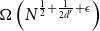 $\Omega \left ( N^{\frac {1}{2} + \frac {1}{2d'} + \epsilon } \right )$
contains
$\Omega \left ( N^{\frac {1}{2} + \frac {1}{2d'} + \epsilon } \right )$
contains $d' + 1$
members on a
$d' + 1$
members on a $(d' -1)$
-flat. By projecting
$(d' -1)$
-flat. By projecting $V$
to a generic
$V$
to a generic $d'$
-dimensional subspace of
$d'$
-dimensional subspace of $\mathbb{R}^d$
, we obtain
$\mathbb{R}^d$
, we obtain $N$
points in
$N$
points in $\mathbb{R}^{d'}$
with no
$\mathbb{R}^{d'}$
with no $d' + 2$
members on a common hyperplane, and every subset in general position has size
$d' + 2$
members on a common hyperplane, and every subset in general position has size $O\left ( N^{\frac {1}{2} + \frac {1}{2d'} + \epsilon } \right )$
.
$O\left ( N^{\frac {1}{2} + \frac {1}{2d'} + \epsilon } \right )$
.
In dimensions $d' \geq 4$
where
$d' \geq 4$
where $d'$
is even, we apply Theorem3.2 with
$d'$
is even, we apply Theorem3.2 with $k = d'- 2$
and
$k = d'- 2$
and $\ell = d' -1$
to obtain a point set
$\ell = d' -1$
to obtain a point set $V$
of size
$V$
of size $N$
in
$N$
in $\mathbb{R}^d$
with the property that no
$\mathbb{R}^d$
with the property that no $d' +2$
members on a
$d' +2$
members on a $(d'-1)$
-flat, and every subset of size
$(d'-1)$
-flat, and every subset of size $\Omega \left ( N^{\frac {1}{2} + \frac {1}{d' - 1} + \epsilon } \right )$
contains
$\Omega \left ( N^{\frac {1}{2} + \frac {1}{d' - 1} + \epsilon } \right )$
contains $d'$
members on a
$d'$
members on a $(d' -2)$
-flat. By adding another point from this subset, we obtain
$(d' -2)$
-flat. By adding another point from this subset, we obtain $d' + 1$
members on a
$d' + 1$
members on a $(d' - 1)$
-flat. Hence, by projecting to
$(d' - 1)$
-flat. Hence, by projecting to $V$
a generic
$V$
a generic $d'$
-dimensional subspace of
$d'$
-dimensional subspace of $\mathbb{R}^d$
, we obtain
$\mathbb{R}^d$
, we obtain $N$
points in
$N$
points in $\mathbb{R}^{d'}$
with no
$\mathbb{R}^{d'}$
with no $d' + 2$
members on a common hyperplane, and every subset in general position has size
$d' + 2$
members on a common hyperplane, and every subset in general position has size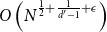 $O\left ( N^{\frac {1}{2} + \frac {1}{d' - 1} + \epsilon } \right )$
.
$O\left ( N^{\frac {1}{2} + \frac {1}{d' - 1} + \epsilon } \right )$
.
Since $\epsilon$
is arbitrary and
$\epsilon$
is arbitrary and $N$
grows to infinity, we can conclude the proof of Theorem1.1 after renaming
$N$
grows to infinity, we can conclude the proof of Theorem1.1 after renaming $d'$
to
$d'$
to $d$
.
$d$
.
Proof of Theorem3.2
. Let $d$
be a sufficiently large integer and
$d$
be a sufficiently large integer and $n$
tend to infinity. We denote
$n$
tend to infinity. We denote $\mathcal{H}$
as the hypergraph with
$\mathcal{H}$
as the hypergraph with $V(\mathcal{H})=[n]^d$
and
$V(\mathcal{H})=[n]^d$
and $E(\mathcal{H})$
consisting of non-degenerate
$E(\mathcal{H})$
consisting of non-degenerate $(k+2)$
-tuples
$(k+2)$
-tuples $T$
such that
$T$
such that $T$
lies on a
$T$
lies on a $k$
-flat. We shall construct a rooted tree
$k$
-flat. We shall construct a rooted tree $\mathfrak{T}$
whose nodes are labelled with vertex subsets of
$\mathfrak{T}$
whose nodes are labelled with vertex subsets of $\mathcal{H}$
as follows. We start with
$\mathcal{H}$
as follows. We start with $\mathfrak{T}$
consisting of one root node labelled with
$\mathfrak{T}$
consisting of one root node labelled with $V(\mathcal{H})$
. Iteratively, if there is a leaf
$V(\mathcal{H})$
. Iteratively, if there is a leaf $x \in \mathfrak{T}$
whose labelled set
$x \in \mathfrak{T}$
whose labelled set $C_x$
has size at least
$C_x$
has size at least $n^{\frac {k}{k + 1}d + k}$
, we apply Lemma 3.1 to
$n^{\frac {k}{k + 1}d + k}$
, we apply Lemma 3.1 to $\mathcal{H}[C_x]$
with
$\mathcal{H}[C_x]$
with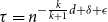 $\tau = n^{-\frac {k}{k + 1}d + \delta + \epsilon }$
where
$\tau = n^{-\frac {k}{k + 1}d + \delta + \epsilon }$
where $\delta$
is defined by
$\delta$
is defined by $|C_x| = n^{d - \delta }$
. As a consequence, Lemma 3.1 produces a collection
$|C_x| = n^{d - \delta }$
. As a consequence, Lemma 3.1 produces a collection $\mathcal{C}$
of subsets of
$\mathcal{C}$
of subsets of $C_x$
. Then we create a child of
$C_x$
. Then we create a child of $x$
in
$x$
in $\mathfrak{T}$
labelled by
$\mathfrak{T}$
labelled by $C$
for each
$C$
for each $C \in \mathcal{C}$
. The iteration continues until there is no leaf
$C \in \mathcal{C}$
. The iteration continues until there is no leaf $x\in \mathfrak{T}$
with
$x\in \mathfrak{T}$
with $|C_x| \geq n^{\frac {k}{k + 1}d + k}$
.
$|C_x| \geq n^{\frac {k}{k + 1}d + k}$
.
During the interative construction of $\mathfrak{T}$
, we need to verify the hypothesis of Lemma 3.1, that is,
$\mathfrak{T}$
, we need to verify the hypothesis of Lemma 3.1, that is,
 \begin{equation*} \Delta _i(\mathcal{H}[C_x]) \leq c \cdot \tau ^{i-1} \frac {|E(\mathcal{H}[C_x])|}{|V(\mathcal{H}[C_x])|} \quad \text{for all }2\leq i\leq k+2. \end{equation*}
To check this, we use Lemma 2.4 to upper bound $\Delta _i(\mathcal{H}[C_x])$
for
$\Delta _i(\mathcal{H}[C_x])$
for $2\leq i \lt k+2$
and use the trivial bound
$2\leq i \lt k+2$
and use the trivial bound $\Delta _i(\mathcal{H}[C_x])\leq 1$
for
$\Delta _i(\mathcal{H}[C_x])\leq 1$
for $i = k+2$
. On the other hand, we use Lemma 2.1 to lower bound
$i = k+2$
. On the other hand, we use Lemma 2.1 to lower bound $|E(\mathcal{H}[C_x])|$
. We shall use
$|E(\mathcal{H}[C_x])|$
. We shall use $n^{d - \delta } = |V(\mathcal{H}')| \geq n^{\frac {k}{k + 1}d + k}$
as well. Since this is a straightforward computation, whose detail will be given as Claim 4.2 in the proof of Theorem1.2, we skip it here.
$n^{d - \delta } = |V(\mathcal{H}')| \geq n^{\frac {k}{k + 1}d + k}$
as well. Since this is a straightforward computation, whose detail will be given as Claim 4.2 in the proof of Theorem1.2, we skip it here.
Now, we analyse this rooted tree $\mathfrak{T}$
. According to Lemma 3.1(c), if
$\mathfrak{T}$
. According to Lemma 3.1(c), if $y$
(labelled with
$y$
(labelled with $C_y$
) is a child of
$C_y$
) is a child of $x$
(labelled with
$x$
(labelled with $C_x$
) in
$C_x$
) in $\mathfrak{T}$
, the number of edges induced by
$\mathfrak{T}$
, the number of edges induced by $C_y$
shrinks from that by
$C_y$
shrinks from that by $C_x$
by a constant factor
$C_x$
by a constant factor $(1-c)$
. On the other hand, a reasonably large set induces many edges in
$(1-c)$
. On the other hand, a reasonably large set induces many edges in $\mathcal{H}$
by Lemma 2.1 (assuming
$\mathcal{H}$
by Lemma 2.1 (assuming $d$
is large). This means the height of
$d$
is large). This means the height of $\mathfrak{T}$
is upper bounded by
$\mathfrak{T}$
is upper bounded by $O(\log n)$
, and in particular our iterative construction ends. According to Lemma 3.1(b), the number of children of any node
$O(\log n)$
, and in particular our iterative construction ends. According to Lemma 3.1(b), the number of children of any node $x$
in
$x$
in $\mathfrak{T}$
is at most
$\mathfrak{T}$
is at most
 \begin{equation*} |\mathcal{C}| \leq \exp ({c^{-1} \cdot \tau |C_x| \cdot \log (1/\tau )}) \leq \exp \left (O\left (n^{\frac {d}{k + 1} + \epsilon }\cdot \log {n}\right )\right ). \end{equation*}
Therefore, let $\mathfrak{C}$
be the collection of sets labelling the leaves of
$\mathfrak{C}$
be the collection of sets labelling the leaves of $\mathfrak{T}$
. Hence, we have
$\mathfrak{T}$
. Hence, we have
 \begin{equation*} |\mathfrak{C}| \leq \exp \left (O\left (n^{\frac {d}{k + 1} + \epsilon }\cdot \log ^2{n}\right )\right ) \quad \text{and}\quad |C| \leq n^{\frac {k}{k + 1}d + k} \ \text{for all }C\in \mathfrak{C}. \end{equation*}
Furthermore, if $I$
is an independent set of
$I$
is an independent set of $\mathcal{H}$
that is contained in a vertex subset
$\mathcal{H}$
that is contained in a vertex subset $C_x$
labelling a non-leaf node
$C_x$
labelling a non-leaf node $x$
, then by the construction of
$x$
, then by the construction of $\mathfrak{T}$
and Lemma 3.1(a), there exists a child
$\mathfrak{T}$
and Lemma 3.1(a), there exists a child $y$
of
$y$
of $x$
in
$x$
in $\mathfrak{T}$
whose labelling set
$\mathfrak{T}$
whose labelling set $C_y$
contains
$C_y$
contains $I$
. This implies every independent set of
$I$
. This implies every independent set of $\mathcal{H}$
is contained in some member of
$\mathcal{H}$
is contained in some member of $\mathfrak{C}$
. Elements in this collection
$\mathfrak{C}$
. Elements in this collection $\mathfrak{C}$
are called containers.
$\mathfrak{C}$
are called containers.
Next, we randomly select a subset of $[n]^d$
by keeping each point independently with probability
$[n]^d$
by keeping each point independently with probability $p$
. Let
$p$
. Let $S$
be the set of selected elements. Then for each
$S$
be the set of selected elements. Then for each $(\ell + 3)$
-tuple
$(\ell + 3)$
-tuple $T$
in
$T$
in $S$
that lies on an
$S$
that lies on an $\ell$
-flat, we delete one point from
$\ell$
-flat, we delete one point from $T$
. We denote the resulting set of points by
$T$
. We denote the resulting set of points by $S'$
. By Lemma 2.5, we have
$S'$
. By Lemma 2.5, we have
 \begin{equation*} \mathbb{E}[|S'|] \geq pn^d - p^{\ell +3}\ell n^{(\ell +1)d+2\ell }. \end{equation*}
By setting $p=(2\ell )^{-\frac {1}{\ell +2}}n^{-\frac {\ell }{\ell +2}(d+2)}$
, we have
$p=(2\ell )^{-\frac {1}{\ell +2}}n^{-\frac {\ell }{\ell +2}(d+2)}$
, we have
 \begin{equation*} \mathbb{E}[|S'|] \geq \frac {pn^d}{2} =\Omega \left (n^{\frac {2(d-\ell )}{\ell +2}}\right ). \end{equation*}
Finally, we set $m = n^{\frac {d}{k + 1} + 2\epsilon }$
. Let
$m = n^{\frac {d}{k + 1} + 2\epsilon }$
. Let $X$
denote the number of independent sets of
$X$
denote the number of independent sets of $\mathcal{H}$
in
$\mathcal{H}$
in $S'$
with cardinality
$S'$
with cardinality $m$
. Using the family of containers, we have
$m$
. Using the family of containers, we have
 \begin{align*} \mathbb{E}[X] & \leq |\mathfrak{C}|\cdot \binom {n^{\frac {k}{k + 1}d + k}}{m} \cdot p^{m} \\ &\leq \exp \left (O\left (n^{\frac {d}{k + 1} + \epsilon }\cdot \log ^2{n}\right )\right ) \cdot \left (\frac {e \cdot n^{\frac {k}{k + 1}d + k}}{m}\right )^m p^m \\ &\leq \exp \left (O\left (n^{\frac {d}{k + 1} + \epsilon }\cdot \log ^2{n}\right )\right ) \cdot \left (e \cdot n^{\frac {k-1}{k + 1}d + k -2\epsilon }\right )^m \left ((2\ell )^{-\frac {1}{\ell +2}} \cdot n^{-\frac {\ell }{\ell +2}(d+2)}\right )^m \\ &\leq \exp \left (O\left (n^{\frac {d}{k + 1} + \epsilon }\cdot \log ^2{n}\right )\right ) \cdot \left (\frac {1}{2}\right )^m\\ &\leq o(1). \end{align*}
Here, the fourth inequality uses the following consequence of $k\leq \ell$
and
$k\leq \ell$
and $d$
being large:
$d$
being large:
 \begin{equation*} \frac {k-1}{k + 1}d + k -2\epsilon -\frac {\ell }{\ell +2}(d+2) \lt 0. \end{equation*}
Notice that $|S'|$
is exponentially concentrated around its mean by Chernoff’s inequality. Therefore, some realisation of
$|S'|$
is exponentially concentrated around its mean by Chernoff’s inequality. Therefore, some realisation of $S'$
satisfies:
$S'$
satisfies: $|S'|=N=\Omega (n^{2(d-\ell )/(\ell + 2)})$
;
$|S'|=N=\Omega (n^{2(d-\ell )/(\ell + 2)})$
; $S'$
contains no
$S'$
contains no $(\ell +3)$
-tuples on a
$(\ell +3)$
-tuples on a $\ell$
-flat; and
$\ell$
-flat; and $\mathcal{H}[S']$
does not contain an independent set of
$\mathcal{H}[S']$
does not contain an independent set of $\mathcal{H}$
with cardinality
$\mathcal{H}$
with cardinality
 \begin{equation*} m = n^{\frac {d}{k + 1} + 2\epsilon } = O\left ( N^{\frac {\ell + 2}{2(k + 1)} + \frac {(\ell +2)\ell }{2(k+1)(d-\ell )} + \frac {\ell + 2}{d-\ell }\epsilon }\right ) \leq O\left ( N^{\frac {\ell + 2}{2(k + 1)} + \epsilon }\right ). \end{equation*}
Here, we assume $d = d(\epsilon ,k,\ell )$
is sufficiently large so that
$d = d(\epsilon ,k,\ell )$
is sufficiently large so that
 \begin{equation*} \frac {(\ell +2)\ell }{2(k+1)(d-\ell )} + \frac {\ell + 2}{d-\ell }\epsilon \leq \epsilon . \end{equation*}
Notice that $S'$
not containing an independent set of size
$S'$
not containing an independent set of size $m$
means every subset of
$m$
means every subset of $S'$
of size
$S'$
of size $m$
contains
$m$
contains $k+2$
points on a
$k+2$
points on a $k$
-flat. We conclude the proof by renaming
$k$
-flat. We conclude the proof by renaming $S'$
to
$S'$
to $V$
.
$V$
.
4. Proof of Theorem1.2
In this section, we prove Theorem1.2. The proof is essentially the same as in the previous section with a different choice of parameters. For the reader’s convenience, we include the details here. We start by proving the following theorem.
Theorem 4.1.
Let $k,\ell ,s$
be fixed integers such that
$k,\ell ,s$
be fixed integers such that $\ell \geq k\geq 2$
,
$\ell \geq k\geq 2$
, $s\geq 2$
,
$s\geq 2$
, $k$
is even, and
$k$
is even, and $\frac {2\ell +s-1}{\ell +s-1} \lt \frac {2k}{k+1}$
. Then for any
$\frac {2\ell +s-1}{\ell +s-1} \lt \frac {2k}{k+1}$
. Then for any $\epsilon \gt 0$
, there is a constant
$\epsilon \gt 0$
, there is a constant $d = d(\epsilon ,k,\ell ,s)$
such that the following holds. For infinitely many values of
$d = d(\epsilon ,k,\ell ,s)$
such that the following holds. For infinitely many values of $N$
, there is a set
$N$
, there is a set $V$
of
$V$
of $N$
points in
$N$
points in $\mathbb{R}^{d}$
such that no
$\mathbb{R}^{d}$
such that no $\ell +s$
members of
$\ell +s$
members of $V$
lie on an
$V$
lie on an $\ell$
-flat, and every subset of
$\ell$
-flat, and every subset of $V$
without
$V$
without $k + 2$
members on a
$k + 2$
members on a $k$
-flat has size at most
$k$
-flat has size at most $O\left ( N^{\frac {1}{2}+\epsilon } \right )$
.
$O\left ( N^{\frac {1}{2}+\epsilon } \right )$
.
Proof.
Just as before, let $\mathcal{H}$
be the hypergraph with
$\mathcal{H}$
be the hypergraph with $V(\mathcal{H})=[n]^d$
and
$V(\mathcal{H})=[n]^d$
and $E(\mathcal{H})$
consisting of non-degenerate
$E(\mathcal{H})$
consisting of non-degenerate $(k+2)$
-tuples
$(k+2)$
-tuples $T$
such that
$T$
such that $T$
lies on a
$T$
lies on a $k$
-flat. We let
$k$
-flat. We let $q=q(k,r,s)$
be a quantity that will be determined later. We again construct a rooted tree
$q=q(k,r,s)$
be a quantity that will be determined later. We again construct a rooted tree $\mathfrak{T}$
whose nodes are labelled with vertex subsets of
$\mathfrak{T}$
whose nodes are labelled with vertex subsets of $\mathcal{H}$
. We start with
$\mathcal{H}$
. We start with $\mathfrak{T}$
consisting of one root node labelled with
$\mathfrak{T}$
consisting of one root node labelled with $V(\mathcal{H})$
. Iteratively, if there is a leaf
$V(\mathcal{H})$
. Iteratively, if there is a leaf $x \in \mathfrak{T}$
whose labelled set
$x \in \mathfrak{T}$
whose labelled set $C_x$
has size at least
$C_x$
has size at least $n^{qd + k}$
, we apply Lemma 3.1 to
$n^{qd + k}$
, we apply Lemma 3.1 to $\mathcal{H}' = \mathcal{H}[C_x]$
with
$\mathcal{H}' = \mathcal{H}[C_x]$
with $\tau = n^{-qd + \delta + \epsilon }$
where
$\tau = n^{-qd + \delta + \epsilon }$
where $\delta$
is defined by
$\delta$
is defined by $|C_x| = n^{d - \delta }$
. We shall use the claim below to verify the hypothesis of Lemma 3.1. As a consequence, Lemma 3.1 produces a collection
$|C_x| = n^{d - \delta }$
. We shall use the claim below to verify the hypothesis of Lemma 3.1. As a consequence, Lemma 3.1 produces a collection $\mathcal{C}$
of subsets of
$\mathcal{C}$
of subsets of $C_x$
. Then we create a child of
$C_x$
. Then we create a child of $x$
in
$x$
in $\mathfrak{T}$
labelled by
$\mathfrak{T}$
labelled by $C$
for each
$C$
for each $C \in \mathcal{C}$
. The iteration continues until there is no leaf
$C \in \mathcal{C}$
. The iteration continues until there is no leaf $x\in \mathfrak{T}$
with
$x\in \mathfrak{T}$
with $|C_x| \geq n^{qd + k}$
.
$|C_x| \geq n^{qd + k}$
.
Claim 4.2.
If $\frac {1}{2} \lt q \leq \frac {k}{k+1}$
and
$\frac {1}{2} \lt q \leq \frac {k}{k+1}$
and $\mathcal{H}'$
defined as above, then
$\mathcal{H}'$
defined as above, then
 \begin{equation*} \Delta _i(\mathcal{H}') \leq c \cdot \tau ^{i-1} \frac {|E(\mathcal{H}')|}{|V(\mathcal{H}')|} \quad \text{for all }2\leq i\leq k+2, \end{equation*}
where $c$
is the constant in Lemma 3.1 depending only on
$c$
is the constant in Lemma 3.1 depending only on $k$
.
$k$
.
Proof of Claim. First, we notice that
 \begin{equation} n^{d - \delta } = |V(\mathcal{H}')| \geq n^{qd + k} \implies \delta \leq d - qd - k. \end{equation}
Assuming $d$
is large, we have
$d$
is large, we have $|E(\mathcal{H}')| \geq \Omega (n^{(k + 1)d - (k + 2)\delta })$
by Lemma 2.1.
$|E(\mathcal{H}')| \geq \Omega (n^{(k + 1)d - (k + 2)\delta })$
by Lemma 2.1.
For $2\leq i \lt k+2$
, Lemma 2.4 gives us
$2\leq i \lt k+2$
, Lemma 2.4 gives us $\Delta _i(\mathcal{H}') \leq n^{(k+1-i)(d-\delta )+k}$
. Hence, it suffices to check
$\Delta _i(\mathcal{H}') \leq n^{(k+1-i)(d-\delta )+k}$
. Hence, it suffices to check
 \begin{equation*} n^{(k+1-i)(d-\delta ) + k} \ll \left (n^{-qd+\delta +\epsilon }\right )^{i-1} \cdot \frac {n^{(k+1)d-(k+2)\delta }}{n^{d-\delta }}. \end{equation*}
Simplifying and comparing the exponents over $n$
, this is implied by
$n$
, this is implied by
 \begin{equation*} (i-1) d + k + (i-1)\epsilon \gt (i-1) q d + \delta . \end{equation*}
Since $d$
is sufficiently large, it suffices to compare the coefficients of
$d$
is sufficiently large, it suffices to compare the coefficients of $d$
. Applying (4.1) and simplifying the terms, the inequality above is implied by
$d$
. Applying (4.1) and simplifying the terms, the inequality above is implied by $i-1 \geq (i-2)q + 1$
, which is true by our hypothesis.
$i-1 \geq (i-2)q + 1$
, which is true by our hypothesis.
For $i = k+2$
, we have
$i = k+2$
, we have $\Delta _i(\mathcal{H}') \leq 1$
trivially. Hence, it suffices to check
$\Delta _i(\mathcal{H}') \leq 1$
trivially. Hence, it suffices to check
 \begin{equation*} 1 \ll \left (n^{-qd+\delta +\epsilon }\right )^{k+1} \cdot \frac {n^{(k+1)d-(k+2)\delta }}{n^{d-\delta }}. \end{equation*}
Simplifying and comparing the exponents over $n$
, this is implied by
$n$
, this is implied by
 \begin{equation*} (k+1)qd \lt kd + (k+1)\epsilon . \end{equation*}
Again, since $d$
is sufficiently large, it suffices to compare the coefficients of
$d$
is sufficiently large, it suffices to compare the coefficients of $d$
. The inequality above is implied by
$d$
. The inequality above is implied by $(k+1) q \leq k$
, which is true by our hypothesis.
$(k+1) q \leq k$
, which is true by our hypothesis.
We can analyse this rooted tree $\mathfrak{T}$
using arguments similar to the previous section. We can conclude that there exists a collection
$\mathfrak{T}$
using arguments similar to the previous section. We can conclude that there exists a collection $\mathfrak{C}$
of vertex subsets of
$\mathfrak{C}$
of vertex subsets of $\mathcal{H}$
with
$\mathcal{H}$
with
 \begin{equation*} |\mathfrak{C}| \leq \exp \left (O\left (n^{d-qd + \epsilon }\cdot \log ^2{n}\right )\right ) \quad \text{and}\quad |C| \leq n^{qd + k} \ \text{for all }C\in \mathfrak{C}. \end{equation*}
and every independent set of $\mathcal{H}$
is contained in some member of
$\mathcal{H}$
is contained in some member of $\mathfrak{C}$
.
$\mathfrak{C}$
.
Next, we randomly select a subset of $[n]^d$
by keeping each point independently with probability
$[n]^d$
by keeping each point independently with probability $p$
. Let
$p$
. Let $S$
be the set of selected elements. Then for each
$S$
be the set of selected elements. Then for each $(\ell + s)$
-tuple
$(\ell + s)$
-tuple $T$
in
$T$
in $S$
that lies on an
$S$
that lies on an $\ell$
-flat, we delete one point from
$\ell$
-flat, we delete one point from $T$
. We denote the resulting set of points by
$T$
. We denote the resulting set of points by $S'$
. By Lemma 2.5, we have
$S'$
. By Lemma 2.5, we have
 \begin{equation*} \mathbb{E}[|S'|] \geq pn^d - p^{\ell +s}\ell n^{(\ell +1)d+(s-1)\ell }. \end{equation*}
By setting $p=(2\ell )^{-\frac {1}{\ell +s-1}}n^{-\frac {\ell }{\ell +s-1}(d+s-1)}$
, we have
$p=(2\ell )^{-\frac {1}{\ell +s-1}}n^{-\frac {\ell }{\ell +s-1}(d+s-1)}$
, we have
 \begin{equation*} \mathbb{E}[|S'|] \geq \frac {pn^d}{2} =\Omega \left (n^{\frac {(s-1)(d-\ell )}{\ell +s-1}}\right ). \end{equation*}
Finally, we set $m = n^{d-qd + 2\epsilon }$
. Let
$m = n^{d-qd + 2\epsilon }$
. Let $X$
denote the number of independent sets of
$X$
denote the number of independent sets of $\mathcal{H}$
in
$\mathcal{H}$
in $S'$
with cardinality
$S'$
with cardinality $m$
. With a foresight soon to be self-evident, we choose
$m$
. With a foresight soon to be self-evident, we choose
 \begin{equation} q = \frac {1}{2} \cdot \frac {2\ell +s-1}{\ell +s-1} + \frac {1}{2d} \cdot \frac {\ell (s-1)}{\ell +s-1} -\frac {k}{2d}. \end{equation}
We remark that our hypothesis on $k,\ell ,s$
implies
$k,\ell ,s$
implies $\frac {1}{2}\lt q \leq \frac {k}{k + 1}$
assuming
$\frac {1}{2}\lt q \leq \frac {k}{k + 1}$
assuming $d$
is large, hence Claim 4.2 can be applied in construction of
$d$
is large, hence Claim 4.2 can be applied in construction of $\mathfrak{T}$
.
$\mathfrak{T}$
.
Using the family $\mathfrak{C}$
, we can estimate
$\mathfrak{C}$
, we can estimate
 \begin{align*} \mathbb{E}[X] & \leq |\mathfrak{C}|\cdot \binom {n^{qd + k}}{m} \cdot p^{m} \\ &\leq \exp \left (O\left (n^{d-qd + \epsilon }\cdot \log ^2{n}\right )\right ) \cdot \left (\frac {e \cdot n^{qd + k}}{m}\right )^m p^m \\ &\leq \exp \left (O\left (n^{d-qd + \epsilon }\cdot \log ^2{n}\right )\right ) \cdot \left (e \cdot n^{(2q-1)d + k -2\epsilon }\right )^m \left ((2\ell )^{-\frac {1}{\ell +s-1}}n^{-\frac {\ell }{\ell +s-1}(d+s-1)}\right )^m \\ &\leq \exp \left (O\left (n^{d-qd + \epsilon }\cdot \log ^2{n}\right )\right ) \cdot \left (\frac {1}{2}\right )^m\\ &\leq o(1). \end{align*}
Here, the fourth inequality uses the following consequence of (4.2):
 \begin{equation*} (2q-1)d + k -2\epsilon -\frac {\ell }{\ell +s-1}(d+s-1) \lt 0. \end{equation*}
Notice that $|S'|$
is exponentially concentrated around its mean by Chernoff’s inequality. Therefore, some realisation of
$|S'|$
is exponentially concentrated around its mean by Chernoff’s inequality. Therefore, some realisation of $S'$
satisfies:
$S'$
satisfies: $|S'|=N=\Omega \left (n^{\frac {(s-1)(d-\ell )}{\ell +s-1}}\right )$
;
$|S'|=N=\Omega \left (n^{\frac {(s-1)(d-\ell )}{\ell +s-1}}\right )$
; $S'$
contains no
$S'$
contains no $(\ell +s)$
-tuples on a
$(\ell +s)$
-tuples on a $\ell$
-flat; and
$\ell$
-flat; and $\mathcal{H}[S']$
does not contain an independent set of
$\mathcal{H}[S']$
does not contain an independent set of $\mathcal{H}$
with cardinality
$\mathcal{H}$
with cardinality
 \begin{equation*} m = n^{d - qd + 2\epsilon } = O\left ( N^{\frac {1}{2}+ \left (\frac {k}{2} + 2\epsilon \right )\cdot \frac {\ell +s-1}{(s-1)(d-\ell )}} \right ) \leq O\left ( N^{\frac {1}{2} + \epsilon }\right ). \end{equation*}
Here, we assume $d = d(\epsilon ,k,\ell ,s)$
is sufficiently large so that
$d = d(\epsilon ,k,\ell ,s)$
is sufficiently large so that
 \begin{equation*} \left (\frac {k}{2} + 2\epsilon \right )\cdot \frac {\ell +s-1}{(s-1)(d-\ell )} \leq \epsilon . \end{equation*}
Since $S'$
does not contain an independent set of size
$S'$
does not contain an independent set of size $m$
, every subset of
$m$
, every subset of $S'$
of size
$S'$
of size $m$
contains
$m$
contains $k+2$
points on a
$k+2$
points on a $k$
-flat. We conclude the proof by renaming
$k$
-flat. We conclude the proof by renaming $S'$
to
$S'$
to $V$
.
$V$
.
Proof of Theorem 1.2
. In dimensions $d'\geq 3$
where
$d'\geq 3$
where $d'$
is odd, we obtain an upper bound for
$d'$
is odd, we obtain an upper bound for $\alpha _{d',s'}(N)$
with
$\alpha _{d',s'}(N)$
with $d's' + 2 \gt 2d' + 2s'$
. We set
$d's' + 2 \gt 2d' + 2s'$
. We set $k = \ell = d'-1$
and
$k = \ell = d'-1$
and $s = s' + 1$
, so we can verify
$s = s' + 1$
, so we can verify $\frac {2\ell +s-1}{\ell +s-1} \lt \frac {2k}{k+1}$
. Hence we can apply Theorem4.1 to obtain a point set
$\frac {2\ell +s-1}{\ell +s-1} \lt \frac {2k}{k+1}$
. Hence we can apply Theorem4.1 to obtain a point set $V$
of size
$V$
of size $N$
in
$N$
in $\mathbb{R}^{d}$
with the property that no
$\mathbb{R}^{d}$
with the property that no $d' +s'$
members lie on a
$d' +s'$
members lie on a $(d' - 1)$
-flat, and every subset of size
$(d' - 1)$
-flat, and every subset of size $\Omega (N^{\frac {1}{2} + \epsilon })$
contains
$\Omega (N^{\frac {1}{2} + \epsilon })$
contains $d' + 1$
members on a
$d' + 1$
members on a $(d' -1)$
-flat. By projecting
$(d' -1)$
-flat. By projecting $V$
to a generic
$V$
to a generic $d'$
-dimensional subspace of
$d'$
-dimensional subspace of $\mathbb{R}^d$
, we obtain
$\mathbb{R}^d$
, we obtain $N$
points in
$N$
points in $\mathbb{R}^{d'}$
with no
$\mathbb{R}^{d'}$
with no $d' + s'$
members on a common hyperplane, and every subset in general position has size
$d' + s'$
members on a common hyperplane, and every subset in general position has size $O( N^{\frac {1}{2} + \epsilon })$
.
$O( N^{\frac {1}{2} + \epsilon })$
.
In dimensions $d' \geq 4$
where
$d' \geq 4$
where $d'$
is even, we obtain an upper bound for
$d'$
is even, we obtain an upper bound for $\alpha _{d',s'}(N)$
with
$\alpha _{d',s'}(N)$
with $d's' + 2 \gt 2d' + 3s'$
. We set
$d's' + 2 \gt 2d' + 3s'$
. We set $k = d'- 2$
,
$k = d'- 2$
, $\ell = d' -1$
, and
$\ell = d' -1$
, and $s = s' + 1$
, so we can verify
$s = s' + 1$
, so we can verify $\frac {2\ell +s-1}{\ell +s-1} \lt \frac {2k}{k+1}$
. Hence we can apply Theorem4.1 to obtain a point set
$\frac {2\ell +s-1}{\ell +s-1} \lt \frac {2k}{k+1}$
. Hence we can apply Theorem4.1 to obtain a point set $V$
of size
$V$
of size $N$
in
$N$
in $\mathbb{R}^d$
with the property that no
$\mathbb{R}^d$
with the property that no $d' +s'$
members on a
$d' +s'$
members on a $(d'-1)$
-flat, and every subset of size
$(d'-1)$
-flat, and every subset of size $\Omega (N^{\frac {1}{2} + \epsilon })$
contains
$\Omega (N^{\frac {1}{2} + \epsilon })$
contains $d'$
members on a
$d'$
members on a $(d' -2)$
-flat. By adding another point from this subset, we obtain
$(d' -2)$
-flat. By adding another point from this subset, we obtain $d' + 1$
members on a
$d' + 1$
members on a $(d' - 1)$
-flat. Hence, by projecting to
$(d' - 1)$
-flat. Hence, by projecting to $V$
a generic
$V$
a generic $d'$
-dimensional subspace of
$d'$
-dimensional subspace of $\mathbb{R}^d$
, we obtain
$\mathbb{R}^d$
, we obtain $N$
points in
$N$
points in $\mathbb{R}^{d'}$
with no
$\mathbb{R}^{d'}$
with no $d' + s'$
members on a common hyperplane, and every subset in general position has size
$d' + s'$
members on a common hyperplane, and every subset in general position has size $O( N^{\frac {1}{2} + \epsilon })$
.
$O( N^{\frac {1}{2} + \epsilon })$
.
Since $\epsilon$
is arbitrary and
$\epsilon$
is arbitrary and $N$
grows to infinity, we can conclude the proof of Theorem1.2 after renaming
$N$
grows to infinity, we can conclude the proof of Theorem1.2 after renaming $d'$
to
$d'$
to $d$
and
$d$
and $s'$
to
$s'$
to $s$
.
$s$
.
5. Proof of Theorem1.3
In this section, we will give a proof of Theorem1.3. Let $V\subset [n]^d$
such that there are no
$V\subset [n]^d$
such that there are no $k +2$
points that lie on a
$k +2$
points that lie on a $k$
-flat. In [Reference Lefmann18], Lefmann showed that
$k$
-flat. In [Reference Lefmann18], Lefmann showed that $|V| \leq O\left (n^{\frac {d}{\lfloor (k + 2)/2\rfloor }}\right )$
. To see this, assume that
$|V| \leq O\left (n^{\frac {d}{\lfloor (k + 2)/2\rfloor }}\right )$
. To see this, assume that $k$
is even and consider all elements of the form
$k$
is even and consider all elements of the form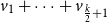 $v_1 + \cdots + v_{\frac {k}{2} + 1}$
, where
$v_1 + \cdots + v_{\frac {k}{2} + 1}$
, where $v_i\neq v_j$
and
$v_i\neq v_j$
and $v_i \in V$
. All of these elements are distinct, since otherwise we would have
$v_i \in V$
. All of these elements are distinct, since otherwise we would have $k + 2$
points on a
$k + 2$
points on a $k$
-flat. In other words, the equation
$k$
-flat. In other words, the equation
 \begin{equation*} \left (\textbf {x}_1 + \cdots + \textbf {x}_{\frac {k}{2} + 1}\right ) - \left (\textbf {x}_{\frac {k}{2} + 2} + \cdots + \textbf {x}_{k + 2}\right ) = \textbf {0}, \end{equation*}
does not have a solution with $\{\textbf {x}_1 , \ldots , \textbf {x}_{\frac {k}{2} + 1}\}$
and
$\{\textbf {x}_1 , \ldots , \textbf {x}_{\frac {k}{2} + 1}\}$
and $\{\textbf {x}_{\frac {k}{2} + 2} , \ldots , \textbf {x}_{k + 2}\}$
being two different
$\{\textbf {x}_{\frac {k}{2} + 2} , \ldots , \textbf {x}_{k + 2}\}$
being two different $(\frac {k}{2} + 1)$
-tuples of
$(\frac {k}{2} + 1)$
-tuples of $V$
. Therefore, we have
$V$
. Therefore, we have $\binom {|V|}{\frac {k}{2} + 1} \leq (kn)^d$
, and this implies Lefmann’s bound.
$\binom {|V|}{\frac {k}{2} + 1} \leq (kn)^d$
, and this implies Lefmann’s bound.
More generally, let us consider the equation
 \begin{equation} c_1\textbf {x}_1+c_2\textbf {x}_2+\ldots +c_r\textbf {x}_r=\textbf {0}, \end{equation}
with constant coefficients $c_i \in \mathbb{Z}$
and
$c_i \in \mathbb{Z}$
and $\sum _i c_i = 0$
. Here, the variables
$\sum _i c_i = 0$
. Here, the variables $\textbf {x}_i$
takes value in
$\textbf {x}_i$
takes value in $\mathbb{Z}^d$
. A solution
$\mathbb{Z}^d$
. A solution $(\textbf {x}_1,\ldots , \textbf {x}_r)$
to equation (5.1) is called trivial if there is a partition
$(\textbf {x}_1,\ldots , \textbf {x}_r)$
to equation (5.1) is called trivial if there is a partition $\mathcal{P}\,:\, [r] = \mathcal{I}_1\cup \ldots \cup \mathcal{I}_t$
, such that
$\mathcal{P}\,:\, [r] = \mathcal{I}_1\cup \ldots \cup \mathcal{I}_t$
, such that $\textbf {x}_j = \textbf {x}_{\ell }$
if and only if
$\textbf {x}_j = \textbf {x}_{\ell }$
if and only if $j,\ell \in \mathcal{I}_i$
, and
$j,\ell \in \mathcal{I}_i$
, and $\sum _{j \in \mathcal{I}_i} c_j = 0$
for all
$\sum _{j \in \mathcal{I}_i} c_j = 0$
for all $i\in [t]$
. In other words, being trivial means that, after combining like terms, the coefficient of each
$i\in [t]$
. In other words, being trivial means that, after combining like terms, the coefficient of each $\textbf {x}_i$
becomes zero. Otherwise, we say that the solution
$\textbf {x}_i$
becomes zero. Otherwise, we say that the solution $(\textbf {x}_1,\ldots , \textbf {x}_r)$
is non-trivial. A natural extremal problem is to determine the maximum size of a set
$(\textbf {x}_1,\ldots , \textbf {x}_r)$
is non-trivial. A natural extremal problem is to determine the maximum size of a set $A \subset [n]^d$
with only trivial solutions to (5.1). When
$A \subset [n]^d$
with only trivial solutions to (5.1). When $d = 1$
, this is a classical problem in additive number theory, and we refer the interested reader to [Reference Cilleruelo and Timmons6, Reference Lazebnik and Verstraëte16, Reference O’Bryant21, Reference Ruzsa25].
$d = 1$
, this is a classical problem in additive number theory, and we refer the interested reader to [Reference Cilleruelo and Timmons6, Reference Lazebnik and Verstraëte16, Reference O’Bryant21, Reference Ruzsa25].
By combining the arguments of Cilleruelo and Timmons [Reference Cilleruelo and Timmons6] and Jia [Reference Jia15], we establish the following theorem.
Theorem 5.1.
Let $d,r$
be fixed positive integers. Suppose
$d,r$
be fixed positive integers. Suppose $V\subset [n]^d$
has only trivial solutions to each equation of the form
$V\subset [n]^d$
has only trivial solutions to each equation of the form
 \begin{equation} c_1\left ((\textbf {x}_1 + \cdots + \textbf {x}_r) - (\textbf {x}_{r + 1} + \cdots + \textbf {x}_{2r})\right ) = c_2\left ((\textbf {x}_{2r + 1} + \cdots + \textbf {x}_{3r}) - (\textbf {x}_{3r+1} + \cdots + \textbf {x}_{4r})\right ), \end{equation}
for integers $c_1,c_2$
such that
$c_1,c_2$
such that $1 \leq c_1,c_2 \leq n^{\frac {d}{2rd + 1}}$
. Then we have
$1 \leq c_1,c_2 \leq n^{\frac {d}{2rd + 1}}$
. Then we have
 \begin{equation*} |V| \leq O\left (n^{\frac {d}{2r}\left (1 - \frac {1}{2rd + 1}\right )}\right ). \end{equation*}
Notice that Theorem1.3 follows from Theorem5.1. Indeed, when $k+2$
is divisible by
$k+2$
is divisible by $4$
, we set
$4$
, we set $r=(k+2)/4$
. If
$r=(k+2)/4$
. If $V\subset [n]^d$
contains
$V\subset [n]^d$
contains $k + 2$
points
$k + 2$
points $\{v_1,\ldots , v_{k + 2}\}$
that is a non-trivial solution to (5.2) with
$\{v_1,\ldots , v_{k + 2}\}$
that is a non-trivial solution to (5.2) with $\textbf {x}_i = v_i$
, then
$\textbf {x}_i = v_i$
, then $\{v_1,\ldots , v_{k + 2}\}$
must lie on a
$\{v_1,\ldots , v_{k + 2}\}$
must lie on a $k$
-flat. Hence, when
$k$
-flat. Hence, when $k + 2$
is divisible by
$k + 2$
is divisible by $4$
, we have
$4$
, we have
 \begin{equation*} a(d,k,n) \leq O\left (n^{\frac {d}{(k + 2)/2}\left (1 - \frac {1}{(k + 2)d/2 + 1}\right )}\right ). \end{equation*}
Since we have $a(d,k,n) \lt a(d,k - 1,n)$
, this implies that for all
$a(d,k,n) \lt a(d,k - 1,n)$
, this implies that for all $k\geq 2$
, we have
$k\geq 2$
, we have
 \begin{equation*} a(d,k,n) \leq O\left (n^{\frac {d}{2\lfloor (k + 2)/4\rfloor }\left (1 - \frac {1}{2\lfloor (k + 2)/4\rfloor d + 1}\right )}\right ). \end{equation*}
In the proof of Theorem5.1, we need the following well-known lemma (see e.g. Lemma 2.1 in [Reference Cilleruelo and Timmons6] and Theorem 4.1 in [Reference Ruzsa25]). For $U,T \subset \mathbb{Z}^d$
and
$U,T \subset \mathbb{Z}^d$
and $x \in \mathbb{Z}^d$
, we define
$x \in \mathbb{Z}^d$
, we define
 \begin{equation*} \Phi _{U - T}(x) = \{(u,t): u - t = x, u \in U, t \in T\}. \end{equation*}
Lemma 5.2.
For finite sets $U, T \subset \mathbb{Z}^d$
, we have
$U, T \subset \mathbb{Z}^d$
, we have
 \begin{equation*} \frac {(|U||T|)^2}{|U+T|} \leq \sum _{x \in \mathbb{Z}^d} |\Phi _{U-U}(x)|\cdot |\Phi _{T-T}(x)|. \end{equation*}
Proof of Theorem5.1
. Let $d$
,
$d$
, $r$
, and
$r$
, and $V$
be as given in the hypothesis. Let
$V$
be as given in the hypothesis. Let $m \geq 1$
be an integer that will be determined later. We define
$m \geq 1$
be an integer that will be determined later. We define
 \begin{equation*} S_r = \{v_1 + \cdots +v_{r}\,:\, v_i \in V, v_i \neq v_j\}, \end{equation*}
and a function
 \begin{equation*} \sigma :\,\binom {V}{r}\rightarrow S_r,\ \{v_1,\ldots , v_r\} \mapsto v_1 + \cdots + v_r. \end{equation*}
Notice that $\sigma$
is a bijection. Indeed, suppose on the contrary that
$\sigma$
is a bijection. Indeed, suppose on the contrary that
 \begin{equation*} v_1 + \cdots + v_{r} = v'_1 + \cdots + v'_{r} \end{equation*}
for two different $r$
-tuples in
$r$
-tuples in $V$
. Then by setting
$V$
. Then by setting $(\textbf {x}_1,\ldots ,\textbf {x}_r)=(v_1,\ldots ,v_r)$
,
$(\textbf {x}_1,\ldots ,\textbf {x}_r)=(v_1,\ldots ,v_r)$
, $(\textbf {x}_{r+1},\ldots ,\textbf {x}_{2r})=(v'_1,\ldots ,v'_r)$
,
$(\textbf {x}_{r+1},\ldots ,\textbf {x}_{2r})=(v'_1,\ldots ,v'_r)$
, $(\textbf {x}_{2r+1},\ldots ,\textbf {x}_{3r})=(\textbf {x}_{3r+1},\ldots ,\textbf {x}_{4r})$
arbitrarily, and
$(\textbf {x}_{2r+1},\ldots ,\textbf {x}_{3r})=(\textbf {x}_{3r+1},\ldots ,\textbf {x}_{4r})$
arbitrarily, and $c_1=c_2=1$
, we obtain a non-trivial solution to (5.2), which is a contradiction. In particular, we have
$c_1=c_2=1$
, we obtain a non-trivial solution to (5.2), which is a contradiction. In particular, we have $|S_r| = \binom {|V|}{r}$
.
$|S_r| = \binom {|V|}{r}$
.
For $j \in [m]$
and
$j \in [m]$
and $w \in \mathbb{Z}_j^d$
, we let
$w \in \mathbb{Z}_j^d$
, we let
 \begin{equation*} U_{j,w} = \{u \in \mathbb{Z}^d\,:\, ju + w \in S_r\}. \end{equation*}
Notice that for fixed $j \in [m]$
, we have
$j \in [m]$
, we have
 \begin{equation*} \sum _{w \in \mathbb{Z}_j^d} |U_{j,w}| = \sum _{w \in \mathbb{Z}_j^d} |\{v \in S_r \,:\, v \equiv w \text{ mod }j\}| = |S_r|. \end{equation*}
Applying Jensen’s inequality to above, we have
 \begin{equation} \sum _{w \in \mathbb{Z}_j^d} |U_{j,w}|^2 \geq |S_r|^2/j^d. \end{equation}
For $i \geq 0$
, we define
$i \geq 0$
, we define
 \begin{equation*} \Phi ^i_{U_{j,w}-U_{j,w}}(x) = \{(u_1,u_2)\in \Phi _{U_{j,w}-U_{j,w}}(x)\,:\, |\sigma ^{-1}(ju_1+w)\cap \sigma ^{-1}(ju_2+w)| = i\}. \end{equation*}
It’s obvious that these sets form a partition of $\Phi _{U_{j,w}-U_{j,w}}(x)$
. We also make the following claims.
$\Phi _{U_{j,w}-U_{j,w}}(x)$
. We also make the following claims.
Claim 5.3.
For a fixed $x\in \mathbb{Z}^d$
, we have
$x\in \mathbb{Z}^d$
, we have
 \begin{equation*} \sum _{j \in [m]}\sum _{w \in \mathbb{Z}_j^d } |\Phi ^0_{U_{j,w}-U_{j,w}}(x)| \leq 1, \end{equation*}
Proof.
For the sake of contradiction, suppose the summation above is at least two, then we have $(u_1,u_2)\in \Phi ^0_{U_{j,w}-U_{j,w}}(x)$
and
$(u_1,u_2)\in \Phi ^0_{U_{j,w}-U_{j,w}}(x)$
and $(u_3,u_4)\in \Phi ^0_{U_{j',w'}-U_{j',w'}}(x)$
such that either
$(u_3,u_4)\in \Phi ^0_{U_{j',w'}-U_{j',w'}}(x)$
such that either $(u_1,u_2)\neq (u_3,u_4)$
or
$(u_1,u_2)\neq (u_3,u_4)$
or $(j,w)\neq (j',w')$
.
$(j,w)\neq (j',w')$
.
Let $s_1,s_2,s_3,s_4 \in S_r$
such that
$s_1,s_2,s_3,s_4 \in S_r$
such that $s_1 = ju_1 + w$
,
$s_1 = ju_1 + w$
, $s_2 = ju_2 + w$
,
$s_2 = ju_2 + w$
, $s_3 = j'u_3 + w'$
,
$s_3 = j'u_3 + w'$
, $s_4 = j'u_4 + w'$
and write
$s_4 = j'u_4 + w'$
and write $\sigma ^{-1}(s_i)=\{v_{i,1},\ldots ,v_{i,r}\}$
. Notice that
$\sigma ^{-1}(s_i)=\{v_{i,1},\ldots ,v_{i,r}\}$
. Notice that $u_1 - u_2 = x = u_3 - u_4$
. Putting these equations together gives us
$u_1 - u_2 = x = u_3 - u_4$
. Putting these equations together gives us
 \begin{equation} j'((v_{1,1} + \cdots + v_{1,r}) - (v_{2,1} + \cdots + v_{2,r})) = j((v_{3,1} + \cdots + v_{3,r}) - (v_{4,1} + \cdots + v_{4,r})). \end{equation}
It suffices to show that (5.4) can be seem as a non-trivial solution to (5.2). The proof now falls into the following cases.
Case 1. Suppose $j \neq j'$
. Without loss of generality we can assume
$j \neq j'$
. Without loss of generality we can assume $j'\gt j$
. Notice that
$j'\gt j$
. Notice that $(u_1,u_2)\in \Phi ^0_{U_{j,w}-U_{j,w}}(x)$
implies
$(u_1,u_2)\in \Phi ^0_{U_{j,w}-U_{j,w}}(x)$
implies
 \begin{equation*} \{v_{1,1},\ldots ,v_{1,r}\}\cap \{v_{2,1},\ldots ,v_{2,r}\}=\emptyset . \end{equation*}
Then after combining like terms in (5.4), the coefficient of $v_1^1$
is at least
$v_1^1$
is at least $j'-j$
, which means this is indeed a non-trivial solution to (5.2).
$j'-j$
, which means this is indeed a non-trivial solution to (5.2).
Case 2. Suppose $j = j'$
, then we must have
$j = j'$
, then we must have $s_1 \neq s_3$
. Indeed, if
$s_1 \neq s_3$
. Indeed, if $s_1=s_3$
, we must have
$s_1=s_3$
, we must have $w=w'$
(as
$w=w'$
(as $s_1$
modulo
$s_1$
modulo $j$
equals
$j$
equals $s_3$
modulo
$s_3$
modulo $j'$
) and
$j'$
) and $s_2=s_4$
(as
$s_2=s_4$
(as $j'(s_1-s_2)=j(s_3-s_4)$
). This is a contradiction to either
$j'(s_1-s_2)=j(s_3-s_4)$
). This is a contradiction to either $(u_1,u_2)\neq (u_3,u_4)$
or
$(u_1,u_2)\neq (u_3,u_4)$
or $(j,w)\neq (j',w')$
.
$(j,w)\neq (j',w')$
.
Given $s_1 \neq s_3$
, we can assume, without loss of generality,
$s_1 \neq s_3$
, we can assume, without loss of generality, $v_{1,1}\not \in \{v_{3,1},\ldots ,v_{3,r}\}$
. Again, we have
$v_{1,1}\not \in \{v_{3,1},\ldots ,v_{3,r}\}$
. Again, we have $\{v_{1,1},\ldots ,v_{1,r}\}\cap \{v_{2,1},\ldots ,v_{2,r}\}=\emptyset$
. Hence, after combining like terms in (5.4), the coefficient of
$\{v_{1,1},\ldots ,v_{1,r}\}\cap \{v_{2,1},\ldots ,v_{2,r}\}=\emptyset$
. Hence, after combining like terms in (5.4), the coefficient of $v_1^1$
is positive and we have a non-trivial solution to (5.2).
$v_1^1$
is positive and we have a non-trivial solution to (5.2).
Claim 5.4.
For a finite set $T \subset \mathbb{Z}^d$
, and fixed integers
$T \subset \mathbb{Z}^d$
, and fixed integers $i,j\geq 1$
, we have
$i,j\geq 1$
, we have
 \begin{equation*} \sum _{w\in \mathbb{Z}_j^d}\sum _{x\in \mathbb{Z}^d} |\Phi ^{i}_{U_{j,w}-U_{j,w}}(x)|\cdot |\Phi _{T-T}(x)|\leq |V|^{2r-i}|T|. \end{equation*}
Proof.
The summation on the left-hand side counts all (ordered) quadruples $(u_1,u_2,t_1,t_2)$
such that
$(u_1,u_2,t_1,t_2)$
such that $(u_1,u_2)\in \Phi ^{i}_{U_{j,w}-U_{j,w}}(t_1-t_2)$
. For each such a quadruple, let
$(u_1,u_2)\in \Phi ^{i}_{U_{j,w}-U_{j,w}}(t_1-t_2)$
. For each such a quadruple, let $s_1,s_2 \in S_r$
such that
$s_1,s_2 \in S_r$
such that
 \begin{equation*} s_1 = ju_1 + w \quad \text{ and}\quad s_2 = ju_2 + w. \end{equation*}
There are at most $|V|^{2r-i}$
ways to choose a pair
$|V|^{2r-i}$
ways to choose a pair $(s_1,s_2)$
satisfying
$(s_1,s_2)$
satisfying $|\sigma ^{-1}(s_1)\cap \sigma ^{-1}(s_2)|=i$
. Such a pair
$|\sigma ^{-1}(s_1)\cap \sigma ^{-1}(s_2)|=i$
. Such a pair $(s_1,s_2)$
determines
$(s_1,s_2)$
determines $(u_1,u_2)$
uniquely. Moreover,
$(u_1,u_2)$
uniquely. Moreover, $(s_1,s_2)$
also determines the quantity
$(s_1,s_2)$
also determines the quantity
 \begin{equation*} t_1-t_2=u_1-u_2=\frac {s_1-w}{j}-\frac {s_2-w}{j}=\frac {1}{j}(s_1-s_2). \end{equation*}
After such a pair $(s_1,s_2)$
is chosen, there are at most
$(s_1,s_2)$
is chosen, there are at most $|T|$
ways to choose
$|T|$
ways to choose $t_1$
and this will also determine
$t_1$
and this will also determine $t_2$
. So we conclude the claim by multiplication.
$t_2$
. So we conclude the claim by multiplication.
Now, we set $T = \mathbb{Z}_\ell ^d$
for some integer
$T = \mathbb{Z}_\ell ^d$
for some integer $\ell$
to be determined later. Notice that
$\ell$
to be determined later. Notice that $U_{j,w} + T \subset \{0,1,\ldots , \lfloor rn/j\rfloor + \ell -1\}^d$
, which implies
$U_{j,w} + T \subset \{0,1,\ldots , \lfloor rn/j\rfloor + \ell -1\}^d$
, which implies
 \begin{equation} |U_{j,w} + T|\leq (rn/j+\ell )^d. \end{equation}
By Lemma 5.2, we have
 \begin{equation*} \frac {|U_{j,w}|^2||T|^2}{|U_{j,w} + T|} \leq \sum _{x \in \mathbb{Z}^d}|\Phi _{U_{j,w}-U_{j,w}}(x)|\cdot |\Phi _{T-T}(x)|. \end{equation*}
Summing over all $j \in [m]$
and
$j \in [m]$
and $w \in \mathbb{Z}_j^d$
, and using Claims 5.3 and 5.4, we can compute
$w \in \mathbb{Z}_j^d$
, and using Claims 5.3 and 5.4, we can compute
 \begin{align*} \sum _{j\in [m]}\sum _{w \in \mathbb{Z}_j^d}\frac {|U_{j,w}|^2||T|^2}{|U_{j,w} + T|} & \leq \sum _{j\in [m]}\sum _{w \in \mathbb{Z}_j^d} \sum _{x \in \mathbb{Z}^d}|\Phi _{U_{j,w}-U_{j,w}}(x)|\cdot |\Phi _{T-T}(x)| \\ & = \sum _{x \in \mathbb{Z}^d} \sum _{j\in [m]}\sum _{w\in \mathbb{Z}_j^d}\left ( |\Phi ^0_{U_{j,w}-U_{j,w}}(x)| + \sum _{i = 1}^{r}|\Phi ^i_{U_{j,w}-U_{j,w}}(x)|\right )|\Phi _{T-T}(x)| \\ & \leq \sum _{x \in \mathbb{Z}^d}|\Phi _{T-T}(x)| \sum _{j\in [m]}\sum _{w\in \mathbb{Z}_j^d}|\Phi ^0_{U_{j,w}-U_{j,w}}(x)| + \sum _{j\in [m]} \sum _{i = 1}^{r}|V|^{2r-i}\ell ^d \\ & \leq \sum _{x \in \mathbb{Z}^d}\Phi _{T-T}(x) + \sum _{j\in [m]} \sum _{i = 1}^{r-1}|V|^{2r-i}\ell ^d\\ & \leq \ell ^{2d} + rm|V|^{2r-1}\ell ^d, \end{align*}
On the other hand, using (5.3) and (5.5), we can compute
 \begin{align*} \sum _{j\in [m]}\sum _{w \in \mathbb{Z}_j^d}\frac {|U_{j,w}|^2||T|^2}{|U_{j,w} + T|} & \geq \sum _{j\in [m]}\sum _{w \in \mathbb{Z}_j^d}\frac {|U_{j,w}|^2\ell ^{2d}}{(rn/j + \ell )^d} \\ & \geq \sum _{j\in [m]} \frac {|S_r|^2\ell ^{2d}}{j^d(rn/j + \ell )^d} \\ & = \sum _{j\in [m]} \frac {|S_r|^2 \ell ^{2d}}{(rn + j\ell )^d}\\ & \geq \frac {m|S_r|^2\ell ^{2d}}{(rn + m\ell )^d}, \end{align*}
Combining the two inequalities above gives us
 \begin{align*} &\frac {m|S_r|^2\ell ^{2d}}{(rn + m\ell )^d} \leq \ell ^{2d} + rm|V|^{2r-1}\ell ^d\\ \implies & |S_r|^2 \leq \frac {(rn + m\ell )^d}{m} + r|V|^{2r-1}\frac {(rn + m\ell )^d}{\ell ^d}. \end{align*}
By setting $m = n^{\frac {d}{2rd + 1}}$
and
$m = n^{\frac {d}{2rd + 1}}$
and $\ell = n^{1 -\frac {d}{2rd + 1} }$
, we get
$\ell = n^{1 -\frac {d}{2rd + 1} }$
, we get
 \begin{equation*} \binom {|V|}{r}^2 = |S_r|^2 \leq cn^{d - \frac {d}{2rd + 1}} + c|V|^{2r-1}n^{\frac {d^2}{2rd + 1}}, \end{equation*}
for some constant $c$
depending only on
$c$
depending only on $d$
and
$d$
and $r$
. We can solve from this inequality that
$r$
. We can solve from this inequality that
 \begin{equation*} |V| = O\left (n^{\frac {d}{2r}\left (1 - \frac {1}{2rd + 1}\right )}\right ), \end{equation*}
completing the proof.
6. Concluding remarks
1. It is easy to see that $\alpha _{d,s}(N)\geq \Omega (N^{1/d})$
for any fixed
$\alpha _{d,s}(N)\geq \Omega (N^{1/d})$
for any fixed $d,s\geq 2$
. Let
$d,s\geq 2$
. Let $S$
be a set consisting of
$S$
be a set consisting of $N$
points in
$N$
points in $\mathbb{R}^d$
with no
$\mathbb{R}^d$
with no $d+s$
members on a hyperplane. Suppose
$d+s$
members on a hyperplane. Suppose $V$
is a maximal subset of
$V$
is a maximal subset of $S$
in general position, then
$S$
in general position, then $V$
generates at most
$V$
generates at most $\binom {|V|}{d}$
hyperplanes and each of them covers at most
$\binom {|V|}{d}$
hyperplanes and each of them covers at most $s$
points from
$s$
points from $S\setminus V$
. Hence, we have the inequality
$S\setminus V$
. Hence, we have the inequality
 \begin{equation*} s\binom {|V|}{d}+|V|\geq |S|=N, \end{equation*}
which justifies the claimed lower bound of $\alpha _{d,s}(N)$
.
$\alpha _{d,s}(N)$
.
Problem 6.1.
Are there fixed integers $d,s\geq 3$
such that
$d,s\geq 3$
such that $\alpha _{d,s}(N)\leq o(N^{1/2})\, ?$
2. We call a subset $V\subset [n]^d$
a
$V\subset [n]^d$
a $m$
-fold
$m$
-fold $B_g$
-set if
$B_g$
-set if $V$
only contains trivial solutions to the equations
$V$
only contains trivial solutions to the equations
 \begin{equation*} c_1\textbf {x}_1+c_2\textbf {x}_2+\ldots +c_g\textbf {x}_g=c_1\textbf {x}'_1+c_2\textbf {x}'_2+\ldots +c_g\textbf {x}'_g, \end{equation*}
with constant coefficients $c_i \in [m]$
. We call
$c_i \in [m]$
. We call $1$
-fold
$1$
-fold $B_g$
-sets simply
$B_g$
-sets simply $B_g$
-sets. By counting distinct sums, we have an upper bound
$B_g$
-sets. By counting distinct sums, we have an upper bound $|V|\leq O(n^{d/g})$
for any
$|V|\leq O(n^{d/g})$
for any $B_g$
-set
$B_g$
-set $V\subset [n]^d$
.
$V\subset [n]^d$
.
Our Theorem5.1 can be interpreted as the following phenomenon: by letting $m$
grow as some proper polynomial in
$m$
grow as some proper polynomial in $n$
, we have an upper bound for
$n$
, we have an upper bound for $m$
-fold
$m$
-fold $B_g$
-sets, where
$B_g$
-sets, where $g$
is even, which gives a polynomial-saving improvement from the trivial
$g$
is even, which gives a polynomial-saving improvement from the trivial $O(n^{d/g})$
bound. We believe this phenomenon should also hold without the parity condition on
$O(n^{d/g})$
bound. We believe this phenomenon should also hold without the parity condition on $g$
.
$g$
.
Funding statement
Andrew Suk is supported by NSF CAREER award DMS-1800746 and NSF award DMS-1952786. Ji Zeng is supported by NSF grant DMS-1800746.


 Open access

