

Gifted students with attention-deficit/hyperactivity disorder (ADHD) may experience a range of social-emotional challenges throughout school related to self-esteem, self-concept, and anxiety (Foley-Nicpon et al., Reference Foley-Nicpon, Rickels, Assouline and Richards2012; Fugate & Gentry, Reference Fugate and Gentry2016; Mayes & Moore, Reference Mayes and Moore2016). These experiences highlight the need for interventions that teachers can use to support social-emotional learning and competence. In this article, we endeavour to highlight what is known about how developmental bibliotherapy can support this student population. Developmental bibliotherapy aligns with long-established evidence-based educational practices that teachers are trained to facilitate, such as shared reading, dialogic discussion, reflective writing, and creative response activities (Suvilehto et al., Reference Suvilehto, Kerry-Moran, Aerila, Kerry-Moran and Aerila2019). A plan for implementation in primary schools has been developed and shared in this article to assist teachers, gifted and talented coordinators, and school counsellors to meet the social-emotional needs of twice-exceptional students.
Twice-Exceptional Students
Within the field of gifted education, twice-exceptional students are those who are identified as gifted (in one or more domains) and also have a diagnosis of one or more learning disabilities (Reis et al., Reference Reis, Baum and Burke2014). These learning disabilities can include ADHD, autism, and specific learning disabilities such as dyslexia. Although there are many conceptualisations of giftedness, within Australia Gagné’s differentiated model of giftedness and talent (DMGT; Gagné, Reference Gagné2004, Reference Gagné2013) is the most commonly used. This conceptualisation of giftedness includes different domains of giftedness (intellectual, creative, physical, and social). It is important to note that the term twice-exceptionality is underpinned by social and cultural constructs of the terms ‘giftedness’ and ‘disability’, representing the milieu within a particular sociocultural context (Cheek et al., Reference Cheek, Garcia, Mehta, Francis and Grigorenko2023; Ronksley-Pavia, Reference Ronksley-Pavia2015). The specific subgroup of twice-exceptional students that this article will focus on are those who are gifted with ADHD.
Gifted students with co-occurring ADHD present with a distinctive and frequently misunderstood profile. According to Gentry and Fugate (Reference Gentry, Fugate, Pfeiffer, Shaunessy-Dedrick and Foley-Nicpon2018), these students demonstrate high intellectual ability or creative potential alongside characteristics associated with ADHD, which include difficulties with sustained attention, working memory, organisation, and self-regulation. This often results in asynchronous development, where advanced reasoning, curiosity, or creativity coexist with inconsistent academic performance and challenges in executive functioning. Gifted students with ADHD may also display heightened creativity and intense engagement in areas of interest, sometimes described as hyperfocus, which can mask attentional difficulties in certain contexts while exacerbating them in others. As a result, these students are at increased risk of misidentification, underachievement, or misinterpretation of behaviour as a lack of motivation or effort. Gentry and Fugate (Reference Gentry, Fugate, Pfeiffer, Shaunessy-Dedrick and Foley-Nicpon2018) suggest that these students require strengths-based approaches that address and support both their advanced cognitive abilities and their need for explicit support in executive functioning and social-emotional development.
Social and Emotional Needs
Gifted students with ADHD experience anxiety at a higher level than their gifted peers who do not have a disability, in addition to poorer levels of happiness, self-esteem, and self-concept (Foley-Nicpon et al., Reference Foley-Nicpon, Rickels, Assouline and Richards2012; Fugate & Gentry, Reference Fugate and Gentry2016; Mayes & Moore, Reference Mayes and Moore2016). This research demonstrates that there is a need for social-emotional support within primary schools to develop the social-emotional competence (skills) to navigate these experiences. This competence may support gifted children with ADHD to better navigate the affective challenges they face and enable them to develop their ability to resolve conflict.
Social and Emotional Competencies
Social and emotional competencies are developmental attributes that are shaped by direct instruction and observed interactions (Junge et al., Reference Junge, Valkenburg, Deković and Branje2020). They are important predictors of health and an individual’s adaptation to their environment (Mikolajczak et al., Reference Mikolajczak, Avalosse, Vancorenland, Verniest, Callens, van Broeck, Fantini-Hauwel and Mierop2015). Social competence refers to an individual’s ability to interact effectively in social situations, while emotional competence refers to an individual’s ability to perceive their own and other’s emotions and respond in prosocial ways (Australian Institute of Health and Welfare, 2012; Domitrovich et al., Reference Domitrovich, Durlak, Staley and Weissberg2017; Junge et al., Reference Junge, Valkenburg, Deković and Branje2020). One study found that the primary challenge for twice-exceptional students was social problems with peers (Foley-Nicpon et al., Reference Foley-Nicpon, Assouline and Colangelo2013), and a recent systematic review found that twice-exceptional children tend to perceive themselves in a negative way (including challenges with lower self-concept, self-esteem, and self-efficacy; Küry & Fischer, Reference Küry and Fischer2025). This research highlights the need for twice-exceptional students to learn important skills in conflict resolution and strategies for emotional regulation and wellbeing. A possible tool to provide this social-emotional skills development is bibliotherapy. Any bibliotherapy program for twice-exceptional students should be developed in collaboration with students, parents, and teachers.
The bibliotherapy process aims to support students in widening their repertoire of strategies they can use in times of social and emotional challenge (Hébert & Kent, Reference Hébert and Kent2000; Tijms et al., Reference Tijms, Stoop and Polleck2018; Wilson, Reference Wilson2014; Zousel et al., Reference Zousel, Rule and Logan2013). The development of social and emotional competence can be influenced through observation (Junge et al., Reference Junge, Valkenburg, Deković and Branje2020), and bibliotherapy offers students the opportunity to observe social interactions and resolutions in literature. In a safe and familiar setting, students are supported to engage with literature and read about characters who face social and emotional challenges similar to their own (Heath et al., Reference Heath, Sheen, Leavy, Young and Money2005). Bibliotherapy offers rich possibilities for students to solve existing problems, resolve conflict with peers, and assist in the prevention of future issues socially and emotionally (Frasier & McCannon, Reference Frasier and McCannon1981). Bibliotherapy has been shown to increase students’ empathy, self-esteem, tolerance, and prosocial behaviours to manage affective challenges (Cornett & Cornett, Reference Cornett and Cornett1980; McCulliss & Chamberlain, Reference McCulliss and Chamberlain2013).
Bibliotherapy
Bibliotherapy is an intervention that uses literature that depicts characteristics or challenges that students are or may be experiencing themselves (Hébert & Kent, Reference Hébert and Kent2000). Bibliotherapy is a valuable tool for teachers to utilise in whole-class or small-group settings (Suvilehto et al., Reference Suvilehto, Kerry-Moran, Aerila, Kerry-Moran and Aerila2019). Classroom teachers in Australian primary schools can implement developmental bibliotherapy as part of a structured social-emotional learning program. For example, bibliotherapy can be used within a targeted withdrawal-group program to support the social-emotional learning of gifted students or as a whole-class approach. Through developmental bibliotherapy, teachers are better able to support students to understand themselves, the social-emotional problems they face, and their behaviours (Gavigan & Kurtts, Reference Gavigan and Kurtts2011; Pulimeno et al., Reference Pulimeno, Piscitelli and Colazzo2020). As early as 1982, Sisk positioned bibliotherapy as ‘getting the right book to the right child at the right time for the right problem’ (p. 224). Bibliotherapy is more than guided reading; it is a journey of reading and reflection (Lucas & Soares, Reference Lucas and Soares2013; Lucas et al., Reference Lucas, Teixeira, Soares and Oliveira2019). Post-reading reflection through art, journaling, and small-group discussion can build new meanings around social-emotional issues and lead to social-emotional growth for students (Iaquinta & Hipsky, Reference Iaquinta and Hipsky2006; Lucas et al., Reference Lucas, Teixeira, Soares and Oliveira2019; Pulimeno et al., Reference Pulimeno, Piscitelli and Colazzo2020).
There are two distinct types of bibliotherapy interventions: clinical and developmental. Clinical bibliotherapy is used to reactively address serious social and emotional issues through counselling sessions, while developmental bibliotherapy is designed for educational contexts as a preventive approach with the aim of reducing these social and emotional issues from developing fully (Alexopoulou et al., Reference Alexopoulou, Batsou and Drigas2019; Hébert & Kent, Reference Hébert and Kent2000; Taş, Reference Taş2019).
Clinical bibliotherapy is a treatment-oriented intervention, typically delivered by psychologists, counsellors, or trained mental health professionals, and is designed to address diagnosed or acute mental health concerns within a therapeutic relationship. In contrast, developmental bibliotherapy is an educational, preventive approach used in schools to support students’ social-emotional understanding, self-reflection, and coping skill development through engagement with literature and guided discussion (Suvilehto et al., Reference Suvilehto, Kerry-Moran, Aerila, Kerry-Moran and Aerila2019). Developmental bibliotherapy does not require teachers to assess, diagnose, or treat mental health conditions, nor does it involve therapeutic disclosure, trauma processing, or individualised psychological intervention. Developmental bibliotherapy aligns with long-established educational practices already embedded in literacy instruction and social-emotional learning curriculums. When implemented developmentally, bibliotherapy functions as a contextualised social-emotional learning pedagogy, rather than a therapeutic intervention, supporting competencies such as self-awareness, emotional literacy, perspective-taking, and problem-solving.
Importantly, teachers implementing developmental bibliotherapy are not positioned as therapists. They are not expected to manage significant emotional distress, provide counselling, or respond to disclosures of trauma beyond existing mandatory reporting and wellbeing procedures already required in schools. Where students present with complex or significant mental health needs, referral to school psychologists, counsellors, or external professionals remains essential, and developmental bibliotherapy should not be viewed as a substitute for clinical support (Suvilehto et al., Reference Suvilehto, Kerry-Moran, Aerila, Kerry-Moran and Aerila2019).
How Bibliotherapy Benefits Social and Emotional Needs
Social and emotional growth for twice-exceptional students can result from a bibliotherapy intervention when a clearly identified purpose is supported by dynamic interactions and discussion among the participants in each session (Prater et al., Reference Prater, Johnstun, Dyches and Johnstun2006; Sisk, Reference Sisk1982). This potential for growth results from rich discussion, the development of strategies that are modelled in the literature, and increased awareness of potential solutions to address affective issues (Cornett & Cornett, Reference Cornett and Cornett1980; Sevinç, Reference Sevinç2019; Tijms et al., Reference Tijms, Stoop and Polleck2018). In turn, bibliotherapy empowers students to cope with foreseeable affective challenges by developing coping strategies, can facilitate relief from emotional pressure (Cornett & Cornett, Reference Cornett and Cornett1980), and provides opportunities for reflection on self and others’ feelings and thoughts (McCulliss & Chamberlain, Reference McCulliss and Chamberlain2013).
The research literature explores bibliotherapy with reference to mainstream students (Cook et al., Reference Cook, Earles-Vollrath and Ganz2006; McCulliss & Chamberlain, Reference McCulliss and Chamberlain2013; Zousel et al., Reference Zousel, Rule and Logan2013), inclusive and special education (Forgan, Reference Forgan2002; Iaquinta & Hipsky, Reference Iaquinta and Hipsky2006; Lenkowsky, Reference Lenkowsky1987), low socioeconomic status or students experiencing/at risk of homelessness (Prater et al., Reference Prater, Johnstun, Dyches and Johnstun2006; Tijms et al., Reference Tijms, Stoop and Polleck2018), and those with lower emotional intelligence (Sullivan & Strang, Reference Sullivan and Strang2002). Furthermore, one experimental design study found that mainstream students in first to third grade had a greater understanding of perfectionism after the bibliotherapy program; however, the experimental group showed greater interest in the use of comics than literature (Zousel et al., Reference Zousel, Rule and Logan2013).
A growing body of literature has focused on the provision of bibliotherapy within school contexts, including guidance for teachers. However, some of this literature is descriptive rather than empirical. Several papers on bibliotherapy and mathematics anxiety or underachievement (Furner, Reference Furner2017; Furner & Kenney, Reference Furner and Kenney2011; Hébert & Furner, Reference Hébert and Furner1997; Wilson, Reference Wilson2014) suggest that teachers can implement this practice to support gifted students’ social-emotional needs in mathematics. Sullivan and Strang (Reference Sullivan and Strang2002) suggested that bibliotherapy could be used to support mainstream students’ development of emotional intelligence. Developmental bibliotherapy can exist as a natural extension of teachers’ existing pedagogical practices with literature to support social and emotional competencies (Heath et al., Reference Heath, Smith and Young2017). Bibliotherapy is uniquely suited to gifted students in primary schools because of their empathy, interest in others, high ability in reasoning, advanced vocabularies, and extensive understandings (Sisk, Reference Sisk1982).
Furthermore, for students who are gifted, there is a small research corpus to support the use of bibliotherapy with this population and its relevance to affective curriculum for gifted students. For example, recent research found that an 8-week bibliotherapy session, using an experimental design, led to greater social-emotional skills for gifted students who participated in the intervention (Tekel & Akgül, Reference Tekel and Akgül2024). These social-emotional skills included problem-solving, communication, coping with stress, and enhancing self-esteem (Tekel & Akgül, Reference Tekel and Akgül2024). Other studies that explored the use of bibliotherapy with gifted students also found improvements in self-esteem (Tofaha, Reference Tofaha2012) and problem-solving (Taş, Reference Taş2019). An earlier experimental design study found that the bibliotherapy program reduced levels of perfectionism in gifted children aged 9 and 10 (İlter et al., Reference İlter, Leana-Taşcılar and Saltukoğlu2018). The authors acknowledge that these studies have small sample sizes and that the results may not be generalisable. Taken together, these studies are beginning to make the case for the use of bibliotherapy with gifted children for social-emotional learning, needs, and competence (skills).
More specifically, there is empirical and academic support for the use of bibliotherapy across grades K-12 with diverse student populations (Cook et al., Reference Cook, Earles-Vollrath and Ganz2006; Gavigan & Kurtts, Reference Gavigan and Kurtts2011; Tijms et al., Reference Tijms, Stoop and Polleck2018; Zousel et al., Reference Zousel, Rule and Logan2013) and gifted student populations in middle and secondary schooling grades (İlter et al., Reference İlter, Leana-Taşcılar and Saltukoğlu2018; Taş, Reference Taş2019; Tekel & Akgül, Reference Tekel and Akgül2024; Tofaha, Reference Tofaha2012). Although there is only a small empirical research base around the use of bibliotherapy with gifted students, this corpus does demonstrate positive effects on gifted students’ social-emotional learning, skills, and wellbeing outcomes (coping with stress and enhancing self-esteem).
For students with ADHD, there is a gap in the research on facilitating social-emotional competence through bibliotherapy; however, a systematic review on bibliotherapy conducted by Montgomery and Maunders (Reference Montgomery and Maunders2015) did assess the effectiveness of the intervention on externalising (ADHD), internalising, and prosocial behaviours. The authors concluded that bibliotherapy has a small moderating effect on children and adults with externalising, internalising, or prosocial behavioural challenges (Montgomery & Maunders, Reference Montgomery and Maunders2015). Therefore, bibliotherapy is a potential tool to support tailored social-emotional learning for gifted students, including those with ADHD.
The Four-Step Process
Bibliotherapy must have a clearly identified purpose and dynamic interactions to promote affective change and support gifted students’ growth socially and emotionally (Prater et al., Reference Prater, Johnstun, Dyches and Johnstun2006; Sisk, Reference Sisk1982). A bibliotherapy intervention can be implemented in the classroom to target a whole-class problem, an individual problem that affects the whole class, a small-group problem, or a personal problem (Frasier & McCannon, Reference Frasier and McCannon1981). Any of these four options can be used, but to ensure affective change, it is essential that the four distinct processes are followed with both meaningful discussion and reflective response activities (Hébert & Furner, Reference Hébert and Furner1997; Sullivan & Strang, Reference Sullivan and Strang2002).
The four distinct processes within a bibliotherapy session are identification, catharsis, insight, and universalisation (Hébert & Furner, Reference Hébert and Furner1997; Hébert & Kent, Reference Hébert and Kent2000; Lenkowsky, Reference Lenkowsky1987; Lucas et al., Reference Lucas, Teixeira, Soares and Oliveira2019). Within the identification stage, students recognise the character’s behaviours and thoughts (Cornett & Cornett, Reference Cornett and Cornett1980). Then, in catharsis, they start making connections between the character’s stressors or experiences and their own experiences (Cornett & Cornett, Reference Cornett and Cornett1980). They can identify, understand, and accept their emotions while witnessing the character solve similar affective issues (Ginns-Gruenberg & Bridgman, Reference Ginns-Gruenberg, Bridgman, Kaduson and Schaefer2021). As a result of this step, students experience a sense of relief emotionally, identifying that they do not face these challenges alone and that other people experience similar challenges (Ginns-Gruenberg & Bridgman, Reference Ginns-Gruenberg, Bridgman, Kaduson and Schaefer2021). In the insight stage, students begin to apply the solutions and strategies they have learned from the text to their own lives to address individual affective issues (Cornett & Cornett, Reference Cornett and Cornett1980; Pulimeno et al., Reference Pulimeno, Piscitelli and Colazzo2020). Lastly, Slavson added a fourth stage in 1950, universalisation, where students recognise that they are part of a universal group of people who experience similar social and emotional challenges and that they are not alone (as cited in Hébert & Furner, Reference Hébert and Furner1997).
Implementation in the School Context
Central to the bibliotherapy process is the use of literature that depicts a protagonist with the characteristics of those participating in the intervention; however, this is not always possible and should at least feature a protagonist who experiences the same social-emotional issues as the students. The use of an indirect approach, where the focus is on the social and emotional challenges the character faces, provides opportunities for students to empathise with the character, identify solutions, and develop insights that might otherwise be unavailable (Ginns-Gruenberg & Bridgman, Reference Ginns-Gruenberg, Bridgman, Kaduson and Schaefer2021). For students with externalising disorders like ADHD, the indirect approach offers opportunities to explore affective challenges without pressure and provides insight into behaviours they may exhibit and solutions for these, with well-chosen literature (Ginns-Gruenberg & Bridgman, Reference Ginns-Gruenberg, Bridgman, Kaduson and Schaefer2021).
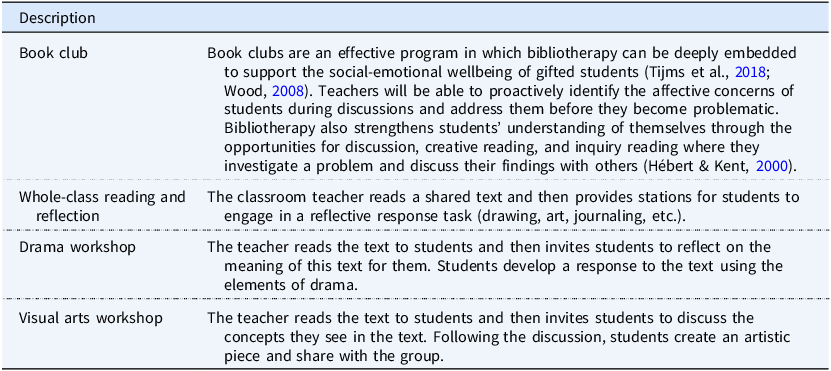
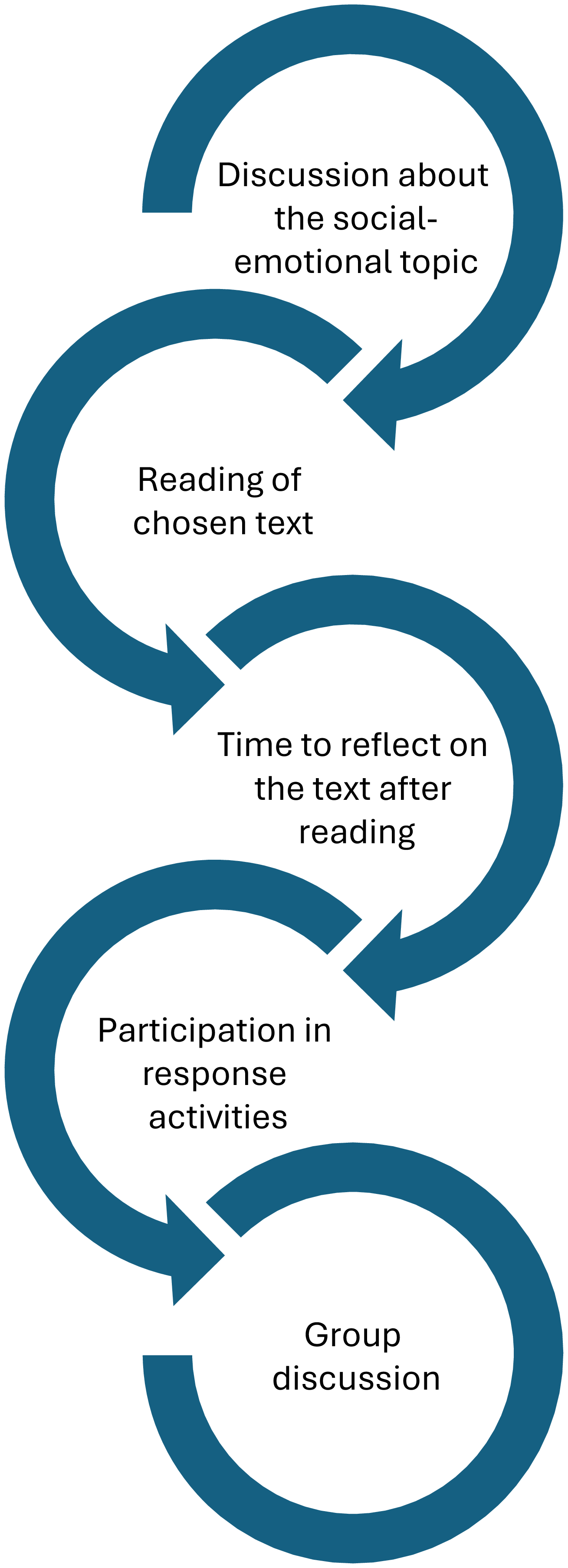
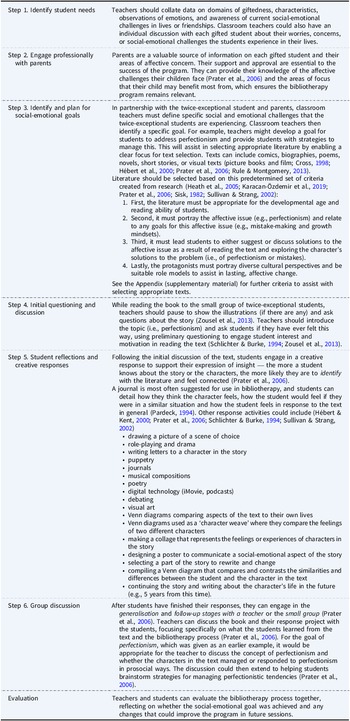
Twice-exceptional students may be supported through bibliotherapy programs, such as those in Table 1, to discuss specific social-emotional problems and develop awareness of coping strategies and solutions (Tijms et al., Reference Tijms, Stoop and Polleck2018). The combination of discussion, development of coping strategies, increased student awareness, and identification of solutions gives students the power to cope with foreseeable affective challenges (Cornett & Cornett, Reference Cornett and Cornett1980; Sevinç, Reference Sevinç2019; Tijms et al., Reference Tijms, Stoop and Polleck2018). A structure for bibliotherapy that includes these elements can be seen in Figure 1. The development of these coping strategies is essential to the social-emotional wellbeing of twice-exceptional students in primary school settings because they provide relief from emotional pressures (Cornett & Cornett, Reference Cornett and Cornett1980).
A Sample of Bibliotherapy Program Options

The Structure of Bibliotherapy Interventions. Figure adapted from Schlichter and Burke (Reference Schlichter and Burke1994) and Zousel et al. (Reference Zousel, Rule and Logan2013).

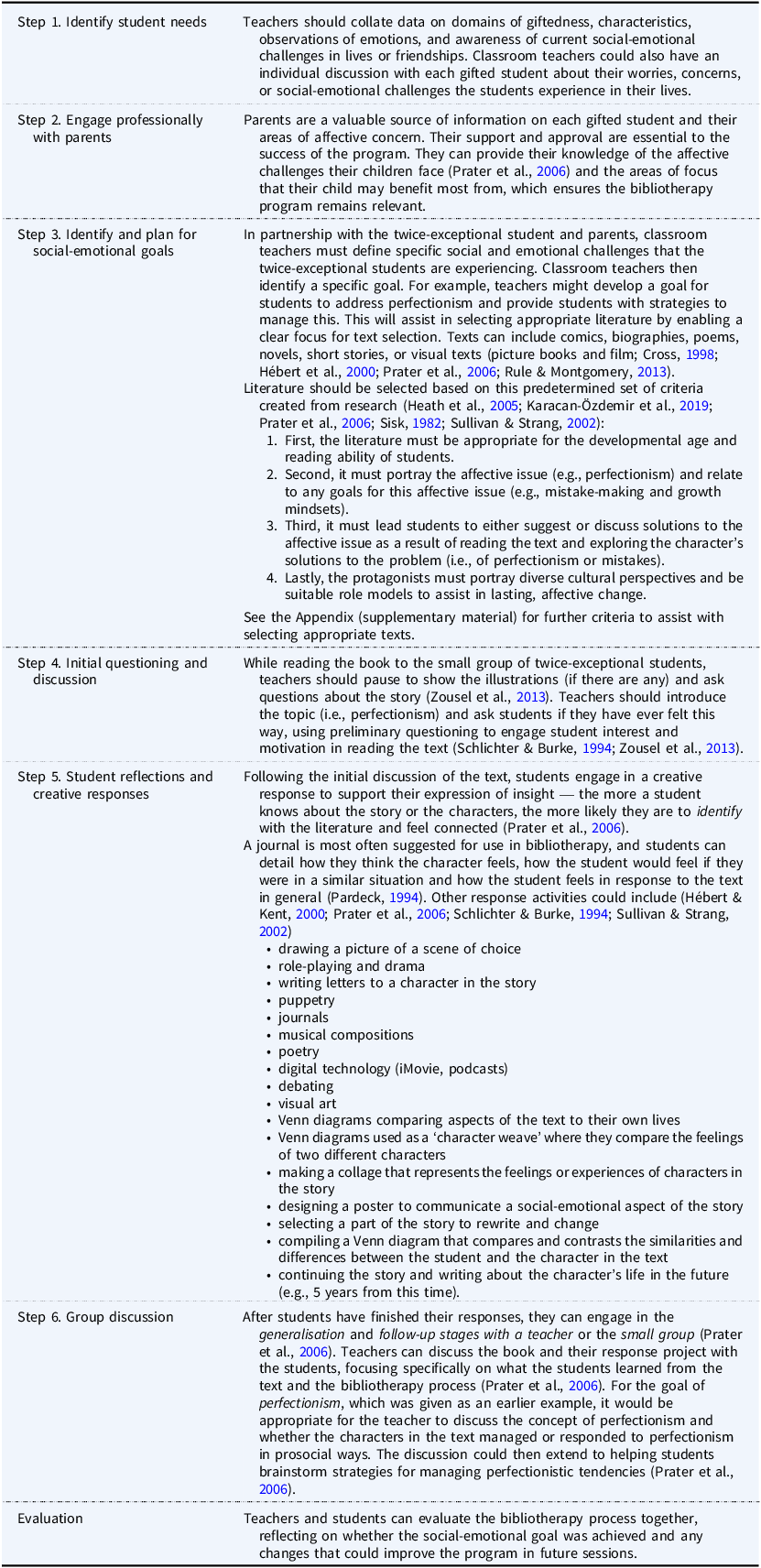
To implement an effective bibliotherapy program, teachers must have an existing rapport with students, be able to captivate students’ engagement, and motivate students to engage interactively in group discussion (Prater et al., Reference Prater, Johnstun, Dyches and Johnstun2006; Sisk, Reference Sisk1982). Bibliotherapy moves beyond reading a book and asking questions, requiring teachers to facilitate discussions that nurture reflection, to provide students with considerable amounts of thinking time, and support the students to achieve insight (Schlichter & Burke, Reference Schlichter and Burke1994). Bibliotherapy in primary schools will be successful only if gifted students feel comfortable enough to engage in these discussions and opportunities (Hébert & Kent, Reference Hébert and Kent2000). An example of how this process could support the structure of a bibliotherapy program within primary school classrooms can be seen in Figure 1.
Bibliotherapy can be implemented using a simple structure that involves initial questioning and discussion about the affective topic, the reading of the chosen text, time to think about the text, participation in response activities, and then a follow-up discussion as a group (Schlichter & Burke, Reference Schlichter and Burke1994; Zousel et al., Reference Zousel, Rule and Logan2013). Carefully selected literature must, of course, meet the criteria in Table 2 to ensure affective change. During the follow-up discussions, students make connections between the character’s experiences of and response to the affective issue and their own lives (Schlichter & Burke, Reference Schlichter and Burke1994). To ensure that the bibliotherapy intervention has the greatest opportunity for success, students must be given ample time to reflect and engage in a response to the text, leading them to insight (Lucas et al., Reference Lucas, Teixeira, Soares and Oliveira2019). Throughout a well-crafted bibliotherapy intervention, students will journey through the four distinct therapeutic processes: identification, catharsis, insight, and universalisation (Hébert & Furner, Reference Hébert and Furner1997; Lucas et al., Reference Lucas, Teixeira, Soares and Oliveira2019; Sullivan & Strang, Reference Sullivan and Strang2002).
A Guide for Implementation
Potential Barriers to the Success of Bibliotherapy in Schools
There are some potential barriers that could limit the effectiveness of a bibliotherapy intervention, such as lack of rapport, time constraints, suitable literature, and teacher qualifications. To successfully foster affective change through bibliotherapy, teachers must first create a safe and supportive environment for students and motivate them to engage with the protagonist and the text in dynamic ways (Prater et al., Reference Prater, Johnstun, Dyches and Johnstun2006). Some students may not feel willing or comfortable discussing the affective issues in the texts (McCulliss & Chamberlain, Reference McCulliss and Chamberlain2013), and in these instances, the intervention should be discontinued. Teachers possess unique professional strengths that support the effective use of developmental bibliotherapy, including established relationships with students, deep knowledge of students’ learning profiles, and expertise in facilitating age-appropriate discussion and reflection in group settings.
Time constraints are a second potential barrier to the effectiveness of a bibliotherapy intervention. Bibliotherapy is a more involved process than a shared reading of a text with follow-up questioning. Teachers must provide significant time periods for reflection and opportunities to respond in creative ways to achieve insight (Schlichter & Burke, Reference Schlichter and Burke1994).
The third, and considerably large, barrier to the effectiveness of a bibliotherapy intervention is the availability of appropriate literature. Due to the different kinds of social and emotional issues that students may experience, bibliotherapy is not restricted to one type of literature. A variety of literary texts can be used, including picture books, chapter books, novels, biographies, poetry, videos, and podcasts (Baska & VanTassel-Baska, Reference Baska and VanTassel-Baska2018; Casares & Binkley, Reference Casares and Binkley2021). Although it is important to ensure that the selected literature is developmentally appropriate, older children can benefit from young children’s books too, with simplistic presentations of affective challenges sometimes being the most powerful (Ginns-Gruenberg & Bridgman, Reference Ginns-Gruenberg, Bridgman, Kaduson and Schaefer2021). Children’s literature today often addresses real-life issues (regarding social-emotional learning) and can provide opportunities for children to problem-solve in their own lives (Ginns-Gruenberg & Bridgman, Reference Ginns-Gruenberg, Bridgman, Kaduson and Schaefer2021). Through an awareness of each of these barriers, teachers implementing a bibliotherapy intervention can actively work towards reducing the influence of these barriers on the intervention.
Reflection
The first author planned and implemented this practitioner guide within a classroom context. Through reflection on the implementation, it was reaffirming to see how a bibliotherapy intervention can assist teachers to support gifted students in the areas of social-emotional learning related to perfectionism and coping strategies when there is a strong rapport with students. This practitioner guide has been developed to support teachers in their professional practice, with particular relevance for affective growth. However, the authors acknowledge the importance of student–teacher relationships for a successful bibliotherapy intervention. It requires a classroom climate in which students are supported to discuss affective challenges and identify possible solutions to these challenges. To achieve this, it is essential that similar challenges and student characteristics are also reflected in the literature that is being used in the intervention. To conclude, bibliotherapy offers a powerful opportunity for classroom teachers to support gifted and twice-exceptional students with their social-emotional autonomy and wellbeing.
Future Directions
More than two decades ago, the need for research on effective interventions to support the social-emotional development of gifted students with ADHD was identified (Foley-Nicpon & Candler, Reference Foley-Nicpon, Candler, Pfeiffer, Shaunessy-Dedrick and Foley-Nicpon2018; Leroux & Levitt-Perlman, Reference Leroux and Levitt-Perlman2000; Moon et al., Reference Moon, Zentall, Grskovic, Hall and Stormont2001). Although many interventions for social-emotional learning are not necessarily designed for gifted students with ADHD (Foley-Nicpon & Candler, Reference Foley-Nicpon, Candler, Pfeiffer, Shaunessy-Dedrick and Foley-Nicpon2018; Lee & Olenchak, Reference Lee and Olenchak2015), it has been suggested that many interventions could still be beneficial for twice-exceptional students (Foley-Nicpon & Candler, Reference Foley-Nicpon, Candler, Pfeiffer, Shaunessy-Dedrick and Foley-Nicpon2018). Research exists on the benefits of bibliotherapy for gifted students and the development of social-emotional skills; however, more studies involving gifted students are needed. A gap has been identified in the research on social-emotional competencies of students with ADHD (see Martin et al., Reference Martin, Cumming, O’Neill, Strnadová, Frydenberg, Martin and Collie2017; Smith, Reference Smith, Piske, Stoltz, Rocha and Costa-Lobo2020); thus, there is an opportunity for future studies to explore bibliotherapy as a potential tool for social-emotional learning with this student population.
Leroux and Levitt-Perlman (Reference Leroux and Levitt-Perlman2000) advocated for adequate emotional support and training through affective interventions for gifted students with ADHD. To ensure adequacy and rigour, these emotional support and training interventions must use a strengths-based approach, honour diversity among students, and focus on social-emotional competencies (Baldwin et al., Reference Baldwin, Omdal and Pereles2015; Foley-Nicpon & Candler, Reference Foley-Nicpon, Candler, Pfeiffer, Shaunessy-Dedrick and Foley-Nicpon2018; Fugate & Gentry, Reference Fugate and Gentry2016; Smith, Reference Smith, Piske, Stoltz, Rocha and Costa-Lobo2020). These interventions should harness creative expression (videos, drawing, role-playing, cartoons, blogs) and explicitly teach social-emotional competencies in small groups with like-minded peers (Gentry & Fugate, Reference Gentry, Fugate, Pfeiffer, Shaunessy-Dedrick and Foley-Nicpon2018; Smith, Reference Smith, Piske, Stoltz, Rocha and Costa-Lobo2020). Bibliotherapy is an intervention that can build on strengths, honour diversity among students, explicitly teach social-emotional competence, and harness opportunities for creative expression. Researchers at Brigham Young University (2018) have developed a series of lesson plans for bibliotherapy and the five social and emotional competencies in the Collaborative for Academic, Social, and Emotional Learning (CASEL) Framework (2025). These resources have been developed for teachers to use in bibliotherapy programs and are underpinned by the CASEL framework, providing opportunities for teachers to use literature and bibliotherapy approaches for social-emotional learning (Heath et al., Reference Heath, Smith and Young2017). The CASEL Framework operationalises social-emotional competence into five key areas: self-awareness, self-management, social awareness, relationship skills, and responsible decision-making (CASEL, 2025). The authors suggest that teachers can embed bibliotherapy into primary schools to better support the needs of twice-exceptional students, gifted students, students with ADHD, and all other students within the school community.
Conclusion
Social and emotional competence is an important component of wellbeing for twice-exceptional students. This student population can experience lower levels of self-esteem and self-concept in schools, conflict with teachers and peers that leads to social exclusion, and feelings of shame and confusion in schools.
This article presents a guide for teachers to use bibliotherapy as a potential tool to meet the needs of twice-exceptional students within their classrooms and foster higher levels of social-emotional competence and wellbeing for this population. The guide deliberately includes safeguards to support appropriate implementation, including
-
• clear differentiation between developmental and clinical use
-
• collaboration with parents and support staff
-
• emphasis on indirect engagement through text rather than personal disclosure
-
• explicit acknowledgement of when bibliotherapy should be discontinued or referrals made.
Schools are uniquely positioned to provide preventive, universal supports that reduce the likelihood of social-emotional difficulties escalating to the point of requiring clinical intervention. Developmental bibliotherapy operates at this preventive level, supporting students to normalise emotional experiences, recognise coping strategies, and develop social-emotional competence before difficulties become entrenched.
Supplementary material
To view supplementary material for this article, please visit https://doi.org/10.1017/jsi.2026.10013


 Open access

