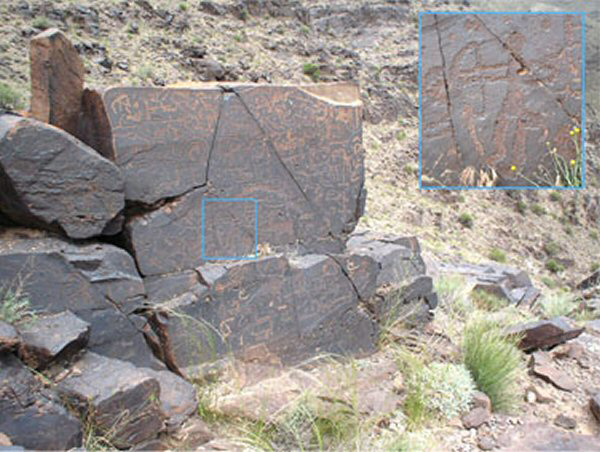


View of the main group of petroglyphs in Kahak.

While frequent and numerous rock art sites in different parts of Asia, including Central Asia (Francfort 1988), Caucasus (Veli 2003), the Indian sub-continent (Chakravarty & Bednarik 1977) and the Levant (Reference AnatiAnati 1996) have been described, discussed, analysed and explained in numerous publications, those of Iran have attracted little attention.
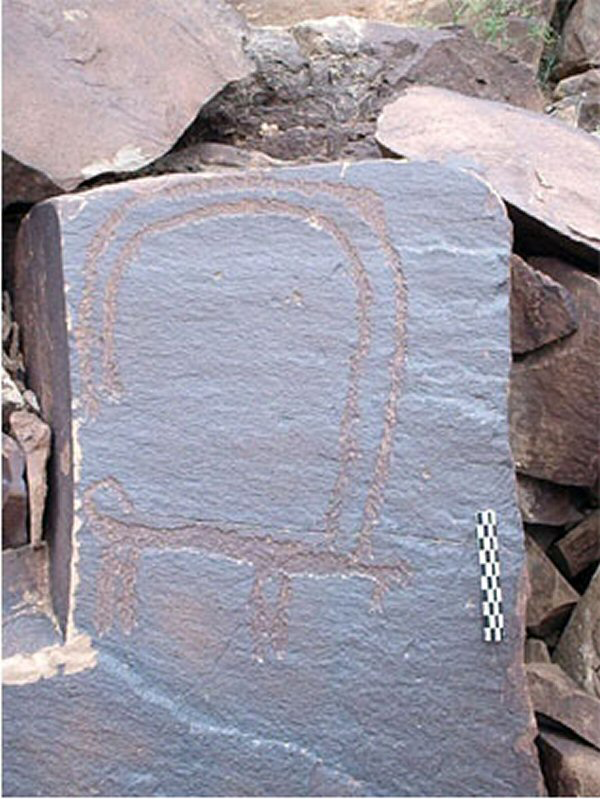
Long horn ibex, accumulated varnish in this motif is easily distinguishable.

Rock art studies in Iran have been carried out irregularly by some Iranian and a few foreign researchers. Parietal art in the Doushe cave and Mir Malas rock shelter in the Kouhdasht area (western Iran ) were among the first rock art sites to attract notice (Izadpanah 1969; Reference BewleyBewley 1984; McBurney 1996). The discovery of a new series of pictographs in the Homian valley, located close to the Doushe and Mir Malas paintings, by archaeologists from Lorestan Cultural Heritage led to new studies in this area (Garajian et al. 2001). Field research carried out by a joint Belgian-Iranian team in 2005 is the most recent effort to identify a new series of rock art in this part of Iran (Remacle et al. 2006).
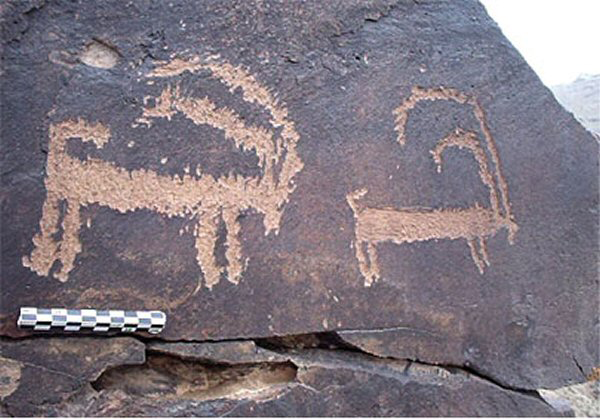
The degree of patination is not significant on these animal figures.

In the more northern parts of the Homian region, in Kurdistan , surveys have documented some new and rich localities dominated by petroglyphs (Lahafian 2004). Apart from western Zagros, the rock carving sites of the central plateau of Iran have been published in a good illustrated volume (Farhadi 1998). There are also reports of the extensive and frequent rock carvings in south-east Iran close to the Pakistani frontier (Heidari 2002).
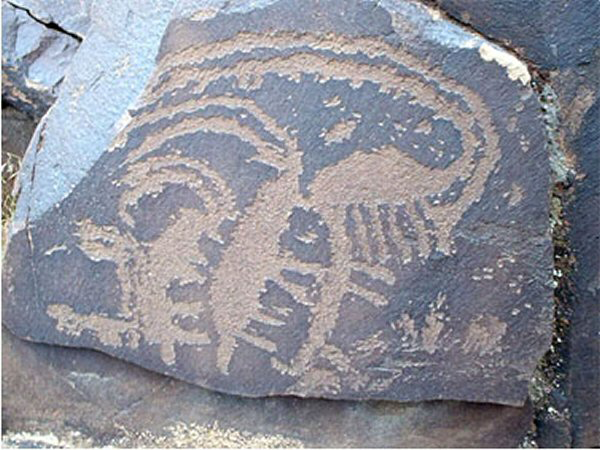
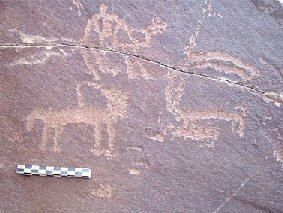
Small panel of zoomorphic motive in the Kahak region.

Surveys in north-western Iran , close to southern Caucasus have yielded new sites, again predominantly of petroglyphs (Reference RafifarRafifar 2002; Reference PedramPedram 1994). The closeness of these sites with the well-known rock art site of Gobostan can be considered a basis for future studies.
Two horsemen with an ibex, Kahak.

In spite of the richness and prevalence of rock art sites throughout Iran, current studies are short-term and disconnected. There is a need for consistent chronology, theorising of information on the techniques and tools used, knowledge concerning preservation status and appropriate data on geographical distribution of sites. Accordingly, the Institute of Archaeology at Tehran University is initiating a co-ordinated campaign of study. We have selected a group of new rock art clusters in the Kahak region, located 35km from Qom city in the central plateau of Iran. The close proximity of the Qom region to the desert leads to a climate which is arid in summer and relatively temperate in winter. As a result, rock art sites in this part of Iran are relatively well conserved. The patination and desert varnish on the rock art is significant. A large number of the engravings are animal figures, which have been carved on flat cliffs and rock boulders with various techniques and, most probably, at different times (Mohammadi in press)
Our plans, not only for Kahak but for other rock art sites in different parts of Iran, include the creation of a comprehensive map of rock art sites, deposits (patina or varnish) from the rock coating for direct dating, laboratory analyses of sampled pictographs (particularly of Homian rock art) to know which kind of pigments were used, conducting microscopic studies to find out the techniques and tools used, exploring new interpretations and evolving a series of methods for conservation of the rock art sites. None of these approaches have been used until now. They will require the assistance and the co-operation of Iranian and foreign researchers.
Acknowledgements
I would like to thank F. Biglari, S. Shidrang and R. Naderi at the Center for Paleolithic Research, National Museum of Iran and Y. Hassanzadeh for all of their help and encouragement.