




The 1988 commemorations for the abolition centennial in Brazil coincided with a period of redemocratisation, after two decades of military rule. As a new constitution was being drafted by an assembly of 559 representatives, only eleven self-identified Afro-descendants were part of that group. Four of them, collectively known as the bancada negra (Black Caucus), were particularly active in crafting progressive legislation.Footnote 1 When asked for their opinion about the meaning of the abolition celebrations, they bluntly stated that there was nothing to commemorate, as racism and racial injustice persisted.Footnote 2 Similar criticisms were voiced by performing artists, especially in popular music and theatre. In February, the mismatch between official narratives and the country’s notorious social inequality resonated in the sambas-enredo (theme-songs) of the three top-ranked samba groups at Rio’s nationally televised Carnaval parade. The escolas de samba Beija-Flor, Mangueira and Vila Isabel did not spare the so-called abolition heroine, Princess Isabel, who signed the 1888 emancipation law, claiming that the real heroes were the black men and women who resisted slavery. Vila Isabel highlighted freedom-seeker Anastácia and the seventeenth-century maroon leader Zumbi dos Palmares, while also condemning the apartheid in South Africa. Mangueira paraded with the theme ‘A hundred years of freedom: reality or illusion?’, which demanded a new political leadership through the figurative return of Zumbi, while questioning the significance of the Golden Law (which abolished slavery) in a memorable line of its samba-enredo: ‘free from the whipping in the slave quarters / imprisoned in the poverty of the slum’. Likewise, Beija Flor’s samba-enredo, also sung by 60,000 people at Rio’s Sambadrome, was a call to action: ‘freedom has dawned, equality has not […] we demand true freedom’. A few months later, on 11 May, two days before the centennial holiday, the Brazilian black movement emphasised these arguments in the ‘march against the abolition farce’. More than five thousand demonstrators showed up in downtown Rio, but as they started to walk the military police forcefully made them change their route.Footnote 3 The following day, the city-organised commemorations included open-air interventions by capoeira and Afro-Brazilian dance groups, culminating in the performance of Missa dos Quilombos (Mass of the Maroons), with music by Milton Nascimento. The ceremony opened with a strong reprimand against police actions the day before, followed by liturgical texts interspersed with poems by Pedro Casaldáliga and Pedro Tierra addressing slavery and black resistance.Footnote 4
Opera also made its way into that mix of celebration and protest, being featured in concerts and a TV special. But as an art of social privilege and a marker of exclusivity, opera epitomised some of the very attitudes being denounced at that historical moment. To counterbalance that perception, a number of intellectuals and cultural producers advanced a more historically nuanced approach,Footnote 5 acknowledging that Brazil’s foremost opera composer, Antonio Carlos Gomes, of black, indigenous and Portuguese ancestry,Footnote 6 had composed an opera with abolitionist undertones, Lo schiavo, which premiered in 1889. But they also knew this was a complicated piece. The original storyline proposed by Alfredo D’Escragnolle Taunay in the early 1880s involved contemporary Atlantic slavery, but this realistic plot, in line with emerging verismo ideals, was modified early in the creative process to become a story about indigenous enslavement by Portuguese settlers in the mid-sixteenth century, at the very beginning of the colonial process. The narrative accepted as genuine by the producers in 1988 was that this transformation had been an imposition of the editor Giulio Ricordi and the librettist Rodolfo Paravicini. But a careful reading of Carlos Gomes’s letters to both Ricordi and Taunay shows that the composer was aware of the change, maybe devising it himself as a strategy to repeat the success of his previous opera, Il Guarany. Resonating with the empowering revisionist initiatives of the centennial celebrations, the 1988 producers enacted a restorative strategy, which required some compromise. First, they relocated the plot to the early 1800s. The original black protagonists from Taunay’s original draft were brought back, but in an altered form. The text of the vocal numbers could not be changed, but only a few numbers were rehearsed and recorded, and a narrator provided the new context. Lo schiavo was produced and broadcast nationally by the public television channel TVE, on the evening of 13 May.
In that same year, another narrative about opera and emancipation emerged abroad, based on a different premise and supported by a much higher budget. Franco Zeffirelli’s biopic Young Toscanini presented a semi-fictionalised account of the maestro’s famous debut in 1886 as a member of the touring company of Claudio Rossi. The Italian-American production foregrounded Verdi’s Aida in the context of the abolition campaign, including sixteen minutes of excerpts from the opera. Although taking Brazilian critics and intellectuals by surprise, this story was not a complete fabrication. Already in 1977 Guilherme Figueiredo, brother of the last military president, General João Baptista Figueiredo, had suggested an idea for a movie about Toscanini’s debut in Rio, a narrative that he embellished with tropes rooted in colonial violence that had emerged over the centuries including the seductive mulata, the ‘benevolent’ enslaver and racial democracy.Footnote 7 In his chronicle he even described a love encounter between the conductor and a fifteen-year-old black Brazilian girl, a singer of lundus and modinhas. In a secondary plot line based on historical evidence, Figueiredo addressed an abolitionist intervention made by the company’s prima donna during another performance of Aida a few weeks later. In 1980, with the approaching abolition centennial in mind, Figueiredo pitched the idea to Zeffirelli, who was then producing La traviata in Rio. Zeffirelli liked it and kept in touch with him while working on other projects. The director came back to Rio in late 1986, already looking for shooting locations and negotiating a film contract with Brazil’s media network Manchete.Footnote 8 Word even got out that Brazilian soap opera star Maitê Proença would play the role of Princess Isabel. The two gentlemen fell out shortly after, however.Footnote 9 After Figueiredo sued Zeffirelli for plagiarism, the director decided to remove some of the potentially litigious passages from the script,Footnote 10 and quickly filmed in Tunisia, Italy and Portugal. To the dismay of a number of Brazilian journalists who saw Young Toscanini in 1988, Zeffirelli hailed the 1886 production of Aida as the catalyst for the events that would culminate in the abolition, which ran counter to the official history.
This article situates the TVE production of Lo schiavo and Zeffirelli’s Young Toscanini in the context of the abolition centennial, when the memory of slavery became a strongly contested space. Decades of cultural whitewashing promoted by a succession of authoritarian governments resulted in incomplete and elitist narratives of emancipation, from which the alternative versions by Figueiredo and Zeffirelli emerged as a natural outgrowth. With the redemocratisation of the 1980s, that official history was challenged by Brazilian society through a number of debunking and restorative initiatives from diverse sectors, from movimento negro, popular music artists and Rio’s carnival associations, to universities, public television and art-music institutions. One example of this is the opera-film version of Lo schiavo, which ended up being rebuked by conservative music critics. After an initial discussion of these developments, this article will then delve more deeply into the history of abolitionist interventions by nineteenth-century activist artists and the events and processes that connected the 1880s stagings of Aida and Lo schiavo with the abolitionist movement.
Aida
There was booing and laughter at the screening of Young Toscanini in the 1988 Venice Film Festival. Someone even threw a tomato at the screen. Critics found particularly laughable the scene in which Elizabeth Taylor, playing Aida in blackface, delivered an abolitionist speech demanding that the Brazilian emperor end slavery.Footnote 11 To be fair, the poor reception of the movie was also a rebuke to Zeffirelli’s ongoing campaign against The Last Temptation of Christ, screened at the same festival. His alleged statement that Scorsese’s movie was a product of the ‘Jewish cultural scum of Los Angeles’ made international headlines and rendered his own movie toxic.Footnote 12 Even after a public apology, Zeffirelli failed to secure a US distributor for Young Toscanini, which for a high-budget independent production in the 1980s was the equivalent of a death sentence.Footnote 13
The movie recounts two episodes of Claudio Rossi’s 1886 tour (30 June and 10 August), condensed into a single event. The first was Toscanini’s celebrated debut in June as an orchestra director after Leopoldo Miguez relinquished his post and the audience rioted against the assistant conductor Carlo Superti.Footnote 14 Less publicised internationally, but more impactful locally, was the abolitionist intervention of José do Patrocínio and the Russian prima donna Nadina Bulicioff during the August performance of Aida, also with Toscanini on the podium, when the singer handed freedom letters to six enslaved women. Although neither of these events was portrayed accurately in the movie, the second one was so detached from narratives constructed around the maestro, and for that matter around Italian opera, that it just vanished from collective memory.
‘Biographical movies are tedious and hard to make’, Zeffirelli complained.Footnote 15 Young Toscanini alternates between reality and fiction, mixes up the timeline, ignores a number of key figures and events, fabricates others, and often condenses in one scene and only a few characters the actions of multiple individuals over a long period of time – just like so many operas. These strategies are often unavoidable when one has little time to deliver a convincing narrative based on events that happened over a long period of time. Moreover, in order to secure a Hollywood distributor for a feature film, it is (or used to be) necessary to stick to the so-called high concept – a clear, simple and believable premise that runs through the film and can be summed up in a single phrase, the logline. As the screenwriter William Stadiem explained, Young Toscanini was:
The Graduate in Rio in 1880, in which Mrs Robinson was a famous La Scala diva living in Rio as the mistress of the Brazilian emperor. Young Toscanini, then an itinerant musician, became her vocal coach/lover as well as her conscience. As a student radical, he was appalled that Brazil still had slavery and he used his affair to convince her to convince the emperor to free the slaves, which was done during a performance of Aida with all its Egyptian slaves on the stage. It was totally strange but all true, and it was the antithesis of Hollywood’s high concept. You could hardly sum it up in a page, much less a phrase.Footnote 16
Opera, slavery and the prodigy maestro were a strange mix. And in spite of Stadiem’s assurance, the argument’s details were not all true.Footnote 17 The real Bulicioff was not the emperor’s mistress, Toscanini did not convince her to persuade Dom Pedro II to end slavery, and slavery did not end because of a performance of Aida. Zeffirelli designed this alternative reality to emphasise existing narratives of Toscanini as a hero and, more generally, of Europeans as carriers of civilisation, while combining early operatic plot devices with Hollywood clichés, from the love triangle and the love-duty dilemma to the troubled young idealist and the motivational speech.
At least two loglines for Young Toscanini appeared years later, one on Rotten Tomatoes and the other on the Internet Movie Database. Neither was able to incorporate in a single statement the three elements Stadiem clearly mentioned: the maestro, the diva and slavery.
Italian cellist Arturo Toscanini (C. Thomas Howell) soothes a prima donna (Elizabeth Taylor) and becomes a conductor. – Rotten Tomatoes
A fanciful biopic of legendary conductor Arturo Toscanini as a young man. – IMDB
At the Venice Festival’s press conference, Brazilian journalist Caio Túlio Costa, from the newspaper Folha de São Paulo, accused Zeffirelli of ignoring Brazilian history and creating a false narrative of the abolition. Zeffirelli answered that the journalist did not know the history of his own country. Both were partially correct.Footnote 18 Following the interview, Costa wrote: ‘Any person in the world who does not have the slightest idea about Brazil, seeing this movie will believe that Toscanini and the opera singer Bulicioff (portrayed in the movie as the mistress of Emperor Dom Pedro II) freed the slaves in Brazil.’Footnote 19 Interestingly, Costa’s words can be arranged as an effective logline: A debuting Italian conductor and a Russian prima donna end slavery in Brazil.
Zeffirelli was obviously not proposing a revisionist narrative of the abolition of slavery; quite the opposite. The new abolition hero was still a white woman, just a foreign one. But for the local elites, forgetting Princess Isabel was unforgivable. Realising that he was on the verge of losing a significant market, Zeffirelli called the Brazilian journalists for a private, conciliatory conversation. It was only then that he declared: ‘The movie is a fable of my own, supported by some moments of truth. It should not be taken as reality, it’s a fantasy.’Footnote 20 Scorsese had to make a similar disclaimer during the festival, stating that The Last Temptation was a fictional experience. And if Scorsese invited viewers to contemplate other ways of thinking about divinity and humanity,Footnote 21 it is possible that Zeffirelli and his diva, in a more aristocratic fashion, wanted their audience to consider current forms of social oppression and unresolved racial issues, as narrated by Arthur Dapieve: ‘According to him, Elizabeth Taylor only accepted the role because of the – bizarre – final speech. The hammy actress wanted to be engaged, “like the artists who spoke against apartheid”. In Zeffirelli’s optics, “Bulicioff was what Jane Fonda is today”.’Footnote 22 The international outcry against apartheid and the role played by artists to raise awareness and put pressure on the South African government were likely on Zeffirelli’s radar when he was working on the script and thinking of a possible cast. Taylor was involved in AIDS relief efforts and HIV decriminalisation initiatives. In spite of Dapieve’s dismissive remarks, she was an engaged artist.
Zeffirelli’s reading of Aida presents the Ethiopian enslaved girl in the Old Kingdom of Egypt as a metaphor for nineteenth-century African slavery in Brazil. Off-screen, there was an undeveloped intention to address apartheid in South Africa. Taylor’s speech, mocked by both the Brazilian and Italian press, is ambiguous enough to allow this interpretation. The monologue appears in the movie at 1:37:47, corresponding to Act II scene 3 of the opera. Right after the priest chorus, when Ethiopian prisoners and Amonasro are brought onstage, Bulicioff/Taylor breaks the fourth wall and addresses the audience:
Your Imperial Highnesses, ladies and gentlemen, maestro … forgive me.
We are here to listen to an opera about slavery.
You’ve come to be swept away by the sublime music of Verdi.
But as someone pointed out to me, there are things that are even more important than music.
Slavery is one of them! And we must do something about it! [booing, hissing, cheering]
I want to help by donating this ring. It is a most treasured and beloved gift from someone I love and admire [close-up on the emperor]. But tonight, I am donating it to the organisation for the abolition of slavery. [cheering, applause]
As of this moment I have set free my own slaves. [audience stands and applauds]
It will not be easy for them to adjust to the strangeness of freedom, and it won’t be easy for us either. But if we open our hearts to help them, perhaps, they will forgive us the injustices of the past and we will all awaken to a new and glorious dawn of this beloved country.
Long live Brazil! [cheering; close-up on the imperial family, including Princess Isabel, leaving their seats and the theatre]
Dapieve and Italian journalist Tulio Kezich accused Zeffirelli and Taylor of naively suggesting that a wide range of social and racial injustices could be solved with a speech.Footnote 23 Apparently trying to find common ground, it places the burden on the oppressed. They were the ones expected to forgive and forget centuries of forced labour and denial of their fundamental rights. The concluding line suggests that slavery lasted for such a long time because ‘it would not be easy’ for the enslaved ‘to adjust to the strangeness of freedom’! Intentionally or not, this appalling argument resonates with the politics of gradual emancipation embraced by Brazilian society at the time.Footnote 24
Zeffirelli’s misconstruction of this particular performance becomes less intriguing when we consider the reception history of this opera. The 1886 performance of Aida in Rio provides an additional layer of meaning to Ralph Locke’s nine readings of empire in Aida. Footnote 25 Locke’s eighth reading – Ancient Egypt as a symbol for any European imperialist ventures outside of Europe – is now thickened to encompass the continuing repercussions of settler colonialism in both Latin America and Africa, including enslavement, segregation and racial inequality and injustice. Likewise, when Locke discusses Edward Said’s main argument about Aida, he provides the key to understanding Zeffirelli’s historical licenses: ‘Said urges that Aida “is not so much about but of imperial domination”. This is to say, the opera is less a comment on or portrayal of the region and its peoples than it is one manifestation or instance of imperialism’s (concrete and conceptual/ideological) network of knowledge-systems.’ Said was referring to the circumstances of Aida’s first production, commissioned by the Khedive of Egypt, and first performed at the Cairo opera house. With this backdrop, the criticisms of Caio Túlio Costa and Arthur Dapieve assume a striking dimension. They are no longer the whining of naive nationalists, unaware of the history of their own country, but the legitimate reprimand of journalists concerned with cultural imperialism and its networks, spaces, venues and agents. Moreover, they expose Zeffirelli’s movie as an object in disguise, in which a thin layer of superficial social content and some factual history conceal a strongly colonialist substance.
Nadina Bulicioff may never have made that speech and never enslaved any individual, but she did deliver manumission documents to six enslaved women during a staging of Aida. It did not happen exactly as portrayed in the movie, but, yes, the imperial family was in the audience and Toscanini was the conductor. Before discussing the details of that 1886 performance of Aida, it is necessary to examine the 1988 production of Lo schiavo and its role in the abolitionist campaign since the early 1880s.
Lo schiavo
Iberê is an enslaved African king. But he was lucky to be the property of Count Rodrigo, whose son, Américo, is a staunch abolitionist. The young man frees Iberê from the plantation’s overseer and acknowledges his leadership in the senzala [slave quarters]. The two men are bonded by friendship. Which crumbles when the abolitionist is sent to the army to put an end to his love for the black girl Ilara. Who ends up marrying king Iberê. Who ends up leading a slave rebellion. Which is finally confronted by officer Américo. –Rogério DurstFootnote 26
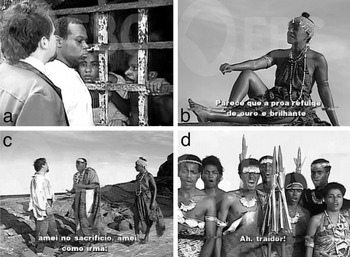
The one-time TV special featuring Carlos Gomes’s opera Lo schiavo was broadcast nationally by state channels TVE and TV Cultura at 23:50 on Friday, 13 May 1988, exactly one hundred years after the emancipation. The concept was to adjust the production to Taunay’s original storyline, which revolved around African and Afro-Brazilian subjects in the early 1800s, as opposed to the sixteenth-century Indigenous characters who populate the final version of this opera. The TV special was filmed, Zeffirelli-style, at the Ilha do Mel, a coastal island in Paraná state (Figure 1). The producers selected only seven vocal numbers and cast black singers in the roles of Iberê and Ilara and the slave chorus.Footnote 27 These numbers alternate with silent action, narrated by celebrity black actor Milton Gonçalves, minimally accompanied by a solo guitar. In the first of these silent scenes, representing the slave quarters, one hears the drums and voices of a ponto de candomblé.
Lo Schiavo: (a) prologue, with spoken narration; (b) Act IV scene 5, Romanza d’Ilara; (c) Act IV scene 9, Ibere, Americo, Ilara; (d) Act IV scene 10, Coro. TVE, 1988. Reproduced with permission from EBC - Empresa Brasileira de Comunicação.

Journalist Rogério Durst located the plot in a ‘bizarre past, where black freedom fight mixes up with the exaggerated white operatic aesthetics’.Footnote 28 Writing a few days later, Marcus Góes used harsher words:
They managed to intersperse atabaques [drums] with passages of Italian opera, in a quite indigestible mixture. Gentlemen, one cannot mix quilombos [Maroon refuges] with Tosca. Nor with Lo schiavo, a work that is viscerally tied to the 1800s Italian operatic tradition […] Bringing this inspired example of Italian melodism from the last century to celebrate the abolition is naive, to say the least. […] My advice: burn the tape, do not allow anybody else to see the monster.Footnote 29
Góes’s remarks predate by five months Donington’s famous appeal not to muddle opera productions with ‘polemical insinuations or any other contaminants from the intellectual sphere, and least of all as well-meant social propaganda’.Footnote 30 These conservative, originalist views resonate with what Geoff Baker described as the seduction of the colonialist message, a trap that may be avoided with performance choices that reveal the imperial and colonial powers that hide behind the attractiveness and harmoniousness of a musical work.Footnote 31 Three additional productions in 1988, all in concert form, stressed the social relevance of Lo schiavo in the context of the abolition centennial. One of them, on the evening of 13 May at Rio’s Theatro Municipal, also featured a cast of black singers.Footnote 32
At the 1889 premiere, many in the audience loved the surprise of seeing another Indianist opera; it not only looked like Il Guarany, it sounded even better. Yet some journalists, particularly Oscar Guanabarino, harshly criticised its historical missteps and misleading title. As a way of distancing himself from the final libretto, Taunay published in two newspapers an article revealing the basic plot he had drafted for Carlos Gomes nine years earlier,Footnote 33 which is partly followed by the TVE production, although the latter kept the Indigenous-sounding names of the libretto. One notable difference is that Iberê, originally the domestic enslaved biracial Ricardo, is transformed into an imprisoned black king in the 1988 production, certainly as a result of the increased interest for Zumbi dos Palmares. Ilara (or Iara) was Analia, whom Taunay described as an ‘almost white’ house handmaid, lovingly raised and educated by Américo’s mother, the countess. At some point before becoming Ilara, Gomes changed Analia’s name to Isaura, suggesting a connection with Bernardo Guimarães’s novela A escrava Isaura, about another ‘almost white’ enslaved girl. He changed her name again after the autumn 1884 premiere of Luigi Mancinelli’s opera Isora di Provenza. Footnote 34 The transformation from black to indigenous slavery had already been decided around this time, with the knowledge of Taunay, who revealed the sources for the new storyline: ‘[Carlos Gomes] asked for books about the history of Brazil, which were soon shipped by [Francisco] Castellões, among them the six volumes of Robert Southey and the Conjuração [sic] dos Tamoyos.’Footnote 35 The epic poem A Confederação dos Tamoios, by Gonçalves de Magalhães, tells the story of Aymberê, a Tupinambá chief who escaped enslavement in São Paulo in the mid-sixteenth century to lead a resistance campaign against the colonists in Rio de Janeiro and Niterói. However, other aspects of the new storyline came from different sources, as Gomes revealed in his pitch to Giulio Ricordi in 1883:
As soon as you have a little time to carefully read the libretto of the Schiavo, let me know so I can send it to you. I will play the music for you later. This opera seems to me like the Guarany with a more interesting plot, but without any point of contact, although the subject is inspired, on the one hand, by the Danicheff, on the other by an episode of Brazilian slavery.Footnote 36
Gomes and Taunay knew very well the Russian-fashioned melodrama Les Danicheff, by Alexandre Dumas and Pierre Corvin-Kroukhovski, as it was staged in both Milan and Rio in the late 1870s. Its main characters are replicated in Lo schiavo. Moreover, the landowner elite and the serfs/enslaved individuals with no rights are engaged in an identical love triangle, identical hierarchies and a similar resolution, with the male serf forsaking love in favour of his upper-class colleague and performing an act of self-sacrifice at the very end (notwithstanding the different methods: in Les Danicheff, the heroic male serf becomes a monk; in Lo schiavo he kills himself to avoid being slain by his rebel fellows after betraying them to save Américo).
One of Carlos Gomes’s closest friends was the black engineer, journalist and leading abolitionist André Rebouças. Also a friend of Taunay, Rebouças was aware of the plans for the new opera and on 9 November 1880, the day Gomes embarked for Italy, he disclosed them to the general public. This was the first of several articles that fed anticipation around the opera over the next months:Footnote 37
The emancipation movement, in which [he] so brilliantly participated, gave him the generous idea of writing an abolitionist opera, whose plot he already has in mind and which will be called La schiava. We cordially wish that this opera surpasses the Fosca and the Maria Tudor, and especially that it becomes as effective as the novel Uncle Tom, by Beecher Stowe, in the extinction of the nefarious slavery.
Despite the fact that the libretto was altered and the premiere delayed, Lo schiavo became entwined with the abolitionist cause from its inception. The analogy with Harriet Beecher Stowe’s Uncle Tom’s Cabin, which circulated in Brazil both as a book and a theatrical play, was a clear testament to the perceived power of abolitionist theatre, no matter how problematic this work may sound to twenty-first-century readers. Identified in the newspapers as a drama of abolitionist publicity, A cabana do Pai Tomás was often performed in events in which freedom letters were handed out to enslaved individuals. The fact that it was followed by several plays on the subject of slavery also gives some indication of the type of impact Rebouças was envisioning for Lo schiavo. Footnote 38 A few months later, Rebouças returned with an update – and a remarkable reference to another work:Footnote 39
Carlos Gomes is not letting fade the generous inspiration to write an abolitionist opera – La schiava, whose plot he already has in mind, and which will be set to verses by the poet Ghislanzoni. […] One cannot trust journalists. At this moment it flows from my pen that we will soon have the pleasant surprise of a prisoners’ Preghiera, which, we hope, will be even more touching than the one in the opera Nabucco by the patriot Verdi, which contributed so much to the emancipation and unification of beautiful Italy!
Rebouças was probably familiar with the analogy made by Padre Antonio Vieira between Jewish captivity in Babylon and African enslavement in Brazil,Footnote 40 and he knew that ‘Va pensiero’ had been included in the programming of abolitionist events.Footnote 41 Yet, Gomes did not find a suitable place in the libretto to include anything like ‘Va pensiero’. There are some exciting choral numbers in the opera, particularly when the Tamoyo are planning their attack, or when they feel betrayed by Iberê, but these passages explore different affects. In spite of that absence, Rebouças understood that an opera could be read as an abolitionist text even if it did not specifically address Atlantic slavery. Moreover, the emancipation and unification of Italy resonated with the abolitionist goal of emancipation and racial coexistence and inclusion, and, just like Verdi, Gomes could contribute to that.
Rio’s newspapers show that in 1886 at least one aria from Lo schiavo was already circulating around the city, in a benefit performance in July by the dilettante Carlota Martins de Toledo Dodsworth, Baroness of Javari. This was likely ‘Sonno oggi schiava’ (probably supplied by Gomes), which was sung by Ilara at the opening of the third act. The Gazeta da tarde columnist Ambrósio noted that this aria – probably Ilara’s ‘sorrow song’ – made it onto the programme thanks to a personal request from Princess Isabel – which was ironic, given that her father, the emperor, had just restarted internal slave traffic. ‘Who knows!’ concluded the columnist, ‘maybe the slave’s fate is tied to the sweet harmony of a volata [ornamentation, lit. flight].’ In 1887 the aria was performed again in Rio at a benefit concert to honour the recently deceased abolitionist singer Luísa Regadas.
A few days after receiving news of the signing of the Golden Law, Carlos Gomes wrote to tenor Innocenzo De Anna: ‘the unexpected decree of 11 May that in the Brazilian capital gave freedom to all, also gave me the ability to free my long-time slave … from my disheartening impotence’.Footnote 42 Free from all self-censorship and the fear of alienating part of his audience, he could finally conclude and stage Lo schiavo, more as a celebration than a call to action, but still tied to the memory of slavery. And it was in that celebratory mood that a few months later the opera premiered in Rio, in September 1889.
Engaging the Diva
The abolitionist movement of the 1870s and 1880s operated on a variety of fronts. Lawmakers worked at the political and legislative levels, hoping to reach a permanent resolution. At the other end of the spectrum, militant lawyers and journalists, most notably the radical liberals, worked directly with affected individuals, promoting forceful and often unlawful interventions. Activist artists occupied a middle ground. Referring to a more recent period, T.V. Reed summarised their role as encouraging, empowering, informing, historicising and enacting the movement’s goals, and challenging dominant ideas, all while still making room for pleasure.Footnote 43
Theatre became a privileged space for abolitionist societies to energise their base and attract new members, and musical interventions were a common feature of their meetings. Conference cycles and regular business meetings were attended by a committed audience, who engaged firmly with local artists and repertory. Between August and October 1880, the Gazeta da tarde reported a series of abolitionist conferences, named after Carlos Gomes, which specifically included interventions featuring instrumental music. Some of these numbers were performed or composed by black artists active in the city’s theatres and the Conservatoire, including composer and director Henrique Alves de Mesquita and the flutist Gregorio Couto, well known as an excellent choro player, who also performed music by Joaquim Callado.Footnote 44 In addition to offering purely aesthetic pleasure, their performances and repertory choices cut through social hierarchies and functioned as political and racial arguments, as John Street has argued.Footnote 45
Co-opted opera stars would often perform at fundraising events, attracting larger and more varied crowds. Fundraising was an essential component of the movement, allowing the negotiation of manumissions and lobbying legislators. These events became so popular that critics reviewed the musical performances in local newspapers like any regular concert.Footnote 46 Since the goal was to bring in wealthy aficionados, which included notorious enslavers, these performances represented a risk for visiting artists of alienating their fans and jeopardising their tours. Notwithstanding this danger, opera artists were particularly effective in attracting subjects to join the movement, so much so that from 1886 these large meetings were strongly repressed and their musical component greatly reduced. The Grand Matinée of January 1884, sponsored by the Brazilian Abolitionist Confederation was one of the most impactful of them, bringing together several opera singers and other artists stationed in the city. The co-repetiteur Luigi Francescolo, known as a ‘benefactor abolitionist maestro’, brought nine Italian colleagues from the Vincenzo Tartini company. Joined by four Italians from other companies, together with one Uruguayan, one Frenchman and four Brazilians, they performed the following programme:
First part
Symphony, with the martial band
Report of events of the week, with Dr. José Mariano
Conference ‘The harmonic solution for the problem of slavery’, with Dr. Ennes de Souza
Second part
Non ti voglio amar, Augusto Rotoli, with Eugenia Leone (soprano assoluta), Amelia Leone (piano)
Ballata Gennariello, from Salvator Rosa, Carlos Gomes, with Ida Giglione (soprano leggero)
Navio Negreiro (The Slave Ship), Castro Alves, recited by the Italian actor Colantoni Rossi
Aria, with Mme Henry
Carmen pot-pourri, Georges Bizet, with the martial band
Serenata, Gaetano Braga, with Luiza Regadas (soprano), J. Martins (violin) and Luigi Francescolo (piano)
Cello variations, with Vittorio Consigli
Romanza ‘O Lisbona’, from Don Sebastiano, Gaetano Donizetti, with Oresti Foresti (baritone)
Duetto, from Lucia di Lammermoor, Gaetano Donizetti, with Emilio Arrighi (tenor) and Serafino Soffietti (baritone)
Third part
Aida excerpts, Giuseppe Verdi, with the martial band
Romanza, from La forza del destino, Giuseppe Verdi, with Dionisia Zani (mezzo soprano)
Cavatina, from I due Foscari, Giuseppe Verdi, with Arrighi (tenor)
Romanza, with Emilio Pollero (baritone)
La preghiera del orfano, Carlos Gomes, with Adele Berio (soprano)
[Cavatina from Ernani, Giuseppe Verdi, with Angelo Lippi (basso)]
[Cavatina from Semiramide, Giuseppe Verdi, with Eugenia Leone (soprano assoluta)]
A escrava, Jayme Victor, recited by the actor Xisto Bahia
Aria, from Lucrezia Borgia, Gaetano Donizetti, with Giulio Sansoni (basso)
Romanza, from Salvator Rosa, Carlos Gomes, [Aria from Nabucco, Verdi] with Domenico Dal Negro (basso assoluto)
Poem, Francisco Correa Vasques, recited by the actor himself
Fantasia on themes from Norma, Bellini, with the young prodigy Belmiro Emilio Rodrigues (flute) and A. Carneiro (piano)Footnote 47
Contractual obligations, sick leave and the singers’ need to rest their voices between performances made it extremely difficult for the most celebrated prime donne to participate in those events. For the organisers, one alternative was to engage a diva early in the season and negotiate a possible intervention at her end-of-season festa artistica. Meanwhile, they would secure the freedom of one or more subjects and have their manumission certificates (freedom letters) issued, which the prima donna would deliver on stage, as a performance within the performance. Without having to contribute monetarily, the singer would lend her symbolic support, delivering the letter, embracing and kissing the liberated subjects – usually young women – and giving visibility and legitimacy to the abolitionist campaign.
In Recife, Pernambuco, there was a commotion when Catalan singer Josefina Senespleda Battaglia was prevented from singing at an abolitionist benefit concert in May 1881. In exchange for receiving subsidies, the impresario Thomaz Passini was asked by local lawmakers to produce two benefit spectacles for the abolitionist societies Club Abolicionista and Nova Emancipadora. As he divided his company into two casts, each one working the whole season with a different set of operas, each society would host a different cast. Passini even instigated a rivalry between each cast and their respective prima donnas, Josefina Senespleda and Ida Giovana, as a means to polarise and energise the aficionados. The Nova Emancipadora ended up with the more experienced Giovana, but contrary to the agreement, its directors also invited the younger Senespleda to sing a number, which she agreed to at first. She would sing ‘Ombra leggera’, the so-called shadow song from Meyerbeer’s Dinorah. Passini did not allow it, as this was Giovana’s night and Senespleda already had other performances that week. This refusal prompted a demonstration in front of the hotel where the impresario was lodged. In order to calm down the mob, Senespleda went to the theatre and showed her appreciation, also making a donation of 50,000 réis to the society and welcoming them to her own festa artística, which was to take place two months later.Footnote 48 At that event, according to a commemorative number of the periodical A Lyra, she delivered a freedom letter to the sixteen-year-old girl Maria Rosalina. For Celso Castilho, such abolitionist performances had the effect of energising and, to some extent, unifying provincial movements within the national political imaginary.Footnote 49
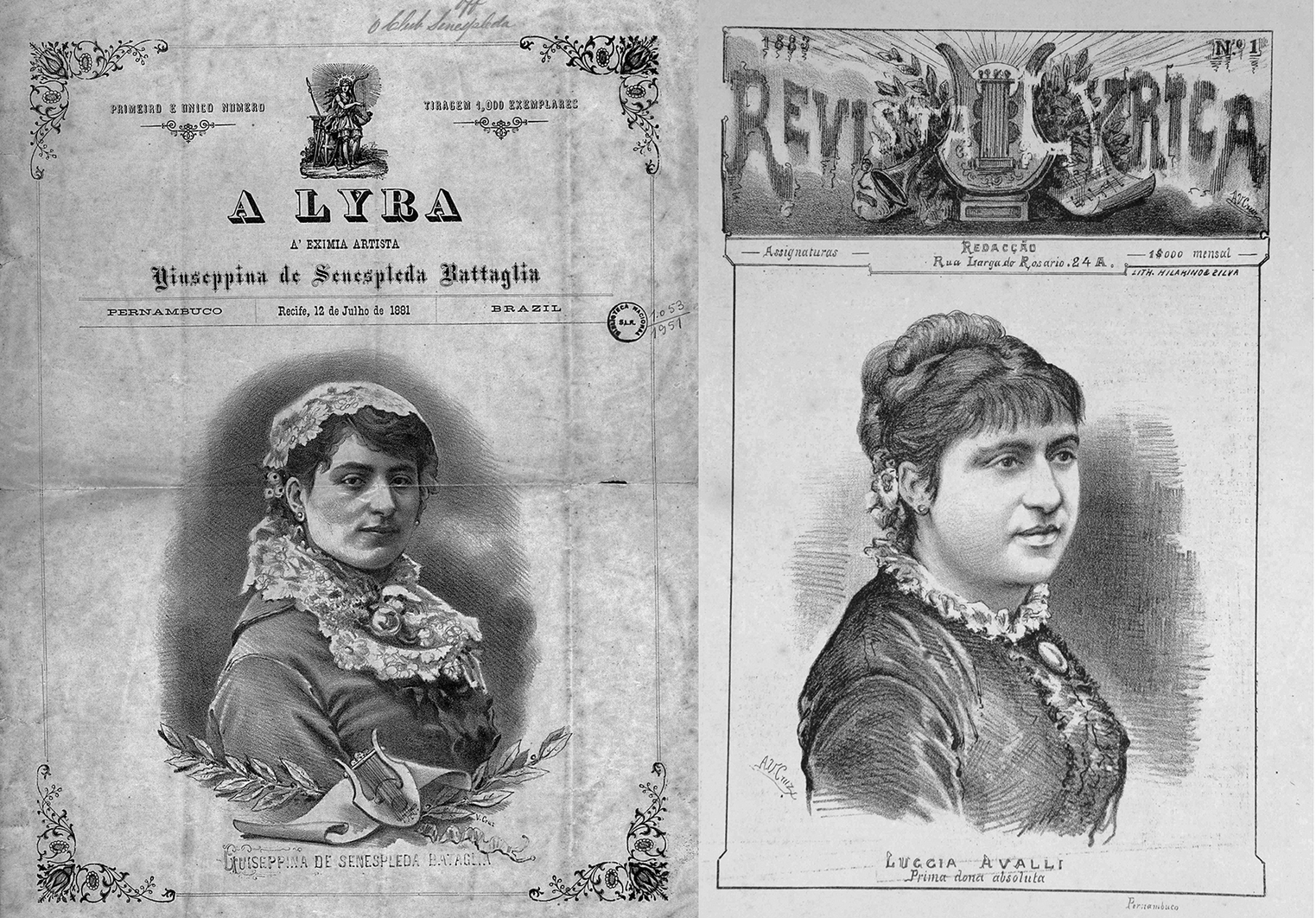
Another Italian soprano remained engaged with the abolitionist movement for almost three years. Lucia Avalli arrived in Brazil in 1879 from Montevideo with the Campantico company, and first sang in São Paulo. Avalli then went to Rio and returned to São Paulo in 1881, after which she worked with the companies Ferrari and Musella, singing in Rio and the northeastern cities of São Luís, Recife and Salvador. On 8 October 1882, the evening of her benefit at the Teatro S. Luiz, Maranhão, Avalli received from the local abolitionists a freedom letter that she handed to an enslaved young woman ‘amidst great enthusiasm from the audience’.Footnote 50 Back in Rio de Janeiro in June 1883, she performed at abolitionist and charity concerts with her long-time colleague, the singer Sidonia Springer. Avalli was also a violinist, and on 5 August, she accompanied Springer in Gaetano Braga’s serenata at the concertant matinée of the Sociedade Libertadora Acadêmica.Footnote 51 Two months later, Avalli was back in Recife, where at her benefit concert on 18 October at the Teatro Santa Isabel in Recife, Pernambuco, she performed in the second act of Donizetti’s Poliuto, before a member of the Club Abolicionista stepped on stage to deliver a speech and hand freedom letters to the prima donna, who in turn presented them to two young women. Two days later, the Jornal do Recife described how this gesture moved the audience and the artist herself to tears while adding splendour to the event. Lucia Avalli returned to Italy in mid-1885, performing in Brescia in 1886. In April 1891 the Diário do Maranhão reported her recent passing in Genoa (Figure 2).Footnote 52
Senespleda and Avalli. A Lyra, 12 July 1881, Revista lyrica 1 (1883).
Another company, organised by scenographer and impresario Claudio Rossi, started its tour in São Paulo in April 1886, with a cast that included the power couple Nikolaj Figner and Medea Mei.Footnote 53 Bulicioff joined them on 9 May for Aida. After thirty-five performances in São Paulo they moved on to Rio, starting the subscription season on 25 June, with Toscanini debuting as a conductor on the 30th. Bulicioff’s abolitionist intervention seven weeks later, on the evening of her festa artistica, was a result of careful planning over the course of several days, if not weeks. The approaching liberation of seven enslaved women was even announced in Rio’s newspapers two days before the concert.Footnote 54 Like Senespleda and Avalli, Bulicioff did not act alone, but in conjunction with an abolitionist association, the Confederação Abolicionista, and the activist journalist José do Patrocínio. As was the custom for a festa artistica, Bulicioff’s fans were already collecting funds to buy her expensive gifts, but she asked them instead to make donations to the abolitionist confederation, which would be used for the manumission of a number of individuals. This idea must have surfaced after interactions with locals who were familiar with abolitionist matinées and the tradition of offering freedom letters in celebratory and performative contexts. Patrocínio and his colleagues at the confederation took care of selecting and negotiating all the payments and paperwork for the recipients (they already had a waiting list), and Bulicioff, still dressed as Aida, handed the documents to six women amidst hugs and kisses on 10 August 1886, right after the third act of the opera.Footnote 55 In addition to the two contos de réis (two million réis) that Bulicioff’s fans donated for this purpose, she also received several gifts, which were all listed in the Gazeta de notícias. Footnote 56 Later that week, Angelo Agostini published an illustration depicting the climactic moment (Figure 3).
Bulicioff, Patrocínio and six enslaved women at the third act intermission of Aida, 10 August 1886. Revista illustrada 11/437 (August 1886).

When describing this apotheosis the following day, music critic Oscar Guanabarino also hinted at additional layers of meaning:
As soon as the 3rd [act] aria was over, a wind band stepped on stage and our colleague José do Patrocínio presented the 7 slaves, who, amidst an indescribable delirium of clapping, cheering, poems, pigeons, flowers and the sound of the national anthem, received by Ms Bulicioff’s hands their letters, having the people as their witness, standing up, waving their handkerchiefs.Footnote 57
Guanabarino then traced parallels between the Egyptian trumpets used to celebrate the victory of enslavers in the opera and the wind band brought on stage to celebrate Aida, this ‘daughter of the African lands’, who instead of being buried alive by the Pharaoh, broke out of the scene to address the public and pulled ‘the wretched ones out of the terrible den of slavery’. In Bulicioff’s multidimensional performance, the enslaved became the redeemer.
Bulicioff was celebrated in the abolitionist festival of 22 August at the Teatro Lucinda, receiving the title of patron member of the abolitionist confederation. For that event, she intended to sing Carlos Gomes’s aria ‘Sonno oggi schiava’, but could not get authorisation from Ricordi’s local representative.Footnote 58 Yet, she still performed two numbers in a spectacle in which Figner, Mei and the bass Gaetano Roveri also participated. In his speech, José do Patrocínio encouraged the audience to think about Bulicioff’s performance, and the opera itself, in ways that transcended aesthetic pleasure:
When for the first time I heard Nadina Bulicioff sing Aida, this poem of slavery which is as grave as it is tender, and touches the heart as much as it elevates the spirit, when I heard her sing Aida giving a special, exquisite interpretation to the sorrowful phrases, the pleading, the moaning of the slave, I said to myself: there should be something inside that heart, a feeling that compels this woman to embody everything she sings, everything the composer imagined to give body, to give soul, to give life and movement to all those pains […] Aida, who faced all dangers to confess her love, left the stage, stepped through the proscenium and came into the bosom of society – one needs to say it – to face all sorts of prejudices to perform a great act of generosity (applause).Footnote 59
Patrocínio also mentioned the gifts of pearls and diamonds that Bulicioff preferred not to receive, first comparing them to the tears of the enslaved ones that she gently dried, then stated that women should not wear pearls and diamonds in a land that is clouded by slavery, since they cannot reflect the light, and finally declared that ladies should take off their jewels so that the wretched could have a moment of happiness in their lives. These donation cues continued to resonate with the readers of the Gazeta da tarde, where the speech was printed the next day. For Patrocínio, translating sentimentality into action was essential to advance the abolitionist campaign.Footnote 60
Danger, compromise, memory
A few days after Bulicioff’s performance, the Gazeta da tarde published the names of the women who were manumitted:Footnote 61
300,000 Jocelyna, 30, D. Judith Doglioni
475,000 Vicentina, 26, judge Gavião Peixoto
150,000 Balbina, 16, José Domingos de Andrade Pinto
250,000 Bernardina, [?], Manoel José Pires Labano Braga
350,000 Raymunda, 23, Manoel Martins de Carvalho
150,000 Solina, [?], D. Belmira Candida Ferreira de Viveiros
Listing the names of their respective enslavers conveyed a sense of transparency to the process. Ironically, it was also a way of honouring the enslaver, encouraging others to negotiate with the confederation. This was not a simple matter, given the remaining balance of 325,000 réis, as one of the enslavers backed off from the deal at the last minute and was publicly scorned by Patrocínio.Footnote 62 The most radical activists often engaged directly with endangered individuals, rescuing and hiding them while filing a lawsuit to force the enslaver to accept the negotiation. If this process was technically illegal, it was rarely prosecuted until the hard-line minister Cotegipe introduced a new law in 1886, establishing heavy penalties for anyone hiding an enslaved person. Known as Regulamento Negro, it encouraged violent actions by pro-slavery supporters who targeted abolitionist demonstrations and invaded theatres, which resulted in serious injuries and at least one death. As Duque-Estrada narrated in his memoir, a number of capoeira fighters offered protection for the events.Footnote 63 Some of them later joined Patrocínio’s guarda negra. Even so, the participation of enslaved activists in the organised urban movement was very limited and their perspective mostly absent. Joaquim Nabuco’s short-sighted argument was that the campaign should distance itself from a type of activism that could lead to a rebellion, which urban abolitionists neither condemned nor encouraged. In order not to imperil their primary goal of persuading the political and economic elites, most urban branches of the movement decided that the ideal performative role for an enslaved person was that of submission.
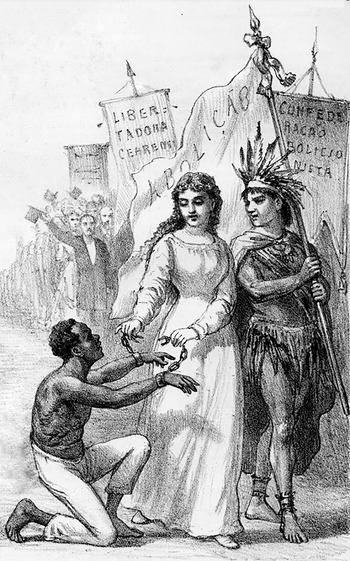
The act of handing over a manumission document to an enslaved individual was already ritualised when abolitionists adopted it in their meetings. As described in a number of sources, the soon-to-be liberated person would dress ‘as a neophyte’, that is, wearing a baptismal robe or white attire, then bowing down in prostration and kissing the hand of the white person delivering the letter, with the effusive approval of the audience.Footnote 64 There was a false antithesis between past slavery and a new life of freedom, since there were neither reparations nor actual paths to full citizenship. Moreover, the enslaved person became an instrument to honour the ‘liberator’.Footnote 65
When they received their freedom certificates on stage, Jocelyna, Vicentina, Balbina, Bernardina, Raymunda and Solina were all standing. This was in sharp contrast to the ritualised ceremonies and imagery of black individuals prostrated in front of a white person or allegory of freedom (Figure 4). Yet, Patrocínio still called Bulicioff sua redentora (their redeemer). A commemorative medal issued by the confederation leaves no doubt about the intentionality of this overlap: it depicts the allegory of freedom holding a chain and a manumission document and, on the other side, a dedication to Nadina Bulicioff (Figure 5).Footnote 66
Allegory of freedom. Revista illustrada 376 (April 1884), 8.

Medal in honour of Nadina Bulicioff offered by the Abolitionist Confederation, Rio de Janeiro.

The number of enslaved individuals directly impacted by these abolitionist performances of freedom – those who were actually manumitted – was very small when compared to the sharp reduction in the enslaved population during the last two decades of slavery (c.1,500,000 in 1872, c.700,000 in 1888).Footnote 67 A much larger number of individuals benefited from the state’s emancipation funds, despite evidence of corruption. Perhaps the most successful aspect of those events was their power to mobilise and energise the urban population around what has been recognised as the country’s first social movement, arguably helping to accelerate the emancipation process.Footnote 68 Conversely, the narrative of submission promoted through the course of the abolitionist campaign did very little to challenge the elite’s negative perceptions of black culture. Whether this would become a significant aim of post-abolition activists it is not clear, but many of those involved in the campaign did not regard their work as complete when the Chamber and Senate finally approved and Princess Isabel signed the law determining the total and unconditional abolition of slavery on 13 May 1888.
At the premiere of Lo schiavo on 27 September 1889, the audience understood the analogy with Atlantic slavery. The indigenous heroes Iberê, Ilara and their companions made the viewers think of slave rebellions, quilombo communities and the struggles of recently freed afro-descendants. Américo, on the other hand, reminded them that the abolitionists were still active: ‘[Américo] places himself between the whip and the slave’s body, speaks to him about freedom, offers his friendly hand, all of this in a warm and elevated speech, capable of stimulating the whole Abolitionist Confederation, even without the music.’Footnote 69 André Rebouças and Joaquim Nabuco continued to promote a political agenda of inclusion and land reform. José do Patrocínio opted for a more forceful strategy. As the organiser of a security force of capoeira fighters, the guarda negra, he tried to protect activists and especially Princess Isabel from violent attacks by resentful former enslavers. Less than two months later, on 15 November, their work was interrupted by the republican coup. Rather than the expected land reform that would compensate the formerly enslaved population, the new government created additional incentives for European immigration, while enacting a vicious and long-lasting campaign against black culture. New policies, starting with the notorious anti-vagrancy laws of 1890 and followed by stricter codes of ordinances in various cities of the empire, promoted the summary incarceration of black men and the repression of candomblé, capoeira and other religious and cultural practices. Not by chance, eugenicists infiltrated cultural and education institutions and were influential in the crafting of government policies until at least the 1930s.Footnote 70 The new republic found it useful to keep the memory of a princess as the main agent in the emancipation, while minimising the role of black abolitionists, intellectuals and artists.
These policies continued to impact perceptions and narratives for several decades to come, as oligarchic and populist governments alternated with dictatorships. Except for the work of activists such as Abdias do Nascimento, Benedita da Silva and Dom Hélder Câmara (who conceived the idea for the Missa dos Quilombos), the whitewashing of Brazilian history, supported by such enduring myths as benign slavery and racial democracy, started to be firmly rejected only after the mid-1980s. Such a change did not happen without a reaction, which became clear during the centennial commemorations. Polar opposites in their socio-historical perspectives, both Lo schiavo and Young Toscanini were reproached by conservative critics primarily out of a reactionary impulse against what they perceived as the belittling of national heroes and the disfiguring of their legacies in the context of a general disrespect for patriotic narratives. In the case of Lo schiavo, addressing the blatant lack of black representation on the Brazilian opera scene did not spare it from being berated for the innovative staging and the singers’ Italian pronunciation.Footnote 71 On the other hand, if Brazilian journalists dismissed Zeffirelli’s colonialist narrative of benign, civilising power, they failed to understand the biases and omissions of the official history they were taught. As we reflect on how the erasure of historical memory thwarted the understanding of social changes that were taking place at that very moment, one piece of advice may be worth considering: let us not burn the tape.
Acknowledgements
Early versions of this research were presented at the conferences Teatro e Escravismo no Brasil: Nexos, Elipses e Inadequações (São Paulo, 5–6 June 2023); the Transnational Opera Studies Conference (TOSC) (Lisbon, 6–8 July 2023); and Decentering Opera (UC Davis, 3–4 February 2024). I thank my colleagues for their feedback at each of these events and the anonymous peer reviewers of this article for their insightful comments.




 Open access

