

Introduction
When someone gets in legal trouble in America, their case is almost invariably decided by a lawyer (a judge), lay people (a jury) or a combination of the two. The exception to this is when the accused is a professional whose practice is so dangerous or unethical that his or her professional license is at stake. In these cases, the accused’s right to practice is decided, usually in the first instance but always in the last, by other members of the accused’s profession sitting on a state licensing board. How well does this system work?
Reports in the media suggest that it does not work very well. Wondery’s 2018 “Dr. Death” podcast revealed that even after receiving multiple credible complaints, the Texas Medical Board failed to halt the bloody career of neurosurgeon Dr. Christopher Duntsch, who maimed and killed dozens of his spinal surgery patients out of ineptitude or something more sinister.Footnote 1 In 2021, the Atlantic ran a long-form piece that included a discussion of the Tennessee Board of Nursing’s feeble response to the “Rock Doc”—a nurse practitioner who prescribed large-dose opioids without exams, made violent threats against patients and colleagues on social media, and had sex with patients (apparently in exchange for prescriptions).Footnote 2 And a multi-year investigation by the Atlanta Journal-Constitution (AJC) found that two thirds of physicians disciplined by the Georgia Composite Medical Board for sexual misconduct were allowed to remain in practice.Footnote 3
Structural features of the American professional disciplinary system suggest that these high-profile examples are the tip of a very large iceberg of misconduct that is ignored or tolerated by licensing boards. Yet legal academic attention to this problem has been scant.Footnote 4 That is a problematic omission, given that about thirty million professionalsFootnote 5—or about a fifth of all American workers and about twice as many workers as are unionizedFootnote 6—are subject to this system of self-regulatory discipline. It is problematic, too, because of the power wielded by professionals and the public risk posed by their misconduct. The danger of bad practice is most obvious in health care, which accounts for approximately two-thirds of licensed professionals.Footnote 7 But even professionals outside of health care, like lawyers and engineers, hold lives in the balance.
One might think that having a reasonable system for removing manifestly unsafe and unethical providers from these professions is a given, and indeed the lack of scholarly attention to the question implies that many assume its existence. But the American professional disciplinary system described in this article falls dramatically short of what is needed to protect the public. The root of its dysfunction lies in the identity of those who hear the cases. In every profession, the accused is tried by a jury truly made up of his peers who take a few days out of their busy professional lives to moonlight as their own regulators. In nearly every instance, the decision-makers are given very little in the way of standards or law to apply, other than to do discipline in the name of the “health, safety and welfare” of the people of their state.Footnote 8 And in every profession except law, these decision-makers have no experience in policy, regulation, or adjudication. They are doctors (and nurses and engineers) playing lawyers.
This Article undertakes the first comprehensive legal-academic account of professional discipline in the United States. Our subject is the state licensing board, the only entity with the authority to say who can practice in a profession and how, and the only body with the ability to remove someone from the profession or put conditions on his practice in response to misconduct. These boards are creatures of state statutes, yet they are governmental in name only. In previous work, one of us (Rebecca Haw Allensworth) identified the 1,790 state licensing boards in the United States and coded their statutory composition.Footnote 9 Nearly every medical licensing board in the United States is dominated by physicians.Footnote 10 The duties of these poorly-understood regulators are roughly divided into three tasks: admitting people into the profession; deciding what constitutes appropriate professional practice; and disciplining noncompliant providers.Footnote 11 Each task is performed in the name of protecting patients and the public, but it is the last task—disciplining and de-licensing dangerous or unethical providers—that can feel most urgent in terms of public protection.Footnote 12
To meaningfully assess how well licensing boards are performing their disciplinary function, this Article must first fill a gap left not only by scholarship but also by professional regulation itself, neither of which advances a theory for why and how to discipline a professional for misconduct.Footnote 13 Our theory defines the goals of discipline (client and patient protection) and explains when and how to use each of the four tools available in the disciplinary case: reprimand, probation with conditions, suspension, and license revocation.Footnote 14
As measured by this public protection theory of discipline, the American licensing board system is in a state of crisis. Boards systematically fail to identify and stop dangerous professional practice. To the few published empirical studies of board discipline, we offer our own contribution: a hand-coded study of five years of disciplinary decisions by the Tennessee Board of Medical Examiners.Footnote 15 We find that in a high percentage of cases, the board kept in practice doctors who have engaged in egregious misconduct, including trading drugs for sex, selling forged prescriptions, or engaging in fraud.Footnote 16 We also present a case study in too-light discipline, that of Dr. Michael Lapaglia, who recently served a federal prison sentence for deeds enabled by the Tennessee Board of Medical examiners.Footnote 17
The reasons for this regulatory failure are structural to the disciplinary system. Professionals fail as self-disciplinarians for two sets of reasons, one more recognized than the other. First, and more familiarly, they fail to be clear-eyed about professional dangerousness or incompetence because of who they are—colleagues of the accused, trained in the same manner and holding similar hopes, fears and professional pressures. Less recognized, and just as important, is what professionals sitting in judgment of their peers are not. They are not trained regulators. Not only are professionals regulating themselves not lawyers naturally conversant in policy and procedure, but even as lay regulators they get far less than what a jury receives in deciding a case—instructions on the law and detailed elements for each offense.
Defenders of self-regulation say that whatever risk of bias comes with self-regulation is offset by the professional expertise that these board members bring to the cases they hear.Footnote 18 But it would seem that a critical kind of expertise—in regulatory goals and methods—is traded off in the bargain. The result is a casual, collegial system for deciding professional disciplinary cases, which is refracted back through the disciplinary process to its inception at the complaint and investigation phase.
America is not the first jurisdiction to experiment with and ultimately learn about the perils of a self-regulatory disciplinary model for the professions. Until the early 2000s, the United Kingdom used a very similar system of professionals-judging-professionals to police the profession of medicine, until scandals led to a crisis of confidence and ultimately to regulatory reform. Today, the UK decides medical disciplinary cases using a tribunal that is formally separate from the authority that sets the entry and practice standards for medicine. This system more closely resembles the adjudicatory systems seen as fair in every other area of American law where one’s case is heard by a combination of legal and lay decision-makers guided by transparent standards, not a true jury of one’s peers given too little information and asked to go with their gut.
Does the UK system work any better? To help answer this question, we also hand-coded two years of disciplinary decisions by the UK’s medical disciplinary tribunal to facilitate a comparison to American professional disciplinary outcomes. Despite the obvious challenges that come with comparing cases against professionals working in very different health care systems, our data suggests that the UK is more appropriately harsh on physicians found to have engaged in major misconduct than the United States, where second chances are abound. We also offer a case study for comparison to Dr. Lapaglia’s—that of Dr. Katie McAllister, who was ultimately removed from the register of physicians in the UK for providing a fatal overdose of prescription drugs to a friend.Footnote 19 We conclude that the United States should take some lessons from across the pond and overhaul professional discipline not only for medicine but for all the professions to be at least as well-informed, transparent, and procedurally fair as the system for physicians in the UK.
Offering an account of the failures of 1,740 licensing boards across fifty states, governing dozens of unique professions,Footnote 20 presents a challenge, to say the least. Indeed, the difficulty of making generalizable claims about board behavior is a likely reason for the lack of scholarship on the topic. To tackle this challenge, we rely on as many studies as we were able to find that cut across states or professions. And although our article applies broadly to the professional board disciplinary system, much of our evidence and examples comes from medicine. We focus on medicine for two reasons. First, although all professional systems of discipline are under-studied, physician discipline has received relatively more academic attention than others, most notably from within medicine itself.Footnote 21 Second, lessons from medicine are generalizable to other professions using self-regulatory systems of discipline. Medicine is the prototypical American (and British) profession, and its governance structure has served as the model for all other professional licensing boards.Footnote 22 Inadequate discipline is a function of regulatory design, and therefore we see the same results in other professions such as nursing,Footnote 23 massage therapy,Footnote 24 and others.Footnote 25
The one licensed profession that presents a more complicated comparison to medicine is law. On the one hand, the legal disciplinary system is even more likely to lead to lax discipline than medicine, because the entities handling it are even more self-regulatory than medical boards.Footnote 26 On the other hand, lawyers-judging-lawyers bring a fluency in policy and procedure to their cases that other professionals cannot. They have been told, in law school, that the regulatory line is drawn not for the well-meaning lawyers just like them, but for the bad man who would walk up to it.Footnote 27 And there is some evidence that lawyers are harsher on their own than other professionals, even if not sufficiently.Footnote 28 Thus, the difficulty of extrapolating our findings in medicine to law is not only a bug but a feature—it supports our thesis that lack of regulatory expertise contributes to the crisis of self-discipline in the professions.
Just as our data from medicine are generalizable to other professions, so too is our data from Tennessee generalizable to disciplinary systems of other American states. Tennessee is an average-sized American state with typical board proceduresFootnote 29 that ranks near the middle of the very few comparative measures of licensing board structure and performance.Footnote 30 Another indication that our findings in Tennessee are typical comes from comparing our data to other state-specific analyses of professional discipline, where researchers and investigative journalists have found serious problems with professional discipline in New York,Footnote 31 the District of Columbia,Footnote 32 Georgia,Footnote 33 Illinois,Footnote 34 Indiana,Footnote 35 New Jersey,Footnote 36 and Texas.Footnote 37
This article proceeds in five parts: Part I defines the stakes of licensing board discipline, explaining the role that boards play in holding the line against unethical and incompetent providers and the wider social consequences that result from a dysfunctional disciplinary system. It then develops a theory of professional discipline that foregrounds public safety and provider quality. Part II describes the current crisis of the board disciplinary system and uses a case study to illustrate its misplaced focused on rehabilitation and second (and third or fourth) chances. Part III then explains why the American system fails at its professed goal: the state medical board is designed to be biased and low-information, and its case outcomes reflect those flaws.
Part IV turns to the UK, identifying the crisis of confidence that led to reforms two decades ago, the nature of those reforms, and the current state of play in professional discipline. Part V then compares the disciplinary outcomes of the two jurisdictions, first through a case study and then through our empirical findings. Part VI outlines how the lessons from the UK might be applied in the United States, and a short section concludes.
I. Why discipline professionals?
States regulate the professions—from doctors to nurses to auctioneers—through statutes called “practice acts,” which define the scope of a professional’s practice, set the basic entry requirements, and broadly define ethical and competent practice.Footnote 38 If a practice act requires a government-granted license as a matter of law for any aspect of professional practice and requires a significant investment in human capital to obtain a license, we call that a “licensed profession.”Footnote 39 A rough back-of-the-envelope calculation suggests that as many as thirty million American workers are subject to licensing requirements as defined, making up about a fifth of the American workforce.Footnote 40 Licensed professionals make up more workers than are members of unions, and about more than thirty times as many workers as are subject to the minimum wage.Footnote 41
If licensing is to be justified as protecting the public by limiting practice to those who have demonstrated competence and ethicality, then it needs to have a disciplinary system that can remove practitioners who have shown themselves to lack these qualities. The American state licensing board is the only entity that can remove or restrict a professional’s legal right to practice in the name of public protection.Footnote 42
A. The stakes: Why state professional board discipline matters
For better or worse, state licensing boards do not concern themselves with ordinary cases of ineptitude or even malpractice.Footnote 43 If licensing board discipline is aimed primarily at removing outliers, how much does it matter that they do a poor job? After all, one imagines that the vast majority of professionals are conscientious, dependable, and ethical. And there are many other regulators of professionals—from private certifying bodies to firms to insurance companies—that may provide another layer of public protection, reducing the need for state boards to act as disciplinarians.
In fact, it matters a great deal that licensing boards are failing to remove dangerous providers from the professions—both because they inflict outsized harm and because the other systems in place to catch them are inadequate.
1. Bad apples
How much harm do bad professionals really inflict? Examples from medicine suggest that dangerous and predatory professionals are more common than one might think.Footnote 44 In Tennessee alone, the Board publicly disciplined hundreds of doctors in the five-year period of our study, with offenses ranging from drug trafficking to sex with patients. And what limited data we have about how often a board responds to an allegation suggests that these numbers are far smaller than the true amount of professional misconduct. These worst-of-the-worst providers have an outsized impact on the public welfare.Footnote 45 For example, unethical doctors prescribing through pill mills accounted for a disproportionate share of opioids dispensed in the United States during the peak prescribing period.Footnote 46 And in Illinois, for example, the 2.37% of doctors with two or more paid medical malpractice claims accounted for fifty-three percent of total payouts.Footnote 47
The devastation caused by professional misconduct is perhaps most striking when it comes to sexual abuse. The most famous example is Larry Nassar, whose victims exceeded 100, including children.Footnote 48 But his is not an isolated case. Columbia University OB-GYN Robert Hadden has been accused by hundreds of women and girls of sexual assault during exams. He was criminally prosecuted but unlike Larry Nassar, who is serving a 175-year sentence, Dr. Hadden received no jail time on his state charges. He was later prosecuted federally and is currently serving a twenty-year sentence.Footnote 49 By the numbers, the professional that represents the most widespread social harm may be Dr. George Tyndall, who served as the OB-GYN at the University of Southern California’s (USC) student health center for twenty-seven years. He abused so many women and girls during that time that their claims were resolved through a class action. Between that and other lawsuits, USC has settled with 16,000 of Dr. Tyndall’s victims for a total of $1.1 billion, or about one fifth of the private school’s total endowment.Footnote 50
Evidence from other professions, such as law, suggest that a profession’s bad apples can create wide-spread harm. Consider the legal and political chaos created by the relatively few lawyers who have pursued baseless claims of election fraud on behalf of President TrumpFootnote 51 or the extremely high caseloads—in the thousands—of lawyers found to have stolen from or neglected their indigent clients’ cases.Footnote 52 Recidivism rates among disciplined lawyers—at almost fifty percent—suggest that bad lawyers can have an outsized effect on the public.Footnote 53
2. Better regulators?
The consequences of inadequate professional discipline in America are severe. Without meaningful governmental regulation that stops unethical or incompetent professionals from practicing, the private sector has layered their own standards and private governance structures on most professionals. But the example of health care, where private regulators like insurance panels, hospitals, and specialty boards layer their own standards on top of licensing board regulation, shows that these entities have their own self-interests in mind when they discipline professionals (or fail to).Footnote 54 Furthermore, they rely on state boards for information about problematic providers,Footnote 55 limiting their ability to detect patterns of bad behavior missed by these boards.
For example, hospitals each have their own credentialing system for healthcare professionals, which relies in significant part on the National Practitioner Databank (the “Databank”), a repository of information about individual healthcare providers’ malpractice history and hospital discipline.Footnote 56 The Databank can be accessed by employers, state boards and insurance companies, but not patients or the public at large.Footnote 57 Even to those who have access to the Databank, the information there is inadequate to protect the public. Malpractice suits are a notoriously inexact measure of incompetenceFootnote 58 and hospitals are infamous for either not reporting egregious behavior to the Databank or, more commonly, eluding the reporting requirement by asking a provider to clean up his act or quietly leave.Footnote 59 Both USC and Columbia knew about their predatory OB-GYNs for years before taking action.Footnote 60 And as Dr. Christopher Duntsch maimed or killed dozens of spinal patients over a fourteen-month period, three different Dallas hospitals learned about the carnage and asked him to move on.Footnote 61 As these examples make clear, asking private entities to discipline physicians is no substitute for governmental regulation through licensure. Less is known about how private regulators, like firms, operate in the market for lawyers, but recent empirical evidence suggests that as in medicine, sanction by private entities like law firms does not stop bad actors from practicing.Footnote 62
And in both medicine and law, private regulatory systems tend to push problematic providers towards underserved client and patient populations, further impugning their status as public protectors. In medicine, a bad record in the Databank may limit your professional prospects to working in institutional settings like prisons or as a cash-based solo practice.Footnote 63 In law, a recent study showed that board discipline tended to push an attorney out of firm practice and towards solo practice serving vulnerable populations like indigent criminal defendants, immigrants, and accident victims.Footnote 64 In these settings, problematic professionals are likely to encounter clients and patients most in need of quality care and least able to protect themselves from unethical or incompetent providers.
B. Towards a theory of professional discipline
In developing a theory of professional discipline, we take at face value the language in professional practice acts that identify “public protection” as the aim of licensure.Footnote 65 Public protection is paramount because patients and clients are uniquely vulnerable in the professional relationship where they cannot directly assess the quality of services, sometimes depend on them for their lives and freedom, and, especially in medicine, often must make themselves physically vulnerable to receive treatment.Footnote 66 The larger public, too, has a stake in the safety of the professions, as illustrated by the role that over-prescribing physicians have played in the opioid crisisFootnote 67 and lawyers have played in the current lack of faith in democracy.
Mitigating these risks is one role of a state licensing board, whose obligation is to ensure that anyone holding a license meets a minimum level of competency, ethics, and professional judgment.Footnote 68 These standards are especially important given the level of independence afforded to many professionals to treat, argue, advise, and design according to their professional judgment. This minimum level does not mean that every provider will be excellent, or even, as the children of Lake Wobegon, above average. But at the point of professional entry, it does mean that every licensed professional will have graduated from an accredited school, passed an exam, shown a respect for patient and client care, and demonstrated a willingness to keep up with best practices and learn from his mistakes. What it means at the disciplinary stage is less theorized. Boards and legislatures give lip service to the idea of using discipline in the name of the public,Footnote 69 yet neither kind of regulator has done much to develop a theory that breaks down how discipline, in practice, might be used to protect the public.Footnote 70
Our theory of professional discipline recognizes that it occurs after a provider has been admitted to the profession—that is, after they have graduated from professional school, taken an exam, and generally been deemed minimally competent by their peers. At the point of a serious accusation of misconduct, a provider has allegedly engaged in some behavior (usually a pattern of behavior) that raises doubts about their current competence or ethics.Footnote 71 This new information may reveal that admission to the profession was a mistake—that despite graduating and passing the tests they never had the requisite skills or ethics. Or perhaps something has changed since getting their license that led the professional astray. Sometimes it is the profession itself that has changed; some disciplinary cases arise from a provider’s failure to stay abreast of best practices.Footnote 72 More often the thing that changed is the professional themselves.Footnote 73
1. The Four Disciplinary Paths: Unrestricted Practice, Restricted Practice, Suspension, Revocation
If board discipline is aimed at protecting the public by ensuring minimum competence and ethics, then that suggests a specific role for using each tool wielded by a licensing board: unrestricted practice after a public reprimand or warning, probation with restrictions, temporary suspension and permanent license revocation.Footnote 74 First, if a board can determine that the provider does presently have the requisite minimum competency and ethics, the board should allow the provider to continue to practice with an unrestricted license. Second, if the board finds that a provider will meet the minimum standards if certain conditions are in place or prerequisites are met, the board should place the provider under a disciplinary order with conditions (in most states this involves placing their license on “probation”). Third, if the board determines that a professional does not currently meet the minimum standard (even in circumscribed circumstances) but that they may, through education or mental health treatment, become competent, the board should place the license on suspension, precluding practice now but leaving open a path to return to practice. Finally, a board can decide that a professional has shown such egregious lapses of skill or judgment that there is little likelihood they can ever be trusted to practice again. These professionals should lose their license permanently.
Crucially, these steps should be taken as swiftly as due process allows, both out of fairness to the professional and for the protection of the public. A professional license is a property right,Footnote 75 and revoking or restricting it requires the board to provide notice and a hearing to an accused professional.Footnote 76 To the extent that the strictures of due process cannot be met before serious harm may come to the public, most boards should use their ability to summarily suspend a license on an emergency basis, pending a full administrative hearing.Footnote 77
2. A Theory of Second (and Third) Chances
Note that three of the disciplinary moves used by boards upon finding misconduct—reprimand, probation with conditions and suspension—involve second chances for problematic providers. These are most appropriate where there is a clear underlying cause of the bad practice or lapse in judgement and there is a reliable way to treat or remove it. The most obvious example is inexpert practice, of a mild to moderate degree, that might be improved through education, supervision, or a more intensive version of supervision called “practice monitoring” where an independent monitor reviews all or some of the probated professional’s work product.Footnote 78
Second chances in the form of probation and suspension may also be appropriate in cases where drug or alcohol use disorder appears to be a direct cause of the bad practice, if the compromised decision-making does not rise to the level of predation or criminality, and if the professional appears genuinely interested in confronting their substance use problem.Footnote 79 The same is true for other mental health issues such as depression or bipolar disorder which can be controlled by treatment.Footnote 80 Importantly, however, there must be some evidence that the addiction or other mental health issues are causal to the bad practice—it is possible (and the facts of many cases suggest that it’s not uncommon) for incompetent or predatory providers to also have a drug or alcohol use disorder or another mental health diagnosis.Footnote 81
Second chances are less appropriate when the provider has abused the public trust in a way that cannot be explained by slipping skills or poor mental health alone. The most obvious example is a professional who has used his license opportunistically—such as a pill mill prescriber or someone engaged in health care fraud.Footnote 82 A related example is the lawyer or doctor who uses his position of power to extort sex from patients. These offenses are undeserving of second chances not only because they are egregious, but because the professional has so totally abandoned the mission of patient or client care and shown a willingness to use his or her license to their own advantage that rehabilitation seems unlikely.Footnote 83 The public protection theory of board discipline also suggests that third chances should almost never be granted. A professional who has been through the disciplinary process understands the seriousness of their misdeeds; they have been through the ringer, faced the fear of losing their livelihood, and been told how to get back on track. A provider who cannot or will not conform his or her practice to comply with patient or client safety after that experience is extremely unlikely to ever do so.
Finally, the public protection theory of discipline tells us that in determining a sanction or remedial measure, boards should consider all relevant facts in the professional’s past, beyond the specific charges raised in the case. Just as in criminal sentencing, the decision to revoke or restrict a license involves a prediction about how this individual will behave in the future. And just like in criminal sentencing, where the rules of evidence are relaxed and both parties are allowed to paint a fuller picture of the defendant as a one-time offender or a likely recidivist, the decision about whether to revoke or restrict a license should account for a provider’s full history, with a particular emphasis on his professional life.Footnote 84
II. Too little, too late: American professional discipline in crisis
A. Dr. Lapaglia: Too Many Chances, Too Little Information
In July of 2019, Dr. Michael Lapaglia appeared before the Tennessee Board of Medical examiners for a disciplinary hearing that would decide the fate of his medical license.Footnote 85 Six months before, his license had been summarily suspended because he had pled guilty to two federal felonies: one for trafficking in prescription drugs for no medical purpose, and the other for health care fraud.Footnote 86 These charges were based on his participation in a practice he called “L&B Healthcare,” which had no brick and mortar operation but rather consisted of a prescription pad made up with his phone number and his partner’s name and DEA number, required for prescribing controlled substances. He used the pad to write prescriptions for drugs with street value—like Suboxone and Valium—and sell them for $300 cash out of his home, in patients’ homes, and at least once, in a McDonald’s parking lot. Some of the prescriptions were pre-signed by his partner. When those ran out, Dr. Lapaglia forged his signature.Footnote 87
As the facts were explained to the three-member panel hearing the case, two of whom were currently-practicing physicians, Dr. Lapaglia needed to prescribe in another doctor’s name because he had lost his DEA registration in a previous round of discipline before this same board.Footnote 88 In 2014, he pled no contest to state criminal charges for dealing prescription drugs and marijuana out of his home and at that time, the board had placed the doctor’s license on probation.Footnote 89 The conditions of his probation were that he attend drug treatment (he himself was evidently addicted to benzodiazepines) and relinquish his authority to prescribe controlled substances.Footnote 90 It was during this probationary period that the doctor came up with the idea for L&B, which resulted in the federal convictions and the hearing in 2019 that determined the status of his Tennessee medical license.Footnote 91
Dr. Lapaglia and his lawyer presented a defense that did not contest the basic facts—he admitted to the forged prescriptions, the cash appointments without exams and the McDonald’s parking lot. Rather, he argued that his heart was in the right place, that he genuinely believed he was prescribing for therapeutic purposes, even if he cut a few corners and did not do things by the book. He also emphasized his own struggles with substance use and his compliance with the board’s previous condition that he get clean.Footnote 92 And despite his role as an ostensible adversary, the lawyer prosecuting the case against Dr. Lapaglia essentially concurred, beginning his closing argument by saying “Dr. Lapaglia did something that was dumb.”Footnote 93 And he failed to confront or correct the doctor when Dr. Lapaglia claimed he had never even been accused of trafficking in narcotics.Footnote 94 The panel was given copies of the two criminal judgments—one state and one federal—for that very crime, but the panel members did not appear to read them.Footnote 95
The newest board member, Dr. Stephen Loyd, lead deliberations after hearing the proof.Footnote 96 It was his second day on the job, after a two-hour orientation on the basics of board service.Footnote 97 He had not been briefed on or even given a copy of the rules or statutes that he was now in charge of interpreting and applying. He had not been given guidance about how to decide contested cases or even about the goals of physician discipline. He had not even been told what remedial and punitive measures the board had at its disposal.Footnote 98
“My job is to protect the health, safety and welfare of the citizens of Tennessee,” Dr. Loyd began. “Do I think taking [Dr. Lapaglia’s] license protects the people of Tennessee? I do not,” he said. “I hope I’m a good judge of a heart. I saw someone who has a good heart.”Footnote 99
Even on the facts presented to the board, at least as viewed by a regulator more clear-eyed about the possibility of a professional lying under oath or otherwise acting opportunistically, this was a questionable proposition. But there were other facts, easily verified and in the public domain, yet not presented to the panel at all, that were relevant to Dr. Lapaglia’s chances of rehabilitation. Although it appeared to the panel that he was asking for a third chance to practice medicine, having twice been convicted of using his license to deal drugs (the second time while on probation for the first offense), he was asking, essentially, for his fifth chance to practice.
As revealed in North Carolina’s public and easily searchable records of physician discipline,Footnote 100 Dr. Lapaglia had faced board discipline because his residency supervisors said he engaged a hospitalized sixteen-year-old in an inappropriate personal relationship.Footnote 101 He ignored the North Carolina board’s requests to tell his side of the story, and his medical license lapsed.Footnote 102 Then, in 2010, while working as an ER physician, he faced legal troubles for medically paralyzing suspected drug dealers at the behest of law enforcement so they could perform warrantless, nonconsensual rectal searches for evidence.Footnote 103 The practice led to two civil suits, which he apparently settled, and a federal case where the Sixth Circuit found that Dr. Lapaglia’s search violated the Fourth Amendment, calling it “so unreasonable as to shock the conscience.”Footnote 104 Neither the inappropriate relationship nor the forced paralyses were mentioned in his Tennessee disciplinary cases.
In the end, Dr. Lapaglia got that third (or fifth) chance to practice medicine. In the July 2019 hearing, the Tennessee Board of Medical Examiners reinstated Dr. Lapaglia’s license with fewer restrictions than when he formed L&B in the first place.Footnote 105
B. A System that Fails the Public
Measured against our theory of professional discipline, the decision in Dr. Lapaglia’s case falls short. Dr. Lapaglia was an unsafe provider—both for his own patients and for the broader population of Tennessee that was and remains in the grips of a pill addiction crisis—not because of his own problems with Benzodiazepines or because he did not know the correct procedure for prescribing controlled substances, but rather because he viewed his medical license as a tool to be used (illegally, according to two different criminal systems) for his own financial gain rather than for patient care. More chances were inappropriate especially because board orders had no apparent deterrent effect on him; instead he saw the board’s regulation as something to be worked around.
The Lapaglia case is not an aberration in the United States. It stands for a larger, more systemic problem: the American licensing system disciplines professionals too infrequently, too late, and too leniently to adequately protect the public.
1. Inaction & Delay
Perhaps the most troubling feature of professional board discipline is its failure to react to bad conduct in the first place. Cases like Dr. Duntsch, whose license was not revoked until well after the criminal case against him was in progress,Footnote 106 or Dr. Tyndall, whose conduct went undetected by the Medical Board of California for almost three decades,Footnote 107 suggest that boards simply do not discipline nearly enough professional providers. A national study of nursing board cases alleging sexual abuse found that states only discipline an average of one or two nurses a year for this offense despite the likelihood that abuse is relatively common.Footnote 108 Inaction at massage boards is likewise a documented problem. The Louisiana Board of Massage Therapy was recently criticized by the state legislature for failing to pursue discipline against providers working at establishments easily identified on the internet as brothels,Footnote 109 and the town of Oxford, Massachusetts, became so frustrated by the state licensing board’s inaction against sex traffickers that it created its own licensing scheme by ordinance.Footnote 110
Boards’ failure to pursue discipline is difficult to study systematically, as it requires knowing the base rate of professional misconduct. As some researchers have done, one way of establishing a base rate is to examine complaint data. Only about two percent of complaints against physicians, for example, result in any public disciplinary action.Footnote 111 The data from law reveal a slightly higher number, although still in the single digits.Footnote 112 Of course, not all patient and client complaints are credible enough to merit an investigation, let alone a finding that discipline is in order. But the prevalence of “private discipline,” in the form of a letter sent to a practitioner without any license restrictions or public information, suggests that boards do consider many complaints that they reject for public discipline to be nevertheless credible and troubling. In law there are twice as many private actions as public.Footnote 113 In medicine, private discipline exceeds public action by a factor of eight.Footnote 114 A more objective measure of base rates of misconduct comes from malpractice data. Researchers have shown that doctors paying out major malpractice settlements and jury awards are still unlikely to face board discipline. Nationally, a physician that pays out on ten malpractice claims still only faces a thirty-three percent chance of board discipline.Footnote 115 The same is true of doctors who face disciplinary actions by their hospitals: more than half face no subsequent board sanction.Footnote 116
In the unlikely event a board does pursue discipline, it does so very slowly. Again, empirical studies are few, but one, by a law professor reading five year’s worth of disciplinary decisions against lawyers in New York, found the length of time between when misconduct came to light and when the board acted “unconscionably long.” He said, “it mocks the professed goal of protecting the public and the administration of justice if a lawyer who will be (and should be) suspended or disbarred is left to practice for years until the day of sanction.”Footnote 117 And an investigative journalist in Florida found that it took the medical board an average of 434 days to resolve a case.Footnote 118
Case studies we gathered from Tennessee suggest long delays between when the board learns of misconduct and when it takes action against a license. It took the licensing board three years to act against an over-prescriber whose misconduct likely led to the overdose deaths of five of his patients in a single year.Footnote 119 During that time he practiced medicine on a clean license. The same board learned in 2013 about an OB-GYN with significant malpractice history who apparently traded drugs for sex with eleven of his patients. They eventually revoked his license in 2017, before reinstating him in 2018.Footnote 120
2. Wrist-slaps
When boards decide disciplinary cases, they are too forgiving and too generous with subsequent chances. Journalists at the Atlanta Journal-Constitution conducted a nationwide study of medical board disciplinary cases and found that of the approximately 2,400 doctors who had received board discipline for sexual misconduct during the period they studied, half were still in practice.Footnote 121 Likewise, empirical evidence of professional recidivism suggests that licensing board disciplinary orders fail to protect the public. Researchers conducting a nationwide empirical study of medical board sanctions found that doctors who receive moderate to severe sanctions who were permitted to return to practice were over twenty times more likely to be disciplined again than doctors without a disciplinary history.Footnote 122 Similar data is found in law, where lawyers having faced previous board sanction are thirty times more likely to receive board discipline than those who have not been in trouble with their licensing board.Footnote 123
To the very few studies of board sanction severity, we add our findings from Tennessee. Our empirical analysis of five year’s worth of medical board disciplinary decisionsFootnote 124 supports the conclusion suggested by the AJC investigation and the evidence about professional recidivism: boards do not discipline professionals in a way that protects the public. Even when a board makes findings of fact that suggest very serious lapses of ethics and competency—often on a repeat basis—they tend to impose sanctions that either keep the provider in practice or articulate a path back to licensure. According to our data, between 2016 and 2020, temporary or permanent revocation of a doctor’s licensure was the outcome in just thirty-three percent of cases involving sexual misconduct. And during that five-year period, when over 10,000 Tennesseans died of drug overdoses mostly driven by the opioid crisis, the board kept in practice almost two thirds of the doctors they found to have improperly prescribed.Footnote 125
III. Personnel is policy: Self-regulatory discipline
Why do boards act so infrequently, so slowly, and with such forbearance when confronted with professional misconduct? The answer lies with the regulatory design used in American professional licensing, most especially the choice of who decides board disciplinary cases. In the typical state, discipline is decided by busy, working professionals, inexpert in regulation, who are given too little information to do much else than go with their instinct to try to rehabilitate respondent professionals. This part shows how these regulatory problems contribute to a professional disciplinary system that is too forgiving to be safe.
A. Agency Structure: Maximum Discretion with Minimal Resources
States regulate the professions through “practice acts,” statutes that define the scope of a profession, outline basic entry requirements like testing and education, and establish ethics rules to define good practice.Footnote 126 Practice acts also create boards to oversee the administration of this statutory scheme, which involves making more fine-grained rules about entry and practice requirements, deciding individual cases for licensure, and identifying professionals who have violated the practice act and deciding whether that justifies a license restriction or revocation.Footnote 127 In this sense, the typical American licensing board does both rule-making and adjudication—it creates its own rules and interprets them in individual cases.Footnote 128
Practice acts also set the qualifications for membership of a licensing board, most often with a majority of seats going to currently-licensed professionals.Footnote 129 Public members (non-professionals) on boards typically have no experience in either the profession or regulation and thus their influence on the board is often weak.Footnote 130 Typically, board members are selected by the state governor, often in consultation with the state professional association.Footnote 131 As a result, most board members come from the ranks of their state or national professional association— groups dedicated to the betterment of the profession and its members.Footnote 132 Not much is known about how public members are selected for service, but most likely it is through a system of political patronage.Footnote 133 Board members are not paid significantly for their time; typically boards only reimburse for travel expenses or provide a modest per diem stipend.Footnote 134 The typical board member must therefore balance full-time professional work with his or her duties on the board, allowing them inadequate time to devote to the regulatory project.Footnote 135
Thus, the American licensing board is an inversion of the typical agency, where bureaucrats take counsel from industry experts but make the final decision for themselves.Footnote 136 At a licensing board, the final decision-making power is given not to those with the most information about the regulatory consequences of a decision—its staff and lawyers—but to professionals who take a few days off every quarter from their busy professional lives to act as their own regulators.
B. System Failures: Under-resourced, Unguided, and Rehabilitative
This choice of personnel has several implications for professional disciplinary procedure. Somewhat counter-intuitively, professionals regulating themselves tend to under-fund their own work, leading to a slow, complaint-based system not equipped to discover professional misconduct when it happens. Self-regulation has also led to a lack of guidance on disciplinary issues, which exacerbates the problem of boards lacking expertise in regulatory matters. Finally, and perhaps most obviously, it leads to pro-professional bias highlighted by the disciplinary system’s emphasis on rehabilitation.
To fully understand how these features of a licensing board contribute to failures of professional discipline, it is important to understand the legal procedure of discipline.Footnote 137 When boards or umbrella agencies’ housing boards receive a credible complaintFootnote 138 about a professional, it is reviewed by a consulting professional to give an opinion about whether the complaint describes improper practice.Footnote 139 If the consultant gives the go-ahead, investigators for the board or the department in which the board is housed will investigate by asking for patient charts or files, interviewing witnesses, and subpoenaing documents.Footnote 140 Once the investigation is complete, another go/no-go decision is made by a member of the profession acting as a consultant or by a panel dominated by professionals.Footnote 141 If charges are recommended, then an attorney prosecuting the case will send either a private letter of warning, or a letter formally charging the professional.Footnote 142 In the latter case, the attorney and professional will begin a negotiating process to come to an agreed order, which must be approved by the board.Footnote 143
If the parties fail to work out a deal or the board rejects it, the case proceeds to a contested case hearing, which resembles a trial,Footnote 144 where facts must be proved either by clear and convincing evidence or, more commonly, by a preponderance of the evidence.Footnote 145 In most states, the board or a smaller panel constituted from it acts as judge and jury.Footnote 146 In some states, as in Tennessee, an administrative law judge sits in on the hearing to swear in witnesses and rule on technical legal issues like the admissibility of evidence.Footnote 147 But it is the board—or a panel comprised of a subset of its members—that decides everything that really matters: what happened, whether it violated their profession’s practice act, and what penalties to impose.Footnote 148 In other states, the case is tried directly to an ALJ, who makes proposed findings of fact, law and sanction.Footnote 149 But here, too, the board has the final say in adopting the recommendation of the judge.Footnote 150 State law provides for an appeal process outside of the administrative proceeding, usually in a state court.Footnote 151 But judicial review is highly deferential and does not permit the court to substitute its judgment for that of the board on the facts of the case.Footnote 152
1. Slow, reactive, nonadversarial
The choice to use volunteers from the profession to implement and oversee this process significantly impacts its design and how well it works. Most fundamentally, boards do not have enough money to adequately fund a disciplinary process that would identify bad actors, marshal the evidence against them, and impose a public-regarding sanction while adhering to the strictures of due process.Footnote 153 Boards’ lack of funding is, in significant part, a function of the professional-volunteer structure of their membership. Most boards are funded primarily or entirely by licensing fees,Footnote 154 and professional board members have an obvious interest in keeping licensing fees low for themselves and their colleagues. Small budgets make for inadequate investigatory resources and necessitate a complaint-based system which is reactive and slow, a dynamic reflected in an empirical study showing a correlation between board resources and disciplinary activity.Footnote 155
Rather, disciplinary cases are opened only when someone files a complaint to a board.Footnote 156 Typically, anyone can file a complaint—even someone who isn’t a patient or a client of the provider.Footnote 157 Sometimes colleagues will turn in a provider to the board, and indeed many states impose an ethical duty on physicians to report their colleagues.Footnote 158 But feelings of loyalty and collegiality prevent this from being a large or reliable source of disciplinary complaints.Footnote 159 Law enforcement agencies may refer cases to boards, but they are not required to do so,Footnote 160 and it happens less than one might expect.Footnote 161
Most often complaints must therefore come from patients and clients. There are major drawbacks to such a system. First, a consumer must know that he has received bad or unethical care, though the licensure system is justified in part by the idea that consumers do not know what they are getting.Footnote 162 Second, they must actually feel harmed by the conduct. For large classes of cases—Dr. Lapaglia’s script-selling scheme, for exampleFootnote 163—consumers will have no complaints about the unethical services they received. Third, the aggrieved consumer must know that a board exists, learn how to get in touch, and be willing to put themselves through the investigation process.Footnote 164
The system could be designed to be more proactive. Licensing boards could use public information about controlled substance prescribing, malpractice suits or hospital discipline to initiate investigations into problematic providers.Footnote 165 Boards could access public criminal records or develop stronger relationships with local law enforcement that might encourage information sharing. But some of these proactive investigative techniques involve resources and as long as boards remain underfunded, their means of learning about bad practice is unlikely to change.
Inadequate funding also contributes to the lack of adversariality in the board disciplinary process because without enough resources to pursue contested cases, board staff feel pressure to negotiate settlements with accused professionals. Meting the due process requirements of a contested case is expensive and time-consuming. Contested cases are also costly because they involve the potential for an appeal in state court, where discipline that is “arbitrary and capricious” will be thrown out.Footnote 166 Board prosecutors are therefore encouraged to work out negotiated settlements with providers. Professionals wanting to avoid a public trial also favor negotiated orders. Board members, as unpaid volunteers, also prefer to approve negotiated settlements than to take yet more time off from their professional lives to travel to the state capital and hear a case, which can take months or years.Footnote 167
Theoretically, the process of working out an agreed order could be adversarial, as are plea negotiations in the criminal system.Footnote 168 But in the licensing context, the negotiation happens in the shadow of a contested case hearing,Footnote 169 where panels constituting mostly representatives from the accused’s own profession will give the provider the benefit of the doubt, removing the leverage that a criminal prosecutor has by threatening a trial before a judge or jury. Furthermore, a heavy reliance on consent orders significantly reduces the amount of public information available about a professional’s misconduct. Documents charging a professional with discipline are not usually public,Footnote 170 as they are in the criminal and civil legal systems, so the full set of alleged facts is unavailable. And consent orders tend to be elliptical in their recitation of the facts underlying the discipline, because they, too, are a product of negotiation between a board prosecutor without leverage and a professional with in interest in admitting as little as possible.
2. Unguided
When it comes to discipline, boards have very little to rely on in terms of statutory guidance or concrete rules with elements. Essentially, boards must find whether a professional has violated a vaguely worded practice act and to discipline is in the interest of the citizens of its state.Footnote 171 Boards do sometimes create policy statements about discipline, but they are often too imprecise—like the statutes they interpret—to be constraining or guiding. Typically, any specificity boards do provide is about what conduct will be deemed misconduct, not about the appropriate disciplinary sanction for a provider who has engaged in it.Footnote 172 Of legal discipline, Professor Leslie C. Levin has said, “even causal observation of the vague, often unarticulated standards used by state decision-makers when imposing discipline raises serious questions about whether sanctions could be imposed fairly.”Footnote 173
Professionals themselves are on record describing board decision-making as unconstrained. For example, board members interviewed for a set of case studies of state medical boards said that they struggled to determine how many instances of negligence amounted to incompetence. They confirmed that “there are no agreed upon, objective standards of competence on which they can rely.”Footnote 174 And professionals on the receiving end of discipline have also said that board decisions amount to “gut reaction[s].”Footnote 175 A sign of the lack of concrete guidance for board members deciding disciplinary cases is the level of variability and inconsistency in the way that regulators react to misconduct. This is a problem not only between statesFootnote 176 but also within the same state and for the same profession. For example, the qualitative study of bar decisions in New York found that lawyer discipline in that state “lacks even an approximation of consistency.”Footnote 177 In psychology, an observer has called for “a lexicon for disciplinary grounds and disciplinary actions” in order to “enhance consistency within as well as across boards.”Footnote 178
Boards’ extreme discretion is a function of regulatory design. In most legal systems, the legislative and adjudicative functions are separate. Sometimes the lines are quite stark— as between Congress and the courts in the federal system. But even in the administrative context, where a single agency can perform both rule-making and adjudicative duties, there is usually more separation of personnel between who makes the rules and who adjudicates cases under them.Footnote 179 One advantage of this separation, wholly absent from the licensing board context, is that it forces the rule-makers to be specific and constraining in their guidance to the adjudicator. This makes for a more transparent process and upholds rule-of-law principles better than a system where the rule-makers give themselves maximal discretion, to be exercised with inappropriate leniency in the end. Specific, constraining guidance would also prevent the current state of affairs where boards can come across as harsh on the books while actually pursing a policy of forgiveness in individual cases.
3. Biased
The last, and perhaps most important, problem with a system that uses professionals to police their own is as obvious as it is difficult to prove. The disciplinary procedure described above is self-regulatory at almost every stage, creating an apparent risk of pro-professional bias. Professionals consult on whether to investigate a complaint, advise board staff about whether to pursue discipline to a full investigation and, in the end, have the voting power over lay members to decide the facts, law, and sanction. Judicial review works as a one-way ratchet in favor of the professional—a court can reject a board’s disciplinary action but cannot make it more severe.Footnote 180
The appearance of bias is itself a problem and threatens the system’s legitimacy in the eyes of the public. Moreover, the apparent risk seems borne out in disciplinary outcomes. As discussed in Part II, professional discipline under the current board system is too inactive, too slow, and too forgiving to be safe. Scholars have asserted that self-regulation is behind this problem.Footnote 181 For example, the authors of a seven-year study of 180 medical licensing board disciplinary cases concluded that their data “suggest that the field of medicine has self-regulated in a manner that protects self-interests above patient interests.”Footnote 182 This conclusion is supported by analogy to studies of malpractice, where professionals are reluctant to testify against their peers.Footnote 183
Empirically proving the link between professional board member dominance and lax discipline, however, is a difficult matter. The only empirical study of licensing board discipline and board composition was unable to show that the percentage of public (non-professional) board members had a strong effect on board disciplinary rates.Footnote 184 This non-finding, however, should not be taken as evidence that self-regulation does not lead to too-light discipline for two reasons. First, because until recently every medical board in the United States was dominated by physicians,Footnote 185 the researchers were not able to compare our system of self-regulation with one in which non-physician voices are given a more meaningful role. And second, the ethos of self-regulation enshrined in American licensing board structure may communicate to minority public members that their role is limited, and they should defer to the professionals on the board.Footnote 186
Why, exactly, do board members go easy on their peers? Board members, knowing that their own practice is far from perfect, may identify with the accused in cases about professional competence. Relatedly, professionals sitting in judgment of their peers may feel the need to protect their profession, as a general matter, from second-guessing by outside voices. Sociologists emphasize the importance of autonomy in establishing professional identity,Footnote 187 and governmental incursions on that, in the form of a licensure action, may be viewed as encroachments on the professional domain.
Harder to understand is why board members appear to be biased in favor of the unethical or predatory members of their own profession, whose continued licensure threatens the reputation and prestige of their profession. It may be that while there are more complicated and competing psychological impulses in a case involving dishonesty or abuse, board members’ impulse to “circle the wagons” around their profession or apply the “golden rule”—treating the professional as they would want to be treated when facing a wrongful accusation—win out over fears of reputational harm to the profession as a whole.
C. Outcome Failures: Tough Love at the Boards
System design leads to results. The American licensing system is designed to produce discipline that focuses on professionals: on their treatment, rehabilitation, and second (or fourth) chances.
In 1980, the American Medical Association came out with a “4D model” to explain physician misconduct.Footnote 188 The model was not evidence-basedFootnote 189 and was ostensibly limited to physicians, but its basic logic has had a lasting and outsized impact on how licensing boards approach professional misconduct generally. Importantly, of the four explanations, three deflect blame from the professional themselves and point towards rehabilitation as the appropriate mode of discipline. The model says that doctors engage in misconduct because their education is “dated,” they are “disabled” by their own substance use, they are “duped” by their patients, or they are “dishonest.” All but the last “D” support continuing education or substance use disorder treatment as a path back to unrestricted practice.Footnote 190 The result is a pattern of disciplinary orders that emphasize education (even in cases where the provider could not possibly have mistaken his conduct as meeting the professional standard), addiction treatment (even for conditions very likely to relapse, and even after multiple relapses) and specific limitations on practice (even where the facts suggest a general lack of judgment, boundaries, and competency). Boards call this “tough love.”Footnote 191
1. Education
Education as a way to remediate imperfect professional practice makes sense when there is a clear connection between a knowledge deficit and the dangerous or unprofessional conduct. Over-prescribing cases against nurses, physician assistants, and doctors from the early and middle periods of the opioid crisis may be good examples, when pharmaceutical companies downplayed the true risks of high-dose opioid use for chronic pain and doctors were deliberately misinformed.Footnote 192 Cases about competence—which are surprisingly rare at licensing boards—may also be good candidates for a rehabilitative order involving education. But the cases we read from Tennessee suggest boards are using education to rehabilitate professionals whose transgressions seem to go beyond a lack of knowledge. For example, nurse Christina K. Collins, whom prosecutors said was the top prescriber of controlled substances in the state at one time, was found by the nursing board to have prescribed one patient so many controlled substances that he would have had to take 51 pills a day and tripled another patient’s morphine prescription after he was hospitalized for an overdose. The nursing board ordered her to attend continuing medical education but otherwise kept her in practice and left her prescribing unrestricted.Footnote 193
2. Practice restrictions
When it comes to remedial measures to rehabilitate professionals, licensing boards tend to be minimalists.Footnote 194 One example is the use of chaperones in orders following sexual misconduct, even though many people argue that chaperones are ineffective at protecting patients.Footnote 195 Other examples of minimally invasive board orders are when a board removes a pill mill prescriber’s ability to prescribe controlled substances or an order limits a sexually predatory professional to working with men or the elderly.Footnote 196 These orders may prevent the precise conduct from recurring in the exact same way, but they ignore the more general danger presented by a provider who has abandoned an ethos of patient or client care to the point of graft or abuse. Indeed, Dr. Lapaglia’s first board order may have removed his ability to personally prescribe controlled substances, but it allowed him to stay in practice where he found other ways to abuse the system. At least one sexually predatory doctor whose disciplinary order precluded practicing on women then turned to victimizing men.Footnote 197
3. Addiction treatment
Finally, and perhaps most importantly, professional board members are quick to attribute misconduct not to incompetence, criminality, or bad judgment, but to what they seem to see as sickness—usually a drug or alcohol use disorder. Here, board members are aided by the 4D model that attributes a large share of misconduct to a professional’s “disability.”Footnote 198 This problem may be especially acute in the health professions where board members are trained to see a substance use disorder as a sickness and to treat the patient with compassion and sympathy, even if the path to redemption puts the public at risk.
In theory, it makes sense for boards to focus on a provider’s substance use. Drug and alcohol use disorders are extremely common among professionals facing discipline before a license board.Footnote 199 Substance use can lead to poor decision-making, failure to apply appropriate boundaries, and mental and physical incapacitation. If a provider’s misconduct stems from a substance use disorder, treating the underlying cause of the misconduct would seem to be the most effective way to stop it at minimal cost to the provider and the public. But in practice, boards take this “illness” model too far. Disciplinary cases from Tennessee suggest that boards persisted in the view that substance use is the root cause of misconduct in the face of clear evidence of other factors not as susceptible to treatment: sexual predation, mendacity, narcissism, and gross professional incompetence.Footnote 200 Another flaw of the “illness” model of professional discipline is that it places the focus on the provider and their story of recovery, relapse, and redemption, rather than focusing on how relapses that result in patient and client harm undermine public safety and confidence in the professions.
IV. Physician Discipline in the UK: Crisis and reform
The General Medical Council (GMC)—the body responsible for licensing and disciplining doctors in the United Kingdom—was for the 150 years following its foundation in 1858, organized and structured to reflect the collegial, self-regulating model currently applied by U.S. state professional licensing boards: a medical profession regulated by doctors for doctors.Footnote 201 Like American boards, it combined rule-making and adjudication within one professionally-dominated regulatory entity. This ended at the beginning of the twenty-first century, when a crisis of public confidence in the profession of medicine forced the regulator to review its processesFootnote 202 and, ultimately, to change the GMC’s structure, decisional rules, and accountability. The GMC no longer hears disciplinary cases against doctors; these are decided by an independent tribunal whose membership includes as many lawyers and lay people as it does physicians, all of whom are merit-selected, paid a salary, and trained in medical professional regulation. They are also held to specific, detailed rules of decision in disciplinary cases.
A. Crisis & Reform
The GMC is like a state medical board in that it has statutory responsibility to regulate the medical profession under an act of the legislature that gives it the authority to decides who can practice medicine (maintaining a “register” of physicians), sets the rules of medical practice, and disciplines doctors whose conduct or performance is called into question— duties it performs in the name of protecting patients and promoting public confidence in the profession.Footnote 203
Beginning in the 1980s, academic and social commentators argued that the GMC’s disciplinary machinery was not applied often enough, hard enough or consistently enough to those who failed to live up to the standards of public protection.Footnote 204 A series of public scandals raised doubts about whether the GMC was able to respond effectively to misconduct, from doctors whose standards of clinical competence were unacceptably poor,Footnote 205 to doctors who sexually assaulted and abused vulnerable patients.Footnote 206 The most well-known and influential inquiry from this period was into the case of Harold Shipman, a doctor who murdered hundreds of his patients.Footnote 207 Dr. Shipman was not struck from the GMC’s medical register (equivalent to license revocation in the United States) until after he was sentenced to fifteen concurrent terms of life imprisonment for the murders.Footnote 208
The government’s subsequent Shipman Inquiry described the procedural failures at the GMC that had enabled someone like Dr. Shipman to stay in practice.Footnote 209 The Shipman report concluded that wherever the GMC’s disciplinary process provided for discretion, the system consistently placed a higher premium on the fair treatment of the doctor than on the protection of patients.Footnote 210 The report recommended that disciplinary decision-makers be given clear and explicit standards to be applied at each stage of the process and that disciplinary adjudication be handled by an agency independent of the GMC itself.Footnote 211 Following the Shipman Inquiry, and in the face of “highly organized and deeply wounded families and patients, relentless media pressure, and a multiplicity of voices demanding action,”Footnote 212 the government was forced to implement reforms that effectively ended the era of medical self-regulation in the UK.Footnote 213
B. General Medical Council: Balanced
Reforms following the Shipman report have made medical regulation in the UK more balanced, structured, and unbiased.
1. Membership
The first important change made following the Shipman report was to the overall membership of the GMC. Today, lay and professional members each get half the seats on the arm of the GMC that sets practice and ethics rules (the violation of which will form the basis of professional discipline) and that sets the priorities for disciplinary enforcement.Footnote 214 In contrast, very few medical boards in America have achieved parity between lay and physician members, and most other professional licensing boards are also dominated by professionals.Footnote 215
The post-Shipman reforms also changed how these members were selected. Prior to 2003, they were elected by members of the profession,Footnote 216 not unlike the process in the United States where professional associations hold sway over the appointment process. Today, appointments to the GMC are made by the Privy Council, a formal body of advisers made up of current and former members of the House of Commons and House of Lords,Footnote 217 through open competition and based on objective criteria.Footnote 218 Importantly, and in contrast to licensing board members in the United States, members of the GMC are not volunteers, but rather are paid a salary for their full-time work.Footnote 219
2. Complaints and Investigations
GMC’s disciplinary procedure is, like its American counterpart, complaint-based,Footnote 220 and for this reason may have some of the same problems in identifying professionals for discipline whose misconduct is unlikely to result in complaints. But once a credible complaint is investigated, the system begins to depart in important ways from that of a state licensing board. At the end of the investigation, evidence is considered by two case examiners employed by the GMC, only one of whom may be a physician, and both must agree on the next step.Footnote 221 The GMC case examiners have three options at this stage of the case. First, if there is little reason to believe the physician violated a rule of practice or ethics, they can close the case.Footnote 222 Second, if the violation is minor, they may issue a warning or ask the doctor to change his or her practice in a specific way (called an “undertaking”).Footnote 223 Finally, if the case is sufficiently serious, however, the case examiners will refer the case to the Medical Practitioners Tribunal Service (MPTS) for a hearing and final determination of discipline.Footnote 224 Of the complaints that British regulators take seriously, less than a third are handled privately as a matter between the regulator and the physician (the second option);Footnote 225 in America that figure may be as high as ninety percent.Footnote 226 Also unlike the American system, the GMC publishes and adheres to guidance detailing the criteria and elements for every stage of a complaint from initial receipt to referral to for discipline. These dozens of documents can be easily viewed on the GMC’s website.Footnote 227
C. Medical Practitioners Tribunal Service: Independent
Thus, when a case is sufficiently serious, the GMC transfers responsibility for adjudicating professional discipline for physicians to an independent body in the form of the MPTS.Footnote 228 The MPTS achieves even greater representation than the GMC of non-physicians in its decision-making procedures, and although the MPTS is funded by the GMC and reports to its governing council twice a year, it is accountable directly only to Parliament.Footnote 229 Also in contrast to the American system, MPTS proceedings (called “tribunals,” equivalent to “contested cases” in the US) are fully adversarial and their decision rules are highly structured to ensure public-regarding disciplinary decisions.Footnote 230 Perhaps most crucially, the cases are decided by panels that are typically not dominated by the profession.
1. Membership and Training
The MPTS adjudicates disciplinary cases through three-member panels, drawn from a pool of about 300 members.Footnote 231 Members of this pool are, like the governing council of the GMC, appointed based on specific criteria and not by a system of political patronage.Footnote 232 Criteria include “intellectual and analytical ability … decision-making and sound judgment … [and] fairness, equality and diversity,” “demonstrable integrity” and a commitment “to follow the Principles of Public Life as drawn up by the Committee on Standards in Public Life.”Footnote 233 They are paid pro-rata for their part-time work, adding to the competitive nature of the selection process.Footnote 234 All new tribunal members attend several days of in-depth training, which emphasizes the legislation and rules that govern the process for hearings—the key skills required for hearing disciplinary cases.Footnote 235 Tribunal members are required to keep their skills and knowledge up to date via regular circulars, updates to guidance, e-learning modules, videos, and webinars. Furthermore, all MPTS tribunal members attend an annual training day.Footnote 236
Once a case has been referred to the MPTS, the doctor will receive a public tribunal as a matter of course; there is no opportunity, as there is in the United States, for the doctor to negotiate a settlement privately.Footnote 237 Tribunals are heard by a three-member panel drawn from the larger body of MPTS panelists, ordinarily consisting of a chair, who is usually legally qualified (in American terms, a lawyer),Footnote 238 one lay member and one member of the medical profession.Footnote 239 Thus, most MPTS panels maintain a two-thirds majority of non-physician members.Footnote 240 Again, this is in contrast to the American system which, for the most part, uses physician-dominated panels to decide contested cases.Footnote 241
2. Rules of decision
The MPTS’s disciplinary trials are designed to assess whether a physician is a safe and ethical provider, in light of evidence found during a GMC investigation. The Medical Act of 1983, the statute that established the GMC and outlined its authority, advances a theory of professional discipline and identifies its three related goals: to protect the public, to send the message to the public that misconduct is unacceptable, and to send that same message to the profession.Footnote 242 The Medical Act thus calls for discipline for doctors whose “fitness to practice” is “impaired” . The term “impairment” is not used as it is in the American system for a doctor who suffers from drug or alcohol use disorder. Rather, “impaired” doctors are those who have put or are likely to put patients at “unwarranted risk,” have brought or are likely to bring the “medical profession into disrepute,” or have breached or are likely to breach “one of the fundamental tenets of the profession.”Footnote 243
In contrast to the typical licensing board hearing, the tribunal’s cases are highly structured, with a three-stage adversarial hearing prosecuted by a lawyer from the GMC. Stage 1 focuses on the past (was there misconduct?), Stage 2 on the present (is the physician unable to safely practice?), and Stage 3 on the future (what sanction, if any, shall be imposed?).Footnote 244
Stage 1 resembles the fact-finding phase of an American trial. As in a civil case in America (and, at least nominally, contested cases before licensing board hearings in states like Tennessee) the tribunal uses a relatively low standard of proof; the GMC must prove “on the balance of probabilities” that misconduct occurred.Footnote 245 If so, the case proceeds to Stage 2, where the tribunal evaluates the physician’s present fitness to practice. Here, the tribunal will consider remedial measures like substance use disorder treatment or further education that the physician has taken since the misconduct only to the extent they imply present fitness to practice.Footnote 246 Finally, at Stage 3, the tribunal will take evidence about the proper sanction. If the doctor is found to have taken sufficient remedial steps as to be presently competent, the doctor can return to practice, with or without an official warning. If not, the tribunal must decide whether to impose conditions (like probation in the American system), suspend the physician from the register (precluding practice for up to one year) or erase the doctor from the register, which is effectively permanent.Footnote 247
Crucially, unlike in the American context, the tribunal must follow the GMC’s Sanctions Guidance for Members of Medical Practitioners Tribunals and for the General Medical Council’s Decision Makers (“Sanctions Guidance”),Footnote 248 which is extensive, specific, and public. Ignoring or misapplying these rules may result in the tribunal’s decision being thrown out on appeal.Footnote 249 Sanctions Guidance identifies mitigating and aggravating factors that focus on fitness to practice, not on the doctor’s character or blameworthiness.Footnote 250 The guidance also sets default sanctions for specific categories of misconduct; for example, erasure for possession of child pornography.Footnote 251
The Sanctions Guidance is supplemented with over forty additional guidance documents, which provide tribunals with direction on subjects such as the interpretation of statutory rules,Footnote 252 the role of the chairperson,Footnote 253 the use of expert witnesses,Footnote 254 voluntary erasure applications,Footnote 255 and considerations relevant to each available sanction.Footnote 256 All this guidance is public, transparent, and easily found on the MPTS’s website.Footnote 257
For example, in its Sanctions Guidance for physicians, the MPTS unambiguously spells out its approach to sexual misconduct, promoting uniformity of purpose and outcomes. Sexual misconduct is defined as encompassing “a wide range of conduct from criminal convictions for sexual assault… to sexual misconduct with patients, colleagues, patients’ relatives or others.”Footnote 258 Panelists are directed to consider precursor acts, which may not involve any sexual contact, as equally serious: “If a doctor has demonstrated predatory behaviour, motivated by a desire to establish a sexual or inappropriate emotional relationship with a patient, there is a significant risk to patient safety…. [and m]ore serious action is likely to be appropriate.”Footnote 259 In deciding upon an appropriate sanction, panelists are guided away from warnings or conditions on practice and towards suspension and erasure from the medical register.Footnote 260
The MPTS’s decisions are subject to a robust review system, both internal and external. The agency’s “Quality Assurance Group” meets monthly to review a portion of written tribunal determinations and the Professional Standards Authority (PSA) must review all fitness to practice determinations made by the MPTS (the PSA may appeal a case if they believe the imposed sanction is too lenient).Footnote 261 Tribunal decisions can be appealed outside of the medical regulatory system to the High Court.Footnote 262 The GMC and the MPTS are bound by decisions by this court and must revise their guidance to fit these decisions.
V. The UK: Better, faster, safer?
In September 2020, Dr. Katie McAllister appeared before a disciplinary panel of the UK’s medical licensing authority.Footnote 263 Much like Dr. Lapaglia, it was not for the first time. But the result in Dr. McAllister’s case—the product of adequate investigation, unbiased decision-making, and a structured, adversarial trial—was a far cry from the decision made by the Tennessee medical board in Dr. Lapaglia’s case.Footnote 264
In May 2015, Dr. McAllister supplied a friend with an opioid pain killer and a benzodiazepine (which had been prescribed to the doctor herself) to help her with anxiety she was suffering in advance of getting a tattoo.Footnote 265 Later that same evening, her friend died of a suspected drug overdose and it was alleged that she had obtained the drugs from Dr. McAllister.Footnote 266 When the police searched Dr. McAllister’s home, they found drugs of the type that led to the overdose as well as some vials of midazolam, another benzodiazepine used in surgery.Footnote 267 She claimed at the time that she had inadvertently taken the vials home from work.Footnote 268
The MPTS immediately imposed an interim order, akin to a summary suspension in the United States, that precluded her from working as a physician.Footnote 269 Dr. McAllister was charged with culpable homicide, supplying a controlled drug outside of medical practice (to her friend) and illegally possessing a controlled drug (the midazolam); she was acquitted on the homicide charge and convicted of the others in June 2017.Footnote 270 She was called in front of the MPTS based on these convictions in November 2017.Footnote 271 That disciplinary panel credited her testimony that her possession of the midazolam was inadvertent, and that she accepted full responsibility and understood the gravity of her mistake in taking the vials home.Footnote 272 Even with these mitigating facts, however, they still suspended her license and placed the burden on her to prove her fitness to practice when she wished to return.Footnote 273
After this decision, additional facts came to light. The GMC learned that Dr. McAllister had left the drugs at her home for her friend with instructions to take them in combination and “help [her]self to the rest of the white wine that’s left in the fridge,” and that later, at the tattoo parlour, Dr. McAllister gave her friend more opioid painkillers.Footnote 274 The GMC also learned that the concentrations and batch numbers of the vials of midazolam Dr. McAllister had removed from her place of work suggested she had taken them on multiple occasions.Footnote 275
The GMC referred these new facts to the MPTS, who convened that second tribunal in 2020 to consider these new allegations and decide whether Dr. McAllister could ever return to practice. The proceeding was, like all MPTS tribunals, heavily structured. At Stage 1, the tribunal applied the civil standard of proof and found most of the new facts proved.Footnote 276 At Stage 2, when the MPTS panel considered her present fitness to practice, they were able to hear not only about the 2017 round of discipline but also her criminal history, which included the conviction for possession and distribution and a 2019 DUI.Footnote 277 The panel found her to be, at present, an unsafe provider. And while the 2017 panel found her to have understood the gravity of her actions, the new facts demonstrating the lie convinced the 2020 panel that the doctor had not accepted responsibility nor shown insight.Footnote 278
When the panel turned to Stage 3, to ask whether there were any circumstances under which Dr. McAllister could safely return to practice, they found the possibility of the doctor reoffending too great to justify a path back to licensure.Footnote 279 In doing so, they quoted the guidance and considered the factors within it that support erasure from the register.Footnote 280 They noted that even one of these factors may point towards erasure; Dr. McAllister’s case involved five.Footnote 281 She was erased from the register in October 2020.Footnote 282
A. Lapaglia and McAllister: A Tale of Two Doctors
At each stage of the McAllister case, the GMC’s disciplinary system used a better balance of physician and non-physician perspectives, included more and more reliable information and facts, and applied clear decision rules aimed at public protection. The result was harsher, which is not in itself proof that the UK system works better than that in the United States, but it does suggest that a doctor like Lapaglia—whose conduct was in some ways more disturbing from a public protection standpoint—would not have been allowed back into medical practice by a system designed like the GMC.
First, Dr. McAllister was not immediately given a second chance to practice after criminal charges for illegally distributing drugs, as Dr. Lapaglia was in his first round of board discipline in 2014.Footnote 283 Rather, she was given the opportunity, and the burden, to prove her fitness at a later date, which she consequently was unable to do.Footnote 284 Then, when new facts came to light, Dr. McAllister’s case was reopened so the panel could be sure it was working with full information.Footnote 285 Facts relevant to Dr. Lapaglia’s fitness to practice—his inappropriate relationship with the sixteen-year-old patient and his forced paralyzations and rectal searchesFootnote 286—were never presented to a disciplinary panel at all.
Next, in 2020, Dr. McAllister’s panel carefully considered whether the removal of midazolam vials amounted to dishonesty; Dr. Lapaglia’s 2019 panel either did not notice or did not put any weight on the doctor lying about the prior accusations of drug trafficking made against him.Footnote 287 Then, in considering present and future fitness (Stages 2 and 3), the MPTS panel considered McAllister’s whole history with the GMC and the criminal system.Footnote 288 In Dr. Lapaglia’s case, his 2014 misdeeds were hardly mentioned in his 2019 hearing.Footnote 289 Finally, in considering Dr. McAllister’s possible return to practice, the tribunal engaged in a forward-looking inquiry about patient protection guided by specific factors.Footnote 290 The panel in Dr. Lapaglia’s case engaged in a loose analysis of the doctor’s personal character, finding him fit to practice because he “has a good heart.”Footnote 291
The identity of the decision-makers in the McAllister case likely played a role in these differences. Six panels were convened over the course of her case.Footnote 292 Three of these panels were comprised of two lay people (one of whom was a lawyer) and one doctor, while the other three were made up of one lay person (again, a lawyer) and two doctors.Footnote 293 These members were trained and paid for their regulatory work.Footnote 294 They were vetted by a rigorous process designed to select for fair, impartial decision-makers, not by a process of political patronage designed to appease a professional association.Footnote 295
B. The TBME and the GMC: A Tale of Two Regulators
To show that the two systems perform differently in a more systematic way, we coded five years of disciplinary data from Tennessee and two years of disciplinary data from the GMC. We compared the overall activity of the disciplinary systems, as well as their responsiveness to certain kinds of conduct. We found that the empirics support the intuition suggested by juxtaposing the McAllister and Lapaglia cases: the system in the UK is more protective of the public.
1. Data collection and coding
Disciplinary information from the Tennessee Board of Medical Examiners was obtained from the state Department of Health’s Disciplinary Action Reports (DARs), available online.Footnote 296 These reports provide the names of doctors receiving public discipline and some bare information about the disciplinary action. We then looked up each doctor’s profile in the Department of Health’s online database, also publicly available online, which has copies of disciplinary orders.Footnote 297 Each case was coded according to the nature of the allegation made against the doctor: criminal conviction, habitual intoxication or personal misuse of drugs, malpractice, fraud, improper prescribing, and sexual misconduct. These categories were not mutually exclusive so, for example, a case about trading sex for prescriptions would be categorized as involving both sexual misconduct and improper prescribing. In Tennessee, the sanctions included mandated education, fines, reprimand, probation with conditions, suspension of licensure, revocation (permanent or with leave to reapply), voluntary surrender, or retirement.Footnote 298 Retirement and voluntary surrender are only used in consent orders; they are not imposed after a contested case hearing.Footnote 299
Disciplinary cases of the MPTS are also available online by reference to a doctor’s entry on the GMC’s Medical Register. We obtained a list of all MPTS determinations made against doctors between January 1, 2019 and December 31, 2020, using powers granted by Section 8 of the Freedom of Information Act 2000.Footnote 300 The list of determinations was then cross-referenced with the Medical Register, from which the determination notices for the listed cases were collected, collated, and coded according to the nature of the offense and the penalty imposed.
In contrast to Tennessee’s nine possible penalties, the MPTS may impose only four sanctions: public warning, conditional practice, suspension and erasure.Footnote 301 To compare these two jurisdictions, it is first necessary to align their respective penalties (Table 1). Private letters of warning, very common in the United States, are not used at all in the UK.Footnote 302 A reprimand in Tennessee is equivalent to a warning in the UK (as all UK warnings are public). There is no distinction between revocation with leave to re-apply and permanent revocation in the UK, so penalties 6 and 7 from Tennessee are combined to align with the UK sanction of erasure. Probation with conditions in the Tennessee Code is functionally equivalent to the British sanction of conditions, though it is not called “probation.” This allows the BME and GMC/MPTS to be directly compared over four categories (C, D, E and F): however, there is no equivalent of education or a fine in the UK (Penalties 1 and 2) and one cannot voluntarily remove oneself or retire to avoid a hearing (Penalties 8 and 9).Footnote 303
Initial alignment of the Tennessee BME’s penalties with MPTS sanctions
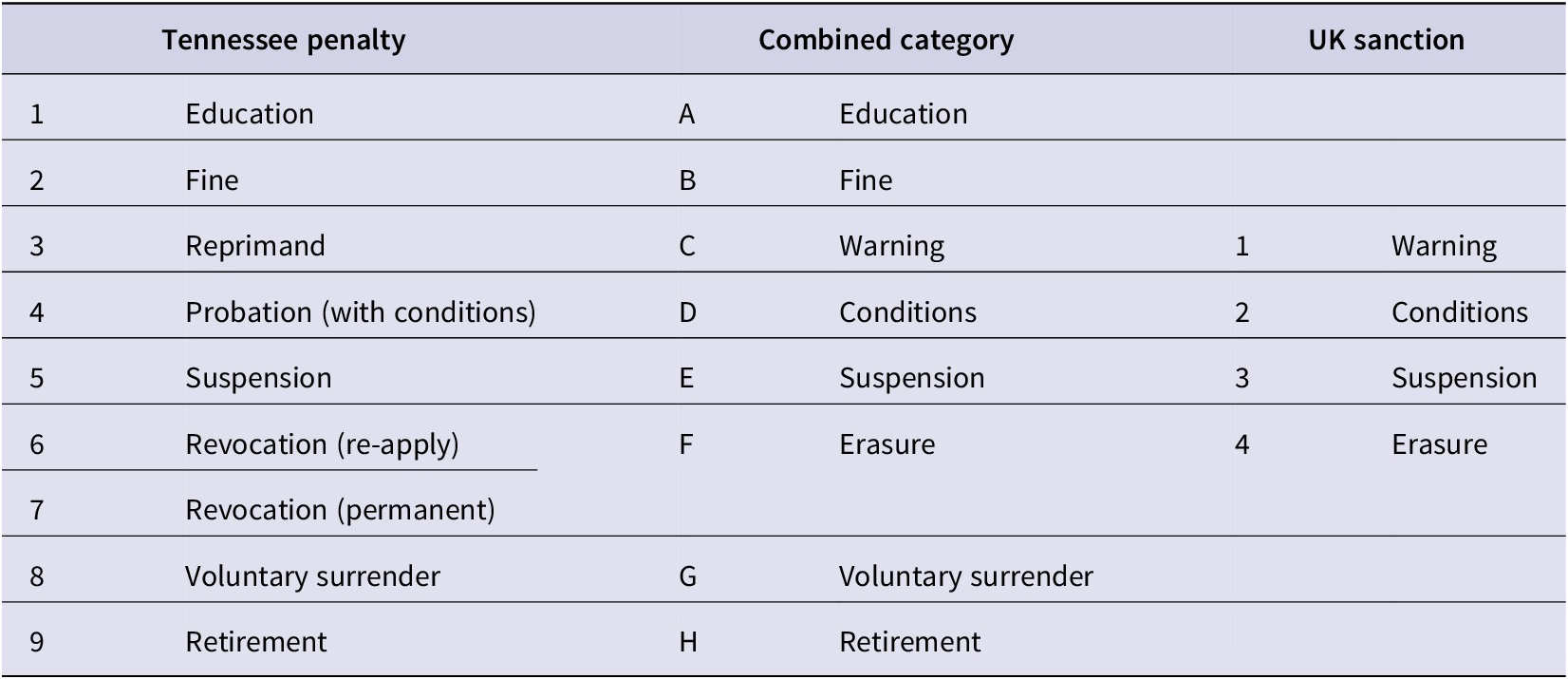
The new combined categories of penalty were further refined into binomial groups based on severity (Table 2). Those categories (A-D), which allow a doctor to continue practicing medicine were categorized as modest, while those that prevented them from doing so (E-H) were categorized as severe. Voluntary surrender of licensure and retirement have the same effect on a doctor’s ability to practice as erasure (i.e., that the doctor may not continue to practice medicine) and were therefore categorized as severe.
Binomial classification of the new combined categories for comparison based on severity
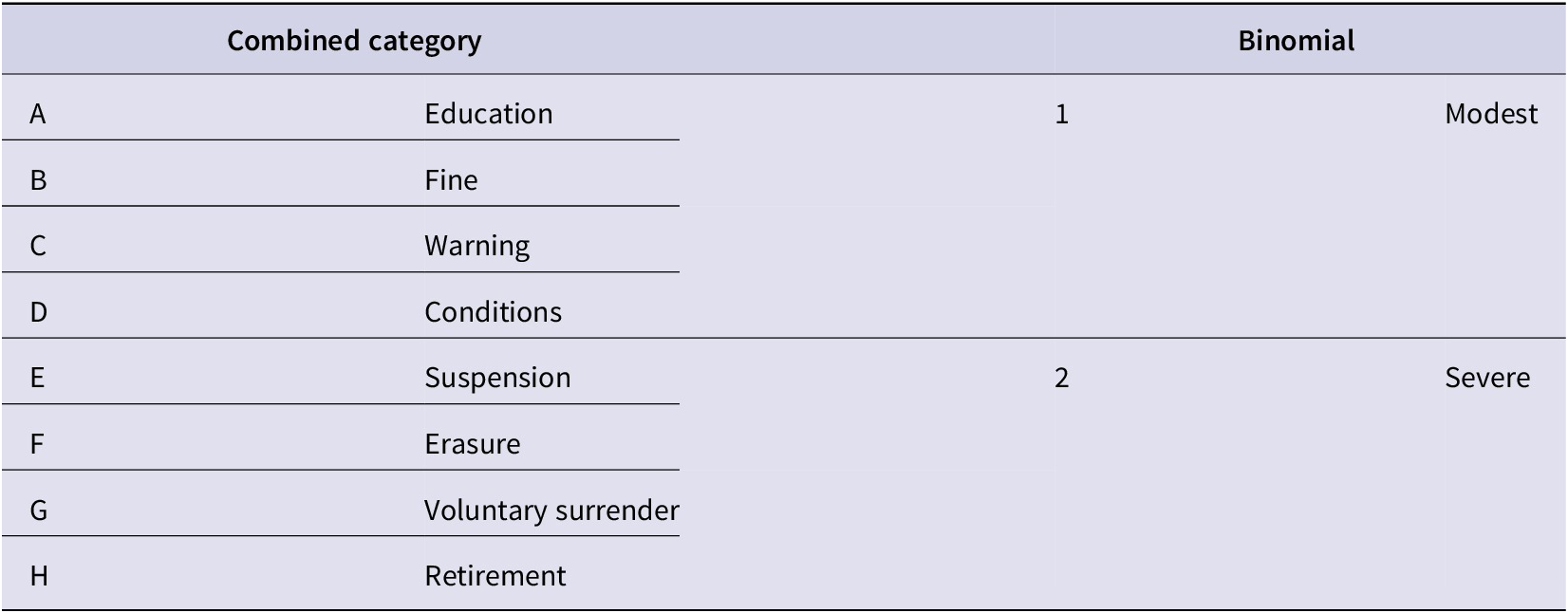
These choices, made to facilitate comparison between the typical American licensing board and the system of medical regulation in the UK, understate the leniency of the American system. First, because conditional probation is far more common in the United States than suspension or probation, the average “severe” sanction in Tennessee is lighter than that imposed in the UK, where erasure accounts for a higher percentage of “severe” sanctions.Footnote 304 Second, we coded voluntary surrenders and retirements in Tennessee—negotiated quietly and out of the public eye—as equivalent to the UK’s “erasure” determination, which necessarily comes after an adversarial and public airing of the doctor’s misdeeds. The former—which far outnumber revocations in contested case hearings in Tennessee—should be seen as less harsh than the latter. Finally, “revocation” in the United States is almost always temporary, and in the UK, it is effectively permanent;Footnote 305 coding them as equivalent understates the relative harshness of the British system.
2. Methodology and empirical results
In comparing the relative seriousness of each regulator’s penalties, Fisher’s Exact Test was used to detect a variation from the distribution of data that should be expected.Footnote 306 In total, 482 cases were included in the analysis, of which 264 (54.8%) occurred in Tennessee and 218 (45.2%) in the UK (Table 3). Of the 264 cases heard in Tennessee, only fifty-six percent of cases resulted in a serious sanction compared to eighty-eight percent in the UK. This represents a statistically significant difference in outcomes between the two jurisdictions (p < 0.0005).
Numbers of cases from Tennessee and the United Kingdom resulting in the imposition of modest and severe penalties/sanctions

Analysis of the complete data demonstrates that UK penalties are more severe than those in Tennessee overall. The picture is the same when the data are broken down by offense category, except for misuse of drugs or alcohol, for which a greater percentage of severe penalties was imposed by the BME than the MPTS. Given the outsized role that Physician Health Programs play in the disciplinary system in the United States, it is perhaps unsurprising that all eight BME cases involving the personal misuse of drugs or alcohol that concluded during the period of the study resulted in conditioning doctor’s practice on participation in the state’s PHP. In contrast, only 57% (four out of seven) of UK cases involving the personal misuse of drugs or alcohol led to severe sanctions, although the difference between the two countries was not statistically significant (p = 0.077).
When examining sexual misconduct (n = 50) and fraud (n = 150), the Tennessee BME imposed severe penalties in only 67% and 63% of cases, respectively. Compare this to 95% and 89% of severe sanctions in the equivalent UK cases (psexual = 0.035; pfraud = 0.007). Temporary or permanent revocation of a doctor’s licensure was the outcome in just 33% of cases involving sexual misconduct in Tennessee, compared to the 95% rate of erasure or suspension in the UK for of doctors found to have engaged in this type of egregious conduct.
We compared our findings in Tennessee to the available national data on physician discipline. The National Practitioner Databank (NPDB) allows researchers to download anonymized nationwide disciplinary data.Footnote 307 The NPDB data for Tennessee is inferior to our own, which was obtained directly from the Tennessee BME and coded for our purposes to include data missing from the national database, such as fine-grained and reliable data on types of offences. Nevertheless, using the information that is available from NPDB, we were able to find yet more confirmation that Tennessee is typical among U.S. states,Footnote 308 and that the American system as a whole imposes “serious” sanctions in disciplinary cases at a rate far lower than in the UK (39% as compared to 88%).
Our data strongly supports the conclusion that the UK system is harsher on doctors who have been found by a tribunal to have engaged in serious misconduct. However, our data also shows that the Tennessee took serious public action against a higher percentage of its total licensed physicians than did the MPTS against physicians in the UK (about 0.02% for the year 2018 in Tennessee compared to 0.008% in the UK).Footnote 309 This might challenge our conclusion that the UK system is harsher and more protective of the public if the base rate of physician misconduct is the same in both jurisdictions, but there is good reason to believe that there is more physician misconduct in Tennessee than in England, and perhaps dramatically more. In a nationalized system as in the UK, there is little incentive to practice medicine in ways to increase profits (selling prescriptions, performing unnecessary surgeries to pad insurance billing). Perhaps not unrelatedly, the United States, and not the UK, is suffering from an opioid crisis driven by physician prescribing.Footnote 310 A large portion of American disciplinary cases that we coded allege misprescribing; in the UK that number is close to zero. Without knowing the actual rate of physician misconduct in each jurisdiction, we should hesitate to use a higher overall rate of discipline in Tennessee to question the idea that the UK system is more effective in bringing doctors to heel.
VI. Fixing the American system
The American system of professional discipline should use the UK system, as it was revised after the Shipman Inquiry, as a model for reform. State boards should be reconstituted to eliminate professional dominance, as was the GMC. And like the GMC, they should be subject to more and stricter state governmental oversight and their members should be merit-selected, paid a professional wage, and fully trained in their regulatory role of protecting the public. Most importantly for this article’s arguments, these boards should not be responsible for hearing disciplinary cases. Rather, discipline should be administered by a body separate in membership and interests from the board that decides the admission, practice and ethics rules that govern professionals. A sketch of how this might be achieved is set out below.
A. Separation of governance and discipline
Due process requires adjudication by an impartial tribunal. Although state administrative law holds that the impartiality requirement is not violated when a board combines rule-making with adjudicative functions,Footnote 311 having a single entity set and apply the rules without any separation of roles leads to conflicts of interest. As discussed in Part III, it permits boards to sound tough at the rule-making stage, and then refuse to bring the hammer down in individual cases. It also encourages boards to make vague or no rules about discipline through a public rule-making process. If an independent entity were delegated authority to apply the rules, boards would likely feel obligated to promulgate, after public input, theories and specifics about when and how a professional should be disciplined. At least one state does this for physicians—New York uses one board to govern physician licensure (the New York State Board for Medicine) and another to handle discipline (the Board for Professional Medical Conduct).Footnote 312
Disciplinary tribunals should not only be independent from the licensing boards creating the rules, but as independent from the professions as possible, so that discipline can vindicate public interests, not focus on the well-being of the accused, as under the current system. The UK achieves this in medicine with a panel of between 250 and 300 hearing officers, only approximately one-third to two-fifths of which are physicians;Footnote 313 in the United States, disciplinary decisions are made by professionally-dominated panels.Footnote 314 The “independent” medical disciplinary board in New York is not an exception to this—it hears cases in panels dominated by its physician members.Footnote 315 A truly independent adjudicatory body would not be dominated by members of the very profession it must discipline.
B. Legal expertise, competency appointment, and training
American states should follow the example of the UK and ensure that there is at least one legally qualified member (a lawyer) on every disciplinary panel. This will help ensure that a professional’s case is heard by someone with at least a basic understanding of due process, regulation, and the adversarial system. Having a lawyer as one of the decision-makers may bring a measure of skepticism to professionals’ self-serving claims of being well-intentioned and perhaps provide some realism that in adversarial hearings, sometimes parties lie. Each panel should also include a member from the profession in question, to advise on the facts of the case from a practitioner’s perspective (not to self-police the profession). Finally, every panel should have one lay member to provide an understanding of what matters most for people using professional services.
Thus, the pool of possible panelists should be roughly one-third lawyers, one-third professionals, and one-third lay members. All members of this pool should be adequately trained on the theories of discipline and the proper role for each sanction—restricted practice, suspension, and revocation—and when second chances are and are not appropriate. They should also be trained on the statutes, rules, and guidelines they will be asked to apply, trial procedure, public health, and other issues related to professional regulation. They should be paid a part-time salary that incentivizes the work, which will be a significant expense given that the pay rate will need to be sufficient to attract good lawyers and professionals whose time is valuable.
C. Guidance and procedure
Good guidance can steer a path aimed at the public-regarding objectives of our model of professional discipline, instead of the status quo—unbounded discretion allows panelists’ feelings of empathy and professional identity to influence decision-making. Ideally, these guidelines should track our theory of discipline and be detailed and specific, yet fall short of mandatory consequences for certain conduct, or, like the Federal Sentencing Guidelines, break cases down in rigid and complicated matrices.Footnote 316 Rather they should establish clear aims, suggest outcomes in typical cases, and express policies on measures like mandated chaperones or practice monitoring. These guidelines should be created by the board in a formal administrative rule-making process that allows for sunshine and public input.Footnote 317
Contested cases should also follow the “stages” approach in the UK,Footnote 318 but with some modifications. In the UK, there are three separate stages to a tribunal (past, present and future). Although this clarifies the fact-finder’s thinking about what question is relevant at each stage, it is cumbersome to have three different stages and stages one and two, especially, risk redundancy. Therefore, we suggest a separating the guilt and the sanction phases into two different proceedings, as is common in the American criminal system. The first stage would establish the facts of the allegation under a preponderance of the evidence standard and ask the panel to decide if there was a violation of the rules of practice and ethics. At this stage, something akin to the rules of evidence would apply, and formal adjudicative procedures followed as in the guilt or liability phase of an American trial.
Then, if the panel finds a violation of the practice act, a new proceeding would begin that resembles a criminal sentencing hearing. Here, the question would be about the appropriate sanction required to protect the public. It would, like Phase 3 in a MPTS tribunal, be largely forward-looking. The accused professional would be allowed to be present and give a statement; other witnesses could be called as well, but the rules of evidence would be relaxed, and a fuller picture of the professional, including past misdeeds, criminal convictions, or prior board discipline that might have been excluded at the fact-finding stage under the prohibition on prior bad acts evidence, could be presented. At the close of this hearing, the panel would deliberate (again, they should do so in private) with clear guidance as to which of the four disciplinary paths best protects the public and its confidence in the profession.
These contested cases should replace all negotiated settlements, as orders hashed out behind the scenes defeat the purpose of professional discipline that we described in Part II: public protection and confidence in the professions. Plea-bargaining with professionals about the appropriate sanction serves expediency, the interests of the professional in keeping things quiet, and little else.Footnote 319 There is a significant cost to the public by not learning about the full range of misconduct (professionals negotiate the statement of facts in agreed orders along with the sanction). It also contributes to the appearance of a regulatory system by and for the profession. A respondent’s cooperation should be expected and not rewarded with a lighter “punishment;” failure to cooperate should invite a separate charge of misconduct.Footnote 320 When board prosecutors compromise with professionals at the settlement phase, they are playing with other people’s money: namely, the public’s safety.
D. Putting it together: The Professional Disciplinary Tribunal
The professions will argue that a UK-style tribunal sacrifices professional expertise.Footnote 321 This criticism is misguided for several reasons. First, every panel would have a professional expert, and where a case required especially detailed or specialized professional knowledge, both parties would be free to call expert witnesses. Second, it improperly privileges one kind of expertise over another. One way of understanding how professional discipline has gone so wrong in America is recognizing that the people deciding the cases are inexpert in what really matters—regulation, adjudication, broader public health issues, patient or client expectations and fears—not the narrow professional expertise of a working provider. Third, most cases of discipline involve either non-technical misconduct, like trading sex for legal services or selling controlled substance prescriptions for profit, or such dramatic lapses in professional judgment (like fusing the wrong vertebrae)Footnote 322 that highly technical medical knowledge is not necessary.
A more serious objection to our suggestion is that it would be prohibitively expensive. First, our system would pay panel members a market rate to do things that members of the profession now do for free. It would also dramatically increase the number of cases heard. Money to pay for the pool members’ time and other trial expenses must come from somewhere. Such an elaborate disciplinary system, repeated nearly 2,000 times over in the United States, could not achieve economies of scale.
Economies of scale need to be found somewhere. We propose that states create one disciplinary tribunal that hears cases from all the professions. This tribunal would draw from a pool with diverse professional membership, allowing there to be one member from the profession in question for each panel. In larger states, it may be feasible to have two tribunals—one for the health care professions and another for the rest. New York uses a system akin to this, by hearing all professional disciplinary cases (except those against doctors) through a single agency: the New York Board of Education.Footnote 323 But whereas in New York, panels for disciplinary hearings are comprised of one lay member from a pool and two professional members of the relevant state boardFootnote 324 (recreating the problem of professional dominance we are trying to solve), our proposed panel would constitute one professional with the relevant expertise (not a board member), one lawyer (perhaps an ALJ), and one lay member, all drawn from a pool of merit-selected, paid, trained regulators.
In the end, financial objections to our proposal should not win the day anyway. Failing to discipline lawyers who have fanned the flames of the current crisis of democracy,Footnote 325 or doctors who sexually abuse dozens or hundreds of patientsFootnote 326 may be pennywise but it is pound foolish. So far, professional self-regulation has been popular at state legislatures because it is cheap. But you get what you pay for.
Implementing these reforms will face significant political headwinds. Professional associations can be expected to resist any reforms that reduce the self-regulatory nature of licensing. For example, the American Medical Association has fought hard for state-by-state licensure, and resisted attempts at licensure reform that would reduce physician influence.Footnote 327 The legal profession has reacted similarly to calls for reform away from self-regulation.Footnote 328 The fact of professional resistance is not, by itself, a reason to not try to fix a broken system. It does, however, underscore the importance of developing countervailing political will by documenting the dangers and dysfunction of the current system, one of the main contributions of this article and other work by one of its authors.Footnote 329
Skeptics will also point out that real reform will involve not only pulling off reform against the headwinds of professional lobbying, but doing so fifty times, as each state has a different licensing regime. Yet in terms of achieving reform, the state-by-state nature of professional licensing may help the odds of making progress. A well-organized campaign in one state may face better prospects than a sweeping, national campaign for reform.Footnote 330 And if one state’s experimenting with an accountable, guided, and balanced disciplinary tribunal is met with success, it can serve as a proof-of-concept for other states seeking reform.Footnote 331
Conclusion
The professions will always be self-regulatory to some degree— indeed autonomy is part of what it means to be a “profession.”Footnote 332 But it does not follow that professional autonomy needs to be taken to the current extreme observed in professional discipline, where accused professionals are judged by their literal peers. While it is sociologically, historically, and culturally ingrained that professionals will govern themselves, it does not need to be accepted as an immovable object, especially with mounting evidence that in the bargain struck between the professions and the public, the professions have not held up their end. In the UK, a similar crisis of confidence in the professional discipline emerged two decades ago, and the solution was to reduce and temper professional influence over the regulatory process, and to provide clear, public-regarding guidelines for how to address unethical, incompetent, and dangerous practice. State licensing boards in the United States should follow suit.
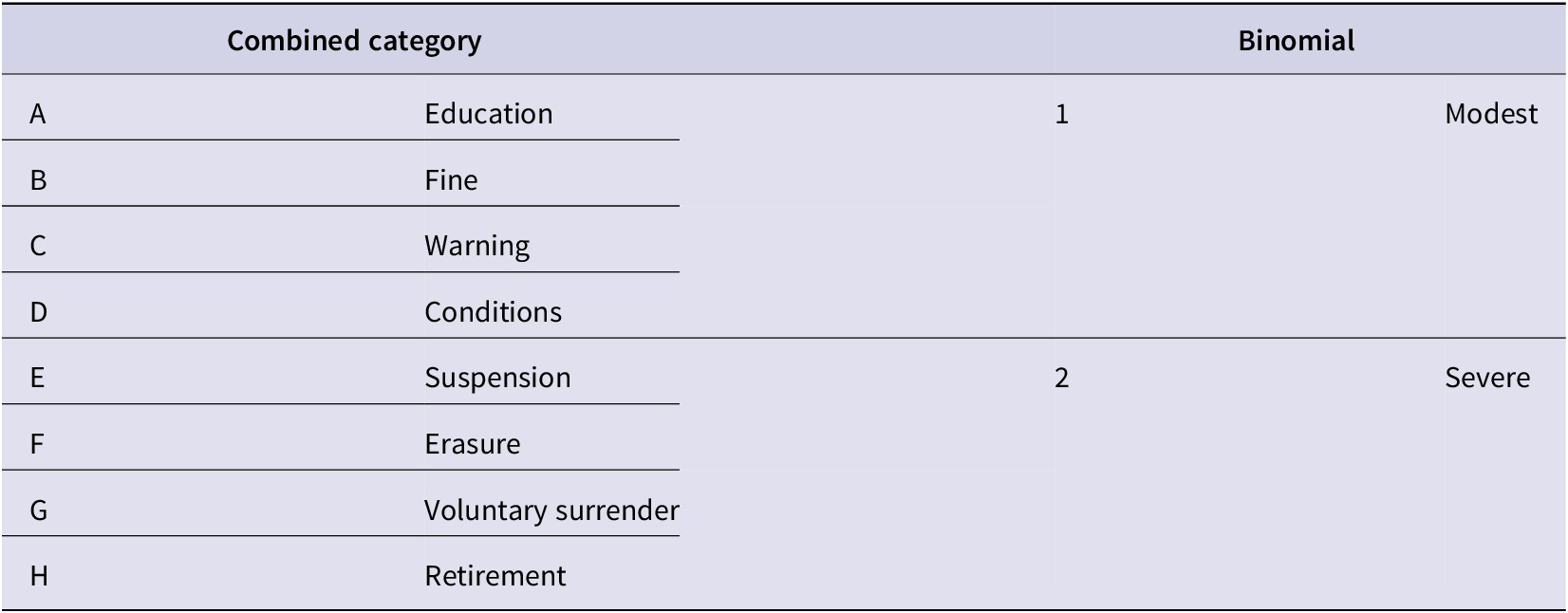


 Open access

