


Why do some individuals tend to have greater conviction toward religion while others do not? While previous studies have shed important light on the knowledge of the link between cognitive disposition and religious belief (Paloutzian & Parks, Reference Paloutzian and Park2005), many researchers have attempted to explain the phenomenon by simply comparing those who are religious and those who are irreligious (Altemeyer & Hunsberger, Reference Altemeyer and Hunsberger1992; Coyle & Lyons, Reference Coyle and Lyons2011; Hunsberger, Reference Hunsberger1985; Järnefelt, Canfield, & Kelemen, Reference Järnefelt, Canfield and Kelemen2015; Kelley & De Graaf, Reference Kelley and De Graaf1997; Loewenthal, MacLeod, & Cinnirella, Reference Loewenthal, MacLeod and Cinnirella2002; Martin & Nichols, Reference Martin and Nichols1962; Norris & Inglehart, Reference Norris and Inglehart2009). For example, previous studies have shown that people with high religious belief have been shown to be associated with lesser intelligence compared to those who have lesser religious belief (Bertsch & Pesta, Reference Bertsch and Pesta2009; Nyborg, Reference Nyborg2009). Other studies suggested that people who self-reported themselves as having less religious belief tend to use more deliberate and controlled cognitive processing, while those who self-reported themselves as having more religious belief tend to rely more on intuition (Pennycook, Cheyne, Koehler, & Fugelsang, Reference Pennycook, Cheyne, Koehler and Fugelsang2013; Shenhav, Rand, & Greene, Reference Shenhav, Rand and Greene2011). In psychology, these two styles of cognitive processing refer to cognitive styles. Other than correlational evidence between cognitive styles and self-reported religious beliefs, a study conducted by Pennycook (Reference Pennycook2013) indicated that religious belief can be affected directly by the priming of cognitive tendencies. However, such findings might neglect the complexity of religious belief since individual thinking style may not be the only predictor of religious belief. Furthermore, those results should not be generalized across different contexts (Gervais et al., Reference Gervais, van Elk, Xygalatas, McKay, Aveyard, Buchtel and Svedholm-Häkkinen2018). In emphasizing this issue, a question is raised about whether cognitive style priming can influence religious belief throughout different contexts, such as can be found in the highly religious society of Indonesia. Further, we ask whether these findings may generalize across different types of religious belief, that is, including individual secular belief.
Previous studies have examined the relationship between cognitive styles and religious beliefs. A study conducted by Shenhav et al. (Reference Shenhav, Rand and Greene2011) manipulated participants with a writing task in which they wrote sentences describing a time when they used deliberate, careful reasoning that resulted in a good outcome. After such priming, participants were asked to complete the explicit measure of belief in God. Participants who were manipulated with such a task scored significantly lower on self-reported belief in God compared to participants who were manipulated with a similar writing task that emphasized the use of intuition or quick judgement. More recently, another experiment in Muslim society in Turkey also found that analytical thinking priming can indeed reduce religious belief and even prejudice (Yilmaz, Karadoller, & Sofuoglu, Reference Yilmaz, Karadöller and Sofuoglu2016). Not only does such priming affect religious belief and prejudice, another previous work also found that it lessens paranormal belief as well (Pennycook, Cheyne, Seli, Koehler, & Fugelsang, Reference Pennycook, Cheyne, Seli, Koehler and Fugelsang2012). However, whether such analytical thinking activation will lead to an increase in secular conviction remains to be explored. Additionally, a study by Farias et al. (Reference Farias, Mulukom, Kahane, Kreplin, Joyce, Soares and Möttönen2017) found null results in that they found no link between cognitive style and supernatural belief, and they regarded the link between cognitive style and religious belief as a premature hypothesis. This casts doubt on the generalizability of findings on whether cognitive style actually predicts religious conviction. It is thus important to test such a hypothesis in various contexts to improve the external validity.
In a highly religious society such as in Indonesia, being secular is much less welcome than being religious, so secular people are a minority group (Colbran, Reference Colbran2010; Salim, Reference Salim2008). This context is important to improve external validity, as previous works focused more on the Western context where being secular is much more normative. Naturally, our study addresses the problem of WEIRD (Western, Educated, Industrialized, Rich, and Democratic) science and offers the rarely investigated Indonesian context (Henrich, Heine, & Norenzayan, Reference Henrich, Heine and Norenzayan2010). Furthermore, secular identities remain highly neglected in psychology literature (Schnell, Reference Schnell2015), so this research may shed some light on the link between cognitive style and secular conviction. By conducting two studies, we investigate whether activation of analytical thinking predicts higher secular belief.
Secular belief
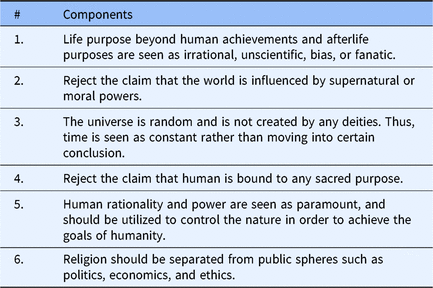
Secular belief is a conviction that denies divine or supernatural influence in the world or in public spheres. Charles Taylor, in his book A Secular Age, stated that there are several elements that define secularism (Taylor, Reference Taylor2007). First, a secular worldview rejects the claim that our world contains supernatural or spiritual influences, while a religious worldview embraces such claims (Taylor, Reference Taylor2007). Also, secularism views the universe as disconnected from the subject, in that the universe was not created by a divine power. Religions reject this because individuals are often bounded to the sacred means or will of God. Additionally, secularism treats human purposes other than purposes related to worldly life as irrational, unscientific, biased, or fanatical. Time is constant, as opposed to moving toward a certain meaning. In contrast, religions emphasize judgment day or the end of time (such as the Abrahamic religions), or predict future happenings using time (e.g., Buddhism, which predicts the occurrence of supreme chaos thousands of years after the birth of Buddhist ideology).
By carefully examining these elements, secular belief is more than the state of “not being religious”. For example, component 5 (see Table 1) is related more to the modernism paradigm and traditional humanistic ideology, which claims that human rationality and feelings are the key for human advancement (Norman, Reference Norman2004). In component 6, people with high religious belief may also endorse the separation of religious institutions from key public institutions such as government, politics and the economy. These are due to the argument that religious people in the 21st century may also endorse a liberal-humanist tradition, which sanctifies human feelings before divine commandments (Harari, Reference Harari2014). In this sense, a reverse measure of religious belief cannot be said to be equivalent to secular belief. To see the complete secular belief domains as described by Taylor (Reference Taylor2007) see Table 1. A study reported that Western countries have a higher degree of secular belief than countries like Ghana, Saudi Arabia, Afghanistan, Malaysia, and Indonesia (Norris & Inglehart, Reference Norris and Inglehart2009). In the countries where secular belief is much lower, to be viewed as having a conviction in supernatural deities is deemed as much more normative, especially because in such a context, those having no divine convictions are regarded as untrustworthy (Norenzayan, Reference Norenzayan2013; Shariff & Norenzayan, Reference Shariff and Norenzayan2011). Thus, to avoid the threat of being non-normative, these people may conform to the norms that are posed within the specific historical contexts (Kruglanski et al., Reference Kruglanski, Gelfand, Bélanger, Sheveland, Hetiarachchi and Gunaratna2014). However, these people may also exhibit a lesser understanding of their own belief (Taylor, Reference Taylor2007) and believe in a religion or God, while at the same time they do not completely understand the content of such teachings.
Components of secular blief according to Taylor (Reference Taylor2007)
It is thus important to measure religious belief not by asking whether a person believes in religion or God, but by asking about their attitudes toward the content of religious teachings. Unfortunately, religious belief measurements tend to directly ask participants questions such as “I have the idea that I entrust myself more and more to God” (see Mature Religiosity Scale; De Vries-Schot, Pieper, & Van Uden, Reference De Vries-Schot, Pieper and Van Uden2012), “I will always believe in God” (see Religiosity Scale; Joseph & DiDuca, Reference Joseph and DiDuca2007), or “I practice religious prayers as taught in my religion” (see Muslim Religiosity Scale; Krauss, Hamzah, & Idris, Reference Krauss, Hamzah and Idris2007). It was thought that such an approach to measuring religious belief might lead participants to respond with normative answers acceptable in their communities (Batson, Schoenrade, & Ventis, Reference Batson, Schoenrade and Ventis1993; Jong, Reference Jong2012; Leak & Fish, Reference Leak and Fish1989; Phillips & Clancy, Reference Phillips and Clancy1972; Presser & Stinson, Reference Presser and Stinson1998). Further, we argue that such statements will be more effective in measuring individuals’ divine convictions in a context where being religious is not extremely normative. This is because such measures rely on self-report that do not directly ask for the content of belief system. Many people show adherence to religious belief even when they do not know or understand the content of such belief (Nelson, Reference Nelson2009; Taylor, Reference Taylor2007). Therefore, we propose the alternative, that is, the measure of secular belief that may extract the content of belief rather than the shallow self-reports of the degree of divine belief without regard to the actual belief contents.
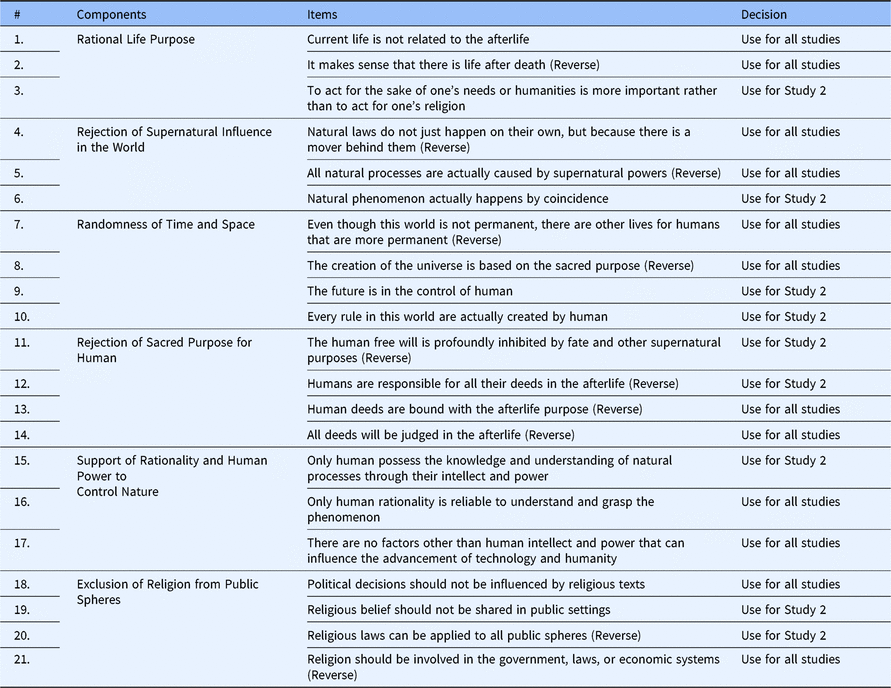
For the purpose of this study, we constructed the Secular Belief Scale, which was administered in the Indonesian language. Here, we used the 21 items of Secular Belief Scale based on Charles Taylor’s six components of secularism.
Cognitive styles and secular belief
Within the historical traditions of major religious teachings such as Christianity and Islam, narrations that emphasize rationality can be observed. In the Middle Ages, Muslim society was known to have developed science and combined their ideological narratives with Greek philosophy. Notable Muslim figures such as Ibn Sinna (Avicenna), Ibn Al Haitam (Alhazen), and Ibn Rushd (Averroes) combined Islam with rational philosophical thoughts. For instance, Averroes wrote that reasons, in the Aristotelian sense, can be reconciled with faith (King, Woody, & Viney, Reference King, Woody and Viney2013). Despite the condemnation of reason in Europe by the Christian churches throughout the Middle Ages, modern science flourished in Europe afterwards. While this modern science operates in a separate dualistic way with religion (Liu, Reference Liu2014), people commonly regard science and religion as complementary (Brooke, Reference Brooke2018). Attributing religion to a lack of rationality is thus questionable, especially when there are various denominations within a single religion.
There are, however, religious narratives in some denominations that emphasize absolute obedience and submission toward holy texts and divine commands, as well as violence, regardless of the religion (Altemeyer & Hunsberger, Reference Altemeyer and Hunsberger1992; Putra & Sukabdi, Reference Putra and Sukabdi2014). This fundamentalist branch of religion emphasizes sacred texts as the ultimate unquestionable truth and that verses should be interpreted literally regardless of context (Williamson, Hood, Ahmad, Sadiq, & Hill, Reference Williamson, Hood, Ahmad, Sadiq and Hill2010). In such narratives, reasons are regarded as less important and may be considered as blasphemous by the followers. Consequently, analytical thinking will be less paramount. It is specifically this type of religious belief that secularism should be placed as a polar opposite, because secular ideology stresses rational human capacity in understanding the world.
Previous studies have noted various factors that determine the tendency toward embracing religious or non-religious worldviews. Cognitive factors such as intelligence and cognitive styles have also been found to be associated with religious convictions (Bertsch & Pesta, Reference Bertsch and Pesta2009; Lynn, Harvey, & Nyborg, Reference Lynn, Harvey and Nyborg2009; Pennycook, Cheyne, Koehler, & Fugelsang, Reference Pennycook, Cheyne, Koehler and Fugelsang2013; Shenhav, Rand, & Greene, Reference Shenhav, Rand and Greene2011). It was found that people who tend to think analytically have fewer religious convictions and higher disbelief in the supernatural or religious phenomenon. These patterns of results assume that religion is a byproduct of a more heuristic and intuitive approach in thinking, as opposed to reflective or analytic tendencies (Yilmaz et al., Reference Yilmaz, Karadöller and Sofuoglu2016). However, many of these studies focused only on religious belief. To our knowledge, there are few psychological studies that have examined the cognitive factors that can influence one’s secular belief.
Despite its tendency to be stable, the cognitive style of an individual can be changed or manipulated in a certain condition (Gervais & Norenzayan, Reference Gervais and Norenzayan2012). Culture and the social factor may play a role in deciding whether people will collectively prefer an automatic approach or a controlled approach in thinking (Kozhevnikov, Reference Kozhevnikov2007; Shenhav et al., Reference Shenhav, Rand and Greene2011). In this study, we hypothesized that analytical thinking priming may affect the endorsement of secular belief. We aimed to conduct two studies to prove our hypothesis. In the first study, we manipulated participants into thinking that the analytical mode of cognition is desirable, while in the second study we utilized another form of stimulus, the instructional manipulation condition (Hauser & Schwarz, Reference Hauser and Schwarz2015; Oppenheimer, Meyvis, & Davidenko, Reference Oppenheimer, Meyvis and Davidenko2009). Additionally, Study 2 examined such priming to the various components of secular belief. We argue that core belief systems in one’s religion might not be affected. The rationale behind this claim is that core belief systems might function to maintain one’s existential needs (Greenberg, Pyszcynski, & Solomon, Reference Greenberg, Pyszczynski and Solomon1986) and so they might not be easily affected by an individual mode of thinking.
STUDY 1
Previous studies have established experimental evidence of analytical thinking priming and religious belief. However, to our knowledge, none have explained this causal effect in secular belief. Thus, we wanted to test whether participants primed with the analytical thinking condition (using a writing task) score higher in secular belief compared to the participants primed with the non-analytical thinking condition. For this purpose, we developed a measure of secular belief.
Methods
Design and participants
A between-subject design with two conditions was conducted using the same approach previously used by Shenhav et al. (Reference Shenhav, Rand and Greene2011). In the positive priming condition, participants were primed to favor a reflective (analytic) cognitive style in which they were asked to write about their experiences with analytical thinking with desirable (positive) consequences. In the negative priming condition, participants were primed to disfavor a reflective cognitive style in which they wrote about their analytical thinking experiences with undesirable (negative) outcomes. Participants were instructed to write 10 sentences for each condition. We also contacted them via email to provide detailed explanations and instructions for the priming itself. We conducted the experiment in several classes at a university in Indonesia right after the participants had attended a class. There were three classes that we visited.
Sixty-four undergraduate students participated in this study. We processed only participants with complete responses on the Secular Belief Scale and those whose writings in the writing task were more than 10 sentences. Overall, there were 9 males and 55 females in this study, with over 80% females in each experimental group. All participants were 19 years old (M = 19, SD = 0). We then conducted the hypothetical testing after we excluded three participants from the negative priming group as they did not meet our priming check requirements. Thus, there were 61 remaining participants who we analyzed (32 participants for treatment group 1 and 29 participants for treatment group 2). The number of females in treatment group 1 was n = 26 (81.25%) while the number of females in treatment group 2 was n = 26 (89.66%).
Procedures
The class in which we administered the positive priming of reflective cognitive style (treatment group 1 or TG1) consisted of 32 participants, while the classes in which we administered the negative priming of reflective cognitive style (treatment group 2 or TG2) consisted of 29 participants. The researcher entered each class with one experimental instructor, who read the priming for participants, and one research assistant, who assisted us in distributing and collecting the questionnaires. Before the research began, the instructor asked the participants to sit not too close to each other.
For TG1, all participants were asked to complete the informed consent. Then, the instructors read to them (in Bahasa Indonesia): “Write at least 10 sentences which tell your past experiences in which you think carefully and it leads to a positive outcome.” Then they wrote 10 sentences narrating the event in which they carefully completed the thought process that brought a positive outcome. After that, they were instructed to complete the Secular Belief Scale. Participants were then instructed to fill the priming check form for TG1 that asked what they feel and think after the priming. Finally, participants were debriefed about the purpose of the study and given a reward for their participation. For TG2, the procedure was the same except that participants had to write 10 sentences narrating the event in which they did the thought process but it led to negative outcomes. The instructions to participants was (in Bahasa Indonesia): “Write at least 10 sentences which tell your past experiences in which you think carefully and it leads to a negative outcome.”
Priming check measures
In order to check whether the priming was successful, we administered the Priming Check Form. For TG1, we asked the participants whether they indeed think that analytic thinking is beneficial for them. If they answered yes, we further asked how important it is for them to think analytically, using the Likert-type scale response (1 = Not important at all, 5 = Extremely important). For TG2, the questions were similar, except we asked whether analytic thinking is disadvantageous for them. We set these questions so that those who answered “no” in the first question for both priming checks were eliminated for further analysis because this meant that the priming did not enhance nor reduce their analytical thinking. For the second question, those who responded with ‘1’ to ‘3’ in the TG1 priming check were eliminated for further analysis for the same reason. Similarly, for TG2, those who responded with ‘1’ to ‘3’ were also eliminated. Consistent with the work by Shenhav et al. (Reference Shenhav, Rand and Greene2011), all participants who wrote less than the required number of sentences were omitted from further analysis. We set the omission standard as a minimum of 10 sentences.
Secular belief scale
We utilized the 12-item Bahasa Indonesia Secular Belief Scale. The complete 12 items can be seen in Table 2. Participants responded on a 4-point Likert-type scale (1 = strongly disagree, 4 = strongly agree). We obtained a Cronbach’s alpha score of .979.
Complete items for the Secular Belief Scale
Results
All participants wrote 10 sentences as required. There were no participants omitted from TG1 (they did not fail the priming checks) while three participants were omitted from TG2 (all females) since they answered that analytical thinking is not disadvantageous for them. We then analyzed the remaining 61 participants. The mean score for secular belief for TG1 was M = 22.34 (SD = 5.65) while the mean score for secular belief for TG2 was M = 19.86 (SD = 2.47). We then conducted an independent measure t test to see the mean differences between TG1 and TG2. One-tailed hypothetical testing showed a significant mean difference between groups (t = 2.180, p < .05, Cohen’s d = 0.569). Thus, participants who were given the positive priming (TG1) had a significantly higher mean of secular belief than participants who were given the negative priming (TG2). In short, participants who were primed to be more reflective (or analytical) had a higher level of secular belief.
Discussion
This study confirmed previous works that have found that priming of analytical thinking may determine the degree of religious belief. Moreover, it extends the literature in which we found that analytical thinking priming determines the endorsement of secular belief as well. Individuals who are primed to favor thinking analytically tend to have higher secular belief than individuals who are primed to disdain analytical thinking. This result seems to be consistent with previous experiments (Shenhav et al., Reference Shenhav, Rand and Greene2011; Yilmaz et al., Reference Yilmaz, Karadöller and Sofuoglu2016) but inconsistent with findings from other experiments (Farias et al., Reference Farias, Mulukom, Kahane, Kreplin, Joyce, Soares and Möttönen2017; Sanchez, Sundermeier, Gray, & Calin-Jageman, Reference Sanchez, Sundermeier, Gray and Calin-Jageman2017).
Perhaps those who are high on secular belief tend to be more analytic in terms of their information processing. Research by Pennycook, Cheyne, Barr, Koehler, and Fugelsang (Reference Pennycook, Cheyne, Barr, Koehler and Fugelsang2013) found that religious participants made more mistakes when they were asked to solve logical problems compared to participants who were skeptical about religion. Moreover, religious participants also responded to logical problems significantly faster than skeptical participants. This showed the difference in cognitive processes. Those who use a reflective cognitive style need more time to evaluate, criticize or counter an intuition, while those who use a more intuitive approach need less time since they rely on intuition. So, the more secular individuals are, the more they use a careful and analytical cognitive process.
We should also note several limitations. First, we did not randomize the participants, thus the effect can never be attributed to the priming alone. Second, our self-report measure of priming checks may not have screened the participants as it should because it is not directly assessing their cognitive process. Third, since we utilized the short form of secular belief, it may be more difficult for us to explain what domains of secular belief will be influenced by analytical thinking. Our second study deals with these issues.
STUDY 2
This study focused on similar research problem. However, we attempted to improve the previous study by conducting four additional efforts. First, we randomized the participants. Second, we attempted to maximize the priming check by employing the cognitive reflection test: the widely used test to examine one’s analytical thinking (Frederick, Reference Frederick2005). Third, we looked more deeply into each domain or component of secular belief rather than examining a single total score of secular belief. For this purpose, we used the 21-item Secular Belief Scale (see Table 2). Fourth, we employed different forms of treatment stimulus compared to the first study. Based on previous work, an instructional manipulation condition (Oppenheimer et al., Reference Oppenheimer, Meyvis and Davidenko2009) can serve as a condition that may improve performance in analytical tasks (Hauser & Schwarz, Reference Hauser and Schwarz2015). We utilized such a treatment condition for this second study.
Methods
Design and participants
The design was similar to Study 1 in which we employed a between-subject design. The independent variable for this study was analytical thinking (two conditions: instructional manipulation condition vs. control). The dependent variable was secular belief. We used the Qualtrics survey tool (www.qualtrics.com) for our data collection. Eighty-five participants completed this study (N female = 65 or 76.5%). Their age ranged from 17 to 29 (M = 21.55, SD = 2.57). The majority of participants were Muslims (N = 77 or 90.6%) while the rest were Christians. Participants’ education varied from junior high school to master’s graduate, though most were either high school graduates (N = 44 or 51.8%) or bachelor degree graduates (N = 31 or 36.5%). The remaining participants (N = 10 or 11.7%) were either junior high school graduates, diploma (vocational degree) graduates, or master graduates.
Most of the participants were college students (N = 61 or 71.8%). Forty-four participants received the analytical condition (N female = 33, M age = 21.70, SD = 2.55) while 41 participants were in the control condition (N female = 32, M age = 21.40, SD = 2.92). In the analytical condition, there were n = 21 (47.77%) high school graduates. In the control condition, the majority of participants were high school graduates (n = 23 or 56.10%).
Procedures
We set up on online experiment using Qualtrics. A between-subject design with two conditions was conducted. After random assignment, participants within the analytical condition (TG1) received the instructional manipulation. Here, the participants were exposed to 10 choices of sport activities that led them to think they were answering a question about sport activities (for detailed instructions, see Oppenheimer et al., Reference Oppenheimer, Meyvis and Davidenko2009). There was an 11th choice that was not related to sport but nevertheless the correct one. When they read the passage, they became wary and thus their analytical thinking will be increased (Hauser & Schwarz, Reference Hauser and Schwarz2015). Then participants answered the three-item Cognitive Reflection Test for the experimental condition check. Finally, participants completed the 21-item Secular Belief Scale along with the demographic questionnaire.
For the control condition (TG2), participants received the control-group manipulation after random assignment. Here, participants only answered with their favorite sport exercise from the choice of 10 sports. As with TG1, participants then completed the three-item Cognitive Reflection Test, 21-item Secular Belief Scale, and demographic questionnaire.
Experimental condition check measure
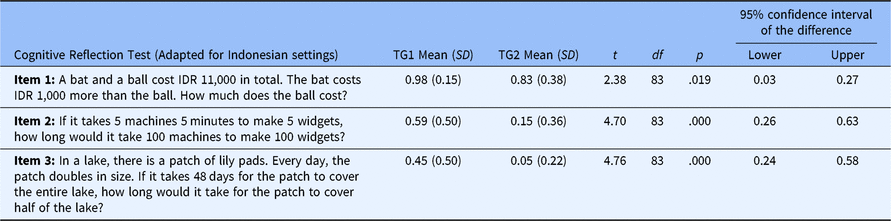
We employed the Cognitive Reflection Test constructed by Frederick (Reference Frederick2005) that we have back translated to assess whether participants’ analytical thinking differs between the experimental conditions. The three items contain simple mathematical questions that will be answered differently depending on the cognitive processes of the participants. The more analytical thinking expressed, the more they will answer the items correctly. Thus, participants in the control condition (TG2) should have a less average score compared to the experimental condition (TG1).
Secular belief measure
While we used the 12-item Secular Belief Scale in Study 1, we employed the longer version of the measure for Study 2 (21-item Secular Belief Scale). Participants responded on a Likert-type scale (1 = strongly disagree, 6 = strongly agree). We obtained a satisfactory internal consistency score (alpha = .84). There were six components of secular belief that we separately computed. Details of the items for each component can be seen in Table 2.
Results
Zero-order correlations
The zero-order correlations for all variables are illustrated in Table 3. Every component of secular belief significantly correlated with each other except for the correlations with component 5. As for the demographic variables, there were mostly no correlations between age, gender and education with the six components of secular belief, except for component 4.
Zero-order correlations
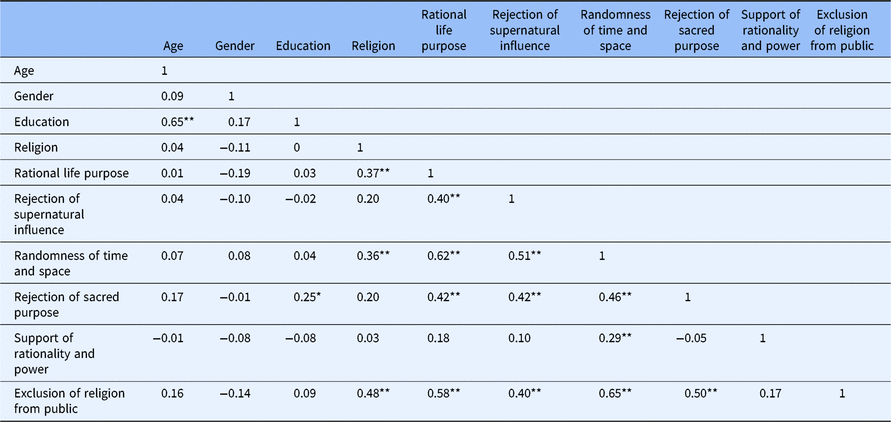
Note: *p < .05 (2-tailed), **p < .01 (2-tailed). We coded the religion score as 0 for Islam and 1 for Christianity, and we coded the gender score as 0 for male and 1 for female. For education, higher scores signify higher education categories (ranging from junior high school to master graduates).
Treatment condition checks
To assess whether participants in TG1 were truly different from TG2 in terms of analytical thinking, we analyzed the three-item Cognitive Reflection Test using an independent measure t test. This analysis is illustrated in Table 4. For the first item, the mean score for participants in TG1 was significantly higher compared to TG2. This finding is similar for the second and third items. The false discovery rate (FDR) correction test (Fink, McConnell, & Vollmer, Reference Fink, McConnell and Vollmer2014) using an alpha level of .05 resulted in a significant result for all three items. Therefore, we regard the experimental treatment as successful.
Results of experimental condition checks
Hypothesis testing
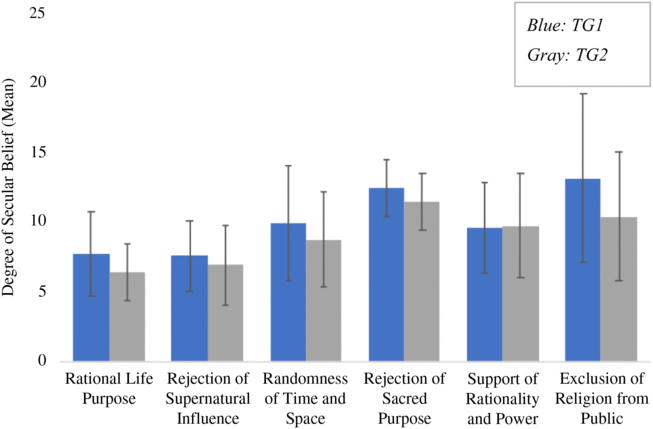
We conducted the independent measure t test for each component of secular belief. All of the results, along with the effect size (Cohen’s d), are illustrated in Table 5 and Figure 1. Generally, the mean score for TG1 is significantly higher compared to TG2 when we computed all components as a single total score. The effect remains significant even after controlling for age, gender, religion, and education altogether, F(1, 84) = 5.43, p < .05. We then analyzed the six components separately. We found that mean scores for TG1 were significantly higher compared to TG2 for component 1, component 4 and component 6. However, we found no significant differences for component 2, component 3 and component 5. Using the FDR correction (alpha level = .05) for these six tests, we found significant results for component 1, component 4 and component 6, but not for the other three components (see Table 5).
Comparison of mean score for each component of secular belief
Results of hypothesis testing
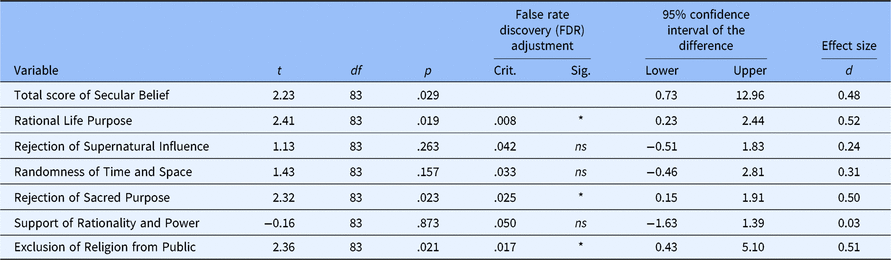
Note: *p < .05.
Discussion
The results once again confirmed our main hypothesis that participants in the analytical 359 condition showed higher endorsement for secular belief compared to the non-analytical condition. Study 2 further examined the domains of secular belief affected by such analytical thinking. We found that participants who were stimulated to be more analytic (TG1) tended to have three specific domains of secular belief (i.e., Rational life purpose, Rejection of sacred purpose for human, and Exclusion of religion from public spheres) higher than participants in the control group (TG2).
However, the other three domains were not or were at least weakly affected by such condition. We will discuss this further in the general discussion. This study also confirmed previous work by Hauser and Schwarz (Reference Hauser and Schwarz2015), which argued that an instructional manipulation condition would enhance participants’ analytical thinking. Individuals who were exposed to the instructional manipulation condition tended to score higher on the Cognitive Reflection Test (Hauser & Schwarz, Reference Hauser and Schwarz2015) compared to those in the control group. Such manipulation should be utilized in future studies as a promising method for priming of analytical thinking. Future studies should also examine which experimental condition works best to enhance analytical thinking.
General discussion
Across the two experiments, the findings of the present study consistently reported that secular belief can be affected causally by the activation of analytical thinking. Moreover, we found that the effect persists even after controlling for age, gender, education, and religion. These findings contributed further to the previous works by several authors (Pennycook et al., Reference Pennycook, Cheyne, Seli, Koehler and Fugelsang2012; Shenhav et al., Reference Shenhav, Rand and Greene2011; Yilmaz et al., Reference Yilmaz, Karadöller and Sofuoglu2016). Not only did analytical thinking lessen one’s supernatural belief and prejudice, it also contributed to the endorsement of secular belief. This is inconsistent with the findings by Farias et al. (Reference Farias, Mulukom, Kahane, Kreplin, Joyce, Soares and Möttönen2017) and Sanchez et al. (Reference Sanchez, Sundermeier, Gray and Calin-Jageman2017), which found no link between cognitive style and supernatural belief. However, our results also revealed that there are some belief components that can be affected more easily than other components. In other words, analytical priming may affect only specific belief components in religious convictions, but not all. Thus, this result may provide one explanation why the inconsistency occurs. It is possible that the absence of effect in some studies could be attributed to the lack of measurement for diverse components of religious conviction.
The analytical model of thinking activates specific components of secular belief, which is the separation of religion from public spheres such as economics, politics and law, but not the core religious Abrahamic belief such as the control of world by supernatural forces. This raises concerns about how far analytical thinking might influence human capacity to question their belief systems. According to existential motivation theories such as the terror management perspective and the quest for significance theory (Greenberg, Pyszczynski, & Solomon, Reference Greenberg, Pyszczynski and Solomon1986; Kruglanski & Orehek, Reference Kruglanski, Orehek, Forgas, Kruglanski and Williams2011), ideological belief systems serve to maintain one’s self-esteem and one’s cognitive certainty. It is highly doubtful that core religious belief systems might be influenced only by the mode of thinking. Further studies should examine whether existential needs can moderate such effects.
The different effects toward various domains of secularism as we found in Study 2 may be attributed to whether the belief is core to Islam or Christianity (our respondents). Fundamentally, the teachings of Abrahamic religion adhere to the belief in a supreme deity such as Allah, as well as the Trinity of Father, Son and Holy Spirit (Montville, Reference Montville2016). For instance, Christian belief tradition emphasizes love for the universe creator as the most paramount holy commandment (Mark 12:30). This is shared with Islam, where one should love the omnipotent being more than anything else (At-Taubah 24). Such a core belief (that there is a supernatural deity who creates and control all its creations) may not be easily affected by analytical conditions. With this in mind, domains of secular belief that emphasize that humans may control nature and that the world is free from the constraints of supernatural determinism may not be truly affected since these are the core belief of one’s own religion.
Consequently, disbelief in the afterlife and sacred life purpose, as well as exclusion of religion from public spheres were found to be affected because such beliefs may not be quite fundamental in Islam and Christian belief systems. Therefore, it can be easily influenced by the activation of analytical thinking. Additionally, items such as ‘It makes sense that there is life after death’ (see item 2, Table 2) and ‘Humans are responsible for all their deeds in the afterlife’ (see item 14, Table 2), ‘Religious laws can be applied to all public spheres’ (see item 23, Table 2) may conflict with other plausible beliefs such as rationality of thought and the rational benefit of one’s life. Life after death may be perceived as an unknown event or it simply makes no sense when one thinks thoroughly, so it might be perceived as improbable for those who think analytically. Similarly, implementing religious laws in public spheres in reality may be perceived as leading to bad consequences. In this way, such belief should be rejected when one thinks analytically.
However, it is important to note that explicitly measured constructs may often exaggerate as a result of biases (Batson et al., Reference Batson, Schoenrade and Ventis1993). In the social desirability bias, participants tend to answer their degree of religious belief in the explicitly measured questionnaires because the norms expect them to do so. This might have explained why we found that Study 2 did not affect all domains of secular belief. It might be that some items were actually still quite high in social desirability. In order to obtain results free from this bias, one perhaps should utilize a more implicit measure of secular belief or religious belief (e.g., Implicit Association Test). One should also measure participants’ social desirability as a covariate. Further studies should consider these measurements.
Finally, we note the limitations of our studies. First, the number of participants might not be enough. Although we attempted to randomize participants to maximize the experimental internal validity in Study 2, a higher number of participants might improve the external validity of these works. Therefore, future studies should be conducted with a higher number of participants. Second, we did not compare the effect of analytic style priming to secular belief relative to measures of religious belief. However, we arguably favored the Secular Belief Measure as a better instrument to be used in the context of Indonesia. Since Indonesian people are highly religious, using standard religious belief measures that directly ask about their conviction of a god might be prone to social desirableness and thus introduce us to bias. Still, future studies should compare the effect of analytical thinking activation in predicting both religious belief and secular belief in Indonesian context. We have noted that religious fundamentalism is conceptually an exact opposite of religious belief, so future studies should examine religious fundamentalism in comparison to secular belief. Finally, we did not use random sampling in determining our participants. The result of this study may be biased because most of our participants are college students, females, and Muslims. So, it is important to replicate our findings in a more representative population using random sampling.
Conclusion
In sum, we found that activation or priming of an analytical cognitive style may determine the endorsement of secular belief. However, the degree of endorsement may differ between the belief components. Core religious belief, such as belief in a supernatural power, was not affected by analytical priming, while other belief content, such as the separation of religion with public affairs, was affected. Thus, an analytical cognitive style effect of divine convictions may be limited only to the belief content that is not central to religion.
Acknowledgements
This research was partially funded by the Indonesian Ministry of Research, Technology and Higher Education under the PKPI Program with Joevarian Hudiyana as awardee and Hamdi Muluk as the supervisor.
Financial Support
None.


 Open access

