





1. Introduction
Deck officers spend a considerable amount of time studying the International Regulations for the Prevention of Collisions at Sea (IRPCS). In theory, if everyone followed these rules there should never be a collision between two vessels at sea. However, figures released by the European Maritime Safety Agency (EMSA) show that there were close to 300 collisions a year between 2014 and 2019 (EMSA, 2020). Administrations worldwide report similar numbers. Collisions are typically attributed to ‘human error’ (Hetherington et al., Reference Hetherington, Flin and Mearns2006; Ismail, Reference Ismail2016; Mohovic et al., Reference Mohovic, Mohovic and Baric2016; Ung, Reference Ung2018). Similarly, of the 1,801 accidents investigated by EMSA between 2014 and 2019, 969 were attributed to ‘human action’ (EMSA, 2020). Ung (Reference Ung2018) claims that violation of the collision regulations is a ‘vital element’ of many collisions. Likewise, in a survey of almost 500 deck officers, over 50% of respondents cited ignorance or disregard for the IRPCS as the main cause of collisions (Gard, 2004). While in ‘an ideal world, the rules would only be open to one interpretation’ (Van Dookum, Reference Van Dookum2016, p. 3) studies as far back as 1989 by Habberley and Taylor state ‘different interpretations of the regulations generate uncertainty concerning the actions of vessels’ (Chauvin and Lardjane, Reference Chauvin and Lardjane2008). Hence, the aim of this study was to explore how newly qualified deck officers and Master Mariners interpreted the IRPCS when presented with authentic scenarios. By exploring how both groups interpreted the IRPCS, the expectation was that this research would generate recommendations to enhance training to reduce collisions.
2. Literature review
The IRPCS form a core part of deck officers’ training. However, studies have shown that the rules can be open to interpretation, which can lead to uncertainty concerning the actions of vessels (Habberley and Taylor, Reference Habberley and Taylor1989; Gard, 2004; Chhabra, Reference Chhabra2013; Ismail, Reference Ismail2016). This uncertainty can sometimes lead deck officers to ignore the formal rules and follow their own informal rules (Chauvin and Lardjane, Reference Chauvin and Lardjane2008). Interpretation of the rules is by no means straightforward, as evidenced by a recent high-profile collision case that was eventually overturned by the UK Supreme Court after being originally upheld in the Admiralty Court and the Court of Appeal (The Ince Group, 2021). Mohovic et al. (Reference Mohovic, Mohovic and Baric2016) suggest that this complexity is compounded by ‘nautical students/navigating cadets as well as practising licensed navigational watch keeping officers generally lacking a full and complete understanding of the Collision Rules’. Similarly, the International Maritime Organisation has ‘clearly indicated that the cause of many accidents at sea is due to deficiencies in the education and training of seafarers’ (Mohovic et al., Reference Mohovic, Mohovic and Baric2016).
Throughout their career at sea, deck officers may benefit from what is known as ‘experiential learning’. David Kolb, one of the best-known advocates of experiential learning, claims that the fact that people learn best through experience is an ‘incontrovertible reality’ (Kolb, Reference Kolb2015). Deck officers regularly practice collision avoidance throughout their career: such ‘spaced retrieval’ of knowledge has been shown to have ‘a meaningful, long-lasting impact on educational outcomes’ (Hopkins et al., Reference Hopkins, Lyle, Hieb and Ralston2016). Experiential learning does not simply happen with time, experiential learning takes work; the learner must go through a number of stages to gain the benefit of experiential learning, namely ‘experiencing, reflecting, thinking, and acting’ (McCarthy, Reference McCarthy2016). As part of their training, cadets spend 12 months at sea understudying experienced officers and putting their learning into practice. By understudying deck officers in collision avoidance situations at sea, cadets are participating in active learning involving real, authentic collision avoidance situations.
For students that attend the National Maritime College of Ireland (NMCI), the application and interpretation of the collision regulations are reinforced in lectures and through the use of simulators by retrieval practice; this approach has been shown by studies to have a ‘meaningful, long-lasting impact on educational outcomes’ (Hopkins et al., Reference Hopkins, Lyle, Hieb and Ralston2016). Newly qualified deck officers should have the theoretical and practical knowledge to safely conduct a watch at sea, despite not having had the benefit of putting the rules into practice over many years. However, research suggests that students may be primarily interested in passing exams, hence newly qualified officers may not have developed an in-depth understanding of the rules (Ghosh et al., Reference Ghosh, Brooks, Ranmuthugala and Bowles2020). This comprehensive understanding is important, as in the modern merchant fleet, ‘over half of these vessels may have at least one junior officer on board whose belief in their ability is misplaced’(Bury et al., Reference Bury, Saeed and Khalique2020).
Studies into the collision regulations all point to an issue with the interpretation of the IRPCS. Deck officers’ knowledge of the IRPCS has already been the subject of numerous studies (Habberley and Taylor, Reference Habberley and Taylor1989; Chauvin and Lardjane, Reference Chauvin and Lardjane2008; Chhabra, Reference Chhabra2013; Ismail, Reference Ismail2016; Mohovic et al., Reference Mohovic, Mohovic and Baric2016), several of which used questionnaires as the primary data-gathering instrument (Chauvin et al., Reference Chauvin, Clostermann and Hoc2008; Chhabra, Reference Chhabra2013; Mohovic et al., Reference Mohovic, Mohovic and Baric2016; Hannaford et al., Reference Hannaford, Maes and Van Hassel2022). While questionnaires offer the advantages of being cost-effective and having the potential to access large populations, a limitation is the lack of depth in the resulting data (DeCarlo, Reference DeCarlo2018). In relation to collisions at sea, although prior research has revealed issues with the interpretation of the IRPCS but very little about the nature of that variation, for instance, why some individuals interpret certain rules differently to others. A better understanding of the variation might subsequently inform training to enhance deck officers’ interpretation and reduce collisions at sea. Hence, this research aimed to address this gap by exploring in depth how newly qualified deck officers and Master Mariners interpret and apply the IRPCS in authentic scenarios.
3. Research method
The research method known as phenomenography was selected for this study, as phenomenography is an ‘innovative research design, which aims at identifying and interrogating the range of different ways in which people perceive or experience specific phenomena’ (Tight, Reference Tight2016, p. 319). As noted by Linder and Marshall (Reference Linder and Marshall2003) the term ‘a way of experiencing a phenomenon’ is used interchangeably with other terms like conception, way of making sense, or understanding'. An underlying assumption in phenomenographic research is that there are ‘a limited number of ways of perceiving, understanding or experiencing’ any given phenomenon of interest (Tight, Reference Tight2016, p. 320). Hence the focus in phenomenographic research is representing the variation in experience across a population as opposed to describing the individual's ‘lived experience’. The output from phenomenographic research is an outcome space, which represents the qualitatively different variants in experience. These various ways are typically organised hierarchically with the ‘highest level representing the most advanced or developed way of experiencing the phenomena’ (Tight, Reference Tight2016, p. 320).
3.1 Data collection
Individual interviews represent the data-collection method of choice for phenomenographic researchers (Tight, Reference Tight2016; Kettunen and Tynjälä, Reference Kettunen and Tynjälä2018). This is because interviews allow for the collection of detailed accounts on complex or confusing topics (DeCarlo, Reference DeCarlo2018). This opportunity for lengthy dialogue is particularly important when the focus is to understand how a phenomenon, like decision making, occurs. Furthermore, interviews have the advantage that they can be adapted to follow up on new or unexpected topics as the research progresses (DeCarlo, Reference DeCarlo2018). However, individual interviews are time-consuming to conduct and analyse. Prior research exploring deck officers' interpretation of the IRPCS has presented participants with interactive scenarios (Chauvin and Lardjane, Reference Chauvin and Lardjane2008; Chauvin et al., Reference Chauvin, Clostermann and Hoc2008; Chhabra, Reference Chhabra2013; Mohovic et al., Reference Mohovic, Mohovic and Baric2016). These interactive scenarios present participants with more complex or authentic situations on which decisions need to be made and provide more realistic settings to evaluate interpretations of the IRPCS. This approach is consistent with phenomenographic research as real experiences are central to phenomenography (Cibangu and Hepworth, Reference Cibangu and Hepworth2016). Consequently, three different scenarios were chosen as the basis to explore participants’ interpretation of the IRPCS. Each scenario was chosen to assess a different aspect of the participants' knowledge, understanding and interpretation of the rules. The scenarios were used to explore the decision-making process following the think-aloud protocol (Charters, Reference Charters2003). Studies have shown that this does not change the course or structure of the thought processes but ‘inferences can be made about the reasoning process that was used during the problem solving’ (Fontteyn et al., Reference Fontteyn, Kuipers and Grobe1993).
3.2 Scenario #1
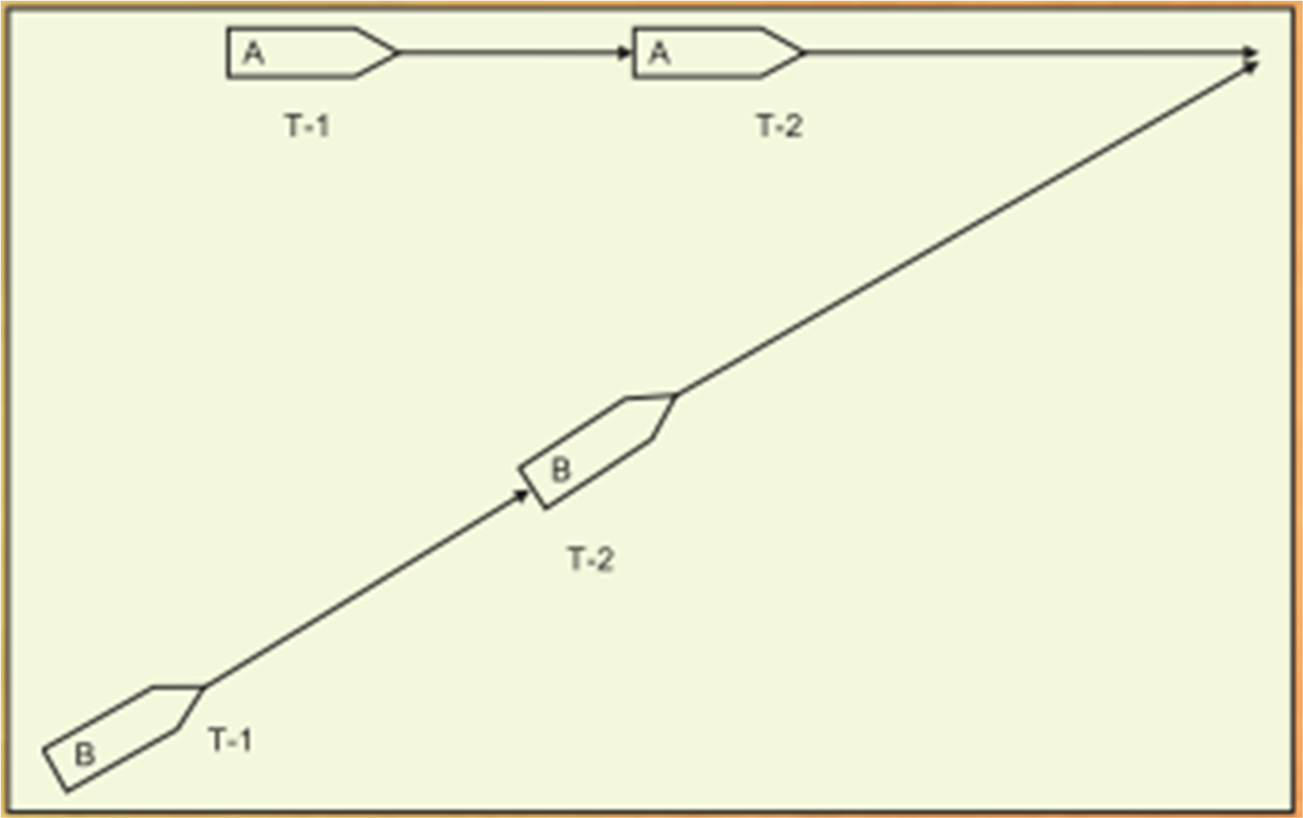
A regular issue in collision avoidance situations is determining whether a vessel is overtaking or crossing. Confusion can result when one vessel is in or around the point at which an overtaking vessel becomes a crossing vessel (22⋅5° abaft the beam). Figure 1 was adapted from Chhabra (Reference Chhabra2013) and used to assess whether participants would recognise that the situation could be interpreted as possibly overtaking or possibly crossing.
Graphical depiction of scenario #1
3.3 Scenario #2
This accident involved a collision between a container ship and a bulk carrier. Details of the accident can be read in MAIB Report No. 11/2014. This was the most complex of the three scenarios as it involved multiple vessels and clear violations of the IRPCS by the two main vessels involved in the accident. This scenario was used to assess how the participants would interpret several rules at the same time, as well as having to adapt and change their interpretation as the scenario developed. Multiple vessel scenarios are difficult to interpret with some researchers asserting that ‘a lacuna exists where the rules do not cover multiple vessel encounters’ (Belcher, Reference Belcher2002) while others argue that a lot of experience is needed to be able to interpret situations that are slightly different from the one-on-one scenarios presented in the IRPCS (Van Dookum, Reference Van Dookum2016).
3.4 Scenario #3
The final scenario was based on an accident report by the Dutch Safety Board between a bulk carrier and a pilot cutter, and was selected as it was an ‘unusual and high-risk situation’ (Dutch Safety Board, 2021). In this case, one vessel was considered restricted in its ability to manoeuvre (RAM) despite not displaying the lights and shapes required of a RAM vessel. The Dutch Safety Board stated that the vessel ‘was restricted in its ability to manoeuvre because it was engaged in replenishment or transferring persons (rule 3(g) (iii) of COLREGs)’ (Dutch Safety Board, 2021). Their interpretation of the rules is that as long a vessel complies with the definition of RAM then it should be considered as such regardless of the lights and shapes displayed.
3.5 Research participants
Participants were selected using a non-probabilistic, convenience-based sampling strategy. A cohort of students that had recently completed their academic studies at the NMCI were invited to participate. Normally, approximately 20 students would complete the course annually; however, with COVID restrictions affecting the number of students progressing to their oral exam, the cohort was limited to six participants. All six agreed to participate in the study. These participants were considered novices for the purpose of this study as they were the most recent generation of deck officers to qualify and would shortly be taking their first watch alone and unsupervised.
The number of Irish-qualified, senior, experienced deck officers working at sea is limited. Through personal contacts, the first author located six participants who had graduated from the NMCI and currently held the highest sea-going maritime qualification of Class 1, Master Mariner. This cohort of participants comprised experienced, senior deck officers. All of this group were still actively working at sea and using the IRPCS on a daily basis. Hence the total number of participants was 12. While this sample size was relatively small, qualitative research notes that with narrowly defined objectives, data saturation can occur quite quickly and smaller samples are appropriate (Hennink and Kaiser, Reference Hennink and Kaiser2022). Furthermore, the sample size was consistent with ‘phenomenographic studies which typically involve small groups of participants’ (Kettunen and Tynjälä, Reference Kettunen and Tynjälä2018).
3.6 Ethical considerations
Ethical approval was obtained from Munster Technological University prior to data collection. All participants were clearly briefed on the research process prior to participating in the interview process and provided signed consent.
3.7 Data processing & analysis
Due to the worldwide pandemic, semi-structured interviews were conducted online and each scenario was verbally described and graphically presented to the participants prior to seeking their interpretation. The same set of open-ended questions was posed to each participant and responses were followed up with exploratory questions. The interviews were recorded, and the recording used to transcribe the interview verbatim. All 12 interviews were held over 1 week to ensure consistency, as well as mitigating against the possibility that participants might discuss the interview and potentially bias their responses. Prior to conducting the interviews, a series of three pilot interviews were conducted with colleagues. Feedback from these interviews helped to formulate the structure and wording and ensure that the questions were not leading or biased.
The transcripts were then ‘chunked’ by scenario. In this process, ‘related parts are divided into segments and analysed in relation to each other’ (Kettunen and Tynjälä, Reference Kettunen and Tynjälä2018). This allowed the study to focus on comparing how participants responded to each scenario. Three qualitatively distinct categories of response were identified, which aligned with the participants’ ability to interpret the IRPCS. In keeping with ‘phenomenographic principles, these categories were not predetermined but constituted on the basis of the collected data’ (Kettunen and Tynjälä, Reference Kettunen and Tynjälä2018). As qualitative data analysis is an iterative process, the analysis was repeated, but this time the interviews were explored with the categories as the basis for the study. For each category, a characteristic was assigned that described how the participants interpreted the rules in the given scenario. One characteristic was the level of confidence displayed by the participant. Variables such as the tone of voice, questions asked, and clarification sought by participants, time taken to formulate an answer and reference to the IRPCS all combined to give an indication of the level of confidence with which the participant interpreted the rules. Throughout, the focus was to uncover variations in participants’ interpretation of the rules, rather than identifying the characteristics of individuals’ responses or participants’ lived experience (Tight, Reference Tight2016).
4. Research results
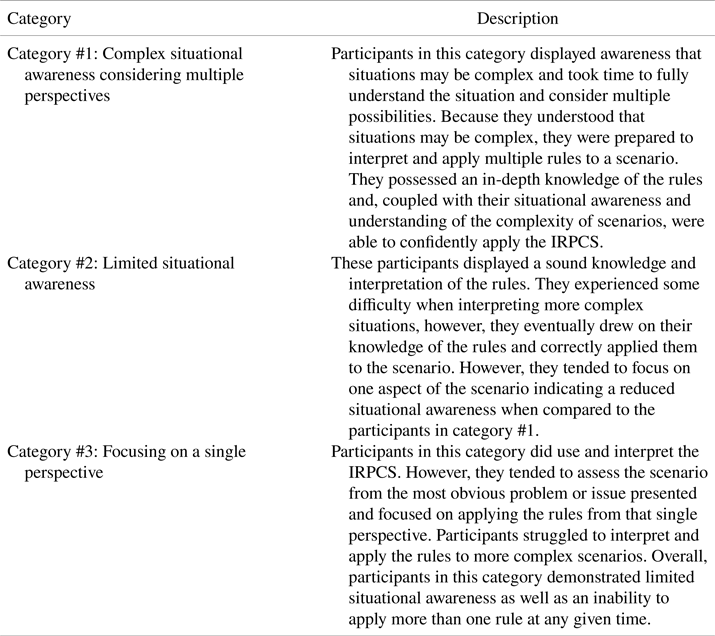
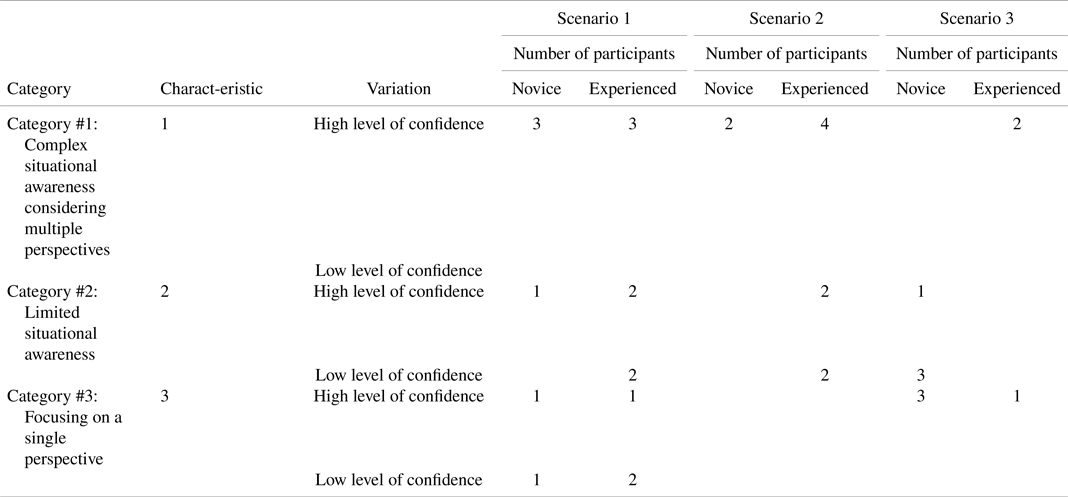
The analysis across all scenarios revealed three distinct categories, with differences between the categories being determined by participants' situational awareness, understanding of the complexity of the situation, ability to consider multiple rules and participants’ confidence in applying rules. Table 1 presents the hierarchical outcome space that was identified, while Table 2 summarises the results.
Identified hierarchical outcome space
Distribution of participants across the outcome space for each scenario presented
4.1 Scenario #1
Seventy-five per cent of participants recognised that this scenario may be interpreted as overtaking or crossing, with responses from the experienced and novice cohorts being broadly similar (see Table 2). When asked how they interpreted the scenario presented to them, participants in category #1 immediately identified the fact that the situation could be deemed to be overtaking or crossing.
Ok for me it's like a straight away crossing or overtaking (Participant #1 – experienced).
Participants in category #2 took more time assessing the situation before eventually realising that the scenario may be interpreted in two ways.
Ok, well initially I thought it was a stand on, give way situation, but then looking at it again, it looks like it's an overtaking situation to me … I'm not sure if it's an overtaking situation (Participant E – novice).
These participants eventually realised that the scenario may not be as straightforward as they originally perceived it to be, and recognised that their original interpretation of the situation may have to be amended.
Only three of the participants were in category #3: they focused on one aspect of rules only and stuck to that interpretation.
Straight away vessel B is overtaking vessel A, vessel B has to keep out of the way of vessel A (Participant #5 – experienced).
4.2 Scenario #2
In this scenario, there was a perceptible difference between how Master Mariners and newly qualified deck officers interpreted the rules (see Table 2). Participants in category #1 displayed an ability to interpret the scenario fully, considered multiple vessels and assessed all options available to them with some, for example, participant #3, also drawing on their personal experience.
Ok, so vessel X, first of all. This is already a special circumstance, it's not clear cut where its crossing or is it because its multiple fishing vessels … between X and Y there is a crossing situation with X being the stand on. Being on the X bridge my first concern is the fishing vessels, since I don't have an immediate problem with any of the other vessels. So, my first concern is the fishing vessels and I will take a bold alteration to starboard in this case. I won't worry too much about vessel Y in this case because once they see my clear manoeuvre, I'm still stand on, they are still give-way. So, they will need to adapt to what I have done (Participant F – novice).
I think the first thing that comes to mind, for me, having been in areas with lots of fishing fleets and things like that and crossing situations. Like if X is concerned that they are passing too close to the fishing vessels at that speed, they need to open up that CPA with the fishing vessels, which is going to close the CPA with Y, I mean an answer to everything there is just take a bit of way off on X, take a bit of way off, you can always come further to starboard so that he opens up the fishing fleet, he doesn't close the CPA with the other vessel on the reciprocal course and he still leaves vessel Y cross ahead (Participant #3 – experienced).
Those in category #2 did not display as in-depth a situational awareness, but did make sound judgements. The difference in the experienced and novice cohorts was in their confidence. The experienced cohort may not have taken the entire situation into account but made confident choices based on their knowledge of the rules:
The reality for me is that vessel X is standing on with caution, vessel Y is crossing, he's not taking action, I've got a vessel coming down my starboard side two points, but ok, large alteration, I mean, depends on the vessel's manoeuvrability, you're not going to port so it's going to be a complete round turn to starboard to avoid collision (Participant #1 – experienced).
In this case the participant focused on the other large vessels in the scenario: the fishing vessels were effectively ignored but the action the participant took complied with the rules and demonstrated a good understanding and interpretation of the situation. In contrast to this positive decision-making, the confidence levels of the novice participants in category #2 were much lower. Asking about the fishing fleet,
so they are all engaged in fishing? I'm more, I don't want to cross too close to them, but I'm concerned about vessel Y … uh and he is crossing ahead a mile and a half now so I'm not too worried, I'm just going to I'm … if I alter to starboard it's going to decrease that CPA as well, so it's a hard decision, so yeah I'm going to slow down a little bit (Participant E – novice).
While the participant did interpret the rules and an argument could be made that the action taken complied with the rules, it did not actually rectify the situation. Slowing down did not increase the distance the vessel would pass from the fishing fleet but it did allow the participant more time to assess the situation and come up with a workable solution.
For this scenario, only two novices featured in category #3 and both found it very difficult to interpret the rules with multiple vessels. Participant A, for example, tried to apply two separate rules and ccould not decide which action to take,
I have to keep out of the way of the fishing vessels … It's a tough one like, I don't know … thinking about it like it's way too close. I'd probably alter to starboard but then I'm not maintaining my course and speed and I'm confusing the fellow that's coming down like (Participant A – novice).
4.3 Scenario #3
The results for the final scenario continued the same trend, with the Master Mariners more dominant in category #1 and the newly qualified deck officers dominating category #3. Only 2 of the 12 participants noticed that the bulk carrier may be RAM, both were experienced deck officers.
See your man is restricted in his ability to manoeuvre isn't he so he can't come to starboard; yeah it's a tough one to call (Participant #6 – experienced).
Half of the participants were in category #2: they made sound decisions but missed the key element. Having said that, the majority of participants in this scenario did recognise that the situation was difficult and were not very confident in their decision, indicating that they were aware that they may be missing something.
Well, if I was on the bulk carrier I would have, am you know, whether the pilot said there was no traffic or not, surely in a busy area like that, I mean I've been up there hundreds of times you know you'd have your lookout … so I would have questioned the pilot, I would have attempted to alter course to avoid collision. But realistically, the bulker should never have been in that situation (Participant #2 – experienced).
Of the participants in category #3, only one was experienced and this participant was convinced that the bulk carrier could not possibly be RAM as it did not have the correct lights and shapes for a RAM vessel:
He's not restricted in his ability to manoeuvre, he's not displaying RAM signals, he is transferring people under-way, he should be using RAM signals (Participant #1 – experienced).
The novice cohort in category #3 concentrated solely on this being a crossing situation and did not consider the fact that the bulk carrier could be RAM: they were quite confident in their assessment of the situation.
So obviously in this situation it's a crossing situation … . They should have altered for the big pilot boat to starboard … well, the bulk carrier should have given way to the pilot vessel (Participant B – novice).
5. Discussion
Across the three scenarios, all participants displayed a sound knowledge of the IRPCS. However, their ability to apply the rules varied, especially in complex scenarios involving multiple vessels. The fact that Master Mariners performed better overall aligns with recent research that deck officers with more work experience interpret the IRPCS better than those with less work experience (Ghosh et al., Reference Ghosh, Brooks, Ranmuthugala and Bowles2020).
A key factor that explains some of the difference between how newly qualified deck officers and Master Mariners interpret the IRPCS was situational awareness. Chauvin et al. (Reference Chauvin, Clostermann and Hoc2008) discuss how situational awareness consists of three parts. The first part relates to acquiring relevant information from the environment: bearings, distance, speed, and so forth. The second part involves interpretating and making sense of these environmental measurements, and the third part involves projecting outcomes. This environmental information was deliberately removed from the first scenario so that it was not obvious whether it was a crossing or overtaking scenario. A quarter of participants did not attempt to seek out this missing information and instead simply assumed that it was one or the other. For scenario #2, the experienced deck officers asked questions to build situational awareness and they all made sound decisions drawing on both their knowledge of the rules as well as their experience. In contrast, only two novice participants were able to use their knowledge of the rules to correctly assess the situation and take appropriate action. In scenario #3 only 2 of the 12 participants came to the same conclusion as the Dutch Safety Board, both of whom were experienced deck officers. In this scenario, those in category #2 missed a key element: they did recognise that the bulk carrier was unable to manoeuvre effectively to avoid a collision, but kept coming back to the situation being a crossing situation. Only one participant in category #2 showed a high level of confidence in their decision. They recognised the fact that the bulk carrier was RAM, but this was only after engaging in a discussion about pilot transfers: they initially assessed the situation as crossing. This finding aligns with that reported by Chauvin et al. (Reference Chauvin, Clostermann and Hoc2008) who noted that many participants failed to ‘grasp the relevant information from their environment’ and that the links between acquiring relevant situational information and decision making were weak.
Scenario #1 did not require a very deep level of interpretation of the participants' knowledge of the IRPCS. Consequently, three-quarters of the participants were able to apply their knowledge of the rules to recognise that the scenario could be interpreted in two ways, and half of the participants interpreted the rules confidently, correctly, and clearly to resolve the situation. Both scenarios #2 and #3 were more complex as they involved multiple vehicles. Multiple vessel scenarios add complexity because multiple rules may apply and deck officers then need to determine the relationships between the rules and which rules take priority for collision avoidance. Novice deck officers struggled considerably with these scenarios and had difficulty interpreting and applying the rules to more than one vessel at any one time. Instead, they tended to simplify the scenario by focusing on one aspect of the rules only.
Encouragingly perhaps, several participants displayed lower levels of confidence in the decisions made in these more complex scenarios. For example, the two novice participants that struggled with scenario #2 recognised that they were struggling and said that if faced with this situation in real life, they would call the Captain. This displayed good judgement as junior deck officers. Similarly, five of the six participants that were placed in category #2 for scenario #3 displayed low levels of confidence in their decision making. These participants recognised that the pilot cutter should have kept clear of the bulk carrier disembarking the pilot, but could not say for certain why this was the case. As one of the experienced deck officers commented after reading the findings of the Dutch Safety Board, ‘I just knew instinctively without having to think about the rules that the pilot cutter should not have been there’. In these cases, the low level of confidence displayed by the participants indicated that they were aware that their interpretation of the rules may not be correct in these cases.
5.1 Limitations
A limitation of this research is that all of the participants attended the same college. This was an intentional decision, as it was considered important to ensure that comparisons were being made between participants that had received similar training. However, it does mean that the results may not hold true if the same scenarios were presented to deck officers that had completed a different course of training at another institution. In theory, the training and experience every cadet receives should be broadly similar, but this is not guaranteed. Further study with larger populations would be required to allow generalisation across training institutions and countries.
6. Conclusion
The participants in this study all displayed a sound knowledge of the rules. A difference between the newly qualified deck officers and Master Mariners related to the confidence with which they interpreted a scenario involving multiple vessels. In scenario #1, which involved two vessels, both the newly qualified deck officers and Master Mariners interpreted the IRPCS similarly. Hence, the results did not support the claim that deficiencies in education and training are contributing to the human error factor of collisions at sea. However, additional research is required to assess whether this is the case generally.
The findings revealed differences in interpretations of the rules in situations that are not directly covered by the IRPCS, or that require a more in-depth knowledge of the rules. The rules do not explicitly cover engagements involving multiple vessels, and the newly qualified deck officers struggled to interpret and apply the rules in these scenarios. However, Master Mariners were able to draw on their experience to fully explore and evaluate the situation before interpreting the rules and taking appropriate action. In contrast, newly qualified deck officers tended to simplify the scenario by focusing on a single aspect. One implication arising from this research is to increase their exposure to complex, multi-vessel scenarios using scenario- and simulator training derived from authentic and real-life encounters. Training should focus on developing situational awareness, identifying the multiple IRPCS rules that may apply and prioritising those rules. In addition, further qualitative research exploring the interpretation of the IRPCS in complex scenarios is recommended.
As the scenarios became more complicated, the newly qualified deck officers generally recognised that the situation was difficult to resolve, that they struggled to interpret the rules and had lower confidence in their interpretation of the situation. This is something that ship owners and operators should account for when manning their vessels. High workloads, ever increasing regulation, larger ships and smaller crews often mean that the Captain can be extremely busy and may also have to stand a watch. Consequently, junior officers may be reluctant to call on the experience of the Captain; yet junior officers need be able to call on, and learn from, this experience when faced with a difficult situation.
Acknowledgements
The second author received some financial support in the writing up of this research from the Higher Education Authority Technological University Fund and Munster Technological University.


 Open access

