



No CrossRef data available.
Article contents
Mangani-eckermannite, NaNa2(Mg4Mn3+)Si8O22(OH)2, a new amphibole from Tanohata Mine, Iwate Prefecture, Japan
Published online by Cambridge University Press: 10 August 2023
Abstract
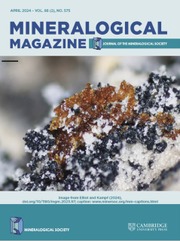
Mangani-eckermannite, ideally NaNa2(Mg4Mn3+)Si8O22(OH)2, is a new member of the amphibole supergroup found at Tanohata Mine, Shimohei District, Iwate Prefecture, Japan. It occurs as prismatic crystals up to 0.3 × 0.2 mm and their aggregates up to 1 mm intergrown with braunite, vittinkiite and quartz. Mangani-eckermannite is cherry-red to very dark red and reddish-brown in thicker grains. It is translucent with a pinkish white streak and vitreous lustre. It is brittle, fracture is stepped along crystal elongation and uneven across a crystal. Cleavage is perfect on {110}. Mohs hardness is 6. Dmeas = 3.16(2) and Dcalc = 3.186 g/cm3. The mineral is optically biaxial (–), with α = 1.645(3), β = 1.668(2), γ = 1.675(3) (589 nm); 2Vmeas = 60(10)°, 2Vcalc = 57°. The empirical formula derived from electron microprobe analysis, secondary-ion mass spectrometry and single-crystal structure refinement and calculated on the basis of 24 (O+OH) atoms per formula unit (apfu) is A(Na0.74K0.24□0.02)Σ1.00 B(Na1.52Ca0.24Mn2+0.24)Σ2.00 C(Mg2.54Mn2+1.45Mn3+0.71Fe3+0.26Ti0.04)Σ5.00 T(Si7.97Al0.03)Σ8.00O22W[(OH)1.52O0.48]Σ2.00. Mangani-eckermannite is monoclinic, space group C2/m, a = 9.9533(4), b = 18.1440(7), c = 5.2970(2) Å, β = 103.948(4)°, V = 928.39(6) Å3 and Z = 2. The strongest lines of the powder X-ray diffraction pattern [d, Å (I, %)(hkl)] are: 8.52(100)(110); 4.54(25)(040); 3.41(29)(131); 3.16(23)(310,201); 2.721(37)(151); 2.533(26)($\bar{2}$ 02). The crystal structure was refined to R1 = 0.0264 for 1001 independent reflections with I > 2σ(I). The place of mangani-eckermannite in the nomenclature of the amphibole supergroup is discussed and the status of mangano-ferri-eckermannite as a valid mineral species and successor of ‘kôzulite’ is questioned.
Keywords
Information
- Type
- Article
- Information
- Copyright
- Copyright © The Author(s), 2023. Published by Cambridge University Press on behalf of The Mineralogical Society of the United Kingdom and Ireland
Footnotes
Associate Editor: Mihoko Hoshino
References
Armbruster, T., Oberhänsli, R., Bermanec, V. and Dixon, R. (1993) Hennomartinite and kornite, two new Mn3+ rich silicates from the Wessels mine, Kalahari, South Africa. Schweizerische Mineralogische und Petrographische Mitteilungen, 73, 349–355.Google Scholar
Barkley, M.C., Yang, H. and Downs, R.T. (2010) Kôzulite, an Mn-rich alkali amphibole. Acta Crystallographica, E66, i83.Google Scholar
Della Ventura, G., Parodi, G.C., Maras, A. and Mottana, A. (1992) Potassium-fluor-richterite, a new amphibole from San Vito, Monte Somma, Campania, Italy. Rendicondi Lincei, Scienze Fisiche, 3, 239–245.CrossRefGoogle Scholar
Della Ventura, G., Robert, J.-L. and Hawthorne, F.C. (1998) Characterization of OH-F short-range order in potassium-fluor-richterite by infrared spectroscopy in the OH-stretching region. The Canadian Mineralogist, 36, 181–185.Google Scholar
Gagné, O.C. and Hawthorne, F.C (2015) Comprehensive derivation of bond-valence parameters for ion pairs involving oxygen. Acta Crystallographica, B71, 562–578.Google Scholar
Gottschalk, M. and Andrut, M. (1998) Structural and chemical characterization of synthetic (Na, K)-richterite solid solutions by EMP, HRTEM, XRD and OH-valence vibrational spectroscopy. Physics and Chemistry of Minerals, 25, 101–111.CrossRefGoogle Scholar
Hålenius, U., Bosi, F. and Jonsson, E. (2020) Mangani-pargasite, NaCa2(Mg4Mn3+)(Si6Al2)O22(OH)2, a new mineral species of the amphibole supergroup. Periodico di Mineralogia, 89, 125–131.Google Scholar
Hawthorne, F.C. (1995) Entropy-driven disorder in end-member amphiboles. The Canadian Mineralogist, 33, 1189–1204.Google Scholar
Hawthorne, F.C. and Della Ventura, G. (2007) Short-range order in amphiboles. Pp. 173–222 in: Amphiboles: Crystal-Chemistry, Occurrence and Health Issues (Hawthorne, F.C., Oberti, R., Della Ventura, G. and Mottana, A., editors). Reviews in Mineralogy and Geochemistry, 67. Mineralogical Society of America and the Geochemical Society, Chantilly, Virginia, USA.CrossRefGoogle Scholar
Hawthorne, F.C., Oberti, R., Cannillo, E., Sardone, N., Zanetti, A., Grice, J.D. and Ashley, P.M. (1995) A new anhydrous amphibole from the Hoskins mine, Grenfell, New South Wales, Australia: Description and crystal structure of ungarettiite, NaNa2(Mn2+2Mn3+3)Si8O22O2. American Mineralogist, 80, 165–172.CrossRefGoogle Scholar
Hawthorne, F.C., Cooper, M.A., Grice, J.D. and Ottolini, L. (2000) A new anhydrous amphibole from the Eifel region, Germany: Description and crystal structure of obertiite, NaNa2(Mg3Fe3+Ti4+)Si8O22O2. American Mineralogist, 85, 236–241.CrossRefGoogle Scholar
Hawthorne, F.C., Oberti, R., Harlow, G.E., Maresch, W.V., Martin, R.F., Schumacher, J.C. and Welch, M.D. (2012) Nomenclature of the amphibole supergroup. American Mineralogist, 97, 2031–2048.CrossRefGoogle Scholar
Holland, T.J.B. and Redfern, S.A.T. (1997) Unit cell refinement from powder diffraction data: the use of regression diagnostics. Mineralogical Magazine, 61, 65–77.CrossRefGoogle Scholar
Ishida, K. and Hawthorne, F.C. (2001) Assignment of infrared OH-stretching bands in manganoan magnesio-arfvedsonite and richterite through heat-treatment. American Mineralogist, 86, 965–972.CrossRefGoogle Scholar
Kasatkin, A.V., Zubkova, N.V., Agakhanov, A.A., Chukanov, N.V., Škoda, R., Nestola, F., Belakovskiy, D.I. and Pekov, I.V. (2023) Mangani-eckermannite, IMA 2023-004. CNMNC Newsletter 73. Mineralogical Magazine, 87, https://doi.org/10.1180/mgm.2023.44Google Scholar
Kitamura, M. and Morimoto, N. (1972) Crystal structure of kôzulite and tetrahedral Al in amphiboles. Acta Crystallographica, A28, S71.Google Scholar
Mandarino, J.A. (1981) The Gladstone–Dale relationship. IV. The compatibility concept and its application. The Canadian Mineralogist, 19, 441–450.Google Scholar
Matsubara, S., Kato, A. and Tiba, T. (1985) Natronambulite, (Na,Li)(Mn,Ca)4Si5O14OH, a new mineral from the Tanohata mine, Iwate Prefecture, Japan. Mineralogical Journal, 12, 332–340.CrossRefGoogle Scholar
Matsubara, S., Miyawaki, R., Kurosawa, M. and Suzuki, Y. (2002) Potassicleakeite, a New Amphibole from the Tanohata Mine, Iwate Prefecture, Japan. Journal of Mineralogical and Petrological Sciences, 97, 177–184.CrossRefGoogle Scholar
Matsubara, S., Miyawaki, R., Kurosawa, M. and Suzuki, Y. (2003) Watatsumiite, KNa2LiMn2V2Si8O24, a new mineral from the Tanohata mine, Iwate Prefecture, Japan. Journal of Mineralogical and Petrological Sciences, 98, 142–150.CrossRefGoogle Scholar
Merlet, C. (1994) An accurate computer correction program for quantitative electron probe microanalysis. Microchimica Acta, 114/115, 363–376.CrossRefGoogle Scholar
Nagase, T., Hori, H., Kitamine, M., Nagashima, M., Abduriyim, A. and Kuribayashi, T. (2012) Tanohataite, LiMn2Si3O8(OH): a new mineral from the Tanohata mine, Iwate Prefecture, Japan. Journal of Mineralogical and Petrological Sciences, 107, 149–154.CrossRefGoogle Scholar
Nambu, M., Tanida, K. and Kitamura, T. (1969a) Kôzulite, a new alkali amphibole, from Tanohata mine, Iwate prefecture, Japan. Journal of the Japanese Association of Mineralogists, Petrologists and Economic Geologists, 62, 311–328 [in Japanese with English abstract].CrossRefGoogle Scholar
Nambu, M., Tanida, K. and Kumagai, S. (1969b) Manganese Deposits in Kitakami Mountainland. I, Iwate Prefecture, pp.146 [in Japanese].Google Scholar
Nishio-Hamane, D., Minakawa, T. and Okada, H. (2014) Iwateite, BaNa2Mn(PO4)2, a new mineral from Tanohata mine, Iwate Prefecture, Japan. Journal of Mineralogical and Petrological Sciences, 109, 34–37.CrossRefGoogle Scholar
Nishio-Hamane, D., Momma, K., Ohnishi, M., Norimasa, S., Minakawa, T., Okada, H. and Imai, H. (2022) Mangano-mangani-ungarettiite from Tanohata mine, Iwate Prefecture, Japan. 2022 Annual Meeting of Japan Association of Mineralogical Sciences, R1P-11 [in Japanese], https://confit.atlas.jp/guide/event/jams2022/subject/R1P-11/detailGoogle Scholar
Oberti, R., Cámara, F., Della Ventura, G., Iezzi, G. and Benimoff, A.I. (2006) Parvo-mangano-edenite, parvo-manganotremolite, and the solid-solution between Ca and Mn2+ at the M4 site in amphiboles. American Mineralogist, 91, 526–532.CrossRefGoogle Scholar
Oberti, R., Boiocchi, M., Hawthorne, F.C., Ball, N.A. and Harlow, G.E. (2015a) Magnesio-arfvedsonite from Jade Mine Tract, Myanmar: mineral description and crystal chemistry. Mineralogical Magazine, 79, 253–260.CrossRefGoogle Scholar
Oberti, R., Boiocchi, M., Hawthorne, F.C., Ball, N.A. and Harlow, G.E. (2015b) Eckermannite revised: The new holotype from the Jade Mine Tract, Myanmar—crystal structure, mineral data, and hints on the reasons for the rarity of eckermannite. American Mineralogist, 100, 909–914.CrossRefGoogle Scholar
Oberti, R., Boiocchi, M., Hawthorne, F.C., Ball, N.A. and Ashley, P.M. (2016) Oxo-mangani-leakeite from the Hoskins mine, New South Wales, Australia: occurrence and mineral description. Mineralogical Magazine, 80, 1013–1021.CrossRefGoogle Scholar
Pasero, M. (2023) The New IMA List of Minerals. International Mineralogical Association Commission on new minerals, nomenclature and classification (IMA-CNMNC). http://cnmnc.main.jp/.Google Scholar
Sheldrick, G.M. (2015) Crystal structure refinement with SHELXL. Acta Crystallographica, C71, 3–8.Google Scholar
Tait, K.T., Hawthorne, F.C., Grice, J.D., Ottolini, L. and Nayak, V.K. (2005) Dellaventuraite, NaNa2(MgMn3+2Ti4+Li)Si8O22O2, a new anhydrous amphibole from the Kajlidongri Manganese Mine, Jhabua District, Madhya Pradesh, India. American Mineralogist, 90, 304–309.CrossRefGoogle Scholar
Williams, P.A., Hatert, F., Pasero, M. and Mills, S.J. (2014) IMA Commission on New Minerals, Nomenclature and Classification (CNMNC) Newsletter 22. New minerals and nomenclature modifications approved in 2014. Mineralogical Magazine, 78, 1241–1248.CrossRefGoogle Scholar

Kasatkin et al. supplementary material
Kasatkin et al. supplementary material

File
618.6 KB
Kasatkin et al. supplementary material
Kasatkin et al. supplementary material
File
139.3 KB