





INTRODUCTION
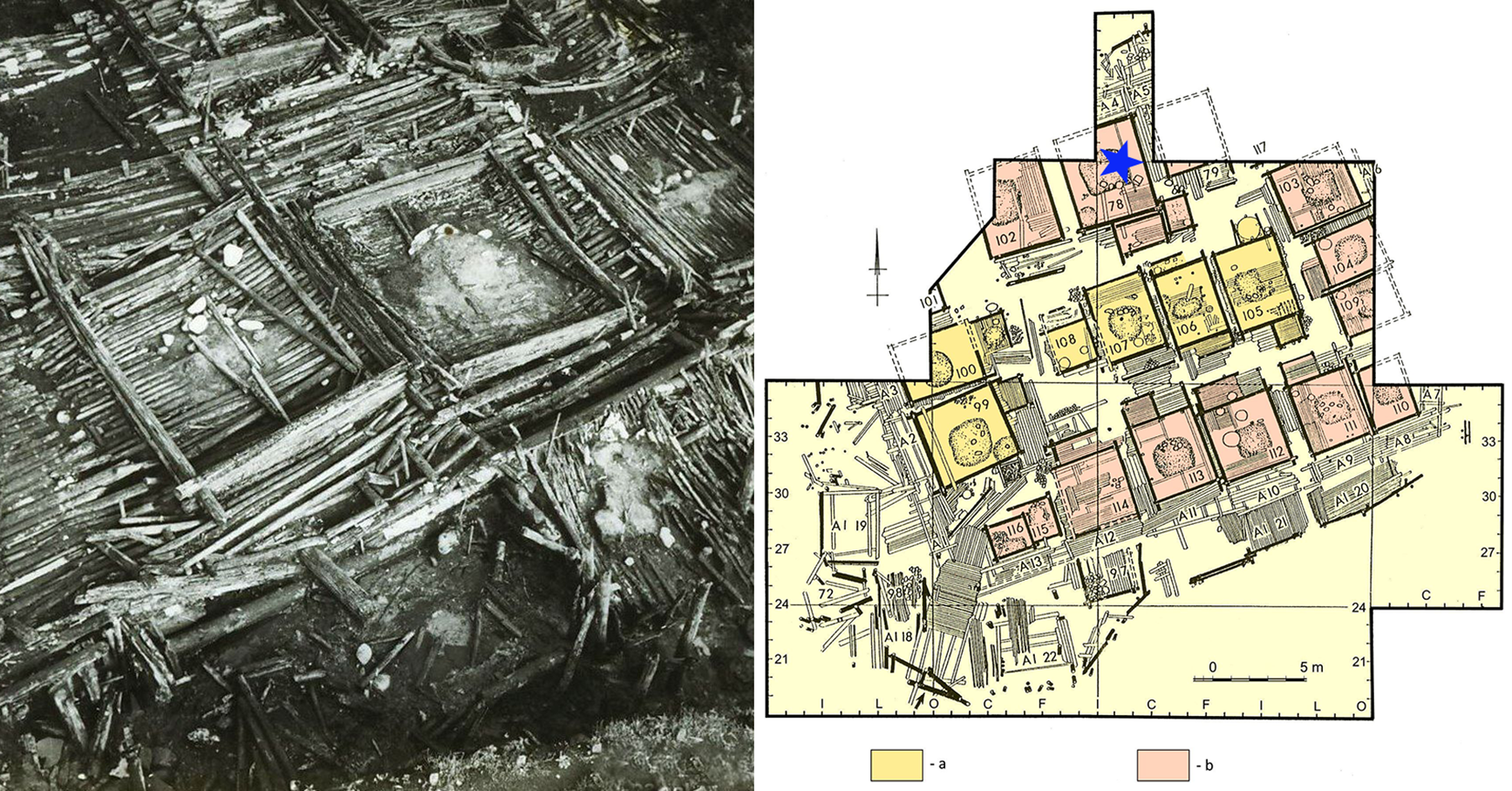
A timber lake-fortress (Figure 1) on an island in Lake Āraiši, Latvia (57°15'07"N, 25°16'58"E, 121 m asl), was excavated in 1965–1969 and 1975–1979 by the archaeologist Jānis Apals, who recognized five construction phases, dated by artifacts to the late 1st millennium AD. Radiometric 14C dates (Punning et al. Reference Punning, Liiva and Ilves1968; Zaitseva and Popov Reference Zaitseva and Popov1994) confirmed this attribution. A mixed-species conifer dendrochronology of Āraiši timbers was cross-matched to ring-width chronologies from Novgorod, Russia, suggesting a felling date of ca. AD 930 for timbers in the log platform underlying the earliest building phase (Chernyh Reference Chernyh1996). Although this date coincided with the calibrated radiometric 14C results, doubts about the methodology employed led to a second dendrochronological investigation, using new ring-width measurements of 3–4 radii in more than 60 surviving wood samples from Āraiši, combined with the earlier ring-width measurements, for a total of 330 measured timbers (Zunde Reference Zunde2000). Of these, 60 Norway spruce (Picea abies) timbers were cross-matched to form a floating chronology spanning ca. 100 years, which provided relative dates for another 19 spruce timbers with anomalous growth patterns and for a floating chronology comprising 11 pine (Pinus sylvestris) timbers, permitting many of the structures to be synchronized (Zunde Reference Zunde2000; Figure 1 right). No absolutely dated ring-width reference chronologies covering the relevant period are available for either species, either from Latvia or from surrounding countries.
(Left) the Phase I log platform and buildings during excavation (J Apals); (right) Riga relative dendro-dating (Zunde Reference Zunde2000): (a, yellow) buildings made of timbers felled the same year as timbers from the log platform; (b, pink) buildings made of timbers felled 1–2 years later. The wiggle-matched timber was from the log platform, under house 78 (star). (Please see online version for color figures.)
In 2012–2013, a spruce timber from the log platform was dated at the Kiel AMS 14C laboratory, by sampling 10 contiguous multi-annual blocks collectively spanning 92 years, ending with the final ring formed before tree-fall, “year n”. Following the publication of the IntCal13 calibration curve (Reimer et al. Reference Reimer, Bard, Bayliss, Beck, Blackwell, Bronk Ramsey, Buck, Cheng, Edwards and Friedrich2013), a wiggle-match felling date of cal AD 775–784 (95% probability) was proposed (Meadows and Zunde Reference Meadows and Zunde2014). It should therefore have been possible to locate the AD 774/5 14C production spike (Miyake et al. Reference Miyake, Nagaya, Masuda and Nakamura2012) in single-year samples from the final decade of growth, and thus to date the Āraiši floating tree-ring chronologies to the exact year. Indeed, inconsistency between 2 14C measurements (KIA-47639, 1265 ± 25 and 1150 ± 20 BP) of unhomogenized acid-base-acid (ABA) residue from the last 6 annual rings suggested that the Miyake event occurred between year n-5 and year n (Meadows and Zunde Reference Meadows and Zunde2014). Concerns about the reproducibility of 14C measurements in Kiel at the time (Meadows et al. Reference Meadows, Hüls and Schneider2015) delayed the dating of single-year samples from Āraiši until after the AD 774/5 Miyake event had been successfully located in known-age oak (Rakowski et al. Reference Rakowski, Krąpiec, Huels, Pawlyta, Dreves and Meadows2015). Dating in 2015–2016 of 2 α-cellulose extracts from each annual ring between year n-5 and year n did not reveal significant inter-annual shifts in 14C content, however (unpublished data).
MATERIAL AND METHODS
Four contiguous biennial samples (KIA-50671-74; Table 1) from the oldest decade of the Āraiši timber (years n-79/80 to years n-85/86) were extracted to α-cellulose in Kiel to check the accuracy of 14C ages from an ABA extract (KIA-49360, years n-77 to n-84), which were rejected by Meadows and Zunde (Reference Meadows and Zunde2014); a single target from each sample was measured in early 2016 and the results appeared to confirm the 2014 wiggle-match. In 2019, therefore, a second attempt was made to locate the AD 774/5 Miyake event by extracting each of the last 11 annual rings (year n-10 to year n) to α-cellulose and dating 2 targets made from separate combustions of the same extract on different AMS target wheels (KIA-54189-99). At the same time, alternate rings were replicated independently, at the Center for Isotope Research, Groningen University (GrM-19695-705). A further 16 single-year α-cellulose samples from earlier decades of the same timber were dated in Kiel in 2020–22 (KIA-56143-48, KIA-56358-67).
Analytical results. KIA-54189—99 double measurements of F14C were first averaged, following (Ward and Wilson Reference Ward and Wilson1978), before their weighted mean was combined with the GrM- F14C value for the same annual ring. Mean 14C ages were calculated from the weighted mean F14C value for each annual ring, following (Stuiver and Polach Reference Stuiver and Polach1977). The final columns indicate the calendar date(s) of each sample, based on the synchronization proposed in this paper, and the corresponding age-corrected Δ14C value.

In Kiel, α-cellulose was extracted by washing fine strips of wood in an ultrasonic bath in a hot (70°C) solution of NaClO2, activated with HCl, 5 times for 1 hr each time; soaking overnight in ultrapure water, followed by repeated rinsing in an ultrasonic bath with ultrapure water (70°C); extraction in an ultrasonic bath with 10% NaOH (70°C, 1 hr), rinsing with cold ultrapure water; a further extraction in an ultrasonic bath with 17% NaOH (70°C, 1 hr), rinsing with cold ultrapure water; extraction overnight with 1% HCL at pH <1, followed by rinsing with ultrapure water to pH >4, freezing and freeze-drying. In 2015, the sodium chlorite was activated with a dose of 100% CH3COOH (acetic acid), rather than HCl. In Groningen, α-cellulose was obtained following (Dee et al. Reference Dee, Palstra, Aerts-Bijma, Bleeker, de Bruijn, Ghebru, Jansen, Kuitems, Paul and Richie2019): fine strips of wood were first extracted using an ABA sequence (1.5M HCl, 80°C, 20 min; 17.5% NaOH, room temperature, 1 hr; 1.5M HCl, 80°C, 20 min), and the resulting insoluble residue was treated in NaClO2, activated with HCl (80°C, 16 hr, and again for 4 hr in a fresh solution), followed by rinsing, freezing and freeze-drying.
Extracts were combusted and reduced to graphite following each laboratory’s standard procedures (Nadeau et al. Reference Nadeau, Grootes, Schleicher, Hasselberg, Rieck and Bitterling1998; Dee et al. Reference Dee, Palstra, Aerts-Bijma, Bleeker, de Bruijn, Ghebru, Jansen, Kuitems, Paul and Richie2019). Carbon content (%C) was measured by pressure-gauge readings during combustion in Kiel, and by Elemental Analyser in Groningen. Graphite 14C and δ13C were measured on a 3MV accelerator mass spectrometer (Kiel, HVEE Tandetron 4130) or a 200 kV compact accelerator (Groningen, Ionplus AG MICADAS). 14C contents were corrected for fractionation using AMS δ13C values and expressed as F14C values and 14C ages. Reported uncertainties include both measurement scatter and uncertainties in fractionation correction and blank correction (Aerts-Bijma et al. Reference Aerts-Bijma, Paul, Dee, Palstra and Meijer2020). Weighted means of multiple F14C results for the same annual rings were calculated following Ward and Wilson (Reference Ward and Wilson1978).
14C ages of multi-annual samples (Meadows and Zunde Reference Meadows and Zunde2014) were fitted to calibration curves by wiggle-matching (Bronk Ramsey et al. Reference Bronk Ramsey, van der Plicht and Weninger2001), using OxCal v.4.4 (Bronk Ramsey Reference Bronk Ramsey2009a), and specifically the D_Sequence (Bronk Ramsey Reference Bronk Ramsey2001) and Outlier_Model (Bronk Ramsey Reference Bronk Ramsey2009b) functions. To locate the AD 774/5 Miyake event, the Āraiši single-year F14C values were compared to Northern Hemisphere mean annual F14C values for up to 11 consecutive years, AD 770–780, recorded in known-age wood from 27 sites (Büntgen et al. Reference Büntgen, Wacker, Galván, Arnold, Arseneault, Baillie, Beer, Bernabei, Bleicher and Boswijk2018). The least-squares method (applied by e.g., Bronk Ramsey et al. Reference Bronk Ramsey, van der Plicht and Weninger2001; Wacker et al. Reference Wacker, Güttler, Goll, Hurni, Synal and Walti2014; Kuitems et al. Reference Kuitems, Panin, Scifo, Arzhantseva, Kononov, Doeve, Neocleous and Dee2020, Reference Kuitems, Wallace, Lindsay, Scifo, Doeve, Jenkins, Lindauer, Erdil, Ledger, Forbes, Vermeeren, Friedrich and Dee2022) was used to determine which annual ring in the Āraiši floating chronology corresponds to AD 775 in the Northern Hemisphere mean series.
RESULTS
Analytical results are reported in Table 1. α-cellulose yields in samples from earlier decades (30–40%) were higher than those for the final decade (10–25%), suggesting that wood was better preserved in the center of the log than closer to its surface. This is unsurprising; the exterior wood would have started to decay while the platform was in use and continued to decay after excavation. The carbon content of α-cellulose from the final decade is similar to that of α-cellulose from earlier decades (and IAEA C3 cellulose) combusted in the same apparatus at Kiel, and is similar between Kiel and Groningen extracts, despite differences in extraction and %C measurement protocols.
The 4 biennial α-cellulose samples for years n-79/80 to years n-85/86 gave similar 14C ages (ca. 1280 BP), confirming that the KIA-49360 ABA results (1360 ± 25 and 1375 ± 25 BP) were too old, as assumed by Meadows and Zunde (Reference Meadows and Zunde2014). All 11 pairs of results from the single years year n-10 to year n measured in Kiel are statistically consistent, and their weighted mean F14C values are statistically consistent with Groningen’s F14C values for the 6 annual samples measured in both laboratories (Table 1 and Supplementary Figure 1). None of the year-to-year F14C differences is more than twice the uncertainty in the difference, so there is no evidence of a 14C production spike. With average 14C ages of ca. 1235 BP, however, these results are slightly too old for the early 9th century AD in IntCal20, but too young for any earlier decade.
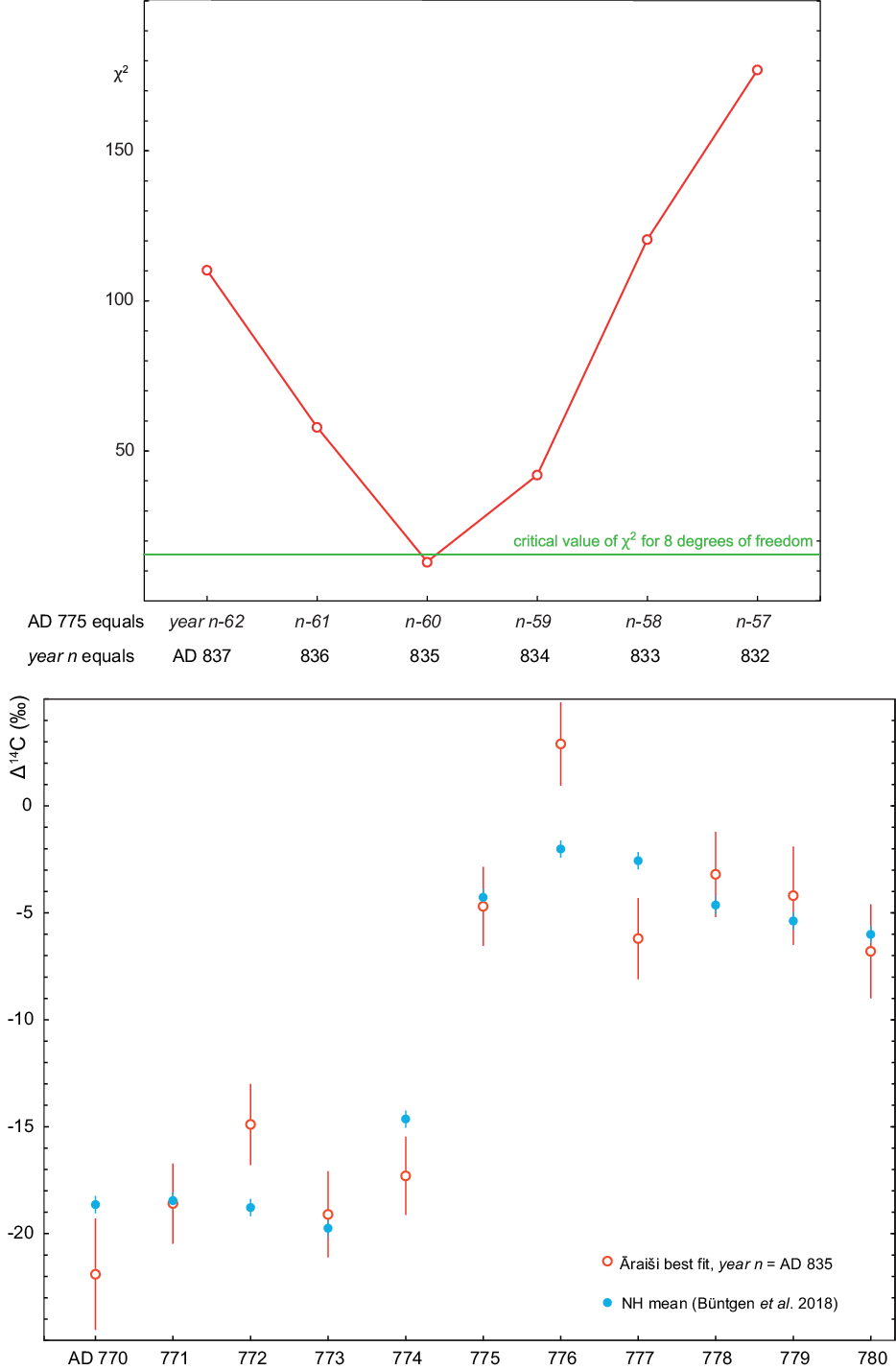
Kiel double measurements of annual samples spanning years n-66 to n-53 agree with IntCal20 values in the AD 770s, and include statistically significant increases in F14C from year n-61 to n-60, and again from year n-60 to n-59. The combined increase, equivalent to 20.3 ± 2.6‰, is similar to, or slightly greater than the Northern Hemisphere average amplitude (15.9 ± 0.3‰) of the AD 774/5 14C spike (Büntgen et al. Reference Büntgen, Wacker, Galván, Arnold, Arseneault, Baillie, Beer, Bernabei, Bleicher and Boswijk2018). Least-squares synchronization of the 14 F14C values for years n-66 to n-53 with NH mean F14C values spanning AD 770–780 (Büntgen et al. Reference Büntgen, Wacker, Galván, Arnold, Arseneault, Baillie, Beer, Bernabei, Bleicher and Boswijk2018) allows us to test 4 potential matching positions, with 10 degrees of freedom. Synchronization of the 14 Āraiši F14C values with the 9 NH mean F14C values spanning AD 771–779 gives 6 potential matching positions, with 8 degrees of freedom. Both approaches minimize χ2 when year n-60 corresponds to AD 775 in the NH mean values, and χ2 falls below the critical value of χ2 at the 95% significance level (15.5 for 8 degrees of freedom) only when AD 775 corresponds to year n-60 (Figure 2 top).
(Top) differences between Āraiši single-year F14C (years n-66 to n-53) and Northern Hemisphere mean F14C in AD 771–779 (Büntgen et al. Reference Büntgen, Wacker, Galván, Arnold, Arseneault, Baillie, Beer, Bernabei, Bleicher and Boswijk2018), expressed as χ2 values; the critical value of χ2 (95%) for 8 degrees of freedom is 15.5 (green line); (bottom) comparison of Āraiši age-corrected Δ14C values (when year n is set to AD 835) to those in NH average single-year 14C data (Büntgen et al. Reference Büntgen, Wacker, Galván, Arnold, Arseneault, Baillie, Beer, Bernabei, Bleicher and Boswijk2018).
DISCUSSION
By locating the AD 774/5 event 60 years before the felling date, the single-year results date year n to AD 835 (Figure 2). This means that the platform was built from trees felled in winter-spring AD 835–836.
Exact dating allows age-corrected Δ14C values to be calculated for all the Āraiši samples. In the AD 770s, Āraiši Δ14C values agree with those in the NH mean curve (Figure 2 right). Jull et al. (Reference Jull, Panyushkina, Lange, Kukarskih, Myglan, Clark, Salzer, Burr and Leavitt2014) first noted a latitudinal difference in the timing and intensity of the AD 774/5 Miyake event, which was confirmed in the 2018 compilation of Δ14C records from known-age wood (Büntgen et al. Reference Büntgen, Wacker, Galván, Arnold, Arseneault, Baillie, Beer, Bernabei, Bleicher and Boswijk2018). Although Āraiši (57.25°N, 25.28°E) is close to the proposed 60°N boundary between NH zone 1 and NH zone 0, there is no indication that a shorter growing season at this latitude produced a regional Δ14C offset.
Exact dating shows that the earlier wiggle-match of the same timber (Meadows and Zunde Reference Meadows and Zunde2014) was wrong by 50–60 years, which is unacceptable in this proto-historic period. The 2014 wiggle-match omitted 4 of the 20 then-available 14C ages, because they did not fit the calibration curve. Using IntCal13 (Reimer et al. Reference Reimer, Bard, Bayliss, Beck, Blackwell, Bronk Ramsey, Buck, Cheng, Edwards and Friedrich2013) or earlier iterations of IntCal to calibrate the selected results, the model gave a unimodal solution of ca. AD 780 for the felling date. Using IntCal20, however, the same model correctly prefers a felling date in the AD 830s (Table 2 and Figure 3). A model which uses all 20 ABA 14C ages, but treats them all as potential outliers (using OxCal’s RScaled Outlier_Model; Bronk Ramsey Reference Bronk Ramsey2009b) again favors a felling date of ca. AD 780 using IntCal13, and a date in the AD 830s using IntCal20.
Wiggle-matching of 14C ages of decadal blocks (published in Meadows and Zunde Reference Meadows and Zunde2014) against IntCal13 and IntCal20. See Supplementary Information for precise details of these models and Figure 3 for output.

Wiggle-matching of multi-annual ABA samples dated at Kiel in 2012–2013, against IntCal13 and IntCal20: (above) 2014 published model, outliers removed manually; (below) all results treated as potential outliers in 14C age, using OxCal’s Outlier_Model RScaled with default settings. The red line (AD 835) is the correct date of year n, based on synchronization with the AD 774/5 Miyake event (Figure 2).
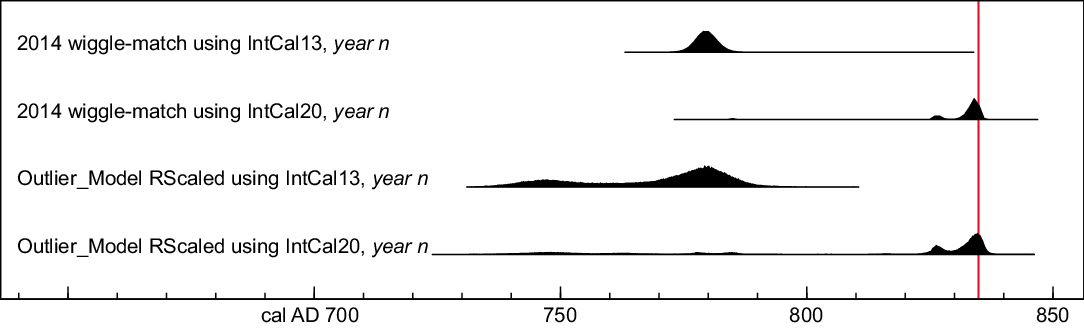
Thus, the misleading 2014 wiggle-match was due to the IntCal13 curve, not to the way outliers were handled. Other published case-studies relying on wiggle-matches with IntCal13 or earlier curves in the period ca. AD 700–840 also need to be reviewed. Thanks to the inclusion of new annual-resolution 14C data sets from the decades surrounding the AD 774/5 Miyake event, IntCal20 is significantly more detailed than IntCal13 in this period and is shifted towards older 14C ages. Similar issues may come to light in other periods, as more precise high-resolution data are included in future iterations of IntCal.
The Āraiši single-year 14C ages for year n-10 to year n appear to be robust, but they are older than annually interpolated values of IntCal20 for AD 825–835 (Figure 4). High-resolution 14C sampling of known-age Danish oak also indicates an offset from IntCal in this interval, leading to the creation of the “Aarhus curve” (Philippsen et al. Reference Philippsen, Feveile, Olsen and Sindbæk2022), which, however, also includes the IntCal raw data. Where direct comparison is possible, the Āraiši results are compatible with the Danish oak data for the corresponding years. As Philippsen et al. (Reference Philippsen, Feveile, Olsen and Sindbæk2022) suggest, therefore, IntCal20 may be too low in the AD 820s–830s. These decades span an interval in which, in the absence of new high-resolution calibration data, IntCal20 converges with IntCal13. In the preceding 2–3 decades, the new calibration data has shifted IntCal20 towards older 14C ages relative to IntCal13, and future iterations of IntCal may validate the Āraiši results for AD 825–835.
Cellulose 14C ages from the Āraiši timber (Table 1), plotted against IntCal20 (Reimer et al. Reference Reimer, Austin, Bard, Bayliss, Blackwell, Bronk Ramsey, Butzin, Cheng, Edwards and Friedrich2020) and the Aarhus calibration curve (Philippsen et al. Reference Philippsen, Feveile, Olsen and Sindbæk2022), with the final tree-ring (year n) placed at AD 835.

CONCLUSION
Both these issues highlight the need to update IntCal calibration curves with annual resolution data sets for all historic and proto-historic periods. Decadal-resolution calibration data from radiometric laboratories, which dominated IntCal13 and earlier curves, produced a wiggle-match date for the Āraiši lake-fortress at least 50 years too early. Several years, and considerable resources, were expended attempting to locate the AD 774/5 Miyake event in the wrong decade of the Āraiši timber. Had IntCal20 been available in 2015, it would have been recognized that the final decade of the Āraiši timber was 50–60 years later than indicated in the 2014 model, allowing the Miyake event to be located much sooner. Had we not attempted to locate the Miyake event, however, the spuriously early wiggle-match date would have been accepted uncritically and could have been applied to other sites dated by dendrochronological synchronization.
ACKNOWLEDGMENTS
Funding for 14C analyses was provided by the ZBSA’s Man and Environment research theme. We thank past and present staff of the Leibniz-Labor, CAU Kiel, for persisting with these samples, and Bente Philippsen for the Aarhus curve raw data.
SUPPLEMENTARY MATERIAL
To view supplementary material for this article, please visit https://doi.org/10.1017/RDC.2023.24


 Open access

