





Introduction
Russia’s full-scale invasion of Ukraine in February 2022 sparked the most significant military conflict in Europe’s post-Second World War history. While a majority of Europeans have opposed Russia’s aggression, non-trivial segments of European societies have displayed more ambivalent positions, with some even supporting the Kremlin’s narrative that places blame for the war on Ukraine (Stolle Reference Stolle2022; Dlhopolec Reference Dlhopolec2022). Where does this support for the aggressor come from? And does it reflect the same logic across different European countries? This paper tackles these fundamental questions, investigating individual-level variation in European citizens’ attitudes towards the war in Ukraine.
Understanding mass beliefs about the Russo-Ukrainian War is of utmost social and scientific relevance. Public opinion creates incentives to honour military alliances (Tomz and Weeks Reference Tomz and Weeks2021) and may shape Europe’s assistance to Ukraine (Brill Reference Brill2023; Krastev and Leonard Reference Krastev and Leonard2024b). Furthermore, although political scientists have thoroughly investigated political support in the context of war, they have largely eschewed public sentiment in third countries not directly involved in armed hostilities. The rare existing studies indicate that this sentiment is poorly structured (Shlapentokh Reference Shlapentokh1999; Haumann and Petersen Reference Haumann and Petersen2004), in contrast to findings on most other foreign policy issues (Berinsky Reference Berinsky2009). While recent studies have investigated attitudes related to the war in Ukraine (Thomson, Mader, Münchow et al. Reference Thomson, Mader, Münchow, Reifler and Schoen2023; Krastev and Leonard Reference Krastev and Leonard2024a; Stolle Reference Stolle2024; Moise and Wang Reference Moise and Wang2025b; Eck and Michel Reference Eck and Michel2025), they have mostly focused on support for war-related public policies and the consequences of the war for Europeanisation and European solidarity, rather than on direct support for the belligerents.
Drawing on the existing literature on war and foreign policy, this paper theorises how support for the pro-Kremlin narrative emerges. We hypothesise that four main types of factors shape attitudes toward Russia’s aggression. The first two – economic interests and ideological preferences – are highlighted by bottom-up models of public opinion on foreign policy, whereas the other two – partisan alignment and disinformation – reflect top-down models (Kertzer Reference Kertzer, L., D.O., J.S. and J.2023). For each type, we formulate and test several concrete hypotheses.
The empirical analyses draw on two types of survey data. The first is an original survey with specifically tailored questions, fielded across five European countries in late 2023 and spanning over 12,000 respondents. Four of the five countries (the Czech Republic, Poland, Slovakia, and Romania) are located in Central and Eastern Europe (CEE), where the ongoing war is most salient because of geographic proximity. The fifth country is France, whose public opinion on the war has been representative of other large Western European countries (see below). The main dependent variables measure whom respondents blame for the war and whom they would like to win. We replicate the first part of the main analysis on blame for the war using the 2023 wave of the Solidarity in Europe (SiE) survey (Kriesi, Stolle and Cicchi Reference Kriesi, Stolle and Cicchi2023), which covers over 24,000 respondents from seventeen European countries. To construct what the analyses identify as a key independent variable – respondents’ proximity to pro-Kremlin political parties – we incorporate data on the positions of European political parties towards Russia’s government from a Chapel Hill expert survey fielded between April and June 2023 (Hooghe, Marks, Bakker et al. Reference Hooghe, Marks, Bakker, Jolly, Polk, Rovny, Steenbergen and Vachudova2024).
The results demonstrate that Europeans’ attitudes towards the conflict are structured and align with most hypothesised factors. Neutral and pro-Kremlin views are, respectively, held by up to 50 per cent (Romania) and 20 per cent (Slovakia) of respondentsFootnote 1 and strongly relate to partisan alignment, disinformation, and, to a lesser extent, ideology. The strongest correlates of the war-related attitudes include support for domestic pro-Kremlin political parties, beliefs in conspiracy theories, reliance on alternative political news, and conservative authoritarian ideology. By contrast, economic factors explain little. Overall, top-down models of public opinion perform better than bottom-up models. These findings update our understanding of public preference formation on foreign policy and carry important implications for efforts to resist the Kremlin’s influence.
Literature review
Most research on wartime public opinion focuses on countries directly involved in military conflicts. It finds that attitudes are shaped by factors similar to those influencing opinion on other foreign policy issues – elite cues, ideology, and instrumental interests. Top-down models of public opinion suggest that citizens use elite positions to compensate for their shallow factual knowledge (Kertzer Reference Kertzer, L., D.O., J.S. and J.2023). Citizens may follow the position of their favourite political parties (Zaller Reference Zaller1992; Berinsky Reference Berinsky2009; Lenz Reference Lenz2012), experts (Guisinger and Saunders Reference Guisinger and Saunders2017), foreign leaders (Hayes and Guardino Reference Hayes and Guardino2011; Guardino and Hayes Reference Guardino and Hayes2018), and their own peers (Kertzer and Zeitzoff Reference Kertzer and Zeitzoff2017). Bottom-up models of public opinion emphasise the role of citizens’ characteristics in the perception of foreign policy issues (Kertzer Reference Kertzer, L., D.O., J.S. and J.2023). In Western countries, foreign policy attitudes tend to be structured around distinct ideological dimensions such as liberalism or militarism (Wittkopf Reference Wittkopf1986; Nevitte and Gibbins Reference Nevitte and Gibbins1986; Ziegler Reference Ziegler1987; Bjereld and Ekengren Reference Bjereld and Ekengren1999; Jenkins-Smith, Mitchell and Herron Reference Jenkins-Smith, Mitchell and Herron2004; Reifler, Scotto and Clarke Reference Reifler, Scotto and Clarke2011), which may reflect citizens’ basic values (Rathbun Reference Rathbun2007; Kertzer, Powers, Rathbun et al. Reference Kertzer, Powers, Rathbun and Iyer2014) and relate to more general ideological orientations (Holsti and Rosenau Reference Holsti and Rosenau1996; Reifler, Scotto and Clarke Reference Reifler, Scotto and Clarke2011). Finally, some studies highlight instrumental motivations – such as economic interests – where citizens assess foreign policy based on personal or national cost-benefit considerations (Verba, Brody, Parker et al. Reference Verba, Brody, Parker, Nie, Polsby, Ekman and Black1967; Larson and Savych Reference Larson and Savych2005; Reifler, Clarke, Scotto et al. Reference Reifler, Clarke, Scotto, Sanders, Stewart and Whiteley2014).
The existing research has paid limited attention to public opinion on wars in third countries,Footnote 2 suggesting low public engagement and a lack of attitudinal differentiation. Rare existing studies find that citizens in third countries tend to care little about foreign conflicts (Thayer Reference Thayer1951) and oppose perceived aggressors (Shlapentokh Reference Shlapentokh1999; Juárez Reference Juárez2004), with foreign wars generally failing to divide public opinion in uninvolved nations (Wilcox, Tanaka and Allsop Reference Wilcox, Tanaka and Allsop1993, Reference Wilcox, Hewitt and Allsop1996; Shlapentokh Reference Shlapentokh1999; Haumann and Petersen Reference Haumann and Petersen2004). Shlapentokh (Reference Shlapentokh1999: 277) observed that NATO’s bombing of Yugoslavia in 1999 prompted ‘a trend of anti-Americanism [that] bridged the gaps between almost all Russians with their varying political views’. Similarly, Haumann and Petersen (Reference Haumann and Petersen2004: 327) studied German attitudes towards the US 2003 invasion of Iraq and found that ‘respondents’ socio-demographic characteristics, their political orientation, even their images of America made only a negligible contribution toward explaining their opposition to the war.’ Together, these findings suggest limited polarisation in third countries’ public opinion over foreign wars.
Recent research offers insights into public opinion on the ongoing Russo-Ukrainian war. Russia’s 2022 aggression triggered a rally-round-the-flag effect behind the EU (Steiner, Berlinschi, Farvaque et al. Reference Steiner, Berlinschi, Farvaque, Fidrmuc, Harms, Mihailov, Neugart and Stanek2023; Fernández, Vandendriessche, Saz-Carranza et al. Reference Fernández, Vandendriessche, Saz-Carranza, Agell and Franco2023; Mader Reference Mader2024; Oana, Moise and Truchlewski Reference Oana, Moise and Truchlewski2025a) and some national governments (Fukumoto and Tabuchi Reference Fukumoto and Tabuchi2023), and it increased the salience of national identity in Spain (Balcells et al. Reference Balcells, Tellez and Villamil2024). The additional support for the EU and its policies has since slightly declined (Truchlewski et al. Reference Truchlewski, Oana and Moise2023). Conversely, the invasion made students in the United States downwardly revise their views on the Russian government (Asadzade and Izadi Reference Asadzade and Izadi2022). It also made European citizens more hawkish with regard to nuclear deterrence and decreased support for the withdrawal of US nuclear weapons from Europe (Onderco et al. Reference Onderco, Smetana and Etienne2023).
Previous studies identified several factors accounting for individual-level variation in pre-2022 attitudes towards Russia and its policies. After Russia annexed Crimea in 2014, Europeans’ support for sanctions against the Kremlin was associated with pro-EU attitudes and centrist ideology (Onderco Reference Onderco2017). The annexation boosted EU support among educated Western Europeans (Kiratli Reference Kiratli2024), but it simultaneously increased confidence in Putin and favourability towards Russia among anti-establishment parties’ supporters in Italy, France, Germany, and Great Britain (Fisher Reference Fisher2021). Slovaks’ support for Russia’s foreign policy in 2014 was positively aligned with conspiratorial thinking (Onderco and Stoeckel Reference Onderco and Stoeckel2023).
Regarding the current war, surveys show variation in Europeans citizens’ support for Ukraine. Even though most Europeans blame Russia for the conflict, many have adopted more ambivalent positions (Stolle Reference Stolle2022). For instance, in Italy and Hungary, as many as 40 per cent and 55 per cent of respondents believe that Ukraine bears some responsibility for the war (Thomson, Mader, Münchow et al. Reference Thomson, Mader, Münchow, Reifler and Schoen2023: 2488; Isernia et al. Reference Isernia, Martini and Cozzi-Fucile2024). A controversial survey even found that Slovaks preferred Russia rather than Ukraine to win the war (Dlhopolec Reference Dlhopolec2022). Although the degree of support for Russia was probably exaggerated because of the survey methodology,Footnote 3 the subsequent victory of the pro-Russian SMER party in the 2023 Slovak legislative election indicates that pro-Kremlin views are not considered taboo among substantial segments of Europeans.
A growing body of research examines cross-national and within-country variation in Europeans’ attitudes toward the war in Ukraine (Thomson, Mader, Münchow et al. Reference Thomson, Mader, Münchow, Reifler and Schoen2023; Krastev and Leonard Reference Krastev and Leonard2024a; Stolle Reference Stolle2024; see also the special issue in European Union Politics (Moise and Wang Reference Moise and Wang2025b)). Most studies focus on support for specific pro-Ukraine measures, ranging from humanitarian assistance to the deployment of troops. A consistent finding is that public support declines as policies become more militarised or more costly: Europeans are less supportive of sending weapons (Krastev and Leonard Reference Krastev and Leonard2024a) and of measures that impose tangible domestic costs, such as troop deployments or higher energy prices (Stolle Reference Stolle2024). However, the role of self-interest appears more limited than this pattern might suggest. Experimental evidence shows that support for Ukraine does not systematically erode when respondents are exposed to self-interested arguments (Bøggild et al. Reference Bøggild, Göbel, Lutscher and Nyrup2024), and individual-level variation is only weakly explained by personal material concerns. Instead, broader attitudinal and identity-based factors matter more. Eck and Michel (Reference Eck and Michel2025) demonstrate that sociotropic evaluations of the national economy and the strength of national identity – rather than personal financial circumstances – account for differences in support. Similarly, Moise and Wang (Reference Moise and Wang2025a) conclude that ideological predispositions, rather than utilitarian cost–benefit calculations, are the primary drivers of attitudes toward the conflict. Although the studied attitudes towards the war do not map neatly onto the traditional left–right ideological spectrum (Stolle Reference Stolle2024), voters of far-right parties are clearly less supportive of pro-Ukraine measures (Oana et al. Reference Oana, Moise and Truchlewski2025b), more favourable to appeasement (Moise and Wang Reference Moise and Wang2025a), and less likely to blame Russia for the war (Thomson, Mader, Münchow et al. Reference Thomson, Mader, Münchow, Reifler and Schoen2023). At the country level, countries that border Russia and may be its future targets tend to be more supportive of Ukraine (Thomson, Mader, Münchow et al. Reference Thomson, Mader, Münchow, Reifler and Schoen2023; Stolle Reference Stolle2024).
Overall, although the existing literature offers valuable insights into public opinion on war generally and Russia’s invasion in particular, it does not address several important points. First, while existing studies examine attitudes towards European or national policy responses to the Russo-Ukrainian war, the literature has not systematically investigated the determinants of public support for the two belligerents.Footnote 4 Consequently, we still know relatively little about the striking variation in citizens’ views on Europe’s largest military conflict since 1945. Second, most existing studies of public opinion on war and foreign policy do not test all the main competing explanations (partisan alignment, ideology, and interests) simultaneously or compare their explanatory potential. Finally, the existing research usually focuses on countries directly involved in military conflicts, paying less attention to third countries – like EU member states in the current context – that are not militarily engaged.Footnote 5 The findings of the few existing studies – that third countries’ public opinion on wars may be less engaged and structured – clash with the more general literature on foreign policy showing well-structured attitudes on international affairs.
Theory & hypotheses
The relevance of a foreign conflict likely shapes the level of interest and structure in third countries’ public opinion on interstate military disputes. When a conflict is geographically remote or lacks tangible domestic consequences, public opinion may be disengaged and unstructured, echoing national elites’ consensual positions and media reporting. Public opinion then largely reflects a top-down dynamic, leading to little polarisation. This can explain why political and socio-demographic factors were unrelated to Russians’ critical views on NATO’s bombing of Serbia in 1999 (Shlapentokh Reference Shlapentokh1999) and Germans’ disapproval of the US invasion of Iraq in 2004 (Haumann and Petersen Reference Haumann and Petersen2004). Conversely, when a conflict is geographically proximate, involves states related to the third country’s recent political developments, and exerts concrete domestic repercussions, third countries’ public opinion is likely to be engaged and structured, as with other major foreign policy issues (Baum and Potter Reference Baum and Potter2008). Citizens’ attitudes towards such conflicts are likely to reflect top-down and bottom-up processes, and it is an empirical question which of the two prevails.
The Russo-Ukrainian War is highly relevant to most European countries. It is unfolding within the EU’s immediate neighbourhood and involves Russia – the successor of the Soviet Union that kept half of the continent behind the Iron Curtain until 1989 (Judt Reference Judt2006). The war disrupted the EU’s energy and trade sectors, prompted millions of Ukrainians to seek refuge in Europe, and heightened security concerns across the continent (Siemplenski Lefort Reference Siemplenski Lefort2022; Hill and Stent Reference Hill and Stent2022; Charap and Pucek Reference Charap and Pucek2023). According to Eurobarometer, it ranks alongside immigration as the EU’s most pressing challenge (European Commission 2023).
The following hypotheses thus consider bottom-up (economic interests, ideology) and top-down (cues) mechanisms. They theorise how the main types of public opinion drivers identified in the literature shape attitudes towards the conflict in Ukraine. Unlike most earlier studies, we distinguish two sources of cues: established elites (governments, political parties) and disinformation channels, often linked to Russia’s influence operations (Yablokov Reference Yablokov2015; Kostelka and Krejcova Reference Kostelka and Krejcova2017; Zilinsky et al. Reference Zilinsky, Theocharis, Pradel, Tulin, De Vreese, Aalberg, Cardenal, Corbu, Esser, Gehle, Halagiera, Hameleers, Hopmann, Koc-Michalska, Matthes, Schemer, Šteˇtka, Strömbäck, Terren and Zoizner2024). By providing new empirical evidence and comparing the explanatory power of these four types of factors, we aim to contribute to the broader theoretical debate on bottom-up and top-down models of opinion formation on war and foreign policy.
This paper focuses on public support for the two belligerents involved in Ukraine. We conceptualise public support in interstate conflicts as a continuum between a preference for one or the other involved state actor. Such support can take the form of, inter alia, blame attribution for the war or preferences regarding its outcome. Putin’s regime blames a ‘Nazi-like regime in Ukraine’, alleged ‘human-rights abuses against its Russian-speaking ethnic minority’, and Western interference (Fridrichová Reference Fridrichová2023). Supporting the Kremlin thus entails accepting its claimsFootnote 6 or wishing for Russia’s victory. The two attitudes are likely strongly related, as we confirm empirically in the Results section.
Economic interests
While most Europeans are not directly exposed to the war, many experience its economic consequences. The EU, US, and their allies adopted economic sanctions against Russia after it annexed Crimea in 2014, which they significantly expanded in the wake of the 2022 full-scale invasion (S&P Global 2024). These measures harmed Western firms tied to trade with Russia. Such companies represent a significant share of the European economy: a recent study found that 11 per cent of large European corporations mentioned anti-Russia sanctions in their annual reports between 2014 and 2017 (Davydov et al. Reference Davydov, Sihvonen and Solanko2022). The resulting economic strain – through reduced bonuses, salary cuts, and lay-offs – likely imposed costs on affected firms’ employees. Sanctions and the broader conflict also steeply increased retail energy prices (Ferriani and Gazzani Reference Ferriani and Gazzani2023). Although European governments implemented various mitigation measures, the rising energy prices contributed to a severe cost-of-living crisis (Coi Reference Coi2023), which particularly affected vulnerable groups, including pensioners and low-income households (Charalambakis et al. Reference Charalambakis, Fagandini, Henkel and Osbat2022; Ernst and Young 2024; Mandys Reference Mandys2024).
The economic costs of anti-Russia sanctions may explain some pro-Kremlin attitudes in Europe. As reviewed above, several studies find that foreign policy attitudes reflect cost-benefit calculations (Verba, Brody, Parker et al. Reference Verba, Brody, Parker, Nie, Polsby, Ekman and Black1967; Larson and Savych Reference Larson and Savych2005; Reifler, Clarke, Scotto et al. Reference Reifler, Clarke, Scotto, Sanders, Stewart and Whiteley2014), and that citizens are particularly sensitive to the costs of security and defence cooperation (Mader et al.Reference Mader, Neubert, Münchow, Hofmann, Schoen and Gavras2024) and policies towards Ukraine (Stolle Reference Stolle2024). In the current context, it is not Russia’s aggression per se that makes some citizens worse off, but rather the West’s response. If the aggression were seen as justified, sanctions – and their domestic costs – would appear illegitimate. Citizens bearing these costs may thus be more receptive to pro-Kremlin narratives. Pro-Kremlin disinformation campaigns have exploited this vulnerability by linking high living costs in the EU to sanctions (Serhan Reference Serhan2022; Canetta et al. Reference Canetta, Danko and Dukach2023). For instance, in Czechia, populist forces organised large anti-sanction, anti-government, and pro-Russian protests, under slogans like ‘Czechia against misery’ in 2022 and 2023 (Kostelka Reference Kostelka and Gladman2023). We thus hypothesise that, following the pocketbook logic, the more citizens depended on economic ties with Russia or struggled during the energy crisis, the less they support Ukraine.
Hypothesis 1.1 The more important Russia was for citizens’ economic activity before the invasion, the less they support Ukraine.
Hypothesis 1.2 The more citizens struggled during the energy crisis, the less they support Ukraine.
Ideology
Citizens’ long-term political outlooks may shape their understanding of the current conflict. Indeed, some of the reviewed studies on public opinion on policies towards the war in Ukraine suggest that ideology trumps interests and utilitarian considerations (Eck and Michel Reference Eck and Michel2025; Moise and Wang Reference Moise and Wang2025a). More generally, earlier research found ideology to inform preferences on the use of military force, foreign policy, and transnational integration (Holsti and Rosenau Reference Holsti and Rosenau1996; Hooghe and Marks Reference Hooghe and Marks2004; Reifler, Scotto and Clarke Reference Reifler, Scotto and Clarke2011; Hobolt and de Vries Reference Hobolt and de Vries2016). Regarding the Russo-Ukrainian war, three ideological dimensions appear especially relevant: the general position on the left-right scale, conservative authoritarianism, and pacifism.
Prior studies show that extreme-left and extreme-right respondents tend to hold more pro-Russia attitudes than centrists (Onderco Reference Onderco2017). On the extreme left, this reflects historical ties to the Soviet Union, once seen as an ideological ally across Europe (March and Mudde Reference March and Mudde2005). After 1991, prominent extreme-left intellectuals opposed US foreign policy, denouncing it as imperialist while downplaying Russia’s own imperialism (Kostelka Reference Kostelka2022a, Reference Kostelka2022b). On the extreme right, pro-Kremlin leanings likely stem from affinities with Russia’s authoritarian political regime and some far-right parties’ proximity to the Kremlin, which we further discuss below.Footnote 7 We expect that when these other factors are controlled for, the extreme right will not be pro-Russian. However, without such controls, both extremes are likely to be positively associated with lower support for Ukraine.
Hypothesis 2.1 The more extreme citizens’ position on the left-right scale, the less they support Ukraine.
Citizens’ ideological proximity to the belligerents’ political regimes may also inform public opinion on the war. Ukraine aspires to join the EU’s liberal democratic order, while Russia is an authoritarian state promoting strongman rule and ultra-conservative values (Diesen Reference Diesen2020; Frye Reference Frye2021). Citizens with authoritarian and culturally conservative views – who favour strong leaders and question minority rights – are more likely to sympathise with the Kremlin. Consequently, we hypothesise that authoritarianism and cultural conservatism correlate negatively with support for Ukraine.
Hypothesis 2.2 The more authoritarian and culturally conservative citizens are, the less they support Ukraine.
An ideological orientation particularly salient to war is pacifism. At its core, pacifism is the belief that wars and violence are fundamentally unjustifiable (Howes Reference Howes2013). In the current context, pacifists should oppose Russia as the aggressor. However, pro-Kremlin disinformation has instrumentalised calls for peace, claiming that supporting Ukraine means prolonging the war (Disinformation Analysis Center 2023). Therefore, pacifism may be confounded by factors such as exposure to pro-Russian narratives and disinformation. Only when these factors are accounted for may the positive relationship between pacifism and pro-Ukrainian attitudes become apparent.
Hypothesis 2.3 Controlling for potential confounders, pacifist attitudes are positively associated with support for Ukraine.
Partisan alignment
The next set of hypotheses relates to elite cues and partisan alignment. Research has repeatedly shown that citizens possess shallow knowledge of foreign policy issues and, instead, rely on heuristics to form opinions (Zaller Reference Zaller1992; Berinsky Reference Berinsky2009; Guisinger and Saunders Reference Guisinger and Saunders2017). In the context of the war in Ukraine, elite positions offer the most accessible heuristic.
As with other foreign and complex policy issues, citizens are likely to follow their government or favourite political parties when assessing Russia’s aggression. With a few significant exceptions, such as Viktor Orban’s cabinet in Hungary and Robert Fico’s recent cabinet in Slovakia, European governments have clearly supported Ukraine (Trebesch et al. Reference Trebesch, Antezza, Bushnell, Frank, Frank, Franz, Kharitonov, Kumar, Rebinskaya and Schramm2023). Party positions vary more, with populist and eurosceptic parties generally less supportive (Hooghe, Marks, Bakker et al. Reference Hooghe, Marks, Bakker, Jolly, Polk, Rovny, Steenbergen and Vachudova2024). Earlier research found that the long-term proximity of far-right and far-left parties to the Kremlin guided their supporters’ views on Russia (Fisher Reference Fisher2021). At the same time, there is variation even within these families: only about half of far-right parties oppose sanctions and blame the West (Wondreys Reference Wondreys2025). It may thus be essential to distinguish between individual parties and not to rely on party families when studying attitudes to the conflict. We hypothesise that party preferences and support for the incumbent cabinet account for individual-level variance in attitudes towards the war. The closer citizens are to parties favourable to Russia, the less they support Ukraine. Similarly, the more citizens support their government, the more likely they are to align with its position towards the war.
Hypothesis 3.1 The closer citizens are to pro-Kremlin parties, the less they support Ukraine in the war.
Hypothesis 3.2 The more citizens support their government, the more they are likely to align with its position towards the war.
Our theory assumes that the potential congruence between party or government positions and those of their supporters, as articulated in Hypotheses 3.1 and 3.2, reflects processes of elite cueing. This implies, among other things, that such congruence should be stronger among individuals with more pronounced party identification, since they are more likely to be exposed to, attend to, and internalise their party’s positions.
Two caveats are in order. First, our hypotheses are agnostic about the timing of the cues, which may have occurred before and after the 2022 invasion. Partisan alignment may therefore arise not only from elite communication about the invasion itself, but also from longer-standing foreign policy orientations and pre-invasion messaging about the belligerents. We are unable to disentangle these temporal dynamics in the following empirical analysis and leave this task to future research that can measure elite cues directly.
Second, observed congruence could in principle reflect reverse causality: citizens may support parties or governments because of those actors’ positions on the conflict. For instance, individuals holding pro-Ukrainian preferences might shift their support toward elites expressing similar stances following Russia’s invasion. This alternative explanation appears substantially less plausible, given that prior research shows that voters care far more about domestic issues than foreign policy (Page and Shapiro Reference Page and Shapiro1992; Lavine et al. Reference Lavine, Sullivan, Borgida and Thomsen1996; Guisinger Reference Guisinger2009; Saunders Reference Saunders2022: 227). Moreover, we present suggestive empirical evidence below (see Analysis 3) that further reduces the likelihood of this reverse causal pathway. Nevertheless, that caveat – together with the previous one – still necessarily qualifies any conclusions that can be drawn from any positive test of Hypotheses 3.1 and 3.2.
Disinformation
Besides elite cues, usually transmitted through mainstream media, citizens may also rely on political information from less conventional sources such as alternative news websites, social media, chat applications, and emails with political content. The content coming from these channels often tends to question official narratives by spreading disinformation and conspiracy theories (Terracino and Matasick Reference Terracino and Matasick2022; van Ham et al. Reference van Ham, Sipma and Fiselier2025). Such messages frequently resonate in polities with low levels of political trust, such as many countries in CEE (Marinov and Popova Reference Marinov and Popova2022).
Exposure to disinformation and beliefs in conspiracy theories likely correlate with pro-Russian attitudes. In the past decade, the Kremlin has extensively used these tools to sway global opinion and destabilise democracies (Yablokov Reference Yablokov2015; Kostelka and Krejcova Reference Kostelka and Krejcova2017; Zilinsky et al. Reference Zilinsky, Theocharis, Pradel, Tulin, De Vreese, Aalberg, Cardenal, Corbu, Esser, Gehle, Halagiera, Hameleers, Hopmann, Koc-Michalska, Matthes, Schemer, Šteˇtka, Strömbäck, Terren and Zoizner2024). Regarding the conflict in Ukraine, disinformation and conspiracy theories have been widespread, promoting pro-Russian narratives and casting doubt on major events such as the downing of MH17 by pro-Russian separatists (Golovchenko et al. Reference Golovchenko, Hartmann and Adler-Nissen2018). We thus hypothesise that the more citizens are exposed to disinformation and the more they tend to believe in conspiracy theories, the less they support Ukraine.
Hypothesis 4.1 The more citizens are exposed to disinformation, the less they support Ukraine.
Hypothesis 4.2 The more citizens believe in conspiracy theories, the less they support Ukraine.
Analysis 1: an original five-country survey
Data & methods
Our main analyses rely on original survey data from five countries (FC dataset). Four (Czechia, Poland, Slovakia, and Romania) lie in CEE, where geographic proximity makes the war particularly salient. Each of these four countries experienced one (Romania) or several (Czechia, Poland, and Slovakia) Soviet occupations in the 20th century. In addition, Russia and its Austrian and Prussian allies deprived Poland of independent statehood between 1795 and 1918. Today, three of these countries (Poland, Slovakia, and Romania) share a border with Ukraine, and the fourth (Czechia) had the largest per-capita intake of Ukrainian refugees as of August 2023 (Plevak Reference Plevák2023). France serves as a comparison case. Its general level of support for Ukraine in earlier surveys was similar to that of other large countries in Western Europe.Footnote 8
The survey was programmed in Qualtrics and fielded via computer-assisted online interviews by the company Cint between November 21 and December 11, 2023. For each country, we obtained a quota-based sample defined in terms of sex, age, region, size of municipality, and education.Footnote 9 As noted below (see Footnote 26), the distribution of our dependent variables is consistent with probabilistically sampled data from Eurobarometers. The final sample size is 12,221 respondents (approximately 2,450 respondents per country). This research received ethical approval from the European University Institute.
We study two dependent variables measuring support for the war’s belligerents. In Analysis 1.1, the dependent variable operationalises adherence to the Kremlin’s narrative via blame attribution for the war in Ukraine. Respondents rated the responsibility of Ukraine, Russia, and NATO for the ‘open conflict between Ukraine and Russia’ on a 0–10 scale where 0 meant ‘not at all responsible’ and 10 meant ‘totally responsible’.Footnote 10 We expect that the more respondents adhere to the Kremlin’s narrative, the more they will blame Ukraine (or NATO) and the less they will blame Russia. To facilitate interpretation, we use as the main dependent variable in Analysis 1.1 a simple difference between the scores given to Ukraine and Russia, respectively (ie negative scores indicate a pro-Russian position blaming Ukraine). Alternative operationalisations, intended for robustness checks, employ a variable that compares Russia’s score to NATO’s score, and a Likert scale based on the three scores (for Russia, Ukraine, NATO).Footnote 11 In Analysis 1.2, the dependent variable measures preferred war outcomes based on a closed question with three possible answers besides ‘don’t know’: ‘Ukraine’s victory’, ‘neither Russia’s nor Ukraine’s victory’, and ‘Russia’s victory.’ The two dependent variables strongly correlate, even though the outcome variable can take only three values (Pearson’s r= 0.56).
We analyse the dependent variables through OLS (blame attribution) and multinomial logit (outcome preference) regressions. To focus on within-country variation, all our analyses employ country-fixed effects. Besides substantive independent variables described below, full model specifications include standard socio-demographic controls used in public opinion research on foreign policy (eg Onderco Reference Onderco2017): gender (dummy variables for women and non-binary respondents), age (a linear variable), and education (dummies for vocational, A-level and university education).
To operationalise Hypothesis 1.1, respondents rated on a 0–10 scale how important selected European economic powers (Germany, Spain, Russia, Great Britain, and Italy) were to the operations of their business or employer over the past five years. The variable Business Importance uses the score for Russia (the larger the score, the more significant Russia was for one’s business or employer).Footnote 12 The operationalisation of Hypothesis 1.2 relies on how difficult it was for respondents’ households to cope with the rise in energy prices since autumn 2021. The variable Energy Crisis ranges from 0 (‘with no difficulty at all’) to 10 (‘with extreme difficulty’).Footnote 13
Regarding the ideological explanations, Hypothesis 2.1’s operationalisation uses respondents’ self-positioning on an eleven-point left-right scale (0 = left, 10 = right). To allow for non-linear relationships, we recoded the scale into five dummy variables (Extreme Left, Moderate Left, Centre, Moderate Right, Extreme Right)Footnote 14 using the centre category as a reference. Hypothesis 2.2 is operationalised through the variable Conservative Authoritarianism,Footnote 15 which is an additive index that combines a measure of cultural conservatism and a measure of authoritarianism.Footnote 16 Hypothesis 2.3 corresponds to a variable Pacifism, which is a Likert scale based on two questions about the use of military force and war (see Appendix J for details).Footnote 17
Concerning partisan alignment, Hypothesis 3.1 on party proximity corresponds to a scale combining respondents’ self-reported probabilities to vote (PTVs) for political parties in a future election (0–10)Footnote
18
and parties’ positions towards the government of Russia extracted from the Chapel Hill expert survey fielded in Spring 2023 (Hooghe, Marks, Bakker et al. Reference Hooghe, Marks, Bakker, Jolly, Polk, Rovny, Steenbergen and Vachudova2024).Footnote
19
For each respondent ${_i}$
in a party system with J parties, the variable Pro-Kremlin Party Proximity calculates the average of the parties’ positions weighted by their respective PTVs increased by one (see Equation 1).Footnote
20
The generated variable remains on a 0–10 scale, but, in practice, it varies from 1.43 (the lowest proximity) to 9.22 (the highest proximity). Hypothesis 3.2 is operationalised through the variable Government Support, which is measured on a 0–10 scale where 0 means ‘no support at all’ and 10 ‘total support’ for pro-Ukrainian cabinets.Footnote
21
For Slovakia, which is the only country in the FC dataset where the cabinet is more pro-Russian, the variable is reverse-coded (‘total support’ = 0).
${_i}$
in a party system with J parties, the variable Pro-Kremlin Party Proximity calculates the average of the parties’ positions weighted by their respective PTVs increased by one (see Equation 1).Footnote
20
The generated variable remains on a 0–10 scale, but, in practice, it varies from 1.43 (the lowest proximity) to 9.22 (the highest proximity). Hypothesis 3.2 is operationalised through the variable Government Support, which is measured on a 0–10 scale where 0 means ‘no support at all’ and 10 ‘total support’ for pro-Ukrainian cabinets.Footnote
21
For Slovakia, which is the only country in the FC dataset where the cabinet is more pro-Russian, the variable is reverse-coded (‘total support’ = 0). $Pro {\hbox{-}} Kremlin\,Party\,Proximit{y_i} = {{\mathop \sum \nolimits_{j = 1}^J {\rm{Party's\;position\;on\;Russi}}{{\rm{a}}_j}\,{\rm{*}}\,\left( {{\rm{PT}}{{\rm{V}}_{ij}} + 1} \right)} \over {\mathop \sum \nolimits_{j = 1}^J \left( {{\rm{PT}}{{\rm{V}}_{ij}} + 1} \right)}}$
We use two variables to test the disinformation-related hypotheses. Altern. News Consumption captures exposure to disinformation (Hypothesis 4.1) by measuring respondents’ reliance on alternative versus conventional sources of political information. Respondents selected their primary political news channels from eight options. We assume that individuals differ in their propensity to consume different news sources. We conducted a confirmatory factor analysis on the resulting binary indicators, which corroborated the presence of a factor positively correlated with traditional media (eg television or mainstream news websites) and negatively correlated with alternative sources (eg alternative media websites, social media, chat applications, and political emails).Footnote 22 We reverse-coded and standardised the extracted factor to vary from 0 (conventional media) to 1 (alternative sources). Finally, the variable Conspiracy Beliefs measures vulnerability to disinformation (Hypothesis 4.2). It is a Likert scale (0–10) based on respondents’ agreement with two common conspiracy claims.Footnote 23
To compare the explanatory potential of the different factors and assess individual hypotheses, we use model fit statistics and regression coefficients. To make all regression coefficients comparable, we rescaled all quantitative independent variables onto a 0–1 scale.Footnote 24 The regression coefficients below can thus be read as the predictors’ maximal potential effects.
Our analyses aim to identify the correlates of support for Russia’s narrative and determine which of the competing accounts (economic interests, ideology, partisan alignment, and disinformation) is the most strongly associated with respondents’ views on the war. Of course, they cannot establish causality as the identified relationships might be confounded by omitted variables, and causality could flow in the opposite direction. Nonetheless, in many cases, such risks are relatively low, and we did our best to reduce them. Many of the predictors, such as ideological orientations, are long-term and stable traits unlikely to shift because of the war (Miller and Shanks Reference Miller and Shanks1996; Prior Reference Prior2010; Reeskens, Muis, Sieben et al. Reference Reeskens, Muis, Sieben, Vandecasteele, Luijkx and Halman2021). To further attenuate the risk of reverse causality, survey items measuring independent variables preceded any reference to the war,Footnote 25 and respondents could not return to previous screens to revise their answers. In the only question mentioning Russia prior to the war section (the variable Business Importance), Russia appeared among other countries (presented in a randomised order), to avoid disclosing the focus of our study. Furthermore, the survey fieldwork coincided with Israel’s early offensive in Gaza, which likely diverted attention from Ukraine and reduced the risk of priming effects on the items used to operationalise our independent variables.
Results
Figure 1 presents the distribution of blame attribution variables in the FC dataset. In all countries, a plurality blames Russia most, but support for the mainstream narrative is far from universal. The share of respondents fully blaming Russia ranges from 55 per cent (in Poland) to 32 per cent (in Slovakia). Between 17 per cent (in Slovakia) and 9 per cent (in Poland) deem Russia only partially responsible, while up to 14 per cent consider Russia not at all responsible (the value of 0). Blame attribution to Ukraine and NATO shows greater variation, with the mode values (ie ‘none’ or ‘partial’ responsibility) generally selected by 20 per cent of respondents. Worryingly, more Slovaks think Ukraine is fully responsible (19 per cent) than not at all responsible (13 per cent).
Responsibility for the war: overview.
Note: 0 means ‘not at all responsible’ and 10 means ‘totally responsible.’ Total N for each question is 12,221. Respondents were not offered a ‘don’t know’ option.

Figure 1. Long description
The image contains three sets of bar graphs, each representing different European countries’ perspectives on the responsibility for the war in Ukraine. The first set of bar graphs at the top shows data for Czechia, France, Poland, Romania, and Slovakia regarding their views on Russia’s responsibility. The second set in the middle shows data for the same countries regarding their views on Ukraine’s responsibility. The third set at the bottom shows data for the same countries regarding their views on NATO’s responsibility. Each bar graphs displays the distribution of percentage values, with the x-axis representing the percentage and the y-axis representing the percentage of respondents. The data suggests varying levels of agreement and disagreement among the countries regarding the responsibility for the war.
The subsequent two figures (2 and 3) graphically present our main dependent variables, allowing for a direct comparison of respondents’ sympathies towards Russia and Ukraine. Both confirm respondents’ overall support for Ukraine. Nevertheless, they also reveal a significant presence of ambivalent and even pro-Russian attitudes. Figure 2 shows that although all five publics attribute more responsibility for the war to the Russian side, there are significant cross-country differences. Poland (4.5-point difference on average) and France (3.1) are the most pro-Ukrainian countries. In the other three cases, Russia is blamed for only between 1.8 (Czechia) and 0.9 (Slovakia) points more than Ukraine. Regarding the preferred outcome of the war (Figure 3), respondents in all countries prefer Ukraine’s victory to Russia’s victory. However, up to 20 per cent of Slovaks prefer a Russian victory. Even more surprisingly, in Czechia, Romania, and Slovakia, the most preferred option is neither side’s victory, favoured by nearly half of the respondents. This comes as a surprise in light of these countries’ experience with Soviet occupations and their vulnerability to the war’s potential escalation. The contrast with France, which neighbours neither Russia nor Ukraine and where Russian soldiers have not set foot since 1815, indicates that other factors, such as those studied below, may outweigh historical and geographic influences in shaping attitudes.Footnote 26
Responsibility for the war: Ukraine vs Russia.
Note: The figure shows average differences in perceptions of Russia’s and Ukraine’s responsibility for the war. It draws on the first two rows from Figure 1. The resulting variable ranges from −10 to +10, but the country averages are all in the 0–5 interval. Positive values indicate greater blame on Russia. 95% confidence intervals.
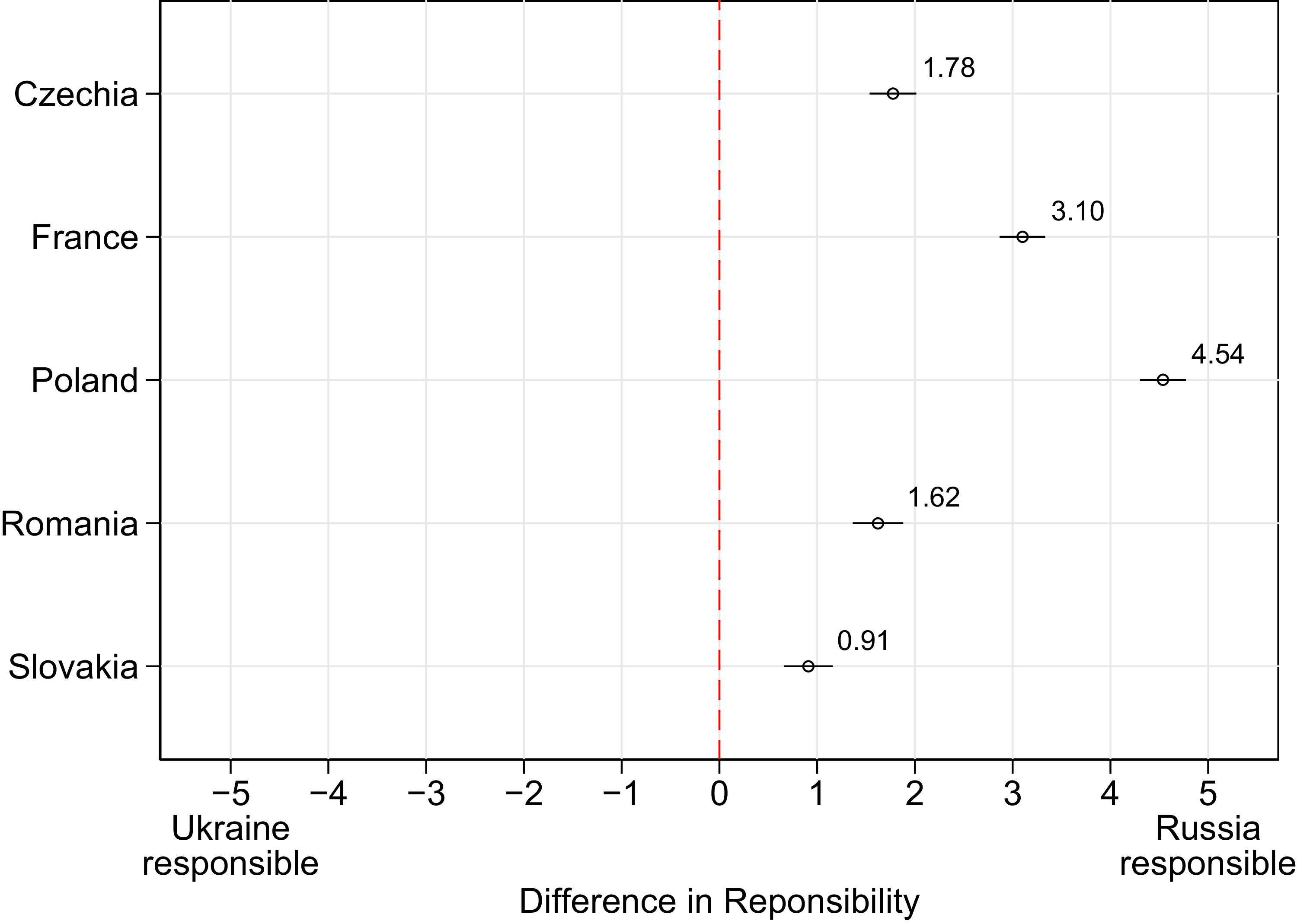
Figure 2. Long description
A horizontal dot plot compares the perceived responsibility for the war between Ukraine and Russia across five countries: Czechia, France, Poland, Romania, and Slovakia. The x-axis represents the difference in responsibility, ranging from negative values indicating Ukraine is considered more responsible to positive values indicating Russia is considered more responsible. The y-axis lists the countries. Each dot represents the average perceived responsibility difference for that country and is accompanied with a confidence interval. Czechia shows a value of 1.78, France 3.10, Poland 4.54, Romania 1.62, and Slovakia 0.91. All these estimates are statistically significant. The red dashed line at zero marks the neutral point where both countries are seen as equally responsible. All values are approximated.
Preferred outcome of the war.
Note: 95% confidence intervals. DK means ‘Don’t Know’.
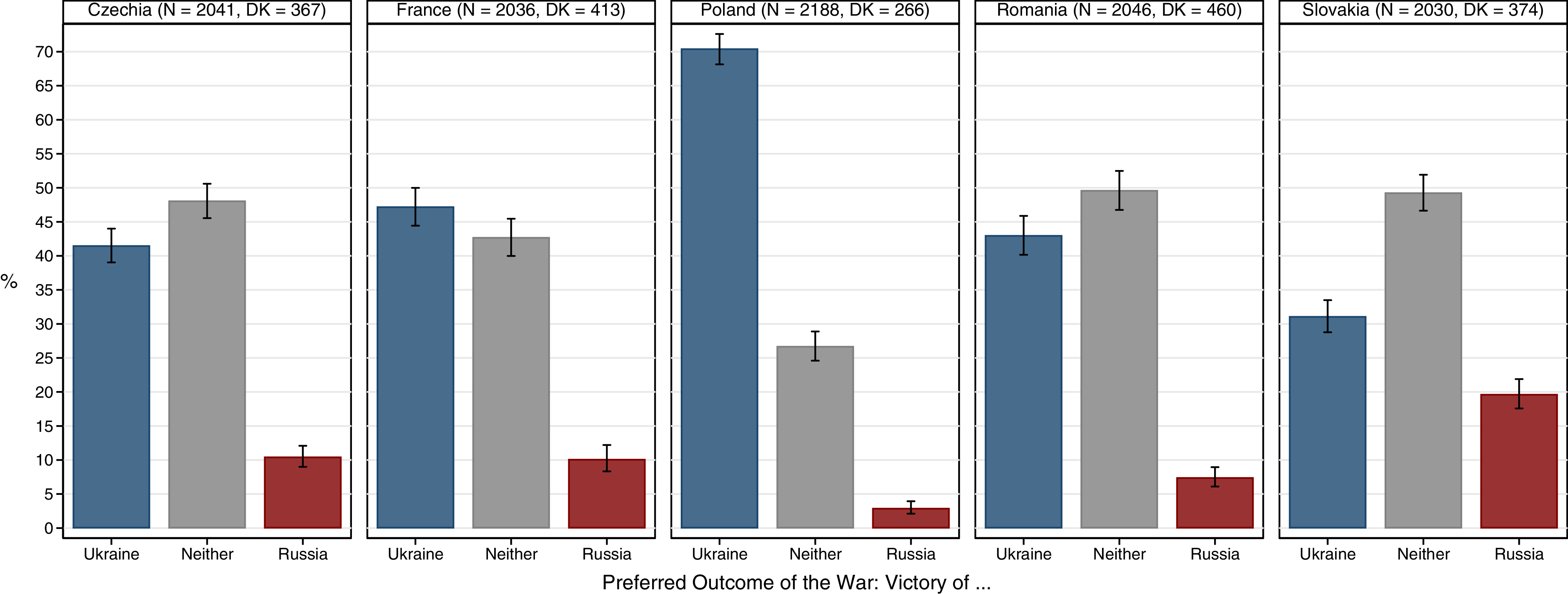
Figure 3. Long description
The bar graph compares the preferred outcomes of the war in five countries: Czechia, France, Poland, Romania, and Slovakia. The x-axis represents the preferred outcome of the war, with categories for Ukraine, Neither, and Russia. The y-axis represents the percentage of respondents. Each country has three vertical bars representing the percentage of respondents who prefer victory for Ukraine, neither, or Russia. Czechia has approximately 40 percentage for Ukraine, 50 percentage for Neither, and 10 percentage for Russia. France has approximately 47 percentage for Ukraine, 43 percentage for Neither, and 10 percentage for Russia. Poland has approximately 70 percentage for Ukraine, 28 percentage for Neither, and 2 percentage for Russia. Romania has approximately 43 percentage for Ukraine, 50 percentage for Neither, and 7 percentage for Russia. Slovakia has approximately 30 percentage for Ukraine, 50 percentage for Neither, and 20 percentage for Russia. The color scheme uses blue for Ukraine, gray for Neither, and red for Russia. All values are approximated.
Altogether, the descriptive evidence underscores the need to better understand attitudes towards the Russo-Ukrainian war. For both dependent variables, public opinion in all five countries favours Ukraine. However, more nuanced positions are surprisingly common and, in three countries, even predominant regarding the preferred outcome of the war.
Analysis 1.1
The first analysis investigates blame attribution for the war. Table 1 displays seven models ranging from a baseline with only country-fixed effects (1), through a series of models testing the different types of factors separately (2–5), to comprehensive models with all independent variables (6) and controls (7).
Responsibility for the war (Ukraine vs. Russia) regressed on predictors
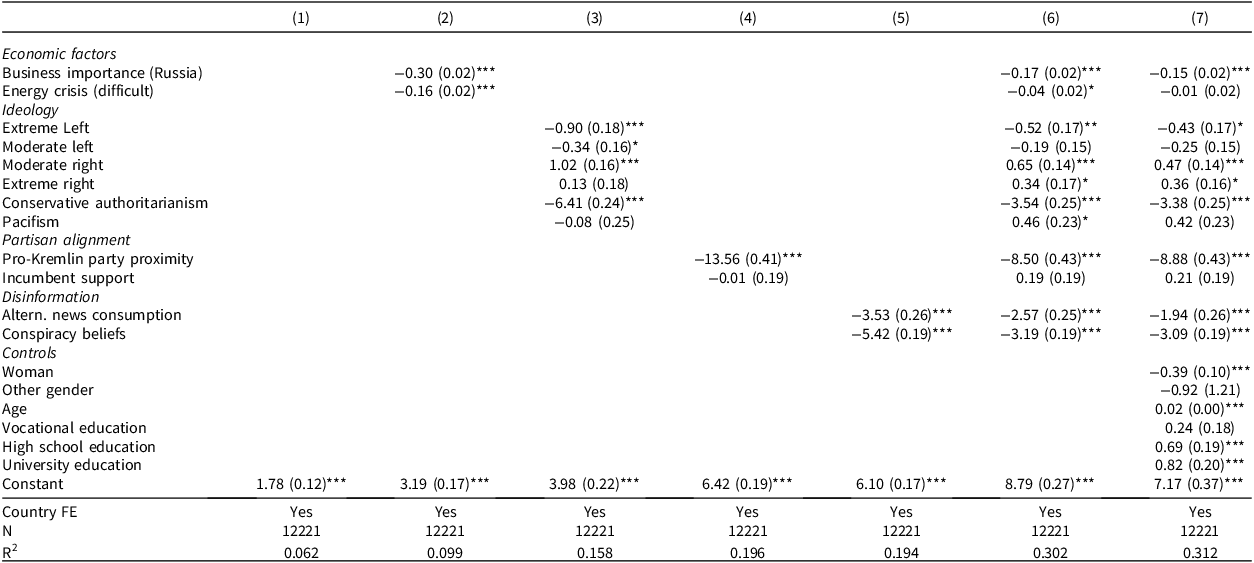
Table 1. Long description
The table presents seven models analyzing blame attribution for the war. The models range from a baseline with only country-fixed effects to comprehensive models with all independent variables and controls. The table includes economic factors, ideology, partisan alignment, disinformation, and controls. Each model shows coefficients and standard errors for variables such as business importance, energy crisis, political ideology, party proximity, news consumption, conspiracy beliefs, and demographic controls. The table aims to investigate the responsibility for the war between Ukraine and Russia.
Note: The DV is coded from −10 (Ukraine is fully responsible for the war) to 10 (Russia is fully responsible for the war). Positive coefficients indicate that respondents attribute more responsibility to Russia. OLS regression. Standard errors in parentheses. Significance levels: ${{\rm{\;}}^{\rm{*}}}{\rm{\!}}p \lt 0.05{,\,^{{\rm{**}}}}{\rm{\!}}p \lt 0.01{,\,^{{\rm{***}}}}{\rm{\!}}p \lt 0.001.$
The separate tests (Models 2–5) support most of our hypotheses. The more respondents deem that Russia was important for their business (H1.1) and the more they suffered during the energy crisis (H1.2), the more they blame Ukraine. The Kremlin’s narrative also finds support among extreme leftists (H2.1), authoritarians (H2.2), respondents close to pro-Kremlin parties (H3.1), consumers of alternative news (H4.1), and believers in conspiracy theories (H4.2). Pacifists (H2.3) are also more likely to blame Russia, although the picture is, as expected, more complex. In the separate test in Model 3, Pacifism has the opposite (ie negative) sign, suggesting that pacifists could be pro-Russian. However, the coefficient becomes positive and statistically significant in the comprehensive model specifications (0.46, $p \lt 0.05$
in Model 6), which indicates the presence of confounding. Additional analyses in Appendix Table A16 confirm that the key confounder is disinformation: when consumption of alternative news and conspiracy beliefs are controlled for, Pacifism takes the hypothesised positive sign. For some respondents, pacifist attitudes reflect a penchant for alternative sources of political news.
$p \lt 0.05$
in Model 6), which indicates the presence of confounding. Additional analyses in Appendix Table A16 confirm that the key confounder is disinformation: when consumption of alternative news and conspiracy beliefs are controlled for, Pacifism takes the hypothesised positive sign. For some respondents, pacifist attitudes reflect a penchant for alternative sources of political news.
There are two chief deviations from our expectations. First, Hypothesis 2.1 receives only partial support: extreme right-wingers blame Russia as much as centrist respondents in Model 3.Footnote 27 In the comprehensive models (6 and 7), the regression coefficient of Extreme Right remains positive. It even becomes statistically significant, indicating that right-wingers are more likely to blame Russia once we control for other factors, including proximity to pro-Kremlin parties and vulnerability to disinformation. This reveals that the relationship between left-right ideology and support for the Kremlin’s narrative is more linear than hypothesised – presumably reflecting the historical affinity of the left with the USSR.
Hypothesis 3.2 also receives little support as the regression coefficient of Incumbent Support is substantively small and statistically insignificant across all models. Appendix analyses (Table A14) demonstrate that the tested relationship is fully nested in the general association between Party Proximity and the dependent variable. When Incumbent Support is tested separately without Pro-Kremlin Party Proximity, its coefficient becomes positive and substantively and statistically significant (2.42, $p \lt 0.001$
). The null finding in Table 1 thus does not imply that citizens do not align their views with those of political elites, but rather that they pay greater attention to party positions rather than government positions.
$p \lt 0.001$
). The null finding in Table 1 thus does not imply that citizens do not align their views with those of political elites, but rather that they pay greater attention to party positions rather than government positions.
The models reveal marked differences in the substantive significance of the observed effects, especially when comparing economic factors to the rest. The regression coefficient of Business Importance (−0.3 in Model 2), which is twice as large as that of Energy Crisis (−0.16), means that the estimated difference between a respondent who considered Russia had been extremely important to their business activity and a respondent who thought the opposite is 0.3 on the 20-point blame-attribution scale. The magnitude of the regression coefficients of Conservative Authoritarianism (Model 3), Pro-Kremlin Party Proximity (Model 4), Conspiracy Beliefs, and Altern. News Consumption (Model 5) are, respectively, 21.3, 45.2, 18.1, and 11.8 times larger (ie −6.41, −13.56, −5.42, −3.53).
Including all four factors jointly (Model 6) and adding controls (Model 7) leaves most substantive results unchanged. Apart from Pacifism, all regression coefficients retain their sign. The most noteworthy difference, besides those commented upon above, is Energy Crisis’s loss of substantive and statistical significance. It suggests that the relationship between one’s economic situation and attitudes towards the war essentially translates political factors such as respondents’ party preference, ideology, and vulnerability and exposure to disinformation. Concerning the controls, pro-Ukrainian attitudes are positively associated with age and level of education, which presumably reflects more experienced and more educated respondents’ geopolitical awareness.
In terms of explained variance, partisan alignment performs the best ( ${R^2} = 19.6{\rm{\% }}$
), followed by disinformation (
${R^2} = 19.6{\rm{\% }}$
), followed by disinformation ( ${R^2} = 19.4{\rm{\% }}$
) and ideology (
${R^2} = 19.4{\rm{\% }}$
) and ideology ( ${R^2} = 15.8{\rm{\% }}$
). Economic factors explain significantly less (
${R^2} = 15.8{\rm{\% }}$
). Economic factors explain significantly less ( ${R^2} = 9.9{\rm{\% }}$
), adding only 3.7 percentage points to the model fit of the baseline fixed-effects specification (
${R^2} = 9.9{\rm{\% }}$
), adding only 3.7 percentage points to the model fit of the baseline fixed-effects specification ( ${R^2} = 6.2{\rm{\% }}$
). The four types of factors jointly account for a solid 30.2 per cent of variance in the dependent variable (Model 6) and 31.2 per cent when the controls are included (Model 7). These proportions demonstrate that individual attitudes towards the war are structured and vary significantly within countries as a function of respondents’ characteristics. The differences in
${R^2} = 6.2{\rm{\% }}$
). The four types of factors jointly account for a solid 30.2 per cent of variance in the dependent variable (Model 6) and 31.2 per cent when the controls are included (Model 7). These proportions demonstrate that individual attitudes towards the war are structured and vary significantly within countries as a function of respondents’ characteristics. The differences in ${R^2}$
between Models 1 and 7 mean that respondents with similar characteristics who come from different countries are closer to each other in their attitudes towards the war rather than to their fellow compatriots with different attributes.
${R^2}$
between Models 1 and 7 mean that respondents with similar characteristics who come from different countries are closer to each other in their attitudes towards the war rather than to their fellow compatriots with different attributes.
Analysing each country separately (Appendix Table A8), Pro-Kremlin Party Proximity, Conspiracy Beliefs, Altern. News Consumption and Conservative Authoritarianism consistently exhibit the hypothesised (negative) sign and are usually statistically and substantively significant. Pro-Kremlin Party Proximity is the strongest predictor in all countries except Romania, likely reflecting Romanians’ low trust in parties (Tatar Reference Tatar2022). The most interesting variation concerns left-right ideology. Its full, unmediated effects (see Appendix Table A9) show that the left is more pro-Russian and the right more pro-Ukrainian in Czechia, Slovakia, and Romania, presumably because of the historical ties between these countries’ left and the USSR (especially before 1968). In Poland, the moderate left is pro-Ukrainian, and no ideological group is distinctly pro-Russian. This probably reflects Poland’s painful experience with the Tsarist and later Soviet domination and externally imposed communism (Kitschelt, Mansfeldova, Markowski et al. Reference Kitschelt, Mansfeldova, Markowski and Toka1999). In France, the right is more pro-Russian than the left. Overall, these ideological patterns appear related to cross-country differences in the association between the economic and cultural attitudinal dimensions (Rovny Reference Rovny2014; Kostelka and Rovny Reference Kostelka and Rovny2019).
The Appendix shows that our main substantive results hold under a variety of alternative model specifications.Footnote 28 When we compare the blame attributed to NATO (instead of Ukraine) and Russia (Table A10), the results remain very similar. Conversely, when we compare NATO and Ukraine (Table A11) in a sort of a placebo test, none of the independent variables is statistically significant in any model specification, and the full model explains only 1.3 per cent of variance. This suggests that, regarding the start of the conflict, public opinion does not exhibit differences in perceptions of NATO’s and Ukraine’s roles. Indeed, using the combined (Ukraine-Russia-NATO) scale as the dependent variable increases the share of explained variance by Model 7 to 36.2 per cent (Table A12).
Analysis 1.2
The multinomial logit regressions of preferred war outcomes closely mirror the results from Analysis 1.1.Footnote 29 As the raw regression coefficients may be misleading (Long and Freese Reference Long and Freese2014; Wulff Reference Wulff2015), they are presented only in the Appendix (Tables A20 and A21), and we turn to marginal effects for interpretation. Figure 4 presents average marginal effects based on the full multinomial logit model that includes exactly the same independent variables as Analysis 1.1.Footnote 30 They indicate the change in the probability of preferring Ukraine’s victory over any other outcome (Russia’s victory or neither’s victory). The signs of the predictors and the relative differences in substantive and statistical significance are essentially the same as in Table 1. Respondents who want Russia to win are close to pro-Kremlin parties, believe in conspiracy theories, are exposed to alternative media, and hold authoritarian attitudes. These four variables are associated with decreases in the probability of supporting Ukraine by up to 0.74, 0.25, 0.21, and 0.17, respectively. These four variables are by far the strongest correlates of the dependent variable, as the absolute values of the other coefficients never exceed 0.11. Like in Analysis 1.1, economic factors are less related to the dependent variable than partisan alignment, exposure to disinformation, and ideology.
Correlates of support for Ukraine’s victory.
Note: Average Marginal effects from the multinomial logit analysis (Model 6 in Tables 2 and 3). The coefficients indicate changes in the probability of preferring Ukraine’s victory (over any other outcome) resulting from one-unit changes in the independent variables (holding other variables at their observed values). 95% confidence intervals.
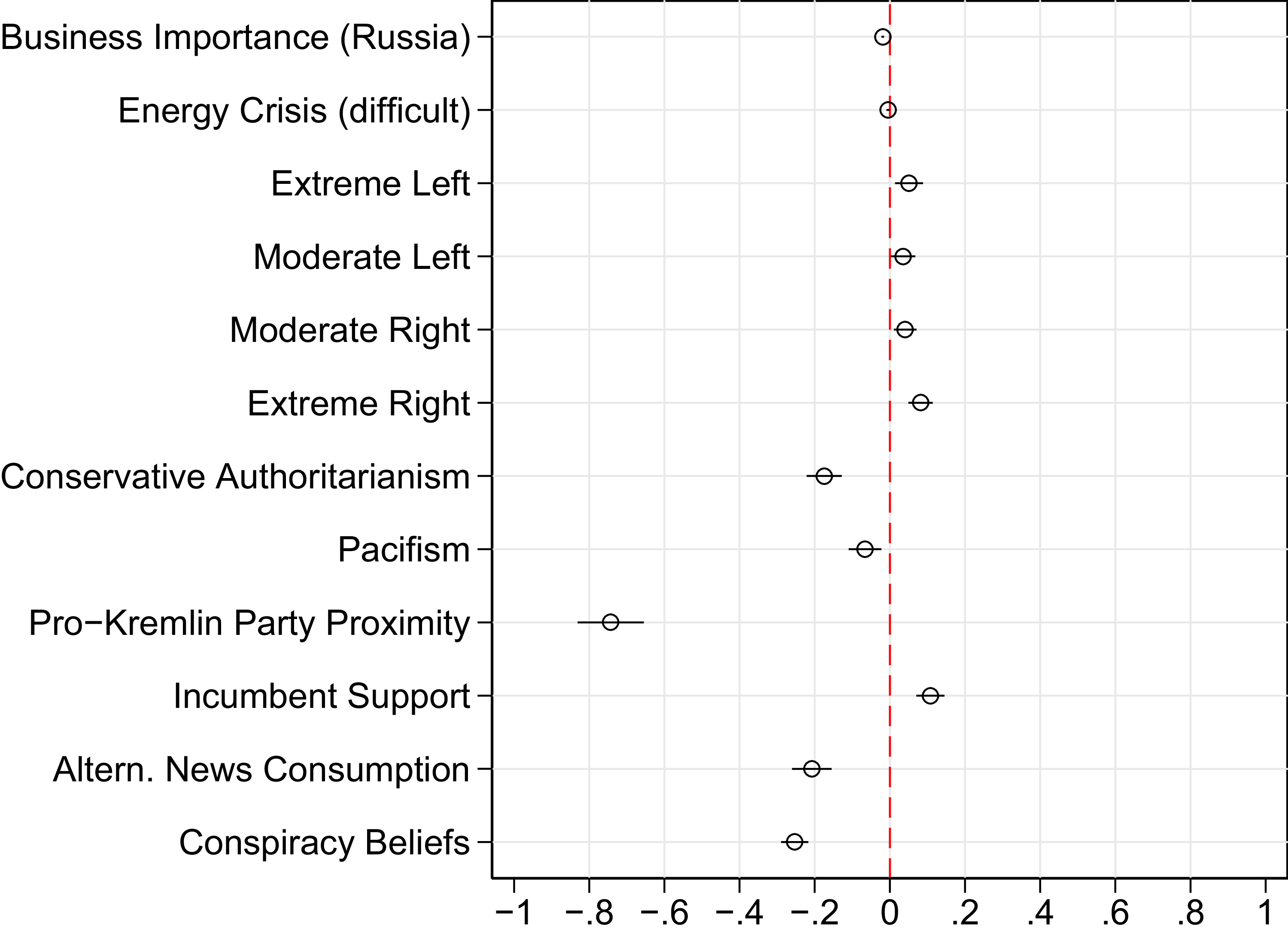
Figure 4. Long description
A vertical dot plot displays the correlates of support for Ukraine’s victory. The x-axis ranges from -1 to 1, representing the correlation values, while the y-axis lists various factors such as Business Importance (Russia), Energy Crisis (difficult), Extreme Left, Moderate Left, Moderate Right, Extreme Right, Conservative Authoritarianism, Pacifism, Pro-Kremlin Party Proximity, Incumbent Support, Altern. News Consumption, and Conspiracy Beliefs. Each dot represents the average marginal effect from the multinomial logit analysis. Notable patterns include high positive values for Business Importance (Russia) and Energy Crisis (difficult), and high negative values for Pro-Kremlin Party Proximity and Conspiracy Beliefs. All values are approximated.
Figure 5 uses predicted probabilities to show that individuals scoring lowest on the four main correlates (0) are highly likely to express a desire for Ukraine’s victory (probability of 0.94) as opposed to Russia’s victory (0). Conversely, those scoring highest (1) show the reverse pattern – strong support for Russia’s victory (0.83) and none for Ukraine’s (0).
Predicted probabilities of the preferred outcomes.
Note: Predicted probabilities from the multinomial logit analyses (Model 6 in Tables 2 and 3) for individuals scoring respectively the maximum and minimum values on the four main correlates of the preferred outcomes (Pro-Kremlin Party Proximity, Conspiracy Beliefs, Altern. News Consumption, Conservative Authoritarianism). Other variables are left at observed values. 95% confidence intervals.

Figure 5. Long description
A horizontal dot plot compares predicted probabilities of preferred outcomes for three categories: Ukraine, neither, and Russia. The x-axis represents probabilities ranging from 0 to 1, while the y-axis lists the categories. Each category contains two dots: one at the minimum value (0) and one at the maximum value (1) on the four main correlates. The Ukraine category shows a dot near 1 at the maximum value and a dot near 0 at the minimum value. The neither category has dots near 0.2 at the minimum value and near 0.2 at the maximum value. The Russia category displays a dot near 0.8 at the maximum value and a dot near 0 at the minimum value. The plot highlights the distribution of predicted probabilities across the three categories, indicating varying levels of support.
Analysis 2: replication using the Solidarity in Europe dataset
Data and methods
To test the generalizability of our main finding – the role of party proximity – we replicate Analysis 1.1 using data from the Solidarity in Europe (SiE) dataset (Kriesi, Stolle and Cicchi Reference Kriesi, Stolle and Cicchi2023). The survey was fielded by the company YouGov in seventeen European countries,Footnote 31 four of which also appear in the FC dataset, between March and April 2023. It includes a question similar to that used for the dependent variable in Analysis 1.1: ‘From what you’ve read and heard, who do you think is responsible for the current situation in Ukraine?’. The possible answers were from 1 (‘Entirely NATO’), 2 (‘More NATO than Russia’), 3 (‘NATO and Russia equally’), 4 (‘More Russia than NATO’), and 5 (‘Entirely Russia). To make the regression coefficients comparable to those in Analysis 1, we rescaled the resulting dependent variable to range from –10 (‘Entirely NATO’) to 10 (‘Entirely Russia’).Footnote 32
Similarly to Analysis 1.1, we conduct OLS regressions with country-fixed effects. The main predictor, operationalising Hypothesis 3.1, gives the position towards Russia’s government – extracted from CHES – of the political party to which the respondent feels close.Footnote 33 Unfortunately, the survey does not allow us to operationalise most other hypotheses. The only exception is Hypothesis 2.1 on ideology, whose operationalisation consists of the same five dummy variables as in the previous analyses (Extreme Left, Moderate Left, Centre, Moderate Right, Extreme Right).Footnote 34 Control variables exactly match Analysis 1, except that age information is only available in categorical form.
Results
Figure 6 plots average blame attribution by country. The picture closely mirrors Figure 2 from the FC dataset. In all countries but Bulgaria, respondents are more likely to blame Russia than NATO. Nonetheless, cross-country differences are substantial. For the four countries included in both datasets, the relative ranking is exactly the same as in Figure 2: Poland is the most pro-Western, followed by France, Romania, and Slovakia. On the whole, however, Eastern countries (in the lower part of the graph) appear more pro-Russian than Western countries. Again, this suggests that painful historical experiences can be overshadowed in citizens’ attitudes by other factors, which may include partisan alignment.
Responsibility for the current situation in Ukraine: NATO versus Russia.
Note: SiE dataset. The figure shows the country averages on the dependent variable which ranges from −10 to +10. Positive values indicate that respondents attribute stronger responsibility to Russia. 95% confidence intervals. Total N = 24,261.

Figure 6. Long description
A horizontal dot plot displays the perceived responsibility for the current situation in Ukraine, comparing NATO and Russia. The y-axis lists 20 countries, while the x-axis ranges from -10 to 10, with negative values indicating NATO responsibility and positive values indicating Russia responsibility. Each country has a dot representing its perceived responsibility, with some countries having multiple dots indicating different data points. Notable values include Denmark at 7.62, Finland at 6.72, and Germany at 0.22. The plot shows a clear division, with many countries leaning towards Russia being more responsible. All values are approximated.
The regression results presented in Table 2 remarkably resemble those from Analysis 1, fully supporting Hypothesis 3.1. The regression coefficients of Pro-Kremlin Party Proximity are consistently negative, substantive, and statistically significant ( $p \lt 0.001$
). Interestingly, the magnitude of the regression coefficient in the full Model 4 (−6.56) aligns closely with that observed in Model 6 in Table 1 (−8.50) despite using entirely different data. When the analyses are conducted separately by subregion (Models 5 and 6), the regression coefficients remain similar, although the magnitude is slightly stronger in CEE (Model 6), likely reflecting the conflict’s heightened salience because of geographic proximity. The results for ideology also echo Table 1. While extreme leftists are more pro-Russian and moderate-rights are more pro-Western, extreme-rights do not significantly differ from centrists (the reference category).Footnote
35
Overall, ideology seems to matter much less than party proximity. Finally, the controls exhibit similar patterns to those in Table 1: female, younger, and less educated respondents report more pro-Russian attitudes.
$p \lt 0.001$
). Interestingly, the magnitude of the regression coefficient in the full Model 4 (−6.56) aligns closely with that observed in Model 6 in Table 1 (−8.50) despite using entirely different data. When the analyses are conducted separately by subregion (Models 5 and 6), the regression coefficients remain similar, although the magnitude is slightly stronger in CEE (Model 6), likely reflecting the conflict’s heightened salience because of geographic proximity. The results for ideology also echo Table 1. While extreme leftists are more pro-Russian and moderate-rights are more pro-Western, extreme-rights do not significantly differ from centrists (the reference category).Footnote
35
Overall, ideology seems to matter much less than party proximity. Finally, the controls exhibit similar patterns to those in Table 1: female, younger, and less educated respondents report more pro-Russian attitudes.
Responsibility for the current situation in Ukraine
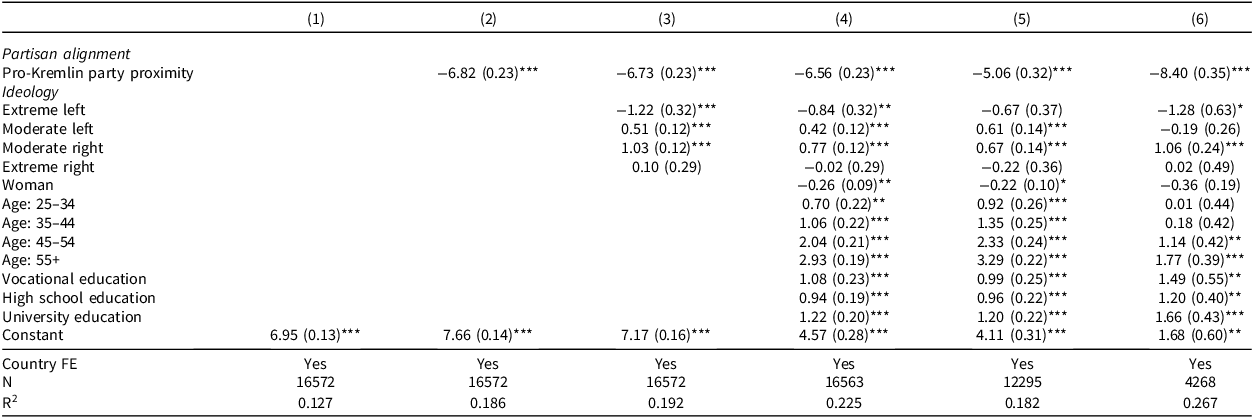
Table 2. Long description
The table presents regression models analyzing responsibility for the current situation in Ukraine. The table has six columns labeled (1) to (6), representing different regression models. The rows include variables such as partisan alignment, pro-Kremlin party proximity, ideology, age groups, gender, education levels, and a constant. Each cell contains regression coefficients with standard errors in parentheses and significance levels indicated by asterisks. Notable trends include consistently negative and significant coefficients for pro-Kremlin party proximity across all models, with varying magnitudes. Ideological alignment shows that extreme leftists are more pro-Russian, moderate rights are more pro-Western, and extreme rights do not significantly differ from centrists. Controls indicate that female, younger, and less educated respondents report more pro-Russian attitudes.
SiE Dataset. The DV is coded from −10 (NATO is entirely responsible) to 10 (Russia is entirely responsible). Models 5 and 6 include only Western European (Denmark, Finland, France, Germany, Greece, Italy, Netherlands, Spain, Sweden, UK) and CEE (Bulgaria, Croatia, Hungary, Lithuania, Poland, Romania, and Slovakia) countries respectively. Positive coefficients indicate greater blame attribution to Russia. OLS regression. Standard errors in parentheses. N (16,572) is smaller than in Figure 6 due to missing values on the independent variables. Significance levels: ${{\rm{\;}}^{\rm{*}}}{\rm{\!}}p \lt 0.05{,\,^{{\rm{**}}}}{\rm{\!}}p \lt 0.01{,\,^{{\rm{***}}}}\!\!\!\!{\rm{\;\;}}p \lt 0.001$
.
${{\rm{\;}}^{\rm{*}}}{\rm{\!}}p \lt 0.05{,\,^{{\rm{**}}}}{\rm{\!}}p \lt 0.01{,\,^{{\rm{***}}}}\!\!\!\!{\rm{\;\;}}p \lt 0.001$
.
Analysis 3: exploratory examination of reverse causality
Our theory assumes that the strong association between party proximity and support for Russia primarily reflects voters adopting party cues. However, in principle, it could also result from voters distancing themselves from pro-Kremlin parties as a result of Russia’s aggression. Such a reverse causality scenario is less likely because, as mentioned above, voters care much more about domestic issues than foreign policy (Page and Shapiro Reference Page and Shapiro1992; Lavine, Sullivan, Borgida et al. Reference Lavine, Sullivan, Borgida and Thomsen1996; Guisinger Reference Guisinger2009; Saunders Reference Saunders2022: 227). Moreover, during the period under study, elections in most EU member states could affect the war in Ukraine only indirectly at best.
We exploratively examine available evidence for the reverse causal path in Analysis 3 in Appendix E.Footnote 36 Using the FC dataset, we focus on two countries that held their last pre-survey legislative election before Russia’s 2022 invasion: Czechia and Romania. We investigate party switching, conceptualised as the difference between the party voted for in the last legislative election – a choice that could not be affected by Russia’s invasion – and the party with the highest reported probability of future support.
The results suggest that reverse causality plays a minimal role in the associations found in Analyses 1 and 2. Party switching is only very weakly related to discrepancies between respondents’ and parties’ war attitudes. Furthermore, the relationship is asymmetric. While some pro-Ukraine respondents switch away from previously supported parties close to Russia, those more pro-Russian than their past vote choice are no more likely to switch than the rest of the sample. Clearly, respondents who vote for pro-Russian parties do so primarily for reasons other than these parties’ attitudes towards the war.Footnote 37
Discussion
This paper conducted a comprehensive investigation of European public opinion towards Russia’s aggression against Ukraine. Its main analyses leveraged an original and specially-tailored survey conducted in five countries, and the main finding was replicated using a large sample from seventeen European countries. The paper confirms that most respondents support Ukraine over Russia. However, ambivalent and pro-Russian attitudes are by no means rare. Respondents in three out of five countries in the FC dataset prefer a draw to the victory of any party. The paper hypothesised that four main factors may account for this individual-level variation: economic interests, partisan alignment, ideology, and disinformation.
Our analyses demonstrate that pro-Russian attitudes are minimally related to economic interests. While suffering from sanctions yields estimates with the expected sign (ie favourable to Russia), their substantive significance is trivial. Instead, attitudes towards the war are strongly associated with party support, disinformation, and conservative authoritarian ideology. The more respondents support pro-Kremlin political parties, believe in conspiracy theories, are exposed to alternative news, and hold conservative authoritarian attitudes, the more they blame Ukraine for the war and wish for a draw, if not an outright Russian victory. These relationships hold in all five countries we studied, regardless of their geographic proximity to the conflict and prior history of Russian or Soviet invasions. Indeed, within-country variance of the studied attitudes is much more substantial than between-country variance despite the striking differences in contextual factors, especially between France and the rest. The analyses of the SiE dataset, covering seventeen European countries, confirmed the strong relationship between party proximity and attitudes towards the war.
Our findings indicate that energy prices exert minimal influence on support for the Kremlin, plausibly because of governments’ partial success in buffering households from rising costs. They also contribute to the literature on public opinion and foreign policy by demonstrating that democratic electorates in third countries can hold well-structured attitudes towards foreign wars. Our models account for roughly one-third of the variance in attitudes toward the conflict between Ukraine and Russia, whereas, in a placebo comparison of attitudes towards Ukraine and NATO, they explain literally nothing.
Naturally, conducting a fair and comprehensive empirical contest between competing perspectives on attitudes towards the war in Ukraine is fraught with difficulty, and this study has several limitations. First, based on prior literature and our observation of the developments in the studied countries, we selected what we judged to be the most relevant feasible operationalisations of top-down and bottom-up mechanisms in a public opinion survey. However, these operationalisations may be approximative, incomplete, or unequal,Footnote 38 and other factors may also be at work.Footnote 39 Second, separating different factors is, to some extent, a simplification. In theory, the different types of factors may interact or partially proxy one another.Footnote 40 Relatedly, our analyses are cross-sectional and should thus be interpreted cautiously in terms of causality and the directionality of the observed relationships. Given our research comparing a multiplicity of relevant factors, our analyses are correlational and not causally identified, and they rely on assumptions. Furthermore, especially for party proximity, which is the strongest predictor of attitudes towards the war, the causal arrow might flow from attitudes to party support. However, we find little evidence that disagreement with party positions on the war would make many voters change their party preferences. It appears that party positions on the war inform their voters’ attitudes in line with top-down models of public opinion and the rich literature on party cues (Zaller Reference Zaller1992; Berinsky Reference Berinsky2009; Lenz Reference Lenz2012).Footnote 41
Despite the limitations, we believe that our findings are important and carry clear policy implications for decision-makers who care about Russia’s influence among the European public. They underscore political parties’ stances and the spread of disinformation as the primary sources of pro-Russian attitudes. Unsurprisingly, the three countries with the most mixed opinions on the conflict in our sample (the Czech Republic, Romania, and Slovakia) belong to the countries most targeted by Russian disinformation operations (Kostelka and Krejcova Reference Kostelka and Krejcova2017; Wenzel, Stasiuk-Krajewska, Macková et al. Reference Wenzel, Stasiuk-Krajewska, Macková and Turková2023). Countering Russia’s influence requires assertive moderation of public discourse and robust efforts to combat disinformation. These implications contrast with governments’ attitudes in many EU member states, including those studied here. For example, the current Andrej Babiš’ cabinet in the Czech Republic has renounced any anti-disinformation measures (Petrů Reference Petru2025). In Slovakia, Prime Minister Robert Fico has himself echoed pro-Russian narratives (Pollet Reference Pollet2024).
The observational evidence provided by this study calls for future research into the exact mechanisms through which parties and disinformation inform attitudes towards the conflict in Ukraine. Survey experiments and qualitative interviews may be particularly informative. Another important line of inquiry relates to the observed attitudes’ stability, especially should the present conflict endure. If public opinion in third countries evolves as it does in directly involved nations, it may become increasingly resilient to elite cues and constraining for politicians (Baum and Groeling Reference Baum and Groeling2010).
Supplementary material
The supplementary material for this article can be found at https://doi.org/10.1017/S1475676526101352.
Data availability statement
Replication files are available at https://doi.org/10.7910/DVN/PCXEEU.
Acknowledgements
We thank André Blais, Simon Hix, Eva Krejcova, the participants of the ‘Transformation of Word Order Through the Prism of War and Peace’ conference at Kyiv National Economic University, and the EJPR reviewers and editors for their insightful comments on earlier drafts of this paper. We also thank Jan Rovny and Jan Kwasniak for their help with the preparation and administration of the survey used in the empirical analyses (FC dataset). We are grateful to Hanspeter Kriesi and Dietlind Stolle for having shared the data from the Solidarity in Europe dataset.
Financial support
This research received financial support from the EUI Research Council. Silvia Porciuleanu would like to acknowledge support from the French Ministry of Higher Education and Research.
Competing interests
The author(s) declare none.
Ethical statement
This research received ethical approval from the European University Institute (20230920_KOSTELKA).


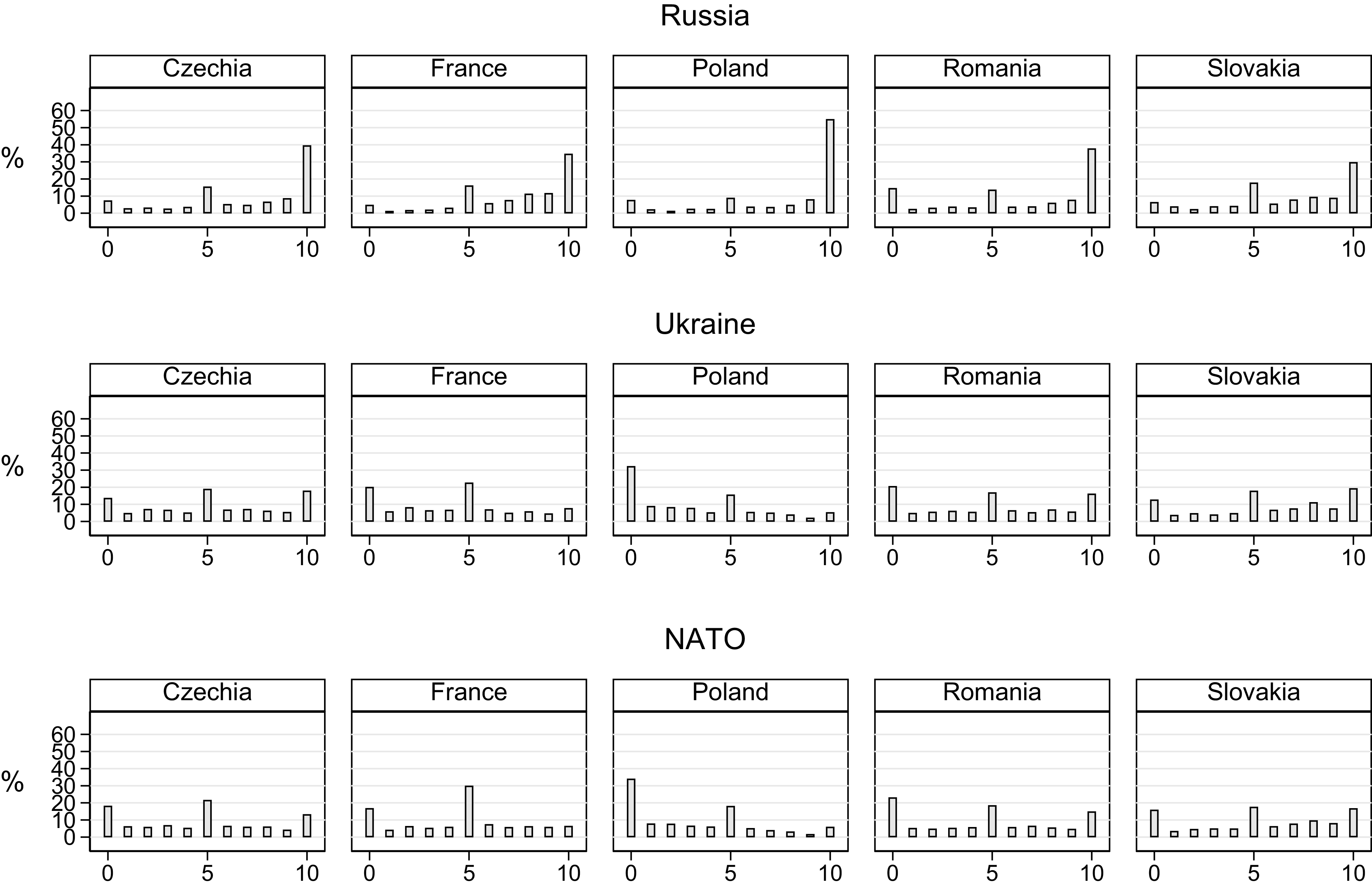
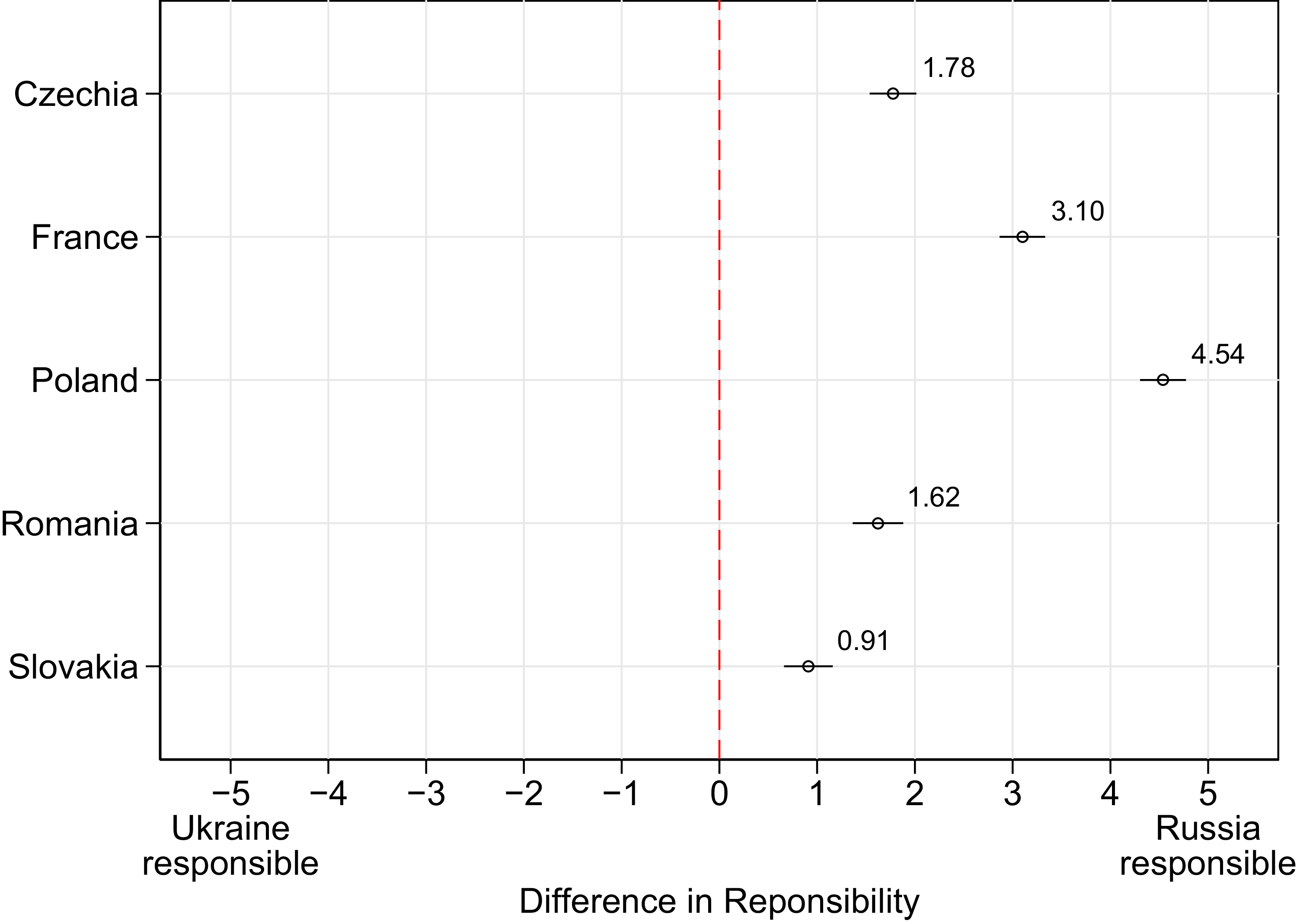
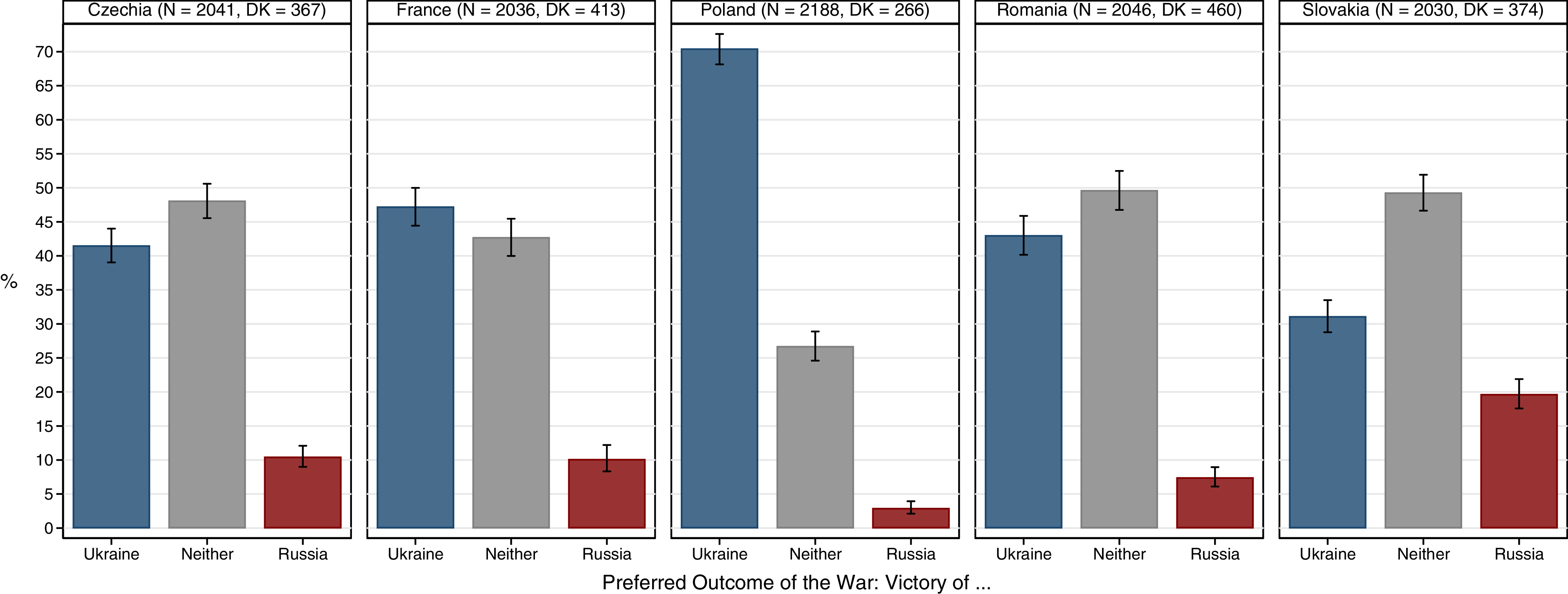
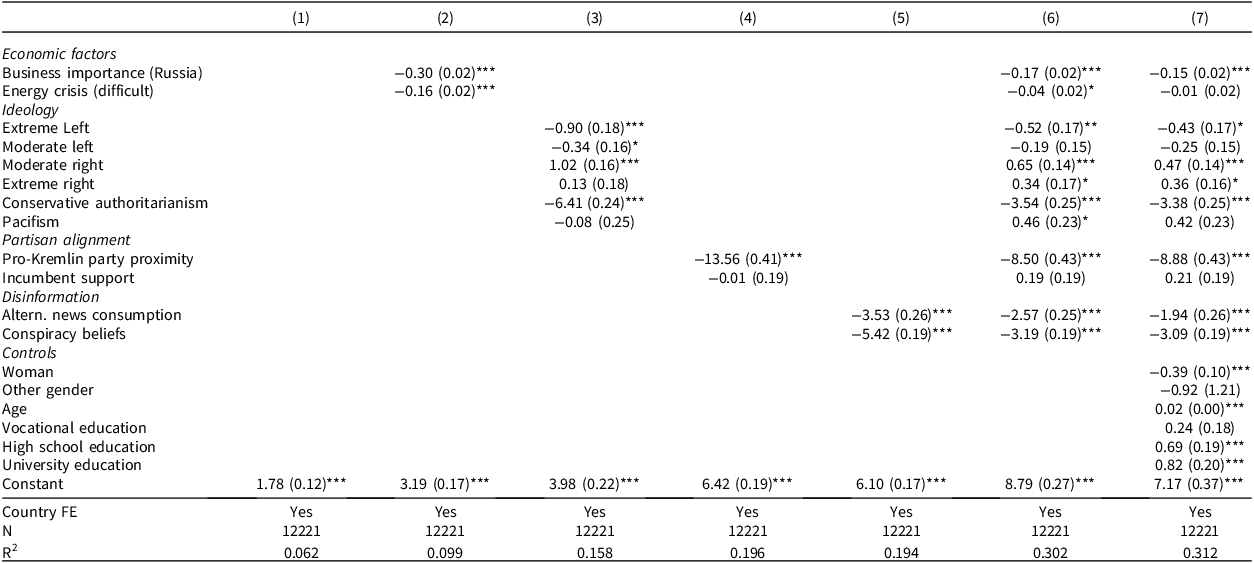
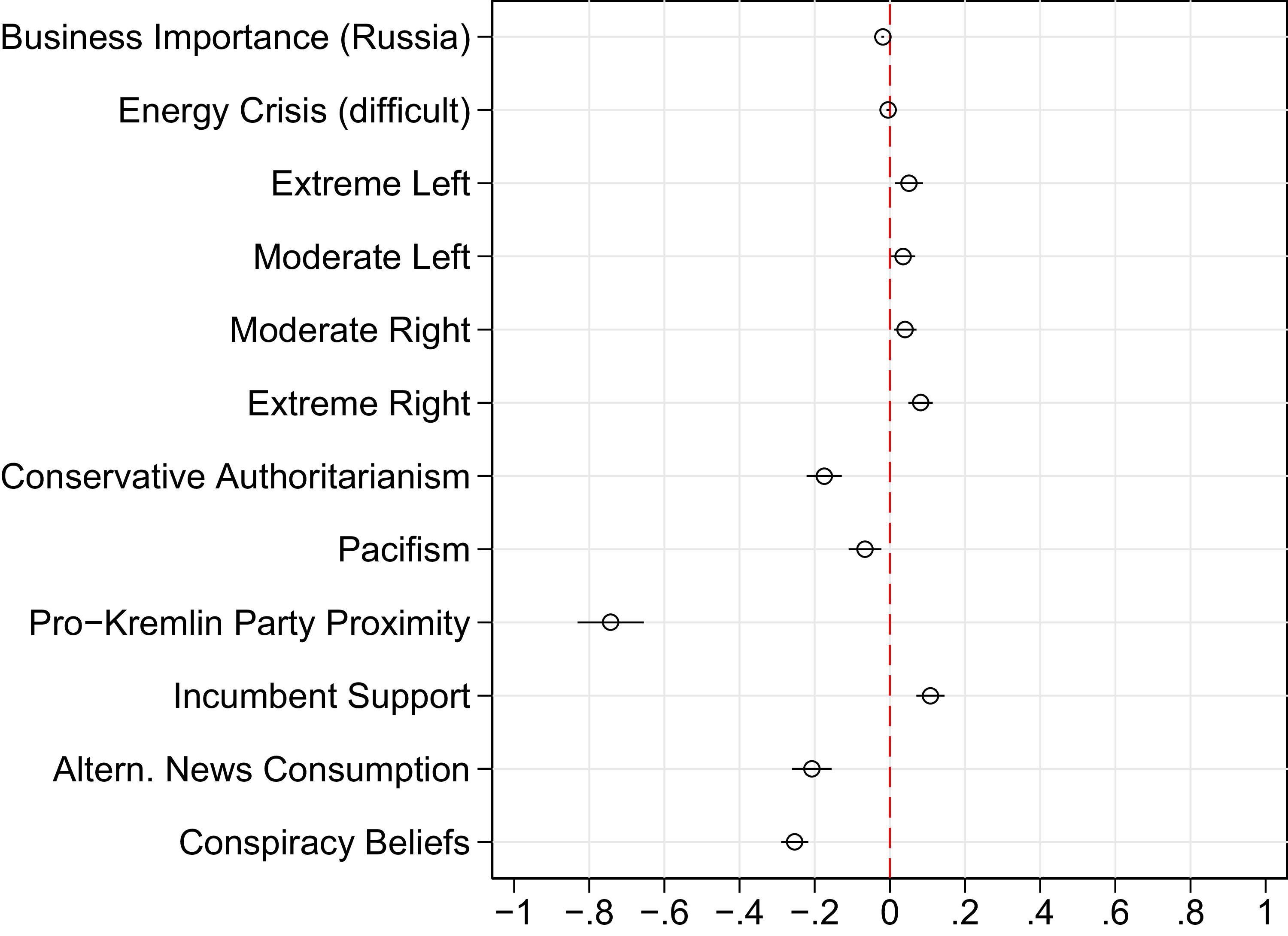
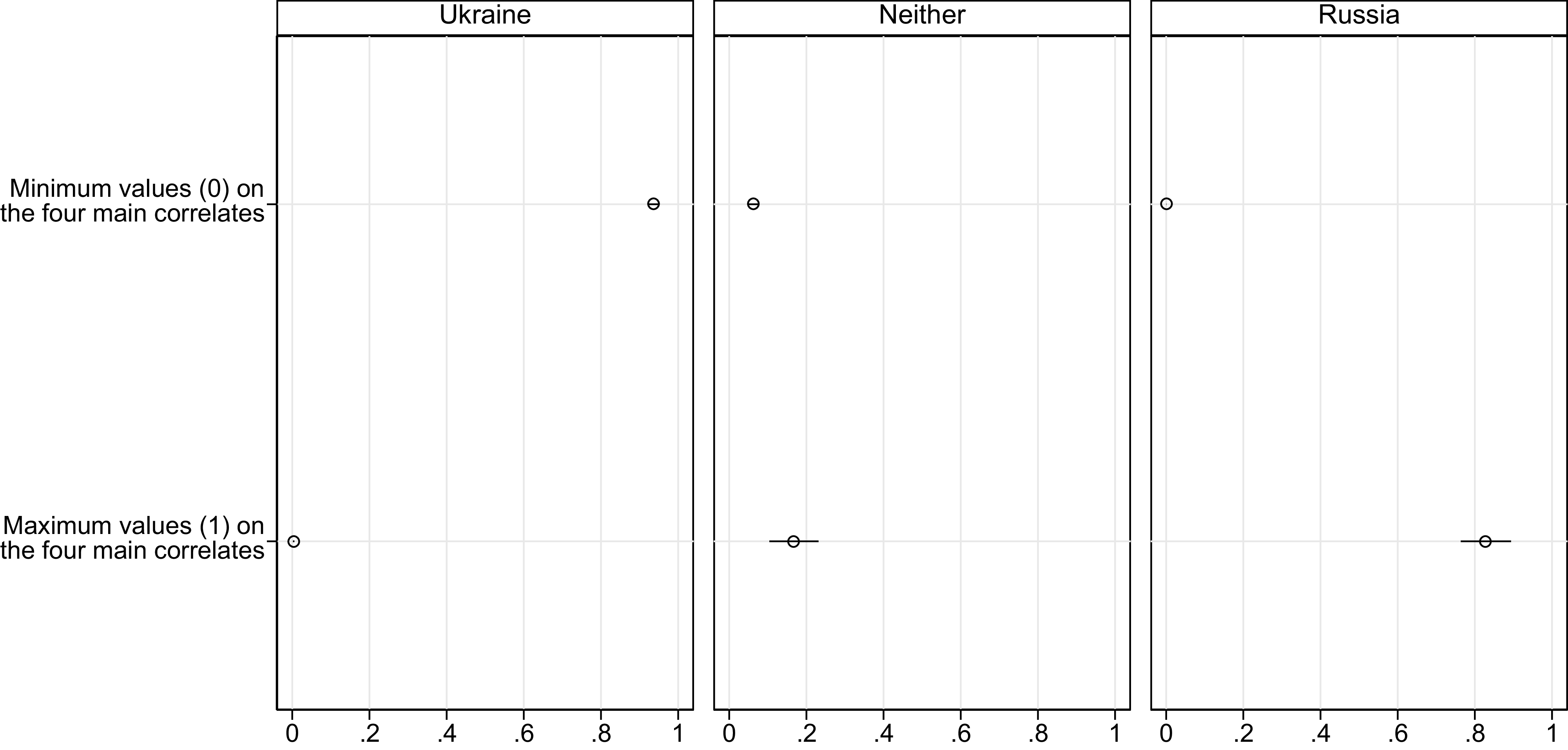
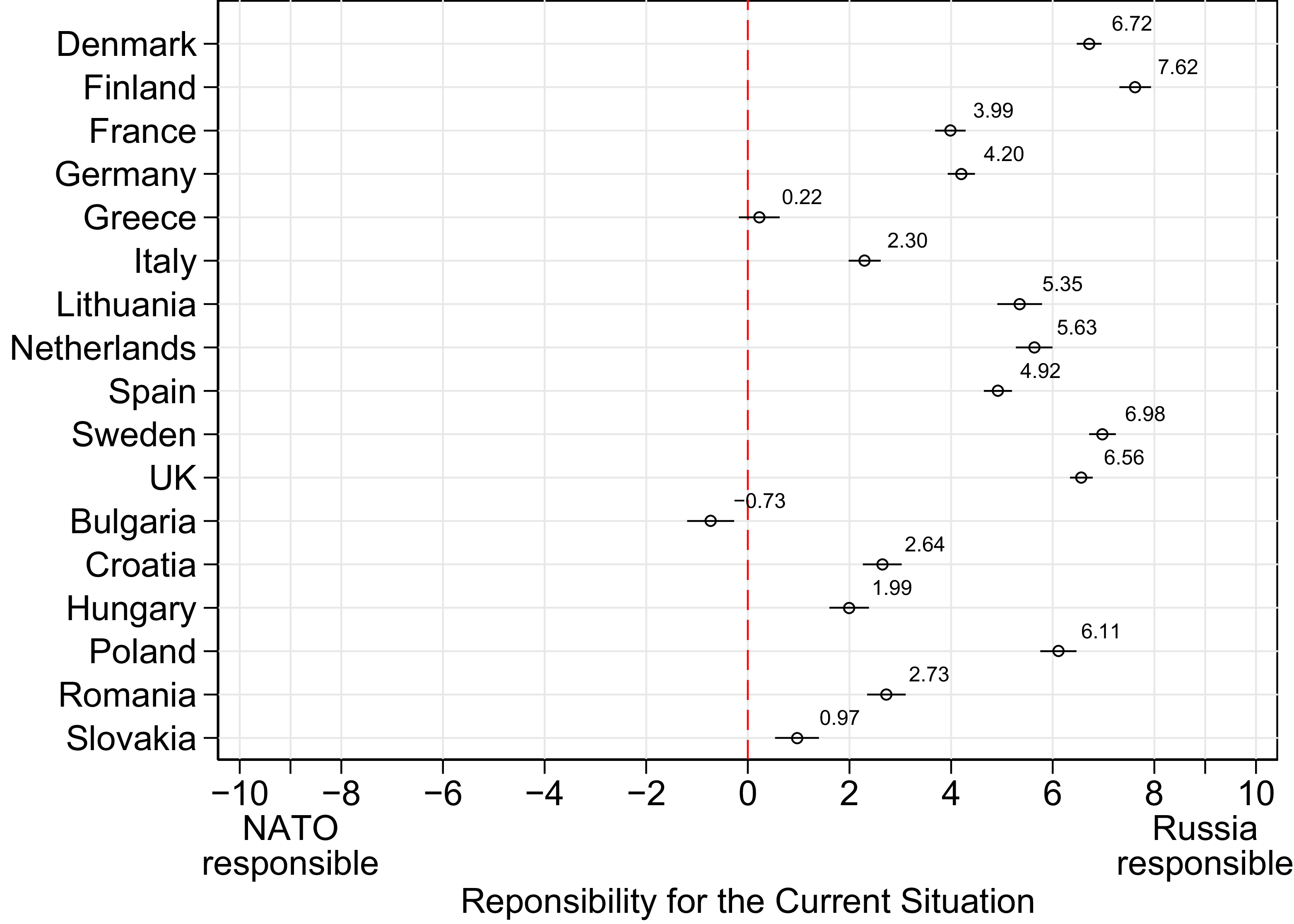
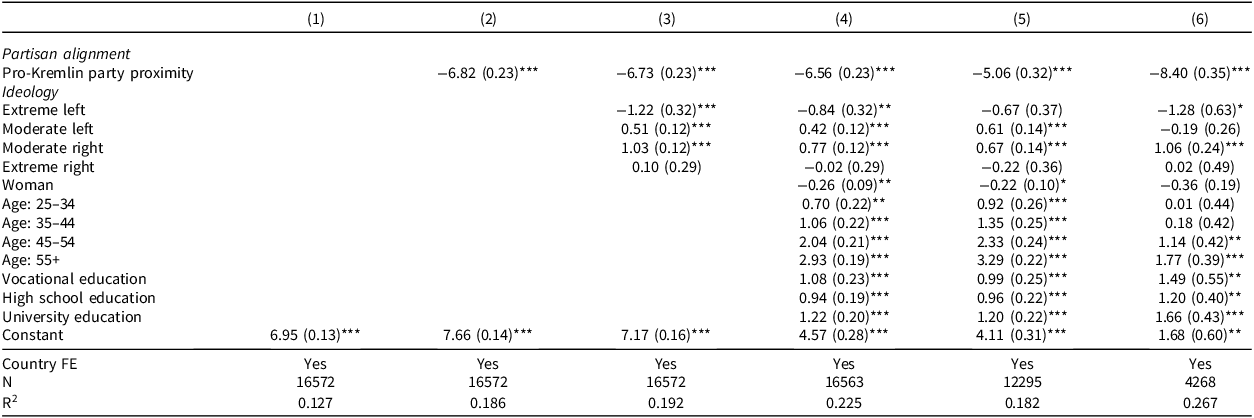


 Open access

