

Introduction
This study addresses the ongoing policy puzzle of identifying the most effective tools for enhancing municipal solid waste (MSW) recycling performance by comparing the impacts of two distinct policy instruments, authority and incentive tools, within the context of South Korea’s MSW recycling policy. Governments rely on various policy instruments to tackle complex social problems, ranging from regulatory measures (authority tools) to motivational mechanisms (incentive tools). Policy tools have drawn scholarly and practical attention for decades in that governments utilize such tools to define policy problems, explore effective means to resolve those problems, and design a proper mixture of policy tools to achieve policy goals.
Despite the long-standing interest in policy tools, a critical question remains: Which policy tools yield better outcomes in specific policy environments? This study seeks to answer this question in the context of South Korea’s MSW policy. By empirically comparing the effects of authority and incentive tools on MSW recycling performance, this study attempts to provide practical implications to public managers in utilizing their policy toolbox to enhance the MSW policy performance in the future. In addition, by considering the combination of two incentive tools, the research explores whether there is any synergetic effect when the two tools are combined.
Like other policy fields that have employed diverse policy tools, the environmental policy field has utilized various tools, including authority and incentive tools. In addressing, MSW issue, the South Korean government has sought to protect the environment by promoting the recycling of MSW and requiring citizens to buy volume-based waste fee (VWF) bags for waste that cannot be recycled. Although multiple policy tools related to MSW recycling have been deployed, existing research has rarely examined their long-term effects. To fill this gap, this study considers three tools actively deployed in South Korea’s MSW policy: one authority tool (government monitoring for illegal MSW disposal) and two incentive tools (individual monetary reward for reporting illegal MSW disposal and community recycling challenge). This research examines the effects of those three policy tools on the performance of MSW policy in the Seoul Metropolitan area of South Korea.
The remainder of the study is structured as follows. First, it introduces definitions and classifications of policy tools, and reviews the existing literature on them in the environmental policy field. It also explains the background of MSW recycling in South Korea and the currently adopted policy tools. Following the introduction of the research framework and hypotheses, it describes the data and measures and presents the results of the panel-corrected standard error (PCSE) regression. It concludes with a discussion of the analysis results and practical implications.
Literature review on policy tools
Definition of policy tools
One can find several definitions of policy tools, often called policy instruments or government instruments. Many scholars use the concept of “techniques” and “methods” in defining policy tools. For example, Bali et al. (Reference Bali, Howlett, Lewis and Ramesh2021, p. 295) provided a concise definition of policy tools: ‘the techniques of governing that help define and achieve policy goals.’ Vedung (Reference Vedung, Bemelmans-Videc and Rist1998, p. 21) defined policy instruments as ‘a set of techniques by which governmental authorities wield their power in attempting to ensure support and affect or prevent social changes.’ Salamon (Reference Salamon2002, p. 19) defined it as ‘an identifiable method through which collective action is structured to address a public problem.’ Narrowly focusing on environmental policy tools, Huppes (Reference Huppes2001, p. 8) defined environmental policy instruments as ‘structured activities aimed at changing other activities in society towards environmental goals.’ In sum, policy tools can be understood as a set of techniques that government authorities utilize to solve social problems.
Classification of policy tools
Scholars have provided several classifications of policy tools. Representatively, Hood (Reference Hood1986) used two standards in classifying policy tools: resources and principal use. It has been observed that policy tools rely on four resources: nodality, authority, treasure, and organization (Hood Reference Hood1986). Based on the principal use, the related tools under each resource can be divided into effectors and detectors. The former is designed to generate change in a policy environment, while the latter aims to detect changes in it (Hood Reference Hood1986). For example, under authority tools, licenses such as regulation and certification work as effectors, whereas census taking works as a detector. Broadening Hood’s (Reference Hood1986) classification, Bali et al. (Reference Bali, Howlett, Lewis and Ramesh2021) added another dimension to the discussion of policy tools. They diagnosed that most studies on policy tools focus on ‘substantive’ tools that affect the nature of the goods and services; instead, they focused on the ‘procedural’ policy tools that are used to affect policy-making behaviors (Bali et al. Reference Bali, Howlett, Lewis and Ramesh2021). Defined as ‘those policy techniques or mechanisms designed to affect how a policy is formulated and implemented” (Bali et al. Reference Bali, Howlett, Lewis and Ramesh2021, p. 298), procedural tools influence the legitimacy and functionality of substantive tools. However, examining procedural tools is beyond the scope of this research as it focuses on substantive tools in the environmental field.
Salamon (Reference Salamon2002) introduced a comprehensive list of policy instruments in his book, including direct government, social regulation, economic regulation, contracting, concession, direct loan, loan guarantee, public insurance, tax expenditure, fees and charges, legal obligations, government corporations, vouchers or bonuses, and public information. On the other hand, Vedung (Reference Vedung, Bemelmans-Videc and Rist1998) suggested a concise classification comprising three types of policy tools: regulation (stick), economic means (carrot), and information (sermon). Regulation is based on the command-and-control mechanism, where rules and laws are heavily used to control behaviors of individuals and organizations. Economic means include diverse types of taxes and subsidies that can affect costs and benefits of economic actors. Finally, providing proper information also helps achieving policy goals. Public education is a representative example (Vedung Reference Vedung, Bemelmans-Videc and Rist1998).
Besides these classifications, Schneider and Ingrams’ (Reference Schneider and Ingram1990) typology is also relevant for considering major substantive policy tools employed in the environmental field. The five policy tools include authority, incentive, capacity, symbolic and hortatory, and learning tools—focusing on manipulable factors affecting citizens’ decisions and actions (Schneider and Ingram Reference Schneider and Ingram1990). Authority tools are typical policy tools where the government acts directly to achieve the policy goals, whether it relies on regulation or permission (Schneider and Ingram Reference Schneider and Ingram1990). Incentive tools provide payoffs to facilitate policy compliance. Assuming individuals to be utility maximizers, various tangible rewards are provided for successful policy implementation (Schneider and Ingram Reference Schneider and Ingram1990). Capacity tools focus on information provision, training, and education to help citizens make correct decisions and take action to achieve policy goals. In contrast, symbolic and hortatory tools mainly deal with beliefs and values based on the assumption that citizens show compliant behaviors desired by a policy when those behaviors are consistent with their beliefs (Schneider and Ingram Reference Schneider and Ingram1990). Finally, learning tools are employed when the policy solution is uncertain. They commonly provide much discretion to lower-level bureaucrats or policy recipients so they can learn through experience from various trials and errors (Schneider and Ingram Reference Schneider and Ingram1990).
Policy tools in environmental policy field
Most policy tools adopted in environmental policy can be placed under the abovementioned classifications. Most studies in the environmental field use Schneider and Ingram’s (Reference Schneider and Ingram1990) concise classification of policy tools based on authority and incentive. For example, focusing on environmental regulations, Ren et al. (Reference Ren, Li, Yuan, Li and Chen2018) classify formal regulations into three policy tools: command-and-control type of environmental regulation, market-based incentive type of environmental regulation, and voluntary environmental regulation. Related laws, rules, and regulations in the environmental field are examples of command-and-control regulations, while pollution charges and emission trading represent market-based incentives (Shen et al. Reference Shen, Li, Wang and Lioa2020). Voluntary environmental regulations include diverse agreements and commitments (Shen et al. Reference Shen, Li, Wang and Lioa2020).
Evaluating the effect of policy instruments on innovation, Bergek et al. (Reference Bergek and Berggren2014) considered two dimensions: whether the instrument is economic or regulatory and whether the instrument is general or technology-specific. Based on a 2 × 2 matrix, they reviewed the effects of four types of policy instruments and found that there is no one best instrument; that is, different types of instruments promoted different types of innovation (Bergek et al. Reference Bergek and Berggren2014). Similarly, focusing on green technology innovation in China, Yi et al. (Reference Yi, Fang, Wen, Guang and Zhang2019) explored the heterogeneous effects of different policy instruments. They classified environmental policy instruments into three types: command-and-control, market-incentive, and social-will. The basic mechanism of command-and-control instruments is the regulation by which governments use their compulsory means to achieve the optimal level of environmental conditions (Yi et al. Reference Yi, Fang, Wen, Guang and Zhang2019). Market-incentive instruments rely on diverse incentives such as taxes and fees, emission trading, and so on, while social-will instruments seek to achieve environmental goals by increasing public pressures, where news media and reports play significant roles (Yi et al. Reference Yi, Fang, Wen, Guang and Zhang2019).
These studies show that authority and incentive tools are the most commonly adopted policy tools in the environmental policy field. The command-and-control and market-based incentive types of regulations match well with Schneider and Ingram’s (Reference Schneider and Ingram1990) authority and incentive tools, respectively.
Policy tools in MSW management
In the field of contemporary MSW management, the policy has focused on meeting sustainable development goals such as efficient waste collection, source segregation of waste, recycling and re-use, circular economy, and public education (Sondh et al. Reference Sondh, Upadhyay, Patel and Patel2022). One can expect that when these goals are met, the amount of generated waste and the rate of recycling will improve. To fulfill these policy goals, governments often adopt a waste management framework for policy implementation. For example, the European Commission (EC) (EC 2024) adopted the waste hierarchy five-step approach, including waste disposal, recovery, recycling, preparing for re-use, and prevention of waste. The OECD presents regulatory, economic, extended producer responsibility, green public purchasing, public information and awareness raising, monitoring and reporting, and enforcement and compliance promotion as policy instruments for waste and materials management (OECD 2019).
Extant literature on MSW recycling policies can be categorized into policies providing financial incentives to improve recycling and those focusing on non-financial factors that can affect MSW recycling (Park Reference Park2018a). The financial stream focuses on how to financially motivate households to recycle more, usually by using policies such as unit pricing and weight-based pricing. The non-financial stream studies examined the effects of elements such as MSW recycling policies (e.g. curbside for convenient recycling), public education or campaign, and demographic factors (e.g. education level, income) on recycling. From Park’s (Reference Park2018a) perspective, the market-based incentive policy fits well with Schneider and Ingram’s (Reference Schneider and Ingram1990) incentive tool. Moreover, as most MSW policies can be considered regulations on waste disposal and recycling that the citizens are obligated to follow, Schneider and Ingram’s (Reference Schneider and Ingram1990) authoritarian tool can be identified in MSW recycling policies. The current study, focusing on South Korean MSW management, examines the effects of these authority and incentive tools.
MSW recycling in South Korea and adopted policy tools
The MSW recycling policies in South Korea were subject to the Waste Control Act (WCA) of 1986. The VWF system was adopted in 1995 in all jurisdictions in South Korea to reduce waste and promote recycling (Ministry of Environment, South Korea [MOE] 2011). According to Article 4 of the WCA, local governments are responsible for treating waste, promoting environmental protection, and reducing waste within their region (Korea Law Translation Center 2021). Article 4 also states that the central government must provide technical and financial assistance to support local governments in managing waste. In summary, in South Korea, local governments play a significant role in managing MSW problems.
Under the current VWF system, citizens can dispose of MSW in two ways: 1) citizens may purchase local government-issued VWF plastic bags and dispose of waste in designated areas for collection, 2) for recyclables, citizens are required to separate them from waste in place those in receptacles in residential areas (MOE 2011). Thus, in South Korea, citizens can either dispose of waste in government-issued VWF plastic bags that they purchase from designated stores (e.g. supermarkets and convenience stores) or leave recyclables to be collected by the government at no cost.
Article 8 section 1 of the WCA states that no one shall dispose of waste in any area other than the designated places or facilities for the collection of waste by the local government, and it also provides legal ground for administrative fines for illegal dumping in Article 68 section 3 (Korea Law Translation Center 2021). Because Article 68, section 4 states that each jurisdiction should impose and collect these fines, each local government monitors the illegal dumping of waste and imposes fines upon the violation of Article 68. Moreover, to stimulate the effect of VWF, the South Korean government has adopted a citizen-report monetary reward system for illegal dumping since 2000 (Kim and Chang Reference Kim and Chang2006). Local governments implementing the system provide cash incentives to citizens who report incidents of illegal waste dumping.
While reducing illegal waste dumping is based on regulatory compliance and citizen participation, positive incentives also exist for increasing recycling and waste reduction. Local governments that adopt these incentive policies foster a competitive environment for waste recycling, offering rewards to communities that excel in the competition (MOE 2021). Community members are offered prize-based rewards (e.g. monetary rewards, award certificates, etc.) as incentives when their community wins recycling challenges, encouraging them to reduce waste and increase recycling efforts.
As illustrated above, the South Korean government employed three main policy tools—government monitoring (authority tool), monetary reward for reporting illegal MSW disposal (incentive tool), and community recycling challenge (incentive tool)—to improve MSW management performance. First, government monitoring is a typical authority tool in that it is the government’s direct intervention in the implementation process. In the context of waste disposal and recycling behaviors, both personal factors (e.g. individual norms and attitudes) and social factors (e.g. punishment measures and supervision methods) affect the decision-making for illegal dumping (Du et al. Reference Du, Xu and Zuo2021). By increasing the likelihood of detection, local governments’ monitoring activities for illegal dumping influence citizens’ perceptions and behaviors.
The other two policy tools serve as incentives, promoting municipal solid waste (MSW) reduction and recycling through the provision of tangible or intangible benefits. The citizen reporting mechanism for illegal dumping operates solely on monetary rewards, whereas the regional competition policy combines both monetary and non-monetary incentives. Both the reward policy and the community recycling challenge exemplify external reward systems (e.g. monetary incentives) to encourage desired behaviors among citizens. Some studies argue that monetary rewards are prerequisites for improving MSW recycling (e.g. Abila and Kantola Reference Abila and Kantola2019). Regarding the former, the report policy for illegal dumping provides both positive and negative incentives in that citizens who report illegal dumping will receive monetary rewards, whereas those who illegally dump waste will pay a fine. The community recycling challenge policy provides opportunities to reduce the amount of MSW or increase MSW recycling to receive rewards (e.g. monetary rewards and award certificates). Because the rewards are directed to communities rather than individuals, the effect might be less than that of individual-based policies such as the report policy. However, this research assumes that community-level rewards will still work as incentives for residents by raising their pride and reputation. Although not many studies exist, existing findings demonstrate the positive effect of the regional incentive policy. For example, Shaw and Maynard (Reference Shaw and Maynard2008, p. 1738), in their survey of London Borough of Havering residents, found that approximately 76% of the survey sample responded that community cash awards can help persuade households to enhance recycling. Community environments, such as a harmonious atmosphere with a sense of belonging, can encourage citizens to protect their environment through waste sorting and recycling (Yang et al. Reference Yang, Jiang, Zheng, Zhou and Liu2022). Moreover, community pressure, neighbor pressure, and social norms can motivate individual recycling (Iyer and Kashyap Reference Iyer and Kashyap2007). For these reasons, citizens are expected to react to the community-level incentives and improve MSW disposal and recycling.
Research framework and hypotheses
Research framework
Figure 1 shows the framework of this study. The framework considers three policy tools mainly adopted in the MSW policy field in South Korea. Including one authority tool and two incentive tools, this research tests which policy tool is more useful to enhance MSW policy performance. Besides the main independent variables, the research also considers the civil report for illegal dumping, the waste cleaning budget independence ratio, and the population of each local territory as control variables in that those variables may affect the performance of MSW policy.
Research framework. Note 1: All independent variables were one-year lagged to assure time precedence in the analysis.
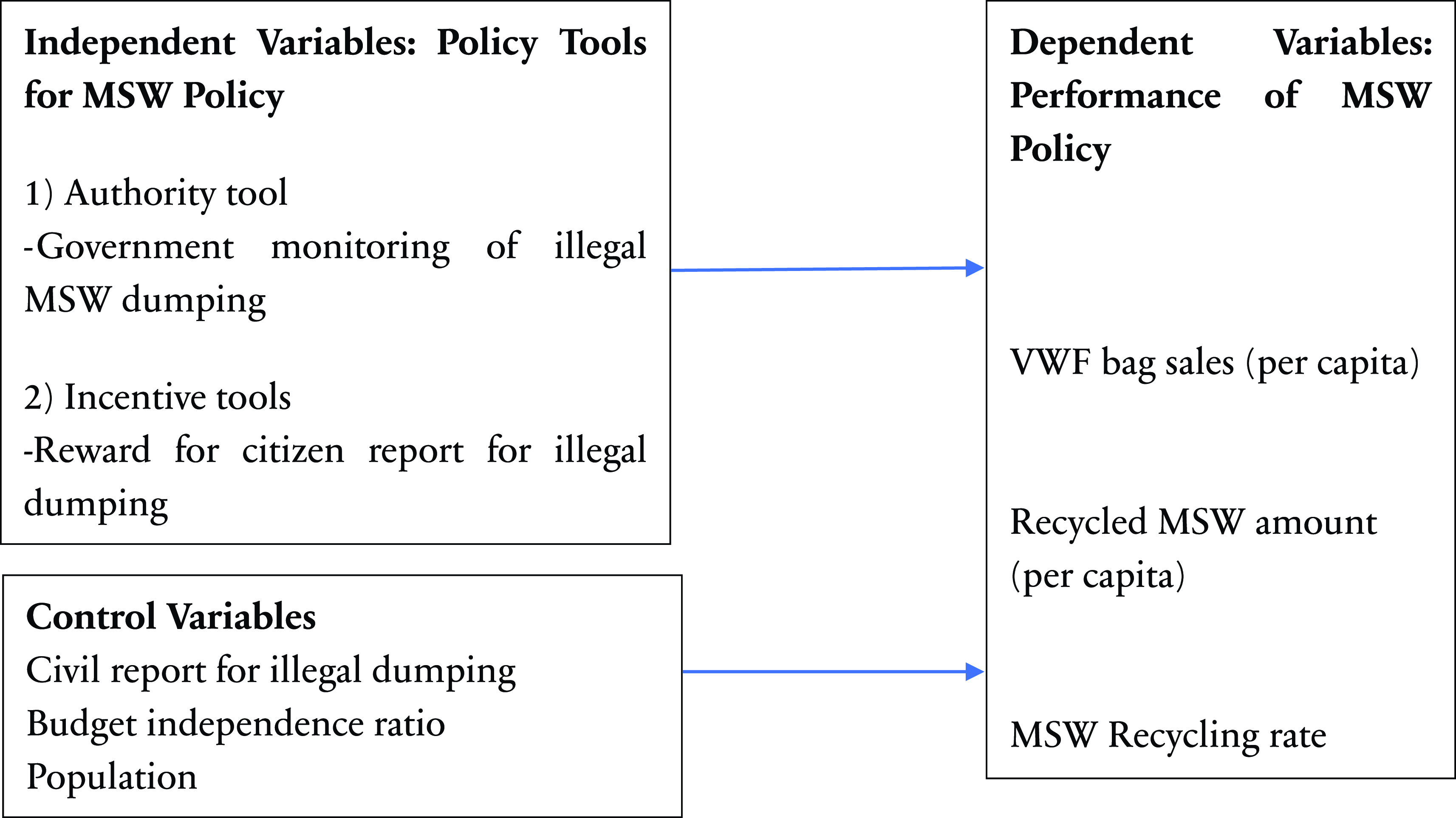
Regarding dependent variables, this research considers the three variables, including VWF bag sales revenue (per capita), amount of recycled MSW, and recycling rate, which reflect the performance of the MSW policy. While the three dependent variables are closely associated with each other, they also show differentiated performance aspects. The VWF bag sales revenue represents the MSW policy performance concerning the waste disposal behavior of citizens. The amount of VWF bag sales revenue implies contrasting results. For instance, an increase in VWF bag sales might reflect the success of the MSW policy, as the purchase of these bags tends to rise when potential illegal dumpers properly manage their waste due to government monitoring or citizen reporting, thereby reducing illegal dumping. Conversely, a decline in VWF bag sales could also indicate the policy’s effectiveness, as successful community recycling challenges encourage citizens to reduce and recycle waste more efficiently. Accordingly, it is reasonable to expect varying effects of different policy tools on VWF bag sales. In sum, to capture the differentiated effects of policy tools on diverse aspects of MSW policy performance, this research considers the three dependent variables.
In measuring recycling performance, the recycling rate, calculated by dividing the total waste collected for recycling by the total waste generated, is the most common indicator (Hotta et al. Reference Hotta, Visvanathan and Kojima2016). In addition to this well-established indicator, the current study considers the recycling amount as a recycling performance indicator. This is because government monitoring and detecting illegal dumping may not necessarily increase the recycling rate. From an economic perspective, while citizens may illegally dump MSW to save the cost of purchasing VWF bags (Park Reference Park2018b), with the government’s monitoring of illegal dumping, citizens may either choose to purchase VWF bags or place the recyclables in designated curbsides rather than illegally dumping them. Consequently, illegal dumping behaviors and buying VWF bags or recycling have a contradictory relationship because the reduction in the citizens’ illegal waste dumping will lead to an increase in legal waste dumping using VWF bags or waste recycling. If citizens dispose of more waste using VWF bags rather than recycling, the recycling rate may decrease due to increased total waste. However, citizens may simultaneously increase recycling by placing recyclables on designated curbsides rather than illegally dumping them with the risk of being penalized. Therefore, to explore those dynamic relationships, the current study seeks to examine the impact of the three policy tools on both the recycling rate and the recycling amount.
Hypotheses
The literature review indicates that authority and incentive tools have been widely adopted in the environmental policy field, and MSW policy in South Korea also heavily relies on those tools. Accordingly, this study examines the effects of one authority tool (government monitoring for illegal dumping) and two incentive tools (monetary reward for reporting illegal dumping and community recycling challenge) used in the Korean MSW policy. Regarding the authority tool, one can assume its positive contribution to MSW policy performance. Extant studies have confirmed that regulatory measures such as law enforcement, punitive policies, and surveillance are effective in preventing illegal dumping (Baird et al. Reference Baird, Curry and Cruz2014; Goulder and Parry Reference Goulder and Parry2008). By increasing the probability of detection and punishment, local government’s monitoring of illegal MSW dumping is expected to foster citizen compliance and prevent illegal waste dumping. Regarding the first dependent variable, the sales of VWF bags, the government monitoring will increase the VWF bag sales by citizens because purchasing VWF bags is the only alternative to the illegal dumping of non-recyclable MSW. Accordingly, we set the following hypothesis.
H1-1: Government monitoring of illegal waste dumping will lead to an increase in VWF bag sales.
Providing incentives is another tool widely employed in the environmental policy field. One can observe attempts by many countries to incentivize citizens to recycle more by providing incentive schemes such as blockchain tokens or contracts for recycling (Spain, Norway, Canada) and discounts from local and national businesses for recycling (the USA) (see, Gibovic and Bikfalvi Reference Gibovic and Bikfalvi2021 for extensive review). The assumption behind these recycling incentive programs is that citizens participate in the policy process to earn rewards. In the case of citizens reporting illegal dumping, potential observers will report illegal dumping in that they will earn monetary rewards. Illegal dumpers will decrease the likelihood of dumping by perceiving the risk of being reported. Likewise, the regional competition is expected to contribute to MSW policy performance by providing benefits to citizens whether the rewards are tangible or intangible.
For the citizen report policy for illegal dumping, as jurisdictions reward citizens who report illegal MSW dumping while charging fines to people who illegally dump waste, the monetary incentive will increase VWF bag sales by reducing illegal dumping. The effect of community recycling challenge policy might be complicated. The policy often requires reducing the absolute amounts of waste while also advertising recycling and VWF bag usage. When focusing on reducing the absolute amounts of waste, the policy may decrease the VWF plastic bag sales. On the other hand, if the competition emphasizes VWF bag usage more, it may increase VWF bag sales. Despite the competitive relationships, this research hypothesizes the positive relationship between the policy and the VWF bag sales by assuming that the reduction of the absolute amounts of waste is limited. The following hypotheses reflect the above discussion
H1-2: The citizen reporting policy for illegal dumping will lead to an increase in VWF bag sales.
H1-3: The community recycling challenge policy will lead to an increase in VWF bag sales.
Another indicator of MSW policy performance is the amount of recycling. The authority tool, government monitoring for illegal dumping, will contribute to increasing the amount by disincentivizing citizens from illegal dumping. Besides dumping waste using VWF bags, one should recycle MSW for legal disposal. Thus, as the intensity of monitoring increases, the recycled amount of MSW will increase. One can expect similar effects for incentive tools on the amount of recycled MSW. The availability of a citizen report policy for illegal dumping will affect illegal dumpers to recycle MSW as the probability of being reported increases. Likewise, the community recycling challenge policy will motivate citizens to recycle more MSW to win the competition. Thus, the following hypothesis is proposed. As the first set of hypotheses (H1-1, H1-2, H1-3) has been explained in detail and shares the same independent variables as the second set (H2-1, H2-2, H2-3), we present a summarized version of the second set of hypotheses.
H2: Government monitoring, citizen reporting, and community recycling challenge policies will lead to an increase in the amount of recycled MSW.
The final indicator of MSW policy performance is the recycling rate. For the authority tool, government monitoring will prevent citizens from illegally dumping MSW waste, some of which will be recycled. Subsequently, the recycling rate increases accordingly. However, a complication may exist because part of the prevented illegal dumping will be transferred to legal dumping using VWF bags. If more volumes of prevented illegal dumping are transferred to legal dumping rather than recycling, the recycling rate might decrease. Nevertheless, recycling is better for citizens who intend to maximize their self-interest by reducing the cost of purchasing VWF. Thus, we hypothesized that a higher level of government monitoring would increase recycling rates. Regarding incentive policy tools, both tools, including citizens’ reports and community recycling challenges, may contribute to increasing the recycling rate. The expected effect of citizens’ reports policy is similar to one of government monitoring. Although the policy tool might have two distinctive effects, facilitating recycling and increasing legal dumping by using VWF bags, the research assumes the incentive for recycling is larger when considering the costs. Regarding the community recycling challenge policy, it may contribute to enhancing the recycling rate. Accordingly, we hypothesize the following relationship. As the first set of hypotheses (H1-1, H1-2, H1-3) has been explained in detail and shares the same independent variables as the third set, we present a summarized version of the hypothesis as follows.
H3: Government monitoring, citizen reporting, and community recycling challenge policies will lead to an increase in the MSW recycling rate.
Methods
Data and analytic method
The time-series cross-sectional (TSCS) data of this study were extracted from the Ministry of Environment (MOE) official website archives (MOE 2021). The MOE releases annual MSW and VWF system-related data from the local governments in South Korea. All data and measures in the current study were extracted from MOE’s MSW and VWF annual reports. The target regions for analysis were 25 local governments (gus) under the jurisdiction of the Seoul Metropolitan City Government. Using the most recently available data, the period for analysis in the current study was from 2006 to 2019. Although data for 2020 are available, because of social distancing during the COVID-19 peak period, many restaurants were closed, so people used delivery food services and online shopping, resulting in more packaging waste (Hantoko et al. Reference Hantoko, Li, Pariatamby, Yoshikawa, Horttanainen and Yan2021). Moreover, massive amounts of medical waste from households (e.g. masks) have been observed. For this reason, waste disposal and recycling outputs and citizen behaviors during the COVID-19 peak period may differ from the past without COVID-19. Thus, this study used MSW data up to 2019. The raw TSCS data had no missing values and were balanced. To correct for serial correlation in the TSCS data, the dependent variables of the current study were lagged by one year.
This study used regression with the panel-corrected standard error (PCSE) for empirical analysis. As the ordinary least squares (OLS) regression assumes homoscedasticity and no autocorrelation in the error term, it is not fit for analyzing TSCS data (Beck and Katz Reference Beck and Katz1995). The PCSE regression is a widely used method to correct possible contemporaneous correlations across units and unit-level heteroskedastisty in TSCS data, which cannot be corrected by implementing OLS regression (Bailey and Katz Reference Bailey and Katz2011). The PCSE regression has been applied in political economy and environmental sciences to analyze TSCS in the following cases: (1) the data is composed of fixed political units during the period of analysis, and (2) the period is less than the number of political units (Beck Reference Beck2001; Beck and Katz Reference Beck and Katz2011; Marques and Fuinhas Reference Marques and Fuinhas2012; Park Reference Park2018a; Park and Hong Reference Park and Hong2021). The TSCS data of the current study fits such conditions because the unit of local government (gu) is a fixed political unit of jurisdiction, and the study period (T = 14) is smaller than the number of political units (N = 25). While extant studies commonly use the feasible generalized least squares (FGLS) regression to analyze TSCS data, to produce consistently accurate confidence intervals by the method, the number of periods should be greater than the number of cross-sectional units, and the data of the current study do not meet this condition (Beck and Katz Reference Beck and Katz1995; Park Reference Park2018a; Reed and Ye Reference Reed and Ye2011).
In addition, the Breusch-Pagan test of independence accounts for the possibility of correlation of error terms among the three models by indicating unequal variances of the error terms. In the current study, the Breusch-Pagan test of independence for the three models (hypotheses for the three dependent variables) presented the possibility of non-constant residual variance. Therefore, following Martin and Smith’s (Reference Martin and Smith2005) recommendation, seemingly unrelated regression (SUR) was conducted to estimate the three models.
Measures
The independent variables in this study are three primary policy tools employed in MSW policy in South Korea, including government monitoring of illegal MSW disposal, reward policy, and recycling challenge policy. The dependent variables, the VWF bag sales, the recycled MSW amount, and the recycling rate, reflect the performances of MSW policy. Specific measurements of each variable are as follows.
VWF bag sales (per capita)
VWF bag sales per capita were calculated by dividing the total VWF bag sales revenue per year by the population. Thus, this variable measured the amount of individual spending on purchasing VWF plastic bags each year. It is assumed that the increase in VWF purchasing amount indicates the increase in legal waste dumping.
Recycled MSW amount (per capita)
The recycled MSW amount per capita was calculated by dividing the total recycled MSW amount per year by the population. In other words, the variable measured the amount of annual MSW recycling per individual. The increase of the variable signifies the increase in recycling performance of a region in the sense that more waste has been recycled at the individual level.
Recycling rate
The recycling rate was calculated by dividing the total amount of recycled MSW by the total amount of MSW generated. The variable measured the annual recycling rate of a jurisdiction (gu). The increase of the variable denotes the increase in recycling performance in the sense that citizens choose to recycle more rather than dispose of waste.
Government monitoring of illegal MSW disposal (per square kilometer)
Regarding the government monitoring measure, the central government reports the total number of illegal MSW dumping yearly at the local government level. To standardize the scale, the total number was divided by the area (per square kilometer of each jurisdiction).
Monetary reward and recycling challenge policy implementation
The availability of cash incentives for citizens’ reporting illegal MSW disposal differs by jurisdiction. In a jurisdiction with such a system, if citizens report illegal dumping of MSW to the government and if those reports are validated, the government provides a financial reward to the reporter. Each jurisdiction (gu) announces the existence of such a reward system each year in the MOE’s VWF data. To measure the existence of the reward policy for reporting illegal dumping in each region, the variable was coded as dichotomous (1 = yes, 0 = no). Having a reward policy indicated that the region implemented the reward policy only for a given year.
Various local community challenge opportunities, such as those focused on reducing waste and increasing recycling, are available based on the discretion of each local government. For example, a local government may host a contest (challenge) for communities to reduce food waste or increase recycling, rewarding the best-performing community with prize-based awards. Each jurisdiction (gu) announces the existence of such a recycling challenge policy in the MOE’s VWF data. To measure the presence of recycling challenges in each region, the variable was coded as dichotomous (1 = yes, 0 = no). A value of 1 indicated that the region implemented a recycling challenge policy for the specified year only. Another variable was created (1 = yes, 0 = no) to reflect the cases where both reward and recycling challenge policies were employed. Therefore, in the current study, the reference group of the dummy variables includes regions that are not implementing either of these policies.
Control variables
This study used civil reporting for illegal waste dumping, waste cleaning budget independence ratio, and population as control variables. Civil reporting of illegal waste dumping exhibits the total number of citizens’ voluntary reports to the authorities (e.g. local governments) regarding illegal dumping. This variable acts as a proxy for civic interest in the environment. The waste cleaning budget independence ratio was calculated by the division of the total revenue of waste management, including collection fees and fines, by the total expenditure in each local government (gu) (Park Reference Park2018a). The MOE announces the independence ratio of the waste cleaning budget every year.
Results
Descriptive statistics
The descriptive statistics for the variables are presented in Table 1. The mean value of VWF bag sales is 10.48, meaning that each individual spends about 10 USA dollars per year. The mean value of recycled MSW amount is 259 kg for each individual per year. The number of government monitoring of illegal disposal has a large variation, ranging from 0.23 to 2206, and the average is 303.85 per square kilometer per year. On average, about 21 percent of the sample had both a reward policy and a recycling challenge policy, while 29 percent conducted a reward policy only, and 9 percent implemented a recycling challenge policy only. Table 2 presents the results of the correlational analysis of the variables. The correlation coefficients revealed that none of the coefficients of the variables was sufficiently high to cause multicollinearity. The only correlation coefficient high enough to cause multicollinearity was the relationship between VWF bag sales and recycled MSW amount (=.814), but these two are dependent variables. As expected, government monitoring of illegal disposal was positively associated with VWF bag sales and recycled MSW. However, it was negatively associated with the recycling rate. To further test for the possibility of multicollinearity, the variance inflation factor (VIF) test was conducted using pooled-regression analysis for each model. In all three models, VIF was 1.16, indicating no serious problem of multicollinearity.
Descriptive statistics of variables
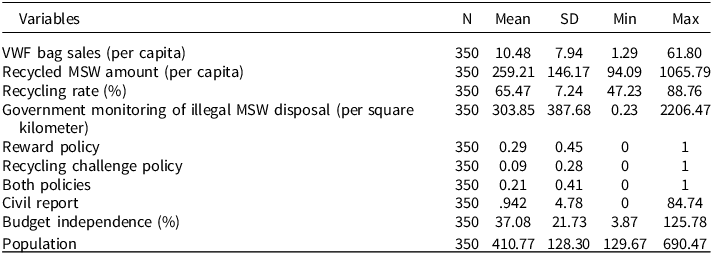
Note: VWF bag sales per capita (by USD using KRW/USD exchange rate as of April 4, 2022), Recycled MSW amount per capita (kg per year), civil report (thousand), population (thousand).
Zero-order correlations between variables
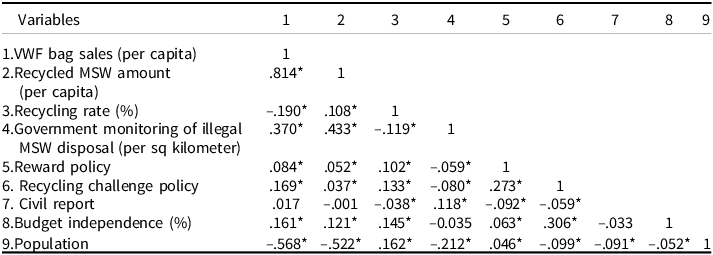
Note: * p < .05.
Regression analysis
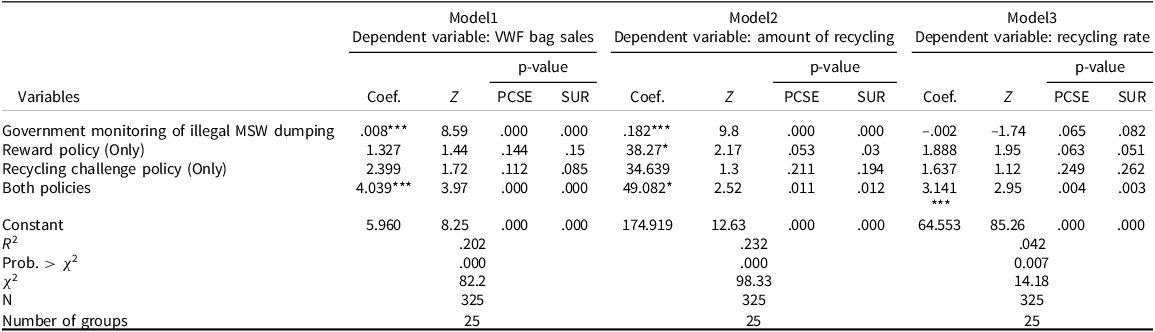
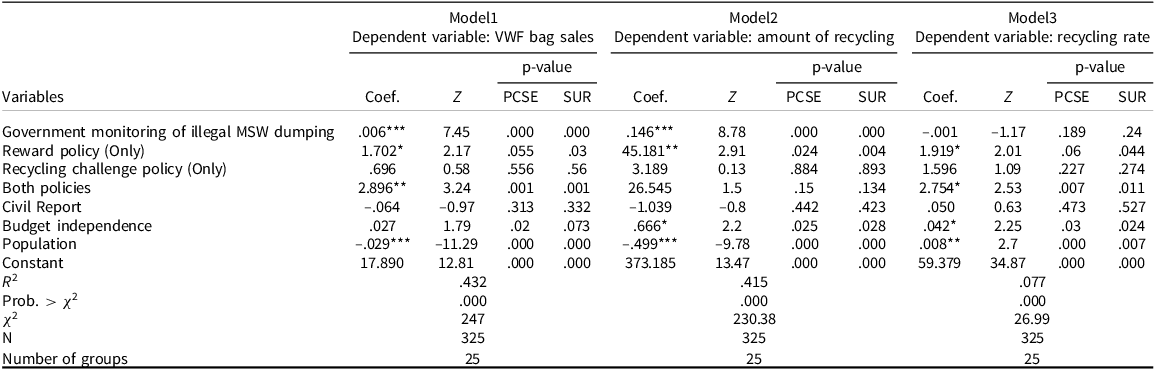
After conducting PCSE, seemingly unrelated regression (SUR) was executed as well to address the correlations of error terms. The coefficients were identical for the two different regressions. The current study used the results of SUR to explain the significance of variables. Tables 3 and 4 present the estimates from the PCSE regression analysis for the three dependent variables. Table 3 shows the result of the analysis with only the independent variables. Table 4 shows the results of all variables included in the models. In the analysis of two approaches, one including only the independent variables and another incorporating all independent and control variables, only one hypothesis (H1-2) demonstrated a significant difference. Therefore, for comprehensiveness and to better account for potential factors, the current study presents and interprets the results from Table 4, including all variables.
Estimates obtained by OLS with SUR without control variables
Note: * p < .05, ** p < .01, *** p < .001.
Estimates obtained by OLS with SUR
Note: * p < .05, ** p < .01, *** p < .001.
From Table 4, model 1 used the estimates of VWF bag sales per capita as the dependent variable. The R-squared value was .432, indicating that Model 1 explained 43.2% of the variance in VWF bag sales per capita. In Model 1, the government’s monitoring of illegal MSW disposal variable was statistically significant (p < .001) with a positive coefficient, exhibiting that a one-unit increase in government monitoring results in an increase of approximately 0.006 USD for VWF bag sales revenue. Second, the monetary reward for reporting illegal dumping policy showed a statistically significant relationship (p < .05) with VWF bag sales. This result implies that jurisdictions with a reward system for reporting illegal MSW dumping led to 1.702 USD higher VWF bag sales revenue per capita than jurisdictions with no incentive policy. This amount is equivalent to approximately 4.15 20-liter VWF plastic bags (41 cents each) sold in Seoul Metropolitan City in 2019. Third, the recycling challenge policy did not significantly impact VWF bag sales. Fourth, when both incentive tools were adopted, it significantly impacted (p < .01) VWF bag sales, implying that both policies resulted in 2.896 USD higher VWF bag sales compared to regions with no policy. Finally, among the control variables, only the population was significant, indicating that more populated jurisdictions showed lower VWF bag sales per capita.
Model 2 uses the estimated amount of recycled MSW per capita as the dependent variable. The R-squared value was .415, indicating that Model 2 explained 41.5% of the variance. First, the government’s monitoring of illegal MSW disposal variable was statistically significant (p < .001) with a positive coefficient, exhibiting that a one-unit increase in government monitoring per square kilometer increased the recycled MSW amount by 0.146 kg per year. Second, regions with a reward policy for reporting illegal dumping experienced an increase in the recycled MSW amount by 45.2 kg per year (p < .01)more than the regions with no incentive policies. Third, the existence of a recycling challenge policy and both policies had no impact on the amount of recycled MSW when compared with the regions with no incentive policies. Finally, budget independence and population were statistically significant, indicating that jurisdictions with higher waste cleaning budget independence and less population tend to recycle more MSW.
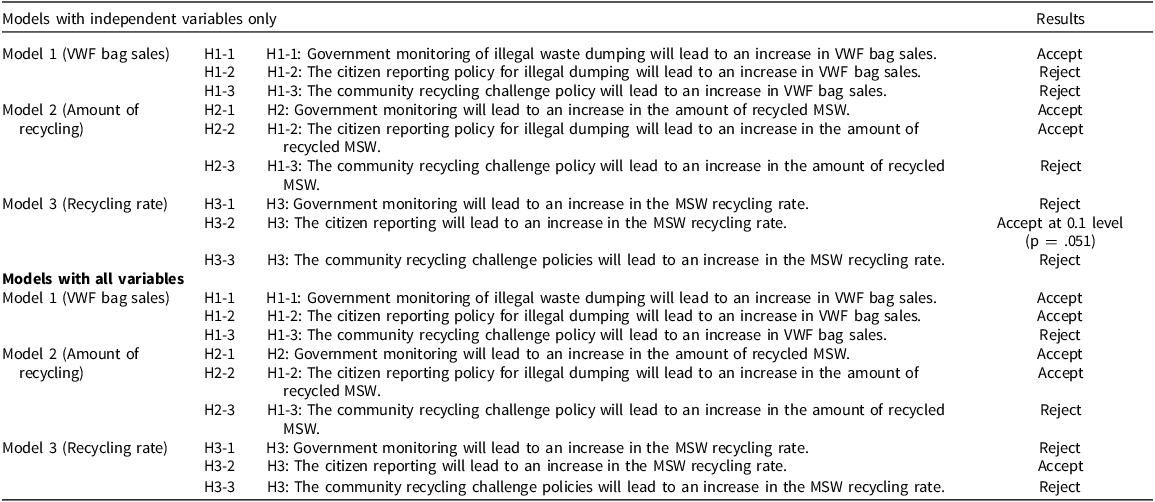
Model 3 estimates the recycling rate as the dependent variable. The R-squared value is .077, indicating that Model 3 explains 7.7% of the variance. First, contrary to the expectations of the current study, government monitoring of illegal MSW did not impact the recycling rate. Models 1 and 2 show that government monitoring positively affects both VWF sales and recycling amount. Thus, while monitoring increases both the legal dumping and recycling amount, it does not lead to a higher recycling percentage. One possibility is that, as government monitoring is conducted, the amount of MSW legally disposed of and the amount of MSW recycled might be similar, so the recycling rate is not much affected. Second, jurisdictions with a reward policy for reporting illegal dumping of MSW had a higher recycling rate (p < .05), that is, 1.92% more than jurisdictions with no incentive policies. Third, the recycling challenge policy had no statistically significant impact on the recycling rate. Fourth, jurisdictions with both policies significantly impacted the recycling rate (p < .05), that is, 2.75% higher recycling rate compared to regions with no incentive policies. Finally, the budget independence ratio and population were positively related to the recycling rate. Table 5 summarizes the results of the hypothesis testing from two approaches, one with independent variables only and the other with all variables.
Results of hypothesis testing
Discussion
The regression analysis demonstrated the effects of authority and incentive tools on the MSW policy performance in the South Korean context. First, it shows that the authority tool still works in the field of MSW policy. Government monitoring of illegal dumping increased VWF bag sales by facilitating citizens to purchase more bags rather than engaging in illegal dumping. Government monitoring has also increased the amount of MSW recycled. As illegal dumping was discouraged by monitoring, citizens were obliged to recycle more MSW than before. Second, incentive tools showed mixed results. The reward policy contributed to the increase in VWF bag sales, the amount of MSW recycling, and the recycling rate. Although conducting the community recycling challenge policy only was not significantly associated with the three dependent variables, adopting both incentive tools, including the reward policy and the recycling challenge policy, significantly increased the VWF bag sales and the recycling rate.
Based on these findings, we can consider several practical implications. First, the authoritative tool is still effective for the MSW policy in South Korea. The results illustrate that more government monitoring led to increased VWF bag sales. As an alternative to illegal dumping and penalties, citizens have purchased more VWF bags for legal dumping. The increase in government monitoring has also led to an increase in the recycled MSW amount. When citizens are discouraged from illegally disposing of waste because of government monitoring, they are more likely to recycle waste. All these results imply that although the current policy trend emphasizes using various incentives and other types of tools, the traditional, authoritative tool still works and has its benefits. The findings provide implications for the command-and-control type of regulation in environmental policy. In general, regulatory punishment for pollution violations has been a major policy tool in industrialized nations’ environmental policy (Gray and Shimshack Reference Gray and Shimshack2011). As regulatory punishment necessitates the enforcement of regulations and the monitoring of potential violators, authoritative tools can serve as an effective means to promote compliance among citizens. Second, government monitoring of illegal dumping did not affect recycling rates. The authoritative tool was effective in making people buy more VWF bags and recycle more, but it did not lead to an increase in recycling rates. This might be because, out of the reduced amount of illegally dumped MSW, the ratio of recycled MSW to legally dumped MSW is similar. Alternatively, this result may imply that the increase in the recycling amount was not significant enough to improve recycling rates. Therefore, future studies may investigate the psychological factors of citizens in response to authoritative tools, attempting to explore perceptions at the individual-level decision-making and identify possible motivators for further increasing recycling.
Third, the analysis demonstrates the positive effects of incentive policy tools. Jurisdictions with a reward policy showed higher VWF bag sales revenue, recycled MSW amount, and recycling rate than jurisdictions with no such policy. These results indicate that the reward policy is effective for MSW policy performance. The possible policy implication of this finding is that by providing financial rewards to citizens who report illegal dumping, governments can reduce illegal dumping and encourage recycling. Governments with no such reward policy may want to consider adopting this policy as a supplement to authoritative policy tools.
Fourth, contrary to the expectations of this study, the existence of a community recycling challenge policy did not affect any of the three dependent variables. This result implies that community-level reward-based incentives fail to positively affect MSW management. Within the scope of the current study, although unclear, the findings may have resulted from the collective action of citizens in the same community. For example, in a survey study of Hong Kong residents, Yau (Reference Yau2010, p. 2441) illustrated the possibility that, in waste recycling, problems of free-riding behavior of residents could occur. It may be possible that, although community-level awards or cash rewards can be provided, individual households could maintain their past behaviors for waste disposal and recycling because they expected to free-ride regardless of neighbors’ efforts. Then, governments may want to re-design the policy and relevant incentives to enhance the motivations of individual households. However, more evidence is required to validate the conjecture. Another possibility is that from an educational perspective, it may take longer for the community recycling challenge policy to take effect. Future research may want to examine the long-term effects of the community recycling challenge policy and explore how the policy affects and changes citizens’ perceptions.
Fifth, the implementation of both reward and community recycling challenge policies had a more significant impact on VWF bag sales and recycling rates compared to regions that adopted only one of these policies. That is, even though the existence of a community recycling challenge policy alone had no meaningful impact on recycling performance, implementing both is significantly better. To identify the specific reasons for this result, future studies may want to explore sophisticated mechanisms of why these tools are effective when adopted together. From a practical standpoint, the government can consider adopting both reward and community recycling challenge policies rather than just a community recycling challenge policy.
Sixth, this research demonstrated that both authoritative (the “stick”) and incentive (the “carrot”) tools are effective in the context of MSW management. When considering that each tool has its own contribution to policy performance, to achieve higher policy performance, the government may want to take a comprehensive approach rather than relying solely on either incentives or punitive measures. A well-balanced approach that integrates motivational incentives and enforcement mechanisms may improve policy effectiveness. Because this research demonstrates the value of a comprehensive strategy that utilizes both carrots and sticks in MSW policy in South Korea, future studies may want to explore the optimal combination of policy tools in other policy areas.
Despite the contributions of this study, it has several limitations. From the aspect of external validity, this study’s findings were based on local government data from South Korea, which limits the generalizability. Furthermore, the underlying logic of the MSW policy—to reduce waste and increase recycling—is relatively simple and straightforward with a low level of ambiguity in policy goals. Thus, the policy tools employed in the MSW policy may not have the same effects on complex environmental policies (e.g. climate change, biodiversity), which limits the applicability of the current findings. Future studies need to test the hypotheses in different countries and diverse policy settings. Because the unit of analysis in this study is the local government, it failed to directly deal with the psychological state of citizens who respond to policy tools. Subsequent studies may want to conduct individual-level research to explore how psychological factors affect MSW policy performance and decision-makings for recycling. Another limitation is that the current research might not be free from the omitted variable bias. As the unit of analysis is the local government, some potential factors, such as average income and education level, the overall interests and activities for environmental protection, and specified population structure, may affect the dependent variables. However, the data were unavailable, preventing the more sophisticated analysis. Future studies need to construct a model with a more comprehensive list of variables to minimize the risk of omitted variable bias. Lastly, as this study employs a PCSE analysis, it does not account for the unique policy environments or decisions of individual local governments, which may lead to varying outcomes of the same policy tools across different regions. By addressing these limitations, future studies will help to understand the mechanism by which MSW policy tools work, as well as provide practical guidance on improving those policies.
Conclusion
The current research compares the effects of authoritative and incentive tools in the context of the MSW recycling policy of South Korea. The analysis demonstrated that the authority tool represented by government monitoring is still a valuable tool contributing to environmental protection by increasing VWF bag sales and the amount of recycled MSW. It also showed that local areas adopting reward policy only, as well as local areas having both reward and community recycling challenge policies, have some positive effects on MSW policy performance. While authoritative tools generate regulatory enforcement, incentive tools can foster voluntary participation, suggesting that an integrated approach may yield the best outcomes. However, the ideal combination of policy tools may vary by policy fields and specific contexts. Thus, beyond the MSW policy context, future research needs to further explore the comparative effectiveness of policy tools across diverse policy areas. Such efforts will contribute to the ongoing discussion on the optimal combination of policy tools in various contexts and the identification of the roles of government in policy design and implementation.
Data availability statement
Replication materials are available in the Journal of Public Policy Dataverse at https://doi.org/10.7910/DVN/1JSWJQ.
Acknowledgements
None.
Funding statement
This work was supported by Yonsei University under the Yonsei Signature Research Cluster Program of 2024-22-0171.


 Open access

