


Practitioner Points
-
• Because displaying prosocial behaviors at work is positively related to the well-being of employees who perform those behaviors, managers can foster prosocial behaviors by role modeling them for their employees.
-
• Work and organizational psychologists working at organizations can promote the enactment of prosocial behaviors among employees to improve well-being at their firms.
The pursuit of employee well-being (i.e., the experience of positive affective responses) (e.g., joy) and the absence of negative ones (e.g., tension) at work (Eid & Larsen, Reference Eid and Larsen2008; Luhmann et al., Reference Luhmann, Hofmann, Eid and Lucas2012) has become a priority due to its effects on individual, organizational, and national level outcomes (Bowling et al., Reference Bowling, Eschleman and Wang2010; Diener & Seligman, Reference Diener and Seligman2004; Goh et al., Reference Goh, Pfeffer and Zenios2015; Keeman et al., Reference Keeman, Näswall, Malinen and Kuntz2017). On an individual level, enhanced well-being contributes to improved mental and physical health (Boehm & Kubzansky, Reference Boehm and Kubzansky2012; Diener et al., Reference Diener, Heintzelman, Kushlev, Tay, Wirtz, Lutes and Oishi2017). On an organizational level, well-being has been linked to a plethora of work criteria, such as increased productivity, creativity, organizational citizenship behavior, and reduced absenteeism and turnover (Baptiste, Reference Baptiste2008; Diener & Ryan, Reference Diener and Ryan2009; Warr & Nielsen, Reference Warr, Nielsen, Diener, Oishi and Tay2018). On a national level, poor well-being affects the economic and social progress of a country (De Neve et al., Reference De Neve, Diener, Tay and Xuereb2013; Graham & MacLennan, Reference Graham and MacLennan2020). In fact, the goal of “good health and well-being” was recognized by the United Nations as part of the 2030 Sustainable Development Goals (UN, 2020).
According to the Chartered Institute of Personnel Development (CIPD) (2016), threats to well-being at work, such as stress, are the main causes of employee absence. In fact, employees’ poor well-being costs businesses in the United Kingdom around £45 billion each year. In addition, for more than 39% of employees, changes in working practices during the pandemic had an impact on their mental well-being (Deloitte, 2020). Thus, it is timely and relevant to study the factors that influence well-being at work and its improvement.
The question of how to increase well-being has increasingly attracted the attention of researchers and practitioners who recognize that well-being at work is essential to organizational success (Peccei, Reference Peccei2004; Tehrani et al., Reference Tehrani, Humpage, Willmott and Haslam2007; Warr, Reference Warr and Warr2002). One of the easiest and most functional ways to positively influence well-being is by fostering prosociality (e.g., Aknin et al., Reference Aknin, Barrington-Leigh, Dunn, Helliwell, Burns, Biswas-Diener, Kemeza, Nyende, Ashton-James and Norton2013; Hui et al., Reference Hui, Ng, Berzaghi, Cunningham-Amos and Kogan2020; Lyubomirsky & Layous, Reference Lyubomirsky and Layous2013). Prosociality is defined as individuals’ tendency to perform behaviors that are intended to benefit others (Caprara et al., Reference Caprara, Alessandri and Eisenberg2012; Midlarsky & Kahana, Reference Midlarsky and Kahana1994). The fact that prosocial behavior appears in many different forms, including simple acts of kindness, enhances its potential to increase well-being, which makes prosociality a potential lever to improve employee well-being.
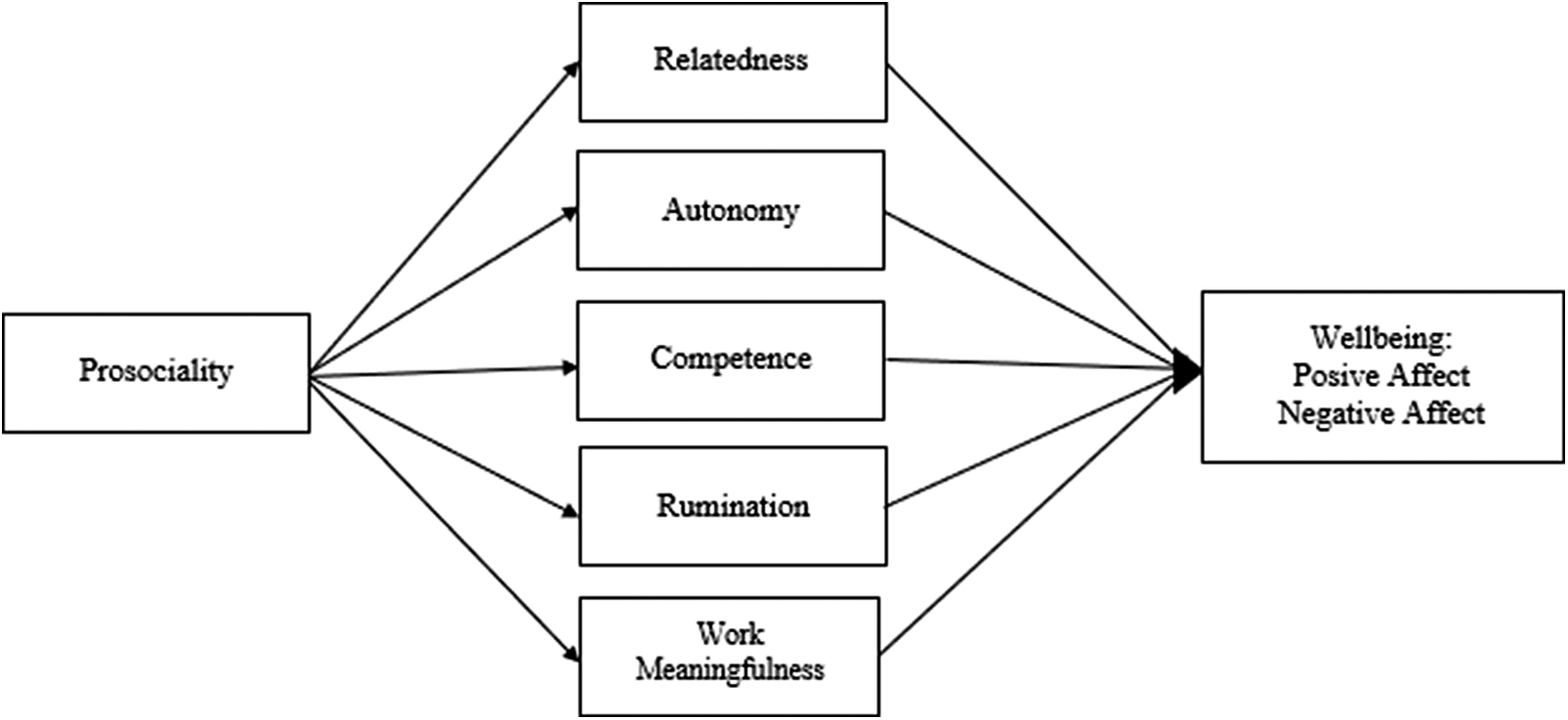
Unfortunately, most previous studies on prosociality and well-being at work have been cross-sectional and, thus, provide very weak evidence about the relationship between these two variables. Moreover, although different potential explanations about the link between prosociality and well-being have been suggested (Midlarsky, Reference Midlarsky and Clark1991; Schwartz & Sendor, Reference Schwartz and Sendor1999), and some mechanisms based on self-determination theory (SDT) have been tested (Feng & Zhang, Reference Feng and Zhang2021; Gradito Dubord et al., Reference Gradito Dubord, Forest, Balčiūnaitė, Rauen and Jungert2022; Liu et al., Reference Liu, Su, Tian and Huebner2021; Titova & Sheldon, Reference Titova and Sheldon2022), scientific understanding of the mechanisms that could explain how and why prosociality is related to well-being is still scarce. This situation is worrisome for theoretical and practical reasons. From a theoretical perspective, there is a need to understand the underlying mechanisms that link prosocial behavior to employee well-being as this question is still not completely clear. Thus, there is a need to understand why prosociality works and the process through which it boosts well-being. In this context, mediation studies in which alternative mediators are tested play a relevant role because they are useful to identify the key mediating mechanisms and move knowledge forward. From a practical perspective, understanding the benefits of prosocial behavior allows us to create interventions that foster prosociality at work. Prosociality represents an easy and cost-effective way for employees to increase their well-being. This inexpensive approach entails minimal time investment from employees and can be repetitively employed to yield benefits for more people without restriction and without resource depletion. To contribute to addressing this research problem, the current study extends recent knowledge on the mediating role of the basic psychological needs proposed by the SDT (Deci & Ryan, Reference Deci and Ryan2000; Ryan & Deci, Reference Ryan and Deci2017) by including two additional mediators to examine how and why prosociality influences well-being of employees. We posit and test five different theory-driven mechanisms through which prosociality may enhance employee well-being. Figure 1 shows our research model.
The proposed research model.
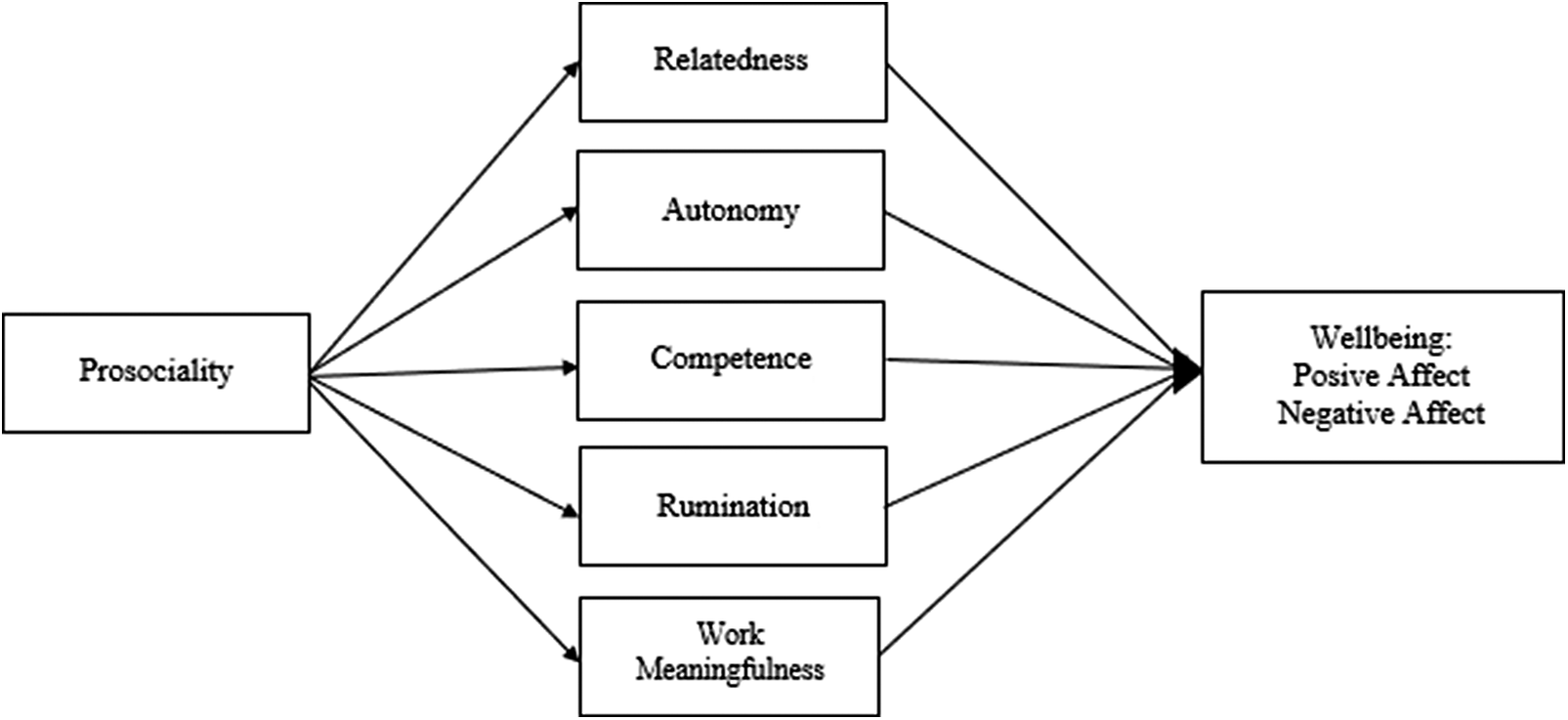
Our study aims to make several contributions to the literature. First, this study aims to understand the process underlying the relationship between prosociality and employees’ well-being. We develop a model with five mechanisms by which prosociality could influence well-being. Based on SDT (Deci & Ryan, Reference Deci and Ryan2000; Ryan & Deci, Reference Ryan and Deci2017), we propose satisfaction of the basic psychological needs for relatedness, autonomy, and competence, as mediator mechanisms. Additionally, building on Midlarsky’s (Reference Midlarsky and Clark1991) reasoning, we propose rumination and work meaningfulness as potential mediators in the relationship between prosociality and well-being. By examining theory-driven mechanisms through which prosociality may be related to employee well-being, we offer detailed and precise knowledge that can contribute to advancing the research on this topic. To our knowledge, this is the first study to empirically test all the mechanisms proposed by Midlarsky (Reference Midlarsky and Clark1991) to explain why prosociality increases well-being. Second, we aim to extend the benefits of prosociality by examining its influence on employees who perform prosocial acts. Until now, prosocial behavior has been known to benefit those who receive help. However, we show that enacting prosocial behaviors can benefit those who perform them. Thus, our findings provide an important opportunity to advance the understanding of the relationship between prosociality and well-being.
Theoretical Framework and Hypotheses
Prosociality and Well-Being
Well-being at work refers to a summative concept that characterizes the quality of an employee’s life (Schulte & Vainio, Reference Schulte and Vainio2010). The hedonic perspective of well-being defines it as the experience of positive affective responses (e.g., joy) and the absence of negative affective responses (e.g., tension) (Eid & Larsen, Reference Eid and Larsen2008; Luhmann et al., Reference Luhmann, Hofmann, Eid and Lucas2012). We adopted this perspective because it is the dominant one in our field (Sonnentag, Reference Sonnentag2015). Therefore, in the current study, we conceptualize well-being as an affective state characterized by the experience of positive affect and the absence of negative affect (Ryan & Deci, Reference Ryan and Deci2001).
It is relatively evident that enacting prosocial behaviors toward others increases positive affect and reduces negative affect in the receiver (Hui & Kogan, Reference Hui and Kogan2018). However, findings suggesting that acting prosocially also promotes the well-being of the helper (Dunn et al., Reference Dunn, Aknin and Norton2008; Plagnol & Huppert, Reference Plagnol and Huppert2010) create new possibilities for boosting employee well-being. Previous research has provided evidence for the positive relationship between prosocial behavior and the well-being of the helper. For instance, Otake et al. (Reference Otake, Shimai, Tanaka-Matsumi, Otsui and Fredrickson2006) tested the relationship between everyday acts of kindness and happiness, finding that individuals who engaged in kind behaviors reported higher happiness and gratitude. Aknin et al. (Reference Aknin, Dunn, Proulx, Lok and Norton2020) found that engaging in prosocial behavior, such as spending one’s resources to benefit others, predicts greater happiness both in cross-sectional and longitudinal studies. Extending this evidence, Nelson et al. (Reference Nelson, Layous, Cole and Lyubomirsky2016) experimentally demonstrated that performing prosocial acts for others over 6 weeks led to greater increases in well-being than engaging in self-focused or neutral behaviors. Meta-analytic findings further confirm that prosocial behavior enhances well-being (Curry et al., Reference Curry, Rowland, Van Lissa, Zlotowitz, McAlaney and Whitehouse2018; Hui et al., Reference Hui, Ng, Berzaghi, Cunningham-Amos and Kogan2020). Although a substantial body of research has demonstrated a positive association between prosocial behavior and the performer’s well-being, the underlying mechanisms—that is, the processes through which prosocial behavior enhances well-being—remain insufficiently understood.
In recent years, there has been a growing interest among researchers in understanding the underlying reasons for the positive influence of prosociality on well-being. To understand the mechanisms underlying this positive relationship, recent studies have focused on investigating the connection between the SDT and prosocial behavior. These studies have found mediating effects of basic psychological needs, as postulated in the SDT, on well-being (Feng & Zhang, Reference Feng and Zhang2021; Gradito Dubord et al., Reference Gradito Dubord, Forest, Balčiūnaitė, Rauen and Jungert2022; Liu et al., Reference Liu, Su, Tian and Huebner2021; Titova & Sheldon, Reference Titova and Sheldon2022). Martela’s work has been seminal in this area, examining how prosocial behavior is linked to well-being through the satisfaction of these needs and exploring beneficence as a potential additional basic need (Martela & Riekki, Reference Martela and Riekki2018; Martela & Ryan, Reference Martela and Ryan2016a,Reference Martela and Ryanb). According to SDT (Deci & Ryan, Reference Deci and Ryan2000; Ryan & Deci, Reference Ryan and Deci2017), individuals experience heightened well-being when they align with the fulfillment of their basic psychological needs. Thus, the basic psychological needs posited by the SDT (relatedness, autonomy, competence) may be viewed as mediators of the relationship between prosociality and well-being. Additionally, Midlarsky’s (Reference Midlarsky and Clark1991) proposed rumination and work meaningfulness as mediators in the relationship between prosociality and well-being. Our study aims to empirically test if the three basic psychological needs (relatedness, autonomy, competence), as well as the two mechanisms (rumination and work meaningfulness) proposed by Midlarsky’s (Reference Midlarsky and Clark1991) mediate the prosociality-well-being relationship. Next, we focus on the central issue of our study and clarify the role of the five proposed mediating mechanisms between prosociality and well-being.
Mechanisms Linking Prosociality and Well-Being
Scholars have suggested mechanisms that may explain why prosociality is positively related to the well-being of a performer. On the one hand, Deci and Ryan’s (Reference Deci and Ryan2000) SDT proposes three basic psychological needs that affect well-being. These three psychological needs may explain why prosociality is positively related to the well-being of a performer. According to SDT (Deci & Ryan, Reference Deci and Ryan2000), humans are considered proactive and growth-oriented, rather than passive and dependent on the circumstances in which they find themselves (Deci & Ryan, Reference Deci, Ryan, Van Lange, Kruglanski and Higgins2012). A core premise of this theory is that humans are strongly motivated and experience well-being when three basic psychological needs are satisfied: the need for relatedness, the need for autonomy, and the need for competence (Deci & Ryan, Reference Deci and Ryan2008). All three of them are essential for people’s optimal physical, psychological, and social development (Ryan & Deci, Reference Ryan and Deci2017; Vansteenkiste et al., Reference Vansteenkiste, Ryan and Soenens2020). Researchers have found that satisfaction of these needs at work leads to greater well-being in employees (Deci et al., Reference Deci, Olafsen and Ryan2017; Gillet et al., Reference Gillet, Vallerand and Lafrenière2012). SDT posits that these three basic psychological needs are universal. This suggests that their link to well-being should remain consistently strong, irrespective of the cultural context in which they are examined (Deci & Ryan, Reference Deci and Ryan2000; Ryan & Deci, Reference Ryan and Deci2017). Previous studies supported the relationship between these three basic psychological needs and well-being, and there are also more recent studies that have tested the mediating effects of the basic psychological needs in the prosociality-well-being relationship (Feng & Zhang, Reference Feng and Zhang2021; Gradito Dubord et al., Reference Gradito Dubord, Forest, Balčiūnaitė, Rauen and Jungert2022;Liu et al., Reference Liu, Su, Tian and Huebner2021; Titova & Sheldon, Reference Titova and Sheldon2022). However, these studies have been carried out with general population samples (Feng & Zhang, Reference Feng and Zhang2021), and with samples of elementary school and university students (Liu et al., Reference Liu, Su, Tian and Huebner2021; Titova & Sheldon, Reference Titova and Sheldon2022). As far as we know, the only study carried out with an employee sample, testing the mediating role of the basic psychological needs on well-being, focused on eudaimonic well-being as the outcome variable (Gradito Dubord et al., Reference Gradito Dubord, Forest, Balčiūnaitė, Rauen and Jungert2022). Thus, further research is needed to establish what role SDT plays in the prosociality-well-being link (Deci & Ryan, Reference Deci and Ryan2004; Sheldon & Niemiec, Reference Sheldon and Niemiec2006). To complement existing literature and prevailing focus on eudaimonic well-being, our study examines the mediated relationship between prosocial behavior and hedonic well-being through the lens of SDT.
On the other hand, Midlarsky (Reference Midlarsky and Clark1991) originally proposed that prosocial behavior may increase well-being by decreasing rumination, increasing a sense of meaningfulness, and increasing competence as well as social integration. The two last mediating mechanisms (competence and social integration) proposed by Midlarsky (Reference Midlarsky and Clark1991) overlap with two of the basic psychological needs proposed by SDT (Deci & Ryan, Reference Deci and Ryan2000): the need for competence and the need for relatedness. To extend previous studies based on SDT, and to test other possible mediating mechanisms that have been proposed in previous studies, we propose a model of five theory-driven mechanisms (satisfaction of the needs of relatedness, autonomy, and competence; rumination, and work meaningfulness) that might explain why prosociality is related to the performer’s well-being. Next, we present each mechanism and examine its role in explaining the relationship between prosociality and well-being.
We begin with the need for relatedness. It represents the need to feel connected to others, care for others, and be cared for by others (Deci & Ryan, Reference Deci and Ryan2008). According to Niemiec and Ryan (Reference Niemiec and Ryan2009), the need for relatedness is satisfied when people convey warmth, liking, and respect for each other. Prosociality involves behaviors that show care for others, and it includes connectedness between people. Helping behavior is a fundamental ability that allows people to maintain rewarding and satisfying relationships (Caprara & Steca, Reference Caprara and Steca2005). When a person behaves prosocially, it is likely that the person receiving the prosocial act will show liking and respect for the performer (Deci & Ryan, Reference Deci and Ryan2008). Thus, prosociality could facilitate the satisfaction of the need for relatedness in the person performing the prosocial behavior. According to SDT (Deci & Ryan, Reference Deci and Ryan2000), the extent to which behaviors satisfy the basic psychological needs, including the need for relatedness, is fundamental to experiencing well-being. SDT proposes that people’s well-being will be enhanced if their need for relatedness is fulfilled (Deci & Ryan, Reference Deci and Ryan2000). In fact, previous studies found that relatedness is positively related to positive affect (Reis et al., Reference Reis, Sheldon, Gable, Roscoe and Ryan2000) and negatively related to negative affect (Tong et al., Reference Tong, Bishop, Enkelmann, Diong, Why, Khader and Ang2009). Following this line of reasoning, we posit that prosociality contributes to satisfying the need for relatedness, which in turn increases positive affect and decreases negative affect. Thus, we propose the following hypothesis:
Hypothesis 1: Prosociality has a positive indirect “effect” on positive affect (H1a) and a negative indirect “effect” on negative affect (H1b) via satisfaction of the need for relatedness.
The second mechanism that could explain the relationship between prosociality and well-being is the need for autonomy. The latter refers to freedom of choice and one’s need to act with a sense of ownership. People’s need for autonomy is satisfied when they perceive that their behaviors are congruent with their chosen direction and feel the sense of personal agency in their actions (Reis et al., Reference Reis, Sheldon, Gable, Roscoe and Ryan2000). Prosociality could facilitate the need for autonomy because the prosocial behavior displayed is chosen by the person, who knows that s/he is the origin of an action (Deci et al., Reference Deci, Olafsen and Ryan2017). By choosing to act prosocially, deciding which acts to perform when and for whom, employees can satisfy the need for autonomy because they have an opportunity to act with a sense of choice (Van den Broeck et al., Reference Van den Broeck, Ferris, Chang and Rosen2016). Thus, the person perceives the prosocial actions as originating from their own volition, representing their true self, rather than being influenced by external forces (Martela & Riekki, Reference Martela and Riekki2018). As SDT argues (Deci & Ryan, Reference Deci and Ryan2008), the satisfaction of this need is positively related to well-being. Previous studies found that the fulfillment of the need for autonomy is positively associated with positive affect and negatively associated with negative affect (Patrick et al., Reference Patrick, Knee, Canevello and Lonsbary2007; Sheldon et al., Reference Sheldon, Ryan and Reis1996). Based on SDT and previous research, we propose that prosociality is positively related to the satisfaction of the need for autonomy, which in turn is positively related to positive affect and negatively related to negative affect. Therefore, we hypothesize the following:
Hypothesis 2: Prosociality has a positive indirect “effect” on positive affect (H2a) and a negative indirect “effect” on negative affect (H2b) via satisfaction of the need for autonomy.
The third psychological need that could mediate the relationship between prosociality and well-being is the need for competence, that is, the need to develop new skills and feel capable of carrying out certain tasks (Deci et al., Reference Deci, Olafsen and Ryan2017). This need is fulfilled when people feel that they can effectively bring about desired outcomes (Reis et al., Reference Reis, Sheldon, Gable, Roscoe and Ryan2000). Prosociality can facilitate the satisfaction of the need for competence because displaying kind behaviors toward others requires effort and a certain level of social skills. People who succeed in performing prosocial behavior and benefiting another person could experience an increase in their feeling of social competence (Van den Broeck et al., Reference Van den Broeck, Ferris, Chang and Rosen2016). According to SDT (Deci & Ryan, Reference Deci and Ryan2000), the satisfaction of the need for competence further enhances people’s well-being. Research has shown that fulfillment of the need for competence is positively associated with positive affect and negatively associated with negative affect (Patrick et al., Reference Patrick, Knee, Canevello and Lonsbary2007; Sheldon et al., Reference Sheldon, Ryan and Reis1996). Drawing on SDT and these findings, we posit that prosociality is positively related to the satisfaction of the need for competence, which is positively related to positive affect and negatively related to negative affect. Thus, we propose the following hypothesis:
Hypothesis 3: Prosociality has a positive indirect “effect” on positive affect (H3a) and a negative indirect “effect” on negative affect (H3b) via satisfaction of the need for competence.
Having discussed how the effect of prosociality on well-being is mediated by the satisfaction of the psychological needs proposed by SDT (Deci & Ryan, Reference Deci and Ryan2000), we now address two additional mechanisms. Building on Midlarsky’s (Reference Midlarsky and Clark1991) reasoning, we examined if work meaningfulness and rumination could explain the relationship between prosociality and well-being. Rumination is defined as passive and repetitive thinking that includes negative thoughts and emotions and is found to be negatively related to well-being (Harrington & Loffredo, Reference Harrington and Loffredo2010; Lyubomirsky & Nolen-Hoeksema, Reference Lyubomirsky and Nolen-Hoeksema1995; Nolen-Hoeksema & Morrow, Reference Nolen-Hoeksema and Morrow1993). According to Midlarsky (Reference Midlarsky and Clark1991), prosociality has the potential to distract a person from repetitive thinking and their own worries. Distraction is a coping strategy that helps decrease rumination by shifting a focus from unpleasant thoughts or feelings toward other activities (Meng & Meng, Reference Meng and Meng2020). When people behave prosocially, they are aware of the needs of others at the present moment. The present-focused attention helps people invest cognitive resources on helping rather than ruminating. Prosociality thus allows a person to be distracted and could stop or decrease rumination (Rude et al., Reference Rude, Little Maestas and Neff2007). Rumination, which is an unpleasant experience, is negatively related to persons’ well-being. Specifically, rumination leads to decreases in positive affect (McLaughlin et al., Reference McLaughlin, Borkovec and Sibrava2007) and increases in negative affect (Kirkegaard Thomsen, Reference Kirkegaard Thomsen2006). Based on these findings and Midlarsky’s (Reference Midlarsky and Clark1991) theoretical propositions, we propose that rumination mediates the relationship between prosociality and well-being, in such a way that prosociality is negatively related to rumination, which is in turn is negatively related to positive affect and positively related to negative affect. We therefore hypothesize the following:
Hypothesis 4: Prosociality has a positive indirect “effect” on positive affect (H4a) and a negative indirect “effect” on negative affect (H4b) via rumination.
Finally, we examine if work meaningfulness is also a mediating mechanism of the relationship between prosociality and well-being, so that prosociality is positively related to work meaningfulness, and the latter is positively related to well-being. Focusing on the prosociality-meaningfulness relationship, prosocial behavior can help realize the meaning and value of life (i.e., life meaningfulness, Midlarsky, Reference Midlarsky and Clark1991). Because our aim is to examine the effects of prosociality at work, we will focus on the meaning and value of work (i.e., work meaningfulness). We define work meaningfulness as the perceived significance of work activities (Baumeister & Vohs, Reference Baumeister and Vohs2002). We propose that prosociality is positively related to work meaningfulness, for several reasons. First, prosociality may positively influence work meaningfulness because it is universally valued (Buss, Reference Buss1989). Thus, it is a way to build a positive reputation and gain social acceptance. According to Van Tongeren et al. (Reference Van Tongeren, Green, Davis, Hook and Hulsey2016), social status and social connections help people realize the meaningfulness of their life and work. Second, people draw meaning from actions intended to make the world better (Wong, Reference Wong, Wong and Fry1998). Since prosociality can improve the well-being of others at work (Haidt, Reference Haidt2007), it has the potential to increase work meaningfulness of people performing these prosocial behaviors. Third, meaningfulness is also derived from being authentic to oneself and having a feeling of self-worth (Van Tongeren et al., Reference Van Tongeren, Green, Davis, Hook and Hulsey2016). Most people want to see themselves as prosocial and moral beings. Displaying prosocial behavior is then a way to act in line with one’s own moral values and to reaffirm the sense of being “good” (Aquino & Reed, Reference Aquino and Reed2002). Regarding the relationship between work meaningfulness and well-being, several studies have shown a positive relationship (Allan et al., Reference Allan, Dexter, Kinsey and Parker2018; Antonovsky, Reference Antonovsky1996; Martin, Reference Martin2000). Doing work that is experienced as meaningful will induce positive affect in the individual and reduce negative affect (Arnold et al., Reference Arnold, Turner, Barling, Kelloway and McKee2007; Doğan et al., Reference Doğan, Sapmaz, Tel, Sapmaz and Temizel2012; Tavares, Reference Tavares2016). Based on these studies and the theoretical arguments presented above, we propose that prosociality is positively related to work meaningfulness, which in turn is positively related to well-being. Thus, we propose the following hypothesis:
Hypothesis 5: Prosociality has a positive indirect “effect” on positive affect (H5a) and a negative indirect “effect” on negative affect (H5b) via work meaningfulness.
The Present Study
The main aim of our study was to identify the mediating mechanisms that explain the relationship between prosociality and well-being at work. We tested the indirect “effects” (H1–H5) of prosociality on the well-being of the performer through the five aforementioned mediators (relatedness, autonomy, competence, rumination, and work meaningfulness), while controlling for their baseline levels. We conducted a field experiment using a pretest–posttest design with an active control group to examine whether changes in prosociality induced by means of an intervention were directly related to the hypothesized mediators and indirectly related to employee wellbeing.
To examine the relationship between prosociality and the hypothesized mediators, we created a simple intervention to produce changes in prosociality between an intervention and a control group. In this intervention, participants were asked to perform prosocial acts. The intervention was designed following recommendations from previous studies (Locklear et al., Reference Locklear, Taylor and Ambrose2020; Ouweneel et al., Reference Ouweneel, Le Blanc and Schaufeli2014; Sheldon & Lyubomirsky, Reference Sheldon, Lyubomirsky, Linley and Joseph2004). We expected the prosociality intervention to produce changes in employee prosociality, which in turn would be related to the well-being of the performer via the hypothesized mediating mechanisms.
Method
Procedure
We adopted an experimental pretest, posttest design with an active control group. Data collection spanned 2 weeks and included three measurement points: a preintervention assessment (Time 1, T1), a postintervention assessment immediately after the intervention (Time 2, T2), and a postintervention assessment 1 week later (Time 3, T3). At T1, demographic data and baseline measures of all mediators and dependent variables were collected. The intervention took place during the following week (Monday–Friday). Each day, participants reported behaviors they had performed that day: those in the intervention group were instructed to carry out and report three prosocial behaviors at work, while those in the control group were asked to report any three work-related behaviors they had performed. At T2, immediately after the intervention, all participants completed the scales assessing the mediators and outcomes, as well as the manipulation check. At T3, 1 week later, both groups completed the outcome measures again. The timing of the assessment was designed to reflect the causal order posited by the theoretical framework.
All data were collected through self-report questionnaires. Ethical approval was not required under the policies of the university’s Research Ethics Committee. Participants were informed that their participation was voluntary, provided written informed consent, and were assured that their responses would remain anonymous and confidential.
Sample
To recruit participants, we used the services of a market research company that managed a respondent panel. This company invited the employed members of its panel to participate in the study if they were at least 18 years old and worked at least 5 days a week and 20 hours per week. The initial sample consisted of 457 employees in Spain who responded to the questionnaire at Time 1. Two attention items were placed in the questionnaire to detect careless respondents. An exclusion criterion was that any participant who had an error on the attention items was not invited to participate in the study. Based on this criterion, 421 participants were randomly assigned to the intervention or control group and invited to participate in the 1-week intervention study. Following the procedures in previous studies (Ko et al., Reference Ko, Margolis, Revord and Lyubomirsky2021; Locklear et al., Reference Locklear, Taylor and Ambrose2020), participants who did not fill in the report on prosocial behaviors on more than 2 days were excluded to ensure that the study sample consists of individuals who were actively engaged in the intervention, thus maintaining internal validity and minimizing potential biases associated with missing or inconsistent data. Participants who filled in the behavior survey on at least 3 days were invited to respond to the questionnaire at Time 2. We collected data at Time 2 from a total of 267 participants (118 in the intervention group and 149 in the control group). The final sample consisted of 200 employees (100 in the intervention group and 100 in the control group) who also completed the questionnaire at T3. The final sample size was previously agreed upon with the market research company, based on the budget for the project. Participants were employees (93 women, 107 men) between 24 and 64 years old (M = 44.3, SD = 9.1 years). Regarding their educational level, 4.5% had finished lower secondary education, 4.5% had vocational education–first level, 15.5% had vocational education–second level, 13% had a high school diploma, 15.5% had a 3-year university/technical engineering degree, 26.5% had a 5-year university/engineering degree, 17.5% had a master’s degree, and 2.5% had a doctorate degree.
Regarding power analysis and considering the sample size of the study (200 subjects), we have enough statistical power to detect relevant relationships between the model variables. Post hoc power calculation with G*Power indicates that for a maximum number of six predictors, an alpha level of 0.05, a sample size of 200 participants, and assuming a small effect size (f 2 = 0.07), the statistical power would be 0.80, which is clearly satisfactory (Faul et al., Reference Faul, Erdfelder, Buchner and Lang2009).
Intervention
The intervention lasted 1 week. We chose a 1-week duration for several reasons. First, extending the intervention across several weeks might reduce the salience of prosocial acts, making it harder for participants to distinguish them from routine behaviors (Layous et al., Reference Layous, Nelson and Lyubomirsky2013; Lyubomirsky et al., Reference Lyubomirsky, Sheldon and Schkade2005). Second, asking participants to report their prosocial behaviors daily over a longer period might reduce motivation due to task fatigue (Baumsteiger, Reference Baumsteiger2019; Emmons et al., Reference Emmons, McCullough, Tsang, Lopez and Snyder2003). Finally, this time frame was also selected for practical reasons and to align with prior interventions using similar daily assignments (e.g., Otake et al., 2006; Seligman et al., Reference Seligman, Steen, Park and Peterson2005).
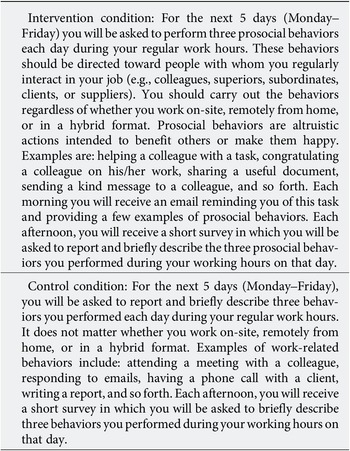
Participants in the intervention condition were asked to perform three prosocial behaviors at their workplace each day for five consecutive days. The instructions they received prior to the intervention are presented in Table 1. In addition, each day, they received reminder emails at 8:00 a.m. and 12:00 p.m. encouraging them to perform three prosocial behaviors, along with examples. At 3:00 p.m., they received a brief questionnaire asking them to report and describe the three prosocial behaviors performed at work that day. At 9:00 p.m., they received a final reminder to complete the questionnaire (if not already done). The questionnaire remained open until midnight (11:59 p.m.).
Instructions provided to participants in the intervention and control conditions
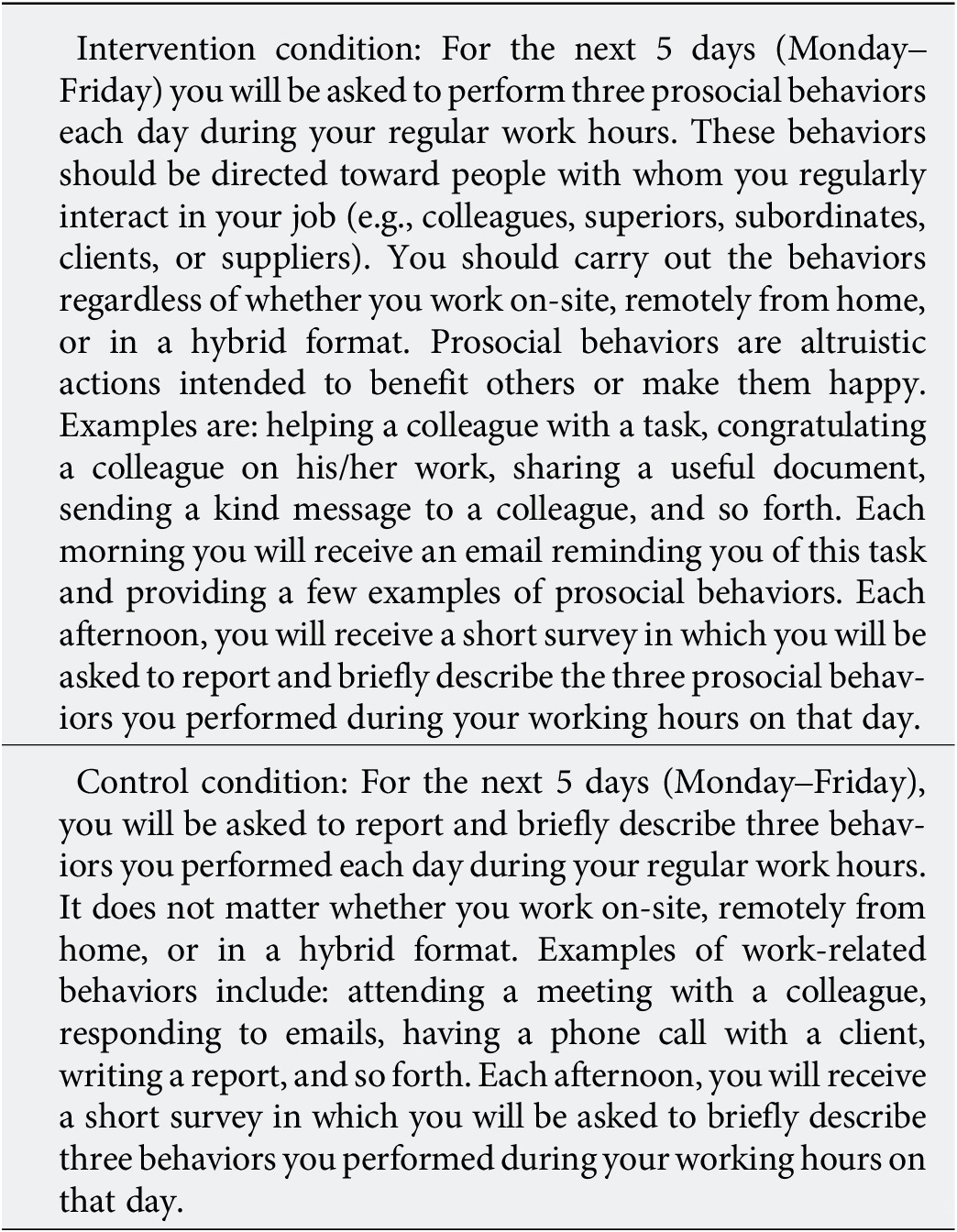
During the intervention week, participants in the control condition were not asked to engage in prosocial acts. Instead, they were instructed to report three daily behaviors they had performed, regardless of type (Giannopoulos & Vella-Brodrick, Reference Giannopoulos and Vella-Brodrick2011). The instructions they received are presented in Table 1. Their daily procedure mirrored that of the intervention group. At 3:00 p.m., participants in the control condition received the questionnaire to report and describe three behaviors performed at work, and at 9:00 p.m., they received a reminder email to complete it if necessary. The questionnaire also remained open until 11:59 p.m. We used an active control group to rule out the possibility that improvements in well-being in the intervention group were attributable to placebo effects. In other words, this design allowed us to ensure that observed changes in outcomes were not due to demand characteristics, whereby participants might unconsciously adjust their behavior to fit what they believed to be the purpose of study (Au et al., Reference Au, Gibson, Bunarjo, Buschkuehl and Jaeggi2020).
Measurements
Prosociality
Prosociality was measured with a 9-item scale that assesses the degree of engagement in actions aimed at sharing and helping others (Caprara et al., Reference Caprara, Steca, Zelli and Capanna2005). The original scale consists of 16 items; however, nine items were selected based on the authors’ recommendation that these items are the most effective in detecting slight variations in prosociality (Caprara et al., Reference Caprara, Steca, Zelli and Capanna2005). The 9-item scale was translated from English to Spanish following the double-translation and reconciliation procedureFootnote 1 (ITC, 2018). The items were responded to on a 6-point Likert scale (1 completely disagree; 6 completely agree). Some example items are “I try to help others” and “I am willing to make my knowledge and abilities available to others” (α = .90).
Basic Psychological Needs (Relatedness, Autonomy, Competence)
Relatedness, autonomy, and competence were measured with a Work-related Basic Need Satisfaction scale adapted from Van den Broeck et al. (Reference Van den Broeck, Vansteenkiste, De Witte, Soenens and Lens2010). The initial scale consisted of 23 items; however, through the process of stepwise removal, Van den Broeck et al. (Reference Van den Broeck, Vansteenkiste, De Witte, Soenens and Lens2010) eliminated the items with lower corrected item-total correlations, keeping 17 final items: 7 items measuring relatedness (α = .87), 6 measuring autonomy (α = .82), and 4 measuring competence (α = .89). Examples of items are as follows: for relatedness (e.g., “At work, I feel part of a group”), for autonomy (e.g., “I feel free to do my job the way I think it could best be done”), and for competence (e.g., “I feel competent at my job”). Participants were asked to report the degree to which they agreed with each statement on a 6-point scale ranging from 1 = completely disagree to 6 = completely agree.
Rumination
Rumination was measured using the five-item Detachment subscale from the Work-Related Rumination Questionnaire (Cropley et al., Reference Cropley, Michalianou, Pravettoni and Millward2012), with answers on a 6-point Likert-type scale ranging from 1 (never) to 6 (always). An example item for this scale is “I feel unable to switch off from work” (α = .92).
Work Meaningfulness
Work meaningfulness was measured with the scale elaborated by May et al. (Reference May, Gilson and Harter2004). This scale was originally composed of six items, but we removed the sixth item because it showed a great overlap with the third item. The final scale consisted of five items (Α = .94) that are responded to on a 6-point Likert-type scale ranging from 1 (strongly disagree) to 6 (strongly agree). Sample items for this scale are “The work I do on this job is very important to me” and “The work I do on this job is worthwhile.”
Positive and Negative Affect
Well-being was measured using a scale that assesses positive and negative affect, the Reduced Affective Well-Being Scale (RAWS) (Kampf et al., Reference Kampf, González Romá and Hernández Baeza2020), which is a shortened version of the affective well-being scale developed by Segura and González-Romá (Reference Segura and González-Romá2003). The RAWS was developed and validated in Spanish. Data in the two mentioned studies (Kampf et al., Reference Kampf, González Romá and Hernández Baeza2020; Segura & González-Romá, Reference Segura and González-Romá2003) were collected in Spanish samples using questionnaires in Spanish. The positive and negative affect scales consist of three items each, responded to on a 5-point Likert scale ranging from 1 (nothing) to 5 (a lot). Items were preceded by the following statement: “Focus on what you think about your current job now. To what extent does your work make you feel ….” Positive affect was assessed through the adjectives cheerful, optimistic, and animated (α = .93); negative affect was assessed through the adjectives tense, nervous, and anxious (α = .88).
Control
To ascertain whether prosociality affected change in the mediators considered, we controlled for baseline (T1) mediators, using the corresponding measures described above, and for the effect of the prosociality intervention on all the other variables.
Data Analysis
To test H1–H5, we employed structural equation modeling methods with maximum likelihood (MLR) estimation, using Mplus 8.7 (Muthén & Muthén, Reference Muthén and Muthén2017). Considering the small sample size and the number of parameters to be estimated, we modeled relationships among observed (not latent) variables. We tested a multiple mediation model with the five mediating mechanisms in parallel. To evaluate the statistical significance of the parameter estimates, we used one-tailed, α = .05, hypothesis tests because the study hypotheses specified directional relationships derived from theory (Cho & Abe, Reference Cho and Abe2013). Moreover, mediation methodologists consider this approach suitable for mediation research (Preacher et al., Reference Preacher, Zyphur and Zhang2010, p. 217). Thus, indirect effects were tested using the 90% bias-corrected bootstrap confidence interval method with 10,000 bootstrapped samples (MacKinnon et al., Reference MacKinnon, Lockwood and Williams2004; Williams & MacKinnon, Reference Williams and MacKinnon2008). Our hypotheses proposed that prosociality would have an indirect “effect” on hedonic well-being, measured as positive and negative affect, via satisfaction of the needs for relatedness (H1), autonomy (H2), and competence (H3), as well as via rumination (H4) and work meaningfulness (H5).
Results
Manipulation Checks
Before conducting the manipulation checks, the contents of the prosocial behavior reports provided by the participants in the intervention group were analyzed. Two independent judges rated the reported behaviors as prosocial (e.g., “I helped my colleague finish an assignment”) or non-prosocial (e.g., “I attended and participated in meetings”). Because the study was focused on prosociality at work, behaviors carried out outside the workplace were disregarded (e.g., “I helped a disabled person in a wheelchair in a shopping center”). The participants in the intervention group were instructed to perform three prosocial behaviors on each of the 5 days (15 prosocial behaviors per participant). Of the 1500 behaviors the participants in the intervention group were expected to report, they reported 1173 behaviors (78.2%). The two independent judges rated whether each of these behaviors was prosocial. The percentage of agreement was 94.1%. The 69 behaviors with initial disagreement were jointly reviewed by the two judges to reach an agreement about the classification of the behavior as prosocial or non-prosocial. After all disagreements were resolved, the raters classified 1037 (88.41%) behaviors as prosocial and 136 (11.59%) as non-prosocial.
Then, the number of reported prosocial behaviors for each employee in the intervention group was computed. The results obtained revealed that, out of the 100 participants in the intervention group, only 19 performed all (15) the expected prosocial behaviors, and 77 participants performed at least 9 (60% of 15) prosocial behaviors throughout the intervention phase. To ensure the validity of our data and to capture the intervention’s impact, we retained the data of participants in the intervention group who performed at least nine prosocial behaviors throughout the intervention (Amico, Reference Amico2009). Thus, the final composition of the intervention group included in the manipulation check consisted of 77 participants.
To test whether our intervention increased prosociality in comparison with the control group, we checked the manipulation by examining differences in prosociality at T2, after controlling for prosociality at T1. The ANCOVA conducted showed that, unfortunately, there were no differences in prosociality (F (1, 197) = 0.24, p = .63, η2 = .001) between the intervention (M = 4.93, n = 77) and control groups (M = 4.88, n = 100).
We also tested whether the manipulation (intervention vs. control group) had an effect on the mediator and outcome variables by performing independent t-tests. Results revealed that the manipulation did not have any impact on the study variables: relatedness (t (198) = 0.63, p = .53, Cohen’s d = .09), autonomy (t (198) = −0.03, p = .98, Cohen’s d = .004), competence (t (198) = 0.22, p = .83, Cohen’s d = .03), rumination (t (198) = 0.6, p = .54, Cohen’s d = .09), work meaningfulness (t (198) = 1.31, p = .19, Cohen’s d = .19), positive affect (t (198) = 1.52, p = .13, Cohen’s d = .23), and negative affect (t (198) = −0.08, p = .94, Cohen’s d = −.01).
After considering the manipulation check results, we decided to take full advantage of all the information we collected and test the study hypotheses using a different approach: testing the hypothesized indirect “effects” by means of a panel data design in which the stability effects were controlled for. This approach is the recommended one for nonexperimental designs (Cole & Maxwell, Reference Cole and Maxwell2003; Finkel, Reference Finkel1995; Maxwell et al., Reference Maxwell, Cole and Mitchell2011; Maxwell & Cole, Reference Maxwell and Cole2007). By controlling stability effects, it partials out the effects of spurious variables and reduces the likelihood that a mediation effect appears when it does not exist (Law et al., Reference Law, Wong, Yan and Huang2016; Maxwell & Cole, Reference Maxwell and Cole2007). When statistically significant results are obtained, it allows the researcher to conclude that a given predictor is related to changes in a given outcome (or mediator) over time (Finkel, Reference Finkel1995). This approach has been adopted in top-tier journals to test for indirect “effects” (e.g., Davcheva et al., Reference Davcheva, González-Romá, Le Blanc, Hernández and Tomás2025; Li et al., Reference Li, Chen, Bai, Liden, Wong and Qiao2023).
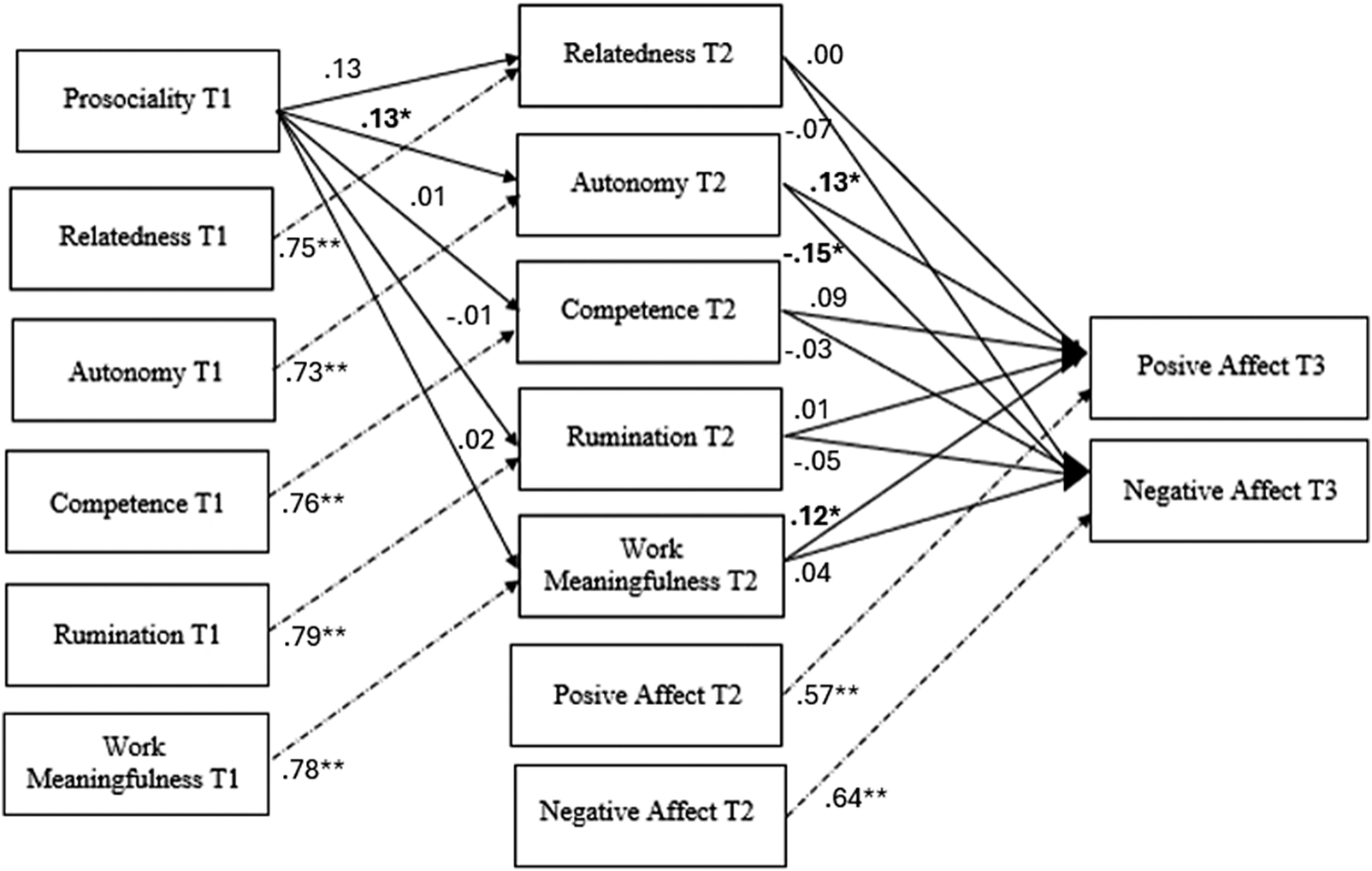
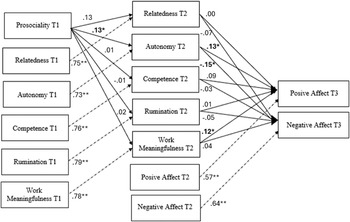
Thus, we tested the study hypotheses using prosociality measured at Time 1 as our predictor variable (instead of our prosociality intervention) and controlling for the stability effects associated with the mediators and outcome variables considered. We used the data provided by the sample composed of 200 subjects and controlled for group membership (intervention vs. control group). The fitted model is shown in Figure 2.
The fitted research model.
Note: Solid lines represent hypothesized relationships; dotted lines represent relationships controlled for.
Preliminary Analysis
To examine the construct validity of our scales, we conducted confirmatory factor analyses with Mplus 8.7 (Muthén & Muthén, Reference Muthén and Muthén2017) using the robust MLR method to correct for item distribution departures from normality (skewness or kurtosis values out of the range from −1 to +1; Muthén & Kaplan, Reference Muthén and Kaplan1985). Model fit was assessed using the chi-square statistic and four goodness-of-fit indices: the root mean square error of approximation (RMSEA; Steiger, Reference Steiger1990), the comparative fit index (CFI; Bentler, Reference Bentler1990), and the standardized root mean square residual (SRMR; Bentler, Reference Bentler1995), following recommendations in the literature (Browne & Cudeck, Reference Browne and Cudeck1992; Browne & Du Toit, Reference Browne and Du Toit1992). A one-factor model (including all the items of the questionnaires measuring the eight variables included in the study) displayed very poor fit to the data (χ2 = 4552.37, df = 819, p < .01; RMSEA = .15; CFI = .34; SRMR = .15). In contrast, the hypothesized eight-factor model (differentiating prosociality, relatedness, autonomy, competence, rumination, work meaningfulness, positive affect, and negative affect) showed an adequate fit to the data (χ2= 1408.15, df = 791, p < .01; RMSEA = .06; CFI = .89; SRMR = .06). All items showed statistically significant factor loadings (above .6, p < .05) in their respective factors. Considering the incremental goodness of fit indices, (△RMSEA = .09, △CFI = .55), the difference between the two models was substantial, showing that the eight-factor model was the better fitting model. The results supported the distinctiveness of the study constructs and provided evidence for the validity of the measures.
Additionally, three alternative measurement models were tested with confirmatory factor analyses, including only the mediators (measured at Time 2), to test for common method bias. A one-factor model (with all items from the five mediator variables) showed very poor fit to the data (χ2 = 2382,27, df = 324, p < .01; RMSEA = .18; CFI = .38; SRMR = .18). A three-factor model (combining the items of relatedness, autonomy and competence into one factor, and treating work meaningfulness and rumination as separate factors) also displayed poor fit (χ2 = 1260.68, df = 321, p < .01; RMSEA = .12; CFI = .72; SRMR = .11). Finally, a five-factor model (separating relatedness, autonomy, competence, rumination, and work meaningfulness) demonstrated an adequate fit to the data (χ2 = 613.72, df = 314, p < .01; RMSEA = .07; CFI = .91; SRMR = .07). The results supported the distinctiveness of the study constructs and provided evidence against common method bias.
Tests of Indirect Effects
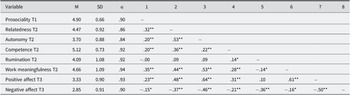
Table 2 reports means, standard deviations, reliability coefficients, and correlations between the study variables.
Means, standard deviations, Cronbach’s alphas, and correlations between the study variables
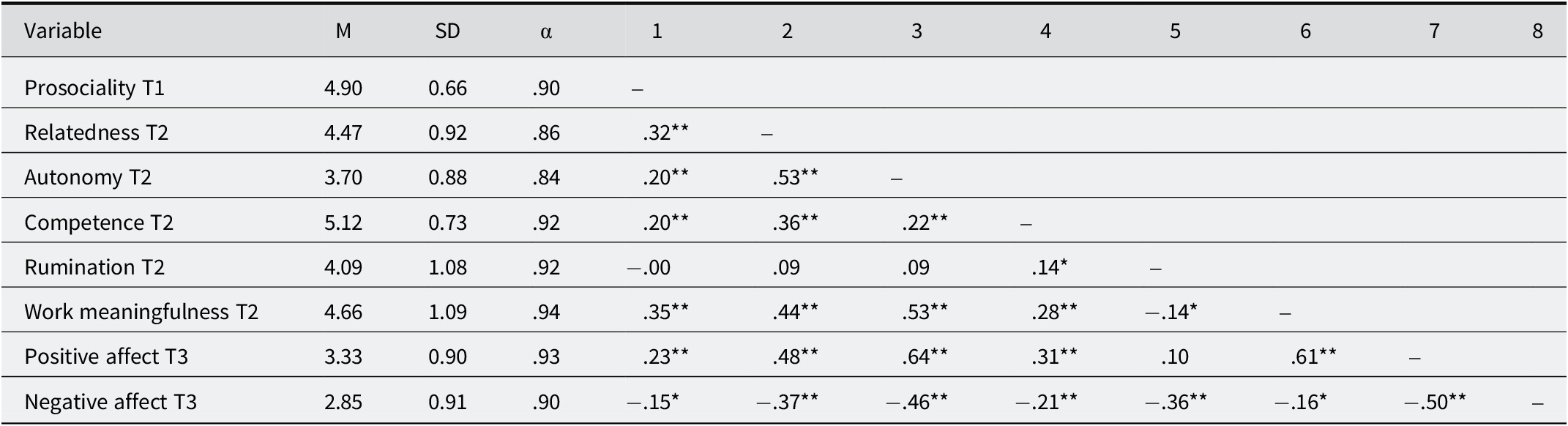
Note: α = Cronbach’s alpha. N = 200, *p < .05; **p < .01, (two-tailed).
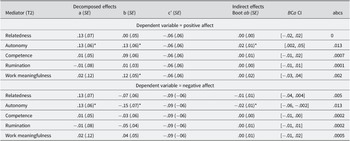
The results for the research mediation model are presented in Table 3. The proposed parallel mediation model (see Figure 2) showed an adequate fit to data (χ2 = 144.06, df = 44, p < .01; RMSEA = .11, CFI = .94, SRMR = .05)Footnote 2. The fact that the RMSEA was greater than .10 was probably due to the large number of parameters estimated in the model. After removing the nonsignificant correlations between mediators, the RMSEA decreased to .09. Prosociality was positively related to the satisfaction of the autonomy need (.13, p = .03), which in turn was positively related to positive affect (.13, p = .02) and negatively related to negative affect (−.15, p = .03). Results showed a significant positive indirect “effect” of prosociality on positive affect via the satisfaction of the need for autonomy (.02, 95% CI [.002, .05]), and a significant negative indirect “effect” of prosociality on negative affect via the satisfaction of the need for autonomy (−.02, 95% CI [−.06, −.002]). These results fully supported Hypothesis 2. To estimate the corresponding effect sizes, we computed the completely standardized indirect “effect” (abcs) because it is independent from sample size and easy to interpret (Wen & Fan, Reference Wen and Fan2015). For the two aforementioned indirect effects, the absolute value of abcs was .01. Thus, for a one standard deviation increase in prosociality, there was a 1% increase in positive affect and a 1% decrease in negative affect via autonomy. As shown in Table 3, there were no other significant indirect “effect” of prosociality on positive and negative affect, and so none of the alternative mediation hypotheses (H1 and H3–H5) were supported by the data. The results were congruent with Hypothesis 2 and showed that the satisfaction of the need for autonomy was the mediating mechanism that helped to explain the relationship between prosociality and positive and negative well-being. Thus, prosociality was positively related to the satisfaction of the need for autonomy, which in turn was positively related to positive affect and negatively related to negative affect.
Direct and indirect effects of prosociality on positive and negative affect (n = 200)
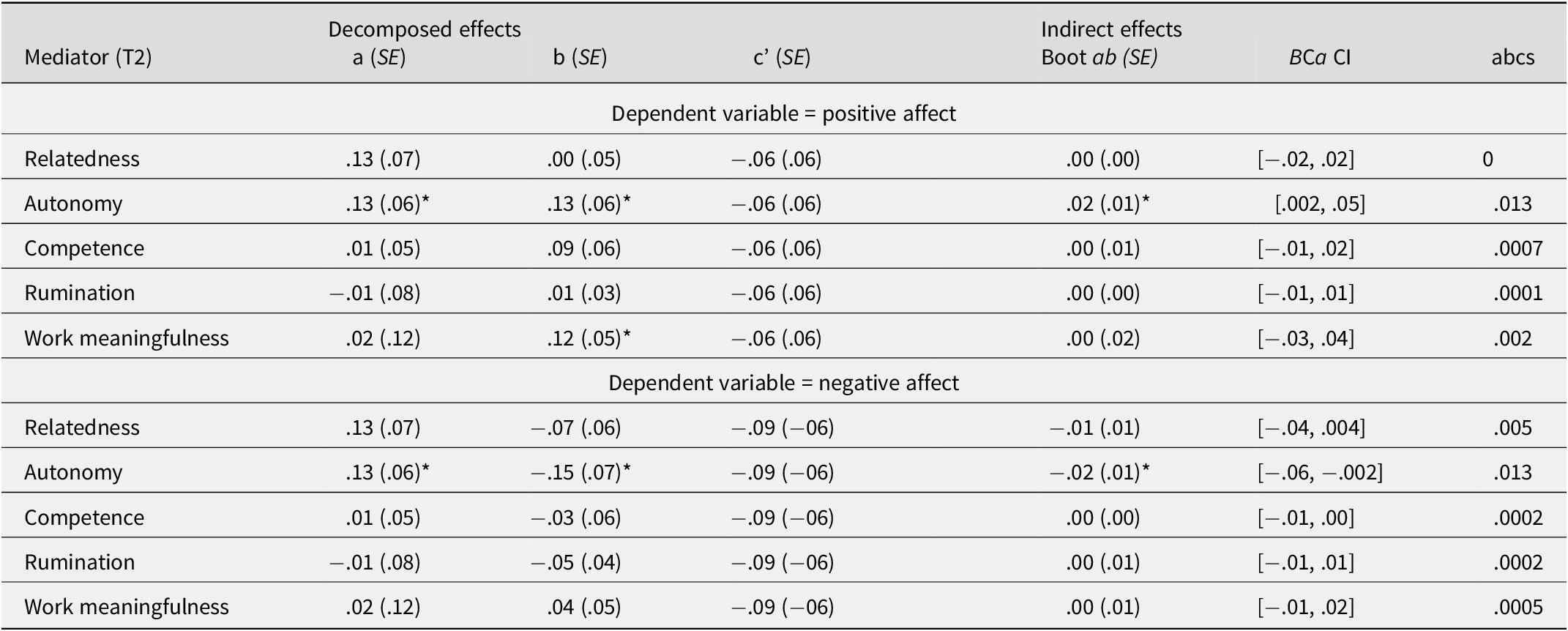
Note: Reported results control for baseline mediators. a = effect of prosociality on mediators, b = effect of mediators on outcomes, c’ = direct effect of prosociality on outcomes, SE = standard error. Boot ab refers to bootstrapped indirect effect; bootstrap sample size 10,000. Unstandardized regression coefficients reported are based on bias-corrected and accelerated 95% confidence intervals (BCaCIs). BCa CIs that do not include zero indicate support for indirect effects.
*p < .05. **p < .01. abcs = completely standardized indirect effect; an effect size measure.
Discussion
The main aim of this study was to identify the mechanisms through which prosociality is related to employee well-being. Although previous studies showed that prosociality is positively related to well-being, little research has examined the mechanisms that explain this relationship. We competitively tested five theory-driven mediators: relatedness, autonomy, competence, rumination, and work meaningfulness. We drew on SDT as well as Midlarsky’s (Reference Midlarsky and Clark1991) theoretical propositions to find theoretical arguments about how prosociality is related to the well-being of a performer.
The results obtained show that prosociality at T1 was positively related to the satisfaction of the need for autonomy at T2, which in turn was positively related to positive affect and negatively related to negative affect at T3, while controlling stability effects. These results show that the relationship between prosociality and the well-being of the performer is mediated by the satisfaction of the need for autonomy. We did not find support for any other mechanism that could explain the link between prosociality and well-being.
Theoretical Implications
Our findings have several theoretical implications. First, they contribute to identifying one of the mechanisms (the satisfaction of the need for autonomy) through which prosociality is related to employee well-being. To our knowledge, this is the first study to empirically test all the propositions suggested by Midlarsky (Reference Midlarsky and Clark1991) on how prosociality is associated with well-being. Midlarsky postulated that rumination and work meaningfulness mediate the relationship between prosociality and well-being, but our findings challenge this assertion, showing that the satisfaction of the need of autonomy is a significant mediator.
We further aimed to systematically test if the three basic psychological needs proposed by the SDT (Deci & Ryan, Reference Deci and Ryan2000) could explain the mechanisms that underlies the relationship between prosociality and well-being. Based on SDT, our results highlight the importance of the satisfaction of the need for autonomy as an intervening mechanism. As Deci et al. (Reference Deci, Olafsen and Ryan2017) suggested, these results indicate that prosociality at work gives employees a sense of choice and ownership because they know they are the source of prosocial behavior. By choosing to act prosocially, toward whom, and in what situations, employees act freely and can satisfy their need for autonomy. In turn, the satisfaction of this need is positively related to positive affect and negatively related to negative affect. These findings are in line with previous research showing that people who help others experience the greatest well-being when they are able to help autonomously (Weinstein & Ryan, Reference Weinstein and Ryan2010). Moreover, our findings advance the understanding of SDT (Deci & Ryan, Reference Deci and Ryan2000) by showing that prosociality is not universally beneficial for the satisfaction of the three considered needs.
Second, in line with previous research, our study shows that prosociality, defined as acting kindly or generously toward others (Hui et al., Reference Hui, Ng, Berzaghi, Cunningham-Amos and Kogan2020), is positively related to well-being, measured as positive and negative affect. In this study, we examined the relationship between prosociality and the well-being of a person acting prosocially. Until now, it was evident that prosociality is a central feature of social life because it brings benefits to receivers of prosocial acts and can increase their well-being (Hui et al., Reference Hui, Ng, Berzaghi, Cunningham-Amos and Kogan2020; Van Tongeren et al., Reference Van Tongeren, Green, Davis, Hook and Hulsey2016). Our findings extend the benefits of prosociality by showing that, by helping others, employees can increase their own well-being. This finding becomes more relevant if we consider the impact of the COVID-19 pandemic on people’s lives and working conditions (Zacher & Rudolph, Reference Zacher and Rudolph2021). During the pandemic crisis, people’s well-being decreased considerably (Blustein et al., Reference Blustein, Duffy, Ferreira, Cohen-Scali, Cinamon and Allan2020; Sibley et al., Reference Sibley, Greaves, Satherley, Wilson, Overall, Lee, Milojev, Bulbulia, Osborne, Milfont, Houkamau, Duck, Vickers-Jones and Barlow2020), which was recognized as a serious, worldwide public health concern. Thus, the finding that employees can positively influence their own well-being at work by being prosocial may make a significant difference in the quality of people’s work life. In addition, these findings provide evidence for those who are skeptical about the impact of prosociality on the well-being of the giver (Dovidio et al., Reference Dovidio, Piliavin, Schroeder and Penner2017).
Research Implications
Contrary to our expectations, we did not find support for the effectiveness of our prosociality intervention. The prosocial behaviors of employees in the intervention group did not increase after the intervention in comparison with the control group. There are several possible explanations for this. First, the results of the content analysis of the participants’ prosocial behavior reports showed that more than 80% of the participants did not perform the three expected prosocial behaviors per day on the five intervention days as instructed. It is worth noting that, at the time the study was conducted, many employees were working remotely due to the COVID-19 pandemic regulations, and so they had limited ways to express prosocial behaviors. Therefore, it is possible that the number of prosocial behaviors performed by participants was not high enough to increase their prosociality levels. Second, we chose a 1-week intervention to keep prosocial behavior from becoming habitual and the participants from becoming bored with the task (Baumsteiger, Reference Baumsteiger2019; Emmons et al., Reference Emmons, McCullough, Tsang, Lopez and Snyder2003; Lyubomirsky & Della Porta, Reference Lyubomirsky, Della Porta, Reich, Zautra and Hall2010). Our results suggest that 1 week may not be enough time for participants’ prosociality to increase. Therefore, to increase the number of prosocial behaviors and the length of time involved, future research should design interventions that last for several weeks. In addition, future research would benefit from ascertaining what number of enacted prosocial behaviors is effective in increasing employees’ prosociality. Third, due to the characteristics of the intervention design implemented and the sample of online participants, we could not be completely sure that the participants in the control group did not engage in prosocial behaviors during the intervention period. We can only attest that the participants in the intervention group were instructed to perform them whereas the members of the control group were not. This lack of control, which is typical in this kind of research designs, might have influenced the intervention effectiveness.
Practical Implications
The findings of our study have relevant practical implications. Given that employee well-being will be a significant and urgent issue in the coming years (Blustein et al., Reference Blustein, Duffy, Ferreira, Cohen-Scali, Cinamon and Allan2020; Restubog et al., Reference Restubog, Ocampo and Wang2020; Rudolph & Zacher, Reference Rudolph and Zacher2020; WHO, 2020), strategies to increase employees’ well-being are critical, and our findings suggest some initiatives.
First, the positive indirect relationship between prosociality at work and employee well-being should be taken into consideration by organizations interested in promoting employees’ well-being. Our results suggest that displaying behaviors that are intended to benefit others is positively related to the well-being of employees who perform those behaviors. Thus, the knowledge that prosociality plays a significant role in the well-being of employees may motivate managers to foster prosocial behaviors by role modeling them for their employees. According to social learning theory (Bandura, Reference Bandura1977), people learn what to do and how to behave by observing others who serve as role models. Based on their position and power, managers are potent role models (Brown & Treviño, Reference Brown and Treviño2014). Thus, by behaving prosocially themselves, managers can foster prosocial behaviors in their employees.
Second, considering the mediating role of the satisfaction of the need for autonomy in the relationship between prosociality and well-being, organizations can help their employees by cultivating a sense of choice and ownership when displaying prosocial behaviors at work. Rather than instructing employees to behave prosocially or establishing a norm, managers can design work contexts that promote prosociality. For example, by rewarding prosociality, managers convey the importance of prosociality while allowing employees to choose to commit prosocial acts. Moreover, findings about the mechanisms that explain the link between prosociality and well-being have implications for designing workplace interventions. Specifically, our mediation results show that helping others is positively related to employees’ well-being because it satisfies the need for autonomy at work. Considering this, future interventions may aim to highlight people’s sense of choice, initiative, and volition, and utilize the satisfaction of the need for autonomy to increase participants’ well-being.
Limitations, Strengths, and Future Research Directions
When interpreting the results of the current study, several limitations should be considered that can be addressed in further research. First, although we experimentally manipulated prosociality, our intervention did not prove to be effective. Thus, we tested the hypothesized indirect “effects” using an alternative approach: a panel data design in which the stability effects were controlled for. An important limitation of this approach is that the results cannot be used to make causal inferences about the relationships between variables. However, the panel design we implemented, together with the theoretical basis for our hypotheses and the results obtained, yields valuable empirical evidence about the relationships investigated. Because we controlled for stability effects when predicting the mediators and outcomes (Finkel, Reference Finkel1995), our results showed that prosociality at T1 was positively related to linear changes in the satisfaction of the need for autonomy over time (T1 and T2), and the satisfaction of the need for autonomy at T2 was positively related to changes in positive affect over time (T2 and T3) and negatively related to changes in negative affect over time (T2 and T3). Nevertheless, to provide more conclusive evidence about causal relationships, future research should design interventions that change participants’ prosociality levels. Our study points to the importance of optimal timing, and so future studies should use designs with longer intervention time frames. Specifically, future studies may find it advantageous to have an intervention time frame of more than 1 week to increase prosociality (Lyubomirsky et al., Reference Lyubomirsky, Sheldon and Schkade2005). Moreover, future studies should reflect on the number of prosocial behaviors participants have to perform in order for the intervention to be effective. For example, it might not be necessary to increase the number of prosocial behaviors per day but rather spread a lower frequency of prosocial behaviors over a longer period (Sheldon & Lyubomirsky,).
Second, the study variables were measured through self-reports from a single source, which could have inflated the relationships among the variables, and so future research should collect data from different sources. However, the fact that some of the observed correlations were equal to or smaller than .10 suggests that common-method variance was not an issue in our study (Spector, Reference Spector2006). Moreover, strength of our investigation was that the predictor, the mediators, and the outcomes were measured at different time points, which helps to reduce concern about common-method bias (Podsakoff et al., Reference Podsakoff, MacKenzie, Lee and Podsakoff2003).
Third, according to Preacher and Kelley (Reference Preacher and Kelley2011), the effect size associated with the observed indirect effect can be considered small. Nevertheless, considering the consequences of low well-being for employee health (Braverman, Reference Braverman2020; Harper et al., Reference Harper, Satchell, Fido and Latzman2021) and the associated costs (around £45 billion each year; Deloitte, 2020), even small effect sizes can have important practical consequences (Cortina & Landis, Reference Cortina, Landis, Lance and Vandenberg2009).
Fourth, the current study focused on the affective component of well-being and measured it as a positive and negative affect. Although it has been suggested that the affective component represents the core of the well-being construct quite well (Eid & Larsen, Reference Eid and Larsen2008), to better understand it, the cognitive component should also be measured (in this case, job satisfaction).
Fifth, on a related note, taking into consideration the eudaimonic perspective of well-being, future studies should also measure the eudaimonic dimensions of well-being as an outcome. This approach to well-being is concerned with actualizing human potential and experiences that are objectively good for the person (Kagan, Reference Kagan1992; Ryan & Deci, Reference Ryan and Deci2001). Whereas in the present study we were able to examine the indirect “effects” of prosociality on hedonic well-being, future research should examine the indirect “effects” of prosociality on eudaimonic well-being.
Conclusion
Although scholars continue to find evidence that prosociality has the potential to increase employee well-being, the investigation of the mechanisms explaining this link has received limited attention, with only a few studies delving into the mediator’s role of the satisfaction of basic needs. The present study contributed to ascertaining why and how prosociality is positively related to employees’ well-being by testing five competing mediators. By demonstrating that the satisfaction of the need for autonomy is a mechanism that helps to explain the relationship between prosociality and well-being at work, the present study advances existing theory, research, and practice related to well-being at work.
Data Availability Statement
The data that support the findings of this study are available from the corresponding author upon reasonable request.
Author Contributions
Conceptualization: V.B., V.G.-R., I.T., A.N.; Data curation: V. B.; Formal analysis: V.B., I.T.; Funding acquisition: V.G.-R., I.T., A.H.-B.; Investigation: V.B.; Methodology: V.G.-R.; Project administration: I.T., A.H.-B.; Supervision: V.G.-R., A.N.; Writing—original draft: V.B.; Writing—review and editing: V.G.-R., I.T., A.N., A.H.-B.
Funding Statement
This study was funded by the Spanish Ministry of Science and Innovation (MCIN), and The European Regional Development Fund (ERDF): Grant PSI2017-86882-R funded by MCIN/AEI/10.13039/501100011033/ and by “ERDF A way of making Europe.”
Competing Interests
The authors declare none.

 Open access

