

Since the turn of the century, the public increasingly promotes corporate social responsibility (CSR; Sheikh, Reference Sheikh, Brown and Nwagbara2019) and expects companies to act ethically (Mohr, Webb, & Harris, Reference Mohr, Webb and Harris2001). Many companies have, through their engagement in CSR, benefitted from increased market share, customer satisfaction and consumer donation, enhanced brand image and product evaluation (for a review, see Aguinis & Glavas, Reference Aguinis and Glavas2012), improved financial performance (Kim, Kim, & Qian, Reference Kim, Kim and Qian2018; Lin, Yang, & Liou, Reference Lin, Yang and Liou2009; Luo & Bhattacharya, Reference Luo and Bhattacharya2006), and increased customer trust (Palacios-Florencio, del Junco, Castellanos-Verdugo, & Rosa-Díaz, Reference Palacios-Florencio, del Junco, Castellanos-Verdugo and Rosa-Díaz2018), as well as elevated market value (Servaes & Tamayo, Reference Servaes and Tamayo2013). Besides, people nowadays have multiple sources of learning about a company’s CSR information, including from a company’s official webpage, news media, the company’s employees, or social media (Stoll, Reference Stoll2019). Interestingly, people can learn about a company’s product crisis internationally and immediately after a crisis occurs, which can bring a big challenge for an organization to manage public responses and rebuild their company reputation in today’s dynamic and complex environment. Given people’s wide exposure to CSR information and the quick spread of product crises in people’s lives, how does a company’s prior commitment to CSR buffer potential reputation loss in a product-harm crisis?
Product-harm crises refer to “discrete, well publicized occurrences wherein products are found to be defective or dangerous” (Dawar & Pillutla, Reference Dawar and Pillutla2000). Companies experiencing product-harm crises may suffer from loss in revenue (Chen, Ganesan, & Liu, Reference Chen, Ganesan and Liu2009), decreased effectiveness of marketing-mix instruments (van Heerde, Helsen, & Dekimpe, Reference Van Heerde, Helsen and Dekimpe2007), reduced ability to attract switchers (Bronnenberg & Wathieu, Reference Bronnenberg and Wathieu1996), and eroded brand equity (Chen et al., Reference Chen, Ganesan and Liu2009; Thirumalai & Sinha, Reference Thirumalai and Sinha2011). A study by Burson-Marsteller and Penn Schoen Berland (2011) showed that 66% of business decision-makers have experienced a product crisis. Indeed, even high-profile companies have encountered product-harm crises. For example, in 2015, Toyota and Nissan recalled 6.56 million cars equipped with faulty airbags (CNN, 2015). In 2016, Samsung recalled its newly launched Galaxy Note 7 due to a battery safety problem. The reputation loss from product-harm crises can spread to non-crisis companies if the crisis company and the non-crisis companies have the same country of origin or manufacture products with similar attributes (Ma, Zhang, Wang, & Li, Reference Ma, Zhang, Wang and Li2014).
As mentioned earlier, CSR engagement can raise a company’s reputation through enhanced company image and financial performance. However, if a company’s reputation is damaged in a product-harm crisis, can a company’s prior CSR engagement help to restore the tarnished reputation? Some evidence indicates that a company’s past CSR record may reduce the reputational damage caused by a product-harm crisis. For example, consumers trust more, and identify more strongly, with companies that have higher performance in CSR or possess the expertise in delivering high-quality products (corporate ability [CA]; Lin, Chen, Chiu, & Lee, Reference Lin, Chen, Chiu and Lee2011). In addition, the public evaluates a company more positively in a product-harm crisis when its prior CSR record is positive (vs. negative; Assiouras, Ozgen, & Skourtis, Reference Assiouras, Ozgen and Skourtis2013; Kim, Reference Kim2014; Klein & Dawar, Reference Klein and Dawar2004), or when its prior reputations in both CSR and CA are good (Sohn & Lariscy, Reference Sohn and Lariscy2015). Positive CSR perceptions also decrease customer discontent in the context of service failure, particularly when the contextual norms prioritize communal (vs. exchange) relationship (Bolton & Mattila, Reference Bolton and Mattila2015). Some evidence also indicated that maligned companies (e.g., tobacco companies) engaging in CSR can change their negative image when the public perceives the companies’ CSR activities to be sincere (Yoon, Gurham-Canli, & Schwartz, Reference Yoon, Gurham-Canli and Schwartz2006).
A related question is: Can a company’s CSR engagement, compared to its CA, more effectively curtail the potential reputation loss caused by a product-harm crisis? We posit that the answer depends in part on the public’s lay theories about the relationship between CSR and CA, which is a factor that has been largely ignored in the CSR literature (Aguinis & Glavas, Reference Aguinis and Glavas2012). Lay theories are people’s basic assumptions about the nature of the social world (Molden & Dweck, Reference Molden and Dweck2006). Some people may believe that CSR and CA are incompatible (i.e. hold an incompatible lay theory), expecting that zealous engagement in CSR would distract a company from delivering high-quality products. We hypothesize that subscribers to the incompatible theory tend not to exonerate a CSR-focused company in a product-harm crisis. Other people submit that CSR is compatible with CA (i.e. hold a compatible lay theory), believing that CSR engagement reflects positively on a company’s CA in assuring product quality. Subscribers to the compatible theory tend to exonerate the CSR-focused company in a product-harm crisis. In short, we contend that when a product-harm crisis occurs, the public’s evaluation of the company will depend both on whether the company has a CSR focus or a CA focus, as well as the public’s lay theory of the relationship between CSR and CA. Consistent with the past findings on the positive effects of prior CSR engagement on company evaluations, we hypothesize that when a product-harm crisis occurs, the public would evaluate a CSR-focused (vs. a CA-focused) company more favorably. However, the benefits of having a CSR focus will disappear among those who believe that CSR engagement will undermine a company’s CA.
Contributions of the present study are twofold. First, it extends current CSR research by investigating the role of lay theories on public reactions to product-harm crises. Past CSR studies either focused on what a company can gain from or how the public reacts to CSR activities in normal settings (Fatma & Rahman, Reference Fatma and Rahman2015). The influence of CSR in the context of product-harm crises only receives limited attention in the literature. The limited extant research has identified the effects of the valence of CSR and CA, transaction norms, and the type of business on people’s response to product-harm crises. However, people, as recipients of product-harm crises information, have not been deeply studied on how their own characteristics affect their response to product crises. To address this academic gap, the present research introduces lay theories of CSR and CA that reflect people’s cognitive beliefs to understand the mechanism of CSR effect in product-harm crises. Specifically, it examines how lay theories of CSR and CA influence the extent to which a company’s CSR focus can moderate the potential reputation damage of a product-harm crisis. Second, we go beyond documenting the general benefits of CSR versus CA. Specifically, we aim to examine the different effects of having a CSR versus CA focus on public reactions to a product-harm crisis. We hope that our findings can inform a company of the extent to which it should highlight CSR engagement or CA when it encounters a product-harm crisis, by considering people’s cognitive beliefs about CSR and CA.
In the following section we will review the pertinent literature on product-harm crisis and CSR. Next, we will report an experiment that examined how the public’s lay theory of the CSR–CA relationship moderated their reactions to a CSR- versus a CA-focused company when it encountered a product-harm crisis.
Conceptual framework
CSR versus CA focus
A company’s prior commitment to CSR signals to the public its social concerns and obligations (Brown & Dacin, Reference Brown and Dacin1997; Sen & Bhattacharya, Reference Sen and Bhattacharya2001). As mentioned above, CA refers to a company’s ability to produce and deliver good quality products or services (Sen & Bhattacharya, Reference Sen and Bhattacharya2001). A company’s commitment to CA signals its primary concern with product and service quality. Past research has consistently shown that having a CSR or CA can have different effects on product evaluations (Berens, van Riel, & van Bruggen, Reference Berens, van Riel and van Bruggen2005; Biehal & Sheinin, Reference Biehal and Sheinin2007; Brown & Dacin, Reference Brown and Dacin1997). Having a CSR focus enhances the perceived warmth of the company, whereas having a CA focus improves the perceived competence of the company. Thus, a company can choose to emphasize its CSR engagement if it aims to position itself as a warm company. Alternatively, a company can choose to highlight its ability to produce and deliver high-quality goods and services through its focus on research and development (R&D) if it aims to position itself as a competent company.
Product-harm crisis: An attribution perspective
A product-harm crisis refers to a discrete and well-publicized instance of defective, contaminated or harmful products (Dawar & Pillutla, Reference Dawar and Pillutla2000). When a product-harm crisis is reported, observers use relevant case information to make sense of the crisis and make company and product evaluations based on their causal understanding of the crisis (Klein & Dawar, Reference Klein and Dawar2004). If the product failure results from the production or distribution of the product and the failure is controllable and occurs regularly over time, the public would attribute the responsibility of the crisis to the company (i.e. internal attribution). In contrast, if the failure results from the consumers (e.g. improper use of the product) and is uncontrollable and temporary, the public would attribute the responsibility of the crisis to external factors (i.e. external attribution; Folkes, Reference Folkes1984).
The observers’ prior impressions of the company also affect the causal attribution process. The observers form a prior impression of a company in part based on their prior business experiences and the company’s responses to previous product-harm crises (Dawar & Pillutla, Reference Dawar and Pillutla2000). A company can manage product-harm crises through different strategies (Dawar & Pillutla, Reference Dawar and Pillutla2000), and the choice of strategy can affect consumer choice and brand equity (Dawar & Pillutla, Reference Dawar and Pillutla2000). For example, if the company has accepted the responsibility of previous failures (e.g. the company has initiated apology, offered a remedy and/or voluntarily recalled defective products), the product-harm crisis would result in relatively mild erosion of brand equity (Dawar & Pillutla, Reference Dawar and Pillutla2000).
Building on this literature, we argue that a company’s CSR versus CA focus prior to the onset of the product-harm crisis also affects how negatively the public will respond to the crisis. Specifically, we contend that having a CSR versus a CA focus may elicit fewer negative public reactions when there is a product-harm failure in the company. However, the beneficial effects of having a CSR focus are limited to people who believe in the compatibility of CSR and CA.
Lay theories about the relationship of CSR and CA
Both companies that have a CSR focus and those that have a CA focus can benefit in marketing performance and market competitiveness (e.g. Berens et al., Reference Berens, van Riel and van Bruggen2005; Luo & Bhattacharya, Reference Luo and Bhattacharya2006). Thus, a company can choose to adopt a CSR or CA focus. However, in a product-harm crisis, having a CSR focus or having a CA focus may have different reputational consequences for the company. When a product-harm crisis occurs, people spontaneously perform causal analysis of the crisis (Folkes, Reference Folkes1984; Folkes & Kotsos, Reference Folkes and Kotsos1986) based on both event-related information and their prior beliefs (Folkes, Koletsky, & Graham, Reference Folkes, Koletsky and Graham1987).
Past research has shown that people’s lay theories (or tacit assumptions about the reality) offer a framework for making sense of their experiences (Chiu, Hong, & Dweck, Reference Chiu, Hong and Dweck1997; Dweck, Chiu, & Hong, Reference Dweck, Chiu and Hong1995). Lay theories are people’s fundamental assumptions about the nature of the social world (Molden & Dweck, Reference Molden and Dweck2006). Because of the complexity of the social world, lay theories could ‘create a broader system of meaning that provides people with a sense of understanding, prediction, and control in their judgments and behaviors’ (Klinger, Scholer, Hui, & Molden, Reference Klinger, Scholer, Hui and Molden2018, p. 2). That is, lay theories function as beliefs and interpretive framework for people to understand the nature of the social world (Klinger et al., Reference Klinger, Scholer, Hui and Molden2018; Levy, Chiu, & Hong, Reference Levy, Chiu and Hong2006). Thus, whether a company has adopted a CSR or a CA focus, the observer’s basic assumptions (or lay theories) about the nature of CSR should influence the attribution process.
In the domain of CSR, Sen and Bhattacharya (Reference Sen and Bhattacharya2001) have identified two types of lay theories about the relationship between CSR and CA. First, some people subscribe to a compatible theory; they believe that CSR can reinforce a company’s CA development. Other people subscribe to an incompatible theory; they believe that CSR engagement can cause a drain on the company’s resources and thus undermine its CA development (Sen & Bhattacharya, Reference Sen and Bhattacharya2001). Individuals holding a compatible lay theory are more likely to support new product development; they offer higher product evaluation and have stronger intention to purchase new products, compared to those holding an incompatible lay theory (Sen & Bhattacharya, Reference Sen and Bhattacharya2001).
How may having a CSR focus curtail the potential reputation damage of a product-harm crisis, and how may lay theories of CSR and CA moderate this effect? Through their CAs, a CSR-focused company signals to the public its strong prosocial commitment. As a result, when there is a product-harm crisis in the CSR-focused company, the observers tend not to attribute the crisis to the malevolent intent of the company.
We contend that the efficacy of CSR’s reputation protection function in a product-harm crisis depends on the observers’ lay theory about the relationship between CSR and CA. People who hold a compatible theory think that a CSR-focused company may also have high CA and therefore refrain from attributing the causal responsibility of the crisis to the malevolence or incompetence of the company. Consequently, the company receives a relatively favorable evaluation.
However, this benefit of having a CSR focus diminishes when the observers hold an incompatible theory and think that a CSR-focused company inevitably has low CA. An incompatible theory about the CSR-CA relationship may create the perception that a CSR-focused company has diverted its resources away from developing its CA, and may even use its CSR engagements to hide its inferior product offerings. Thus, individuals who subscribe to the incompatible theory may attribute the product failure of a CSR-focused company to the company and evaluate it negatively.
When there is a product-harm crisis in a CA-focused company, regardless of whether the observers hold a compatible or incompatible theory of CSR and CA, the crisis challenges their prior expectations of the company’s CA. Moreover, from the observers’ perspective, the company’s high CA should have prevented the product-harm crisis. Following the augmentation principle in attribution theory (Kelley Reference Kelley, Jones, Kanouse, Kelley, Nisbett, Valins and Weiner1972), which states that stronger internal attribution for an act will be made in the presence of factors that inhibit its commission, we expect the observers to attribute the crisis in a CA-focused company to the company and evaluate it relatively negatively.
Based on the above reasoning, we formulate the following hypotheses.
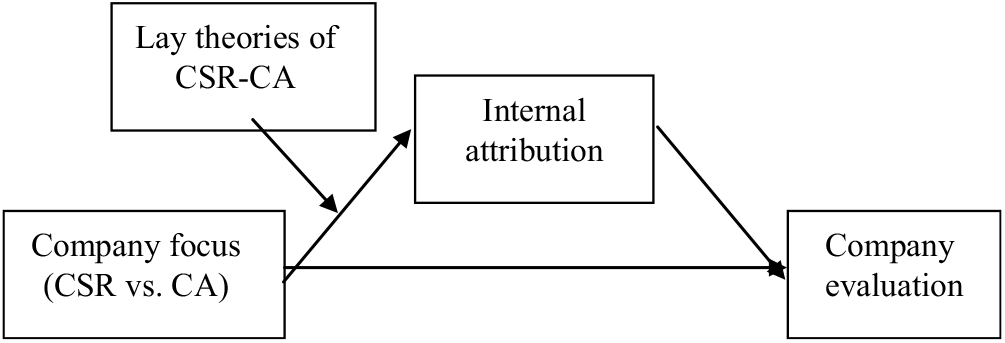
Hypothesis 1 (H1): In a product-harm crisis, there would be a significant interaction of company focus and lay theory of CSR and CA on company evaluation, such that a CSR-focused company (vs. a CA-focused company) will receive higher company evaluation only among people who hold a compatible theory about CSR and CA.
Hypothesis 2 (H2): Internal attribution of the inference that the company is responsible for the product-harm crisis would mediate the above interaction effect of company focus and lay theory of CSR and CA on company evaluation.
The above hypotheses are outlined in Figure 1. We also expect that the hypothesized effect of lay theories about CSR and CA in the product-harm crisis is independent of consumers’ personal prosocial behaviors, although there is a possibility that the lay theories about CSR and CA may be confounded with the participants’ prosocial orientation. People who actively engage in prosocial behaviors and endorse philanthropic values are more likely to support companies with CSR orientation. For example, people who value self-transcendence (i.e. protecting the welfare of all) and care about social issues favor companies that practice ethical philanthropic-based CSR (Hallahan, Reference Hallahan2001). Socially responsible individuals are sensitive to a company’s CSR initiatives (Feldman & Vasquez-Parraga, Reference Feldman and Vasquez-Parraga2013; Mohr et al., Reference Mohr, Webb and Harris2001), and people’s reaction toward CSR is affected by their altruistic values (Romani, Grappi, & Bagozzi, Reference Romani, Grappi and Bagozzi2013) and prosocial motive (Basil & Weber, Reference Basil and Weber2006). However, these studies tend to suggest a positive relationship between prosocial motive and CSR endorsement, rather than how prosocial people view the relationship between CSR and CA. Besides, for people who do not engage in prosocial activities, they may also have a compatible belief about CSR and CA if they encounter more information and cases that a company is socially responsible and also has a good marketing performance. To examine the premise that the hypothesized effect is not influenced by people’s prosocial behaviors, we measured participants’ prosocial experience in the present research.
The conceptual model.
Methods
We carried out an experiment to test the above hypotheses. The experiment used a one-factor (company focus: CSR vs. CA) between-subjects design. The procedure of the study was: (1) we measured participants’ lay theories about CSR and CA; (2) participants viewed a webpage of a fictitious company, in which the company focus (CSR vs. CA) is manipulated; (3) participants read a news report about a product crisis of the company; (4) we measured participants’ attribution tendency of the product failure and company evaluation; (5) we measured participants’ previous prosocial behavior and collected their demographic information. We hypothesized that participants who held a compatible theory about CSR and CA would respond more positively to the product crisis if the company had a CSR versus CA focus. In contrast, participants who held an incompatible theory about CSR and CA would respond equally negatively to the product crisis of a CSR-focused company and that of a CA-focused company. We also hypothesized that internal attribution of the product crisis to the company would mediate the interaction effect of company focus and lay theory on company evaluation.
Stimuli and pretest
The target company that we used in the main study was a fictitious kitchenware company, called ‘Tian Qi’. We used a fictitious company to ensure that prior knowledge of an existing company would not bias the participants’ judgments. We created a webpage to manipulate the CSR versus CA focus of the company. Participants did not know that the company was a fictitious one. In the CSR-focused condition, consistent with the European Commission’s definition of CSR as a concept integrating social and environmental concerns into business strategies and operations, the webpage highlighted Tian Qi’s commitment to repaying society and the environment, and its contributions to CSR activities. CA is a company’s expertise in producing and delivering good quality products, and research and development (R&D) and innovativeness are considered as key attributes of CA (Feldman & Vasquez-Parraga, Reference Feldman and Vasquez-Parraga2013). Thus, in the CA-focused condition, the webpage highlighted Tian Qi’s focus on R&D and how its heavy investment in R&D had led to a good performance in technological innovation.
To ensure that the participants perceived the two web pages equally favorably, we conducted a pretest before the main study by recruiting 30 participants who were independent of the main study. In the pretest, we randomly assigned 30 participants to browse one of the web pages and rated the extent to which its design and contents were good on a 7-point Likert-type scale (1 = strongly disagree, 7 = strongly agree). Pretest participants perceived the two web pages equally favorably (M = 5.21 for the CSR-focused webpage and M = 4.50 for the CA-focused webpage), F(1, 28) = 2.30, p = .141. As a manipulation check, we also had the pretest participants use the same scale (1 = strongly disagree, 7 = strongly agree) to evaluate the webpage they browsed on two items: “The company has a strong commitment to corporate social responsibility” and “The company has a strong commitment to technological innovation”. One pretest participant did not respond to these items. As expected, participants rated the company’s commitment to CSR to be higher after browsing the CSR-focused webpage (M = 5.07) than the CA-focused one (M = 4.07), F(1, 27) = 4.50, p = .043. Participants also evaluated the company’s commitment to technological innovation to be higher after browsing the CA-focused webpage (M = 5.53) than the CSR-focused one (M = 3.64), F(1, 27) = 16.27, p < .001).
Participants, procedure, and measures
A total of 137 Chinese citizens (52.6% female) were recruited from a public university in Beijing, China. Their mean age was 23.06 years (SD = 2.73). We first assessed participants’ lay theories about CSR and CA using a scale adapted from Sen and Bhattacharya (Reference Sen and Bhattacharya2001; 7-point Likert-type scale; α = .92; M = 4.01, SD = 1.03) before the manipulation of company focus. The scale included 10 items (see Appendix). Two sample items are: “Socially responsible activities detract from companies’ ability to provide the best possible products” and “Socially responsible activities could be carried out at the expense of improved product offerings”. We reversed the scores in the analysis, and higher scores on this measure indicate a stronger belief in the compatibility of CSR and CA.
All participants were then randomly assigned to the CA-focused condition or CSR-focused condition. That is, they browsed the webpage of the fictitious company, Tian Qi, which was either CSR-focused or CA-focused. Next, they learned from reading a fictitious newspaper article that dozens of consumers had complained about the new microwave ovens produced by Tian Qi. According to the article, Tian Qi’s new microwave ovens were extremely noisy and their power supply mechanisms were defective.
After reading the article, the participants responded to two attribution items adapted from Klein and Dawar (Reference Klein and Dawar2004). In the first item, participants rated the likelihood that Tian Qi versus other outside parties was causally responsible for the product problem (7-point scale, 1 = very unlikely, 7 = very likely). In the second question, participants were asked to determine on a percentage scale (0–100%) the extent to which Tian Qi (vs. other outside parties) was responsible to the product problem. The two items were highly correlated (r = .66, p < .001). We standardized them (SD = .91) and used their mean to form an index of internal attribution (i.e. the extent to which Tian Qi was causally responsible for the product problem).
Next, we measured company evaluation using the measure adapted from Klein and Dawar (Reference Klein and Dawar2004; a 7-point Likert-type scale; α = .91; M = 3.88, SD = .85). The adapted measure included four items: “Generally speaking, what would you guess is the overall quality of Tian Qi? (bad/good)”, “In your opinion, Tian Qi is not at all trustworthy/very trustworthy”, “Tian Qi is not at all dependable/very dependable”, and “Tian Qi is not at all concerned about customers/very concerned about customers”.
To establish the robustness of the hypothesized results, we also measured the participants’ prosocial behaviors in the present research. To exclude the confounding influence of prosocial orientation, the participants reported whether they had participated in any volunteer activities in the last year. If they had, they would be asked to use a 7-point scale to evaluate the extent to which the experience was (a) pleasant versus unpleasant, and (b) meaningful versus meaningless (α = .86). The mean score of these two items was used to form a measure of positive prosocial experiences, with higher scores indicating more positive experiences.
At the end of the study, participants responded to demographic questions and were asked about what they thought of the purpose of the study was and were fully debriefed. None of the participants knew the real purpose of the study.
Results
Effect of lay belief on company evaluation
To test our hypothesis that lay theories of CSR-CA moderated the effect of the company’s focus on CSR versus CA on company evaluation, we performed a company focus × lay theory general linear model (GLM) company evaluation. Scores of lay theories about CSR and CA were mean-centered to minimize the influence of multicollinearity (Aiken & West, Reference Aiken and West1991). Results showed that the two-way interaction on evaluation was significant, F(1, 133) = 5.60, p = .019, supporting H1. The main effect of the company focus on evaluation was not significant, F(1, 133) = .83, p = .364.
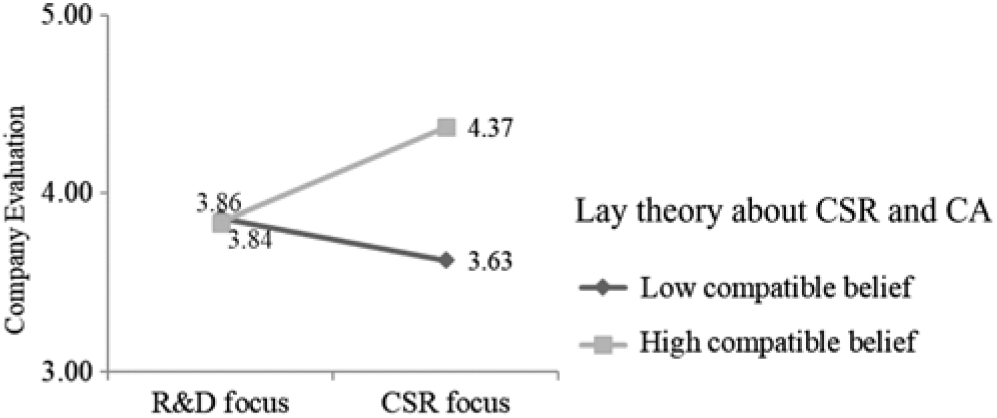
To better understand the pattern of the interaction effect, we also performed an ordinary least squares regression analysis on company evaluation, with the CSR-CA lay theory (mean-centered) and the experimental manipulation of company focus (CA condition = 0, CSR condition = 1) and their interaction as predictors. As seen in Table 1 (regression 1), both main effects were non-significant. As hypothesized, the company focus × lay theory interaction significantly predicted participants’ company evaluation after a product crisis (β = .37, p = .019). Figure 2 illustrates the nature of this interaction. Follow-up simple slope analysis shows that when participants believed more strongly that CSR and CA were compatible (one standard deviation above the mean), they evaluated the CSR-focused company more favorably than they did the CA-focused company (β = .53, p = .023). In contrast, when participants believed less strongly that CSR and CA were compatible (one standard deviation below the mean), they evaluated the CSR- and CA-focused companies equally favourably (β = -.24, p = .306). That is, having a CSR focus is a buffer against negative company evaluations following a product crisis only among individuals who believe strongly that CSR and CA are compatible with each other.
Regression Results for the Company Focus × Lay Theory Effect on Company Evaluation and Internal Attribution
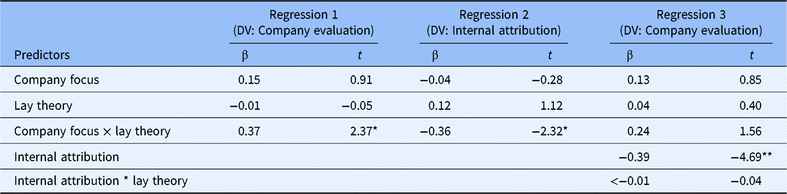
Note: Unstandardized coefficients; Higher scores on the lay theory measure indicate stronger beliefs in the compatibility of CSR and CA; Variable coding: Company focus = 1 if the focus was CSR, and 0 if it was R&D.
*p < .05. **p < .001
Interactive effect of company focus and lay theory about CSR and CA on company evaluation.
Moderating effect of lay theory on attribution
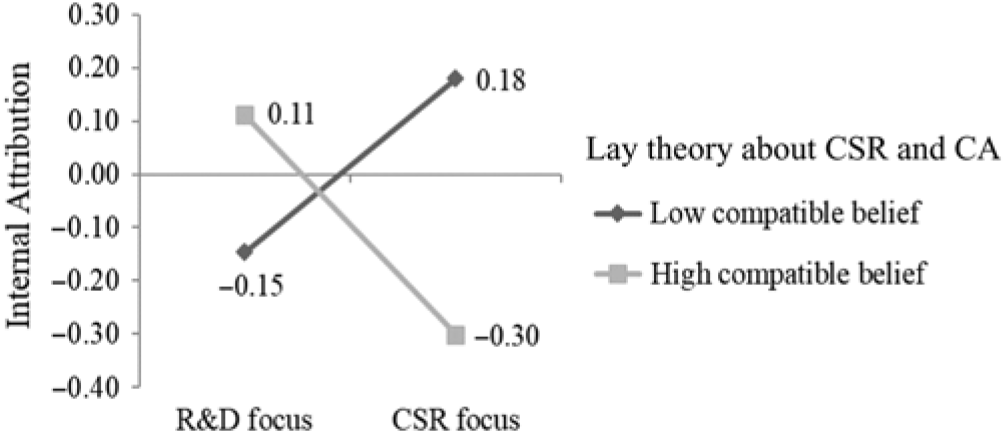
Regression results (regression 2 in Table 1) show that the company focus × lay theory interaction also significantly predicted internal attribution (β = -.36, p = .022). As shown in Figure 3, simple slope test results show that for participants with relatively strong belief in the compatibility of CSR and CA (one standard deviation above the mean), the CSR-focused company was less responsible for the product crisis than the CA-focused company (β = -.41, p = .071). In contrast, among participants with relatively weak belief in the compatibility of CSR and CA (one standard deviation below the mean), the CSR- and CA-focused companies were held responsible for the product crisis to the same extent (β = .32, p = .145).
Interactive effect of company focus and lay theory about CSR and CA on internal attribution.
Robust tests
To test whether the company focus × lay theory interaction on company evaluation and internal attribution remained significant after controlling for the participants’ prosocial experiences, we coded whether the participants had prior prosocial experience in the past year (1 = no, 0 = yes) and if they did, whether the experience was positive. Experiences with lower than average ratings on the positivity of prosocial experiences (<5.59) were coded as negative experiences (1) and those with higher than average ratings (>5.59) were coded as positive experiences (0). As seen in Table 2, when prosocial experience, experience valence, as well as their interactions with company focus and lay theory were entered into the regression equations, the only significant effect involving prosocial experience and experience valence was the main effect of prosocial experience on company evaluation: participants with prosocial experiences evaluated the company more favorably than did those without prosocial experiences (β = -.59, p = .027). After controlling for the effects of prosocial experience, experience valence, and their interactions with company focus, the company focus × lay theory interaction still significantly predicted company evaluation (β = .64, p = .025) and internal attribution (β = -.57, p = .042). These results attest to the robustness of the effect of the company focus × lay theory interaction on consumer reactions to product crisis.
Regression results for the company focus × lay theory effect on company evaluation and internal attribution after controlling for prosocial experiences

Note: Unstandardized coefficients; Variable coding: Company focus = 1 if the focus was CSR, and 0 if the focus was R&D; Prosocial experience = 1 if participants did not have prior prosocial experience, and 0 if otherwise; Experience valence = 1 if participants’ prior prosocial experience was negative (i.e. below the mean), and 0 if otherwise.
* p<.05
Test of mediated moderation
We hypothesized that internal attribution would mediate the interaction effect of company focus and lay theory on company evaluation (H2). To examine this hypothesis, we performed a mediated moderation analysis following the procedures suggested by Muller, Judd, and Yzerbyt (Reference Muller, Judd and Yzerbyt2005). As mentioned earlier, the company focus × lay theory interaction was significant on both internal attribution and company evaluation, meeting the first two criteria of mediated moderation. As shown by regression 3 in Table 2, internal attribution negatively predicted company evaluation (β = -.39, p < .001), meeting the third criterion of mediated moderation. After controlling for the effect of internal attribution and its interaction with lay theory, the company focus × lay theory interaction was no longer significant (t = 1.56). These results together suggested that for individuals who believe strongly that CSR and CA are compatible, a company’s focus on CSR can exonerate the company from the causal responsibility of the product crisis, which in turn enhances company evaluation.
Discussion
Increasingly, the public expects companies to behave socially responsibly, and in response, companies have become more CSR conscious in their routine business activities and when they respond to unexpected circumstances, such as product-harm crises and disaster reliefs. The general public, particularly individuals with a strong prosocial orientation, tends to evaluate companies with a greater commitment to CSR in business routines more favorably (e.g. Berens, van Riel, & van Rekom, Reference Berens, van Riel and van Rekom2007). However, as shown in the present experiment, companies will face negative evaluation when they produce defective products. Even individuals with prior pleasant prosocial experiences would evaluate a firm negatively when it is involved in a product-harm crisis.
Nonetheless, following a product-harm crisis, observers may exonerate a company with a CSR focus. This is the case particularly among those who believe that a company’s CSR engagement will not undermine the company’s CA. If the observers believe that CSR engagement would inevitably reduce a company’s CA, they would view a company’s CSR engagement as a sign of low CA and attribute causal responsibility of the product-harm crisis to the company. The company will therefore experience significant reputation loss.
Theoretical contributions
Product-harm crises can cause a significant loss in company revenue, market share, reputation, marketing competitiveness and financial performance (Bronnenberg & Wathieu, Reference Bronnenberg and Wathieu1996; Chen et al., Reference Chen, Ganesan and Liu2009; Cleeren, van Heerde, & Dekimpe, Reference Cleeren, van Heerde and Dekimpe2013; van Heerde et al., Reference Van Heerde, Helsen and Dekimpe2007; Thirumalai & Sinha, Reference Thirumalai and Sinha2011). Thus, it is important to know whether a company’s CSR engagement can protect the company from potential reputation loss when a crisis occurs. Several past studies have shown that good past performance in CSR activities (Assiouras et al., Reference Assiouras, Ozgen and Skourtis2013; Kim, Reference Kim2014; Klein & Dawar, Reference Klein and Dawar2004; Lin et al., Reference Lin, Chen, Chiu and Lee2011) and the intention to perform CSR activities (Yoon et al., Reference Yoon, Gurham-Canli and Schwartz2006) can reduce a company’s reputation loss in a product crisis. The current research adds to this literature by showing that the benefits of CSR in a product crisis have boundaries. Specifically, although individuals who believe that CSR and CA are compatible tend to exonerate a CSR-focused (vs. CA-focused) company involved in a product-harm crisis, those who believe in the incompatibility of CSR and CA do not.
Second, past research has identified several factors that may reduce negative responses to a product-harm crisis, including the company’s coping strategies and the public’s prior impression of the company (e.g. Dawar & Pillutla, Reference Dawar and Pillutla2000). The present study adds to this literature by showing that a company’s prior engagement in CSR can also soften observers’ negative responses, although this effect is restricted to those who believe that CSR efforts would not undermine the company’s CA.
Third, a company can foster its reputation by highlighting its focus on CSR or CA (Berens et al., Reference Berens, van Riel and van Bruggen2005; Biehal & Sheinin, Reference Biehal and Sheinin2007). However, it is still unclear whether CA and CSR influence a company’s reputation in the same way (see Fatma & Rahman, Reference Fatma and Rahman2015). We begin to address this research gap by showing that compared to its prior CA record, a company’s CSR record is more able to protect the company from the potential reputation loss in a product-harm crisis, although the relative efficacy of CSR over CA in this protective function is limited to observers who subscribe to a compatible theory of CSR and CA.
Finally, the present research applies the lay theories approach to predict public reactions to a product-harm crisis from the observers’ psychological characteristics (Pérez & Bosque, Reference Pérez and Bosque2013). Previous research shows that observers’ value system, such as Christian faith and Confucian values (Jamali & Sdiani, Reference Jamali and Sdiani2013; Ramasamy, Yeung, & Chen, Reference Ramasamy, Yeung and Chen2013), or attribution styles (dispositional vs. situational attribution style; Lim, Sung, & Lee, Reference Lim, Sung and Lee2018), predicts support for CSR. We extend this literature by showing that lay conception of the relationship between CSR and CA is another personal attribute that influences the observers’ support for CSR-focused companies in a crisis context. When the observers hold a compatible theory about CSR and CA, they evaluate a CSR-focused company more positively. As we will explain in the next section, this finding has managerial implications for product crisis management.
Managerial implications
When a product-harm crisis occurs, the company can reduce potential reputation loss by emphasizing its prior investment in product development to signal its strong ability and determination to produce and deliver good quality products. However, if, despite the company’s high investment in CA, a product-harm crisis occurs in the company, the observers may have serious doubt on the company’s actual CA and evaluate the company negatively.
Alternatively, the company can emphasize its CSR engagement to signal its commitment to prosocial values. This strategy may lead the public to infer that the company did not intend the product failures and they will exonerate the company. However, a company will benefit from having a CSR focus only when the observers believe that CSR does not undermine CA.
Lay theories are malleable. That is, to benefit from a compatible theory of CSR and CA, companies can promote to the public how CA and CSR can enhance each other. For example, companies can point out how engagement in CSR can inspire the development of new products and business models, improving the company’s CA. Companies may also highlight how improved CA enables a company to pursue its CSR goals more effectively. The emphasis on the mutual benefits of CA and CSR in corporate communication can strengthen the public’s belief in a compatible theory of CA and CSR. This strategy is useful not only to the company in a product-harm crisis, but also companies that may suffer reputation loss spread from a crisis in a related company (Gao, Knight, Zhang, & Mather, Reference Gao, Knight, Zhang and Mather2013) or another company in the same industry (Roehm & Tybout, Reference Roehm and Tybout2006).
Future research
The present research has limitations that need to be addressed in future research. First, the current study examined the role of CSR in a product-harm crisis for one product category (microwave oven) only. In addition, some product-harm crises elicit stronger negative reactions than others. For example, people tend to have strong reactions to harmful failures in products that are consumed by humans physically (e.g. food and drinks; Haas-Kotzegger & Schlegelmilch, Reference Haas-Kotzegger and Schlegelmilch2013). To further generalize our results, we need to replicate the present study using product-harm crises of different degrees of severity.
In response to the call for carrying out CSR studies in transforming economies (Fatma & Rahman, Reference Fatma and Rahman2015), we conducted the current study in China. Nonetheless, a limitation of our study is that only student samples were included in the present investigation. We welcome replication of the present study in other countries using a community sample. Furthermore, instead of testing our hypothesis using a fictitious product-harm crisis, we welcome future big data studies that analyze social media responses to product-harm crises in CSR- and CA- focused firms.
While our focus here was in the context of product crisis, the interactive mechanism of lay theory and company focus may also exert influence on brand preference in the context of new product launch. Usually, consumers have limited purchase experience with new products, and they may infer product quality from a company’s prior marketing performance. As a CA-focused company signals the intense effort and expertise in improving product performance and CSR information is not directly related to product performance, a new product launched by a CA-focused company would lead to a more favorable evaluation than a new product launched by a CSR-focused company. However, if consumers believe that CSR and CA are compatible, a CSR-focused company may yield a similar positive product evaluation as a CA-focused company, because those consumers consider CSR efforts as reinforcement of a company’s ability, and would believe that a CSR-focused company has the capability to produce high-quality products. This potential mechanism could be examined in future research. Finally, as argued earlier, firms that are not directly involved in a product-harm crisis may also suffer from spill-over reputation loss if the crisis occurs in a related company or another company in the same industry. In these instances, mechanisms other than causal responsibility attribution may mediate public evaluations of these indirectly affected firms (since these firms could not be held causally responsible for the crisis). One mechanism is the amount of trust in the company. How may firm focus and lay theories of CSR and CA influence trust and company evaluation of indirectly affected firms? This is another question that merits future investigation.
Disclosure of potential conflicts of interest
The author(s) declare no potential conflicts of interest with respect to the research, authorship, and/or publication of this article.
Funding
The author(s) received no financial support for the research, authorship, and/or publication of this article.
Appendix Measures Used in the Study
Lay theories about CSR and CA (7-point scales; 1= strongly disagree, 7 = strongly agree; adapted from Sen & Bhattacharya, Reference Sen and Bhattacharya2001)
1. Socially responsible behavior detracts from companies’ ability to provide the best possible products. (r)
2. Socially responsible behavior is a drain on a company’s resources. (r)
3. Socially responsible behavior by firms is often a cover-up for inferior product offerings. (r)
4. Socially responsible firms produce worse products than do firms that do not worry about social responsibility. (r)
5. All else equal, a socially responsible firm is likely to have lower technological expertise than a firm that is not socially responsible. (r)
6. Firms that devote resources towards socially responsible actions have fewer resources available for increasing employee effectiveness. (r)
7. A company can be both socially responsible and manufacture products of high value.
8. Firms engage in socially responsible behaviors to compensate for inferior product offerings. (r)
9. Resources devoted to social responsibility come at the expense of improved product offerings. (r)
10. Socially responsible behavior by firms is often a cover-up for weak capabilities. (r)
Internal attribution (adapted from Klein & Dawar, Reference Klein and Dawar2004)
11. Please rate the likelihood that Tian Qi versus other outside parties was causally responsible for the product problem (7-point scale, 1 = very unlikely, 7 = very likely)
12. Please assign a percentage of the problem that might be due to each of the following parties (with totals summing to 100%)
Tian Qi:______
Other parties except for Tian Qi:______
Company evaluation (7-point scales; adapted from Klein & Dawar, Reference Klein and Dawar2004)
1. Generally speaking, what would you guess is the overall quality of Tian Qi? (1 = bad, 7 = good)
2. In your opinion, Tian Qi is not at all trustworthy/very trustworthy.
3. Tian Qi is not at all dependable/very dependable.
4. Tian Qi is not at all concerned about customers/very concerned about customers”.
Prosocial behavior
1. Have you participated in any volunteer activities in the last year? Yes/No
2. (if participants choose Yes in the above question) Please evaluate your volunteer experience: unpleasant/pleasant, meaningless/meaningful (7-point scales).




 Open access

