


1 Introduction
In February 2022, Russia invaded Ukraine. This invasion shifted the relations that numerous European countries had with the belligerents. The EU member states, including previously Russia-aligned countries such as Hungary, sanctioned Russia and provided support to Ukraine. Belarus, a close ally of Russia, followed its partner into the conflict and was accordingly also sanctioned by the EU member states. Turkey, a political and economic partner of both Ukraine and Russia, struggled to remain neutral in the conflict and therefore sought to mediate between the belligerents. The Russian attack was thus followed by geopolitical adjustments, demonstrating the importance of positive and negative ties in the international network of states. This shows how pairwise cooperation and conflict between countries are interdependent.
Political scientists have studied this interplay of positive and negative ties between states since the early 1960s (Harary Reference Harary1961). In this context, international relations are conceived as signed networks, where the nodes are states and the edges are either positive, corresponding to bilateral cooperation, negative, expressing bilateral conflict, or non-existent. Most of this research directly builds on structural balance theory, which postulates that triads are balanced if they include an odd number of positive relations and unbalanced if that number is either even (“strong” structural balance; Cartwright and Harary Reference Cartwright and Harary1956; Heider Reference Heider1946) or exactly two (“weak” structural balance; Davis Reference Davis1967)Footnote 1. Accordingly, International Relations scholars have applied this theory from Social Psychology to the behavior of states, studying whether specific triangular constellations correspond with its propositions (Doreian and Mrvar Reference Doreian and Mrvar2015; Harary Reference Harary1961; Healy and Stein Reference Healy and Stein1973; McDonald and Rosecrance Reference McDonald and Rosecrance1985) and what implications structural balance has for community formation and system polarization (Hart Reference Hart1974; Lee, Muncaster, and Zinnes Reference Lee, Muncaster and Zinnes1994). More recent studies seek to test whether structural balance affects interstate conflict and cooperation in an inferential framework (Kinne and Maoz Reference Kinne and Maoz2023; Lerner Reference Lerner2016; Maoz et al. Reference Maoz, Terris, Kuperman and Talmud2007).
Beyond this work, there is a wider, quickly growing literature in International Relations that investigates networks with binary, i.e., non–signed, ties. Early key works here propose to conceptualize International Relations as a network where states are nodes connected by dyadic ties consisting of their political relations, and call attention to the new theoretical insights this perspective can offer (see Hafner-Burton, Kahler, and Montgomery Reference Hafner-Burton, Kahler and Montgomery2009; Maoz Reference Maoz2010; Maoz et al. Reference Maoz, Kuperman, Terris and Talmud2006). These studies emphasize the importance of endogenous network processes, such as brokerage, triadic closure, and structural equivalence, in the formation of International Relations networks. In parallel, other research showed that, empirically, studying such networks using methods that assume conditional independence risks faulty statistical inferences and introduced more appropriate methods for the study of International Relations networks (Cranmer and Desmarais Reference Cranmer and Desmarais2016; Hoff and Ward Reference Hoff and Ward2004; Poast Reference Poast2010).
The most prominent of these methods arguably are Exponential Random Graph Models (ERGMs), as introduced to the Political Science and International Relations literature by Cranmer and Desmarais (Reference Cranmer and Desmarais2011), which explicitly allow modeling and testing the empirical relevance of network effects. ERGMs have been applied to study the endogenous network effects structuring alliance formation (Cranmer, Desmarais, and Kirkland Reference Cranmer, Desmarais and Kirkland2012a; Cranmer, Desmarais, and Menninga Reference Cranmer, Desmarais and Menninga2012b) and conflict between countries (Campbell, Cranmer, and Desmarais Reference Campbell, Cranmer and Desmarais2018), but also military interventions (Corbetta Reference Corbetta2013), arms transfers (Thurner et al. Reference Thurner, Schmid, Cranmer and Kauermann2019), and foreign direct investment ties (Schoeneman, Zhu, and Desmarais Reference Schoeneman, Zhu and Desmarais2022). An alternative method, the Stochastic Actor Oriented Model (SAOM, see Snijders Reference Snijders2017), has been employed to investigate the network dynamics driving alliances, arms transfers, bilateral lending, and formal defense cooperation agreements (Kinne Reference Kinne2016; Kinne and Bunte Reference Kinne and Bunte2020; Warren Reference Warren2010). What all this work, however, has in common is its focus on binary networks where ties are either present or absent. Latent variable-based methods that allow substantively focusing on exogenous, non-network covariates while statistically accounting for unknown network effects have also increasingly found use within International Relations and can be applied to non-binary, weighted networks (see Dorff, Gallop, and Minhas Reference Dorff, Gallop and Minhas2020; Minhas et al. Reference Minhas, Dorff, Gallop, Foster, Liu, Tellez and Ward2022; Minhas, Hoff, and Ward Reference Minhas, Hoff and Ward2016)Footnote 2. But these models, in turn, do not permit explicitly testing the influence of network effects and, importantly, currently also do not exist for signed networks.
The inferential study of signed networks, within but also outside of International Relations, so far has thus mainly relied on logistic regression (Lerner Reference Lerner2016; Maoz et al. Reference Maoz, Terris, Kuperman and Talmud2007) or perceiving the observations as multivariate networks with multiple layers (Huitsing et al. Reference Huitsing, van Duijn, Snijders, Wang, Sainio, Salmivalli and Veenstra2012; Huitsing et al. Reference Huitsing, Snijders, Van Duijn and Veenstra2014; Stadtfeld, Takács, and Vörös Reference Stadtfeld, Takács and Vörös2020), where one level relates to the positive and another to the negative edges. While the former approach disregards endogenous dependence, the latter only allows for dependence between the separate observed layers of the network. Moreover, the multilayer approach does not adequately capture that most interactions in signed networks are either positive, negative, or non-existent. In other words, countries having negative and positive relations at the same time is unrealistic. Finally, the model closest to ours is introduced by Yap and Harrigan (Reference Yap and Harrigan2015). This model, however, is purely cross-sectional and constrained to networks of the same positive and negative density as the observed one. In other words, an existing positive tie can only be removed if, elsewhere in the network, a new positive tie is created at the same time. This restraint imposes an empirically often untenable assumption, complicates model interpretation, and results in overconfident uncertainty quantification.
In the context of binary networks, Frank and Strauss (Reference Frank and Strauss1986) proposed ERGMs as a generative model for a network encompassing n actors represented by the adjacency matrix ${\mathbf {y}} = ({\mathbf {y}}_{ij})_{i,j = 1, ..., n}$
, where
${\mathbf {y}} = ({\mathbf {y}}_{ij})_{i,j = 1, ..., n}$
, where $y_{ij} = 1$
translates to an edge between actors i and j and
$y_{ij} = 1$
translates to an edge between actors i and j and ${y}_{ij} = 0$
indicates that there is no edge. Henceforth, we use lowercase letters for variables when referring to the realized value of a random variable, i.e., the observed network
${y}_{ij} = 0$
indicates that there is no edge. Henceforth, we use lowercase letters for variables when referring to the realized value of a random variable, i.e., the observed network $\mathbf {y}$
, and capitalize the name to indicate that they are stochastic random variables, for instance,
$\mathbf {y}$
, and capitalize the name to indicate that they are stochastic random variables, for instance, $\mathbf {Y}$
. Within this framework, Wasserman and Pattison (Reference Wasserman and Pattison1996) formulate a probability distribution over all possible
$\mathbf {Y}$
. Within this framework, Wasserman and Pattison (Reference Wasserman and Pattison1996) formulate a probability distribution over all possible $\mathbf {y} \in {\mathcal {Y}}$
by a canonical exponential family model:
$\mathbf {y} \in {\mathcal {Y}}$
by a canonical exponential family model:
 $$ \begin{align} \mathbb{P}_{\boldsymbol{\theta}}(\mathbf{Y} = \mathbf{y}) = \frac{\exp \left\{ \boldsymbol{\theta}^\top\mathbf{s}( \mathbf{y}) \right\}}{\kappa(\boldsymbol{\theta})} ~ \forall ~ \mathbf{y} \in \mathcal{{Y}}, \end{align} $$
where $\mathcal {{Y}}$
is the set of all observable binary adjacency matrices among n fixed actors,
$\mathcal {{Y}}$
is the set of all observable binary adjacency matrices among n fixed actors, $ \mathbf{s}\text { : }\mathcal {{Y}} \rightarrow \mathbb {R}^p$
is a function of sufficient statistics weighted by the coefficients
$ \mathbf{s}\text { : }\mathcal {{Y}} \rightarrow \mathbb {R}^p$
is a function of sufficient statistics weighted by the coefficients $\theta \in \Theta \subseteq \mathbb {R}^p$
, and
$\theta \in \Theta \subseteq \mathbb {R}^p$
, and $\kappa (\boldsymbol {\theta }) := \sum _{\tilde {\mathbf {y}} \in \mathcal {{Y}}} \exp \{\theta ^\top \mathbf {s}( \tilde {\mathbf {y}})\}$
is a normalizing constant. Possible choices for the sufficient statistics
$\kappa (\boldsymbol {\theta }) := \sum _{\tilde {\mathbf {y}} \in \mathcal {{Y}}} \exp \{\theta ^\top \mathbf {s}( \tilde {\mathbf {y}})\}$
is a normalizing constant. Possible choices for the sufficient statistics $\mathbf {s}( \mathbf {{y}})$
of directed networks include the number of edges and triangles in the network (see Lusher, Koskinen, and Robins Reference Lusher, Koskinen and Robins2012 for a detailed overview of the model and other possible statistics). Depending on the specific sufficient statistics, ERGMs relax the often unrealistic conditional independence assumption inherent to most standard regression tools in dyadic contexts and allow general dependencies between the observed relations. In many applications, auxiliary information
$\mathbf {s}( \mathbf {{y}})$
of directed networks include the number of edges and triangles in the network (see Lusher, Koskinen, and Robins Reference Lusher, Koskinen and Robins2012 for a detailed overview of the model and other possible statistics). Depending on the specific sufficient statistics, ERGMs relax the often unrealistic conditional independence assumption inherent to most standard regression tools in dyadic contexts and allow general dependencies between the observed relations. In many applications, auxiliary information $\mathbf {x}$
exogenous to the network is available, which can also be used in the sufficient statistics. For brevity of the notation, we omit the dependence of
$\mathbf {x}$
exogenous to the network is available, which can also be used in the sufficient statistics. For brevity of the notation, we omit the dependence of $\mathbf {s}$
on
$\mathbf {s}$
on $\mathbf {x}$
. Due to this ability to flexibly specify dependence among relations, account for exogenous information, the desirable properties of exponential families, and versatile implementation in the
$\mathbf {x}$
. Due to this ability to flexibly specify dependence among relations, account for exogenous information, the desirable properties of exponential families, and versatile implementation in the $\mathtt {ergm}\ \mathtt {R}$
package (Handcock et al. Reference Handcock, Hunter, Butts, Goodreau and Morris2008; Hunter, Goodreau, and Handcock Reference Hunter, Goodreau and Handcock2008a), the ERGM is a core inferential approach in the statistical analysis of networks. Methodological research in political science has further extended this framework to accommodate continuous edges (Desmarais and Cranmer Reference Desmarais and Cranmer2012), incorporate actor-specific unobserved heterogeneity (Box-Steffensmeier, Christenson, and Morgan Reference Box-Steffensmeier, Christenson and Morgan2018), and to account for the specific dynamics of substantive application cases such as court citation networks (e.g. Schmid, Chen, and Desmarais Reference Schmid, Chen and Desmarais2022). Accordingly, it underlies much of the research on networks in International Relations we discuss above (see, e.g., Cranmer, Desmarais, and Menninga Reference Cranmer, Desmarais and Menninga2012b; Thurner et al. Reference Thurner, Schmid, Cranmer and Kauermann2019).
$\mathtt {ergm}\ \mathtt {R}$
package (Handcock et al. Reference Handcock, Hunter, Butts, Goodreau and Morris2008; Hunter, Goodreau, and Handcock Reference Hunter, Goodreau and Handcock2008a), the ERGM is a core inferential approach in the statistical analysis of networks. Methodological research in political science has further extended this framework to accommodate continuous edges (Desmarais and Cranmer Reference Desmarais and Cranmer2012), incorporate actor-specific unobserved heterogeneity (Box-Steffensmeier, Christenson, and Morgan Reference Box-Steffensmeier, Christenson and Morgan2018), and to account for the specific dynamics of substantive application cases such as court citation networks (e.g. Schmid, Chen, and Desmarais Reference Schmid, Chen and Desmarais2022). Accordingly, it underlies much of the research on networks in International Relations we discuss above (see, e.g., Cranmer, Desmarais, and Menninga Reference Cranmer, Desmarais and Menninga2012b; Thurner et al. Reference Thurner, Schmid, Cranmer and Kauermann2019).
In this article, we show how (1.1) can be extended to signed networks under general dependency assumptions and coin the term Signed Exponential Random Graph Model (SERGM) for the resulting model. The SERGM provides an inferential framework to test the predictions of, e.g., structural balance theory (Cartwright and Harary Reference Cartwright and Harary1956; Heider Reference Heider1946) without assuming that all observed relations are independent of one another. This characteristic is of vital importance given that balance theory explicitly posits that the sign of one relation depends on the state of other relations in the network. As the introductory examples suggest, interdependence-driven sign changes occur rapidly between states, necessitating endogenous network statistics to capture them adequately. Along these lines, Lerner (Reference Lerner2016, 75) notes that “tests of structural balance theory” should not rely on “models that assume independence of dyadic observations” and thereby flags the importance of developing an ERGM for signed networks. We answer this call by introducing and, via the $\mathtt {R}$
package
$\mathtt {R}$
package $\mathtt {ergm.sign}$
, providing statistical software in
$\mathtt {ergm.sign}$
, providing statistical software in $\mathtt {R}$
(R Core Team Reference Team2021) to implement the SERGM for static and dynamic networks, which is available in the Supplementary Materials.
$\mathtt {R}$
(R Core Team Reference Team2021) to implement the SERGM for static and dynamic networks, which is available in the Supplementary Materials.
Here, we apply this new model to analyze cooperation and conflict between states in the decade 2000–2010. Motivated by Maoz et al. (Reference Maoz, Terris, Kuperman and Talmud2007) and Lerner (Reference Lerner2016), we use the SERGM, as well as Maoz et al. (Reference Maoz, Terris, Kuperman and Talmud2007)’s approach with lagged triadic covariates, to investigate whether the formation of cooperative and conflictual ties in this network is in line with structural balance theory. Results from the SERGM indicate that this is the case. Countries are hence more likely to cooperate if they have the same partners or share common enemies. In contrast, testing structural balance via lagged statistics is found to fit less well and produces results that are substantively different from those of the SERGM and offer, at best, mixed support for structural balance theory.
We proceed as follows: In the consecutive section, we formally introduce the SERGM and a novel suite of sufficient statistics for capturing network topologies specific to signed networks. In Section 3, we detail how to estimate the parameters of the SERGM and quantify the uncertainty of the estimates. Next, we apply the introduced model class to the interstate network of cooperation and conflict in Section 4. Finally, we conclude with a discussion of possible future extensions.
2 The Model Formulation
First, we establish some notation to characterize signed networks. Assume that the signed adjacency matrix $\mathbf {y} = (y_{ij})_{i,j = 1, ..., n}$
was observed between n actors. Contrasting the binary networks considered in (1.1), the entries of this signed adjacency matrix
$\mathbf {y} = (y_{ij})_{i,j = 1, ..., n}$
was observed between n actors. Contrasting the binary networks considered in (1.1), the entries of this signed adjacency matrix $y_{ij}$
are either “
$y_{ij}$
are either “ $+$
”, “
$+$
”, “ $-$
”, or “0”, indicating a positive, negative, or no edge between actors i and j. To ease notation, we limit ourselves to undirected networks without any self-loops, i.e.,
$-$
”, or “0”, indicating a positive, negative, or no edge between actors i and j. To ease notation, we limit ourselves to undirected networks without any self-loops, i.e., $y_ {ij} = y_ {ji}$
and
$y_ {ij} = y_ {ji}$
and $y_{ii} =$
“0” holds for all
$y_{ii} =$
“0” holds for all $i,j = 1, ..., n$
. Nevertheless, the proposed model naturally extends to directed settings. We denote the space encompassing all observable signed networks between n actors by
$i,j = 1, ..., n$
. Nevertheless, the proposed model naturally extends to directed settings. We denote the space encompassing all observable signed networks between n actors by $\mathcal {Y}^\pm $
and specify a distribution over this space analogous to (1.1) in the following log-linear form:
$\mathcal {Y}^\pm $
and specify a distribution over this space analogous to (1.1) in the following log-linear form:
 $$ \begin{align} \mathbb{P}_{\boldsymbol{\theta}}(\mathbf{{Y}} =\mathbf{{y}}) = \frac{\exp \left\{ \boldsymbol{\theta}^\top\mathbf{s}( \mathbf{{y}}) \right\}}{\kappa(\boldsymbol{\theta})} ~ \forall ~ \mathbf{y} \in \mathcal{Y}^\pm. \end{align} $$
The function of sufficient statistics in (2.1) takes a signed network as its argument and determines the type of dependence between dyads in the network. A theoretically motivated suite of statistics one can incorporate as sufficient statistics follows in Section 2.1 but mirroring the term counting edges in binary networks, we can use the count of positive ties in signed network $\mathbf {y}$
via
$\mathbf {y}$
via
 $$ \begin{align*} \text{EDGE}^+( \mathbf{{y}}) = \sum_{i<j} \mathbb{I}(y_{ij} = \text{"+"}), \end{align*} $$
where $\mathbb {I}(\cdot )$
is the indicator function. Along the same lines, one can define a statistic for the number of negative edges
$\mathbb {I}(\cdot )$
is the indicator function. Along the same lines, one can define a statistic for the number of negative edges $\text {EDGE}^-( \mathbf {{y}})$
and use both statistics as intercepts in the model.
$\text {EDGE}^-( \mathbf {{y}})$
and use both statistics as intercepts in the model.
We can extend (2.1) to dynamic networks, which we denote by $\mathbf {Y}_1, ..., \mathbf {Y}_T$
for observations at
$\mathbf {Y}_1, ..., \mathbf {Y}_T$
for observations at $t = 1, ..., T$
, by assuming a first-order Markov dependence structure to obtain
$t = 1, ..., T$
, by assuming a first-order Markov dependence structure to obtain
 $$ \begin{align} \mathbb{P}_{\boldsymbol{\theta}}(\mathbf{Y}_t = \mathbf{y}_t|\mathbf{Y}_{t-1} = \mathbf{y}_{t-1}) = \frac{\exp \left\{ \boldsymbol{\theta}^\top\mathbf{s}( \mathbf{y}_{t}, \mathbf{y}_{t-1}) \right\}}{\kappa(\boldsymbol{\theta}, \mathbf{y}_{t-1})} ~ \forall ~ \mathbf{y}_t \in \mathcal{Y}^\pm. \end{align} $$
This mirrors the extension of binary ERGMs to Temporal ERGMs (TERGM, Hanneke, Fu, and Xing Reference Hanneke, Fu and Xing2010). The sufficient statistics encompassed in $\mathbf {s}(\mathbf {y}_{t}, \mathbf {y}_{t-1})$
capture within-network or endogenous dependencies through statistics that only depend on
$\mathbf {s}(\mathbf {y}_{t}, \mathbf {y}_{t-1})$
capture within-network or endogenous dependencies through statistics that only depend on $\mathbf {y}_{t}$
and between-network dependencies when incorporating
$\mathbf {y}_{t}$
and between-network dependencies when incorporating $\mathbf {y}_{t-1}$
. One instance of network statistics for between-network dependency is the stability statistic for positive edges
$\mathbf {y}_{t-1}$
. One instance of network statistics for between-network dependency is the stability statistic for positive edges
 $$ \begin{align*} \text{STABILITY}^+(\mathbf{{y}}_t,\mathbf{{y}}_{t-1}) = \sum_{i<j} \mathbb{I}(y_{ij,t} = \text{"+"})\mathbb{I}(y_{ij,t-1} = \text{"+"}), \end{align*} $$
which can equivalently be defined for negative ties. Thus, we assume that the observed network is the outcome of a Markov chain with state space $\mathcal {Y}^\pm $
and transition probability (2.2). Of course, we may also include exogenous terms in (2.2), i.e., any pairwise- or actor-specific information external to
$\mathcal {Y}^\pm $
and transition probability (2.2). Of course, we may also include exogenous terms in (2.2), i.e., any pairwise- or actor-specific information external to $\mathbf {y}_{\mathbf{t}}$
(the statistic defined in (2.8) is one possibility).
$\mathbf {y}_{\mathbf{t}}$
(the statistic defined in (2.8) is one possibility).
For the interpretation of the estimates, techniques from binary ERGMs can be adapted. To derive a local tie-level interpretation, let $\theta _q$
with
$\theta _q$
with $q \in \{1, ..., p\}$
denote the qth entry of
$q \in \{1, ..., p\}$
denote the qth entry of $\theta $
corresponding to the qth sufficient statistic,
$\theta $
corresponding to the qth sufficient statistic, $s_{q}( \mathbf {y}_t, \mathbf {y}_{t-1})$
. We further define
$s_{q}( \mathbf {y}_t, \mathbf {y}_{t-1})$
. We further define ${\mathbf {y}_t} = (y_{ij,t})_{i,j = 1, ..., n}$
for
${\mathbf {y}_t} = (y_{ij,t})_{i,j = 1, ..., n}$
for $t = 1, ..., T$
and denote the network
$t = 1, ..., T$
and denote the network $\mathbf {y}_t$
with the entry
$\mathbf {y}_t$
with the entry $y_{ij,t}$
fixed at “
$y_{ij,t}$
fixed at “ $+$
” by
$+$
” by $\mathbf {y}_{ij,t}^+$
. Then,
$\mathbf {y}_{ij,t}^+$
. Then, $\mathbf {y}_{ij,t}^-$
and
$\mathbf {y}_{ij,t}^-$
and $\mathbf {y}_{ij,t}^0$
are established accordingly. Let
$\mathbf {y}_{ij,t}^0$
are established accordingly. Let $\mathbf {y}_{(-ij),t}$
refer to the network
$\mathbf {y}_{(-ij),t}$
refer to the network $\mathbf {y}_t$
excluding the entry
$\mathbf {y}_t$
excluding the entry $y_{ij,t}$
. Due to the added complexity of signed networks, the distribution of
$y_{ij,t}$
. Due to the added complexity of signed networks, the distribution of $Y_{ij,t}$
conditional on
$Y_{ij,t}$
conditional on $\mathbf {Y}_{(-ij),t}$
is a multinomial distribution where the event probability of entry “+” is:
$\mathbf {Y}_{(-ij),t}$
is a multinomial distribution where the event probability of entry “+” is:
 $$ \begin{align} \begin{aligned} \mathbb{P}_\theta&(Y_{ij,t} =\text{"+"} | \mathbf{Y}_{(-ij),t} = \mathbf{y}_{(-ij),t}, \mathbf{Y}_{t-1} = \mathbf{y}_{t-1}) = \frac{\exp \left\{ \boldsymbol{\theta}^\top\mathbf{s}( \mathbf{y}_{ij,t}^+,\mathbf{y}_{t-1}) \right\}}{\sum_{k \in \{+,-,0\}}\exp \left\{ \boldsymbol{\theta}^\top\mathbf{s}( \mathbf{y}_{ij,t}^k,\mathbf{y}_{t-1}) \right\} }. \end{aligned} \end{align} $$
In the same manner, we can state the conditional probability of “ $-$
” and “0”. In accordance with change statistics from binary ERGMs, we subsequently define positive and negative change statistics through
$-$
” and “0”. In accordance with change statistics from binary ERGMs, we subsequently define positive and negative change statistics through
 $$ \begin{align} \begin{aligned} \Delta_{ij,t}^{0\rightarrow +}(\mathbf{y}_{(-ij),t}, \mathbf{y}_{t-1}) &= \mathbf{s}( \mathbf{y}_{ij,t}^+, \mathbf{y}_{t-1}) - \mathbf{s}( \mathbf{y}_{ij,t}^0, \mathbf{y}_{t-1}) \\ \Delta_{ij,t}^{0\rightarrow -} (\mathbf{y}_{(-ij),t}, \mathbf{y}_{t-1}) &= \mathbf{s}( \mathbf{y}_{ij,t}^-, \mathbf{y}_{t-1}) - \mathbf{s}( \mathbf{y}_{ij,t}^0, \mathbf{y}_{t-1}). \end{aligned} \end{align} $$
While the positive change statistic $\Delta _{ij,t}^{0\rightarrow +}( \mathbf {{y}}_t, \mathbf {y}_{t-1})$
is the change in the sufficient statistics resulting from flipping the edge value of
$\Delta _{ij,t}^{0\rightarrow +}( \mathbf {{y}}_t, \mathbf {y}_{t-1})$
is the change in the sufficient statistics resulting from flipping the edge value of $y_{ij,t}$
from “0” to “+”, the negative change statistic
$y_{ij,t}$
from “0” to “+”, the negative change statistic $\Delta _{ij,t}^{0\rightarrow -} (\mathbf {{y}}_t, \mathbf {y}_{t-1})$
relates to the change from “0” to “
$\Delta _{ij,t}^{0\rightarrow -} (\mathbf {{y}}_t, \mathbf {y}_{t-1})$
relates to the change from “0” to “ $-$
”. By combining (2.3) and (2.4), we can obtain the relative log odds of
$-$
”. By combining (2.3) and (2.4), we can obtain the relative log odds of $Y_{ij,t}$
to be “+” and “
$Y_{ij,t}$
to be “+” and “ $-$
” rather than “0”:
$-$
” rather than “0”:
 $$ \begin{align} \begin{aligned} \log\left(\frac{\mathbb{P}_\theta(Y_{ij,t} = \text{"+"} | \mathbf{Y}_{(-ij),t} = \mathbf{y}_{(-ij),t}, \mathbf{Y}_{t-1} =\mathbf{y}_{t-1})}{\mathbb{P}_\theta(Y_{ij,t} =\text{"0"} | \mathbf{Y}_{(-ij),t} = \mathbf{y}_{(-ij),t}, \mathbf{Y}_{t-1} =\mathbf{y}_{t-1})} \right) &=\theta^\top\Delta_{ij,t}^{0\rightarrow +}( \mathbf{y}_{(-ij),t}, \mathbf{y}_{t-1}) \\ \log\left(\frac{\mathbb{P}_\theta(Y_{ij,t} = \text{"-"} | \mathbf{Y}_{(-ij),t} = \mathbf{y}_{(-ij),t} , \mathbf{Y}_{t-1} = \mathbf{y}_{t-1})}{\mathbb{P}_\theta(Y_{ij,t} = \text{"0"} | \mathbf{Y}_{(-ij),t} = \mathbf{y}_{(-ij),t}, \mathbf{Y}_{t-1} = \mathbf{y}_{t-1})} \right) &= \theta^\top\Delta_{ij,t}^{0\rightarrow -}( \mathbf{y}_{(-ij),t}, \mathbf{y}_{t-1}). \end{aligned} \end{align} $$
This allows us to relate $\theta $
to the conditional distribution of
$\theta $
to the conditional distribution of $Y_{ij,t}$
given the rest of the network and derive two possible interpretations of the coefficients reminiscent of multinomial and logistic regression: the conditional log-odds of
$Y_{ij,t}$
given the rest of the network and derive two possible interpretations of the coefficients reminiscent of multinomial and logistic regression: the conditional log-odds of $Y_{ik,t}$
to be “
$Y_{ik,t}$
to be “ $+$
” rather than “
$+$
” rather than “ $0$
” are changed by the additive factor
$0$
” are changed by the additive factor $\theta _p$
, if the value of
$\theta _p$
, if the value of $y_{ij,t}$
changing from “0” to “
$y_{ij,t}$
changing from “0” to “ $+$
” raises the pth entry of
$+$
” raises the pth entry of $\Delta _{ij,t}^{0\rightarrow +}( \mathbf {y}_{(-ij),t}, \mathbf {y}_{t-1})$
by one unit, while the other statistics remain unchanged. A similar interpretation holds for the negative change statistic.
$\Delta _{ij,t}^{0\rightarrow +}( \mathbf {y}_{(-ij),t}, \mathbf {y}_{t-1})$
by one unit, while the other statistics remain unchanged. A similar interpretation holds for the negative change statistic.
Second, one can employ a global interpretation to understand the parameters on a network level. Then, $\theta _q>0$
indicates that higher values of
$\theta _q>0$
indicates that higher values of $s_{q}( \mathbf {{y}}_t, \mathbf {y}_{t-1})$
are expected under (2.1) than under a multinomial graph model, which we define as a simplistic network model where the value of each dyad is “+”, “
$s_{q}( \mathbf {{y}}_t, \mathbf {y}_{t-1})$
are expected under (2.1) than under a multinomial graph model, which we define as a simplistic network model where the value of each dyad is “+”, “ $-$
” and “0” with equal probability. In the opposing regime with
$-$
” and “0” with equal probability. In the opposing regime with $\theta _q<0$
, we expect lower values than under this multinomial graph model.
$\theta _q<0$
, we expect lower values than under this multinomial graph model.
2.1 From Structural Balance Theory to Sufficient Statistics
As discussed in the introduction, structural balance theory is a natural approach to signed networks. But so far, inferential work on it remains limited and uses, as we show below, suboptimal measures of its structural expectations. We thus shortly introduce the core logic of structural balance theory, discuss previous measures of it, and then derive sufficient statistics from it for inclusion in the SERGM. These statistics enable us to test the structural expectations formulated by structural balance theory in a principled manner within the framework introduced in Section 2.
Theory
The main implication of structural balance theory relates to the existence of triads between actors. Triads are the relations between three actors (Wasserman and Faust Reference Wasserman and Faust1994) and are generally called balanced if they consist solely of positive ties (“the friend of my friend is my friend”) or one positive and two negative ties (“the enemy of my enemy is my friend”). According to structural balance theory, this type of triad should be observed more often than expected by chance in empirical signed networks. In contrast, triads that include a single negative tie are structurally imbalanced as the node participating in both positive relations has to cope with the friction of its two “friends” being opposed to each other. This actor should thus try to turn the negative tie into a positive tie to achieve a balanced constellation where all three actors share positive connections. But if this proves impossible, the actor will eventually have to choose a side, making one of its previously positive ties negative and resulting in structural balance. In triads where relations between all three actors are negative, the actors at least have incentives to make similar changes; these triads are thus also considered structurally imbalanced (Cartwright and Harary Reference Cartwright and Harary1956; Heider Reference Heider1946). In particular, two actors could reap benefits by developing a positive relationship, pooling their resources, and ganging up on the third node. However, later work views these triads without any positive ties as weakly balanced (Davis Reference Davis1967; Heider Reference Heider1958), as Davis (Reference Davis1967) notes that enemies of enemies being enemies indicates structural imbalance only if there are two subsets of nodes in the network. Triadic constellations with one negative relation are thus structurally imbalanced, should be empirically rare, and, where they exist, tend to turn into balanced states. Where only one negative tie exists, there is strong pressure to either eliminate it or create an additional one. And where there are three negative ties, actors at least have a clear incentive to turn one of them into a positive relation opportunistically, though their (im-)balance depends on the nature of the wider system (see also Easley and Kleinberg Reference Easley and Kleinberg2010, Ch. 5).
Testing Structural Balance via Lagged Statistics
In interstate relations, this theory implies that two countries that are on friendly terms with the same other state should not wage war against each other. If three states all engage in conflict with each other, two of them may also find it beneficial to bury their hatchet, focus on their common enemy, and pool their resources against it. Along these lines, existing research asks whether two countries’ probability to cooperate or to fight is affected by them sharing common friends or foes (Lerner Reference Lerner2016; Maoz et al. Reference Maoz, Terris, Kuperman and Talmud2007). In particular, these authors investigate whether having shared allies or enemies at time $t-1$
affects the presence of positive and negative ties at t. The resulting “friend of my friend is my friend” statistic we can incorporate in the sufficient statistics of (2.2) is:
$t-1$
affects the presence of positive and negative ties at t. The resulting “friend of my friend is my friend” statistic we can incorporate in the sufficient statistics of (2.2) is:
 $$ \begin{align} \text{CF}^+(\mathbf{y}_t, \mathbf{y}_{t-1}) = \sum_{i<j} \mathbb{I}(y_{ij,t} =\text{"+"}) \left( \sum_{\substack{h \neq i, h \neq j}} \mathbb{I}(y_{ih,t-1} = \text{"+"}) \mathbb{I}(y_{jh,t-1} =\text{"+"})\right). \end{align} $$
Similar delayed statistics can be defined for all other implications of the theory by treating the existence of common friends and foes as exogenous covariates. However, this approach comes with both theoretical and methodological problems. It is unclear whether actors wait a period (a calendar year in the case of Maoz et al. Reference Maoz, Terris, Kuperman and Talmud2007 and Lerner Reference Lerner2016) to adjust their relations towards structural balance and why they should do so as other applications of structural balance theory view these changes as instantaneous (see, e.g., Kinne and Maoz Reference Kinne and Maoz2023). If the countries do not wait for a period, this approach can misrepresent the dynamics of signed networks as contradicting structural balance theory when they do not.
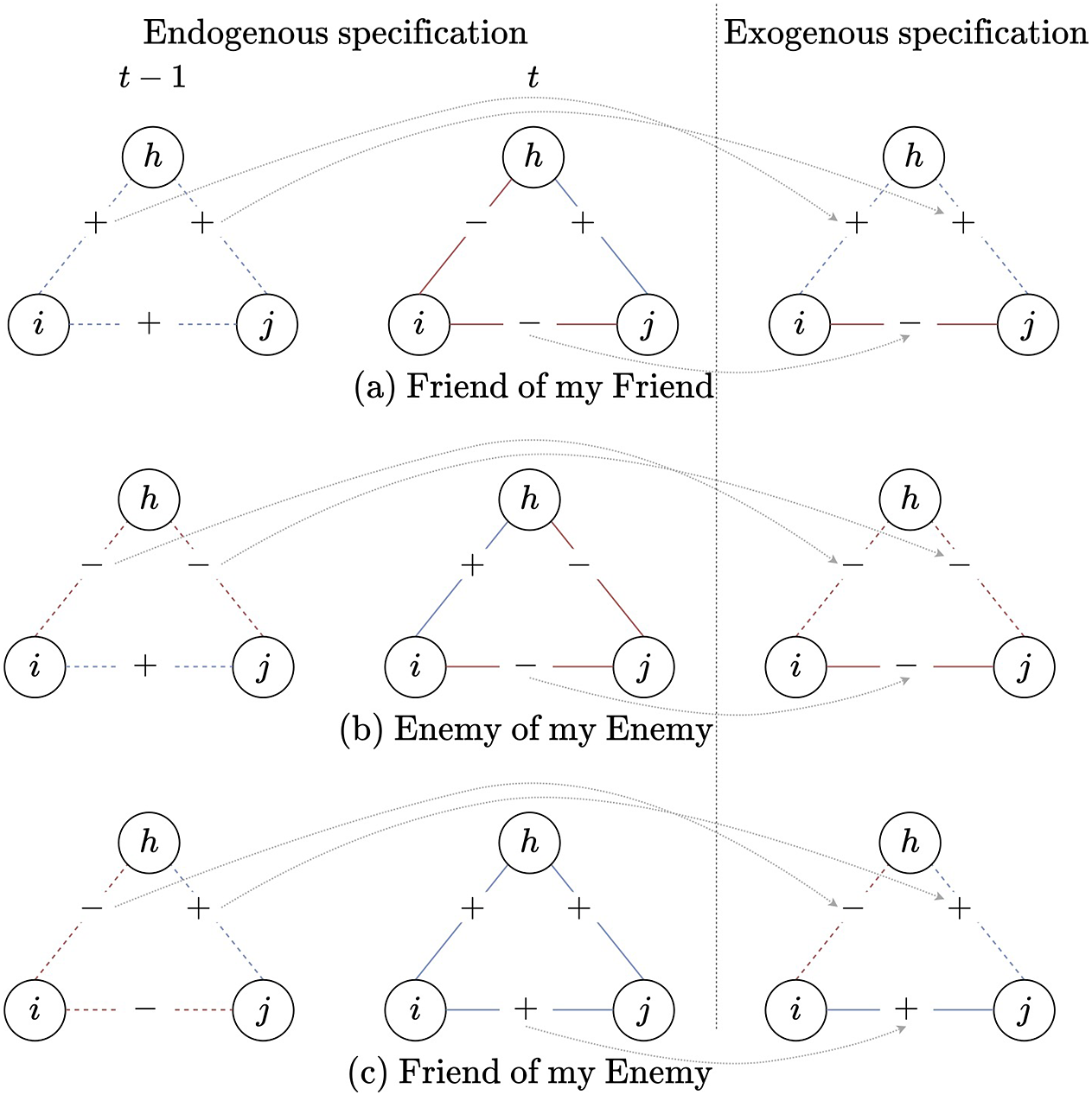
To illustrate this point, the right side of Figure 1 visualizes three structurally imbalanced constellations which Maoz et al. (Reference Maoz, Terris, Kuperman and Talmud2007) and Lerner (Reference Lerner2016) uncover in the network of cooperation and conflict between states: (a) The friend of a friend being an enemy, (b) the enemy of an enemy being an enemy, and (c) the friend of an enemy being a friend. The left side of Figure 1 presents the triads at $t-1$
and t that these constellations are potentially made up of as ties are not observed simultaneously. The links of i and j to h were observed at
$t-1$
and t that these constellations are potentially made up of as ties are not observed simultaneously. The links of i and j to h were observed at $t-1$
but those between i and j at t. The structurally imbalanced triads on the right side of Figure 1 thus consist of observations of the same triad made at two different points in time. Crucially, the left side of Figure 1 shows that both of these observations can themselves be structurally balanced. Exogenous measures of common friends and enemies can thus only capture the predictions of structural balance theory if (i) actors i and j wait a period until they change their tie sign due to their links to h and (ii) their links to h remain unchanged. Both of these conditions require strong assumptions regarding how actors behave within a network. In particular, structural balance theory implies that the edges between i, j, and h are interdependent. But its exogenous operationalization assumes two of these edges as fixed while waiting to observe the third. An example shows that this is not just a theoretical issue, but mischaracterizes empirically observed relations between states: The US and Iran had common foes in 1978 but, in 1979, had become outright enemies themselves. The exogenous operationalization of structural balance regards this situation as unbalanced, although it is an example of the scenario in Figure 1b.
$t-1$
but those between i and j at t. The structurally imbalanced triads on the right side of Figure 1 thus consist of observations of the same triad made at two different points in time. Crucially, the left side of Figure 1 shows that both of these observations can themselves be structurally balanced. Exogenous measures of common friends and enemies can thus only capture the predictions of structural balance theory if (i) actors i and j wait a period until they change their tie sign due to their links to h and (ii) their links to h remain unchanged. Both of these conditions require strong assumptions regarding how actors behave within a network. In particular, structural balance theory implies that the edges between i, j, and h are interdependent. But its exogenous operationalization assumes two of these edges as fixed while waiting to observe the third. An example shows that this is not just a theoretical issue, but mischaracterizes empirically observed relations between states: The US and Iran had common foes in 1978 but, in 1979, had become outright enemies themselves. The exogenous operationalization of structural balance regards this situation as unbalanced, although it is an example of the scenario in Figure 1b.
Combining past and present ties can misrepresent structural (im-)balance: Triads observed at $t-1$
and t are balanced (left side), combined triads are imbalanced (right side). Dashed lines indicate tie at
$t-1$
and t are balanced (left side), combined triads are imbalanced (right side). Dashed lines indicate tie at $t-1$
, solid ones at t. The dotted arrows show which ties from
$t-1$
, solid ones at t. The dotted arrows show which ties from $t-1$
and t contribute to the exogenous specification.
$t-1$
and t contribute to the exogenous specification.
Testing Structural Balance via Endogenous Statistics
Therefore, endogenous network terms are necessary to capture the endogenous network dynamics postulated by structural balance theory. We next define endogenous statistics that mirror each constellation described by structural balance theory to test its predictions empirically. Building on the k-Edgewise-Shared Partner statistic developed to measure transitive closure in binary ERGMs (Hunter Reference Hunter2007), we can define k-Edgewise-Shared Friends, $\text {ESF}_k(\mathbf {y})$
, and
$\text {ESF}_k(\mathbf {y})$
, and $k-$
Edgewise-Shared Enemies,
$k-$
Edgewise-Shared Enemies, $\text {ESE}_k(\mathbf {y}_t)$
, for signed networks. The statistic
$\text {ESE}_k(\mathbf {y}_t)$
, for signed networks. The statistic $\text {ESF}_k(\mathbf {y}_t)$
counts the edges with k shared friends and
$\text {ESF}_k(\mathbf {y}_t)$
counts the edges with k shared friends and $\text {ESE}_k(\mathbf {y}_t)$
those with k shared enemies. We further differentiate these statistics based on the state of the edge at the center of each triangular configuration and, e.g., write
$\text {ESE}_k(\mathbf {y}_t)$
those with k shared enemies. We further differentiate these statistics based on the state of the edge at the center of each triangular configuration and, e.g., write $\text {ESF}^+_k(\mathbf {y}_t)$
and
$\text {ESF}^+_k(\mathbf {y}_t)$
and $\text {ESF}^-_k(\mathbf {y}_t)$
as the version of the statistic where the value of
$\text {ESF}^-_k(\mathbf {y}_t)$
as the version of the statistic where the value of $y_{ij}$
is “+” and “
$y_{ij}$
is “+” and “ $-$
”, respectively. Figure 2 illustrates the resulting four statistics.
$-$
”, respectively. Figure 2 illustrates the resulting four statistics.
Sufficient statistics for signed networks.
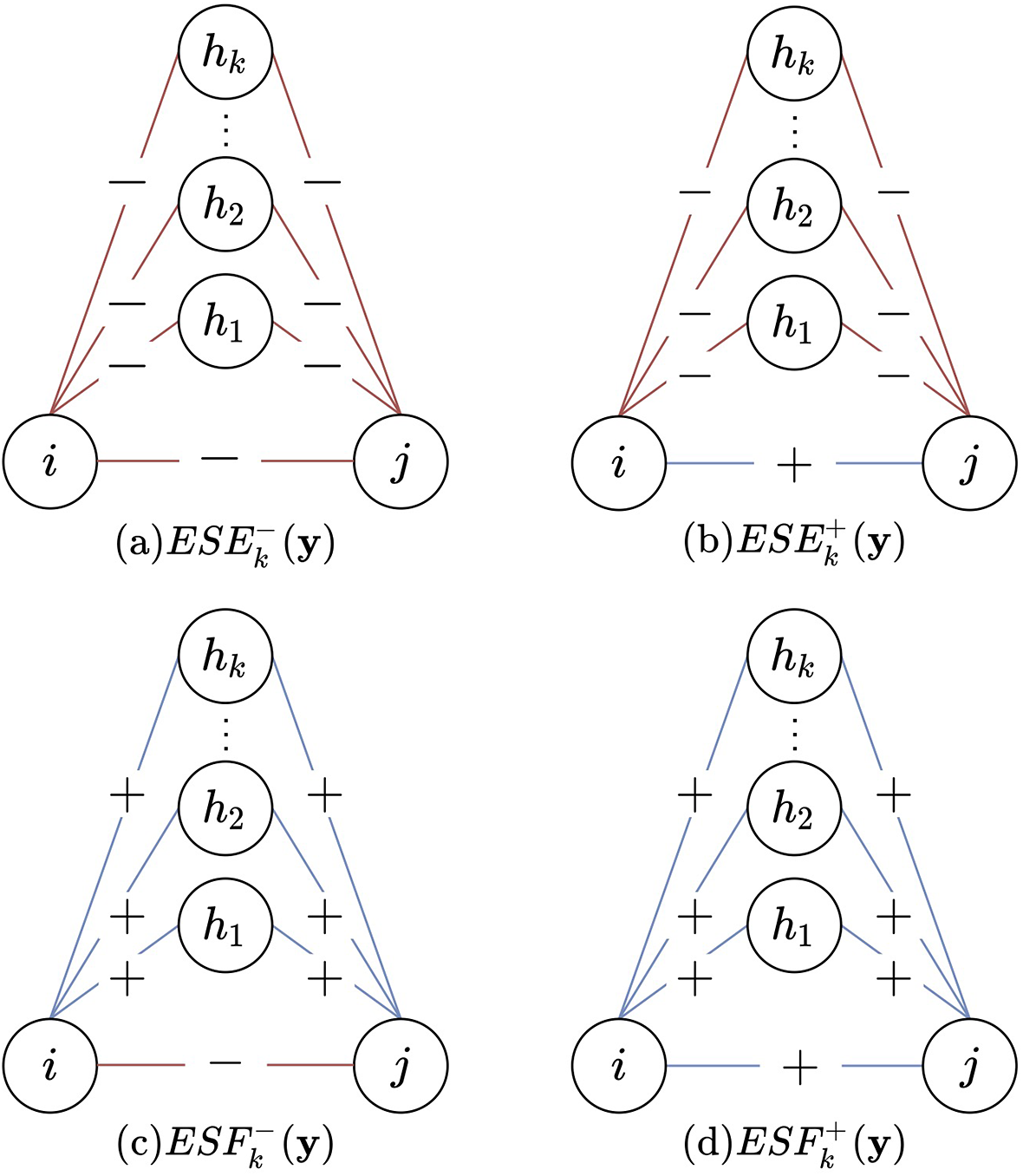
Transformations of these statistics reduce to specific types of triangular configurations (Hunter Reference Hunter2007). However, as shown in Snijders et al. (Reference Snijders, Pattison, Robins and Handcock2006), these statistics frequently lead to degenerate distributions where most probability mass is put on the empty or full graph (Handcock Reference Handcock2003; Schweinberger Reference Schweinberger2011). Moreover, the implied avalanche effect, where changing the value of one tie yields a considerable change in the probability of observing the respective network, is particularly pronounced if the corresponding parameters are positive, as structural balance theory suggests. For binary ERGMs, it is thus standard to employ a statistic of the weighted sum of statistics in which the weights are proportional to the geometric sequence (Hunter and Handcock Reference Hunter and Handcock2006; Snijders et al. Reference Snijders, Pattison, Robins and Handcock2006). We follow this practice and define the geometrically weighted statistic for negative edgewise-shared enemies, as portrayed in Figure 2a, with a fixed decay parameter $\alpha $
as
$\alpha $
as
 $$ \begin{align} \text{GWESE}^+(\mathbf{y}_t,\alpha) = \exp\{\alpha\} \sum_{k = 1}^{n-2} \left(1-\left(1-\exp\{-\alpha\}\right)^k\right) \text{ESE}^+_k(\mathbf{y}_t). \end{align} $$
We establish the geometrically weighted variants of $\text {ESE}^-_k(\mathbf {y}_t), \text {ESF}^+_k(\mathbf {y}_t),$
and
$\text {ESE}^-_k(\mathbf {y}_t), \text {ESF}^+_k(\mathbf {y}_t),$
and $\text {ESF}^-_k(\mathbf {y}_t)$
accordingly. Each of these statistics reflects a specific type of triadic closure in signed networks as visualized in Figure 2. To interpret the coefficient
$\text {ESF}^-_k(\mathbf {y}_t)$
accordingly. Each of these statistics reflects a specific type of triadic closure in signed networks as visualized in Figure 2. To interpret the coefficient $\theta _{GWESE^+}$
one can consider the logarithmic relative change in the probability according to (2.2) when increasing the number of common enemies of a befriended edge by one and keeping all other statistics constant. If the befriended actors already had k prior common enemies before this change, this relative change is given by
$\theta _{GWESE^+}$
one can consider the logarithmic relative change in the probability according to (2.2) when increasing the number of common enemies of a befriended edge by one and keeping all other statistics constant. If the befriended actors already had k prior common enemies before this change, this relative change is given by
 $$ \begin{align*} \theta_{\text{GWESE}^+} \left(1-\left(1-\exp\{-\alpha\}\right)\right)^k. \end{align*} $$
Thus, if $\theta _{\text {GWESE}^+}>0$
, each additional common enemy between two actors increases the probability of observing a positive edge between them, although the increments become smaller for higher numbers of common enemies. In other words, a positive coefficient is associated with a tendency toward balanced triads. Hunter (Reference Hunter2007) shows that these geometrically weighted statistics are equivalent to the alternating k-triangle statistics proposed by Snijders et al. (Reference Snijders, Pattison, Robins and Handcock2006).
$\theta _{\text {GWESE}^+}>0$
, each additional common enemy between two actors increases the probability of observing a positive edge between them, although the increments become smaller for higher numbers of common enemies. In other words, a positive coefficient is associated with a tendency toward balanced triads. Hunter (Reference Hunter2007) shows that these geometrically weighted statistics are equivalent to the alternating k-triangle statistics proposed by Snijders et al. (Reference Snijders, Pattison, Robins and Handcock2006).
These triadic structures fully capture the logic of structural balance as they allow us to study the prevalence of triads where positive ties account for zero (Figure 2a), one (Figure 2b), two (Figure 2c), and all three (Figure 2d) of the edges. According to this logic, we would expect the statistics $\text {GWESE}^+(\mathbf {y}_t$
) and
$\text {GWESE}^+(\mathbf {y}_t$
) and $\text {GWESF}^+(\mathbf {y}_t$
) to be higher in empirical networks than expected by chance, but not
$\text {GWESF}^+(\mathbf {y}_t$
) to be higher in empirical networks than expected by chance, but not $\text {GWESE}^-(\mathbf {y}_t$
) and, particularly,
$\text {GWESE}^-(\mathbf {y}_t$
) and, particularly, $\text {GWSF}^-(\mathbf {y}_t$
). If, on the other hand, the coefficients corresponding to
$\text {GWSF}^-(\mathbf {y}_t$
). If, on the other hand, the coefficients corresponding to $\text {GWESE}^-(\mathbf {y}_t$
) or
$\text {GWESE}^-(\mathbf {y}_t$
) or $\text {GWESF}^-(\mathbf {y}_t$
) turn out to be positive in a network, this would offer empirical support for modifications of structural balance theory that also see the constellation in Figure 2a as balanced (Davis Reference Davis1967; Heider Reference Heider1958) or combine it with insights about, e.g., opportunism or reputation (Maoz et al. Reference Maoz, Terris, Kuperman and Talmud2007). Mirroring the development of edge-wise shared enemy and friend statistics, it is also possible to compute dyad-wise statistics that do not require i and j to share a tie.
$\text {GWESF}^-(\mathbf {y}_t$
) turn out to be positive in a network, this would offer empirical support for modifications of structural balance theory that also see the constellation in Figure 2a as balanced (Davis Reference Davis1967; Heider Reference Heider1958) or combine it with insights about, e.g., opportunism or reputation (Maoz et al. Reference Maoz, Terris, Kuperman and Talmud2007). Mirroring the development of edge-wise shared enemy and friend statistics, it is also possible to compute dyad-wise statistics that do not require i and j to share a tie.
Other Sufficient Statistics
Besides these substantively informed statistics developed from structural balance theory, there are—as in the binary case—numerous other statistics one may incorporate into the model. Some of these are even necessary to isolate the effects of structural balance. In binary networks, closed triads where each node is connected to the others are more likely to form if the involved actors are highly active due to processes such as popularity. In the context of ERGMs, this phenomenon is captured by degree statistics counting the number of actors in the network with a specific number of edges. For signed networks, similar but more complicated processes may be at work and, to capture them, we define $\text {DEG}^+_k(\mathbf {y}_t)$
and
$\text {DEG}^+_k(\mathbf {y}_t)$
and $\text {DEG}^-_k(\mathbf {y}_t)$
as statistics that, respectively, count the number of actors in the signed network
$\text {DEG}^-_k(\mathbf {y}_t)$
as statistics that, respectively, count the number of actors in the signed network $\mathbf {y}_t$
with degree
$\mathbf {y}_t$
with degree $k\in \{1, ..., n-1\}$
for “+”- and “
$k\in \{1, ..., n-1\}$
for “+”- and “ $-$
”-signed links, respectively. Since the degree statistics are also prone to the degeneracy issues detailed above, we define geometrically-weighted equivalents for the positive and negative degrees. One can also incorporate exogenous statistics for the propensity to observe a positive tie, similar to (2.6), via the following statistic:
$-$
”-signed links, respectively. Since the degree statistics are also prone to the degeneracy issues detailed above, we define geometrically-weighted equivalents for the positive and negative degrees. One can also incorporate exogenous statistics for the propensity to observe a positive tie, similar to (2.6), via the following statistic:
 $$ \begin{align} \text{EXO}^+(\mathbf{y}_t) &= \sum_{i<j} \mathbb{I}(y_{ij,t} = \text{"+"})x_{ij,t}, \end{align} $$
where $x_{ij,t}$
can be any pairwise scalar information. Similar statistics can be defined for negative,
$x_{ij,t}$
can be any pairwise scalar information. Similar statistics can be defined for negative, $\text {EXO}^-(\mathbf {y}_t)$
, and any,
$\text {EXO}^-(\mathbf {y}_t)$
, and any, $\text {EXO}^\pm (\mathbf {y}_t)$
, ties. To test whether there is a tendency for homo- or heterophily based on actor attribute
$\text {EXO}^\pm (\mathbf {y}_t)$
, ties. To test whether there is a tendency for homo- or heterophily based on actor attribute $x = (x_1, ..., x_n)$
in the network, one may transform the nodal information to the pairwise level by setting
$x = (x_1, ..., x_n)$
in the network, one may transform the nodal information to the pairwise level by setting $x_{ij,t} = |x_{i,t} - x_{j,t}|$
or
$x_{ij,t} = |x_{i,t} - x_{j,t}|$
or $x_{ij,t} = \mathbb {I} (x_{i,t} = x_{j,t})$
for continuous and categorical attributes, respectively.
$x_{ij,t} = \mathbb {I} (x_{i,t} = x_{j,t})$
for continuous and categorical attributes, respectively.
3 Estimation and Inference
To estimate $\theta $
for a fully specified set of sufficient statistics, we maximize the likelihood of (2.2) conditional on the initial network
$\theta $
for a fully specified set of sufficient statistics, we maximize the likelihood of (2.2) conditional on the initial network $\mathbf {y}_0$
:
$\mathbf {y}_0$
:
 $$ \begin{align} \mathcal{L}(\theta; \mathbf{y}_1, ...,\mathbf{y}_T) =& \prod_{t = 1}^T \frac{\exp \left\{ \boldsymbol{\theta}^\top\mathbf{s}( \mathbf{y}_{t}, \mathbf{y}_{t-1}) \right\}}{\kappa(\boldsymbol{\theta}, \mathbf{y}_{t-1})} =\frac{ \exp\left\{ \boldsymbol{\theta}^\top \left(\sum_{t = 1}^T \mathbf{s}( \mathbf{y}_{t}, \mathbf{y}_{t-1}) \right)\right\}}{\prod_{t = 1}^T \kappa(\theta,\mathbf{y}_{t-1})}. \end{align} $$
We can observe that this joint probability of the observed networks is still an exponential family, where the sufficient statistic is the sum of the individual statistics, the normalizing constant is composed of the product of the normalizing constants at each time point, and the canonical parameter is unchanged. Evaluating the normalizing constant in (3.1), on the other hand, necessitates the calculation of $T\cdot \exp \{n\,(n-1)/2 \,\log (3)\}$
summands, making the direct evaluation of the likelihood prohibitive even for small networks. Fortunately, these difficulties are known from the analysis of binary networks and have been tackled in numerous articles (see, e.g., Strauss and Ikeda Reference Strauss and Ikeda1990; Hummel, Hunter, and Handcock Reference Hummel, Hunter and Handcock2012; Snijders Reference Snijders2002; Hunter and Handcock Reference Hunter and Handcock2006), which guide our estimation approach for the SERGM.
$T\cdot \exp \{n\,(n-1)/2 \,\log (3)\}$
summands, making the direct evaluation of the likelihood prohibitive even for small networks. Fortunately, these difficulties are known from the analysis of binary networks and have been tackled in numerous articles (see, e.g., Strauss and Ikeda Reference Strauss and Ikeda1990; Hummel, Hunter, and Handcock Reference Hummel, Hunter and Handcock2012; Snijders Reference Snijders2002; Hunter and Handcock Reference Hunter and Handcock2006), which guide our estimation approach for the SERGM.
To circumvent the direct evaluation of (3.1), we can write the logarithmic likelihood ratio of $\theta $
and a fixed
$\theta $
and a fixed $\theta _0$
without a normalizing constant but an expected value
$\theta _0$
without a normalizing constant but an expected value
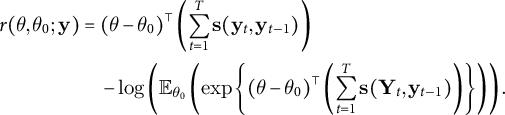 $$ \begin{align} \begin{aligned} r(\theta,\theta_0;\mathbf{y}) &= (\theta - \theta_0)^\top \left(\sum_{t = 1}^T \mathbf{s}(\mathbf{y}_t, \mathbf{y}_{t-1})\right) \\& \quad -\log\left(\mathbb{E}_{\theta_0}\left(\exp\left\{(\theta - \theta_0)^\top \left(\sum_{t = 1}^T \mathbf{s}(\mathbf{Y}_t, \mathbf{y}_{t-1})\right)\right\}\right)\right). \end{aligned} \end{align} $$
We approximate the expectation in (3.2) by sampling networks over time, denoted by $\mathbf {Y}^{(m)} = (\mathbf {Y}_1^{(m)}, ..., \mathbf {Y}_T^{(m)})$
for the mth sample, whose dynamics are governed by (2.2) under
$\mathbf {Y}^{(m)} = (\mathbf {Y}_1^{(m)}, ..., \mathbf {Y}_T^{(m)})$
for the mth sample, whose dynamics are governed by (2.2) under $\theta _0$
. Due to the Markov assumption, it suffices to specify only how to sample
$\theta _0$
. Due to the Markov assumption, it suffices to specify only how to sample $\mathbf {Y}_t^{(m)}$
conditional on
$\mathbf {Y}_t^{(m)}$
conditional on $\mathbf {y}_{t-1}$
for
$\mathbf {y}_{t-1}$
for $t = 1, ..., T$
via Gibbs samplingFootnote 3. In particular, we generate a Markov chain with state space
$t = 1, ..., T$
via Gibbs samplingFootnote 3. In particular, we generate a Markov chain with state space $\mathcal {Y}^\pm $
that, after a sufficient burn-in period, converges to samples from
$\mathcal {Y}^\pm $
that, after a sufficient burn-in period, converges to samples from $\mathbf {Y}_t$
conditional on
$\mathbf {Y}_t$
conditional on $\mathbf {y}_{t-1}$
. Since we toggle one dyad in each iteration of this procedure, the conditional probability distribution we sample from is the multinomial distribution stated in (2.3). In a setting where we sample
$\mathbf {y}_{t-1}$
. Since we toggle one dyad in each iteration of this procedure, the conditional probability distribution we sample from is the multinomial distribution stated in (2.3). In a setting where we sample $Y_{ij,t}$
conditional on
$Y_{ij,t}$
conditional on $\mathbf {y}_{(-ij),t}$
and
$\mathbf {y}_{(-ij),t}$
and $ \mathbf {y}_{t-1}$
with its present value given by
$ \mathbf {y}_{t-1}$
with its present value given by $\tilde {y}_{ij,t}$
, we can restate this conditional probability for “
$\tilde {y}_{ij,t}$
, we can restate this conditional probability for “ $+$
” in terms of change statistics:
$+$
” in terms of change statistics:
 $$ \begin{align*} \displaystyle &\mathbb{P}_\theta(Y_{ij,t} = \text{"+"}| \mathbf{Y}_{(-ij),t} = \mathbf{y}_{(-ij),t}, \mathbf{Y}_{t-1} = \mathbf{y}_{t-1}) = \frac{\exp \left\{ \boldsymbol{\theta}^\top \Delta_{ij}^{\tilde{y}_{ij,t}\rightarrow +}( \mathbf{y}_{(-ij),t}, \mathbf{y}_{t-1}) \right\}}{\sum_{k \in \{ +, -, 0\}}\exp \left\{ \boldsymbol{\theta}^\top\Delta_{ij}^{\tilde{y}_{ij,t}\rightarrow k}( \mathbf{y}_{(-ij),t}, \mathbf{y}_{t-1}) \right\}}. \end{align*} $$
This reformulation speeds up computation since, for most statistics, the calculation of global statistics is computationally more demanding than the calculation of the change statistics defined in (2.4). Given M sampled networks, we get
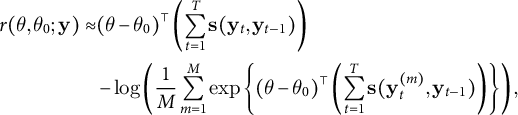 $$ \begin{align} \begin{aligned} r(\theta,\theta_0;\mathbf{y})\approx &(\theta - \theta_0)^\top \left(\sum_{t = 1}^T \mathbf{s}(\mathbf{y}_t, \mathbf{y}_{t-1})\right) \\&-\log\left(\frac{1}{M} \sum_{m = 1}^M\exp\left\{(\theta - \theta_0)^\top \left(\sum_{t = 1}^T \mathbf{s}(\mathbf{y}_t^{(m)}, \mathbf{y}_{t-1})\right)\right\}\right), \end{aligned} \end{align} $$
as an approximation of (3.2). However, according to standard theory of exponential families, the parameter $\theta $
maximizing (3.3) only exists if the sum of all observed sufficient statistics
$\theta $
maximizing (3.3) only exists if the sum of all observed sufficient statistics $\sum _{t = 1}^T \mathbf {s}(\mathbf {y}_t, \mathbf {y}_{t-1})$
under
$\sum _{t = 1}^T \mathbf {s}(\mathbf {y}_t, \mathbf {y}_{t-1})$
under $\theta _0$
is inside the convex hull spanned by the sum of the sampled sufficient statistics (see Theorem 9.13 in Barndorff-Nielsen Reference Barndorff-Nielsen1978). Since this condition does not hold for arbitrary values of
$\theta _0$
is inside the convex hull spanned by the sum of the sampled sufficient statistics (see Theorem 9.13 in Barndorff-Nielsen Reference Barndorff-Nielsen1978). Since this condition does not hold for arbitrary values of $\theta _0$
, we modify the partial stepping algorithm under a log-normal assumption on the sufficient statistics introduced by Hummel, Hunter, and Handcock (Reference Hummel, Hunter and Handcock2012) to dynamic signed networks for finding an adequate value for
$\theta _0$
, we modify the partial stepping algorithm under a log-normal assumption on the sufficient statistics introduced by Hummel, Hunter, and Handcock (Reference Hummel, Hunter and Handcock2012) to dynamic signed networks for finding an adequate value for $\theta _0$
(details can be found in the Supplementary Material). We seed our algorithm with
$\theta _0$
(details can be found in the Supplementary Material). We seed our algorithm with $\theta _0$
maximizing the pseudo-likelihood constructed through (2.3). To obtain estimates in the cross-sectional setting of (2.1), we can use the same procedure by setting
$\theta _0$
maximizing the pseudo-likelihood constructed through (2.3). To obtain estimates in the cross-sectional setting of (2.1), we can use the same procedure by setting $T=1$
.
$T=1$
.
To quantify the sampling error of the estimates, we rely on the theory of exponential families stating that the Fisher information $\mathcal {I}(\theta )$
equals the variance of
$\mathcal {I}(\theta )$
equals the variance of $\sum _{t = 1}^T \mathbf {s}(\mathbf {Y}_t, \mathbf {y}_{t-1})$
under the maximum likelihood estimate
$\sum _{t = 1}^T \mathbf {s}(\mathbf {Y}_t, \mathbf {y}_{t-1})$
under the maximum likelihood estimate $\hat {\theta }$
. We can estimate the Fisher information by again sampling networks
$\hat {\theta }$
. We can estimate the Fisher information by again sampling networks $\mathbf {Y}^{(1)}, ...,\mathbf {Y}^{(M)}$
and calculating the empirical variance of
$\mathbf {Y}^{(1)}, ...,\mathbf {Y}^{(M)}$
and calculating the empirical variance of $\sum _{t = 1}^T \mathbf {s}(\mathbf {y}_t^{(m)},\mathbf {y}_{t-1})$
for
$\sum _{t = 1}^T \mathbf {s}(\mathbf {y}_t^{(m)},\mathbf {y}_{t-1})$
for $m = 1, ..., M$
. Due to the employed MCMC approximation, we follow standard practice of the
$m = 1, ..., M$
. Due to the employed MCMC approximation, we follow standard practice of the $\mathtt {ergm}$
and
$\mathtt {ergm}$
and $\mathtt {coda}$
packages (Handcock et al. Reference Handcock, Hunter, Butts, Goodreau and Morris2008; Plummer et al. Reference Plummer, Best, Cowles and Vines2006) and estimate the MCMC standard error by the spectral density at frequency zero of the Markov chains of the statistics. For the final variance estimate, we sum up both types of errors. By extending the bridge sampler introduced in Hunter and Handcock (Reference Hunter and Handcock2006) to the SERGM for dynamic networks, we can also evaluate the AIC value of the model to carry out model selection (see Supplementary Material). Moreover, we provide a simulation study in the Supplementary Materials to assess the quality of the proposed estimation algorithm.
$\mathtt {coda}$
packages (Handcock et al. Reference Handcock, Hunter, Butts, Goodreau and Morris2008; Plummer et al. Reference Plummer, Best, Cowles and Vines2006) and estimate the MCMC standard error by the spectral density at frequency zero of the Markov chains of the statistics. For the final variance estimate, we sum up both types of errors. By extending the bridge sampler introduced in Hunter and Handcock (Reference Hunter and Handcock2006) to the SERGM for dynamic networks, we can also evaluate the AIC value of the model to carry out model selection (see Supplementary Material). Moreover, we provide a simulation study in the Supplementary Materials to assess the quality of the proposed estimation algorithm.
4 Testing Structural Balance in International Cooperation and Conflict
4.1 Motivation
We now employ the SERGM to investigate relations of cooperation and conflict in the interstate network over the years 2000–2010. This application speaks directly to Maoz et al. (Reference Maoz, Terris, Kuperman and Talmud2007), Lerner (Reference Lerner2016), and the many other studies on structural balance in international relations cited above. We focus on this period since it is the most current period for which we have comprehensive and reliable data on interstate conflict and cooperation. While cooperation in the form of alliances remains important, there is nowadays relatively little change in the alliance network from one year to another as “only a dozen new alliances have emerged since 9/11” (Kinne Reference Kinne2020, 730). Instead, a new type of formal commitment between states, defense cooperation agreements (DCA), has become widely used throughout the 1990s and 2000s (see Kinne Reference Kinne2018, Reference Kinne2020). To ensure that we capture interstate cooperation in a meaningful manner for the period we are interested in, we depart from previous studies of structural balance in international relations and use DCAs instead of alliances to operationalize interstate cooperation. We do so for several reasons.
First, as noted, the contemporary alliance network is basically static, experiencing little to no shifts over timeFootnote 4. This is a challenge for estimation but, substantively, also severely limits the extent to which alliance relations could be affected by conflict between states. In contrast, DCAs are both initiated and terminated regularly (Kinne Reference Kinne2018). Second, contemporary alliance ties are often multilateral and strongly institutionalized, meaning that if, e.g., a new member joined NATO, it would result in the creation of several new alliance ties at once, but also that terminating these alliances, which have own secretariats, headquarters, and command structures, is challenging and thus empirically rareFootnote 5. Alliances hence do not clearly correspond to dyadic ties and have a life of their own which restricts tie deletion. In contrast, DCAs are bilateral and not as institutionalized, making them correspond much better to positive dyadic ties which can be formed but also removed (Kinne Reference Kinne2018). Third, as opposed to alliances, DCAs are also signed by countries that have a policy of neutrality, thus reducing the risk that some ties are structural zeros, i.e., ineligible to be formed (Kinne Reference Kinne2020). And fourth, though some alliances do mandate peacetime military cooperation, most alliances only become active during armed conflictFootnote 6, stipulating wartime cooperation between their members (Leeds et al. Reference Leeds, Ritter, Mitchell and Long2002). However, their goal is to deter enemies from instigating conflict in the first place. In other words, states’ formal commitment to cooperate, as demonstrated in an alliance, becomes realized only in a fraction of cases which are those where the alliance’s main goal, deterrence, has failed. In contrast, DCAs specify states’ commitment to and framework for peacetime, day-to-day defense cooperation regarding activities such as joint defense policies, military exercises, the co-development of military technology, and bilateral arms transfers (Kinne Reference Kinne2018, Reference Kinne2020). DCAs therefore present a better dynamic measure of regular, bilateral defense cooperation between states for the 2000s than alliances do.
4.2 Model Specification
To measure cooperative, positively-signed interstate relations, we thus use the DCA data collected by Kinne (Reference Kinne2020) and consider a tie as existent and positive if a pair of states shares at least one active DCA in year t. For conflictious negatively-signed relations, we follow Maoz et al. (Reference Maoz, Terris, Kuperman and Talmud2007) and Lerner (Reference Lerner2016) by using the Militarized Interstate Dispute (MID) Data provided by Palmer et al. (Reference Palmer, McManus, D’Orazio, Kenwick, Karstens, Bloch, Dietrich, Kahn, Ritter and Soules2022). MIDs are defined as “united historical cases of conflict in which the threat, display or use of military force short of war by one member state is explicitly directed towards the government, official representatives, official forces, property, or territory of another state” (Jones, Bremer, and Singer Reference Jones, Bremer and Singer1996, 163). We consider a tie to be existent and negative in year t if a pair of states has at least one MID between themFootnote 7. Since we observe dyads on a yearly basis, thus aggregating over time, we have some cases where two countries have both a DCA and a MID. We treat these observations as positive ties because DCAs are arguably the more enduring and meaningful relationship—some MIDs may last only a single or few days, be limited to one event, and result from the actions of low-level decision-makers such as border guards. That being said, our substantive results change very little when instead treating these observations as negative ties. We plot the resulting interstate network, consisting of positive DCA- and negative MID-ties, in the Supplementary Material.
To specify a SERGM for modeling this evolving network, we first follow Maoz et al. (Reference Maoz, Terris, Kuperman and Talmud2007) and Lerner (Reference Lerner2016) by including several exogenous covariates, namely i’s and j’s political difference in terms of their polity scores, military capability ratio, the difference in wealth, and geographical distance. Note that while we include these covariates for both positive and negative ties, it is possible to do this jointly (Abs. Distance), separately (for instance, CINC Ratio), or even only for one tie direction. These variables’ sources are discussed in the Supplementary Material. Stemming from (2.2), we condition on the first year for the estimation and hence effectively model the network between 2001 and 2010.
Regarding endogenous statistics, the SERGM includes, most importantly, the four triadic terms developed above to capture the network’s tendency towards or against structural balance. Theoretically, we would expect the coefficients concerning $\text {GWESE}^+(\mathbf {y}_t$
) and
$\text {GWESE}^+(\mathbf {y}_t$
) and $\text {GWESF}^+(\mathbf {y}_t)$
, but not
$\text {GWESF}^+(\mathbf {y}_t)$
, but not $\text {GWESF}^-(\mathbf {y}_t)$
, to have positive and statistically significant coefficients. For
$\text {GWESF}^-(\mathbf {y}_t)$
, to have positive and statistically significant coefficients. For $\text {GWESE}^-(\mathbf {y}_t)$
, the expectation depends on whether we believe the state system to consist of two or more groups (Davis Reference Davis1967). The latter appears more likely for the 2000s, and we may thus expect to observe a positive coefficient. Furthermore, we include the positive and negative degree statistics to capture highly active nodes’ propensity to (not) form more ties and statistics that count the number of positive and negative edges as well as how many isolated nodes exist in each part of the network. Finally, stability terms are included to capture positive and negative ties remaining from the previous period. We term this specification Model 1 and present the results on the left side of Table 1.
$\text {GWESE}^-(\mathbf {y}_t)$
, the expectation depends on whether we believe the state system to consist of two or more groups (Davis Reference Davis1967). The latter appears more likely for the 2000s, and we may thus expect to observe a positive coefficient. Furthermore, we include the positive and negative degree statistics to capture highly active nodes’ propensity to (not) form more ties and statistics that count the number of positive and negative edges as well as how many isolated nodes exist in each part of the network. Finally, stability terms are included to capture positive and negative ties remaining from the previous period. We term this specification Model 1 and present the results on the left side of Table 1.
Estimated coefficients and confidence intervals of the two model specifications detailed above. Dashes indicate the exclusion of covariates in a model specification. $\Delta $
AIC indicates the difference between the AIC values of Model 1 and the other model.
$\Delta $
AIC indicates the difference between the AIC values of Model 1 and the other model.
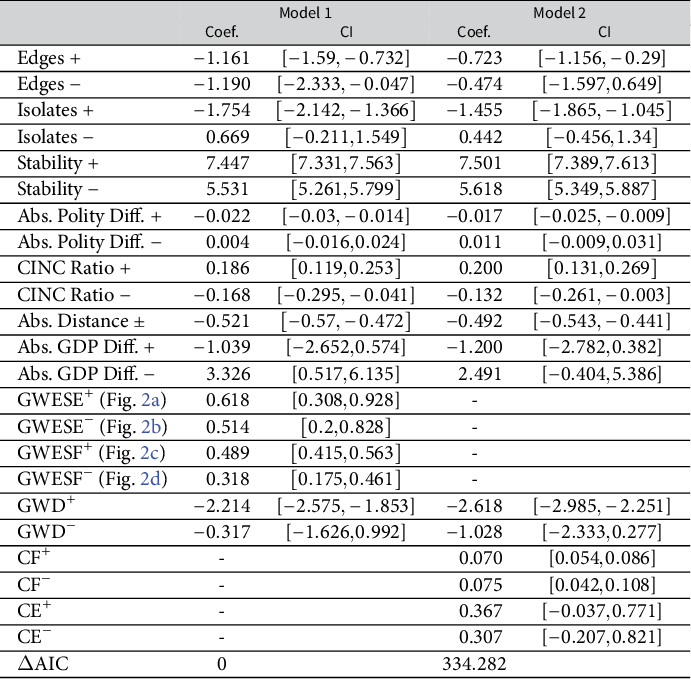
We further compare Model 1 to a model specification where we replace the endogenous terms of structural balance, as depicted in Figure 2, with the exogenous versions used by Maoz et al. (Reference Maoz, Terris, Kuperman and Talmud2007) and Lerner (Reference Lerner2016), stated in (2.6), where i’s and j’s ties with h are observed not contemporaneously but in $t-1$
. We denote the corresponding statistics by
$t-1$
. We denote the corresponding statistics by $\text {CF}^+(\mathbf {y}_{t}, \mathbf {y}_{t-1})$
and
$\text {CF}^+(\mathbf {y}_{t}, \mathbf {y}_{t-1})$
and $\text {CF}^-(\mathbf {y}_{t}, \mathbf {y}_{t-1})$
to quantify the effect of common friends on positive and negative ties, while the number of common enemies are
$\text {CF}^-(\mathbf {y}_{t}, \mathbf {y}_{t-1})$
to quantify the effect of common friends on positive and negative ties, while the number of common enemies are $\text {CE}^+(\mathbf {y}_{t}, \mathbf {y}_{t-1})$
and
$\text {CE}^+(\mathbf {y}_{t}, \mathbf {y}_{t-1})$
and $\text {CE}^-(\mathbf {y}_{t}, \mathbf {y}_{t-1})$
. Each of these exogenous measures corresponds to one of our triadic endogenous statistics, e.g.,
$\text {CE}^-(\mathbf {y}_{t}, \mathbf {y}_{t-1})$
. Each of these exogenous measures corresponds to one of our triadic endogenous statistics, e.g., $\text {CF}^+(\mathbf {y}_{t}, \mathbf {y}_{t-1})$
to
$\text {CF}^+(\mathbf {y}_{t}, \mathbf {y}_{t-1})$
to $\text {GWESF}^+(\mathbf {y}_{t})$
and
$\text {GWESF}^+(\mathbf {y}_{t})$
and $\text {CE}^-(\mathbf {y}_{t}, \mathbf {y}_{t-1})$
to
$\text {CE}^-(\mathbf {y}_{t}, \mathbf {y}_{t-1})$
to $\text {GWESE}^-(\mathbf {y}_{t})$
. Otherwise, the two models are identical, as Model 2 includes the other endogenous statistics specified in Model 1. We can thus adjudicate whether operationalizing structural balance dynamics in an endogenous manner, implying that they occur instantaneously, is preferable over the exogenous specification where these dynamics occur with a one-period time delay.
$\text {GWESE}^-(\mathbf {y}_{t})$
. Otherwise, the two models are identical, as Model 2 includes the other endogenous statistics specified in Model 1. We can thus adjudicate whether operationalizing structural balance dynamics in an endogenous manner, implying that they occur instantaneously, is preferable over the exogenous specification where these dynamics occur with a one-period time delay.
4.3 Results
Below, we interpret the results of the endogenous network terms and their exogenous equivalents. We discuss the coefficient estimates of the exogenous covariates in the Supplementary Material. As expected, both the $\text {GWESF}^+(\mathbf {y}_t)$
and the
$\text {GWESF}^+(\mathbf {y}_t)$
and the $\text {GWESE}^+(\mathbf {y}_t)$
terms exhibit positive and statistically significant coefficients, with neither confidence interval encompassing zero. These results align with structural balance theory in that both “the friend of my friend” and “the enemy of my enemy” are my friends. But we also find that the
$\text {GWESE}^+(\mathbf {y}_t)$
terms exhibit positive and statistically significant coefficients, with neither confidence interval encompassing zero. These results align with structural balance theory in that both “the friend of my friend” and “the enemy of my enemy” are my friends. But we also find that the $\text {GWESF}^-(\mathbf {y}_t)$
and
$\text {GWESF}^-(\mathbf {y}_t)$
and $\text {GWESE}^-(\mathbf {y}_t)$
coefficients are positive and statistically significant, albeit with smaller effects and confidence intervals closer to zero than in the case of the first two statistics. The positive effect of
$\text {GWESE}^-(\mathbf {y}_t)$
coefficients are positive and statistically significant, albeit with smaller effects and confidence intervals closer to zero than in the case of the first two statistics. The positive effect of $\text {GWESE}^-(\mathbf {y}_t)$
indicates that there is a tendency towards enemies of enemies being enemies in the studied interstate network. This echoes the point that triangles with three negative ties are imbalanced only in systems with two subsets (Davis Reference Davis1967), a condition unlikely to hold in the international system during our period of observation. This result is thus consistent with the verdict that, against early formulations of structural balance theory (Cartwright and Harary Reference Cartwright and Harary1956; Heider Reference Heider1946), “if two negative relations are given, balance can be obtained either when the third relationship is positive or when it is negative” (Heider Reference Heider1958, 206). Observing a positive and statistically significant effect for
$\text {GWESE}^-(\mathbf {y}_t)$
indicates that there is a tendency towards enemies of enemies being enemies in the studied interstate network. This echoes the point that triangles with three negative ties are imbalanced only in systems with two subsets (Davis Reference Davis1967), a condition unlikely to hold in the international system during our period of observation. This result is thus consistent with the verdict that, against early formulations of structural balance theory (Cartwright and Harary Reference Cartwright and Harary1956; Heider Reference Heider1946), “if two negative relations are given, balance can be obtained either when the third relationship is positive or when it is negative” (Heider Reference Heider1958, 206). Observing a positive and statistically significant effect for $\text {GWESE}^-(\mathbf {y}_t)$
underlines the importance of overall network structure for the predictions of structural balance theory.
$\text {GWESE}^-(\mathbf {y}_t)$
underlines the importance of overall network structure for the predictions of structural balance theory.
We also find that friends of friends have an increased probability of being enemies as the effect of $\text {GWESF}^-(\mathbf {y}_t)$
is positive and statistically significant. In the international relations of the 2000s, what seems to hold is that both enemies of enemies and friends of friends are more likely to interact than if they did not share relations with a common third state. Friends of friends being more likely to fight than to have no relation at all suggests that shared relations may also indicate the “reachability” of one state to another within a system where some dyads, e.g., that between Lesotho and Belize, have a very low structural probability of ever being active (see, e.g., Quackenbush Reference Quackenbush2006). Triadic closure, regardless of the sign, thus exists also in the network of cooperation and conflict between states. However, we observe that the tendency towards such closure is stronger for structurally balanced relations than for structurally imbalanced ones.
$\text {GWESF}^-(\mathbf {y}_t)$
is positive and statistically significant. In the international relations of the 2000s, what seems to hold is that both enemies of enemies and friends of friends are more likely to interact than if they did not share relations with a common third state. Friends of friends being more likely to fight than to have no relation at all suggests that shared relations may also indicate the “reachability” of one state to another within a system where some dyads, e.g., that between Lesotho and Belize, have a very low structural probability of ever being active (see, e.g., Quackenbush Reference Quackenbush2006). Triadic closure, regardless of the sign, thus exists also in the network of cooperation and conflict between states. However, we observe that the tendency towards such closure is stronger for structurally balanced relations than for structurally imbalanced ones.
A comparison of the two model specifications shown in Table 1 allows us to ascertain whether specifying the triadic relationships endogenously affects substantive results and model performance. Here, it is visible that the AIC of the model with the endogenous statistics is lower than that with their exogenous versions. Specifying interdependent dynamics in the interstate network via endogenous covariates hence increases model performance compared to trying to capture them by including lagged, exogenous variables.
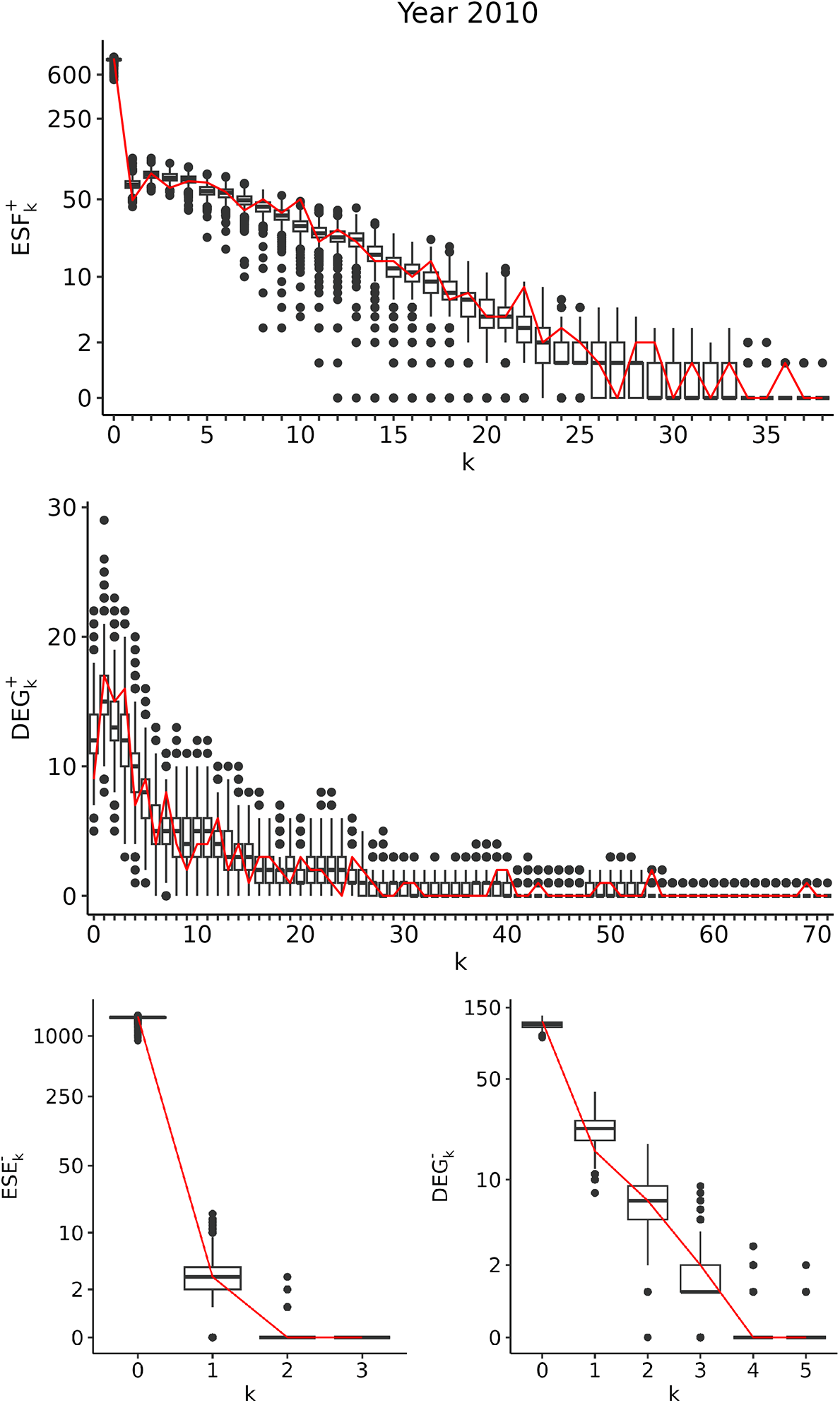
Goodness-of-fit assessment in the year 2010.
More strikingly, Table 1 shows that the substantive results of the corresponding endogenous and exogenous measures of structural balance dynamics differ significantly. Contrasting the results under the endogenous and exogenous model specification, the latter offers much more limited support for these notions. While the coefficient of $\text {CF}^+(\mathbf {y}_t, \mathbf {y}_{t-1})$
is positive and statistically significant, its effect size is still very close to zero. The “friends of friends are friends”-effect is thus found to be substantively negligible in Model 2. In contrast, the coefficient of
$\text {CF}^+(\mathbf {y}_t, \mathbf {y}_{t-1})$
is positive and statistically significant, its effect size is still very close to zero. The “friends of friends are friends”-effect is thus found to be substantively negligible in Model 2. In contrast, the coefficient of $\text {CE}^+(\mathbf {y}_t, \mathbf {y}_{t-1})$
is positive and substantively larger, while its 95
$\text {CE}^+(\mathbf {y}_t, \mathbf {y}_{t-1})$
is positive and substantively larger, while its 95 $\%$
-confidence interval includes zero, indicating that the model cannot statistically distinguish it from zero as its estimation is very imprecise. The statistics
$\%$
-confidence interval includes zero, indicating that the model cannot statistically distinguish it from zero as its estimation is very imprecise. The statistics $\text {CF}^-(\mathbf {y}_t, \mathbf {y}_{t-1})$
and
$\text {CF}^-(\mathbf {y}_t, \mathbf {y}_{t-1})$
and $\text {CE}^-(\mathbf {y}_t, \mathbf {y}_{t-1})$
mirror their corresponding endogenous terms from Model 1 in that both exhibit positive coefficients but, again, the first is substantively much smaller and the second one very imprecisely estimated. On the whole, this comparison of an endogenous and an exogenous specification of the triadic configurations motivated by structural balance theory thus shows that Model 1 is preferable over Model 2. The model including endogenous terms thus not only provides better performance than that with their exogenous counterparts but these terms are also estimated to be more influential and more precisely.
$\text {CE}^-(\mathbf {y}_t, \mathbf {y}_{t-1})$
mirror their corresponding endogenous terms from Model 1 in that both exhibit positive coefficients but, again, the first is substantively much smaller and the second one very imprecisely estimated. On the whole, this comparison of an endogenous and an exogenous specification of the triadic configurations motivated by structural balance theory thus shows that Model 1 is preferable over Model 2. The model including endogenous terms thus not only provides better performance than that with their exogenous counterparts but these terms are also estimated to be more influential and more precisely.
4.4 Model Assessment
To assess the fit of the estimated SERGM, we employ a graphical tool inspired by Hunter, Goodreau, and Handcock (Reference Hunter, Goodreau and Handcock2008a) to evaluate whether it can adequately represent topologies of the observed network not explicitly incorporated as sufficient statistics in (2.2). Therefore, we sample networks from (2.2), compute the statistics, summarize them, and then compare this summary to the statistics evaluated on the observed network. Heuristically, a model generating simulations that better reflect the observed values also has a better goodness-of-fit. To cover signed networks, we investigate the observed and simulated distributions of positive and negative degrees and edgewise-shared enemies and friends in the interstate network.
We report the goodness-of-fit plots for Model 1 from Table 1 in Figure 3 for the year 2010. In each subplot, a series of box plots displays the distribution of a given value of the statistic under consideration over the networks simulated from the model via the Gibbs sampler detailed in Section 3. The red line indicates where the statistic is measured in the observed network and should thus, ideally, lie close to the median value of the simulated networks, i.e., the center of the box plots. In Figure 3, this is the case for all four statistics, indicating that Model 1 under the estimated parameters generalizes well to network topologies not explicitly incorporated in the sufficient statistics. We present the same selection of plots for the other years in the Supplementary Materials, where we also use them for a comparison of Models 1 and 2.
Together, the results presented here indicate that the SERGM is able to uncover structural balance dynamics in the interstate network and is preferable over approaches that seek to model signed interstate networks under conditional independence, but also that further substantial research on structural balance in international relations is needed. The Supplementary Material employs the SERGM to analyze a cross-sectional network, representing enmity and friendship among New Guinean Highland Tribes (Hage and Harary Reference Hage and Harary1984) and shows its applicability when there is no observable temporal dependence structure.
5 Discussion
We extended the core regression model for network data to dynamic and cross-sectional signed networks. Given the theoretical foundation of structural balance, we introduce novel endogenous statistics that offer better performance than operationalizing them by lagged covariates, as commonly done in previous research. Finally, we apply the method to recent data on militarized interstate disputes and defense cooperation agreements and provide a software implementation with the $\mathtt {R}$
package
$\mathtt {R}$
package $\mathtt {ergm.sign}$
.
$\mathtt {ergm.sign}$
.
From a substantive point of view, this research offers new insights on the empirical testing of structural balance theory and challenges earlier inferential studies on the topic. How one captures structural balance matters. We show that an approach relying on past observations of some ties within a triad to measure structural balance as an exogenous variable can mischaracterize triadic (im-)balance. We thus develop endogenous balance measures that can be used in the SERGM framework and show empirically that these endogenous measures result in different substantive results as well as increased model performance as compared to the exogenous ones. Most importantly, the exogenous measures do not affect tie formation consistent with structural balance theory, whereas when employing the endogenous ones, we find evidence in line with it. States are thus more likely to cooperate if they share common partners or are hostile to the same enemies. This indicates that there is structural balance in interstate cooperation and conflict, at least when studying the 2000s. Future work in International Relations should seek to build on and further investigate this result. As structural balance is directly related to systemic polarity (see Lee, Muncaster, and Zinnes Reference Lee, Muncaster and Zinnes1994), it may be worthwhile to test whether our finding also holds for the bipolar Cold War period, or the multipolar Interwar years. And in light of Maoz et al. (Reference Maoz, Terris, Kuperman and Talmud2007), it will be fruitful to investigate how structural balance interacts with the Kantian triad of joint democratic status, trade interdependence, and international organizations (see Oneal and Russett Reference Oneal and Russett1999), given how, so far, network approaches have mainly served to criticize this influential International Relations perspective (see Campbell, Cranmer, and Desmarais Reference Campbell, Cranmer and Desmarais2018; Ward, Siverson, and Cao Reference Ward, Siverson and Cao2007).
Moreover, the study of signed networks is not restricted to International Relations. Within Political Science more generally, signed networks occur in positive and negative electoral campaigning (De Nooy and Kleinnijenhuis Reference De Nooy and Kleinnijenhuis2013), parliamentarians’ voting behavior (Arinik, Figueiredo, and Labatut Reference Arinik, Figueiredo and Labatut2020), but potentially also bureaucracies and judicial politics. And beyond it, there are applications to friendship and bullying between children (Huitsing et al. Reference Huitsing, van Duijn, Snijders, Wang, Sainio, Salmivalli and Veenstra2012; Huitsing et al. Reference Huitsing, Snijders, Van Duijn and Veenstra2014), alliances and conflicts between tribal (Hage and Harary Reference Hage and Harary1984) or criminal groups (Nakamura, Tita, and Krackhardt Reference Nakamura, Tita and Krackhardt2020), and even to interactions within ecological networks (Saiz et al. Reference Saiz, Gómez-Gardeñes, Nuche, Girón, Pueyo and Alados2017). In the setting of online social media and multiplayer games, signed networks are also frequently studied (Bramson et al. Reference Bramson, Hoefman, Schoors and Ryckebusch2022; Leskovec, Huttenlocher, and Kleinberg Reference Leskovec, Huttenlocher and Kleinberg2010). Beyond International Relations and Political Science, the SERGM will thus serve to advance research across all Social Sciences, allowing researchers to investigate tie formation in networks of friendship and enmity between school children, gangs, or social media accounts.
At the same time, we find that, generally, states appear more likely to interact, positively or negatively, when they share friends or enemies. Substantively, this result suggests that, additional to structural balance, something else is at play and may indicate that some state dyads are structurally very unlikely to ever be active due to the countries’ distance, lack of economic development, and/or power projection capabilities, mirroring research on politically “relevant” or “active” dyads (see Quackenbush Reference Quackenbush2006). But this implied variation in “reachability” between states also points to the fact that structural balance theory was developed on complete networks, where every possible tie is realized with either a negative or a positive sign, while empirical networks are usually incomplete (see Easley and Kleinberg Reference Easley and Kleinberg2010, Ch. 5). It thus lends some support to Lerner’s (Reference Lerner2016) argument that tests of structural balance theory should not examine states’ marginal probability to cooperate or fight, but instead their probability of cooperating or fighting conditional upon them interacting. However, following Lerner’s (Reference Lerner2016, Sec. 4.2.1) argument on the use of ERGMs in conjunction with this conditional viewpoint, it becomes evident that (2.2) is consistent with it. Defining $\mathbf {Y}^{|\pm |}$
with
$\mathbf {Y}^{|\pm |}$
with $Y^{|\pm |}_{ij} = 1 \text { if } Y_{ij} \neq $
“0” as the random adjacency matrix describing any type of interaction and
$Y^{|\pm |}_{ij} = 1 \text { if } Y_{ij} \neq $
“0” as the random adjacency matrix describing any type of interaction and $\mathcal {Y}$
, be it positive or negative, one can derive the following conditional probability distribution
$\mathcal {Y}$
, be it positive or negative, one can derive the following conditional probability distribution
 $$ \begin{align} \mathbb{P}_{\boldsymbol{\theta}}\left(\mathbf{Y}_t = \mathbf{y}_t|\mathbf{Y}^{|\pm|}_t = \mathbf{y}^{|\pm|}_t,\mathbf{Y}_{t-1} = \mathbf{y}_{t-1}\right) = \frac{\exp \left\{ \boldsymbol{\theta}^\top\mathbf{s}( \mathbf{y}_{t}, \mathbf{y}_{t-1}) \right\}}{\tilde{\kappa}\left(\boldsymbol{\theta}, \mathbf{y}_{t-1},\mathbf{y}^{|\pm|}_t\right)} ~ \forall ~ \mathbf{y}_t \in \mathcal{Y}^{\pm}, \end{align} $$
where $\tilde {\kappa }(\boldsymbol {\theta }, \mathbf {y}_{t-1},\mathbf {y}^{|\pm |}_t) = \sum _{\tilde {\mathbf {y}} \in \mathcal {Y}^{\pm }} \mathbb {I}(\tilde {\mathbf {y}} = \mathbf {y}^{|\pm |}_t)\exp \left \{ \boldsymbol {\theta }^\top \mathbf {s}( \tilde {\mathbf {y}}, \mathbf {y}_{t-1}) \right \}$
. The conditional distribution (5.1) is thus a SERGM with support limited to networks where
$\tilde {\kappa }(\boldsymbol {\theta }, \mathbf {y}_{t-1},\mathbf {y}^{|\pm |}_t) = \sum _{\tilde {\mathbf {y}} \in \mathcal {Y}^{\pm }} \mathbb {I}(\tilde {\mathbf {y}} = \mathbf {y}^{|\pm |}_t)\exp \left \{ \boldsymbol {\theta }^\top \mathbf {s}( \tilde {\mathbf {y}}, \mathbf {y}_{t-1}) \right \}$
. The conditional distribution (5.1) is thus a SERGM with support limited to networks where $\mathbf {y}^{|\pm |}_t$
is equal to the observed network and the coefficients of (5.1) are unchanged. Therefore, (2.2) implies (5.1).
$\mathbf {y}^{|\pm |}_t$
is equal to the observed network and the coefficients of (5.1) are unchanged. Therefore, (2.2) implies (5.1).
Alternatively, the lack of “reachability” of some dyads may indicate that dependency structures are not fully global, even in international relations where all actors know each other. Major powers should generally be able to reach all other states in the system and thus make their actions globally relevant, but the reach and relevance of smaller states will be more locally limited. Since the general framework of ERGMs in (1.1) relies on homogeneity assumptions implying that each endogenous mechanism has the same effect in the entire network, model (2.2) might assume dependence between relations where, in reality, there is none. One possible endeavor for future research would be to adapt local dependence (Schweinberger and Handcock Reference Schweinberger and Handcock2015) to signed and dynamic networks. This approach assumes complex dependence only within observed or unobserved groups of actors, thus solving the obstacle of “reachability” between some countries in the network. At the same time, other extensions of ERGMs are feasible under (2.1) and (2.2). Following Box-Steffensmeier, Christenson, and Morgan (Reference Box-Steffensmeier, Christenson and Morgan2018), we can capture unobserved actor heterogeneity in signed networks with two actor-specific random effects, one governing the activity of positive and one of the negative ties. Moreover, the first stage of the Generalized Exponential Random Graph Model of Desmarais and Cranmer (Reference Desmarais and Cranmer2012), which originally models continuous ties in the bounded interval between 0 and 1, could be adapted to continuous signed edges between $-1$
and 1. Since the transition from (2.1) and (2.2) is reminiscent of the TERGM, one could assume a model in which three separate SERGMs govern the evolution of previously positive, negative, and nonexistent ties akin to the STERGM introduced by Krivitsky and Handcock (Reference Krivitsky and Handcock2014). And given ongoing debates on out-of-sample prediction for network data (Block et al. Reference Block, Hollway, Stadtfeld, Koskinen and Snijders2022; Leifeld and Cranmer Reference Leifeld and Cranmer2019, Reference Leifeld and Cranmer2022), another venue for future research is the analysis of proper scoring rules as introduced by Gneiting and Raftery (Reference Gneiting and Raftery2007) to assess out-of-sample performance for network models.
$-1$
and 1. Since the transition from (2.1) and (2.2) is reminiscent of the TERGM, one could assume a model in which three separate SERGMs govern the evolution of previously positive, negative, and nonexistent ties akin to the STERGM introduced by Krivitsky and Handcock (Reference Krivitsky and Handcock2014). And given ongoing debates on out-of-sample prediction for network data (Block et al. Reference Block, Hollway, Stadtfeld, Koskinen and Snijders2022; Leifeld and Cranmer Reference Leifeld and Cranmer2019, Reference Leifeld and Cranmer2022), another venue for future research is the analysis of proper scoring rules as introduced by Gneiting and Raftery (Reference Gneiting and Raftery2007) to assess out-of-sample performance for network models.
Acknowledgements
We are grateful to the editor and anonymous reviewers for their helpful feedback on an earlier version of this article. The majority of this work was carried out while CF and MM were working at LMU Munich.
Data Availability Statement
Replication code for this article has been published in Political Analysis Harvard Dataverse at https://doi.org/10.7910/DVN/7ZRCS6. The $\mathtt {R}$
package
$\mathtt {R}$
package $\mathtt {ergm.sign}$
, provided in the replication code, allows the analysis of signed networks with the tools developed in this article.
$\mathtt {ergm.sign}$
, provided in the replication code, allows the analysis of signed networks with the tools developed in this article.
Supplementary Material
For supplementary material accompanying this paper, please visit https://doi.org/10.1017/pan.2024.21.


 Open access

