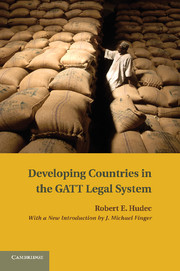
Book contents
- Frontmatter
- Contents
- Foreword by Hugh Corbet
- Acknowledgments
- DEVELOPING COUNTRIES IN THE GATT LEGAL SYSTEM
- Introduction to the New Edition
- PART I A HISTORY OF THE LEGAL RELATIONSHIP
- 1 Post-war Negotiations on Trade Liberalization
- 2 First Decade of the GATT – 1948–1957
- 3 Demands for a New Legal Relationship – 1958–1963
- 4 Defining the New Relationship – 1964–1971
- 5 Testing the New Relationship – 1972–1979
- 6 Developments in the 1980s – Form without Substance
- PART II A LEGAL CRITIQUE OF THE GATT'S CURRENT POLICY
- List of References
- Index
- References
1 - Post-war Negotiations on Trade Liberalization
Published online by Cambridge University Press: 03 May 2011
Foreword by
Book contents
- Frontmatter
- Contents
- Foreword by Hugh Corbet
- Acknowledgments
- DEVELOPING COUNTRIES IN THE GATT LEGAL SYSTEM
- Introduction to the New Edition
- PART I A HISTORY OF THE LEGAL RELATIONSHIP
- 1 Post-war Negotiations on Trade Liberalization
- 2 First Decade of the GATT – 1948–1957
- 3 Demands for a New Legal Relationship – 1958–1963
- 4 Defining the New Relationship – 1964–1971
- 5 Testing the New Relationship – 1972–1979
- 6 Developments in the 1980s – Form without Substance
- PART II A LEGAL CRITIQUE OF THE GATT'S CURRENT POLICY
- List of References
- Index
- References
Summary
GATT LEGAL policy towards developing countries owes nothing to the past. There was no Golden Age that pointed the way. Before 1939, the organizing principle for rich-poor relationships had been colonialism. Most of the countries in Africa and Asia were colonies de jure. A goodly portion of those in Central and South America were colonies de facto. This colonial past was not what the post-1945 world was looking for. The world required a clean start – a completely new departure.
Policy in the United States before 1939 stood apart from the explicitly colonial policies of the other major powers. The United States had few de jure colonies. Although its economic and political relationship with most Latin American countries was de facto colonial, its formal legal relationship with those countries consisted of conventional sovereign-to-sovereign dealings, with very few of the preferential qualities found in the typical colonial relationship. In the years 1934–42, the United States negotiated reciprocal trade agreements with twenty-seven countries, including the following sixteen developing countries: Cuba, Haiti, Brazil, Honduras, Colombia, Guatemala, Nicaragua, El Salvador, Costa Rica, Ecuador, Turkey, Venezuela, Argentina, Peru, Uruguay and Mexico. Each agreement contained a reciprocal exchange of tariff reductions and a framework of other GATT-like obligations to protect the commercial value of the tariff reductions. None of these agreements called for special treatment because of developing-country status.
Information
- Type
- Chapter
- Information
- Developing Countries in the GATT Legal System , pp. 26 - 38Publisher: Cambridge University PressPrint publication year: 2010
References
, The United States and the Restoration of World Trade: an Analysis and Appraisal of the ITO Charter and the General Agreement on Tariffs and Trade (Washington: Brookings Institution, 1950) pp. 20–22Google Scholar
, Multilateral Commercial Diplomacy: the General Agreement on Tariffs and Trade and Its Impact on National Commercial Policies and Techniques (London: Michael Joseph, 1965)Google Scholar
, World Trade and the Law of GATT: A Legal Analysis of the General Agreement on Tariffs and Trade (Indianapolis: Bobbs-Merrill, 1969)Google Scholar
, International Trade Policy and the GATT 1947–1967 (Stockholm: Almqvist & Wiksell, 1969)Google Scholar
Accessibility standard: Unknown
Why this information is here
This section outlines the accessibility features of this content - including support for screen readers, full keyboard navigation and high-contrast display options. This may not be relevant for you.Accessibility Information
Accessibility compliance for the PDF of this chapter is currently unknown
and may be updated in the future.