


Introduction
Acute upper respiratory infections (URIs), which include acute uncomplicated bronchitis, pharyngitis, rhinosinusitis, and the common cold, are the most common reason for ambulatory visits. Reference Harris, Hicks and Qaseem1 In the United States, these conditions have collectively been associated with 221 antibiotic prescriptions per 1000 patients, of which 50% is deemed inappropriate. Reference Fleming-Dutra, Hersh and Shapiro2 The Centers for Disease Control and Prevention (CDC) identifies acute URIs as examples of high-priority conditions in which clinicians commonly deviate from best practices for antibiotic prescribing and for which there are opportunities to improve outpatient antibiotic stewardship. Reference Harris, Hicks and Qaseem1,3 Factors that influence antibiotic prescribing for acute URIs, including those that are institution-specific, would be important for antimicrobial stewardship programs to recognize as they think about quality improvement initiatives in this area.
Multiple studies on acute URIs in ambulatory settings have examined factors associated with antibiotic prescribing in the general patient population. Reference Steinman, Landefeld and Gonzales4–Reference Bizune, Tsay and Palms13 Healthcare provider characteristics such as type, number of years since training graduation, and specialty appear to drive some of the variations in antibiotic prescription. Reference Steinman, Landefeld and Gonzales4,Reference Jones, Sauer and Jones6,Reference Silverman, Povitz and Sontrop9,Reference Childers, Bisanz, Vilke, Brennan, Cronin and Castillo12 Others have found that certain diagnoses (eg, acute sinusitis) or clinical features (eg, purulent sputum, tonsillar exudate) can influence antibiotic prescribing. Reference Jones, Sauer and Jones6–Reference McKay, Mah, Law, McGrail and Patrick8 Additionally, rapid diagnostics to detect respiratory viruses, particularly influenza, may impact treatment decisions. Reference Havers, Hicks and Chung11
In contrast, not much is known about how ambulatory cancer patients with acute URIs are managed. Community-acquired respiratory viral infections in immunosuppressed cancer patients may lead to pneumonia in approximately 30% of cases, so rapid diagnosis is important to guide decisions regarding infection control, antiviral therapy if indicated, and timing of cancer treatment. Reference von Lilienfeld-Toal, Berger and Christopeit14 If there is diagnostic uncertainty regarding the causality of a cancer patient’s URI symptoms, it is plausible that this may affect a provider’s decision to prescribe an antibiotic.
At one cancer center, nearly one-third of hematology-oncology patients were given antibiotic prescriptions for URIs. Reference Krantz, Zier and Stohs15 Patients who presented with sputum production or chest congestion were more likely to have received an antibiotic. Another finding was that testing for respiratory viruses was associated with a lower risk for antibiotic prescribing. However, respiratory viral testing was predominantly performed by the bone marrow transplant and hematology services and was rarely ordered in the solid tumor clinics. The high correlation between respiratory viral testing and clinical service thus limited the authors’ ability to separate these effects on prescribing. It was also not clear whether these results were unique to their institution.
At Memorial Sloan Kettering Cancer Center (MSK), respiratory pathogen panel (RPP) testing is readily available at all outpatient locations. Adult cancer patients who presented to the hospital’s Urgent Care Center (UCC) or Symptom Care Clinic (SCC) with URI symptoms and underwent RPP testing were examined. Study objectives were to characterize URI management and to determine predictors of antibiotic prescription.
Methods
Study population
This study was reviewed and approved by the Institutional Review Board at MSK, a tertiary cancer center in New York, NY. Patients with urgent medical issues related to cancer or their treatment can be seen in the UCC at the hospital’s main campus or at a SCC located at one of six regional sites within New York and New Jersey. Adults ≥ 18 years of age who presented to the hospital’s UCC or SCC with URI symptoms and underwent RPP testing between September 1, 2019, and March 11, 2020, were included. For patients who had > 1URI episode, only the first episode was included in the analysis.
Any patient with URI symptoms presenting to the UCC or SCC after March 11, 2020, was excluded due to the start of the global Coronavirus Disease 2019 (COVID-19) pandemic. Reference Cucinotta and Vanelli16 Patients were also excluded if they had RPP testing but no documented URI symptoms, if they had evidence for lower respiratory tract involvement, Reference Hirsch, Martino, Ward, Boeckh, Einsele and Ljungman17 or if they required 24-hour observation or hospital admission immediately after the UCC or SCC encounter.
The institutional electronic health record was used to obtain clinical information, as well as laboratory, microbiology, and radiology results, for each patient encounter. Abstracted data encompassed four broad areas: (1) patient attributes (eg, demographics, cancer diagnosis, comorbid conditions); (2) cancer treatment; (3) visit (eg, date, location, provider type) and URI characteristics; and (4) URI management.
Definitions
Neutropenia was defined as having an absolute neutrophil count<1.0 K/mcL; lymphopenia was defined as having an absolute lymphocyte count < 0.9 K/mcL. The appropriateness of the antibiotic prescription for indication was determined by using CDC guidance for adults seeking care for common infections in the outpatient setting. 18 Documentation pertaining to counseling on supportive care measures (eg, ensure adequate hydration, use decongestant as needed) and/or return instructions if patients had worsening symptoms counted as patient education. Clinic or telephone follow-up within 14 days of the initial encounter was defined as URI-related if any of the following was conducted: notification of the RPP result, URI symptom follow-up, counseling on supportive care measures for the URI, antibiotic or antiviral management, resumption in cancer treatment due to recovery from the URI, or delay in cancer treatment due to ongoing symptoms.
Laboratory methods
Nasopharyngeal swabs were submitted for respiratory pathogen testing at the clinicians’ discretion. Testing was performed by using the FilmArray® Respiratory Panel that could detect adenovirus; coronavirus types 229E, HKU1, NL63, and OC43; human metapneumovirus; human rhinovirus/enterovirus; influenza types A and B; parainfluenza types 1, 2, 3, and 4; respiratory syncytial virus; Bordetella parapertussis, B. pertussis, Chlamydophila pneumoniae, and Mycoplasma pneumoniae (BioFire Diagnostics Inc., Salt Lake City, UT, USA). Reference Richardson, Brite and Del Castillo19
Statistical analyses
Descriptive statistics were presented as counts and percentages for categorical variables and as means and standard deviations (SD) or medians and interquartile ranges (IQR) for continuous variables. To compare baseline characteristics between patients who received antibiotic prescriptions and those who did not, the χ2 or Fisher’s exact test was performed for categorical variables, and the Student’s t test or Mann–Whitney U test was performed for continuous variables. Univariate and multivariate logistic regression analyses were used to evaluate predictors of antibiotic prescription for URIs in cancer patients. SAS software version 9.4 (SAS Institute Inc., Cary, NC, USA) was used in all analyses. All statistical tests were 2-tailed, and P-values < .05 were considered statistically significant.
Results
Patient characteristics
A total of 552 patients comprised the study population. Overall, the mean age (SD) was 57.8 (14) years, 216 (39.1%) were men, and the majority (343, 62.1%) had solid tumor cancers. Only 101 (18.3%) individuals were recipients of hematopoietic cell transplantation (HCT) or chimeric antigen receptor T-cell therapy. Study patients had a median (IQR) of one (0 – 2) comorbid condition besides their cancer, and many (384, 69.6%) underwent cancer therapy within 30 days of the UCC or SCC visit.
Table 1 shows patient characteristics dichotomized by antibiotic prescription status. One hundred fifty-six patients (28.3%) were prescribed an antibiotic for their URI at the UCC or SCC visit. A significantly higher proportion of patients who got an antibiotic had receipt of cancer therapy within 30 days of the visit compared with those who did not receive an antibiotic (120/156, 76.9% vs 264/396, 66.7%; P = .018).
Patient characteristics by antibiotic prescription status

Abbreviations: ALC, absolute lymphocyte count; ANC, absolute neutrophil count; CAR, chimeric antigen receptor; GCSF, granulocyte colony stimulating factor; HCT, hematopoietic cell transplantation; HIV, human immunodeficiency virus; IQR, interquartile range; SD, standard deviation.
Visit and URI characteristics
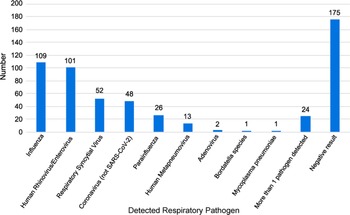
Study patients were seen by a physician (252, 45.7%) or an advanced practice provider (300, 54.3%), respectively. Many (302, 54.7%) were evaluated at the SCC. The distribution of visits for URI by month is shown in Figure 1. The majority (439, 86.6%) presented with symptom duration ≤ 7 days with a median (IQR) of 3 (2 – 3) reported symptoms. Of 552 RPP tests, 377 (68.3%) were positive, and 122 (22.1%) were positive for influenza type A or B. Figure 2 shows the distribution of RPP results. In addition to the RPP test, 9 (1.6%) had sputum sent for culture, and 92 (16.7%) underwent throat culture. In the univariate analysis, there were statistical differences in visit location, positive RPP result, positive RPP result for influenza, symptom duration, earache, sinus symptoms, fever, and pharyngitis between cancer patients who received an antibiotic for their URI and those who did not (Table 2).
Distribution of visits for upper respiratory infection by month.

Respiratory pathogen panel results.

Visit and URI characteristics by antibiotic prescription status

Abbreviations: APP, advanced practice provider; IQR, interquartile range; RPP, respiratory pathogen panel; URI, upper respiratory infection.
URI management
The top three prescribed antibiotics were azithromycin, amoxicillin/clavulanate, and levofloxacin, accounting for 86.5% (135/156) of prescriptions (Table 3). Only 26 of 156 (16.7%) prescriptions had appropriate indications for antibiotics and included 2 with group A streptococcal pharyngitis; 6 with either acute bronchitis, otitis media, or sinusitis with concomitant neutropenia; 5 with acute bronchitis but with concern for progression to pneumonia if untreated; 9 with acute otitis media; and 4 with persistent or worsening symptoms of sinusitis. Three of 156 (1.9%) patients subsequently reported an adverse reaction to the antibiotic and discontinued. Providers’ suggestions for symptom relief such as use of decongestants or cough suppressants are shown in Table 3. Overall, 323 (58.5%) patients received counseling on supportive care measures, and 288 (52.2%) patients were advised to return if they had worsening symptoms. Among patients who were actively receiving treatment for their malignancy, 19% (73/384) had cancer treatment held due to the URI diagnosis.
Upper respiratory infection management by antibiotic prescription status

Many study patients (382/552, 69.2%) had telephone or in-person follow-up with their primary oncology team within 14 days of the initial encounter. Details of URI-related interventions during follow-up are shown in Table 4. Among 382 patients who had follow-up, 4 (1%) patients were instructed to stop the antibiotic based on the RPP result supporting a viral etiology, and 26 (6.9%) were prescribed oseltamivir for a positive RPP result for influenza. Ten of 382 (2.6%) patients were directed for admission due to pneumonia (N = 7), dehydration in setting of influenza (N = 2), and fever and neutropenia (N = 1).
URI-related interventions performed during the follow-up encounter

Abbreviations: RPP, respiratory pathogen panel; URI, upper respiratory infection
Note. Patients could have more than one URI-related intervention during the follow-up encounter.
* Based on the RPP result, 26 patients were prescribed oseltamivir for influenza, and 4 patients were instructed to stop taking the antibiotic.
Predictors of antibiotic prescribing
SCC visit location, cancer therapy within 30 days of the UCC or SCC visit, symptom duration > 7 days, earache, sinus symptoms, pharyngitis, negative RPP result, and negative RPP result for influenza correlated with likelihood of antibiotic prescription by univariate logistic regression (Table 5). Multivariate logistic regression showed that predictors of antibiotic prescribing remained SCC visit location (odds ratio (OR) 2.09, 95% confidence interval (CI) 1.30 – 3.38), symptom duration > 7 days (OR 2.29, 95% CI 1.26 – 4.17), earache (OR 9.30, 95% CI 3.47 – 24.93), sinus symptoms (OR 2.64, 95% CI 1.53 – 4.56), negative RPP result (OR 1.88, 95% CI 1.18 – 2.98), and negative RPP result for influenza (OR 3.31, 95% CI 1.53 – 7.16) (Table 5).
Univariate and multivariate models for predictors of antibiotic prescription

Note. The categories on the left side of vs are the reference groups. The categories on the right side of vs are the comparison groups of interest.Abbreviations: APP, Advanced Practice Provider; CI, confidence interval; OR, odds ratio; RPP, respiratory pathogen panel; SCC, Symptom Care Clinic; UCC, Urgent Care Center.
Discussion
In this study of 552 ambulatory cancer patients who underwent RPP testing for their acute URI, an antibiotic was prescribed in 156 (28.3%) patients. Seven (4.5%) of 156 patients were subsequently instructed to stop taking the antibiotic due to either an adverse reaction or confirmation of a viral etiology on the RPP test during follow-up with their primary oncology team. In addition, all patients diagnosed with influenza were prescribed oseltamivir with the majority (79.5%) of prescriptions provided at the UCC or SCC visit. The risk of antibiotic prescription was significantly increased with the SCC visit location, symptom duration > 7 days, symptom type (namely, earache and sinus symptoms), negative RPP result, and negative RPP result for influenza.
Cancer patients are vulnerable to infections through an interplay of underlying immune deficiencies, associated comorbidities, and treatment-related adverse effects. Reference Zembower20 It has not been clear whether providers would be more inclined to give antibiotics for acute URIs in this special patient population. This study found that antibiotics were prescribed for URIs in 28.3% of hematology-oncology outpatients. Similarly, Krantz et al found that 32% of patients were given antibiotics in the only other publication consisting solely of ambulatory cancer patients with URIs. Reference Krantz, Zier and Stohs15 Krantz et al also found that antibiotic prescribing was significantly lower among those who got respiratory viral testing, but because respiratory viral testing was primarily done in bone marrow transplant recipients and patients with hematologic malignancies, they were unable to gauge how access to testing would have influenced prescribing in the solid tumor clinics. At MSK, RPP testing is available at all ambulatory sites, so patients with solid tumors or hematologic malignancies are well represented.
We found that RPP results were significant predictors for antibiotic prescribing in ambulatory cancer patients with URIs. Regardless of cancer type, patients had a 1.88-fold likelihood of being prescribed an antibiotic with a negative RPP result and a 3.31-fold likelihood of being prescribed an antibiotic with a negative RPP result for influenza. Previous investigations in immunocompetent outpatients have likewise suggested that multiplex real-time polymerase chain reaction assays for the detection of respiratory pathogens may decrease unnecessary antibiotic use. Reference Brittain-Long, Westin, Olofsson, Lindh and Andersson21,Reference Green, Hitoaliaj, Kotansky, Campbell and Peaper22
Even so, patients can still be prescribed antibiotics despite the finding of a respiratory virus. Of the 156 patients given an antibiotic in our study, 82 (52.6%) had a positive RVP result. Krantz et al also noted that antibiotics were prescribed despite viral etiologies being identified in 75% of those tested. Reference Krantz, Zier and Stohs15 Part of this is because detection of a virus by sensitive molecular methods reduces but does not eliminate the probability of a secondary bacterial infection. Reference Pavia23 There are also lack of data on which cancer patient subgroups outside of allogeneic HCT recipients and patients with hematologic malignancies will progress to lower respiratory tract infection. Reference Vakil and Evans24 It would be helpful to have validated scoring tools like the immunodeficiency scoring index that stratifies allogeneic HCT patients with respiratory syncytial virus to distinguish those who would benefit most from antiviral therapy. Reference Shah, Ghantoji and Ariza-Heredia25 Finally, providers may discharge patients from their clinic while respiratory viral results are still pending. While the SCC visit location was a predictor of antibiotic prescription, we think that this finding was instead a surrogate marker for the longer transit times needed for transport of the nasopharyngeal swabs from the individual SCCs within the NY and NJ region to the clinical microbiology laboratory in comparison with the UCC that is in closer proximity. Thus, providers in the UCC received timelier results.
Certain reported symptoms corroborated by physical examination findings were associated with antibiotic receipt, but only earache and sinus symptoms remained statistically significant. There are no national treatment guidelines for acute otitis media (AOM) in adults. Some experts suggest that it may be prudent to treat since this entity is unusual in adults and complications (eg, mastoiditis, brain abscess) while rare can be significant. Reference Limb, Lustig and Durand26 However, one large VA study found no difference in outcomes between patients who received antibiotics and those who did not, suggesting that watchful waiting may be an appropriate strategy for most. Reference Pontefract, Nevers, Fleming-Dutra, Hersh, Samore and Madaras-Kelly27 Because of sparse data in cancer patients, we chose to define antibiotic treatment for AOM as appropriate. Investigations to identify risk factors for complicated AOM in adults to better target those most likely to benefit from antibiotic treatment are needed.
National guidelines for acute rhinosinusitis recommend symptomatic therapy for all patients and an observation period for most of the patients with uncomplicated infection. 18 Antibiotic treatment for acute bacterial sinusitis is contingent on severity, persistence (> 10 d) without improvement, or biphasic worsening of symptoms. Despite this framework, antibiotics continue to be commonly given before waiting at least 10 days for symptoms to subside. Reference Jones, Sauer and Jones6,Reference Havers, Hicks and Chung11,Reference Chandra Deb, McGrath and Schlosser28 One problem with the guidelines is that there are too many variables to consider during the ambulatory visit. Perhaps scheduling follow-up for these patients rather than giving them a prescription may be a better approach.
Having symptom duration > 7 days was also found to be a predictor. To our knowledge, this finding has not been previously described in the published literature but doesn’t seem surprising. While the usual duration of acute URIs is 7 – 10 days, symptoms can linger for up to 21 days. This is of relevance to cancer patients who can experience delays in their cancer treatment pending symptom resolution. Nearly 20% of our study patients had cancer treatment held due to the URI diagnosis.
One unique aspect of our study was that almost 70% of patients had documentation of follow-up within 14 days of the initial UCC or SCC visit. This contrasts with the general patient population in which scheduling routine clinic follow-ups for an acute URI is not the norm. In our study, few patients required hospital admission, which is concordant with that of Krantz et al who found that serious outcomes related to acute URIs (eg, lower respiratory tract infections, hospitalizations) were rare. Reference Krantz, Zier and Stohs15 These data suggest that management of acute URIs for most cancer patients should not differ significantly from that of non-cancer patients.
When examining interventions performed by the primary oncology teams during telephone or scheduled clinic follow-up, the most common intervention was checking for symptom resolution, followed by counseling on supportive care measures (if URI symptoms were still present), informing the patient of the RPP result, and deciding whether to resume or delay cancer treatment. It is notable that 30 (7.9%) of the interventions entailed antibiotic or antiviral management in which 26 patients were prescribed oseltamivir and 4 were instructed to stop taking the antibiotic. From an antimicrobial stewardship perspective, the telephone or in-person follow-up visit may be an opportunity to educate and develop a protocol to assist primary oncology teams on when to stop unnecessary antibiotics for viral URIs.
In terms of study limitations, results may not be generalizable to other cancer centers that may have differing patient populations, ambulatory practices, and respiratory viral testing procedures. Definitions for what constituted appropriate antibiotic therapy (eg, treatment of acute AOM) may also differ. However, we also have several strengths. One is that we had a large study cohort with good representation of adults with solid tumor or hematologic malignancies with acute URIs, and all underwent RPP testing as part of their workup. This enabled us to characterize their URI presentation and management. In addition, we were able to follow their URI course due to the majority having telephone or clinic follow-up within 14 days of the initial visit. This finding is something that we can try to leverage when we think about antimicrobial stewardship initiatives to reduce needless antibiotic use for acute URI indications.
In conclusion, almost one-third of outpatients at a single cancer center were prescribed antibiotics for their acute URI with only 16.7% being appropriate. Having a negative RPP result or a negative RPP result for influenza were two predictors of antibiotic prescription. Other predictors included prolonged URI symptom duration, earache, and sinus symptoms. Understanding these risk factors for antibiotic prescribing in ambulatory cancer patients with URIs may better direct antimicrobial stewardship efforts.
Author contributions
HMJ and SKS conceived the study design and prepared the initial manuscript draft; HMJ, AB, and SKS did the data collection; IL analyzed the data; all authors discussed the results and contributed to the final manuscript.
Financial support
This work was funded in part by the NIH/NCI Cancer Center support grant (P30 CA008748).
Competing interests
All authors report no conflicts of interest relevant to this article.




 Open access

