


Introduction
Many of the lodgement till surfaces which are exposed beyond the margins of present glaciers show streamlined features elongated in the direction of glacier flow. These features have been aptly grouped together as “longitudinal shear marks” by Reference Clayton, Moran and CoatesClayton and Moran (1974)· The most common of such features are low (<2 m), narrow (<3 m) ridges which are often very long (observed up to ι km in length) with a uniform cross-sectional shape (Figs 1, 2 and 3), and with the appearance of a field ploughed strictly parallel to the direction of glacier How. These are generally referred to as “flutes”.
A large boulder ( 1.5 m in length) showing a till wedge ploughed up before it, which leads into a flute. The boulder has just been released from beneath the retreating glacier. Glacier movement is from left to right.
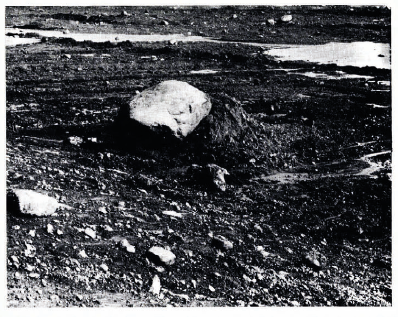
The same boulder as shown in Figure 1. but four years later. Both the till and the flutes have been reduced in size by slumping and surface washing.

A deeply embedded boulder at the head of a flute. The boulder is 1.7 m from side to side. and prominent grooves occur on both flanks of the flute. The direction of viewing is away from the glacier.
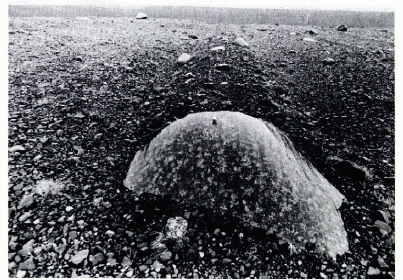
Flutes maybe composed of stratified sediments (Reference Boulton and GoldthwaitBoulton ([1971]) has described them in Tertiary clays, and Reference Paul and EvansPaul and Evans (1974) have described them in stratified sands), but they are almost ubiquitous on lodgement till surfaces which have recently been exposed.
Reference DysonDyson (1952) noted the common association of flutes with boulders at their points of initiation, and suggested that till might flow into subglacial tunnels which opened in the lee of the boulders, thus producing flutes parallel to the direction of glacier flow. Schytt (in Reference Hoppe and SchyttHoppe and Schytt, 1953) commented upon the great length of many flutes, and suggested that this could only occur if till freezes as it flows into the tunnel, subsequently to be carried forward by the ice until it is frozen to the substratum near to the cold glacier margin. In their hypothesis, flutes grow by accretion of till at their head directly in the lee of the initiating boulder (rather than at their distal extremity as suggested by Dyson), and by implication should not occur beyond or beneath glaciers which are temperate to their snout.
Schytt (in Reference Hoppe and SchyttHoppe and Schytt, 1953) observed that flutes al the margin of Isfallsglaeiären in Kebnekaise, Sweden displayed a clear average spacing, an observation also made by Reference BaranowskiBaranowski (1970) who interpreted this as evidence of some rhythmic formative mechanism, and suggested that frost-heaving at the junction between the cold margin and temperate interior might form flute-generating mounds which were evenly spaced. Reference Shaw and FreschaufShaw and Kreschauf (1973) have also interpreted these data as evidence of a rhythmic formative process, and have suggested that transverse How in the basal ice, analogous to secondary flow in water streams, could produce '"streaming" of basal debris in transport, which could subsequently be deposited as flutes.
Several authors have noted that although the majority of Hutes have boulders at their heads, this is not necessarily so. The hypothesis of Baranowski can explain such flutes, as can that of Reference Shaw and FreschaufShaw and Freschauf.
This paper develops a theory of flute formation from observations of the form, structure, and the interrelations between flutes on lodgement till surfaces beneath and beyond the margins of present-day glaciers in Iceland, Spitsbergen, Norway, and the Alps. Although short flutes have been observed to form in basal crevasses, and the mechanism of Hoppe and Schytt may be partially applicable to glaciers with cold margins, it is concluded, in general, that flutes are formed by the squeezing-up of deformable subglacial sediment into low-pressure areas in the Ice of rigid obstructions, These obstructions can take the form of boulders embedded in the till, or bedrock knobs. Thus, the theory is a development of that initially suggested by Reference DysonDyson (195a), and it accounts for the detailed form, the internal structure, and the distribution of flutes on surfaces revealed from beneath retreating glaciers. In other words, flutes are similar to many other “shear marks” formed when two surfaces slide over each other. If a boulder in the glacier sole projects into, and ploughs through the till, the groove left in the till behind the boulder fills with till rather than ice, and thus no structure remains visible on the till surface. If, however, a boulder is embedded in the till, a groove forms in the ice, which is filled with fluid till and thus leaves a flute on déglaciation. The particular form of a fluted surface thus reflects the different “hardnesses” of ice and till.
There has been some discussion of whether flutes represent depositional forms or whether they form as a by-product of the erosion of inter-flute grooves (Reference PricePrice, [1973]). It is considered here that the flutes are constructional forms and that they arise as a result of post-depositional deformation of subglacia! sediment, and it is suggested that the term be restricted to such a process, and also to a derivation from single, rigid obstacles.
The Form Of Individual Flutes
Studies of fluted surfaces beyond the margins of 13 glaciers (five in Spitsbergen, lour in Iceland, two in Norway and two in the Alps) showed that, where the points of flute initiation were exposed beyond the glacier, almost all emanated from some rigid obstruction, such as bedrock knobs or boulders projecting from the till surface.
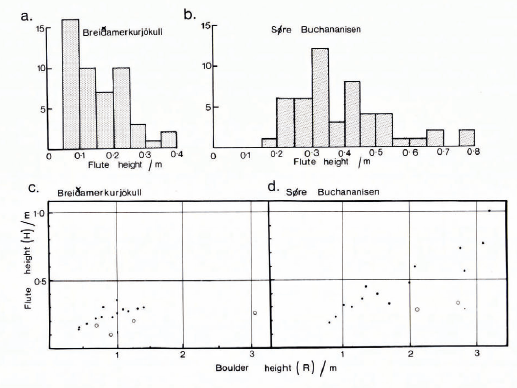
Figure 1 shows part of a typical fluted surface developed in lodgement till beyond the margin of Breiðamerkurjökull in Iceland. The till is up to 2 m thick and rests on fluviatile gravels. It was found that flutes did not occur in the lee of the boulders which projected less than about 0.3-0.5 m above the general level of the surface. Λ histogram showing the frequency distribution of flute heights on this surface is shown in Figure 4a and b, and compared with one made up from observations on a fluted surface beyond the margin of Søre Buchananisen in Spitsbergen. Both show a skewed distribution and a modal class of 0.05-0.1 m for Breiðamerkurjökull and 0.3-0.35 m for Sore Buchananisen. Although in both cases flute heights measured beyond the glacier snout are probably very much degraded by slumping below their subglacial heights, I suggest that these flutes illustrate a real contrast which requires explanation.
a and b. Frequency distribution of flute heights on till surfaces beyond Breiðamerkurjökull in Iceland, and Søre Buchananisen in Spitsbergen. Open circles refer to flutes derived from lightly embedded boulders. c and d. Flute heights plotted against the height of boulders from the same two surfaces.
In general, the crest-lines of individual flutes maintain a uniform height above the adjacent till surface, although subaerial degradation causes some to decrease in height with distance from the glacier. Sudden increases of flute height occur down-glacier of points where particularly large boulders occur in the body of the flute. At the lateral margins of the flutes there is a tendency towards the development of a furrow which lies below the general level of the till surface (Fig. 3).
Investigations showed that, on all surfaces observed, a flute was found in the lee of a boulder if the boulder was deeply embedded in the till and projected about 0.3-0.5 m above the level of the surface. In these cases, and also in cases where the point of flute initiation has only recently been revealed from beneath the retreating glacier and thus not suffered excessive degradation, the flute intersects the lee flank of the initiating boulder via a streamlined wedge of till. The width of the flute in the lee of the boulder is generally slightly less than that of the boulder.
Where a large flute-generating boulder merely rests on the till surface, or is lightly embedded in it, it is found that the crest line of the flute rises to intersect the boulder by way of a more prominent till wedge, the longitudinal profile of which shows strong upward concavity (Figs 1 and 2). Some of these lightly embedded boulders do not have a flute developed in their lee, but merely the streamlined wedge of till.
The relationships between flute heights H and the heights R of flute-initiating boulders are plotted in Figure 4b for till surfaces at the margins of Breiðamerkurjökull and Søre Buchananisen. It is clear that the height of flutes is less than the height of the initiating boulder but dependent upon it. If we assume a linear relationship, then for Søre Buchananisen H/R = 0.26 and for Breiðamerkurjökull H/R = 0.16. For Brciðamerkurjökutl, four H/R ratios are relatively low and for Sore Buchananisen two are relatively low. These were measured on flutes whose initiating boulders were only embedded lightly in the till surfaces.
Flutes which appear to be generated by rigid bedrock knobs that project above the till surface also occur. Four such examples have been observed, one in Spitsbergen, two in Iceland, and one beyond the margin of the Glacier des Bossons in the French Alps. They are essentially similar to flutes derived from deeply embedded boulders and lack the concave lee-side wedges which lightly embedded boulders display. Reference Paul and EvansPaul and Evans (1974) also describe Mutes which they believe to have been generated in the lee of bedrock knobs beneath the margin of Blomstrandbreen, a belief verified after further glacier retreat (personal observation).
Subglacial Observations
Observations in man-made and natural tunnels beneath Breiðamerkurjökull in Iceland and Nordenskiöldbrcen in Spitsbergen throw some light on the genesis of flutes.
Part of the northern frontal margin of Nordenskiðldbreen flows from a fjord basin onto land, and is thus temperate in its basal part in this locality. A short tunnel, excavated at the glacier margin, led into a till- and silt-floored cavity, with a low roof, on the down-glacier side of a hummocky bedrock surface which just protruded above the till surface (Fig. 5). Three flutes were exposed in the cavity, each flute emanated from a low hummock on the bedrock surface. The flutes were straight, 0.3 m in height, and they intersected the bedrock surface via streamlined wedges of sediment. At the lateral margins of the flutes the sediment surface was depressed into furrows. The ice roof of the cavity exhibited deep grooves emanating from the points where the glacier sole still retained contact with the tops of the flute-generating hummocks. Each groove lay above a flute, although it was no longer in contact with the till. At the lateral margins of the grooves the ice projected downwards as ribs below the general level of the glacier sole (Fig. 6). The structure of these ribs reflected an enhanced plastic flow of ice displaced around the flanks of the / hummocks and the presence of much regelation ice, presumably derived from pressure-melting against the up-glacier faces of the hummocks.
Plan of a natural subglacial cavity on the down-glacier side of an irregular bedrock surface near to the western margin of Nordenskiöldbreen, Spitsbergen.
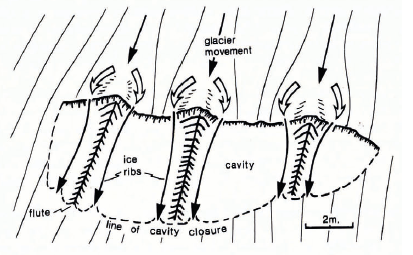
A rib on the ice roof of a subglacial cavity. The rib extends from a low point in a bedrock surface to the right. The rib extends 1.5 m below the general level of the ice roof.

The implications of this locality are clear, and, in general, support the hypothesis of Dyson (1952). Nordenskiöldbreen has undergone steady retreat in recent years, and in past times, when the ice was much thicker at this locality, I assume that the cavity would have been supressed and the glacier sole would have made contact with the till. The downward-facing ribs on the flanks of the grooves would have pressed into the till and forced it to flow laterally. The till would have flowed readily into the grooves, but would also have moved away from them, thus forming the observed flutes and the associated marginal furrows. The implied pressure distribution would be, on the whole, similar to that inferred by Paul and Evans (1974) from observations which they made on Blomstrandbreen, Spitsbergen.
The readiness with which water-saturated subglacial till flows under pressure was observed beneath Breiðamerkurjökull. A short subglacial tunnel (5 m long) was hewn out over a till surface beneath up to 20 m of ice. After 24 h it was found that the till floor had risen by some 20 cm above the base of the ice walls, where it was subject to a pressure of at least 2 bar. During construction, a flute was exposed in the tunnel walls (Fig. 7), and, as flanking ice was hacked away from the flute, water-saturated till flowed very readily into the tunnel. (This contrasts strikingly with the frozen flutes exposed by tunnelling beneath Isfallsglaciären in Swedish Lappland (Hoppe and Schytt, 1953).) The flute exposed in the tunnel walls appeared to be folded over the flanking ice. Similar characteristics, and also flutes with a mushroom-like cross-section, were observed by Reference BaranowskiBaranowski (1970) who interpreted them as evidence for subglacial frost heaving. Here, however, the till was quite unfrozen and below the depth to which winter cold might be expected to penetrate. I suggest that, in the ice ribs, hydrostatic pressures which are locally high and which are formed by flow around the flanks of the flute-initiating boulder, cause this ice to relax relatively rapidly on stress release in the lee of the boulder, which thus pinches the sides of the flute in. Similar relaxation of flanking ice occurs in many subglacial cavities (Reference Boulton, Wright and MoseleyBoulton, 1975), and a mushroom-shaped cross-section may be typical of many subglacial flutes.
Cross-section of a tunnel hewed into the glacier-till interface near the western frontal margin of Breðamerkurjökull, Iceland. The tunnel intercepted a till flute which collapsed into the tunnel. Till also intruded into the tunnel walls. The dashed line is a hypothetical reconstruction of the original form of the flute.
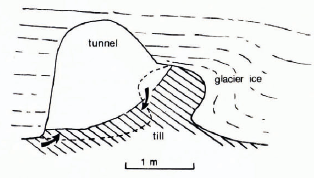
When exposed beyond the glacier margin, collapse of the originally steep-sided flute produces a typical inverted-V cross-section. The flute heights plotted in Figure 4 may be proportional to their subglacial heights but the flanks of many flutes have been much degraded, the inverted-V form probably bearing little relation to subglacial form. The extent of such degradation is illustrated by Figures 1 and 2, which show a lightly-embedded boulder which has initiated a flute immediately after exposure from beneath the retreating glacier, and, again, after four years of subaerial exposure. The height of the flute has been reduced from 0.4 to 0.25 m and the till wedge on the lee side has also been much degraded. Another result of subaerial activity is the preferential removal of fines from the crests of flutes and their re-deposition in the flanking hollows, producing a contrast between stoney flute crests and finer-grained flanking areas. This contrast is shown in photographs of flutes beyond Werenskiold-breen (Baranowski, 1970), and has been reported by Reference Kozarski and SzupryczyńskiKozarski and Szupryczyński (1973) from Sidujökull in Iceland.
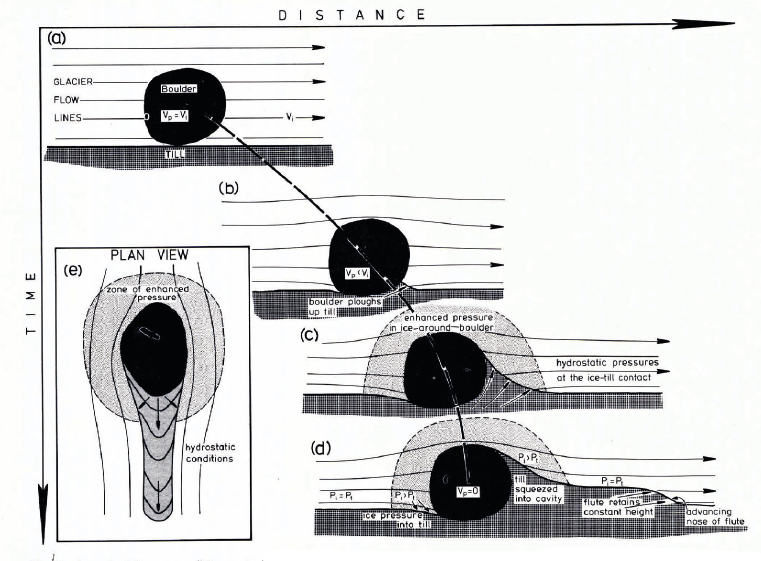
Subglacial observations also provide direct evidence for the mechanism of deposition of flute-generating boulders and the initiation of flutes. Boulders in transport in basal ice, which have partially melted out of this ice, protrude into the underlying till and plough through it. The boulder is thus retarded relative to the moving ice, and till is pushed up by the advancing boulder into a streamlined wedge in its lee. This process is illustrated in Figure 8. The ice digs into the till around the boulder and causes the lee-side till mass to decrease in height until the ice pressure is reduced to the till pressure. Beyond this point, the flute height remains constant, no matter how fluid the till. If no deformable sediment had been present under the glacier, a lee-side cavity might have formed.
A graph of time versus distance superimposed on diagrams of (a) an englacially transported boulder, which is (b) retarded by ploughing into the till, and which (c) subsequently develops a wedge of till on its lee side. This till can (d) be traced into a flute. Diagram (e) shows a plan view of diagram (d)
Observations also show that boulders may be removed from the heads of flutes which they have initiated. Many glaciers' which are currently retreating but which have a high activity index undergo a slight re-advance during late winter and spring. Winter and spring re-advances of up to 20 m have been measured at the margin of Breiðamerkurjökull. One effect of these is to sweep along many of the large boulders left resting on or lightly embedded in the till surface during the retreat of the previous year, and to re-deposit them at the limit of winter re-advance as a linear concentration of boulders associated with a small push-moraine. Thus, lightly embedded boulders which had previously stood at the head of flutes may be removed from this position. In addition, lightly embedded boulders could easily be removed from the heads of flutes as ice thickness is reduced, as this would lead to a reduction in the strength of the embedding till which, hitherto, retarded the boulder.
Patterns Of Strain Within Fluted Sediments
Further evidence for the origin of glacial flutings can be derived from the patterns of deformation within them as revealed by their fabric and structure.
(i) Fabric analysis
Fabrics at each fabric site have been determined by two methods, conventional orientation analysis of 50 clasts between 5 and 20 cm in length, and with an axial ratio of at least 1.5: i, and by measurement of the anisotropy of magnetic susceptibility of small cylindrical samples of radius 2.5 cm and axial length 2.5 cm (Reference ReesRees, 1964; Reference Boulton and GoldthwaitBoulton, [1971]). The first method gives an average fabric over a volume of the order of 0.05-0.01 m3 of till, and the second from a very much smaller volume. The first method has the disadvantage that it averages the fabric over a volume which is significantly large compared with the size of the flute. The second method, although it has much greater resolution, is likely to reflect local deformation related to flow around rigid clasts in the till.
(a) Lee-side till wedges. Detailed fabrics have been determined for four till accumulations from lee-side till wedges, two in the lee of lightly embedded boulders, one in the lee of a deeply embedded boulder, and one in the lee of a bedrock knob. Analysis of the wedges in the lee of lightly embedded boulders and close to the boulders show a series of fabric peaks which, in the horizontal plane, radiate outwards from a point low on the leading face of the boulder (Fig. 9). Fabrics also dip towards this point. Further from the boulder, fabric peaks dip forward and down the flanks of the till wedge. I suggest that this fabric pattern supports the hypothesis that the till wedges in the lee of lightly embedded boulders are produced by ploughing through the till or the pre-existing flute.
Results of till-fabric measurements on a till wedge in the lee of a large lightly embedded boulder. Data are plotted on the lower hemisphere of a Schmidt equal-area projection. 50 points are plotted in each case, contoured at 20 intervals. The arrow gives the direction of ice movement. Near to the boulder, fabric peaks dip steeply towards it in a fan-like pattern. Away from the boulder and on the flanks of the tilt wedge, fabrics dip down the flanks.

These fabrics contrast with those determined from till wedges in the lee of deeply embedded boulders or bedrock knobs. In these, the fabrics largely appear to reflect the transverse form of the till wedges. Transverse orientations dominate, in an anticlinal pattern, although near to the surface there is a tendency for an up-glacial imbrication.
I suggest that these patterns reflect simply an extrusion of till from beneath flanking ice into a low-pressure zone in the lee of the obstructions. The fabrics are quite different from those suggested as evidence of ploughing in the lee of lightly embedded boulders.
(b) Fabrics within flutes. The pattern of microfabric variation has been established in detail for two flutes by magnetic methods, one from the margin of Brciðamerkurjökull, and one from Sore Buchananisen. This technique produces a susceptibility ellipsoid which is assumed to reflect the strain ellipsoid. Sections which are parallel to and transverse to the Breiðamcrkurjökull flute axis are shown in Figure 10, together with a horizontal section. The two-dimensional projections of the three-dimensional ellipsoids are shown in these planes.
A plot of ellipsoids of magnetic susceptibility measured in a till flute taken from beyond the margin of Breiðamerjökull in south-east Iceland. The locations of clasts larger than 100 mm in diameter are also plotted, (a) shows a trench section across the flute, (b) is the horizontal projection of a surface dug out along the line A-B in (a), (c) is a vertical section parallel to the flute crest of a surface dug back from C-D in (a).
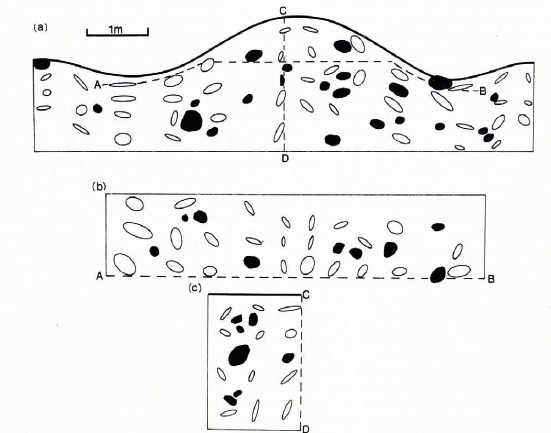
In vertical cross-section, the implied pattern of strain shows an anticlinal structure dipping away from the flute axis, down each flank. The steepest dips occur at some depth below the flute axis. A synclinal structure occurs beneath the troughs which flank the flutes, and beyond them there is again a subsidiary anticline. The most elongated ellipsoids are to be found beneath the flanking troughs, where they suggest vertical compression and horizontal extension away from the troughs, and deep beneath the flute crest, where they suggest horizontal compression and vertical extension towards the flute crest. The two-dimensional pattern of strain within the flute indicated by the magnetic fabric suggests that material has been expelled from the location of the flanking troughs horizontally and upwards towards the position of the flute crest. It has also moved from the trough location, in a direction away from the flute crest producing a subsidiary anticline outside the troughs.
This two-dimensional pattern is wholly consistent with a theory of flute formation in which till is expelled from beneath the walls of a tunnel to flow into the tunnel and also to flow from this position away from the tunnel, forming a subsidiary anticline due to the compression generated against vertically confined till. This latter observation indicates that the vertical pressure adjacent to the tunnel walls is greater than that further from the tunnel, a conclusion also implied by the presence of the troughs which flank the flutes.
In horizontal cross-section (Fig. 10b), there is a preferred orientation parallel to ice movement, though with a component which points forward and towards the flute axis, forming a herring-bone pattern. This is a little difficult to interpret. It could reflect a single phase of deformation in which till is squeezed, not only laterally towards the axis of the tunnel, but also forward in the direction of the advancing head of the tunnel. Alternatively, the component parallel to the ice movement could reflect the shearing action of ice as it moves over the flute surface after its formation. Of course, both processes may be involved together.
The vertical longitudinal section (Fig. 10c) shows a general fabric dip in an up-glacier direction which is greatest at lower levels. The greatest elongation of susceptibility ellipsoids is found in the surface horizons and at basal horizons, with an intermediate horizon of reduced elongation. I would explain the elongation in the lower horizon as a response to strong vertical extension, and the elongation in surficial horizons as a response to shearing by the over-riding glacier after the formation of the flute.
In Figure 10 the position of all clasts greater than 100 mm in diameter has been plotted, and it is noticeable that in the vicinity of these clasts, or groups of clasts, the pattern of orientation breaks down. I would suggest that these clasts block the pattern of flow in the till matrix and locally influence matrix fabrics, and that the till acts as a mechanically complex material, with some areas behaving in a rigid, passive fashion, and others in elastic/plastic fashion.
A similar analysis of magnetic fabric for a flute in the much more bouldery till of Sore Buchananisen failed to reveal any systematic microfabric. I assume here that deformation in the till matrix is dominated by the presence of, and interactions between, boulders in a till which contains a very large boulder fraction. The contrast between microfabrics and macro-fabrics can be used as an index of the mechanical behaviour of the till, if one compares the intensity and direction of matrix (microfabric) to the clast fabric at different points.
In order to investigate general patterns of macrofabric development, a large number of stone-orientation fabrics made on nine different flutes have been superimposed (Fig.11). A vertical cross-section of an ideal flute has been divided up into 18 roughly equal areas, and all stone orientation determinations made in real flutes have been ascribed to one or other of these areas. In addition, right- and left-hand sides of flutes have been superimposed by changing the sign of the longitudinal reference axis, so that all measurements have been plotted as if made on the right-hand side of a flute. The effect of this is to obliterate any asymmetry which may be found in particular flutes.
Several generalizations can be made from Figure 11. In the surface layers, principal-orientation vectors lie parallel to the flute axis, with a subsidiary orientation pattern similar to that described from the microfabric analysis shown in Figure 10. At intermediate levels, the parallel orientation component is diminished in strength, a transverse anticlinal pattern is found below the flute axis, and a transverse synclinal pattern beneath the flanking troughs. The lowermost horizons sampled, which vary in individual flutes from 0.5-1.5 m below surface, show little reflection of this anticlinal form, except immediately beneath the flute crest and the flanking troughs.
A summary of macrofabric data measured on nine different flutes Superimposed onto one half of an idealized flute. Contours at 20 intervals. The number of determinations plotted in each Schmidt equal-area net is as follows: 1. 350; 2· 370; 3, 140; 4, 36; 5, 245; 6. 114; 7, 104; 8, 95; 9, 50; 10, 77;, 11, 100; 14, 87; 15 50; 16, 180; 17, 50; 18, 50. Ice movement direction from top to bottom.

I would explain these three fabric domains as follows. The lowest horizons reflect the fabrics which antedate flute formation (except beneath flute crest and flanking troughs where the deformation associated with flute formation was most intense). Intermediate horizons tend to reflect the deformation associated with flute formation, horizontally away from flanking troughs both towards the flute crests and away from them, and upwards and forwards into the ice tunnel which the flute filled. The parallel orientations in surficial horizons predominantly reflect re-alignment of the fabric in response to the shearing imposed by the movement of ice over the flute surface.
The fabric pattern shown in Figure 11 is generalized and individual flute fabrics may diverge considerably from it. The three principal modes of variation are: the depth to which surface reorientation occurs, presumably resulting from different depths to which shear deformation by the moving glacier occurs; the depth to which the flute-forming deformation penetrates; and the fact that many fabric patterns are asymmetric. Because of this variability the fabric strengths in Figure 11 are not as great as they may be in particular cases.
A particular example of macrofabric asymmetry is shown in Figure 12. There is relatively little parallel re-orientation by glacier shear in the surface layers, but a general anticlinal pattern flanked by synclines, which are themselves flanked by minor anticlines, is maintained. The lower horizons also show what 1 assume to be a pre-flute parallel orientation. However, the most striking feature is that the axis of the flute is not coincident with the fabric anticline. For instance in samples H and L, on the right-hand side of the flute, the leftward dip is still maintained. The anticlinal axis appears to occur between samples L and M. A similar asymmetry has been noted by Paul and Evans (1974) and by E. A. Derbyshire (personal communication).
Macrofabrics from flute-forming till from beyond the margin of Breiðamerkurjökull, Iceland. Plotted on the lower hemisphere of a Schmidt equal-area projection. The arrow gives the direction of ice movement and of flure crest. 2σ contour interval.

On the flanks of some flutes are high dips which may well reflect pinching-in of the flute walls by flanking ice in the way shown in Figure 7. In other flutes, the patterns of fabrics, which are considered to represent the phase of flute formation, break down at 0.5-1.0 m below surface and give place, not to simple orientation peaks parallel to ice movement, but to complex fabric patterns which may have been derived from pre-existing flutes which have been buried.
(ii)Internal structure of flutes
Paul and Evans (1974) show how flutes composed of over-ridden and originally horizontally bedded sediments have an anticlinal structure which clearly indicates upward movement of sediment into the flute. They also suggest a strong lateral component of movement, as if sediment has been squeezed away from the lateral flanks, both towards the flute crest and away from it. The fold structures which they describe are also highly asymmetric.
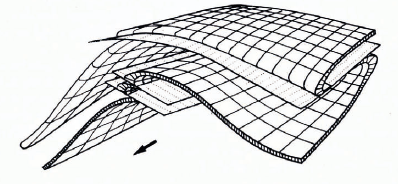
The flutes in bedded sediment beneath the margin of Nordenskiöldbreen are also exposed beyond the glacier margin, where they are channelled by a pro-glacial stream, revealing internal structures very similar to those described by Paul and Evans. They were systematically excavated here in order to examine the three-dimensional pattern of internal folding which is reconstructed in Figure 13.
· Schematic reconstruction of folding in fluted sediments beyond the margin of Nordenskiöldbreen, Spitsbergen. The direction of ice movement and the trend of the flute crest are given by the arrow. Twofold sets are present. One, with an axis parallel to ice movement indicates the phase of flute formation. This fold is asymmetric and is cut by small thrusts. The second, isoclinal set, affects only surface horizons, is folded about axes transverse to ice movement, and is associated with thrusting parallel to ice movement.
Several generalizations can be made about individual flutes:
-
(a) Two major fold sets can be readily identified, the first fold set has axial planes which strike parallel to the flute axis; the second, a later set, has axial planes which strike transverse to the flute axis.
-
(b) The first folds are broad and asymmetric, about steeply inclined axes, although distinct shear planes occur within them. They terminate downwards against a well-defined plane of décollement, below which there is little deformation, and indicate a transverse movement away from the furrows at the foot of the lateral flanks.
-
(c) The second set re-folds the first set along flat-lying axes into a series of overturned and isoclinal folds. The second set penetrates to shallower depths than do the first folds.
I suggest that the folds which are formed first arise as a result of flow from beneath the ribs of ice which form on the lateral flanks of rigid obstructions. The reason for this flow, I suggest, is failure of the till under the locally high bearing pressures which occur beneath these ribs. The re-folding of these first-formed folds I interpret as evidence for shear strain in the uppermost horizons of the flutes, in response to the shear stresses imposed by the overriding ice after the formation of the flute.
On first examination, it appeared that the bedded sediments in the flat areas between flutes were horizontally bedded and undisturbed. Closer examination showed that these sediments were isoclinally folded along horizontal axes, the tectonic strike of which was transverse to the ice movement. It seems likely that the flute sediments had also suffered this phase of folding, but the tightness of the folds and their subsequent re-folding made this difficult to discern. I suggest that these very light folds are a response to ice over-riding, that such folding was continuous both before and after flute formation, and that the second-phase folds in the flutes were produced by this process.
The internal structure of till flutes has been investigated by Reference Kozarski and SzupryczyńskiKozarski and Szupryczy ński 1973), Reference Boulton and DentBoulton and Dent (1974), and Reference Boulton, Boulton, Dent and MorrisBoulton and others (1974). In the second and third of these articles, the authors show that the till at the western margin of Breiðamerkurjökull had a two-layer structure. A thin (400 mm) surface horizon occurred, in which the concentration of fines in the silt/fine sand range (80 to 30) was significantly greater than in the underlying till. Beneath and at the glacier margin, this was associated with a much higher voids ratio, and was interpreted as evidence of continuous shear failure in the upper horizon of the till. It caused grain crushing and dilation in a previously tightly packed till. The interface between these two horizons passed without disturbance beneath flutes.
The observations of Kozarski and Szupryczyński at Sidujökull, Iceland, also indicate a similar structure, with a contrast between a surface layer (200 mm thick) enriched in fines and the underlying till.
Many flutes appear to show a secondary pattern, resulting from continuous shear strain beneath overriding ice superimposed on the pattern of strain which reflects flute formation. This secondary pattern need not develop if effective pressures are great enough to inhibit failure, in which case, transverse and upward flow into the flute will dominate the fabric pattern. Continuous shear strain will tend to impose a secondary, longitudinal fabric pattern, although the depth to which this re-orientation occurs will depend upon the mechanical properties of the till and local stress conditions.
These observations suggest that flute formation is independent of whether shear failure occurs or not. If failure does occur, the sediment will exhibit critical voids ratios, in the sense used by Reference Schofield and WrothSchofield and Wroth (1968).
Theory—The Origin of Individual Flutes
When a glacier flows over a rigid bedrock surface, it is commonly found that cavities occur in the lee of prominent obstacles on their surface. From glacier sliding theory (Reference NyeNye, 1970), cavities will tend to occur when:

where a is the amplitude, λ the wavelength of obstacles, n the ice viscosity, v i the ice velocity, K * a material constant, p i the density of ice, h the ice thickness, and p w the value of any water pressure at the ice-bed interface. The size of the cavity will increase as the difference between the left- and right-hand sides of the equation increases.
When a boulder in transport within basal ice comes into contact with the glacier bed, it is found that the boulder is retarded with respect to the ice, which moves around it with velocity vt. This value can be substituted for v i in the above equation. If vr is large enough, then a cavity will tend to develop. Unloading of the till in the lee of the boulder sets up a pressure gradient in the till which may be adequate to cause the till to flow into the cavity.
If till flows into an incipient lee-side cavity, its presence will further retard movement of the boulder, vr will increase and, from the equation, so will the size of the cavity, which will thus fill up with more till and retard the boulder further until its motion ceases and νr becomes equal to v i Because of this deceleration the form of the till-filled cavity will change, producing a streamlined wedge of till of which the longitudinal slope of the crest line decreases (Fig. 8), as has been observed in the lee of lightly embedded boulders.
Observations show that, at some point in the lee of the initiating boulder, the streamlined till wedge ceases to diminish and leads into a flute of constant height. I assume that at this point the inward force tending to close the till-filled cavity is balanced by a resistive force in the till, whilst by implication, the force in the ice up-glacier of this point has exceeded that in the till and has decayed to an average subglacial value at the point of flute initiation. When ice flows around an obstructing boulder in its path, the hydrostatic pressure in the ice in the immediate vicinity is raised above the average value at the base of the glacier. At the point of flute initiation this has decayed to an average value (Fig. 8). This excess pressure in the ice flanking the boulder can be dissipated by the ice displacing till around the boulder flanks, and by a more generalized deformation within the ice. The equilibrium size of the flute will depend, in a complex way, upon the magnitude of the stress enhancement around the boulder (i.e. νr and boulder size) and the mechanical properties of the till. Thus, for a lightly embedded boulder still in motion beneath the glacier, vr will be less than v i and, compared with a deeply embedded stationary boulder of similar projection size and shape in which v r = vu i the equilibrium size of the flute will be less. This is clearly seen to be so in Figure 4, c and d. In addition, the greater the strength of the till, the more readily will it resist diminution of the till-filled tunnel, and thus the systematic height differences between flutes of different composition can also be explained (Fig. 4a and b). For deeply embedded boulders there should be correlation between boulder size and flute size, and this does indeed occur. 1 suggest that the stability and great length of many of the flutes arise from the hydrostatic conditions which obtain in the vicinity of the till-filled tunnel away from the initiating boulder (Fig. 8). Thus, even though the till may be in a fluid state, the flute is a stable form. I reject the contention of Hoppe and Schytt (1953) that very long flutes can form only if the till within them freezes.
A realistic analysis of this process would clearly be very complex and would probably require the use of a plastic flow law for ice, Reference Morris and MorlandMorris and Morland (1976) have used a simplified theoretical model to estimate the height of flutes. They calculate a maximum flute height which is dependent on the mechanical properties of the material. They also suggest that flute heights less than this maximum should be similar to the height of some obvious feature on the initiating boulder. In fact, this is not so (Fig. 4, c and d), but it is precisely here, in the relationship between initiating boulder and flute, that their simplified model breaks down. A realistic estimate of pressure beneath flute tunnel walls in the vicinity of the initiating boulder must take into account the complex pattern of flow around the boulder.
I noted earlier that some flutes had a cross-section which was mushroom-shaped. This can be explained by reference to typical patterns of ice flow around obstacles in the path of the glacier. It has been observed that, when ice flows around a three-dimensional obstacle, the flanking ice flows into the lee-side position more rapidly than the overlying ice (Boulton, 1975)· This presumably results from higher normal pressures against the flanks at the ice-bed interface. Thus, as ice flows alongside the lee-side wedge of till and the succeeding flute, the flanking ice pushes more strongly against the till, producing a mushroom-shaped cross-section.
Detailed patterns of strain within flutes are difficult to reconstruct because of the Theological complexity of till; it may be described as a plastic or frictional material containing large rigid clasts which obstruct the free pattern of deformation of the matrix. Nevertheless, several generalizations have been made earlier in this paper, and these can be compared with the strain patterns which would be expected as a result of extrusion of till into an ice tunnel from beneath its flanking walls. An estimate of the strain pattern which might be expected from such a process is shown in Figure 14. In order to make this estimate, two assumptions are necessary: an assumption of a depth beneath which the till will not be deformed by the flute-forming process; and an assumption of the final shape of the flute. Given these, then the way in which an originally square lattice must be deformed in order to take up the new cross-sectional shape can be estimated. The amount and direction of strain required for each of the lattice elements depends on their position. Beneath the flanking troughs, considerable lateral extension and vertical compression occurs, whilst beneath the flute axis, lateral compression and vertical extension dominate. Exactly this cross-sectional pattern of strain was inferred from fabric measurements. The amount of cross-sectional strain is least half-way down the lateral flanks of the flute.
Fig. 14. The expected pattern of strain raising from lateral intrusion of till into a cavity, exemplified by the pattern of deformation of a cuboidal network.

Figure 15 shows the net displacement of lattice intersections, downwards beneath the flanking troughs and upwards between the crest, with a reduced magnitude at lower horizons. Of course, these constructions only take into account lateral movements. Patterns of strain in real flutes also incorporate the effects of a forward component of flow into the advancing nose of the ice tunnel as it fills with the flute material. This flow occurs in surface horizons as a result of the longitudinal shear forces generated by glacier movement over the flute surface. During flute formation, till will flow in a down-glacier direction along the axes of the flute; the three-dimensional pattern of till deformation, composed of transverse and parallel elements, will result in a herring-bone pattern in the horizontal plane. In several flutes in which herring-bone patterns exist, it is found that these patterns are replaced in near-surface horizons by a relatively strong fabric which is aligned parallel to ice flow along the axis of the flute. I suggest that these fabrics represent a reorientation of pre-existing flute Fabrics by the shear forces imposed by movement of the glacier over the flute surface. In some cases the reorientation is minimal, in others it affects almost all the flute (e.g. Kozarski and Szupryczyński, 1973). The complex patterns of strain produced by these two processes are well illustrated by the deformation of stratified sediments shown in Figure 13.
Particle trajectories produced by the deformation pattern in Figure 14, a and b.

The fabric asymmetry reported by Paul and Evans (1974) and E. A. Derbyshire (personal communication), and illustrated in Figure 12 is easily explained. The rheological inhomogeneity of till in flutes has already been demonstrated. If the till on one side of a tunnel extending on the lee of an obstruction is weaker than on the other, the tunnel will tend to fill more readily with till from the weaker side. Alternatively, the regional pattern of stress in the glacier may be such that one flank of the tunnel is more heavily loaded than the other.
It is also possible to consider flute-forming deformation as occurring primarily along two discrete shear planes (Fig. 16). For this type of bearing-capacity problem, where shear movement is considered to occur over a large number of stress discontinuities, it can be shown (Reference Schofield and WrothSchofield and Wroth, 1968) that for a cohesive soil
(q-p) = 5.14K
where (q—p) is the difference in loading, and K is the soil cohesion. Thus, for a till in which K = 0,25 bar (typical of Breiðamerkurjökull), a flute will develop if the ice pressure is greater than 1.28 bar, equivalent to 14 m of ice if the glacier bed is fully drained. However, (q—p) cannot be transformed directly into an ice thickness, as this is the ice pressure at the margin of the flute, which is enhanced by plastic flow around the boulder and pressure due to bridging.
Diagram showing the positions of shear planes in subglacial sediments which might develop in response to differential loading across a subglacial tunnel. One shear plane will tend to dominate and thus produce an asymmetric deformation pattern.

It is a mistake to assume that the inverted-V cross-section of a flute exposed beyond a glacier margin necessarily indicates its subglacial shape. This may have been steep-walled or mushroom-shaped, producing a fanned cross-sectional pattern of strain (Fig. 7 and Baranowski, 1970). Collapse of such sleep-sided flutes on subaerial exposure may, of course, produce secondary slumped fabrics in which the long axes of particles lie down the line of greatest lateral slope. Reference Morris and MorlandMorris and Morland (1976) have used a complex analysis to determine the theoretical pattern of strain within a flute. However, they are constrained by their analysis 10 use a simplified model for the till which assumes uniform elastic properties and does not take into account longitudinal strain.
Interrelationships Between Flutes On Fluted Surfaces
Several authors have shown that there is a typical spacing between flutes (Reference Hoppe and SchyttHoppe and Schytt, 1953; Reference BaranowskiBaranowski, 1970; Reference Shaw and FreschaufShaw and Freschauf, 1973), and data from Breiöamerkur-jökult and Sore Buchananisen, Spitsbergen clearly support this (Fig. 17), However, it is erroneous to conclude from these data that some rhythmic mechanism must be responsible. In the theory presented here, the majority of flutes on a lodgement till surface are initiated by boulders, and thus the distribution of these flute-generating boulders is of crucial importance. Two boulder-placement models which depend upon the concentration of boulders in transport, are suggested. If relatively few boulders of flute-forming size are transported, 1 expect these to lodge in a random fashion as a result of ploughing into the till matrix (Fig. 8). If a large number are transported, they may initially lodge on a random basis, but subsequently, the obstruction provided by these rigid, lodged boulders may cause others to lodge in proximity to them, so producing a series of randomly distributed boulder clusters (Boulton, 1975)·
Frequency distribution of flute spacings from (a) Brei∂amerkurjökull. Iceland; (b) Søre Buchananisen, Spitsbergen; and (c) Isfallsglaciären, Sweden.
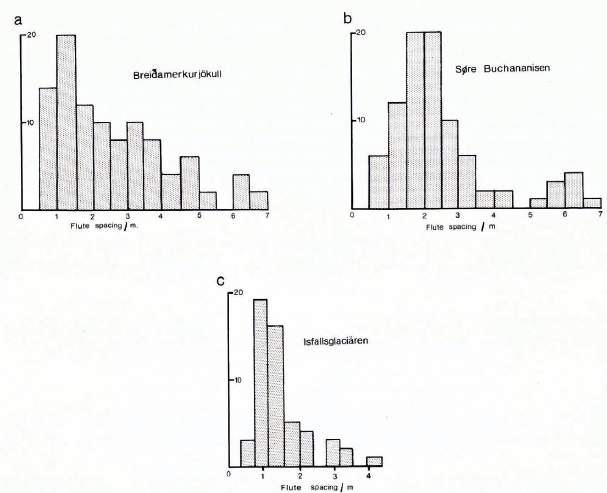
Λ flute-spacing model which depends on flute-generation by randomly placed boulders can be simulated by identifying boulder coordinates from a table of random numbers and drawing parallel lines from these. This procedure gives a Gaussian frequency distribution of flute spacing, indicating that a clear average spacing is the most probable result of random boulder placement, not an indication of a rhythmic formative process as suggested by Hoppe and Schytt (1953), Baranowski (1970), and Shaw and Freschauf (1973).
If the spacing density of flute-forming boulders is high, flutes will tend to be very close. However, field observations indicate (Fig. 18a) (hat the ribs of ice which form around the flanks of flute-generating boulders will tend to displace pre-existing flutes sideways so as to maintain some minimum spacing. The absence of such small spacings will tend to produce a positively-skewed distribution. Thus this model agrees well with flute spacings measured in the field from Breiðamcrkurjokull, Sore Buchanaiiisen (Fig. 17) and Isfallsglaeiären (Hoppe and Schytt, 1953).
If, however, flute-generating boulders are found in randomly distributed clusters, a bi-modal distribution of flute spacings might be expected, the large spacings occurring between flutes from different clusters, and the small spacings between flutes from the same cluster. Such a distribution was indeed found for flute spacings from die above three glaciers, and, in the case of Søre Buchananisen at least, a well-defined pattern of randomly placed boulder clusters does occur.
Flutes often show complex field relations, which can be readily understood in the light of the theory, and by considering the conditions in the basal part of the glacier. Several of these are illustrated in Figure 18.
Several field relationships between boulders and flutes, (a) Line of a flute diverted past a flute-generating boulder. (b) Flute terminates against a boulder, which then generates a larger flute on its down-glacier side, (c) Boulder with a wedge of till and short flute on its down-glacier side, (d) A cluster of three boulders each with wedges of till and short flutes on their down-glacier sides. The arrows show the direction of ice movement.
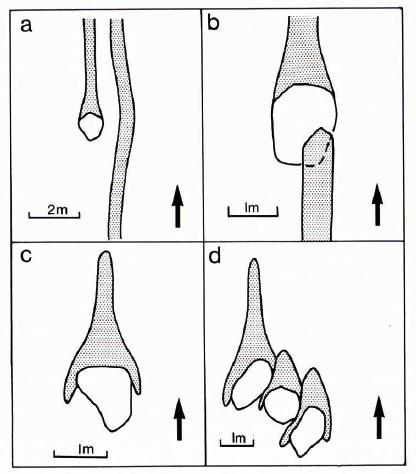
Figure 18a shows the detour taken by a flute around a very large boulder in its path, which itself initiates a flute. I suggest that the disturbance to ice flow caused by the boulder forces ice-flow lines and structures such as till-filled tunnels to diverge around it.
In Figure 18b a large boulder occurs in an existing flute, and in traversing the boulder the flute grows in size. I suggest that here the till-filled tunnel closes against the up-glacier flank of the boulder, due to the stress concentration in the ice as it moves against the boulder. On the lee side, another flute forms in the normal way. Flutes have also been found to terminate against bedrock obstructions.
Figure 18c shows a boulder with a ploughed-up nose of till followed by a short flute in its lee. I suggest that the boulder first made contact with the till not far from the snout of the glacier. It ploughed up till in its lee and a flute began to form, but that the advancing till-filled tunnel, then intersected the glacier margin, and was thus terminated.
Figure 18d shows three large boulders, the first similar to that described above, and the other two in close proximity with till noses, but without flutes. 1 suggest that the first boulder and flute were formed in the same way as that shown in Figure 18c, but that the other boulders were impeded in turn by the first boulder and its till nose. They then ploughed up noses of till, but before flutes could form they were exposed at the glacier margin.
Nomenclature And Classification
The terms “flute”, “fluted surface”, “fluted ground moraine”, etc., are all descriptive terms which have only been defined very loosely. For instance, Reference FlintFlint ([1971]) defines fluted surfaces as “fields of straight parallel grooves with intervening ridges” and applies the term to those developed in bedrock, in till, and in stratified drift. Reference PricePrice ([1973]) defines fluted ground moraine as “a distinct lineation approximately parallel to the former direction of movement of the glacier or ice sheet by which it was deposited”. Using such definitions as that of Flint, in which bedrock flutings and till flutes are classified together, it is clearly not sensible to ask the question “How do flutes form?” This would imply that similar morphology and, in the cases quoted, a morphology only vaguely specified, must imply similar genesis, whereas homeomorphy and “equi-finality”, by which forms of different origin assume a similar morphology, are ubiquitous in the natural environment. The assumption that there must be an origin for flutes, and an origin for drumlins, etc., has probably retarded advances in understanding of the processes at work in the evolution of such morphologically defined forms.
I wish to propose that the term “flute” should be used in a genetic and not a descriptive sense, and that it should be restricted to forms which originate in the manner described in this paper. I consider these processes to be by far the most important mechanisms at work in the production of fields of parallel ridges on deformable subglacial surfaces. I define a flute as a long, parallel-sided ridge which indicates accurately the direction of ice movement, and which occurs when deformable subglacial materials are intruded into tunnels which open up on the lee sides of single, rigid obstructions on the glacier bed. They are thus neither depositional nor erosional features, but result from post-depositional deformation of pre-existing materials. They should be distinguished from bedrock forms, termed flutes by Reference FlintFlint ([1971]), in which the erosional furrows are the primary forms, and which I would term grooves. They should be distinguished from ridges squeezed up into crevasses and also from a variety of “drumlinoid” forms which tend to be elliptical in plan, and which are clearly not derived from single obstacles. I suggest that forms which are elliptical in plan should continue to be known by the descriptive term “drumlin” until they can be genetically differentiated and defined, and that other flute-like forms not adhering to the definition presented here should be described as longitudinal ridges.
Acknowledgements
Thanks are due to many students of the University of East Anglia for their assistance in the field, to Flosi and Sigidur Bjørnsson of Kvisker for their help and hospitality, and to M. A. Paul and E. M. Morris for useful discussions. Much of the work described here was financed by grants from the Royal Society of London and the Natural Environment Research Council.



