




Highlights
-
All farm types were vulnerable and locked in with limited adaptive capacity.
-
Challenges often did not jeopardize the continuity of the farms but constrained performance.
-
Positive deviants showed strong autonomy and connectedness and were rich in optionality and stocks.
-
Antifragility can increase when autonomy is enhanced.
Introduction
During the second half of the 20th century, agricultural practices have radically changed throughout South Asia: mechanization, intensification, and specialization driven by the Green Revolution policy objectives and advancing technology led to major changes in farm management (Behera and France, Reference Behera and France2016; Davis et al., Reference Davis, Chhatre, Rao, Singh, Ghosh-Jerath, Mridul, Poblete-Cazenave, Pradhan and DeFries2019). Introduction of chemical fertilizers, improved crop varieties and animal breeds, irrigation, and mechanization induced changes in both the biophysical and socioeconomic environment, aiming for improved yields, profit, or labor productivity. Although yields increased and economy grew from these efforts (Jat et al., Reference Jat, Chakraborty, Ladha, Rana, Gathala, McDonald and Gerard2020), the gains were distributed unequally. Nowadays, poverty and undernourishment are still the reality, among others in Bihar, one of India’s most populous states. Continuous intensive cultivation led to soil degradation and overexploitation of natural resources which resulted, in combination with the changes in the biophysical and climatic environment, high degree of farm fragmentation, inadequate infrastructure, and weak institutions and markets, in a challenge for smallholder farmers to sustain their livelihoods (Aryal et al., Reference Aryal, Jat, Sapkota, Kassie, Rahut and Maharjan2018; Lopez-Ridaura et al., Reference Lopez-Ridaura, Frelat, Van Wijk, Valbuena, Krupnik and Jat2018).
Climate variability is identified as the primary stressor (Singh et al., Reference Singh, Singh, Kumar, Sheoran, Sharma, Stringer, Quinn, Kumar and Singh2020), but also unfavorable biophysical circumstances and disturbances in the socioeconomic domain (e.g., labor dynamics and price volatility) impact farm management and likely affect production. Farming activities are often exposed to unpredictable perturbations, for example, floods, labor shocks, or the recent COVID-19 pandemic that cannot be anticipated. To act upon the expression to ‘expect the unexpected’, the ability to make changes and adaptations are recognized as essential. As farming is subjected to the dynamics of complex systems, the focus should be on managing farms toward their adaptive capacity, creating conditions that enable productive, but largely unspecified, future states. It is about defining the conditions for an adaptive system that benefits and evolves from disturbances (Darnhofer, Reference Darnhofer2020; Taleb, Reference Taleb2012).
The objective to optimize production systems drives the development direction toward high-yielding mechanized agriculture, often based on capital-intensive inputs, making smallholder farmers increasingly dependent, for instance, on external inputs, machinery, and financing. The consequence is optimization, homogenization, and fragilization of such systems: the system impairs in suboptimal circumstances (Altieri et al., Reference Altieri, Nicholls, Henao and Lana2015; Meynard et al., Reference Meynard, Charrier, Fares, Le Bail, Magrini, Charlier and Messéan2018; Urruty et al., Reference Urruty, Tailliez-Lefebvre and Huyghe2016). Although there has been an increasing social and political pressure for enhanced robustness (withstanding) and resilience (recovery, ‘bounce back’) of these systems, it can be questioned whether the current system needs enhancement or a thorough transformation (Hendrickson, Reference Hendrickson2015; Rivera-Ferre et al., Reference Rivera-Ferre, López-i-Gelats, Ravera, Oteros-Rozas, di Masso, Binimelis and El Bilali2021). Instead of aiming for highly productive and efficient systems, here we propose to investigate ways to become antifragile: the opposite of fragile.
A system is antifragile when it gains from disturbances (Taleb, Reference Taleb2012). The average performance of an antifragile system increases as perturbations trigger selection and removal of underperforming system features, while the strongest features survive. The response to the disturbance could start with a temporary decline of performance followed by a recovery exceeding the initial performance of the system. Antifragility can be developed in all systems (natural, human, financial, social or socioeconomical, biophysical, natural, or political) and at all levels (molecules, organisms, people, companies, or markets).
In this paper, we focus on the vulnerability of smallholder farmers in Bihar and explore options to become more antifragile. The objectives are to: i) identify their main challenges and coping strategies; ii) assess the scope for antifragility; and iii) learn from positive deviants who have already transformed their farming systems toward more antifragile systems. In the discussion, we elaborate attention points to enhance antifragility among farmers in Bihar.
Methodology
Conceptual framework
In the past decades, concepts like vulnerability, robustness, and resilience have been used to better grasp the sustainability and understand the dynamics of socio-ecological systems (Folke et al., Reference Folke, Haider, Lade, Norström and Rocha2021; Meuwissen et al., Reference Meuwissen, Feindt, Spiegel, Termeer, Mathijs, de Mey, Finger, Balmann, Wauters, Urquhart, Vigani, Zawalińska, Herrera, Nicholas-Davies, Hansson, Paas, Slijper, Coopmans, Vroege, Ciechomska, Accatino, Kopainsky, Poortvliet, Candel, Maye, Severini, Senni, Soriano, Lagerkvist, Peneva, Gavrilescu and Reidsma2019). The vulnerability of a farming system can be conceptualized as a result of the exposure and sensitivity to changing conditions and the inherent adaptive capacity to deal with those conditions (Adger, Reference Adger2006; Smit and Wandel, Reference Smit and Wandel2006). After a disturbance, the performance of a fragile system is impaired, and the system is not able to return to the original state over time (Figure 1a). In contrast, a robust system withstands shocks and maintains performance within the normal variation around the mean (Figure 1b), while a resilient system is affected but recovers over time (Figure 1c). In this study, we add antifragility to these concepts. Opposed to the fragile response, the antifragile system (Figure 1d) improves its performance over time due to reorganization after a disturbance (Taleb, Reference Taleb2012). The disturbance then triggers this reorganization, within the field or farm or even at higher levels, enabling selection and removal of less-adapted system features. In addition to adaptation after a disturbance, Taleb (Reference Taleb2012) describes the importance of evolutionary improvement that can be triggered through processes like ‘tinkering’ and the ‘Barbell Strategy’. Tinkering refers to a process of trial and error informed by knowledge and experience accumulated over time (a career, a lifetime, or generations). In their commercial strategy, farmers could apply the ‘Barbell Strategy’ which implies combining an array of low-risk activities (limited gains in case of success, but also low losses when a failure occurs) with a small number of high-risk activities that can potentially result in large gains when successful. These strategies increase the adaptiveness (i.e., the capacity to change) which is necessary for evolutionary improvement but also is a valuable asset in case of unexpected disturbances.
Responses of a system’s performance (green line) to variability in a driving variable over time (blue line). The arrows indicate disturbances.

We present antifragility here rather as a set of features enabling an antifragile response than a ‘testable body of theory’. Building upon Taleb (Reference Taleb2012), we identified three features as imperative to allow antifragile responses of farming systems:
-
Accumulating stocks: Reserves or storage capacity to be able to use a resource when needed but are redundant to the system at status quo. These reserves may be of use when the system reorganizes after a disturbance. Accumulating reserves also entails keeping debts (negative stocks) at a low level, relative to the assets of the farm.
-
Creating optionality (i.e., having multiple options): Employing multiple activities and skills (e.g., diversity of crops grown, biodiversity, multiple sources of income and information, and diversity of resources) which enable new opportunities. Experimentation is necessary to develop new skills and try new practices which can be upscaled if they prove to be successful.
-
Strengthening autonomy: Self-determination and self-organization that enable autonomous decision-making, rather than relying on external help. This includes the ability and creativity to see opportunities and customize these to the local context and to disengage from activities which are no longer opportune.
Supplementary Material Table S1 contains a glossary with all terms.
Study area
This study focused on farmers in the villages Chaundali (district of Samastipur) and Nirpur (district of Vaishali), located in Northern Bihar (Supplementary Material Figure S1), which were visited in January and February 2020. Previous studies from the same research team (Adelhart Toorop et al., Reference Adelhart Toorop, Ceccarelli, Bijarniya, Jat, Jat, Lopez-Ridaura and Groot2020a, Reference Adelhart Toorop, Lopez-Ridaura, Bijarniya, Kalawantawanit, Jat, Prusty, Jat and Groot2020b) were conducted in these villages, and strong contacts had already been established. The villages were 20 km apart from each other and considered comparable in terms of farming systems, soils, and climate. Both villages were located at a distance of ca. 6 km from the nearest market, with poor access roads. At a weather station in Pusa, Samastipur (<20 km from study sites), the yearly rainfall ranged from 787 to 2390 mm/year in the time period between 2007 and 2017 with an average of 1344 mm/year. July–September were typically the hottest (33.5 to 38.5°C) and most humid months receiving up to 70% of annual precipitation, while the lowest temperatures were recorded in January with mean temperatures ranging from 7 to 10°C (Jat et al., Reference Jat, Singh, Kumar, Jat, Parihar, Bijarniya, Sutaliya, Jat, Parihar, Kakraliya and Gupta2018). The dominant cropping pattern is rice in kharif (monsoon, June–October) followed by wheat in rabi (November–April) and a fallow period during zaid (summer, April–June/July). Data for this study were collected in the middle of the rabi season (January and February) which is a relatively quiet moment agriculturally in the year.
Methodological framework
Figure 2 gives an overview of the methodological framework. Two central questions were formulated: 1) how vulnerable are different types of smallholder farmers in Bihar and 2) what are attention points to promote antifragility among smallholder farmers? These questions led to a three-step approach where first the challenges and coping strategies of farmers were identified in order to assess their vulnerability. Subsequently, the options to become more antifragile were explored in focus group discussions (FGDs) with farmers and interviews with policy-informers (step 2) and in interaction with positive deviant farmers (step 3). The last two steps constitute an iterative cycle where the learnings from positive deviants could be discussed with and valued by farmers. Positive deviants are defined as individuals that achieve better outcomes than their peers despite having the same resources and constraints (Pant and Odame, Reference Pant and Odame2009). The viewpoints of farmers, positive deviants, and policy-informers enable the formulation of attention points to increase the antifragility among farmers.
Methodological framework with main research questions (purple dashed boxes) to be answered through three subsequent steps (blue boxes) with corresponding sub-questions (green boxes) and methods (orange boxes).

For clarity: in this study, we refer to farmers and positive deviants. Farmers are regular farmers, while positive deviants are the farmers that were specifically selected as exemplary farmers with more antifragile farming systems. Positive deviants cannot be grouped in one of the farm types, as their farm structure and management strongly deviate from the average. Both farmers and positive deviants were smallholders.
Participant selection
Farmers were recruited for FGDs based on their willingness to participate in the study and on their farm type. A typology constructed by Lopez-Ridaura et al. (Reference Lopez-Ridaura, Frelat, Van Wijk, Valbuena, Krupnik and Jat2018) was used, as their extensive household survey on farming systems and livelihood pursuits among 269 households in Northern Bihar was suitable to categorize farmers in this study in the same area. Based on functional and structural characteristics, five smallholder farm types were distinguished: part-time farmers, wealthy farmers, small-scale crop and livestock farmers, medium-scale cereal crop farmers, and resource-poor farmers (see Supplementary Material Table S2 for descriptions of each of the farm types). In the days prior to the FGDs, quick surveys were conducted to assign farmers to a type (Supplementary Material Table S3). Two FGDs were organized for each of the five farm types, one in Chaundali and one in Nirpur, with about 10 farmers attending each FGD. In total, 92 farmers attended the FGDs.
To understand policy-making and dissemination, we aimed at interviewing ‘policy-informers’ at all levels of the socio-institutional environment around farming in the case study area. Policy-informers could be both governmental and nongovernmental and were involved in policy-making, often through an advisory role. The snowball technique (Goodman, Reference Goodman1961) was used to get in touch with people from village to state level. In total, 13 policy-informers were interviewed. At the end of each interview, participants were asked to nominate positively deviating farmers which they thought to be outstanding in terms of autonomy, optionality, and stocks, that is, the features for antifragility. Those farmers were visited as positive deviants. We here elaborate on the practices and trajectories of four positive deviants.
Identifying challenges and coping strategies
In FGDs, farmers were asked to list all challenges they faced to sustain their livelihoods, followed by a discussion where farmers shared their coping strategies and potential solutions (see Supplementary Material Table S4 for a description of the format of the FGDs). Each response was assigned the label ‘coping’, ‘buffering’, or ‘adapting’. The response received the label: ‘coping’ when it implied continuation of the business as usual (i.e., no new skills or knowledge required); ‘buffering’ when management was adjusted to mitigate the effect; and ‘adapting’ when the response required new knowledge and skills and implied transformation at systems level. To reduce perception bias, two researchers assigned the labels independently.
In this way, we answered the questions: a) What challenges/constraints do farmers face to sustain their livelihoods? b) How do farmers cope, buffer, or adapt to these challenges? and c) What could be done additionally to improve the situation?
Assessing scope for antifragility
In FGDs and interviews, both farmers (n = 92) and policy-informers (n = 13) were introduced to the concept of antifragility (‘eventually gaining from an unfortunate situation’) and the three strategies. They were asked to rank the following five statements based on importance: ‘I aim for a diversified income’; ‘I am dependent on advice’; ‘Limiting the use of fertilizers and inputs is important’; ‘Water storage is essential in case of a drought’; ‘Storage facilities to store produce are important to get a good price on the market’. To ensure that all respondents understood the exercise, an individual explanation was given and each statement was written in Hindi and depicted with an icon on a card.
Each of the statements was used to trigger discussions about autonomy, optionality, and stocks, and we compared differences between farmers and policy-informers using a Kruskal–Wallis test, in case of significant differences followed by a Dunn’s test, to assess post hoc differences between types (farmers and policy-informers). For all the analyses, we used R software and considered statistical significance at P-value < 0.05. Likert scale data R-packages were used for visualization (http://www.bryer.org/project/likert/).
To understand how farmers are supported and directed in their decision-making, we interviewed people who had a stake in the development of policies (referred to as ‘policy-informers’). Figure 3 presents the policy structure in Bihar with the research, training, and extension organizations (‘knowledge generators’) in green and the governmental policy system in gray. The knowledge generators inform the policy system and are in direct touch with farmers, as part of research and through extension of KVKsFootnote 1 which are under their direction. Within the policy system, we distinguish ‘vision makers’, who plan and design development programs and ‘implementers’ who disseminate these through extension services.
Institutional web of policy-informers, with knowledge generators, vision makers, implementers, and extension workers. Functions in gray are part of the governmental policy system, and functions in green are research, training, and extension organizations.

We had 13 semi-structured interviews with knowledge generators (4), vision makers (3), implementers (4), and extension workers (2) to ask for their responsibilities, goals, and vulnerability (‘what is the worst that can happen’). We addressed this question both for the position of the interviewee and for the organization they worked for. The interview was followed by the ranking of the strategies for antifragility and elaboration on each of the strategies. As part of this ranking, we discussed to what extent their work contributed to the development of the three strategies (i.e., stock, optionality, and autonomy) at farm level and what their outlook was on agriculture for the coming 5–10 years. Finally, we asked if they could nominate a positive deviant farm with strong performance on the three strategies.
Through the FGDs with farmers and interviews with policy-informers, we addressed the questions: a) How are the strategies for antifragility interpreted by farmers and policy-informers? b) How are they currently represented in the lives of farmers? and c) Is there scope to develop these strategies?
Learning from positive deviants
Based on the nominations from policy-informers, positive deviant farmers were visited. During a farm tour, structural (farm assets and resources) and functional (livelihood pursuits) characteristics of the farm were listed (Supplementary Materials Table S5). A semi-structured interview followed in which the farmer was asked for the trajectory of change and reflection on the three strategies for antifragility.
These farm visits revealed information to answer the questions: a) What enabled positive deviant farmers to transform their farming system? b) What makes their farming systems more antifragile? and c) How are the three strategies for antifragility represented?
Results
Challenges and coping strategies
Farmers across all farm types listed a broad array of challenges to sustain their livelihoods: water and labor scarcity; low market prices; and low quality and access to inputs (Table 1). Farmers coped with the majority of the challenges by bearing higher costs, leaving land fallow, or postponing farm management practices. Pointing at the government for support was common. The consequences of challenges and room to maneuver differed among farm types. For the part-time farmers and wealthy farmers, water or labor scarcity mainly resulted in higher cultivation costs: they had the means to pay higher diesel prices to use borewells or machinery. Farmers from other farm types often had to ‘queue’ to use a community borewell or to hire laborers. These farmers would eventually also bear the costs of being late with their practices with reduced farm productivity. High-quality inputs were expensive and scarce resulting in inevitable yield penalties for farmers without access to credits (often medium-scale crop and livestock farmers and resource-poor farmers). They either bought low-quality seeds or were late with the purchase of seeds as they did not have credits until their harvest of the previous season was sold.
Most frequently mentioned challenges with potential coping strategies. Italics categorize the strategies which were already (widely) practiced. Colors categorize the responses as coping (orange), buffering (yellow), or adaptation (green). In the case of white cells, the challenge was not (unanimously) recognized by the farm type

In some cases, the impact of the problem was buffered through deviation from the business as usual. Labor scarcity could be buffered through including family labor or using mechanization instead of hiring labor; lack of seeds was partly solved by saving wheat seeds; and low market prices were less of a problem when produce was primarily for self-consumption. In addition to the coping and buffering responses, some solutions implied a systems transformation, that is, rearrangement of the farming system and its management. Farmers mentioned switching crops (especially replacing vegetables and rice), use of organic instead of artificial fertilizers, and starting a machinery cooperative as potential options to overcome constraints. However, apart from the use of organic fertilizers, these transformative changes were not practiced among the participants of the FGDs. In addition to the constraints summarized in Table 1, land fragmentation, damage by wild animals, lack of off-farm working opportunities, and poor water quality were listed as problems, but no solutions were raised. For solutions, the farmers pointed at the government to take action.
Scope for antifragility
Insights from farmers
Farmers interpreted optionality as diversification of marketable crops, and this feature was valued as a way to spread risks in case of climatic disasters. Although not acknowledged as optionality, most farmers owned cattle and produced dairy products, crops (cereals), and fruit for home consumption. Especially, cereal production was highly valued by all farm types, both for home consumption and sales. Livestock had a subordinate role because of the high labor demand and competition between food and feed crops. Only the farm type with livestock as livelihood strategy (small-scale crop and livestock farmer) mentioned milk as a continuous source of income, with a low, but stable price. The part-time farmers and resource-poor farmers relied on their income from off-farm activities to sustain their way of farming, and a lack of off-farm job opportunities for the resource-poor farmers was mentioned as problematic. For the other farm types, an off-farm job was undesirable but considered an option, if necessary, to continue farming. Farmers of all types wanted a future outside agriculture for the next generations.
There was little response to peak prices on the market. Farmers reasoned that other farmers would respond quicker and that a good price in 1 year did not guarantee a good price for the next year. Moreover, there was a general reluctance toward change: experimentation was not common, and changes were implemented after others (e.g., neighbors) showed these to be successful. This conservative attitude is also expressed in Table 1, and farmers coped with most challenges.
Stocks were mostly interpreted as storage capacity for products and were acknowledged as important to better regulate supply and demand. Although farmers understood the benefits of stocks like rainwater storage and soil organic matter stocks, these were not a priority. There were communal water ponds in the villages, but as these were used by wealthier farmers who had the means to pump, they were not perceived as stocks. On-farm storage was limited to cereals for home consumption and wheat seeds.
When talking about autonomy, farmers referred to the freedom to say ‘no’ to advisors and shopkeepers. Although this freedom was felt, farmers expressed the feeling of being locked in. They acknowledged the need for change but did not take any action themselves as they expected the government to support them with the right techniques and financial support. In general, they felt disadvantaged when compared to farmers in other states and thought that their governmental support was less relevant than in the neighboring states. They mentioned that in Bihar, the minimum support priceFootnote 2 was not working and that they lacked ‘good’ markets where they could get good prices. When discussing collectiveness versus independence, farmers expressed a strong sense of community with neighbors and family for daily life, but that farming was restricted to the household. In village meetings, farm-related issues were discussed and there was information exchange about governmental projects and schemes. Despite these village meetings, there was little (collective) power to address the challenges at hand. Farmers relied heavily on all sorts of inputs and argued that these inputs gave the best chance to get the highest attainable yield. With these high yields, the high costs of cultivation would pay off.
Insights from policy-informers
Policy-informers mentioned various solutions to address the challenges that farmers mentioned. Conservation agriculture and integrated farming systems were frequently mentioned as the development directions which could integrally solve the problems at hand. When talking about antifragility, all policy-informers acknowledged the need of optionality and especially highlighted the importance of a diversity of activities to spread risks. Nevertheless, cereals, and in particular rice, were still seen as the most important crops of which the cultivation needed to be enhanced through improved technology. Increasing stocks of water and soil quality were mentioned as crucial for sustainable development of farming systems. Minimizing inputs was not seen as urgent. Use of vermicompost and manure was promoted, but the use of artificial fertilizers, pesticides, and purchased seeds was still considered to be inevitable. Policy-informers were less familiar with the concepts of autonomy and independence, and these features were not seen as positive assets. Enhancing farmers’ livelihoods was viewed on as a governmental responsibility, as one of the vision makers said: ‘It is our responsibility to bring changes in farmers’ behavior and to improve their income, their quality of life’. Being successful as governmental organization implied having farmers adopt the promoted practices. Policy-informers were mostly skeptical about antifragility as a concept, especially in case of shocks. In their opinion, farming systems should be robust enough to not be affected by mild and medium-sized disturbances, and large disturbances were undesirable.
Ranking features of antifragility
Farmers and policy-informers did not indicate clear priorities in development directions when asked to rank features for antifragility (Figure 4). No significant differences were found between farmers and policy-informers (Supplementary Material Method S1). All statements received both low and high ranks, indicating that stakeholders were divided within and between groups. Interviews and FGDs revealed that low ranks indicate lower importance but were not perceived as unimportant. The only statement that received more low than high ranks by both farmers and policy-informers concerned limiting the use of inputs in order to become independent. In general, increasing optionality and stocks were understood as important for farmers to develop further, but autonomy and independence were not seen as important characteristics to support an effective response to disturbances.
Results of a five-point Likert scale ranging from less important (1) to very important (5) in which farmers were asked how important they considered the features for antifragility. Percentages indicate the share of responses that were less important (receiving 1 or 2, left), neutral (receiving 3, middle), and important (receiving 4 or 5, right).

Positive deviants
Table 2 gives an overview of four farming systems that were nominated by the interviewed policy-informers as positively deviating from the farmer population on the basis of the three strategies. The farmers stated that structural long-term challenges and constraints rather than unpredictable shocks triggered them to change their farm management. Opportunities arose through their professional network, which helped them to acquire knowledge and skills. These positive deviants started with a phase of low-cost experiments in which new practices were developed next to the business as usual.
Description of production and management systems of antifragile examples

* Supplementary Material Box S1 gives a short description of the trajectories of change for these farmers.
Only in the case of success, the practice was upscaled. The products (e.g., mushrooms, fish, and organic vegetables) could be sold on a niche market, where good prices were received. The four positive deviant farmers made the deliberate choice to increase their optionality, in particular through diversification of activities. They showed independence, for instance, through direct sales, but were nevertheless still dependent on some inputs like seeds. In Supplementary Material Box S1, two positive deviants give a short description of their trajectories of change.
Discussion
In this study, we assessed the vulnerability of different types of smallholder farmers in Bihar and explored the scope for more antifragile farming systems. Our results show that farmers across all farm types were vulnerable and locked in with limited adaptive capacity to improve their situation (Table 1). The level of vulnerability differed across farm types as adaptive capacity and exposure to challenges depended on resource endowment. Many challenges implied either increased cultivation costs or delayed crop management practices leading to yield penalties. The higher-resource endowed farmers (part-time farmers, wealthy farmers, and medium-scale cereal crop farmers) could afford the higher costs, while the less-resource endowed farmers (small-scale crop-livestock farmers and resource-poor farmers) had no means to manage higher costs, or the social context did not allow them to have the first access to the resource. FGDs and interviews with policy-informers revealed a strong top-down community governance and policy structure. The financial resources and information available were translated into concrete and systematic programs which could be adopted by farmers. With their focus on uniformity, the development programs often did not encourage all features required for antifragility. Especially, the higher-resource endowed farmers in this study showed limited initiative and autonomy.
The ability to take initiative (i.e., decision-making and agency) is not purely a rational process (Moller et al., Reference Moller, Ryan and Deci2006; Pacilly et al., Reference Pacilly, Groot, Hofstede, Schaap and van Bueren2016; Rietveld et al., Reference Rietveld, Van Der Burg and Groot2020). Adoption and adaptation of new practices and technologies are related to farmers’ motivations, which can range in their degree of autonomy and control (Jambo et al., Reference Jambo, Groot, Descheemaeker, Bekunda and Tittonell2019; Moller et al., Reference Moller, Ryan and Deci2006). Self-determination theory recognizes autonomy, competence, and connectedness as the basis on which motivation is built (Ryan and Deci, Reference Ryan and Deci2000). In our study, these characteristics distinguished the positive deviants from the farmers in the FGDs. Although farms within a farm type were comparable in their resources and livelihood strategies, there was no collective power or agency (i.e., connectedness) to overcome the constrained situation, neither to share knowledge or practical work. In contrast, the positive deviants formed strong ties with others for production and marketing, which stimulated learning and continuous adaptations of the farming systems management. They indicated engagement and satisfaction with their systems, their daily activities, and their income.
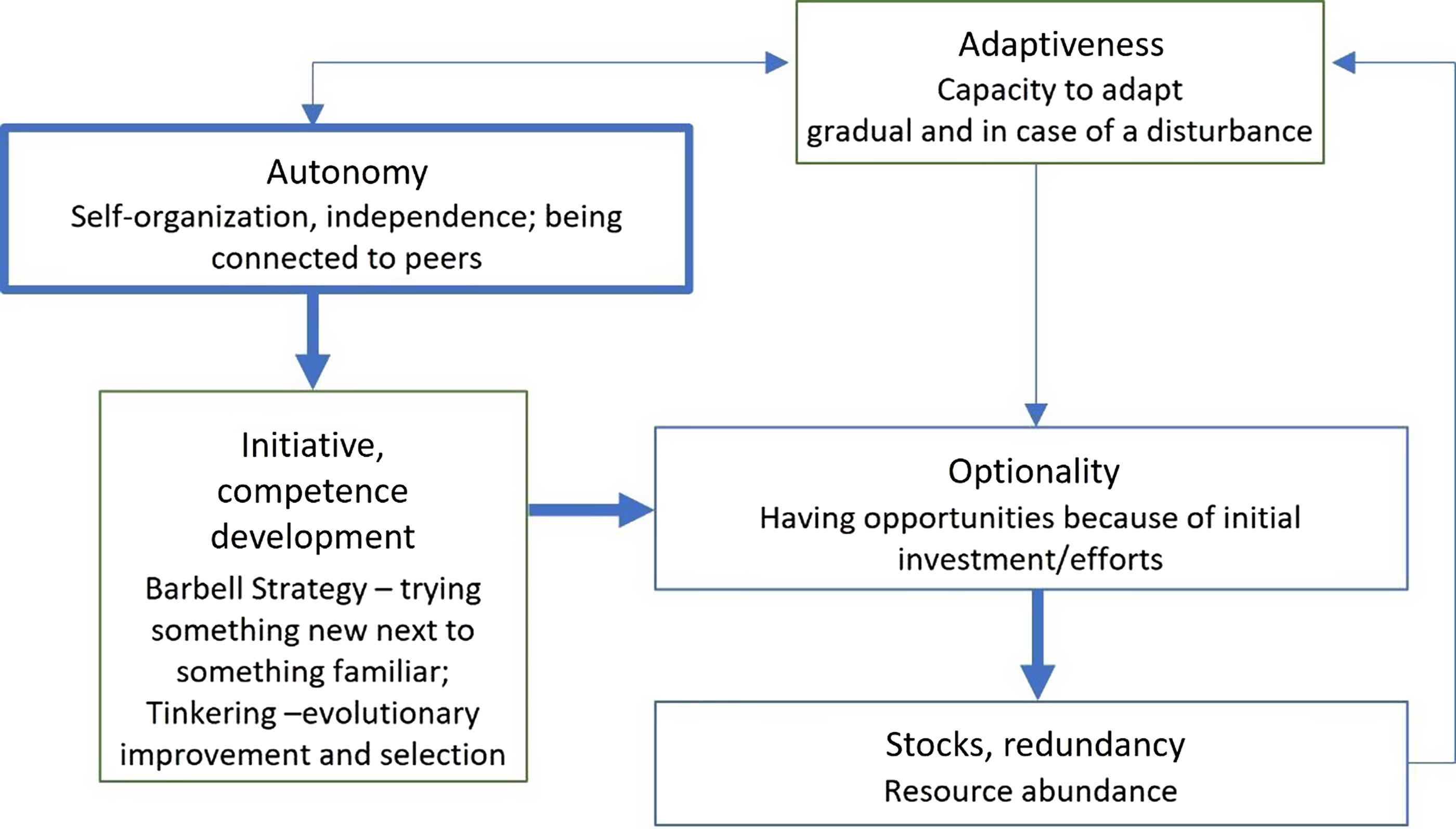
The self-determination theory explains that coercive and external pressures tend to minimize (intrinsic) motivation (Moller et al., Reference Moller, Ryan and Deci2006; Ryan and Deci, Reference Ryan and Deci2000). We observed this in the strong reliance on and expectation of governmental interventions. Triggering farmers’ intrinsic motivation and connectedness is crucial to increase autonomous functioning (Stobbelaar et al., Reference Stobbelaar, Groot, Bishop, Hall and Pretty2009). Figure 5 schematically represents a rationale which could ultimately lead to more antifragility at farm level. Greater autonomy will enable initiative and development of competences (Moller et al., Reference Moller, Ryan and Deci2006), for example, through a dual strategy where something new is explored simultaneously with activities that are known and safe (Barbell Strategy) or through trial, error, and selection (‘tinkering’). When practices, knowledge and skills are continuously developed, complexity will evolve over time (Clancy, Reference Clancy2010; Urruty et al., Reference Urruty, Tailliez-Lefebvre and Huyghe2016), and an increase in optionality and stocks can be expected (Altieri et al., Reference Altieri, Nicholls, Henao and Lana2015; Gliessman, Reference Gliessman and Engles2015). As a result of these assets, adaptiveness (i.e., capacity to adapt farming practices and cultivation choices) increases. To support such a shift, transformation and adaptation of policies may be required. This can, for example, start with formulation of goal-oriented and adaptive policies that promote cooperation (Stobbelaar et al., Reference Stobbelaar, Groot, Bishop, Hall and Pretty2009). In this way, connective systems which are socioeconomically and biophysically adaptive can be aimed for.
Relationship between autonomy and the ability to develop optionality and stocks, to reinforce adaptiveness in case of a disturbance.
When interpreting the results presented here, the limitations of the research context should be considered. In this study, we organized FGDs to identify challenges and coping strategies of different types of smallholder farmers. In order to have farmers available, the FGDs were planned in the middle of the rabi season (January and February) which is a relatively quiet moment in the year. Our results and analysis are based on a snapshot in time, while the perception of challenges may be dynamic (Nikolaski et al., Reference Nikolaski, Christiaensen and Hill2018). The challenges listed in Table 1 can be identified as structural problems or long-term stressors. Although Bihar is known for its vulnerability caused by climatic anomalies (Chhabra and Haris, Reference Chhabra and Haris2015; Lopez-Ridaura et al., Reference Lopez-Ridaura, Frelat, Van Wijk, Valbuena, Krupnik and Jat2018; Shirsath et al., Reference Shirsath, Aggarwal, Thornton and Dunnett2017), sudden disturbances and shocks were hardly mentioned. This can be explained by the lower frequency of the shocks compared to the continuous stress of the daily challenges and the age of the participants. Only challenges that were shared among all participants of the FGDs were listed, and younger farmers may not have been exposed to less frequent shocks. Although the list of challenges may not be exhaustive, understanding of the stressors is an indispensable first step toward increasing the systems’ vulnerability to shocks (Tendall et al., Reference Tendall, Joerin, Kopainsky, Edwards, Shreck, Le, Kruetli, Grant and Six2015).
Four positive deviant farms showed that it was feasible to deviate from the dominating wheat–rice production systems. We did not collect data on their performance indicators and were therefore not able to show quantitative (statistical) deviance compared to average farmers. Because the positive deviant farmers showed optionality, stocks, and autonomy, we expect them to be more antifragile, but we do not have direct evidence in terms of differences in system dynamics between their farms and average farms. Moreover, it was difficult to single out success factors with this small and normatively selected sample of positive deviant farmers. To go beyond the explorative nature of this study, the social and agronomical performance and development of different types of positive deviant farming systems should be better understood. Clear indicators for positive deviance should then be developed. These positive deviants received help from governmental programs, which is probably why they were known by the policy-informers who nominated them. Although they showed higher levels of autonomy and seemed to not to rely on the extra attention they got, their flagship position may have also helped them to develop.
In this study, we elaborate on the term ‘antifragility’, that was first introduced by Taleb (Reference Taleb2012), as a dynamic system property in socio-ecological systems. The features contributing to antifragility are not new in the scientific literature. A few examples: optionality, especially in the form of diversity, is widely acknowledged to foster adaptation. Ecological, social, and political diversity are promoted to increase options and reduce risks (Altieri et al., Reference Altieri, Nicholls, Henao and Lana2015; Hoy, Reference Hoy2015; Lade et al., Reference Lade, Steffen, de Vries, Carpenter, Donges, Gerten, Hoff, Newbold., Richardson and Rockström2020). Stocks in various forms contribute as a buffer against failure, redundancy, and diversity and avoid that the loss of critical system components triggers dramatic changes in the system dynamics (Altieri et al., Reference Altieri, Nicholls, Henao and Lana2015; Hodbod and Eakin, Reference Hodbod and Eakin2015). Fraser et al. (Reference Fraser, Legwegoh and KC2015) and Stave and Kopainsky (Reference Stave and Kopainsky2015) relate the importance of stocks to food security. Autonomy or self-organization in biological, social, and ecological systems should avoid top-down suppression and reliance and supports the self-organizing properties of diverse entities at local scales (Berkes, Reference Berkes2007; Hoy, Reference Hoy2015).
Antifragility has overlap with the scientific literature describing adaptive management, adaptation, resilience, and transformation: it requires, for example, that adaptation and transformation benefit from disturbances and evolve. Antifragility, however, aims to use disturbances to improve the system and to increase its performance. It does not aim at stability, coping, or recovery; instead, it requires long-term learning, trial, and adaptation to structurally gain from ‘disorder’ (e.g., rapid and unpredictable changes). The resilient system dynamics described by, for example, Darnhofer (2021) (i.e., transformation after unexpected shocks) and Tendall et al. (Reference Tendall, Joerin, Kopainsky, Edwards, Shreck, Le, Kruetli, Grant and Six2015) (i.e., eradicate weaknesses to build capacities) could therefore be recognized as antifragile responses. Moreover, movements like agroecology and organic agriculture claim to reduce vulnerability and increase resilience due to attention to crop and animal diversification, maintenance of local genetic diversity, crop rotations, and organic matter and nutrient cycles (Altieri et al., Reference Altieri, Nicholls, Henao and Lana2015), and these systems may often have antifragile responses. However, similar to the concept of resilience thinking, antifragility is still a paradigm rather than a testable concept. A framework for collecting empirical evidence for antifragility in agroecosystems still needs to be developed.
This study explored the scope to increase antifragility at farm level. However, farmers are, as primary producers, influenced by commercial (traders, breeders, and financers) and public institutes (Figure 3) all with their own objectives (Pacilly et al., Reference Pacilly, Groot, Hofstede, Schaap and van Bueren2016). True antifragility extends to this whole system. Recent studies on the impact of COVID-19 on the food system have found that long supply chains are more vulnerable (Kumar et al., Reference Kumar, Singh, Pandey, Singh, Srivastava, Kumar, Dubey, Sah, Nandan, Singh, Agrawal, Kushwaha, Rani, Biswas and Drews2021; Meuwissen et al., Reference Meuwissen, Feindt, Spiegel, Termeer, Mathijs, de Mey, Finger, Balmann, Wauters, Urquhart, Vigani, Zawalińska, Herrera, Nicholas-Davies, Hansson, Paas, Slijper, Coopmans, Vroege, Ciechomska, Accatino, Kopainsky, Poortvliet, Candel, Maye, Severini, Senni, Soriano, Lagerkvist, Peneva, Gavrilescu and Reidsma2019; Rivera-Ferre et al., Reference Rivera-Ferre, López-i-Gelats, Ravera, Oteros-Rozas, di Masso, Binimelis and El Bilali2021), and that connectedness, flexibility, and diversity throughout the supply chain were beneficial in dealing with the crisis. These studies suggest that a trajectory toward more antifragility at the farm level ideally goes hand in hand with rigorous rethinking of the hierarchical structures and desirable sizes of food systems.
Conclusions
Farming systems are increasingly exposed to unpredictable perturbations. Antifragile systems thrive in such situations, as their configuration and characteristics enable them to change and adapt when necessary. The concept of antifragility could provide a new perspective on ‘sustainability’ in the agricultural domain, although a framework that collects empirical evidence should be developed.
This study used a case study approach to explore the concept of antifragility at farm level. Farmers across all farm types in the two villages in Bihar, India, appeared to be vulnerable and locked in with limited adaptive capacity to overcome the challenges at hand. Four positive deviants that were more autonomous and richer in optionality and stocks were expected to be more antifragile and thus able to deal better with unexpected shocks and disturbances. We conclude that supporting antifragility at the farm level requires changes at policy level. This could start with the formulation of goal-oriented and adaptive policies that promote cooperation and farmers’ autonomous decision-making. This may result in a more proactive attitude enabling development of competences leading to more optionality and stocks. That, in turn, will increase the adaptiveness of the farmer and the farm enterprise.
Supplementary material
For supplementary material accompanying this paper visit https://doi.org/10.1017/S0014479723000017
Acknowledgements
We thank the farmers for their time and for sharing their experiences and expertise.
Financial Support
We acknowledge the financial and technical support from CGIAR Research Programs on Climate Change, Agriculture and Food Security (CCAFS), Wheat Agri-food Systems (WHEAT), Indian Council of Agricultural Research (ICAR), and all donors who supported this research through their contributions to the CGIAR Fund. For a list of Fund donors, please see: http://www.cgiar.org/our-funders/. The contribution of JCJG was supported by the Senior Expert program of the Dutch Science Council (NWO), grant number 17222.
Conflicts of Interest
The authors declare no conflicts of interest.


 Open access

