




The Mexica (Aztec) Empire had an elaborate market system that circulated a wide range of goods and services throughout central Mexico. Every town had a market, and the presence of imported goods found archaeologically in both elite and commoner contexts suggests that these items were obtained through markets (Garraty Reference Garraty2007; Smith et al. Reference Smith, Wharton, Olson and Bray2003). Historic accounts describe large marketplaces with a variety of commodities that include everything from luxury goods to prepared food items. The empire also exacted tribute on peasants and nobles, but the needs of urban populations could not be met through the tribute system alone, requiring everyone to participate in marketplace exchange (Blanton Reference Blanton, Berdan, Blanton, Boone, Hodge, Smith and Umberger1996).
Prior to the rise of the Triple Alliance, during the Early Postclassic (900 b.c.–1200) and Middle Postclassic (1200 b.c.–1350) periods, market exchange is thought to have been noncentralized but organized along subregional systems that were influenced by confederation territories, alliances, and social or ethnic boundaries (De Lucia Reference De Lucia2018; Hodge and Minc Reference Hodge and Minc1990; Minc et al. Reference Minc, Hodge, Blackman, Hodge and Smith1994). Exchange became increasingly centralized in the Late Postclassic period (1350 b.c.–1521) as the Basin became politically unified under Mexica rule (Hodge and Minc Reference Hodge and Minc1990). However, the extent to which production and exchange was controlled by the empire has been debated. On one hand, some scholars have argued that the state manipulated exchange networks, fostered regional specialization, and undermined local production (Brumfiel Reference Brumfiel1980; Hassig Reference Hassig1985). On the other hand, scholars have also argued that distribution systems were based on competitive market exchange driven by the forces of supply and demand (Berdan 1985; Blanton Reference Blanton, Berdan, Blanton, Boone, Hodge, Smith and Umberger1996; Brumfiel Reference Brumfiel1980; Garraty Reference Garraty2007; Hicks Reference Hicks, Claessen and Van de Velde1987).
Models of Late Postclassic market systems often focus on the strategies of elite manipulation of economic patterns (e.g., Garraty Reference Garraty2007; Nichols et al. Reference Nichols, Brumfiel, Neff, Hodge, Charlton and Glascock2002). For example, they often highlight the ways in which elites constrained patterns of production and exchange and may have promoted regional specialization (e.g., Blanton Reference Blanton, Berdan, Blanton, Boone, Hodge, Smith and Umberger1996; Charlton and Nichols Reference Charlton, Nichols, Nichols and Charlton1997:202–203; Charlton et al. Reference Charlton, Nichols and Charlton2000; Minc et al. Reference Minc, Hodge, Blackman, Hodge and Smith1994). Elites were leaders in imperial formation, and they wielded important political and economic power. However, the ways in which commoners participated in marketplace exchange and production and were constrained (or not) by the state, is less well understood. Commoners produced most goods including all kinds of daily necessities, ritual items, and even luxuries as part-time and small-scale manufacturers (De Lucia Reference De Lucia2013, Reference De Lucia2018; Hirth Reference Hirth2009, Reference Hirth and Manzanilla2011; Nichols Reference Nichols, Hodge and Smith1994). Commoners participated in market exchange as both buyers and sellers and therefore shaped the market economy by both supplying products and creating demand (De Lucia Reference De Lucia2013, Reference De Lucia2018; De Lucia and Morehart Reference De Lucia, Christopher, Morehart and Lucia2015; Rodríguez-Alegría et al. Reference Rodríguez-Alegría, Millhauser and Stoner2013). Examining the ways in which commoner activities were constrained by imperial efforts to control the market, particularly in regions outside of Tenonchtitlan, could help us understand the market system more clearly.
To better understand the degree of imperial control over markets in the Late Postclassic period and to study the role of commoners in shaping ceramic production and exchange, we present the results of a chemical characterization study of 111 ceramic fragments excavated at Xaltocan, a town in the northern basin of Mexico (Figure l). The sample includes decorated serving vessels, plain serving vessels, and utilitarian wares. All samples in the current study are from Late Postclassic contexts. During the first part of this period, Xaltocan was an independent city-state at war with Cuauhtitlan, a neighboring city-state to the west. By 1428, Xaltocan was under Mexica domination. Previous chemical characterization studies at Xaltocan by De Lucia and Rodríguez-Alegría focus on the two periods before and after the Late Postclassic respectively: the Early and Middle Postclassic, when Xaltocan was an independent community (De Lucia et al. Reference De Lucia, Boulanger and Glascock2020), and the colonial period (post -1521, after the Spanish conquest; Rodríguez-Alegría and Stoner Reference Stoner2016; Rodríguez-Alegría et al. Reference Rodríguez-Alegría, Millhauser and Stoner2013). With this study we complete a long-term sequence that can help us understand changes in production and exchange of ceramics at different points in the complicated political history of Xaltocan, from the Early Postclassic to the colonial period. The analysis is based on existing compositional profiles of ceramics from Xaltocan, and on reference groups that were defined using roughly 8,000 samples from central Mexico that have been characterized at MURR to date (e.g., Hodge and Neff Reference Hodge, Neff and Brumfiel2005; Hodge et al. Reference Hodge, Hector Neff, Minc and Neff1992; Nichols et al. Reference Nichols, Brumfiel, Neff, Hodge, Charlton and Glascock2002; Stoner et al. Reference Stoner, Millhauser, Rodríguez-Alegría, Overholtzer and Glascock2014). Other scholars have carried out chemical characterization studies of pottery from Xaltocan, or that include pottery from Xaltocan among a sample from many different sites, providing a broader context for our interpretations (Crider Reference Crider2011; Garraty Reference Garraty2007; Hodge and Neff Reference Hodge, Neff and Brumfiel2005; Nichols et al. Reference Nichols, Brumfiel, Neff, Hodge, Charlton and Glascock2002; Overholtzer and Stoner Reference Overholtzer and Stoner2011; Overholtzer et al. Reference Overholtzer, Pierce and Glascock2020).
Map of central Mexico with Xaltocan and other sites mentioned in the text.
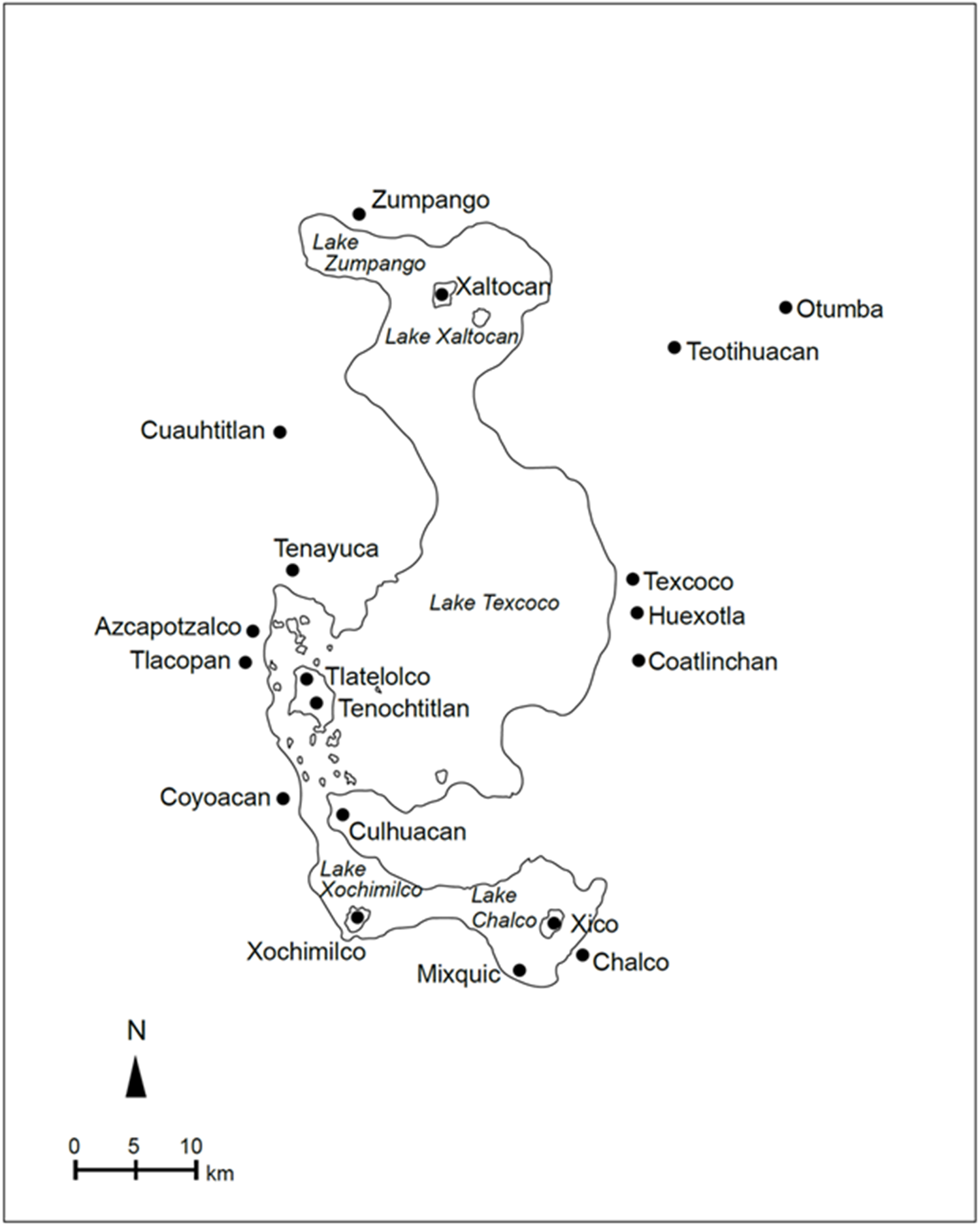
Figure 1 Long description
The map illustrates central Mexico, highlighting various locations and lakes. Key sites include Xaltocan, Zumpango, Cuauhtitlan, Tenayuca, Azcapotzalco, Tlacopan, Tlatelolco, Tenochtitlan, Coyoacan, Culhuacan, Xochimilco, Mixquic, Chalco, Xico, Texcoco, Huexotla and Coatlinchan. Lakes depicted are Lake Zumpango, Lake Xaltocan, Lake Texcoco, Lake Xochimilco and Lake Chalco. The map includes a scale indicating distances in kilometers and a north directional arrow. Otumba and Teotihuacan are also marked on the map, providing a comprehensive view of the region's geography.
Production, exchange, and empire
Two primary models have been proposed to explain the Late Postclassic economy under the Mexica empire. The “political economy model,” suggests that urbanization and elite interests shaped production (Hodge et al. Reference Hodge, Hector Neff and Minc1993; Nichols et al. Reference Nichols, Brumfiel, Neff, Hodge, Charlton and Glascock2002:29–31). Cities, especially imperial capitals, concentrated production of some goods, forcing rural residents to supply urban markets with rural products (primarily food and cloth) that they exchanged for urban crafts. Rural producers concentrated their efforts on agricultural products, producing surplus for sale in urban markets. Some scholars have argued that urban products consisted mainly of luxuries for elite consumption and rural producers went to urban markets to sell their surplus to be able to meet the tribute demands of the Mexica (Brumfiel Reference Brumfiel1980, Reference Brumfiel1983, Reference Brumfiel, Gero and Conkey1991). Others have argued that urban products included luxuries as well as daily necessities and rural producers went to the market to obtain some of these daily necessities (Garraty Reference Garraty2007; Hassig Reference Hassig1985; Nichols et al. Reference Nichols, Brumfiel, Neff, Hodge, Charlton and Glascock2002:30). Either way, elite control over and manipulation of markets often figures prominently in such models because imperial centers could obtain revenue through taxes, in addition to rural products, from commercial activity in urban markets (Garraty Reference Garraty2007). Thus, the economic system would have been a way for elites to increase their wealth through the collection of tribute and maintain power through control over luxury goods and marketplaces (Smith Reference Smith, Nichols, Berdan and Smith2017).
Alternatively, the “market model” proposes that there was “less economic centralization and less political control of the economy on the one hand, because of the retention of greater regionalism or, on the other hand, because of the presence of a strong integrated regional market system” (Nichols et al. Reference Nichols, Brumfiel, Neff, Hodge, Charlton and Glascock2002:30). Scholars who favor political regionalism as an explanation argue that political boundaries limited exchange. People from each city-state exchanged products at markets belonging to their own political region (Charlton and Nichols Reference Charlton, Nichols, Nichols and Charlton1997:202–203; Charlton et al. Reference Charlton, Nichols and Charlton2000; Minc et al. Reference Minc, Hodge, Blackman, Hodge and Smith1994; Smith Reference Smith, Garraty and Stark2010). Some scholars focus on political regionalism less, in favor of explanations that emphasize the existence of a robust system of regularly scheduled markets, which survived political, demographic, and other changes. They argue that the economy in the Basin of Mexico was commercialized and not controlled by city-states (Hirth and Pillsbury Reference Hirth, Pillsbury, Hirth and Pillsbury2013). Even as the Mexica empire formed, the market system remained politically autonomous. Regardless of imperial attempts at changing economic patterns, and despite other historical events, people could count on those markets and the products that flowed through them, resulting in continuities in production and exchange of different goods (Blanton Reference Blanton, Berdan, Blanton, Boone, Hodge, Smith and Umberger1996; Blanton et al. Reference Blanton, Kowalewski, Feinman and Finsten1993; Nichols et al. Reference Nichols, Brumfiel, Neff, Hodge, Charlton and Glascock2002:30–31).
Both models have advanced our understanding of Late Postclassic markets and economies considerably. Still, it is difficult to see the actions of commoners in either model. In the political economy model, urban elites are the main drivers of economic activity and commoners can only react. Further, when state formation is identified as the main instigator of change, other potential explanatory factors can be overlooked such as conflicts between rural areas or demographic changes. And while in the market model commoners are ultimately responsible for the functioning of the market system, the inter-site perspective and systems-level approach makes it difficult to see and understand their decisions and actions on a small-scale basis. In this study, we aim to build on previous scholarship to bring into focus both the actions and interests of rural commoners, as well other historical events, in addition to imperial formation, into the study of ceramic production and exchange in Late Postclassic Xaltocan. We build on the work of the scholars cited earlier by focusing on the activities of commoners at a single site, which allows us to better understand patterns of change and interaction at the household level. By focusing on the activities of commoners at the household level, we aim to paint a more complete picture of production and exchange in the context of the Mexica empire.
Political and economic background
During the Postclassic, many city-states in the Basin of Mexico competed for political domination, culminating in the formation of the Mexica empire in 1428. The empire had three capitals—often referred to as the Triple Alliance—that divided control over different geographical regions and many provinces in the Basin of Mexico and beyond. Mexico-Tenochtitlan was the greatest political, economic, and military power, Texcoco was a close second, and Tlacopan was the weakest of the three (Berdan Reference Berdan, Nichols and Rodríguez-Alegría2017). In 1521, an army of Indigenous warriors and Spanish invaders conquered Tenochtitlan and many other city-states in Mexico and began three centuries of Spanish colonialism (Carballo Reference Carballo2022; Gibson Reference Gibson1964; Lockhart Reference Lockhart1992).
Some aspects of Postclassic economies make it ideal for the study of the actions of commoners. The Mexica empire did not control production in most places, and most commoners were independent producers. Despite being independent producers, there is broad consensus that households in the Basin of Mexico were not self-sufficient throughout this process of imperial formation and conquest. To supply their households, commoners engaged in multicrafting, or the production of a variety of different types of goods while also farming for subsistence purposes. They relied on exchange to fulfill their daily needs (Berdan Reference Berdan2014; De Lucia Reference De Lucia2013; Hirth and Nichols Reference Hirth, Nichols, Nichols and Rodríguez-Alegría2017). People went to regularly scheduled marketplaces to obtain items they needed for subsistence, religious practices, and other aspects of daily life. The Mexica also exacted tribute from all over the empire, forcing the movement of luxury goods, ritual items and everyday necessities into the cities at the core of the empire, especially Tenochtitlan. Long-distance merchants transported items including raw materials and goods that were produced outside of central Mexico, incorporating them into the market and the tribute system of the Basin of Mexico (Hassig Reference Hassig1985; Hirth Reference Hirth2016).
Xaltocan was a small island in Lake Xaltocan, approximately 35 kilometers north of Tenochtitlan. Scholars have used a combination of historical sources and archaeological evidence to reconstruct its past. Briefly, Xaltocan was occupied permanently around 900 b.c. (Brumfiel Reference Brumfiel and Brumfiel2005a), although there is evidence of human presence, perhaps as seasonal camps or hamlets, centuries before then (Morehart et al. Reference Morehart, Peñaloza, Sánchez, de Tapia and Morales2012). It grew in population and political power during the next two centuries. By the twelfth and thirteenth centuries, it was an island kingdom that dominated over the northern basin of Mexico and collected tribute from city-states in the region (Brumfiel Reference Brumfiel and Brumfiel2005a; Carrasco Reference Carrasco Pizana1950:116; Morehart Reference Morehart2012). Historical sources narrate that it then became embroiled in a lengthy war against Cuauhtitlan, a lakeshore settlement west of Xaltocan, and that Xaltocan lost the war in 1395 (Bierhorst Reference Bierhorst1992). Xaltocan was depopulated after the war and then conquered by the Mexica in 1428. The Mexica sent people from Acolman, Culhuacan, and Tenochtitlan to repopulate the island (Brumfiel Reference Brumfiel and Brumfiel2005a:35). Several archaeologists working at Xaltocan have used archaeological and historical data, as well as DNA, to assess whether this story of population replacement is true and found different lines of historical and archaeological evidence largely in support of it (summarized in Mata-Míguez et al. Reference Mata-Míguez, Overholtzer, Rodríguez-Alegría, Kemp and Bolnick2012; Morehart Reference Morehart2016:184; Rodríguez-Alegría Reference Rodríguez-Alegría2016:107–109; although see Overholtzer Reference Overholtzer2013). In addition, the vast majority of houses appear to have been abandoned in the Late Middle Postclassic (De Lucia and Overholtzer Reference De Lucia and Overholtzer2014). In the Late Postclassic, Xaltocan was under control of the Mexica and paid tribute to both Tenochtitlan and Texcoco, until the Spanish conquest of 1521 (Brumfiel Reference Brumfiel and Brumfiel2005a). In the colonial period, Xaltocan became a cabecera (head town) and it has remained occupied until the present (Bejines Juárez Reference Bejines Juárez1999; Rodríguez-Alegría Reference Rodríguez-Alegría2016). This history of empire building, warfare with other city-states, demographic change, and incorporation into the Mexica and later the Spanish empires provides a rich background for our chemical characterization study of ceramics excavated at Xaltocan.
To build on knowledge of the economy under the Mexica empire we ask: was incorporation into the Mexica empire accompanied by a reduction in local production and exchange of different ceramic types? Such a reduction could be seen in types including Aztec III Black-on-Orange, Redware, and Polychrome, which were the primary ceramic types circulating in the Postclassic period. The political economy model would expect that some ceramic types would be produced exclusively (or mostly) in imperial capitals in an attempt to make rural sites dependent on exchange with those capitals. In contrast, the market model would expect to find continuity in production and exchange before and after the formation of the Mexica empire. Still, if we are interested in the actions and strategies of commoners, could patterns of production and exchange of ceramics be explained as resulting from the actions of commoners? Such actions could include local copying of ceramics styles from other cities, innovation of ceramic styles, exclusive consumption of local pottery, and perhaps other patterns. We also ask, did trade in daily necessities (in this case, ceramics) change in tandem with political conflict and warfare between city-states, or following conquests by Tenochtitlan and later by the Spanish? More specifically, did the long war with Cuauhtitlan, or demographic changes at Xaltocan precede any changes in ceramic production and exchange?
The ceramic sample
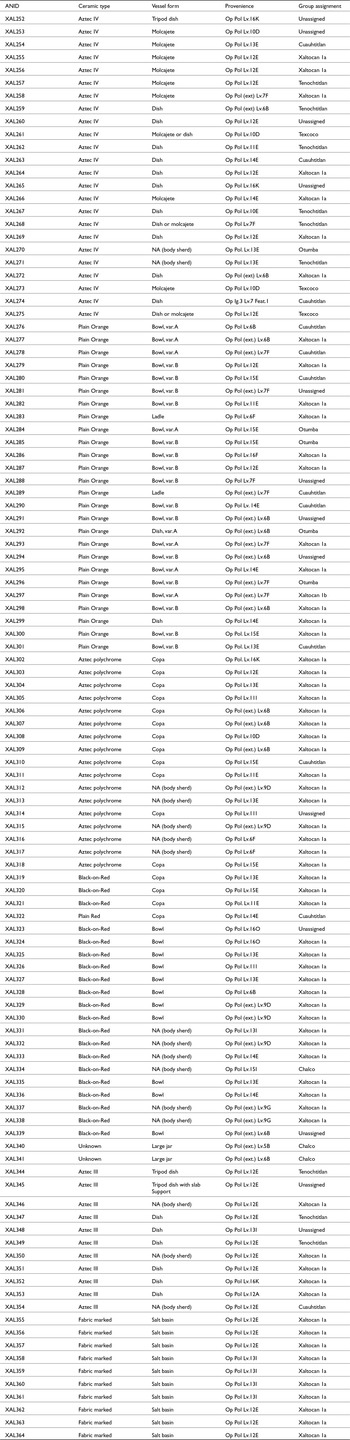
The sample for this study includes a variety of decorated and undecorated serving vessels and utilitarian wares excavated from a Late Postclassic context by De Lucia and Rodríguez-Alegría in 2017 called Operation Pol (hereafter, Op Pol) (Table 1). Op Pol is ideal for obtaining a sample from the Late Postclassic because it contained deeply stratified Late Postclassic domestic contexts and very little material from other periods. Op Pol is interpreted as a commoner household because it was mostly constructed of adobe, like other houses in Xaltocan, and there were no luxury goods or ornate decorations to indicate that it was an elite household (Rodríguez-Alegría and De Lucia Reference Rodríguez-Alegría and De Lucia2024). While we consider the sample useful to study a specific time period, one must be careful not to generalize about the entire site from a single household. The sample from Op Pol can help understand patterns of consumption in that household, and it can help identify some of the loci of production of ceramics used in Xaltocan at the time. However, the household may not be representative of all patterns at Xaltocan, and other households may have obtained ceramics from a broader or narrower range of production locales. To make the sample from Op Pol more meaningful, we compare the results with previous studies of ceramics from the Late Postclassic at Xaltocan analyzed by neutron activation analysis (NAA). They include samples drawn from seven operations (associated with households) excavated around Xaltocan, from contexts in which Aztec III and IV ceramic predominated (analyzed by Hodge and Neff Reference Hodge, Neff and Brumfiel2005 and Nichols et al. Reference Nichols, Brumfiel, Neff, Hodge, Charlton and Glascock2002), and an additional household excavation with Aztec III and IV ceramics (Overholtzer et al. Reference Overholtzer, Pierce and Glascock2020).
Ceramic samples, descriptions, and group assignments
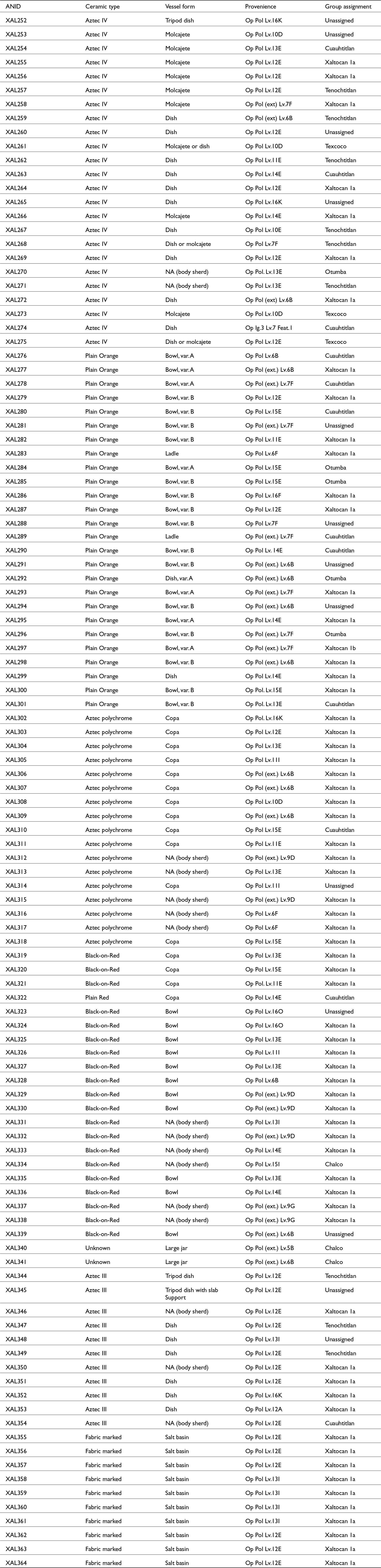
Table 1 Long description
This table details 113 ceramic samples, categorized by ceramic type, vessel form, provenience, and group assignment. The majority of samples are Aztec IV and Plain Orange, with vessel forms including dishes, molcajetes, and bowls. Provenience locations such as Op Pol Lv.12E and Op Pol (ext.) Lv.6B are common. Group assignments frequently include Xaltocan 1a, Cuauhtitlan, and Tenochtitlan, though many samples remain unassigned. Notably, Aztec polychrome and Black-on-Red types are less frequent, and the Unknown type is rare. The data suggests a strong representation of Xaltocan 1a across various types and forms, indicating its significance in the collection.
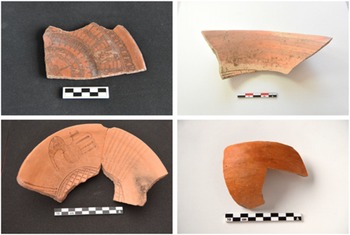
Among the ceramics, we included two Black-on-Orange types: Aztec III and Aztec IV (Figure 2). Aztec III is characterized by thin, parallel lines in decorative bands below the rim of vessels. It includes different variants, some of which are defined by dots, dashes, or fine lined fancy motifs painted between bunches of parallel fine lines (Hodge and Neff Reference Hodge, Neff and Brumfiel2005:327; Minc Reference Minc, Nichols and Rodríguez-Alegría2017). Additionally, whereas some variants seem rather refined, with fine lines that are evenly painted and parallel to one another (probably painted with a multipoint brush; Minc Reference Minc, Nichols and Rodríguez-Alegría2017), we describe one of the variants as “sloppy,” with lines of uneven thickness or that run into one another occasionally (see also Parsons Reference Parsons1966:165). Hodge and colleagues (Reference Hodge, Hector Neff and Minc1993:149) suggest that Aztec III decoration is regionally distinctive with vessels produced in the Texcoco region composed of “parallel lines and straight-line zigzag motifs” derived from geometric-style Aztec II pottery that preceded it. In contrast, vessels produced in the Ixtapalapa Peninsula typically have “small open circles, comb-like designs, and thickly filled-in wall” suggesting stylistic continuity with the Aztec II calligraphic style (Hodge et al. Reference Hodge, Hector Neff and Minc1993:149). Overall, there is more uniformity in Aztec III pottery compared to the earlier Aztec I and Aztec II styles (Hodge et al. Reference Hodge, Hector Neff and Minc1993). Archaeologists have argued that Aztec III pottery was produced in the Late Postclassic and well into the colonial period (Charlton et al. Reference Charlton, Fournier and Charlton2015:463; Evans and Freter Reference Evans and Freter1996; Nichols and Charlton Reference Nichols and Charlton1996; Parsons Reference Parsons, Patricia Fournier and Wiesheu2015). Some have argued that Aztec III continued to be produced well into the colonial period in rural areas, but that its “designs do not persist in the urban areas” (Charlton et al. Reference Charlton, Charlton, García, Kepecs and Alexander2005:62). The Aztec III sample from Op Pol used in this study consists of 11 fragments from contexts that date to the Late Postclassic.
Black-on-Orange pottery. Top (left to right): Aztec II Black-on-Orange, Aztec III Black-on-Orange. Bottom (left to right): Aztec IV Black-on-Orange, Plain Orange.
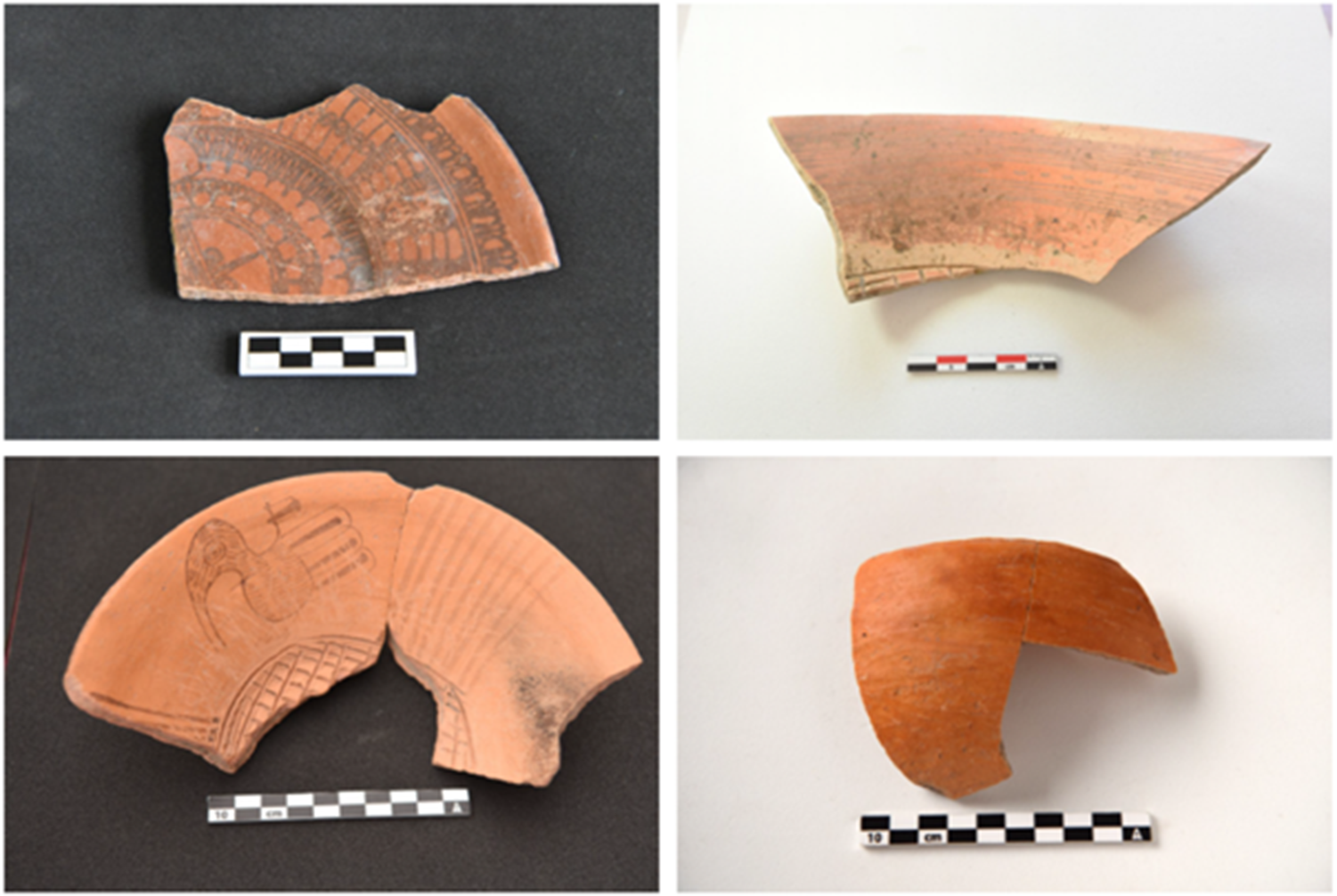
Figure 2 Long description
The image shows four pottery fragments, each accompanied by a scale bar. The top left fragment features intricate geometric patterns with parallel lines and circular motifs. The top right fragment is plain with a smooth surface and triangular shape. The bottom left fragment displays decorative bands and curved lines, with a broken edge. The bottom right fragment is a plain curved piece with a smooth texture. Each fragment is positioned on a contrasting background to highlight its features.
Aztec IV Black-on-Orange ceramics include variants that have alternating thin and heavy lines, variants with scrolls and other curvilinear motifs, and variants with naturalistic motifs, like feathers, animals, down balls, and flowers (Figure 2). The chronology of Aztec IV and its different variants has been debated, especially whether all its different variants were produced before the Spanish conquest (Cervantes Rosado et al. Reference Cervantes Rosado, Fournier, Staedtler, Carrión and Cook2007; Charlton et al. Reference Charlton, Fournier and Charlton2015:463; Minc Reference Minc, Nichols and Rodríguez-Alegría2017; Nichols and Charlton Reference Nichols and Charlton1996; Parsons Reference Parsons1966:304, Reference Parsons, Patricia Fournier and Wiesheu2015). Most scholars agree that Aztec IV was in production in the Late Postclassic and that potters continued producing it for decades after the Spanish conquest. Some archaeologists have considered Aztec IV to be a colonial innovation, mostly in use in the colonial period, or treated it as colonial in their analysis (Charlton Reference Charlton1968; Charlton and Fournier Reference Charlton, Patricia Fournier, Rogers and Wilson1993; Nichols and Charlton Reference Nichols and Charlton1996; Nichols et al. Reference Nichols, Brumfiel, Neff, Hodge, Charlton and Glascock2002). Others have argued that it was a pre-conquest urban innovation that lasted into the colonial period generally (Cervantes Rosado et al. Reference Cervantes Rosado, Fournier, Staedtler, Carrión and Cook2007; Minc Reference Minc1994:163) or at least in rural sites (Charlton et al. Reference Charlton, Fournier and Charlton2015:463). Still others assign the geometric variants to the Late Postclassic, and variants with naturalistic motifs to the early colonial period, considering that those motifs were influenced by European aesthetics (Minc Reference Minc, Nichols and Rodríguez-Alegría2017; Parsons Reference Parsons, Patricia Fournier and Wiesheu2015), although, as we discuss later, the naturalistic motifs were probably a Mexica innovation and not a European introduction.
A chronological assessment using multiple categories of artifacts helped determine that all variants of Aztec IV from excavations in Op Pol, whether with geometric or with naturalistic motifs, were present in contexts that predate the Spanish conquest. Those contexts lacked any glazed ceramics, glass, metal artifacts, or remains of Old World fauna, characteristic of colonial contexts in central Mexico (Parsons Reference Parsons, Patricia Fournier and Wiesheu2015; Rodríguez-Alegría and De Lucia Reference Rodríguez-Alegría and De Lucia2024). At Xaltocan, colonial contexts typically have at least some sixteenth-century majolica, glass, metal artifacts, or Old World faunal remains (e.g., Piñón Castillo et al. Reference Piñon Castillo, Valadez Azúa, Rodríguez Galicia, Rodríguez-Alegría and Lucia2024; Rodríguez-Alegría Reference Rodríguez-Alegría2010, Reference Rodríguez-Alegría2016); therefore, all variants of Aztec IV from Op Pol are present in contexts that most likely date to the period under Mexica domination. This indicates that the naturalistic motifs on Aztec IV Black-on-Orange pottery are in fact of Indigenous origin rather than learned from or influenced by Spanish colonizers. In the sample we include 11 dishes, 10 molcajetes (grinding dishes with striated bottoms), two fragments that may belong to dishes or molcajetes, and two samples of indeterminate form. Both Aztec III and Aztec IV ceramics help us examine the origin of decorated serving vessels during the Late Postclassic at Xaltocan.
We also include Plain Orange serving vessels in the sample. They are like Black-on-Orange ceramics, but without any decoration (Figure 2). They were an important part of any house’s furnishings. In Late Postclassic contexts in Op Pol, for example, they make up 9.44 percent (n = 1,060) of all ceramics by count and are found in greater frequency than Aztec III (n = 101) and Aztec IV (n = 141) combined. Brumfiel (Reference Brumfiel and Brumfiel2005b:361) documented a decrease of the ratio of decorated vessels to undecorated vessels in the Late Postclassic (Phase IV in her analysis), underscoring the importance of Plain Orange serving vessels at the time. We included 23 Plain Orange hemispherical bowls, two ladles, and one dish. This type could help understand whether there was trade or local production in plain serving vessels, and whether it was different from that of decorated vessels.
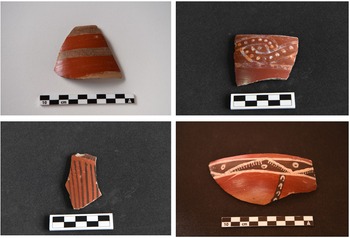
Red Ware serving vessels, with their characteristic deep red slip (Minc Reference Minc, Nichols and Rodríguez-Alegría2017; Parsons Reference Parsons1966), formed part of the sample analyzed. We focused mostly on decorated Red Ware types, including 20 Black-on-Red samples and one Plain Red sample (Figure 3). Of those, 11 were bowls, four were copas (including the Plain Red fragment), and six could not be classified by form due to fragmentation. Previous studies of Red Ware in the Early and Middle Postclassic found that Red Ware in Xaltocan was made in a variety of locales, including Xaltocan, the southern basin of Mexico, the Otumba region, and Tenochtitlan (De Lucia et al. Reference De Lucia, Boulanger and Glascock2020; Nichols et al. Reference Nichols, Brumfiel, Neff, Hodge, Charlton and Glascock2002). Another study found that Red Ware was made mostly locally in the colonial period: 13 of the samples submitted were made in Xaltocan, one in Cuauhtitlan, and two in the southern basin of Mexico (Rodríguez-Alegría et al. Reference Rodríguez-Alegría, Millhauser and Stoner2013). Thus, it could be that the sources of Red Ware pottery at Xaltocan narrowed and local production increased during the Late Postclassic and remained dominant in the early colonial period. Alternatively, the changes in production took place only in the colonial period. Our sample of Red Ware could help understand the chronology of changes in the sources of Red Ware.
Redware pottery. Top (left to right): Red-on-Natural, Aztec Polychrome, Bottom (left to right): Black-on-Red, Black-and-White-on-Red.
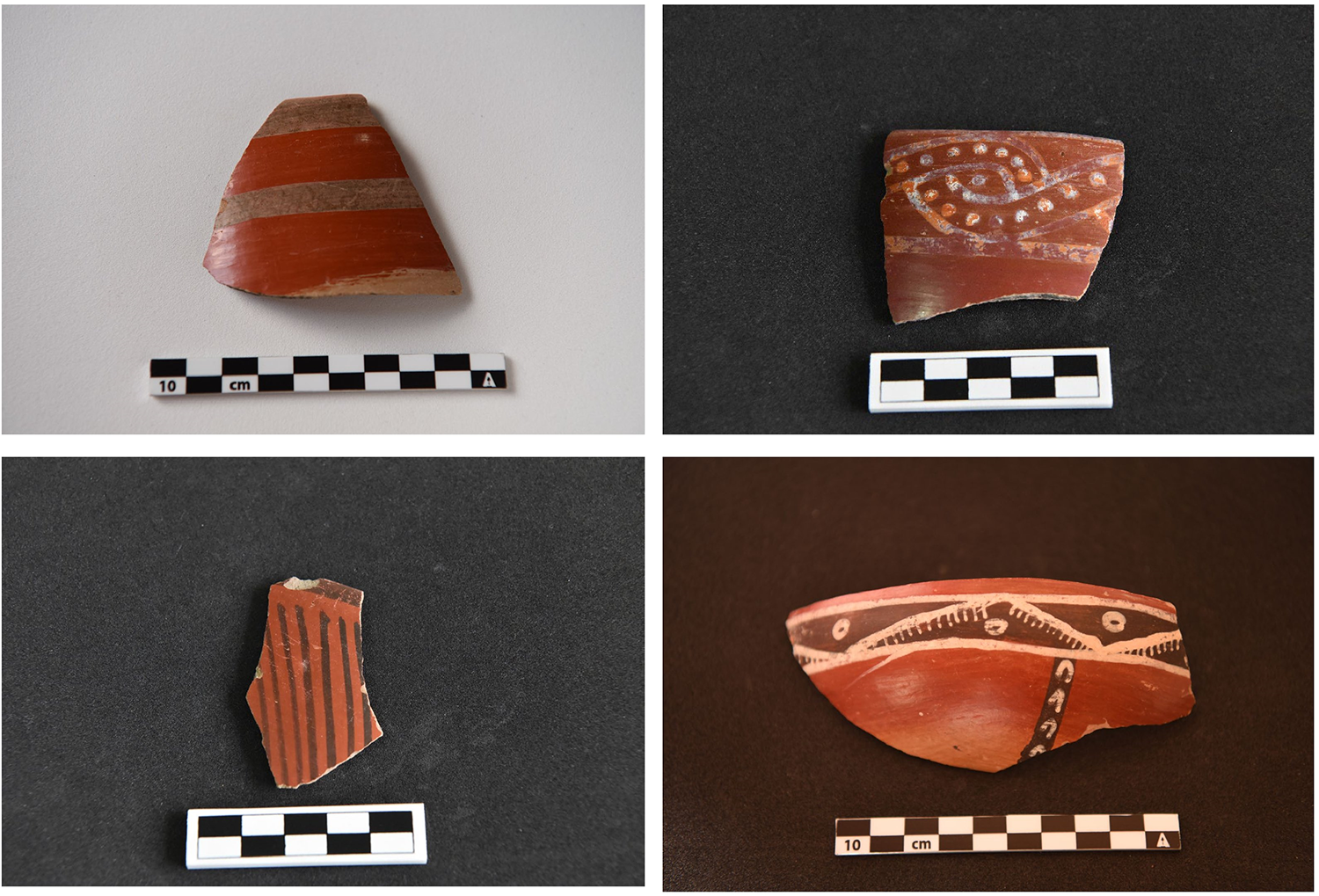
Figure 3 Long description
Four pottery fragments are displayed, each with unique patterns. The top left fragment has horizontal bands. The top right fragment features a dotted and curved design. The bottom left fragment shows vertical lines. The bottom right fragment has a combination of geometric and dotted patterns. Each fragment is placed on a black and white scale for size reference.
Aztec Polychrome ceramics round out the sample of serving vessels analyzed (Figure 3). In terms of decoration, it is much simpler than other polychrome types from the Postclassic (see Hernández Sánchez Reference Hernández Sánchez2005). Aztec Polychrome from Xaltocan (also referred to as Yellow-on-Red) is characterized by a highly burnished red slip with orange and white painted designs that resemble a chain or interwoven bands and are almost always in the form of copas (Brumfiel Reference Brumfiel and Brumfiel2005c:139; Noguera Reference Noguera1934:Figure V). These vessels usually have vertical burnishing on the exterior and have a plain, unburnished interior. We included 16 samples of Aztec Polychrome, 11 of which were copas and the remaining five cannot be determined but are likely copas or bowls.
We also included 10 fragments of Texcoco Fabric Marked pottery. They are all salt basins, with a surface that bears cloth impressions, probably from making the pot in fabric-lined molds or pits (Millhauser Reference Millhauser2020; Parsons Reference Parsons1966:247). We wanted to see whether Xaltocan produced its own containers for salt or imported them from other sites. It is also possible that Xaltocan, despite producing salt, used this type of basin to exchange salt with other towns. Archaeologists have noted increases in salt production in the Late Postclassic. Salt production sites became more numerous in comparison to earlier periods, and they became larger. Historical sources mention people selling salt in ceramic containers in Mexica markets (Millhauser Reference Millhauser2020:5), and we suspected that some of the salt basins that we excavated in Xaltocan could be the product of exchange. An analysis of Texcoco Fabric Marked pottery could help come closer to answering those questions. Finally, two samples were plainware jars. Jars decline dramatically in frequency during the Postclassic period.
Sample preparation and analysis
Standard analytical procedures were used for sample preparation and data collection as is typical of NAA of ceramics at MURR. The procedures are discussed in detail elsewhere (Glascock Reference Glascock and Neff1992; Neff Reference Neff and Neff1992, Reference Neff, Ciliberto and Spoto2000; Stoner and Glascock Reference Stoner and Glascock2011), as is the interpretation of compositional data obtained from the analysis of archaeological materials (Glascock and MacDonald Reference Glascock, MacDonald, Pollard, Armitage and Makarewicz2023; see also Baxter and Buck Reference Baxter, Buck, Ciliberto and Spoto2000; Bieber et al. Reference Bieber, Dorothea, Garman and Edward1976; Bishop and Neff Reference Bishop, Neff and Allen1989; Glascock Reference Glascock and Neff1992; Harbottle Reference Harbottle1976; Neff Reference Neff, Ciliberto and Spoto2000). The combined descriptive, contextual, and compositional database for samples analyzed as part of this study will be incorporated into the MURR database, retained for future comparative purposes, and made publicly available via the laboratory’s website following publication, in accordance with the Archaeometry Laboratory’s Data Management and Sharing Plan (University of Missouri Research Reactor 2024).
NAA has a long-standing history of use in the Basin of Mexico, and MURR’s internal database has over 8,000 comparative specimens from this area. Over time, the accumulation of large assemblages of clays and ceramics from across the Basin has allowed for the creation of compositional reference groups representing broad production zones. These groups were originally defined using a combination of exploratory multivariate statistics, archaeological sampling strategies focused on known production locales, and geological expectations regarding clay chemistry in different parts of the basin. Particular compositional characteristics, such as elevated chromium and transition metals in the southern basin or higher sodium in northern sources allow unknown samples to be compared to these long-established reference groups. The logic of defining groups in this way and the geological and archaeological reasoning behind them has been demonstrated repeatedly in prior work (see Neff and Glascock Reference Neff and Glascock2000; Nichols et al. Reference Nichols, Brumfiel, Neff, Hodge, Charlton and Glascock2002; Stoner et al. Reference Stoner, Millhauser, Rodríguez-Alegría, Overholtzer and Glascock2014; Stoner Reference Stoner2016). These established regional patterns form the comparative basis for assigning the samples analyzed here.
Xaltocan is particularly well represented in the NAA database at MURR (see DeLucia et al. Reference De Lucia, Boulanger and Glascock2020; Hodge and Neff Reference Hodge, Neff and Brumfiel2005; Overholtzer et al. Reference Overholtzer, Pierce and Glascock2020; Rodriguez-Alegria et al. Reference Rodríguez-Alegría, Millhauser and Stoner2013). Earlier research by Stoner and colleagues (Reference Stoner, Millhauser, Rodríguez-Alegría, Overholtzer and Glascock2014) shows that many Xaltocan pastes share a distinctive combination of elevated alkali concentrations, especially sodium and potassium, reflecting the saline lacustrine geology of the northern Basin. Characteristic rare-earth element patterns also allow for further subdivision into Xaltocan 1a and 1b reference groups. Evidence for small-scale, household level ceramic production of both plain and decorated wares of the Xaltocan 1b reference group, was recovered from Casa Z, an Early Postclassic household (De Lucia et al. Reference De Lucia, Boulanger and Glascock2020), although we have not identified production locales for Xaltocan 1a ceramics.
NAA produced concentrations for 33 elements in most samples in this study. Nickel was removed due to excessive missing values, a common issue for Basin ceramics in which it frequently falls below detection limits. Arsenic and terbium were also excluded from most statistical analyses because prior regional studies have documented that these elements are unreliable. Their exclusion ensures compatibility with previous compositional studies. All remaining elemental data were transformed using base-10 logarithms primarily to reduce the influence of large magnitude differences between major and trace elements.
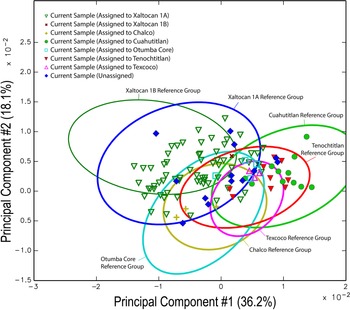
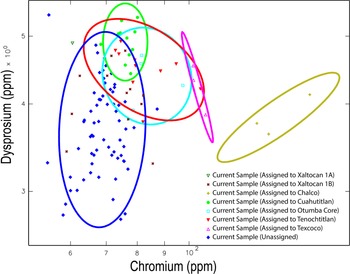
The statistical evaluation was designed to first understand the structure of the dataset and then to situate each specimen within the broader compositional landscape. Principal components analysis (PCA) provided an initial view of major chemical contrasts in the dataset and allowed us to examine how the Xaltocan samples relate to established regional patterns (Figure 4). In this case, the first principal components summarized contrasts among alkali elements, transition metals, and rare-earth elements. Most samples fall within the compositional range defined for Xaltocan, while a smaller subset aligned more closely with chromium-rich signatures associated with the southern basin and other areas (Figure 5).
Current samples labeled with their final group assignments and projected onto bivariate plot of the first two principal components calculated for the BOM reference groups. Ellipses represent 90 percent confidence interval of group membership. This plot explains 54.3 percent of the cumulative variance in the combined datasets.
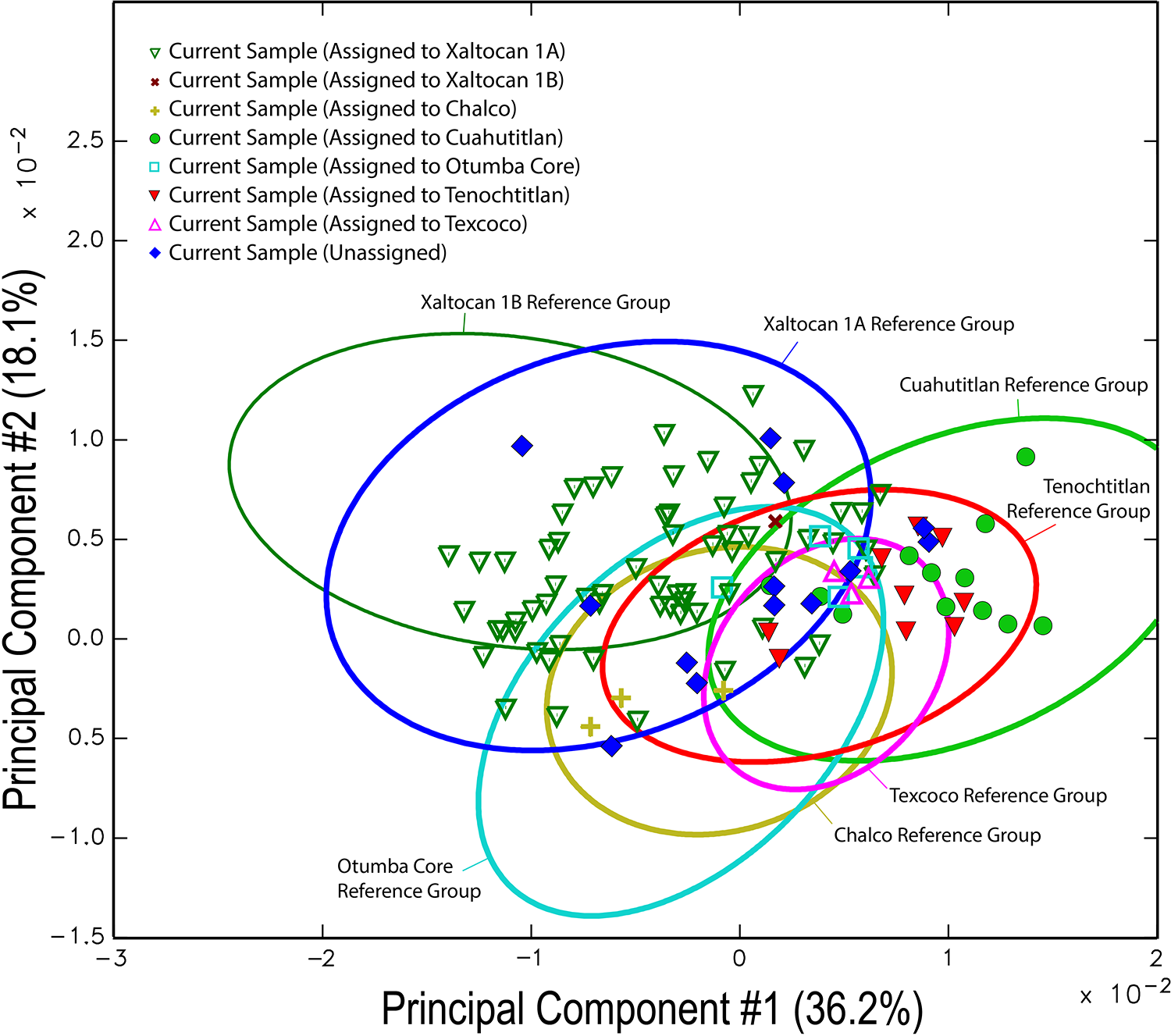
Figure 4 Long description
The plot displays principal component number 1 on the x-axis (36.2 percent) and principal component number 2 on the y-axis (18.1 percent). Various samples are plotted, each assigned to different reference groups: Xaltocan 1A, Xaltocan 1B, Chaco, Cuauhtitlan, Otumba Core and Texcoco. Unassigned samples are also shown. Ellipses represent the 90 percent confidence interval for each group. The plot includes distinct markers for each group, with a legend indicating the group assignments.
Bivariate plot of chromium and dysprosium concentrations for the current dataset. Specimens are grouped and labeled according to their final assignments into the BOM reference groups.
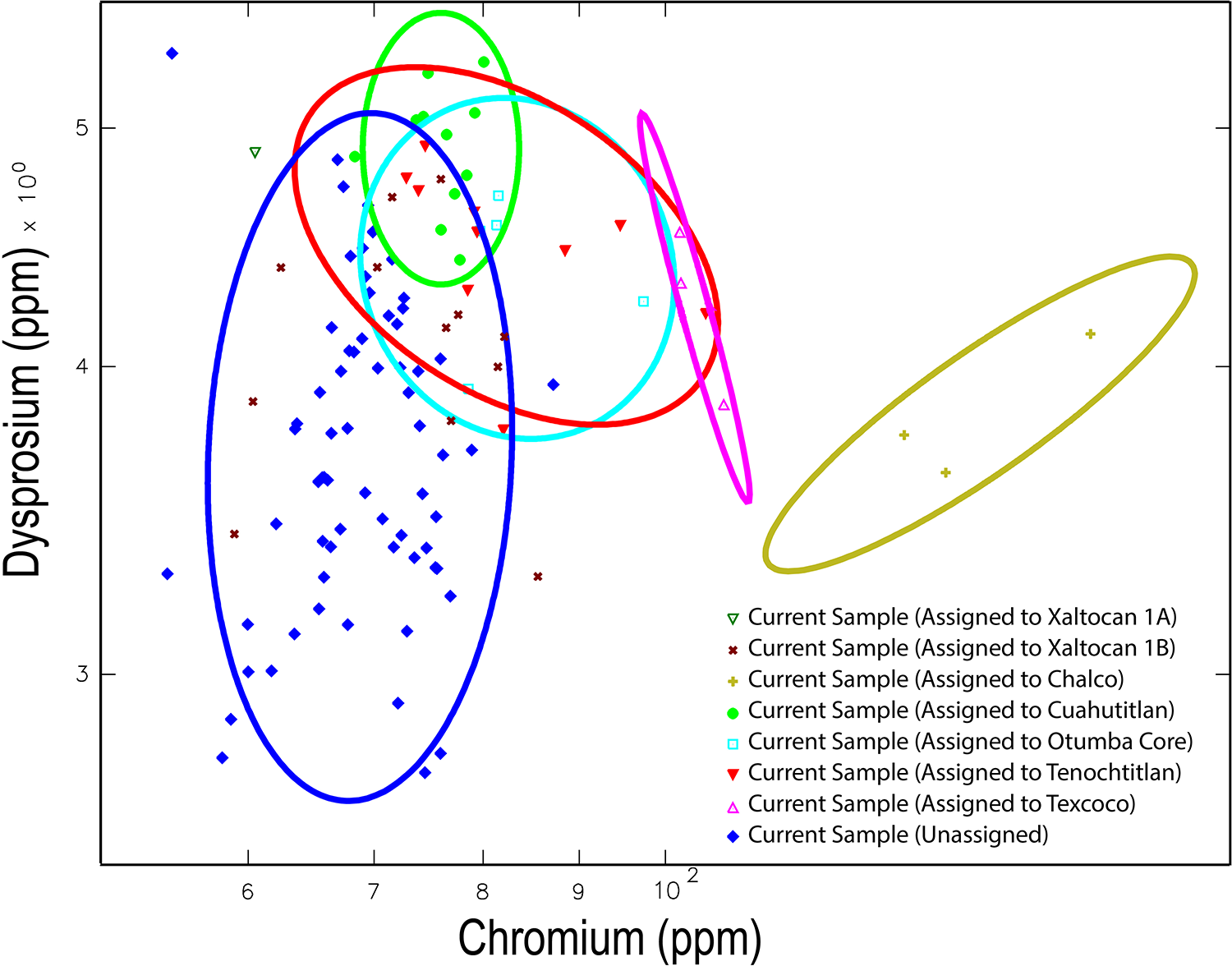
Figure 5 Long description
A bivariate plot showing chromium concentration on the x-axis in parts per million and dysprosium concentration on the y-axis in parts per million times 10 superscript negative 2. The plot includes various data points grouped and labeled according to their assignments into BOM reference groups. Different colored ellipses and symbols represent samples assigned to Xaltocan 1A, Xaltocan 1B, Chalco, Cuitzeo, Otumba Core, Tenochtitlan, Texcoco and unassigned samples. Each group is visually distinguished by unique colors and symbols, with a legend indicating the specific assignment for each group.
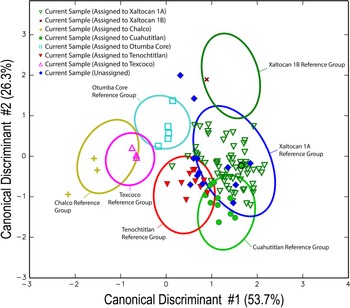
Canonical discriminant analysis (CDA) was then used to refine group separation and assign individual specimens to reference groups (Figure 6). Unlike PCA, CDA emphasizes the dimensions that best distinguish among the reference groups. Projecting the Xaltocan samples into this discriminant space clarifies relationships among northern Basin groups and highlights cases where samples show stronger affinities with other defined production zones. This step helps resolve samples that lie near areas of overlap in PCA space. Similar steps have been employed in previous studies (e.g., De Lucia et al. Reference De Lucia, Boulanger and Glascock2020).
Current samples labeled with their final group assignments and projected onto bivariate plot of the first two canonical discriminant components calculated for the BOM reference groups. Ellipses represent 90 percent confidence interval for group membership. This plot explains 80 percent of the cumulative variance in the datasets.
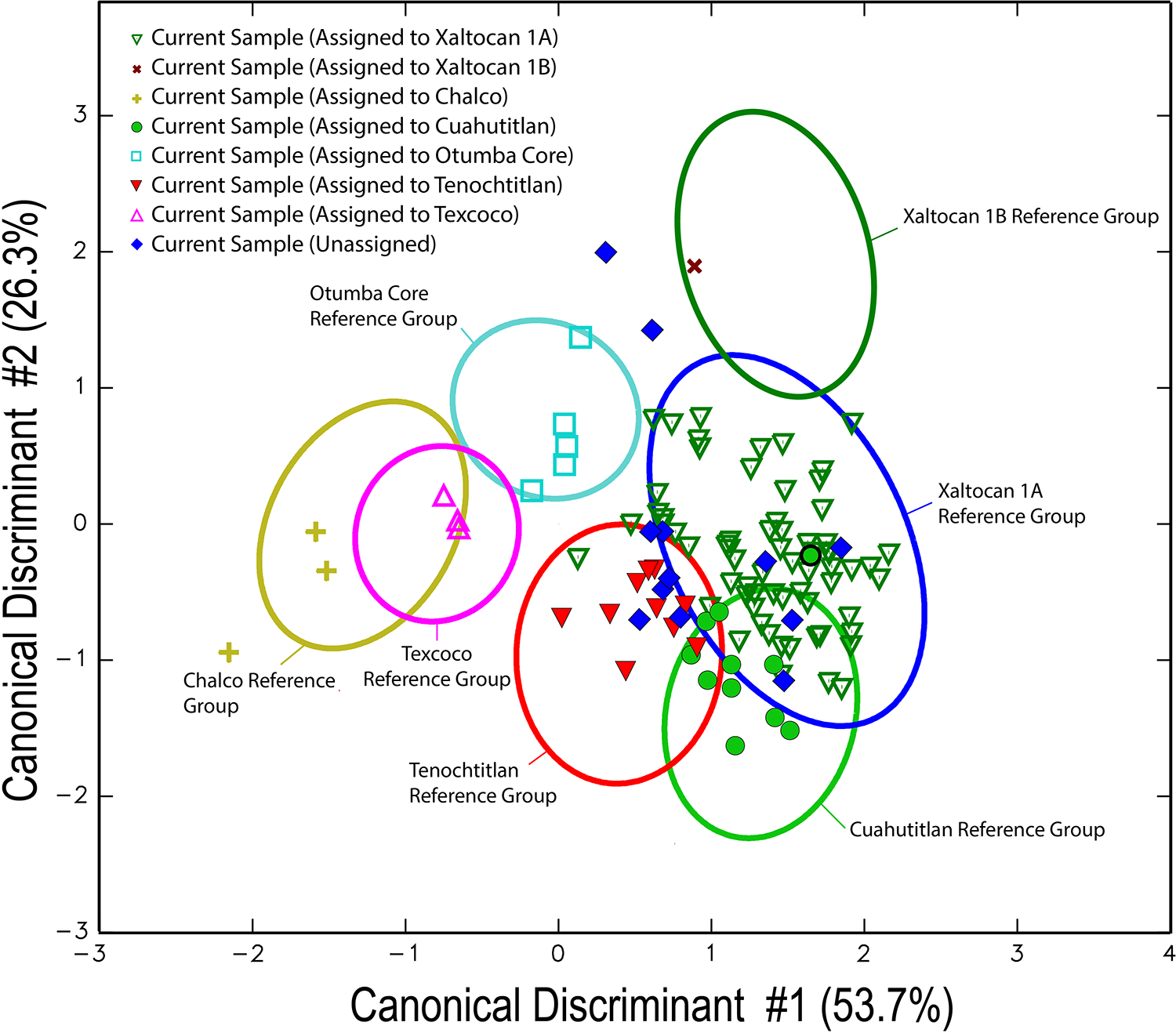
Figure 6 Long description
A scatter plot displays canonical discriminant analysis results with two axes: Canonical Discriminant number 1 (53.7 percent) on the x-axis and Canonical Discriminant number 2 (26.3 percent) on the y-axis. Various symbols represent current samples assigned to different reference groups, including Xaltocan 1A, Xaltocan 1B, Chalco, Cuauhtitlan, Otumba Core, Tenochtitlan and unassigned samples. Ellipses indicate 90 percent confidence intervals for group membership. The plot includes reference groups such as Xaltocan 1A, Xaltocan 1B, Cuauhtitlan, Otumba Core, Chalco, Texcoco and Tenochtitlan, each marked with distinct colors and symbols.
To complement the visual analyses, Mahalanobis distance-based probabilities were calculated to assess the degree to which each specimen fits within a reference group. Probability estimates were calculated three ways: using the full element suite (minus those noted earlier), using a smaller set of elements known from earlier studies to discriminate effectively in the basin, and using principal component scores that capture the bulk (∼90 percent) of variation in the dataset. These results provide a conservative measure of group membership and help identify cases where the initial visual interpretations and group assignments, relying heavily on CDA, converge with those of other analyses. These results are presented in a supplementary table.
Final group assignments integrate the evidence from all the methods described here. For most specimens, the results from PCA, CDA, and probability calculations converge. These samples were assigned confidently to established reference groups. Thirteen samples remain unassigned because none of the statistical approaches placed them near any reference group with sufficient consistency.
Main sources
The results show that there was both local production of pottery at Xaltocan, and regional exchange of ceramics in the Late Postclassic. Most samples (58.6 percent, n = 65) fell within the Xaltocan 1a group. We are confident that both the Xaltocan 1a and 1b groups represent local production at Xaltocan because most pottery samples in both groups have been excavated at Xaltocan, with the exception of few samples from San Bartolomé Salinas, close to Xaltocan (Millhauser Reference Millhauser2012, Reference Millhauser2020; Stoner et al. Reference Stoner, Millhauser, Rodríguez-Alegría, Overholtzer and Glascock2014), and because evidence of production of pottery from the 1b group has been found in a household in Xaltocan (De Lucia et al. Reference De Lucia, Boulanger and Glascock2020). The pattern also suggests that local potters were involved in producing both serving and utilitarian wares under Mexica domination. Local production of plain and decorated wares has been documented at Xaltocan for the Early Postclassic period (De Lucia et al. Reference De Lucia, Boulanger and Glascock2020; Hodge and Neff Reference Hodge, Neff and Brumfiel2005; Nichols et al. Reference Nichols, Brumfiel, Neff, Hodge, Charlton and Glascock2002; Stoner et al. Reference Stoner, Millhauser, Rodríguez-Alegría, Overholtzer and Glascock2014). While the results from our current study resemble the results from studies of ceramics from earlier periods, the current study corroborates that the Xaltocan 1a and 1b subgroups are likely a result of changing resource use over time. The ceramics from the Early Postclassic sample were almost exclusively members of the Xaltocan 1b subgroup (De Lucia et al. Reference De Lucia, Boulanger and Glascock2020) and the current, Late Postclassic sample falls mostly into the Xaltocan 1a subgroup. Nonetheless, evidence for local production in the Late Postclassic predominates.
The second source most represented is Cuauhtitlan, which accounts for 10.8 percent of the sample. This source had been identified in analyses of pottery from Early and Middle Postclassic contexts at Xaltocan (Hodge and Neff Reference Hodge, Neff and Brumfiel2005; Nichols et al. Reference Nichols, Brumfiel, Neff, Hodge, Charlton and Glascock2002; Stoner et al. Reference Stoner, Millhauser, Rodríguez-Alegría, Overholtzer and Glascock2014), and it is interesting for showing trade with a former enemy of the town. Cuauhtitlan, along with Chiconautla, are two sites where ceramics made in Xaltocan have been identified through chemical characterization (Nichols et al. Reference Nichols, Brumfiel, Neff, Hodge, Charlton and Glascock2002). A third major source of pottery identified in the current study is Tenochtitlan, which produced around 25 percent of the Black-on-Orange pottery in the sample. Texcoco, Otumba, Chalco, and the southern basin are minor sources of pottery in this study.
Sources per ceramic type
While the results of the study as a whole show that there was both local production and regional exchange of ceramics in the Late Postclassic, examining the results by ceramic type can furnish further insights. Aztec III Black-on-Orange ceramics excavated in Op Pol were made locally at Xaltocan or brought from other sites in roughly equal numbers. Of the 11 specimens analyzed, five belong in the Xaltocan 1a compositional group, three are from Tenochtitlan, one from Cuauhtitlan, and two are unassigned. Previous studies of Aztec III ceramics at Xaltocan had assigned specimens to Tenochtitlan, Cuauhtitlan, Xaltocan, Otumba, and the southern basin (Hodge and Neff Reference Hodge, Neff and Brumfiel2005:334; Nichols et al. Reference Nichols, Brumfiel, Neff, Hodge, Charlton and Glascock2002:40). We subdivide Aztec III into different variants, including one that we describe generally as “sloppy,” as discussed earlier. Its decorative lines are not consistently parallel, straight, or well painted. Others are “fine” variants, with precise, parallel, and straight decorative lines (Parsons Reference Parsons1966:165). We found that both sloppy and fine variants were made locally, whereas the samples from Tenochtitlan include only fine variants or we were unable to record a variant due to fragmentation. This could mean that potters at Xaltocan were imitating finely decorated ceramics made at Tenochtitlan (or perhaps other places as well) and refining their skills at decorating over time. Alternatively, it could reflect different stylistic preferences of Xaltocan’s consumers, the stylistic variation of different potters, or different skill levels. Future analyses may help identify Tenochtitlan or other places as sources of sloppy variants or confirm that imported Aztec III pottery at Xaltocan was only of the fine variants.
Studies of Aztec I and II ceramics excavated at Xaltocan have found local production of Black-on-Orange ceramics (De Lucia et al. Reference De Lucia, Boulanger and Glascock2020; Hodge and Neff Reference Hodge, Neff and Brumfiel2005; Nichols et al. Reference Nichols, Brumfiel, Neff, Hodge, Charlton and Glascock2002). But there are two important differences between the production loci of Aztec I and II on one hand, and Aztec III ceramics on the other. We have already commented that Aztec I and II ceramics from Xaltocan mostly belong in the Xaltocan 1b subgroup (De Lucia et al. Reference De Lucia, Boulanger and Glascock2020). The shift from Xaltocan 1b in Aztec I and II to Xaltocan 1a in Aztec III indicates a change in resource use over time, whether due to a depletion of clay or other raw material sources, or to changes in the potting communities or raw material extraction preferences. The later pottery is thinner in profile and has fewer inclusions than earlier pottery. In addition, previous studies assigned some Aztec I and II samples excavated in Xaltocan to compositional groups from Chalco and the southern basin of Mexico (Crider Reference Crider2011; De Lucia et al. Reference De Lucia, Boulanger and Glascock2020; Hodge and Neff Reference Hodge, Neff and Brumfiel2005; Nichols et al. Reference Nichols, Brumfiel, Neff, Hodge, Charlton and Glascock2002; Overholtzer et al. Reference Overholtzer, Pierce and Glascock2020). The evidence shows that Xaltocan maintained trade in Black-on-Orange ceramics with sites in the southern basin over time (because they are sources for other types of pottery in the Late Postclassic), but during the Late Postclassic, the proportion of samples analyzed that are assigned to the southern basin is low. The low proportion of Black-on-Orange pottery from the southern basin at Xaltocan in the Late Postclassic could be due to sampling, given that our sample of Aztec III was excavated in one house, but it is more likely due to changes in production and/or exchange relationships. Nichols et al. (Reference Nichols, Brumfiel, Neff, Hodge, Charlton and Glascock2002) also observed a lack of exports from Chalco in Aztec III pottery in Xaltocan, and they explain it as perhaps due to Chalco’s reduced influence as Tenochtitlan rose to power. This change would lend partial support to the political economy model. Other studies suggest that regional variation in the motifs present in Aztec III ceramics reflects limited distribution of Aztec III ceramics by region (Hodge and Minc Reference Hodge and Minc1990; Minc Reference Minc, Nichols and Rodríguez-Alegría2017). Their view lends partial support to the market model. Alternatively, the lack of exchange with the southern basin could be due to demographic shifts following Xaltocan’s abandonment in the Middle Postclassic. De Lucia (Reference De Lucia2018) argues that Xaltocan maintained strong social connections and shared identity with several lakeshore communities in the southern basin and Cholula during the Early and Middle Postclassic periods. When Xaltocan’s inhabitants fled following its conquest, those social connections may have dissolved, supporting models that see commoners as the main drivers of consumption.
Aztec IV Black-on-Orange ceramics from Op Pol present a pattern that is different from Aztec III in interesting ways: while Aztec IV was also produced locally, more than half of the Aztec IV samples in the sample from this household were made outside of Xaltocan. Of 24 samples submitted for analysis, seven were classified in the Xaltocan 1a group, six were made at Tenochtitlan, three at Cuauhtitlan, three at Texcoco, one at Otumba, and four remain unassigned. The presence of Texcoco as a source may be due to increased contacts or interaction with Texcoco after the Mexica conquest. Historical sources note that Xaltocan paid tribute to Texcoco as well as Tenochtitlan (Brumfiel Reference Brumfiel and Brumfiel2005a:35; Nazareo Reference Nazareo de Xaltocan, Paso and Troncoso1940:120). Texcoco and Otumba were not among the producers of Aztec III ceramics found in our study, nor were they listed among sources of Aztec IV excavated at Xaltocan included in previous NAA studies (e.g., Nichols et al. Reference Nichols, Brumfiel, Neff, Hodge, Charlton and Glascock2002; Overholtzer et al. Reference Overholtzer, Pierce and Glascock2020); therefore, these results indicate that changes in political relations may have impacted trade in ceramics. It is important to keep in mind that the fact that our study identified a broader range of sources of Aztec IV in comparison to previous studies raises two possibilities. First, it is possible that the household at Op Pol had its own connections with producers or with people at other sites (specifically, Texcoco and Otumba), and that households sampled in previous NAA studies from Xaltocan lacked those connections. That would mean that different households were making their own political or trade alliances under Aztec domination, and that political changes affected households differently even within a site. Alternatively, it is possible that other contexts in Xaltocan had Aztec IV ceramics from Texcoco and Otumba as well, but they were not present in the contexts from which the samples were drawn, or they are among the samples that were analyzed but that remained unassigned to any source. The percent of unassigned Aztec III and IV specimens from Xaltocan discussed by Nichols and her colleagues (Reference Nichols, Brumfiel, Neff, Hodge, Charlton and Glascock2002:40) is 16.7 percent, while Overholtzer et al. (Reference Overholtzer, Pierce and Glascock2020:7) admit disappointment that the percent of unassigned samples in their study is much higher, at 45 percent. Hence, the addition of samples from Op Pol provides valuable data that build upon these previous studies.
The Aztec IV samples submitted for analysis can be classified into three decorative variants. One variant had parallel thick and thin lines, another variant had curvilinear scrolls, and a third variant had naturalistic motifs, such as birds and feathers. All three variants were made at Xaltocan, and at other sites as well, suggesting that the different styles do not reflect local stylistic differences. As discussed earlier, there is debate on the chronology of Aztec IV pottery, regarding whether the different variants are colonial or whether any of them begin before the Spanish conquest. Naturalistic motifs are sometimes considered to be a result of Spanish influence (Minc Reference Minc, Nichols and Rodríguez-Alegría2017; Parsons Reference Parsons, Patricia Fournier and Wiesheu2015). The samples we analyzed are all from the period before the conquest. Given that the samples are from the years before the conquest, when Aztec IV was being introduced, the people at Op Pol embraced it rather quickly. No specific site controlled the decoration, nor did the people at this household reject it.
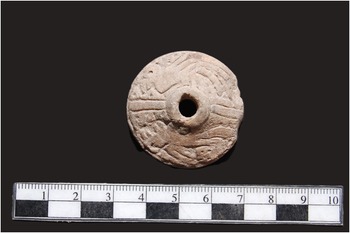
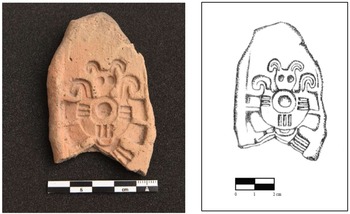
We believe that Indigenous potters were innovating the kinds of decoration found in Aztec IV pottery, especially the naturalistic motifs. The beautifully painted flowers, birds, fish, and other motifs are reminiscent of the naturalistic drawings one finds in pictorial codices. Moreover, there is also naturalistic imagery in sculpture, mural art, figurines, and even pottery associated with the pre-Hispanic period, as remarked by González Rul (Reference González Rul1988:93), so there is no reason to assume that people would not have been interested in producing naturalistic motifs prior to the arrival of the Spanish. Middle Postclassic polychrome pottery recovered in Xaltocan and imported from Chalco, for example, frequently depicted birds (turkeys) on the centers of plates. In addition, spindle whorls and stamps often depicted animals such as birds and butterflies (Figures 7 and 8; Enciso Reference Enciso1953, Reference Enciso1971). However, even if Tenochtitlan and Texcoco had tried to limit or control production of Aztec IV pottery, the chemical characterization evidence suggests that Aztec IV decoration was adopted in many sites outside of the imperial core. Such an adoption requires action and initiative from potters and consumers in different places. It supports our contention that the actions of commoners, and not just the machinations of imperial capitals, can explain patterns of production and exchange of pottery.
Spindle whorl with a naturalistic motif from an Early Postclassic household context.
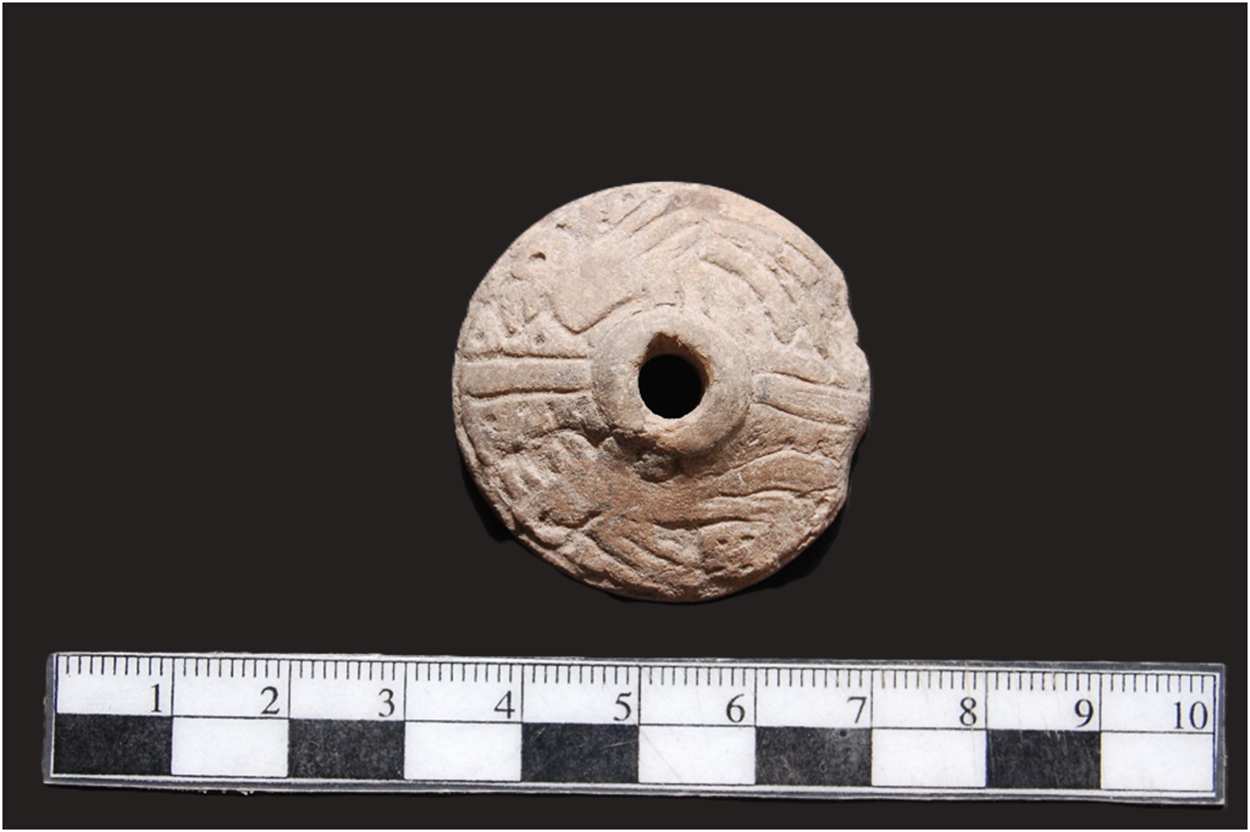
Figure 7 Long description
The image shows a spindle whorl with intricate carvings, positioned next to a ruler for scale. The spindle whorl has a circular shape with a central hole and the carvings appear to be detailed and textured. The ruler below the spindle whorl displays measurements from zero to ten, with alternating dark and light segments for clarity.
Clay with stamped impression of butterfly, Op Pol.
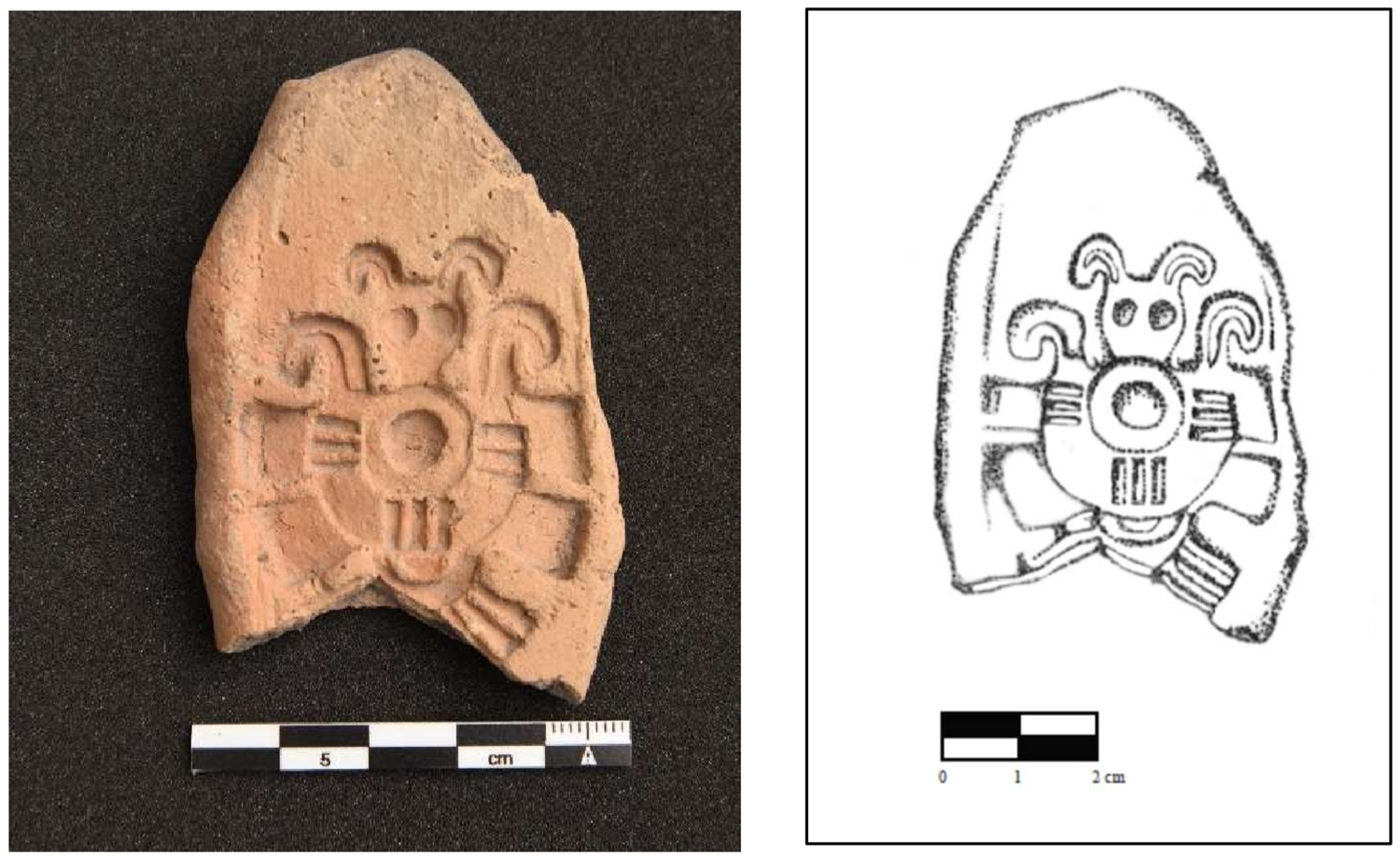
Figure 8 Long description
The image shows a clay fragment with a stamped impression of a butterfly on the left. The butterfly design includes intricate patterns and shapes. Below the fragment is a scale for measurement. On the right is an outline drawing of the same butterfly impression, highlighting the design details. A scale is also present below the drawing for reference.
The final orange pottery type that we sampled is Plain Orange, including two forms that can also be found in Black-on-Orange ceramics: hemispherical bowls and molcajetes. The origin of Plain Orange ceramics in the sample presents its own pattern, in some ways different from that of Black-on-Orange serving vessels. Locally produced Plain Orange is found in nearly the same numbers as Plain Orange made at other sites: out of 26 samples analyzed, 12 samples are from Xaltocan, six from Cuauhtitlan, four from Otumba, and four are unassigned. Two aspects of this pattern stand out. First, we found no Plain Orange serving vessels from Tenochtitlan in our sample from Op Pol, even though Tenochtitlan was a major source of Black-on-Orange pottery found at Xaltocan, and even though a sample from another Late Postclassic household found one plain dish from Tenochtitlan (Overholtzer et al. Reference Overholtzer, Pierce and Glascock2020). We did not find any Plain Orange from Texcoco either, which is found, although in small numbers, among the sources of Aztec IV. Second, an important source of Plain Orange was Cuauhtitlan, a former enemy of Xaltocan, a pattern that had been noted in other studies as well (Rodríguez-Alegría and Stoner Reference Stoner2016; Rodríguez-Alegría et al. Reference Rodríguez-Alegría, Millhauser and Stoner2013; Stoner et al. Reference Stoner, Millhauser, Rodríguez-Alegría, Overholtzer and Glascock2014). A sample from another Late Postclassic household did not assign any Plain Orange samples to Cuauhtitlan (Overholtzer et al. Reference Overholtzer, Pierce and Glascock2020), raising the possibility that different households in the Late Postclassic obtained plain serving vessels from different sites, whether due to different connections or to chance. The pattern may also be due to limited sampling from all studies, or to a high proportion of unassigned samples, and it is worth reexamining in the future. It also emphasizes the importance of sampling and comparison from multiple households to look at intra- and inter-household consumption patterns. In this sample there is also a greater proportion of Plain Orange from Otumba in comparison with Black-on-Orange ceramics. People from Xaltocan are said to have fled to Otumba (another Otomi site) and other sites following the conquest and abandonment of Xaltocan in the late Middle Postclassic (Chimonas Reference Chimonas and Brumfiel2005:171). The new exchange relations with Otumba could reflect new social relations with this community as some Xaltocamecas may have returned to Xaltocan while others decided to stay at Otumba. The pattern also may indicate that social relations with the southern basin and Cholula declined following Xaltocan’s abandonment, as we rarely find ceramics from this region which were ubiquitous in the Early Postclassic period (De Lucia Reference De Lucia2018). It seems like the actions of local potters were more important or effective in supplying serving vessels at Xaltocan, or at least at Op Pol, than the actions of two of the capitals of the Triple Alliance.
Together, the pattern of orange ceramics, including Aztec III and IV as well as Plain Orange, shows that there was local production of all major wares of ceramic serving vessels as well as trade in ceramics from a variety of other sites, including two of the capitals of the Triple Alliance (Tenochtitlan and Texcoco), an enemy of Xaltocan (Cuauhtitlan), and Otumba, a city-state near one of the major sources of gray obsidian and important Otomi center. Our study did not identify any sources of orange ceramics from the southern basin of Mexico. The study by Nichols et al. (Reference Nichols, Brumfiel, Neff, Hodge, Charlton and Glascock2002:40) identified only two Aztec III samples from Xaltocan made in the southern basin out of a sample of 26 (7.6 percent of the sample), and Overholtzer et al. (Reference Overholtzer, Pierce and Glascock2020) did not identify any samples from the southern basin. This pattern may indicate that trade in ceramics, and perhaps in other goods, with sites south of Tenochtitlan was more limited (although it existed) in the Late Postclassic in comparison with earlier periods. Still, the variety of sources of orange ceramics indicate that Xaltocan was not isolated under Mexica rule, and it was able to trade in many different types of ceramics. Nor was Xaltocan restricted from ceramic production or under Triple Alliance domination. The differences in terms of which ceramics they traded must have been a matter of choice and may be largely based on social ties, rather than a result of isolation, marginalization, or state control.
While the orange ceramics recovered from Op Pol and across Xaltocan were produced at many different sites, production of Red Ware was overwhelmingly local: out of 20 samples of Red Ware that we characterized (19 Black-on-Red and one Plain Red), 17 were from Xaltocan, one from Cuauhtitlan, one from Chalco, and one unassigned. The only Plain Red sample included in the analysis was from Cuauhtitlan. All the local samples are from the Xaltocan 1a compositional group like the orange wares, and just like the Red Ware analyzed by De Lucia et al. (Reference De Lucia, Boulanger and Glascock2020) in Early and Middle Postclassic contexts. This pattern may indicate over two hundred years of continuous production of Red Ware at Xaltocan, unless our analysis is unable to identify periods when production was abandoned and resumed, perhaps years or decades later, with the same clay sources. It is remarkable that we did not find any Red Ware from Tenochtitlan or Texcoco, and that such a low proportion of vessels come from outside of Xaltocan, although we note that there was a sample of Red Ware from Chalco, which is where many Red Wares were also produced in earlier periods (Minc Reference Minc1994). Given the presence of much orange pottery from other sites, the low amount of Red Ware produced outside of Xaltocan must have been the result of choice, rather than being left out of spheres of exchange altogether. The people of Xaltocan may have not wanted to use Red Ware produced elsewhere, or strongly preferred local Red Ware, or both. Alternatively, the people at Op Pol may have preferred local Red Ware. Other households may have had different or less limited patterns of consumption. It is also possible that producers of Red Ware at other sites did not trade this type with Xaltocan. Alternatively, Xaltocan’s political and social ties to the southern basin, which were strong in the Early and Middle Postclassic period (De Lucia Reference De Lucia2018) may have been weakened following Xaltocan’s abandonment and repopulation by the Triple Alliance, making ceramics from this region less desirable. Regardless of the causes, the strong pattern of local production of Red Ware indicates purposeful choice rather than simply being left out of economic spheres or a result of imperial manipulation of the economy.
Aztec Polychrome is another type that is mostly locally produced. It is a type of Red Ware, as defined by its slipped red background color, with orange/yellow curvilinear scrolls on the surface. Out of 16 samples submitted for analysis, 14 are classified in the Xaltocan 1a group, one is from Cuauhtitlan, and one is unassigned. The origin and use of polychrome ceramics in the Late Postclassic at Xaltocan shows major changes in comparison with earlier periods. Useful data for comparison come from Structure 1, an Early to Middle Postclassic house approximately 150 meters northeast of Op Pol (De Lucia Reference De Lucia2011, Reference De Lucia2018). In Structure 1, in contexts that precede the Mexica empire, polychrome ceramics were predominantly types made at Chalco and Cholula, characterized by a white, grayish, or orange background overlain with complex designs in red, white, orange, and black (De Lucia Reference De Lucia2011, Reference De Lucia2018). In Op Pol, where our current sample was obtained, the predominant type was Aztec Polychrome, and it was not brought from sites in the southern basin. It was produced locally. We believe that the change is temporal; that is, that Xaltocan obtained polychrome ceramics in the Early and Middle Postclassic from sites in the southern basin, and in the Late Postclassic, it mostly made its own polychrome pottery. However, the pattern may also have to do with the connections that each specific household had to local producers and pottery vendors in the market, and further analysis of distributional patterns and of patterns in other households may help clarify this question.
One final type that we discuss here in Texcoco Fabric Marked pottery. All samples submitted for analysis (n = 10) were locally made. Previous studies show that even though utilitarian wares were mostly produced locally, there was trade in those wares as well. For example, Xaltocan imported cooking vessels even from Cuauhtitlan, its former enemy (Rodríguez-Alegría and Stoner Reference Stoner2016). But in the case of salt basins, the sample indicates only local production. Salt basins were likely used as packaging for the trade and exchange of salt and therefore would have likely been made by the salt producers themselves (Charlton Reference Charlton1969; Parsons Reference Parsons, Hodge and Smith1994; Williams Reference Williams, Williams and Weigand1999). The local production of Fabric Marked pottery therefore suggests that Xaltocan was producing and exchanging salt along with the basins. Perhaps the people of Xaltocan had no incentive to import salt from other sites given the presence of abundant local production of salt (Millhauser Reference Millhauser2012). Or perhaps other households imported salt from other sites, but the people at Op Pol did not.
Conclusion
In the Late Postclassic, ceramics used by people at Op Pol were made at a variety of locations including Xaltocan, Cuauhtitlan (its enemy well into the Late Postclassic), Tenochtitlan (its conqueror), Texcoco (which drew tribute from Xaltocan), Otumba, Chalco, and the southern basin. The varied sources of pottery are probably the result of people exchanging pottery in the market system, as is documented in historical sources and through archaeological research (Hodge and Minc Reference Hodge and Minc1990; Minc Reference Minc, Nichols and Rodríguez-Alegría2017). The household at Op Pol, and probably others, obtained pottery from vendors in marketplaces, without an exclusive connection to any specific producers, although it is still possible that they had personal connections to potters at Xaltocan. It is still possible that the household had personal connections to some producers or vendors, but those connections changed over time, or they were not exclusive, resulting in a pattern of obtaining pottery made at many sites in the northern half of the basin, and some pottery from the southern basin as well. The market system did not result in a homogeneous distribution of pottery. Some types were imported from more sites than other types. Some types were locally produced and imported rarely. Trade in some types changed over time.
If the political economy model was correct for the production and exchange of ceramics, most of the ceramics from Xaltocan in the Late Postclassic would originate at Tenochtitlan or Texcoco, assuming that the Mexica would have wanted to control ceramics. At least, one would see an increase in ceramics from the capital cities in comparison to locally made pottery (see Garraty Reference Garraty2007). But political changes from the Early to the Late Postclassic did not result in any clear control of ceramic production by the Mexica, and they even resulted in widespread production of some new ceramic types beyond the capital cities. The actions of commoners explain this pattern better than any elite or urban attempts at controlling production and distribution. The market system does not appear to have been constrained by political factors. Thus, ultimately, it is the decisions, choices, and actions of commoners that explain this pattern, rather than any elite attempts at controlling production and distribution.
For example, we interpret local production of Aztec III pottery as the result of commoner initiative and action. If new types (such as Aztec III and IV) were innovated in urban centers in the Late Postclassic, commoners from Xaltocan learned to make their own versions of new types of pottery at Xaltocan, as did commoners from other sites. If new types were invented in rural areas, commoners were innovating without control of urban elites. It seems that Tenochtitlan did not control production, or that even if it tried to control it, rural potters learned to make Aztec III pottery soon enough. Their initiative supplied their town, or at least houses like Op Pol, with Aztec III pottery, in ways that the political economy model cannot explain, and allowing us to see the strategies employed by commoners in ways that are not visible at the scale of inter-site analysis. Regardless of who was innovating new ceramic types, potters from Xaltocan made all the different decorative variants of Aztec III and IV pottery that we sampled from Op Pol. They also made Plain Orange ceramics, and all the other ceramic wares that we studied, including Polychrome ceramics which they had not produced earlier in the Postclassic.
In a previous study, Hodge and Neff (Reference Hodge, Neff and Brumfiel2005) found that Aztec III pottery at Xaltocan was exclusively imported from Tenochtitlan through a sample collected from six test pits excavated by Elizabeth Brumfiel across the site. The results from our study do not invalidate Hodge and Neff’s findings but may reflect consumer preferences in different households across Xaltocan. Perhaps the Op Pol household preferred local suppliers. The difference could also reflect temporal differences, where the test pits in the first study may represent periods when local production may have ceased due to disruptions caused by conquest. Alternatively, the difference could also reflect sampling bias if particular styles of Aztec III pottery were selected for analysis in the earlier study. Either way, our study conclusively demonstrates that there were local producers of Aztec III at Xaltocan and production was not controlled by Tenochtitlan, a pattern that does not support the political economy model and that supports the idea that commoners were shaping production patterns.
Changes in the Late Postclassic did not result in a homogeneous distribution of all ceramic wares that were moving through the market system. While Op Pol obtained Black-on-Orange ceramics from a variety of producers, it mostly used locally produced Red Ware and Aztec Polychrome. This could mean that the household chose only to obtain Red Ware from potters with a personal connection to the household, that the household made its own Red Ware and did not need to buy it in the market, or that access to Red Ware from a variety of sites was limited from the source (producers or vendors) rather than by consumer choice. It could also mean that the people who lived there chose locally produced Red Ware for other reasons, whether symbolic, traditional, ritual, or any other reason. An attempt at monopolizing production of Red Ware (as expected by the political economy model) cannot explain the pattern, because there was local production at Xaltocan. If urban centers were trying to monopolize or at least control production and withhold it from rural areas (for which we have no evidence), rural producers made their own pottery and supplied their towns with it. The actions of commoners who made pottery locally over long periods of time and sold their products in local and distant markets, and of consumers who obtained their pottery locally, often in marketplaces, are better explanations of this pattern.
The limited sources of Red Ware were probably not peculiar to the house at Op Pol. A similar pattern exists at a different Late Postclassic house excavated in Xaltocan (Overholtzer et al. Reference Overholtzer, Pierce and Glascock2020). Both studies identified nearly exclusive local production of Red Wares in the Late Postclassic. The mostly local origin of Red Ware in colonial contexts, was identified in a previous study (Rodríguez-Alegría et al. Reference Rodríguez-Alegría, Millhauser and Stoner2013) and thought to be an early colonial development. Our sample comes from Late Postclassic contexts, showing that the local production of Red Ware was the result of changes in the Late Postclassic rather than in the early colonial period. This indicates that incorporation into the Spanish empire was not the only source of changes in production of this kind of pottery. Changes in production could be the result of other processes, whether determined by local producers, or in reaction to other historical events and processes.
An interesting aspect of the patterns of ceramic production and exchange of Late Postclassic pottery is that they sometimes partially support the political economy model or the market model. For example, the decrease in Black-on-Orange pottery from Chalco could be a result of Chalco’s waning political power as Tenochtitlan became more dominant, which would support the political economy model (see also Garraty Reference Garraty2007). The regional distribution of different decorative variants of Black-on-Orange types could lend support to the market model (Minc et al. Reference Minc, Hodge, Blackman, Hodge and Smith1994). But it could also be due to shifting social and exchange networks after Xaltocan was abandoned and its inhabitants fled to Otumba. Therefore, the different models may not be mutually exclusive explanations of ceramic production and exchange in the Basin of Mexico. Each model, we argue, is a partial explanation of the patterns. And as we can see from the patterns found in this chemical characterization study, it is worth broadening the range of historical factors that served as context for the actions of commoners, beyond processes of imperial formation and top-down control over markets.
Supplementary material
The supplementary material for this article can be found at https://doi.org/10.1017/S0956536126100959
Data availability statement
The combined descriptive, contextual, and compositional database for samples analyzed as part of this study will be incorporated into the MURR database, retained for future comparative purposes, and made publicly available via the laboratory’s website following publication, following the Archaeometry Laboratory’s Data Management and Sharing Plan (Boulanger and Stoner Reference Boulanger and Stoner2012).
Acknowledgements
We thank the Consejo de Arqueología of the Instituto Nacional de Antropología e Historia for permission to conduct this research. We would like to thank the people of Xaltocan, the Delegados, the Mayordomos and the Iglesia San Miguel de Xaltocan, the Casa de Cultura, and the Museum for their generous support for our project throughout the years.
Funding statement
This project was made possible by support from the National Science Foundation (Award no. 1550446 to Rodríguez-Alegría; Award no. 1550698 and 1733980 to De Lucia. Partial support was provided by NSF support of the Archaeometry Laboratory at MURR (Award no. 2208558), a Colgate University Research Council Picker Grant, and the Department of Anthropology at the University of Texas at Austin.
Competing interests
The authors declare none.


 Open access

